Showing posts with label Stuart. Show all posts

Monday, October 28, 2019

Stuart London - A Time and Place for Discovery

By Michael Ward

Maybe it’s the journalist in me, but I’m often attracted to historical research that produces surprises.

Discovering that Isaac Newton, the father of modern physics, had a deep interest in alchemy certainly raised an eyebrow. As did finding out that people used to believe swallows hibernated in mud, rather than migrated, over winter.

But why wouldn’t they? The idea that such a small bird could fly as far as southern Africa would have seemed far-fetched indeed to someone in the 1600s, assuming they had any notion where southern Africa was.

Over time I’ve come to realise that my research ‘revelations’ have said more about me and my 21st century assumptions, than the people of the period I was studying.

Nowhere has this been truer than my examination of England in the mid 17th century. Of course I knew about the civil war, Cromwell’s Commonwealth and the Great Fire but I still expected to learn much on my voyage of discovery. However, I had no inkling of just how many ‘oh really?’ moments I would encounter along the way, such as burrowing birds and Newton’s alchemy.

My first surprise was that so much change was compressed into such a short period. In just over 25 years, the country experienced civil war, regicide, a republic, and a restoration of the monarchy.

Any one of these would have produced sufficient shock waves to reverberate for a decade. But to have experienced each in rapid succession, followed by 1666, a hellish year of fire and plague, meant that, for Londoners in particular, it must have been both a formative and terrifying time to be alive.

Consider experiencing the politically divisive furore of five or six consecutive Brexits between now and 2040 plus a conflict that accounted for proportionally more of the country’s population than World War One, followed by a pandemic that wiped out a quarter of the people in London and a blaze that consumed much of city. Then take away the ability to know what was happening and why, and you begin to get an inkling.

As my research continued, I realised this period also witnessed fundamental changes in science, medicine and commerce, as well as politics and religion. Beliefs firmly held for centuries were now being challenged, almost on a daily basis, by a constant stream of newly discovered, empirically driven knowledge, forced to the surface by an unquenchable spirit of enquiry.

Public Domain image of the type of printing presses
which would help transform 17th-century England

There was a swathe of new thinking. I’ve already mentioned Newton, the ‘father of modern physics’. Historians have enjoyed using such titles, with many paternity suits still argued on behalf of the sciences in particular. Nevertheless, the 17th century had more than its fair share of claimants: Galileo –the father of modern science (according to Einstein, no less), Francis Bacon - scientific method, Francesco Redi – experimental biology, Robert Boyle – modern chemistry, Marcello Malpigi – microscopic anatomy, and so on, leaving supporters of Rene Descartes and Pierre de Fermat to fight over analytical geometry.

My third realisation was that the key players of this period did not always behave to type. Several of the grandest lords in the kingdom, such as Essex and Warwick, were early and powerful advocates of the Parliamentary cause, as were a number of leading merchants, including some within the more conservative Merchant Adventurers. Equally, kings were seen as guardians of the status quo yet radical thinkers in science and medicine benefitted from their patronage.

William Harvey is a case in point. At the start of the 17th century, the views of Galen, a Greek physician born in 210 AD, still dominated medical practice throughout Europe, and his anatomical theories, including the body’s circulatory system, were largely uncontested. In 1628, William Harvey published ‘De Motu Cordis’ demonstrating that people had a single blood system which circulated continuously throughout their bodies. This flatly contradicted the accepted Galean doctrine that organs consumed blood which had to be replenished by either the liver of the heart, and each had their own circulatory networks.

William Harvey, demonstrating his theory of circulation
of Wellcome. Click HERE for image attribution

Harvey expected a storm of opposition and he wasn’t disappointed. Yet it only took 30 years for his ideas to become more widely accepted, and Galen’s 1,400 year grip on medicine to be broken, such was the iconoclastic spirit of the age.

Yet it was King James I who supported Harvey’s research by allowing him to join his court when hunting game, so that Harvey could dissect fallen animals immediately, in situ, and observe their blood flow. (However, James’ son Charles 1 later extracted a favour in return, requiring the eminent physician to dodge the musket fire at the Battle of Edgehill where, as the King’s ‘Physician in Ordinary’, he is said to have looked after the two royal princes while tending the wounded.)

As I delved deeper into the plethora of 17th century discoveries and developments, I began to notice a form of symbiotic relationship between some, despite being in different fields. I would often pull at, then follow, a thread of research in, say, scientific advances, only to discover its impact on something completely different, such as religious belief. In the 17th century, it seems one new way of interpreting the universe often led to another.

So, from Galileo onwards, many of the advances in astrology were driven by the fervent search for improved navigational tools by the expanding merchant sector. Improvements in printing technology led to a proliferation of unlicensed printing presses in London which came to have a major impact on political discourse and the spread of radical ideas, before and during the civil war. Again it is notable how quickly this development was understood and seized upon, this time by political activists including the King’s supporters, in this age of experimentation.

Another example can be found in the dramatic population shifts of this period. In just 15 years, from the late 1620s to the early 1640s, some 80,000 people sailed from England’s shores, with up to 60,000 of them crossing the Atlantic, an enormous figure for that time. A significant number of these were Puritans, wishing to found a New World where they could practise their religion freely.

Puritans left England in large numbers to set up colonies in the New World to practise their religion.
This Public Domain image shows Puritans burning a book they deemed to be heretical in Massachusetts Bay. 

One would expect such a rapid depopulation to have a concentrated impact in London, by far England’s largest city, especially when combined with its high mortality rate. Yet simultaneous advances in commerce meant that London’s growth did not stall. It actually increased, the rising economy driven in no small part by the expansion of merchant trade to all points of the globe including the Caribbean and the Americas. Each week hundreds would arrive from the surrounding counties, eager to share in the city’s new found wealth.

This more than compensated for the mass emigration partly fuelled by religious change. However, many of the new arrivals soon discovered the streets of London to be paved with something far less pleasant than gold. The city’s existing housing stock and barely rudimentary sanitation were overwhelmed by the needs of newcomers and much of London descended into a disease-ridden squalor.

This, of course, added more fuel to the political unrest, and so interlocking cycles of change and challenge continued to drive the English 17th century into the uncharted depths of civil strife, setting brother against brother and father against son.


Further reading

Adamson, J. (2009). The Nobel Revolt. London. Phoenix.

Brenner, R. (2003). Merchants and Revolution. London. Verso.

Evans, J. (2018). Emigrants. London. Orion.

Rees, J. (2016). The Leveller Revolution. London. Verso.


~~~~~~~~~~

Michael Ward is a former BBC journalist and academic. His debut novel “Rags of Time” is set in 1639, with England sliding into civil war. Spice trader Thomas Tallant returns from India to find the overcrowded streets of London seething with sedition. Soon he is sucked into the city’s turbulence, accused of murder.

The book follows his desperate attempts to find the real killer and clear his name, helped by the enigmatic Elizabeth Seymour, astrologer and mathematician whose thirst for knowledge is only matched by her addiction to tobacco and the gaming tables. Can Elizabeth untangle the web of deceit threatening to pull Tom under?

Early reviews of ‘Rags of Time’ have described it as “a wonderful debut” with an “outstanding story”, noting that “…the author has clearly done all the hard work by researching the period and manages to impart that knowledge without any big information dumps.”

The sequel is now under development.

Connect with Michael: Amazon page Rags of Time

Amazon US 

GoodReads book page

Author’s email: mike@mikewardmedia.com


Wednesday, June 15, 2016

Your Weight in Gold - The Problem of Tudor and Stuart Money

By Deborah Swift


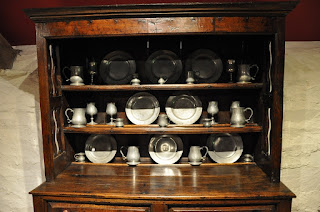
This Horrible Histories video shows precisely the difficulty with Tudor and Stuart coinage - the denominations were extremely confusing. But it wasn't the only problem - in these days of virtual money, credit cards and online banking, we tend to forget exactly how much space the average man’s wealth took up. Money in Tudor and Jacobean England was a physical commodity that needed to be stored, carried and guarded. Often wealth was stored as 'plate', i.e. silver and gold that could be used for a purpose such as dining. Large sums of money meant having the physical space to keep it and so wealth was often displayed in the form of silver or gold plate, cutlery, candlesticks or other domestic trappings, which could be melted down to make a large number of coins of the same weight.


Wealth was very visible in the 16th century. Ben Jonson’s play, ‘Volpone’, opens with Volpone’s worship of his gold:

‘Good morning to the day; and next, my gold!
Open the shrine that I may see my Saint!’


Johnson’s play about greed and lust satirises some of the forms of financial speculation practised in Jacobean London. The phrase ‘worth your weight in gold’ was a literal truth in Tudor England.

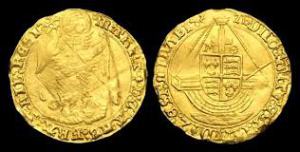
Currency was based on the penny, and the smallest denomination above it was the humble groat or fourpenny piece, and the half-groat (twopence), and one of the largest was the Angel or Angel-noble, called this because of its image of the Archangel Michael stamped in the design. The first shillings, or 'testoons' were created in 1502 in the reign of Henry VII. Occasionally half-pennies or farthings (quarter of a penny) were actually struck as coins, but this was rare: the smaller denominations were usually made by cutting a full penny into halves and quarters, or by using tokens as in Pepys’s Diary.

From The Pastry Cook at the sign of the Crown in Shoe Lane
The picture above is from this excellent site about trade tokens in the 17th Century.

Just a few of the coins in circulation:
Farthing = 1/4 penny
Half-penny = 1/2 penny
Three-farthing = 3/4 penny
Groat = 4 pennies (4d)
Sixpence = 6 pennies (6d)
Shilling = 12 pennies (1s )
Half-crown = 30 pennnies (2s 6d)
Crown = 60 pennies (5s)
Angel = 120 pennies (10s)
Pound = 240 pennies (20s or £1)
Sovereign = 360 pence (30s or £1 10s)

The sovereign was first minted under Henry VII as the gold equivalent of a pound (20 shillings) and was much easier to carry about than the arm-stretching weight of a pound of silver coinage. However, because the currency was based on the actual value of the precious metal, the face value of individual coins was not static as modern coins are, and a particular coin’s value would fluctuate with the price of silver or gold. Apart from the weight, the other disadvantage was that counterfeiting and coin-clipping (chipping a bit off the edge) was rife, although counterfeiting coins was a hanging offence. More detail about actual coins is here: Tudor Coinage.

Gold Angel

Most Elizabethan and Jacobean aristocrats borrowed heavily. Shakespeare’s patron William Herbert, the Earl of Pembroke, for instance, borrowed large sums from regular court money-lender Sir Michael Hicks. The borrowing was mainly to invest in mercantile ventures in other countries, from where England imported luxury goods or foodstuffs not easily obtained at home. Investing in trade was a risky business. Most trades depended on the ocean and many investors lost their fortunes to the sea. There were rare examples of great success in trade, such as Sir Thomas Gresham who became enormously wealthy from his dealings in munitions and bullion in the Netherlands. Gresham founded and invested in the Royal Exchange, the forerunner of London’s modern stock exchange in 1570. Sadly the first Royal Exchange, the great centre of trade and finance, was destroyed by the Great Fire in 1666.


And in fact the biggest risk to all wealth was fire. In towns made of wood and wattle, and thatched with reed, it was an ever-present risk. In this letter from Henry Wotton to Edward Bacon dated 13 July 1613, he says; ‘some of the paper or other stuff where with one of them was stopped did light on the thatch, where being thought at first but an idle smoke, it kindled inwardly and ran round like a train, consuming the whole house to the very grounds.’

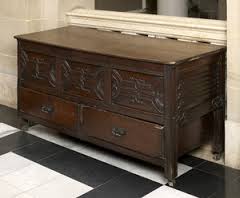
Counter Table from Hull Museum

Fear of losing all your money led to obsessive tallying, both at home, and at the ‘Counting House’. This is a rare example from Hull Museum is of a 'counter table' from the time of Henry VIII. Often the surfaces were marked with a grid or had a chequered board to help counting. In fact this is where the word 'counter' , as in a shop counter, is derived. In wills and inventories from the 16th century, counters are often listed as having a compartment. These compartments were probably for storing money and accounting ledgers, but in this example the drawers and hinged lid were added to it later, probably in the 18th century.

By the closing years of Elizabeth’s reign inflation was unstoppable and if their ships failed to come in, many men found themselves in debt. Debt carried a prison sentence so was greatly feared. In ‘The Merchant of Venice’ the themes of loans, bonds and mercantile transactions are interwoven with the plot. Financial concerns would have been familiar to Shakespeare as his father John Shakespeare made a good deal of money from investments in commodities such as wool and malt, apart from carrying on his business as a glover. He also did a bit of moneylending on the side. William followed in his father’s footsteps and these ventures, apart from inspiring a play, probably brought in considerably larger sums than his craft.

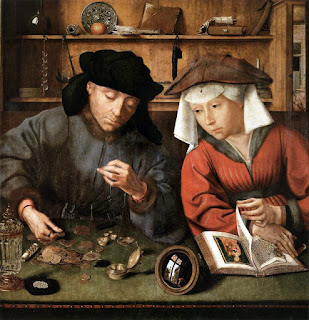
The Moneylender and his Wife - Matsys

Lending sums of money at a high rate of interest was common as interest rates were not fixed. It was usual to charge ‘damages’ , particularly if a debt was paid late, and often substantial fines were added with the full support of the law.

In Johnson’s ‘Every Man out of his Humour’ Puntarvolo invites his friends to sponsor him in his journey to Constantinople. Men would regularly lay down large sums of money to sponsor travellers on condition that the sums were doubled or trebled on their safe return. Travel was risky, but could be lucrative for the sponsor when the traveller returned with the spoils of their travels. 

Johnson and Shakespeare deposited £40 with the eccentric Somerset traveller Thomas Coryate before he set out to walk to Venice and back in a single pair of shoes. Coryate seems to have made quite a good living out of his sponsored travels, together with the books he wrote about them -- and even those who did not provide him with major support were willing to stand him a good dinner in return for his eyewitness accounts of exotic places. Coryate died during his last journey to India in 1670, but his books are still available today.


This type of sponsorship was a form of gambling, and the dividing line between legitimate investment or ‘venturing’ and various forms of betting was a good deal finer than it is today. Almost all Elizabethans gambled, from schoolboys who wagered with the ‘points’ that fastened their clothes, to the Queen and her courtiers who loved to play card games with enormous stakes. John Harrington wrote an epigram on the ‘rake’s progress’ of Marcus, a young man who gambled away his fortune at the very popular card game Primero. ‘The Counter’, where Marcus ends up, was one of London’s debtors prisons, called that because of its large number of debtors.

Lucas van Leyden - Primero players

Primero appears to have been one of the earliest card games played in England during Tudor and Stuart times, and was a forerunner to poker. Even Kings, or especially Kings, were not immune to gambling. During the reign of Henry VII, notices of the King's losses at cards appear in the Remembrance's Office. An entry is shown of one hundred shillings paid at one time to him for the purpose of playing at cards. The private expenses of Princess Mary, Henry VIII's daughter and later Queen, also contain numerous items of money ‘for the playe at cardes’.

Sources: 
Shakespeare's Life and World - Katherine Duncan-Jones
Early Modern England - Sharpe
The Time Traveller's guide to Elizabethan England - Ian Mortimer

Deborah Swift is the author of five historical novels for adults and a trilogy for teens. She blogs on her website about historical curios and historical fiction, and whilst you're reading this she is probably staring out of the window, coffee in hand, lucky black cat on lap, plotting her next book. You can chat to her online @swiftstory, or find her on facebook.

Wednesday, February 24, 2016

The Great Wash - Laundry in the 17th century

by Deborah Swift

Washing in the 17th century was certainly labour-intensive. In the Stuart period outer garments could not easily be washed because fine fabrics - the silks, brocades and velvets, (beloved of those who wanted to show their status) would not stand up to the harsh treatment. Clothes were hand-made and valuable, and were worn until they were too dirty to be tolerated. However, the undergarments were usually linen, which was tough and hard-wearing, and could be washed.

'Before that you suffer it to be washed, lay it all night in urine, the next day rub all the spots in the urine as if you were washing in water; then lay it in more urine another night and then rub it again, and so do till you find they be quite out' 

Hannah Woolley, in The Compleat Servant-Maid, 1677


So where did this urine come from, and where was it used?

It came from chamberpots and was used neat straight from the pot. Apparently men's was more effective than women's so this was much in demand. (They would say that, wouldn't they?)The ammonia in the urine removed grease and stains before the washing was then soaked in a 'buck tub.' After that a buck cloth was spread over the top and potash or lye was poured through and collected from a hole in the bottom. Sometimes the clothes were layered, hung on sticks, and the lye, which was alkaline, was poured through. This is a possible origin of the term ‘passing the buck’.

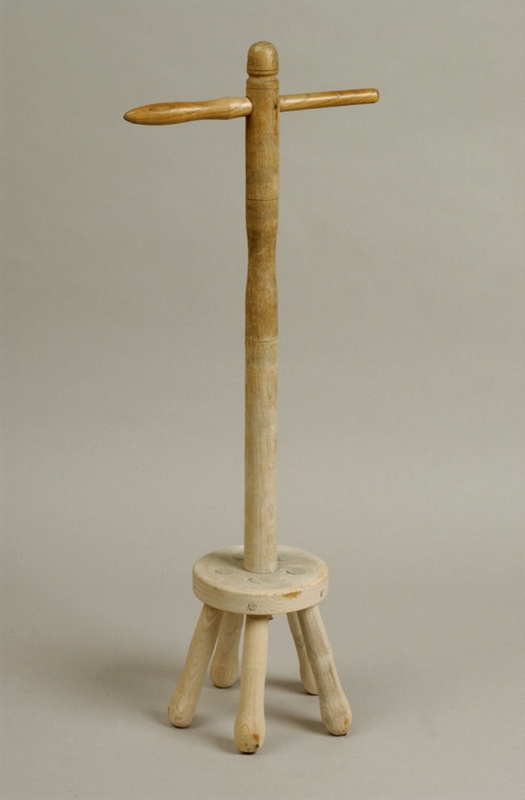
modern dolly stick (1950's)
the design stayed unchanged
The water was then boiled up again and passed through as many as eight times. (See the picture of the woman using a buck tub, above.) Then the linen was soaped by hand and paddled with 'dolly sticks' or slapped against washboards before rinsing. Soap was a new commodity - In the 17th century the first soap factory was built in Toulon for the mass production of soap for laundering. The soap was made of goat's or sheep's fat, and ash. Rinsing was necessary to remove the lye before it caused damage to the fabric. In rural England, clothes were taken to the nearest stream or river and either paddled, with a wooden bat, or trodden. Sometimes used wash water was donated to the poor because soap was still an expensive luxury.

Generally a 'Great Wash' would only be done twice a year by most households unless they had many servants. This event could take three days, and usually took place at the same time as a 'spring clean' of the house. The Great Wash was often seen as a symbolic purification of the house. 

From Old and Interesting blog, (do visit it - it's indeed very interesting) here are the laundry expenses for the Duke of Bedford's Great Wash in 1675.

'For washing sheets and napkins before the great wash when the two masters was in town 2s
For four pounds of soap 1s
For six pounds of candles 2s 6d
For three women one day to wash 4s 6d
A woman two days to help dry up the linen 3s
For oil, ashes, and sand to scour 1s 8d
A woman to scour two days 3s
For washing of twelve pair of sheets at 4d per pair 4s
For two pounds of soap to scour the great room 6d
For nine pounds of soap 2s 3d
For four mops 4s
For Fuller's earth and sand to scour the rooms 1s 8d
A woman six days to help to wash all the rooms after the workmen left the house 6s
A woman six days for scouring and washing the rooms and cleaning the irons against the family's coming to town 6s
A woman to help air the bedding when the family came to town 2s' (2s = $0.34)


Some better off English houses had many staff, and used a brass tally of rotating discs to keep track of the linen that had been sent away for starching.. Each disc lists an accessory - for example neckwear -  'Ruffes' and 'Bandes', and lace-topped boot hose. These small items of linen that were worn next to the skin were washed more often than the sheets or napkins for example. Professional whiteners of linen were called 'whitsters' and they would bleach and starch the linen, and sometimes offer crimping or goffering for ruffs, collars and cuffs. This tally board (above) was originally from Haddon Hall, near Bakewell, Derbyshire, Click the picture for more information.

Whenever I think about the characters in my books I have to be aware of this - that people would have taken care not to get dirt on their clothes, because washing was such an ordeal. In my most recent novel, Lady Katherine Fanshawe has lost all her servants because of the Civil War. In a big house, the loss of servants for washing and mundane tasks creates a radical shift in daily life. So many processes were incredibly labour-intensive, and without servants to help, many things were forced to change. In many ways this was echoed three centuries later after WWI.

There is another good blog on washing in the colonies on the Plymouth Pilgrim's site here

Thanks for reading!
visit my website to sign up for a free book, or say hello on Twitter @swiftstory

Wednesday, December 2, 2015

Poison - hidden weapon of the Tudor wife

by Deborah Swift

The population of early modern England regarded poisoning as the most cowardly and unsporting method of murder:


of all murders poisoning is ye worst and most horrible 1. because it is secrett 2 because it is not to be prevented 3 because it is most against nature and therefore most hainous 4 it is alsoe a cowardly thing                                                                                  ~Sir John Coke

17th century poison cabinet or cunning woman's book

In 1663 Mary Bell was accused of killing her husband - six years earlier she had put poison into his food. This demonstrates one of the difficulties of poisoning - that it is an 'invisible' crime. Poison is a unique method of murder because it allows no self-defence, no chance for the victim to understand what is happening, and is often done secretly over a long time frame. Because poisoning involved planning and was done in cold-blood, it was perfect for those without social power. 

The servant classes, women and the weak were always the prime suspects in poisoning cases. Poisoning was a skill often linked to witchcraft - akin to the mixing of potions and charms. It was considered almost exclusively a wife's weapon because her main duty was to provision the house, and she alone was in charge of the cooking. Poison has always been linked with femininity.

In Tudor and Stuart England poisoning a husband or employer was seen as a kind of petty treason. This is because it challenged the husband's superiority, masculinity and domestic power. Men had a huge fear of being poisoned by their wives, but in actual fact there were very few cases. The cases that did come to light received enormous publicity, and poisoning was often featured in chapbooks of the time. In 1677 a pamphlet records a sixteen year old girl who admitted to poisoning her mother. Much was made of her treasonous behaviour, her cold-blood, her malice and wickedness, blurring the lines between witchcraft and murder.

Aqua Tofana, a poison, was known in Italy as 'inheritance powder' - a tool used by rich wives to murder their husbands. Supposedly Mozart died of Aqua Tofana poisoning. 


Right up until the Victorian era women had no legitimate outlet for violence in this society where men carried guns and swords and were allowed to use them in anger or to defend themselves from another's violent attack. Men's violence was seen as hot, the result of choler and anger; women's as cold, the result of bile and bitterness. Women could be beaten, within the law, but had little chance of retribution.

Men feared being poisoned because women were seen as harbouring a wickedness (thanks to Eve) that was waiting to erupt. In 1654 Jane Scales was supposed to have poisoned her baby. She said she had fed the baby sugar, but after the baby grew ill and died, the white powder was believed to be something far more sinister. Although she had no credible motive, she was found guilty, and the motive was malice or random wickedness.

The threat of the maidservant was equivalent to that of the wife. Resentful servants such as Liddy Wilson poisoned a whole household with ratsbane. Ratsbane was a common poison in this period, as was henbane, monk's blood, nightshade and arsenic. 

A 17th century peddler hawking his apothecary's wares

Poison was easy to obtain - there were no regulations governing its purchase, and many plants could be found wild. It was very difficult to detect once ingested, leading to physicians searching for 'signs' through an external examination. 'Signs' included altered skin colour, vomiting, strange bruising of the skin, even bleeding wounds. In 1662 the first autopsy to discover poison was performed on Anne Mennin by David Shevell and Charles Clerke. What the actual evidence was is not on record, but they pronounced that they had found 'the poison'. Nightshade berries perhaps?


In the case of Mary Bell, where it took six years to come to a verdict - the extra evidence was supplied by witnesses. Often witnesses were the main form of evidence. Margaret Armestronge said that the chickens ate Mary Bell's husband's vomit and they promptly keeled over and died. Such tales to bolster the evidence were very common and taken as tangible proof.

Because there was such fear of poison, the prevention and cure of poisoning was big business in Tudor and Stuart England. It was quite common to have mistakenly eaten poisonous roots, fungi or herbs, and physicians often diagnosed poison as the cause in the event that the patient deteriorated and their cures failed to produce better health. Add to this the nation's fear of poisoning, and you have a large market for peddling a cure.

Weird cures involved unicorn horn and Bezoar stones. A Bezoar stone (often from the Far East) was like a gallstone from the intestines of  a llama, goat or stag. The stone was said to detect and cure poison, and the stones were mounted like a jewel on a chain and dipped into drinks to counter the effects of poison. Queen Elizabeth I kept a Bezoar stone 'sett in golde hanging at a little Bracelett … The most parte of this stone being spent' implying that the Queen used it well.

17thC Bezoar stone mounted in gold
Needless to say, I shan't be dunking one of those in my morning coffee!


Sources
Murder in Shakespeare's England by Vanessa McMahon
The Recipes Project - cures for poison 
A Blast From the Past - Mike Dash's blog 
Early Modern England - Sharpe

chat to me on twitter @swiftstory

www.deborahswift.com

Tuesday, September 8, 2015

Tudor and Stuart Energy Crisis - Coal

by Deborah Swift


In the period 1500 - 1700 England made the transition from a wood-burning nation to a coal burning nation. This transition affected almost everything about domestic and manufacturing life.

The poulation of England and Wales had nearly doubled between the years of 1500 and 1690. Immense pressure was put on the woodlands to provide wood for building, for manufacture, for the new printing industry - paper and books - and for fuel.

London, one of the largest cities in Europe, was a boom town and multiplied eight-fold, from 60,000 people in 1534 to 530,000 in 1696, so that although only one in ten was a town dweller in the early sixteenth century, one in four were by the end of the seventeenth century. The timber to build new dwellings (mostly wood-framed in this period) and their necessary winter fires for cooking and heating put even greater strain on the forests, until deforestation was a real issue.

In places where coal seams were near the surface and occurred naturally, coal was burnt and had been ever since Roman times, but the idea of collecting it and sending it elsewhere was not considered until Tudor times. This was because the idea of taking earth or minerals away was not part of the medieval mind-set. Mining was regarded as rape of the land. Unlike ploughing or sowing the land, taking parts of it away were seen as robbing the local people of their subsistence - land being equated to wealth and food production.

Tudor Mining Coat
This idea changed with Agricola's publication of a book on mining, which equated mining to opening a fruit to see the goodness within. However, this idea only applied to metals such as tin and copper ore, and not to coal. It took a dose of inflation plus a shortage of wood to make people turn to coal as a last resort.

Coal produces smoke and fumes and whilst there was wood, it was considered too dirty and overlooked as a source of fuel. In Tudor times coal began to be shipped short distances and used by the poor as an alternative to wood, but by the early 17th century, the shortage of decent timber for shipbuilding seemed to threaten Britain's existence, and coal became the only viable alternative for heating and manufacture. A royal proclamation of 1615 laments the former wealth of 'Wood and Timber,' but by then mines had begun to provide employment, and there were even railways with horse-drawn carriages to bring the coal to the docks.

Stuart Mining Machinery

By the time of the English Civil War (1640's) Londoners were dependent on 'sea coal' to keep warm. The surviving records of the customs officials at Newcastle-upon-Tyne show a continuous and rapid growth in the shipments of coal between 1550 and 1700. Ten thousand men worked the colliery at Newcastle, either underground or on the four hundred or so vessels moored in the Tyne river to ferry the coal around England.

Imports to London grew even faster, probably more than thirtyfold. A contemporary of John Evelyn, the diarist, described the London smog:
Such a cloud of sea-coal, as if there be a resemblance of hell upon earth, it is in this volcano in a foggy day; this pestilent smoak, which corrodes the very yron and spoils all the movables, leaving a soot on all things that it lights; and so fatally seizing on the lungs of the inhabitants, that cough and consumption spare no man.

New technology was necessary in the wake of this new fuel which burned so hot. Methods of firing glass and pottery had to be developed to protect the products from direct contact with the burning coals. After about 1610 glass began to be manufactured with mineral fuel, followed by the cementation process for converting wrought iron into steel and a method of baking bricks for building. Further advances occurred in the brewing industry, where coal fires were used to dry malt, and by the late seventeenth century it became possible to smelt the lead, copper and tin ores of Britain with coal.

I find this historical background fascinating - how the introduction of new fuel produces such a far-reaching effect on a population, in a similar way to the advent of electricity in a later era.

Links:
John Adair - By The Sword Divided 
Peter Ackroyd - London: The Biography
Paper on Coal: John U. Nef - Scientific American http://nature.berkeley.edu/er100/readings/Nef_1977.pdf
Tudor Mining Coat: http://www.leics.gov.uk/revealed_objects_tudorminingcoat.htm
Stuart Mining Machinery: http://cookit.e2bn.org/historycookbook/33-340-Life-in-stuarts.html

~~~~~~~~~~~~~

My 17th century novels set in the earliest Industrial Revolution (the coal rather than steam powered one!) can be found on my website www.deborahswift.com

Amazon

Friday, March 21, 2014

17th & 18th Century England: Histories Informing One Another

17th & 18th Century England - Philippa Jane Keyworth17th & 18th Century England - Philippa Jane Keyworth17th & 18th Century England - Philippa Jane Keyworth
By Philippa Jane Keyworth

During my studies at university I have become rather addicted to research. Now, don’t get me wrong, before I started studying my history degree I did do research for my novels….when I had to. You see, research always seemed a hassle when I was writing. I would be flying along, tapping out my story or scrawling it in illegible handwriting, and to stop and check a date or what my character would wear to the theatre in 1815 was just a hindrance to the flow.

There it is. I have been honest about it; research was to me a hindrance, not a love. In some ways it still is, but since starting at university, my whole view of history has changed, and with it so has my aversion to research, an activity so many other historical fiction authors love!

So what is university doing to change my view of research? Well, quite simply, it is showing me the interconnection of the past and how histories inform each other, and this has become very evident as I've looked at the seventeenth and eighteenth centuries in England.

The seventeenth century saw a period of rapid population expansion. London’s population grew from 80,000 to 400,000 in the hundred years between 1550-1650. This population boom put pressure on the economy. Slow economic growth meant a lack of job opportunities and food supplies.

Seventeenth century England still relied heavily upon it’s agriculture to provide food, and a series of bad harvests in the 1620s, 1630s and 1640s saw starvation and the rural poor moving into cities in order to find either work or poor relief, thus increasing the risk of plague and civil unrest.

Though the scientific revolution took place during this century, England was still far off from expanding their exports beyond the dominating wool product, and equally far off from increasing domestic manufacturing through the use of new technologies.

The economic and social pressures were added to by the religious turmoil of the day. Catholics and Protestants were still at loggerheads, and the monarchy did not help matters. The Civil War punctuated the mid 1600s, turning fathers against sons and mothers against daughters.

And then, to top it all off, in 1688, the Glorious Revolution took place. Thank goodness it was a bloodless revolution! It was the beginning of the truly constitutional monarchy; some say the start of the Enlightenment. All in all, when taking a very broad overview, the seventeenth century is not one I would have particularly liked to make my home in, and it stands in huge contrast to its descendant, the eighteenth century.

Dorothy Marshall dubs the eighteenth century as ‘… ‘the Age of Challenge Contrast and Compromise.’’ Most of all, in comparison to many of the preceding centuries, the eighteenth was one of relative stability. Though there were bad harvests they did not repeat themselves incessantly as they had before and therefore did not cause the mass starvation of previous centuries. Outbreaks of plague began to lessen, none decimating the population as they had in the fourteenth century. The monarchy was now constitutional, established with William III, and continued without abusing the English people to the same extent of Charles I and his penchant for prerogative taxation.

Even religion changed. Enlightened thought was a new philosophy running through the courts of Europe, preaching equality between men, God as benevolent not malevolent, and pleasure as the highest achievement.

The still growing population was now supported by an expanding economy. As Beverly Lemire surmises in her article on the second hand clothes trade, the general standard of living was higher. Labourers now had surplus income not needing to be spent on essentials such as food. The new money went on luxuries like jewellery and clothing. The rise of consumerism had begun and the working and middling classes began their ascent through society.

Towards the end of the century the industrialisation of Britain began. Silk throwing factories, spinning machines, all of them made lighter work, created more jobs in cities and moved people away from their rural crafts to begin massive urbanisation.

However, the eighteenth century, like the seventeenth, was not without its turmoil. The American Revolution of 1775 saw the outworking of Enlightened thought and the loss of the English colonies. It also resulted in the bankruptcy of the French government, one of the factors that sparked the French Revolution of 1789. This in turn sparked a series of European wars.

It is narrow-minded and terribly whiggish to think that history is simply a recording of human progress, however, it is hard to view the seventeenth and eighteenth centuries without coming to similar conclusions.

What can be seen most however, is the insight into how histories interconnect and inform one another. Without the religious persecutions of the previous two centuries, one could argue the Enlightenment would not have come about. Without religious persecution, the colonies of America might never have attracted so many brilliant-minded people, nor perhaps would the colonies have cast off their kin across the Atlantic. Without the American Revolution, the French government may not have become bankrupt and thus a large factor on the run up to the French Revolution would have been taken out of play. Without the rapid expansion of the population of the seventeenth century, eighteenth century England would not have had to improve manufacturing techniques, grow industry and the economy and thus begin the industrialisation of England which would eventually lead to the Industrial Revolution.

I realise this is all conjecture on my part but it does fascinate and show that history is interconnected. So, I’ll end this post by saying, I cannot deny it, the more I see histories informing each other, the more I want to research!

References:

The Stuart Age: England 1603-1714 by Barry Coward

Eighteenth Century England by Dorothy Marshall

~~~~~~~~~~~~~

Philippa Jane Keyworth, known to her friends as Pip, has been writing since she was twelve in every notebook she could find. Whilst she dabbles in a variety of genres, it was the encouragement of a friend to watch a film adaptation of Jane Austen's Pride and Prejudice that would start the beginning of her love affair with the British Regency. Her debut novel, The Widow's Redeemer (Madison Street Publishing, 2012), is a traditional Regency romance bringing to life the romance between a young widow with an indomitable spirit and a wealthy viscount with an unsavory reputation.

The Widow's Redeemer - Regency Romance - Philippa Jane Keyworth

The Widow's Redeemer @ Amazon UK

The Widow's Redeemer @ Amazon USA

Monday, December 2, 2013

Low-Life of Elizabethan London

by Deborah Swift

Whilst researching my character Zachary Deane, I researched the late Elizabethan and Jacobean underworld to find out about what sort of ways a penniless person could cheat, lie, steal or embezzle to make a living in 1609. Most of this information comes from a book called The Elizabethan Underworld by Gamini Salgado - a book I highly recommend.

Diogenes Looking for an Honest Man - Caesar Van Everdingen 1652

The Righteous Beggar

The Reformation had cast out many friars and pardoners and made them into itinerant beggars. In the eyes of the law these were now vagrants, but the general population had quite a lot of sympathy for them, as they were seen as former 'holy men.'  Impersonating a monk became a lucrative way of begging.

Many soldiers and sailors in the wars against Portugal and Spain had not been properly paid and when the campaign was over were discharged onto the streets. A common begging ruse was to claim you had been with Drake in the expedition against Portugal (1589), and the sympathetic public would donate thinking you were a patriotic sailor. These righteous beggars were called 'rufflers'. There were also what were known as 'upright men', who were discharged soldiers who would knock on your door and demand food, lodgings or money. In the world of the beggar, the 'upright man' was King and carried a truncheon or 'filchman' to enforce his authority over other less brazen beggars. Click on the picture below to see just how much information can be gleaned about beggars just from this one drawing.

"Beggar in a Large Coat" Adriaen van Ostade

'Whipjacks' were men who has supposedly been shipwrecked or lost everything at sea. Men who had really been at sea were given a licence to beg, but these were often counterfeited by unscrupulous beggars, 'these fresh water mariners, their ships were drowned in the plain of Salisbury' (Thomas Harman). Other beggars faked diseases such as epilepsy by chewing soap to make their saliva froth.

Church and Conman

Surprisingly enough, one of the hot-beds of crime at the turn of the 16th century was St Paul's Church (Cathedral as it was later known after its rebuilding). In 1561 one of the bishops complained about the uses it was put to; 'the south alley for popery and usury, the north for simony, and the horse fair in the midst for all kinds of bargains, meetings, brawlings, murders, conspiracies, and the font for the ordinary payment of money.'


Cutpurses and pickpockets or 'nips' and 'foists' abounded, often working in groups or pairs, and attempting to cheat out-of-towners of their money. A common ruse was to faint and then when someone came to help, to cut away their purse. The playhouses as well as the church were fertile grounds for thieves. Cloak-snatchers and handkerchief snatchers were common in the Church and the theatre, as were confidence tricksters known as 'coneycatchers'.

Rigging the Odds

Dice and Cards were the principal games at which you could gamble and cheat. There were no less than fourteen different kinds of rigged dice, including 'fullams' - dice loaded with lead, and 'bristles'with a hair set in one side to stop the dice landing that way up. 'Gourds' were dice hollowed on one side to weight them one way or the other. Of course sleight of hand was necessary to substitute the dice, but this could be learned easily with practice. Rigged outcomes were common at bowling alleys, bear-baiting and anywhere where gambling was undertaken.

Another great source of information about the female cutpurse and cheat can be found in The Roaring Girl - a play by Middleton and Dekker from about 1607, about a woman called Mary Frith, alias Moll Cutpurse, though admittedly she did dress as a man for many of her exploits as can be seen on this pamphlet of the time.


Thanks for reading, hope I haven't given you any ideas! Here are my books, the cutpurse Zachary Deane features in A Divided Inheritance.