Showing posts with label gambling. Show all posts

Monday, December 11, 2017

Living on Credit is Not a New Thing

by Maria Grace

It’s easy to believe that living on credit is a modern thing. The news abounds with tales of woe regarding consumer debt, mortgages, student loans, and other lines of credit. How would Jane Austen have reacted to such news? Probably with great aplomb and a declaration that the more things change, the more they stay the same.

During the Regency era “almost all members of the middle and upper classes had accounts with different suppliers, who extended credit to their patrons. … Only if the amount was small or they were traveling did they pay cash. In fact, only the poor did not live on credit in one guise or another.” (Forsling, 2017) In fact, more people depended on credit than ever before resulting in perpetual overcrowding in the debtor's prisons.

Although debt, both personal and national, were rife in Regency society, attitudes toward debt were largely divided across class lines. “Aristocratic claims for leadership had long been based on lavish displays and consumption while the middle class stressed domestic moderation. In particular, aristocratic disdain for sordid money matters, their casual attitude to debt and addiction to gambling …, were anathema to the middling ranks whose very existence depended on the establishment of creditworthiness and avoidance of financial embarrassment.” (Davidoff, 2002).

Many small and otherwise flourishing businesses failed due to bad debts, especially among the upper classes. Some went so far as to begin refusing credit and to only sell for ‘ready money’. The notion that debts of honor had to be paid and paid quickly while debts to merchants could be put off indefinitely only exacerbated the situation.

Robbing Peter to Pay Paul

Gaming debts were regarded as sacrosanct which might not have been so significant an issue had there not been so many of them. The Regency was a time when Englishmen, especially the wealthy and highborn, were ready to bet on almost anything. Though gaming for high stakes was illegal by Austen’s day, authorities mostly seemed to turn a blind eye to it, (Fullerton, 2004) perhaps because it was considered largely an upper class vice.

Different social classes offered different reasons for the immorality of gaming. The upper classes feared losing their money to the lower class, giving them income without having earned it and opposing the work ethic. The rising middle class also saw gaming as opposing the values of stability, property, domesticity, family life and religion. (Rendell, 2002) Regardless of the reason, there was widespread agreement that gaming was a problem, thus legislation was passed against it.

Unfortunately anti-gaming laws, much like prohibition in the US, only forced gambling from public venues into private clubs where individuals bet on any and nearly everything. Organized sports including cricket, horse racing, prize fighting and cock fighting attracted spectators willing to bet on the outcome. Huge fortunes, even family estates could be won and lost at games of chance. Even the outcome of the Napoleonic Wars were subject to betting.

Moneylenders and bankers made themselves available at private clubs to assist gentlemen in settling their debts of honor which were not otherwise enforceable by law. The cost of this service though (beyond the interest on the debt of course), was creating a legally enforceable debt from which one had not been so previously.

Debtors' Prison

English bankruptcy laws were particularly harsh, demanding personal repayment of all debt, including business debt, and often incarceration. Ironically, there was no disgrace about being sent to gaol during the era, provided it was for an acceptable crime like debt or libel. (Murry, 1999) The Royal Courts administered three prisons primarily for debtors: the Fleet, the King's Bench and the Marshalsea, though debtors might be imprisoned at other facilities as well. (Low, 2005) At any given time during the era, upward of a 10,000 men were imprisoned for debts as small as four pence. (Savage, 2017)

Debtors were probably the largest proportion of the era’s prison population and had privileges not granted to ordinary criminals, including the right to have their family stay with them and to have other visitors. They could also often arrange to be supplied with beer or spirits. (Low, 2005) “During the quarterly terms, when the court sits, (Fleet) prisoners on paying five shillings a-day, and on giving security, are allowed to go out when they please, and there is a certain space round the prison, called the rules, in which prisoners may live, on furnishing two good securities to the warden for their debt, and on paying about three per cent on the amount of their debts to the warden.” (Feltham, 1803)

The process of obtaining an arrest warrant for debt was expensive. Often several tradesmen would have to band together to see a writ for debt issued. (Kelly, 2006)

Once the writ was obtained, the debtor (once caught, of course, as it was not uncommon for debtors to flee in the face of a writ, even so far as to leave the country) would first be confined to a spunging or lock-up house. A spunging-house was a private house maintained for the local confinement of debtors to give them time to settle their debts before the next step, debtors' prison. “…For twelve or fourteen shillings a-day, a debtor may remain [at the spunging house], either till he has found means of paying his debt, or finds it necessary to go to a public prison, when the writ against him becomes returnable. We have heard that great abuses prevail in these spunging-houses, and that many of the impositions practised in them deserve to be rectified. … It would be wrong to quit the sad subject of prisons, without observing that such is the bad arrangement of the laws between debtor and creditor, that ruin to both is greatly accelerated by the expensiveness of every step in the proceedings, insomuch that not one debtor in ten ever pays his debt after he enters a prison. (Feltham, 1803)

Why Debtors' Prison?

Given that once a debtor was in prison, they lacked the ability to earn money making the payment of his debt even less likely, this approach to debt seems ridiculous. So why was it done?

First, it was assumed that the debtor’s family and friends would be available to help pay off their debts. So imprisoning the debtor might help motivate them to action. Second, it was perceived as a deterrent to getting into debt in the first place. (Clearly, given the numbers in debtors’ prison it was a total failure on that count.) (Savage, 2017)

The third reason is perhaps the most difficult for the modern reader to understand. To the people of the time, the issue was bigger than simply insuring the debtor paid off their debts. “The ‘moral’ imperative to make the debtor aware of their responsibility for not living beyond their means was judged more important. … To understand the mind-set of the time, it’s important to remember two things: taking on more debt than you could pay was seen as a form of theft; and, … (t)heft broke the Biblical commandment, “Thou shalt not steal”. The causes of becoming too indebted to pay also pointed to the presence of other sins: idleness, covetousness, greed, deceitfulness. … Sin demanded punishment and repentance not support,” thus jailing the debtor fulfilled the moral imperative. (Savage, 2017)

Myth of the smock wedding

Just because there was a moral imperative to punish debtors didn’t mean that those who owed money accepted their fate easily or didn’t attempt creative means by which to discharge their debts. Running to avoid one’s creditors was common. Beau Brummell fled to France to avoid debtors’ prison. In some cases a debtor could be pressed into naval service in exchange for the Navy to cover their debts.

Marriage, particularly for the upper class, was also a handy means of bringing in quick cash to alleviate a family’s money woes. The (disastrous) marriage of the Prince of Wales to his cousin, Princess Caroline of Brunswick in 1795 came about so that Parliament would pay off his debts.

Not all men were happy to marry a woman with debts, especially a widow still responsible for her late husband’s debts. Consequently, the practice of a ‘smock wedding’ came into being. At such a wedding, the bride would be married naked, bringing nothing into the marriage. In practice, she usually was barefoot and garbed in a chemise or sheet. The salient point was that she was technically bringing nothing into the marriage, thus her husband-to-be was thought not liable for any debts she might have. (Adkins, 2013) It is too bad that snopes.com was not around in the era, because it could have told them that the ‘smock wedding’ way out of debt was an urban myth and would not stop the new bride’s creditors from knocking at their door.

References

Adkins, Roy, and Lesley Adkins. Jane Austen's England. Viking, 2013. 
Craig, Sheryl. Jane Austen and the State of the Nation. New York: Palgrave Macmillan, 2015.
Davidoff, Leonore, and Catherine Hall. Family Fortunes: Men and Women of the English Middle Class, 1780-1850. Chicago: University of Chicago Press, 1987.
Feltham, John. The picture of London, for 1803; being a correct guide to all the curiosities, amusements, exhibitions, public establishments, and remarkable objects in and near London; with a collection of appropriate tables. For the use of strangers, foreigners, and all persons who are intimately acquainted with the British metropolis. London: R. Phillips, 1803.
Forsling, Yvonne . “Money Makes the World Go Round.” Hibiscus-Sinensis. Accessed July 22, 2017. http://hibiscus-sinensis.com/regency/money.htm
Fullerton, Susannah. Jane Austen and Crime. Sydney: Jane Austen Society of Australia, 2004.
Kelly, Ian. Beau Brummell: The Ultimate Man of Style. New York: Free Press, 2006.
Laudermilk, Sharon H., and Teresa L. Hamlin. The Regency Companion. New York: Garland, 1989.
Low, Donald A. The Regency underworld. Stroud: Sutton, 2005.
Murray, Venetia. An Elegant Madness: High Society in Regency England. New York: Viking, 1999.
Rendell, Jane. The Pursuit of Pleasure Gender, Space & Architecture in Regency London. London: Athlone Press, 2002.
Savage, William . “The Georgian Way with Debt.” Pen and Pension. July 19, 2017. Accessed July 25, 2017. https://penandpension.com/2017/07/19/the-georgian-way-with-debt/ .

~~~~~~~~~~
Though Maria Grace has been writing fiction since she was ten years old, those early efforts happily reside in a file drawer and are unlikely to see the light of day again, for which many are grateful.

After penning five file-drawer novels in high school, she took a break from writing to pursue college and earn her doctorate. After 16 years of university teaching, she returned to her first love, fiction writing.

Click here to find her books on Amazon. For more on her writing and other Random Bits of Fascination, visit her website. You can also like her on Facebook, or follow on Twitter.

Friday, December 30, 2016

An Almack's Mystery-Who was Miss Pelham?

by Lauren Gilbert

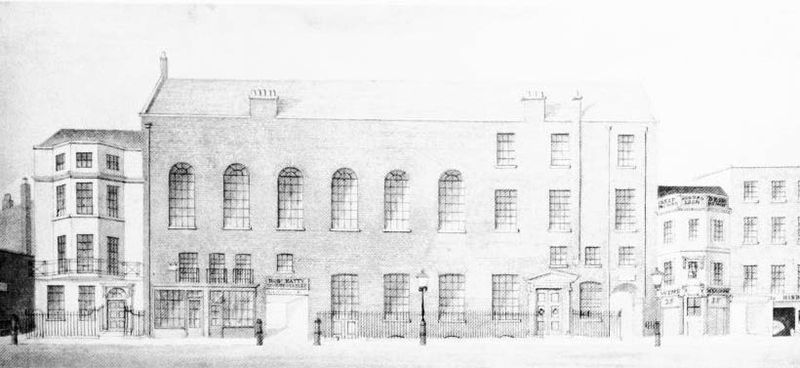
Almack's Assembly Rooms
The Almack’s best known today is the “Marriage Mart” of the Regency era, with the Lady Patronesses at the helm: Lady Jersey, Lady Sefton, Lady Castlereagh, Mrs. Drummond-Burrell, Princess Esterhazy and Princess Lieven. We know of it from novels, for its mediocre suppers, stringently-enforced rules (no waltzing without the approval of a Lady Patroness), and highly prized vouchers. However, there was life at Almack’s before that. And it was somewhat different...

One cannot underrate the importance of assembly rooms in the Georgian and Regency periods. With the sharp divide between men’s and women’s activities, a free zone where both could be present was a necessity. Places to see and be seen, young people were closely chaperoned as they met, danced and conversed. Potential marriage partners were on display, and the rituals of courtship (or commerce) observed. Every town or city had its own assemblies during its social season. Of course, London had to have the most exclusive of all. One thing the assembly rooms have in common is gambling. Cards were offered for the entertainment of those who did not dance. This included women.

Almack’s Coffee House opened in 1763 in St. James’s Street, and, some years later, became known as the gentlemen’s club Brookes’s. (Coffee houses catered to men.) William Almack decided on a new venture, selected a site on King Street, St. James’s, east of Pall Mall Place, and built three very elegant rooms, offering a ball and supper once a week for twelve weeks for a subscription of 10 guineas. In 1768, he added another room for cards, decorated in blue damask. It did not take long for Almack’s to be firmly established and popular with the highest of high society, including Lady Sarah Lennox, the Duke of Cumberland (brother of George III), the Duchess of Gordon and other notables. It became known for high play, with fortunes lost and won, by women as well as men. On May 6, 1770, Walpole wrote to George Montagu about an innovation at Almacks: “It is to be a club of both sexes to be erected at Almacs, on the mode of that of the men of Whites. Mrs. Fitzroy, lady Pembroke, Mrs. Meynel, lady Molyneux, Miss Pelham, and Miss Loyd, are the foundresses.”[i] I found the inclusion of two single ladies in such a leadership position interesting, and decided to investigate Miss Pelham. Who was she, and how did she get into this position at Almacks?

Rt. Honorable Henry Pelham
I cannot say unequivocally that I found her. However, I did find a likely candidate: Frances Pelham, daughter of Rt. Hon. Henry Pelham who served as Prime Minister during George II’s reign (Mr. Pelham’s brother was the Duke of Newcastle). Available data indicates that Frances was born in 1728, one of six daughters, and the second eldest of the four who survived into adulthood. The earliest mention I have of her so far is in John Robert Robinson’s biography of William Douglas, fourth Duke of Queensberry. Then Lord March, William Douglas took a house on Arlington Street in Piccadilly in 1752 next door to that of the Hon. Henry Pelham, then First Lord of the treasury. According this biography, the reason for his choice was “the bright eyes of Miss Frances Pelham, who had smitten the heart of this noble ‘macaroni’.”2 At this time, Frances would have been approximately 24 years old. According to this source, Lord March and Miss Pelham conversed through facing windows, as her father would not admit him. Supposedly, Lord March courted Miss Pelham about seven years. Upon her father’s death in 1754, unaccountably, the couple did not marry. One speculation is that, with her father’s death, any hope of political assistance for Lord March died as well, but that idea is discounted in Mr. Robinson’s biography. Her father left her a life estate in Esher, Surrey. 

Little information surfaces about Miss Pelham again, until mentioned in relationship to Almack’s, and gambling. In 1770, Frances Pelham would have been forty two years old and well past an expectation of marriage, a spinster of means and social status. Her being involved with such a venture as Almack’s is not an impossible or unlikely event. At any rate, at this point in time, the Miss Pelham of Almack’s was a gambler, who was famed for her fondness for deep play. By 1773, she was known for losing hundreds of pounds a night, and (with several of the other ladies) had moved away from Almack’s to other venues, and had earned the nickname of Miss Pell-Mell. There are indications that she dissipated her own fortune and required assistance from her relatives.

Miss Frances Pelham never married, and died the 10th of January 1804 at about age 76. According to The Annual Register, Or, A View of the History, Politics and Literature for the Year 1804, she had an excellent reputation. This reference indicates she was very rich, with a considerable estate. However, A Topographical History of Surrey is very specific that Mr. Pelham had left his possessions in Esher for her life by will and, at her death, the property devolved to her nephew. This in some ways supports my theory identifying Frances Pelham with Miss Pelham of Almack’s fame, as a life estate limited the inheritor’s ownership, and his (or her) ability to dispose of assets. She would have had a place to live and conceivably assets (or at least family) to support her after she had gambled away her disposable funds. 

I am continuing my research, but we may never find incontrovertible evidence for the identity of Miss Pelham, founding patroness of Almack’s. I haven’t even been able, to date, to find a portrait of Frances Pelham, and she is not identified in The Peerage. However, I can’t help but feel that Miss Frances Pelham, spinster daughter of a Prime Minister of superior social standing, may have found some satisfaction and excitement in an alternative life as Miss Pell-Mell, gambler, for a period of time after other options faded away.

[1] Letters from the Hon. Horace Walpole, to George Montagu, Esq. From the Year 1736, to the Year 1770 (The Works of Horatio Walpole, Earl of Oxford in six volumes. Vol. VI.) P. 434.

2 Robinson, John Robert, ’Old Q’ A Memoir of William Douglas Fourth Duke of Queensberry K. T. P. 59.

Sources:

Chancellor, E. Beresford. Memorials of St. James’s Street and Chronicles of Almack’s. New York: Brentano’s, 1922. 

The University of Nottingham. “Biography of Henry Pelham (c. 1695-1754: Prime Minister.” Here.

Google Books. The Annual Register, Or, A View of the History, Politics, and Literature for the Year 1804. “Deaths in 1804.” London: W. Otridge & Sons, et al, 1806.Here.

Google Books. A Topographical History of Surrey by Edward Wedlake Brayley, F.S.A., etc. London: G. Willis, 1850. Here.

Google Books. Letters from the Hon. Horace Walpole, to George Montagu, Esq. From the Year 1736, to the Year 1770 (The Works of Horatio Walpole, Earl of Oxford in six volumes. Vol. VI.) London: Rodwell and Martin, 1818). Here.

Google Books. ‘Old Q’ A Memoir of William Douglas Fourth Duke of Queensberry K.T. by John Robert Robinson. London: Sampson Low, Marston and Company, Limited, 1895. PP. 58-61. Here.

Google Books. Women, Sociability and Theatre in Georgian London, by Gillian Russell. Cambridge University Press, 2007. Here.

This was originally posted on my blog January 12, 2014 here. Unfortunately, I have turned up no further information. If any readers can contribute, please leave information in a comment!
~~~~~~~~~~

Lauren Gilbert holds a BA in English Literature and has been a member of the Jane Austen Society of North America since 2005. A life-long reader of historical fiction, her first published work HEYERWOOD: A Novel was released in 2011. A second novel, A Rational Attachment, is in process. She lives in Florida with her husband, where winter may be finally making an appearance. Visit her website here for more information.

Wednesday, June 15, 2016

Your Weight in Gold - The Problem of Tudor and Stuart Money

By Deborah Swift


This Horrible Histories video shows precisely the difficulty with Tudor and Stuart coinage - the denominations were extremely confusing. But it wasn't the only problem - in these days of virtual money, credit cards and online banking, we tend to forget exactly how much space the average man’s wealth took up. Money in Tudor and Jacobean England was a physical commodity that needed to be stored, carried and guarded. Often wealth was stored as 'plate', i.e. silver and gold that could be used for a purpose such as dining. Large sums of money meant having the physical space to keep it and so wealth was often displayed in the form of silver or gold plate, cutlery, candlesticks or other domestic trappings, which could be melted down to make a large number of coins of the same weight.


Wealth was very visible in the 16th century. Ben Jonson’s play, ‘Volpone’, opens with Volpone’s worship of his gold:

‘Good morning to the day; and next, my gold!
Open the shrine that I may see my Saint!’


Johnson’s play about greed and lust satirises some of the forms of financial speculation practised in Jacobean London. The phrase ‘worth your weight in gold’ was a literal truth in Tudor England.

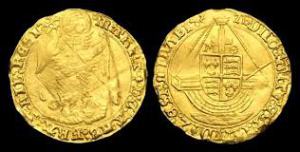
Currency was based on the penny, and the smallest denomination above it was the humble groat or fourpenny piece, and the half-groat (twopence), and one of the largest was the Angel or Angel-noble, called this because of its image of the Archangel Michael stamped in the design. The first shillings, or 'testoons' were created in 1502 in the reign of Henry VII. Occasionally half-pennies or farthings (quarter of a penny) were actually struck as coins, but this was rare: the smaller denominations were usually made by cutting a full penny into halves and quarters, or by using tokens as in Pepys’s Diary.

From The Pastry Cook at the sign of the Crown in Shoe Lane
The picture above is from this excellent site about trade tokens in the 17th Century.

Just a few of the coins in circulation:
Farthing = 1/4 penny
Half-penny = 1/2 penny
Three-farthing = 3/4 penny
Groat = 4 pennies (4d)
Sixpence = 6 pennies (6d)
Shilling = 12 pennies (1s )
Half-crown = 30 pennnies (2s 6d)
Crown = 60 pennies (5s)
Angel = 120 pennies (10s)
Pound = 240 pennies (20s or £1)
Sovereign = 360 pence (30s or £1 10s)

The sovereign was first minted under Henry VII as the gold equivalent of a pound (20 shillings) and was much easier to carry about than the arm-stretching weight of a pound of silver coinage. However, because the currency was based on the actual value of the precious metal, the face value of individual coins was not static as modern coins are, and a particular coin’s value would fluctuate with the price of silver or gold. Apart from the weight, the other disadvantage was that counterfeiting and coin-clipping (chipping a bit off the edge) was rife, although counterfeiting coins was a hanging offence. More detail about actual coins is here: Tudor Coinage.

Gold Angel

Most Elizabethan and Jacobean aristocrats borrowed heavily. Shakespeare’s patron William Herbert, the Earl of Pembroke, for instance, borrowed large sums from regular court money-lender Sir Michael Hicks. The borrowing was mainly to invest in mercantile ventures in other countries, from where England imported luxury goods or foodstuffs not easily obtained at home. Investing in trade was a risky business. Most trades depended on the ocean and many investors lost their fortunes to the sea. There were rare examples of great success in trade, such as Sir Thomas Gresham who became enormously wealthy from his dealings in munitions and bullion in the Netherlands. Gresham founded and invested in the Royal Exchange, the forerunner of London’s modern stock exchange in 1570. Sadly the first Royal Exchange, the great centre of trade and finance, was destroyed by the Great Fire in 1666.


And in fact the biggest risk to all wealth was fire. In towns made of wood and wattle, and thatched with reed, it was an ever-present risk. In this letter from Henry Wotton to Edward Bacon dated 13 July 1613, he says; ‘some of the paper or other stuff where with one of them was stopped did light on the thatch, where being thought at first but an idle smoke, it kindled inwardly and ran round like a train, consuming the whole house to the very grounds.’

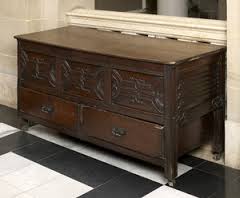
Counter Table from Hull Museum

Fear of losing all your money led to obsessive tallying, both at home, and at the ‘Counting House’. This is a rare example from Hull Museum is of a 'counter table' from the time of Henry VIII. Often the surfaces were marked with a grid or had a chequered board to help counting. In fact this is where the word 'counter' , as in a shop counter, is derived. In wills and inventories from the 16th century, counters are often listed as having a compartment. These compartments were probably for storing money and accounting ledgers, but in this example the drawers and hinged lid were added to it later, probably in the 18th century.

By the closing years of Elizabeth’s reign inflation was unstoppable and if their ships failed to come in, many men found themselves in debt. Debt carried a prison sentence so was greatly feared. In ‘The Merchant of Venice’ the themes of loans, bonds and mercantile transactions are interwoven with the plot. Financial concerns would have been familiar to Shakespeare as his father John Shakespeare made a good deal of money from investments in commodities such as wool and malt, apart from carrying on his business as a glover. He also did a bit of moneylending on the side. William followed in his father’s footsteps and these ventures, apart from inspiring a play, probably brought in considerably larger sums than his craft.

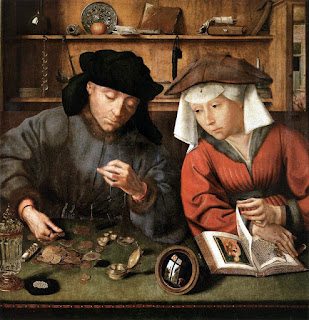
The Moneylender and his Wife - Matsys

Lending sums of money at a high rate of interest was common as interest rates were not fixed. It was usual to charge ‘damages’ , particularly if a debt was paid late, and often substantial fines were added with the full support of the law.

In Johnson’s ‘Every Man out of his Humour’ Puntarvolo invites his friends to sponsor him in his journey to Constantinople. Men would regularly lay down large sums of money to sponsor travellers on condition that the sums were doubled or trebled on their safe return. Travel was risky, but could be lucrative for the sponsor when the traveller returned with the spoils of their travels. 

Johnson and Shakespeare deposited £40 with the eccentric Somerset traveller Thomas Coryate before he set out to walk to Venice and back in a single pair of shoes. Coryate seems to have made quite a good living out of his sponsored travels, together with the books he wrote about them -- and even those who did not provide him with major support were willing to stand him a good dinner in return for his eyewitness accounts of exotic places. Coryate died during his last journey to India in 1670, but his books are still available today.


This type of sponsorship was a form of gambling, and the dividing line between legitimate investment or ‘venturing’ and various forms of betting was a good deal finer than it is today. Almost all Elizabethans gambled, from schoolboys who wagered with the ‘points’ that fastened their clothes, to the Queen and her courtiers who loved to play card games with enormous stakes. John Harrington wrote an epigram on the ‘rake’s progress’ of Marcus, a young man who gambled away his fortune at the very popular card game Primero. ‘The Counter’, where Marcus ends up, was one of London’s debtors prisons, called that because of its large number of debtors.

Lucas van Leyden - Primero players

Primero appears to have been one of the earliest card games played in England during Tudor and Stuart times, and was a forerunner to poker. Even Kings, or especially Kings, were not immune to gambling. During the reign of Henry VII, notices of the King's losses at cards appear in the Remembrance's Office. An entry is shown of one hundred shillings paid at one time to him for the purpose of playing at cards. The private expenses of Princess Mary, Henry VIII's daughter and later Queen, also contain numerous items of money ‘for the playe at cardes’.

Sources: 
Shakespeare's Life and World - Katherine Duncan-Jones
Early Modern England - Sharpe
The Time Traveller's guide to Elizabethan England - Ian Mortimer

Deborah Swift is the author of five historical novels for adults and a trilogy for teens. She blogs on her website about historical curios and historical fiction, and whilst you're reading this she is probably staring out of the window, coffee in hand, lucky black cat on lap, plotting her next book. You can chat to her online @swiftstory, or find her on facebook.

Tuesday, August 25, 2015

Easy come, easy go - of a creative Scot and financial bubbles

by Anna Belfrage

Admit it. People start talking about Keynes and Milton, and chances are you, dear reader, will start considering what to cook for supper or how to change the subject. That’s the problem with financial theories, that no one really tends to find them interesting. Given this, it is somewhat ironic that no matter how bored we are with economics, most of us are rather interested in money. After all, money makes the world go round.

Money was not always available in electronic form as it is today. Nor was it available in bills. No, up to the late 17th century, money was mostly available as coins. Rich people, per definition, either had strong biceps or hired people with adequate musculature to lug their riches around. While not wanting to toot the nationalistic horn too much, I am rather proud to inform you that paper money was to a large extent a Swedish invention – the Swedish National Bank (the first ever National Bank, yet another cause for a bashful blush) issued paper money already in the 1650s. Quick to follow on was England – and Scotland, seeing as both these nations were major trading economies, ergo quickly saw the benefit of using paper rather than bags of coin.

Our John
Today, I’d like to introduce you to one of the early promoters of paper money. Not only was this gentleman an extremely skilled mathematician and a successful gambler, he was also to become singlehandedly responsible for one of the more disastrous financial bubbles of the early 18th century. Ladies and gentlemen, I give you John Law of Lauriston.

Our hero was born in Scotland in 1671. His father was a prosperous gold-smith – rich enough to buy a castle, no less, hence the “of Lauriston” – and the expectations were that John as the eldest son would follow in dear Papa’s footsteps. Not to be. Law senior died when John was still young, and anyway, John showed little aptitude for making pretty things out of gold. No, John was in love with mathematics – and gambling.

In the aftermath of the Glorious Revolution our Scotsman decided to try his luck in London. Tall, dark and handsome, possessed of excellent manners, John was something of an immediate success in London society – at least with the ladies. He gambled, lost, gambled, lost some more, gambled and began to win. Capable of extremely complex mental probability calculations, endowed with an excellent memory for cards, over time John achieved quite the reputation at gaming tables. People preferred not to meet him. Well, the sensible ones. There are always those that set out to prove they can win no matter who they’re playing against.

Other than cards, John enjoyed the ladies. Not, I’d hasten to add, in an overtly scandalous manner, but women liked him and he liked women – in particular Catherine Knollys. Catherine was married (as per some sources), which does not seem to have deterred either her or John, maybe because her husband was exiled in Paris together with the former king, James II.

However, our young man was not only a shallow card-playing rake. He had dreams. Odd dreams, his contemporaries thought, not at all understanding what he was on about when he spoke of a new type of banks and paper money. Where other people held on to coins, Law scoffed, saying paper money was the way to the future, having the added benefit of being elastic – i.e. when in need of more money, you could print it, when there was too much money, you could trash it. In Law’s opinion, there was only one financial instrument that was better than paper money: shares. Why? Because shares, as per Law, were essentially monetary equivalents with the added benefit of giving the owners dividends.

While impressed by the young man’s obvious intelligence, the movers and shakers of London’s financial world were not quite as taken by his notions of new banking systems, new money systems. Besides, who did he think he was, this young lad from the back of beyond? After all, the Bank of England had just been chartered, and any day soon, they'd be issuing paper notes - once they'd investigated the issue thoroughly. Not enough, Law attempted to explain. A central bank should control the finances, use the tools at its disposal (such as paper money, which can be printed when the need for money escalates, thrashed when things move the opposite direction). He was met with condescending smiles. A frustrated Law dreamed of truly changing the financial markets, but continued to frequent the elegant salons of London, in between nurturing the growing attraction between him and Catherine.

E Villiers
Enter Elizabeth Villiers. Well, enter and enter: Betty Villiers was very much a part of all those elegant salons, her rumoured role as the king’s mistress making her popular among those who wished to influence their new Dutch leader. Law very much wanted to somehow catch the ear of the king so as to whisper seductively about growth and trade and a bright future – all of it built on Law’s own theories regarding banks and the supply of money. What transpired next is a bit vague, but somewhere along the line John Law felt obliged to call out a certain Edward Wilson – this to safeguard his honour and that of Mrs Villiers.

Duels were illegal. A duel in which one of the parties was killed was considered murder. John Law, who had considerable skills outside his beloved numbers, killed Wilson with one thrust. One moment, he was an up-and-coming man, the next he was in Newgate, facing imminent execution. The execution was commuted to a fine, Wilson’s family protested, the death penalty was upheld, and John Law had no option but to flee the country. He would have a price on his head for the coming 23 years…

When John Law escaped to the Continent, Catherine decided to join him. Her husband does not seem to have cared one way or the other, and whatever their other faults, John and Catherine were devoted to each other, a life-long love story that would produce two children. Were they married? Once again, some sources say they lived in sin. Others say they did marry. Does it matter? Not to us, it doesn’t, and John and Catherine don’t seem the type of people who would have cared.

John continued to earn his living at the gaming tables. He became rich – very rich. Women continued to flirt and wink at him, fans waving ecstatically whenever this handsome man walked by. John smiled and bowed, twirled in his splendid clothes, and did quite some flirting back. In the European salons his ideas about banks and companies, about paper money and shares mostly fell on deaf ears, no matter how impressed people were by John’s intellectual prowess. The world was simply not ready for John’s ideas.

But there were exceptions: France, for example, was so mired in debt, the entire economy stagnating after decades of mismanagement, that there were people who listened to Law and nodded in agreement. Not so the Sun King and his advisors.

The boy king
However, no one lives for ever, and in 1715 the Sun King passed away. France’s new king was a child of five, with the Duke d’Orleans acting as the regent. And the duke was rather fond of Law, who was put in charge of revitalising the dying economy. At the time, France was a mess. People starved, people stole, people begged – years of war, years of lavish expenditure by the king on matters close to his heart, had left the state finances precariously close to bankruptcy, plus the social unrest was making people nervous. Specifically, the rich people were getting a tad antsy. What if all these disgruntled desperate people would rebel, raise the standards of revolution and colour the fields red with the blood of their oppressors? (Happened anyway, as we all know)

John Law rubbed his hands. At last an opportunity to test his grand theories. For years, he had advocated the concept of a central bank, one institution in the country responsible for all major credits, for issuing paper money with corresponding securities in land or gold. Taxes, Law argued, should be collected and handled centrally so as to increase control and enable investments for the greater good.

D'Orleans
D’Orleans listened, and in 1716 Law’s bank saw the light of the day. Investors could pay for their shares with gold and with land, and the bank was authorised to issue its own money, which, because of the solid base created by gold and land, did not fluctuate as much as the livre did.

Once the bank was in place, Law implemented a series of measures that can essentially be described as some sort of proto-Keynesian approach, namely he created jobs. How? By investing in roads, in canals, in rebuilding. The national debt rose, but the social unrest faded. Law had done what Roosevelt would do two centuries later, what all desperate governments since have attempted to do: expand a suffering economy by state-financed infrastructural investments.

There was just a teensy, weensy problem in all this: France still lacked money – or rather, the French government was more or less paralysed by lack of funds. The bank in itself created stability rather than development, and for France to rise out of its impoverished state, something had to change. Law mulled this over and came up with the brilliant idea of what was to be known as the Mississippi Company. Here, at last, he would be able to prove just how fantastic shares could be, how easily they could substitute money.

It must be said from the start: Law genuinely believed his idea would work. Being a man of honour and integrity himself, he had no understanding for such base emotions as greed, nor did he understand fully just how people would react when presented with an “easy killing”.

The Mississippi company – or, to be correct, the Companie d’Occident – was founded to exploit the vast natural riches in the French American colonies. Whether the riches were vast yes or no, no one really knew, but everyone expected them to be. Law was not entirely sure, but was confident there’d be enough riches – in land, if nothing else, to guarantee the success of the venture. The company was set up, went on to acquire the monopoly on the lucrative tobacco trade and was awarded the responsibility for all African trade. An exciting new venture was under way, and Law as one of the main shareholders stood to make a fortune.

John Law
Expansion requires money. In 1719, Law was given permission to issue 50 000 shares in the company at a nominal value of 500 livres. To make people more willing to part with their money, only 72 livres had to be paid up-front. The rest was to be paid over five years.

People rushed to buy the shares. The price went up to 1 000 livres, and a further 300 000 shares were issued, with Law expressing this would be enough to more or less wipe out France’s national debt. People screamed for shares. They traded like hot cakes, and bowing to popular pressure – and his own convictions – Law ended up issuing 600 000 shares.

Poor people scraped together everything they had to invest in this golden opportunity, widows gambled their pensions, orphans their inheritance. By the end of 1719, the shares had risen to the intoxicating price of 15 000 livres each. A new term, millionaire, saw the light of the day. People were rich – stinkingly rich – in shares.

And here, dear people, was the rub. No matter Law’s insistence that shares could be used as money, should, in fact, be accepted as payment for goods and services, most people preferred gold. When, as a consequence of all this heady economic development, prices began to rise markedly, shareholders started to sell. Those who had invested early on wanted to recoup and make that killing. Some of them did, but like any pyramid game it was those who entered first and exited first who were the winners – all the rest were losers.

Law – who as the newly appointed Controller General managed France’s entire finances, from the national debt to the collection of taxes, to the issuing of money, to the Mississippi company – attempted to control the price by setting a limit on how much actual gold the seller of a share should receive. Did not go down well.

More people insisted on selling, and, as Adam Smith (yet another Scotsman with a love for finance and economy) was to demonstrate some years later, price is affected by supply and demand. When supply exceeds demand, prices fall. Where before, everyone wanted shares in the Mississippi company, now everyone wanted to sell their shares, and accordingly, the prices plummeted. The Mississippi bubble had burst, so to say, and people who until recently were rich – on paper – now faced destitution.

Law was appalled. One desperate measure after the other was attempted to save the company and safeguard France’s fragile economy. Nothing worked, and by the summer of 1720, angry mobs were forming outside Law’s private residence. He had lost just as much as anyone else, but people didn’t care. This was all his fault, with his new-fangled ideas. Law had to flee France, reduced to virtual poverty. For the rest of his life, he was to live like an itinerant, moving from city to city, reduced to yet again making his living at the gambling tables.

In 1729, John Law died, alone and poor, in Venice. But, as he would now and then say, once he, a simple commoner, controlled all of France. At the time of his death, his reputation was in tatters, this rather brilliant man vilified as nothing but a con-man. Over the years, he has been vindicated – many of his theories were sound, a lot of his measures were the right thing to do. Had Law been less of a mathematician and more of a psychologist, chances are he’d have realised that his grand scheme had one major flaw: human nature, which rarely conforms to other theories than that of rampant self-interest.

~~~~~~~~~~~~~

Anna Belfrage is the successful author of eight published books, all of them part of The Graham Saga. Set in 17th century Scotland, Virginia and Maryland, this is the story of Matthew Graham and his wife, Alex Lind - two people who should never have met, not when she was born three centuries after him.

Anna's books have won several awards - recently, one of her books won the HNS Indie Book of the Year Award -  and are available on Amazon, or wherever else good books are sold.

Presently, Anna is working on a new series set in 14th century England - the first installment will be published in November 2015.
For more information about Anna and her books, please visit her website. If not on her website, Anna can mostly be found on her blog.

Friday, September 26, 2014

Horse Racing and its Organization

by Sue Millard

The Jockey Club


The Jockey Club, according to its own records, was founded in the reign of George II, in 1750. It was effectively one of the most exclusive of gentlemen’s clubs. Its first meetings were held at the Star & Garter Pub at Pall Mall, London before moving to Newmarket, which under James I, Charles II and Queen Anne had gradually become the home of racing. The Jockey Club controlled all regulations to do with racing until 2006 when, in a conscious move to decouple racing from its “patrician” roots, it set up the British Racing Authority. 


Weatherbys


Weatherbys is a privately owned English company, established 1770, which provides British horse racing with its central administration under contract to the British Horseracing Authority, acts as its bank and has maintained the Thoroughbred breed register since its inception.

Training


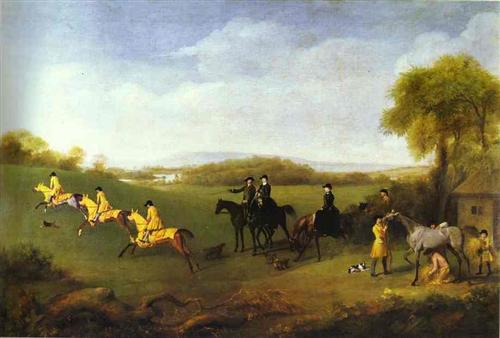
John Evelyn recorded in his Diary around 1684: “We returnd over New-market-heath...the Jockies breathing their fine Barbs & racers, & giving them their heates.” The term “breathing” meant giving a horse exercise that raised its respiration rate, while “heat” meant any exercise that raised its temperature, crudely measured as making the horse sweat. In 1761 George Stubbs portrayed the Duke of Richmond’s racehorses, being exercised in heavy rugs and hoods to achieve this.

Stubbs, The Duke of Richmond’s racehorses, painting from WikiArt


Types of races


In the early years, horse races were “matches” between two horses who competed in multiple heats, at distances from two to four miles. Only on a match day did a heat mean a stage of a race. Race heats were repeated until a horse had won the event twice or “distanced” the opponent – arriving at the finish more than 30 horse-lengths ahead, about 240 yards. These races were “stakes” in which both parties put up equal money as a sporting bet, and the winner took all.  

Horses were not raced until they were five or six years old. Carlisle racecourse, for instance, held a King's Plate – a race for 5-year-old horses in 3 mile heats – set up by George III in 1763.

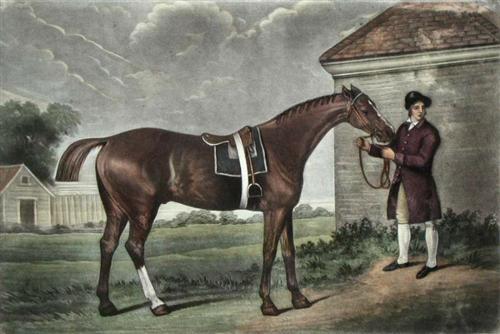
Eclipse, by George Stubbs

The great horse Eclipse started racing at the age of five on 3 May 1769. Most racehorses ran only a few times in their lives, but Eclipse ran the unusually high number of 18 races in a career of about 17 months – by which time rival owners would no longer enter their horses against him because he was unbeatable: “Eclipse first, the rest nowhere”.

Originally, short races for 2 and 3 year old horses, the ones we are most familiar with today, were “futurities”, testing youngsters a couple of times on their potential for longer races.  The St Leger, first run in 1776 at Doncaster, was the first “Classic” race, though today the Derby has greater fame. The St Leger is a single contest for 3-year-olds over 1 mile 6 furlongs, so from the start it broke the tradition of races run in repeated heats and over long distances. 


Handicapping


Most races in the past were at “level weights” – all horses carrying the same weight (rider, saddle and, if necessary, lead strips carried in a saddle cloth). Weight-for-age races were a way of compensating for the relative strengths of younger and older horses and giving all a more equal chance of winning; they defined level weights for horses of equal age, with younger horses carrying less weight. 

Handicap races, in which faster or stronger horses are allotted slightly more weight to try and level the chances of winning, were not introduced until the 19th century. The name “handicap” comes from a method of making a trading agreement, Hand I(n) Cap – a bit like Scissors Paper Stone, but with the participants hiding their hands in a cap containing money. When they pulled out their hands at the word, the agreement was made if they had all picked up some money, but if one or all had not, there was no contract.

Handicapping in horseracing there’s far less chance of the “Eclipse first, the rest nowhere” scenario where the favourite is so likely to win that no-one will take your bet. In hound trailing very often the bookmakers will not give odds against two or three of the really good hounds running and you can only bet on who will be third or fourth! So the Handicap system made gambling more exciting.


Bookmaking


The first commercial bookmaker in Britain was probably Harry Ogden, who opened a business in the 1790s; then an Act of Parliament in 1845 made it illegal to gamble except at race tracks. Bookies had to be extremely good at calculating odds, so they didn’t make a loss overall. From those times onward to the present day, and with the legalisation of off-track betting in 1961, commercial interests took over racing.


A comparison with the modern day


Horseracing now has the production values of an entertainment industry, with vast sums being generated in stud fees for outstanding stallions, and total prize money exceeding the £1 million mark for some high-prestige races. 

Thoroughbred foals can only be registered if their dams are registered with Weatherby’s, and they have to be DNA sampled and microchipped before they are 4 weeks old. When they are a year old they are sold on the basis of their pedigree (which gives an idea of whether their parents or grandparents had been any good on the racecourse), their conformation (overall good physique) and their heart-score (a predictor of blood-pumping capacity, ie, racing efficiency). 

The five great British Classics are the 2,000 Guineas, the 1,000 Guineas (for fillies only), the Derby, the Oaks (for fillies only), and the St Leger. They are all for 3-year-olds, and since these runners have to be trained and prepared for the high-value contests for months beforehand, the majority of modern racing uses very young horses of two and three years old, and mature horses are now the exception rather than the rule in the thoroughbred flat-racing population. 

Training involves dietary analysis, veterinary advice and treatment, regular weighing, interval training and swimming as well as exercise with a “lad” or a “work rider” on the gallops. Yet only a third of the foals born, overall, are ever good enough mentally or physically to set foot on a racecourse, let alone to win a race.

The first Derby on 4 May 1780 had been won by Diomed, a colt owned by Sir Charles Bunbury, who collected prize money of £1,065 15s. Two hundred and thirty-three years later the first prize was £782,314.

It’s all a far cry from word-of-mouth pedigrees and gentlemen’s wagers, in racing’s amateur heyday.


~~~~~~~~~~~~~

 Sue Millard is the author of several books on horses, both fiction and non-fiction. Her web site is Jackdaw E Books, http://www.jackdawebooks.co.uk


Monday, December 2, 2013

Low-Life of Elizabethan London

by Deborah Swift

Whilst researching my character Zachary Deane, I researched the late Elizabethan and Jacobean underworld to find out about what sort of ways a penniless person could cheat, lie, steal or embezzle to make a living in 1609. Most of this information comes from a book called The Elizabethan Underworld by Gamini Salgado - a book I highly recommend.

Diogenes Looking for an Honest Man - Caesar Van Everdingen 1652

The Righteous Beggar

The Reformation had cast out many friars and pardoners and made them into itinerant beggars. In the eyes of the law these were now vagrants, but the general population had quite a lot of sympathy for them, as they were seen as former 'holy men.'  Impersonating a monk became a lucrative way of begging.

Many soldiers and sailors in the wars against Portugal and Spain had not been properly paid and when the campaign was over were discharged onto the streets. A common begging ruse was to claim you had been with Drake in the expedition against Portugal (1589), and the sympathetic public would donate thinking you were a patriotic sailor. These righteous beggars were called 'rufflers'. There were also what were known as 'upright men', who were discharged soldiers who would knock on your door and demand food, lodgings or money. In the world of the beggar, the 'upright man' was King and carried a truncheon or 'filchman' to enforce his authority over other less brazen beggars. Click on the picture below to see just how much information can be gleaned about beggars just from this one drawing.

"Beggar in a Large Coat" Adriaen van Ostade

'Whipjacks' were men who has supposedly been shipwrecked or lost everything at sea. Men who had really been at sea were given a licence to beg, but these were often counterfeited by unscrupulous beggars, 'these fresh water mariners, their ships were drowned in the plain of Salisbury' (Thomas Harman). Other beggars faked diseases such as epilepsy by chewing soap to make their saliva froth.

Church and Conman

Surprisingly enough, one of the hot-beds of crime at the turn of the 16th century was St Paul's Church (Cathedral as it was later known after its rebuilding). In 1561 one of the bishops complained about the uses it was put to; 'the south alley for popery and usury, the north for simony, and the horse fair in the midst for all kinds of bargains, meetings, brawlings, murders, conspiracies, and the font for the ordinary payment of money.'


Cutpurses and pickpockets or 'nips' and 'foists' abounded, often working in groups or pairs, and attempting to cheat out-of-towners of their money. A common ruse was to faint and then when someone came to help, to cut away their purse. The playhouses as well as the church were fertile grounds for thieves. Cloak-snatchers and handkerchief snatchers were common in the Church and the theatre, as were confidence tricksters known as 'coneycatchers'.

Rigging the Odds

Dice and Cards were the principal games at which you could gamble and cheat. There were no less than fourteen different kinds of rigged dice, including 'fullams' - dice loaded with lead, and 'bristles'with a hair set in one side to stop the dice landing that way up. 'Gourds' were dice hollowed on one side to weight them one way or the other. Of course sleight of hand was necessary to substitute the dice, but this could be learned easily with practice. Rigged outcomes were common at bowling alleys, bear-baiting and anywhere where gambling was undertaken.

Another great source of information about the female cutpurse and cheat can be found in The Roaring Girl - a play by Middleton and Dekker from about 1607, about a woman called Mary Frith, alias Moll Cutpurse, though admittedly she did dress as a man for many of her exploits as can be seen on this pamphlet of the time.


Thanks for reading, hope I haven't given you any ideas! Here are my books, the cutpurse Zachary Deane features in A Divided Inheritance.


Tuesday, September 25, 2012

A Profitable Vice: Gambling in Regency England

by J.A. Beard

Games of chance have been with mankind from our most ancient days. Even in cultures and times where currency and property were unknown ideas, staring down fate and wagering something of importance were known. In many ancient cultures, gambling was even linked to mystical, religious, and ritualistic practices. The pervasive allure of gambling also affected the English of the Regency period.

While the Regency English did not elevate gambling to a mystical experience, the pastime, as it were, was tremendously popular during the period. It’s important to note this fondness for games of chance and profit/loss cut across all levels of society. It was arguably most pronounced among the top tiers of proper society, as the elite could enjoy the special thrill that came with extremely high stakes.

Both men and women were drawn in by Lady Luck's tests of chance, though there were differences in regards to their typical approaches to gambling. Men, in general, bet on a wider range of activities including cards, dice, sporting events (e.g., boxing and races), et cetera. Really, though, the true gamblers, would bet on almost anything. Women, however, particularly women of higher social standing, tended to keep their gambling more focused on cards and also tended to keep their stakes lower. Whist, faro, piquet, and loo were all popular card game choices for men and women who wanted to toss a bit of coin around and challenge fortune.

This is not to say that women never played for larger stakes, and there even was the occasional titled woman who decided that there was good money to be made in facilitating gambling and taking a cut. After all, the house always wins, right? Men also had their gambling facilitated by its more prominent presence at their clubs and their greater social freedom to frequent "gaming hells."

Although there were some who looked askance at gambling as a moral failing, there was no general social condemnation against the activity in polite society. Excessive gambling, as with other excessive behaviors, was frowned upon, but people of great social respectability could freely gamble without a lasting taint on their reputation, even with the occasional playing at one of the seedier gaming dens. Though larger bets meant great reward, they obviously also carried greater risks, and it wasn't unknown for people to even bet and lose property, a rather serious matter in a society that so tied land to status.

Indeed, arguably, the main social condemnation related to gambling at the time (other than cheating) applied only to those who acquired gambling debts and then did not pay them off.

As with all things during the Regency, social class differences heavily colored the view of a gambling debt. A titled gentleman would feel pressured to promptly pay back his debts to another titled aristocrat of similar rank. A titled aristocrat might feel he could take his time, though, if he owed debts to a common merchant. Although the general tendency of social classes to mix with those of their own kind kept the overall amount of extreme class differences between debt holders and their debtors relatively low, there were more than a few gentlemen of means who found themselves owing a large sum to their alleged social inferiors. They would get their money… eventually. Despite the "advantage" that came with being able to be leisurely repay one's social inferiors, it was somewhat offset with the reality that owing money to a social inferior was very damaging to one's reputation.

Gambling could also reinforce social classes in a different way. In Pride and Prejudice, Lizzie Bennet finds herself a bit off-put not by the presence of gambling, but by what she assumed were too high of stakes:

"On entering the drawing room she [Elizabeth] found the whole party at loo, and was immediately invited to join them; but suspecting them to be playing high she declined it, and making her sister the excuse, said she would amuse herself for the short time she could stay below with a book."

Pride and Prejudice, Chapter 8.

I'm guessing that once she became Mrs. Darcy, she was a bit less nervous about high stakes.