Showing posts with label Great Fire. Show all posts

Monday, October 28, 2019

Stuart London - A Time and Place for Discovery

By Michael Ward

Maybe it’s the journalist in me, but I’m often attracted to historical research that produces surprises.

Discovering that Isaac Newton, the father of modern physics, had a deep interest in alchemy certainly raised an eyebrow. As did finding out that people used to believe swallows hibernated in mud, rather than migrated, over winter.

But why wouldn’t they? The idea that such a small bird could fly as far as southern Africa would have seemed far-fetched indeed to someone in the 1600s, assuming they had any notion where southern Africa was.

Over time I’ve come to realise that my research ‘revelations’ have said more about me and my 21st century assumptions, than the people of the period I was studying.

Nowhere has this been truer than my examination of England in the mid 17th century. Of course I knew about the civil war, Cromwell’s Commonwealth and the Great Fire but I still expected to learn much on my voyage of discovery. However, I had no inkling of just how many ‘oh really?’ moments I would encounter along the way, such as burrowing birds and Newton’s alchemy.

My first surprise was that so much change was compressed into such a short period. In just over 25 years, the country experienced civil war, regicide, a republic, and a restoration of the monarchy.

Any one of these would have produced sufficient shock waves to reverberate for a decade. But to have experienced each in rapid succession, followed by 1666, a hellish year of fire and plague, meant that, for Londoners in particular, it must have been both a formative and terrifying time to be alive.

Consider experiencing the politically divisive furore of five or six consecutive Brexits between now and 2040 plus a conflict that accounted for proportionally more of the country’s population than World War One, followed by a pandemic that wiped out a quarter of the people in London and a blaze that consumed much of city. Then take away the ability to know what was happening and why, and you begin to get an inkling.

As my research continued, I realised this period also witnessed fundamental changes in science, medicine and commerce, as well as politics and religion. Beliefs firmly held for centuries were now being challenged, almost on a daily basis, by a constant stream of newly discovered, empirically driven knowledge, forced to the surface by an unquenchable spirit of enquiry.

Public Domain image of the type of printing presses
which would help transform 17th-century England

There was a swathe of new thinking. I’ve already mentioned Newton, the ‘father of modern physics’. Historians have enjoyed using such titles, with many paternity suits still argued on behalf of the sciences in particular. Nevertheless, the 17th century had more than its fair share of claimants: Galileo –the father of modern science (according to Einstein, no less), Francis Bacon - scientific method, Francesco Redi – experimental biology, Robert Boyle – modern chemistry, Marcello Malpigi – microscopic anatomy, and so on, leaving supporters of Rene Descartes and Pierre de Fermat to fight over analytical geometry.

My third realisation was that the key players of this period did not always behave to type. Several of the grandest lords in the kingdom, such as Essex and Warwick, were early and powerful advocates of the Parliamentary cause, as were a number of leading merchants, including some within the more conservative Merchant Adventurers. Equally, kings were seen as guardians of the status quo yet radical thinkers in science and medicine benefitted from their patronage.

William Harvey is a case in point. At the start of the 17th century, the views of Galen, a Greek physician born in 210 AD, still dominated medical practice throughout Europe, and his anatomical theories, including the body’s circulatory system, were largely uncontested. In 1628, William Harvey published ‘De Motu Cordis’ demonstrating that people had a single blood system which circulated continuously throughout their bodies. This flatly contradicted the accepted Galean doctrine that organs consumed blood which had to be replenished by either the liver of the heart, and each had their own circulatory networks.

William Harvey, demonstrating his theory of circulation
of Wellcome. Click HERE for image attribution

Harvey expected a storm of opposition and he wasn’t disappointed. Yet it only took 30 years for his ideas to become more widely accepted, and Galen’s 1,400 year grip on medicine to be broken, such was the iconoclastic spirit of the age.

Yet it was King James I who supported Harvey’s research by allowing him to join his court when hunting game, so that Harvey could dissect fallen animals immediately, in situ, and observe their blood flow. (However, James’ son Charles 1 later extracted a favour in return, requiring the eminent physician to dodge the musket fire at the Battle of Edgehill where, as the King’s ‘Physician in Ordinary’, he is said to have looked after the two royal princes while tending the wounded.)

As I delved deeper into the plethora of 17th century discoveries and developments, I began to notice a form of symbiotic relationship between some, despite being in different fields. I would often pull at, then follow, a thread of research in, say, scientific advances, only to discover its impact on something completely different, such as religious belief. In the 17th century, it seems one new way of interpreting the universe often led to another.

So, from Galileo onwards, many of the advances in astrology were driven by the fervent search for improved navigational tools by the expanding merchant sector. Improvements in printing technology led to a proliferation of unlicensed printing presses in London which came to have a major impact on political discourse and the spread of radical ideas, before and during the civil war. Again it is notable how quickly this development was understood and seized upon, this time by political activists including the King’s supporters, in this age of experimentation.

Another example can be found in the dramatic population shifts of this period. In just 15 years, from the late 1620s to the early 1640s, some 80,000 people sailed from England’s shores, with up to 60,000 of them crossing the Atlantic, an enormous figure for that time. A significant number of these were Puritans, wishing to found a New World where they could practise their religion freely.

Puritans left England in large numbers to set up colonies in the New World to practise their religion.
This Public Domain image shows Puritans burning a book they deemed to be heretical in Massachusetts Bay. 

One would expect such a rapid depopulation to have a concentrated impact in London, by far England’s largest city, especially when combined with its high mortality rate. Yet simultaneous advances in commerce meant that London’s growth did not stall. It actually increased, the rising economy driven in no small part by the expansion of merchant trade to all points of the globe including the Caribbean and the Americas. Each week hundreds would arrive from the surrounding counties, eager to share in the city’s new found wealth.

This more than compensated for the mass emigration partly fuelled by religious change. However, many of the new arrivals soon discovered the streets of London to be paved with something far less pleasant than gold. The city’s existing housing stock and barely rudimentary sanitation were overwhelmed by the needs of newcomers and much of London descended into a disease-ridden squalor.

This, of course, added more fuel to the political unrest, and so interlocking cycles of change and challenge continued to drive the English 17th century into the uncharted depths of civil strife, setting brother against brother and father against son.


Further reading

Adamson, J. (2009). The Nobel Revolt. London. Phoenix.

Brenner, R. (2003). Merchants and Revolution. London. Verso.

Evans, J. (2018). Emigrants. London. Orion.

Rees, J. (2016). The Leveller Revolution. London. Verso.


~~~~~~~~~~

Michael Ward is a former BBC journalist and academic. His debut novel “Rags of Time” is set in 1639, with England sliding into civil war. Spice trader Thomas Tallant returns from India to find the overcrowded streets of London seething with sedition. Soon he is sucked into the city’s turbulence, accused of murder.

The book follows his desperate attempts to find the real killer and clear his name, helped by the enigmatic Elizabeth Seymour, astrologer and mathematician whose thirst for knowledge is only matched by her addiction to tobacco and the gaming tables. Can Elizabeth untangle the web of deceit threatening to pull Tom under?

Early reviews of ‘Rags of Time’ have described it as “a wonderful debut” with an “outstanding story”, noting that “…the author has clearly done all the hard work by researching the period and manages to impart that knowledge without any big information dumps.”

The sequel is now under development.

Connect with Michael: Amazon page Rags of Time

Amazon US 

GoodReads book page

Author’s email: mike@mikewardmedia.com


Thursday, December 14, 2017

The London Plague 1665

By Brindy Wilcox

Two major events  happened in the winter of 1664.

Firstly, there were sightings of a large comet over London, on which John Gadbury, a distinguished astrologer commented, ‘portends pestiferous and horiible windes and tempests’. An extract from the diary of Samuel Pepys on Thursday 15 December 1664 reads: ‘So to the Coffeehouse, where great talke of the Comet seen in several places’.

Public Domain image via Wikipedia

The second event was the unremarkable recording of the death of Goodwoman Phillips in the parish of Saint Giles in the Fields, outside the City walls of London, on Christmas Eve 1664, where parish searchers pronounced her to have died of the plague. (From: The Great Plague – The Story of London’s Most Deadly Year – A.Lloyd Moote & Dorothy C Moote, John Hopkins University Press 2004.)  Whilst the death would be of concern to the immediate neighbours of Goodwoman Phillips it would not raise concerns with officials, as it was not uncommon for the occasional death from plague to appear on a Bill of Mortality. Old women, known as ‘searchers’, were usually paid pennies by the Parish authorities to determine the cause of death of ordinary people and, with no training, they could be unreliable. These were often elderly female pensioners supported by the local Parish and once the cause of death had been determined they reported it to the parish clerk for inclusion on the London Weekly Bill of Mortality.

Public Domain image via Wikipedia

These events heralded a difficult year for Charles II, who came to the throne in 1660 after the execution of his father, Charles I in 1649 and the death of Oliver Cromwell in 1658, marking an end to republican rule in England. He is probably better remembered for being on the throne during the Great Plague of 1665 and the Fire of London in 1666 than his role during the Anglo-Dutch wars. He was well renowned for his love of dogs and, in particular, the King Charles spaniel, who took their breed name from him. He was rarely seen going anywhere without some of his beloved dogs and even preferred to be entertained by them during meetings when he should have been attending to state business.

Modern King Charles Spaniels - photo supplied by author

The first recorded deaths of the Great Plague appeared on the London Weekly Bill of Mortality in April 1665. There is some discrepancy as to who this is reported to have been with notations quoting both Rebecca Andrews and Margaret Porteous as being the first, the only consistency being they are both reported to have died on April 12th 1665. By early June 1665 recorded deaths from the plague had risen to 112 in a week across 12 parishes. At the time, it was believed that the plague was being spread by dogs and cats and, in an effort to control the disease, the Lord Mayor issued a decree that from July 1st 1665 all cats and dogs within the City of London were to be killed. Householders were told to kill all of their dogs, regardless of breed, or face prosecution and a special team of dog killers were put in place. In an attempt to control the plague it is rumoured that 40,000 dogs and 200,000 cats were slaughtered and that the domestic cat was almost wiped out in London.

The summer of 1665 was one of the hottest driest droughts for many years, ideal conditions for the spread of the plague. By July there were over 1,000 deaths a day from the plague and Samuel Pepys wrote the following in his diary,
“But, Lord! What a sad time it is to see no boats upon the river; and grass grows all up and down White Hall court, and nobody but poor wretches in the streets!” 
The rich had mostly left London to avoid catching the disease, the King and his dogs had gone up to Hampton Court and people needed a Certificate of Health to confirm that they were plague free before they could leave the City of London. These were issued by doctors but, as more and more doctors left London, a black-market trade grew up for people who could afford to pay for a fake certificate. Trade with London had ground to a halt and it was mainly the poor that had nowhere else to go that remained.

Samuel Pepys decided to stay at his home in London, although he did send his wife away to Woolwich during July, when he also made this entry in his diary showing that people would rather admit to murder than admit that they had the plague in their household.

July 22nd 1665
I met this noon with Dr Burnett, who told me, and I find in the news-book this week that he posted upon the Change, that whoever did spread that report that instead of the plague, his servant was by him killed, it was forgery; and showed me the acknowledgement of the maister of the Pest-house that his servant died of a Bubo on his right groine, and two Spots on his right thigh, which is the plague.

The number of deaths peaked in the week of September 19th 1665, when there were 7,185 plague deaths across 126 parishes, with only 4 parishes reportedly being plague-free. Unknown to the authorities the Lord Mayor’s decree had probably made things worse as, rather than the cats and dogs being the problem, it was the fleas that lived on rats - and by killing off the natural predators of the rats the plague had been able to spread more rapidly.

As the winter weather moved in the numbers of deaths began to reduce and winter brought an end to the Great Plague of London. Charles II eventually considered it safe to return to London in February of 1666. Over 100,000 people are estimated to have died from the plague, although in the later weeks record keeping was far from accurate due to the numbers dying.

1665 saw the last major outbreak of the bubonic plague in Great Britain with the last recorded death from the plague in 1679. It was removed from the Bills of Mortality as a specific category after 1703.

~~~~~~~~~~

Born in Settle, North Yorkshire, Brindy Wilcox's love of books started at an early age and she grew up loving the adventures of The Famous Five and The Secret Seven by Enid Blyton. Another fond childhood memory is of Rusty, her very lovable Red Setter dog; she would spend hours sitting with him telling him stories. So, it seems inevitable that, when she decided to write her first novel, it would be about adventurous dogs. She first had an ambition to write a book about 25 years ago but a career in Accountancy kept her busy so that she only found time to start writing a couple of years ago. She chose the self-publish route and one of her proudest moments was when she finally held her completed YA novel, Through Time To London in September 2016.
Amazon Author Page

Thursday, May 23, 2013

Changing the Face of London - the Great Fire of 1666


by Regina Jeffers

The development of new standards and statutes after The Great Fire of 1666 changed London forever. The years following the fire saw the building of St Paul’s Cathedral, along with numerous other churches. Public buildings and domestic buildings introduced new standards of design, many still enforced today.

After the fire, Sir Matthew Hale drew up An Act for Rebuilding the City of London. Compiled jointly by City authorities and the Privy Council, this Act was a comprehensive statute. An earlier Act, the Fire of London Disputes Act 1666, had set up a court to settle disputes arising from buildings destroyed by fire. This Act regulated the rebuilding as well as authorizing the City of London Corporation to reopen and widen roads, making the anniversary of the fire a feast day and erecting the Monument. A duty of one shilling on a tonne of coal was imposed to pay for all these measures.


Technical advisers, comprised of the City’s surveyors (Robert Hooke, Edward Jerman, and Peter Mills) and the Principal Architect, Sir Christopher Wren, were charged with rebuilding of the City. According to W. G. Bell’s The Great Fire of London, Wren’s efforts were centered on St Paul and other churches. The initial plan to rebuild the City included:
1.    The need to raise funds to rebuild the public (NOT the private) buildings by levying a duty on coal
2.    The limited standardization of the buildings, chiefly when it came to fire resistance
3.    Forethought regarding the previous deficiencies in the City’s layout

The most obvious improvement to the streets was the development of King Street and the conversion of Queen Street from a narrow lane to a street, which would hold horse-drawn traffic. These two changes provided easy access from Guildhall to the Thames.  Guildhall is the only stone building not belonging to the Church to have survived the Great Fire. It is a building off Gresham and Basinghall streets, in the wards of Bassishaw and Cheap. It has been used as a town hall for several hundred years, and is still the ceremonial and administrative centre of the City of London.

The standardization of the building styles proved more beneficial. The Act was the first time such measures were taken. The City divided the four categories:

Neither more nor less than four storeys’ houses were permitted on ‘high and principal streets.’
Three storeys’ houses on ‘streets and lanes of note.’
Two storeys’ houses on ‘by-lanes.’
Houses of ‘the greatest bigness,’ which “did not front the street but which lay behind, with courtyards and gardens” were limited to four storeys.

Houses were to have walls of brick or stone, but the Act went as far as setting thickness of the walls at various heights, as well as the timber scantlings and the ceiling heights of the various floors. For the larger houses, a first floor balcony was required, with a ‘pent house’ below, which protected pedestrians from rainfall. The exteriors were left to the owners’ tastes. There were plenty vagaries of taste displayed.


Although the City struggled to finance its part of the rebuilding, private wealth prevailed. According to Bell, by the spring of 1668, 1600 houses were under development. In 1670, fourteen churches broke ground. By the time Ogilby and Morgan produced their large-scale map of London in 1677, the City was well on its way to new greatness. The original map is 8 feet 5 inches by 4 feet 7 inches in 20 sheets.

In 1894, the British Museum granted permission to the London and Middlesex Archaeological Society to make a reduced copy of the source. An excellent source for viewing the individual sheets of the map is British History Online. The map’s authors surveyed every corner of the City with each individual house noted. In addition, John Strype gives those interested in this time a compete catalog of every street, lane, alley, court, and yard in one square mile of the city. His observations are recorded in Strype’s 1720 edition of Stow’s Survey. To each noted structure, Strype includes personal comments describing the area in which the item sat, in such terms as “indifferent good” and “a pretty open place.”

Public buildings fell into two categories:

The various guildhalls were “regular City architecture.” These stood some distance from the street, with small courtyards and gardens. Master craftsmen built the majority of these establishments, and several survive, most notably Skinners’ Hall and Vintners’ Hall and Apothecaries’ Hall.


The Vintners’ Hall likely existed as early as the 12th Century and received a Royal Charter in 1363. The Vintners Hall is situated by Southwark Bridge, in Vintry ward. The Worshipful Company of Skinners is one of the Livery Companies in London. It was originally an association of those engaged in the trade of skins and furs. It has evolved into an educational and charitable instution, supporting the Tonbridge School and several others.

The Apothecaries’ Hall is based in Blackfriars. The building, originally part of the Dominican priory of Black Friars, was called Cobham House prior to its purchase by the society in 1632. The original building was destroyed in the Great Fire. A new hall was built on the same site in 1672 to the design of Edward Jerman; an “Elaboratory” was included at the time for the first ever large-scale manufacture of drugs.

Sir Christopher Wren’s “brilliance” is displayed when one looks upon its churches. While the house and buildings rose no more that forty feet, Wren’s fifty steeples dominated the skyline. With its spiritual history of the 17th Century firmly instilled, St Paul’s easily outshines the others.

Wren had earlier made a journey to Paris in 1665, where he studied the architecture of the city, as well as the drawings of Bernini, the great Italian sculptor and architect. He made his first designs for St Paul’s upon his return, but the Great Fire changed his plans. He submitted his plans for rebuilding the city to King Charles II, although the plans were never adopted.

With his appointment as King’s Surveyor of Works in 1669, Wren had a presence in the general process of rebuilding, but was not directly involved in the designs for houses and guildhalls. Although each did not represent Wren’s own fully developed design, he was personally responsible for the rebuilding of 51 churches.


~~~~~~~~~~~~

Regina Jeffers loves all things Austen and is the author of several novels, including Darcy’s Temptation, Captain Wentworth’s Persuasion, The Disappearance of Georgiana Darcy and Second Chances: The Courtship Wars .

Her website is: www.rjeffers.com

Sunday, September 2, 2012

By Permission of Heaven - The Great Fire of London

by Richard Denning


Jane called up about three in the morning, to tell us of a great fire they saw in the City. So I rose, and slipped on my night-gown and went to her window, and thought it to be on the back side of Mark Lane at the farthest; but, being unused to such fires as followed, I thought it far enough off, and so went to bed again, and to sleep. . . . By and by Jane comes and tells me that she hears that above 300 houses have been burned down tonight by the fire we saw, and that it is now burning down all Fish Street, by London Bridge. So I made myself ready presently, and walked to the Tower; and there got up upon one of the high places, . . .and there I did see the houses at the end of the bridge all on fire, and an infinite great fire on this and the other side . . . of the bridge. . . . 
Samuel Pepys Diary for 2nd September 1666


The 2nd of September 1666 was the day that the Great Fire of London started. Today I will give an overview of the fire.


Before the Fire – early 1666.
London, in early 1666, was a city still suffering from the great plague. The death rate was slowing down but new cases were still happening even up to the time of the fire. The King and his court had evacuated the city and the government was run from Oxford through the winter and early spring. Yet in the summer of 1666 life was returning to the city. The markets were open and trade was thriving once more. England was at war with Holland and France and that meant that in the summer the fleet put to sea looking for an engagement that would decide the war. That fleet needed provisions and one of the bakers that supplied the all important ship’s biscuit was Thomas Farriner of Pudding Lane. 

At the time accusations of conspiracy would fly around the city as rapidly as the fire itself. Catholics were to blame, or French or Dutch spies or maybe republicans. Then again maybe it was the will of God. London was a cesspit of sin and the wrath of God would be visited upon it. That at least was the predictions of astrologers before the fire. This year – 1666 – was full of portents of doom and the unrighteous would soon suffer hell fire. That is what people said. 

Eventually the truth came out. It was not the judgement of heaven or the evil act of malicious enemies. No it was merely a baker forgetting to put out his ovens. Thomas Farriner was to blame. Not that he ever admitted to this himself of course.

But we should not blame Farriner. Really it was the case that the city of London in 1666 was ready for this disaster. Most houses in this crowded and congested city were wood and thatch leaning precariously towards each other. The city contained hundreds of workplaces, many of which were fire hazards- foundries, smithies, glaziers and was full of warehouses which had stores and cellars of combustibles. That summer of 1666 had been one of the hottest in living memory making the buildings dry as tinder. Finally there was a strong wind blowing north westerly for the first three days fanning on the fire.

Here then is an outline of the key stages in the fire:

Day 1: Sunday 2nd September 

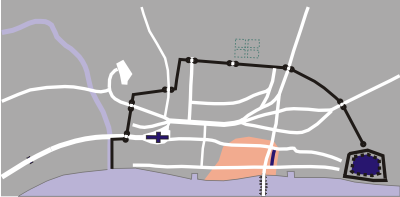
Extent of Fire damage on 2nd September (with thanks to Wikipedia for the image - reused under commons agreement)

Circa 1am the fire starts at the Bakers on Pudding Lane. 4am Lord Mayor Bludworth visits but down plays it and goes back to bed! Later that day he fails to act decisively. Samuel Pepys goes to see king and gets royal orders back to Mayor so he starts to pull down houses BUT it is already too late. The fire is spreading fast and Londoners start to flee. Getting his priorities right, Pepys buried a big cheese and wine in his garden!

Day 2: Monday 3rd September 

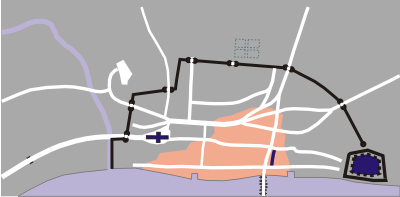
Extent of Fire damage on 3rd September 
About four oclock in the morning, my Lady Batten sent me a cart to carry away all my money, and plate, and best things, to Sir W. Riders at Bednall-greene. Which I did riding myself in my night-gowne in the cart; and, Lord! to see how the streets and the highways are crowded with people running and riding, and getting of carts at any rate to fetch away things.
Samuel Pepys Diary for 3rd September 1666.

The fire spread throughout the 3rd, despite the efforts of the Duke of York who was given command of fire-fighting that morning and began to bring better organisation to the fight. The only success came at Leadenhall in the north-east, were a combination of low wind and the leadership and wealth of one citizen which enabled him to hire sufficient labour to create a working firebreak stopped the blaze advancing. Paranoia over suspected plots meant that people start attacking foreigners in the street. James is forced to spend a lot of time saving foreigners from attacks by the London mob. 
James Duke of York - who led the fire fighting efforts
“the whole City in dreadful flames near the water-side; all the houses from the Bridge, all Thames-street, and upwards towards Cheapside, down to the Three Cranes, were now consumed” 
John Evelyn

Day 3: Tuesday 4th September 


Now begins the practice of blowing up of houses in Tower-streete, those next the Tower, which at first did frighten people more than anything, but it stopped the fire where it was done, it bringing down the houses to the ground in the same places they stood, and then it was easy to quench what little fire was in it, though it kindled nothing almost. W. Hewer this day went to see how his mother did, and comes late home, telling us how he hath been forced to remove her toIslington, her house in Pye-corner being burned; so that the fire is got so far that way, and all the Old Bayly, and was running down to Fleete-streete; and Pauls is burned, and all Cheapside. I wrote to my father this night, but the post-house being burned, the letter could not go. 
Samuel Pepys Diary for 4th September 1666.

By sunrise September 4th, the fire was at its peak, an estimated ten times as strong as twenty-four hours previously. The success at Leadenhall was repeated on the 4th by other teams – one led by Samuel Pepys who now used gunpowder to clear great gaps in the city and build fire breaks In the east, the fire was stopped before reaching The Tower of London. However, in the north the flames remained unchecked, surging with avarice across Cheapside and the city market, and in the west they jumped across the River Fleet in spite of attempts to clear the bridge and nearby buildings. People ran and pushed goods and belongings into St. Pauls or up against the walls hoping it would protect them. It did not! By the midnight of the 4th/5th September, St. Paul’s Cathedral was surrounded and literally melting: the lead roofing flowed down the streets and building stones exploded from the heat.


Day 4: Wednesday 5th September Day 5: Thursday 6th September
On the 5th two events conspired to save London: firefighters started to actively use gunpowder to clear firebreaks on a wider scale. More crucially, the powerful east wind dropped. There was still a great struggle. Pepys reports than even the King was seen helping carry buckets, but the tide had turned. Small fires still burnt by midday on Thursday 6th 1666, but they were soon under control.

The Aftermath
There was something of a witch hunt during and after the fire looking for the culprits and the London mob chased down any foreigners or just someone who looked a bit odd. A mentally ill Frenchman admitted to causing the fire and although it was shown that he could not have done so he was still hung. In the end calm prevailed and it was realised by those in government that it had just been an accident made worse by the condition of the city.

Rebuilding 
The destruction was vast. It is estimated that the destruction included 13200 houses, 87 churches, 44 Guild Halls, St Pauls Cathedral, Baynards Castle, the Royal Exchange, Newgate prison and many other important sites. Maybe 1 person in 3 or 4 of greater London was made homeless. Something like £14 Billion of damages in today’s terms was caused. For some this was an opportunity. Unscrupulous bankers made a fortune giving loans at huge rates of interest to assist rebuilding. Landlords discovered that they would insist on the properties they had rented out being rebuilt at the tenants cost and usually ended up with buildings of greater value. A massive legal process ensued with court cases going on for years. Others had higher aims. John Evelyn and Christopher Wren both submitted plans for rebuilding the city. The warren of streets would be swept away and broad avenues and squares echoing the glories of Italian cities brought in. In the end though landlords insisted on their houses being rebuilt and the best that Wren achieved was the contract to design and rebuild London’s churches including the magnificent St Paul’s Cathedral.

The Monument

Near the site of the original bakery where the fire had started a monument was constructed. On it read the words:
Here by ye permission of Heaven, Hell broke loose on this protestant city.


The Monument depicted in a picture
by Sutton Nicholls, c. 1753


A modern version of the monument (near the Underground Station that shares its name) is still there today.
~~~~~~~
Richard Denning is a historical fiction author. His main areas of writing are the early Anglo-Saxon years. For more details go to his website: http://www.richarddenning.co.uk/. The Great Fire of London is of particular interest to him. It was the back drop to his historical fantasy The Last Seal, and he published a boardgame based wound the events of the Great Fire: The players are men of wealth and standing who own property around London. They can use the trained bands to fight the fire, use demolitions to destroy blocks of housing to prevent the fire flowing or turn a blind eye and allow the fire to spread and damage rival’s property. Victory can belong to the player with the most property left but putting out fires can give you a boost. In addition each player will have several hidden objectives which might include helping another player or protecting parts of the city.

Sunday, September 25, 2011

Plots, beliefs and Omens in the Great Fire of 1666

By Richard Denning
The 17th century is the age of Newton and Harvey and other scientists that discovered many of the scientific truths we know today. YET it was still a time where people believed in magic, witchcraft and omens. It could be a paranoid time. It was also a moment when the average Londoner had reason to distrust foreigners and to be afraid of home brewed plots and conspiracies,  Today I look at some of those beliefs, fears and distrusts and how as a result they suggested to me that the Fire was a perfect moment for the setting of a historical fantasy.
Witchcraft and Magic

Put simply in this time period, despite the growth of science, people believed in Magic and in witchcraft. It  was during the reign of Elizabeth I that campaigns to catch and try witches began – around 1563 - and these were further developed during the reign of James I. The estimate of the number of persons hanged as witches in England  in the  century or so of active trials was about 1,000. The first person hanged for witchcraft was Agnes Waterhouse at Chelmsford in 1566, the last was Alice Molland at Exeter in 1684.
If you were a women who was old, ugly, had warts you were at possible risk of accusation. If you fell out with a neighbour they might just call you a witch. Then the search would begin for “evidence” such a calf being still born in the area or milk turning sour.

Prince Rupert’s demon poodle
As an example of how much credence people might sometimes give to tales of magic and demons, in the civil war the Parliamentarians spread a rumour that Boy – Prince Rupert’s dog (prince Rupert was nephew to King Charles I) – was a demon in disguise. Pamphlets circulated claiming that he had the power to predict the future, find treasure, alter his shape and was invulnerable to bullets. Alas if he did have this power, it failed him at the battle of Marston Moor in 1644, because Boy died at that battle.
 Omens
The mid 17th century was a time of great superstition and people attributed significance to omens that they saw about them. There were Solar eclipses in the southern hemisphere in 1666. Comets had been seen in the skies in 1664. There were also lunar eclipses. People seemed willing to believe that any apparently natural occurrence had deeper meaning. For example in 1666 it was widely reported that a hen’s egg had been laid in Poland with the mark of the cross on it.
All of these – and many other occurrences  - were believed by many to imply that some great catastrophe was looming.

Astrology
There was even a prediction made by  William Lilly, the best known astrologer of his day, who predicted the plague of 1665 and the  Great Fire of London (1666) in 1652. Of course the year 1666 would be likely to attract such predictions due to its signifiacnce (see below) and there were many predictions that DID NOT come true that are not reported but many people suggested after the fire that his (and other) predictions were to blame.
The End of the World
Every few years people predict that the world will end. Many people believed that 1666 was the end of the world!! In the Book of Revelations there is this passage that says that the number of the beast – of the devil is 666.  In 1666 many people thought they were living in the year the world would end (because of that 666 bit.) In the New Almanack and Prognostication of 1666 astrologer John Booker who was quite well known, pointed out the significance of the date. There were other articles in advance of the year - for example a priest pointed out that if you arranged all the Roman numerals in order (MDCLXVI ) it became 1666 and that must mean something surely! Then there was the "interpretation" - a mathematical/theological work that analysed 666 and 1666 and purported to show how these were magic numbers. This book was a best seller in 1666 - even the diarist Samuel Pepys bought one.

Home brewed Fears
In 1666 King Charles II had only been king 6 years. There were many who did not fully trust the king and a good number who opposed his restoration and believed in a republic. Some would go as far as armed rebellion or attempts at assassination. There were at least half a dozen plots against the King in those first 6 years. Charles responded by introducing a robust organisation of spies and informers. Because of these attempts to overthrow the king there was great fear of more Catholic “papist plots” like the Gunpowder plot of 1605 and the more recent attempts on the king's life.


Foreign Enemies
Mistrust was not just confined to home spun plots and enemies. In 1666 England was at war with both Holland and France over domination of the seas and of world trade and everyone was paranoid about foreign spies. As a result all foreigners were viewed with suspicion and stories abounded about atrocities inflicted by these other nations.

When I was researching the start of the fire, I started thinking that given the superstitions of that time period in which many people did believe in supernatural explanations for much of what they saw around them, it was only a small jump to a plot focused around a fantastical basis for the fire.


The Last Seal

This, then, was the spark of an idea that became The Last Seal. So we have the real world of 1666 with its cramped London of tenements and warehouses, celebrities and historical buildings, its markets and its thieves. Blended amongst it we have the spies working for the King, secret societies, sorcery and a demon.
The Last Seal is, I hope, fast moving, exciting and at times frightening, but I have strived to make it a good recreation of the period. 


Check out the book’s Facebook page here: http://www.facebook.com/TheLastSeal
Read part of the book here: http://www.richarddenning.co.uk/thelastseal.html
Buy the book on Amazon: http://www.amazon.com/Last-Seal-Richard-Denning/dp/0956810330  available in Paperback and Kindle