Showing posts with label Stuarts. Show all posts

Thursday, October 8, 2020

Stuart Stumpwork

By Prue Batten 

Embroidery – notionally and popularly a woman’s activity throughout history. Something that began as a necessity but developed to become a skill or an artform that an accomplished woman should possess.


And no time more so than the seventeenth century when raised, also called embossed work, was the fashion de jour. Called stumpwork embroidery since the nineteenth century, raised work traces its roots back to the highly padded ecclesiastic work of the fifteenth century. Gradually the three-dimensional stitching and unique subject matter of such embroidery became popular with the more affluent families of Stuart England. They needed to be affluent, because the supplies required to stitch the work (see below), were imported and pure. Nothing at all acrylic, plastic or cheap in those days.

*

Stumpwork relied heavily on detached buttonhole stitch and needlelace stitch, also on wires for supporting the raised or three-dimensional appearance and on silk threads, metal purl and bead work. At the time, colours were bright, and a strict pattern was always followed.

Black outline on extant pieces of raised embroidery leads one to believe that stitchers actually worked from kits in much the same way we do today. There is evidence that embroidery pedlars would travel from wealthy house to wealthy house selling kits with scenes and subject matter tailored cleverly to those families. Wily pedlars would appeal to the vanities of the women of the house by including fashion of the times in the designs, ensuring a ready sale.

*

The kits were luscious, and as mentioned, expensive. ‘Silver and gold thread, fine gimp cords from Italy, lightly twisted silks from the Continent and further afield, thick chenille threads, wools, satin ribbons, tiny brocade tassels, silk-covered purls, painted bullion, spangles, seed pearls, semi-precious stones, (floral glass, amber, turquoise) coral, tiny seashells, slivers of mother of pearl, fine kid leather, peacock plumules, wrapped and looped vellum, sheets of mica and talc and scraps of treasured fabrics.’ To me, it sounds like expansive 17th century trade all stitched up in magnificent caskets, mirrors, frames and boxes and I can almost feel my spine tingling as I read the names of the components.


I can speak from experience when I say the opening of a kit to reveal a heavenly rainbow of silk threads that lie softly but seductively in one’s hand, along with little containers of metallic thread and delicate beading is something that raises the heartbeat of an embroiderer, be they Stuart or contemporary. I can also speak from experience when I say that stumpwork is an extremely challenging artform. It takes hours of concentration to create each of the individual raised elements before one can add them to the embroidery as a whole. 

*

In the Stuart era, political causes inveigled their way into the subject matter – royalist loyalties being signified by Charles I’s caterpillars and Charles II’s butterflies, oaks and acorns. 

But as in all aspects of the arts, flower species were used to define particular emotions and perhaps even convey a message from the soul. 


And of course, when an embroiderer wanted to throw all caution to the wind, they would stitch a cornucopia of fruits, birds and animals from pattern sheets that the same wily pedlar would hawk to the house, no attention being paid to the relative size and shape of subject matter which makes for some fascinating viewing today!

*

The finished piece would then be sent to a carpenter or joiner to be padded and mounted into caskets, mirror-frames, trays and chests. Many pieces exist in museums around the world, but the V&A in particular is renowned for its casket collection. The sad thing is, of course, that the colours have faded through time and so one must use one’s imagination when seeing the collections.

The artform faded from popularity in the eighteenth century when exploration began to introduce new and more fashionable modes of stitchery from across the globe. Fashions and interests changed and women moved on but fashions of stitching tend to move in circles and in the 1990’s stumpwork resurrected itself into a much sought-after form of embroidery and in all countries of the world there are many stunning examples of contemporary stitching based on those age-old techniques.

*

Stumpwork is an extremely exacting form of embroidery which requires good light, good eyes and exemplary patience. The requirements of good light and good eyesight alone make one wonder how such magnificent work was ever achieved in the candlelit domains of the seventeenth century. In current times, most embroiderers will use a magnifying light along with magnifying lenses on their glasses. In the Stuart Era not so much…

I spent a number of years under the tutelage of one of the world’s best teachers, Jane Nicholas, and learned just how difficult stumpwork can be and how testing it is for one’s eyesight and patience.

I’m still chasing the skills needed to stitch a Fritillaria Meleagris…


References:

*Nicholas J. Stumpwork Embroidery – a collection of fruit, flowers and insects for contemporary raised embroidery. Sally Milner Publishing Australia 1995

*Stinton K & Needlework, Royal College of. Stumpwork Search Press Ltd UK 2011


~~~~~~~~~~

A former journalist from Australia who graduated with majors in history and politics, Prue Batten is now a cross-genre writer. Several of her books, including her historical fiction novels, have been privileged to win a number of awards.

To find out more about Prue:

Website

Facebook

Pinterest


Tuesday, June 30, 2015

Preserving the World in Paint - Women Artists of the Stuart Period

by Deborah Swift

The story of  The Lady’s Slipper is a story about a rare wild flower, but it is also the story of the 17th century artist who wished to capture its unique beauty in paint.

When researching the heroine of my novel I looked to female artists of the seventeenth century, especially those who painted flowers and the natural world. Unsurprisingly not many are documented, but here I give you just a taste of three extraordinary women who really lived, and one imaginary artist who only lives between the pages of my novel. Can you spot the imaginary artist amongst the real ones?

Maria Sybilla Merian (1647-1717)
Maria seemed to be an infant prodigy and Maria’s step-father, who was also a painter, doted on her, predicting that she would increase the fame of the Merian family name; so, apparently, did her half-brothers Matthäus and Caspar, twenty years her senior. She studied flowers, and more importantly - insects, keeping her own live specimens, and often travelling abroad in search of more specimens to draw. In her time, it was very unusual that someone would be genuinely interested in insects, which had a bad reputation and were colloquially called "beasts of the Devil." She described the life cycles of 186 insect species, amassing evidence that contradicted the contemporary notion that insects were "born of mud" by some sort of spontaneous generation.


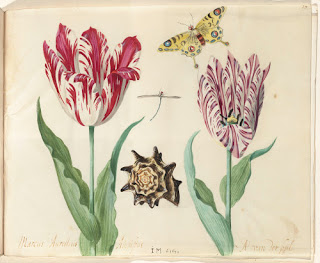
Just one of Merian’s superb paintings
of pomegranates, insects and butterflies

Alice Ibbetson (1635 - 1701)

Alice was an English watercolourist whose studies of natural forms were some of the earliest annotated studies of medicinal herbs and flowers. Brought up by her botanist father John Ibbetson, who built his renowned Physic Garden with the help of John Tradescant, her work was collected by wealthy patrons including Sir John Fairfax. Unfortunately her early studies of flowers and fruit were lost when Parliamentary troops fired her home during the English Civil War, and the family were forced to flee for their lives. John Ibbetson’s notes survive however, and are much influenced by the herbals of Nicholas Culpeper. Ibbetson’s early life was beset by tragedy, but later she made her home in New Hampshire where she continued to record native medicinal flora, some for the first time.
 
A page from Alice Ibbetson’s notebook. Her flower
paintings were much admired for their fluidity of line.

Mary Beale (1633 – 1699)

Mary Beale was the first fully professional woman artist in England. Her husband Charles even left his job as a clerk to help Mary prepare her canvases and mix her paints. He experimented with pigments and became an expert in the field. She quickly made enough from the business to support her family, including her sons Bartholomew and Charles (later an admired society miniaturist). While she painted, Charles would write up detailed notebooks in which he customarily referred to his wife as 'Dearest Heart' and described the sittings, the sitters and his own technical discoveries. The majority of his notes have been lost, but those for the years 1677 and 1681 survive in the archives of the Bodleian Library at Oxford and the National Portrait Gallery. His notebook of 1677 details a busy year: 83 commissions, bringing in earnings of £429. During the 1660s, when the plague ravaged London, Beale moved her home and workplace out of the city to the safety of Allbrook Farmhouse.

Nell Gwyl (Nell Gwyn) by Mary Beale. I can definitely see
from this painting why she would attract the notice of the King!

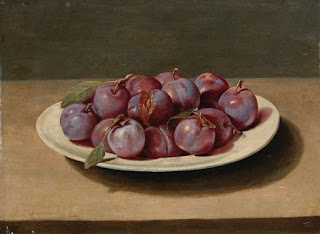
Louise Moillon (1610–1696) was one of seven children. Her father was the landscape and portrait painter Nicolas Moillon, but he died when she was an infant, and her mother when she was only twenty. Her mother’s inventory of possessions included a series of paintings on wooden panels by her daughter Louise, so it would appear that Louise showed talent from an early age. The high esteem in which her work was held is demonstrated by the fact that in 1639 Charles I of England had five still life pieces by the artist, framed in pear wood and ebony. Mouillon’s work was admired for its lifelike quality but also for its restrained stillness.


Bowl of Plums by Louise Moillon

~~~~~~~~~~~~~

I hope you enjoyed the pictures. An earlier version of this post appeared here in 2010.
www.deborahswift.com
Twitter @swiftstory

Friday, March 21, 2014

17th & 18th Century England: Histories Informing One Another

17th & 18th Century England - Philippa Jane Keyworth17th & 18th Century England - Philippa Jane Keyworth17th & 18th Century England - Philippa Jane Keyworth
By Philippa Jane Keyworth

During my studies at university I have become rather addicted to research. Now, don’t get me wrong, before I started studying my history degree I did do research for my novels….when I had to. You see, research always seemed a hassle when I was writing. I would be flying along, tapping out my story or scrawling it in illegible handwriting, and to stop and check a date or what my character would wear to the theatre in 1815 was just a hindrance to the flow.

There it is. I have been honest about it; research was to me a hindrance, not a love. In some ways it still is, but since starting at university, my whole view of history has changed, and with it so has my aversion to research, an activity so many other historical fiction authors love!

So what is university doing to change my view of research? Well, quite simply, it is showing me the interconnection of the past and how histories inform each other, and this has become very evident as I've looked at the seventeenth and eighteenth centuries in England.

The seventeenth century saw a period of rapid population expansion. London’s population grew from 80,000 to 400,000 in the hundred years between 1550-1650. This population boom put pressure on the economy. Slow economic growth meant a lack of job opportunities and food supplies.

Seventeenth century England still relied heavily upon it’s agriculture to provide food, and a series of bad harvests in the 1620s, 1630s and 1640s saw starvation and the rural poor moving into cities in order to find either work or poor relief, thus increasing the risk of plague and civil unrest.

Though the scientific revolution took place during this century, England was still far off from expanding their exports beyond the dominating wool product, and equally far off from increasing domestic manufacturing through the use of new technologies.

The economic and social pressures were added to by the religious turmoil of the day. Catholics and Protestants were still at loggerheads, and the monarchy did not help matters. The Civil War punctuated the mid 1600s, turning fathers against sons and mothers against daughters.

And then, to top it all off, in 1688, the Glorious Revolution took place. Thank goodness it was a bloodless revolution! It was the beginning of the truly constitutional monarchy; some say the start of the Enlightenment. All in all, when taking a very broad overview, the seventeenth century is not one I would have particularly liked to make my home in, and it stands in huge contrast to its descendant, the eighteenth century.

Dorothy Marshall dubs the eighteenth century as ‘… ‘the Age of Challenge Contrast and Compromise.’’ Most of all, in comparison to many of the preceding centuries, the eighteenth was one of relative stability. Though there were bad harvests they did not repeat themselves incessantly as they had before and therefore did not cause the mass starvation of previous centuries. Outbreaks of plague began to lessen, none decimating the population as they had in the fourteenth century. The monarchy was now constitutional, established with William III, and continued without abusing the English people to the same extent of Charles I and his penchant for prerogative taxation.

Even religion changed. Enlightened thought was a new philosophy running through the courts of Europe, preaching equality between men, God as benevolent not malevolent, and pleasure as the highest achievement.

The still growing population was now supported by an expanding economy. As Beverly Lemire surmises in her article on the second hand clothes trade, the general standard of living was higher. Labourers now had surplus income not needing to be spent on essentials such as food. The new money went on luxuries like jewellery and clothing. The rise of consumerism had begun and the working and middling classes began their ascent through society.

Towards the end of the century the industrialisation of Britain began. Silk throwing factories, spinning machines, all of them made lighter work, created more jobs in cities and moved people away from their rural crafts to begin massive urbanisation.

However, the eighteenth century, like the seventeenth, was not without its turmoil. The American Revolution of 1775 saw the outworking of Enlightened thought and the loss of the English colonies. It also resulted in the bankruptcy of the French government, one of the factors that sparked the French Revolution of 1789. This in turn sparked a series of European wars.

It is narrow-minded and terribly whiggish to think that history is simply a recording of human progress, however, it is hard to view the seventeenth and eighteenth centuries without coming to similar conclusions.

What can be seen most however, is the insight into how histories interconnect and inform one another. Without the religious persecutions of the previous two centuries, one could argue the Enlightenment would not have come about. Without religious persecution, the colonies of America might never have attracted so many brilliant-minded people, nor perhaps would the colonies have cast off their kin across the Atlantic. Without the American Revolution, the French government may not have become bankrupt and thus a large factor on the run up to the French Revolution would have been taken out of play. Without the rapid expansion of the population of the seventeenth century, eighteenth century England would not have had to improve manufacturing techniques, grow industry and the economy and thus begin the industrialisation of England which would eventually lead to the Industrial Revolution.

I realise this is all conjecture on my part but it does fascinate and show that history is interconnected. So, I’ll end this post by saying, I cannot deny it, the more I see histories informing each other, the more I want to research!

References:

The Stuart Age: England 1603-1714 by Barry Coward

Eighteenth Century England by Dorothy Marshall

~~~~~~~~~~~~~

Philippa Jane Keyworth, known to her friends as Pip, has been writing since she was twelve in every notebook she could find. Whilst she dabbles in a variety of genres, it was the encouragement of a friend to watch a film adaptation of Jane Austen's Pride and Prejudice that would start the beginning of her love affair with the British Regency. Her debut novel, The Widow's Redeemer (Madison Street Publishing, 2012), is a traditional Regency romance bringing to life the romance between a young widow with an indomitable spirit and a wealthy viscount with an unsavory reputation.

The Widow's Redeemer - Regency Romance - Philippa Jane Keyworth

The Widow's Redeemer @ Amazon UK

The Widow's Redeemer @ Amazon USA

Tuesday, November 19, 2013

The Lost Children of Charles I

by Anita Davison


This post originally appeared in Hoydens and Firebrands in 2009, but it attracted so much interest at the time I wanted to repeat and expand on it here.

Charles I's Children - Mary, James, Charles Elizabeth and Anne

On 1 May 1625 Charles I was married by proxy to fifteen-year-old Henrietta Maria in front of the doors of the Notre Dame de Paris, before his first Parliament, who disapproved of a Catholic bride for the English king, could meet to forbid the banns.

Charles James, Duke of Rothesay and Cornwall (13 May 1629); their first child, was stillborn.

Elizabeth Stuart

Princess Elizabeth 'Temperance'
Born in 1635, Princess Elizabeth was called "Temperance" due to her pious and gentle nature. When she was seven, her father, Charles I marched into the House of Commons with troops to demand the arrest of five MPs, an action which resulted in open revolt where the royal family were forced to flee to Oxford for their safety.

The King and two elder sons, Charles and James, established a new royalist government at Oxford, but the Commons refused permission for Elizabeth and two-year-old Henry to join their parents, keeping them virtual prisoners at St. James's Palace. 

Their mother and baby sister, Henriette Anne, born in 1644, eventually fled to the continent, but Elizabeth never saw her mother again.

A sickly child, Elizabeth broke her leg in 1643 when she was eight and moved to Chelsea with her brother where she was tutored by the female scholar, Bathsua Makin. At this young age she could read and write Hebrew, Greek, Latin, Italian and French and the scriptures in their original tongues.

When Elizabeth was ten, her hostess the Countess of Dorset died and she and Henry were placed in the care of the Duke of Newcastle in a house on the Thames. James, Duke of York was allowed to visit, but Elizabeth was concerned about him being around the king's enemies for any length of time and provided the clothes, and perhaps the plan for his successful escape to the continent.

In 1647, Elizabeth and Henry were living at the country home of the Countess of Leicester. The French ambassador described her as a "budding young beauty" characterised by grace, dignity, sensibility and intelligence. Unlike her father she could judge characters and understand different points of view. But she was powerless, distraught and saddened as the tragedy of the English revolution unfolded. As parliamentary prejudice hardened, the Countess of Leicester was ordered to treat her royal charges without special privileges.

In January 1649, when Charles was tried, found guilty of treason and condemned to death, Elizabeth wrote a long letter to Parliament requesting permission to join her sister, Princess Mary, in Holland. This request was refused until after the execution had taken place.

On the day after Elizabeth's 13th birthday, King Charles was allowed one last meeting with Elizabeth and Henry. The prematurely aged king told her not to grieve as he would die a martyr and he gave her a Bible, which she kept close at hand for the rest of her short life.

The royal children were stripped of their titles and no one was allowed to kiss their hands or treat them as royal. Prince Henry, Duke of Gloucester was now merely “Mr Harry”. Parliament continued to treat them with consideration, but the myth that they planned to marry Elizabeth to a commoner and apprentice Henry to a trade is royalist propaganda.
Elizabeth wrote an account of her last meeting with her father before his execution which was found among her possessions when she died in September 1650:

He bid us tell my mother that his thoughts had never strayed from her, and that his love would be the same to the last. Withal, he commanded me and my brother to be obedient to her; and bid me send his blessing to the rest of my brothers and sisters, with communications to all his friends. Then, taking my brother Gloucester on his knee, he said, 'Sweetheart, now they will cut off thy father's head.' And Gloucester looking very intently upon him, he said again, "Heed, my child, what I say: they will cut off my head and perhaps make thee a king. But mark what I say. Thou must not be a king as long as thy brothers Charles and James do live; for they will cut off your brothers' heads when they can catch them, and cut off thy head too at the last, and therefore I charge you, do not be made a king by them.' At which my brother sighed deeply, and made answer: 'I will be torn in pieces first!' And these words, coming so unexpectedly from so young a child, rejoiced my father exceedingly. And his majesty spoke to him of the welfare of his soul, and to keep his religion, commanding him to fear God, and He would provide for him. Further, he commanded us all to forgive those people, but never to trust them; for they had been most false to him and those that gave them power, and he feared also to their own souls. And he desired me not to grieve for him, for he should die a martyr, and that he doubted not the Lord would settle his throne upon his son, and that we all should be happier than we could have expected to have been if he had lived; with many other things which at present I cannot remember.

In July 1650, the ruling Council of State decided to move Elizabeth and Henry to their father's former prison, Carisbrooke Castle. Elizabeth complained that her health was not equal to moving, but it went ahead anyway; taken there by the king's former servant Anthony Mildmay, described as, "at heart a knave".

Elizabeth had always suffered ill health, possibly including rickets. On the Monday after her arrival she caught a chill that developed into a fever which turned into headaches and fitting. On the morning of Sunday the 11th September 1650, Elizabeth was found dead, her head resting on the open Bible that had been her father's parting gift. Ironically three days later, unaware of the tragedy, the Council of State decided on her release so that she could join her elder sister Mary in the Netherlands. (Henry was released to Mary in early 1653).

Elizabeth's coffin was laid in a vault under the floor of St Thomas Church in Newport, Isle of Wight, with a stone marked "E.S." for Elizabeth Stuart as her only memorial. She was fourteen years old.

Princess Elizabeth's Tomb Sculpted by Carlo Marochetti

In the 1850s Victoria and Albert, whose holiday home, Osborne House is on the Isle of Wight, hired Carlo Marochetti, an Italian sculptor to complete a new tomb for Elizabeth in Carrara marble. Completed in 1856, Queen Victoria was so impressed with the result, she hired the same sculptor to carve the mausoleum statue for herself and Albert.

Anne Stuart

Anne was born on 17 March 1637 at St. James's Palace, the seventh child and third daughter. She was baptised on 30 March by William Laud, the Anglican Bishop of London. 

Anne was a sickly child, frail and slightly deformed. She contracted tuberculosis, and on the 5th November 1640, at the age of three, died at Richmond Palace. She was buried in Westminster Abbey, next to her brother Charles James.

Catherine Stuart  - 29 June 1639, lived a few hours.

Henry Stuart, 1st Duke of Gloucester and Duke of Cambridge - born 8 July 1640 also known as Henry of Oatland.

Henry, Duke of Gloucester and Cambridge

After his father's defeat at the end of the English Civil War, Henry and his elder sister Elizabeth were captured.  During the debates as to what regime should succeed the now abolished monarchy, Parliament was briefly suggested Henry be placed on the throne, and made to govern as a limited, constitutional monarch.

Considered young enough not to have been "corrupted" by the Catholic and absolutist views of his parents, Parliament felt he might be tutored to accept their perspective. However, the Rump Parliament opted instead to establish of a Republican Commonwealth. 

In 1652, Oliver Cromwell agreed to release Elizabeth and Henry, although it was too late for Elizabeth. Henry joined his mother and brothers in Paris, but as a staunch Protestant, he quarrelled bitterly with his mother, who was determined to convert him to Catholicism. In her view 'England was finished' and Henry needed to be acceptable to a European Catholic bride. Their mutual dislike reached such a level, that Henrietta expelled him from Paris.

Henry joined the Spanish armies fighting at Dunkirk where he met the Prince of Condé.  Henry was a good soldier and distinguished himself in battle, gaining an enviable reputation and formed a strong bond with the agnostic Condé,  and it was suggested that Henry might marry Condé's niece.

After the conclusion of peace between France and Spain, Henry lived at one of Condé's estates. After Oliver Cromwell's death and collapse of the Commonwealth, he was reunited with his brothers Charles and James. He returned to England as part of Charles' triumphant progress through London in May 1660, and took up residence in Whitehall.

He was created Duke of Gloucester and Earl of Cambridge by Charles II in 1659, but died of smallpox in September 1660, four months after reaching England again.  Much to his brother's distress, Henrietta Maria refused to see him as he lay dying. He was 20.


This mourning locket for Henry of Gloucester was discovered at Ham House and was believed to have belonged to Elizabeth Dysart and probably held a lock of his hair. 

Tuesday, September 4, 2012

Undergarments Revealed

by Diane Scott Lewis

Undergarments Revealed, 17th and 18th Century.

Determined to do accurate research on my historical novels, the most difficult and interesting task was to find out what people wore under all that clothing. Many writers have erred in this area, as in mentioning “bloomers” in the eighteenth century, an item which didn’t come into use until the 1850’s. My interests are mainly in the eighteenth to early nineteenth century, but for this post I’m slipping back into the seventeenth as well.

While in previous years undergarments were utilitarian, to throw off the strict hand of the Puritans, under the Stuarts underclothes took on more of a sexual allure.
A man’s shirt became ruffled and more visible, with puffed sleeves tied in ribbons, to show him off as a fine gentleman.

Women’s dresses became less rigid, and cut to flaunt pretty petticoats. The petticoat, often several of them, was worn to give the outer gown a better shape, and I’m certain, important for warmth. It was often of embroidered or ruffled material in bright, attractive colors.

Poet Robert Herrick wrote in 1650: A sweet disorder in the dress kindles in clothes a wantonness.

Beneath their dresses, next to their skin, women wore chemises or smocks made of Holland, and heavily perfumed to diffuse body odors.
Sleeves were long and sometimes trimmed in lace. In the 1660’s dress sleeves were shortened to reveal the evocative chemise. Silk and linen were also popular materials because they harbored less vermin than wool. Wool fell out of favor, prompting Charles II to legislate that everyone must be buried in wool garments to promote the British wool industry.

With the extreme décolletage of the gowns, corsets or “stays” had no shoulder straps.
The corset was heavily boned with a long busk in front and was laced tightly at the back. People of the time commented that young women were foolish to want such “whalebone prisons” for fashion, and left themselves open to consumptions.

Drawers, what we know today as underwear or knickers, were worn by French women, but there’s no evidence that Englishwomen wore such an item in this era. Although a country race where women ran to win a new smock said the girls wore half-shirts and drawers. So it is still a mystery.

In the eighteenth century the hoop came into fashion again, reminiscent of the farthingale of the sixteenth century. These pushed out dress skirts and the women walked holding them to one side like a bell to reveal their fancy under-petticoats, and the shape of their legs. This must have been dangerous considering the women wore no knickers. The hoop or pannier, especially in Court dress, pushed the sides of gowns out to ridiculous proportions where women had to walk sideways to fit through doors. Later in the century, panniers became narrower and the corset lighter, lacing in the front as well as back.

Men still revealed their fancy shirts by leaving their waistcoats unbuttoned to attract the ladies. Men’s drawers are another mystery.
Some reports have them wearing such items—a loose fitting garment that tied at the waist and on each leg—but other sources say that men wore long shirts that covered their privates in their breeches. Breeches had linings of detachable washable material, which no doubt served the purpose of drawers.

During the French Revolution after 1789 the classic style pervaded, and women discarded their corsets and confining gowns for simple, high-waisted Greek style chemises. Many women dampened these dresses to show off the fact they were naked beneath. It would take the stringent Victorian age to turn fashion to a more modest level and bring back restrictive undergarments.

Information garnered from my own research and The History of Underclothes, by C. Willett and Phillis Cunnington, 1992 edition.
Check out the results of my research in my debut novel, adventure and romantic elements in eighteenth century England.

Diane Scott Lewis has three published historical novels. Visit her website at: