Showing posts with label Eighteenth Century England. Show all posts

Sunday, June 7, 2015

Lacock Village, a Town Preserved in Time

by Diane Scott Lewis

In 2000, when I was traveling through England researching my eighteenth century novels, my husband and I visited the city of Bath. I discovered that an eighteenth century village, perfectly preserved, was nearby along with Lacock Abbey; unfortunately the abbey was closed. We took the tour of this fascinating step back in time.

A settlement had existed here in this rural county of Wiltshire since the Iron Age. The Saxons called the Bide Brook, which flows through the village, “lacuc” meaning “little stream.” In the Domesday Book, Lacock is said to have belonged to Edward Salisbury, Sheriff of Wiltshire.


Though touted as an eighteenth century village, several buildings date to an earlier time.

Lacock Abbey was founded in the early thirteenth century and most of the inhabitants of the village were tenants of the abbey. They were expected to perform various duties on the manor lands in return for their holdings, such as spreading dung over the fields. At certain times the village folk might be granted milk from one cow for eight days. They paid their rents in kind: corn; hides; and fleeces were collected in the still-standing fourteenth century tithe barn.

The tithe barn is of cruck beam construction, (a curved beam, one of two, which supports the roof of a building) as is the Cruck House on the corner of Church Street. The curved beam can be seen on the outside of the Cruck House, and is a rare example of this construction in south England.


During the Middle Ages, Lacock thrived with its wool industry. In the fifteenth century wide looms were introduced and many houses were built with broad first floor rooms to lodge them. The large size of several houses shows the wealth of these inhabitants. Some of the dwellings still have their “horse passages.” These narrow passages allowed for horses to be led from the street through the house, and to the stables in the backyard.

At the Dissolution of the Abbeys, Sir William Sharington, from a wealthy Norfolk family, bought the property in 1539 for £783. After nefarious dealings with coinage that involved Lord Thomas Seymour, Sharington confessed, blamed Seymour (who was beheaded) and had to buy the properties back at £8,000. His sixteenth century brewery remains in the Abbey courtyard.

Sharington’s holdings passed to his brother Henry, and Henry’s youngest daughter Olive married Sir John Talbot. Talbot’s family has been connected with Lacock ever since.

Talbot made many changes to the Abbey and the village changed as well. Brick buildings were added in the eighteenth century, or facades were simply bricked-over.


This included the Red Lion public house which dates from 1740.

The oldest public house in Lacock (700 years) is the George Inn in West Street, which holds the longest continuously held liquor license in the West Country. My husband and I had lunch there. If I remember right, there was a dog wheel built in the wall, where dogs were once “encouraged” by hot sticks to run and turn the spit for roasting meat in the huge hearth.


Lacock’s wool trade came to an end with the general decline in the West Country during the Industrial Revolution.

In 1916 Charles Henry Fox Talbot bequeathed the Lacock estate to his niece, Matilda Gilchrist-Clark. She took the name of Talbot. In 1944, she gave the estate, 285 acres, the Abbey and the village to The National Trust.

Sources: Lacock, an illustrated souvenir, The National Trust, 1999
Wikipedia

Lacock photos taken by George Parkinson (author's husband)

~~~~~~~~~~~~~

If you’d like to know more about me and my novels, please visit my website:
http://www.dianescottlewis.org



Sunday, April 26, 2015

Deadly or a Curative-poisons in medications

by Diane Scott Lewis

Toxins and poisonous plants have been utilized for centuries in medications. A Persian physician in the tenth century first discovered that poisons such as mercury could be employed as curatives and not only for applying on the tip of an arrow/spear to kill your enemy. But poisons had to be managed carefully.

Plants, long the healing forte of the wise-woman in England, were a common ingredient in medicinal "potions," though many had deadly qualities.

The foxglove, with its beautiful hooded, purple bloom is fatal if eaten.

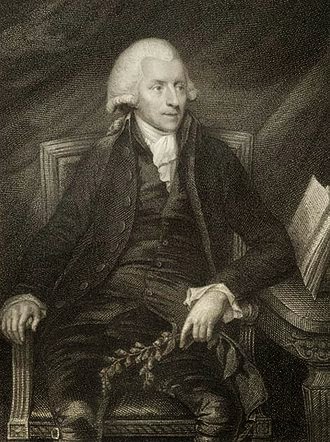
William Withering
But eighteenth century British physician, William Withering, used infusions of this plant to treat dropsy (now known as edema).

Later, digitalis for heart failure, was created from this plant.

Rosy periwinkle is also toxic to eat. However, in traditional Chinese and Indian medicine, it’s used to treat diabetes and constipation.

More well known is the Opium poppy, used to make morphine (and unfortunately heroin-the killer of many an addict). Morphine is invaluable as a pain reliever for the sickest of patients. Small doses of other deadly toxins such as henbane, hemlock and mandrake have been employed to ease the pain of surgeries. But a dose slightly too high would kill the patient.


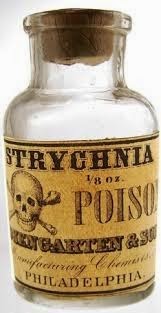
Strychnine, derived from a tree seed or bark, was made into medicines to raise blood pressure. It was first marketed as a poison to kill rodents.

In Shakespeare’s time, poisonous extracts were added to cough medicines. Opiates were common in cough remedies, mainly for sedation. Mrs. Cotton in the seventeenth century suggested a mixture of vinegar, salad oil, liquorice, treacle, and tincture of opium when "the cough is troublesome."

No one yet understood the addictive nature of some of these drugs—if the patient lived to find out.

The chemical element mercury, another toxin, was used starting in the 1500’s to treat syphilis.

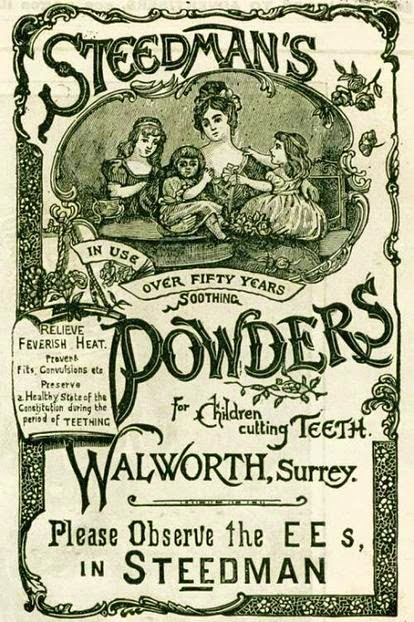
Well into the twentieth century, mercury was an ingredient in purgatives and infant’s teething powder.

Arsenic is another poison (also utilized to kill rats) that was commonly added to medications. A chemical element, arsenic is found in many minerals. In the 18th to 20th centuries, arsenic compounds, such as arsphenamine (by Paul Ehrlich, 1854-1915) and arsenic trioxide (by Thomas Fowler, 18th c.) were popular. Arsphenamine was also used to treat syphilis. Arsenic trioxide was recommended for the treatment of cancer and psoriasis.

Numerous people suffered adverse effects or died after the ingestion of these lethal ingredients.

In my recent release, The Apothecary’s Widow, arsenic is found in the tinctures used to treat the ague of Lady Pentreath. Unfortunately, arsenic is not normally one of the ingredients listed in that cure, and never in such a large dose.


Who murdered Lady Pentreath, her miserable husband, Branek, or the apothecary Jenna who prepared the medicines, a widow about to be evicted from her shop, which is owned by the Pentreaths? A corrupt constable threatens to send them both to the gallows.

Click here to purchase The Apothecary’s Widow.

To find out more about my novels, please visit my website:

http://www.dianescottlewis.org

Sources:

livescience.com
The Power of Poison: Poison as Medicine, the American Museum of Natural History

William Buchan, Domestic Medicine: or, a treatise on the prevention and cure of diseases by regimen and simple medicines [second edition] (London: 1772)

Wikipedia

Monday, October 20, 2014

The Independent English Domestic

by Diane Scott Lewis

In the eighteenth century, a time when domestic service was seen as easier than toiling in a shop or factory, a poor farmer’s sons and daughters would go happily into this type of work. Even a parson’s family did not look down on the occupation. However, the English domestics thought of themselves as a cut above.

The English servant was quite independent and rarely satisfied with low wages. Instead of being content in the early part of the century with £2 a year, they were demanding as much as £6 and £8. Writer Daniel Defoe wanted to see wages fixed at no more than £5, or soon this rabble would insist on as much as £20.

Lord Fermanagh, when writing to a friend about his butler, who had the audacity to ask for £10, said: "I would have a sightly fellow and one that has had the smallpox, and an honest man, for he is entrusted with store of plate, and can shave, but I will give no such wages as this."

The English servant stood up for himself, giving notice or running away if ill-treated. One servant, after being struck by his master, turned on the man and killed him with a pitchfork.

Foreigners were amazed—since they treated their servants like slaves—to see a nobleman like Lord Ferrers hanged in 1760 for the murder of his steward.

In the earlier part of the century there was a scarcity of women servants, but later, after years of bad harvests, starvation sent many girls into service. One lady, upon advertising for another housemaid, had over 200 applicants.

If wages were low, servants in a large house could supplement their pay with vails (tips). One foreigner complained after dining with a friend at his home: "You’ll find all the servants drawn up in the passage like a file of musqueteers from the house steward, down to the lowest liveried servant, and each of them holds out his hand to you in as deliberate a manner as the servants in our inns on the like occasion."

One clergyman reported that when he dined with his Bishop, he spent more in vails than would have fed his family for a week.

At lease the Duke of Ormonde, when inviting a poor relation to dine, always sent him a guinea ahead of time for the vails.

A movement, rumored to have started in Scotland, was put forth to abolish vails, but nothing came of it.

If servants believed themselves independent, striving for respect, their employers often demanded too much from them for little pay. Mrs. Purefoy advertised for a coachman who can not only drive four horses but must understand husbandry business and cattle, plus he’d also be expected to plough. She also required a footman who could "work in the garden, lay the cloth, wait at table, go to the cart with Thomas, and do any other business that he is ordered to do and not too large sized a man, that he may not be too great a load for the horse when he rides."

Servants were derided by their "betters" as being lazy and selfish, especially when they’d leave their positions for higher wages and vails.


Of course, many servants during the eighteenth century—especially in the larger towns and cities—were mistreated and far underpaid, if paid at all.

Still, some servants were honored and treated as members of the family, as shown by this epitaph on a coachman’s headstone: Coachman the foe to drink and heart sincere; Of manners gentle and of judgment clear; Safe through the chequered track of life he drove; And gained the treasure of his master’s love...

~~~~~~~~~~~~~

Diane Scott Lewis. To learn more about her eighteenth-century novels, please visit her website:

http://www.dianescottlewis.org
Source: English Country Life in the Eighteenth Century, by Rosamond Bayne-Powell, 1937


Thursday, August 21, 2014

Apple Peels and Snails to Snare a Husband in the Eighteenth Century?

by Diane Scott Lewis

Folklore abounds in the villages of England around the single girl’s search for a husband—as in the eighteenth century marriage was what most young women had to look forward to, or they’d be ridiculed and regulated to spinsters, farmed out as governesses, or forced to live on the charity of their family.

Most of these search-for-true-love customs revolved around the seasons.

At the ruined Abbey of Cerne Abbas in Dorsetshire, girls flocked around the wishing-well in all seasons. To obtain their heart’s desire, they’d pluck a leaf from a nearby laurel bush, make a cup of it, dip this in the well, then turn and face the church. The girl would then "wish" for presumably a man she already has in mind, but must keep this wish a secret or it wouldn’t come true.

Other customs included, in Somersetshire on May Day Eve or St. John’s Eve, a lass putting a snail on a pewter plate. As the snail slithered across the plate it would mark out the future husband’s initials.

On another ritual to this end, writer Daniel Defoe remarked by saying: "I hope that the next twenty-ninth of June, which is St. John the Baptist’s Day, I shall not see the pastures adjacent to the metropolis thronged as they were the last year with well-dressed young ladies crawling up and down upon their knees as if they were a parcel of weeders, when all the business is to hunt superstitiously after a coal under the root of a plantain to put under their heads that night that they may dream who should be their husbands."

Throwing an apple peel over the left shoulder was also employed in the hopes the paring would fall into the shape of the future husband’s initials. When done on St. Simon and St. Jude’s Day, the girls would recite the following rhyme as they tossed the peel: St. Simon and St. Jude, on you I intrude, By this paring I hold to discover, without any delay please tell me this day, the first letter of him, my true lover.


On St. John’s Eve, his flower, the St. John’s Wort, would be hung over doors and windows to keep off evil spirits, and the girls who weren’t off searching for snails in the pastures would be preparing the dumb cake. Two girls made the cake, two baked it, and two broke it. A third person would put the cake pieces under the pillows of the other six. This entire ritual must be performed in dead silence-or it would fail. The girls would then go to bed to dream of their future husbands.

On the eve of St. Mary Magdalene’s Day, a spring of rosemary would be dipped into a mixture of wine, rum, gin, vinegar, and water. The girls, who must be under twenty-one, fastened the sprigs to their gowns, drink three sips of the concoction, then would go to sleep in silence and dream of future husbands.

On Halloween, a girl going out alone might meet her true lover. One tale has it that a young servant-maid who went out for this purpose encountered her master coming home from market instead of a single boy. She ran home to tell her mistress, who was already ill. The mistress implored the maid to be kind to her children, then this wife died. Later on, the master did marry his serving-maid.

Myths and customs were long a part of village life when it came to match-making.


In my novel, Ring of Stone, which takes place in eighteenth-century Cornwall, my heroine Rose will experience magic on All Hallows Eve and glimpse her future husband-a most inappropriate man-over her shoulder.

~~~~~~~~~~~~~

For more on Diane Scott Lewis’s novels, visit her website: http://www.dianescottlewis.org
Source: English Country Life in the Eighteenth Century, by Rosamond Bayne-Powell, 1935.

Friday, March 21, 2014

17th & 18th Century England: Histories Informing One Another

17th & 18th Century England - Philippa Jane Keyworth17th & 18th Century England - Philippa Jane Keyworth17th & 18th Century England - Philippa Jane Keyworth
By Philippa Jane Keyworth

During my studies at university I have become rather addicted to research. Now, don’t get me wrong, before I started studying my history degree I did do research for my novels….when I had to. You see, research always seemed a hassle when I was writing. I would be flying along, tapping out my story or scrawling it in illegible handwriting, and to stop and check a date or what my character would wear to the theatre in 1815 was just a hindrance to the flow.

There it is. I have been honest about it; research was to me a hindrance, not a love. In some ways it still is, but since starting at university, my whole view of history has changed, and with it so has my aversion to research, an activity so many other historical fiction authors love!

So what is university doing to change my view of research? Well, quite simply, it is showing me the interconnection of the past and how histories inform each other, and this has become very evident as I've looked at the seventeenth and eighteenth centuries in England.

The seventeenth century saw a period of rapid population expansion. London’s population grew from 80,000 to 400,000 in the hundred years between 1550-1650. This population boom put pressure on the economy. Slow economic growth meant a lack of job opportunities and food supplies.

Seventeenth century England still relied heavily upon it’s agriculture to provide food, and a series of bad harvests in the 1620s, 1630s and 1640s saw starvation and the rural poor moving into cities in order to find either work or poor relief, thus increasing the risk of plague and civil unrest.

Though the scientific revolution took place during this century, England was still far off from expanding their exports beyond the dominating wool product, and equally far off from increasing domestic manufacturing through the use of new technologies.

The economic and social pressures were added to by the religious turmoil of the day. Catholics and Protestants were still at loggerheads, and the monarchy did not help matters. The Civil War punctuated the mid 1600s, turning fathers against sons and mothers against daughters.

And then, to top it all off, in 1688, the Glorious Revolution took place. Thank goodness it was a bloodless revolution! It was the beginning of the truly constitutional monarchy; some say the start of the Enlightenment. All in all, when taking a very broad overview, the seventeenth century is not one I would have particularly liked to make my home in, and it stands in huge contrast to its descendant, the eighteenth century.

Dorothy Marshall dubs the eighteenth century as ‘… ‘the Age of Challenge Contrast and Compromise.’’ Most of all, in comparison to many of the preceding centuries, the eighteenth was one of relative stability. Though there were bad harvests they did not repeat themselves incessantly as they had before and therefore did not cause the mass starvation of previous centuries. Outbreaks of plague began to lessen, none decimating the population as they had in the fourteenth century. The monarchy was now constitutional, established with William III, and continued without abusing the English people to the same extent of Charles I and his penchant for prerogative taxation.

Even religion changed. Enlightened thought was a new philosophy running through the courts of Europe, preaching equality between men, God as benevolent not malevolent, and pleasure as the highest achievement.

The still growing population was now supported by an expanding economy. As Beverly Lemire surmises in her article on the second hand clothes trade, the general standard of living was higher. Labourers now had surplus income not needing to be spent on essentials such as food. The new money went on luxuries like jewellery and clothing. The rise of consumerism had begun and the working and middling classes began their ascent through society.

Towards the end of the century the industrialisation of Britain began. Silk throwing factories, spinning machines, all of them made lighter work, created more jobs in cities and moved people away from their rural crafts to begin massive urbanisation.

However, the eighteenth century, like the seventeenth, was not without its turmoil. The American Revolution of 1775 saw the outworking of Enlightened thought and the loss of the English colonies. It also resulted in the bankruptcy of the French government, one of the factors that sparked the French Revolution of 1789. This in turn sparked a series of European wars.

It is narrow-minded and terribly whiggish to think that history is simply a recording of human progress, however, it is hard to view the seventeenth and eighteenth centuries without coming to similar conclusions.

What can be seen most however, is the insight into how histories interconnect and inform one another. Without the religious persecutions of the previous two centuries, one could argue the Enlightenment would not have come about. Without religious persecution, the colonies of America might never have attracted so many brilliant-minded people, nor perhaps would the colonies have cast off their kin across the Atlantic. Without the American Revolution, the French government may not have become bankrupt and thus a large factor on the run up to the French Revolution would have been taken out of play. Without the rapid expansion of the population of the seventeenth century, eighteenth century England would not have had to improve manufacturing techniques, grow industry and the economy and thus begin the industrialisation of England which would eventually lead to the Industrial Revolution.

I realise this is all conjecture on my part but it does fascinate and show that history is interconnected. So, I’ll end this post by saying, I cannot deny it, the more I see histories informing each other, the more I want to research!

References:

The Stuart Age: England 1603-1714 by Barry Coward

Eighteenth Century England by Dorothy Marshall

~~~~~~~~~~~~~

Philippa Jane Keyworth, known to her friends as Pip, has been writing since she was twelve in every notebook she could find. Whilst she dabbles in a variety of genres, it was the encouragement of a friend to watch a film adaptation of Jane Austen's Pride and Prejudice that would start the beginning of her love affair with the British Regency. Her debut novel, The Widow's Redeemer (Madison Street Publishing, 2012), is a traditional Regency romance bringing to life the romance between a young widow with an indomitable spirit and a wealthy viscount with an unsavory reputation.

The Widow's Redeemer - Regency Romance - Philippa Jane Keyworth

The Widow's Redeemer @ Amazon UK

The Widow's Redeemer @ Amazon USA

Thursday, February 20, 2014

A Fictitious Young Lady of Fashion in the 1700's

By Rosanne E. Lortz

In the year 1926 a manuscript titled The Diary of a Young Lady of Fashion in the Year 1764-1765 was published. The book purported to be a recently unearthed diary which had been written by the witty, effervescent, and not entirely wise Cleone Knox, a young lady who had traveled around eighteenth century Europe meeting notable figures like King Louis XV and the philosopher Voltaire. The diary was a publishing success, well-received by twentieth century literary critics. The diary also happened to be a fraud.

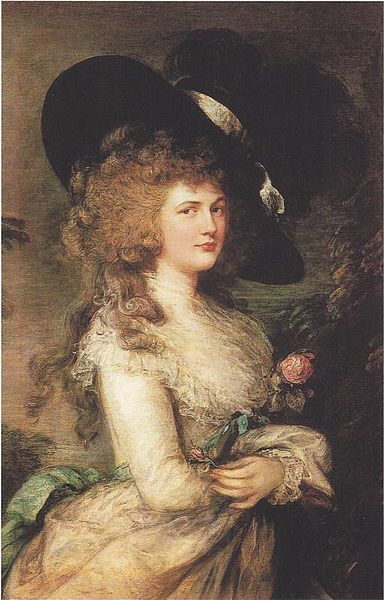
A Gainsborough portrait of a fashionable lady
from the same era as Cleone Knox

Cynthia Crossen of The Wall Street Journal writes that:
Critics declared the diary authentic partly because it contained obsolete expressions and spelling and lots of capital letters. "Her diary must take its place beside that of Mr. Pepys," one critic wrote. Another opined, "No modern girl will ever write a diary like this. Cleone Knox breathes the very spirit of the witty, robust, patriotic, wicked, hard-drinking, hard-swearing 18th century."
It was only after the diary went through several printings both in America and England that the real author of the eighteenth century memoirs fessed up. The book had been written by Magdalen King-Hall, a nineteen-year-old with a lively imagination and a penchant for jokes. "If I had realized that so many distinguished persons would take it seriously,” said King-Hall, “I would have spent more time and pains on it."

Cleone’s visit with Voltaire is an especially memorable episode, mostly because of how irreverent it is. "The great man received us in a chintz dressing gown,” she wrote—or rather, King-Hall wrote. “To tell the truth, he reminded me of nothing so much as a chattering old magpie. We listened, silent, with the Respect which is due to Genius, however Wearisome it may be.

But it is the opening entry in the diary which is my favorite, the entry which sets the tone for the rest, and the entry in which King-Hall introduces her eighteenth-century protagonist.
March 3rd  
This morning had a vastly unpleasant interview with my Father. Last night, Mr. Ancaster, who is the indescreetest young man alive, was seized suddenly while riding home along the shore with the desire to say good night to me. He climbed the wall, the postern gate being locked at the late hour, and had the Boldness to attempt to climb the ivy below my window; while but half way up the Poor Impudent young man fell. (If he hadn’t, Lord knows what would have happened, for I am terribly catched by the Handsome Wretch.) As ill luck would have it, Papa and Ned, who were conversing in the library, looked out at the moment and saw him lying Prostrate on the ground! 
No need to describe the scene that followed. My Father it seems thinks me guilty of Indescretion and Immodesty, though why I don’t know, for I was sound asleep the whole time and never heard so much as an Oath (and I dare swear there were plenty flying round!). My father said some mighty unkind things to me this morning and I wept loudly for more than Half an Hour. 
Men are such Silly Fools. 
Although the book turned out to be more fictitious than factual, it still managed to enthrall twentieth century readers who were as “terribly catched” by the clever Cleone as she was by the “indescreet” Mr. Ancaster. In The Diary of a Young Lady of Fashion, we experience the winsomeness of a young woman who may not really have lived, but still manages to fill the pages of history as one of the eighteenth century’s most memorable heroines—historical fiction at its best.

Magdalen King-Hall went on to become a historical novelist in a more forthright fashion, writing historicals set during the Crusades, and also in sixteenth, seventeenth, and—yes—eighteenth century England. Her novel The Life and Death of the Wicked Lady Skelton, the story of a lady and a highwayman, was made into a film the same year it was published, receiving the title The Wicked Lady (1945) and starring Margaret Lockwood and James Mason.

_________________

Rosanne E. Lortz is the author of two books: I Serve: A Novel of the Black Prince, a historical adventure/romance set during the Hundred Years' War, and Road from the West: Book I of the Chronicles of Tancred, the beginning of a trilogy which takes place during the First Crusade.

You can learn more about Rosanne's books at her Official Author Website where she also blogs about writing, mothering, and things historical.


_________________

BIBLIOGRAPHY

Crossen, Cynthia. “This Column Is Real, But Not All Authors Stick to the Truth.” The Wall Street Journal (April 7, 2008). http://online.wsj.com/article/deja_vu.html.

Knox, Cleone. The Diary of a Young Lady of Fashion in the year 1764-1765. Edited by Alexander Blacker Kerr. New York: D. Appleton and Co., 1926.

Monday, January 20, 2014

Clothing as a Map to the Past

By Philippa Jane Keyworth

Medieval Clothing - Clothing as a Map to the Past by Philippa Jane Keyworth
Richard Grassby wrote in his article ‘Material Culture and Cultural History’ in the Journal of Interdisciplinary History, that ‘Clothes in a draw have no meaning, but when worn they become a uniform with social and moral implications.’

I am a woman, and I love clothes. What a stereotype – except that if you continued to talk to me about them, you would see that I have an obsession with clothes of bygone ages rather than what’s in high-street stores right now.

As an amateur historian, I am coming to the firm conclusion that to assume people just wore certain clothes because they liked them is missing a much broader range of motivations. There were many reasons individuals in the past chose to wear what they wore.

Many previous historians have given the main motivation, when people were choosing what to wear, as ‘social emulation’. The basic meaning of this being to dress like your betters and hope to rise through society’s ranks. Of course that is a just consideration. It is clear from eighteenth century accounts of working and middle class people that they would dress like their betters in order to enhance their job prospects and to feed their social aspirations. How many people have bought Ugg boots in the last few years because everyone else has a pair?

The idea I would like to present to you is one that sees a host of other motivations as well, and that these motivations often reflected the contemporary social, economic and political events of the day. ‘I’m confused!’ you say – but have no fear, I wish to give some examples to better explain my theory!

Whilst studying the medieval period, I was astonished to find that there were such things as sumptuary laws. These laws were designed to govern the wearing of sumptuous dress, restricting certain clothing to the rich and certain clothing to the poor. This way, if someone were to look at someone else on the street, they would be able to determine their rank within society immediately. This is much like a football player wearing his team colours.

The clearest example of these laws is in furs. Rich people were allowed to wear furs such as ermine, whilst poor people were confined to furs such as squirrel. If the poor were to don ermine they would be breaking the law. So, in this case, the type of clothing worn gives a map of the social hierarchy in society at the time which can be viewed in documents and through art.

Elizabeth I's Clothing - Clothing as a Map to the Past by Philippa Jane Keyworth
Jumping forward, Elizabeth I’s motivations when choosing the clothing she was portrayed wearing in her portraits reflects the political and gender mindsets of her time. Roy Strong’s book Gloriana explains her use of ermine was a signifier of purity, establishing her as the Virgin Queen and reinforcing her claim of marriage to her country. Equally, the fact that she chose to dress in similar clothes to her father with the masculine broad shoulders and puffy sleeves shows her legitimising her claim to the throne both by associating herself with her father Henry VIII and asserting her authority to rule in spite of her sex. Elizabeth’s choice of clothing reflected her political tools and from it you can deduce the challenges to her rule i.e. not marrying, the questioning of her claim to the throne and her sex.

Georgian Clothing - Clothing as a Map to the Past by Philippa Jane Keyworth

And what can the eighteenth century tell us? Oh, the wide-pannier court dresses and the lavish wigs! It was all pomp and splendour and what for? The obvious answer is to display wealth. When materials were expensive and there was no mass production available, dresses using yards and yards of the stuff were the perfect way to display wealth, importance and power. The same goes for those astronomical wigs. The larger the wig, the more expensive – I hear that’s where the term ‘big-wigs’ comes from, the wearing of big wigs by the rich and powerful.

Then on to the Regency, that most elegant of ages, what were the motivations for dressing in tight buckskin breeches and flimsy muslin dresses, (not at the same time I hasten to add)? I agree with Christopher Breward in his book The Culture of Fashion, that after the violence of 1789, the English aristocracy wanted to distance themselves from the indulgences of their French equivalents. They discarded embroidered frock coats in favour of plain jackets reminiscent of the middling classes. Then there was also the harking back to neo-classical philosophies in the previous century. The Enlightenment had brought with it ideas of equality and appreciation of antiquity. Surely that had something to do with those muslin dresses that looked so much like the clothing of caryatids? Not to mention influencing the wearing of tight buckskin breeches that Ian Kelly in Beau Brummel, said were to show the nudity of ancient statues in the everyday dress of men.

Grace Kelly - Clothing as a Map to the Past by Philippa Jane Keyworth
Finally, a friend pointed out something to me I did not know about the large 1950s skirts that women wore. We were watching Grace Kelly in Rear Window (a great film if you’ve never seen it), and were admiring Kelly’s beautiful dresses. My friend remarked upon the fact that the reason pencil skirts were so popular in the 1940s was because of fabric rationing due to the war, and when this rationing was lifted, full-bodied skirts came into fashion. Right there, a little passing comment made me realise that from two different designs of skirt the international relations and economy of countries was alluded to.

I hope that by touching upon a few highlights of bygone fashions you are starting to see clothes as I do. They can provide a map to view beliefs and attitudes in the past. They can echo the current economy, social situation, governmental changes and individual’s desires. They really do provide us amateur historians with a map to the past.

In writing all this, I do not want people to think I am completely discarding the idea of people choosing a dress or jacket simply because they like the design. I am sure they did, but along with that desire, there were lots of underlying motivations, either conscious or subconscious, that can be discovered and unpacked when looking at clothing. Next time you are looking at historical attire, why not see what it can tell you about the past?

References:

Gloriana: The Portraits of Queen Elizabeth I by Roy Strong

The Culture of Fashion: A history of Fashionable Dress by Christopher Breward

‘Material Culture and Cultural History’ by Richard Grassby in Journal of Interdisciplinary History

~~~~~~~~~~~~~

Philippa Jane Keyworth, known to her friends as Pip, has been writing since she was twelve in every notebook she could find. Whilst she dabbles in a variety of genres, it was the encouragement of a friend to watch a film adaptation of Jane Austen's Pride and Prejudice that would start the beginning of her love affair with the British Regency. Her debut novel, The Widow's Redeemer (Madison Street Publishing, 2012), is a traditional Regency romance bringing to life the romance between a young widow with an indomitable spirit and a wealthy viscount with an unsavory reputation.

The Widow's Redeemer - Regency Romance - Philippa Jane Keyworth

Sunday, January 19, 2014

Catharine Macaulay – a dangerous woman writer in a scandalous marriage

by Diane Scott Lewis

Catharine Macaulay, (née Sawbridge), born in Kent in 1731—and an early advocate for women’s rights—has been discredited and disregarded for years due to her damaged reputation, a woman’s most important asset in the eighteenth century.

Educated by a governess, Catharine later described herself as "a thoughtless girl till she was twenty, at which time she contracted a taste for books and knowledge by reading an odd volume of some history, which she picked up in a window of her father's house."

A female contemporary, after conversing with Macaulay, remarked that she was "more deeply learned than becomes a fine lady."

In 1760 she married a Scottish physician, George Macaulay, and they moved to St. James’ Place in London. Six years later, and after one child, George—almost twenty years her senior—died.

Between 1763 and 1783 Macaulay wrote, in eight volumes, The History of England from the Accession of James I to that of the Brunswick Line. She believed that the Anglo-Saxons had possessed freedom and equality that was lost at the Norman Conquest. To her the history of the English was the struggle to win back their rights that were crushed by the "Norman yoke."  Whigs welcomed the first volumes as a Whig answer to David Hume's "Tory" History of England. In 1768 relations between Macaulay and the Whigs cooled. Volume four of the history was published, which dealt with the trial and execution of King Charles I. Macaulay thought Charles's execution was justified, praised the following Commonwealth and showed republican sympathies. This caused her to be abandoned by the Rockingham Whigs.

Macaulay with the Bluestockings

Macaulay remained one of the leading political activists of her day. She was closely associated with the radical Society for the Supporters of the Bill of Rights. Her final important pamphlet, the 1790 Observations on the Reflections of the Right Hon. Edmund Burke on the Revolution in France, in a Letter to the Earl of Stanhope, supported the French Revolution and its demands for liberty and equality. Her works were critically acclaimed, financially successful and politically influential in her own period—highly unusual for a woman.


She wrote in 1790 in her Letters on Education, as Mary Wollstonecraft (who was tremendously influenced by Macaulay’s work) did in 1792, that the apparent weakness of women was due to their lack of quality education.


Her Letters on Education also dealt with morality, non-violence, and the treatment of children, slaves, and the poor, and she’s remembered as one of the earliest advocates for gender equality and co-education.

In 1778, at the ripe old age of forty-seven, she married William Graham, the younger brother of a close friend. Graham was only twenty-one. The marriage, as well as the increasingly radical nature of her writings—her attacks on the government—damaged her reputation in Britain. She was accused of marrying a man of inferior status, and too many years her junior. The marriage, however, seemed to have been a happy one.

Still popular in America, (she’d criticized the policy of the British Government in the lead up to the American War of Independence) she was associated with the leading Revolutionaries there, even visiting with George Washington at Mount Vernon in Virginia.

Plagued by increasingly ill-health, she died in Berkshire in 1791.

Unfortunately, Macaulay’s status as a scandalous woman writer with a damaged reputation (according to the mores of her time) has allowed her to be disregarded by later historians of eighteenth-century literature and politics. Recently, her significance as a writer and political thinker has been recognized. Her work is thankfully the focus of a growing number of studies.

For further reading on Macauley's writings: http://plato.stanford.edu/entries/catharinemacaulay/#ThoProLibEdu

See more on Diane Scott Lewis.
 

Wednesday, June 5, 2013

Efforts to Tame the Unmannerly Poor

by Diane Scott Lewis


The Society for the Reformation of Manners was founded in 1691 in London. While concerned with brothels and prostitution, it also insisted that the poor (because the rich could never behave in such a way) needed instruction to tame their lewd and blasphemous behaviors.

In league with the Society for the Promotion of Christian Knowledge, the organization concerned itself with the morals and manners of those creatures who were less fortunate, and therefore, easily led astray.

Since the Revolution of 1688, England believed she had a special connection with divine providence, and must live up to that standard. Reformer Josiah Woodward opined that: "National sins deserve national judgments."

In Bristol, England, a local "manners" society started prosecuting people for swearing and other indecent behavior. People were beaten and put in pillories for these infractions. A woman was arrested for "Disorderly Walking."


In 1704, Bristol’s poor were referred to as "lousing like swarms of locusts in every corner of the streets." The indigent were morally contaminating the urban environment by their very appearance.


Workhouses and infirmaries were tasked with taming the poor. In one workhouse, groups of pauper girls were stripped, washed and given decent clothes, because outward changes led to inner ones. Appearance, behavior, and moral worth were all the same. They were then sent to hard labor. The girls’ emotions and personal feelings were never a consideration.

If the poor became ill, they couldn’t enter the infirmary unless they had clean clothes, because only respectable paupers should be healed. Charities were relied upon to provide these items. Inside the infirmary, no smoking, dice or cards was allowed as the people should be removed from corrupt influences. Patients were exposed to daily prayers, and some establishments had Biblical texts painted on the walls. Every ward had Bibles or prayer books, ignoring the fact that the majority of the poor couldn’t read.


Bristol Mint/workhouse/St. Peter's Hospital
Hospitals and infirmaries were expected to cure the underprivileged of extravagance, cursing, and contempt of authority. Unfortunately, there was no mention of the cure of bodily ills.


Charity schools taught religion and compliance, but little about how to improve your lot in life. The indulgent upper classes believed that everyone should know and remain in their proper place. The poor would stay poor, but should work hard and behave themselves. If work was difficult to find, and people starved, they should never swear about it and still attend church every Sunday, or they’d end up in gaol.

The reason the lower orders were so ill-behaved was attributed to England’s liberal freedoms. Clergyman Josiah Tucker called the poor brutal, insolent, debauched, and idle in their religion. He claimed that England was so careful of personal freedoms that "our People are drunk with the cup of Liberty." His sermons became so damning, that he was followed in the streets by pauper boys who hurled insults at him. The refining of the poor obviously wasn’t working.


Josiah Tucker
The Bristol society of manners eventually withered away when no one bothered to attend meetings anymore.


Resource: Patients, Power, and the Poor in Eighteenth-Century Bristol, by Mary E. Fissell, 1991

~~~~~~~~~~~~
For more on the turbulent eighteenth century, check out my novels:

http://www.dianescottlewis.org

Monday, May 6, 2013

The Rise of Reading Pleasures in Georgian England

by Diane Scott Lewis


The eighteenth century witnessed a huge boom in book reading. Between the 1500’s and the mid-eighteenth century, male literacy grew from ten to sixty per cent. Women, naturally with less opportunity, lagged behind, ranging from one to forty percent, which was still an improvement. Female literacy grew the fastest in London, probably with the rise of the middle, merchant, class.


The elite—the aristocratic, noble and rich merchant males—were almost totally literate by 1600.

Obviously, as literacy grew so did the desire for books. A spurt in publishing—due to the relaxation of the crown and conservatism—started in the late seventeenth century to meet those needs.

Books in the past were rare, usually of a religious bent, and treated as sacred. Cookery and herbal books were found in many households. Sermons and poetry were the most widely published literary forms in this era. History books were national or Eurocentric, with an emphasis on understanding France.

But now the populace wanted to read for pleasure as well as learning.


Books became widely available from lending libraries, booksellers, and even itinerant peddlers sold abbreviated versions of Defoe’s Robinson Crusoe and Moll Flanders, or Henry Fielding’s Joseph Andrews and Tom Jones.

Periodicals, such as the Gentleman’s Magazine, advertised what new novels were available to order and purchase from the booksellers. These books could also be borrowed for a nominal fee.

The large circulating libraries offered places where patrons could browse, gossip, flirt, or actually read a book. These establishments promoted learning and leisure. Novels, tales, and romances were the most checked-out books. History remained popular, such as Captain Cook’s voyages, and William Robertson’s History of the Americas in two volumes (1777). Sterne’s Tristram Shandy and Dr. Johnson’s Lives of the Poets were also well-borrowed.

The fee of three shillings a quarter, kept the poorer people at bay. But libraries were still a bargain because books weren’t cheap. By the third quarter of the century one novel could cost three shillings.

Unfortunately, libraries earned the reputation as places full of fictional pap served up for rich ladies with nothing better to do than read romantic nonsense. Though men remained the majority subscribers, visiting to read or discuss religious and political controversy.

Church libraries offered books to the poorer in the parish, though probably not the variety.

Coffee houses maintained collections of books for their patrons, which had to be read on the premises. Any man, merchant or laborer, could wander in, order a glass of punch, and read a newspaper—a sign of English liberty.

Even the illiterate were encouraged to buy books so their more literate friends could read to them. People read aloud in taverns for the enjoyment of the less educated.

Well-appointed homes had private libraries for the use of family and guests. In 1650 few country houses had a room set aside for books and reading, while in the late eighteenth century a house without a library was unthinkable.

Books became icons. In paintings, the depiction of a man with books became as common as with his spouse or dog. And though men would never admit it, the frivolous novel reader was as much male as female.

With this wider reading public, more women romantic writers emerged, such as Fanny Burney who published Evelina in 1778 and Cecilia, 1782...

Fanny Burney
as well as Ann Radcliffe, most famous for The Mysteries of Udolpho, published in 1794. But men also wrote romantic novels: Clarissa by Samuel Richardson, 1749; Amelia by Henry Fielding, 1751.

Nevertheless, women read critically to lift the mind from sensation to intellect as well as their male counterparts.

Everyone profited from increased literacy, education and the availability of the written word to broaden the mind in the sciences, philosophy, history, and of course, those romantic novels for pleasure.


Source: The Pleasures of the Imagination, by John Brewer, 1997

~~~~~~~~~~~~

Diane Scott Lewis writes historical fiction with romantic elements. Visit her website:

http://www.dianescottlewis.org


Thursday, April 4, 2013

Eighteenth Century Welfare-Parish Relief


by Diane Scott Lewis


Throughout the eighteenth century, charity was limited. The very poor had to rely on parish relief to survive. But first they had to prove they had a legal link, such as birth, a residence or employment, in the parish—the territorial area under the clerical jurisdiction of one parish priest—where they sought funds. 


People who were denied parish relief were sometimes found starved to death.

Some parishes were so small they tried to shuffle their poor into the larger neighboring parishes. The elderly and sick were turned away. A few parishes paid indigent bachelors in other settlements 40 shillings to marry their poor women to take them off the books. Overseers of the poor might interfere in a marriage between two paupers, fearing it would result in burdensome children.


To make matters worse, parish authorities were often corrupt and stingy. They’d spend the Poor Rate (the tax on prosperous citizens for the care of the poor) on themselves instead of their deserving claimants.

The poor rates were a source of constant irritation to those who had to pay them. As the population and rates rose, the richer citizens were desperate to find others to pay for their poor. Men who deserted their wives or bastard children were pursued for support. One prominent merchant was discovered to have let his mother wilt away in a workhouse—he was forced to pay for her maintenance.

For deserted children, or foundlings, wherever they were found was their settlement/parish. Self-sacrificing women often traveled to the richer parishes at the onset of labor, hoping to birth their babies in more solvent settlements. But the parish authorities were aware of this and would force these women back over the boundaries. The Parish Act of 1772 came to the aid of these women by stating: "mothers who are suddenly taken in labour will no longer be subject to be removed..." Of course, enforcing this act was another matter.

Children born in wedlock were part of their father’s settlement. If the fathers died, after the age of seven, the children became part of their mother’s parish.

Reformer Jonas Hanway—a merchant who had traveled widely (and the first Londoner to carry an umbrella it is rumored)—devoted himself to philanthropy. His efforts resulted in a Parliamentary act in 1767 to set aside funds to send urban orphans to country wet-nurses, and provided incentives for the children’s survival.

Though commissioned in the late seventeenth century, the classic eighteenth century’s solution to ending poverty and idleness was the workhouse. By the 1720’s parishes could commit any pauper who sought relief to the workhouse. Ideally a shelter, these places could never make a profit since many people were indigent because there wasn’t enough work available. 

Workhouses became the repository of the sick, elderly and mentally retarded. Infants consigned to workhouses before Hanway’s intervention were virtually sentenced to death. Hanway called one London workhouse "the greatest stink of mortality in these kingdoms, if not on the face of the whole earth."

Three substantial private charities would be formed to take the burden from the parishes. The Foundling Hospital for abandoned children, Magdalen House to reform prostitutes, and Hanway’s Marine Society to clothe and prepare pauper boys for the navy.

Parish relief was resented, underfunded, unorganized and corrupt. Along with these issues and the misunderstanding of poverty’s causes, attempts to help the poor, or at least make them less visible, were doomed to fail.

Sources:

Daily Life in 18th Century England, by Kirstin Olsen, 1999
Dr. Johnson’s London, by Liza Picard, 2000

~~~~~~~~~~~~

Diane Scott Lewis writes historical fiction with romantic elements.

http://www.dianescottlewis.org


Tuesday, September 4, 2012

Undergarments Revealed

by Diane Scott Lewis

Undergarments Revealed, 17th and 18th Century.

Determined to do accurate research on my historical novels, the most difficult and interesting task was to find out what people wore under all that clothing. Many writers have erred in this area, as in mentioning “bloomers” in the eighteenth century, an item which didn’t come into use until the 1850’s. My interests are mainly in the eighteenth to early nineteenth century, but for this post I’m slipping back into the seventeenth as well.

While in previous years undergarments were utilitarian, to throw off the strict hand of the Puritans, under the Stuarts underclothes took on more of a sexual allure.
A man’s shirt became ruffled and more visible, with puffed sleeves tied in ribbons, to show him off as a fine gentleman.

Women’s dresses became less rigid, and cut to flaunt pretty petticoats. The petticoat, often several of them, was worn to give the outer gown a better shape, and I’m certain, important for warmth. It was often of embroidered or ruffled material in bright, attractive colors.

Poet Robert Herrick wrote in 1650: A sweet disorder in the dress kindles in clothes a wantonness.

Beneath their dresses, next to their skin, women wore chemises or smocks made of Holland, and heavily perfumed to diffuse body odors.
Sleeves were long and sometimes trimmed in lace. In the 1660’s dress sleeves were shortened to reveal the evocative chemise. Silk and linen were also popular materials because they harbored less vermin than wool. Wool fell out of favor, prompting Charles II to legislate that everyone must be buried in wool garments to promote the British wool industry.

With the extreme décolletage of the gowns, corsets or “stays” had no shoulder straps.
The corset was heavily boned with a long busk in front and was laced tightly at the back. People of the time commented that young women were foolish to want such “whalebone prisons” for fashion, and left themselves open to consumptions.

Drawers, what we know today as underwear or knickers, were worn by French women, but there’s no evidence that Englishwomen wore such an item in this era. Although a country race where women ran to win a new smock said the girls wore half-shirts and drawers. So it is still a mystery.

In the eighteenth century the hoop came into fashion again, reminiscent of the farthingale of the sixteenth century. These pushed out dress skirts and the women walked holding them to one side like a bell to reveal their fancy under-petticoats, and the shape of their legs. This must have been dangerous considering the women wore no knickers. The hoop or pannier, especially in Court dress, pushed the sides of gowns out to ridiculous proportions where women had to walk sideways to fit through doors. Later in the century, panniers became narrower and the corset lighter, lacing in the front as well as back.

Men still revealed their fancy shirts by leaving their waistcoats unbuttoned to attract the ladies. Men’s drawers are another mystery.
Some reports have them wearing such items—a loose fitting garment that tied at the waist and on each leg—but other sources say that men wore long shirts that covered their privates in their breeches. Breeches had linings of detachable washable material, which no doubt served the purpose of drawers.

During the French Revolution after 1789 the classic style pervaded, and women discarded their corsets and confining gowns for simple, high-waisted Greek style chemises. Many women dampened these dresses to show off the fact they were naked beneath. It would take the stringent Victorian age to turn fashion to a more modest level and bring back restrictive undergarments.

Information garnered from my own research and The History of Underclothes, by C. Willett and Phillis Cunnington, 1992 edition.
Check out the results of my research in my debut novel, adventure and romantic elements in eighteenth century England.

Diane Scott Lewis has three published historical novels. Visit her website at: