Showing posts with label trade. Show all posts

Saturday, December 24, 2016

A Viennese Christmas, 1814

by M.M. Bennetts

Imagine it!  For over twenty years, Great Britain had been cut off from Continental travel and culture.  And when I say cut off, I mean, cut off.

War is always bad for international trade and social and cultural intercourse.  And since 1793, the Continent had been embroiled in a series of wars, first with the newly formed French Republic and subsequently with Napoleonic France.

Then, with the imposition of the Berlin Decrees in November 1806 and the 1807 Milan Decrees, the French Emperor had effectively severed all commercial ties between the Continent and Great Britain.  If things hadn't been difficult enough, now it was impossible (unless you were a smuggler, and in that case, business began to boom...)

Hence British merchants, travelers, scientists and diplomats (and their wives) had had to find other markets, other places to do business, other cities to visit and enjoy, other more exotic lands to investigate. Books, music and ideas had perhaps continued to be exchanged between the Continent and Britain--a bit--but only because these could easily be sent or smuggled without damage.

And then, finally, in 1814, came peace.  The holiday-abroad-starved Brits (who had become quite insular over the past two decades) flocked to the Continent and especially to Vienna in the autumn of 1814, where the great European Congress, the first ever international peace conference, was being held.
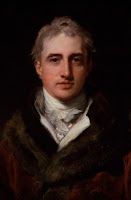
Great Britain's Foreign Secretary, Viscount Castlereagh arrived with his wife and brother in tow and a diplomatic mission of some 80 others.  There were fourteen assistants, including Lord Cathcart and Lord Clancarty, Edward Cooke, the undersecretary of state, and Joseph Planta, Castlereagh's private secretary.

The parties and balls that autumn were extravagant and endless as European heads of state, diplomats and their entourages, and those representing special interests such as printers and publishers, the Papal representative or the Jewish delegation engaged in a ceaseless round of business-mingling and flirtation that accomplished little.  Meanwhile, the Viennese shopkeepers, wine-sellers, brothel-owners, hoteliers, gambling dens, restauranteurs, and secret service made money hand over fist.

Then, as December came to Vienna, snow began to fall occasionally, the days were shorter and colder, and the city began to celebrate Advent and prepare for Christmas.  It would be the first Christmas without war in twenty years...
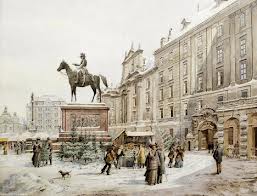
From the 13th century, Viennese traders had held a special December Market, the Thomasmarkt, from before Christmas through New Year, which sold wonderful gingerbread and pastries.  In the Am Hof market though, the sale of this special gingerbread (a study of contemporary invoices tells us) had expanded to include Christmas goods too for the first time--angels, silver-plated nuts, ribbons, lametta (thin strips of metallic decorative work formed into stars, snowflakes and icicles, etc.) and candles--alongside the standard market fare.
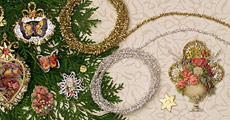
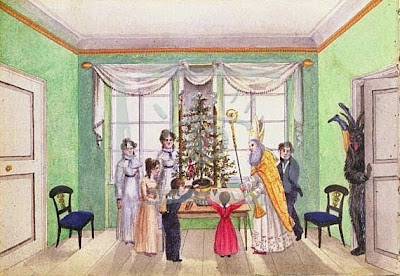
Then, just before Christmas, there was a great party at the Arnstein mansion held by Fanny von Arnstein, a prominent Viennese hostess, where guests found in the salon a great, tall fir tree, decorated all over with gifts, lametta and candles.  It was the first Christmas tree ever seen in Vienna, and it's referred to in the diaries of diplomats and the reports of the many spies of the Congress, as "the Berlin custom".

The many guests were enchanted.

The French embassy were among the first to adopt the custom as their own.  There, the French ambassador's hostess, Dorothee, Duchesse du Perigord, convinced the ambassador to decorate the mansion Berlin-style.  Nor was she content with just one tree.  In the great hallway, guests were greeted with a huge fir tree, adorned with "colourful garlands and lit candles" while another even larger tree stood near the mansion's famous staircase, and everywhere too, there were platters of German-style marzipan delicacies--formed into fruits and small animals, gingerbread and butter biscuits.

And that year, when Dorothee hosted a party on Christmas Eve, gifts were exchanged that night, again, German-style--not as they did in Catholic countries like Austria and France, on New Year's Eve...

It was the start of a whole new way of celebrating Christmas.  Imagine that...

Editors' Choice from the Archives: originally published December 18, 2012.

~~~~~~~~~~~~
M.M. Bennetts was one of the driving forces behind the EHFA blog and contributed many wonderful posts before her early demise some years ago. She was a specialist in early 19th century European history and the Napoleonic wars, and the author of two novels, May 1812 and Of Honest Fame set during the period.



Wednesday, June 15, 2016

Your Weight in Gold - The Problem of Tudor and Stuart Money

By Deborah Swift


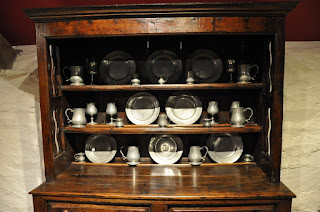
This Horrible Histories video shows precisely the difficulty with Tudor and Stuart coinage - the denominations were extremely confusing. But it wasn't the only problem - in these days of virtual money, credit cards and online banking, we tend to forget exactly how much space the average man’s wealth took up. Money in Tudor and Jacobean England was a physical commodity that needed to be stored, carried and guarded. Often wealth was stored as 'plate', i.e. silver and gold that could be used for a purpose such as dining. Large sums of money meant having the physical space to keep it and so wealth was often displayed in the form of silver or gold plate, cutlery, candlesticks or other domestic trappings, which could be melted down to make a large number of coins of the same weight.


Wealth was very visible in the 16th century. Ben Jonson’s play, ‘Volpone’, opens with Volpone’s worship of his gold:

‘Good morning to the day; and next, my gold!
Open the shrine that I may see my Saint!’


Johnson’s play about greed and lust satirises some of the forms of financial speculation practised in Jacobean London. The phrase ‘worth your weight in gold’ was a literal truth in Tudor England.

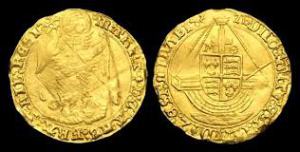
Currency was based on the penny, and the smallest denomination above it was the humble groat or fourpenny piece, and the half-groat (twopence), and one of the largest was the Angel or Angel-noble, called this because of its image of the Archangel Michael stamped in the design. The first shillings, or 'testoons' were created in 1502 in the reign of Henry VII. Occasionally half-pennies or farthings (quarter of a penny) were actually struck as coins, but this was rare: the smaller denominations were usually made by cutting a full penny into halves and quarters, or by using tokens as in Pepys’s Diary.

From The Pastry Cook at the sign of the Crown in Shoe Lane
The picture above is from this excellent site about trade tokens in the 17th Century.

Just a few of the coins in circulation:
Farthing = 1/4 penny
Half-penny = 1/2 penny
Three-farthing = 3/4 penny
Groat = 4 pennies (4d)
Sixpence = 6 pennies (6d)
Shilling = 12 pennies (1s )
Half-crown = 30 pennnies (2s 6d)
Crown = 60 pennies (5s)
Angel = 120 pennies (10s)
Pound = 240 pennies (20s or £1)
Sovereign = 360 pence (30s or £1 10s)

The sovereign was first minted under Henry VII as the gold equivalent of a pound (20 shillings) and was much easier to carry about than the arm-stretching weight of a pound of silver coinage. However, because the currency was based on the actual value of the precious metal, the face value of individual coins was not static as modern coins are, and a particular coin’s value would fluctuate with the price of silver or gold. Apart from the weight, the other disadvantage was that counterfeiting and coin-clipping (chipping a bit off the edge) was rife, although counterfeiting coins was a hanging offence. More detail about actual coins is here: Tudor Coinage.

Gold Angel

Most Elizabethan and Jacobean aristocrats borrowed heavily. Shakespeare’s patron William Herbert, the Earl of Pembroke, for instance, borrowed large sums from regular court money-lender Sir Michael Hicks. The borrowing was mainly to invest in mercantile ventures in other countries, from where England imported luxury goods or foodstuffs not easily obtained at home. Investing in trade was a risky business. Most trades depended on the ocean and many investors lost their fortunes to the sea. There were rare examples of great success in trade, such as Sir Thomas Gresham who became enormously wealthy from his dealings in munitions and bullion in the Netherlands. Gresham founded and invested in the Royal Exchange, the forerunner of London’s modern stock exchange in 1570. Sadly the first Royal Exchange, the great centre of trade and finance, was destroyed by the Great Fire in 1666.


And in fact the biggest risk to all wealth was fire. In towns made of wood and wattle, and thatched with reed, it was an ever-present risk. In this letter from Henry Wotton to Edward Bacon dated 13 July 1613, he says; ‘some of the paper or other stuff where with one of them was stopped did light on the thatch, where being thought at first but an idle smoke, it kindled inwardly and ran round like a train, consuming the whole house to the very grounds.’

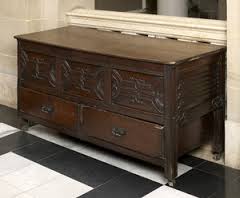
Counter Table from Hull Museum

Fear of losing all your money led to obsessive tallying, both at home, and at the ‘Counting House’. This is a rare example from Hull Museum is of a 'counter table' from the time of Henry VIII. Often the surfaces were marked with a grid or had a chequered board to help counting. In fact this is where the word 'counter' , as in a shop counter, is derived. In wills and inventories from the 16th century, counters are often listed as having a compartment. These compartments were probably for storing money and accounting ledgers, but in this example the drawers and hinged lid were added to it later, probably in the 18th century.

By the closing years of Elizabeth’s reign inflation was unstoppable and if their ships failed to come in, many men found themselves in debt. Debt carried a prison sentence so was greatly feared. In ‘The Merchant of Venice’ the themes of loans, bonds and mercantile transactions are interwoven with the plot. Financial concerns would have been familiar to Shakespeare as his father John Shakespeare made a good deal of money from investments in commodities such as wool and malt, apart from carrying on his business as a glover. He also did a bit of moneylending on the side. William followed in his father’s footsteps and these ventures, apart from inspiring a play, probably brought in considerably larger sums than his craft.

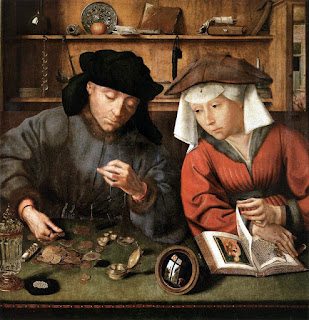
The Moneylender and his Wife - Matsys

Lending sums of money at a high rate of interest was common as interest rates were not fixed. It was usual to charge ‘damages’ , particularly if a debt was paid late, and often substantial fines were added with the full support of the law.

In Johnson’s ‘Every Man out of his Humour’ Puntarvolo invites his friends to sponsor him in his journey to Constantinople. Men would regularly lay down large sums of money to sponsor travellers on condition that the sums were doubled or trebled on their safe return. Travel was risky, but could be lucrative for the sponsor when the traveller returned with the spoils of their travels. 

Johnson and Shakespeare deposited £40 with the eccentric Somerset traveller Thomas Coryate before he set out to walk to Venice and back in a single pair of shoes. Coryate seems to have made quite a good living out of his sponsored travels, together with the books he wrote about them -- and even those who did not provide him with major support were willing to stand him a good dinner in return for his eyewitness accounts of exotic places. Coryate died during his last journey to India in 1670, but his books are still available today.


This type of sponsorship was a form of gambling, and the dividing line between legitimate investment or ‘venturing’ and various forms of betting was a good deal finer than it is today. Almost all Elizabethans gambled, from schoolboys who wagered with the ‘points’ that fastened their clothes, to the Queen and her courtiers who loved to play card games with enormous stakes. John Harrington wrote an epigram on the ‘rake’s progress’ of Marcus, a young man who gambled away his fortune at the very popular card game Primero. ‘The Counter’, where Marcus ends up, was one of London’s debtors prisons, called that because of its large number of debtors.

Lucas van Leyden - Primero players

Primero appears to have been one of the earliest card games played in England during Tudor and Stuart times, and was a forerunner to poker. Even Kings, or especially Kings, were not immune to gambling. During the reign of Henry VII, notices of the King's losses at cards appear in the Remembrance's Office. An entry is shown of one hundred shillings paid at one time to him for the purpose of playing at cards. The private expenses of Princess Mary, Henry VIII's daughter and later Queen, also contain numerous items of money ‘for the playe at cardes’.

Sources: 
Shakespeare's Life and World - Katherine Duncan-Jones
Early Modern England - Sharpe
The Time Traveller's guide to Elizabethan England - Ian Mortimer

Deborah Swift is the author of five historical novels for adults and a trilogy for teens. She blogs on her website about historical curios and historical fiction, and whilst you're reading this she is probably staring out of the window, coffee in hand, lucky black cat on lap, plotting her next book. You can chat to her online @swiftstory, or find her on facebook.

Thursday, April 16, 2015

Everyday Medieval Women

By E.M. Powell

So much of the fascination of history is accounts of kings and queens, mighty battles and events that helped shape the modern world. Medieval history is no exception. The murder of Thomas Becket, The Wars of the Roses, Magna Carta, Richard the Lionheart, the Crusades: all indeed showstoppers. But what of the everyday day life that millions of people had to lead? I confess to finding that equally, and at times, even more absorbing. When visiting re-enactments or museums, I’m less taken with sword A or helmet B, but more likely to watch as a woman makes a dish of pottage using twelfth century implements and ingredients.

Medieval Cooking Pot
© York Museums Trust used with permission.


The fascination for me is that it’s so relatable. Everyone has to make their way in the world and we (most of us, anyway) don’t do it from the battlements of a castle. Yet even in the history of the ordinary man, it tends to be just that. Men. Whatever sparse records exist tend to disappear almost entirely when it comes to women, as so many records are linked to land. We do know some of what life was like for a woman who was not at the top of the social tree: challenging is a word that springs to mind.

Amazon.co.uk

Everyday women were excluded from holding any kind of office. A woman’s legal rights were defined primarily by men throughout her life. Men defined her description. When she was a maiden, her father was in charge. As a wife, her husband. A medieval legal definition of married women from 1180 tells us that “every married woman is a sort of infant.” A wife has to agree to her husband’s sexual demands, cannot borrow money without his permission and is not able to make a will. A widow’s standing is based on her late husband’s status. This might suggest some level of independence.

Amazon.co.uk

But the widow of a villein (a tenant entirely subject to a lord) had, in reality, to remarry. She had a brief few months to make her own choice. If she did not, then the lord’s bailiff or reeve would select her next spouse for her. Refusal brought a fine, or imprisonment. Giving birth to an illegitimate child carried a fine called childwyte. This seems particularly punitive when one considers the law on rape. It was believed that conception could only occur when a woman experienced orgasm. And if she did so, then she had enjoyed the encounter with the man. And so it wasn’t rape. Blinding logic. For medieval men, that is.

Amazon.co.uk 

Childbirth was a terribly risky endeavour for medieval women, no matter what their status in society. It is estimated that for every pregnancy, a woman had a one in fifty chance of dying in childbirth. Women from the lower classes were often employed as wet-nurses for the wealthy.

The wives of peasants and villeins shared much of the agricultural labour with their husbands. They could earn money as labourers but were paid about half than men for the same work. Seasonal work paid better than service. Women’s tasks included sheep shearing, milking cows and looking after livestock and chickens, planting, winnowing and weeding. This was on top of all the domestic tasks: keeping a fire, cooking, washing.

Amazon.co.uk

The dark hours were put to good use also. Cheese making and brewing could yield a woman some extra income. Many women brewed ale. The demand for ale was high as drinking water was frequently dirty and unsafe. While the brewers were women, the tasters were male and women could be fined for sour beer. With the introduction of hops to brewing (which makes beer, rather than ale and preserves the drink for a lot longer), it became a male-dominated practice, through women continued to sell it.

With the expansion of towns and cities in the medieval period, women found other opportunities to earn an income. Many unmarried young women opted for service as it gave a yearly wage and moved from the countryside to secure a place. Women also worked as huxters. They would buy produce such as bread, eggs, vegetables or other foods and sell from baskets, either door-to-door or on foot in the increasingly busy marketplaces. The female ale sellers went by some rather wonderful names: gannockers, tapsters or tranters. The money earned in these ways was pitifully small.

Amazon.co.uk

Medieval towns also saw the rise of the apprentice, where a young person could be trained to learn a craft over many years. But there were no female guilds, and female apprenticeships do not occur in large numbers in the records. The skilled weavers, for instance, were men. The preparatory work for weaving, such as combing, carding and spinning of the wool tended to be done by women who would be paid little for this work. Silk weaving developed as an all-female craft in London, yet the silk-women only formed a collective, not a guild.

Laundry was an all-female preserve. Women did their own washing at home, often using unpleasant substances such as lye and urine as cleaning agents. They also worked as laundresses, travelling to the houses of the rich to carry out their duties. Naturally, the work in the laundry is dismissed by some chroniclers as a hot-bed of gossiping. It must in reality have been back-breaking.

Amazon.co.uk

Moving to towns and cities made women vulnerable to exploitation. Prostitution was rife. Female prostitutes were tolerated in fourteenth century London so long as they wore a yellow hood that marked them out. This was to save confusion on behalf of men who might mistake a respectable woman for a prostitute.

I like chain-mailed heroes as much as the next medieval history fan. But for me, these forgotten women were pretty darned heroic too. Speaking as an everyday woman, I'm so privileged I have my life and not theirs.

References:
Included in the post above with Amazon links: there is so much more to discover in them about ordinary life in medieval times.

~~~~~~~~~~~~~


E.M. Powell’s medieval thrillers The Fifth Knight and The Blood of the Fifth Knight have been #1 Amazon bestsellers. Born and raised in the Republic of Ireland into the family of Michael Collins (the legendary revolutionary and founder of the Irish Free State), she lives in northwest England with her husband, daughter and a Facebook-friendly dog. She blogs for English Historical Fiction Authors, reviews for the Historical Novel Society and contributes to The Big Thrill. Find out more at www.empowell.com.

Amazon.com
Amazon.co.uk
Barnes & Noble
Walmart

Friday, September 7, 2012

17th Century Recipes

by Katherine Pym

From the book: Samuel Pepys' Penny Merriments, Being a Collection of Chapbooks, full of Histories, Jests, Magic, Amorous Tales of Courtship, Marriage and Infidelity, Accounts of Rogues and Fools, together with Comments on the Times. Selected and Edited by Roger Thompson of the University of East Anglia at Norwich, 1977.

Whew, what a mouthful. Our titles these days are much shorter, with less syllables, easier to remember. To remember this, I simply refer to it as: Penny Merriments, a tome I found in a bookstore and considered a great find. It has all sorts of wonderful information, like recipes to make one beautiful, or a recipe for the newest way to roast a hare. It sends me right back into the era of my choice...

17th century England started out with traders going to far distant shores, but the cost was extensive. Spices were gathered through the Levant Company (owned by noblemen and gentlemen of quality) and the fledgling East India Company. As the century moved forward, their ships went to places already taken by the Spanish and Portuguese. 
 
Battle during First Anglo/Dutch War
The Dutch East India Company (VOC) began at about the same time as England's, but they weren't hampered by the religious upheaval and civil wars England endured during the first half of the century. The Dutch VOC had a leg up on English merchant shipping until Cromwell decided enough was enough and went to war with Holland. This is known as the First Anglo/Dutch war (1652-54), and fought entirely at sea. These wars were over trade, who could monopolize which ports in the East and West Indies.


With that said, the recipes below show an inordinate amount of spices, which were very costly. During the reign of King James I, a fight to near death took place between VOC and English Merchantmen in the South Seas that decimated the crops of nutmeg on Pulo Run Island, in the Banda archipelago.


Dutch Flagship sailing into Mediterranean Harbor
Through the Levant Company, citrus fruits, dates, pepper, cotton cloth, and other fruits and spices were trekked across the desert sands to ports the Levant held in the Mediterranean, then imported via ship to London. (I won't even mention the pirate contingent that upped the cost of goods.) Once these commodities hit the London markets, they proved costly for the middling English household.

The below recipes can only come from later in the 17th century, and were directed to the more well-to-do. Middling folk who could read, enjoyed the thoughts of these, though... 

"To Roast a shoulder of mutton with Oysters the best way.
"Take one not too fat nor too lean, open it in divers places, stuff your oysters in with a little chopt penny-royal (of the mint family), baste it with butter and claret wine, then serve it up with grated nutmeg, yolks of eggs, ginger, cinnamon, butter and red wine vinegar."

"To Stew a Leg of Lamb the best way.
"Slice it and lay it in order in your stewing-pan, seasoned with salt and nutmeg, adding a pound of butter, and half a pint of claret, with a handful of sliced dates, and the like quantity of currants, and make the sauce with the yolk of two eggs, a quarter pint of verjuice (acid juice from sour or unripe fruit, very sour), and two ounces of sugar. Boil them up, and put them over the meat, serving up hot together." 

"The Art of Beautifying the Hands, Neck, Breast and Face: Harmless and Approved, with other Rare Curiosities.
"To make the hands arms white, clear and smooth. Take a quarter of a pound of sweet almonds, blanch and bruise them, with a quarter of a pint of oil of roses, and the like quantity of betony-water (plant of the mint family): heat them over a gentle fire; and then press out the liquid part, and it will serve for either hands or face anointed therewith."

"To take away Freckles, Morphew (scurfy skin) or sunburn.
"Steep a piece of copper in the juice of lemon till it be dissolved (can copper dissolve?), and anoint the place with a feather morning and evening, washing it off with white wine."

"To take off any scurf from the hands and face.
"Take water of tartar, that is, such wherein calcined (burnt to a powder) tartar has been infused, anoint the place, and wash it as the former (with white wine)."

And now, for the final and most excellent recipe...

"To sweeten the Breath, and preserve the Teeth and Gums.
"Boil a handful of juniper berries, a handful of sage, and an ounce of caraway seeds in a quart of white wine, til a third part be consumed: strain it and wash your mouth with it morning and evening, suffering a small quantity to pass down: you may whiten the teeth by rubbing them with pumice stone."

So, who wants to try one of these recipes and let me know how it works? I'd especially like to know the results of whitening your teeth with pumice stone. Or should I do a disclaimer? Don’t do this without the guide of a professional!

~~~~~~~~~
Katherine Pym's novel Twins, a 2012 EPIC finalist, delved into trade with the Levant Company. Find all of Katherine's works at: http://www.amazon.com/Katherine-Pym/e/B004GILIAS