Showing posts with label apothecary. Show all posts

Sunday, January 9, 2022

Unwanted Pregnancies in the Middle Ages

by Jeri Westerson

We’ve read about some pretty bold women in the Middle Ages; Eleanor of Aquitaine, Queen Elizabeth, Kathrine Swynford. They made their destinies, though they might have had trouble achieving it in early life…or as in the case of Eleanor was consigned to what amounted to house arrest in the latter part of her life.

But for the average medieval woman, when one could be married off to secure alliances, gain property for the family, or to be sent to nunneries—there was surprisingly little impediment when it came to some control of their lives. For them, it was whether to remain pregnant or not. Granted, for some women, giving birth to an important man’s child meant a place at court or court adjacent at the very least, as well as funds to raise that bastard child, but other women who got into a family way through country matters needed a way out.

It’s a modern idea to consider an embryo a person, something that didn’t worry the medieval mind in so far as the Church was concerned. Much of the physician’s art in the Middle Ages favored Greek philosophers and ancient physicians, who had nothing to go on but their own feelings on the matter, and a certain tradition among them. Certainly nothing scientific.
Many of these men—and they were most often men—were of the opinion that an embryo was plantlike until birthed and took its first breath. Indeed, this was the medieval Hebrew philosophy as well, citing Adam: mere clay until God breathed life into him to become a human being.

Hippocrates, on the other hand, forbade ending pregnancies. In his oath he mentions, “I will not give to a woman an abortive remedy”, but then again, he also stated that the fetus was only viable from the moment its various organs – their structures – were already formed, which puts the kibosh on only later abortions, just not earlier ones. This was also what the famous ancient physician, surgeon, and philosopher Galen (c. 129 CE) expressed.

Aristotle viewed abortion as population control for a well-ordered society, but only before the embryo achieved animal life, or was recognizably human. “The line between lawful and unlawful abortion will be marked by the fact of having sensation and being alive,” he stated. Before that, Aristotle did not regard abortion as the killing of something human. (It should be understood that the “unlawful” aspect leaned heavily as to whether the husbands wanted to end this pregnancy). Unmarried women would find less opposition. Including (or perhaps even especially) prostitutes.

In Greece and ancient Rome, various instruments—curettes, hooks, other scraping tools—might be used to extract a fetus, but early physicians were worried that these instruments—and rightly so—could perforate the organ. A woman’s life over the unborn was
always utmost in cases of these operations.

By the time we reached the Middle Ages, such procedures, though still practiced, were not preferred. Herbalists/apothecaries were easier and no doubt more inexpensive to consult. Female apothecaries were often nuns in monasteries with access to the herbs grown on convent grounds. Midwives, too, were experts on such herbs for contraceptives and all stages of pregnancies, both wanted and unwanted.

An amazing array of proscribed methods such as bloodletting, fasting, diuretics, emmenagogues (herbs that stimulate menstruation), and enemas, were used. Jumping up and down. Carrying heavy objects. Heavy horseback riding. A painful massaging of the abdomen, and similarly binding the abdomen tightly.

Did any of these approaches work? Was there a scientific method involved? Not so much. These were from those same unscientific ancient physicians, folk remedies, “old wives’ tales”, and any number of shamanistic methods that came down to medieval woman from very old sources indeed (the first recorded evidence of induced abortion is from an Egyptian papyrus recorded in 1550 BCE.)

Perhaps these methods worked coincidentally. Or the embryo wasn’t viable to begin with. Or poor nutrition contributed to a spontaneous abortion. Or the woman wasn’t pregnant in the first place. Whatever the situation, women, herbalists, apothecaries, and physicians of the day believed in it, and proscribed them again and again.

An apothecary administering 
pennyroyal to a patient. 
Public domain

The variety of concoctions of herbs used was breathtaking; pepper, myrrh, thyme, rue, catnip, dittany, savory, sage, watercress seed, parsley, soapwort, hyssop, marjoram, tansy, juniper, hellebore, and pennyroyal (the last two of which contain some properties that actually can be used as an abortifacient. But beware. Too much pennyroyal or hellebore can cause death. Consult your apothecary).

These herbs and essential oils used in conjunction with one another could be drunk with hot water in a kind of tea with honey. Mostly, they were to induce menstruation to begin again, which would expel the embryo.
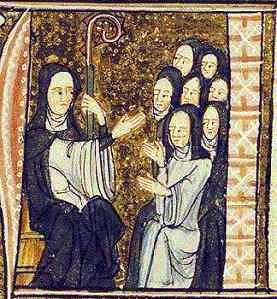
Hildegard von Bingen
Public domain

Even Hildegard von Bingen, the saint and mother superior of her convent in the twelfth century who wrote sacred music, works of theological philosophy, and scientific works on botanicals and their medicinal properties, got into the act and described a particular treatment (tansy) to restore menstruation in her treatise De Simplicis Medicinae. 

Were there medieval laws against a woman obtaining an abortion? In a word, no. The Church seemed to prefer not to meddle into what amounted to “women’s complaints”. So women consulted other women to help them with these life-changing difficulties. It was a natural for nuns to work as apothecaries to help in the physicians’ art and to administer to other women, including their own nuns in the convent who might also get into a family way. After all, it wasn’t all prayer and meditation. Not everyone could be a St. Hildegarde.

~~~~~
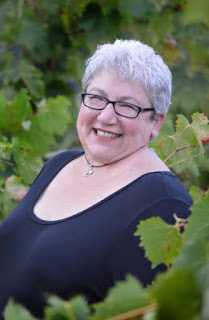
Jeri Westerson


  • Jeri Westerson is the author of fifteen novels in the Crispin Guest Medieval Noir mysteries that just concluded the series with The Deadliest Sin that deals with nuns administering abortifacients; the Enchanter Chronicles, a gaslamp fantasy-steampunk trilogy; Booke of the Hidden, an urban fantasy series, and several standalone historical novels. Be looking for her newest mystery Courting Dragons, the first in her King's Fool Mysteries with Henry VIII's real court jester Will Somers as the amateur sleuth. See all her books at jeriwesterson.com.


Wednesday, April 15, 2020

Apothecary

By Toni Mount


Medieval apothecaries were the equivalent of our modern pharmacists. An apothecary’s shop was full of various cures, most of which he prepared himself. He was usually a trusted member of the community, but at times, apothecaries were accused of practising magic or witchcraft. In an age before folk had easy access to doctors and when hospitals were religious foundations, more interested in curing your soul than your body, the apothecary was an ordinary person’s best hope of a cure or relief from an illness. Because apothecaries saw different people with various illnesses each day, most had a huge knowledge of the human body and herbal remedies.

Early in the Middle Ages, an apothecary would have cultivated all the plants and herbs needed for his medicines himself. Later, supplies became more organised, especially in cities like London, York and Bristol, with individuals growing plants to order for the apothecaries.


The recipes for the wines, syrups, cordials and medicines were passed down through the generations, from master to apprentice. They were closely guarded secrets too, since the most successful apothecary would have the most customers. While some apothecaries worked on a casual basis from their own homes, many had their own retail premises, usually a small shop. The front of the shop would have shelves full of medicines and herbs and in the back section, the apothecary would prepare medicines as and when they were needed. Ideally, he would also have access to a garden, where he could grow some of the less exotic herbs and plants he needed to prepare his cures. Some of the most popular medicines were prepared in advance, ready for sale, just as in a modern-day pharmacy. Other cures were prepared as and when needed, and were made up precisely, with the apothecary using his knowledge of the patient and the illness to prepare what he thought would be the ideal remedy.

Apothecaries were often spicers or pepperers as well. Because their work involved weighing out small amounts of herbs and spices for use in medicine, or for direct sale to customers, their trade was regulated by the Grocers’ Guild. It was impossible to separate the two businesses completely as both were involved in importing and distributing spices from abroad, for use in cooking and in the preparation of products such as spiced wines. In addition to food and drugs, apothecaries also sold inks and pigments to the stationers, beauty products and perfumes, substances used in fumigation and pest control and even good luck charms and novelties such as serpent-stones – what we know to be ammonite fossils.


A collection of medical recipes from the fifteenth century [now MS136 at the Literary Society of London] has remedies which make use of herbs that really could have performed the cure as intended:

For the Migraine take half a dishful of barley, one handful each of betony, vervain and other herbs that are good for the head; and when they be well boiled together, take them up and wrap them in a cloth and lay them to the sick head and it shall be whole – I proved.

A sick headache might well be eased by this poultice. Betony was a favourite herb in medieval times and was taken internally for a range of ailments. It’s still used today in treatments for nervous headaches and some types of migraine. Vervain is also used in modern medicine as a nerve tonic and as a calming restorative for patients in a debilitated condition. It too is used to treat migraine and depression.

For those troubled with digestive problems, this fifteenth century remedy would have helped:

To void Wind that is the cause of Colic take cumin and anise, of each equally much, and lay it in white wine to steep, and cover it over with wine and let it stand still so three days and three nights. And then let it be taken out and laid upon an ash board for to dry nine days and be turned about. And at the nine days’ end, take and put it in an earthen pot and dry over the fire and then make powder thereof. And then eat it in pottage or drink it and it shall void the wind that is the cause of colic.

Both these spices, anise and cumin, are carminatives, so this medicine would do exactly what it said on the tin – or earthen pot. The herbs dill and fennel could be used instead to the same effect – twentieth century gripe water for colicky babies contained dill. Wind and constipation were common preoccupations in the Middle Ages because folk ate so many pulses and little roughage, apart from cabbage.


Despite such suitable treatments as these, other remedies, despite the use of some exotic ingredients, could only have worked as panaceas. These concoctions are for gout:

Take badger’s grease and swine’s grease and hare’s grease and cat’s grease, dog’s grease and capon’s grease and suet of a deer and sheep’s tallow, of each equally much and melt them in a pan. Then take the juice of herb-robert, morell, mallow and comfrey and daisy and rue, plantain and maidenhair, knapweed and dragance, of each equally much juice, and fry them in the pan with the aforesaid greases, and keep it well, for the best ointment for gout is this. Or:

Take an owl and pluck it clean, and open it clean and salt it. Put it in a new pot and cover it with a stone and put it in an oven and let it stand till it be burnt. And then stamp [pound] it with boar’s grease and anoint the gout therewith.

A cough cure was more pleasant, consisting of the juice of horehound to be mixed with diapenidion and eaten. Horehound is good for treating coughs and diapenidion is a confection made of barley water, sugar and whites of eggs, drawn out into threads, so perhaps a cross between candy floss and sugar strands. It would have tasted nice and sugar is good for the chest, still available in an over-the-counter cough mixture as linctus simplex. Another pleasant cough treatment was coltsfoot comfits, like tiny sugary sticks of pale brown rock. King Henry III had the apothecary, Philip of Gloucester, supply him with 7½ lbs of diapenidion when the king visited the West Country in May 1265, along with 5lbs of grana, all together costing 7s 6d. My source for this [The Royal Apothecaries by Leslie G Matthews, 1967, pub by the Wellcome Historical Medical Library] suggests ‘grana’ meant aromatic seeds to aid digestion, like caraway or cumin, or it could have been Grains of Paradise, a kind of pepper. But ‘grana’ was also a name given to the exotic ‘kermes’ – dried scale insects, imported as a crimson dye. Could they have been used medicinally? Or was grana to be used to dye the king’s robes?

Another medicinal possibility is that grana was for dyeing the bed linen and curtains as part of the treatment of smallpox, in which the sickroom was swathed in red. Today we know this wasn’t so daft since red cloth filters out UV light, to reduce the production of scar tissue and to protect the eyesight of patients with smallpox or measles (these two diseases were hard to tell apart in the early stages anyway) – red light works for burns victims and would have decreased the pock marking in the case of smallpox. The medieval apothecary, like Gilbert Eastleigh in ‘The Colour of Poison’, was expected to know so much about such treatments, even if the reasons why they worked – or didn’t – were beyond the medical knowledge of the time.

N.B. One fifteenth century school book gives a list of collective nouns, including ‘a poison of treaclers’ (i.e. apothecaries who sold medicinal treacle).

[This an archive Editor's Choice post. It originally appeared on EHFA on 28 April 2016]

~~~~~~~~~~

Toni Mount earned her research Masters degree from the University of Kent in 2009 through study of a medieval medical manuscript held at the Wellcome Library in London. Recently she also completed a Diploma in Literature and Creative Writing with the Open University. Toni has published many non-fiction books, but always wanted to write a medieval thriller, and her first novel “The Colour of Poison” is the
result. Toni regularly speaks at venues throughout the UK and is the author of
several online courses available at www.medievalcourses.com.


Wednesday, December 2, 2015

Poison - hidden weapon of the Tudor wife

by Deborah Swift

The population of early modern England regarded poisoning as the most cowardly and unsporting method of murder:


of all murders poisoning is ye worst and most horrible 1. because it is secrett 2 because it is not to be prevented 3 because it is most against nature and therefore most hainous 4 it is alsoe a cowardly thing                                                                                  ~Sir John Coke

17th century poison cabinet or cunning woman's book

In 1663 Mary Bell was accused of killing her husband - six years earlier she had put poison into his food. This demonstrates one of the difficulties of poisoning - that it is an 'invisible' crime. Poison is a unique method of murder because it allows no self-defence, no chance for the victim to understand what is happening, and is often done secretly over a long time frame. Because poisoning involved planning and was done in cold-blood, it was perfect for those without social power. 

The servant classes, women and the weak were always the prime suspects in poisoning cases. Poisoning was a skill often linked to witchcraft - akin to the mixing of potions and charms. It was considered almost exclusively a wife's weapon because her main duty was to provision the house, and she alone was in charge of the cooking. Poison has always been linked with femininity.

In Tudor and Stuart England poisoning a husband or employer was seen as a kind of petty treason. This is because it challenged the husband's superiority, masculinity and domestic power. Men had a huge fear of being poisoned by their wives, but in actual fact there were very few cases. The cases that did come to light received enormous publicity, and poisoning was often featured in chapbooks of the time. In 1677 a pamphlet records a sixteen year old girl who admitted to poisoning her mother. Much was made of her treasonous behaviour, her cold-blood, her malice and wickedness, blurring the lines between witchcraft and murder.

Aqua Tofana, a poison, was known in Italy as 'inheritance powder' - a tool used by rich wives to murder their husbands. Supposedly Mozart died of Aqua Tofana poisoning. 


Right up until the Victorian era women had no legitimate outlet for violence in this society where men carried guns and swords and were allowed to use them in anger or to defend themselves from another's violent attack. Men's violence was seen as hot, the result of choler and anger; women's as cold, the result of bile and bitterness. Women could be beaten, within the law, but had little chance of retribution.

Men feared being poisoned because women were seen as harbouring a wickedness (thanks to Eve) that was waiting to erupt. In 1654 Jane Scales was supposed to have poisoned her baby. She said she had fed the baby sugar, but after the baby grew ill and died, the white powder was believed to be something far more sinister. Although she had no credible motive, she was found guilty, and the motive was malice or random wickedness.

The threat of the maidservant was equivalent to that of the wife. Resentful servants such as Liddy Wilson poisoned a whole household with ratsbane. Ratsbane was a common poison in this period, as was henbane, monk's blood, nightshade and arsenic. 

A 17th century peddler hawking his apothecary's wares

Poison was easy to obtain - there were no regulations governing its purchase, and many plants could be found wild. It was very difficult to detect once ingested, leading to physicians searching for 'signs' through an external examination. 'Signs' included altered skin colour, vomiting, strange bruising of the skin, even bleeding wounds. In 1662 the first autopsy to discover poison was performed on Anne Mennin by David Shevell and Charles Clerke. What the actual evidence was is not on record, but they pronounced that they had found 'the poison'. Nightshade berries perhaps?


In the case of Mary Bell, where it took six years to come to a verdict - the extra evidence was supplied by witnesses. Often witnesses were the main form of evidence. Margaret Armestronge said that the chickens ate Mary Bell's husband's vomit and they promptly keeled over and died. Such tales to bolster the evidence were very common and taken as tangible proof.

Because there was such fear of poison, the prevention and cure of poisoning was big business in Tudor and Stuart England. It was quite common to have mistakenly eaten poisonous roots, fungi or herbs, and physicians often diagnosed poison as the cause in the event that the patient deteriorated and their cures failed to produce better health. Add to this the nation's fear of poisoning, and you have a large market for peddling a cure.

Weird cures involved unicorn horn and Bezoar stones. A Bezoar stone (often from the Far East) was like a gallstone from the intestines of  a llama, goat or stag. The stone was said to detect and cure poison, and the stones were mounted like a jewel on a chain and dipped into drinks to counter the effects of poison. Queen Elizabeth I kept a Bezoar stone 'sett in golde hanging at a little Bracelett … The most parte of this stone being spent' implying that the Queen used it well.

17thC Bezoar stone mounted in gold
Needless to say, I shan't be dunking one of those in my morning coffee!


Sources
Murder in Shakespeare's England by Vanessa McMahon
The Recipes Project - cures for poison 
A Blast From the Past - Mike Dash's blog 
Early Modern England - Sharpe

chat to me on twitter @swiftstory

www.deborahswift.com