Monday, November 16, 2015

From Major to minor - a Bohemian Rhapsody

by Anna Belfrage

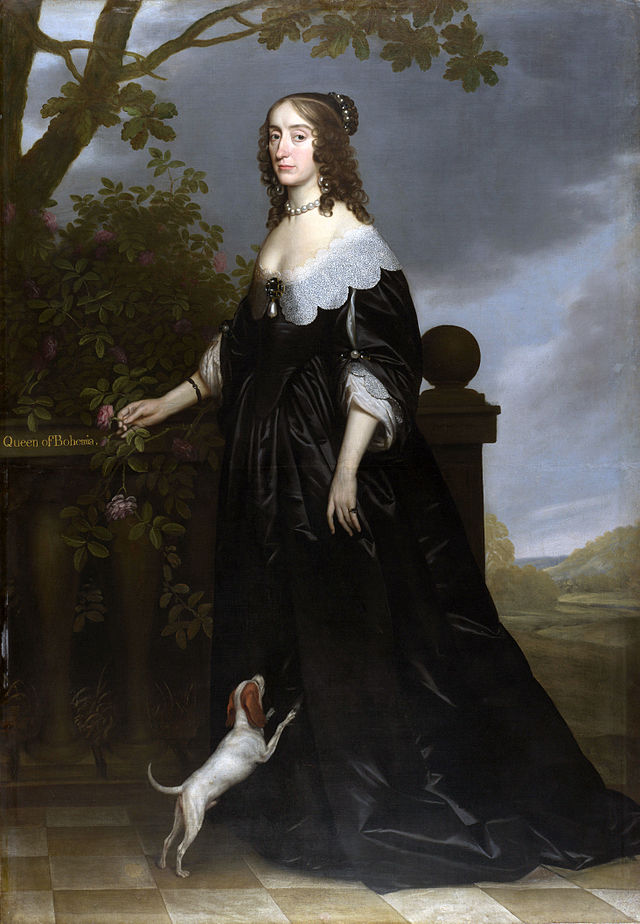
This, ladies and gentlemen, is Elizabeth Stuart, princess of Scotland and England, daughter to James VI & I and his Danish queen, Anne. Like her younger brother, Charles, Elizabeth was destined for a life of tragic adventure, but fortunately this was something she was totally unaware of during her childhood. As an added boon, she never had her head chopped off – even if the Stuarts are somewhat over-represented when it comes to beheading statistics, what with both Mary Queen of Scots and her grandson, Charles I, dying under the executioner’s blade.

Back to our Elizabeth. Born in 1596, she was James’s and Anne’s second child, and seeing as they already had a thriving male heir, the little girl was received with open arms. A Scottish princess, no less – named for the ageing English queen to curry favour not only with Virgin Bess but also with James’ potential future subjects, one imagines.

Elizabeth’s early years were spent in Linlithgow Palace. Early on, she developed a strong bond with her older brother, Henry Frederick, while showing little interest in her sister who was born in 1598. Seeing as Margaret died within the year, maybe this was not a bad thing.  In 1600, the nursery saw yet another addition, little Charles. Elizabeth was only vaguely interested. Yet another brother was born – and died – in 1602.

James VI & I
In 1603, Queen Elizabeth died. James VI of Scotland was to become James I of England, and off he went with wife and his two eldest children in tow to claim the English throne (Charles was considered too frail to make the journey). Now we have to remember that James was a Scot. For most English people that translated as being the enemy, almost as bad as being French. Almost. And where England could boast a population of four million and healthy trade, Scotland was home to a fifth as many souls and had suffered one economic set-back after the other during the last few decades. It was very much a case of the poor cousin being invited to the party, and James, always painfully aware of his dignity, had every intention of making a good impression. His children were part and parcel of this ambition, and both Henry Frederick and Elizabeth were expected to be on their best behaviour.

Royal children at the time were good at being on their best behaviour. In this particular case, the children were also bright and comely. James’ new subjects thawed somewhat: here was a handsome boy, their future king, and beside him his pretty sister. Even better, the children – just as their father – were raised as staunch Protestants, maybe a tad too Calvinistic for English tastes, but still.

Not everyone in England was thrilled with a Scottish king. A minority of the English were also of the opinion that England needed to be returned to the true Catholic faith – an opinion that was reinforced when James showed no intention of being more lenient towards Catholics than his successor. (In all fairness to James, he was prepared to be open-minded, but a planned attempt on his life in 1603 featuring Catholic priests and nobles sort of soured his relationship with the recusants).

While little Elizabeth applied herself to her lessons, monitored by Lord Harrington, others planned yet another devious plot centred round the little girl. Once again, we have a group of Catholic nobles conspiring against the king. This time, the intention was to kill the king by blowing up Parliament, probably killing the Prince of Wales as well, and then place Princess Elizabeth on the throne, a little puppet queen to be raised a Catholic and eventually to be married to a Catholic. As we all know, the infamous Gunpowder Plot failed, and Elizabeth was never to be queen of England.

James was a great believer in education, even for his daughter. Well, he drew the line at Latin, being of the opinion that women had no benefit from studying the classics, but all the same, by the time she was 12, Elizabeth spoke several languages, including French, and was well-versed in her bible and the Protestant faith. She was also, by all accounts, a great rider and quite attractive.

Suitors flocked like drones round a queen bee. The future Swedish king was one of them, but Gustav Adolf was crossed off the list at Queen Anne’s behest (no love lost between Swedes and Danes). Otherwise, there was an assortment of princes, of dukes and earls. Elizabeth had little say in who the lucky groom would be. Her marriage was a matter of state, and Elizabeth could only hope her father would make a wise choice.

Fortunately, James did. After much consideration, he chose Frederick, Count Palatine of the Rhine. Of impeccable lineage, the young man came with the added benefit of being a devout Protestant and having a sweet disposition. In 1612, Frederick arrived in London, there to woo his bride. Well, woo and woo: the marriage was more or less a done deal anyway, but James was happy enough to allow the young couple some time to get to know each other.

In November of 1612, Henry Frederick died, and Princess Elizabeth was suddenly second in line to the throne, after her rather sickly younger brother Charles. Queen Anne felt this required a better groom than Frederick: her daughter was now in a position to marry a future king, not an insignificant Count Palatine. But Elizabeth had set her heart on Frederick, and James agreed with her – the poor man was probably too distraught by his heir’s death to really care one way or the other.

In 1613, Elizabeth and Frederick were married, and the wedding itself was a lavish feast that more or less wiped out King James’s funds. After the wedding, Elizabeth and her husband set out for Heidelberg, Frederick’s principal home, where they settled down to refurbish the castle, including a magnificent garden, and to make babies.

As regular as clockwork, out came a baby, with the eldest born in 1614, and the youngest in 1632. In total, this happy couple produced thirteen children in 18 years – thirteen! Elizabeth was effectively pregnant for 9 years and nine months…. No wonder she reputedly had a distant relationship with her children – she was always busy expecting the next one. Anyway, all those pregnancies do not seem to have cramped her style, seeing as she accompanied her husband all over the place. Like to Bohemia.

Bohemia…Situated in the present day Czech Republic, this was a kingdom in which the king traditionally was elected by the aristocracy. Well, that’s the way it used to be, until Bohemia was annexed by the Hapsburg Empire. Hapsburg Emperors had little time for this election nonsense, and the Bohemians were smart enough to realise they had no chance in hell to withstand the powerful Empire – nor did they feel the need to do so as long as the Hapsburgs allowed them to practice their Protestant faith.

But in 1618 things changed: the old emperor was ailing and demanded that Bohemia recognise his heir, Ferdinand as their crown-prince. Problem was, Ferdinand was virulently anti-Protestant, so when he sent a couple of Catholic counsellors to Prague, the Bohemian nobles responded by throwing these gentlemen out of the window, the so called Prague Defenestration. Did not go down well with Ferdinand. In fact, it made him even more determined to wipe out the Protestant heresy from his lands.

In 1619, Emperor Matthias died. The Bohemian nobles seized the opportunity offered, invoked their ancient right to choose their king themselves, and offered the crown to Frederick, Count Palatine. Fredrick wasn’t so sure about this. Being an intelligent young man, it took him like five seconds to work out that Bohemia was very, very small in comparison to the very, very big Hapsburg Empire. His wife, however, thought the idea of going to Bohemia was great – well, I think she liked the idea of being a queen. Plus, both Frederick and Elizabeth genuinely believed they needed to do this to defend their faith.

Off they went to Bohemia, and one month after her coronation, Elizabeth gave birth to her third son, Prince Rupert of English Civil War fame. (See? Eight months along and she travels all the way from Heidelberg to Prague). That, essentially, was the high point of Elizabeth’s sejour in Bohemia. Emperor Ferdinand II was not about to allow the Bohemian revolt to go unpunished (and for those of you who like your history, the Bohemian Revolt is generally considered to be the starting point of the Thirty Years’ War),- and in November of 1620 the imperial force routed Frederick’s army. The King of Bohemia had lost his crown.

One would have thought Elizabeth and Frederick could return to Heidelberg. Nope. The Rhine Palatinate was part of the Hapsburg Empire, and so, in one fell swoop, Frederick was reduced to a landless exile – more or less simultaneously with becoming a father for the fifth time, seeing as Prince Maurice was born in January of 1621.

This was not the life Elizabeth had envisioned. Our Stuart princess was no longer a queen, she was reduced to being grateful for the invitation from the Prince of Orange to come to Hague, there to set up a much reduced court. But at least they still had each other, and apparently Frederick and Elizabeth found comfort in each other’s arms, resulting in eight more babies. Handsome babies, most of them!

Frederick decided to ally himself with the star of the north, Gustav Adolf of Sweden. In January of 1632, Frederick kissed his newborn son and wife farewell and sat up on his horse. She would never see him again. In late November of 1632, Frederick succumbed to an infection and died, just 36 years old. (And by then Gustav Adolf was also dead, his pillaged body found in the aftermath of the Battle of Lützen.)

Losing the Bohemian crown was nothing to losing her beloved husband. Elizabeth was prostrate with grief, for several days she neither drank nor ate. Frederick had been the love of her life, far more important to her than their many children, and now he was gone – for good. She wept, she paced her rooms, she wept some more…But after some days of such uncharacteristic behaviour, she pulled herself together: she had a son to fight for, a fifteen-year-old boy who she was determined to see succeed to his father’s lands.

Over the coming years, Elizabeth was to suffer hardship and loss in spades. While she did manage to secure her son’s inheritance, she was to live through the death of four of her children, suffer the shock of her brother’s execution, see her nephews reduced to penniless exiles, and all the while be dependent on the somewhat stingy largesse (I know, I know, but it’s a beautiful contradiction ;)) of the Prince of Orange. It seems all this suffering endowed her with dignity, softened somewhat the haughty edges of the princess.

In 1660, the Stuart dynasty was restored to the throne of England, Scotland and Ireland. Elizabeth, by now in her sixties, yearned to revisit the land of her birth and arrived in England in May 1661. She extended her stay, fell ill in pneumonia and died in February of 1662.

Elizabeth was buried in Westminster Abbey, her coffin accompanied by only one of her children, Prince Rupert. She would have preferred to be laid to rest beside her beloved Fredrick, but that, sadly, was not possible, as no one knew where Frederick’s remains had ended up. Originally buried in Frankenthal, Frederick’s embalmed body was transported to Kaiserslautern when the Spanish soldiers invaded his resting place. What happened to him afterwards remains unknown.

And so ends the story of Elizabeth Stuart, princess, queen, mother and wife. Most of all wife. Several years later, Elizabeth’s and Frederick’s grandson was to ascend the English throne as the first of the Hanover kings. I think Elizabeth would have been pleased. But I think she would have happily traded that for some more years by Frederick’s side.

NOTE: This post has previously been published on Anna's own blog

~~~~~~~~~~~~~

Anna Belfrage is the successful author of eight published books, all of them part of The Graham Saga. Set in 17th century Scotland, Virginia and Maryland, this is the story of Matthew Graham and his wife, Alex Lind - two people who should never have met, not when she was born three centuries after him.

Presently, Anna is hard at work with The King’s Greatest Enemy, a series set in the 1320s featuring Adam de Guirande, his wife Kit, and their adventures and misfortunes in connection with Roger Mortimer’s rise to power. The first instalment, In the Shadow of the Storm, was published on November 1, 2015.

For more information about Anna and her books, please visit her website. If not on her website, Anna can mostly be found on her blog.

Sunday, November 15, 2015

Margaret of Scotland: Saintly Queen, Queenly Saint

by Margaret Porter

National Trust Images/John Hammond
The sixteenth day of November, the date on which Saint Margaret died in 1093, is her feast day.

A princess of the House of Wessex, Margaret was the daughter of Edward the Exile and Agatha of Hungary, and probably left England in infancy in the time of King Canute. First exiled in Sweden, then Kiev, Edward and his wife eventually settled in her native Hungary, where Margaret and her siblings were born. The Hungarian court was highly religious, and from an early age Margaret became devoted to the church.

According to Turgot, her confessor and biographer:
Whilst Margaret was yet in the flower of youth, she began to lead a very strict life, to love God above all things, to employ herself in the study of the Divine writings, and therein with joy to exercise her mind. Her understanding was keen to comprehend any matter, whatever it might be; to this was joined a great tenacity of memory, enabling her to store it up, along with a graceful flow of language to express it.
In 1057 she returned with her family to England. Her father, summoned as a potential heir to Edward the Confessor's throne, did not long survive the journey. After the Norman invasion and Harold's defeat at the Battle of Hastings, her brother Edgar was proclaimed king, but the Conqueror prevailed and England became unsafe for the returned royal exiles. Edgar, his mother Agatha, Margaret, and other family members fled to Northumbria. It is believed they were sailing back to the continent when a storm drove their ship onto the coast of Scotland. They chose to remain. This second exile resulted in Margaret's marriage to King Malcolm III, who supported her brother's claim to the English throne.

Medieval image of Queen Margaret
Margaret's influence on the church in Scotland was profound, and she imported continental Catholic practices to a realm where religion was somewhat less sophisticated. She brought other refinements, introducing arts and culture to her husband's court. She was also a proponent of royal rule that was 'just' and 'holy'.

Turgot describes the Malcom's admiration of his queen, and her role in the expansion of his faith:

. . . he could not but perceive from her conduct that Christ dwelt within her; nay, more, he readily obeyed her wishes and prudent counsels in all things. Whatever she refused, he refused also, whatever pleased her, he also loved for the love of her. Hence it was that, although he could not read, he would turn over and examine books which she used either for her devotions or her study; and whenever he heard her express especial liking for a particular book, he also would look at it with special interest, kissing it, and often taking it into his hands. Sometimes he sent for a worker in precious metals, whom he commanded to ornament that volume with gold and gems, and when the work was finished, the king himself used to carry the book to the queen as a loving proof of his devotion.
Malcolm had sons at the time of their marriage, but Margaret bore him six more and two daughters. Three of those sons succeeded Malcolm in turn--Edgar, Alexander, and eventually David. Their daughter Matilda married Henry I of England, and another daughter married a French count. Not surprisingly, one son became an abbot.

She was a great giver of alms and reportedly never sat down to dine without first feeding the poor and the orphaned--she founded or encouraged the creation of schools, orphanages, and hospitals. The chief recipient of her support was Dunfermline Abbey.

Says Turgot, in his account of her, "When [she] spoke, her conversation was with the salt of wisdom. When she was silent, her silence was filled with good thoughts. So thoroughly did her outward bearing correspond with the staidness of her character that it seemed as if she has been born the pattern of a virtuous life."

Not only was Margaret's piety expressed through many good works, she strongly believed that Holy Communion should be received frequently rather than rarely or periodically, as was customary in her time.

Margaret's husband and eldest son were away during what proved to be her final illness at Edinburgh Castle. Turgot received a firsthand account of her last days from a witness:

Her face was already covered with a deadly pallor, when she directed that I, and the other ministers of the sacred Altar along with me, should stand near her and commend her soul to Christ by our psalms. Moreover, she asked that a cross, called the Black Cross, which she always held in the greatest veneration, should be brought to her...she received it with reverence, and did her best to embrace it and kiss it . . . .
She was already preparing for death when her son Edgar arrived at Edinburgh Castle in the aftermath of the Battle of Alnwick just over the Border. He was reluctant to announce the tragic news of her husband's and her eldest son's deaths, but Margaret insisted upon hearing it. After learning of her losses, she continued to pray with her last breaths and died peacefully. "Her departure was so calm, so tranquil, that we may conclude her soul passed at once to the land of eternal rest and peace. It was remarkable that her face...became afterwards suffused with fair and warm hues, so that it seemed as if she were not dead but sleeping."

A century and a half after her death, Queen Margaret was canonised by Pope Innocent the IV, for her faithfulness, her charity, and her success in reforming the church in her adopted land. At that time her remains were removed from their original burial place at Dunfermline Abbey and re-interred in a shrine with her husband. During the 16th century, historian John Major in A History of Greater Britain as Well England as Scotland writes of the event as it occurred in 1250:

In the following year Alexander [the Third] and his mother, with the bishops of the Church, assembled at Dunfermline for the transfer of the remains of Queen Margaret. And when these were raised, a most sweet fragrance filled the whole church. But while the remains were being carried with all due honour to the monument which marked the resting-place of her husband, Malcolm, the bearers found themselves completely unable to go further—until some wise men gave them this advice: to disinter likewise the bones of Malcolm. And, when the saintly bones were united with one another, they were carried without difficulty to the appointed place, where, with due adornment of gold and precious stones, they remain to this day.
Except that Margaret did not remain. Her head was later removed from the shrine by none other than Mary Queen of Scots in 1570, who sought her saintly ancestress's presence during childbearing. The head, possibly with the rest of the saint, was later transferred to the Catholic monastery and seminary at Douai in France. All bodily relics associated with Margaret were lost during the French Revolution.

The Roman Catholic Church formerly celebrated Margaret's feast day in June. However with a later revision of the Calendar of Saints, her death date became vacant. Since 1969 the Catholic Church to which she belonged has followed the tradition of the Church of Scotland, which she reformed, honouring her on 16th November.

Margaret's Shrine, Dunfermline, © Kim Traynor
~~~~~~~~~~~~

Margaret Porter is the award-winning and bestselling author of twelve period novels, whose other publication credits include nonfiction and poetry. A Pledge of Better Times, her highly acclaimed novel of 17th century courtiers Lady Diana de Vere and Charles Beauclerk, 1st Duke of St. Albans, is her latest release, available in trade paperback and ebook. Margaret studied British history in the UK and the US. As historian, her areas of speciality are social, theatrical, and garden history of the 17th and 18th centuries, royal courts, and portraiture. A former actress, she gave up the stage and screen to devote herself to fiction writing, travel, and her rose gardens.


Saturday, November 14, 2015

The Role of Ransoms in Medieval Warfare

by Helena P. Schrader


The concept of ransom dates back to classical times, but during the Early Middle Ages they fell into disuse and we hear little about them. By the mid-11th century, however, they were back in fashion, and from the mid-12th century to the end of the 15th they were a dominant feature of warfare.  Although they have since disappeared from Western warfare, the criminal custom of capturing people for ransom still persists in some parts of the world such as Latin America and Nigeria. In England, the age of ransoms was the High Middle Ages, when ransoms constituted a fundamental component of warfare. Without them, the very course of English history would have been different — not just because kings like Richard I of England and John “the Good” of France might have been killed rather than held for ransom, but because the custom of allowing a captive to buy his freedom altered many aspects of warfare itself.

It is worth noting, however, that the tradition of ransom was strongest in France. It spread with French influence to England and the Holy Land, but was not so well established in the Holy Roman Empire or Iberia. Interestingly, the Saracens either had an independent tradition of ransom (and if someone knows about this please leave a comment!) or rapidly adopted the “Frankish” custom because it was so highly lucrative. The Arabs were, after all, very good businessmen and traders, and ransoms were first and foremost a financial transaction.

In the French/English tradition, ransoms were a means of enriching oneself, and the rules of tournaments reflected this by dictating that a captured knight had to surrender his horse and armor to his captor. It was the lure of loot as much as the hope for fame and honor that produced the “tournament circuits” of the 12th to 14th centuries, where knights travelled from tournament to tournament like modern-day professional athletes. But the fortunes made on the tournament fields were a pale imitation of what “real” ransoms could bring.


A man taken in battle by his enemy was completely at the mercy of the victor, and the stakes were impossibly high; the victor was within his right to slaughter his opponent. The custom of ransom dramatically decreased casualties, because the prospect of financial gain greatly increased the proclivity of victorious fighting men to show mercy toward those who surrendered to them. This had the unfortunate side-effect, of course, of making the lives of wealthy men more valuable than the lives of the poor. As a result, throughout the High Middle Ages there was a tendency for those of a class deemed good for ransom to escape death, while their less fortunate followers paid the price of defeat with their lives.

But ransoms were not fixed and so not immutably tied to rank and title. They were always negotiable, and a rich merchant’s son — assuming he had enough time to describe the size of his father’s purse to his erstwhile murderer — stood as good if not a better chance of being granted the privilege of ransom than a poor knight. Ransoms were always based on what a man (or his family) could pay quite simply because there was no point in setting a price that one could not hope to collect — unless the real intent was to ensure the captive could never again raise arms against you.

Had Philip II of France, for example, held Richard the Lionheart captive instead of the Holy Roman Emperor, it is probable that he would have set demands intended to keep Richard in a dungeon for the rest of his life.  Likewise, the ransom set for John “the Good” of France after he was captured at the Battle of Poitiers was dictated far more by the political advantage of denying the French a rival king to Edward III than by thoughts of monetary gain. Except where kings and important nobles were at stake, however, ransoms were generally dictated by a captive’s ability to pay.


By which, of course, I do not mean the captive himself, for he was just that — held captive. Ransoms were usually raised by a captive’s relatives — parents, wives, siblings, children. If they couldn’t (or wouldn’t) scrape together the funds needed, then the appeal would go to cousins and in-laws, anyone who might have money and care enough for the captive to contribute to the cause. Lucky men, who enjoyed the respect of those more powerful and wealthy than themselves, might also be ransomed by their feudal overlord. Examples of this were the payment of Aimery de Lusignan’s ransom by King Amalric, or William Marshal’s ransom by Queen Eleanor. In the case of captive kings and barons, of course, they did not have to rely on the generosity of those that loved or respected them. They could demand contributions from their subjects, vassals and tenants.

Usually a man was held in captivity until the ransom was paid, and conditions varied. Some men enjoyed comfortable “house arrest,” able to interact with the household and even family of the man to whom they had surrendered. Others were kept locked in a single room, even a dungeon. In the worse cases, prisoners were kept chained the walls of their prison until the ransom was paid.  On rare occasions, a man (of high rank generally) might be freed on parole in order to enable him to better collect the sum owed. Famous cases of this were Baldwin of Ramla, who was released by Saladin after payment of only a small portion of the enormous ransom set, and Bertrand du Guesclin, who the Black Prince paroled so he could raise his ransom. The former talked the Byzantine Emperor into paying the outstanding portion of his ransom, and the latter raised his ransom from the King of France, Louis d’Anjou and Henry of Trastamare.

While the payment of a ransom could financially ruin a man and his family, ransoms could make the fortune of those fortunate enough to take a valuable prize.  The English and Gascons almost tore the French king apart at the Battle of Poitiers in their eagerness to lay claim to his ransom. Desmond Seward describes a situation like this in his history of the Hundred Years War ( The Hundred Years War: The English in France, 1337-1445, Macmillan, New York, 1978):
[King John] was recognized and surrounded by a great crowd of soldiers anxious to take so fabulous a ransom. Although he surrendered to a knight of Artois, he was still in peril, for the brawling mob of Gascons and English began to fight for him. Finally he was rescued by the Earl of Warwick and Lord Cobham, who took him to the Prince [of Wales].

Few men had a share of a king’s ransom, but as long as a man was on the winning side, it was possible to accumulate a small fortune from the ransoms of lesser men. Ransoms more than plunder was what made the Hundred Years War so lucrative for England — and impoverished France. The latter was in part due to the fact that because a ransom was a reflection of a man’s ability to pay, it was also indirectly a reflection of his “worth.” The English soon learned that it was to their advantage to let French captives name their own ransoms because pride often induced the prisoners to name ransoms suited more to their self-image than the size of their pocketbook.  Even the Black Prince used this tactic when setting the ransom for Guesclin; the latter named the huge sum of 100,000 francs, something he could not possibly have raised from his own resources, hence the resort to the King of France et. al.

Yet common as ransoms were throughout the High Middle Ages, they remained a privilege not a right. The Knights Templar, for example, explicitly prohibited their members from paying ransoms. A Knight Templar was expected to die for Christ and find salvation for his soul in that act of martyrdom. This may have contributed to the Saracen tendency to slaughter captured Templars and Hospitallers; they had no monetary value and so eliminating them sooner rather than latter made sense.

Normally, however, it was the circumstances in which the victor found himself, not the ideology of the captive, that determined whether a ransom would be accepted or not. In the heat of battle, many soldiers became overcome by “blood lust” that utterly obliterated their greed for gold. Or, when the battle was not one between mercenaries but between true adversaries, fighting men might simply hate their opponents too much to be willing to grant mercy. There were also times when commanders made a strategic decision to kill prisoners. A famous case in point here was Henry V’s order to kill the French prisoners taken at Agincourt, which was largely dictated by his sense of vulnerability. Underestimating the demoralizing effect of his initial successes, he felt he needed every Englishman on the frontline, ready to repel the next attack by the still numerically superior French and was unwilling to spare men to guard the prisoners.


Even more significant, however, is that by the Wars of the Roses commanders were beginning to prefer annihilation of the enemy’s ability to fight over the profit gained from ransoms. It is a clear indicator of the increasing hatred between the rival factions for the English throne that Edward IV allegedly told his soldiers to “kill the lords and spare the commons.” Edward IV recognized that the commons might not pay monetary ransoms, but they were his subjects and he gained nothing from killing them. The rebellious lords, on the other hand, were the threat to his throne.

 In the subsequent century, as warfare became increasingly tied to religion and kings became increasingly despotic, the notion that an opponent might be allowed to live in exchange for a payment of money became discredited. Ransoms became anachronistic and eventually disappeared from the customs of Western warfare altogether.

~~~~~~~~~~~~~

Helena P. Schrader is the author of three books set in the crusader kingdoms. St. Louis’ Knight is set in the Latin Kingdom of Cyprus in the mid-13th century and Knight of Jerusalem and Defender of Jerusalem are the first two books in a three biographical novel of Balian d’Ibelin, who defended Jerusalem against Saladin in 1187 and later played an important role during the Third Crusade. St. Louis Knight was winner of the 2014 Chaucer Award for Historical Fiction set in the High Middle Ages.

Amazon

Friday, November 13, 2015

Mrs. Beeton’s Book of Household Management: A Victorian Publishing Phenomenon

by Mimi Matthews

Beeton’s Book of Household Management, Colored Plate

Published in 1861, Beeton’s Book of Household Management is perhaps one of the most famous non-fiction books to come out of the 19th century. At over one thousand pages long, it was the first publication of its kind to address all aspects of household management, covering everything from cooking and cleaning to childrearing and animal husbandry. It even includes a section on the law, providing the inquiring housewife with general information on leaseholds, the legal rights and obligations between husband and wife, and the questionable validity of an I.O.U.

Original Title Page
In the first year alone, Beeton’s Book of Household Management sold more than 60,000 copies. Over the next decade, it would sell 2 million more. The book Voices of Victorian England, edited by John Wagner, explains the enormous popularity of Beeton’s Book of Household Management, stating:
By the 1850s, middle-class wives were expected to frugally and efficiently run their husband’s households, and thus had to be skilled in such tasks as hiring, firing, and supervising servants; planning and cooking meals; dealing with tradesmen; and teaching, nursing, and disciplining children. Because many girls were no longer automatically learning these skills from their mothers, there existed a need for a practical handbook on household management, which the Beetons recognized and sought to meet.
Isabella Beeton was only twenty-five at the time she wrote Beeton’s Book of Household Management. Married to publisher Samuel Beeton, she was a working journalist herself. She began her career in 1857 by contributing three articles a month to The Englishwoman’s Domestic Magazine, one of her husband’s most popular periodicals. By 1860, she was one of the magazine’s editors, as well as its fashion correspondent. Parts of Beeton’s Book of Household Management originally appeared in The Englishwoman’s Domestic Magazine. Explaining her reasons for expanding those separately published columns into one, comprehensive guide, the Encyclopedia of British Writers quotes Beeton as saying:
What moved me, in the first instance, to attempt a work like this, was the discomfort and suffering which I had seen brought upon men and women by household mismanagement. I have always thought that there is no more fruitful source of family discontent than a housewife’s badly cooked dinners and untidy ways.
Isabella Beeton, 1860

Beeton’s Book of Household Management was not the first book of its kind. In 1845, English cook Eliza Acton published Cookery for Private Families and in 1848 French chef Alexis Soyer published The Modern Housewife. Beeton’s book, however, far eclipsed those of her predecessors. Not only did it cover every aspect of household management, Beeton’s particular “tone and form of address” offered inspiration and assurance to her readers. As the book Consuming Culture in the Long Nineteenth Century explains:
Any woman who felt her position to be unimportant and useless could be persuaded by the strength of Mrs. Beeton’s rhetoric: the mistress is ‘the first and last, the Alpha and Omega in the government of her establishment’ and ‘it is by her conduct that its whole internal policy is regulated.’ In her opening sentence, Mrs. Beeton compares the mistress of the house to ‘a Commander of an Army’ who attains the ‘highest rank’ of the female character when she enters into knowledge of household duties.
It was not only the rhetoric that made Beeton’s book a Victorian phenomenon. Her guide included innovations that changed the face of cookbooks for generations to come. For example, Voices in Victorian England reports that Beeton was the first writer to place the list of ingredients at the start of the recipe. She was also the first writer to supply recommended cooking times. This was all part and parcel of Isabella Beeton’s genius for “compiling and organizing information.” She was not an accomplished cook herself. In fact, very few of the recipes in her book are her own. Even so, she possessed a talent for making the recipes of others easier to follow and conveying ideas on every aspect of household management to a middle-class audience without challenging “the more conventional notion of bourgeois femininity.”

Upon its publication in 1861, Beeton’s Book of Household Management was met with instant acclaim. A review in the November 9, 1861 edition of the Edinburgh Evening Courant closes by declaring:
Mrs. Beeton has endeavored to adapt her book to nearly all circumstances and conditions of life. She shows that, while luxurious repasts and sumptuous hospitalities rightly belong to the high and wealthy, there is no monopoly of good digestion or of appetite, and that enjoyment may be found in a ragout of yesterday’s cold meat, and even a relish imparted to our traditional ‘kailbrose.’ It is on the cook rather than on the materials, on the preparation rather than the cost, that a good dinner mainly depends; and hence the value of a book like this, which duly studied by mistress and cook may yield us a different and enjoyable dinner every day, whether our means be great or small, and whether one dish or twenty be set before us.
Beeton’s Book of Household Management, Colored Plate

Recipes were, indeed, a large component of Beeton’s Book of Household Management. Beeton provides instructions for the preparations of staples like meat, potatoes, and various puddings. She also provides recipes for foods which are very much of the moment today, such as boiled sea kale. In addition, Beeton advises on the best diet for livestock, the dangers of ‘rust’ in bacon and ‘rot’ in rabbits, and the perils of poisonous mushrooms. In the final segment of her cookery section, Beeton even includes recipes for beverages, such as the following for Cowslip Wine:

Recipe for Cowslip Wine from
Beeton's Book of Household Management, 1861

Perhaps the best bits of Beeton’s Book of Household Management, at least in my humble opinion, are those sections where she imparts advice to Victorian housewives. For instance, in the first pages of the hefty tome, she writes:
Early rising is one of the most Essential Qualities which enter into good Household Management, as it is not only the parent of health, but of innumerable other advantages. Indeed, when a mistress is an early riser, it is almost certain that her house will be orderly and well-managed. On the contrary, if She remain in bed till a late hour, then the domestics, who, as we have before observed, invariably partake somewhat of their mistress’s character, will surely become sluggards.
And later, in her chapter on Domestic Servants, she addresses the lady’s maid, advising her on her duties to her mistress and providing helpful recipes to assist her in her work, such as the following recipe for shampoo:

Recipe for Hair Wash from
Beeton's Book of Household Management, 1861

The chapter on Domestic Servants also provides guidelines for the hiring and firing of servants, the writing of a character reference, and the respective wages commonly paid for each position in the household. For those of us who write novels set in the 19th century, this section of the book is invaluable.

Guidelines for Servant Wages from
Beeton's Book of Household Management, 1861

On February 6, 1865, less than four years after the publication of Beeton’s Book of Household Management, Isabella Beeton died from puerperal fever contracted during the birth of her fourth child. She was only twenty-eight years old. Samuel Beeton initially suppressed news of her death so that he could continue to publish under her now famous name. This strategy was ultimately not a successful one. Within only a few weeks, newspapers were printing reports of her death. The following appeared in the February 18, 1865 edition of London’s Illustrated Times:

February 18, 1865, Illustrated Times, London, England

Beeton’s Book of Household Management has been in continuous print since it was first published in 1861. Now popularly known as Mrs. Beeton’s Book of Household Management, it has remained a perpetual bestseller and can be purchased in its various incarnations from booksellers all over the world (*though being a purist, I advise the original edition which is currently free in the public domain). If you are at all curious about Victorian life, I highly recommend you give it a look. It is much, much more than a mere 19th century cookbook.
________________________________________

Works Referenced or Cited in this Article
Beeton, Isabella. Ed. Beeton’s Book of Household Management. London: Farrar, Straus, and Giroux, 1861.
Beetham, Margaret. Ed. Victorian Women’s Magazines: An Anthology. Manchester: Manchester University Press, 2001.
Hartley, Cathy. A Historical Dictionary of British Women. London: Routledge, 2013.
Krueger, Christine L. Ed. Encyclopedia of British Writers, 19th and 20th Centuries. New York: Facts on File, 2003.
Wagner, John A. Ed. Voices of Victorian England: Contemporary Accounts of Daily Life. Greenwood, 2014.
Wagner, Tamara S. Ed. Consuming Culture in the Long Nineteenth Century: Narratives of Consumption, 1700-1900. New York: Rowman & Littlefield, 2010.
________________________________________

© 2015 Mimi Matthews
For more Romance, Literature, and History, follow me on:
Facebook and Twitter
________________________________________

Author Biography
Mimi Matthews is an author of contemporary and historical romance. She is a member of Romance Writers of America (PRO), The Beau Monde, and Savvy Authors, and is currently represented by Serendipity Literary Agency in New York. In her other life, she is an attorney with both a Juris Doctor and a Bachelor of Arts in English Literature. She resides in Northern California with her family – which includes an Andalusian dressage horse, a Sheltie, and two Siamese cats.

Website: MimiMatthews.com
Facebook: Facebook.com/MimiMatthewsAuthor
Twitter: Twitter.com/MimiMatthewsEsq


Gwenllian, the Warrior Princess

by Jean Gill

Historical research throws up interesting questions and connections. This was one of mine: could Eleanor of Aquitaine have any link to Gwenllian, a Welsh princess?

Gwenllian, the Warrior Princess

While England was torn between rival claims to the throne during the 1100s, the three kingdoms of Wales formed alliances and fought; with each other, and with the Anglo-Norman marcher lords whose new stone castles dominated the Welsh landscape.

In c.1113 Gruffudd ap Cynon, the ruler of Gwynedd (the kingdom of North Wales) played host to the vibrant ruler of Deheubarth (the kingdom of South Wales), Gruffydd ap Rhys. The Lord of Deheubardd sought support from the north against the Anglo-Norman residents of ‘his’ land, support which would repay the debt owed from the past, when south had supported north. When his guest had gone home, the Lord of Gwynedd went to London. There, he bargained with Henri 1 of England to bring about the downfall of Deheubardd and gain security for Gwynedd.

He was away from home when his youngest, and very beautiful daughter, Gwenllian, sneaked out from the family seat of Ynys Môn on the Isle of Anglesey towards the beach. With full approval of her brother Owain, and of her mother, Gwenllian took to the seas. The boat sent from South Wales by Nest, Lady of Pembroke, sister to the Lord of Deheubarth, took Gwenllian to join her lover, that same Gruffydd ap Rhys who had recently been a guest.

Presumably the courtship took place under the very nose of the Lord of Gwynedd, and whether it was a passionate love affair or not, it also matched the political aims of the Lord of Deheubarth perfectly. He was keen to unite the Welsh against the Anglo-Norman oppressors. Owain Gwynedd and his mother agreed with Gruffydd and saw the love affair as an opportunity to join north and south against Anglo-Norman threats, in direct opposition to Gruffudd ap Cynon’s policy of appeasing the English.

What the Lord of Gwynedd said to his son and wife when he returned from England to find that Gwenllian was now married to the Prince of Deheubardd is not recorded but the alliance changed Welsh politics. The word ‘alliance’ still means ‘wedding ring’ in modern French and medieval marriages were as important as battles in shaping events. But Gwenllian was no mere trade object. Her soubriquet of ‘warrior princess’ was earned by living rough and fighting alongside her husband.

When Henri I died in 1135 and England was unstable, combined Welsh forces from north and south rose up against the Anglo-Norman castles in a more organised way. At one point in these skirmishes and sieges, Gruffydd won Kidwelly Castle, and Gwenllian lived there for a few months, pregnant, and enjoying the life of a lady. However, Deheubardd was not strong enough to hold Kidwelly. Soon Gwenllian was once more living with her people in the wooded hills, the traditional Welsh tactic to protect women and children in times of war. The nomadic way of life allowed lightning strikes and withdrawals, so the marcher lords were never secure. One consequence of this period was to convince Maurice de Londres, Lord of Kidwelly Castle, that Gruffydd and Gwenllian were a serious threat to Kidwelly.

In 1136 Gruffydd was in North Wales, seeking help from his father-in-law and Gwenllian was Lord of Deheubardd in Gruffydd’s absence. She received word that a Norman army was on its way from England to meet up with Maurice de Londres, intending to wipe out Gruffydd, Gwenllian and their troublesome family.


The warrior princess decided to surprise the army from England and cut them off before they reached Kidwelly, at Mynydd y Garreg. Her decision is described with hindsight by historians as ‘brave but misguided’, ‘foolish’ but was it? With her children’s lives at stake as well as the future of Deheubarth and its people? She could not have anticipated that a Welshman, Gruffudd ap Llewellyn, would betray her so that the Normans knew the exact spot she would attack and were prepared.

The battle was bloody. Giraldus Cambrensis describes the Welsh qualities as fighters; "… on many occasions they have not hesitated to fight without any protection at all against men clad in iron, unarmed against those bearing weapons, on foot against mounted cavalry. They are so agile and so fierce that they often win battles against such odds." Gwenllian’s decision seems to fit her countrymen’s attitude, and if she was ‘misguided’ then so were most of the male Welsh leaders of the time – yet historians do not describe them so.

Courageous? Certainly. Although the surprise element was reversed, and Gwenllian’s forces outnumbered, they fought on. Then Maurice de Londres arrived with his army.

Caught in the pincer-stroke, Gwenllian had no option but to surrender, probably expecting the honourable treatment due to nobility. She had her two youngest sons with her in the battle, hoping to keep them safe. Maurice de Londres gave his orders. Morgan was killed on the spot but Maelwgyn was taken prisoner. His fate after that is unknown. Gwenllian was beheaded by sword, there on the Mynydd y Garreg battlefield, on a spot grazed by peaceful cows these days.


Her legacy is more than the name on a memorial at Kidwelly Castle, or at the local hotel. Some historians believe she created the Mabinogion, that collection of tales which includes one branch of ‘the matter of Britain’, the Arthurian legends. It is highly probable that these legends reached Eleanor’s court in Aquitaine, that magnet for troubadours and bards. Bledri is one such Welsh bard who could well have taken Gwenllian’s Welsh tales of Arthur to the château in Poitiers so Eleanor could have listened to stories composed by Gwenllian. Such speculation ventures into the territory of a historical novelist. From the gaps and possibilities come our own stories.

What is without question is another legacy. Gwenllian’s second son Rhys made Deheubarth into a power that even Henry II of England was forced to treat with respect. The stormy relationship between the two men and kingdoms shaped Wales in the second half of the 12th century.

Prince Rhys (as he liked to be called) was also a singer himself and attracted the best of bards… or even troubadours… to his court. He is said to have inaugurated a song tourney that was the prototype of the modern Eisteddfod. But that is definitely another story.

Cofiwch Gwenllian! Remember Gwenllian!

The storyboard on display in Kidwelly shows the warrior princess in the chainmail hauberk and coif typical of an Anglo-Norman knight, carrying a sword. Most Welsh soldiers would be without armour and bearing spears, javelins or bows (the southern speciality) but the elite guard protecting the Welsh royal families would have dressed like their enemies, as would those nobles themselves, so Gwenllian's appearance in armour is plausible.

Photos: Lesley Walters

~~~~~~~~~~~~~

Jean Gill is the author of The Troubadours Quartet:1150 in Provence, Global Ebooks Award-Winner for Best Historical Fiction.

She is a Welsh writer and photographer living in the south of France with a big white dog, a scruffy black dog, a Nikon D750 and a man. For many years, she taught English in Wales and was the first woman to be a secondary headteacher in Carmarthenshire. She is also mother or stepmother to five children so life was hectic.

Her eighteen published books are varied, including prize-winning poetry and novels, military history, translated books on dog training (from French), and a cookery book on goat cheese.

Book 1 of the Troubadours series, Song at Dawn is free; details are on the Giveaways page.

Website www.jeangill.com winner of the 2015 Silver IPPY AWard for Best Author website

I first researched Gwenllian for my Young Adult novel Crystal Balls in which a teenager's dreams are haunted by the warrior princess.

In celebration of the new Troubadours book, Book 1 ‘Song at Dawn’ is free at the moment and there’s also a free ebook copy of my collection ‘One Sixth of a Gill’, which was shortlisted for the Wishing Shelf Award’, for every new subscriber to my newsletter. Just sign up here for news and offers on my books. http://eepurl.com/AGvy5

Contact

jean.gill@wanadoo.fr

Amazon

IPPY Silver Award for Best Author Website www.jeangill.com

Blog www.jeangill.blogspot.com

https://twitter.com/writerjeangill

Facebook https://www.facebook.com/writerjeangill

The Troubadours Page https://www.facebook.com/jeangilltroubadours


Further Reading

The Journey through Wales and The Description of Wales - Gerald of Wales

Brut Y Tywysogion, or, The Chronicle of the Princes - Caradoc of Lancarvan

The Lord Rhys, Prince of Deheubarth - Roger Turvey


Wednesday, November 11, 2015

The Remarkable Life of Lady Unknown: Angela Burdett Coutts

by Lauren Johnson

What links the British bee-keeping association, Ragged Schools, dog water fountains, the Royal Marsden Hospital and a refuge for prostitutes?

All were funded by the remarkable Victorian philanthropist Angela Burdett Coutts. A celebrated figure in her own lifetime, Angela inherited Coutts Bank at twenty-three years old and spent the remaining seventy years of her life investing her fortune in a wide array of good causes. Yet today Angela is little remembered. She has lived up to the moniker she used in many of her anonymous donations – she has become Lady Unknown

Angela’s life is a story that cries out to be told. Born into an age when women could not vote or stand for parliament, and when a wife’s body as well as her property was completely under the control of her husband, she used her almost unique position as a single woman with independent wealth and influence to improve the lives of thousands of others.

(National Portrait Gallery)

Angela Burdett’s upbringing was not unusual for a woman of her status, but her family life was tumultuous. Her father was the radical Sir Francis Burdett – that extraordinary thing, a popular politician. Burdett campaigned for better treatment of prisoners, for parliamentary reform, spoke out against the Peterloo Massacre and criticized the unrepresentative make-up of the House of Commons. Such was the strength of feeling towards this ‘man of the people’ that when he was arrested in 1810 for publishing his criticism of parliamentary practice, a riot broke out in London.

Angela’s grandfather was the banker Thomas Coutts, and it was from him – in the most circuitous and unexpected manner – that Angela gained her fortune. Thomas had three daughters, and each of them had several children – including, crucially, a number of sons.  According to general practice, the bank should have passed to one of these boys. But in 1815 Thomas secretly married Harriot Mellon, an illegitimate actress forty years his junior. In 1822 he left his entire fortune and partnership in Coutts Bank to her. (The family were unimpressed.) Harriot began life as ‘a poor little player child, with just food and clothes to cover me’ and ended it as the Duchess of St Albans. It was to this unlikely patron that Angela owed her fortune.

During her childhood, Angela became a favourite companion of Harriot’s, and the elder woman saw something in her quiet, thoughtful step granddaughter. When Harriot died in 1837 she left the Coutts legacy to Angela. In modern terms, Angela became an overnight millionaire, and in deference to the conditions of Harriot’s will, adopted the surname ‘Coutts’.

Harriot Mellon
(National Portrait Gallery)

The anticipated next step for a woman in Angela’s position was marriage – allowing a well-born husband to take control of her fortune while she retired into domestic obscurity. There was certainly no want of suitors. One peer wrote that he got on well with Angela in later life,
because I never proposed to her. Almost all the [other] young men of good family did: those who did their duty by their family always did.[1]
The shy youngest child whose closest relationship had always been with her parents was suddenly public property, her personal life openly debated, her decisions questioned. Among the unwanted seekers of her attention was a man who would be her shadow for over a decade: the Irish barrister Richard Dunn. To modern eyes, Dunn was clearly an obsessed stalker. He followed Angela around the country, broke into her garden, followed her to church, sent constant letters and reminders. He even forged poems which he claimed Angela had written him – and was convicted of perjury for doing so.

Given this constant romantic bombardment, it is not altogether surprising that Angela remained single for most of her life. What is surprising is what she chose to do with her wealth. Instead of retiring to the countryside Angela lived mostly at 1 Stratton Street, right on Piccadilly in London. In London, then as now, the richest in society were crammed tight against the poorest. Even Parliament backed onto a slum. The ‘polite’ thing to do at a certain level of society was to ignore the poverty – to look away from the poor, desperate and destitute right outside your window. What Angela did was engage with it.
What is the use of my means but to try and do some good with them?[2].
Perhaps because she had not expected her wealth, Angela felt a considerable duty to use it for the improvement of other people’s lives as well as her own. All the same, she had observed Harriot Mellon’s style of over-generous but under-researched charity. Angela would not indiscriminately hand over wads of cash or use untested middlemen. Instead, she carefully investigated her investments and was in constant communication with her agents. Everywhere she travelled, she took a writing desk with her, stuffed full of demands for support, investment or help. As time passed she moved from offering donations towards other people’s projects into creating her own long-term developments.

In 1851 she started building Columbia Square, new housing for poor families in the East End of London. The emphasis here, as in much of Angela’s work, was on practicality. The apartment blocks were light and airy with their own gas and water supplies, ensuring good sanitation. To prevent unscrupulous rent increases, subletting was forbidden. About 600 people were housed in this community, at a time when across London, slums were being demolished and the families renting there simply turfed out to make room for middle class expansion and railways.

Angela in later life.
(Wikimedia Commons)

Angela was also a lifelong campaigner for educational reform, encouraged by her friendship with Charles Dickens. His book Hard Times was a product of their conversations about schooling. They were both patrons of the ‘Ragged School’ movement, which was one of the few routes into education for poor children. As well as providing new schooling facilities, Angela established a group of ambulatory teachers to tour local areas, promoted evening classes and practical training for working children, wrote a ‘poor woman’s Mrs Beeton’ called Common Things and petitioned government for reform.

Angela’s personal life jostles for attention alongside her work (of which the examples above are a very small sample). In 1847 she proposed to the Duke of Wellington – the hero of Waterloo and ex-Prime Minister, then in his seventies. In 1881 the age dynamic was reversed, with no less public scandal. Angela waited until she was sixty-six to marry, and the husband she finally chose was William Ashmead Bartlett, an American-born twenty-nine year old who she had funded through school. One of the conditions of Angela’s inheritance had been that she could not marry a foreigner, so by choosing Bartlett (who took her name after 1881) Angela lost the majority of her fortune. Even with a considerably reduced income, however, Angela’s work did not cease. The first meeting of the organization that would become the NSPCC took place in her drawing-room.

In 1893 Angela wrote a report On the Philanthropic Work of Women, characteristically deflecting attention away from her own work and towards the charity of others. She focused on those who did not simply give donations to those in need, but who ‘enabled the destitute to help themselves.’[3]

During her lifetime Angela gave away somewhere between £3 million and £4 million. When she died in 1906 30,000 people came to her house to pay their respects. She is buried in Westminster Abbey.

Angela’s life is crying out for a sweeping, big budget biopic but in the absence of such a movie Untold and myself have produced a play about just one aspect of her life: her work and friendship with Charles Dickens. For decades, Dickens acted as Angela’s ‘front man’ investigating appeals for donations and rather obscuring her own work behind his celebrity persona. Angela was happy to let Dickens be the public face of their charitable work and for herself to remain ‘lady unknown’ – indeed, given the nature of some of their work, anonymity was a necessity.

Urania Cottage, the 'home for homeless women'
(Wikimedia Commons)
Together, the pair established a home for homeless women which took ex-convicts and prostitutes to provide education, rehabilitation and refuge. Angela’s involvement with the house for fallen women did not meet with universal approval in highly moralistic Victorian society. The Duke of Wellington declared with the blithe presumption of someone born privileged and male that these women were ‘irreclaimable’.
I am afraid that experience, as well as the information to be derived from statistical works, have taught us that there is but little, if any, hope of saving in this world that particular class of Unfortunates.[4]
Nonetheless, the home was built, staffed, stocked and provided care for over a hundred women. They proved to be very far from irreclaimable.

Lady Unknown,
a play I have written about Angela’s life, will be shown at the Charles Dickens Museum in London on Monday 16th November. You can read more about the project here. We are still seeking crowdfunding support to finance the play, and if you are able to help us with a small donation we would be enormously grateful.


~~~~~~~~~~~~~

Lauren Johnson is an author and historian. Her debut novel is The Arrow of Sherwood, and Lady Unknown will be her first play.

@History_Lauren
@Untold


[1] Edna Healy, Lady Unknown: The Life of Angela Burdett Coutts (Sidgwick & Jackson, 1978), p. 53.
[2] Charles Dickens reporting Angela’s words. Clara Burdett Patterson, Angela Burdett-Coutts and the Victorians (John Murray, 1953), p. 166.
[3] Healy, p. 218.
[4] Anne Isba, Dickens’s Women: His Great Expectations (Continuum, 2011), p. 89.

All Servants Were Not Created Equal: The Gender Divide

by Maria Grace

During the Regency era , anywhere from ten to twenty percent of the British population were employed in domestic service. Of that number, approximately ninety percent were women. A significant gender gap existed both in wages and prestige afforded male and female servants.

Male versus female labor

Two primary factors contributed to these gender differences. Firstly, men were more expensive to hire. Not only did they command higher wages, but the 1776 tax on male servants made them dramatically more expensive to employ. Effectively a household required an income of at least 1000 pounds per year to employ a man servant (though 700 pounds a year might afford a footboy),whereas households having only 150 pounds a year could afford a maid-of-all-work.

Male servants became a status symbol and a mark of prestige, whereas female servants were only a commonplace feature found in even very modest households.

On the whole, women filled unskilled positions in the house, primarily cleaning and cooking. Men managed and oversaw those positions and supervised household valuables and luxury items like tobacco and alcohol. Perhaps more significantly, male servants engaged in what was considered skilled labor, including most of the labor outside of the house. Young men apprenticed in those tasks, learning to take on those skilled positions in the future.

Most male servants reported to the master of the house, through a hierarchy of male servants. The system worked well for those servants concerned with outdoor activities. Problems arose, though, when indoor male servants reported to the mistress of the house. Conflicts often arose when a woman attempted to supervise male staff, requiring the intervention of the master of the house.


The professional staff positions available in large households demonstrated this divide clearly.
This gender divide extended from the lowest to the highest staff positions in households, with all of the highest paid, most powerful and prestigious positions held by men.

The largest households employed stewards to manage the lands. In some cases when the house itself was very large, the house also had a steward assigned. Paid a salary from 50 to 300 pounds a year, depending on the size and profitability of the estate, these men usually had a background in law and many had served as clerks to solicitors. Land stewards would have a separate dwelling on the estate, but a house steward would have private quarters in the house. Neither were considered servants, but rather professionals and according respect equal to or above the family lawyer.

No directly corresponding female positions existed. The closest analogy might be the lady’s companion or the governess. Both these positions employed women who were gently born but forced into service by some unfortunate circumstance. Thus, they were not fully considered as servants. However, despite their skills and education, they were not afforded professional status either. They were relegated to a neither/nor position where they did not fit with the family and were not accepted among the household staff. Similarly, their salaries were typically only in the range of 25 pounds a year, half of what the least steward might earn.

In short, male servants cared for the household luxuries, alcohol, silver, crystal and were paid far more than the women who cared for the household’s young ladies and children.

Hardships of the female servant

The lowest order of servants was relegated to the most difficult, unpleasant tasks: cleaning, scrubbing, hauling water and waste, maintaining fires and cleaning up after them. These were the scullery maids and maids-of-all-work. They also made up the largest single category of those in domestic service.

Girls as young as eleven filled these roles. They were also the servants most subject to physical discipline by their employers, particularly the mistress of the house. No laws prevented a master or mistress from beating a servant they felt deserving of it. A servant could petition the courts if they felt themselves mistreated, but such an action could impact their ability to seek future employment, so such complaints might cause more problems than they resolved.

Female servants were subject to one further hardship that male servants did not generally face. Women in service were deemed sexually available to the men of the household, including male servants. Even if the female servant was married, or the master enforced celibacy (forbade boyfriends) among the servants, this additional ‘service’ could be demanded from female employees, including governesses and companions. To add further insult to injury, nothing prevented a jealous mistress from venting her spleen upon these vulnerable servants. Few legal protections existed in this situation, and girls could be dismissed for pregnancy, even if it were caused by one of the members of the household.

Although men and women both worked in service, both law and tradition conspired to make their relative situations vastly different. Despite occupying only ten percent of the domestic service positions, high paying, high power and prestige roles were held almost exclusively by men while the lowest ranks were occupied by women.

References

Adams, Samuel, and Sarah Adams. The Complete Servant; Being a Practical Guide to the Peculiar Duties and Business of All Descriptions of Servants ... with Useful Receipts and Tables,. London: Knight and Lacey, 1825.
Ardelie, Susan. "Domestic Servants - Part 1 - Women." Making History Tart Titillating. February 16, 2010. Accessed August 10, 2015. https://lifetakeslemons.wordpress.com/2010/02/16/domestic-servants-part-1-women/.
Ardelie, Susan. "Domestic Servants - Part 2 - Men." Making History Tart Titillating. March 2, 2010. Accessed August 10, 2015. https://lifetakeslemons.wordpress.com/2010/03/02/domestic-servants-part-2-men/.
Barker, Anne. The Complete Servant Maid or Young Woman's Best Companion. Containing Full, Plain, and Easy Directions for Qualifying Them for Service in General, but More Especially for the Places of Lady's Woman, Housekeeper, Chambermaid, Nursery Maid, Housemaid, Laund. London: Printed for J. Cooke, No. 17, Pater-Noster Row, 1770.
Beeton, Isabella Mary. The Book of Household Management. Edited by Mrs. I. Beeton, Etc. [With Illustrations.]. London: S. O. Beeton, 1861.
Cosnett, Thomas. The Footman's Directory, and Butler's Remembrancer Or, the Advice of Onesimus to His Young Friends: Comprising, Hints on the Arrangement and Performance of Their Work ; Rules for Setting out Tables and Sideboards ; the Art of Waiting at Table, and Conduct. London: Printed for the Author ;, 1823.
Giles, Kelly. "Servants." Randolph College Faculty Webserver. Accessed August 10, 2015. http://faculty.randolphcollege.edu/janeausten/reports/servants.htm.
Glover, Anne. "Regency Culture and Society: A Primer on Household Staff." Regency Reader. March 19, 2012. Accessed August 10, 2015. http://www.regrom.com/2012/03/19/regency-culture-and-society-a-primer-on-household-staff/.
Hoppe, Michelle Jean. "Servants--Their Hierarchy and Duties." Literary Liaisons. 2003. Accessed August 10, 2015. http://www.literary-liaisons.com/article046.htm.
Household Work, Or, The Duties of Female Servants Practically and Economically Illustrated, through the Respective Grades of Maid-of-all-work, House and Parlour-maid, and Laundry-maid : With Many Valuable Recipes for Facilitating Labour in Every Departmen. London: J. Masters, 1850.
Koster, Kristen. "A Primer on Regency Era Servants - Kristen Koster." Kristen Koster. November 29, 2011. Accessed August 10, 2015. http://www.kristenkoster.com/a-primer-on-regency-era-servants/.
Schmidt, Wayne. "Victorian Domestic Servant Hierarchy and Wage Scale." Wayne's This and That. Accessed August 10, 2015. http://www.waynesthisandthat.com/servantwages.htm.
The Servant's Guide and Family Manual: With New and Improved Receipts, Arranged and Adapted to the Duties of All Classes of Servants ... Forming a Complete System of Domestic Management. 2d ed. London: J. Limbird, 1831.
Webster, Thomas, and William Parkes. An Encyclopædia of Domestic Economy .. London: Longman, Brown, Green, and Longmans, 1852.

 ~~~~~~~~~~~~

 Maria Grace is the author of Darcy's Decision,  The Future Mrs. Darcy, All the Appearance of Goodness, and Twelfth Night at Longbourn, Remember the Past, and Mistaking Her Character.  Click here to find her books on Amazon. For more on her writing and other Random Bits of Fascination, visit her website. You can also like her on Facebook, follow on Twitter or email her.