Showing posts with label regency. Show all posts

Friday, April 17, 2020

Of Refinement and Good Manners

by Maria Grace

Etiquette is an integral part of every culture. Although the details differ among regions and historical periods, the concept of correct and incorrect ways to behave remains constant. Rules of polite behavior are essential elements of communication within a society, a social code that enables individuals to understand motives and subtle messages that are otherwise cumbersome to display through words alone.

These social rules are adopted and adapted over time. Some may be written into elaborate manuals, though many are unwritten, caught rather than taught among the population at large.

In general these rules reflect the values of a society. Following these rules demonstrates respect for the common morality and for other people. Obedience to the guidelines of good manners also reflects on the character of the individual and suggests one is well bred and refined.

In periods of great social transition, like the Regency, published manuals are especially abundant. Many pages in these manuals were filled with comments on general deportment and the behavior to be exhibited by individuals of good breeding. When trying to rise into higher levels of society, a family’s social standing could be made or broken by the ability to conform to all the conventions associated polite behavior.

Although these patterns of etiquette might appear awkward and restrictive, especially for women, they did act as a safeguard against misunderstanding and embarrassment for both parties. This was particularly true as well-bred women were thought to have a "natural" sense of delicacy. Taste and poise should come naturally to a lady, and it was an indictment against her breeding to be worried about looking correct.

Marks of Good Breeding


In line with the emphasis on elegance and formality, people were encouraged to maintain an erect seating posture when sitting or standing. Slouching or leaning back was regarded as slothful unless the individual was infirm in some way. Similarly, a well-bred person walked upright and moved with grace and ease. Moreover, such a person maintained an elegance of manners and deportment and could respond to any social situation with calm assurance and no awkwardness.

Etiquette demanded a person behaved with courteous dignity to acquaintance and stranger alike at all times. Well-bred individuals and those seeking to be seen as such were instructed to keep at arm's length any who presumed too great a familiarity. Icy politeness was the best weapon in putting so-called 'vulgar mushrooms' in their place.

To be considered wall-mannered, an individual had to control their features, their physical bodies, and their speech when in company. Extremes of emotion and public outbursts were unacceptable, as was anything pretentious or flamboyant. A woman, though, could have the vapors, faint, or suffer from hysteria if confronted by vulgarity or an unpleasant scene.

All forms of vulgarity were unacceptable and to be continually guarded against. Laughter, too, was moderated in polite company, particularly among women. Men might engage in unrestrained mirth in the company of other men or among women of low repute for whom the rules of etiquette were more or less irrelevant.

Showing Respect

These marks of good breeding were one means by which respect for others was demonstrated. Rituals of bowing and curtsying accomplished similar ends.
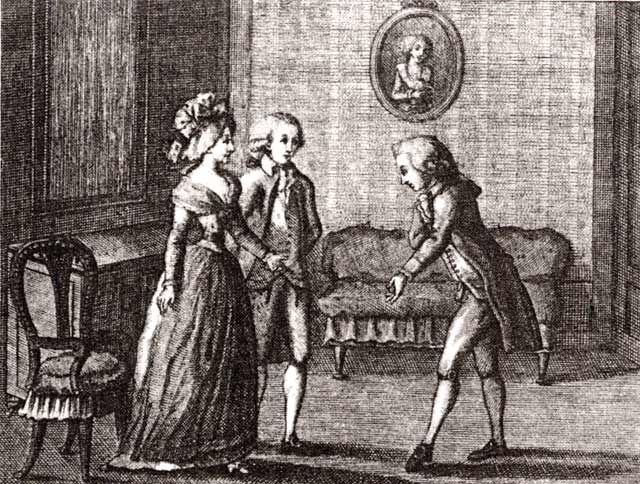


A bow or curtsy would be performed according to the status and relationship of the person encountered and with respect to the particular circumstance. For example, a bow or curtsey would be made on entering or leaving a room, though good friends and family were not always bowing to one another.

Bows and curtsies were expected at the beginning and end of a dance, and on encountering any person one wished to acknowledge. Children generally bowed or curtsied on meeting their parents for the first time each day.

When encountering people in public, etiquette suggested it was the woman's duty to acknowledge an acquaintance first by a slight bow with the head and shoulders. If she did not make such an acknowledgement, a gentleman should not acknowledge her.

Such recognition could only occur if the two individuals had been previously introduced.

Introductions

It was unacceptable to speak to anyone of good breeding without a formal introduction by a third party.

The higher ranking individual (or the woman in the case of two equally ranking individuals) would indicate whether he or she wishes to permit the introduction of an inferior. In the case he or she desired an introduction, a third party would be asked to make one. At a public ball, the Master of Ceremonies would conduct this service to enable gentleman and ladies to dance. However, if the higher ranking person did not desire an introduction, one could not be forced upon them.

In some circumstances, the higher ranking person could introduce him or herself to the lower one. When introduced the people of lower rank bowed or curtsied. Gentlemen and ladies of equal rank bowed and curtsied when formally introduced to each other and again when parting.

Touching and tipping one's hat was a standard salutation, not returning it would be very rude. After being introduced, individuals always acknowledged each other in public, at minimum with a tip or touch to the hat or a slight bow of the shoulders. Failure to acknowledge an acquaintance was a breach in conduct and considered a cut. Manuals warned that a lady should never ‘cut’ someone unless ‘absolutely necessary’ and only ladies were truly justified in delivering a ‘cut’.

Servants
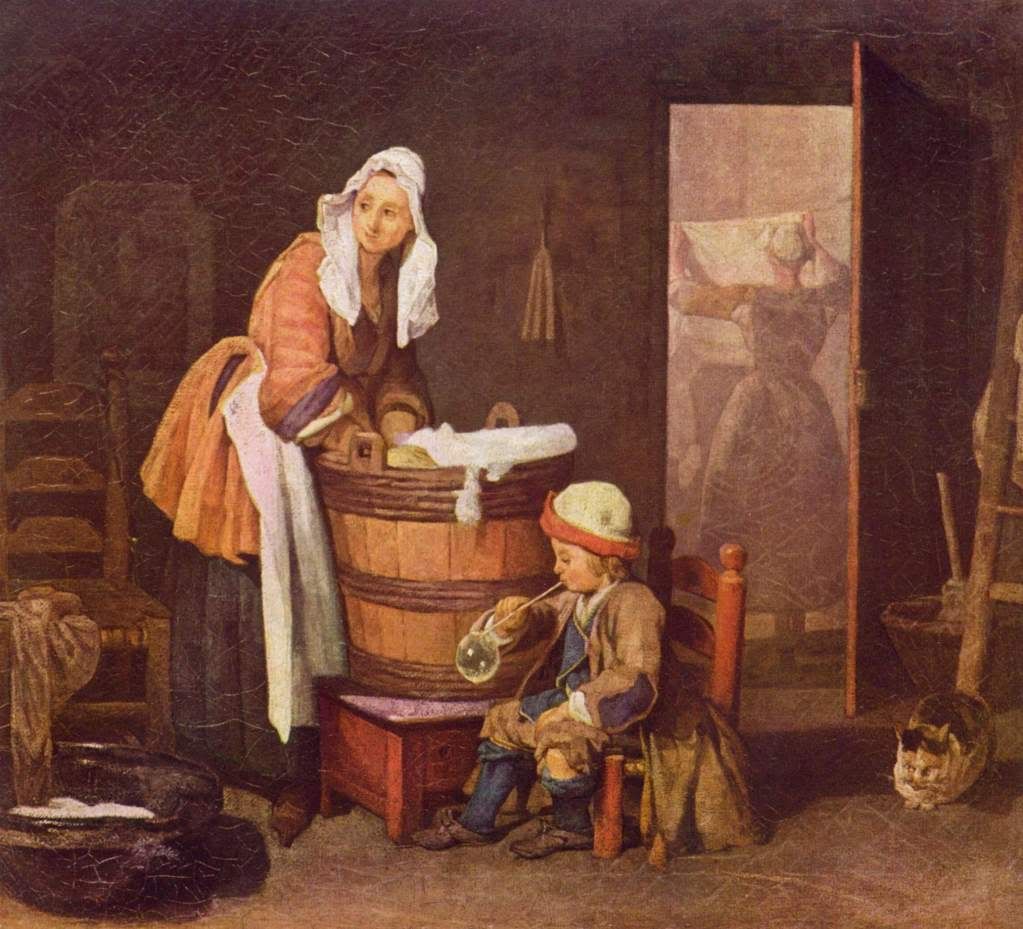


Servants and social inferiors were, of course the exception to this rule. They were always kept at a proper distance but without arrogance, pride or aloofness. The well-bred individual spoke to servants with an appropriate degree of civility and avoided the casual informality with which a person might address an equal. Private business was not discussed in the presence of servants and they were generally ignored at mealtimes. Mocking or belittling servants or their families was deemed undignified and a sign of bad manners.

Conversation

The heart of polite sociability was conversation. The whole purpose of conversation was to please other people and to be deemed pleasing. In general, conversation was tightly controlled by rules of etiquette as well. The list of unacceptable topics far outnumbered the acceptable ones.

A polite individual did not ask direct personal questions of someone they had just met. To question or even compliment anyone else on the details of their dress might also be regarded as impertinent. Personal remarks, however flattering, were not considered good manners. Etiquette manuals counseled such comments should be exchanged only with close family and intimate friends.

Similarly, scandal and gossip should be omitted from public conversation. Any references to pregnancy, childbirth, or other natural bodily functions were considered coarse and carefully sidestepped. A man could sometimes discuss his hunters or driving horses in the presence of ladies though it was generally discouraged. Greater latitudes of conversation were allowed when the genders were segregated, particularly for the men.

Touch 

Not surprisingly, good manners required all forms of touching between members of the opposite sex were to be kept to a minimum. Putting a lady's shawl about her shoulders, or assisting her to mount a horse, enter a carriage and for a gentleman to take a lady's arm through his to support her while out walking were considered acceptable forms of courtesy.


Shaking hands though was not. In the Regency era, shaking hands was considered a mark of unusual affability or intimacy. Only gentlemen of about the same social class, who knew each other well, shook hands. Moreover, the intimacy of shaking hands was a mark of condescension, if offered by one of a higher rank.

Shaking hands with a person of the opposite sex was less frequent and less proper. A pressure of the hands, was the only external sign a woman could give of harboring a particular regard for certain gentleman and was not to be thrown away lightly. According to some contemporary conduct guides, a woman should avoid even touching the hand of a man who was not a family member.

Between sisters or ladies of equal age or rank a kiss on the cheek was acceptable. A gentleman might kiss a lady's hand, but kissing it 'passionately' was a gesture of excessive intimacy.

Though these rules might seem excessive, adherence to them was crucial, especially for ladies whose reputations were especially brittle. For those seeking admission to higher society, any breech in etiquette could be fatal to one’s social standing.

References
A Lady of Distinction - Regency Etiquette, the Mirror of Graces (1811). R.L. Shep Publications (1997)
Black, Maggie & Le Faye, Deirdre - The Jane Austen Cookbook. Chicago Review Press (1995)
Byrne, Paula -in Jane Austen in Context. Cambridge University Press (2005)
Day, Malcom - Voices from the World of Jane Austen. David & Charles (2006)
Downing, Sarah Jane - Fashion in the Time of Jane Austen. Shire Publications (2010)
Jones, Hazel - Jane Austen & Marriage. Continuum Books (2009)
Lane, Maggie - Jane Austen's World. Carlton Books (2005)
Lane, Maggie - Jane Austen and Food. Hambledon (1995)
Laudermilk, Sharon & Hamlin, Teresa L. - The Regency Companion. Garland Publishing (1989)
Le Faye, Deirdre - Jane Austen: The World of Her Novels. Harry N. Abrams (2002)
Ray, Joan Klingel - Jane Austen for Dummies. Wiley Publishing, Inc. (2006)
Ross, Josephine - Jane Austen's Guide to Good Manners. Bloomsbury USA (2006)
Selwyn, David - Jane Austen & Leisure. The Hambledon Press (1999)
Trusler, John - The Honours of the Table or Rules for Behavior During Meals. Literary-Press (1791)
Vickery, Amanda - The Gentleman's Daughter. Yale University Press (1998)

An Editor's Choice from the #EHFA Archives, originally published April 11, 2013


~~~~~~~~~~~~

Though Maria Grace has been writing fiction since she was ten years old, those early efforts happily reside in a file drawer and are unlikely to see the light of day again, for which many are grateful.

After penning five file-drawer novels in high school, she took a break from writing to pursue college and earn her doctorate. After 16 years of university teaching, she returned to her first love, fiction writing.

Click here to find her books on Amazon. For more on her writing and other Random Bits of Fascination, visit her website. You can also like her on Facebook, or follow on Twitter.

Saturday, December 22, 2018

It’s your Natal Day, Regency Style

by David William Wilkin


“It is the old girl's birthday, and that is the greatest holiday and reddest-letter day in Mr. Bagnet's calendar.” Charles Dickens, Bleak House Chapter 49, 1853.

This is not the only Dickensian reference we have to celebration of a birthday. 

From Dickens the Pickwick Papers 1836-1837, we have this:

“ "Never mind that," said the old gentleman; "you're much too fond of punch, Tom."
Tom Smart was just on the point of protesting that he hadn't tasted a drop since his last birthday, “

Regency Tea Party

And then there is the practice of giving flowers on a birthday:
“For instance, the recurrence of a birthday affords a suitable occasion for paying a compliment of a more marked character than mere words express. Birthday bouquets intended as offerings to young people, are most appropriate when composed of spring flowers-wild if possible.” Cassells Household Guide, New and Revised Edition (4 Vol.) c.1880.

Happy Birthday William Powell Frith

Though Dickens writes just at the beginning of the Victorian era, we can extrapolate that things he observed when young (Charles lived from 1812 to 1870) were customs that were also in place when he was older. Especially as some customs relating to birthdays were practiced for several centuries by the time of the Regency.
As mentioned in previous posts, the time of the English Regency, when George the III was mad and his son George (who would be King George IV) oversaw the government for his father was from 1811 to 1820. The culture of the period though, fashion, art, extends from an earlier time, and does not change until Victoria has been on the throne for a little while. For simplicity, if we look at this from 1788 when George was first mad, to 1837, when his son William died, we have a fifty year period that Charles Dickens knew well.
One in which birthdays, as the character Tom Smart above found a way to celebrate with some punch, were honored.
Birthdays have been celebrated for a long time. First in ancient Egypt, 3000 BC (still celebrated in modern Egypt as well, I am willing to wager, despite the country going through regime change.) First in Egypt and then in Babylonia the birth of male royalty was what was celebrated. The practice began after Menes united the Upper and Lower Kingdoms. These were elaborate feasts in which slaves, servants, and freedmen all took part. Even prisoners could be released from the jails.

Walter Frederick Osborne The Birthday Party

Plutarch writes how Cleopatra threw an immense birthday celebration for Mark Antony. (They deserved some happiness before their tragic end.) A few Cleopatras before, though her husband Ptolemy gave her for a birthday present the dismembered body of their son. (Cleo II)
After the invitation of the celebration of Birthdays by the Egyptians, we move on to ancient Greece. Often we think that the Romans took all that was Greek, but here we have the Greeks taking that which is Egyptian and Persian, it would seem. Persians made cakes. (In the Regency Era, Marie Antoinette would tell you that the French did as well.)

Why not, our ancient Greek ancestors thought, put Cake and Birthday together. Philochorus writes that Artemis’ birthday was celebrated on the sixth day of each month with a large honey cake. That would be twelve birthday celebrations a year. The cake was even topped with lighted candles. 

It was the Gods who were fortunate to have their birthdays celebrated monthly. Mere mortal women and children, no birthday party at all (chauvinism goes back a long way.) For the man of the house, though, the annual celebration there was nothing that was too lavish, even after death.

The Romans (remember, they steal everything) put a twist harkening back to the Egyptians. Important statesmen would find their Natal Day festivities national holidays. IN 44 BC Caesar rated an annual parade, circus performance, gladiators, a banquet and a play.


Then came Christianity. And birthday observances stopped.
It was equating entering the world with Original Sin, and since that was the day of your birth, why mark it as special. (One day they might even come up with Temperance...)
What was celebrated instead was the death days (not the birthdays) of the saints. These became their feast days. A saint is born when he/she passes into heaven.
Before the fourth century, it was heresy to try and figure out when JC was born. But after, the church decided they wanted to know, and thus with much serious discussion, we have Christmas.

The Age of Augustus, the Birth of Christ
Jean-Léon Gérôme
By the 12th century, parish churches were recording the birth dates of women and children. Now families were celebrating with annual parties and the birthday cake, along with candles reemerged. (I won’t argue that this was now the end of the Dark Ages as light was reintroduced.)


John Lorimar Grandmother's Birthday

The reemergence was first called the Kinderfeste. It began at dawn. The birthday child was greeted with a cake with the candles already lit. And these candles were changed to stay lit the entire day. A full day of partying.
Making a wish and blowing out the candles also comes from the Kinderfeste tradition. There was an old tradition, now gone of the Birthday Man. An elf who brought extra gifts to the birthday child. 
Now bringing it to the Regency. Jane, for all our Janeites, does not mention Birthday celebrations I went through 17 sources on daily life in Georgian times, and again no mention of the activity. Writers up to now may not have cared. But we do have some examples as noted above in Dickens. Whether it is Tom Smart taking a nip at every birthday to acknowledge the occasion, or the old girl who made of it a great celebration each year.
That suggests to me (though as you have read, we don't have much that is definitive) that should you have the chance to celebrate, and the means to do so, why would you not want to have a lavish affair like Cleopatra and Marc Antony. Certainly the Ton of the Regency was always looking for entertainments and here was a reason for it.

Research (partial)
Charles Panati Panati’s Extraordinary Origins of Everyday Thing, 1987
Sally Mitchell Daily Life in Victorian England, 1996
Maggie Lane Jane Austen’s World, 1996
Daniel Pool, What Jane Austen Ate and Charles Dickens Knew, 1993


* * *

Editor's Choice: This post was originally posted on this blog, August 31, 2012.


Mr. Wilkin writes Regency Historicals and Romances, Ruritanian (A great sub-genre that is fun to explore) and Edwardian Romances, Science Fiction and Fantasy works. He is the author of the very successful Pride & Prejudice continuation; Colonel Fitzwilliam’s Correspondence. He has several other novels set in Regency England including The End of the World and The Shattered Mirror. His most recent work is the humorous spoof; Jane Austen and Ghosts, a story of what would happen were we to make any of these Monsters and Austen stories into a movie.

And Two Peas in a Pod, a madcap tale of identical twin brothers in Regency London who find they must impersonate each other to pursue their loves.


The links for all locations selling Mr. Wilkin's work can be found at the webpage and will point you to your favorite internet bookstore: David’s Books, and at various Internet and realworld bookstores including the iBookstore, Amazon, Barnes and Noble, Smashwords.


He is published by Regency Assembly Press
And he maintains his own blog called The Things That Catch My Eye where the entire Regency Lexicon has been hosted these last months as well as the current work in progress of the full Regency Timeline is being presented.


You also may follow Mr. Wilkin on Twitter at @DWWilkin
Mr. Wilkin maintains a Pinterest page with pictures and links to all the Regency Research he uncovers at Pinterest Regency-Era


Tuesday, December 11, 2018

Advice from a Lady of Distinction

by Maria Grace


Clothing made a (Wo)man
Ackermann's 1809

During the Regency era, fairly strict rules defined how a lady of quality should dress according to the time of day and her anticipated activities.  Theoretically, one wore Undress in the morning, Half-dress in the afternoon, and Full Dress for (formal) evening events. If it sounds like a gentlewoman had to change clothes several times a day, you’d be right. To be active in society, a Regency era lady had to have the right garment for the right occasion, and that added up to a lot of gowns (and corresponding expense.)

Unfortunately wearing the wrong sort of gown at the wrong time could be a devastating social blunder. Ladies (and gentlemen) were judged by their dress. If you did not dress properly, it was a sure statement about your fortune (or lack thereof) and your place in society. In a very real sense, a man or woman was made by their appearance, for better or worse.

Given the very negative impact dressing improperly could have on a young lady in society,  one could hardly blame said young ladies and their mothers for seeking advice from those who might know better than themselves. Enter ‘A Lady of Distinction’, the esteemed authoress of The Mirror of Graces  (1811). This unnamed woman (women publishing anonymously was common in the era) says of herself in the preface:
These pages were not intentionally at first written for publication, but originally composed by the desire of some female friends, who live at a remote part of the west of England; and who, aware of her consummate knowledge of the world, and experience in all that is honourable in the art of captivation, had applied to her for certain directions on the subject. She indulgently complied with their request, and in the elegant treatise we now present to our readers, gratified her friends with as fine a lesson on PERSONAL and MENTAL accomplishments as could ever flow from the experienced and delicate pen of a woman of VIRTUE and of TASTE.
What better recommendations to heed her advice could we have? Moving on…

Importance of good taste
While good taste has always been, well good, in just about every era, it took on a moral aspect during the Regency era that has a lot in common with a lot of modern standards about dress. We might raise an eyebrow, or comment unfavorably upon the lady who shows up to the grocery store in her pajamas, and some would go so far as to condemn her character for it. The Regency era was just a judgemental, perhaps even more so
.
1809 Ackermann's Walking Dress
In the words of A Lady of Distinction:

Fine taste in apparel I have ever seen the companion of pure morals, while a licentious style of dress is as certainly the token of the like laxity in manners and conduct. To correct this dangerous fashion ought to be the study and attempt of every mother, of every daughter, of every woman…p. 19
…I beg leave to observe, that I never yet met with a woman whose general style of dress was chaste, elegant, and appropriate, that I did not find, on further acquaintance, to be in disposition and mind, an object to admire and love. P 63-64
Effectively, the taste with which a woman dressed herself was a reflection of her morals, her character, and to some degree her virtue as well. As if deciding what wear wasn’t tough enough to start with!
Attention to one’s station in life, and not trying to leave that sphere to which she was born (as Lady Catherine was wont to say) reflected good morality as well. Upward mobility as we understand it today was considered inappropriate at best and vulgar at worst.
As there is a proprietary in adapting your dress to the different seasons of your life, and the peculiar character of your figure, there is likewise a necessity that it should correspond with the station you hold in society.
This is a subject not less of a moral concern than it is a matter of taste. … It is not from a proud wish to confine elegance to persons of quality that I contend for less extravagant habits in the middle and lower orders of people:  it is a conviction of the evil which their vanity produces that impels me to condemn  in toto the present levelling and expensive mode. P.85
Apparently A Lady’s fear was that spending too much money on clothing and the like would drive a poorer family into ruin and thus reflected bad character and moral. Because of course, those of the lower orders could not make intelligent and informed decisions on how to spend their income. I have a hunch that, though she does not say it, there is also a concern that a girl from the lower orders might be mistaken for one of higher rank or station and some poor young man might extend his attentions to the undeserving girl he might meet at a public assembly.


Dress According to Your Age

1809 Ackermann's- Dancing Dress
In addition to dressing for one’s station, one must also dress according to one’s age. A Lady of Distinction does not mince words in making a distinction between what is appropriate for young ladies versus older matrons. She says:
In the spring of youth, when all is lovely and gay, then, as the soft green, sparkling in freshness, bedecks the earth; so, light and transparent robes, of tender colours, should adorn the limbs of the young beauty … Her summer evening dress may be of a gossamer texture; but it must still preserve the same simplicity, though its gracefully-diverging folds may fall like the mantle of Juno…In this dress, her arms, and part of her neck and bosom may be unveiled: but only part. The eye of maternal decorum should draw the virgin zone to the limit where modesty would bid it rest.” P71

Where in doubt may be about this or that hue being becoming or genteel (as it is very possible it may neither be the one nor the other), let the puzzled beauty leave both, and securely array herself in simple white. That primeval hue never offends, and frequently is the most graceful robe that youth and loveliness can wear. P. 122
In contrast, by the time a woman sees her thirtieth birthday (which by the standards of the day was approaching what we would consider middle age), she should be reconsidering her mode of dress:
As the lovely of my sex advance towards the vale of years, I counsel them to assume a graver habit and a less vivacious air. Cheerfulness is becoming at all times of life; but sportiveness belongs to youth alone’ and when the meridian or decline of our days affects it is every heavy and out of place … At this period she lays aside the flowers of youth, and arrays herself in the majesty of sobriety, or in the grandeur of simple magnificence… Long is the reign of this commanding epoch of a woman’s age; for from thirty to fifty she may most respectably maintain her station on this throne of matron excellence.” P 81
 Our authoress actually has quite a bit to say about how disgusting and inappropriate it is for an ‘older’ woman to seek to draw attention to her appearance as might be appropriate for a younger woman. To have men pay attention to her appearance was regarded vulgar and repulsive. Modesty was the name of the game for the matron of the Regency era.

Modesty

Not unlike today, the amount of skin to be shown in the name of fashion invited some very strongly worded commentary.
Custom regulates the veiling or unveiling the figure, according to different periods in the day. In the morning the arms and bosom must be completely covered to the throat and wrists. From the dinner hour to the termination of the day, the arms, to a graceful height above the elbow may be bare; and the neck and shoulders unveiled as far as delicacy will allow.  P. 95
1809 Ackermann's Although the focus is
supposed
to be on the hats,
notice the neckline and the gloves.
Just how much unveiling delicacy allowed might be a bit debatable. Apparently it was not an absolute degree of exposure, but also related to the ‘charms’ of the beauty being exposed.
To the exposure of the bosom and back, as some ladies display those parts of their person, what shall we say? This mode (like every other which is carried to excess and indiscriminately followed) is not only repugnant to decency, but most exceedingly disadvantageous to the charms of nine women out of ten.  …  When a woman, grown to the age of discretion for her own choice: unveils her beauties to the sun and moon;” then, from even an Helen’s charms the sated eye turns away loathing. … Were we even, in a frantic and impious passion, to set virtue aside, policy should direct out damsels to be more sparing of their attractions. An unrestrained indulgence of the eye robs imagination of her power, and prevents her consequent influence on the heart. And if this be the case where real beauty is exposed how much more subversive of its aim must be the studied display of an ordinary or deformed figure! pp92-93
 If the prevailing fashion be to reject the long sleeve, and to partially display the arm, let the glove advance considerably above the elbow, and there be fastened with a drawing string or armlet. But this should only be the case when the arm is muscular, coarse or scraggy. When it is fair, smooth and rounds, it will admit of the glove being pushed down to a little above the wrists. p. 130

So immodesty was even worse for a plain woman than an attractive one—who knew?
So there you have it, to be perceived as a woman of virtue and taste was no simple feat. Good taste had to be acquired—probably by studying tomes such as The Mirror of Graces along with fashion magazines like Ackermann’s Repository. One needed to dress according to her age and her station in life, keeping in mind both her own physical assets and appropriate modesty while realizing one’s entire future could rest upon making the right impression on the local society. No pressure right?

Reference

Regency Etiquette: The Mirror of Graces (1811). Enl. ed. Mendocino, CA: R.L. Shep;, 1997.

~~~~~~~~~~~~~~~~~~~~~~~~~~~~~~
Though Maria Grace has been writing fiction since she was ten years old, those early efforts happily reside in a file drawer and are unlikely to see the light of day again, for which many are grateful. 

After penning five file-drawer novels in high school, she took a break from writing to pursue college and earn her doctorate. After 16 years of university teaching, she returned to her first love, fiction writing.

Click here to find her books on Amazon. For more on her writing and other Random Bits of Fascination, visit her website. You can also like her on Facebook, or follow on Twitter.


Monday, March 12, 2018

Newspapers, Gossip Columns, and Scandal Mongers

by Maria Grace


It seems people have always been hungry for news. Not unlike today with abounding media outlets, newspapers proliferated during the Regency era. In spite of heavy taxation, high costs, and government censorship (that could include prosecution for libel!) by 1816, thirty one national newspapers were published in Britain, including fourteen in London itself. Some published daily, some several times a week, and some even less regularly. Daily papers included: The Morning Chronicle, Morning Post, The Times, and The Morning Herald. (Bolen, 2012)

Newspapers were not cheap. Costing around seven pence apiece (over half the price being tax!), they were often shared among many readers at coffee houses and circulating libraries or passed among friends and family members around the neighborhood.

The dawn of serious journalism

What did these popular papers publish? Most of those who (could afford to) read newspapers were interested in parliamentary proceedings. Consequently, reports on those often took up at least half the print space. (Day, 2006) The rest of the space—often in relatively haphazard order—was taken up by the rest of the news. Reports on the visual and performing arts became increasingly popular during the era. News of crime and punishments including bankruptcies, duels and seductions appeared with almost monotonous regularity. (Fullerton, 2004)

Some news was difficult to report, particularly that related to the Peninsula war. Captain Rees Howell Gronow noted, “there was a very limited and imperfect amount of intelligence which the best journals were enabled to place before their readers (the progress of the Peninsular campaign was very imperfectly chronicled.)” (Summerville, 2006) To answer some of this difficulty, The Times of London sent the first war correspondent, Henry Crabb Robinson, to Spain to report on the Peninsula War. (Grum, 1975) In contrast, Adm. Nelson did not leave the job to reporters. He ensured that he received praise and public recognition by issuing press releases to the papers directly. (Summerville, 2006)

Such a wide variety of sources suggests a wide range in the reliability of various newspapers. Indeed, some had high standards, publishing what we would consider today to be important news including new of Parliament, war correspondence, current events and even the weather. (Journalism standards and ethics were also being established during this period, which considering what some papers printed, was a very necessary thing.)

James Leigh Hunt
For example London’s The Examiner, edited by the Hunt brothers, James Leigh and John, published serious news, even though it was not always popular. Among other things, they called the government to task for the heavy taxation. In 1812, they criticized the Prince Regent for gambling and womanizing and running up huge debts while not doing anything for the citizenry. Despite the truth of what they printed, the Hunts were sued for libel and James Leigh imprisoned for two years though he continued to edit The Examiner from prison. (Gaston, 2008)

…and not so serious

Other newspapers flourished by reporting the scandals of the “the celebrities of the day. Women of the peerage, like royalty, combined the glamour of present-day Hollywood with the power and prestige of modern political and economic elites. Aristocratic comings and goings, successes and failures, travels and travails, were avidly reported in the English press.” (Lewis, 1986) Reports of elopements were frequently published under the heading 'Fashionable World.' Other missteps might find their way under columns dedicated to ‘Fashionable Faux Pas.'

Even the ordinary news of a betrothal in the Morning Post, the Gazette or The Times could be spiced up by reporting the bride’s fortune—whether the reporter knew the actual amount or not. Sometimes, the announcements did not give the name of the bride, only that of her father and any titled connections—because of course that was what really of interest to readers. (Jones, 2009)

Reporters often purchased their juicy tidbits from servants less than loyal to their masters and gentlemen and ladies willing to expose their friends. Purchasing gossip could get expensive; blackmail was much cheaper. Some newspapers were known to take money to not print some embarrassing incident—which might or might not actually even be true. (Gaston, 2008)
Theodore Hook
One of the most notorious of such journalists was Theodore Hook. He lost a great deal of money in a government job when a clerk under him embezzled money he was responsible for. To make up for lost income, Hook started the Sunday newspaper, The John Bull.

Unlike the Hunts, he sided with the Prince Regent—not a bad idea considering his situation. In his paper, he freely criticized prominent Whigs and even Queen Caroline and her attendants. Even more endearing, while not above paying for gossip, Hook gleaned most of his information by keeping his identity as editor of The John Bull a secret, and essentially spying on his friends and connections. Charming guy, huh? (Gaston, 2008)
Away from London, country newspapers reported on the doings of the local landowners—the closest thing passing for a celebrity in the remote regions. Local gentry would then include these scintillating tidbits in their letter so local news did not stay local very long. Sufficiently scandalous items managed to find their way into the national papers.

Even with the use of initials and dashes to substitute for full names (ostensibly to protected editors from legal actions) little remained private. When things were especially salacious full names were often used citing the ‘concern for public morality.’ (Jones, 2009) Crim con trials were a particular favorite scandal to report on.

Crim con trials

Crim con trials, or more properly Criminal Conversation trials, were the part of a divorce proceeding where a wife’s infidelity was proven in a court of law. Since divorce required a literal act of Parliament, only the very wealthy and well-connected were able to even consider seeking a divorce, effectively guaranteeing that crim con trials would be newsworthy.

The trials tended to be colorful, highly publicized events open to the general public—as close to modern reality TV as the Regency era could get. For those not fortunate enough to be able to attend in person, most book sellers carried newspaper, pamphlets, transcripts and ‘true’ exposés documenting all the sexual misadventures of high society.
Barristers on both sides of the case played up the drama as much for the public notoriety as for the effect on the court’s decisions. During the 1809 Clarke scandal, the Duke of York bore the humiliation of having his love letters to Mrs. Clarke read out to the entire House of Commons and published in every scandal seeking newspaper in the country.

Trial proceedings called upon servants, especially young pretty ones, to deliver testimony for both the plaintiff and the defense. While servants could be (mostly) excused for presenting sensational tales in coarse language, the barristers were gentlemen and adopted notably euphemistic and flowery language to express the necessary elements with decency and taste. Some said it became something of an art form.

With so much at stake, both in terms of finances and reputations, truth and accuracy fell to the need to convince jurors. What better fodder for sensation hungry editors to use to sell newspapers? Not surprisingly, the papers sold out as fast as they could be printed. (Murray, 1998)

Of course, all this sounds nothing like the media today, does it? Uhm, yeah, sure. Absolutely—not. One more case of the more things change, the more they stay the same.

References

Bolen, Cheryl. "The Proliferation of Newspapers in Regency England.” The Beau Monde. March 22. 2012. Nov. 27, 2017 .http://thebeaumonde.com/the-proliferation-of-newspapers-in-regency-england/

Fullerton, Susannah. Jane Austen and Crime. Sydney: Jane Austen Society of Australia, 2004.

Gaston, Diane. “Scandal! Gossip! Research.” Risky Regencies. August 25, 2008. Accessed Nov. 27, 2017 . http://www.riskyregencies.com/2008/08/25/scandal-gossip-research/

Gronow, R. H., and C. J. Summerville. Regency Recollections: Captain Gronow's Guide to Life in London and Paris. Welwyn Garden City, U.K.: Ravenhall, 2006.

Grun, Bernard. The timetables of history: a chronology of world events: based on Werner Steins "Kulturfahrplan". London: Thames and Hudson, 1975.

Harvey, A. D. Sex in Georgian England: Attitudes and Prejudices from the 1720s to the 1820s. New York: St. Martin's Press, 1994.

Jones, Hazel. Jane Austen and Marriage. London: Continuum, 2009.

Laudermilk, Sharon H., and Teresa L. Hamlin. The Regency Companion. New York: Garland, 1989.

Lewis, Judith Schneid. In the Family Way: Childbearing in the British Aristocracy, 1760-1860. New Brunswick, N.J.: Rutgers University Press, 1986.

Murray, Venetia. An Elegant Madness: High Society in Regency England. New York: Viking, 1999.

Wilkes, Roger. Scandal: a scurrilous history of gossip. London: Atlantic, 2003.

~~~~~~~~~~

Though Maria Grace has been writing fiction since she was ten years old, those early efforts happily reside in a file drawer and are unlikely to see the light of day again, for which many are grateful. 

After penning five file-drawer novels in high school, she took a break from writing to pursue college and earn her doctorate. After 16 years of university teaching, she returned to her first love, fiction writing.

Click here to find her books on Amazon. For more on her writing and other Random Bits of Fascination, visit her website. You can also like her on Facebook, or follow on Twitter.


Thursday, January 11, 2018

Giving Birth in Jane Austen’s Day: Confinement, Lying-in, and Churching

by Maria Grace

Unlike women today who often give birth in hospitals or birthing centers, women of the regency era normally gave birth at home. Preparation for confinement fell almost exclusively to the mother--big surprise, I know. Among the most significant of those preparatory decisions was where she would be confined. (Vickery, 1998)

Confinements

The decision was a significant one. A woman's confinement, also called her lying-in, lasted a month to six weeks starting when the baby was born, through her subsequent recovery.  In some cases, women imminently due to give birth were also confined to the house and treated as invalids. (But only in cases where there was sufficient assistance available to take over the mother-to-be’s duties, of course.)   During confinement women were expected to stay indoors, preferably in bed. Most felt well enough to emerge from confinement after a month. (Honestly I think they’d have to be really ill not to be utterly stir-crazy by then. But then again, I get stir crazy confined by a day or two of rain.)

The medical community believed that an extended period of strict rest was necessary to help protect against the postnatal dangers threatening the mother and the baby.  Considering the number of women who died in childbirth and those who experienced complications including puerperal fever, hemorrhage, thrombosis and milk fever, the precaution made a great deal of sense.

Some women chose to return to their mother’s home to give birth. Others brought female relatives to their home for the event.  It was not unusual for rooms used for lying-in to be rearranged or redecorated in anticipation of the event. (Martin, 2004) Ideally, the mother would have two interconnected room. The inner, would contain the mother’s lying-in bed, usually kept dark though labor, delivery and at least the first week afterwards. The outer room would serve as a waiting room of sorts, a place for friends and relatives to gather.  (Lewis, 1986)

For those who could afford it, London, because of its reputation for skilled doctors, was regarded as the best place for a confinement, especially for the birth of an anticipated heir.  When a family went to town for a confinement, it could disrupt the household for weeks, even if the family maintained a house in London. And since delivery dates could not be accurately predicted, all this often happened at the very last minute. (I can’t think of anything I would less rather do at the very end of a pregnancy than be confined for hours on end in a bouncy-jolty carriage, moving households to somewhere else.) 

During the confinement, especially one with all the pomp and circumstance of a London confinement, the mother often received visits from friends and relatives. Sometimes a greate many of them, perhaps even more than she desired. Frequently these were women who had “shared in the drinking of caudle, the hot spiced wine mixture she had imbibed to ease her labor pains,” her ‘gossips.’ (Lewis, 1986) Country confinements had the advantage of fewer ‘drop-in’ sort of visitors. The new parents could exercise a little more control in who came to visit.

“The confinement itself was composed of a set of clearly defined stages in the recovery process. While these provided something of a guideline for the recovery of all women, they were flexible enough to allow for individual differences.  …  Generally, the stages …consisted of increasingly long forays from bed to sofa; thence to the outer or dressing room of the lying-in chambers; downstairs, possibly to dine with the family; and finally to take her first leave of the premises. The entire process lasted from four to six weeks.” (Lewis, 1986)

 Churching

A woman’s confinement ended when the mother had been "churched" and her child christened. Considering the very real risks to both mother and infant, it is not surprising that the Church had a special service of thanksgiving after (surviving) childbirth. The Book of Common Prayer of the Church of England, called it the Churching of Women. Traditionally, a woman paid her first visit upon leaving home to her church for this service which emphasized a woman's gratitude toward God for her full recovery. (Lewis, 1986)

Although sanctioned by the Old Testament (Leviticus 12), churching was a prickly issue within the Church. Some condemned it as a remnant of the Jewish religion or as a Catholic rite. Still, it continued as a pervasive practice, especially in rural areas. (Collin, 2001) This may have been because of superstitions about women bringing bad luck following childbirth unless ritual cleansing took place.  

The ceremony was generally sought after by women, a ceremony that focused on them and acknowledged the perils they had faced. It was also an opportunity to rejoin society after extended isolation and often an opportunity to feast with the friends who had helped her through her labor (her ‘gossips.’)  (Knöde, 1995)

Women who experienced a still birth or whose child died soon after were still churched. But, women who gave birth to illegitimate children were not until they publicly repented before the whole congregation.  “There are also records of a debate whether a woman who had died in giving birth should be buried in the church graveyard if she had died unchurched. Popular custom occasionally had another woman undergoing the ceremony for the woman who had died, but such practice was not favoured by the church. It was eventually decided that an unchurched woman could be buried, but in a number of cases they were buried in a special part of the graveyard and superstitious beliefs had it that women between 15 and 45 were not supposed to be going to that particular part of the graveyard.” (Knöde, 1995)

References

Adkins, Roy, and Lesley Adkins. Jane Austen's England. Viking, 2013. 
Collins, Irene. Jane Austen and the Clergy. London: Hambledon and London, 2001. 
Collins, Irene. Jane Austen, the Parson's Daughter. London: Hambledon Press, 1998. 
Knödel, Natalie. The Thanksgiving of Women after Childbirth, commonly called The Churching of Women. University of Durham. April 1995   http://users.ox.ac.uk/~mikef/church.html   
Lane, Maggie. Jane Austen's World: The Life and times of England's Most Popular Novelist. 2nd ed. London: Carlton Books, 2005.
Lewis, Judith Schneid. In the Family Way: Childbearing in the British Aristocracy, 1760-1860. New Brunswick, N.J.: Rutgers University Press, 1986. 
Martin, Joanna. Wives and Daughters: Women and Children in the Georgian Country House. London: Hambledon and London, 2004. 
Selwyn, David. Jane Austen and Children. New York City: Continuum Books, 2010.
Vickery, Amanda. The Gentleman's Daughter: Women's Lives in Georgian England. New Haven, Conn.: Yale University Press, 1998.


~~~~~~~~~~

Though Maria Grace has been writing fiction since she was ten years old, those early efforts happily reside in a file drawer and are unlikely to see the light of day again, for which many are grateful. 

After penning five file-drawer novels in high school, she took a break from writing to pursue college and earn her doctorate. After 16 years of university teaching, she returned to her first love, fiction writing.

Click here to find her books on Amazon. For more on her writing and other Random Bits of Fascination, visit her website. You can also like her on Facebook, or follow on Twitter.


Monday, December 11, 2017

Living on Credit is Not a New Thing

by Maria Grace

It’s easy to believe that living on credit is a modern thing. The news abounds with tales of woe regarding consumer debt, mortgages, student loans, and other lines of credit. How would Jane Austen have reacted to such news? Probably with great aplomb and a declaration that the more things change, the more they stay the same.

During the Regency era “almost all members of the middle and upper classes had accounts with different suppliers, who extended credit to their patrons. … Only if the amount was small or they were traveling did they pay cash. In fact, only the poor did not live on credit in one guise or another.” (Forsling, 2017) In fact, more people depended on credit than ever before resulting in perpetual overcrowding in the debtor's prisons.

Although debt, both personal and national, were rife in Regency society, attitudes toward debt were largely divided across class lines. “Aristocratic claims for leadership had long been based on lavish displays and consumption while the middle class stressed domestic moderation. In particular, aristocratic disdain for sordid money matters, their casual attitude to debt and addiction to gambling …, were anathema to the middling ranks whose very existence depended on the establishment of creditworthiness and avoidance of financial embarrassment.” (Davidoff, 2002).

Many small and otherwise flourishing businesses failed due to bad debts, especially among the upper classes. Some went so far as to begin refusing credit and to only sell for ‘ready money’. The notion that debts of honor had to be paid and paid quickly while debts to merchants could be put off indefinitely only exacerbated the situation.

Robbing Peter to Pay Paul

Gaming debts were regarded as sacrosanct which might not have been so significant an issue had there not been so many of them. The Regency was a time when Englishmen, especially the wealthy and highborn, were ready to bet on almost anything. Though gaming for high stakes was illegal by Austen’s day, authorities mostly seemed to turn a blind eye to it, (Fullerton, 2004) perhaps because it was considered largely an upper class vice.

Different social classes offered different reasons for the immorality of gaming. The upper classes feared losing their money to the lower class, giving them income without having earned it and opposing the work ethic. The rising middle class also saw gaming as opposing the values of stability, property, domesticity, family life and religion. (Rendell, 2002) Regardless of the reason, there was widespread agreement that gaming was a problem, thus legislation was passed against it.

Unfortunately anti-gaming laws, much like prohibition in the US, only forced gambling from public venues into private clubs where individuals bet on any and nearly everything. Organized sports including cricket, horse racing, prize fighting and cock fighting attracted spectators willing to bet on the outcome. Huge fortunes, even family estates could be won and lost at games of chance. Even the outcome of the Napoleonic Wars were subject to betting.

Moneylenders and bankers made themselves available at private clubs to assist gentlemen in settling their debts of honor which were not otherwise enforceable by law. The cost of this service though (beyond the interest on the debt of course), was creating a legally enforceable debt from which one had not been so previously.

Debtors' Prison

English bankruptcy laws were particularly harsh, demanding personal repayment of all debt, including business debt, and often incarceration. Ironically, there was no disgrace about being sent to gaol during the era, provided it was for an acceptable crime like debt or libel. (Murry, 1999) The Royal Courts administered three prisons primarily for debtors: the Fleet, the King's Bench and the Marshalsea, though debtors might be imprisoned at other facilities as well. (Low, 2005) At any given time during the era, upward of a 10,000 men were imprisoned for debts as small as four pence. (Savage, 2017)

Debtors were probably the largest proportion of the era’s prison population and had privileges not granted to ordinary criminals, including the right to have their family stay with them and to have other visitors. They could also often arrange to be supplied with beer or spirits. (Low, 2005) “During the quarterly terms, when the court sits, (Fleet) prisoners on paying five shillings a-day, and on giving security, are allowed to go out when they please, and there is a certain space round the prison, called the rules, in which prisoners may live, on furnishing two good securities to the warden for their debt, and on paying about three per cent on the amount of their debts to the warden.” (Feltham, 1803)

The process of obtaining an arrest warrant for debt was expensive. Often several tradesmen would have to band together to see a writ for debt issued. (Kelly, 2006)

Once the writ was obtained, the debtor (once caught, of course, as it was not uncommon for debtors to flee in the face of a writ, even so far as to leave the country) would first be confined to a spunging or lock-up house. A spunging-house was a private house maintained for the local confinement of debtors to give them time to settle their debts before the next step, debtors' prison. “…For twelve or fourteen shillings a-day, a debtor may remain [at the spunging house], either till he has found means of paying his debt, or finds it necessary to go to a public prison, when the writ against him becomes returnable. We have heard that great abuses prevail in these spunging-houses, and that many of the impositions practised in them deserve to be rectified. … It would be wrong to quit the sad subject of prisons, without observing that such is the bad arrangement of the laws between debtor and creditor, that ruin to both is greatly accelerated by the expensiveness of every step in the proceedings, insomuch that not one debtor in ten ever pays his debt after he enters a prison. (Feltham, 1803)

Why Debtors' Prison?

Given that once a debtor was in prison, they lacked the ability to earn money making the payment of his debt even less likely, this approach to debt seems ridiculous. So why was it done?

First, it was assumed that the debtor’s family and friends would be available to help pay off their debts. So imprisoning the debtor might help motivate them to action. Second, it was perceived as a deterrent to getting into debt in the first place. (Clearly, given the numbers in debtors’ prison it was a total failure on that count.) (Savage, 2017)

The third reason is perhaps the most difficult for the modern reader to understand. To the people of the time, the issue was bigger than simply insuring the debtor paid off their debts. “The ‘moral’ imperative to make the debtor aware of their responsibility for not living beyond their means was judged more important. … To understand the mind-set of the time, it’s important to remember two things: taking on more debt than you could pay was seen as a form of theft; and, … (t)heft broke the Biblical commandment, “Thou shalt not steal”. The causes of becoming too indebted to pay also pointed to the presence of other sins: idleness, covetousness, greed, deceitfulness. … Sin demanded punishment and repentance not support,” thus jailing the debtor fulfilled the moral imperative. (Savage, 2017)

Myth of the smock wedding

Just because there was a moral imperative to punish debtors didn’t mean that those who owed money accepted their fate easily or didn’t attempt creative means by which to discharge their debts. Running to avoid one’s creditors was common. Beau Brummell fled to France to avoid debtors’ prison. In some cases a debtor could be pressed into naval service in exchange for the Navy to cover their debts.

Marriage, particularly for the upper class, was also a handy means of bringing in quick cash to alleviate a family’s money woes. The (disastrous) marriage of the Prince of Wales to his cousin, Princess Caroline of Brunswick in 1795 came about so that Parliament would pay off his debts.

Not all men were happy to marry a woman with debts, especially a widow still responsible for her late husband’s debts. Consequently, the practice of a ‘smock wedding’ came into being. At such a wedding, the bride would be married naked, bringing nothing into the marriage. In practice, she usually was barefoot and garbed in a chemise or sheet. The salient point was that she was technically bringing nothing into the marriage, thus her husband-to-be was thought not liable for any debts she might have. (Adkins, 2013) It is too bad that snopes.com was not around in the era, because it could have told them that the ‘smock wedding’ way out of debt was an urban myth and would not stop the new bride’s creditors from knocking at their door.

References

Adkins, Roy, and Lesley Adkins. Jane Austen's England. Viking, 2013. 
Craig, Sheryl. Jane Austen and the State of the Nation. New York: Palgrave Macmillan, 2015.
Davidoff, Leonore, and Catherine Hall. Family Fortunes: Men and Women of the English Middle Class, 1780-1850. Chicago: University of Chicago Press, 1987.
Feltham, John. The picture of London, for 1803; being a correct guide to all the curiosities, amusements, exhibitions, public establishments, and remarkable objects in and near London; with a collection of appropriate tables. For the use of strangers, foreigners, and all persons who are intimately acquainted with the British metropolis. London: R. Phillips, 1803.
Forsling, Yvonne . “Money Makes the World Go Round.” Hibiscus-Sinensis. Accessed July 22, 2017. http://hibiscus-sinensis.com/regency/money.htm
Fullerton, Susannah. Jane Austen and Crime. Sydney: Jane Austen Society of Australia, 2004.
Kelly, Ian. Beau Brummell: The Ultimate Man of Style. New York: Free Press, 2006.
Laudermilk, Sharon H., and Teresa L. Hamlin. The Regency Companion. New York: Garland, 1989.
Low, Donald A. The Regency underworld. Stroud: Sutton, 2005.
Murray, Venetia. An Elegant Madness: High Society in Regency England. New York: Viking, 1999.
Rendell, Jane. The Pursuit of Pleasure Gender, Space & Architecture in Regency London. London: Athlone Press, 2002.
Savage, William . “The Georgian Way with Debt.” Pen and Pension. July 19, 2017. Accessed July 25, 2017. https://penandpension.com/2017/07/19/the-georgian-way-with-debt/ .

~~~~~~~~~~

Though Maria Grace has been writing fiction since she was ten years old, those early efforts happily reside in a file drawer and are unlikely to see the light of day again, for which many are grateful.

After penning five file-drawer novels in high school, she took a break from writing to pursue college and earn her doctorate. After 16 years of university teaching, she returned to her first love, fiction writing.

Click here to find her books on Amazon. For more on her writing and other Random Bits of Fascination, visit her website. You can also like her on Facebook, or follow on Twitter.