Showing posts with label 14th Century. Show all posts

Wednesday, December 18, 2019

An Emperor's Christmas at Eltham in 1400

by Mark Patton

The south London suburb of Eltham today seems an improbable location for a Medieval Christmas celebration involving kings and emperors, but the area was, in the Fifteenth Century, in open countryside, just a day's ride from London, but sufficiently distant from the polluted Thames and from the frequently plague-ridden capital, for a King of England to entertain his guests in style and to enjoy, with them, the favoured pastimes of the time and season, notably hunting and jousting.

Eltham Palace: the Medieval great hall is on the right; the buildings on the left
were added in the 1930s, as the private home of Stephen and Virginia Courtauld.
Photo: Nick Blackburn (licensed under CCA).

Over the Christmas season of 1400-1401, the King in question was Henry IV, and his guests included the Byzantine Emperor, Manuel II Palaeologus. We refer today to the "Byzantine Empire," but nobody who lived in it ever thought of it as anything other than the "Roman Empire." Although his capital was Constantinople, not Rome, and his people spoke Greek, rather than Latin, Manuel regarded himself as the heir to the empires of Augustus and of Hadrian: and of Constantine, who had made the empire Christian and moved the capital eastward to a new city named after himself.

King Henry IV, UK National Archives DL 42/1
(image is in the Public Domain).

Emperor Manuel II Palaeologus,
Bibliotheque Nationale de France
(image is in the Public Domain).

Roman or Byzantine, however, the Empire, in 1400, was crumbling. The schism that had opened up in 1054, between the Eastern Orthodox and Western Catholic Churches, had never been repaired: and in 1204, the forces of the Fourth Crusade, in open defiance of the Pope, had sacked and pillaged Constantinople, dividing much of Byzantine territory up between Catholic French, German and Italian nobles. Now the Empire faced a new threat from the Muslim Ottoman Empire, which had more or less encircled Constantinople, cutting it off from its agricultural hinterland.

The Hippodrome of Constantinople, here shown on a 17th Century print,
was destroyed by the forces of the Fourth Crusade and never restored
(image is in the Public Domain).
The chariot races held here were among the city's last
tangible connections to the Rome of the Caesars.

The Mediterranean World in 1400 (image is in the Public Domain).

Manuel's journey to the west, far from being just a friendly visit, was a life-or-death diplomatic mission to secure the military and financial support that might enable his Empire to survive. One can hardly fail to admire his efforts, but the harsh truth is that it was probably already too late to save the Empire, which would ultimately fall to the Ottomans in 1453.

As a young man, Manuel had been a hostage of the Ottoman Sultan, Bayezid I at Bursa, and had escaped to Constantinople, where he was proclaimed Emperor. Bayezid besieged Constantinople from 1394 to 1402, and it was during a lull in the fighting that Manuel and his family had slipped away from the city to seek support overseas. Leaving his capital under the regency of a nephew, and his wife and children under the protection of his brother in Greece, Manuel traveled to Venice, and on to Padua, Milan, and Paris, where he met the French King, Charles VI.

The meeting of the magi, from Les Tres Riches Heures du Duc de Berry,
Musee Conde (image is in the Public Domain).
The figure on the white horse is believed by some to be styled on Manuel.
Clearly a fine horseman, the fifty year old emperor impressed the Parisian crowd
by leaping from one horse to another without touching the ground. 

His Christmas sojourn in England may, in fact, have been an accident, prompted by a recurrence of the mental illness that had dogged Charles throughout much of his reign. Henry IV, however, was a natural ally. He was more widely traveled than many English monarchs, having participated with the Teutonic Knights, in a "Crusade" against the supposedly Pagan Lithuanians, and having made a pilgrimage to Jerusalem, where he had promised to return as a Christian liberator.

Henry met the Emperor at Blackheath, and conducted him, with his forty retainers, to Eltham Palace. Manuel spoke no English, which was unsurprising, but he equally spoke no Latin (the universal language of diplomacy and scholarship in the Catholic west). His entourage must have included men who could translate between Latin and Greek, whilst Henry's court would have included many who could translate from Latin to English. Conversation cannot have been easy; already, from Paris, Manuel had complained in a letter to a Greek friend, that "the difference in language ... did not allow us to converse, as we had wished, with really good men who were extremely anxious to show us favour."

Hunting in December, from Les Tres Riches Heures du Duc de Berry,
Musee Conde (image is in the Public Domain).

The Medieval hall of Eltham Palace (extensively remodeled by Edward IV).
Photo: David Hatch (licensed under CCA). 

Manuel had brought with him Christmas gifts of religious relics: fragments of the True Cross and of garments believed to have been worn by Christ and the Virgin Mary. There was much hunting and feasting, and some of the people of London traveled down to Eltham to entertain the royal party with carols and mumming. Ultimately, however, Manuel returned to Constantinople empty-handed. Neither his English nor his French allies were able to offer any meaningful assistance, their own armies and treasuries seriously depleted by decades of war and plague.

Mark Patton is a published author of historical fiction and non-fiction, whose books can be purchased from Amazon.

[This post is an Editor's Choice article and was originally published on the blog on 16th December 2017]

Friday, July 27, 2018

A splendid 14th century wedding

by Anna Belfrage

History is littered with people whose lives are forgotten. Most of the people who have lived and died in the past have done so in obscurity and this also applies to the high-born. We know they were born, we may now when they died, but unless they were in line to become king or queen or did something out of the ordinary, younger sons and daughters are rarely remembered.

This is not entirely true for today’s protagonist. Lionel of Antwerp has left something of a mark on history. Not only did he leave a surviving child, he is also remembered because of his extraordinary height—and for the extravagant wedding festivities at his second wedding.

Lionel, as depicted
on his father's tomb
Lionel was the third son born to Edward III of England and his queen, Philippa. Theirs was a happy—and fruitful—union, resulting in an surfeit of sons. Not necessarily a problem while Edward III was alive, nor would it have been a problem had Edward’s eldest son and namesake lived longer than he did. But, as we all know, Edward III was succeeded by a child, his grandson Richard II. Some years later, the descendants of Edward’s various sons were locked in a bloody battle for the crown, a conflict that would dominate the political climate for close to a century.

All of this was in the future when baby Lionel uttered his first bawls in November of 1338. I think that a man who was close to seven feet as an adult was probably a very big baby, so I imagine poor Philippa was somewhat affected by the birth as such. Affected, but proud—and likely delighted at how healthy and lusty her new son was. After all, her previous son, born a year or so before Lionel, had died in infancy.

In 1342, four-year-old Lionel was married to the ten-year-old Elizabeth de Burgh, Countess of Ulster. A perfect bride for the king’s son, a rich heiress. Through his wife, Lionel became the Earl of Ulster. Elizabeth had inherited her lands as a baby when her father died and had been raised at the court of her future father-in-law, so she was probably well-integrated into the royal family.

Ireland was to play an important part in Lionel’s life. He spent much time there, sent over by his father to bring order to this somewhat wild and savage place. By all accounts, Lionel wasn’t quite up to the task, but for his efforts Edward III made him the Duke of Clarence.

In 1355, Elizabeth gave birth to a daughter, Philippa. In the fullness of time, Philippa was destined to marry Edmund Mortimer, third Earl of March. Their granddaughter would marry Richard of Conisburgh, son to yet another of Edward III’s sons, and give birth to Richard Plantagenet, Duke of York, principal contender for the crown of England.

Lionel probably wanted a son—men did, back then, especially men with titles and lands. There was no further issue with Elizabeth and in 1363 she died. Was Lionel devastated? No idea. But he was young and life had to go on. Plus, an unmarried prince was an asset to be deployed as it best suited the king.

Gian Galeazzo II
In this case, Edward III needed money. Waging constant war was an expensive business so when Gian Galeazzo II Visconti of Milan approached him, suggesting an alliance, Edward was happy to listen. Galeazzo was very, very rich. He also had a young daughter, Violante, who came generously dowered. Galeazzo wanted his children to marry into the European royal houses. His son he had married to a French princess, so marrying Violante to an English prince could be seen as Galeazzo hedging his bets, indirectly bankrolling both the French and English war effort. (At the time, though, England and France were happily at peace—for now)

Gian Galeazzo Visconti is one of those very complicated men who combine an extremely ruthless—cruel, even—side, with a passion for art and culture. The Visconti men were usually referred to as the Vipers of Milan, not only because their armorial device included a serpent eating a Saracen but because the family had a reputation for bizarre and sadistic behaviour. In comparison to his brother, Bernabo, Gian Galeazzo comes across as a mild lamb, but that says more about Bernabo, who seems to have been a horrible and borderline insane despot, than it does about Galeazzo. In his case, on the one side he introduced the Quaresima, a so called torture protocol, whereby a man condemned to die was publicly tortured for forty days before finally being allowed to expire. On the other, he founded the University in Pavia.

Galeazzo’s character was not particularly relevant to Edward. His money was. Which is why Lionel was betrothed to little Violante early in 1368. In return, a dowry amounting to a staggering two million gold florins would be paid to the groom (and his father). Lionel was pushing thirty. Violante was thirteen. I dare say Galeazzo hoped for many, many grandchildren from this union.

Paris, Jean Fouquet
Lionel’s journey down to Italy was one luxurious cavalcade. With a retinue of close to 500 people and 1200 horses, he set off from England, beginning with an April visit to Paris where he was feted not only by the French king, Charles V, but also by said king’s brothers’ the dukes of Anjou, Berry and Burgundy, more than eager to showcase their wealth and splendour before the English prince. They were of an age, these young aristocrats, so the nights were long and the days were mostly spent recuperating—or shopping. Here our Lionel had the best guide available in his bride-to-be’s uncle, Amadeus of Savoy, who was also in attendance. Amadeus was a fashionista and spent ridiculous amounts on jewels, feathers, cloth of gold, capes lined with fur and other of life’s essentials.

Eventually, Lionel arrived in Milan, there to greet his pretty bride and her somewhat overbearing father. It was June, and as Lionel’s party approached the Visconti capital – now further swelled with close to 1,500 fighting men from the White Company, captained by John Hawkwood.  Galeazzo sent out 60 maids to meet him. Each damsel was dressed in scarlet and gold and accompanied by an equally well-dressed knight.

Yet another extravagant feast, Tres Riches Heures
du Duc de Berry
The wedding feast was so magnificent we still have records of what was served. Thirty double courses of meat and fish alternated with lavish gift-giving. During the long outdoor meal, falcons, horses, hounds, jewels, silks, velvet capes, spurs, were given away to various members of Lionel’s entourage. All the dishes served were gilded, using a paste of egg and saffron and gold leaf. Suckling pigs landed on the table together with crabs, hares with pikes, peacocks with cabbage, French beans with pickled tongue. There were roasted calves, venison, capons and beef. Ducks and herons, trout quail, lamb—an endless list. Reputedly, the leftovers were sufficient to feed 10,000 people.

Once the feasting was over, Lionel and Violante retired. After a further few days in Milan, they travelled onwards to Violante’s—oops, Lionel’s—Italian lands. We know nothing about the Violante-Lionel union, beyond the fact that it was destined to be short. Only five months after the wedding, Lionel died of an unknown bowel affliction. Yes, there were mutters of poison, discreet finger-pointing in the direction of the Visconti. Given the amount of money Galeazzo spent on the wedding, I find it unbelievable.

Violante and her brother
A year or so after Lionel set off for Italy, his remains returned to England, there to be buried at Clare Priory in Suffolk in accordance with his will. Beside him lay his first wife, Elizabeth. His second wife, Violante, was not destined for much happiness. Her second husband was a known sadist who was assassinated at the behest of her own brother, a fate which he shared with her third husband. Thrice widowed, Violante died at the age of 31, leaving a little boy behind. By then, I suspect she barely remembered her first husband – well, except for his size. A dashing golden giant, was Lionel of Antwerp. Difficult to fully forget, once you’d seen him, but rather unforgettable in all other aspects.

All pictures in public domain and/or licensed under Wikimedia Creative Commons

~~~~~~~~~~~

Had Anna Belfrage been allowed to choose, she’d have become a professional time-traveller. As such a profession does not exist, she became a financial professional with two absorbing interests, namely history and writing.

Anna's most recent series is The King’s Greatest Enemy, a series set in the 1320s featuring Adam de Guirande, his wife Kit, and their adventures and misfortunes in connection with Roger Mortimer’s rise to power. And yes, Edmund of Woodstock appears quite frequently. The first book, In The Shadow of the Storm was published in 2015, the second, Days of Sun and Glory, was published in July 2016, and the third, Under the Approaching Dark, was published in April 2017. The fourth instalment, The Cold Light of Dawn, was published in February 2018.


When Anna is not stuck in the 14th century, she's probably visiting in the 17th century, specifically with Alex(andra) and Matthew Graham, the protagonists of the acclaimed The Graham Saga. This is the story of two people who should never have met – not when she was born three centuries after him. The ninth book, There is Always a Tomorrow, was published in November 2017.


Friday, August 5, 2016

Crime and Punishment the Medieval Way

by Jeri Westerson

Fourteenth century London wasn’t any more dangerous than life on the streets today. Oh, the weapons might be different, but the people who were “dead of a death other than their rightful death” were much the same as in the twenty-first century. You likely knew your killer, and that’s because you lived in such close proximity, worshipping in the same parish church (of which there were many), fetched water from the same cisterns, shopped at the same shops, and generally knew one another intimately. There were over thirty churches in London and the city was divided into these parishes or neighborhoods. It took a village, and these parishes did serve as little villages in the vastness of London. The city was a pretty big place, by medieval standards. The second largest city in the medieval world, with Paris being first. These parishes were strung together into larger districts called wards, twenty-five of them. This division made it easier for the justice system to take care of business when there was a death.

So just what did happen when a body was found?

This unlucky person is called the “First Finder.” It’s up to him to call the “hue and cry”, literally crying out to the parish. He gets neighbors to help him investigate. Now, if you are the First Finder and you don’t do these things, you can be fined pretty stiffly. So as you can imagine, many a First Finder simply backed carefully out of the room and left it all for the next poor schlub.

But let us suppose that the nosy neighbors turned up a likely suspect—and in many cases this happens because Man “A” was heard arguing with Man “B” the night before, and if Man “B” suddenly turns up dead, then you’d naturally go to Man “A”…and you’d most likely be right. Same as today.

Anyway, you’ve got a suspect. He is arrested and indicted by judges. Depending on his status in society he might very well languish in prison until it comes to trial and that could be a year or more. In the meantime a jury is chosen from the people in the parish who knew the suspect and from the ward in which the crime was committed—which might be the same area--and they investigate it, talking to witnesses.

Finally it comes to trial, but it’s mostly decided before the trial begins.

In a medieval courtroom there is the bar that the prisoner stands against facing the judge or judges on a bench. You’ve heard these terms before. A lawyer arguing before the bar. The judge serving on the bench. These terms that we still use today are very old and came from these literal sources. The bar—originally from the architectural structure of inns in which the law was taught—came to mean the law itself, a tribunal, the physical place in the court. It was the actual barrier or wooden rail marking off the judge's seat—a bench—the place at which prisoners stand for arraignment, trial, or sentence.

The lawyer, if you can afford one, comes with you to your trial. However, it isn’t the lawyer who speaks for the prisoner. He isn’t allowed to. The prisoner must speak and defend himself. Silence is construed as guilt.

And by the way, neither the prisoner nor the witnesses are sworn in as we do today, because it is assumed that they might lie and the state didn’t want to be responsible for their blaspheming.

As for a jury, King Henry II in the twelfth century brought us this unique judicial system. This isn’t the kind of jury we know. This jury knows you. Today the lawyers try to make certain that no one on the jury knows you and can influence the trial, but in medieval times it was important that they did know you and could influence the trial. And it made sense. Remember the parishes that people lived in, in close proximity? That guaranteed that nothing could be devious and in secret. If everyone knows each other’s business then it’s easy to point a finger and say, “He did it!”

Choosing a jury was important because it is essentially this jury—made up of at least nine to twelve and sometimes more men—would do the lion share of investigating. They would talk to witnesses, they would examine evidence. It was pretty much a done deal when you got to trial—in a year or two—what the verdict would be.

Now the prisoner and the lawyer may question witnesses brought forth and, of course, the lawyer can advise his client and file writs, but that’s all he can do.

In terms of a murder trial, there were two kinds of murder in the beginning: Murdrum—the slaying in secret, what we might call murder in the first degree today. This is murder that is planned, carried out, and hidden.

Then there was Simplex Homicedrum—unplanned, or murder in self-defense, or accidental. Later was added Manslaughter, the slaying in “hot blood” as in a duel or if you caught your wife in bed with another man. Usually that counted when you slew the man, but sometimes it counted, too, when you murdered your wife.

The degree of murder then, as it does now, depends on intention. Here’s a quote from Henry de Bracton a thirteenth century jurist who wrote about the law and how to interpret it. Here he’s talking about “homicide through misadventure”:

“…as with where one intending to cast a spear at a wild beast or does something of the sort, as where playing with a companion he has struck him in thoughtless jest, or when he stood far off when he drew his bow or threw a stone--he has struck a man he did not see, or where playing with a ball it has struck the hand of a barber he did not see so that he has cut another’s throat, and thus has killed a man, not however with the INTENTION of killing him; he ought to be absolved, because a crime is not committed unless the INTENTION to injure exists…” (my emphasis.)

Was the justice system fair? Well, in 200 cases of homicide between 1281 and 1290 brought up from Newgate prison in London, only 21% were found guilty. This is either the result of some good detective work…or the meting out of excellent bribes. You decide.

For further reading (and I warn you, most of it is pretty dry), try The Criminal Trial in Later Medieval England by J. G. Bellamy, Public Order and Law Enforcement: The Local Administration of Criminal Justice, 1294-1350 by Anthony Musson, Crime and Conflict in English Communities, 1300-1348 by Barbara A. Hanawalt, Crime and Public Order in England in the Later Middle Ages by John Bellamy, and Verdict According to Conscience: Perspectives on the English Criminal Trial Jury, 1200-1800 by Thomas Andrew Green.

~~~~~~~~~

Jeri Westerson writes the Crispin Guest Medieval Noir Mysteries. The series has been nominated for twelve national awards from the Agatha to the Shamus. Her ninth book, A MAIDEN WEEPING —dealing with a medieval murder trial — was released August 1, 2016. See Jeri’s website for book discussion guides, her character’s blog, excerpts, maps, and many other fascinating things.

Thursday, May 26, 2016

The Favourite from Hell

by Anna Belfrage

There are few men in English history as vilified as Hugh Despenser the younger. This man, it would seem, was Satan come to earth, and it was his evil influence that indirectly caused the situation which led to Edward II being deposed and locked away in Berkeley Castle. Except, of course, that it was Edward II who was the king, not Despenser, and if Edward allowed Hugh to lead him about by a figurative ring through his nose, then how can that be Hugh’s fault?

Edward I and his son, Edward
Hugh Despenser was born in 1286, making him a couple of years younger than Edward of Caernarvon, Edward I’s fifth and only surviving son. Hugh’s father was another Hugh, and accordingly today’s protagonist usually goes by the name of Hugh Despenser the younger so as to differentiate from his father, Hugh Despenser the elder. These two gentlemen had more in common than their name, namely a rapacious greed that quickly made them extremely unpopular with everyone but their king, Edward II.

The Despensers came with something of a stain, seeing as our Hugh’s grandfather had died at Evesham, fighting for Simon de Montfort against the royal forces. Somewhat ironically, this Despenser (also a Hugh) was killed by a Mortimer (also a Roger) thereby laying the grounds to the implacable enmity between the Despensers and the Mortimers. In brief, all of this history resulted in two of Edward IIs most capable barons detesting each other.

Thanks to Hugh the younger’s paternal great-grandmother, all had not been lost to the Despensers after the debacle of Evesham. Hugh the elder worked hard to re-establish himself in Edward I’s favour, and his son was an intelligent and personable young man who found favour with the king – so much favour, in fact, that in 1307 Edward I did Hugh the younger the honour of giving him Eleanor de Clare as his wife. Eleanor was not only beautiful she was also Edward I’s granddaughter. Hugh Despenser the younger had thereby through his marriage become a member of the royal family.

In July of 1307, Edward I died. Rejoicing broke out in both Scotland and (I assume) in Wales, but the English knew they had lost a great king, and looked with some concern at his heir, the newly crowned Edward II. This second Edward was a handsome man, gifted with a vivid intelligence and physically agile and strong. He was brave, he had presence, and appeared to be everything a king should be – had it not been for his odd pastimes. The new English king enjoyed manual work and would happily spend his time in smithies or thatching. And then there was his faiblesse for handsome young men – and especially for Piers Gaveston, the Gascon knight who so easily twirled Edward II round his little finger.

As Piers is not the subject of the post, suffice it to say that this charismatic man effectively became the power behind the throne. This did not please the barons, and soon enough loud voices were calling for the favourite’s exile.

Piers and Edward, Marcus Stone (1876) 

Piers was not only the king’s favourite, he was also Hugh’s brother-in-law, having married Eleanor’s younger sister, Margaret, late in 1307. I’m not sure this endeared Piers to Hugh, and by 1310 or thereabouts Hugh was firmly in bed with the baronial opposition. Hugh the elder, meanwhile, stood by his king. Now and then I wonder if this was a tactic, the two Hughs sitting down and deciding it made sense to have one foot in each camp, so to say.

By 1312, Piers was dead, executed (murdered, some said, among them the distraught king) by the barons led by Thomas of Lancaster, first cousin to the king. Edward was never to forgive him for this. Hugh the younger was not in a position to comfort his distraught king – at least not initially, given his support for the barons – so the king consoled himself elsewhere. But bit by bit, Hugh wormed his way into the king’s confidence, no doubt helped by the fact that Edward was very fond of his niece, Eleanor de Clare.

Bannockburn (Scotichronicon, c:a 1440)
The Scots had been quick to capitalise on the unrest in England, and in 1314 the king decided it was time to show the Scots once and for all that the son of The Hammer of the Scots could do some hammering of his own. Well, we all know how well that worked out for Edward, don’t we? At the Battle of Bannockburn, the English hit the dust, and among the many, many men killed was Gilbert de Clare, Earl of Gloucester – and Hugh the younger’s brother-in-law.

Gilbert left no children, and so his huge estates were to be distributed between his three sisters. In the ensuing free-for-all, Hugh the younger showed his very rapacious side, having no qualms about hogging the lion’s share on behalf of his beloved wife. What Eleanor may have thought about all this is uncertain, but I I suppose she was as dynastic in her approach as her husband – after all, she had the future of her children to consider. Whatever the case, Hugh’s behaviour alienated his sisters-in-law and their husbands. But by now, Hugh was rising rapidly in Edward’s favour, so I dare say he wasn’t all that worried.

Soon enough, Hugh was a constant presence at the king’s side, hungry for more land, more power. The king was more than happy to give it to him, no matter that the barons grumbled. Edward shrugged and made Hugh his royal chancellor. Suddenly, Hugh controlled access to the king, making him the most powerful man around – well, with the exception of his easy-going royal master.

This is where we can return to my initial paragraph: Hugh did not take his power by force. It was freely given to him by the king, who chose to ignore the rumbling protests this caused. Edward had no desire to submerge himself in the details of running his kingdom and was more than happy to let Hugh handle the day-to-day. Besides, I suspect Edward enjoyed twisting the noses of his recalcitrant barons out of joint – and in particular that of Thomas of Lancaster who was predictably enraged at having someone like Hugh wielding power he felt should be his.

So instead of stopping Hugh when he appropriated land that did not belong to him – Edward even looked the other way when Hugh claimed land belonging to the king’s half-brothers, the earls of Norfolk and Kent – instead of curbing his favourites excesses, Edward sat back and enjoyed the ride. He didn’t even intercede when Despenser violated the law, as he did in the case of the Welshman Llewellyn Bren, whom Hugh had hanged, drawn and quartered, without a trial.

By 1321, the barons had had enough. Their attempts to reach an amicable solution with the king had failed, and consensus among them was that Hugh Despenser – both of them – had to go. The rebellious barons devastated Despenser land and marched in force against the king, throwing a cordon of armed men round the royal court. Led by Thomas of Lancaster, Humphrey de Bohun and Roger Mortimer, they demanded that the king exile his favourite – and Papa Hugh – that he allow himself to be counselled by his barons, and that order and the rule of law be restored within the realm. This last was a not-so-oblique reference to the unjust killing of Bren. The king was trapped and had no choice but to comply.

Hugh the younger and elder left – but they did not go far. For the coming months, they took up a career as Channel pirates, while in England the king plotted his revenge. For once, Edward II showed an impressive capacity for swift action, and come late autumn he had the tables turned on the victorious barons.

Had Lancaster ridden to Mortimer’s aid, the king might not have had such an easy win, but Lancaster preferred to stay in the north, thereby giving Edward the opportunity to pick his enemies off one by one. Mortimer ended up in the Tower, Lancaster was executed, and Hugh Despenser returned to his beloved king. And this time, Despenser and the king thought they had won for good.

Turns out they hadn’t. In 1323, Mortimer escaped from the Tower and fled to France, where he was warmly welcomed by Queen Isabella’s brother, King Charles.  Edward II and Despenser went into a frenzy. It became paramount to cleanse the realm of England of any potential traitors, a.k.a. Mortimer supporters, and so a large number of men were hauled before the assizes, in many cases subjected to crippling fines, but just as often found guilty of treason and executed. Family members of these traitors – wives, children – were confined or thrown out to starve. Dark, dark years for the English – and most blamed Hugh Despenser.

By now, Hugh had also earned the enmity of the queen, firstly by marginalising her at court, secondly by suggesting to the king that he take back her dower lands and exile her French household. Seeing as England was at war with France over Gascony, exiling potential French spies made some sense, but Isabella had been Edward’s loyal wife for sixteen years, and she took it badly. Very badly.

The war in France did not go well, and Edward saw no option but to send Isabella to negotiate with her brother. Which she did, brokering a peace treaty which called for Edward to do homage for his French lands – in France. Not a good idea, as per Hugh, because with the king gone, God knew what might happen to him, poor unprotected favourite left behind in England? Hmm, the king said, but he loved Hugh, and these last few years of tyranny had not endeared Hugh to the barons – rather the reverse.  So instead, Edward sent his son, the future Edward III to France.

In retrospect, Edward could just as well have tightened a noose around his own neck. Waiting for Prince Edward in France was not only the disgruntled queen, but also Roger Mortimer – and Mortimer had scores to settle, especially with his personal enemy, Hugh Despenser.

An artistic interpretation of Edward II's arrest
In 1326, Mortimer and Isabella returned to England, bringing with them a small invasion force – and the young prince. The people of England flocked to their banners, tired of living under the heavy Despenser yoke. The king could easily have raised an army to meet them, but Despenser panicked and suggested they flee west, make for Ireland before it was too late. Edward did as his favourite asked, but they never made it to Ireland. Instead, the king and his favourite were captured in Wales. Edward was hauled off to Kenilworth as a prisoner. Hugh Despenser was hauled off to Hereford, there to die.

On November 24, 1326, Hugh Despenser the younger stood some sort of trial in Hereford. The verdict was never in doubt, and the naked man was attached to four horses that dragged him towards the waiting gallows, built very high so that everyone could see how the king’s favourite, the rapacious and greedy Despenser, died. He was hanged, taken down while alive, castrated and disembowelled. Purportedly, Mortimer and Isabella sat watching the spectacle while partaking of food and wine. Hugh, they say, died well – whatever that means when you’re being tortured to death.


Following Despenser’s death, Queen Isabella had Despenser’s wife incarcerated in the Tower. Three of Hugh’s daughters were forcibly veiled as nuns (the oldest of them was about ten), and his sons were locked up. And as to Hugh, his bodily remains were quartered and hung from the city walls in York, Bristol, Dover and Carlisle, while his parboiled head adorned London Bridge. By then, of course, Hugh was no longer in a position to care.

Hugh Despenser was not a nice man. Once in power, he stopped at little to further his own interests, whether that meant disinheriting orphans and widows, or killing men without trial. But ultimately, he was a product of his king, a sovereign too weak to keep his favourite in check.

All images from Wikimedia Commons, Public Domain

~~~~~~~~~~~

Had Anna been allowed to choose, she’d have become a professional time-traveller. As such a profession does not exist, she became a financial professional with two absorbing interests, namely history and writing. 

Presently, Anna is hard at work with The King’s Greatest Enemy, a series set in the 1320s featuring Adam de Guirande, his wife Kit, and their adventures and misfortunes in connection with Roger Mortimer’s rise to power. And yes, Hugh Despenser plays a central role.

The first book In The Shadow of the Storm was published in 2015, the second, Days of Sun and Glory, will be published in July 2016.

When Anna is not stuck in the 14th century, she's probably visiting in the 17th century, specifically with Alex and Matthew Graham, the protagonists of the acclaimed The Graham Saga. This is the story of two people who should never have met – not when she was born three centuries after him. 

More about Anna on her website or on her blog


Saturday, May 21, 2016

Medieval Illuminated Manuscripts.

By E.M. Powell

The word manuscript literally means ‘written by hand’ and medieval manuscripts refers to those books produced in Europe between about the fifth century and the late fifteenth century. Illuminated manuscripts are works which are decorated with a variety of pictures and ornamentation.

Psalm 27 from the Vespasian Psalter- 8th Century Kent.
It is the earliest surviving English biblical example of an initial with a narrative scene.

The word ‘illuminated’ comes from a usage of the Latin word illuminare in the sense of its meaning ‘to adorn’. Burnished gold was often used in the decorating of books from the 13th century onwards but the term ‘illuminated’ does not only apply to manuscripts where gold or silver is used. It applies more broadly to any manuscript that is more elaborately decorated than with simple coloured initials.

From the early writings of Saint Jerome (who died c.420) to around 1100, the vast majority of manuscripts were produced in the scriptoria or cloisters of abbeys and monasteries. They were primarily theological, liturgical and academic works.

The Lindisfarne Gospels- 8th Century
Written & illustrated probably by Eadfrith, bishop of Lindisfarne.

Prior to the time of Saint Jerome, manuscripts (such as those produced in Rome) were in scroll format and made of papyrus. The use of papyrus is problematic in that, as a material, it is more likely to break, especially if it is handled frequently. Early medieval scribes moved to the use of prepared animal skin, the material that we refer to as parchment or vellum. The format also underwent a significant change to that of the book or codex, with separate pages that can be turned, read in sequence and much more easily navigated by a reader.

Initial from the Howard Psalter & Hours- England,1310 -1320.
Clerics sing from a scroll, which contains musical notation. 

The codex didn’t only make life easier for readers. It also improved the lot of those who wrote and illustrated the manuscripts—our medieval scribes. It is much easier to write on the flat, stable surface of a page than on a lengthy, unrolled scroll. But it’s probably fair to say the ‘easier’ is a relative term. Even the preparation was laborious and demanded perfection. Producing fine vellum involved the soaking in lime and skilled, meticulous scraping and stretching of expensive calfskin. Inks such as oak gall and lampblack had to be produced. Guide lines had to be ruled with absolute precision.

Book of Hours- Oxford, 1240, written in & illuminated by William de Brailes.
It is the earliest surviving English Book of Hours.

Note that such precision also had to be achieved using a feather quill pen. Quill pens were introduced around the sixth century and replaced the reed pen. They were most commonly made from the flight feathers of geese but could also be made from swan, duck, crow, or even pelicans and peacocks. Most of the feather was removed and the end sharpened and slit so it could be filled with ink.  The sharpening of the nib was done at different angles, which would make pen strokes of differing thickness. Such careful nib-work didn’t last long. A scribe would have to trim it frequently with a quill-cutter to keep its sharpness.

A seated scribe from the Life of St Dunstan.
Canterbury- late 11th/early 12th Century

All that before the most challenging and skilled task of all: the writing and illustrating of the text. One can only deeply admire the concentration, dedication and sheer physical toll it must have taken, with scribes having no reading glasses, no electric light and no modern heating through freezing and damp winters.

The fruits of their labours, that are the decorations on medieval illuminated manuscripts, are of three main types. First, larger illustrations that can take up a whole page and /or miniatures or small pictures incorporated into the text. These usually illustrate or complement the content of the text.

A map of the whole known world from Ranulf Higden’s Polychronicon.
England, last quarter of the 14th century.

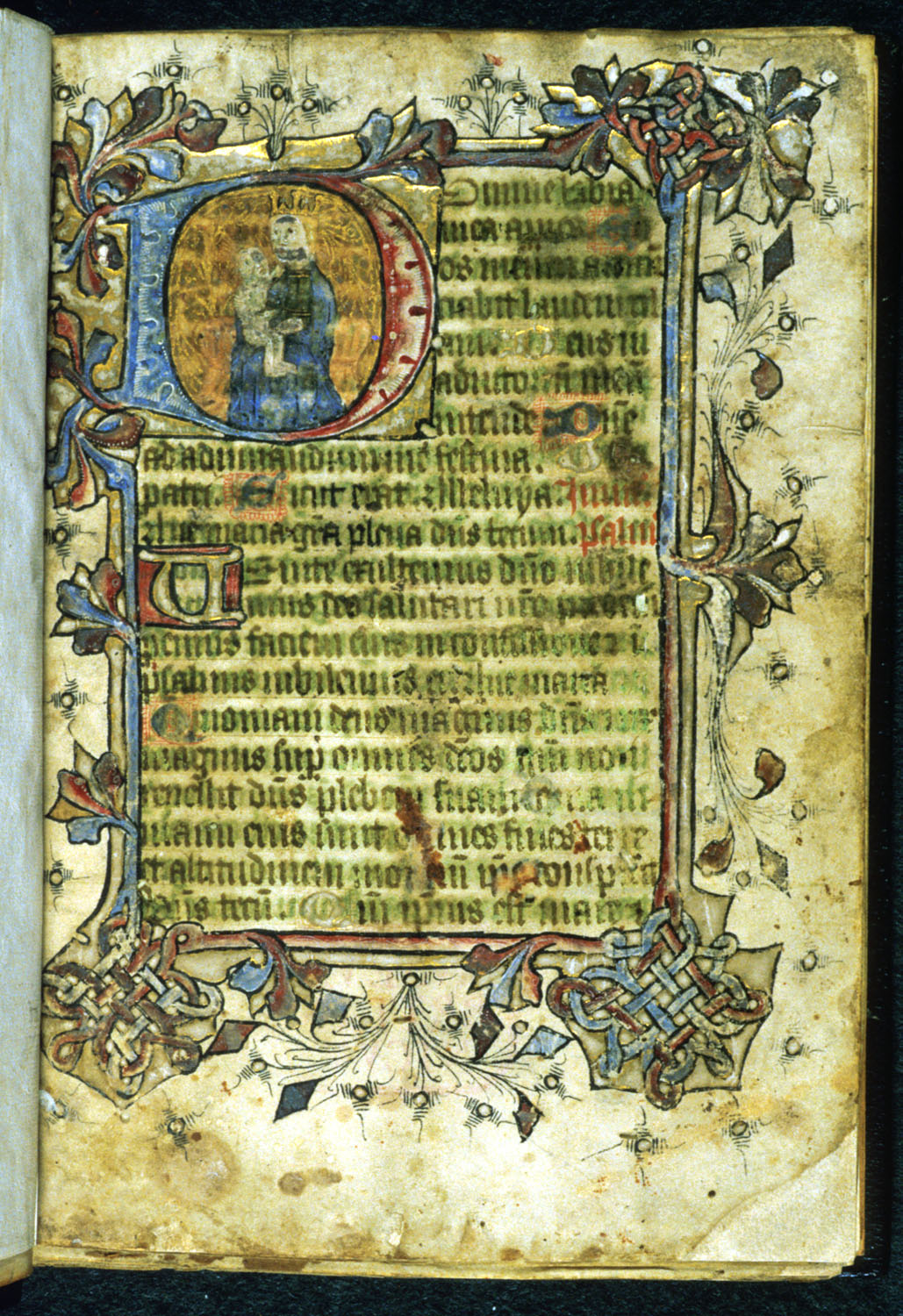
The second type are initial letters that contain scenes (known as historiated initials) or that have elaborate decoration. Again, these usually illustrate or complement the content of the text.

Historiated initial 'D'(omine) with a crowned Virgin and Child.
English Book of Hours, 1st quarter of the 15th century.

Third, we have borders and line-endings, which may have many detailed images/miniatures in them. These often do not relate directly to the text and can contain unusual figures.

Marginal illustration from the Gorleston Psalter- Norfolk, early 14th century.
How much do we love the medieval duck? 

And while the illuminations could serve to illustrate or to decorate, they also provided aids for contemplation and meditation for those reading them as part of their daily prayer and devotion. On another (very practical) level, the illustrations were useful markers for less literate readers to be able to navigate a lengthy manuscript. One does not have to be able to read to identify a picture of the Virgin Mary or one of the story of Adam and Eve.

Four scenes from the Book of Genesis, with three of Adam & Eve.
The Huth Psalter, England, late 13th century.

Although so many wonderful works were produced by men (and women) of the church, by 1100 this situation began to change. The production of manuscripts was no longer the preserve of the church, and secular scribes and illustrators rose in importance. This was in part due to the expansion of the content of manuscripts. Romances, chronicles, medical and other texts and aristocratic family trees all began to be produced. The rise of the universities and the increase in book ownership by the wealthy saw a thriving secular book trade in Paris and Bologna by the 13th century.

Guinevere questioning Lancelot about his love for her.
Lancelot du Lac, France, c.1316.

It was another university city, the city of Cologne, that was to trigger the start of the demise of the manuscript. By the 1470s Cologne had become the most important centre of printing in north-west Germany and where a certain William Caxton was perfecting his own particular art. Handwritten texts were being replaced by the printed version.

From the Arnstein Bible, a large two-volume MS, Germany c. 1172.
It was written by a single scribe, a monk named Lunandus.

But it was English Reformation that was to see the wanton destruction of the illuminated manuscript. Henry VIII decreed that the 'images and pictures' of Saint Thomas Becket shall 'through the whole realm be put down and avoided out of all churches, chapels, and other places.’ The Act against Superstitious Books and Images (1550) ordered that prayer and service books that did not comply with the reformed liturgy should be destroyed. The religious communities did their best to keep their handwritten treasures safe. Books were smuggled out of religious houses and hidden in sympathetic homes. But not all could be saved. Priceless manuscripts were torn up, burned, used to clean candlesticks, clean boots, stop up beer barrels and even deployed in the privies.

The martyrdom of Thomas Becket from the Harley collection-
a rare survival in an English context.
Netherlands, 3rd quarter of the 15th century.
           

Yet despite all of this appalling vandalism, medieval manuscripts have preserved for posterity the lion’s share of medieval painting. As Beal so beautifully puts it: ‘Books have a knack of surviving.’ It is our great good fortune that they do.


Detail of marginal images of apes with books.
France, 1318-1330.

~~~~~~~~~~~~~~~~
References:
All images are in the Public Domain and are part of the British Library's Catalogue of Illuminated Manuscripts. (This online resource is truly a treasure trove and I cannot recommend it highly enough.)
Beal, Peter, A Dictionary of English Manuscript Terminology 1450–2000: Oxford University Press, Current Online Version. (2011)
Brigstocke, Hugh, The Oxford Companion to Western Art: Oxford University Press, Current Online Version (2003)
Chilvers, Ian, The Oxford Dictionary of Art and Artists (4 ed.): Oxford University Press, Current Online Version (2014)
De Hamel, Christopher, A History of Illuminated Manuscripts (2nd ed.), London: Phaidon Press Ltd. (1994).
Kerr, Julie: Life in the Medieval Cloister, London, Continuum Publishing (2009)
Whittock, Martyn, A Brief History of Life in the Middle Ages: London, Constable & Robinson (2009)
~~~~~~~~~~~~~~~
E.M. Powell’s medieval thrillers THE FIFTH KNIGHT and THE BLOOD OF THE FIFTH KNIGHT have been #1 Amazon bestsellers and a Bild bestseller in Germany. Book #3 in the series, THE LORD OF IRELAND, about John’s failed campaign in Ireland was published by Thomas & Mercer on April 5 2016. Born and raised in the Republic of Ireland into the family of Michael Collins (the legendary revolutionary and founder of the Irish Free State), she now lives in northwest England with her husband, daughter and a Facebook-friendly dog. As well as blogging and editing for EHFA, she is a contributing editor to International Thriller Writers The Big Thrill magazine, reviews fiction & non-fiction for the Historical Novel Society and is part of the HNS Social Media Team. Find out more by visiting www.empowell.com.

Find her books on:
Amazon

Friday, February 12, 2016

With a Little Help from the Saints: Medieval Lovers.

By E.M. Powell

You probably can't have failed to notice that wherever you turn at present, your senses are assailed by objects of the red, heart-shaped variety. Although it's not a particular wave I personally like to get swept up in, I couldn't fail to be halted by this gem in a local card shop: 'To My Gran on Valentine's Day.'  I did brace myself for the Four Horsemen of the Apocalypse to come crashing through the door at any second, but all remained calm. And just as I was about to deride twenty-first century consumerism for this new level of madness, it occurred to me that, like so much in our world, it is all the fault of the medievals.

From: The Roman de la Rose
The Lover (L'Amans) in bed with a man (Dangier, or Danger) holding a club.

The medievals loved their love and especially of the courtly variety. It found its expression in poetry and among the most famous is the French Roman de la Rose, or The Story of the Rose. It was composed by two authors: Guillaume de Lorris in around 1230 and Jean de Meun in around 1275, some forty years later. The poem takes the form of a dream, in which the dreamer, the Lover, approaches the rose (the symbol of his lady's love) in a garden but is spurned. The Lover then has to learn the rules of love to win the object of his desire. The complete work is over 21,000 lines and was hugely popular amongst the elite of England and France. Several copies are still in existence.

The Lover pierced by an arrow,
kneeling before the God of Love (Diex d'Amour).

I have chosen the images from a manuscript from c1320-1340 for this post. Interestingly, it is a non-religious work, so no saints (of which more later). The fourteenth century also saw the introduction of a custom for lovers within court circles that is still with us: Valentine's Day. February 14th is the day that the medievals reckoned birds began mating. So why not have a day when refined men and women could do the same in elaborate rituals and games?

Male Lovers pierced by arrows.

The poetry of the time again reflects the custom. Geoffrey Chaucer's Parliament of Fowls is the earliest, dating from around 1381. In it, lovers are birds, quarrelling over the finest partner on Valentine's Day.

Female Lovers- and a Monk.

By 1400, the French Court had founded the Cour Amoureuse, or the Court of  Love, supposedly in honour of women. It first met on Valentine’s Day in 1400, ruled over by a ‘Prince of Love’ who was a professional poet. Noble ladies heard various love-poems and presented prizes to the winners. It sounds very charming until one realises that around 600 people took part. One can only suppose that, with those sorts of numbers, everyone probably went home with something out of the day.

The God of Love taking hold of the Lover.

In the fifteenth century, the poet and prior of Hatfield Regis, John Lydgate, wrote ‘A Valantine to Her That Excelleth All’.  And we start to see the custom of the Valentine move beyond the confines of the court. In a letter dating from 1477 Norwich, Margery Brews writes to her fiancé John Paston as her ‘right wellbelovyd Voluntyn’.

Envie (Envy) looking at a pair of lovers.

What's even more interesting is that Margery's mother Elizabeth also writes to John to ask that the marriage takes place on 'Sent Volentynes Day'... [when] every brydde chesyth hym a make.' Yes, we have mention of the bird choosing a mate again. But we also have reference to Saint Valentine. It is likely that clerics began making the connection between a saint and the secular customs around finding a partner. Two third century saints were named Valentine: Valentine of Rome and Valentine of Interamna (modern Terni in Italy). We know little about them other than they were martyred and that is commemorated on February 14. They had never been associated with lovers up the middle ages.

Vilenie (Villainy, Abuse, Baseness)
offering the Lover a potion.

Of course other medieval saints were on hand to help steer the course of true love. Fifth century Saint Dwynwen is the Welsh patron saint of love. Dwynwen was one of the twenty four daughters and eleven sons of King of Wales, Brychan Brycheiniog and his wife, Prawst. When I came across those statistics, I felt perhaps that Brychan should patron saint of something, but I wasn’t quite sure what. Prawst, I continue to feel, should just be regarded with awe.

Oiseuse (Idleness, Ease, Leisure)
admitting the Lover through the gate.

Dwynwen was not as fortunate - or fruitful - in love as her parents. Her love story is of a bleaker kind and she suffered horribly at the hands of a man who should have loved her. After much travail, Dwynwen’s prayers were answered. As a mark of her thanks, she devoted herself to God's service for the rest of her life. She founded a convent on Llanddwyn, on the west coast of Anglesey, where she was joined by other broken-hearted women. After her death in 465AD, a well named after her became a place of pilgrimage and it remains there today.

Tristece (Sorrow or Misery), tearing her hair and clothes.

I think blaming the medievals for the annual fuss about Lovers is fair. But I did find an account where some level-headed souls decided it might be nice to use the day to celebrate neighbourly love. A 1415 charter from Norwich records that the citizens should some together on Valentine's Day, 'make peace, unite, and accord, poore and ryche to ben one in herte, love and charite.' Now, that's more like it. And even if they didn't get a card, I'll bet all the Grans were happy.

~~~~~~~~~~~~~~
References:
All images are in the Public Domain and are part of the British Library's Catalogue of Illuminated Manuscripts. 
Drabble, Margaret, ed. et al., The Concise Oxford Companion to English Literature (3 ed.), Oxford University Press (2007, Online version: 2007)
Knowles, Elizabeth, ed.: The Oxford Dictionary of Phrase and Fable (2 ed.) Publisher: Oxford University Press (2005, Current Online Version: 2014)
Lindahl, C., McNamara, J & Lindow, J. (eds.): Medieval Folklore, Oxford University Press (2002)
Livingston, E.A.,ed.:The Concise Oxford Dictionary of the Christian Church (2 rev.ed.), Oxford University Press (2006, Current Online Version: 2013)
MacKillop, James: A Dictionary of Celtic Mythology , Oxford University Press (2004, Current Online Version: 2004)
National Library of Wales: Dictionary of Welsh Biography Online.
Simpson, Jacqueline & Roud, Steve: A Dictionary of English Folklore, Oxford University Press (2003, Current Online Version: 2003)

E.M. Powell is the author of medieval thrillers THE FIFTH KNIGHT & THE BLOOD OF THE FIFTH KNIGHT which have both been #1 Historical Thrillers on Amazon's US and UK sites and on the Bild bestseller list in Germany..

Sir Benedict Palmer and his wife Theodosia are back in book #3 in the series, THE LORD OF IRELAND. It's 1185 and Henry II sends his youngest son, John (the future despised King of England), to bring peace to his new lands in Ireland. But John has other ideas and only Palmer and Theodosia can stop him. THE LORD OF IRELAND is published by Thomas & Mercer on April 5 2016.

E.M. Powell was born and raised in the Republic of Ireland into the family of Michael Collins (the legendary revolutionary and founder of the Irish Free State) she now lives in the north west of England with her husband and daughter and a Facebook-friendly dog. Find out more by visiting www.empowell.com

Amazon.com
Barnes & Noble
Amazon.co.uk
Waterstones