Showing posts with label church history. Show all posts

Sunday, November 15, 2015

Margaret of Scotland: Saintly Queen, Queenly Saint

by Margaret Porter

National Trust Images/John Hammond
The sixteenth day of November, the date on which Saint Margaret died in 1093, is her feast day.

A princess of the House of Wessex, Margaret was the daughter of Edward the Exile and Agatha of Hungary, and probably left England in infancy in the time of King Canute. First exiled in Sweden, then Kiev, Edward and his wife eventually settled in her native Hungary, where Margaret and her siblings were born. The Hungarian court was highly religious, and from an early age Margaret became devoted to the church.

According to Turgot, her confessor and biographer:
Whilst Margaret was yet in the flower of youth, she began to lead a very strict life, to love God above all things, to employ herself in the study of the Divine writings, and therein with joy to exercise her mind. Her understanding was keen to comprehend any matter, whatever it might be; to this was joined a great tenacity of memory, enabling her to store it up, along with a graceful flow of language to express it.
In 1057 she returned with her family to England. Her father, summoned as a potential heir to Edward the Confessor's throne, did not long survive the journey. After the Norman invasion and Harold's defeat at the Battle of Hastings, her brother Edgar was proclaimed king, but the Conqueror prevailed and England became unsafe for the returned royal exiles. Edgar, his mother Agatha, Margaret, and other family members fled to Northumbria. It is believed they were sailing back to the continent when a storm drove their ship onto the coast of Scotland. They chose to remain. This second exile resulted in Margaret's marriage to King Malcolm III, who supported her brother's claim to the English throne.

Medieval image of Queen Margaret
Margaret's influence on the church in Scotland was profound, and she imported continental Catholic practices to a realm where religion was somewhat less sophisticated. She brought other refinements, introducing arts and culture to her husband's court. She was also a proponent of royal rule that was 'just' and 'holy'.

Turgot describes the Malcom's admiration of his queen, and her role in the expansion of his faith:

. . . he could not but perceive from her conduct that Christ dwelt within her; nay, more, he readily obeyed her wishes and prudent counsels in all things. Whatever she refused, he refused also, whatever pleased her, he also loved for the love of her. Hence it was that, although he could not read, he would turn over and examine books which she used either for her devotions or her study; and whenever he heard her express especial liking for a particular book, he also would look at it with special interest, kissing it, and often taking it into his hands. Sometimes he sent for a worker in precious metals, whom he commanded to ornament that volume with gold and gems, and when the work was finished, the king himself used to carry the book to the queen as a loving proof of his devotion.
Malcolm had sons at the time of their marriage, but Margaret bore him six more and two daughters. Three of those sons succeeded Malcolm in turn--Edgar, Alexander, and eventually David. Their daughter Matilda married Henry I of England, and another daughter married a French count. Not surprisingly, one son became an abbot.

She was a great giver of alms and reportedly never sat down to dine without first feeding the poor and the orphaned--she founded or encouraged the creation of schools, orphanages, and hospitals. The chief recipient of her support was Dunfermline Abbey.

Says Turgot, in his account of her, "When [she] spoke, her conversation was with the salt of wisdom. When she was silent, her silence was filled with good thoughts. So thoroughly did her outward bearing correspond with the staidness of her character that it seemed as if she has been born the pattern of a virtuous life."

Not only was Margaret's piety expressed through many good works, she strongly believed that Holy Communion should be received frequently rather than rarely or periodically, as was customary in her time.

Margaret's husband and eldest son were away during what proved to be her final illness at Edinburgh Castle. Turgot received a firsthand account of her last days from a witness:

Her face was already covered with a deadly pallor, when she directed that I, and the other ministers of the sacred Altar along with me, should stand near her and commend her soul to Christ by our psalms. Moreover, she asked that a cross, called the Black Cross, which she always held in the greatest veneration, should be brought to her...she received it with reverence, and did her best to embrace it and kiss it . . . .
She was already preparing for death when her son Edgar arrived at Edinburgh Castle in the aftermath of the Battle of Alnwick just over the Border. He was reluctant to announce the tragic news of her husband's and her eldest son's deaths, but Margaret insisted upon hearing it. After learning of her losses, she continued to pray with her last breaths and died peacefully. "Her departure was so calm, so tranquil, that we may conclude her soul passed at once to the land of eternal rest and peace. It was remarkable that her face...became afterwards suffused with fair and warm hues, so that it seemed as if she were not dead but sleeping."

A century and a half after her death, Queen Margaret was canonised by Pope Innocent the IV, for her faithfulness, her charity, and her success in reforming the church in her adopted land. At that time her remains were removed from their original burial place at Dunfermline Abbey and re-interred in a shrine with her husband. During the 16th century, historian John Major in A History of Greater Britain as Well England as Scotland writes of the event as it occurred in 1250:

In the following year Alexander [the Third] and his mother, with the bishops of the Church, assembled at Dunfermline for the transfer of the remains of Queen Margaret. And when these were raised, a most sweet fragrance filled the whole church. But while the remains were being carried with all due honour to the monument which marked the resting-place of her husband, Malcolm, the bearers found themselves completely unable to go further—until some wise men gave them this advice: to disinter likewise the bones of Malcolm. And, when the saintly bones were united with one another, they were carried without difficulty to the appointed place, where, with due adornment of gold and precious stones, they remain to this day.
Except that Margaret did not remain. Her head was later removed from the shrine by none other than Mary Queen of Scots in 1570, who sought her saintly ancestress's presence during childbearing. The head, possibly with the rest of the saint, was later transferred to the Catholic monastery and seminary at Douai in France. All bodily relics associated with Margaret were lost during the French Revolution.

The Roman Catholic Church formerly celebrated Margaret's feast day in June. However with a later revision of the Calendar of Saints, her death date became vacant. Since 1969 the Catholic Church to which she belonged has followed the tradition of the Church of Scotland, which she reformed, honouring her on 16th November.

Margaret's Shrine, Dunfermline, © Kim Traynor
~~~~~~~~~~~~

Margaret Porter is the award-winning and bestselling author of twelve period novels, whose other publication credits include nonfiction and poetry. A Pledge of Better Times, her highly acclaimed novel of 17th century courtiers Lady Diana de Vere and Charles Beauclerk, 1st Duke of St. Albans, is her latest release, available in trade paperback and ebook. Margaret studied British history in the UK and the US. As historian, her areas of speciality are social, theatrical, and garden history of the 17th and 18th centuries, royal courts, and portraiture. A former actress, she gave up the stage and screen to devote herself to fiction writing, travel, and her rose gardens.


Sunday, May 12, 2013

Saint Boniface: A Man on a Mission

by Kim Rendfeld


In 750, Archbishop Boniface anointed the upstart Frankish King Pepin in Soisson. A Saxon in his 70s, he could have had influenced Frankish politics, or he could have retired to a monastery. Instead, a few years later, he embarked on a dangerous mission to preach to the pagan Frisians.

That’s the striking thing about Saint Boniface. He could have had an easy life, by early medieval standards, but again and again, he gave up power and the privileges that went with it to pursue his missionary work.

Boniface is believed to have been born to a noble family in Saxon kingdom of Wessex in the 670s - details of his early life are sketchy. He was called Winfrid until he took the Latinized version of his name, either when he joined the Benedictine order or when he was consecrated bishop in 722.

From an early 20th century prayer card
When he was a child, missionary monks visited his family’s home. Their stories must have made quite an impression on the boy, enough to make him want to be a monk. Did what they say about the pagans in Saxony cause him to worry that thousands of fellow Saxons faced eternity in hell? Did he see himself rescuing them from that fate?

Regardless of the boy’s motives, Boniface’s father prohibited his son from pursuing a religious life but relented after becoming seriously ill, believed to be a sign from God to let his son go the monastery.

At age 13, he went to the abbey of Adescancastre (site of today’s Exeter) and seven years later the abbey of Nhutscelle (between Southhampton and Winchester). There, he furthered his education, joined the Benedictine order, and was ordained a priest at age 30. (The lines between priest and monk were loose then.)

Rejecting Power and Prestige 

A memorial to Boniface in Fritzlar
He could have basked in the praise of his scholarship and preaching, but that’s not what he wanted. He wanted to preach to the Continental Saxons, pagans who lived in today’s Germany and might have practiced human sacrifice as a thanksgiving after a first battle. At this point, he was probably in his late 30s or early 40s.

He made a foray into Frisia but found the political situation too unstable and returned to Britain. About a year later, toward the end of 717, the abbot of Nhutscelle died, and the monks elected Boniface the abbot. Abbots often had political influence, and although the abbot at Nhutscelle chose an austere lifestyle, many lived as aristocrats. Boniface rejected the abbacy and instead convinced the bishop of Winchester to have the monks elect someone else.

He then traveled to Rome to receive the pope’s blessing for his mission to the Continent. When the pope determined Boniface had the right morals and motivation, he sent him to lands in today’s Germany.

Mission on the Continent
 
What Boniface found was that officially Christian countries had lapsed, often following a mix of Christianity and paganism. With the exception of a couple of visits to Rome, he spent the next decade preaching, converting pagans, founding monasteries and appointing abbesses. Some of his tactics will bother a tolerant 21st century audience. He felled a tree sacred to the pagans and made a chapel from its wood, and he destroyed an idol. His stature and mission continued to grow.

In 732, he was elevated to archbishop and continued to found monasteries and build churches and institute reforms. He wanted to resign his archbishopric in 738 and return to mission work, but the pope would not let him. For many years, he held synods, enforced canons, trained monks, and led prayers and meditation.

An 11th century illustration from the Sacramentary of Fulda

About 753, he resigned the archbishopric of Mainz and went to Frisia with his followers. He surely knew that it was not safe. Having lived longer than most medieval folk, perhaps he did not fear death. While he prepared for confirmation rites for converts on the River Bornes in 754, his party was attacked by pagans, apparently intent on robbery. He told his followers not to resist. His body was found near a bloodstained copy of Saint Ambrose’s The Advantage of Death.

He was eventually taken to Fulda, whose establishment he had supervised, and his canonization soon followed (exactly when is unclear). In 778, more than 20 years after Boniface’s death, the monks at Fulda went to great lengths to protect his relics. While pagan Saxons warriors closed in, they fled for their lives, taking the saint’s bones with them. The monks were able to return to Fulda, where Boniface’s tomb remains today.

Sources: The Catholic Encyclopedia (1907), article by Francis Mershman

Rev. Alban Butler’s The Lives of Saints 

Carolingian Chronicles: Royal Frankish Annals and Nithard’s Histories, translated by Bernhard Walter Scholz with Barbara Rogers

Charlemagne: Translated Sources, P.D. King

Public domain images via Wikimedia Commons.

~~~~~~~~~~~~

Kim Rendfeld is the author of two books set in Carolingian Francia, where Boniface was revered: The Cross and the Dragon, published by Fireship Press, and the yet-to-be published The Ashes of Heaven’s Pillar. For more about Kim and her fiction, visit kimrendfeld.com or her blog, Outtakes. You can also connect with her on Facebook and Twitter.

Tuesday, October 2, 2012

The Demise of the Medieval Rood Loft


Judith Arnopp

Before the Reformation the focal point of all churches, even small ones, was the Holy Rood; a great crucifix that stood high above the congregation upon the Rood beam above the chancel. The cross was often accompanied by figures of Mary and John where candles were kept burning, paid for by the many bequests for 'the light to burn before the Rood.’ 

Access to the beam was by way of the Rood Loft, usually an ornately carved and painted structure set just above the Rood Screen beneath the chancel arch.  On occasion the priest would preach from the loft, lit by the candles about the Rood, the added height and position providing extra impact to his sermons.

During the Reformation of the Church the changes did not at first, affect the Roods although it was ordered that the accompanying images be removed.  There were those at this time who saw the Rood as a prime object of idolatry and instances of vandalism are recorded, but the Rood was allowed to remain and there was no major demolition of the Roods until the reign of Edward VI.

Early in his reign his zealous reforms called for the removal of all shrines, images, candlesticks, painted images on walls, screens and even on the stained glass windows. This general destruction began in London in 1548 and spread throughout the realm.

Although many reformers regarded them as Popish idolatry the figures about the Rood were highly valued in most parishes. When they were ordered to be destroyed many parishes, unable to face their ruin, hid their prized images away and later, at the time of Queen Mary’s reversal of the reforms, they were simply brought  out of hiding and reinstated in the church.

It was during the Elizabethan Injunctions that irreversible damage occurred when anything connected with the old religion was ripped out and burnt on huge bonfires.

With the Roods and Rood figures gone, the loft itself had little use and in the following years most of them slowly decayed until they were removed altogether. The stairs that led to them were largely blocked up and plastered over but in a few churches, the stairs still remain today, built into the solid walls, leading nowhere, a reminder of our medieval past. 

There are no Rood Crosses left in Britain today but some Screens remain, often ornately carved and painted. They stand as testament to the changes the church has endured and marking the medieval divisions between the earthly and divine. Very few Rood Lofts are left although some have been reconstructed, as only a small amount survived the upheavals of reform.

I recently had the good luck to visit The Church of Merthyr Issui at Patricio in Mid-Wales which houses a splendid unspoiled example of an intact Rood Loft and Screen.

Patricio is a tiny church nestling on a hillside in a wooded valley; a valley infused with natural peace where the only sound is of grazing sheep and birdsong. The building has no ostentatious grandeur, no opulent riches on display but for me, the simplicity adds to its charm. It is the sort of place that makes an atheist pause and begin to question his convictions.

Somehow, possibly due to its remote location, Patricio escaped the devastation of church reform and stands today pretty much as it did in the medieval period. On opening the door you are assailed by cold, the smell of damp and the impact of a thousand years of prayer. 

The floor is slate, the walls are stone and, here and there, a wall painting peeps from beneath the layer of white wash. There is the depiction of Time, a skeleton with scythe and hourglass, reminding us of our mortality; the Royal coat of Arms; a biblical text in thick, black, forbidding script … but it is the Rood Screen and Loft that draws your eye and pulls you toward the altar.

It lies beneath the chancel arch, stretching the width of the church, a masterpiece of craftsmanship, laden with carved  leaves and flowers concealing a dragon, the emblem of evil, consuming a vine, the emblem of good.  

The loft and screen are in an unpainted state, it has never been painted, the Irish oak has  been left to flaunt its own natural beauty which makes it, as far as I know, quite unique. You are forced to stand and stare until, at length, you stretch out a finger to trace the path of the ancient chisel.

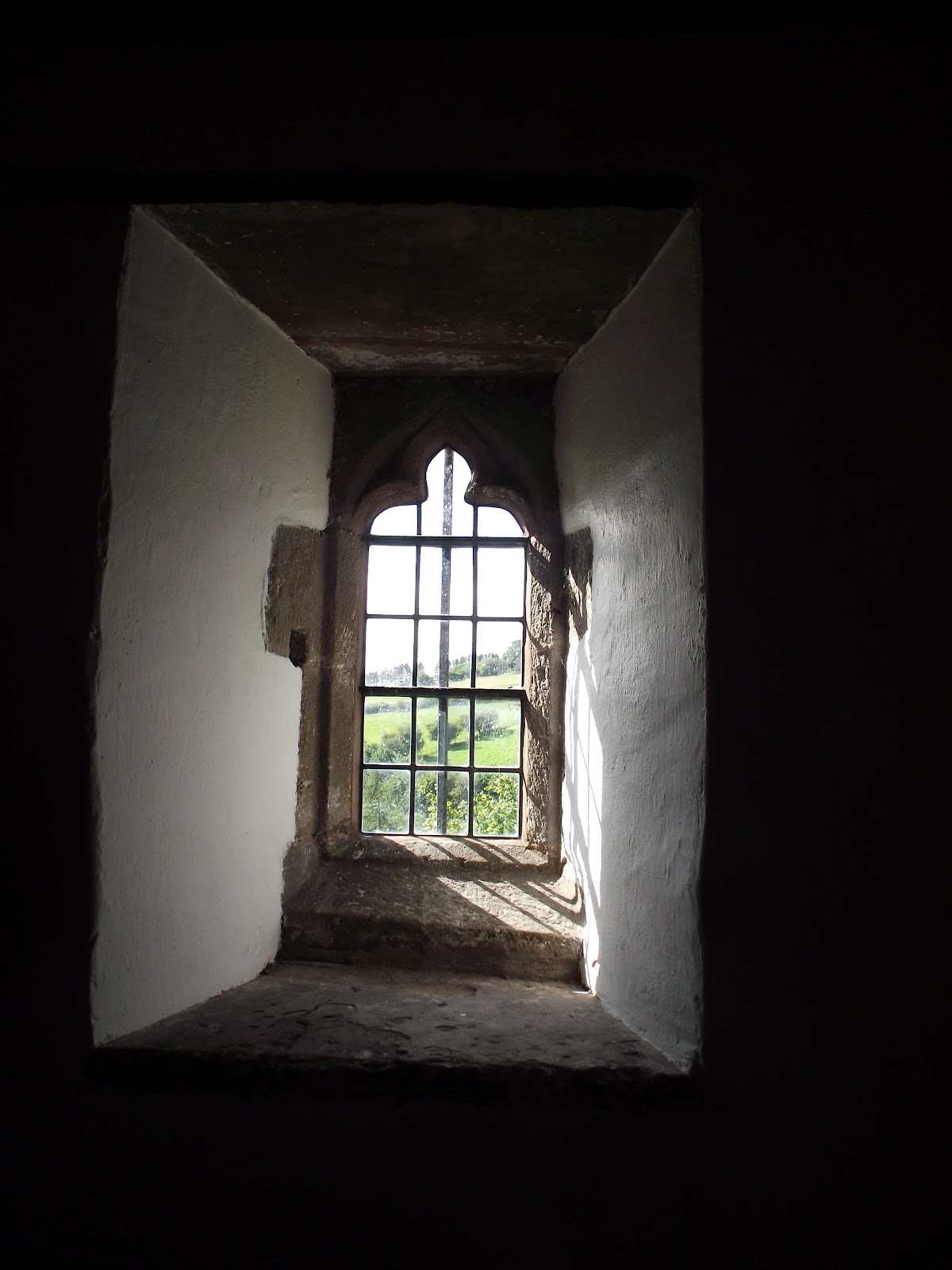
A short stone stairway is cut into the wall, the Tudor headed doorway suggesting it was added later than the two stone altars which have also somehow escaped the destruction ordered in the Elizabethan period.

I love this place. I do not want to leave. My camera clicks, recording what I see but there are things the lens can never quite capture; the serenity of the graveyard, the cool tranquility of the interior, the brush strokes of long dead painters, the chisel marks of the carpenter on the Rood Loft and Screen, the antiquity of the incised consecration crosses on the altars. And, most of all, it can never capture the whispering echoes of  the prayers of the long dead congregation. 
You will have to make the journey there to experience that.

Photos by the author. For information about Judith's novels and work please visit her webpage: www.juditharnopp.com

Tuesday, September 11, 2012

Vicars and curates and livings…oh my!


By Maria Grace

In the 1800’s the English laws of primogenitor, intended to preserve the integrity of large landed estates, made it a challenge for younger sons of the landed gentry to establish themselves in life. If their family did not possess an additional estate for them to inherit or they lacked some other relative to provide an inheritance, younger sons had little choice but to make their own way in the world. The question was how.

Traditional ‘learned’ professions: the church, the law and medicine had a respectable character as ‘liberal professions’ befitting gentlemen. So these, together with the armed forces formed the primary options for gentlemen's younger sons.  The church was a particularly attractive option if a family had a living they could bestow as they chose. A living meant a guaranteed income and home for the lifetime of the clergyman lucky enough to be appointed to one.

Ordination

To qualify for a living, a man had to be ordained. The process started with a standard honors degree from Cambridge or Oxford. Afterwards, the candidate needed a testimonial from his college vouching for his fitness for ordination. He then presented the testimonial to a bishop and made arrangements for an examination to prove his competency in Latin, knowledge of the Scripture, and familiarity with the liturgy and church doctrine as written in the 39 Articles. Some bishops made only a cursory examination in these areas, only a few took their responsibilities more seriously.

After Japanning (slang for ordination referring to putting on black cloth, from the color of black japanware) a man was qualified to administer the sacraments of the Church. His career would begin at age 23, as a deacon, assisting an ordained priest. At 24 he could be fully ordained and eligible to be in charge of a parish and obtain a living.

Obtaining a Living

For all but the luckiest young men, the real challenge began at this point. The surest way of procuring a benefice was to be related to the patron. A well-placed relative might mean he could walk into a living immediately after ordination. Less well-connected individuals could wait ten or twenty years for the opportunity.

The right to appoint a clergyman to a living was called an advowson and considered a form of property to be bought, sold and inherited. Typically an advowson sold for five to seven times the annual value of the living. Instead of selling an entire advowson, a gentleman strapped for cash might sell just the ‘right of next presentation’ as did Sir Thomas Bertram in Jane Austen's Mansfield Park. An extremely fortunate clergyman could own an advowson and appoint himself to a living.

Approximately 11,500 benefices or livings existed in England and Wales at the end of the 18th century. This sounds like a sufficient number; however, over half the ordained clergy never received a living. 

Oxford and Cambridge colleges controlled nearly 5% of benefices, presenting them as gifts to fellows and masters who wished to marry and leave academic pursuits. Another 10% or so belonged to the Crown, to be presented to government supporters. Bishops and cathedral chapters possessed about 20%. The gentry and aristocracy held the largest share, on the order of 60%. Most great families had at least one or two livings at their disposal. 

The value of a living

Still, having a living, did not guarantee the holder a life of wealth and ease. An 1802 figure suggests a third of the benefices brought in less than £150 a year and some 1,000 of those less than £100. (£50 a year was more or less equivalent to our minimum wage.)  A clergyman needed an income £300-400 per annum to be on the level with the lesser gentry. 

Incomes might be increased by serving more than one parish, but this seldom resulted in real wealth. Only a third of all clergy acquired more than one living. Slightly more than one in twenty held more than two benefices and of these few had as many as four or five. 

Additional income might also be found through teaching or cultivating gardens and the glebe (acreage provided by the parish.) The amount of land varied by parish, some only had a field in others, fifty acres or more. The incumbent might chose to farm it himself or rent it out to a tenant farmer.

Enter the curate

In the Regency period, once installed in a living, a man was there for life. No one less than the bishop could remove him for cause. A vicar could resign his duties to a curate once he obtained the permission of his bishop. Many hired a curate from the beginning of their incumbency. Others only did so when they had to retire.

A curate was usually a young man just recently ordained, who assisted or sometimes performed the duties of a clergyman. A curate’s wages would be paid from the vicar’s own pocket and typically were very low, as little as £50 per year, not enough to afford a maid. Moreover, a vicar did not have to give up the parsonage house to the curate. He might continue to live in it himself and leave the curate to find his own living quarters somewhere within an easy distance of the church. 

Even at trifling wages, a curacy was not easy to obtain. In the early 1800’s curates made up close to half of the clergymen. Even with a position, their future was not secure. The death of the incumbent did not imply the curate would ascend to the living. Moreover, there was no guarantee that the successor would even continue to employ the curate. A curate did not retire unless he had private means of support because the church offered no pensions. 

As members of the clergy, curates were regarded as gentlemen. Despite their official standing, the subservient nature of their position and their paltry incomes caused some of the gentry and peers to hold them in disregard.

Parish duties

The clergyman’s duties in the church included holding service on Sundays and hold Holy Communion at least three times a year. Midweek duties included baptisms, marriages and funerals and visiting the sick.

Outside of the church, the clergyman officiated at parish meetings to discuss local affairs including charity, parish employment, care of the poor, repair and maintenance of the church and election of the churchwardens. The parish was responsible for the administration of the poor laws and elected Supervisors of the Poor who collected the Poor Rate taxes from the wealthier parishioners. The parish also appointed two Surveyors of Highways to supervise the maintenance and repair of the roads. Thus, whether vicar or lowly curate, the clergyman played a major role in the life of his parish community.


For more information see:
  
Collins, Irene. (1998)  Jane Austen, The Parson's Daughter . Hambledon Press.
Collins, Irene. (2002)  Jane Austen & the Clergy. Hambledon Press.
Day, Malcom. (2006) Voices from the World of Jane. Austen David & Charles .
Grose, Captain (Francis). (2004)  Dictionary of the Vulgar Tongue, 1811 ed. Ikon Classics
Le Faye, Deirdre.  (2002).   Jane Austen: The World of Her Novels. Harry N. Abrams
MacDonagh, Oliver . (1991) Jane Austen, Real and Imagined Worlds.  Yale University Press.
Sullivan, Margaret C. (2007) The Jane Austen Handbook. Quirk Books.
  
~~~~~~~~~~

Though Maria Grace has been writing fiction since she was ten years old, those early efforts happily reside in a file drawer and are unlikely to see the light of day again, for which many are grateful. 

After penning five file-drawer novels in high school, she took a break from writing to pursue college and earn her doctorate. After 16 years of university teaching, she returned to her first love, fiction writing.

Click here to find her books on Amazon. For more on her writing and other Random Bits of Fascination, visit her website. You can also like her on Facebook, or follow on Twitter.


Wednesday, July 18, 2012

Welsh Idylls with Judith Arnopp Part One: St Gwenog's Church


Llanwenog Church, Ceredigion
Just a stone’s throw from my home in the parish of Llanwenog is St Gwenog’s church. I have only recently found the time to go and have a close look and thought I would share my visit with you.
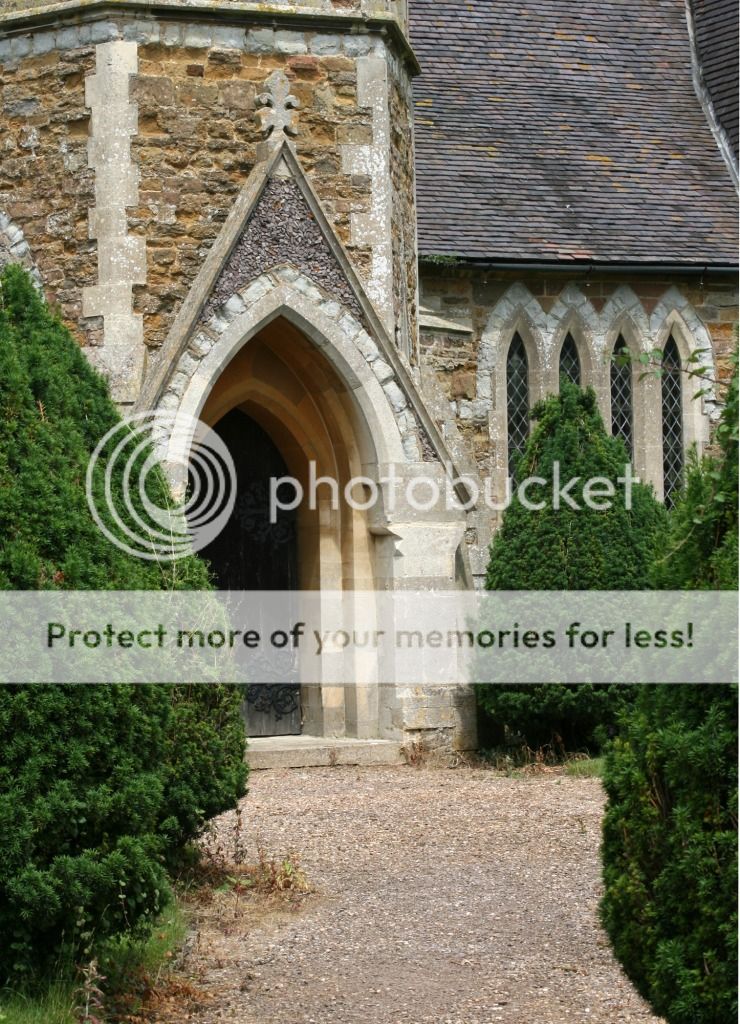
The Church of St Gwenog is delightful and anyone in love with ancient churches and planning a trip to the area should put it on their list of places to visit. It is only a small building and does not take long to explore but entering the church is like stepping into another world.
A memorable battle was fought in Llanwenog in 981, between the Dane, Godfrid, and the native Welsh chieftan, Eineon ab Owain; a battle in which the Danes were totally defeated.  Nearby there is a field on a farm named Ty Cam where the engagement is believed to have occurred.  The field is called Cae'r Vaes, or roughly translated, ‘the battle field,’ although whether the story has its root in fact or legend is open to debate.
In ancient, pagan times the word ‘Llan’ was used to denote an enclosure or sacred place. Early Christians built their churches in such places in an attempt to displace older religions.  By utilising ancient religious sites, Christian priests thought to encourage pagan worshippers to abandon the old gods and adopt the new teachings.
There are many such sites in Wales and Llanwenog is possibly one of the oldest for, although most of the extant building dates back to the 13th century, the foundation of the earliest church dates to the 6th.  As I circumnavigate the graveyard it is still just possible to detect that the original enclosure or ‘Llan’ was circular, or oval, in shape although it has now been extended and squared off at one end.
St Gwenog
We know almost nothing about St Gwenog.  She is mentioned in the Laws of Howell Dda copied in the 15th century and in the 18th century an annual local fair, held in January, was known as Ffair Gwenog’s.  Links have also been made with St Gwennlian who was active locally but it is a link that is difficult to establish. Even St Gwenog’s Well, once famous for its healing properties, has long since disappeared.  Its existence points to the reason for the site being allocated as a ‘Llan’ in pagan times as water was the earliest form of worship followed by that of the sun until Christianity incorporated elements of those older religions into its own.
Inside the church I see thick whitewashed walls and, at the altar, an early stone carving of Mary and St John at the foot of the cross. It is very badly weathered having originally been built into the exterior end of the side chapel. Now it is safe and sound in the new altar, the figures barely discernible.  I turn away and spy an early wall painting of the Apostles and the Ten Commandments, the faces peer out at me through the fog of time while, above me, the beautiful ceiling rafters smile down.  Richly carved pews escort me to the door and I climb a few worn stone steps while the tiny stone heads of the saints watch me as I pass.
Outside the battlemented tower draws my eye from the older, softer parts of the church. It is an imposing feature, providing protection for the village in times of strife.  It was a later edition to the building, built in the 15th century by Sir Rhys ap Thomas whose heraldric shield is displayed above one of the windows. The building was to commemorate Henry VII’s victory over Richard III at Bosworth in 1485.  Many men from Llanwenog parish fought and died for Henry in his quest for the throne but, once established, the Tudor dynasty did little to enhance the fortunes of their Welsh countrymen. 
I sit for a while among the markers of the dead and think about what I have seen.  I am touched by the peace and the great age of the place and love every inch of it.  But for me, the best thing about the visit is the font.  I slip back inside for another look. 
Llanwenog Church interior
It used to sit near the western doorway but has been moved to the south side of the lady chapel.  Today it is filled with a tacky flower arrangement totally out of keeping with the awesome antiquity of the piece. I take away the flowers and with the tip of one finger trace the marks where the cover once sat.  It dates from the Norman period and is showing its age.  The stone is carved with the heads of the twelve apostles, worn from centuries of visitors drawn to touch the primitive features as I am doing now. I have seen these carved faces described variously as ‘crude’, ‘grotesque’ and ‘rough’ but to me, they are beautiful. The tracks of the ancient chisel giving voice to the long dead craftsman.  I wish I could spend longer here. I run my fingers over the surface and feel as if I am clasping the gnarled hand of the mason that worked it.
font, featuring the twelve apostles, circa 11th century

Information about Judith Arnopp and her books can be found on her webpage: http://www.juditharnopp.com