Showing posts with label Victorian era. Show all posts

Monday, May 4, 2020

The Dangers of the Victorian Pleasure Garden

by Mimi Matthews

The Dancing Platform at Cremorne Gardens by Phoebus Levin, 1864.

When thinking of nineteenth century pleasure gardens, most of us instantly conjure up images of Vauxhall. But those in the Georgian era weren’t the only ones to enjoy a pleasure garden in London. In 1830 Cremorne Gardens was opened in Chelsea. Over the decades that followed, it offered concerts, circuses, dancing, and fireworks. It also offered military exhibitions and feats of dangerous daring, including high-wire acts and balloon ascents. Though many of these feats were successful, earning acclaim for various wire-walkers and aeronauts, still others ended in tragedy. Gruesome injuries and even fatalities occurred with some regularity—in full view of the Victorian public.

The Collapsed Platform


In 1855, during a military fete at Cremorne Gardens, a platform collapsed under the weight of sixty soldiers carrying their muskets and bayonets. According to an 18 August 1855 edition of the Huddersfield Chronicle, the soldiers were comprised mostly of Grenadier Guards who were enacting “the capture of the Mamelon and rifle pits by the allied troops before Sebastapol.” The performance had received the patronage of Queen Victoria and Prince Albert, as well as of “the highest military authorities.” Both the Household Troops and Royal Artillery were in attendance.

Banqueting halls at Cremorne Gardens, mid-19th century.

To enact the mock siege, stages of various heights had been constructed. As the Huddersfield Chronicle reports:
“Just as the spectacle was reaching its close, when the defenders of the Mamelon and the rifle-pits had been drive to the highest part of the staging by the assaulting columns below, the gallery on which they stood gave way, bringing some 60 men, with bayonets fixed on their muskets, crashing to the ground through a fall of at least 20 feet.”
During the fall, some of the men were bayoneted on their own weapons. Others broke their legs or fractured their ribs and limbs. No soldiers died at the scene, but one is reported to have suffered serious internal injuries.

The Broken Wire


An even more frightful accident occurred at Cremorne Gardens in June of 1863. The public had gathered to watch a show put on by the acclaimed acrobat Carlo Valerio. For the past two months, the twenty-five year old Valerio had been performing a high-wire act at the Gardens during which he walked along a wire cable that measured 600 feet across. The 27 June 1863 edition of The London Daily News reports that, on the night in question:
“He had advanced nearly to the point from which he usually returned backwards, when the wire rope suddenly gave way, and he fell heavily to the grassplat, a distance of upwards of sixty feet.”
Valerio’s injuries were severe. He suffered a fractured skull, a broken collar-bone, and many other injuries. According to a graphic first-hand account published in the 30 June 1863 edition of the Dundee, Perth, and Cupar Advertiser:
“When the wire slackened the unfortunate man staggered, and was precipitated violently to the ground on the back of his head, the blood pouring profusely from the wound and from his ears. Numbers of persons, particularly the females, were dreadfully shocked and affected, many of the corps de ballet being afterwards scarcely able to go through their performance. He was immediately removed, and the dance and music proceeded.”

The Ashburnham Pavilion at Cremorne Gardens, Illustrated London News, 1858.

The London Daily News states that Valerio was taken to Chelsea Hospital where he “lingered in great pain” until three o’clock in the morning, at which point “he expired” from his injuries. His death prompted an outcry against dangerous exhibitions. It was reasoned that, since acrobats would continue to test their skills in ever increasing feats and since the public would continue to arrive in droves to see such performances, it was up to the proprietors of places like Cremorne Gardens to prohibit exhibitions which put performers’ lives at risk.

In fact, Valerio’s death prompted Mr. E. T. Smith, then the proprietor of Cremorne Gardens, to write to the editor of The Era declaring just that. His letter, printed in the 28 June 1863 edition of The Era, reads in part:
“The sad accident that occurred at these Gardens on Thursday evening to the unfortunate Carlo Valerio during his performance on the wire rope, and which no person can more deeply regret than myself, induces me, with your permission, to seek the earliest moment of announcing, through your columns, that no such exhibition will ever again be permitted to take place here as long as I remain the Proprietor.”

The Flying Man's Shroud


Unfortunately, Valerio’s death was not the last fatality to occur as a result of an exhibition at Cremorne Gardens. In 1874, crowds again gathered to watch a death-defying feat. This time, the stunt was performed by M. Vincent de Groof, a thirty-five-year-old performer known as the Flying Man. According to the 11 July 1874 edition of the Belfast News-Letter, M. de Groof promised to:
“Fly a distance of 5,000 feet through the air by means of a pair of wings shaped like a bat’s, which were fixed to his shoulders and worked by his arms.”

Balloon Ascent at Cremorne Gardens, Walter Greaves, 1872.

M. de Groof ascended into the air by means of a balloon, from which he was suspended by a rope “about twenty feet below the car.” As the balloon rose to a height of approximately 1000 feet, M. de Groof flapped his wings, making for a churchyard some fifty years away. When he hit a favourable current of wind, he cut the rope, fully expecting to fly free of the balloon by virtue of the wings attached to his arms. Instead, as the Belfast News-Letter grimly relates:
“He came crashing through the air; the wing closed around him like a living shroud, and narrowly escaping the outer parapet, he fell with fearful violence on his head and right side in the road, immediately opposite the front entrance of St. Luke’s Church. Hundreds of persons immediately rushed to his assistance, and found him bleeding violently from the nose and ears, and without any sign of life.” 


In Conclusion

As the decade progressed, Cremorne Gardens’ reputation as a popular venue for wholesome entertainment began to sink. After the sun had set and Victorian families had departed, it transformed into what one Baptist minister of the 1870s referred to as “a nursery of vice.” Robberies and assaults were regularly reported, as were the goings on of prostitutes and their clients. In the end, it was this less gruesome but rather more unsavoury aspect of Cremorne Gardens which led to its closure in 1877. An increasingly prudish Victorian public objected to the goings on there, especially after dark.
________________________________________

Sources

Belfast News-Letter (Antrim, Northern Ireland), 11 July 1874.
Dundee, Perth, and Cupar Advertiser (Angus, Scotland), 30 June, 1863.
Elgin Courier (Moray, Scotland), 17 August 1855.
The Era (London, England), 28 June 1863.
Guard, Richard. Lost London. London: Michael O’Mara Books, Ltd., 2012.
Huddersfield Chronicle (West Yorkshire, England), 18 August 1855.
Illustrated London News (London, England). 5 June 1847.
London Daily News (London, England), Saturday 27 June 1863.
Thomas, Donald. The Victorian Underworld. London: Orion Publishing Group, 2014.

This article is an Editor's Choice and was originally published September18, 2017.
________________________________________

USA Today bestselling author Mimi Matthews writes both historical nonfiction and award-winning proper Victorian romances. Her novels have received starred reviews in Library Journal and Publishers Weekly, and her articles have been featured on the Victorian Web, the Journal of Victorian Culture, and in syndication at BUST Magazine. 

In her other life, Mimi is an attorney. She resides in California with her family, which includes a retired Andalusian dressage horse, a Sheltie, and two Siamese cats.

For more information, see Mimi's website MimiMatthews.com or connect with her through Facebook and Twitter


Friday, September 27, 2019

Women’s Lives Recorded in Diaries and Sketchbooks

By Lauren Gilbert

Diaries and sketchbooks fascinate me, especially those of women. Many of my favourites happen to have been drawn or written by English women in earlier times. The ability to depict one’s daily life in a way that is clear and entertaining to a third party, whether in art or in writing, is a real talent. (My own efforts tend to read more like the essay read in Cheech and Chong’s “Sister Mary Elephant”.) One cannot always assume that a diary written by a woman, especially a young, unmarried woman living with her parents or guardian, expressed her true feeling or opinions as her diary may not have been private. However, the details of one’s daily activities and the people with whom time was spent can give the viewer an idea of how life was lived on an intimate level. I’d like to introduce three of my personal favourites.

MRS HURST DANCING & Other Scenes from Regency Life 1812-1823 is a collection of sketches made by a young woman named Diana Sperling living with her family at Dynes Hall in Essex. She was the daughter of John Sperling and his wife Harriet Rochfort. The Sperling family was well-to-do, having made money in the fur trade, but were gentry by Diana’s time. She had two sisters, Isabella and Harriet, and two brothers, Henry John and Charles Robert, as well as a half-brother named John Thomas Kilpatrick (from Harriet Rochfort’s previous marriage). Born in 1791, during the period covered, Diana was between the ages of about 21 to 32. She filled multiple sketchbooks. (MRS HURST DANCING contains 70 of her paintings.)

Diana painted and drew informal and frequently humorous pictures of her family and friends, including her sister Isabella falling from a donkey, her mother swatting flies, and her brother Harry falling into a stream. A military review, country walks, dealing with a stubborn donkey are all captured, along with a spirited game of battledore and shuttlecock and the family at dinner. Fresh, lively and very personal, these paintings show the artist, her family and friends engaged in the normal activities about which one reads in the novels and letters of Jane Austen, providing a visual frame of reference. She had a third sketchbook for 1823-1833 which is not represented here. Diana married in 1834 at the age of 43 to Fred Luard Wollaston, and survived to the age of about 70. She died in 1862. Unfortunately, it appears that she stopped painting upon her marriage.

I recently received MAUD: The Illustrated Diary of a Victorian Woman, and find it fascinating. 

Caroline Maud Tomlinson was born in 1859 to William Tomlinson, a school master already 50 years old and his wife, possibly named Anne. She had several siblings who were much older, to whom she was not close, and a younger brother Hugh. Maud was 14 years old when Mr. Tomlinson retired, and 23 years old when they moved to the Isle of Wight. 

Flora Fraser adapted Maud’s diaries for the period 1888 (when Maud was 29 years old) to 1901. Her entries, which include sketches at water colours, address her family, friends, and her marriage in 1892 at age 33 to Colonel James Cavan Berkeley, an older widower with three daughters not much younger than his new bride. Interestingly, Maud had her first child after her husband’s daughters had left their home for their own lives. Maud’s diary entries continue into 1901, at which point she had had her third child, and announced that her diary keeping days were over as she would commence compiling albums for each of her children. It is no coincidence, I think, that this last entry cited includes a photograph of her children. Maud died in 1949, aged almost ninety. She lived through an era of great change, and her diary records her activities with her friends, her marriage, her stepdaughters, and all of the normal life events with great detail, including drawings of fashion, household duties, and her pets. She had an eye for detail and a great deal of humour which shows through her writing as well as her illustrations.

Another favourite of mine is THE COUNTRY DIARY OF AN EDWARDIAN LADY. This is different to the other two volumes, as it is more than a work of art, yet not primarily a diary of activities. Edith Blackwell Holden focused the 1906 journal on nature, not her daily routine (although there are hints here and there).

Thanks to the publication of this book in 1977, followed by a biography of Edith, we know a great deal more about Edith than we do about Diana or Maud. Edith was born September 26, 1871 in Kings Norton, Birmingham, England. Her mother was the former Emma Wearing, who had been a governess, and was the author of two religious books. Her father, Arthur Holden was a successful business man (Arthur Holden & Sons Paint Factory), a town councillor and philanthropist. They were Unitarians and spiritualists. A cousin was Elizabeth Blackwell, the first female physician; Edith’s middle name was selected to honour Dr. Blackwell. One of seven children (she had four sisters and two brothers), Edith and her sisters were taught at home by their mother. At age 13, Edith was sent to the Birmingham School of Art, where she did extremely well. Two younger sisters followed her there. At age 19, one of Edith’s paintings was accepted by the Royal Birmingham Society of Artists for the Artists’ Exhibition. At the age of 20, in August of 1891, at the suggestion of her tutors at school, Edith became a residential student with Denovan Adam, an established artist, for a year, an unusual step for a young woman. Her work was exhibited several times between 1890-1907 at the Birmingham Society of Artists. She also had a painting exhibited at the Royal Academy of Arts in 1907.

Edith taught art at the Solihull School for Girls from1906-1909. She created NATURE NOTES FOR 1906 as an example to assist her students. Organised by month, each month’s section contained beautiful and detailed illustrations of some combination of flowers, plants, birds, animals, reptiles and insects, which were identified, poems and mottos, and diary entries. She went on to work as a professional illustrator from 1907 on. Her illustrations were found in 4 volumes of the magazine “The Animal’s Friend” and children’s books, including BIRDS, BEASTS AND FISHES, THE THREE GOATS GRUFF and MRS. STRANG’S ANNUAL FOR CHILDREN.

In 1909, she gave up teaching and moved to London. Edith married Ernest Smith, a talented sculptor in 1911 (she was 40 and he was 30 years old). They lived in Chelsea, and she continued her work as an illustrator. Another of her paintings was exhibited at the Royal Academy of Arts in 1917.

Edith drowned in the River Thames near the Kew Gardens Walk on March 16, 1920, at the age of 48. Her death was determined to be an accident. She had no children. NATURE NOTES FOR 1906 stayed in her husband’s family, finally inherited by a great-niece Rowena Stott, who arranged for publication in 1977. It became a best seller. Edith’s biography THE EDWARDIAN LADY: The Story of Edith Holden compiled by Ina Taylor was published in 1980. Much to everyone’s surprised, an unknown document, NATURE NOTES OF 1905 was found in Hampshire, in the possession of people unrelated to the family. The authorship was confirmed, and this was published in 1989 as THE NATURE NOTES OF AN EDWARDIAN LADY. It was also a best seller.

These three women, in their own individual ways, illustrated their lives. Through their art and, in the cases of Maud and Edith, their words, we can see something of what they experienced. Their works are not only delightful to study; they give us valuable insight on the lives of women in their respective times. I highly recommend all of these works, as they give glimpses of normal lives and different perspectives to time periods we may only know from history.

SOURCES INCLUDE:

Fraser, Flora. MAUD: The Illustrated Diary of a Victorian Woman. 1987: Chronicle Books, San Francisco.

Holden, Edith. THE COUNTRY DIARY OF AN EDWARDIAN LADY. 1977: Webb & Bower Ltd, Exeter, England.

Sperling, Diana (watercolours) and Mingay, Gordon (text). Pictures (c) Neville Ollerenshaw. MRS. HURST DANCING & Other Scenes from Regency Life 1812-1823. 1981: Photoset by Rowland Phototypesetting Ltd, Bury St. Edmunds, Suffolk, England.

Corkpastandpresent.ie Green, T. George, H. INDEX TO THE MARRIAGE BONDS OF THE DIOCESE OF CLOYNE, IRELAND For the Years for the Years from 1630 to 1800, p. 88. 1899-1900: Guy & Co. Ltd, Cork. HERE

Geni.com “Diana Sperling, Artist.” (No author or post date shown.) HERE

Countrydiary.co.uk “Edith’s Biography.” (No author or post date shown.) HERE

Encyclopedia.com “Holden, Edith B. (1871-1920)” From WOMEN IN HISTORY: A Biographical Encyclopedia, (c) 2002: Gale Research Inc. HERE

Nationalarchives.gov.uk. “Berkley, James Cavan 1839-1926” Catalogue Description. HERE

~~~~~~~~~~~~~

An avid reader, Lauren Gilbert was introduced to English authors early in life. Lauren has a bachelor of arts degree in liberal arts English with a minor in Art History. A long time member of JASNA, she has presented various programs at meetings of the South Florida region, and presented a breakout session at the Annual General Meeting in 2011. She lives in Florida with her husband. Her first book, HEYERWOOD A Novel, is available. A second novel, A RATIONAL ATTACHMENT, is finally due out later this year. A long-time contributor to this blog, some of her work is included in both volumes of CASTLES, CUSTOMS AND KINGS: True Tales by English Historical Fiction Authors. She is also researching material for a biography. For more information, visit her website here.


Friday, November 13, 2015

Mrs. Beeton’s Book of Household Management: A Victorian Publishing Phenomenon

by Mimi Matthews

Beeton’s Book of Household Management, Colored Plate

Published in 1861, Beeton’s Book of Household Management is perhaps one of the most famous non-fiction books to come out of the 19th century. At over one thousand pages long, it was the first publication of its kind to address all aspects of household management, covering everything from cooking and cleaning to childrearing and animal husbandry. It even includes a section on the law, providing the inquiring housewife with general information on leaseholds, the legal rights and obligations between husband and wife, and the questionable validity of an I.O.U.

Original Title Page
In the first year alone, Beeton’s Book of Household Management sold more than 60,000 copies. Over the next decade, it would sell 2 million more. The book Voices of Victorian England, edited by John Wagner, explains the enormous popularity of Beeton’s Book of Household Management, stating:
By the 1850s, middle-class wives were expected to frugally and efficiently run their husband’s households, and thus had to be skilled in such tasks as hiring, firing, and supervising servants; planning and cooking meals; dealing with tradesmen; and teaching, nursing, and disciplining children. Because many girls were no longer automatically learning these skills from their mothers, there existed a need for a practical handbook on household management, which the Beetons recognized and sought to meet.
Isabella Beeton was only twenty-five at the time she wrote Beeton’s Book of Household Management. Married to publisher Samuel Beeton, she was a working journalist herself. She began her career in 1857 by contributing three articles a month to The Englishwoman’s Domestic Magazine, one of her husband’s most popular periodicals. By 1860, she was one of the magazine’s editors, as well as its fashion correspondent. Parts of Beeton’s Book of Household Management originally appeared in The Englishwoman’s Domestic Magazine. Explaining her reasons for expanding those separately published columns into one, comprehensive guide, the Encyclopedia of British Writers quotes Beeton as saying:
What moved me, in the first instance, to attempt a work like this, was the discomfort and suffering which I had seen brought upon men and women by household mismanagement. I have always thought that there is no more fruitful source of family discontent than a housewife’s badly cooked dinners and untidy ways.
Isabella Beeton, 1860

Beeton’s Book of Household Management was not the first book of its kind. In 1845, English cook Eliza Acton published Cookery for Private Families and in 1848 French chef Alexis Soyer published The Modern Housewife. Beeton’s book, however, far eclipsed those of her predecessors. Not only did it cover every aspect of household management, Beeton’s particular “tone and form of address” offered inspiration and assurance to her readers. As the book Consuming Culture in the Long Nineteenth Century explains:
Any woman who felt her position to be unimportant and useless could be persuaded by the strength of Mrs. Beeton’s rhetoric: the mistress is ‘the first and last, the Alpha and Omega in the government of her establishment’ and ‘it is by her conduct that its whole internal policy is regulated.’ In her opening sentence, Mrs. Beeton compares the mistress of the house to ‘a Commander of an Army’ who attains the ‘highest rank’ of the female character when she enters into knowledge of household duties.
It was not only the rhetoric that made Beeton’s book a Victorian phenomenon. Her guide included innovations that changed the face of cookbooks for generations to come. For example, Voices in Victorian England reports that Beeton was the first writer to place the list of ingredients at the start of the recipe. She was also the first writer to supply recommended cooking times. This was all part and parcel of Isabella Beeton’s genius for “compiling and organizing information.” She was not an accomplished cook herself. In fact, very few of the recipes in her book are her own. Even so, she possessed a talent for making the recipes of others easier to follow and conveying ideas on every aspect of household management to a middle-class audience without challenging “the more conventional notion of bourgeois femininity.”

Upon its publication in 1861, Beeton’s Book of Household Management was met with instant acclaim. A review in the November 9, 1861 edition of the Edinburgh Evening Courant closes by declaring:
Mrs. Beeton has endeavored to adapt her book to nearly all circumstances and conditions of life. She shows that, while luxurious repasts and sumptuous hospitalities rightly belong to the high and wealthy, there is no monopoly of good digestion or of appetite, and that enjoyment may be found in a ragout of yesterday’s cold meat, and even a relish imparted to our traditional ‘kailbrose.’ It is on the cook rather than on the materials, on the preparation rather than the cost, that a good dinner mainly depends; and hence the value of a book like this, which duly studied by mistress and cook may yield us a different and enjoyable dinner every day, whether our means be great or small, and whether one dish or twenty be set before us.
Beeton’s Book of Household Management, Colored Plate

Recipes were, indeed, a large component of Beeton’s Book of Household Management. Beeton provides instructions for the preparations of staples like meat, potatoes, and various puddings. She also provides recipes for foods which are very much of the moment today, such as boiled sea kale. In addition, Beeton advises on the best diet for livestock, the dangers of ‘rust’ in bacon and ‘rot’ in rabbits, and the perils of poisonous mushrooms. In the final segment of her cookery section, Beeton even includes recipes for beverages, such as the following for Cowslip Wine:

Recipe for Cowslip Wine from
Beeton's Book of Household Management, 1861

Perhaps the best bits of Beeton’s Book of Household Management, at least in my humble opinion, are those sections where she imparts advice to Victorian housewives. For instance, in the first pages of the hefty tome, she writes:
Early rising is one of the most Essential Qualities which enter into good Household Management, as it is not only the parent of health, but of innumerable other advantages. Indeed, when a mistress is an early riser, it is almost certain that her house will be orderly and well-managed. On the contrary, if She remain in bed till a late hour, then the domestics, who, as we have before observed, invariably partake somewhat of their mistress’s character, will surely become sluggards.
And later, in her chapter on Domestic Servants, she addresses the lady’s maid, advising her on her duties to her mistress and providing helpful recipes to assist her in her work, such as the following recipe for shampoo:

Recipe for Hair Wash from
Beeton's Book of Household Management, 1861

The chapter on Domestic Servants also provides guidelines for the hiring and firing of servants, the writing of a character reference, and the respective wages commonly paid for each position in the household. For those of us who write novels set in the 19th century, this section of the book is invaluable.

Guidelines for Servant Wages from
Beeton's Book of Household Management, 1861

On February 6, 1865, less than four years after the publication of Beeton’s Book of Household Management, Isabella Beeton died from puerperal fever contracted during the birth of her fourth child. She was only twenty-eight years old. Samuel Beeton initially suppressed news of her death so that he could continue to publish under her now famous name. This strategy was ultimately not a successful one. Within only a few weeks, newspapers were printing reports of her death. The following appeared in the February 18, 1865 edition of London’s Illustrated Times:

February 18, 1865, Illustrated Times, London, England

Beeton’s Book of Household Management has been in continuous print since it was first published in 1861. Now popularly known as Mrs. Beeton’s Book of Household Management, it has remained a perpetual bestseller and can be purchased in its various incarnations from booksellers all over the world (*though being a purist, I advise the original edition which is currently free in the public domain). If you are at all curious about Victorian life, I highly recommend you give it a look. It is much, much more than a mere 19th century cookbook.
________________________________________

Works Referenced or Cited in this Article
Beeton, Isabella. Ed. Beeton’s Book of Household Management. London: Farrar, Straus, and Giroux, 1861.
Beetham, Margaret. Ed. Victorian Women’s Magazines: An Anthology. Manchester: Manchester University Press, 2001.
Hartley, Cathy. A Historical Dictionary of British Women. London: Routledge, 2013.
Krueger, Christine L. Ed. Encyclopedia of British Writers, 19th and 20th Centuries. New York: Facts on File, 2003.
Wagner, John A. Ed. Voices of Victorian England: Contemporary Accounts of Daily Life. Greenwood, 2014.
Wagner, Tamara S. Ed. Consuming Culture in the Long Nineteenth Century: Narratives of Consumption, 1700-1900. New York: Rowman & Littlefield, 2010.
________________________________________

© 2015 Mimi Matthews
For more Romance, Literature, and History, follow me on:
Facebook and Twitter
________________________________________

Author Biography
Mimi Matthews is an author of contemporary and historical romance. She is a member of Romance Writers of America (PRO), The Beau Monde, and Savvy Authors, and is currently represented by Serendipity Literary Agency in New York. In her other life, she is an attorney with both a Juris Doctor and a Bachelor of Arts in English Literature. She resides in Northern California with her family – which includes an Andalusian dressage horse, a Sheltie, and two Siamese cats.

Website: MimiMatthews.com
Facebook: Facebook.com/MimiMatthewsAuthor
Twitter: Twitter.com/MimiMatthewsEsq


Friday, July 10, 2015

The Ubiquitous Servant


by Maria Grace

Servants find their way into nearly every work of historical fiction, a familiar stock character in any era. The role and situation of the servant changed dramatically through the ages, in some cases little better than slaves, in others, like the late Georgian/early Victorian era, a person with recognized rights and responsibilities in the eyes of the law.

In the early to mid-1800’s many young people began their adult lives with positions in service. Many moved on to marriage (for the women) or other forms of work. Some remained in service all their adult lives progressing through the ranks to the upper servants ranks: housekeepers, butlers and housestewards. Many households, and nearly all that reached above the lowest classes employed at least one domestic servant.

Servant’s Wages

General recommendations suggested that for incomes of over a thousand pounds a year, about one third of that should go to household expenses and one quarter towards servants and equipage (horses and carriages), the same amount suggested for clothing and other extras. In general, the greater the income, the more servants and the more specialized the servants. A small household might have only one maid of all work whereas a large one might have upper maids, lower maids, laundry maids, dairy maids, nursery maids, still-room maids, scullery maids and a housekeeper to oversee them all.

Most considered an annual income of at least one hundred pounds or guineas a year to be the minimum necessary to employ a servant. At this income level, a household could hire a single young maid servant. (Female servant’s salaries were lower than male servants and the Male Servant Tax 1777-1852 made male servants more expensive to employ.) The expected salary for such a servant would be from five to ten guineas a year, depending on her capabilities.

At an annual income of two hundred pounds, an experienced maid of all work might be hired with an annual salary of twelve to fourteen guineas, but a male servant would probably not be hired until an income level of five to six hundred pounds a year was reached. A male servant’s wages began at around twenty guineas a year for an under footman. A butler might earn fifty and a French trained man-cook eighty. The top paid female servants, the housekeeper and lady’s maid might be paid as much as thirty guineas, notably less than the male servants.

As with the Commander of an Army

"As with the commander of an army, so it is with the mistress of a home" Beeton (1861) wrote. Though the mistress of a household might not be employed outside the home, she had a full-time occupation managing the servants and all the household work. In very large establishments, a housekeeper might manage many of the lower female servants; the mistress was ultimately responsible for directing the housekeeper, governess and lady’s maid. In smaller establishments, the mistress and her daughters might very well work alongside a maid of all work, or even several maids in order to accomplish all that needed to be done in the household. Even if she did not, the mistress of the household had to have a solid understanding of how each task must be done in order to properly supervise the servants.

Often the mistress of the household was herself responsible for hiring (and dismissing) servants. In doing so, household manuals such as Mrs. Beeton’s recommended that she obtain not just a letter of character, but interview the candidate’s previous mistress to ascertain the suitableness of the candidate for a position. Such consideration was important as servants became a kind of dependent upon the family to whom the mistress owed a particular duty of benevolence.

Servants who became ill could not, by law (Adams,1825) be dismissed during the duration of their employment contract. The mistress of the household had the responsibility to see to their proper medical treatment, food and comfort during their illness. Mistresses were encouraged to allow the servants to join family devotions and endeavor to make the servants "spend the Sabbath properly". Day to day, she would both promote their comfort and oversee the steady performance of their duties. Though cautioned not to become overly familiar with her servants, still mistresses were urged to treat them with kindness, gentleness and respect for their feelings.

Desirable qualities for servants

Young persons, on their first entering into service, should endeavor to divest themselves of former habits, and devote themselves to the control of those whom they engage to serve… They will wisely take advantage of the opportunity which Providence fortunately presents to them, to cultivate their minds and improve their principles… They will eagerly embrace every opportunity of learning everything that may be useful to themselves, and of doing anything that may be useful to others. (Adams, 1825)

Though some manuals considered time spent in service as an opportunity to improve one’s character, these same manuals also recommended particular necessary traits for good servants. Mistresses desired servants who were industrious, early-rising, punctual and orderly in their work. Similarly, honesty, loyalty, and cleanliness were also valuable. These traits are similar to those employers would look for today.

Due to the live-in, community nature of the servant employing household, several additional qualities were regarded important. These included, good temper, particularly necessary for getting along both with other servants, and for enduring a cranky mistress ranked high among desirable traits. Humility, modesty and temperance all made it far easier for servants to get along in the household, as did the avoidance of tale bearing. One household manual even devoted an entire section of how female servants were to treat others in the household so as to get along best with everyone.


References

Adams, Samuel, and Sarah Adams. The Complete Servant; Being a Practical Guide to the Peculiar Duties and Business of All Descriptions of Servants ... with Useful Receipts and Tables,. London: Knight and Lacey, 1825.

Barker, Anne. The Complete Servant Maid or Young Woman's Best Companion. Containing Full, Plain, and Easy Directions for Qualifying Them for Service in General, but More Especially for the Places of Lady's Woman, Housekeeper, Chambermaid, Nursery Maid, Housemaid, Laund. London: Printed for J. Cooke, No. 17, Pater-Noster Row, 1770.

BEETON, Isabella Mary. The Book of Household Management. Edited by Mrs. I. Beeton, Etc. [With Illustrations.]. London: S. O. Beeton, 1861.

Cosnett, Thomas. The Footman's Directory, and Butler's Remembrancer Or, the Advice of Onesimus to His Young Friends: Comprising, Hints on the Arrangement and Performance of Their Work ; Rules for Setting out Tables and Sideboards ; the Art of Waiting at Table, and Conduct. London: Printed for the Author ;, 1823.

Household Work, Or, The Duties of Female Servants Practically and Economically Illustrated, through the Respective Grades of Maid-of-all-work, House and Parlour-maid, and Laundry-maid : With Many Valuable Recipes for Facilitating Labour in Every Department. London: J. Masters, 1850.

The Servant's Guide and Family Manual: With New and Improved Receipts, Arranged and Adapted to the Duties of All Classes of Servants ... Forming a Complete System of Domestic Management. 2d ed. London: J. Limbird, 1831.

~~~~~~~~~~~~

 Maria Grace is the author of Darcy's Decision,  The Future Mrs. Darcy, All the Appearance of Goodness, and Twelfth Night at Longbourn and Remember the PastClick here to find her books on Amazon. For more on her writing and other Random Bits of Fascination, visit her website. You can also like her on Facebook, follow on Twitter or email her.

Saturday, June 8, 2013

Victorian Violence: Repelling Ruffians (Part Two)

by Terry Kroenung


 Genteel Self Defense
"I can almost hear people say, ‘Oh, this is all rubbish; I’m not going to be attacked; life would not be worth living if one had to be always ‘on guard’ in this way.’ Well, considering that this world, from the time we are born to the time we die, is made up of uncertainties, and that we are never really secure from attack at any moment of our lives, it does seem worth while to devote a little attention to the pursuit of a science, which is not only healthful and most fascinating, but which may, in a second of time, enable you to turn a defeat into a victory, and save yourself from being mauled and possibly killed in a fight which was none of your own making. 

"Added to all this, science gives a consciousness of power and ability to assist the weak and defenceless, which ought to be most welcome to the mind of any man. Though always anxious to avoid anything like ‘a row,’ there are times when it may be necessary to interfere for the sake of humanity, and how much more easy is it to make that interference dignified and effective if you take your stand with a certainty that you can, if pushed to extreme measures, make matters very warm indeed for the aggressor? 

"The consciousness of power gives you your real authority, and with it you are far more likely to be calm and to gain your point than you would be without the knowledge. Backed up by science, you can both talk and act in a way which is likely to lead to a peaceful solution of a difficulty, whereas, if the science is absent, you dare not, from very uncertainty, use those very words which you know ought to be used on the occasion.” ~ Rowland George Allanson-Winn, 5th Baron of Headley, 1890

Pugilism
"Professional pugilism has died out, as much choked by the malpractices of its followers as strangled by public opinion…The noble art of self-defence is not, however, altogether neglected, but finds its place among the athletic sports, and the clubs by which it is encouraged may be congratulated on keeping alive one of the oldest institutions, in the way of manly exercise, on record.” ~ Charles Dickens, Jr., 1879

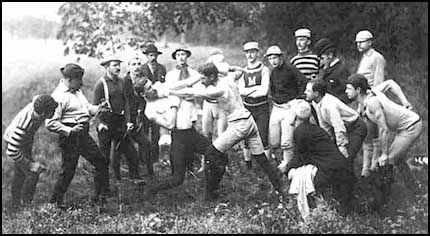
As we are concerned with the employment of self-defense techniques in the protection of one’s person and loved ones on the streets of Victorian London, it is not our purpose here to elaborate upon prize fights. Yet it is indisputably true that the one informed the other. Effective methods of pugilism were developed in the ring and then adopted by gentlemen on the boulevards. British boxing arose from the Age of Enlightenment’s love of all things classical. The ancient Greek sport of pankration, renowned for its brutality, and subsequent Roman variants, were revived in much more genteel versions in the mid 18th century.

It was the upper-classes who led the way in this, as simple brawling with fists had never died out among the working folk. Naturally, gambling was the impetus for injecting rules and order into what had been a mere vulgar scrap. A way had to be found to settle disputes when great sums were being wagered on gentlemen’s champions.

Thus the first regulations were set in place by former fighter John Broughton. His interest in fair play – gloves, set rounds, no attacking a downed man, etc. -- was somewhat selfish: he ran a school to teach pugilism to men of refinement and they did not wish to take broken jaws and black eyes home to their ladies.

Here we see the beginnings of the later Victorian attitude that boxing was a quintessentially English activity to be practiced by the ‘quality.’ To be sure, those less-mannered had always been beating one another to a bloody pulp in the alleys of London, but by the 1780’s pugilism began to evolve into an art that eventually replaced fencing in the hearts of the British middle- and upper-classes.

The decades-long struggle with France accelerated this urge toward the good manly virtue of boxing. Fisticuffs were seen as an antidote to the effeminate ways of the Continent. Less lethal than dueling (a strong selling point with every man needed to carry a musket against Bonaparte) and purely egalitarian (man vs. man with no underhanded doctoring of weapons), boxing became a national craze.


But it was a fad that suffered from early Victorian attitudes. That age’s philosophy stressed morality, faith, and family rather than the violence that Napoleon’s threat had necessitated. So the vogue waned for some time, as fighting was considered as beneath the dignity of a proper man. But when it returned it did so with a vengeance. The Queensberry Rules of 1867 were adopted with alacrity and became so widespread that the very nature of boxing changed.

With padded gloves an absolute requirement, tactics and footwork had to shift. First off, there actually could  be tactics, rather than mere flailing away until someone collapsed. In bare-knuckle boxing the defense, such as it was, was with the forearms rather than the hands. To protect one’s face the stance was upright, leaning the head back to keep it away from the opponent’s fists. Now the heavy gloves served as a shield to crouch behind.

In order to defeat this barrier, the now-familiar bobbing and weaving came into play, along with active footwork. Counter-intuitively, this all made the sport rather more dangerous. With bare knuckles a fighter had to pull a punch somewhat or risk a shattered hand. Now blows were delivered with much more fury and with greater rapidity. As a result men were struck harder and more often, since fights resulted in less bout-ending blood and broken teeth than before.

The cumulative effect of many punches caused more damage and actual knockouts than a few nasty but less forceful knuckle strikes. Brain injuries became common.


In a sense the popularity and widespread adoption of the Queensberry Rules might have been the downfall of many a well-trained but rule-bound gentleman when it came to actual no-holds-barred self-defense in the street. When accosted by an alley ruffian intent on relieving him of his wallet or watch, the club-trained man of means may have found himself at a disadvantage when kicked, grappled, or struck with a club. One can imagine him being overwhelmed mentally, as well, as the thug did not conform to the rules. Fair play did not enter into the equation.

But one can also imagine the contrary. Assailed by an unskilled, desperate, possibly intoxicated street thief, the training in pugilism might have made for a brief encounter. For the value in boxing does not lie only in simple techniques, but in the intangible qualities of confidence, cool-headedness, and quick judgement of the opponent’s strengths and weaknesses. Indeed, simply knowing how to take a punch, and how to mitigate the impact of it, would be of immeasurable value in itself. Attacked by an over-confident, swaggering hooligan who launched a clumsy haymaker, the gentleman’s schooling at his club could very well have resulted in the automatic response of step into the attack,/block, it/simultaneously punch with other fist.

Here we would be well-advised to recall the words of Allanson-Winn at the beginning of this essay, that pugilism is "a science, which is not only healthful and most fascinating, but which may, in a second of time, enable you to turn a defeat into a victory, and save yourself from being mauled and possibly killed in a fight which was none of your own making.”

As proof of the efficacy of pugilism as self-defense, though admittedly not in a historical context, we offer this video of a trained boxer fending off a veritable horde of enraged attackers with only the skills a Victorian gentleman might have learned from his boxing instructor:


In Part 3 we will explore the variety of weapons available to a Victorian in defending against armed or unarmed assailants, from the ubiquitous walking stick or umbrella to the cudgel or loaded riding crop.
Part 4 will conclude the series with an examination of Bartitsu, the only mixed martial art of this era and indeed, the first such.

~~~~~~~~~~~~
Terry Kroenung is the author of Brimstone and Lily, a seriocomic fantasy novel set in 1862, and its sequel, Jasper’s Foul Tongue. Book 3 in the series, Jasper’s Magick Corset, will be available in September. Paragon of the Eccentric, his Steampunk prequel to War of the Worlds, is pending. He has also written dramas set in the 19th century, such as Gentle Rain and Coolness and Courage.

Wednesday, April 11, 2012

The Art of Courtship

by V.R. Christensen

People have very little idea how great are the injuries which imprudence draws on them, or they would not despise this homely virtue. Especially for young women is prudence required in the conduct of love affairs. There is no end to the tale of misery we could tell resulting from its want. ... Marriage would not be the lottery it is, if girls would exercise a little prudence. They should never engage themselves to a man of whom they know nothing—the past of their future husband ought to be clear to them...

So advises, Mrs Valentine in The Young Woman's Book - A Useful Manual for Everyday Life.

Indeed, most advice books of the time dealt not so much with the where's and how's of courtship as with the qualities and modes of conduct most desirable in a matrimonial candidate. Robert Morris, in his Courtship and Matrimony, admonishes mothers, teachers and nursery maids to begin in childhood to establish the virtues desirable in an adult. In the instance of young men, in particular, he advises rooting out the "early habits, of disrespect, of insolence, and of moral recklessness," which should be "guarded against with the most vigilant caution."

Wise counsel indeed! For marriage, without the prospect of divorce, with hardly any opportunity to 'test the waters', so to speak, as is the aim of our modern system of 'dating', was a very serious matter. For women, in particular, it was a decision that bore with it the promise of happiness and protection, but also brought with it the very real prospect of trial and misery.

Though the idea of romantic love was the driving factor behind many Victorian marriages, marriage as a business transaction was still the reality. The concept of two becoming one in matrimony was much more than a sentimental aphorism. Before 1882, a woman's legal identity, as well as all of her personal property, was literally absorbed by her husband upon marriage. It's little wonder there was such a demand (and presumably a need) for the vast quantities of literature that were written on the subject.

So, considering the grave nature of the matrimonial contract, just what were the considerations involved? Well, to begin with, no gentleman possessing any degree of respectability could even consider marriage until he had established the means by which he could support a wife, no matter how fond he might be of a particular woman.

Such a dilemma is illustrated in George Meredith's Diana of the Crossways. An established bachelor, Thomas Redworth, is caught off guard by the disarming beauty and sharp wit of Diana Merion. As he is assigned to serve her at table during a dinner party, and during which time she engages him in some witty banter, he begins to reconsider his position. What has he to offer her?

"Eight or ten hundred. Comfortable enough for a man in chambers. To dream of entering as a householder on that sum, in these days, would be stark nonsense: and a man two removes from a baronetcy has no right to set his reckoning on deaths:—if he does, he becomes a sort of meditative assassin. But what were the Fates about when they planted a man of the ability of Tom Redworth in a Government office! Clearly they intended him to remain a bachelor for life. And they sent him over to Ireland on inspection duty for a month to have sight of an Irish Beauty....

"—Eight hundred? a thousand a year, two thousand, are as nothing in the calculation of a householder who means that the mistress of the house shall have the choicest of the fruits and flowers of the Four Quarters; and Thomas Redworth had vowed at his first outlook on the world of women, that never should one of the sisterhood coming under his charge complain of not having them in profusion."

Perhaps Redworth might have done more to prepare. Perhaps circumstances were beyond his control. Whatever the reason, he was in no position to consider Diana as a prospect. And when she married another, a heartless wastrel, just the sort Mr. Morris above would have warned against... his chance, for all intents and purposes, has passed.

To marry an equal was of course the aim of most. It came with the fewest complications. And yet, to many, the appeal of marrying up, with an eye at improving one's position, could not be denied. A gentleman did wise to marry above his station, at least where money was concerned. A woman, however, took a very great risk in marrying a man without money, even if (or perhaps particularly if) he had property. Before the Married Women's Property Act of 1882, all portable property, including money, all income made, belonged to her husband. Trusts arranged by fathers could only protect a woman's property by removing it from her hands as well, and into the protective custody of a trustee. Even for the working classes, marriage was a financial risk. As Mrs. Valentine warns, the improvident husband might sink to idleness, succumbing to the temptation to rely upon the labours of his more industrious wife.

Yet money wasn't the only matter to be considered when it came to matrimonial ambition. The social aspects were often at least as significant. A woman typically adopted the sphere of her husband, whether higher or lower. As stated in one advice guide of the time, The Etiquette of Love, Courtship, and Marriage, "A lady of high rank does not raise her husband to the same position as she formerly occupied; but sinks down to his standard; but the gentleman raises the lady, however much below himself, to the position in society."

Of course this is not universally true. Take the example of Arthur Munby, who married his servant, Hannah Cullwick. The marriage was kept a secret. Perhaps in part because Hannah would not give up her station. But, considering that Munby was obsessed with the working woman, it's quite possible he did not wish to raise her. It wasn't until many years after his death that his persona papers were made available and the truth made known.

Courtship rituals of course differed somewhat for the working classes, who did not (and could not afford to) live by such strict rules of conduct and propriety as did the upper and even middle classes, who strove to emulate their betters. The intercourse of the working classes being freer, they had much greater license, and opportunity, to become acquainted with members of the opposite sex.

However, for anyone aspiring to respectability, the prescribed method of courtship went something like this:

1) A gentlemen/lady singles out a member of the opposite sex who he/she thinks might be a good candidate.

2) He/she does a little reconnaissance in order to find out what the general opinion, character, reputation and family/financial situation of the person is.

3) If the couple are not already acquainted, a formal introduction is arranged, either through family members or a mutual friend of the same station of the party who inhabits that which is highest of the two. (An introduction at a ball does not count.)

4) Once introduced, the gentleman, as a prospective suitor, has the obligation of making his position known to the lady, as tactfully as possible. The blunt stating of financial position, as with the case of Mr. Guppy, in the prologue to his proposal to Esther in Bleak House, would have been considered presumptuous and in bad form.

"My present salary, Miss Summerson, at Kenge and Carboy's, is two pound a week. When I first had the happiness of looking upon you, it was one fifteen, and had stood at that figure for a lengthened period. A rise of five has since taken place, and a further rise of five is guaranteed at the expiration of a term not exceeding twelve months from the present date. My mother has a little property, which takes the form of a small life annuity, upon which she lives in an independent though unassuming manner in the Old Street Road. ... It is lowly, but airy, open at the back, and considered one of the 'ealthiest outlets. Miss Summerson! In the mildest language, I adore you. Would you be so kind as to allow me (as I may say) to file a declaration—to make an offer!"

Mr. Guppy went down on his knees. I was well behind my table and not much frightened. I said, "Get up from that ridiculous position immediately, sir, or you will oblige me to break my implied promise and ring the bell!"

5) Having accomplished the task of making his ability to support a wife known (and in considerably more tact than the illustration above) the next thing to do was to ascertain, very carefully, the feelings of the young woman. This was a bit of a precarious business, as a man who was too forward might offend. Alternately, he would wish to take care not to draw the young woman into any precipitate commitments, lest she compromise her character by having the term 'flirt' adhered to her.

6) Once the gentleman has some assurance of the lady's reciprocal interest, he might beg permission to call upon her, meeting her 'privately', at home, in the company of her family. All their intercourse from here on would be conducted in the presence of a chaperone, preferably married, though very often it was a hired companion, or barring that luxury, a member of the family, or a trusted household member. Here it was the young woman's duty to ascertain the gentleman's character, looking for flaws and inconsistencies which might shed some light on his true character.

7) Once an understanding has been established, the gentleman must address the girl's father, stating his intentions and proving his ability to provide for the gentleman's daughter in a matter at least equal to that which she is used to.

8) Obtaining the father's permission (or other, lacking that, a trusted guardian or appointed authority), the gentleman would, without waste of time and in all possible eloquence and delicacy, present his offer.

9) At which juncture the young woman in question had the opportunity and right (and some might add the greatest power she would ever in her life wield) to refuse or to accept.

Congratulations to them!

But what if this carefully guarded system failed to produce the desired results?

Well,...one could always place an add in the local newspaper.


For more about the Matrimonial advertisements, visit my blog post, (pr)eHarmony - or Alternative Courtship in the Victorian era.

*personal ads taken from 1)Freeman's Journal and Daily Commercial Advertiser. Dublin, Ireland. 12 Feb 1875 2)Truman's Exeter Flying Post. Exeter, England. 30 Sep 1893 3)Bristol Mercury and Daily Post. Bristol, England. 19 Mar 1892


V.R. Christensen is the author of Of Moths & Butterflies, and Blind - a novella. Cry of the Peacock, a companion piece to Of Moths & Butterflies, is due to be released in October of 2012. To learn more about her and her work, visit www.vrchristensen.com