Showing posts with label Victorian. Show all posts

Thursday, August 13, 2020

The Vulnerable Victorian Governess

by Mimi Matthews

The Governess by Richard Redgrave, 1844.

A governess occupied a unique position in a Victorian household. She was neither servant, nor family member. She existed in a sort of in-between world which often left her feeling isolated and alone. To combat this, the young governess was advised to cultivate a tolerance for solitude. Author Susan Ridout addresses this in her somewhat depressing nineteenth century book of advice, Letters to a Young Governess on the Principles of Education and Other Subjects Connected with Her Duties (1840):
“Consider therefore, before you enter a family, how far you are able to support the solitude into which you must be thrown, in such a situation. It is not now a separation merely from friends and relations to which you are called; it is a seclusion from society altogether, at least from any which sympathizes with you.”
Seclusion from society not only left a Victorian governess isolated and alone, it also left her vulnerable to the unwelcome advances of men, both in and out of the household. To that end, Ridout instructs the young governess to be gentle, modest, reserved, and dignified, stating that:
“If there are young men in the family where you reside, remember that your carriage will generally govern theirs; they will not presume, if you are discreet and unpretending.”
On occasion, modesty and dignified reserve did not provide enough of a deterrent to gentlemen who were determined to take liberties with an unprotected female. Cases abound of governesses who were kissed, groped, and otherwise assaulted in the course of their employment. On these unfortunate occasions, there was little incentive for the governess to complain to her employer, since, as Ridout implies, gentlemanly presumptions were generally marked down to some lapse in decorum on the part of the governess. If she brought them to the attention of the mistress or master of the household, she risked being let go without a reference.

Fortunately, the courts were not always as indifferent to the plight of governesses as the rest of society. Below are just a few instances of advances made toward young governesses, some of which were ultimately dealt with in a Victorian court of law.

Proposals, Elopements, and Bigamy


In some cases, the overtures of a gentleman of the household could lead to a marriage proposal. This happened with enough regularity—both in reality and in popular fiction—that the young governess could be forgiven for dreaming that she might, too, meet a wealthy Mr. Rochester during the course of her employment. In reality, however, the man of the house was usually more of a middle-aged fellow in a marital rut than a single, charismatic hero.

Arrival of a New Governess in a Merchant's House by Vasily Perov 1866.

The 18 November 1893 edition of the Yorkshire Gazette reports the case of Mr. Hearn, a wealthy, fifty-four year old father who had engaged Miss Crosswell, a governess, to instruct his daughters on the pianoforte. He subsequently fell in love with Miss Crosswell and made her an offer of marriage. Miss Crosswell eagerly accepted, but when Mr. Hearn’s daughters protested the engagement, he broke it off. Miss Crosswell pleaded with Mr. Hearn to stand by her. When he refused, she promptly sued him for breach of promise. According to the Yorkshire Gazette, the jury awarded her £475, a sum which they considered to be “an approximate pecuniary equivalent to her pain and loss.”

Often, the master of the house developed a tendre for the governess while still married to his wife. This caused quite a bit of tension in the household. The 17 September 1892 edition of the Dundee Evening Telegraph reports the case of a wealthy farmer who eloped with the family governess while still married. As the newspaper explains:
“His wife had occasion to remonstrate concerning his marked attentions to the attractive young lady who had for a considerable period acted as governess in the family.”
When confronted, the governess agreed to find another situation and asked for a leave of absence in order to do so. The husband left the family home at the same time, ostensibly on a business trip. The following day, the pair was spotted “at a junction in England,” after which they were never seen again.

A governess and her male employer in 1901 were not so lucky. The Sheffield Independent states that, after ten years of marriage, Leopold Moulton and his wife, Lucy, hired a governess named Miss Robson to teach their children. Less than two years later, Mr. Moulton and Miss Robson departed the family home, intending to elope together to Australia. The pair was “caught together at Marseilles,” at which point they made a full confession. Mrs. Moulton subsequently sued her husband for divorce on the grounds of cruelty and adultery and was granted a dissolution of marriage.

Assault


Far more common than marriage proposals and elopements, were the everyday instances of physical encroachments perpetrated against the vulnerable young governess. If committed by a member of the household, these insults were difficult to defend against. However, if an assault was perpetrated by a man outside of the home, a governess sometimes had recourse in the courts—especially if that assault was witnessed by others.

The Governess by Rebecca Solomon, 1851.

In 1874, while out walking in a field with her three young charges, governess Lydia Jackson crossed paths with Mr. John Bickley, a young gentleman of the neighbourhood who was heir to a great fortune. Mr. Bickley was driving by in a cart when he saw Miss Jackson gathering violets. He made disparaging remarks about the children and, when Miss Jackson did not reply, the 20 May 1874 edition of the Norwich Mercury states that Mr. Bickley “did something to his trowsers; and subsequently tying his horse up, he came towards plaintiff in that position.”

Miss Jackson ran. Mr. Bickley followed and soon overtook her, grabbing hold of her jacket. Miss Jackson was able to get free and, along with the children, ran to the cottage of a neighbour. When later confronted in court, Mr. Bickley denied he had ever even seen or spoken to Miss Jackson. He claimed she was either lying or that it was a case of mistaken identity. Fortunately, the children and the neighbour were all able to verify Mr. Bickley’s presence in the field of violets that afternoon. The Norwich Mercury reports that:
“The jury almost immediately returned a verdict for the plaintiff for the full amount claimed, namely £50, the usual costs following. His Honour, addressing the jury, said that if it was any satisfaction to them to know it, he quite concurred in the decision at which they had arrived.”
In a similar case from 1881, a governess by the name of Jane Hutton was out walking when Christopher Henderson, a railway worker, grabbed her by the wrist, pulled her close to him, and attempted to kiss her. Miss Hutton ran away, but, as the Dundee Courier relates:
“He ran after her and overtook her, and again seized hold of her by the wrist and arm, dragged her on to the embankment, pulled her on to his knee, and placed his arm round her waist.”
What happened next is not entirely clear from the reports, but whatever transpired, it was enough to result in Mr. Henderson being sentenced to thirty days' imprisonment.

Murder


Cases of governess murdered by their employer are not as numerous as those involving assault, but they do exist and are, in my opinion, some of the most tragic. Victorian governesses were often alone in the world, without friends or family to inquire after them if they should happen to disappear. With no one to ask questions, a governess’s murder could go undiscovered for years. For example, in 1843, a governess by the name of Miss Crossland was employed by Mr. and Mrs. Clarke at Firth Wood Farm. The 19 August 1893 edition of the Yorkshire Evening Post reports that:
“Clark became enamoured of her and got rid his wife, to whom he allowed £60 a year, while he retained Miss Crossland as housekeeper.”
Mr. Clarke was a big man who had been known to participate in prize fights. When Miss Crossland later disappeared, the locals assumed she had either “died in giving birth to a child” or met with foul play.

The New Governess by Thomas Ballard, (1836-1908).

Her ultimate fate was destined to remain a mystery until, forty years later, railway workers excavating a field near Firth Wood found “the remains of a young woman” buried in a shallow grave. The newspaper reports that “the skull was crushed on to the chest, and both jaws wore broken, as well as several ribs.” By this point, Mr. Clarke had long since died himself and, though the remains were widely believed to be those of Miss Crossland, the Coroner in the case declined to hold an inquest.

In Conclusion


Not every position held by a Victorian governess was fraught with physical danger. There were many families who were genuinely decent and respectable, allowing the governess to go about her duties without fear of being importuned by the gentlemen of the household. With that being said, it is important to remember just how vulnerable a governess was during the nineteenth century and just how precarious her situation could become if an unscrupulous man should decide to embark on a seduction.
________________________________________
Sources
Dundee Courier (Angus, Scotland), 26 November 1881.
Norwich Mercury (Norfolk, England), 20 May 1874.
Ridout, Susan. Letters to a Young Governess on the Principles of Education and Other Subjects     Connected with her Duties. London: Edmund Fry, 1840.
Sheffield Independent (South Yorkshire, England), 05 February 1901.
Yorkshire Evening Post (West Yorkshire, England), 19 August 1893.
Yorkshire Gazette (North Yorkshire, England), 18 November 1893.

This post is an Editor's Choice from the Archives, originally published August 7, 2017.

~ ~ ~ ~ ~ ~ ~ ~ ~ ~ ~ ~
Mimi Matthews writes both historical non-fiction and traditional historical romances set in Victorian England. She is the author of numerous works both nonfiction and fiction, including The Pug Who Bit Napoleon: Animal Tales of the 18th and 19th Centuries, A Victorian Lady’s Guide to Fashion and Beauty, The Work of Art, and most recently, Fair as A Star.


In her other life, Mimi is an attorney with both a Juris Doctor and a Bachelor of Arts in English Literature. She resides in California with her family, which includes an Andalusian dressage horse, two Shelties, and two Siamese cats.

Website: www.MimiMatthews.com
Facebook: Facebook.com/MimiMatthewsAuthor
Twitter: Twitter.com/MimiMatthewsEsq

Monday, May 4, 2020

The Dangers of the Victorian Pleasure Garden

by Mimi Matthews

The Dancing Platform at Cremorne Gardens by Phoebus Levin, 1864.

When thinking of nineteenth century pleasure gardens, most of us instantly conjure up images of Vauxhall. But those in the Georgian era weren’t the only ones to enjoy a pleasure garden in London. In 1830 Cremorne Gardens was opened in Chelsea. Over the decades that followed, it offered concerts, circuses, dancing, and fireworks. It also offered military exhibitions and feats of dangerous daring, including high-wire acts and balloon ascents. Though many of these feats were successful, earning acclaim for various wire-walkers and aeronauts, still others ended in tragedy. Gruesome injuries and even fatalities occurred with some regularity—in full view of the Victorian public.

The Collapsed Platform


In 1855, during a military fete at Cremorne Gardens, a platform collapsed under the weight of sixty soldiers carrying their muskets and bayonets. According to an 18 August 1855 edition of the Huddersfield Chronicle, the soldiers were comprised mostly of Grenadier Guards who were enacting “the capture of the Mamelon and rifle pits by the allied troops before Sebastapol.” The performance had received the patronage of Queen Victoria and Prince Albert, as well as of “the highest military authorities.” Both the Household Troops and Royal Artillery were in attendance.

Banqueting halls at Cremorne Gardens, mid-19th century.

To enact the mock siege, stages of various heights had been constructed. As the Huddersfield Chronicle reports:
“Just as the spectacle was reaching its close, when the defenders of the Mamelon and the rifle-pits had been drive to the highest part of the staging by the assaulting columns below, the gallery on which they stood gave way, bringing some 60 men, with bayonets fixed on their muskets, crashing to the ground through a fall of at least 20 feet.”
During the fall, some of the men were bayoneted on their own weapons. Others broke their legs or fractured their ribs and limbs. No soldiers died at the scene, but one is reported to have suffered serious internal injuries.

The Broken Wire


An even more frightful accident occurred at Cremorne Gardens in June of 1863. The public had gathered to watch a show put on by the acclaimed acrobat Carlo Valerio. For the past two months, the twenty-five year old Valerio had been performing a high-wire act at the Gardens during which he walked along a wire cable that measured 600 feet across. The 27 June 1863 edition of The London Daily News reports that, on the night in question:
“He had advanced nearly to the point from which he usually returned backwards, when the wire rope suddenly gave way, and he fell heavily to the grassplat, a distance of upwards of sixty feet.”
Valerio’s injuries were severe. He suffered a fractured skull, a broken collar-bone, and many other injuries. According to a graphic first-hand account published in the 30 June 1863 edition of the Dundee, Perth, and Cupar Advertiser:
“When the wire slackened the unfortunate man staggered, and was precipitated violently to the ground on the back of his head, the blood pouring profusely from the wound and from his ears. Numbers of persons, particularly the females, were dreadfully shocked and affected, many of the corps de ballet being afterwards scarcely able to go through their performance. He was immediately removed, and the dance and music proceeded.”

The Ashburnham Pavilion at Cremorne Gardens, Illustrated London News, 1858.

The London Daily News states that Valerio was taken to Chelsea Hospital where he “lingered in great pain” until three o’clock in the morning, at which point “he expired” from his injuries. His death prompted an outcry against dangerous exhibitions. It was reasoned that, since acrobats would continue to test their skills in ever increasing feats and since the public would continue to arrive in droves to see such performances, it was up to the proprietors of places like Cremorne Gardens to prohibit exhibitions which put performers’ lives at risk.

In fact, Valerio’s death prompted Mr. E. T. Smith, then the proprietor of Cremorne Gardens, to write to the editor of The Era declaring just that. His letter, printed in the 28 June 1863 edition of The Era, reads in part:
“The sad accident that occurred at these Gardens on Thursday evening to the unfortunate Carlo Valerio during his performance on the wire rope, and which no person can more deeply regret than myself, induces me, with your permission, to seek the earliest moment of announcing, through your columns, that no such exhibition will ever again be permitted to take place here as long as I remain the Proprietor.”

The Flying Man's Shroud


Unfortunately, Valerio’s death was not the last fatality to occur as a result of an exhibition at Cremorne Gardens. In 1874, crowds again gathered to watch a death-defying feat. This time, the stunt was performed by M. Vincent de Groof, a thirty-five-year-old performer known as the Flying Man. According to the 11 July 1874 edition of the Belfast News-Letter, M. de Groof promised to:
“Fly a distance of 5,000 feet through the air by means of a pair of wings shaped like a bat’s, which were fixed to his shoulders and worked by his arms.”

Balloon Ascent at Cremorne Gardens, Walter Greaves, 1872.

M. de Groof ascended into the air by means of a balloon, from which he was suspended by a rope “about twenty feet below the car.” As the balloon rose to a height of approximately 1000 feet, M. de Groof flapped his wings, making for a churchyard some fifty years away. When he hit a favourable current of wind, he cut the rope, fully expecting to fly free of the balloon by virtue of the wings attached to his arms. Instead, as the Belfast News-Letter grimly relates:
“He came crashing through the air; the wing closed around him like a living shroud, and narrowly escaping the outer parapet, he fell with fearful violence on his head and right side in the road, immediately opposite the front entrance of St. Luke’s Church. Hundreds of persons immediately rushed to his assistance, and found him bleeding violently from the nose and ears, and without any sign of life.” 


In Conclusion

As the decade progressed, Cremorne Gardens’ reputation as a popular venue for wholesome entertainment began to sink. After the sun had set and Victorian families had departed, it transformed into what one Baptist minister of the 1870s referred to as “a nursery of vice.” Robberies and assaults were regularly reported, as were the goings on of prostitutes and their clients. In the end, it was this less gruesome but rather more unsavoury aspect of Cremorne Gardens which led to its closure in 1877. An increasingly prudish Victorian public objected to the goings on there, especially after dark.
________________________________________

Sources

Belfast News-Letter (Antrim, Northern Ireland), 11 July 1874.
Dundee, Perth, and Cupar Advertiser (Angus, Scotland), 30 June, 1863.
Elgin Courier (Moray, Scotland), 17 August 1855.
The Era (London, England), 28 June 1863.
Guard, Richard. Lost London. London: Michael O’Mara Books, Ltd., 2012.
Huddersfield Chronicle (West Yorkshire, England), 18 August 1855.
Illustrated London News (London, England). 5 June 1847.
London Daily News (London, England), Saturday 27 June 1863.
Thomas, Donald. The Victorian Underworld. London: Orion Publishing Group, 2014.

This article is an Editor's Choice and was originally published September18, 2017.
________________________________________

USA Today bestselling author Mimi Matthews writes both historical nonfiction and award-winning proper Victorian romances. Her novels have received starred reviews in Library Journal and Publishers Weekly, and her articles have been featured on the Victorian Web, the Journal of Victorian Culture, and in syndication at BUST Magazine. 

In her other life, Mimi is an attorney. She resides in California with her family, which includes a retired Andalusian dressage horse, a Sheltie, and two Siamese cats.

For more information, see Mimi's website MimiMatthews.com or connect with her through Facebook and Twitter. 


Friday, January 17, 2020

Romancing the Tower of London: William Harrison Ainsworth

By Nancy Bilyeau

On a December night in 1840, a sizable group of writers, editors, publishers, printers and illustrators gathered at the Sussex Hotel, in the fashionable town of Royal Tunbridge Wells, for a dinner party. It is possible that Charles Dickens, the young author of Oliver Twist and The Life and Adventures of Nicholas Nickleby, was invited to the party. Most definitely in attendance was George Cruikshank, the talented illustrator of Oliver Twist.

The host of this lavish affair was the famed 35-year-old novelist William Harrison Ainsworth. The occasion: the successful serialization over the last year of his fifth novel, The Tower of London: A Historical Romance, which told the story of the tragic Lady Jane Grey, beginning with her arrival by barge at the Tower to launch her nine-day-reign and ending with her decapitation on Tower Green on July 10, 1553.

William Harrison Ainsworth

The novelist was sure to have cut quite the dash at his own party: He was tall, slim and dark, with a fondness for stylish clothes that earned him the description dandy. From the Oxford Dictionary of National Biography: "Lady Blessington, whose salon he attended, said he and Count D'Orsay were the two handsomest men in London."

In a passage accepted as autobiographical, a character in one of Ainsworth's novels says, "Some people told me I was handsome, and my tailor (excellent authority, it must be admitted) extolled the symmetry of my figure, and urged me to go into the Life Guards."

Ainsworth was at perhaps the zenith of his career in 1840. He was a friendly rival to Dickens; in fact, his 1839 novel Jack Shepard outsold Oliver Twist in early editions, and Ainsworth had recently replaced Dickens as editor of Bentley's Miscellany, the predominant fiction magazine.


The rivalry with Dickens would not last; nor would the friendship. Dickens would become a colossus as Ainsworth slowly sank into oblivion. His 39 historical novels, all of them romances and adventures, were astoundingly popular with the reading public of Victorian England, but not with the critics. Although Ainsworth was himself a genial and generous man, he was often on the receiving end of literary volleys almost hysterical in their dislike. When his books no longer sold as well, he had no circle of supporters to buoy him. Quite the opposite. One writer said of him in 1870: "Let us start with an opinion fearlessly expressed as it is earnestly felt, that the existence of this writer is an event to be deplored." Ainsworth was still alive when this sentiment was published, and in reduced circumstances.

That dazzling night at Royal Tunbridge Wells, Ainsworth, mercifully, could not know that his books would go out of print, that fellow writers such as Edgar Allan Poe would describe his prose as "turgid pretension."

Yet he is not without a legacy. The book celebrated that night, The Tower of London: A Historical Romance, triggered a new kind of interest in William the Conqueror's castle keep. It was an interest that deepened through the Victorian age, and is part of the reason visitors pour into the Tower, to the tune of 2 million a year.

Ainsworth was born on February 4, 1805, in Manchester, as the city became the center of the industrial movement. Thomas Ainsworth was a prominent lawyer and pressured his oldest son to follow him in that profession, which he did for a time, but without much enthusiasm. There was a younger son, Thomas Gilbert Ainsworth, who at university suffered a "brain fever" and was incapicitated by mental illness his entire life.

Two years after the father died, Ainsworth, newly married, published his first novel, the romance Sir John Chiverton. It brought him to the attention of Walter Scott, who befriended Ainsworth but privately referred to him as an "imitator." His next two books, the historical novels Rockwood and Jack Schepard, both featuring famous outlaws, were tremendous successes. Yet some criticized the romanticizing of criminals, a complaint Dickens was also hearing with Oliver Twist.

It was time to try something different.

When Ainsworth, along with his illustrator, George Cruikshank, researched the Tower of London, it was far from the smoothly operating tourism operation of today. It had been two centuries since the last monarch, Charles II, resided there. Dickens wrote: "Once a fortress, a royal residence, a court of justice and a prison, {the Tower} is now a government storehouse and armory." An outbreak of disease caused by poor water supply (and blamed on the filthy moat) killed three men of the garrison.

A visitor in 1851 wrote:

"Every one must be struck with the incivility and want of accommodation therein. Upon entering the gates this afternoon I found some hundreds of persons, male and female, huddled together, striving to obtain tickets from a window under a portico where no two persons can pass abreast, and the scene there reminded me of what might be expected at the gallery entrance of a theatre on boxing night. After waiting just one hour we obtained our tickets and were ordered into what is called the ante or refreshment room. This room is about 12ft. by 18ft., with a counter containing ginger pop, buns, &c., immediately behind which are two waterclosets (I understand recently erected). I will not attempt to describe the stench one had to contend with, the place being completely crammed with persons waiting their turns or numbers to be called, but merely add that this room seems to be the resort of pickpockets, two ladies having been eased of their purses, containing some pounds, during the half hour I was present therein."

Ainsworth opened the door to a more illustrious period in the Tower's history. It's true that the novel's prose is melodramatic ("heaving bosoms," "piercing black eyes" and "sinister smiles") and the pages are crowded with Gothic characters (not one or two but three supporting characters who are giants--and a dwarf!) along with august personages of the past. But Ainsworth's diligent research brings to life the grounds, the kitchens, the passageways, the prison cells and the beautiful chapels of the Tower. He made full, imaginative use of the Tower of London, as a setting for a story of high drama. And Cruikshank's 40 engravings and 58 woodcuts play their suggestive part.


Cruikshank's depiction of Lady Jane Grey
And in the center of it all is Lady Jane Grey, a character of undeniable pathos, surrounded by conspiracies. Ainsworth invests the Spanish ambassador, Simon Renard, with the malevolent abilities of a Blofeld straight from Bond. Northumberland is formidable indeed.There is an energy to the book, and an eerie, even frightening atmosphere. The rack, the Scavenger's Daughter and the infamous Little Ease are all present and accounted for.

The current official Historical Royal Palaces Tower of London "fact sheet" on torture emphasizes how little actual torture has taken place within its walls: "Myth-making reached its peak in the 19th century, spurred on by novelists who wished to evoke the Tower of London in its former days as an ancient fortress and stronghold e.g. Ainsworth’s The Tower of London." Ainsworth may have put the devices of torture to Gothic uses, but they were very much present in the 16th century. Ironically, government-approved torture of prisoners ebbed during the reigns of Edward VI, Jane Grey, and Mary, only to rise to highest levels during reign of Elizabeth.

After The Tower of London, Ainsworth's career went on for more than thirty years. The characters in his books were not dimensional; bosoms continued to heave and black eyes to snap. R.H. Horne, Dickens' friend and collaborator, described Ainsworth as "a reviver of old clothes" whose novels are "generally dull except when revolting." Punch satirized Ainsworth as an aging Tudoresque dandy with the caption "The Greatest Axe-and-Neck Romancer of Our Time."


By the time of the Punch jab, Ainsworth, a widower, was responsible for his mentally ill brother. He had accepted a government pension because...he needed it. A year after a dinner in his honor in Manchester, arguably the only place where he was still esteemed, William Harrison Ainsworth died at the age of 77.
But the Tower felt the lingering impact of Ainsworth. In the foreword of his book, he had called for the opening to the public of Beauchamp Tower, the place of imprisonment of the Lady Jane Grey, where she is thought to have written on the wall of her cell. The cause was taken up by powerful patrons, including Prince Albert. Beauchamp was restored by architects and made available to visitors; other buildings were opened too.

Ainsworth's influence, as explained in The Tower of London: The Official Illustrated History:

"In The Tower of London: A Historical Romance, the Tower was first and foremost the setting for an endless series of heart-rending events and foul play. The author tells of dungeons though in fact the Tower has very few basement rooms and of a time when Tower Hill boasted a scaffold and "its soil was dyed with the richest and best blood in the land.” Such fantasies, backed by the relentless march of the romantic movement, helped create and fuel an ever-increasing demand to see and experience such events.”

No matter how much the novel's violence veers into fantasy, the faintly menacing image of the Tower that draws the throngs of the curious today was created in part by William Harrison Ainsworth. He was the greatest neck-and-axe romancer of his time...and perhaps of ours too.

This article is an Editor's Choice and was originally published August 19, 2012. 

~~~~~~~~~~

Nancy Bilyeau is a historical novelist and magazine editor based in New York. She wrote the Joanna Stafford trilogy, a trio of thrillers set in Henry VIII’s England, for Simon & Schuster. Her fourth novel is The Blue, an 18th century thriller revolving around the art & porcelain world. Her latest novel is Dreamland, set in Coney Island of 1911, is published by Endeavour Quill. A former staff editor at Rolling Stone, Entertainment Weekly, and InStyle, Nancy is currently the deputy editor at the Center on Media, Crime and Justice at John Jay College and contributes to Town & Country, CrimeReads, and Mystery Scene magazine.

For more information, visit www.nancybilyeau.com.

Thursday, July 11, 2019

When Picnics were for the Privileged Class


by Maria Grace

The concept of a picnic has been existence for a very long time. (Of course, one could argue that eating outdoors was the very first way to eat, but let’s not go back quite that far.) Food historians suggest that the modern concept of the picnic evolved from traditional moveable outdoor feasts. The first English picnics were medieval hunting feasts staged before the chase (not after, I suppose, in case the hunt wasn’t particularly successful, but I digress).

The word picnic (which the OED says did not occur in print in English until 1748, in a letter by Lord Chesterfield) probably originated with the French pique nique found in a 1649 satirical French poem in which Frères Pique-nicques is known for visiting friends “armed with bottles and dishes.” (Kennedy, 2013) The word later was used to mean to ‘pick a place’, typically an isolated spot, where a group could enjoy a pleasant meal together, free from distractions and demands of daily life.

The English word ‘picnic’ became associated with card-playing, drinking and conversation. By 1802, British Francophiles formed a Pic-Nic society in London devoted to eating, drinking and performing amateur theatricals. Dinners for this society were provided by the members who drew lots to determine who would be bringing which dish—we wouldn’t want thirty-seven blancmanges to show up for the same picnic, would we?

The idea of a picnic also referred to a dinner where all those present contributed foods and was eaten indoors—rather like the modern pot luck meal. The meaning gradually changed to include the concept of eating out-of-doors and by 1860 (solidly in the Victorian era), the change in meaning—a meal eaten outdoors—was complete.

Picnics and the Privileged Class


In the 1800s, British authors began to describe picnics: the adventures of characters who staged their meals in pastoral locations, rather like theater sets. Romantic aesthetics were often important in crafting the ideal picnic setting. In “Emma,” Jane Austen’s character Mrs. Elton plans a “sort of Gipsy party.” She had in mind walking about the gardens, gathering strawberries, sitting under trees and the like, in addition to enjoying a meal out-of-doors. Her stated intention was to keep things as natural and simple as possible. (Kennedy, 2013)

However unpretentious picnics might appear, this activity was actually far from being simple. Hubbell (2006) tells us:
“Picnicking, which first evolved in early nineteenth century Britain, is an ideological act, freighted with values for ‘nature’ and ‘culture’, food and taste, aesthetics and ethics, community and solitude. To picnic is to consume not only particular food, but also a specific environment chosen according to an aesthetic standard, and a particular form of sharing food according to certain standards of behavior.

It means creating a moveable feast and overcoming difficulties and inconveniences, not only for preparation and transportation, but also for consumption and cleanup. Yet picnicking is the pleasurable pursuit of a leisured people, so the difficulty of moving the feast has some reward. The reward is primarily ideological: it enables the participant to share a form of eating that creates relationships between small groups of people, natural landmarks, and cultural ideals. These relationships form a consciousness of national identity. Picnicking, especially for early nineteenth-century picnickers, was thus a way of performing Britishness.”
So picnicking was far more than an impromptu meal outdoors. Even when each person attending brought food, it meant a great deal of work for everyone, especially the servants. Since picnicking was, during Jane Austen’s day, mostly the province of the privileged, servants were definitely involved.

Food and furnishing, dining ware and linens, not to mention the accouterments for any intended amusements—games, fishing, reading and the like—all had to be packed up and transported to the picnic site. Keep in mind, too, that the wagons used for transport might not actually be able to make it all the way to the chosen site and the final distance might require everything to be hand carried there. Afterwards, of course, it would all have to be packed up to be taken home, and possibly cleaned or laundered before being put away.

It was not until the Victorian Era with the rise of the middle class and train transportation that picnics became more widely enjoyed.

Sample Menu


With out the benefit of modern refrigeration or convenient packaged food, what might have been eaten at a picnic? This suggested menu comes from Mrs. Beeton’s 1860 book, which is decidedly Victorian, but the foods are indicative of what might have been served in Austen’s era as well.

BILL OF FARE FOR A PICNIC FOR 40 PERSONS

A joint of cold roast beef, a joint of cold boiled beef, 2 ribs of lamb, 2 shoulders of lamb, 4 roast fowls, 2 roast ducks, 1 ham, 1 tongue, 2 veal-and-ham pies, 2 pigeon pies, 6 medium-sized lobsters, 1 piece of collared calf’s head, 18 lettuces, 6 baskets of salad, 6 cucumbers.

Stewed fruit well sweetened, and put into glass bottles well corked; 3 or 4 dozen plain pastry biscuits to eat with the stewed fruit, 2 dozen fruit turnovers, 4 dozen cheesecakes, 2 cold cabinet puddings in moulds, 2 blancmanges in moulds, a few jam puffs, 1 large cold plum-pudding (this must be good), a few baskets of fresh fruit, 3 dozen plain biscuits, a piece of cheese, 6 lbs. of butter (this, of course, includes the butter for tea), 4 quartern loaves of household broad, 3 dozen rolls, 6 loaves of tin bread (for tea), 2 plain plum cakes, 2 pound cakes, 2 sponge cakes, a tin of mixed biscuits, 1/2 lb, of tea. Coffee is not suitable for a picnic, being difficult to make. 
Things not to be forgotten at a Picnic 
A stick of horseradish, a bottle of mint-sauce well corked, a bottle of salad dressing, a bottle of vinegar, made mustard, pepper, salt, good oil, and pounded sugar. If it can be managed, take a little ice. It is scarcely necessary to say that plates, tumblers, wine-glasses, knives, forks, and spoons, must not be forgotten; as also teacups and saucers, 3 or 4 teapots, some lump sugar, and milk, if this last-named article cannot be obtained in the neighbourhood. Take 3 corkscrews.

3 dozen quart bottles of ale, packed in hampers; ginger-beer, soda-water, and lemonade, of each 2 dozen bottles; 6 bottles of sherry, 6 bottles of claret, champagne à discrétion, and any other light wine that may be preferred, and 2 bottles of brandy. Water can usually be obtained so it is useless to take it.
So, the next time you pack a few sandwiches and some cold cans of soda, reflect back on what the picnic used to be, and how Jane Austen would so be judging you now!

References

Beeton, Isabella. Beeton's Book of Household Management. London: S. O. Beeton Publishing, 1861.

Cameron, Collette. “Pleasures and Proprieties of a Country Picnic. Collette Cameron. / May 31, 2015. Accessed June 3, 2019. https://collettecameron.com/pleasures-and-proprieties-of-a-country-picnic

Davidson, Alan. The Oxford Companion to Food. Oxford: Oxford University Press, 1999.

Gaston, Diane. Regency Picnic or a Labor Day? The Risky Regencies. September 5, 2011. Accessed June 3, 2019. http://www.riskyregencies.com/2011/09/05/regency-picnic-or-a-labor-day/

Hubbell, Andrew. How Wordsworth invented picnicking and saved British Culture. Romanticism, Volume 12, Number 1, 2006, pp. 44-51 (Article) Published by Edinburgh University Press DOI: For additional information about this article Access provided at 11 Jun 2019 https://doi.org/10.1353/rom.2006.0003

Kennedy, Pagan. "Who Made That Picnic." New York Times, August 23, 2013. Accessed June 3, 2019. https://www.nytimes.com/2013/08/25/magazine/who-made-that-picnic.html

Oliver, Lynne. “The Food Timeline: Food-Picnics.” The Food Timeline. 2004. Accessed Jun 3, 2019, http://www.foodtimeline.org/foodpicnics.html

Sanford, Vic.Emma: Picnicking on Box Hill Jane Austen’s World. March 21, 2008. Accessed June 3, 2019. https://janeaustensworld.wordpress.com/2008/03/21/emma-picnicking-on-box-hill/

~~~~~~~~~~


Though Maria Grace has been writing fiction since she was ten years old, those early efforts happily reside in a file drawer and are unlikely to see the light of day again, for which many are grateful. 


After penning five file-drawer novels in high school, she took a break from writing to pursue college and earn her doctorate. After 16 years of university teaching, she returned to her first love, fiction writing.

Click here to find her books on Amazon. For more on her writing and other Random Bits of Fascination, visit her website. You can also like her on Facebook, or follow on Twitter.

Thursday, November 15, 2018

Lady Charlotte Guest - Victorian powerhouse of myth and iron

by Deborah Swift

Next weekend* I am booked to give a talk on the Mabinogion, the extraordinary collection of Welsh myths that were first brought to prominence in England by Lady Charlotte Guest. Not only are the myths fascinating, but Charlotte Guest was quite a phenomenon herself.

Charlotte Guest

Born Charlotte Bertie in May 1812, she was the eldest child of the ninth Earl of Lindsay of Lincolnshire, and was brought up at Uffington House, a large country estate. When she was six years old, her father died and her mother remarried a vicar, a man whom she disliked intensely. Charlotte was a bookish and intelligent child, and being educated at home, her only escape was into literature. She soon taught herself several languages, including Arabic, Hebrew and Persian. She began keeping a journal when she was nine, and so we know a lot about her life, because she carried on writing it for another seventy years - until she was was seventy-nine! 

Page from Charlotte Guest's Diary

Her interest in Wales and its history began after meeting the MP for Merthyr Tydfil,  John Josiah Guest.  Full of vitality and energy, Josiah ran the largest ironworks in the country, the Dowlais Iron Company, which employed 7,000 workers. In 1833 Charlotte and John were married. Charlotte took a keen interest in the business, and in the welfare and education of the workers. Moreover, she was keen to escape the oppression of her step-father and Wales was suitably far from her family home.

Ever a keen linguist, she launched herself into learning Welsh. At that time there was a romantic revival and a strong interest in Arthurian legends. Charlotte began translating some Medieval Welsh tales into English. These tales were part of an oral tradition, and drawn from the written sources of the Llyfr Coch o Hergest, or Red Book of Hergest. Her translations included the four branches of the Mabinogi, three Arthurian Romances, and a translation of the well-known myth Taliesin. 


The Lady of the Fountain  (an Arthurian tale) was first published in 1838, and in 1849 the collected tales appeared as The Mabinogion in a lavishly illustrated edition. Since then they have been widely studied by poets such as Tennyson and scholars of Welsh and Celtic mythology, as well as those interested in the spiritual and wisdom traditions they embody. The myths are much-loved by illustrators too, trying to capture the unknowable in paint.

Click picture for more great
illustrations by Lee

Back to Charlotte Guest.  Not content with documenting the ancient tribes of Britain, Lady Charlotte also produced her own tribe - ten children: five boys and five girls. She was ambitious for her children, marrying them into the aristocracy and ensuring their education through the schools she endowed (the Dowlais Central Schools cost £20,000 to build - an enormous sum in the Victorian era.) This area of Wales was heavily influenced by Chartism, and these principles were evident in Charlotte Guest's educational ideals for her workforce.

On her husband's death she became the only active trustee of the ironworks, and ran the business. Astute and energetic, she insisted on being in control. This included negotiating terms when the men went on strike, and dealing with dissatisfied workers who in those times were unused to being ordered by a woman. One cannot help but think, that the models of the powerful women in the tales from the Mabinogion must have proved an inspiration to her when faced with these difficulties.

Dowlais House, centre of Charlotte Guest's empire

Two years later Charlotte fell in love with her son's classics tutor, Charles Schreiber. They shared a passion for history and collecting ceramics, and from then on they travelled the continent collecting, as many wealthy Victorians did. Their collections were left to the nation and are housed in the V&A, where there is a 'Schreiber' Room, and in the British Museum, which houses her collection of playing cards and fans. In 1891 she became the first woman to receive the freedom of the Worshipful Company of Fanmakers. 

Below - an unmounted fan-leaf,  painted for the occasion of the Schreibers' silver wedding anniversary in 1880, now in the British Museum.


Lady Charlotte died in 1895 but it wasn't until 1950 that her grandson, the Earl of Bessborough, published edited highlights from her diaries. The originals are now housed in the National Library of Wales. 

Charlotte Guest is chiefly remembered for her translations of the Mabinogion, from which we receive most of our knowledge about Welsh mythology, including the story of Rhiannon, the tale of the mysterious mound that leads to the Otherworld, Bran and the ravens that now roost in the Tower of London, about Arianrhod and her turning wheel of stars. Although many now take issue with Guest's translations, without her a whole generation of people would have had the door to these wisdom stories closed to them.

Work with the myths and stories of the Mabinogion still goes on, and new translations have appeared and continue to do so, proving that good stories always outlast those that tell them.


Watch a BBC video about The Mabinogion
The Dancing Floor Film - new film based on Mabinogion Myths

Sources:
The Mabinogion - translations by Guest, Davies, Jones
National Library of Wales

* This post is an Editors' Choice post, originally published on this blog on 16 March 2016

~~~~~~~~~~

Deborah Swift is the author of seven novels for adults and a trilogy for young adults. She lives in the North of England close to the mountains and the sea. Follow her on Twitter @swiftstory or find her on her website www.deborahswift.com

Wednesday, February 15, 2017

A History of the Cuckold's Horns

By Deborah Swift


What is a cuckold?
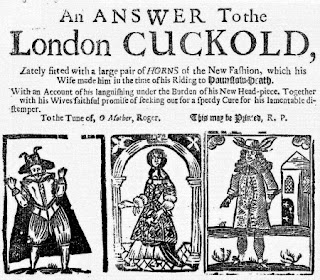
Up until the Victorian era, the concept of the cuckold was endemic through English culture. The word 'cuckold' comes from late Old English, from the Old French cucuault. The root of this is from cucu ‘cuckoo’, and refers to the cuckoo's habit of laying its egg in another bird's nest. A cuckold is the husband of an adulterous wife, and in days gone by, a label associated with shame and humiliation. It's implication was that the man could not control his wife, or that he was impotent.

Copy of a painting by Francois Bunel

The Mystery of the Horns
The symbol universally associated with cuckolding was a pair of ram's horns. Strength, power and supremacy, along with procreative vigor have always been associated with horns, which are used when the animal fights its rival in the mating season. In some cultures today, horns are still used symbolically, and powdered rhinoceros horn is still sold in Asia as an aphrodisiac. What we must understand as modern readers is that the horns had connotations of the Devil, that the mention of them was full of sexual innuendo. In a way the horn embodies both the male and female organs by being both hollow and protuberant.

In Shakespeare's Much Ado About Nothing, Beatrice says 
'There will the Devil meet me, like an old cuckold, with horns on his head.' 
Stag antlers were also an old symbol of cuckolds. Christianity sought to discourage pagan worship of horns and depicted the Devil himself as bestial, and thus horned.

The Contented Cuckold 1673 - British Museum

Charlton Horn Fair 
One of the most popular events in London's season was the Charlton Horn Fair, which lasted for three days, and was a fair with a scurrilous reputation, encouraging rowdy and drunken behaviour. It was so bawdy that the fair had to be moved from its place opposite St Luke's Church, to a place at the other end of the village.

The Legend of King John
So how did it start? Legend has it that King John, having been out hunting on Shooters Hill, was in dire need of refreshment. Finding a miller's cottage nearby, he went to ask for a drink. He found the master of the house away, but his beautiful wife took pity on him (or perhaps was impressed by his fine clothes) and invited him in.

They talked a while, and she gave him food and drink, and the attraction between the King and the miller's wife grew. Just as he was about to kiss her, the door swung open and the miller strode in. Finding his wife in the King's arms, the miller pulled out a dagger and swore he'd kill them both.

Of course the King then told him who he was, and the miller sheathed his dagger and swallowed his fury. The King, mindful of the wrong he had done to the miller, and no doubt grateful for his life, vowed to endow him with him all the land he could see - as far as the bend in the river where the horns were fixed on a pole.

He also gave him permission to hold a fair on 18th October every year - the anniversary of the event. That bend in the river became known as Cuckold's Point, and the fair the Horn Fair. Now whether this is a true story, we can only guess, but perhaps there is a grain of truth there.

The Procession
By tradition, the fair opened with a procession, headed by a man carrying a pair of horns on a pole, and visitors dressed up as the miller, his wife or the King. Much cross-dressing went on, and ribald jokes and lewd behaviour were the order of the day.
'at Horn Fair, a party of humorists of both sexes (query, of either sex) cornuted in all the variety of bull-feather fashion, after perambulating round Cuckold’s Point, startled the little quiet village of Charlton on St. Luke’s Day, shouting their emulation, and blowing voluntaries on rams’ horns, in honour of their patron saint.'
In this 18th century etching from the British Museum below, we can see 'a riotous scene in a country village where a shrewish wife and hen-pecked husband are mocked by their neighbours in procession. The couple ride on one horse, the man facing the tail, preceded by another man on horseback who throws grain from a pannier to the crowd. Further to the right, cuckold's horns in the form of a stag's head, a ram's head and a cow's head are held aloft, the latter attached to a woman's shift, and "rough music" is played on pots and pans. In the background, is a river and a similar procession takes place on the far bank.

Skimmington-Triumph, Or the Humours of Horn Fair

When the parade reached the actual fair, this was the scene, according to author Daniel Defoe:
'Charleton, a village famous, or rather infamous for the yearly collected rabble of mad-people, at Horn-Fair; the rudeness of which I cannot but think, is such as ought to be suppressed, and indeed in a civiliz’d well govern’d nation, it may well be said to be unsufferable. The mob indeed at that time take all kinds of liberties, and the women are especially impudent for that day; as if it was a day that justify’d the giving themselves a loose to all manner of indecency and immodesty, without any reproach, or without suffering the censure which such behaviour would deserve at another time.'
Every visitor to the fair wore a pair of horns, or carried one, and horns were tied above the gate, around the fences and over the stalls. Even the gingerbread men for sale had horns. The fair was a great excuse for licentiousness in all forms and this no doubt led to its great popularity.

The cuckold was a common feature of married life in the seventeenth century, and cuckold often used as an insult, the way bastard might be now. Insulting someone could be done by showing them a horned fist gesture, or putting two fingers up behind the head as a sign of  their stupidity. During the English Civil War a song called Cuckolds All In A Row was popular with Cavaliers, who sang it as a chant against the London Roundheads.
‘And when they reach Cuckold’s Point they make a gallant show.
Their wives bid the Musick play Cuckolds All In A Row.’
Cuckold’s Point also features in the play Eastward Ho by Ben Jonson. This scene epitomises the idea of putting up cuckold's horns to let a man know his wife was being unfaithful.
Enter SLITGUT with a pair of ox-horns, discovering Cuckold’s Haven.
SLIT: All hail, fair haven of married men only! for there are none but married men cuckolds. For my part, I presume not to arrive here but in my master’s behalf, a poor butcher of Eastcheap, who sends me to set up, in honor of Saint Luke, these necessary ensigns of his homage. And up I got this morning, thus early, to get up to the top of this famous tree, that is all fruit and no leaves, to advance this crest of my master’s occupation.' 
Censure and Closure of the Horn Fair
In 1873 the fair fell victim to Victorian morality and was closed down. It has been re-incarnated as a family friendly event, with none of its historical connotations, and Cuckold’s Point is now The Canary Wharf Hilton Hotel!

Charlton Horn Fair - Victorian era

I couldn't resist including a cuckolding procession in one of my novels, and you'll find it in The Lady's Slipper. 

Bibliography
London Lore - Steve Roud
Mayhew's London - Peter Quinell
Folklore and Customs of Rural England - Margaret Baker
Shakespeare's Life and World - Folio Society
Strange History
Charlton Champion

~~~~~~~~~~

Deborah Swift lives in North Lancashire on the edge of the Lake District, an area made famous by the Romantic Poets such as Wordsworth and Coleridge. In the past she used to work as a set and costume designer for theatre and TV, so enjoys the research aspect of creating historical fiction.

More details of her research and writing process can be found on her blog at www.deborahswift.com or follow her on twitter @swiftstory

Friday, November 13, 2015

Mrs. Beeton’s Book of Household Management: A Victorian Publishing Phenomenon

by Mimi Matthews

Beeton’s Book of Household Management, Colored Plate

Published in 1861, Beeton’s Book of Household Management is perhaps one of the most famous non-fiction books to come out of the 19th century. At over one thousand pages long, it was the first publication of its kind to address all aspects of household management, covering everything from cooking and cleaning to childrearing and animal husbandry. It even includes a section on the law, providing the inquiring housewife with general information on leaseholds, the legal rights and obligations between husband and wife, and the questionable validity of an I.O.U.

Original Title Page
In the first year alone, Beeton’s Book of Household Management sold more than 60,000 copies. Over the next decade, it would sell 2 million more. The book Voices of Victorian England, edited by John Wagner, explains the enormous popularity of Beeton’s Book of Household Management, stating:
By the 1850s, middle-class wives were expected to frugally and efficiently run their husband’s households, and thus had to be skilled in such tasks as hiring, firing, and supervising servants; planning and cooking meals; dealing with tradesmen; and teaching, nursing, and disciplining children. Because many girls were no longer automatically learning these skills from their mothers, there existed a need for a practical handbook on household management, which the Beetons recognized and sought to meet.
Isabella Beeton was only twenty-five at the time she wrote Beeton’s Book of Household Management. Married to publisher Samuel Beeton, she was a working journalist herself. She began her career in 1857 by contributing three articles a month to The Englishwoman’s Domestic Magazine, one of her husband’s most popular periodicals. By 1860, she was one of the magazine’s editors, as well as its fashion correspondent. Parts of Beeton’s Book of Household Management originally appeared in The Englishwoman’s Domestic Magazine. Explaining her reasons for expanding those separately published columns into one, comprehensive guide, the Encyclopedia of British Writers quotes Beeton as saying:
What moved me, in the first instance, to attempt a work like this, was the discomfort and suffering which I had seen brought upon men and women by household mismanagement. I have always thought that there is no more fruitful source of family discontent than a housewife’s badly cooked dinners and untidy ways.
Isabella Beeton, 1860

Beeton’s Book of Household Management was not the first book of its kind. In 1845, English cook Eliza Acton published Cookery for Private Families and in 1848 French chef Alexis Soyer published The Modern Housewife. Beeton’s book, however, far eclipsed those of her predecessors. Not only did it cover every aspect of household management, Beeton’s particular “tone and form of address” offered inspiration and assurance to her readers. As the book Consuming Culture in the Long Nineteenth Century explains:
Any woman who felt her position to be unimportant and useless could be persuaded by the strength of Mrs. Beeton’s rhetoric: the mistress is ‘the first and last, the Alpha and Omega in the government of her establishment’ and ‘it is by her conduct that its whole internal policy is regulated.’ In her opening sentence, Mrs. Beeton compares the mistress of the house to ‘a Commander of an Army’ who attains the ‘highest rank’ of the female character when she enters into knowledge of household duties.
It was not only the rhetoric that made Beeton’s book a Victorian phenomenon. Her guide included innovations that changed the face of cookbooks for generations to come. For example, Voices in Victorian England reports that Beeton was the first writer to place the list of ingredients at the start of the recipe. She was also the first writer to supply recommended cooking times. This was all part and parcel of Isabella Beeton’s genius for “compiling and organizing information.” She was not an accomplished cook herself. In fact, very few of the recipes in her book are her own. Even so, she possessed a talent for making the recipes of others easier to follow and conveying ideas on every aspect of household management to a middle-class audience without challenging “the more conventional notion of bourgeois femininity.”

Upon its publication in 1861, Beeton’s Book of Household Management was met with instant acclaim. A review in the November 9, 1861 edition of the Edinburgh Evening Courant closes by declaring:
Mrs. Beeton has endeavored to adapt her book to nearly all circumstances and conditions of life. She shows that, while luxurious repasts and sumptuous hospitalities rightly belong to the high and wealthy, there is no monopoly of good digestion or of appetite, and that enjoyment may be found in a ragout of yesterday’s cold meat, and even a relish imparted to our traditional ‘kailbrose.’ It is on the cook rather than on the materials, on the preparation rather than the cost, that a good dinner mainly depends; and hence the value of a book like this, which duly studied by mistress and cook may yield us a different and enjoyable dinner every day, whether our means be great or small, and whether one dish or twenty be set before us.
Beeton’s Book of Household Management, Colored Plate

Recipes were, indeed, a large component of Beeton’s Book of Household Management. Beeton provides instructions for the preparations of staples like meat, potatoes, and various puddings. She also provides recipes for foods which are very much of the moment today, such as boiled sea kale. In addition, Beeton advises on the best diet for livestock, the dangers of ‘rust’ in bacon and ‘rot’ in rabbits, and the perils of poisonous mushrooms. In the final segment of her cookery section, Beeton even includes recipes for beverages, such as the following for Cowslip Wine:

Recipe for Cowslip Wine from
Beeton's Book of Household Management, 1861

Perhaps the best bits of Beeton’s Book of Household Management, at least in my humble opinion, are those sections where she imparts advice to Victorian housewives. For instance, in the first pages of the hefty tome, she writes:
Early rising is one of the most Essential Qualities which enter into good Household Management, as it is not only the parent of health, but of innumerable other advantages. Indeed, when a mistress is an early riser, it is almost certain that her house will be orderly and well-managed. On the contrary, if She remain in bed till a late hour, then the domestics, who, as we have before observed, invariably partake somewhat of their mistress’s character, will surely become sluggards.
And later, in her chapter on Domestic Servants, she addresses the lady’s maid, advising her on her duties to her mistress and providing helpful recipes to assist her in her work, such as the following recipe for shampoo:

Recipe for Hair Wash from
Beeton's Book of Household Management, 1861

The chapter on Domestic Servants also provides guidelines for the hiring and firing of servants, the writing of a character reference, and the respective wages commonly paid for each position in the household. For those of us who write novels set in the 19th century, this section of the book is invaluable.

Guidelines for Servant Wages from
Beeton's Book of Household Management, 1861

On February 6, 1865, less than four years after the publication of Beeton’s Book of Household Management, Isabella Beeton died from puerperal fever contracted during the birth of her fourth child. She was only twenty-eight years old. Samuel Beeton initially suppressed news of her death so that he could continue to publish under her now famous name. This strategy was ultimately not a successful one. Within only a few weeks, newspapers were printing reports of her death. The following appeared in the February 18, 1865 edition of London’s Illustrated Times:

February 18, 1865, Illustrated Times, London, England

Beeton’s Book of Household Management has been in continuous print since it was first published in 1861. Now popularly known as Mrs. Beeton’s Book of Household Management, it has remained a perpetual bestseller and can be purchased in its various incarnations from booksellers all over the world (*though being a purist, I advise the original edition which is currently free in the public domain). If you are at all curious about Victorian life, I highly recommend you give it a look. It is much, much more than a mere 19th century cookbook.
________________________________________

Works Referenced or Cited in this Article
Beeton, Isabella. Ed. Beeton’s Book of Household Management. London: Farrar, Straus, and Giroux, 1861.
Beetham, Margaret. Ed. Victorian Women’s Magazines: An Anthology. Manchester: Manchester University Press, 2001.
Hartley, Cathy. A Historical Dictionary of British Women. London: Routledge, 2013.
Krueger, Christine L. Ed. Encyclopedia of British Writers, 19th and 20th Centuries. New York: Facts on File, 2003.
Wagner, John A. Ed. Voices of Victorian England: Contemporary Accounts of Daily Life. Greenwood, 2014.
Wagner, Tamara S. Ed. Consuming Culture in the Long Nineteenth Century: Narratives of Consumption, 1700-1900. New York: Rowman & Littlefield, 2010.
________________________________________

© 2015 Mimi Matthews
For more Romance, Literature, and History, follow me on:
Facebook and Twitter
________________________________________

Author Biography
Mimi Matthews is an author of contemporary and historical romance. She is a member of Romance Writers of America (PRO), The Beau Monde, and Savvy Authors, and is currently represented by Serendipity Literary Agency in New York. In her other life, she is an attorney with both a Juris Doctor and a Bachelor of Arts in English Literature. She resides in Northern California with her family – which includes an Andalusian dressage horse, a Sheltie, and two Siamese cats.

Website: MimiMatthews.com
Facebook: Facebook.com/MimiMatthewsAuthor
Twitter: Twitter.com/MimiMatthewsEsq