Showing posts with label 13th Century. Show all posts

Friday, June 1, 2018

Giving it and taking it back - the complicated case of Whilton manor

by Anna Belfrage

In 1264, William de Whelton faced something of a conundrum. He wasn’t alone. England was at war, on the one side Simon de Montfort seemed to be carrying the day, on the other King Henry III and his son, the future Edward I, claimed hereditary right to rule. In between were all those men who were fast approaching a point at which they had to choose sides. Sitting on the fence was not an option, not when the rattling of swords and lances clearly proclaimed the conflict was about to turn bloody. Very bloody.

William lived in Northamptonshire. He was the proud owner of four manors which in this case made sitting things out even more of an impossibility. He was simply too important to be allowed to remain neutral. In William’s region, the flamboyant Earl of Leicester threw the longest shadow and to stand in opposition against de Montfort while surrounded by his allies would likely have resulted in a very short lifespan. Plus, it is probable William agreed with the Provisions of Oxford—even saw Simon as something of a refreshing counterbalance to the weak king, so dominated by his French half-siblings and his wife’s Savoyard kinsmen.

To choose wrongly came at a price. Whoever ended up on the losing side could say bye-bye to whatever manors they might have had. This may be the reason behind William’s decision regarding his manor at Whilton. Maybe he was hoping to safeguard something for the future by granting the manor to his second son. Or maybe it was as simple as William wanting Nicholas de Whelton to have his own land and by granting him the manor in his own lifetime he could bypass the laws of inheritance that would otherwise have seen all his belongings pass to his eldest son.

To ensure his second son had property was also a way to facilitate Nicholas’ search for a bride. At the time, Nicholas had found a bride and as Joyce la Zouche came from a powerful family I imagine her father would have insisted on Nicholas having something to his name so as to safeguard Joyce’s future dower income should Nicholas predecease her.

Whatever the case, in 1264 William undertook a number of actions whereby he transferred ownership of Whilton to Nicholas. In return, Nicholas granted William full rights of usage for the rest of William’s life, i.e. any incomes deriving from the manor would still end up in William’s purse. But formally the manor would belong to Nicholas. Well, it would do once Nicholas had taken seisin of it.

To take possession of land—delivery of seisin—was a rather formal affair. Not so that it required a lot of written documentation. No, delivery of seisin was all about actively doing a number of things. In view of future events, a written document would not have been a bad idea, but in 1264 William saw no reason to have his clerk put quill to parchment. After all, he knew exactly what the next steps were.

First of all, William had to visibly transfer ownership. This was done by a ritual whereby William led Nicholas up to the main entrance of the manor and placed his hand on the door hasp, thereby “giving” him the door and all the contents within. Then he presented Nicholas with a branch of a fruit tree to show that Nicholas now had the right to make use of everything that grew on the manor. Finally, once he’d done this, William waved “bye-bye” to his son (and Joyce, one presumes) and left Nicholas to formally take possession.

Taking possession in this case meant Nicholas remained at Whilton for two weeks or so, very much behaving like the lord of the manor. He burned wood, he took oaths of fealty from the tenants and did some fishing—all of this to show he was entitled to use the land as he saw fit.

Two weeks later, William returned and now it was Nicholas’ turn to grant the manor back to his father for life. After all this seisin stuff the manor was formally Nicholas’ and once William was dead the full use of the manor would revert to Nicholas, not to big brother Roger who, according to the laws of primogeniture that were applied to everything to do with land, otherwise would inherit. As an aside, it is interesting to note that William could never have written a will in which he left one of his manors to Nicholas as this would never have been recognised as a valid transfer of land, not when there was an older brother. But gifting land in your own lifetime was okay.

Anyway: to really seal the deal William then persuaded his eldest son Roger de Whelton to sign a quitclaim, a document in which he accepted his father’s gift to his younger brother. After all this, Nicholas was now safely in possession of Whilton—well, so one would think.

All William’s careful planning proved totally futile after August 1265. At the Battle of Evesham Simon de Montfort was killed and all those fighting for him were branded rebels, their lands forfeited. William and his sons had been fighting for Simon and so the de Whelton family suddenly found themselves without any manors at all. A most dire situation and had it not been for the fact that they were not exactly alone—many, many were the men of noble birth who were suddenly rendered destitute, thereby becoming a potentially dangerous and destabilising influence on society—this story would have ended there.

However, eager to bring peace and stability to his realm, King Henry approved the Dictum of Kenilworth. This allowed for the rebels to buy back their lands with a hefty fine. Yes, things would be tight for some years, but most who could leapt at the opportunity. So did those who did not have the money at the ready but hoped to somehow finance the repurchase of their hereditary lands. Among them was William. Not among them was Nicholas, who had sadly passed away, leaving a young widow and a very young daughter.

Oh, dear. Suddenly, gifting Whilton to Nicholas appeared a very, very bad idea. William never expected his son to die that young—or to leave an infant girl as his heir. This was all very bad for the de Whelton family as Nicholas’ widow, Joyce, could claim a third of the income from the manor for life. And as to baby Felicia, well she was now the ward of William’s overlord (although the lord in this case was a lady) and her two-thirds of the income would end up in the hands of said lord. Instead of setting his son up for life, William had managed to lose control over 25% of his total income.
If we’re going to be correct, at the time Whilton was still under attainder as William had not managed to raise the money to cover the fine. This, however, was just a temporary setback. The gifting of Whilton was a much more permanent setback. The future of the de Whelton family now depended on whether the gift was valid yes or no.

Joan de Stuteville was the overlord of Whilton and thereby automatically became Felicia’s guardian. The baby was whisked away to be raised in Joan’s household and Joyce returned to her father, there to prepare for her next marriage. She was young, she was fertile and in possession of an annual income of 8 pounds or so from Whilton—assuming the gifting of the manor to Nicholas was considered legal.

Joan de Stuteville was all for upholding the gift. After all, this gave her access to Felicia’s inheritance for well over a decade.

In all this upheaval, William de Whelton died, still without having paid the fine. It fell to his eldest son, Roger, to finalise these matters. Roger was short of money and when Joyce’s father approached him with a plan, he therefore listened.

William la Zouche was determined to do his best for his recently widowed daughter. In this case this meant negotiating a good second marriage for her and to do so it would help if Joyce brought a nice chunk of property to her new husband.

La Zouche’s plan was simple: Roger was to claim his father’s grant to Nicholas was invalid. Thereby, Whilton reverted to Roger. La Zouche would lend him the money Roger required to pay the fine and in turn Roger would name William la Zouche his heir for Whilton—and for his other three manors. Effectively, la Zouche was cheating little Felicia out of her inheritance to boost his daughter’s marital prospects. He sugar-coated the offer by throwing in some land which would pass from Roger to “heirs of his body.” If no such heirs existed, this land would revert to la Zouche.

All very complicated, isn’t it? The end result was that Joyce became quite the catch. She’d bring four manors to her future husband rather than a paltry eight pounds a year. Roger would be able to pay the fine, end up with some land and have use of the manors for his life. Felicia would be left disinherited and dependent on the goodwill of her relatives. In view of how they were all acting—her maternal grandfather, her paternal uncle, even her mother—this was not a good thing for Felicia.


One major hurdle remained for Roger. He had to prove his father’s grant of Whilton was invalid. To do so, he examined just what decisions Nicholas took during those fifteen days in which he’d been in possession of Whilton prior to re-granting it to William. Turns out burning wood and taking oaths was not enough. Nicholas should have ordered a field to be ploughed or had a pig slaughtered or fired the reeve. Nicholas did none of this. Had he lived it would never have mattered. Now, however, he was as dead as a rock and the one paying the price for his ploughing negligence was his little daughter.

For years, the dispute was brought before various assizes and juries. The fact that Roger had signed a quitclaim was neither here nor there—unless Nicholas had properly taken possession, the document was irrelevant. For years, Felicia’s guardian defended the rights of her ward against Felicia’s family and stepfather.

In 1273, Joyce remarried. Her new groom was Robert de Mortimer and he was determined to see his wife recognised as heir to those four manors. After all, he hoped she would give him a son, a boy to inherit those nice, fat livings. At the time, Felicia (well, her guardian, seeing as Felicia was at most eight) was in possession of Whilton. Some months later, her representatives were ejected by the Mortimers who now claimed they had seisin of the manor.

The Court of Common Pleas
Once again, the case was dragged before the assizes. One judge gave Felicia the right of it, another ruled in Joyce’s favour. Somewhere along the lines this had become a mother-daughter fight, something which must have soured their relationship permanently. Back and forth went the rulings until, in 1280, the courts handed down a final verdict: Roger de Mortimer and his wife Joyce were to be considered rightful owner of Whilton. Felicia had lost it all: her father, her lands and, one assumes, her mother—and all because her father had been somewhat remiss in claiming possession.

Things did not end here. Once Felicia married, her husband was as determined as de Mortimer to get his hands on Whilton. What then followed is probably the longest ever land dispute in English history, stretching all the way from 1264 to 1380. Along the way a wife would poison her husband, cousins would marry cousins and one judge after the other would be presented with a case where the stack of documents grew into a huge tottering pile. How it all ended? Well, I am happy to report Felicia’s descendants won out—but that, I think, is the subject for a future post.

All pictures in public domain and/or licensed under Wikimedia Creative Commons

~~~~~~~~~~~

Had Anna Belfrage been allowed to choose, she’d have become a professional time-traveller. As such a profession does not exist, she became a financial professional with two absorbing interests, namely history and writing.


Presently, Anna is hard at work with The King’s Greatest Enemy, a series set in the 1320s featuring Adam de Guirande, his wife Kit, and their adventures and misfortunes in connection with Roger Mortimer’s rise to power. And yes, Edmund of Woodstock appears quite frequently. The first book, In The Shadow of the Storm was published in 2015, the second, Days of Sun and Glory, was published in July 2016, and the third, Under the Approaching Dark, was published in April 2017. The fourth instalment, The Cold Light of Dawn, was published in February 2018.


When Anna is not stuck in the 14th century, she's probably visiting in the 17th century, specifically with Alex(andra) and Matthew Graham, the protagonists of the acclaimed The Graham Saga. This is the story of two people who should never have met – not when she was born three centuries after him. The ninth book, There is Always a Tomorrow, was published in November 2017.

Thursday, December 21, 2017

Two ladies, two crowns - of Jeanne de Dammartin and Eleanor of Castile

by Anna Belfrage

Henry on his way to France
In 1234, Henry III of England was in his twenties and ready to wed. It was his obligation to marry a fertile wife, someone who would present him (and his kingdom) with a lusty, squalling heir. It was also his obligation to marry a woman who would bring other benefits, like a nice chunk of land or extremely valuable connections. It went without saying that a royal bride also had to be of high birth with a nice line-up of illustrious ancestors.

After some consideration, Henry decided that the woman best placed to become his wife was a certain Jeanne de Dammartin. The lady came with various benefits, the principal one being that she stood to inherit not only the county of Ponthieu but also Aumale, thereby giving Henry III a foothold in Normandy and an opportunity to recoup on everything his father, King John had lost.

Further to this, Jeanne also came with an impressive pedigree, being the granddaughter of the princess Alys, that unfortunate woman who was promised to Richard Lionheart as his wife, raised in England where she purportedly was seduced by her future father-in-law, Henry II, returned as soiled goods to France where her brother, King Philippe Augustus, hastily married her off to the much, much younger William of Ponthieu. Not that Henry III cared all that much about Alys’ unhappy life: the important thing was that little Jeanne had Capet blood in her veins.

Jeanne's uncle on his way to his prison
On her father’s side Jeanne was a Dammartin. Probably made Henry nod in approval, as the Dammartins had proved themselves to be loyal to the Angevin kings. So loyal, in fact, that after the Battle of Bouvines in 1214 (where Philippe Augustus crushed the English and their allies) Jeanne’s uncle, Renaud de Dammartin had been dragged off to captivity, fated to spend the rest of his life chained to the wall. A harsh punishment meted out by Philippe Augusts who considered Renaud’s decision to support the Angevin to be doubly treasonous: not only had Renaud sworn to serve Philippe Augustus, but he was also one of Philippe’s oldest and best friends. Well, until Bouvines. Afterwards, that friendship was as dead as a rock.

Renaud’s brother (Jeanne’s father), Simon, had fought with his brother at Bouvines. After the battle, he fled and spent a number of years in exile. His wife, Marie of Ponthieu, was left holding the can, so to say. Philippe Augustus had had it with the Dammartins, and when Simon’s father-in-law passed away, he therefore denied Marie her inheritance, which seems rather unfair as Marie’s father had fought for Philippe Augustus.

Fortunately for Marie (and, indirectly, for Jeanne) Philippe died in 1223. His son proved easier to negotiate with, so Marie was recognised as countess of Ponthieu and after a further few years of negotiation, Simon was allowed to come back home. To show his goodwill, Simon made a promise that he would not marry off any of his daughters without the consent of the French king. As an aside, it is interesting to note that his daughters were all born in the 1220s when Simon officially was exiled. I’m guessing that old adage “distance makes the heart grow fonder” was valid for Simon and his Marie as well, ergo a certain willingness to take risks to meet and hold each other.

By the time Henry III decided to pay court to Jeanne, twenty years had passed since the Battle of Bouvines. So maybe Henry was hoping that bygones were bygones – or maybe he didn’t know that the Dammartin daughters could not be wed without royal French consent. Whatever the case, negotiations started in secret in 1234. Simon and Marie were likely delighted at the idea that their eldest would become queen consort of England, their grandson a future king.

Queen Blanche
However, early in 1235 rumours about the proposed match reached Paris and the ears of Queen Blanche. This formidable lady was the widowed mother and regent of the young French king Louis IX and being a most conscientious and capable ruler, she wasted no time in informing Papa Simon that he could forget about marrying his daughter to Henry. The French king would not consent. Neither, it turned out, would the pope. Swayed by Blanche, he refused the dispensation Henry had asked for.

Eleanor of Provence
Henry soon found a new bride. I am sure Blanche was delighted by the fact that Henry chose to marry Eleanor of Provence as this meant the new English queen was also the sister of the future French queen, Marguerite. But Blanche had one remaining headache: she somehow had to compensate Jeanne de Dammartin for the lost opportunity of becoming a queen.

Queen Blanche was Castilian by birth, daughter of Alfonso VIII and Eleanor of England. Eleanor was Henry III’s aunt, so Blanche and Henry were cousins, albeit Henry was close to two decades younger than Blanche and thereby of an age with Blanche’s precious son, Louis. He was also of an age with King Fernando of Castile, Blanche’s nephew. (It all gets a bit complicated here: Fernando and Louis were first cousins, Henry was first cousins with both Blanche and Berenguela, Fernando’s mother)

In 1235, Fernando’s first wife, Elizabeth of Hohenstaufen, known as Beatriz in Spain, died. By all accounts, Fernando and Beatriz had enjoyed a happy—and fruitful—marriage. Now, the Castilian kings had a bit of a reputation when it came to women, but as long as Fernando had been married to Beatriz, he’d shown little inclination to stray. This may have been because Fernando spent most of his life fighting the Moors, women and leisure being something he rarely had time for. His mother Berenguela decided it was better to be safe than sorry and started looking for a new wife for her son. Blanche was quick to suggest Jeanne and Berenguela approved.

Fernando
Instead of marrying an English king, Jeanne was now set to marry a Castilian king. Was she thrilled to bits? No idea. Rarely did anyone ask a young bride for her opinion in matters of dynastic importance, but I suspect the Dammartins weren’t too happy with this new marriage for their eldest daughter. After all, Fernando’s first wife had left him with at least nine surviving children of which seven were sons. It was therefore highly unlikely that any son of Jeanne’s would become king. Also, Jeanne was of an age with her eldest stepson, Fernando being close to twenty years her senior.

Whether she objected or not, in 1237 Jeanne and Fernando were wed in Burgos. In 1239 she gave birth to a son, Fernando, who would go on to become Count of Aumale. Some years later, she gave birth to a daughter, Leonor. Three more sons followed of which two died very young.

In 1252, Jeanne became a widow, her dying husband entreating his eldest son and heir to treat his stepmother fairly and with kindness. Not much of that around, as Alfonso never warmed to Jeanne whom he found severely lacking compared to his own saintly mother. Even worse, Jeanne conspired with Alfonso’s younger brother Enrique when this disgruntled gent threatened rebellion. There were even rumours that Jeanne and Enrique were lovers, but that should probably be treated as salacious gossip.

Upon his deathbed, Fernando also commended the care of his younger children to his eldest son, and while Alfonso may have had issues with his stepmother, he seems to have genuinely cared for his half-siblings. Especially for Leonor.

While Jeanne had been in Spain birthing babies, Henry and his Eleanor had been in England doing the same. Well, not Henry, obviously, but he was more than delighted when his eldest son, Edward, was born in 1239, interestingly enough at almost the same time as Jeanne’s first boy was born. Some years down the line and Henry started looking for a bride for his son. As always, a royal marriage was a negotiating tool, and in this case Henry wanted to come to some sort of accord with Alfonso X of Spain, this related to a dispute involving Gascony going back to the wedding between Eleanor of England and Alfonso VIII.

Alfonso
In 1254, Henry and Alfonso reached an agreement over Gascony. According to the treaty, Henry’s eldest son would marry Leonor (or Eleanor), at the time thirteen or so. Jeanne’s opinion in the matter was never asked for. After all, Leonor was an Infanta of Castile and it was her royal brother, not her mother, who had the right to arrange her life as it suited him. Besides, by 1254 Jeanne was no longer in Castile, having returned to France with her eldest son.

Late in 1254, Leonor married the recently knighted Prince Edward. They would go on to have a long and happy marriage, albeit marred by all those babies who died. Something of a full circle, one could say, the son of Henry marrying the daughter of Jeanne.

While Leonor—oops, Eleanor—adapted to her new life, Jeanne was enjoying the relative freedom of being a widow with a steady income. As Countess of Ponthieu in her own right she had the wherewithal with which to spoil herself and others. Truth be told, Jeanne had quite the indulgent side to her, so she happily spent far more than her income. Soon enough, the title passed to her son, but this did not stop Jeanne’s lavish spending and I am guessing her son was more than relieved when dear mama married again. Jeanne’s eldest son died in 1265, the title of Count of Aumale passing to his young son. The title of Count of Ponthieu passed to Jeanne’s second surviving son, Louis, but he too was destined to die relatively young and due to the customs of Ponthieu, his children could not inherit the title. Instead it reverted to Jeanne.

Upon Jeanne’s death in 1279, Ponthieu—and Jeanne’s huge debts—passed to Eleanor (and Edward).  That piece of land which the French had been so determined to keep from the English king now became an English fief and would remain so until 1369. I wonder what Queen Blanche would have thought of that!

All pictures in public domain and/or licensed under Wikimedia Creative Commons

~~~~~~~~~~~

Had Anna Belfrage been allowed to choose, she’d have become a professional time-traveller. As such a profession does not exist, she became a financial professional with two absorbing interests, namely history and writing.


Presently, Anna is hard at work with The King’s Greatest Enemy, a series set in the 1320s featuring Adam de Guirande, his wife Kit, and their adventures and misfortunes in connection with Roger Mortimer’s rise to power. And yes, Edmund of Woodstock appears quite frequently. The first book, In The Shadow of the Storm was published in 2015, the second, Days of Sun and Glory, was published in July 2016, and the third, Under the Approaching Dark, was published in April 2017.

When Anna is not stuck in the 14th century, she's probably visiting in the 17th century, specifically with Alex(andra) and Matthew Graham, the protagonists of the acclaimed The Graham Saga. This is the story of two people who should never have met – not when she was born three centuries after him. The ninth book, There is Always a Tomorrow, was published in November 2017.


Friday, August 25, 2017

A dark Welsh lady

by Anna Belfrage

In 1230, Ralph Mortimer of Wigmore took a certain Gwladus Ddu as his wife. Ralph was a Marcher Lord, always intent on expanding his domains into Wales. His new wife was as Welsh as they came, daughter of Prince Llewellyn the Great.

While Gwladus’ paternity has never been up for discussion – she is Gwladus ferch Llewellyn when mentioned in records of the time – who her mother was is a substantially thornier issue. Was Gwladus the product of Llewellyn’s long-standing affair with a certain Tangwystl, mother of his eldest son Gruffydd, or was she a legitimate daughter, born to Llewellyn and his Angevin wife Joanna? Somewhat ironically given the discussions as to whether Gwladus was illegitimate or not, Joanna was most definitely illegitimate, the daughter of King John of England.

To sort out who was Gwladus’ mother, one could start by trying to pin down when Gwladus was born. Well, unsurprisingly, it’s not as if there’s a neat entry stating her date of birth. Instead, genealogists usually work backwards from what known facts there are, and one of those facts is that Gwladus’ marriage to Ralph was not her first: she’d been wed to Reginald de Braose already back in 1215.

This, according to some, means she must have been born at the latest around 1202, so as to be of marriageable age in 1215. And if Gwladus was born in 1202, she could not be Joanna’s daughter seeing as Joanna and Llewellyn were wed in 1205, ergo Ralph Mortimer married an illegitimate Welsh princess.

However, there are some doubts as to whether there was a real marriage in 1215. Maybe it was more of a betrothal. Besides, why would Reginald de Braose, a man pushing forty and with heirs to his body (among which a certain William de Braose whom Llewellyn would hang in 1230 for having engaged in adulterous relations with Llewellyn’s wife, Joanna. All very complicated, isn’t it?) want to marry the illegitimate daughter of Llewellyn? A second marriage in this case would have been entered out of political interests, and Gwladus was worth much, much more as a political pawn if she was the legitimate daughter of a Welsh prince and the granddaughter of an English king than if she were the daughter of Llewellyn and the irresistibly named Tangwystl.

It is also interesting to note that while Gwladus and Reginald were married for thirteen years there are no recorded children. Reginald was definitely fertile and with her second husband Gwladus would go on to prove that she was too which begs the question if this first marriage was ever consummated, thereby indicating (perhaps) that maybe the bride was very young in 1215, corresponding with a birthdate after 1205.

When King John gave his daughter in marriage to Llewellyn, he also had Llewellyn promise that it would be the children he had with Joanna who would be his heirs. This was not in accordance with Welsh custom which in general supported every child’s right to inherit from its father, no matter if the child was conceived within or without the marital bed. At the time of Llewellyn’s wedding to Joanna, he already had a son named Gruffydd, so by agreeing to John’s demands he was effectively disinheriting his boy. Did not go down well with Gruffydd.

Llewellyn with his sons
Eventually, Joanna did present Llewellyn with a son who was named Dafydd. In 1229, young Dafydd rode to London to visit with his young uncle, Henry III. He did this to present himself before the entire English court as Llewelyn’s recognised heir, thereby formally acquiring his uncle’s support against his half-brother’s claim.

Interestingly enough, Dafydd was accompanied on this little jaunt by none other than Gwladus, at the time recently widowed as Reginald passed away in 1228. Now, the fact that Gwladus chose to accompany her younger sibling may indicate nothing more than a case of wanderlust. But if Gwladus was Gruffydd’s full sister, wouldn’t she have hesitated in accompanying her half-brother on a trip that had as its purpose to permanently scotch Gruffydd’s hopes of inheriting Llewellyn’s lands?

It did not take long for Llewellyn to find a new husband for his widowed daughter. This time, Gwladus was dispatched to wed Ralph Mortimer of Wigmore, a man some years her senior who’d become heir to the Mortimer lands upon the death of his older brother. The Mortimers were as covetous and power-hungry as all the Marcher Lords and while Ralph definitely wanted heirs, he also wanted valuable alliances. I seriously doubt he’d have wanted Gwladus—no matter how beautiful she might have been—unless she was not only the daughter of Llewellyn but also the niece of Henry III.

Whatever the case, Ralph and Gwladus seem to have hit it off. Over the first nine years of married life, she gave birth to six known children, among them the very competent Roger Mortimer who would go on to become a loyal servant of the king, behead Simon de Montfort at Evesham and marry Maud de Braose, daughter of the man his Welsh grandfather once hanged for adultery.
In 1246, Ralph died, leaving Gwladus a widow. She never remarried, dying five years later while visiting with her uncle, Henry III, in Winchester.

Not only don’t we know for sure who Gwladus’ mother was. We know nothing about Gwladus herself, beyond who her father was, who her husbands were, who her children were. She is defined not by who she was but by what she was, daughter, wife, mother. We have no depiction of her, all we have is her epithet, Ddu, which is Welsh for black. I guess this probably means that Gwladus was dark rather than fair, and I picture her with long dark braids and eyes the colour of a deep forest tarn. For some reason, I imagine she was of a serious disposition – but that is entirely fanciful, and for all I know, Gwladus may have been the life and soul of any medieval party she might have been invited to.

Gwladus Ddu remains an enigmatic and anonymous lady who attracts more interest due to the uncertainties surrounding her mother than due to herself. That’s a bit sad. However, no matter who her mother was, through Gwladus the blood of the Royal House of Gwynedd would pass down the Mortimer line, the Welsh Dragon lying dormant until that very distant descendant of hers, Edward IV, claimed the throne. Through Edward’s daughter, Elizabeth of York, that rather diluted drop of Welsh blood has made it all the way down the line to the present Queen. Having cried my eyes out over the sad fate of Llewellyn’s grandson and namesake, Llewellyn the Last, I find some comfort in that. Some.


All pictures in public domain and/or licensed under Wikimedia Creative Commons

~~~~~~~~~~~

Had Anna Belfrage been allowed to choose, she’d have become a professional time-traveller. As such a profession does not exist, she became a financial professional with two absorbing interests, namely history and writing.

Presently, Anna is hard at work with The King’s Greatest Enemy, a series set in the 1320s featuring Adam de Guirande, his wife Kit, and their adventures and misfortunes in connection with Roger Mortimer’s rise to power. And yes, Edmund of Woodstock appears quite frequently. The first book, In The Shadow of the Storm was published in 2015, the second, Days of Sun and Glory, was published in July 2016, and the third, Under the Approaching Dark, was published in April 2017.

When Anna is not stuck in the 14th century, she's probably visiting in the 17th century, specifically with Alex(andra) and Matthew Graham, the protagonists of the acclaimed The Graham Saga. This is the story of two people who should never have met – not when she was born three centuries after him.


Friday, December 23, 2016

The Life of a Queen Bee - or doing your royal duty

by Anna Belfrage

One of the things a medieval queen was expected to provide her husband with was a male heir. Plus, preferably, a spare. For a medieval king to have only female heirs caused a number of problems, primarily that of convincing the male barons to swear allegiance to a woman. Plus, from a purely dynastic perspective, whatever children the female ruler had would belong to their father’s house.

To not have male heirs was a problem Henry I of England faced. When his only (legitimate) son died in the White Ship disaster of 1120, this powerful king was left with a mere daughter as his legitimate heir. Not that Matilda was in any way a mere anything, but as per the mind-set of the times, being a woman did not exactly make her the self-evident choice as next ruler of England. Henry knew this, which was why he had his barons swear allegiance to Matilda while he was still alive. Didn’t help much, because no sooner was Henry dead, but the majority of the Anglo-Norman barons turned to Matilda’s cousin, Stephen of Blois instead.

What followed was a period known as the Anarchy, several decades of civil war that ravaged the country. No future king wanted a repeat on that. Ever.

Matilda - as per a 15th C chronicle
No matter that ultimately Matilda’s side “won”, she never became queen. Instead, the crown passed from Cousin Stephen to her son, Henry II, a vigorous young man whom the nobles gladly acclaimed. Henry wasn’t about to risk ending up in the same pickle as his grandfather. Once wed to Eleanor of Aquitaine – several years his senior, and judged incapable of producing a son for her first husband, king Louis of France – they did some serious begetting which resulted in many sons. Too many, one could say, as all those haughty young princes were soon to become Henry II’s major headache – and heartache. But at least he didn’t leave his vast lands without a male heir: upon his death, Richard Lionheart was ready to take over. When Richard died, baby brother John picked up the pieces, rid himself permanently of the competition in the form of his nephew Arthur, and settled down to rule – and beget heirs of his own.

By the time John’s grandson Edward was old enough to wed, the Plantagenet kings had established themselves firmly on the English throne, the crown passing safely from father to son. Edward was only fifteen when he married Eleanor of Castile in 1254, and as always when it came to royalty, this wedding had a political purpose at heart – in this case, to keep Alfonso X of Castile from invading Gascony.

Edward & Eleanor - not the most flattering
of likenesses
The happy couple only met a few days before being married. He was already inordinately tall – if lacking in bulk, I imagine. She was not quite thirteen. Was she fair? Dark? No idea. She did, however, come with a good pedigree. Her mother, Jeanne de Dammartin, had once been considered by Henry III as a wife for himself, but due to political reasons this was not to be. Instead, Jeanne was wed to Fernando III of Castile (the future St Fernando) as his second wife. With her husband came an entire brood of step-children, first and foremost the future Alfonso X of Castile.

Eleanor not only had a saint for a father, but also had Plantagenet blood, in that her great-grandmother was Henry III’s aunt, Eleanor of England, who wed Alfonso VIII. (I know: it does get a bit complicated with all these Eleanors and Alfonsos). Plus – and this was a major point in her favour – she came from a notably fertile family. Her mother had given Fernando five children, four of whom were sons. Her paternal grandmother, Berenguela, had produced five children during seven years of marriage. And as to Eleanor of England, well she had presented her husband with twelve children – one every other year or so. However, very few of the sons survived – in fact, once the youngest was killed by a falling tile, the Castilian crown passed through Berenguela to Fernando. (Berenguela was wise enough to understand the Castilian nobles would not accept her as queen – but they readily accepted her son as king.)

Anyway, with all these fertile females up Eleanor of Castile's family tree, no one was particularly worried about the mandatory male heir. In the fullness of time, Edward’s new wife would surely present him with a healthy, squalling son.

The young couple seem to have taken an immediate liking to one another. This resulted in a stillborn (or dead shortly after its birth) baby in 1255, the first of sixteen (at least fourteen) children. At the time, Eleanor was not yet fourteen, so I imagine this was a traumatic experience. There was a gap of some years – years in which the affection and love between Edward and Eleanor grew, making them almost inseparable. Whether or not there were miscarriages, we don’t know. I hold it likely: Edward and Eleanor not only liked each other but also desperately needed to produce an heir. Besides, throughout their marriage, Eleanor did not seem to have a problem conceiving – it was more a matter of the viability of the children she gave birth to.

There was probably quite some rejoicing and relief when, in 1261, Edward and Eleanor welcomed a daughter, Katherine, into this world. Their joy was short-lived. Little Katherine died at three, and one year later, in 1265, Eleanor was delivered of yet another daughter, Joanna, who died some months later. I imagine that by now, Eleanor and Edward were beginning to become quite concerned. More than ten years married, and no living children – that did not bode well.

Fortunately, in 1266, little John arrived, and he was miraculously healthy. Prayers of gratitude rang in the royal solar, even more so when in 1268 yet another son, Henry, saw the light of the day. Two boys, albeit that little Henry was sickly.  To round things off, a healthy daughter, Eleanor, was born in 1269.

Edward I
In 1270, Edward took the cross. As a matter of course, Eleanor decided to accompany him, leaving her babies in the care of their grandmother and, in the case of the precious heir, their great-uncle. In 1271, there was a stillborn child. In 1272, while in Palestine, Edward and Eleanor welcomed yet another daughter, Joan. By then, they would have heard that their son John had died and what little joy they experienced at the birth of their daughter soured into fear when Edward was almost murdered. Clearly, they weren’t welcome in the Holy Land, and they set off for home. On the way, they learnt Henry III was dead. Edward was now king, and the pressing matter of a male heir became even more pressing – little Henry was not expected to live long.

In 1273, son number three, Alphonso, was born. A fine, lusty son, and Eleanor must have wept in relief. It was therefore with great happiness Edward and Eleanor celebrated their coronation in 1274. By then, they’d been married almost twenty years, and even if little Henry died some months later, they did have their lovely Alphonso – and two healthy little girls. Does not seem much, given that Eleanor had carried nine babies to full term. Nine. As she was only thirty-three, she could look forward to several more pregnancies. I wonder if there were times when this thought filled her with trepidation.

1275, 1276, 1277, 1279 – four pregnancies, four births, resulting in four little girls of whom two died. But at least Alphonso, this apple of his parents’ eyes, still thrived.

1281 – a little boy came and went like a shadow in the night. But still, they had Alphonso.

1282 – Elizabeth of Rhuddlan was born. A healthy child, and now there were five daughters – plus the precious Alphonso.

In April of 1284, a heavily pregnant Eleanor accompanied her husband to Wales. And there, in the building site that was Caernarvon Castle, Eleanor was delivered of a boy. A boy! Yes, a miracle baby, a strong little prince, and Eleanor smiled and wept as she presented her husband with the much-desired spare. And as to Alphonso, their sweet son was now old enough to wed, and a marriage had been arranged for him with Margaret, daughter of the Count of Holland. For a little while there, everything was perfect in the Eleanor-Edward household. Until Alphonso fell ill, dying in August of 1284.

Alphonso
Alphonso lived the longest of all those children who died. Long enough for his parents to pin hopes on him, long enough to grow from an anonymous baby into an adored boy. And then, just like that, he died.  It must have been utterly devastating. Yes, they had Prince Edward, but both Eleanor and Edward knew just what frail things children were – after all, with Alphonso they buried a tenth child.

Eleanor was not to have any more children. After sixteen births, I guess she was worn out, and besides, her health was failing. So all hopes for a surviving male heir now rested on baby Edward, and even if he was a robust child, there were concerns that he too would die young. On a daily basis, Eleanor did not see much of her youngest son. In fact, she rarely saw much of any of her children, seeing as she was always travelling from one place to the other.

Judging by moral standards, this behaviour does not make a good mother. After all, we expect mothers to spend time with their children. As per the standards of her time, Eleanor was a conscientious mother, ensuring her children were in good, competent hands and lived relatively stable lives while she accompanied her husband from one end of his kingdom to the other. Did she love her children? I’d say yes – as much as she dared to, given all those losses. But no matter that she loved them, she loved her husband much, much, more. It was with him she wanted to be, it was at his side she belonged, as his loyal and supporting spouse. And he, I believe, agreed.

Edward I with Prince Edward
In 1290, Eleanor died. Edward was numb with grief – so much so that for three whole days all royal business was suspended. But life goes on, and Edward had a duty to the crown – and his dynasty – to ensure there was more than one little boy in line to the throne. So in 1299, Edward married a second wife, the pretty and vivacious sister of the king of France. At the time, he was sixty and she was twenty – and fertile enough to present him with two beautiful and healthy sons.

In the event, these little spares would not be needed. In 1307, Eleanor’s lastborn, Edward of Caernarvon, became king after his father. I daresay she would have been mightily pleased. She had done her duty – she had birthed the next king.

Eleanor's life consisted of more than having babies - much more. In fact, this is an intriguing lady who surprisingly often surfs just under the radar, despite building up a considerable real estate fortune and being a proactive member of Edward's court. But that side of her will have to wait for another day, another post.

All pictures in public domain and/or licensed under Wikimedia Creative Commons

~~~~~~~~~~~

Had Anna been allowed to choose, she’d have become a professional time-traveller. As such a profession does not exist, she became a financial professional with two absorbing interests, namely history and writing.

Presently, Anna is hard at work with The King’s Greatest Enemy, a series set in the 1320s featuring Adam de Guirande, his wife Kit, and their adventures and misfortunes in connection with Roger Mortimer’s rise to power. The first book, In The Shadow of the Storm was published in 2015, the second, Days of Sun and Glory, was published in July 2016.

When Anna is not stuck in the 14th century, she's probably visiting in the 17th century, specifically with Alex(andra) and Matthew Graham, the protagonists of the acclaimed The Graham Saga. This is the story of two people who should never have met – not when she was born three centuries after him.

More about Anna on her website or on her blog!

Thursday, June 9, 2016

Medieval Estate Management and Accounting

By Annie Whitehead


The treatises discussed here were modest products of the age of high scholasticism and of the heydey of high farming on the estates of the great English landlords. The development of education in the 12th century meant that every aspect of life was potentially a subject for study. The more scientifically oriented scholars led the field in writing treatises on practical matters, and it comes as no surprise that Robert Grosseteste was the author of the first known treatise on estate management, for as a bishop he was himself faced with the problems of the duties of a great landlord.

The subsequent literature on estate management, (the Seneschaucy, Walter, and the Husbandry,) were written really for a rising profession of estate administrators who were learning outside the universities by studying practical manuals.

Literate administration is typical of the 12th and 13th centuries. It developed in the royal exchequer where the earliest surviving accounts date from 1130, and a treatise of exchequer methods was written in the 1170s. From there it spread to the estates of the great magnates.

The Rules -
Was compiled in French, for the use of the Countess of Lincoln, from 1240-42. It was based on a set of Latin rules which Robert Grosseteste had issued for his own officers of household and estate. It consists of two sets of rules, one for the management of estate, and one for the seignorial household. Grosseteste is named as the author but the deep knowledge shown within it suggests that someone else was brought in to expand the bishop’s ideas. The larger part of the treatise, dealing with the supervision of a baronial household, was not suitable for application to monastic households, and this may explain the limited circulation of the Rules at first.

“Here begin the rules that the good bishop of Lincoln, S. Robert Groseteste, made for the Countess of Lincoln to guard and govern her lands and hostel:

The first rule teaches how a lord or lady shall know in each manor all their lands by their parcels, all their rents, customs, usages, services, franchises, fees, and tenements.”


In the later half of the 13th century, six copies were included in legal compilations however, and, translated into Latin, the treatise was revised to apply to clerical households.

Bishop Grosseteste

The Seneschaucy and Walter - 
Are the most widely known representatives of literature on estate management. They are closely linked, and it has been argued that Walter was in fact based on the Seneschaucy. Both were compiled for the legal public. The author of the Seneschaucy was unknown when the archetype of the principal tradition of copies was written. The author of Walter is known by name and calling, but there is still uncertainty about his background or the estate where he gained his experience as a bailiff. Both treatises were compiled for use on estates in the Midlands, because Walter of Henley refers to the two and three-field rotations of cultivation in some of his comments to the Seneschaucy; some information in Walter suggests a possible link with districts of Herefordshire and Gloucestershire.

The author of the Seneschaucy described the management and procedure of accounting on large seigneurial estates known to us from surviving records; Walter of Henley commented on certain points in the Seneschaucy, keeping to the same order; he outlined practices of Husbandry, some common but others unusual and apparently drawn from personal experience. He also taught the costing of certain principal expenses on the estate, such as ploughing and the keeping of plough-beasts; or the methods of assessing and checking certain yields, such as that from the dairy.

“It is usual and right that plough beasts should be in the stall between the feast of St Luke and the feast of the Holy Cross in May, five and twenty weeks, and if the horse is to be in condition to do his work, it is necessary that he should have very night at the least the sixth part of a bushel of oats…”


His advice was often difficult to accept, even to understand. To make his points he chose round figures, and his examples must not be taken at face value. For his advanced knowledge, Maitland called him a reformer, (The Collected Papers of Frederic William Maitland) and many of his contemporaries called him a ‘wise man’.

Neither treatise was written for the lords of manorial estates. Few landlords with sufficient land to employ a staff of officers, including stewards and bailiffs, would themselves have had time or inclination to take an active part in the administration and farming of their manors, while lords of small estates would have no need for an account of the duties and qualifications of high-ranking estate officers whom they would not wish to employ; but this did not stop some copyists from advocating the perusal of the texts by manorial lords.

The Seneschaucy was copied within the legal circle for which it had been compiled and is found hardly anywhere else. Walter appealed to a larger audience. Although written for and copied by lawyers, its instructions on farming attracted the monastic lords, among them especially Canterbury Cathedral Priory, and it aroused the interest of agriculturists, naturalists and antiquarians long after the Seneschaucy had gone out of circulation.

The plan of the Seneschaucy has a clear division into three parts. The office of steward, the work of bailiff and reeve, and the supervision of the manor by auditors and the lord. Walter of Henley, known to have become a friar preacher in middle life, cast his text in the form of a sermon, the advice of a father to his son.

“The father having fallen into old age said to his son, Dear Son, live prudently towards God and the world … if you can approve your lands by tillage or cattle or other means beyond the extents, put the surplus in reserve … why? I will tell you …”


The construction of the treatise is precise, even within the three main divisions - prologue, text and epilogue - and the phrasing and the use of proverbs show that the author had undergone his training as a preacher before he wrote the book.

“For it is said in in the English proverb, One year or two, wrong will on hand go, and ever at an end, wrong will wend.” And “The English proverb says, He that stretches farther than his whittle will reach, in the straw his feet he must stretch.”

The careful arrangement of both treatises suggest that their authors had been trained in the construction of texts, possibly at a university, where teaching was of a precise character and pupils were asked to copy and learn by heart the compositions written by their masters; a method advocated in the introduction of one tradition of the Seneschaucy.

It is doubtful whether the anonymity of the author had any influence on the more drastic treatment afforded to the Seneschaucy as compared with the given to Walter, since plagiarism had been accepted practice. It is more likely, however, that the central theme of the Seneschaucy, a discussion of the offices of the estate personnel n one type of estate, could easily be adapted to suit others by merely altering the details. Two revised versions of the Seneschaucy made during its early history are known. One, made c1290 by a lawyer imprisoned in the Flete Prison, and included in the extensive legal compilation known as the Fleta, is a conflation of the Seneschaucy and Walter. This revision was adapted for use on a small lay estate, smaller than that described in the Seneschaucy. Only one steward was in charge of the estate and household and the bailiff had for this reason greater independence.
 

The other revision, presumed to have been written by John of Longueville, a Northampton lawyer, c1300 for the use of lay lords, enlarges on the duty of the auditors. Although several copyists had very early, in the history of Walter, made deliberate omissions, additions, or alterations, no revision was made of the treatise apart from Fleta before the 15th century. At that time, long after the interest in the literature on estate management had waned, Walter was still copied, translated into Latin or English, and rewritten for its naturalist or farming content as well as for its antiquarian interest.

The Husbandry -
And 34 other texts deal with different aspects of accounting, such as the form of the account, the auditing, the procedure of compiling the data for the account, the assessment and the check of yields or profits etc.

Typical chapter headings in the Husbandry include: “How one must pay labourers in August and in time of haymaking” and “How the land ought to be measured.”


The Husbandry, that is to say a revised version of the treatise, is extant in many copies. The original consisted, first, of a collection of memoranda, yield tables, ready reckoners, and advice on auditing obtained from different sources, and grouped as an auditor would have wished in order to consult them at the audit; second, of some chapters discussing various duties:

“The provost must cause all the hairs of the avers to be gathered to make ropes for which he shall have need, and he must cause hemp to be sown in the court to make ropes for the waggons, for harness and other necessary things, and an allowance must be paid for making them, if there is anyone in the court who knows how to do so. For repairing houses, hedges, walls and ditches if need be an allowance must be paid according to what is right. And the provost must not buy, sell, receive or deliver anything unless by tally and good witness. And the provost must make all the servants of the court when they come for their labour work in the court in threshing corn or making walls or ditches or hedges or other works in the court to save money. And if there is a servant who knows how to do work in the court for which it would be necessary to pay another highly, let him do the work and pay another in his place. The seneschals or head-bailiffs ought to see all purchases and all sales that the provosts or under-bailiffs make to see that they are well made and to the lord’s profit.”


Author and date are unknown but it appears from the date of the extant copies and from internal evidence that the author apparently knew Walter, and that the compilation was made after Walter, but before 1300, by someone familiar with the conditions on the estates of Ramsey Abbey. The original version is transmitted only in the copy included in the remembrancer of the Abbot of Ramsey; The revision - extant in several copies - circulated with few exceptions among monastic houses.

The value of these treatises to the historian cannot be underestimated - they contain a wealth of information about ideas on estate management. They were written at a time of great learning, and reflect how widespread this renaissance had been - stretching into every field of learning. This is especially true when we consider that these treatises were indeed written to be studied and not just observed. If followed, these treatises would provide invaluable help to those faced with the duties of estate management.

(All images Public Domain)

~~~~~~~~~~~

Annie Whitehead is an author and historian, and a member of the Royal Historical Society. Her first two novels are set in tenth-century Mercia, chronicling the lives of Æthelflæd, Lady of the Mercians, who ruled a country in all but name, and Earl Alvar who served King Edgar and his son Æthelred the Unready who were both embroiled in murderous scandals. Her third novel, also set in Mercia, tells the story of seventh-century King Penda and his feud with the Northumbrian kings. Mercia: The Rise and Fall of a Kingdom will be published by Amberley in September 2018.


Find out more at www.anniewhiteheadauthor.co.uk
Annie's Author Page
Buy Alvar the Kingmaker
Buy To Be A Queen
Buy Cometh the Hour

Saturday, May 21, 2016

Medieval Illuminated Manuscripts.

By E.M. Powell

The word manuscript literally means ‘written by hand’ and medieval manuscripts refers to those books produced in Europe between about the fifth century and the late fifteenth century. Illuminated manuscripts are works which are decorated with a variety of pictures and ornamentation.

Psalm 27 from the Vespasian Psalter- 8th Century Kent.
It is the earliest surviving English biblical example of an initial with a narrative scene.

The word ‘illuminated’ comes from a usage of the Latin word illuminare in the sense of its meaning ‘to adorn’. Burnished gold was often used in the decorating of books from the 13th century onwards but the term ‘illuminated’ does not only apply to manuscripts where gold or silver is used. It applies more broadly to any manuscript that is more elaborately decorated than with simple coloured initials.

From the early writings of Saint Jerome (who died c.420) to around 1100, the vast majority of manuscripts were produced in the scriptoria or cloisters of abbeys and monasteries. They were primarily theological, liturgical and academic works.

The Lindisfarne Gospels- 8th Century
Written & illustrated probably by Eadfrith, bishop of Lindisfarne.

Prior to the time of Saint Jerome, manuscripts (such as those produced in Rome) were in scroll format and made of papyrus. The use of papyrus is problematic in that, as a material, it is more likely to break, especially if it is handled frequently. Early medieval scribes moved to the use of prepared animal skin, the material that we refer to as parchment or vellum. The format also underwent a significant change to that of the book or codex, with separate pages that can be turned, read in sequence and much more easily navigated by a reader.

Initial from the Howard Psalter & Hours- England,1310 -1320.
Clerics sing from a scroll, which contains musical notation. 

The codex didn’t only make life easier for readers. It also improved the lot of those who wrote and illustrated the manuscripts—our medieval scribes. It is much easier to write on the flat, stable surface of a page than on a lengthy, unrolled scroll. But it’s probably fair to say the ‘easier’ is a relative term. Even the preparation was laborious and demanded perfection. Producing fine vellum involved the soaking in lime and skilled, meticulous scraping and stretching of expensive calfskin. Inks such as oak gall and lampblack had to be produced. Guide lines had to be ruled with absolute precision.

Book of Hours- Oxford, 1240, written in & illuminated by William de Brailes.
It is the earliest surviving English Book of Hours.

Note that such precision also had to be achieved using a feather quill pen. Quill pens were introduced around the sixth century and replaced the reed pen. They were most commonly made from the flight feathers of geese but could also be made from swan, duck, crow, or even pelicans and peacocks. Most of the feather was removed and the end sharpened and slit so it could be filled with ink.  The sharpening of the nib was done at different angles, which would make pen strokes of differing thickness. Such careful nib-work didn’t last long. A scribe would have to trim it frequently with a quill-cutter to keep its sharpness.

A seated scribe from the Life of St Dunstan.
Canterbury- late 11th/early 12th Century

All that before the most challenging and skilled task of all: the writing and illustrating of the text. One can only deeply admire the concentration, dedication and sheer physical toll it must have taken, with scribes having no reading glasses, no electric light and no modern heating through freezing and damp winters.

The fruits of their labours, that are the decorations on medieval illuminated manuscripts, are of three main types. First, larger illustrations that can take up a whole page and /or miniatures or small pictures incorporated into the text. These usually illustrate or complement the content of the text.

A map of the whole known world from Ranulf Higden’s Polychronicon.
England, last quarter of the 14th century.

The second type are initial letters that contain scenes (known as historiated initials) or that have elaborate decoration. Again, these usually illustrate or complement the content of the text.

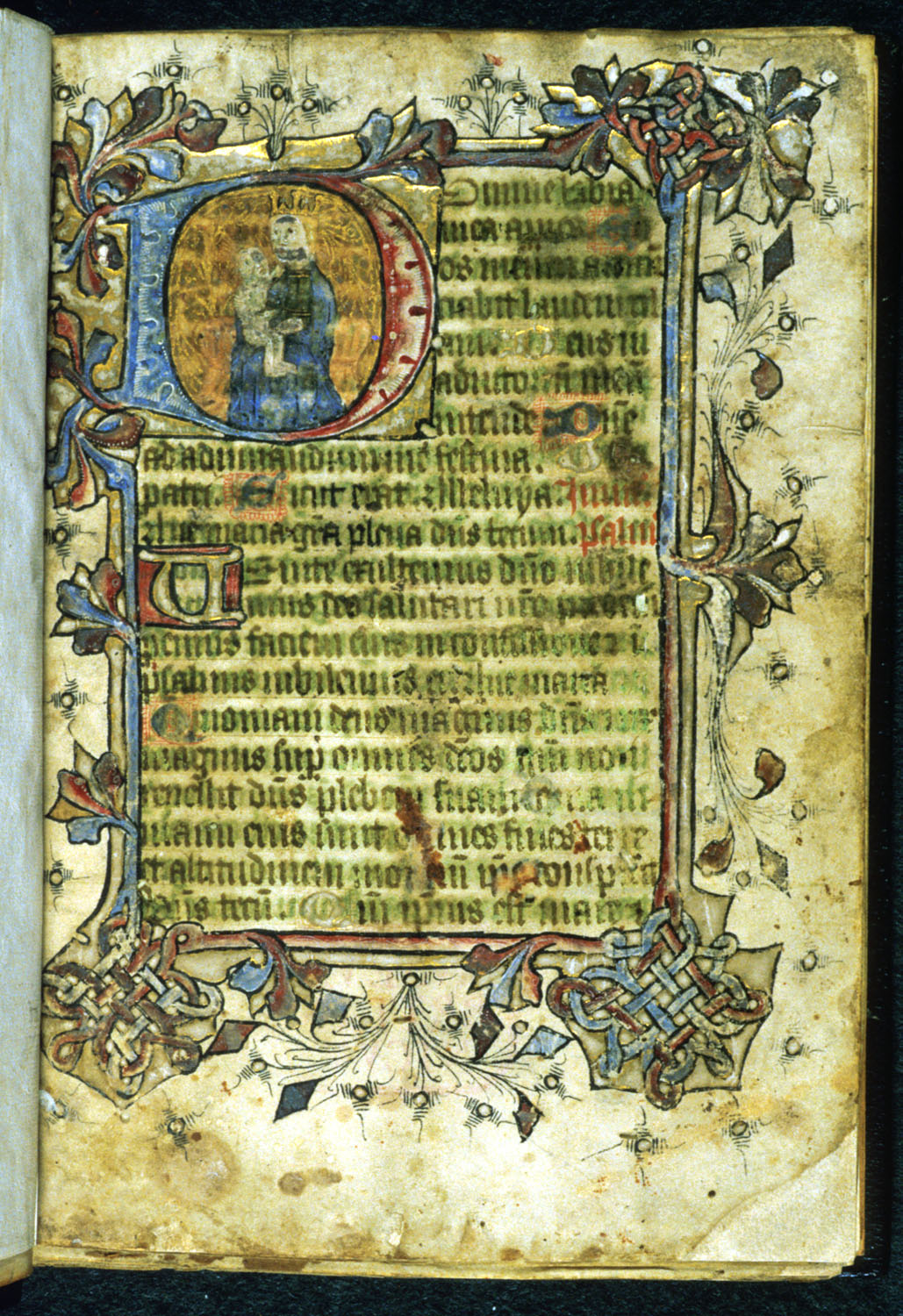
Historiated initial 'D'(omine) with a crowned Virgin and Child.
English Book of Hours, 1st quarter of the 15th century.

Third, we have borders and line-endings, which may have many detailed images/miniatures in them. These often do not relate directly to the text and can contain unusual figures.

Marginal illustration from the Gorleston Psalter- Norfolk, early 14th century.
How much do we love the medieval duck? 

And while the illuminations could serve to illustrate or to decorate, they also provided aids for contemplation and meditation for those reading them as part of their daily prayer and devotion. On another (very practical) level, the illustrations were useful markers for less literate readers to be able to navigate a lengthy manuscript. One does not have to be able to read to identify a picture of the Virgin Mary or one of the story of Adam and Eve.

Four scenes from the Book of Genesis, with three of Adam & Eve.
The Huth Psalter, England, late 13th century.

Although so many wonderful works were produced by men (and women) of the church, by 1100 this situation began to change. The production of manuscripts was no longer the preserve of the church, and secular scribes and illustrators rose in importance. This was in part due to the expansion of the content of manuscripts. Romances, chronicles, medical and other texts and aristocratic family trees all began to be produced. The rise of the universities and the increase in book ownership by the wealthy saw a thriving secular book trade in Paris and Bologna by the 13th century.

Guinevere questioning Lancelot about his love for her.
Lancelot du Lac, France, c.1316.

It was another university city, the city of Cologne, that was to trigger the start of the demise of the manuscript. By the 1470s Cologne had become the most important centre of printing in north-west Germany and where a certain William Caxton was perfecting his own particular art. Handwritten texts were being replaced by the printed version.

From the Arnstein Bible, a large two-volume MS, Germany c. 1172.
It was written by a single scribe, a monk named Lunandus.

But it was English Reformation that was to see the wanton destruction of the illuminated manuscript. Henry VIII decreed that the 'images and pictures' of Saint Thomas Becket shall 'through the whole realm be put down and avoided out of all churches, chapels, and other places.’ The Act against Superstitious Books and Images (1550) ordered that prayer and service books that did not comply with the reformed liturgy should be destroyed. The religious communities did their best to keep their handwritten treasures safe. Books were smuggled out of religious houses and hidden in sympathetic homes. But not all could be saved. Priceless manuscripts were torn up, burned, used to clean candlesticks, clean boots, stop up beer barrels and even deployed in the privies.

The martyrdom of Thomas Becket from the Harley collection-
a rare survival in an English context.
Netherlands, 3rd quarter of the 15th century.
           

Yet despite all of this appalling vandalism, medieval manuscripts have preserved for posterity the lion’s share of medieval painting. As Beal so beautifully puts it: ‘Books have a knack of surviving.’ It is our great good fortune that they do.


Detail of marginal images of apes with books.
France, 1318-1330.

~~~~~~~~~~~~~~~~
References:
All images are in the Public Domain and are part of the British Library's Catalogue of Illuminated Manuscripts. (This online resource is truly a treasure trove and I cannot recommend it highly enough.)
Beal, Peter, A Dictionary of English Manuscript Terminology 1450–2000: Oxford University Press, Current Online Version. (2011)
Brigstocke, Hugh, The Oxford Companion to Western Art: Oxford University Press, Current Online Version (2003)
Chilvers, Ian, The Oxford Dictionary of Art and Artists (4 ed.): Oxford University Press, Current Online Version (2014)
De Hamel, Christopher, A History of Illuminated Manuscripts (2nd ed.), London: Phaidon Press Ltd. (1994).
Kerr, Julie: Life in the Medieval Cloister, London, Continuum Publishing (2009)
Whittock, Martyn, A Brief History of Life in the Middle Ages: London, Constable & Robinson (2009)
~~~~~~~~~~~~~~~
E.M. Powell’s medieval thrillers THE FIFTH KNIGHT and THE BLOOD OF THE FIFTH KNIGHT have been #1 Amazon bestsellers and a Bild bestseller in Germany. Book #3 in the series, THE LORD OF IRELAND, about John’s failed campaign in Ireland was published by Thomas & Mercer on April 5 2016. Born and raised in the Republic of Ireland into the family of Michael Collins (the legendary revolutionary and founder of the Irish Free State), she now lives in northwest England with her husband, daughter and a Facebook-friendly dog. As well as blogging and editing for EHFA, she is a contributing editor to International Thriller Writers The Big Thrill magazine, reviews fiction & non-fiction for the Historical Novel Society and is part of the HNS Social Media Team. Find out more by visiting www.empowell.com.

Find her books on:
Amazon