Showing posts with label Victorian England. Show all posts

Wednesday, November 11, 2015

The Remarkable Life of Lady Unknown: Angela Burdett Coutts

by Lauren Johnson

What links the British bee-keeping association, Ragged Schools, dog water fountains, the Royal Marsden Hospital and a refuge for prostitutes?

All were funded by the remarkable Victorian philanthropist Angela Burdett Coutts. A celebrated figure in her own lifetime, Angela inherited Coutts Bank at twenty-three years old and spent the remaining seventy years of her life investing her fortune in a wide array of good causes. Yet today Angela is little remembered. She has lived up to the moniker she used in many of her anonymous donations – she has become Lady Unknown

Angela’s life is a story that cries out to be told. Born into an age when women could not vote or stand for parliament, and when a wife’s body as well as her property was completely under the control of her husband, she used her almost unique position as a single woman with independent wealth and influence to improve the lives of thousands of others.

(National Portrait Gallery)

Angela Burdett’s upbringing was not unusual for a woman of her status, but her family life was tumultuous. Her father was the radical Sir Francis Burdett – that extraordinary thing, a popular politician. Burdett campaigned for better treatment of prisoners, for parliamentary reform, spoke out against the Peterloo Massacre and criticized the unrepresentative make-up of the House of Commons. Such was the strength of feeling towards this ‘man of the people’ that when he was arrested in 1810 for publishing his criticism of parliamentary practice, a riot broke out in London.

Angela’s grandfather was the banker Thomas Coutts, and it was from him – in the most circuitous and unexpected manner – that Angela gained her fortune. Thomas had three daughters, and each of them had several children – including, crucially, a number of sons.  According to general practice, the bank should have passed to one of these boys. But in 1815 Thomas secretly married Harriot Mellon, an illegitimate actress forty years his junior. In 1822 he left his entire fortune and partnership in Coutts Bank to her. (The family were unimpressed.) Harriot began life as ‘a poor little player child, with just food and clothes to cover me’ and ended it as the Duchess of St Albans. It was to this unlikely patron that Angela owed her fortune.

During her childhood, Angela became a favourite companion of Harriot’s, and the elder woman saw something in her quiet, thoughtful step granddaughter. When Harriot died in 1837 she left the Coutts legacy to Angela. In modern terms, Angela became an overnight millionaire, and in deference to the conditions of Harriot’s will, adopted the surname ‘Coutts’.

Harriot Mellon
(National Portrait Gallery)

The anticipated next step for a woman in Angela’s position was marriage – allowing a well-born husband to take control of her fortune while she retired into domestic obscurity. There was certainly no want of suitors. One peer wrote that he got on well with Angela in later life,
because I never proposed to her. Almost all the [other] young men of good family did: those who did their duty by their family always did.[1]
The shy youngest child whose closest relationship had always been with her parents was suddenly public property, her personal life openly debated, her decisions questioned. Among the unwanted seekers of her attention was a man who would be her shadow for over a decade: the Irish barrister Richard Dunn. To modern eyes, Dunn was clearly an obsessed stalker. He followed Angela around the country, broke into her garden, followed her to church, sent constant letters and reminders. He even forged poems which he claimed Angela had written him – and was convicted of perjury for doing so.

Given this constant romantic bombardment, it is not altogether surprising that Angela remained single for most of her life. What is surprising is what she chose to do with her wealth. Instead of retiring to the countryside Angela lived mostly at 1 Stratton Street, right on Piccadilly in London. In London, then as now, the richest in society were crammed tight against the poorest. Even Parliament backed onto a slum. The ‘polite’ thing to do at a certain level of society was to ignore the poverty – to look away from the poor, desperate and destitute right outside your window. What Angela did was engage with it.
What is the use of my means but to try and do some good with them?[2].
Perhaps because she had not expected her wealth, Angela felt a considerable duty to use it for the improvement of other people’s lives as well as her own. All the same, she had observed Harriot Mellon’s style of over-generous but under-researched charity. Angela would not indiscriminately hand over wads of cash or use untested middlemen. Instead, she carefully investigated her investments and was in constant communication with her agents. Everywhere she travelled, she took a writing desk with her, stuffed full of demands for support, investment or help. As time passed she moved from offering donations towards other people’s projects into creating her own long-term developments.

In 1851 she started building Columbia Square, new housing for poor families in the East End of London. The emphasis here, as in much of Angela’s work, was on practicality. The apartment blocks were light and airy with their own gas and water supplies, ensuring good sanitation. To prevent unscrupulous rent increases, subletting was forbidden. About 600 people were housed in this community, at a time when across London, slums were being demolished and the families renting there simply turfed out to make room for middle class expansion and railways.

Angela in later life.
(Wikimedia Commons)

Angela was also a lifelong campaigner for educational reform, encouraged by her friendship with Charles Dickens. His book Hard Times was a product of their conversations about schooling. They were both patrons of the ‘Ragged School’ movement, which was one of the few routes into education for poor children. As well as providing new schooling facilities, Angela established a group of ambulatory teachers to tour local areas, promoted evening classes and practical training for working children, wrote a ‘poor woman’s Mrs Beeton’ called Common Things and petitioned government for reform.

Angela’s personal life jostles for attention alongside her work (of which the examples above are a very small sample). In 1847 she proposed to the Duke of Wellington – the hero of Waterloo and ex-Prime Minister, then in his seventies. In 1881 the age dynamic was reversed, with no less public scandal. Angela waited until she was sixty-six to marry, and the husband she finally chose was William Ashmead Bartlett, an American-born twenty-nine year old who she had funded through school. One of the conditions of Angela’s inheritance had been that she could not marry a foreigner, so by choosing Bartlett (who took her name after 1881) Angela lost the majority of her fortune. Even with a considerably reduced income, however, Angela’s work did not cease. The first meeting of the organization that would become the NSPCC took place in her drawing-room.

In 1893 Angela wrote a report On the Philanthropic Work of Women, characteristically deflecting attention away from her own work and towards the charity of others. She focused on those who did not simply give donations to those in need, but who ‘enabled the destitute to help themselves.’[3]

During her lifetime Angela gave away somewhere between £3 million and £4 million. When she died in 1906 30,000 people came to her house to pay their respects. She is buried in Westminster Abbey.

Angela’s life is crying out for a sweeping, big budget biopic but in the absence of such a movie Untold and myself have produced a play about just one aspect of her life: her work and friendship with Charles Dickens. For decades, Dickens acted as Angela’s ‘front man’ investigating appeals for donations and rather obscuring her own work behind his celebrity persona. Angela was happy to let Dickens be the public face of their charitable work and for herself to remain ‘lady unknown’ – indeed, given the nature of some of their work, anonymity was a necessity.
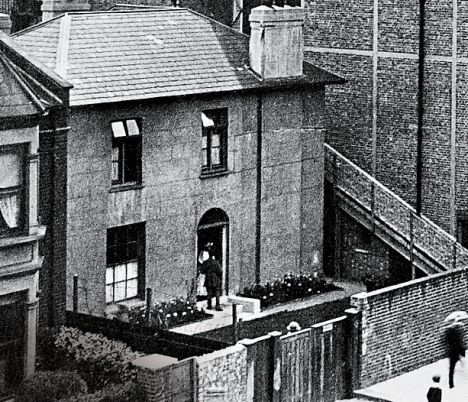
Urania Cottage, the 'home for homeless women'
(Wikimedia Commons)
Together, the pair established a home for homeless women which took ex-convicts and prostitutes to provide education, rehabilitation and refuge. Angela’s involvement with the house for fallen women did not meet with universal approval in highly moralistic Victorian society. The Duke of Wellington declared with the blithe presumption of someone born privileged and male that these women were ‘irreclaimable’.
I am afraid that experience, as well as the information to be derived from statistical works, have taught us that there is but little, if any, hope of saving in this world that particular class of Unfortunates.[4]
Nonetheless, the home was built, staffed, stocked and provided care for over a hundred women. They proved to be very far from irreclaimable.

Lady Unknown,
a play I have written about Angela’s life, will be shown at the Charles Dickens Museum in London on Monday 16th November. You can read more about the project here. We are still seeking crowdfunding support to finance the play, and if you are able to help us with a small donation we would be enormously grateful.


~~~~~~~~~~~~~

Lauren Johnson is an author and historian. Her debut novel is The Arrow of Sherwood, and Lady Unknown will be her first play.

@History_Lauren
@Untold


[1] Edna Healy, Lady Unknown: The Life of Angela Burdett Coutts (Sidgwick & Jackson, 1978), p. 53.
[2] Charles Dickens reporting Angela’s words. Clara Burdett Patterson, Angela Burdett-Coutts and the Victorians (John Murray, 1953), p. 166.
[3] Healy, p. 218.
[4] Anne Isba, Dickens’s Women: His Great Expectations (Continuum, 2011), p. 89.

Thursday, March 13, 2014

The Cheesewring on the Bodmin Moor

by Diane Scott Lewis

A decade or so ago, my husband I traveled to Cornwall to research my first novel. On a misty, foggy day (how appropriate) we walked on the Bodmin Moor. The first sign we encountered was a tiny one that said Cheesewring with an arrow. In those dark-ages days before the internet was so readily available, we scratched our heads, wondering what this could be.

Traipsing the mysterious moor over scrubby grass, glared at by disturbed sheep, I saw a strange rock formation in the distance and insisted my husband take my picture with it.

Only when we arrived home, and I researched in a book I had, did I find that this granite tor had been the Cheesewring.

Located on the southern edge of the Bodmin Moor, the Cheesewring, or in Cornish, Keuswask, is a geological formation on Stowe’s Hill formed by centuries of weathering—harsh winds and rain. The name is derived from the piled slabs that resemble a cheese press.

Author Wilkie Collins described the formation in 1861 in his book, Rambles Beyond Railways: "If a man dreams of a great pile of stones in a nightmare, he would dream of such a pile as the Cheesewring."

Thirty-two feet in height, the tor is top-heavy, the fifth and sixth rocks of immense size and thickness. Four lower rocks support them, all perfectly irregular, the towering formation having no lateral support as it clings to the steep hill. It’s said the formation spewed from the earth, and crystallized as tubular granite.

In local legend, the Cheesewring is the result of a contest between a man and a giant. The giants who dwelled in the Cornish caves were angry when Christianity was first introduced to the British Islands. The Saints had invaded their land, and the largest giant Uther was sent to chase them out. The frail Saint Tue proposed a rock throwing contest. If he won, the giants had to convert to Christianity. If Uther won, the Saints would leave Cornwall.

Uther easily threw a small rock to the top of Stowe’s Hill. Tue prayed for assistance. He picked up a huge slab, and found it miraculously light. They continued throwing, stacking the stones in perfect piles. When the score was twelve each, Uther tossed a thirteenth, but it rolled down the hill. Tue picked up his fallen stone, and as he lifted it an angel appeared to carry the slab to the top of the rock pile. At seeing this, Uther conceded, and most of the giants converted to Christianity.

In a book on Arthurian Legend, it’s said that the slabs turn and twist at certain times of the year. Or when the tor hears a cock crow.

According to the 1903
Journal of the Transactions of the Victoria Institute "In this country of ancient art, such as standing stones, old crosses, druidical circles, and dolmens, the Cheesewring rises pre-eminent as a conspicuous work of nature."


Located adjacent to the Cheesewring Quarry and surrounded by other granite formations, this landmark was threatened with destruction in the late nineteenth century by the proximity of blasting operations, but was saved as a result of local activism.

Cheesewring Quarry

~~~~~~~~~~~~~

For more on Diane Scott Lewis and her Cornish novels:

http://www.dianescottlewis.org


Saturday, June 8, 2013

Victorian Violence: Repelling Ruffians (Part Two)

by Terry Kroenung


 Genteel Self Defense
"I can almost hear people say, ‘Oh, this is all rubbish; I’m not going to be attacked; life would not be worth living if one had to be always ‘on guard’ in this way.’ Well, considering that this world, from the time we are born to the time we die, is made up of uncertainties, and that we are never really secure from attack at any moment of our lives, it does seem worth while to devote a little attention to the pursuit of a science, which is not only healthful and most fascinating, but which may, in a second of time, enable you to turn a defeat into a victory, and save yourself from being mauled and possibly killed in a fight which was none of your own making. 

"Added to all this, science gives a consciousness of power and ability to assist the weak and defenceless, which ought to be most welcome to the mind of any man. Though always anxious to avoid anything like ‘a row,’ there are times when it may be necessary to interfere for the sake of humanity, and how much more easy is it to make that interference dignified and effective if you take your stand with a certainty that you can, if pushed to extreme measures, make matters very warm indeed for the aggressor? 

"The consciousness of power gives you your real authority, and with it you are far more likely to be calm and to gain your point than you would be without the knowledge. Backed up by science, you can both talk and act in a way which is likely to lead to a peaceful solution of a difficulty, whereas, if the science is absent, you dare not, from very uncertainty, use those very words which you know ought to be used on the occasion.” ~ Rowland George Allanson-Winn, 5th Baron of Headley, 1890

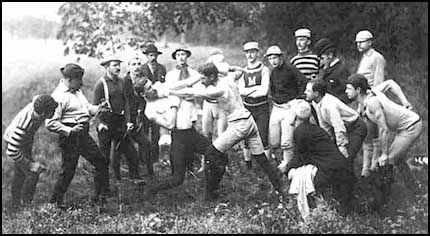
Pugilism
"Professional pugilism has died out, as much choked by the malpractices of its followers as strangled by public opinion…The noble art of self-defence is not, however, altogether neglected, but finds its place among the athletic sports, and the clubs by which it is encouraged may be congratulated on keeping alive one of the oldest institutions, in the way of manly exercise, on record.” ~ Charles Dickens, Jr., 1879

As we are concerned with the employment of self-defense techniques in the protection of one’s person and loved ones on the streets of Victorian London, it is not our purpose here to elaborate upon prize fights. Yet it is indisputably true that the one informed the other. Effective methods of pugilism were developed in the ring and then adopted by gentlemen on the boulevards. British boxing arose from the Age of Enlightenment’s love of all things classical. The ancient Greek sport of pankration, renowned for its brutality, and subsequent Roman variants, were revived in much more genteel versions in the mid 18th century.

It was the upper-classes who led the way in this, as simple brawling with fists had never died out among the working folk. Naturally, gambling was the impetus for injecting rules and order into what had been a mere vulgar scrap. A way had to be found to settle disputes when great sums were being wagered on gentlemen’s champions.

Thus the first regulations were set in place by former fighter John Broughton. His interest in fair play – gloves, set rounds, no attacking a downed man, etc. -- was somewhat selfish: he ran a school to teach pugilism to men of refinement and they did not wish to take broken jaws and black eyes home to their ladies.

Here we see the beginnings of the later Victorian attitude that boxing was a quintessentially English activity to be practiced by the ‘quality.’ To be sure, those less-mannered had always been beating one another to a bloody pulp in the alleys of London, but by the 1780’s pugilism began to evolve into an art that eventually replaced fencing in the hearts of the British middle- and upper-classes.

The decades-long struggle with France accelerated this urge toward the good manly virtue of boxing. Fisticuffs were seen as an antidote to the effeminate ways of the Continent. Less lethal than dueling (a strong selling point with every man needed to carry a musket against Bonaparte) and purely egalitarian (man vs. man with no underhanded doctoring of weapons), boxing became a national craze.


But it was a fad that suffered from early Victorian attitudes. That age’s philosophy stressed morality, faith, and family rather than the violence that Napoleon’s threat had necessitated. So the vogue waned for some time, as fighting was considered as beneath the dignity of a proper man. But when it returned it did so with a vengeance. The Queensberry Rules of 1867 were adopted with alacrity and became so widespread that the very nature of boxing changed.

With padded gloves an absolute requirement, tactics and footwork had to shift. First off, there actually could  be tactics, rather than mere flailing away until someone collapsed. In bare-knuckle boxing the defense, such as it was, was with the forearms rather than the hands. To protect one’s face the stance was upright, leaning the head back to keep it away from the opponent’s fists. Now the heavy gloves served as a shield to crouch behind.

In order to defeat this barrier, the now-familiar bobbing and weaving came into play, along with active footwork. Counter-intuitively, this all made the sport rather more dangerous. With bare knuckles a fighter had to pull a punch somewhat or risk a shattered hand. Now blows were delivered with much more fury and with greater rapidity. As a result men were struck harder and more often, since fights resulted in less bout-ending blood and broken teeth than before.

The cumulative effect of many punches caused more damage and actual knockouts than a few nasty but less forceful knuckle strikes. Brain injuries became common.


In a sense the popularity and widespread adoption of the Queensberry Rules might have been the downfall of many a well-trained but rule-bound gentleman when it came to actual no-holds-barred self-defense in the street. When accosted by an alley ruffian intent on relieving him of his wallet or watch, the club-trained man of means may have found himself at a disadvantage when kicked, grappled, or struck with a club. One can imagine him being overwhelmed mentally, as well, as the thug did not conform to the rules. Fair play did not enter into the equation.

But one can also imagine the contrary. Assailed by an unskilled, desperate, possibly intoxicated street thief, the training in pugilism might have made for a brief encounter. For the value in boxing does not lie only in simple techniques, but in the intangible qualities of confidence, cool-headedness, and quick judgement of the opponent’s strengths and weaknesses. Indeed, simply knowing how to take a punch, and how to mitigate the impact of it, would be of immeasurable value in itself. Attacked by an over-confident, swaggering hooligan who launched a clumsy haymaker, the gentleman’s schooling at his club could very well have resulted in the automatic response of step into the attack,/block, it/simultaneously punch with other fist.

Here we would be well-advised to recall the words of Allanson-Winn at the beginning of this essay, that pugilism is "a science, which is not only healthful and most fascinating, but which may, in a second of time, enable you to turn a defeat into a victory, and save yourself from being mauled and possibly killed in a fight which was none of your own making.”

As proof of the efficacy of pugilism as self-defense, though admittedly not in a historical context, we offer this video of a trained boxer fending off a veritable horde of enraged attackers with only the skills a Victorian gentleman might have learned from his boxing instructor:


In Part 3 we will explore the variety of weapons available to a Victorian in defending against armed or unarmed assailants, from the ubiquitous walking stick or umbrella to the cudgel or loaded riding crop.
Part 4 will conclude the series with an examination of Bartitsu, the only mixed martial art of this era and indeed, the first such.

~~~~~~~~~~~~
Terry Kroenung is the author of Brimstone and Lily, a seriocomic fantasy novel set in 1862, and its sequel, Jasper’s Foul Tongue. Book 3 in the series, Jasper’s Magick Corset, will be available in September. Paragon of the Eccentric, his Steampunk prequel to War of the Worlds, is pending. He has also written dramas set in the 19th century, such as Gentle Rain and Coolness and Courage.

Thursday, May 9, 2013

The Battle of Majuba Hill, February 27th 1881

by David William Wilkin


This month my contribution is more on what occurred during the first Boer War of 1880-1881--a war that did not last very long, resulted in a British defeat and, of course, did not resolve enough, so that there eventually was a second war that was much worse for all.

The Transvaal War, The Battle of Majuba Hill by Richard Caton Woodville

The Battle of Majuba Hill would prove to be the deciding battle of the war. Up to this point the Boers were very much having their way with the British. The Boers believe the British were thinking of trying to outflank them at Laing's Nek. Major-General Sir George Pomeroy Colley moved his troops up the 2000 foot tall hill on the night of the 26th--a feat, for the Boers did not think the hill was scalable.

There now were 405 British soldiers atop the hill--men of the 58th Regiment, the 92nd (Gordon Highlanders) and a even a small naval brigade from the HMS Dido. Most of the troops though were inexperienced and the regiments had not seen any action since the Crimean War (which ended in 1856, twenty five years before.)


The aid post on Majuba Hill.  Lance Corporal Turner winning the V.C.

Colley was urged and advised to have the men dig in, but he ignored that. He also did not bring any artillery, which might have been difficult in any case. He seems to have believed that the mere sight of the British troops in a position of advantage would cause the Boers to retreat. The Boers, under Nicolas Smit, gathered together at least 450 men to attack the hill.


Daybreak was at 4:30. The Highlanders covered a wide perimeter, and a handful were at Gordon's Knoll (Kopje) on the right of the summit. 

The Boers began to panic fearing that the British had artillery on the hill. They had been taken by surprise and had not known of the soldiers until the Gordons began to yell and shake their fists. Three Boer parties began an advance on the hill. The groups were led by Field Cornet Stephanus Roos, Commandant D.J.K. Malan and Commandant Joachim Ferreira. The Boers, as they had proven in all the previous battles, were much better marksmen than the British infantry. (At about 10 to one efficiency in the previous fights.) With their skill, the Boers kept the British from attacking while they got into position. At 12:45 Ferreira's men began a great rate of fire on the exposed knoll and captured it. Colley had been in his tent and was informed that the Boers were advancing but took no action.

Over the next hour, the Boers came over the top of the British Line and engaged at long range, not hand-to hand. The ability of the Boers to sharpshoot and keep the British from using their bayonets was telling again. The British were not ready for this type of fighting (especially with units that had not seen action for 25 years). Now the British morale, since they were suffering all the casualties and the Boers were suffering almost none, failed. The British began to flee. The officers had done little during the attack till then.  They didn't issue orders or direct the fighting. The British line collapsed and many fled from the Hill, with the Gordons standing firm the longest. When they were routed though the battle was over. 

The Boers then further launched an attack the destroyed what remained of the British line. The Thin Red Line was broken.

Major General Sir George Pomeroy Colley

Colley attempted to order the men into a fighting retreat. He was shot and killed by a Boer marksman. The rest of the force fled down the rear slopes of Majuba, as many more were hit by the Boers who now had taken the summit and were shooting down at the foe.

The 15th King's Hussars and the 60th Rifles tried to stage a rearguard but it failed. They had marched from Mount Prospect but had little impact. 285 British troops were killed, captured or wounded, including Captain Cornwallis Maude (KIA), son of the 1st Earl de Montalt (who was a government minister).

Some of the British wounded were surrounded by the Boers and were able to give an account of what they saw. Many of the Boers who had defeated them were just farm boys armed with rifles. The British sense of prestige had assured those of the empire that they would easily and quickly be victorious. They found it hard to reconcile that when their professional army was defeated by such as the Boers. This was the first significant defeat since the American War of Independence for the British. Previous defeats since that war had always seen the British roaring back to victory in such wars. This was the last in a string of defeats over three months from which the British could not easily recover. It may have been philosophically the beginning of the end of the British Empire.

Research
Ian Knight The Boer Wars (1) 1836-981996

Joseph Lehmann Echoes of War, The First Boer War, 1972

Donald Denoon Southern Africa Since 1800, 1972


* * *


Mr. Wilkin writes Regency Historicals and Romances, Ruritanian (A great sub-genre that is fun to explore) and Edwardian Romances, Science Fiction and Fantasy works. He is the author of the very successful Pride & Prejudice continuation; Colonel Fitzwilliam’s Correspondence. He has several other novels set in Regency England including The End of the World and The Shattered Mirror. 


His most recent work is the humorous spoof; Jane Austen and Ghostsa story of what would happen were we to make any of these Monsters and Austen stories into a movie.


And Two Peas in a Pod, a madcap tale of identical twin brothers in Regency London who find they must impersonate each other to pursue their loves.
He is published by Regency Assembly Press


The links for all locations selling Mr. Wilkin's work can be found at the webpage and will point you to your favorite internet bookstore: David’s Books, and at various Internet and realworld bookstores including the iBookstoreAmazonBarnes and NobleSmashwords.


And he maintains his own blog called The Things That Catch My Eye where the entire Regency Lexicon has been hosted these last months as well as the current work in progress of the full Regency Timeline is being presented.

You also may follow Mr. Wilkin on Twitter at @DWWilkin
Mr. Wilkin maintains a Pinterest page with pictures and links to all the Regency Research he uncovers at Pinterest Regency-Era


Monday, June 11, 2012

Evening Amusements

by V.R. Christensen

My friends and family are aware of my strange (to them) fascination with old books, and so, at times, I'm blessed with random gifts of literary kindness.


Recently, I was given a very old and fascinating copy of a book called Evening Amusements, which describes, and gives detailed instructions for parlour games and tricks and various other suggestions for activities that might while away the evening hours in a time before t.v., internet and cinema. I believe the book was printed in the 1880's. Some sources say 1870's, but certainly by 1880 it was in publication.

Preface
With the winter time of the year, a book like this should prove a welcomed guest; as it is essentially intended as a book to amuse, to pass quickly away the long nights, to add to the festivity of Evening Parties, and to be a pleasurable companion on all Social Gatherings; for it is to be hoped we are none of us so old or so crusty but that we can still appreciate

"Jest and youthful jollity,
Sport that wrinkled Care derides,
And Laughter, holding both his sides."

 With this book as one's guide, we are promised that we will never find ourselves, 'for an evening's entertainment, like the poor old lady in this picture' . . .
 
The Game of Frog in the Middle
A player selected by lot sits on the carpet, while the others form a circle round him, taking him unawares every time he turns his back, pulling him, pinching him, buffeting him, and pulling his hair. When he succeeds in catching one of them the captive must change places with him. As the players dance and caper round the Frog they cry "Frog in the middle—catch him who can."

The Game of the Huntsman
This game is one of the liveliest winter evening's pastimes that can be imagined. It may be played by any number of persons above four. One of the players is styled the "Huntsman," and the others must be called after the different parts of the dress or accoutrements of a sportsman: thus, one is a coat, another a hat, whilst the shot, shot-belt, powder, powder-flask, dog, and gun, and every other appurtenance belonging to a huntsman, has its representative. As many chairs as there are players, excluding the huntsman, should next be ranged in two rows, back to back, and all the players must then seat themselves; and being thus prepared, the huntsman walks round the sitters, and calls out the assumed name of one of them; for instance, "Gun!" when that player immediately gets up, and takes hold of the coat-skirts of the huntsman, who continues his walk, and calls out the others one by one. Each must take hold of the skirts of the player before him, and when they are all summoned, the huntsman sets off running round the chairs as fast as he can, the other players holding on and running after him. When he has run round two or three times, he shouts out "Bang!"and immediately sits down on one of the chairs, leaving his followers to scramble to the other seats as they best can. Of course one must be left standing, there being one chair less than the number of players, and the player so left must pay a forfeit. The huntsman is not changed throughout the game unless he gets tired of his post.


The Game of Evasion
This amusement is of an intellectual character, and consists in a number of questions being addressed to the company, alternately, by the director of the game, or by themselves to each other; to every one of which questions, evasive or indirect answers must always be given, and never a direct affirmative or negative, under a penalty of a forfeit; for instance:—
DIRECTOR. I proclaim, that no question from this time be answered either in the affirmative or negative.
EDWARD. Does your injunction extend to every question that may be proposed from this moment?
DIRECTOR. Yes, to every question.
EDWARD. Then please to pay a forfeit for your "yes".
DIRECTOR. Oh! you cunning rogue! you took advantage of me; but you shall not escape, if I can help it: perhaps you have played the game before?
EDWARD. Perhaps I have.
DIRECTOR. Which do you prefer, Maria, music or drawing?
MARIA. Indeed, I hardly know to which to give the preference.
DIRECTOR. Experience, I perceive, has made you wary; you do not, however, expect to escape, I suppose?
MARIA. I only hope to do so.
DIRECTOR. Have you been to the theatre, Sophia, lately?
MARIA. You seem to have forgotten that I last week informed you of my having seen the Comedy of Errors.
DIRECTOR. Well, and how did you like it?
MARIA. No one, I think, possessing a taste for dramatic representations, can witness the performance of any of Shakespere's plays without feeling truly gratified. But did not I hear the bell ring?
EDWARD. Oh, no; it's not supper-time yet.
SOPHIA. How happy I am to call on Edward for a forfeit! are you not glad, Maria, that he is bit at last?
MARIA. Yes, that I am; how silly he was to allow himself to be so easily caught!
DIRECTOR. As Maria is so much wiser, she certainly cannot mind paying a forfeit for her "Yes, that I am!"

The director continues the game in this manner until enough forfeits have been collected.
*   *   *
So! What does one do with all these 'forfeits'? The book offers suggestions for that, as well.


Ninety-and-Five Forfeits
The most enjoyable pleasure of an evening's entertainment, or nearly so is "Crying the Forfeits," as it usually concludes the holiday evening's gambols. The previous portion of the evening, as respects the games, being generally looked upon as a means for the collection of this description of mirth and glee . . .

 As it frequently takes the invention of those who are called upon to decide on the penalty to be paid for the mistakes made during the evening, the following forfeits, even though they are not literally carried out, may be the means of starting ideas that might not, without such a spur to thought, have come into existence. We all remember what Campbell says in the "Pleasure of Hope."

"Wake but one thought, and lo! what myriads rise."

Much inconvenience may be avoided, if the persons who subject themselves to forfeiture in play, would, instead of depositing their trinkets, or the like, merely write their names on a strip of paper or card each time, and give it to the Director; it being arranged that each person is bound to redeem his name, the same as if it were the most valued of ornaments.

The Director, or any one of the party who has no forfeits, collects them altogether; and sitting down calls any of the players to kneel with his (or her) face on the Director's knees, so that the forfeit cannot be seen, as the Director, holding up one of the slips of card (or the forfeited article) a little way over the head of the person kneeling, cries out "Here's a pretty thing, a very pretty thing; and what's to be done to the owner of this very pretty thing?" The person having to declare the penalty then asks, "Is it for a lady, or a gentleman?" and, on receiving the answer, proclaims the forfeit, choosing the most difficult things to be thought of (suggested by the others in attendance). The person to whom the forfeit belongs has accordingly to perform the penance or forfeit just mentioned. In this way all the forfeits are cried, one at a time. The Director can call a different person to kneel as often as is pleased; or, if preferred, each one can cry a fixed number of forfeits a-piece.

We here give some very good forfeits for our friends to cry when they (the persons who must perform the forfeit) are kneeling down before the Director:—
1. To laugh in one corner, to cry in another, to sing in another, and to dance in another.
2. To put one hand where the other cannot touch it.
This forfeit is managed by putting the right hand to the left elbow.
3. To say "Quizzical Quiz, kiss me quick" six times running without drawing breath.
4. To lay a sheet of newspaper down without leaving it, and place two persons on it in such a way that they cannot touch each other with their hands. (This must be done by putting the newspaper on the floor, half inside the door, and half outside; then, if you put one person on the end of the newspaper outside the door, and shut the door, and put the other person on the inside half, they cannot touch each other, do all they can.)
5. To bow to the wittiest, kneel to the prettiest, and kiss the one they love the best.
6. To bite an inch off a hot poker.
This is done by making a bite, with your mouth one inch distance away from the hot poker.
7. To make a wall-flower of yourself. (To perform this forfeit; if it is for a lady, she must place herself with her back against the wall, and remain there until she has been kissed twice, by two different gentlemen, each of whom she must herself ask to come and kiss her. But if this forfeit falls on a gentleman, he must place himself against the wall until any one of the ladies will take compassion on him and release him by kissing him.)
*   *   *
And that's only seven of them! Interesting, isn't it, how absurd, comical, and altogether "undignified" some of these are? I love it!

The book also contains magic tricks. These are my favourite. I hardly think they'd be recommended today.
 *   *   *
The Great Gun Trick
Amalgamate some tin-foil and quicksilver, and with the composition make a bullet, which will be as heavy as a leaden one. Produce a leaden bullet, and request some person to mark it, and then state you have a composition with which you must rub the bullet to prevent it from hurting you. Rub it with some of the composition, which will give it the exact appearance of the artificial bullet previously prepared by you. It is easy to change one for the other during the process, and when ready you ask which of the audience will fire at you! Having obtained a volunteer, you tell him to put the powder in the gun, then ask him to observe you put in the bullet, telling him to listen and he will hear it fall. You then order him to "present" and to "fire;" when you say the word "fire" you must slip the real bullet in your mouth, or between your shirt and your waistcoat, so that on undoing the latter it will drop down, or if kept in the mouth you can spit it out on a plate.

We strongly advise our young readers to be very cautious and careful if they try this trick, and to have an old hand with them while learning it.

Turning a Sovereign into a Shilling
If a sovereign be rubbed with mercury, it will lose its usual appearance, and become as if silvered over; the attraction of gold for the mercury being sufficient to cause a coating of it to remain.

When it is wished to remove the silvery appearance, dip the sovereign in a dilute solution of nitric acid, which will entirely take it off. Some rather laughable circumstances have occurred, where persons, having a little quicksilver get loose in their pockets, have been surprised to find their sovereigns apparently changed to shillings.

To Make Fusible Spoons
Melt about four ounces of bismuth in a crucible, and, when fused, throw in about two ounces and a half of lead, and one ounce and a half of tin. These metals will combine, and form an alloy, which melts at a very low degree of temperature. If some of it is formed into tea-spoons (which may easily be done by making a mould in a clay, or plaster of Paris, from another spoon), the spoons thus made will produce much amusement; for if one of them be placed in hot tea it will melt, and sink to the bottom of the cup, much to the surprise of the person using them; and even if they do not melt, they will bend considerably. They have a bright appearance, and if made well, will not be easily distinguished from ordinary metal spoons.

There is even a section entitled How to Make Laughing Gas. But I'll leave that one for another time. I'd hate to have the authorities after me.

*   *   *

Don't miss the Of Moths & Butterflies giveaway!  Find out more about the book at www.vrchristensen.com. To enter, leave a comment here, or see here for more details.

Wednesday, April 4, 2012

Phantasmagoria: Getting Your Fright On in Late Georgian England

by J.A. Beard

The lady and her guests have gathered in a sitting room. Only the light of a few candles fights off the choking darkness.

Suddenly a rattling chain and the scratching of unearthly talons echoes through the room. A skeleton appears, then a ghost! The terrified audience holds their hands in front of them in a feeble attempt to shut out the creatures.

The English of the late Georgian era appreciated a good fright just as much as we do. The rise of Gothic literature and related novels of fright provided a giddy thrill for many readers, but reading about a phantom lacks the impact of actually seeing one. Though the people in this era lacked television and movies, they did have their own way of experiencing the visceral thrill of laying their eyes on the macabre and supernatural: the phantasmagoria.

Before we discuss the actual show, we need to discuss the primary tool used for it: the magic lantern. Though historians aren't completely sure, the magic lantern seems to have been invented in either the 15th or 16th century in northern Europe.

The magic lantern is a fairly a simple device. It is basically just has a concave mirror that is placed in front of a light source. The set-up allows the gathering up of light. In the magic lantern, the concentrated light is then passed through a glass slide with an image on it toward a lens. The lens then projects a larger version of the slide image onto another surface. So, what they really had was a simple slide projector. 

In the earliest magic lanterns, candles or a conventional (non-magic as it were) lantern provided the necessary light. As the centuries passed, improved illumination technologies were integrated into the magic lantern to provide for brighter images. Though various types of images were projected when the devices were first introduced, dark images of supernatural creatures were popular from the earliest years. Skilled performers made us of multiple magic lanterns, sound effects, smoke, and other such elements to create a thrilling experience.

The magic lantern had a history on the Continent before its arrival in England. The quick summary version is that during a period of heightened interest in spiritualism and all things dark and supernatural, particularly toward the end of the 18th century, a well-positioned magic lantern could do a lot to convince people that something supernatural was indeed present, especially in a time where people would rarely encounter such technology. By 1801, the phantasmagoria was firmly established in England. At this point, many showmen began to be a bit more honest about the non-supernatural nature of their shows. It's important to note that not everyone believed they were witnessing supernatural goings-on even before the lantern men fully committed to honesty, but there was enough belief in it to occasionally attract the attention of authorities. Coming clean, among other things, also allowed for better integration of other theatrical elements such as live music and guided narration. The displays by this point made use of multiple wheeled projectors. The mobility allowed for the ghosts, devils, and other assorted creatures to move, grow, or shrink during the performance as needed. 

The shows grew in popularity just before and during the Regency period (1811-1820). The Prince Regent, never one to pass up a good time in whatever form, was known to entertain guests and himself with phantasmagoria displays on occasion (along with regular non-horror themed shows as well). 

The magic lantern and phantasmagoria would remain popular through the end of the Georgian era and into the Victorian era.

Wednesday, March 14, 2012

Stand And Deliver ... Your Tolls? The Rise and Fall of the Turnpikes

by J.A. Beard

Of all the benefits of modern industrialized civilization, roads are perhaps one we take the most for granted. Perhaps quality roads and easy of transport seem not all that worthy of special attention. Many ancient civilizations, after all, had developed fine road networks. At the dawn of the Georgian age, however, the quality of many roads in England left much to be desired.

First, let's take a step back and consider many roads prior to the 18th century. During this period, the resources and funds for road maintenance were maintained mostly at the parish level. Paving of any form certainly was limited. This was adequate for making sure various local roads were decent, but the system didn't do much to maintain the quality of distant roads and the intermediate roads connecting various far-flung locales. The net result was a haphazard system of road improvements of varying quality. Wheeled travel was often unpleasant and dangerous. Rugged road conditions and holes could easily lead to accidents.

Inclement weather only made things worse and England is far from an arid country. It was somewhat difficult to drive a coach through a muddied mess. Riding a horse was more practical, but not necessarily comfortable or practical depending on one's circumstances.

Economic improvements, along with the accompanying transportation of heavier amounts of goods, also contributed to wear and tear on many a poor-quality road. Even if the Georgian-era traveler ignored the poor quality of the roads and the difficulties associated with weather, there also was the unpleasant issue of highwaymen. The increase in traffic and trade travel, particularly in the environs of London, hadn't been lost on the criminal element. The lack of an organized police force, let alone anything akin to a highway patrol, only contributed to the problem. A swift, mounted criminal could waive a pistol and demand that someone, “Stand and deliver!” often with impunity despite the threat of execution or transportation to Australia.

Things began to turn around for the often poor, sad, and unsafe roads of England at the beginning of the 18th century because of the Turnpike Acts. Following up on earlier parliamentary acts, in 1696, the first Turnpike Act was enacted, the first of many to follow.

So what were these Turnpike Acts, why did they have to pass so many, and what did they have to do with road quality and highwaymen? These acts established Turnpike Trusts. These trusts were granted the responsibility of taking care of a certain portion of a road, but also granted them several legal tools to do this, including two of particular importance: the right to collect tools and to control access on roads through the use of both gates and men.  The name itself comes from gates’ designs that involved pike-like constructions on crossbars that could be rotated, though not every tollgate necessarily had such a design, and now, of course, the turnpike has evolved into just a general term for toll road.

The trusts each could handle their various roads and road sections as they saw fit, so many would farm out the actual administration of the trusts to other enterprising people. These sort of trust subcontractors, as it were, could then do their best to efficiently run the trusts for a profit.

In the early years of the system, the various turnpike roads weren’t necessarily all that better maintained than before, but techniques advances lead to general quality improvements, particularly in the latter half of the 18th century, which, in turn, fueled a massive expansion of the system, with a general slowing of expansion with the coming of the 19th century. Although there were nearly one thousand trusts in place by the end of the Regency, and thus the tail end of the Georgian era, in 1820, it’s important to note that the majority of roads in England were still maintained by parishes and other local entities. That being said, many major important roads were under the control of turnpike trusts.

While the trusts, in general, contributed to road improvements that helped reduce transport times and the general quality and safety of travel, they also improved general security. Although there were some other contributory factors, the rise of the turnpike system, particularly on high traffic roads, greatly contributed to the decline of highwaymen. The presence of so many guarded gates made post-robbery escapes far more difficult.

Although, like so many things, the decline of the turnpike system was multi-factorial, the most fundamental contributory factor was the rise of a more efficient and swift means of mass transit: the railroads. By the end of the 19th century, a stronger central government, municipalities, and county councils took down the gates and took over the responsibility of maintaining the roads. Only a smattering of smaller private roads, tolled bridges, tolled tunnels, and the newer M6 Toll remain as the descendants, direct and indirect, of the extensive system that once covered tens of thousands of kilometers.

Sunday, March 11, 2012

Queen Charlotte?

Or how Queen Victoria almost wasn't.

by V.R. Christensen

The matter of royal accession during the reign of George III should not have been a matter of any great debate. George IV had already served as regent (off and on) during his father’s madness. The line of George IV was further ensured by the fact that he had a legitimate child, even if she was merely a daughter.

A princess though she was, Charlotte was not much pampered or loved. She was pawn, as children too often are, in the acrimonious game between her rivalling parents, estranged from the time of her conception. She was an unhappy young woman, and desperate to escape the confines of her life. Her ticket out? Marriage.

Because of the Royal Marriages Act of 1772 (passed by George III to ensure that his children's choice of spouses met with his approval) Charlotte's choices were relegated to a few foreign princes whom she'd never met. She made a run at Frederick of Prussia, but he was unresponsive. And then, at a ball given by the Duke and Duchess of York, she met the handsome Prince Leopold of Saxe-Coburg-Saalfield. Not only was he charming, ambitious and a renowned lady’s man, but he was also heavily in debt and looking for a solution. Charlotte was not very much in love with Leopold at the outset; she simply saw him as a means of escape. Neither was Leopold in love with her, but he was very much enamoured of the idea of being consort to a rich princess, and one who would very probably become Queen. Perhaps taking a lesson from her father's miserable marriage, Leopold considered it wise to fortify his position by convincing Charlotte to love him, at least to rely on him. By all accounts, he succeeded quite brilliantly in his aim to win her heart. He was an an affectionate and attentive husband. So successful was he, that, in the course of his efforts, Leopold found himself very much in love with her in turn. He gave up his rakish ways and took up the part of faithful husband and indispensable helpmate. Charlotte was so dependent on him in fact, that she made a royal declaration that she would subject herself to her husband’s rule, making him King upon her accession. All he needed more to secure his position was an heir.

In due course, an heir was on its way, but Charlotte was subject to the ‘skill’ of the royal doctors, who prescribed a ‘lowering’ treatment for the expectant mother. This consisted of a liquid diet of meatless, vegetable-free broth and restriction from all exercise. Consequently, when her time came, two weeks after the due date, she lacked the necessary strength to deliver the baby. After a gruelling fifty hours of labour, the baby, a beautiful, perfectly formed boy, emergeddead. Charlotte had not even the strength to feel her devastation. To make matters worse, her placenta had not detached, and she endured a procedure which essentially tore it from her uterus. Her torso was then wrapped tightly in bandages, and when she complained of pain, she was given warm compresses. She was bleeding internally, though she was wrapped so tightly no one was yet aware of it. Until it was too late.

At 2:30 in the morning, Charlotte died, and two generations of royalty were swept away.

It was 1817 and the question of accession was once more brought to the fore.

Charlotte’s death had sent her father, George IV, into a nearly fatal fit of illness, and it was generally believed he would die. He rallied, however. He might have done more to ensure the endurance of his own line. When his wife, Caroline died in 1826, he declared his intention to find a new wife and to produce another heir. But, lazy, fat, old and in poor health, he did nothing.

The next in line after the Regent, was George III’s second son Frederick, but the Duke of York had, as had his brother before him, separated from his wife within a year of their marriage, having produced no children. Also out of the running was the sixth brother, Augustus, whose marriage had not satisfied the requirements of the Royal Marriages Act.

That left William, Edward, Ernest and Adolphus vying for position.

William, Duke of Clarence, was next in line. It was Charlotte’s death that induced him to leave his beloved mistress (Mrs. Dorothy Jordan, with whom he had ten children) and look for a wife. He decided upon Adelaide of Saxe-Meiningen, whom he chose sight unseen. She was sickly, unattractive, but intelligent and pious—all of which rather counted against her with the world-wise (if not world-weary) prince. Adelaide was a mere 25 to his 52, yet despite all this, their marriage was a happy one.

The next in line after William was Edward, Duke of Kent. Edward was a favourite of Charlotte and Leopold and it was they who played matchmaker. Leopold introduced him to his sister Victoire. Edward was taken with her and proposed. She refused him. She had been married before, to a much older, unattractive and inattentive husband, who, as it so happened, had been the widower of her maternal aunt (yes, that made him her uncle). Consequently, she had no desire to enter again into that unhappy state called matrimony. Her interests, as well as those of her two children, were best served by remaining a widow. Disappointed, Edward returned to the arms of his mistressuntil events catapulted him back into the hunt. With the announcement of Charlotte’s death, he tried once more for Victoire’s hand, this time begging the influence of her brother, who, though shattered over his wife's death, was ever the man of political strategy (he would later exhibit the foresight to train his nephew up to be the Queen’s consort). He saw in this match another opportunity to advance his own interests, and so persuaded Victoire to see them too. Circumstances had changed, and Edward was no longer a longshot for the throne.

Next was Ernest, Duke of Cumberland. But Cumberland was much feared and loathed by the people. It was generally believed at the time (though modern scholars doubt the allegations hold any truth) that he had murdered his valet and homosexual partner, and that he had fathered a child with his sister, Sophia. His choice of bride was almost as notorious as he. His first cousin, Frederica of Mechlenberg-Sterlitz, was once engaged to his brother Adolphus, Duke of Cambridge, but eloped with the Prince of Solms, whom she was later suspected of murdering. Ernest's marriage to Frederica, solemnised in 1815, satisfied all provisions of the Royal Marriages Act.

The last of the qualifying princes was Adolphus, Duke of Cambridge. Cambridge, the youngest of the seven sons, was also the most temperate of all the brothers, though perhaps no less ambitious. Within two weeks of Charlotte’s death, he was married to Augusta of Hesse-Kassel.

And so, in March of 1819, two years after Charlotte’s death, these four brothers, with their respective and very pregnant wives, rightly held very high hopes for the throne.

Cambridge (Adolphus) was the first to produce a post-Charlotte heir. Upon hearing of the delivery of the Cambridge child, Clarence (William) went to see for himself, sending a message to the King soon after informing him of the arrival (at long last) of a legitimate grandson. The child was called George in honour of his uncle and King.

On the 27th of March, the Duke and Duchess of Clarence had a daughter, but she did not survive her first day.

On the 29th of May, the Duke and Duchess of Cambridge (Adolphus) announced the birth of their son, also named George. The King was well pleased, for he’d taken great measures to ensure that his throne should pass to no woman. The Regent, too, felt very strongly that a King should be the head of England.

Except that five days earlier, the Duchess of Kent had given birth to a daughter, and the Kent child was ahead of the little Georges in succession, Kent (Edward) being next in line after William, who so far had no heir (nor would he, as all of his children by Adelaide died in infancy).

But then the Duke of Kent died. The laws of accession did not rule out his young daughter’s claim, but a King could take certain precautions, as had George III with his own daughters, denying them marriages and thereby guaranteeing they had no claims upon the throne. Perhaps to protect her from such devices, or perhaps to shield her from the unsavoury influences of his profligate brothers (for custom would dictate she fall under George’s care, then William’s upon the former's death) Kent made legal arrangements that his wife should maintain care of their child after his death, a thing virtually unheard of at the time.

Six days after Kent’s death, the King followed. In the shock, George IV fell ill as well, and it was believed he, too, would die. He rallied, however, despite surrendering 150 ounces of blood to the royal doctors.

George IV, once recovered, turned his back upon his niece and was prepared to turn them over to the Coburgs in Germany. Leopold, however, stepped in once again. Such royal neglect on the part of the English relatives proved to be just as well. It was Leopold who arranged for the burial of Kent's body at Windsor, as well as settling all of his sister's outstanding debts. He intereceded with George IV's favourite sister and arranged for them to assume residence at Kensington Palace, where Victoria was trained, very quietly, and without her knowledge, to one day reign.

Though Victoria was brought up to know she was a princess, she spent her childhood wholly unaware of just how great the chance was that she would one day claim the throne. Unlike the heirs apparent both before and after her, she had no cause to consider herself superior, no reason to be vain or to believe in her own self-importance. Instead, she had a unique sense of responsibility and a deep desire to do good.

When, after her uncle William's death in 1837, Victoria at last gained the throne, she was precisely what the people wanted, and perhaps what society needed. They were tired of the old ways, the old excesses.

Victoria brought the promise of a new era, and the world has never been the same.


For more about the life of Queen Victoria, see We Two, by Gillian Gill.

V.R. Christensen is the author of Of Moths & Butterflies, and Blind - a novella. Cry of the Peacock, a companion piece to Of Moths & Butterflies, is due to be released in October of 2012.