Showing posts with label 11th century. Show all posts

Monday, October 17, 2016

Ossulstone - London in the Domesday Book

By Mark Patton.

"While spending the Christmas time of 1085 in Gloucester," the Anglo-Saxon Chronicler tells us, "William [the Conqueror] had deep speech with his counselors and sent men all over England to each shire to find out what or how much each landowner had in land and livestock and what it was worth ... there was no one single hide, nor a yard of land, nay, moreover (it is shameful to tell, though he thought it no shame to do it), not even an ox, nor a cow, nor a swine was there left, that was not set down in his writ. And all the recorded particulars were afterwards brought to him."

So began one of the most remarkable undertakings of record-keeping in Medieval Europe, the Domesday Survey, probably inspired by the Biblical story of a decree going out from Caesar Augustus that all the world should be taxed. In fact, the great cities of London, Winchester, and Durham (and with them, probably, a significant number of cattle and swine) were excluded from the survey, the results of which were almost certainly never brought before William, who returned to Normandy in 1086, and did not set foot in England again.

Part of the Domesday Book entry for Middlesex. Photo: National Archive (Public Domain).


Whilst the walled city of London was excluded from the survey, most of what we today consider as "Greater London" was included. England was divided into seven "Circuits," one of which included the counties of Bedfordshire, Buckinghamshire, Cambridgeshire, Hertfordshire and Middlesex. Each county, in turn, was divided into "Hundreds," and the return for each Hundred as sworn by twelve jurors, half of them English, half of them Norman (the population of England at the time was around 1.5 million, of whom 10-20 thousand were Norman settlers).

The Domesday Circuit of Buckinghamshire, Bedfordshire, Cambridgeshire, Hertfordshire and Middlesex. Image: Thomas Gun (licensed under CCA).


London north of the Thames fell within the County of Middlesex, where 25 major landowners were recorded, including the King; the Archbishop of Canterbury; the Bishop of London; Westminster Abbey; Holy Trinity Abbey, Rouen; various noblemen, and one noblewoman. Most of North London fell, more specifically, within the Middlesex Hundred of Ossulstone, where the largest settlement, by far, was Stepney.

The Middlesex Hundreds. Image: Institute for Historical Research (Public Domain).


The Bishop of London held Stepney, with 32 hides, and land for 25 ploughs. On his land were 44 villagers, each with one virgate of land; 46 cottagers, each with one hide, paying 30 shillings per year; four mills; pasture for the village livestock; and woodland for 400 pigs. The total value of the land in 1086 was £48 (it had been £50 before 1066 - land values diminished across the country in the aftermath of the conquest, but far more so in the north of England than in the south).

The Medieval system of land-holding (image is in the Public Domain). A virgate was the amount of land that was tillable by two oxen in a ploughing season, and was, typically, seen as a quarter of a hide, the latter being the area of land required to support a household.


In the same village of Stepney, Hugh of Berniers (not one of the 25 major landowners of Middlesex) held five hides of land under the Bishop. Below him were two small-holders, each with half a virgate; and two cottagers, each with two and a half acres: these land-holdings were below subsistence level, so the cottagers and small-holders would have to work on Hugh's land; or on the Bishop's; or as labourers on building projects in the City; in order to support their families.

Part of the Domesday Book entry for Middlesex. Photo: National Archive (Public Domain). 


Other settlements mentioned in Ossulstone Hundred include Hoxton (held by the Canons of Saint Paul's, with 10 villagers and 16 cottagers); Hampstead (held by the Abbot of Saint Peter's - Westminster Abbey, with one villager, five small-holders, one slave, and woodland for 100 pigs); and Haggerston (held by Robert Gernon - one of the 25 major landowners of Middlesex, with three villagers and seven small-holders).

Most conspicuous of all, however, are the place-names that are not represented: there is no Hackney; no Camden; no Islington; and no Highgate. There are twelve and a half acres of "nomansland," held by the King (presumably for hunting); and many acres of woodland, supporting a great many pigs (or hogs, or swine - these words are all Anglo-Saxon), tended by the English cottagers and small-holders, whilst most of the pork (a Norman word, derived from the Latin - porcus, a pig) would have been consumed by the Norman landowners, bishops, abbots, and their guests.

Mark Patton blogs regularly on aspects of history and historical fiction at http://mark-patton.blogspot.co.uk. His novels, Undreamed Shores, An Accidental King, and Omphalos, are published by Crooked Cat Publications, and can be purchased from Amazon. He is currently working on The Cheapside Tales, a London-based trilogy of historical novels.


Saturday, October 1, 2016

Government in the Reigns of Edgar and Aethelred II

by Annie Whitehead

Neither Edgar (959-975) nor his son Aethelred (978-1016) came to the throne free from controversy. Both of them succeeded their elder brothers, who reigned only briefly. King Eadwig (Edwy) succeeded his uncle in 955, while his brother Edgar was declared king in Mercia and the Danelaw. With the existence of two royal courts it seems likely that civil war was not far away when Eadwig died on this day - 1st October - in 959. He had issued so many charters that a degree of irresponsibility is probable, and he had quarrelled with Abbot, later Archbishop, Dunstan and driven him into exile.

King Edgar

Aethelred was Edgar’s younger son, and succeeded his (step) brother Edward when he was murdered at Corfe. Throughout his reign he was never entirely able to escape from the fact that the murder had been committed for his sake.

King Aethelred

The youth of these kings produced an environment where faction could arise. Powerful ealdormen could be found influencing politics and the monarch, even changing the face of war, as was the case at the end of Aethelred’s reign.

This then was the political situation over which Edgar and Aethelred had to govern.

The king normally stayed in the south, and his presence in the north was made to be felt by his appointed ealdormen. Within the royal court there was a strict hierarchy, evidence of which comes from a scrutiny of the witness lists of Aethelred’s reign, where athelings, ealdormen, thegns and bishops subscribed in strict order of seniority. This order normally changed only when one subscriber died, but the witness lists of Aethelred’s reign show how powerful particular ealdormen could become. Eadric Streona headed the lists from 1009x12 to 1016, in the lifetime of other ealdormen who had once been his seniors. The king had no choice but to rely on these men for their cooperation and support, which was to some extent ensured by their attendance at the royal council, the Witan, where laws were deliberated upon and promulgated.

The Witan

Edgar relied heavily on the bishops and abbots within the Witan. He was the great patron of the monastic revival, overseen by bishops Oswald, Dunstan and Aethelwold. Many grants of land were made to the Church, and the ecclesiastical support thus ensured gave Edgar the means to check the power of the ealdormen. Oswald was given the triple-hundred* of Oswaldslow to the exclusion of Aelfhere of Mercia, and the leases of Oswald are an indication of his power. The Anglo-Saxon Chronicle records that in 975 “Ealdorman Aelfhere had very many monasteries destroyed...” This action arose more out of political rivalry it seems, than anti-monasticism.

In contrast, the early years of Aethelred’s reign show him undoing much of Edgar’s work, with lands being taken away from religious foundations, such as Abingdon, Rochester and Winchester. Until 993 it seems that Aethelred was being led astray by ealdormen who took advantage of his youth and ignorance. Fortunately for the church, these lands were restored after 993, when, with different ealdormen emerging, Aethelred was seen to mend his ways with the restoration of the privileges of Abingdon.

A charter from Aethelred's reign

There was a long tradition of financial organisation in Anglo-Saxon England. In the tenth century traditional renders gave way to the Geld. The payment of Geld involved the handling of coinage; King Athelstan (924-939) decreed that each burh (borough/fortified town) would have a mint, and he attempted to limit the number of moneyers. Edgar reinforced this legislation in his own law codes. “There shall run one coinage throughout the realm.” [2]  Every borough was expected to issue coinage.

Edgar’s reforms set the standard and the system was continued under Aethelred. During his reign there were more than 60 mints in operation. Of course, there was a great increase in the output of the mints at this time because of the payment of the Danegeld, something with which Edgar was not confronted. It was probably at the instigation of Archbishop Sigeric after Byrhtnoth of Essex was killed at Maldon (991), that the decision was taken to pay the Danes in the hope that they would go away.

“In this year it was decided to pay tribute to the Danes … on this occasion it amounted to £10,000. This course was adopted on the advice of Archbishop Sigeric.” [3]

The payment of the Danegeld indicates two things: the amount of fluid wealth in England and the capacity of the English to tap it.

Another form of taxation (albeit strictly a military tax) was the Ship Soke. Most of the evidence we have for this comes from the reign of Aethelred. The much quoted entry for 1008 in the Anglo-Saxon Chronicle tells us that

 “In this year the king gave orders that ships should be speedily built throughout the whole England: namely one large warship was to be provided from every 300 hides, and a a cutter from every ten hides, while every eight hides were to provide a helmet and a corselet.”

Aethelred was reacting sensibly to the Danish threat, but there is evidence to suggest that this was no innovation. FE Harmer (Anglo-Saxon Writs) pointed out that in 1003/4 Archbishop Aelfric made a bequest of ships and HPR Finberg [4] credited Edgar with the invention.  He cited the Triple Hundred of Oswaldslow created by Edgar, and said that Edgar organised efficient naval patrols around the shores of Britain.

The origin of the Hundred is somewhat hazy. Most of what we know about this administrative unit is derived from a document known as the Hundred Ordinance. Dated somewhere between 939 and 960, the Ordinance is the subject of controversy among historians who are unable to agree upon its author. But the Ordinance was definitely in existence by Edgar’s reign. It decrees that the hundred court should meet every four weeks, and that each man should do justice to other men there. II&III Edgar reinforces the Ordinance, by stating that the borough court is to be held thrice a year and the shire court twice, and the hundred court is to be attended as was ‘previously established.’

My very battered student copy of the translation of the Hundred Ordinance

Aethelred’s laws make frequent reference to the hundreds, in particular the importance of oath-taking. In III Aethelred, the ‘Wantage code’, which deals mainly with the Danelaw, we find what Finberg calls the earliest known reference to the sworn jury of presentment: “and the twelve leading thegns … are to come forward and swear on the relics which are put forward into their hands that they will accuse no innocent man nor conceal any guilty one.”

Edgar’s dealings with the Danelaw can be found in IV Edgar, the Wihbordesstan Code. It had often been said that Edgar was creating something new with this code. But technically speaking this is a letter to the Danes, showing Edgar eager to respect an autonomy which was already a fact.

It is probable that Edgar became king of England in 959 with the help of a powerful group of magnates who wanted a king who would not encroach on the customary law. Niels Lund [5] says that the whole point of the letter is to notify the Danelaw that he wishes a new law to apply to all his kingdom, that he knows that this is a violation of their privileges but nevertheless he asks them to accept it. Edgar stresses five times that he has every intention of respecting the Danelaw. It is possible that although IV Edgar is a recognition of established fact, Edgar himself created the Danelaw, as there are no earlier references to it. In all probability these privileges were granted by Edgar in 957, in gratitude for the support given him in the north against his brother Eadwig.

King Eadwig, who died 1st October, 959

It has been said that Aethelred also recognised the validity of the Danelaw, but in fact his dealings with these provinces sharply contrast with those of Edgar. In IV Edgar the king is careful not to offend the Danes to whom he owes a great deal. Aethelred was not so subtle. Whitelock suggests that he appointed to office men he had himself advanced, rather than men belonging to old established families. He was quick to seize lands in the Danelaw, for example those of the murdered Sigeferth and Morcar.

In the Wihtbordesstan code, sanctions against lawbreakers are left to be decided by the Danes, while Edgar and his councillors provide the rules for the rest of England. “And it is my will that secular rights be in force among the Danes according to as good laws as they can best decide upon. Among the English, however, that is to be in force which I and my councillors have added to the decrees of my ancestors.”

A comparison of Aethelred’s Wantage and Woodstock codes, shows that Aethelred on the other hand, attempted to impose English law on the Danelaw. Known respectively as III and I Aethelred, these codes were issued at more or less the same time, Wantage being specifically for the Danelaw.

I Aethelred says, “If, however he (the accused) is of bad reputation, he shall go to the triple ordeal.”
III Aethelred says, “And each man frequently accused is to go to the triple ordeal and pay four-fold.”

Not only did Aethelred set out the sanctions he imposed in the Danelaw, but he took a portion of the fines as well. Fines in the Danelaw were heavier than elsewhere in the country. It has been said that these measures show how much Aethelred was firmly in control of the Danelaw. Lund argues that rather it shows how Aethelred was attempting to gain firm control. He had no reason to think that he could rely on the north for support. On the contrary, he feared treachery, which led to his securing hostages from Northumbria in 991, and to the notorious massacre of St Brice’s day in 1002. His relations with the Danes are highlighted by the readiness with which the north accepted the Danish conquerors. The murdered Sigeferth and Morcar belonged to a northern family so powerful that Aethelred’s son Edmund Ironside’s marriage to Sigeferth’s widow gained him enough power to become the accepted king of the Five Boroughs. [6] It was people like these whom Aethelred, in total contrast to Edgar, managed to alienate by his attempts to impose English law on them.

Edmund 'Ironside'

Edgar’s was a peaceful reign, free from invasion. All he had to do was respect the Danelaw; he had already been shown their loyalty in 957. Aethelred on the other hand was plagued by raids from the sea. He had to pay tribute to the raiders from Denmark, and was never assured of the loyalty of the Danes in his own country. It is possible that Edgar introduced the Ship Soke, but is was certainly highlighted in Aethelred’s reign, because of the wretched situation in which he found himself. In short, the differences in the administration of these two kings stems from the difference in their reigns. One was always at peace; the other seemed permanently to be fighting off invasion.

[1] EHD (English  Historical Documents) 1 113
[2] II&III Edgar 59-963 EHD 1 40
[3] The Anglo-Saxon Chronicle (E) 991
[4] The Formation of England 550-1042
[5] King Edgar and the Danelaw, Med. Scand. 9
[6] The five main towns of the Danelaw: Derby, Leicester, Lincoln, Nottingham, Derby
* Triple hundred - an area of land, three times the administrative unit of the hundred
(All above images are in the public domain)

~~~~~~~~~~

Annie Whitehead is a history graduate and prize-winning author. Her novel, To Be A Queen, is the story of Aethelflaed, daughter of Alfred the Great, who came to be known as the Lady of the Mercians. It was long-listed for the Historical Novel Society’s Indie Book of the Year 2016 and has been awarded an indieBRAG medallion. Her current release, Alvar the Kingmaker, which tells the story of politics, intrigue, deceit and murder in the time of King Edgar, has also been awarded an indieBRAG medallion. She has recently contributed to 1066 Turned Upside Down, an anthology of short stories in which nine authors re-imagine the events of 1066 and ask 'What If'.

Saturday, August 27, 2016

Dress, Music and Fighting: 11th-century life through the eyes of an Anglo-Saxon artist (Part II - Music & Fighting)

By Christopher Monk

As a specialist in Anglo-Saxon cultural history, I’ve found it immensely rewarding to explore the world of the early English peoples through the illustrated pages of their books.  My favourite manuscript for doing this is the Old English Illustrated Hexateuch (see HERE for Part I of this article)

Getting down with the womenfolk
For my second detail from the Hexateuch, I want to focus on a particular ‘female’ skill, and in doing so throw something out there that may cause a stir.  Now, I bet you’re thinking weaving, spinning or embroidery, aren’t you?  Well, I’m not going there; instead we’re going to look at women as musicians.

When was the last time you saw in a ‘medieval’ film a woman playing a musical instrument in the feast hall? Whenever an Anglo-Saxon scop (musical poet) is called for, you just know it will be a male actor chosen. Now I’m not saying that women were employed as scops in Anglo-Saxon times – in reality, ‘professional’ scops were likely male, as is suggested by the poem Beowulf, in which the scop is depicted as part of the all-male comitatus, or band of warriors – but I am saying that the idea of women playing music is not alien to the Anglo-Saxon imagination.  Take a gander at this picture of Miriam (the sister of Moses and Aaron, also known as Mary or Maria) and her women.


As you see, most of the women are playing something akin to the triangular harp.  The Harley Psalter, produced in Canterbury around the same time as the Hexateuch, shows similar instruments.  Note, too, that the woman on the far left is playing a smaller stringed instrument that resembles the lyre. 


Now you might be thinking that the artist had to show the women playing their stringed instruments because that’s what it says in the Old English text.  Indeed, the text states that they ‘took their harps (OE hearpe) in hand and praised and glorified God both with harp and with song (OE lofsang, literally ‘praise-song’)’. However, there’s more to it than that.  

The Latin Vulgate text actually says that Miriam ‘took a timbrel (Lat. tympanum) in her hand: and all the women went forth after her with timbrels and with dances’ (Exodus 15:20).  It would seem that the anonymous translator was unfamiliar with the timbrel, or tambourine, which was not yet introduced into Europe.  

Unwise as it is here to be categorical, I will simply suggest that the translator substituted an instrument with which he was familiar, the harp, and which was familiar to him in the very context of contemporary women playing instruments.  Furthermore, and rather fascinatingly, he didn’t seem to like the idea of women dancing and so instead he focuses on their instrument playing and singing.  

The artist apparently had no trouble in following the translator’s lead, though, remarkably, he also chose to make an additional contribution by depicting the men dancing, which is not described either in the Hexateuch text or the Latin Vulgate.


Perhaps what we are seeing here is a culturally acceptable interpretation of this biblical scene, and as a consequence we are shown that women in the late-Anglo-Saxon period could pick up their harp as well as their spindle!

Kicking the hell out of one another
Back to the men for my final insight from the Hexateuch.  And what is it in Anglo-Saxon culture that men did best?  All you living history performers know, don’t you?  Yes, fighting, of course.  Well my focus here is less on swordsmanship and valour, and rather more on getting the job done. 


Take a look at Moses’ fighting technique.  He’s just about to avenge a brother Israelite by slaying his killer, an Egyptian slave-driver (Exodus 2:11, 12).  Now ignore the ridiculously big sword in Moses’ right hand and instead take a close look at his left hand and right foot.  

Aha!  It would seem that the best way to demobilise your enemy was to grab his beard, place your foot firmly and swiftly in his abdomen, and then dispatch the sword.  None of this is described in either the Hexateuch or Vulgate texts, so it seems reasonable to suggest that the artist was drawing upon contemporary experience.  

But wait, I hear you cry, the artist was a monk, so would likely not be conversant with fighting. That may be the case – though, it should be noted, monks came from all sorts of backgrounds, including in some cases a warrior one – but there is other evidence that may shed light on this.  

The early Anglo-Saxon law of Ethelbert (c.600) refers to the ‘seizing of hair’ in the context of injuries from acts of violence, for which compensation had to be paid to the victim by the perpetrator.  Now it may be that this law refers specifically to cutting off a man’s hair as a means of insulting him (the OE word used, feaxfang, literally means ‘hair-booty’), something that is referred to in the laws of Alfred the Great (reigned 871-899), where beard-cutting is also mentioned.  Or it may simply mean that men grabbed other men’s hair when fighting.

In any case, it seems that seizing a man by his hair, or indeed his beard, may have been a common means of restraining a man in order to inflict violence upon him.  Perhaps the monk artist had witnessed this mode of ‘street fighting’ and tapped into his personal recollection as a means of imagining Moses’ vengeance.

Certainly when we examine images of warfare in the Hexateuch, we can appreciate that the artist didn’t just stick with a neatly choreographed sword-and-shield technique, but, as you see in the next two images, went as far as depicting warriors trampling on the heads and bodies of their enemies and, yes, pulling hair – a reflection perhaps of the real mess of war.


Well I hope you’ve enjoyed this short foray into Anglo-Saxon art as a means of gaining insight into the lives of the peoples of early medieval England.  There is so much more to be studied in the Old English Illustrated Hexateuch, in terms of cultural practices and items of everyday life: feasting, burying the dead and midwifery, for example; or baskets, buckets, wagons and farming tools, to name just a few objects.  

A more thorough study of the art of this remarkable book would, I suggest, open up a finer reading of Anglo-Saxon culture alongside historical and archaeological records.  Perhaps I should write a book about it...  

Works consulted:
Graham Lawson and Susan Rankin, ‘Music’, and Graeme Lawson, ‘Musical Instruments’, from The Blackwell Encyclopaedia of Anglo-Saxon England, ed. Michael Lapidge et al. (Blackwell, 2001). 
Gale R. Owen-Crocker, Dress in Anglo-Saxon England: Revised and enlarged edition (Boydell, 2004).
Dorothy Whitelock (ed.), English Historical Documents c. 500-1042 (Eyre & Spottiswoode, 1955).

Online:
Bosworth-Toller Anglo-Saxon Dictionary: http://bosworth.ff.cuni.cz/
Dictionary of Medieval Latin from British Sources: http://logeion.uchicago.edu/
Douay-Rheims Bible:  http://www.drbo.org/
The Old English Illustrated Hexateuch: http://www.bl.uk/manuscripts/BriefDisplay.aspx: Just type ‘hexateuch’ into the search box.

Dr Christopher Monk taught for four years at the University of Manchester (UK) on subjects ranging from the language and history of Beowulf to sex and sexuality in Anglo-Saxon art.  He now works as an independent consultant and development editor.  Recently he was the medieval history and manuscript expert for a major permanent exhibition at Rochester Cathedral (due to open later in 2016) about one of Britain’s most important, but overlooked, medieval books, the twelfth-century Textus Roffensis.  Chris continues to juggle scholarly work with creative writing.  He has just published a chapter in a collection of essays about the Bayeux Tapestry, and has an eBook under review called Sodom in the Anglo-Saxon Imagination.  But he’s also written a screenplay based in 1978 about a Kate Bush obsessive and is presently writing what he describes as “a sort of historical fantasy prequel to Beowulf”. He blogs as the transhistorical Anglo-Saxon Monk. Rounded Globe have just announced that they are to publish Christopher's study *Sodom in the Anglo-Saxon Imagination* as an eBook. 
Find him: At his website

Tuesday, August 23, 2016

Dress, Music and Fighting: 11th-century life through the eyes of an Anglo-Saxon artist (Part I - Dress)

by Christopher Monk

How should we imagine life back in early medieval England (pre-1066)?  What did people look like?  What did they believe?  What did they do to ‘hang out’, as one historical fiction writer put it to me recently?

There are, of course, written historical records upon which we can draw.  We have laws, charters and wills, for example – written from as early as 600 in the case of the Kentish laws of Ethelbert – from which we may tease out details about everyday life.  We also have the rich archaeological record from the Anglo-Saxon period (c.450-c.1066), which furnishes us with many a revelation, be they somewhat tantalising at times.

Not to be overlooked as a resource is the art of the period.  As a specialist in Anglo-Saxon cultural history, I’ve found it immensely rewarding to explore the world of the early English peoples through the illustrated pages of their books.  My favourite manuscript for doing this is the Old English Illustrated Hexateuch.  Let me tell you something about it, and let us see what insights it might bring to our understanding of life back in the eleventh century.


The Hexateuch goes by the official ‘shelfmark’ of London, British Library, Cotton Claudius B.iv.  To see it in the flesh, then, you would need to go to the British Library, though it’s extremely unlikely that it would be made available for your perusal at leisure.  Fortunately, we can see it online, as the Library has made it available in full as one of its digitised manuscripts (a link is provided at the end).  And what’s particularly exciting is that we can zoom in really close to examine the detail.

The Hexateuch was produced around 1020-40, so towards the end of the Anglo-Saxon period, very probably during the reign of King Cnut (reigned 1016-35).  Its origin is likely the St Augustine’s monastery at Canterbury.  The Hexateuch combines both a textual and visual treatment of the first six books of the Bible, Genesis through to Judges.  It is essentially a picture book – certainly the design of the book focused on the illustrations – accompanied by vernacular (Old English [OE]) translations and paraphrases of Jerome’s Latin Vulgate bible.

To the modern eye, it resembles a comic book.  The pictures closely follow the order of the text but they dominate the pages, there being 394 framed illustrations in total.  Furthermore, they frequently amplify the text, revealing emotions, tensions and scenarios not always evident in the words themselves.  What is key for our purposes is that the artist draws upon contemporary life in order to bring the lives of the patriarchs and the Israelites into sharp focus.  

Let us have a look at just a handful of pictorial scenes to see what they reveal about life in eleventh-century England.  And hopefully that will help us all appreciate that we have another resource in which our imagining of the Anglo-Saxons can be rooted.

Dapper dressers

So what did the Anglo-Saxons look like?  How did they dress, for example?

First, I should point out that we need to show care when interpreting art.  To illustrate: when God or angelic messengers appear in the Hexateuch, they are depicted in classical garb, thus we have a nod to Roman culture rather than a representation of what figures of authority in the period would have gone around wearing.  And I should also make the observation that colour is not always used in a realistic way by the artist.  So, for example, please don’t think that blue rinses were in fashion!

One of my favourite images for demonstrating male attire is the one here of four ‘unrighteous’ men in the days of Noah before the Flood.  They are probably meant to represent the giants or ‘entas’* who were born from the miscegenation of ‘the sons of God’ and ‘the daughters of men’ (Genesis 6:1-8)


They wear the ubiquitous long-sleeved short tunic, along with a cloak fastened by a brooch, either at the shoulder or centrally (the majority of men are shown wearing it at the shoulder).  

Elsewhere men are shown without cloaks or with shorter versions than you see here.  Sometimes we also see men with longer tunics, often kings or pharaohs, though these are also very often shown on men who are seated and so perhaps the artist is concerned with preserving modesty rather than wishing to indicate actual length. 

Though the vast majority of tunics are plain, nevertheless we do come across a significant number of tunics with decorated edging, very similar to those worn by the two central figures.  As you see, these fringes run along the bottom and partway up the sides of the garment.  This may indicate that some tunics had side slits, similar to those on Joseph’s famous ‘coat of many colours’, depicted later – although Joseph’s garment lacks an embellished edging.  Incidentally, the ‘technicolour dreamcoat’ is not shown as truly multi-coloured because the artist is following the slightly odd OE translation – hringfag, meaning ‘ring-patterned’ – of the Latin polymita, meaning ‘cloth woven from threads of many colours’. 


These decorative edges, or fringes, may be representative of embroidery, and would likely have been worn by men of some note, not by ordinary ceorls (free-men of low rank) and certainly not by slaves.  Indeed, in the Hexateuch they appear on men from important families, such as Joseph’s brothers, who as you see here are shown with golden edging on their tunics. 


It would seem, then, that if you really wanted to look the dapper man about town in the eleventh century, you needed embroidered garments.  Maybe it might catch on today? 

I’m afraid that’s all I have space for in this post concerning dress.  There was so much more that could have been said about both male and female dress, too, which brings me to a core area of my present research: women in Anglo-Saxon culture.

For my second detail from the Hexateuch, I want to focus on a particular ‘female’ skill, and in doing so throw something out there that may cause a stir.  Now, I bet you’re thinking weaving, spinning or embroidery, aren’t you?  Well, I’m not going there; instead we’re going to look at women as musicians. And then it will be back to the men for my final insight from the Hexateuch.  And what is it in Anglo-Saxon culture that men did best?  All you living history performers know, don’t you?  Yes, fighting, of course.  

[These will be published in Part 2 - Music and Fighting - on Saturday (27th August)]


*Tolkien fans will recognise the origin here of his giant tree-beings, the ‘ents’.

Works consulted:
Graham Lawson and Susan Rankin, ‘Music’, and Graeme Lawson, ‘Musical Instruments’, from The Blackwell Encyclopaedia of Anglo-Saxon England, ed. Michael Lapidge et al. (Blackwell, 2001). 
Gale R. Owen-Crocker, Dress in Anglo-Saxon England: Revised and enlarged edition (Boydell, 2004)
Dorothy Whitelock (ed.), English Historical Documents c. 500-1042 (Eyre & Spottiswoode, 1955)

Online:
Bosworth-Toller Anglo-Saxon Dictionary: http://bosworth.ff.cuni.cz/
Dictionary of Medieval Latin from British Sources: http://logeion.uchicago.edu/
Douay-Rheims Bible:  http://www.drbo.org/
The Old English Illustrated Hexateuch: http://www.bl.uk/manuscripts/BriefDisplay.aspx: Just type ‘hexateuch’ into the search box.

Dr Christopher Monk taught for four years at the University of Manchester (UK) on subjects ranging from the language and history of Beowulf to sex and sexuality in Anglo-Saxon art.  He now works as an independent consultant and development editor.  Recently he was the medieval history and manuscript expert for a major permanent exhibition at Rochester Cathedral (due to open later in 2016) about one of Britain’s most important, but overlooked, medieval books, the twelfth-century Textus Roffensis.  Chris continues to juggle scholarly work with creative writing.  He has just published a chapter in a collection of essays about the Bayeux Tapestry, and has an eBook under review called Sodom in the Anglo-Saxon Imagination.  But he’s also written a screenplay based in 1978 about a Kate Bush obsessive and is presently writing what he describes as “a sort of historical fantasy prequel to Beowulf”. He blogs as the transhistorical Anglo-Saxon Monk.
Find him At his website

Sunday, March 6, 2016

The Jomsvikings: Legendary Viking Mercenaries

by Kelly Evans

Thorkell the Tall (also referred to as Thorkell the High in the Anglo Saxon Chronicle due to his great height), was truly a great Dane. He fought alongside Canute the Great, the Danish invader who became King of England, Denmark and Norway and achieved much success in life, becoming a lord in his own right. But what of his early years, and how did he learn the skills that made him such a successful warrior?

Rune Stone mentioning Thorkell the Tall (source: Wikipedia) 

Little is known of Thorkell’s early life, but what we do know is mainly through his association with the legendary Viking mercenaries, the Jomsvikings.

We know about the Jomsvikings from the Icelandic sagas, particularly The Jomsvikinga Saga and King Olaf Tryggvasson’s Saga. They were staunchly pagan, worshipping Odin and Thor, but would fight for Christian rulers if the price was right. Hiring themselves out to the highest bidder, they nonetheless followed a very strict set of rules and regulations.
1,000 year old Mjolnir pendant, 
similar to those possibly worn by the Jomsvikings
for protection (source: National Museum of Denmark
Their stronghold, Jomsborg, is said to have been located on the southern shore of the Baltic Sea. The exact location has never been found and is still the cause of great debate amongst scholars and amateurs alike as there are no primary sources that mention the place. There are, however, three contemporary rune stones that mention their battles and hint at a central location.

Thorkell the Tall would have had to follow the code by which the Jomsvikings ruled themselves. They were extremely selective when deciding whom to admit to their group, with membership being restricted to men aged 18 to 50 who had proven their bravery. This usually took the form of a display of strength, with a ritual duel, or holmgang, with an existing Jomsviking. (Normally these duels would be to the death, but in the case of proving yourself to the Jomsviking, besting your opponent was enough).

Once admitted to the group, a Jomsviking would continue to follow the strict code used to maintain order and instill military discipline.
- a Jomsviking was bound to defend his brothers and avenge their deaths.
- quarrelling or speaking ill of fellow Jomsvikings was forbidden
- blood feuds, if they arose, would be adjudicated by senior Jomsvikings
- a Jomsviking was forbidden to show fear in the face of the enemy, or run from battle (orderly retreat when against an enemy of superior strength, however, was permitted)
- spoils from a battle were shared equally amongst the entire order
- no Jomsviking could be absent from Jomsborg for more than 3 days without permission from the order
- no women or children were permitted within the Jomsborg fortress walls
- no women or children were to be taken captive

Non-adherence to any of these rules resulted in the offender being expelled from the group.

A few sources state that Harald Bluetooth, who ruled Denmark from 958 to c985, and from whom we get the Bluetooth symbol used in today’s technology (the Norse runes for ‘H’ and ‘B’ are combined to create the Bluetooth symbol), was the founder of the Jomsvikings. Another source claims the Jomsvikings were given their land by mythological ruler of Denmark. But no one really knows for certain where or why the group was started.

Curmsun Disc – 
Commemorating the death of Harald Bluetooth
at Jomsborg (Source: Wikipedia)

There is also very little known about what happened to the Jomsvikings. One story tells us that Magnus I, King of Norway (from 1035) and Denmark (from 1042) until his death in 1047 may have destroyed Jomsborg and the Jomsvikings as a show of control the year after he conquered Denmark. But without primary sources and with the lack of archaeological evidence, this legendary group of warriors will remain just that: legendary.

~~~~~~~~~~~~~

Kelly Evans was born in Canada of Scottish extraction but spent much of her life in London, England. She obtained degrees in History and English in Canada and continued her studies in London, focusing on Medieval Europe, landscape archaeology, and the Icelandic Sagas.

Kelly moved back to Canada eight years ago, shortly after which her first short stories were published. The Northern Queen is her first novel. Her work can be found on kellyaevans.com or via Nordland Publishing
Twitter: @chaucerbabe
Facebook

Tuesday, February 9, 2016

Eadric Streona: An Eleventh Century Villain

by Kelly Evans

In 2005, Eadric Streona (Streona is not his real last name, rather a nickname assigned to him meaning ‘grasper’ or ‘acquisitor’), a little known man to most, was voted the worst Briton of the 11th century in a poll conducted by BBC History Magazine. And, to those who know of him, for good reason. The chronicler William of Malmsbury (1095-1143) had this to say about Eadric:
“This fellow was the refuse of mankind, the reproach of the English; an abandoned glutton, a cunning miscreant; who had become opulent, not by nobility, but by specious language and impudence. This artful dissembler, capable of feigning anything, was accustomed, by pretended fidelity, to scent out the king’s designs, that he might treacherously divulge them.”
Who Was Eadric?
Eadric was one of eight or more children, born to a father who worked at the court of King Aethelred Unraed. There is no evidence that Eadric’s father, Ethelric, held any titles or contributed to the court in any significant way. Eadric and many of his brothers followed in their father’s footsteps; their names are included as witnesses of many charters from Aethelred’s reign.
320px-Ethelred_the_Unready
Aethelred Unraed (Source: Wikipedia)
The first appearance of Eadric’s name on a charter is in 1002, where he stood as witness along with his father and brother. History suggests that Eadric was retained by Aethelred to perform the more distasteful tasks of rule, one of which was the murder in 1006 of a nobleman, Ealdorman Aelfhelm. (Aelfhelm was father to Aelfgifu of Northampton, who would later go on to marry Aethelred’s enemy Canute). Aelfhelm’s sons were blinded on Aethelred’s orders and although there is no evidence that Eadric performed this task it is likely, given his role in their father’s death, that he was at least present.
A Rising Star
The following year Eadric was made Ealdorman of Mercia and it was around this time that he also married the king’s daughter, Eadgyth. Obviously Aethelred valued Eadric’s contribution to his reign.
It was a dangerous time for Aethelred and England: the country’s borders were weakly protected and England was a tempting prize for Danish invaders. After an invasion of the Danes in 1009, Aethelred was prepared to retaliate with force but was persuaded by Eadric to take a different course. Over the next two years the Danes ravished England and were only stopped by the payment of nearly 50,000 pounds of gold, an unpopular move negotiated and delivered by Eadric Streona.
Early in 1013 Sweyn Forkbeard attacked England and this time no amount of gold would be enough: Forkbeard wanted the crown. By the end of the year Aethelred, his wife Emma, their children, and Eadric had all fled to Emma’s home in Normandy. Sweyn died early the following year however and while Sweyn’s supporters declared his son Canute king, the royal counsel in the south of England asked Aethelred back.
Sweyn_Forkbeard
Sweyn Forkbeard (Source: Wikipedia)
Eadric followed Aethelred and his family back from Normandy and once again set himself up as the king’s enforcer. One of his first acts was to punish two of the leading thegns from the Danelaw for their possible support of the invaders. Sigeforth and Morcar were tricked into attending a meeting where Eadric murdered them.
Canute arrived back in England a year later, having restocked supplies, ships, and men. By this time Aethelred was ill and his son by his first wife Edmund Ironside took control of the English army. Eadric had his own army and ships and for reasons unknown to history, betrayed his king and country to side with the invading Canute.
Betrayal
In April of 1016 Aethelred died and Edmund was nominated king by the London noblemen, despite more widespread support for Canute. The fighting continued, with Canute’s and Eadric’s armies stretching Edmund’s resources to breaking points. At the battle of Otford, John of Worcester writes that Edmund had the upper hand but Eadric, still fighting with Canute, cut the head off of a soldier who looked like Edmund, held it in the air and told the English that their leader was dead, an act which further sealed his reputation as worst Briton of the time. Eadric isn’t done however.
Edmund_Ironside_-_MS_Royal_14_B_VI
Edmund Ironside (Source: Wikipedia)
Late that same summer Eadric switched sides once again, swearing loyalty to Edmund. The Anglo-Saxon Chronicle’s comment on this act is revealing: “No greater folly was ever agreed to than this one.”
In October the final battle occurred and with it another of Eadric’s treacheries. Edmund should have won the Battle of Assandun; his forces were superior to the Danes and he had enlisted fresh fighters, compared to the Danish forces who were fewer in number and battle-weary. The fighting continued for hours, the sound of shield walls thundering could be heard in the next village. But at a pivotal moment, Eadric fled the battlefield, his many supporters along with him. The sides were now numbered in favour of the Danes and the English suffered a crushing defeat.
The Anglo-Saxon Chronicle’s record for the day of the battle: “Then Ealdorman Eadric did as he so often did before, first started the fight…and betrayed his royal lord and the whole nation.”
After the battle Edmund and Canute met and divided the country between them, with Canute ruling in the north and Edmund in the south. They agreed that if either died without issue then the other would take the entire country. Fortunately for Canute, Edmund died of battle injuries not long afterwards; Canute now ruled all of England.
cnut
Canute (Source: Wikipedia)
Demise
Eadric ingratiated himself enough with the new king to remain Ealdorman of Mercia but by the following Christmas, 1017, the mood had changed: Canute either suspected Eadric of treason or had already accused him of such.
In the Encomium Emmae, Emma of Normandy’s account of events, Eadric’s death is noted:
“…One of these was Eadric, who had fled the war, and to whom, when he asked for a reward for this (ie aiding Canute at Assandun) from the king, pretending to have done it to ensure his victory, the king said sadly ‘shall you who have deceived your lord with guile, be capable of being true to me? I will return to you a worthy reward, but I do so to the end that deception may not subsequently be your pleasure’. And summoning Erik, his commander, he said ‘Pay this man what we owe him, that is to say, kill him lest he play us false.’ (Erik) indeed raised his axe without delay and cut of his head with a mighty blow…”
Other versions of his death have Eadric being strangled and his body thrown out of a window, decapitation with his head thrown out of a window and decapitation with his head posted on a pole to serve as a warning to other would-be traitors.
Conclusion
So does Eadric Streona deserve the title of worst 11th century Briton? It would seem so, for even the chroniclers of the time were horrified by his actions. As well as the earlier quote by William of Malmsbury, John of Worcester (died 1140) has this to say: “He was a man, indeed, of low origin but his smooth tongue gained him wealth and high rank, and, gifted with a subtle genius and persuasive eloquence, he surpassed all his contemporaries in malice and perfidy as well as in pride and cruelty.”
Worst Briton indeed!
References
Campbell, Alistair, ed. Encomium Emmae Regina. Cambridge: Cambridge University Press, 1998
Fjalldal, Magnus. Anglo-Saxon England in Icelandic Medieval Texts. Toronto: University of Toronto Press, 2005.
Stenton, Frank. Anglo-Saxon England. Oxford: Oxford University Press, 2001.
Swanton, Michael, ed. The Anglo-Saxon Chronicles. Great Britain: Pheonix Press, 2000.
BBC News: http://news.bbc.co.uk/2/hi/uk/4560716.stmkellyaevans.com Book Link  (Amazon)
Book Link (Amazon UK)
Universal Amazon Author Link

Friday, November 20, 2015

Where history brushes my cheek

by Anna Belfrage

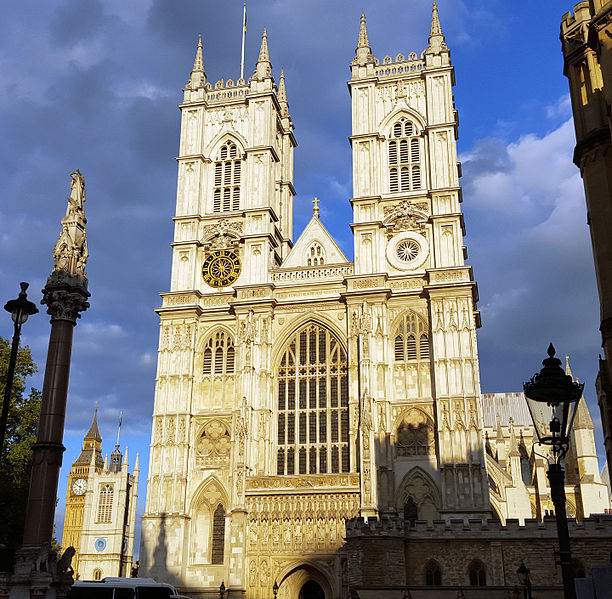
Westminster Abbey,
Chapter house by Aiwok, 2012
There are few places in the world I am so in love with as Westminster Abbey. I recall my first visit there – ages ago – when you were still allowed to ramble around as you pleased, instead of like now, following a preordained route. But as no London visit of mine is complete without a session in the abbey, I will obediently follow the signs, stopping at my own personal highlights - like the magnificent chapter house.

Now Westminster Abbey is not first and foremost a burial site of the famous – it is a church, built in testimony of deep faith. Two English kings were to spend the equivalent of a major fortune on this their favourite church, but the origins are far older than that. In fact, we probably have the Romans to thank for the original settlement on what was then known as Thorn Ey (Island of the brambles), a small patch of solid land in the marsh that abutted the northern shore of the Thames. You see, the Romans had a logistical problem: somehow they wanted to join up Watling Street with Dover Street, and the self-evident intersection was round Thorn Ey, where the Thames was fordable at low tide.

Anyway, time came and went, the tidal waters of the Thames lapped at the shores of little Thorney Island. To the west, the Roman settlement of Londinium had evolved into Lundenvic, and Thorney Island was ideal as a further outpost of civilisation, having natural springs for drinking water and being bordered by two streams (one of which was the now subterranean Tyburn) on which to transport whatever materials might be needed to build a house, a palace, a church – well, whatever. Obviously, the then inhabitants of Lundenvic found Thorney Island too suburban, too remote, how else to account for the fact that at the time of the Norman Conquest, there were only 25 houses on the Island. Or maybe they didn’t like the marshy surroundings…

As to the abbey, its roots are lost in antiquity. As per one legend, the Romans built a temple to Apollo on the present day site of the abbey. Out went the Romans, in came the barbarous Saxons, and the temple was razed to the ground, a forgotten ruin, no more, until King Sebert of Essex (a gentleman who lived in the 7th century) saw the light and decided to build a church on top of the Roman ruins to celebrate his conversion to Christianity.
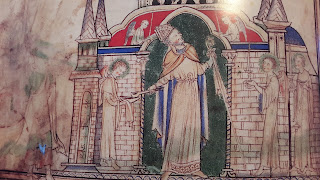
St Peter visiting the church, from La Estoire de Seint Aedward le Roi
On the eve of its dedication, or so the story goes, an anonymous traveller asked a fisherman to carry him across to the finished church. The fisherman – Edric to his friends – agreed, but chose to remain in his boat when his passenger stepped ashore. When the stranger entered the church, heavenly light poured down from above, the sky rang with the sounds of angels singing, and poor Edric was terrified. Understandably, one would think. The stranger returned to the boat, asked Edric for something to eat, but our fisherman had been so stunned by the spectacle he’d just witnessed that he’d forgotten to cast his net. “Do so now,” the stranger urged, and Edric did, bringing aboard the largest catch in his life. The traveller smiled, told him to share the fish with the bishop and revealed himself as St Peter before, I presume, stepping back into invisibility as gracefully as he’d stepped out of it.
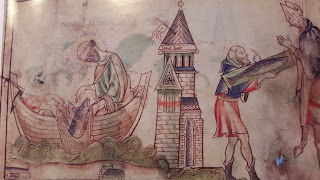
Edric and his fish, La Estoire de Seint Aedward le Roi
Sadly, historical proof to support the above is lacking. In fact, a lot of the documents pointing to an early church on Thorney Island are 11th century forgeries produced by skilled Westminster monks eager to prove their abbey was the earliest of all Christian abbeys in England. There was a major fight ongoing between Glastonbury and Westminster, both religious houses claiming to be the oldest and therefore most important site. Of course, once Glastonbury produced the story of Joseph of Arimathea, come to England with the Holy Grail and a staff that was to take root and become the Glastonbury thorn, they sort of won that particular dog-fight…

Back to Westminster: It is believed there was a small religious community already by the 8th century, but Danish raids probably destroyed what there was. After years of unrest, the 10th century saw the re-emergence of a strong Saxon – and Christian – kingdom. Under King Edgar, religion flourished, and a certain Dunstan – bishop of Worcester and London, soon to be Archbishop and a saint – founded Westminster with monks from the Benedictine community he’d started in Glastonbury. (And in view of the previous paragraph, this would indicate Glastonbury was first, wouldn’t it? Except that the monks some centuries down the line were rather bickering about the FIRST religious settlements on their sites, the ones before dear Dunstan.)

The 11th century ushered in a Danish dynasty and so Knut (Canute), son of Sven Tveskägg (Svein Forkbeard) became king of all of England in 1016. He rather liked Westminster, despite having issues with the temperamental tides of the Thames, so he decided to build a royal palace next door to the monastery. In doing so, Knut indirectly forged the first of several links that would forever tie the future abbey to the English royals. By then, Westminster had grown into one of the more important monasteries in England. Several years of royal patronage had resulted in a wealthy monastery, and  an impressive collection of relics – among which figured parts of the True Cross – ensured a steady stream of eager pilgrims.

The Danish dynasty was to be one of the more short-lived in England. Knut died in 1035, his son Harold Harefoot became king by default as Knut’s named heir – Harold’s half-brother – Hårdeknut (Harthacnut) was stuck in Denmark due to political reasons. Eventually, Harold died of a sudden illness – some people saw this as divine justice, punishment for usurping his brother’s throne. Hårdeknut obviously agreed, as one of his first acts once he arrived in England was to exhume his half-brother’s recently buried body, decapitate it, and throw it in the Thames. Two years later, Hårdeknut was dead, and in 1043 the throne passed to Edward, known to posteriority as Edward the Confessor.
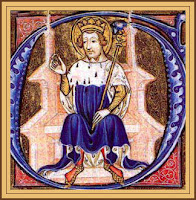
Edward as per the Litlyngton Missal
Edward was the son of Ethelred, the Saxon king deposed by Sven Tveskägg and his son. He’d grown up mostly in Normandy, and must often have despaired of ever becoming king. Tradition has it that Edward had promised to make a pilgrimage to St Peter’s grave in Rome should he regain his kingdom – and that when he was finally crowned, he found himself unable to fulfil that vow as his absence could result in him losing his crown. A compromise was found: instead of taking a very, very long walk to Rome, Edward was absolved from his vow if he instead were to build – or enlarge and restore – a monastery dedicated to St Peter. Somewhat coincidental, all this, seeing as just opposite the royal palace in Westminster was a monastery dedicated to…ta-daa…St Peter.

Other sources, such as the Vita Aedwardi, site somewhat more prosaic reasons for rebuilding the existing church at Westminster: the king wanted a grand burial place. Whatever the case, Edward immediately initiated his building project. By 1045, the work could begin in earnest, and Edward had every intention of building a permanent landmark, something that would inspire awe long after he was dead and gone. I think it is safe to say he succeeded.

The church Edward built was huge by those days’ standards. It was also built to an innovative design, the first cruciform church in England, further adorned by a huge lantern tower and turrets. It was, by all accounts, magnificent, and people gawked and exclaimed as stone by stone, the building rose towards the heavens, testament to Edward’s faith and unswerving determination to build one of the finest churches in Christendom.
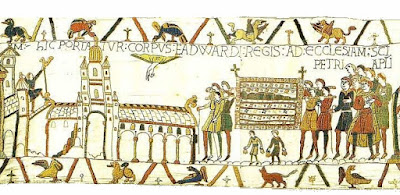
Westminster Abbey - on the Bayeux tapestry
Twenty years after the building work started, the church was sufficiently finished to be consecrated. It was 1065, and while successful in his church-building endeavours, Edward had failed dismally at another royal obligation: that of producing an heir. Maybe his piety made it difficult for him to indulge in carnal relations with his wife. Or maybe the fact that Queen Edith was Godwin of Wessex’s daughter had Edward approaching her with caution – his and Godwin’s relationship was stormy at best. Whatever the case, there was no son, no daughter, and Edward was sixty – a considerable age for the times.

It was decided that the new church was to be consecrated on St Stephen’s Day in 1065. Accordingly, Edward celebrated Christmas in the nearby Westminster Palace. On Christmas Eve, Edward became ill. He managed to keep his condition secret for some days, but by the 27th he took to his bed, incapable of attending the impressive hallowing of his precious church. Two archbishops, a number of bishops and abbots went through with the consecration, at which a new list of relics were drawn up. The king himself had contributed with the Virgin Mary’s milk (and let’s not start thinking about how he got hold of that), hairs from St Peter’s beard and a broken jaw with three teeth that supposedly belonged to St Anastasia.

Neither the consecration nor the relics helped. Edward sank closer and closer to death, nominated his brother-in-law Harold as his successor, ordered that he be buried in his new church “in a place that will be shown to you”, and died on January 4th, 1066. That most momentous year in English history had, one could say, opened inauspiciously.

The day after his death, Edward was buried in front of the high altar of his new church, right under the lantern tower. That same day, Harold was crowned.
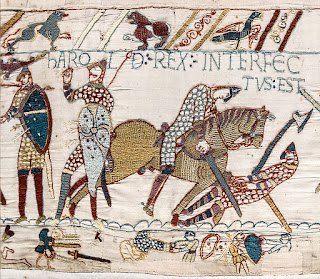
Death of Harold
Harold was destined to be a brave, tragic and unlucky king. Portents in the sky, the rumours that he’d made a binding promise to support Duke William of Normandy’s claim to the English throne, plus the treachery of baby brother Tostig, made his a very shaky throne indeed. And while he managed to defeat Tostig and his Norse companions, he lost his life in the Battle of Hastings, supposedly shot through the eye by a Norman arrow. Saxon England had cause to weep and tear their clothes. Norman William, however, decided it was time for pageantry – and where better to drive home his victory than in the church built by Edward?
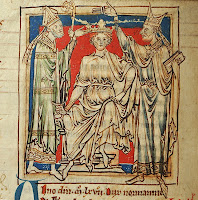
William's coronation, Matthew Paris
On Christmas Day 1066, William was crowned king of England in Westminster Abbey, the coronation chair strategically placed on Edward’s tomb. Inside the church, the Saxon nobles loudly acclaimed the new king – what else could they do, what with the circle of armed men that surrounded the church? Outside the church, those same armed men feared the shouts from within was a sign of treachery, and set about burning as much of the nearby surroundings as they could. A rather odd behaviour, one thinks, as William was inside the church with the potentially rebelling Saxons…

Since that long gone December day, Westminster Abbey has seen the coronation of thirty-nine English monarchs and the burial of sixteen – plus an assortment of wives and children.  And to this day, the heart of this mighty church is the chapel to St Edward the Confessor, built two centuries after Edward’s death by Henry III, the second royal builder of Westminster Abbey.
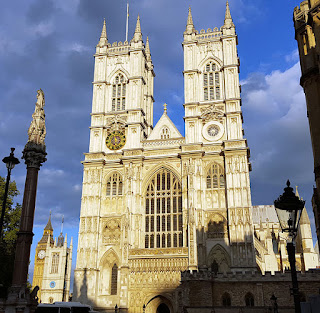
Westminster Abbey, West facade, by Bede 735
Whenever I set foot inside this ancient building. I see them all, from pious Edward through gallant Harold to the determined William. In my head, I see Henry II come striding, power and energy surging round him. There is Richard and John, the rather ineffectual if artistic Henry III, Edward Longshanks and his beloved Eleanor. There is Edward III, surrounded by his wife and many children, to the side stands handsome Richard II, and just beyond the choir I catch a glimpse of Henry Tudor, wretched and bereaved now that his wife is dead. I see them all, in this place that all of them at some point in time visited, prayed in or maybe even despaired in. I see them all, so lost in my own imagination I only notice I’m holding up the traffic when one of the wardens gently moves me aside. From the expression on his face, I am not the only one to be so overcome. In Westminster Abbey, history brushes my cheek. No wonder I always have to go back!

~~~~~~~~~~~~~

Anna Belfrage is the author of the acclaimed  The Graham Saga. Set in 17th century Scotland, Virginia and Maryland, eight books tell the story of Matthew Graham and his wife, Alex Lind - two people who should never have met, not when she was born three centuries after him.

Presently, Anna is hard at work with The King’s Greatest Enemy, a series set in the 1320s featuring Adam de Guirande, his wife Kit, and their adventures and misfortunes in connection with Roger Mortimer’s rise to power. The first instalment, In the Shadow of the Storm, was published on November 1, 2015.

For more information about Anna and her books, please visit her website. If not on her website, Anna can mostly be found on her blog.

Saturday, November 14, 2015

The Role of Ransoms in Medieval Warfare

by Helena P. Schrader


The concept of ransom dates back to classical times, but during the Early Middle Ages they fell into disuse and we hear little about them. By the mid-11th century, however, they were back in fashion, and from the mid-12th century to the end of the 15th they were a dominant feature of warfare.  Although they have since disappeared from Western warfare, the criminal custom of capturing people for ransom still persists in some parts of the world such as Latin America and Nigeria. In England, the age of ransoms was the High Middle Ages, when ransoms constituted a fundamental component of warfare. Without them, the very course of English history would have been different — not just because kings like Richard I of England and John “the Good” of France might have been killed rather than held for ransom, but because the custom of allowing a captive to buy his freedom altered many aspects of warfare itself.

It is worth noting, however, that the tradition of ransom was strongest in France. It spread with French influence to England and the Holy Land, but was not so well established in the Holy Roman Empire or Iberia. Interestingly, the Saracens either had an independent tradition of ransom (and if someone knows about this please leave a comment!) or rapidly adopted the “Frankish” custom because it was so highly lucrative. The Arabs were, after all, very good businessmen and traders, and ransoms were first and foremost a financial transaction.

In the French/English tradition, ransoms were a means of enriching oneself, and the rules of tournaments reflected this by dictating that a captured knight had to surrender his horse and armor to his captor. It was the lure of loot as much as the hope for fame and honor that produced the “tournament circuits” of the 12th to 14th centuries, where knights travelled from tournament to tournament like modern-day professional athletes. But the fortunes made on the tournament fields were a pale imitation of what “real” ransoms could bring.


A man taken in battle by his enemy was completely at the mercy of the victor, and the stakes were impossibly high; the victor was within his right to slaughter his opponent. The custom of ransom dramatically decreased casualties, because the prospect of financial gain greatly increased the proclivity of victorious fighting men to show mercy toward those who surrendered to them. This had the unfortunate side-effect, of course, of making the lives of wealthy men more valuable than the lives of the poor. As a result, throughout the High Middle Ages there was a tendency for those of a class deemed good for ransom to escape death, while their less fortunate followers paid the price of defeat with their lives.

But ransoms were not fixed and so not immutably tied to rank and title. They were always negotiable, and a rich merchant’s son — assuming he had enough time to describe the size of his father’s purse to his erstwhile murderer — stood as good if not a better chance of being granted the privilege of ransom than a poor knight. Ransoms were always based on what a man (or his family) could pay quite simply because there was no point in setting a price that one could not hope to collect — unless the real intent was to ensure the captive could never again raise arms against you.

Had Philip II of France, for example, held Richard the Lionheart captive instead of the Holy Roman Emperor, it is probable that he would have set demands intended to keep Richard in a dungeon for the rest of his life.  Likewise, the ransom set for John “the Good” of France after he was captured at the Battle of Poitiers was dictated far more by the political advantage of denying the French a rival king to Edward III than by thoughts of monetary gain. Except where kings and important nobles were at stake, however, ransoms were generally dictated by a captive’s ability to pay.


By which, of course, I do not mean the captive himself, for he was just that — held captive. Ransoms were usually raised by a captive’s relatives — parents, wives, siblings, children. If they couldn’t (or wouldn’t) scrape together the funds needed, then the appeal would go to cousins and in-laws, anyone who might have money and care enough for the captive to contribute to the cause. Lucky men, who enjoyed the respect of those more powerful and wealthy than themselves, might also be ransomed by their feudal overlord. Examples of this were the payment of Aimery de Lusignan’s ransom by King Amalric, or William Marshal’s ransom by Queen Eleanor. In the case of captive kings and barons, of course, they did not have to rely on the generosity of those that loved or respected them. They could demand contributions from their subjects, vassals and tenants.

Usually a man was held in captivity until the ransom was paid, and conditions varied. Some men enjoyed comfortable “house arrest,” able to interact with the household and even family of the man to whom they had surrendered. Others were kept locked in a single room, even a dungeon. In the worse cases, prisoners were kept chained the walls of their prison until the ransom was paid.  On rare occasions, a man (of high rank generally) might be freed on parole in order to enable him to better collect the sum owed. Famous cases of this were Baldwin of Ramla, who was released by Saladin after payment of only a small portion of the enormous ransom set, and Bertrand du Guesclin, who the Black Prince paroled so he could raise his ransom. The former talked the Byzantine Emperor into paying the outstanding portion of his ransom, and the latter raised his ransom from the King of France, Louis d’Anjou and Henry of Trastamare.

While the payment of a ransom could financially ruin a man and his family, ransoms could make the fortune of those fortunate enough to take a valuable prize.  The English and Gascons almost tore the French king apart at the Battle of Poitiers in their eagerness to lay claim to his ransom. Desmond Seward describes a situation like this in his history of the Hundred Years War ( The Hundred Years War: The English in France, 1337-1445, Macmillan, New York, 1978):
[King John] was recognized and surrounded by a great crowd of soldiers anxious to take so fabulous a ransom. Although he surrendered to a knight of Artois, he was still in peril, for the brawling mob of Gascons and English began to fight for him. Finally he was rescued by the Earl of Warwick and Lord Cobham, who took him to the Prince [of Wales].

Few men had a share of a king’s ransom, but as long as a man was on the winning side, it was possible to accumulate a small fortune from the ransoms of lesser men. Ransoms more than plunder was what made the Hundred Years War so lucrative for England — and impoverished France. The latter was in part due to the fact that because a ransom was a reflection of a man’s ability to pay, it was also indirectly a reflection of his “worth.” The English soon learned that it was to their advantage to let French captives name their own ransoms because pride often induced the prisoners to name ransoms suited more to their self-image than the size of their pocketbook.  Even the Black Prince used this tactic when setting the ransom for Guesclin; the latter named the huge sum of 100,000 francs, something he could not possibly have raised from his own resources, hence the resort to the King of France et. al.

Yet common as ransoms were throughout the High Middle Ages, they remained a privilege not a right. The Knights Templar, for example, explicitly prohibited their members from paying ransoms. A Knight Templar was expected to die for Christ and find salvation for his soul in that act of martyrdom. This may have contributed to the Saracen tendency to slaughter captured Templars and Hospitallers; they had no monetary value and so eliminating them sooner rather than latter made sense.

Normally, however, it was the circumstances in which the victor found himself, not the ideology of the captive, that determined whether a ransom would be accepted or not. In the heat of battle, many soldiers became overcome by “blood lust” that utterly obliterated their greed for gold. Or, when the battle was not one between mercenaries but between true adversaries, fighting men might simply hate their opponents too much to be willing to grant mercy. There were also times when commanders made a strategic decision to kill prisoners. A famous case in point here was Henry V’s order to kill the French prisoners taken at Agincourt, which was largely dictated by his sense of vulnerability. Underestimating the demoralizing effect of his initial successes, he felt he needed every Englishman on the frontline, ready to repel the next attack by the still numerically superior French and was unwilling to spare men to guard the prisoners.


Even more significant, however, is that by the Wars of the Roses commanders were beginning to prefer annihilation of the enemy’s ability to fight over the profit gained from ransoms. It is a clear indicator of the increasing hatred between the rival factions for the English throne that Edward IV allegedly told his soldiers to “kill the lords and spare the commons.” Edward IV recognized that the commons might not pay monetary ransoms, but they were his subjects and he gained nothing from killing them. The rebellious lords, on the other hand, were the threat to his throne.

 In the subsequent century, as warfare became increasingly tied to religion and kings became increasingly despotic, the notion that an opponent might be allowed to live in exchange for a payment of money became discredited. Ransoms became anachronistic and eventually disappeared from the customs of Western warfare altogether.

~~~~~~~~~~~~~

Helena P. Schrader is the author of three books set in the crusader kingdoms. St. Louis’ Knight is set in the Latin Kingdom of Cyprus in the mid-13th century and Knight of Jerusalem and Defender of Jerusalem are the first two books in a three biographical novel of Balian d’Ibelin, who defended Jerusalem against Saladin in 1187 and later played an important role during the Third Crusade. St. Louis Knight was winner of the 2014 Chaucer Award for Historical Fiction set in the High Middle Ages.

Amazon