By Annie Whitehead
There is a beautiful song, written by Steve McDonald and performed by him and Hollie Smith. It’s called Fallen Flowers and it features the most sublime cello playing. It is not an easy song to listen to, especially if you are, like me, a mother. It talks about a young man who lies dying after the Battle of Halidon Hill and what his mother wouldn't give just to have him back again. The images it invokes are haunting. So, when I found myself near Berwick-upon-Tweed recently, I visited the battlefield, and set out to find out what I could about the battle.
The site itself is bleak, even on a sunny day. And yes, it is definitely a hill, rising some 600 ft above sea level. The battle took place in July, 1333, during the second war of Scottish independence, when the forces of Edward III of England fought the Scots, although this wasn’t a straightforward case of England V Scotland, for Edward had ridden north to support the claim of one Scots king against another.
Edward III, having overthrown Roger Mortimer, was free to turn his attention to Scotland where, just four years earlier, Robert Bruce had died, leaving as his heir his seven-year-old son, David II. The Bruces were not the only ones who laid claim to the Scottish throne, and Edward III supported the rival claim of Edward Balliol. Balliol was crowned, but deposed very soon afterwards, fleeing to Carlisle from where he sent an SOS to the English king.
The Scottish chronicler Walter Bower was vehement in his condemnation of ‘Edward de Windsor king of England’, whom he described as a ‘breaker of oaths and violator of his own pledge’ who ‘disregarded the promise of eternal peace … and promised speedy help, [breaking] ‘the bonds of peace [and assembling] a very large army against his brother-in-law King David.’ (At the tender age of four, David had been married to Joan, daughter of Edward II.)
Edward III responded to Balliol’s call for help by marching his forces to Berwick where he besieged the town. The Scots, led by Sir Archibald Douglas, meanwhile, marched down and occupied Tweedmouth. The townsfolk of Berwick, represented by Governor Anthony Seton, promised to surrender if the town had not been relieved by 11 July. When the Scots managed to destroy a bridge over the River Tweed, Sir William Keith took a small contingent into the town and rescinded the promise of surrender. Unfortunately, Edward III had taken hostages, and he began to hang them, starting with Seton’s own son, Thomas, hung from a gallows in full view of the town. He vowed to hang two more for every day the town continued to defy him. A new surrender agreement was reached.
Douglas, who in the meantime had gone to raid Bamburgh, where Edward's queen, Phillipa was ensconced, waited until the eleventh hour before surrender was due. It was a bad decision. Approaching from the northwest, he had to position his troops high above Berwick at a place beyond Halidon Hill, known as Witches’ Knowe. He then faced the task of leading his troops downhill while Edward, holding Halidon Hill, controlled the surrounding area. Had the Scots made any attempt to enter Berwick, Edward would have seen. The view from the hill towards the Tweed is a clear one, as this picture, taken on a hazy day, still shows.
The English army stood between the Scots and Berwick, and the Scots had to cross a marsh to get to them.
Boggy terrain and English archers made for a deadly combination. It was said that the Scots turned their faces away for the storm of arrows was like sleet.
Douglas was killed, the fleeing Scots were pursued by the English on horseback, and the following day, Berwick surrendered.
If contemporary accounts can be believed, the Scottish losses included ten earls, sixty-nine barons, 105 ‘knights-batchelors', 4,250 men-at-arms, 63,200 ordinary folk, and 5,000 residents of Berwick and the surrounding area.
The losses were certainly catastrophic, not just in terms of numbers but because those who could mount an effective challenge to the might of the English army were now either dead, or in hiding. Edward III, victorious, reimposed Balliol as king.
In October, Edward Balliol held a parliament in Perth. At this parliament, he reversed many of the land grants made by Robert Bruce. Edward III left him alone but Balliol’s position as puppet king was not a free one. He had to pay homage to the English king and grant him all the English-occupied southern shires of Scotland. Edward’s attention soon turned towards France and Balliol, whose decision to reverse the grants of Robert Bruce had been unpopular to say the least, was left increasingly isolated.
The young David Bruce grew to adulthood in exile in Normandy, living at Chateau Gaillard with his wife, Joan, and returning to Scotland in 1341. He did not find it easy to re-establish himself. He gained strength, though, and in 1346 he advanced his troops towards Durham. His army was caught out at Neville’s Cross where Balliol fought for the English. David was wounded and captured. The complicated political situation was to rumble on and on - enough to be the subject of at least one other, completely separate article!
A visit to Berwick shows that the town is still partly encased by sturdy defensive walls. These are not the medieval walls, however, which originally spanned a greater area of the town. These walls, when built, actually cut the town in half and were built in the sixteenth century. Peace between the two countries it seems, was never assured.
Halidon Hill was only one of a vast number of battles between Scots and English. What of those losses? Some estimate the number of Scots lining up against the English at 14,000, with the English fielding some 10,000. Other sources put the numbers of casualties anywhere between 20,000 to 40,000, while yet different figures suggest that somewhere between 18,000 and 25,000 Scots took part in the battle.
It is difficult, even when standing on top of the hill, to envisage anything like this number of men fighting for their very lives at this spot. I’d venture to say that Halidon Hill isn’t one of the better-known battle sites. Yet, in visiting such sites, it is also hard to forget that, in amongst however many men who were truly fighting that day, each man who died was mourned by someone. The song I mentioned at the beginning of this post helps to bring home the tragedy of any conflict and I’m glad to say that at least part of this site remains free from crops and it is marked with a memorial stone.
[all photos by and copyright of Annie Whitehead]
~~~~~~~~~~
Annie Whitehead is an author and historian, and a member of the Royal Historical Society. She has written three award-winning novels set in Anglo-Saxon Mercia. Her history of Mercia, from Penda the pagan king to the last brave stand of the earl of Mercia against the Conqueror, Mercia: The Rise and Fall of a Kingdom, is published by Amberley.
Find her at: www.anniewhiteheadauthor.co.uk/
on Amazon
Facebook
and Twitter
and on her own blog, Casting Light upon the Shadow
Showing posts with label Edward III. Show all posts
Friday, May 10, 2019
Fallen Flowers: The Battle of Halidon Hill
Labels:
Archibald Douglas,
Berwick-upon-Tweed,
David II,
Edward Balliol,
Edward III,
Halidon Hill,
Second Scottish War of Independence,
Walter Bower
Friday, July 27, 2018
A splendid 14th century wedding
by Anna Belfrage
History is littered with people whose lives are forgotten. Most of the people who have lived and died in the past have done so in obscurity and this also applies to the high-born. We know they were born, we may now when they died, but unless they were in line to become king or queen or did something out of the ordinary, younger sons and daughters are rarely remembered.
This is not entirely true for today’s protagonist. Lionel of Antwerp has left something of a mark on history. Not only did he leave a surviving child, he is also remembered because of his extraordinary height—and for the extravagant wedding festivities at his second wedding.
Lionel was the third son born to Edward III of England and his queen, Philippa. Theirs was a happy—and fruitful—union, resulting in an surfeit of sons. Not necessarily a problem while Edward III was alive, nor would it have been a problem had Edward’s eldest son and namesake lived longer than he did. But, as we all know, Edward III was succeeded by a child, his grandson Richard II. Some years later, the descendants of Edward’s various sons were locked in a bloody battle for the crown, a conflict that would dominate the political climate for close to a century.
All of this was in the future when baby Lionel uttered his first bawls in November of 1338. I think that a man who was close to seven feet as an adult was probably a very big baby, so I imagine poor Philippa was somewhat affected by the birth as such. Affected, but proud—and likely delighted at how healthy and lusty her new son was. After all, her previous son, born a year or so before Lionel, had died in infancy.
In 1342, four-year-old Lionel was married to the ten-year-old Elizabeth de Burgh, Countess of Ulster. A perfect bride for the king’s son, a rich heiress. Through his wife, Lionel became the Earl of Ulster. Elizabeth had inherited her lands as a baby when her father died and had been raised at the court of her future father-in-law, so she was probably well-integrated into the royal family.
Ireland was to play an important part in Lionel’s life. He spent much time there, sent over by his father to bring order to this somewhat wild and savage place. By all accounts, Lionel wasn’t quite up to the task, but for his efforts Edward III made him the Duke of Clarence.
In 1355, Elizabeth gave birth to a daughter, Philippa. In the fullness of time, Philippa was destined to marry Edmund Mortimer, third Earl of March. Their granddaughter would marry Richard of Conisburgh, son to yet another of Edward III’s sons, and give birth to Richard Plantagenet, Duke of York, principal contender for the crown of England.
Lionel probably wanted a son—men did, back then, especially men with titles and lands. There was no further issue with Elizabeth and in 1363 she died. Was Lionel devastated? No idea. But he was young and life had to go on. Plus, an unmarried prince was an asset to be deployed as it best suited the king.
In this case, Edward III needed money. Waging constant war was an expensive business so when Gian Galeazzo II Visconti of Milan approached him, suggesting an alliance, Edward was happy to listen. Galeazzo was very, very rich. He also had a young daughter, Violante, who came generously dowered. Galeazzo wanted his children to marry into the European royal houses. His son he had married to a French princess, so marrying Violante to an English prince could be seen as Galeazzo hedging his bets, indirectly bankrolling both the French and English war effort. (At the time, though, England and France were happily at peace—for now)
Gian Galeazzo Visconti is one of those very complicated men who combine an extremely ruthless—cruel, even—side, with a passion for art and culture. The Visconti men were usually referred to as the Vipers of Milan, not only because their armorial device included a serpent eating a Saracen but because the family had a reputation for bizarre and sadistic behaviour. In comparison to his brother, Bernabo, Gian Galeazzo comes across as a mild lamb, but that says more about Bernabo, who seems to have been a horrible and borderline insane despot, than it does about Galeazzo. In his case, on the one side he introduced the Quaresima, a so called torture protocol, whereby a man condemned to die was publicly tortured for forty days before finally being allowed to expire. On the other, he founded the University in Pavia.
Galeazzo’s character was not particularly relevant to Edward. His money was. Which is why Lionel was betrothed to little Violante early in 1368. In return, a dowry amounting to a staggering two million gold florins would be paid to the groom (and his father). Lionel was pushing thirty. Violante was thirteen. I dare say Galeazzo hoped for many, many grandchildren from this union.
Lionel’s journey down to Italy was one luxurious cavalcade. With a retinue of close to 500 people and 1200 horses, he set off from England, beginning with an April visit to Paris where he was feted not only by the French king, Charles V, but also by said king’s brothers’ the dukes of Anjou, Berry and Burgundy, more than eager to showcase their wealth and splendour before the English prince. They were of an age, these young aristocrats, so the nights were long and the days were mostly spent recuperating—or shopping. Here our Lionel had the best guide available in his bride-to-be’s uncle, Amadeus of Savoy, who was also in attendance. Amadeus was a fashionista and spent ridiculous amounts on jewels, feathers, cloth of gold, capes lined with fur and other of life’s essentials.
Eventually, Lionel arrived in Milan, there to greet his pretty bride and her somewhat overbearing father. It was June, and as Lionel’s party approached the Visconti capital – now further swelled with close to 1,500 fighting men from the White Company, captained by John Hawkwood. Galeazzo sent out 60 maids to meet him. Each damsel was dressed in scarlet and gold and accompanied by an equally well-dressed knight.
The wedding feast was so magnificent we still have records of what was served. Thirty double courses of meat and fish alternated with lavish gift-giving. During the long outdoor meal, falcons, horses, hounds, jewels, silks, velvet capes, spurs, were given away to various members of Lionel’s entourage. All the dishes served were gilded, using a paste of egg and saffron and gold leaf. Suckling pigs landed on the table together with crabs, hares with pikes, peacocks with cabbage, French beans with pickled tongue. There were roasted calves, venison, capons and beef. Ducks and herons, trout quail, lamb—an endless list. Reputedly, the leftovers were sufficient to feed 10,000 people.
Once the feasting was over, Lionel and Violante retired. After a further few days in Milan, they travelled onwards to Violante’s—oops, Lionel’s—Italian lands. We know nothing about the Violante-Lionel union, beyond the fact that it was destined to be short. Only five months after the wedding, Lionel died of an unknown bowel affliction. Yes, there were mutters of poison, discreet finger-pointing in the direction of the Visconti. Given the amount of money Galeazzo spent on the wedding, I find it unbelievable.
A year or so after Lionel set off for Italy, his remains returned to England, there to be buried at Clare Priory in Suffolk in accordance with his will. Beside him lay his first wife, Elizabeth. His second wife, Violante, was not destined for much happiness. Her second husband was a known sadist who was assassinated at the behest of her own brother, a fate which he shared with her third husband. Thrice widowed, Violante died at the age of 31, leaving a little boy behind. By then, I suspect she barely remembered her first husband – well, except for his size. A dashing golden giant, was Lionel of Antwerp. Difficult to fully forget, once you’d seen him, but rather unforgettable in all other aspects.
All pictures in public domain and/or licensed under Wikimedia Creative Commons
~~~~~~~~~~~
Had Anna Belfrage been allowed to choose, she’d have become a professional time-traveller. As such a profession does not exist, she became a financial professional with two absorbing interests, namely history and writing.
Anna's most recent series is The King’s Greatest Enemy, a series set in the 1320s featuring Adam de Guirande, his wife Kit, and their adventures and misfortunes in connection with Roger Mortimer’s rise to power. And yes, Edmund of Woodstock appears quite frequently. The first book, In The Shadow of the Storm was published in 2015, the second, Days of Sun and Glory, was published in July 2016, and the third, Under the Approaching Dark, was published in April 2017. The fourth instalment, The Cold Light of Dawn, was published in February 2018.
When Anna is not stuck in the 14th century, she's probably visiting in the 17th century, specifically with Alex(andra) and Matthew Graham, the protagonists of the acclaimed The Graham Saga. This is the story of two people who should never have met – not when she was born three centuries after him. The ninth book, There is Always a Tomorrow, was published in November 2017.
History is littered with people whose lives are forgotten. Most of the people who have lived and died in the past have done so in obscurity and this also applies to the high-born. We know they were born, we may now when they died, but unless they were in line to become king or queen or did something out of the ordinary, younger sons and daughters are rarely remembered.
This is not entirely true for today’s protagonist. Lionel of Antwerp has left something of a mark on history. Not only did he leave a surviving child, he is also remembered because of his extraordinary height—and for the extravagant wedding festivities at his second wedding.
![]() |
| Lionel, as depicted on his father's tomb |
All of this was in the future when baby Lionel uttered his first bawls in November of 1338. I think that a man who was close to seven feet as an adult was probably a very big baby, so I imagine poor Philippa was somewhat affected by the birth as such. Affected, but proud—and likely delighted at how healthy and lusty her new son was. After all, her previous son, born a year or so before Lionel, had died in infancy.
In 1342, four-year-old Lionel was married to the ten-year-old Elizabeth de Burgh, Countess of Ulster. A perfect bride for the king’s son, a rich heiress. Through his wife, Lionel became the Earl of Ulster. Elizabeth had inherited her lands as a baby when her father died and had been raised at the court of her future father-in-law, so she was probably well-integrated into the royal family.
Ireland was to play an important part in Lionel’s life. He spent much time there, sent over by his father to bring order to this somewhat wild and savage place. By all accounts, Lionel wasn’t quite up to the task, but for his efforts Edward III made him the Duke of Clarence.
In 1355, Elizabeth gave birth to a daughter, Philippa. In the fullness of time, Philippa was destined to marry Edmund Mortimer, third Earl of March. Their granddaughter would marry Richard of Conisburgh, son to yet another of Edward III’s sons, and give birth to Richard Plantagenet, Duke of York, principal contender for the crown of England.
Lionel probably wanted a son—men did, back then, especially men with titles and lands. There was no further issue with Elizabeth and in 1363 she died. Was Lionel devastated? No idea. But he was young and life had to go on. Plus, an unmarried prince was an asset to be deployed as it best suited the king.
![]() |
| Gian Galeazzo II |
Gian Galeazzo Visconti is one of those very complicated men who combine an extremely ruthless—cruel, even—side, with a passion for art and culture. The Visconti men were usually referred to as the Vipers of Milan, not only because their armorial device included a serpent eating a Saracen but because the family had a reputation for bizarre and sadistic behaviour. In comparison to his brother, Bernabo, Gian Galeazzo comes across as a mild lamb, but that says more about Bernabo, who seems to have been a horrible and borderline insane despot, than it does about Galeazzo. In his case, on the one side he introduced the Quaresima, a so called torture protocol, whereby a man condemned to die was publicly tortured for forty days before finally being allowed to expire. On the other, he founded the University in Pavia.
Galeazzo’s character was not particularly relevant to Edward. His money was. Which is why Lionel was betrothed to little Violante early in 1368. In return, a dowry amounting to a staggering two million gold florins would be paid to the groom (and his father). Lionel was pushing thirty. Violante was thirteen. I dare say Galeazzo hoped for many, many grandchildren from this union.
![]() |
| Paris, Jean Fouquet |
Eventually, Lionel arrived in Milan, there to greet his pretty bride and her somewhat overbearing father. It was June, and as Lionel’s party approached the Visconti capital – now further swelled with close to 1,500 fighting men from the White Company, captained by John Hawkwood. Galeazzo sent out 60 maids to meet him. Each damsel was dressed in scarlet and gold and accompanied by an equally well-dressed knight.
![]() |
| Yet another extravagant feast, Tres Riches Heures du Duc de Berry |
Once the feasting was over, Lionel and Violante retired. After a further few days in Milan, they travelled onwards to Violante’s—oops, Lionel’s—Italian lands. We know nothing about the Violante-Lionel union, beyond the fact that it was destined to be short. Only five months after the wedding, Lionel died of an unknown bowel affliction. Yes, there were mutters of poison, discreet finger-pointing in the direction of the Visconti. Given the amount of money Galeazzo spent on the wedding, I find it unbelievable.
![]() |
| Violante and her brother |
All pictures in public domain and/or licensed under Wikimedia Creative Commons
~~~~~~~~~~~
Had Anna Belfrage been allowed to choose, she’d have become a professional time-traveller. As such a profession does not exist, she became a financial professional with two absorbing interests, namely history and writing.
Anna's most recent series is The King’s Greatest Enemy, a series set in the 1320s featuring Adam de Guirande, his wife Kit, and their adventures and misfortunes in connection with Roger Mortimer’s rise to power. And yes, Edmund of Woodstock appears quite frequently. The first book, In The Shadow of the Storm was published in 2015, the second, Days of Sun and Glory, was published in July 2016, and the third, Under the Approaching Dark, was published in April 2017. The fourth instalment, The Cold Light of Dawn, was published in February 2018.
When Anna is not stuck in the 14th century, she's probably visiting in the 17th century, specifically with Alex(andra) and Matthew Graham, the protagonists of the acclaimed The Graham Saga. This is the story of two people who should never have met – not when she was born three centuries after him. The ninth book, There is Always a Tomorrow, was published in November 2017.
Friday, October 27, 2017
The debacle in Weardale - or how a young king learnt a valuable lesson
by Anna Belfrage
In 1327, a very young Edward III rode out of York at the head of an army. His purpose was to find and destroy the Scots who were presently raiding northern England, leaving destruction in their wake. Edward was not having it, all of him quivering in anticipation at the thought of teaching these dratted Scots a lesson. After all, Bannockburn was still an open sore for the English, and our gallant young king wanted nothing so much as to show the Scots he too could hammer them. Just like his grandfather had done.
Not everyone was as enthused as Edward. Notably the king’s mother and her constant companion and co-regent, Roger Mortimer, had no desire to provoke a full out war with Scotland. First of all, they were already in some sort of negotiation with Robert Bruce—they had been since 1326 when they promised Bruce a permanent treaty if he did not take advantage of the turbulent situation caused by their invasion of England and subsequent imprisonment and deposition of Edward II. Secondly, England was as yet not fully pacified. Yes, by the summer of 1327 Mortimer had control of most of the kingdom, but there were several very strong barons who were severely disenchanted by the fact that England was now ruled by Isabella and Mortimer. Men like Henry of Lancaster, Edmund of Woodstock (earl of Kent) and several others felt they too should have a say in how the realm was governed during the king’s minority.
The reason Robert Bruce had agreed to hold off while Mortimer and Isabella did their invading thing was because he wanted a permanent peace. His country needed peace, and a treaty would not only give Scotland that but also confirm Robert Bruce as king, thereby strengthening the Bruce dynasty. At the time, Robert Bruce was all of fifty-three and fully aware of the fact that he would likely not live much longer. His heir was a boy of three and Robert knew his countrymen well enough to know a boy-king could quickly become a pawn—or even worse, ousted.
Robert watched from afar as Mortimer and Isabella landed in September of 1326, sat on his hands throughout the following months as Isabella and Mortimer took control over the country. Come February of 1327, Edward II had abdicated, Edward III was crowned, and Bruce expected the treaty with Scotland to be the next item on the agenda. It wasn’t. Isabella and Mortimer had a kingdom to heal, an administration to put in order, muttering barons to be put in their place. On the other side of the border, Robert the Bruce grew impatient. When the negotiations were yet again put on hold—or broke down, depending on whose POV you applied—the Scottish king decided to do some serious prodding. He ordered his two captains, James Douglas and Thomas Randolph to invade northern England and create havoc.
Which is why, in July of 1327, Edward III did all that mustering. An impressive English army took the field, led by the Earl Marshal of the realm (Edward’s uncle, the earl of Norfolk), the earl of Kent (Edward’s other uncle) and the earl of Lancaster who was more than happy to ride against the Scots as a lot of the raiding was done on his land plus he suspected the king's campaign against the Scots had seriously twisted Mortimer’s nose out of joint. Whatever Mortimer’s private thoughts on this matter, he too rode with the king. While not given an official command, I think it’s a safe bet to assume Mortimer was very much on top of things—it sort of went with his nature.
Edward was of the firm opinion that Scotland was his kingdom. He had his forces ride under the cross of St George, bright red crosses flapping in the wind as the English army advanced. As an aside, Edward III had a serious thing about St George, whom he considered a far more appropriate saint for his bellicose ambitions than Edward the Confessor. This is why he founded a college dedicated to St George at Windsor (which then took over the chapel previously dedicated to St Edward) and why the red cross is part of the insignia for the Order of Bath. Right: not today’s topic.
James Douglas was as capable as any of the commanders on the English side. This hero of the Scottish people had stood by his king through thick and thin and would continue to do so as long as he had breath in his body. He had only one objective with his raiding: to force the English back to the negotiation table, there to recognise Scottish independence and Robert the Bruce as Scottish king. Made Edward almost choke just to think of doing so. His grandfather had fought long and hard to bring the Scots to bay, and our Edward was not about to give back what he considered his.
So off the English army went, eager to corner the Scots and force them to fight. Douglas was no fool. He'd be outnumbered on the battlefield. Instead, he led his mounted men in a cat-and-mouse game. If Edward and his men rode one way, the Scots would ride the other and set whatever buildings they came across alight. If the English turned towards the destruction, chances were new fires would spring to life behind them. Very frustrating. I imagine Edward took every opportunity offered to call these elusive Scots craven and misbegotten creatures.
The Scots were neither craven or misbegotten. After some weeks of playing the scarlet pimpernel with the English (you know: they seek him here, they seek him there. Is he in heaven or is he in hell, that darned elusive pimpernel?) Douglas found a nice, strong position and set up camp. He also had one of his English captives released, ordering the man to find Edward and tell him the Scots were waiting to do him battle.
“Yes!” Edward exclaimed. “Finally!” His commanders were not quite as delighted. Mortimer especially had far too much respect for Douglas to believe Sir James had set himself up as an easy kill. He hadn’t. Douglas had chosen his position carefully. A hill, defended by the river Wear and steep slopes, with Douglas’ colours—three silver stars on a blue background—flapping lazily in the wind. Mortimer groaned inwardly, even more so when Edward started talking about what strategies to use to pulverise the Scots.
“You can’t fight them up that hill,” Mortimer told his young king.
“Of course, I can. But I’ll start by inviting him to come down and meet us on the flat ground, prove he is as brave as they say.”
“He’s brave, not a complete idiot,” Mortimer probably replied. “What commander worth his salt would give up that position?”
Mortimer was right. Sir James politely declined Edward’s invitation to come down from his hill, and Edward decided it was time to show the Scots just who had the upper hand. He ordered his archers to advance. The English (and Welsh) archers were the best in the world, and as soon as they came within range, they’d fill those dratted Scots with more arrows than a hedgehog has spines. Douglas was fully aware of how deadly the English archers were. He waited until they were wading the river, or making a hesitant approach up the slopes before attacking them. Dead archers everywhere, making it clear Edward had no hand at all—not in this game of war poker.
An exhausted and dispirited English army settled down for the night. Weeks of chasing the Scots, of more or less constant rain, of insufficient food, had left Edward’s men weak and grumpy. Their Scottish foes were made of sterner stuff: no sooner had the summer night begun to darken, but the Scots began an all-night party, blowing horns and clashing swords against shields. Impossible to sleep in, so to all their other woes, Edward’s men could now add sleep-deprivation.
Come morning, a host of pale and shivering Englishmen did their best to look intimidating and warlike, all of them probably hoping there wouldn’t be a battle this day. There wasn’t. James stuck to his hill and come nightfall the Scots repeated last night’s procedure. Blaring horns, steel against steel, and the English tossed and turned, further plagued by the drifting scents of roasted meat.
A couple of nights of this, and then suddenly, just before dawn, the Scots went quiet.
“Finally!” the English exclaimed, sinking into blissful oblivion. When they woke, it was to discover Douglas had snuck away, leading his men to a new, if possible even more impregnable, position.
Edward spent some time cursing the Scottish dogs to hell and back. Didn’t help much. He ordered the English army to follow Douglas and set up a new camp.
For a change, that August day was a nice day. No rain, and once the tents had been set up and the fires lit, the English had yet another pleasant surprise: the Scots were obviously too tired to repeat the hullabaloo of the preceding nights so the summer night was fragrant and wonderfully silent.
The king and his earls had supper with Mortimer. Plans were drawn up for the next day. Some wine, some good food and they took to their beds—as did the rest of the men. Which is when some of them registered the sound of many horses, approaching at a gallop.
Out of nowhere—or so it seemed—came the Scots. Armed with torches and spears, they charged through the English camp. Some wielded swords to cut the guy ropes, thereby causing the tents to collapse. Others set fire to the tents, or skewered the people trapped within on their spears.
Like witless hens, the English ran before the Scots. Some emerged with sword in hand and began to fight back. Others died. Quite a lot of others. The Scots thundered on, making for the tent flying the royal colours. Swish, and the guy lines were cut. Like a cut soufflé, the tent fell together, trapping the young king inside. The Scots were only moments away from abducting him, but Edward’s men rallied and the Scots backed away. A horn blew. Douglas, calling for help. The horn blew again, and the Scots rode to their lord’s defence. Some moments later, they were gone, leaving a trail of carnage behind them.
Next morning, Douglas and his men were gone, riding hard for Scotland. Standing in the shambles of his camp, the young Edward had learnt a valuable lesson: never underestimate your enemy.
A year or so later, a treaty with Scotland was concluded, sealed by the marriage of Edward’s little sister, Joan, to Robert the Bruce’s little son, David. Edward didn’t want the treaty. He wanted Scotland. But other than never to underestimate, he had also learnt another lesson: bide your time. So he did. For a while.
All pictures in public domain and/or licensed under Wikimedia Creative Commons
~~~~~~~~~~~
Had Anna Belfrage been allowed to choose, she’d have become a professional time-traveller. As such a profession does not exist, she became a financial professional with two absorbing interests, namely history and writing.
Presently, Anna is hard at work with The King’s Greatest Enemy, a series set in the 1320s featuring Adam de Guirande, his wife Kit, and their adventures and misfortunes in connection with Roger Mortimer’s rise to power. And yes, Edmund of Woodstock appears quite frequently. The first book, In The Shadow of the Storm was published in 2015, the second, Days of Sun and Glory, was published in July 2016, and the third, Under the Approaching Dark, was published in April 2017.
When Anna is not stuck in the 14th century, she's probably visiting in the 17th century, specifically with Alex(andra) and Matthew Graham, the protagonists of the acclaimed The Graham Saga. This is the story of two people who should never have met – not when she was born three centuries after him. The ninth book, There is Always a Tomorrow, will be released in November.
![]() |
| Bannockburn as depicted in Holkham Bible |
Not everyone was as enthused as Edward. Notably the king’s mother and her constant companion and co-regent, Roger Mortimer, had no desire to provoke a full out war with Scotland. First of all, they were already in some sort of negotiation with Robert Bruce—they had been since 1326 when they promised Bruce a permanent treaty if he did not take advantage of the turbulent situation caused by their invasion of England and subsequent imprisonment and deposition of Edward II. Secondly, England was as yet not fully pacified. Yes, by the summer of 1327 Mortimer had control of most of the kingdom, but there were several very strong barons who were severely disenchanted by the fact that England was now ruled by Isabella and Mortimer. Men like Henry of Lancaster, Edmund of Woodstock (earl of Kent) and several others felt they too should have a say in how the realm was governed during the king’s minority.
![]() |
| Robert Bruce |
![]() |
| Edward III being crowned |
Which is why, in July of 1327, Edward III did all that mustering. An impressive English army took the field, led by the Earl Marshal of the realm (Edward’s uncle, the earl of Norfolk), the earl of Kent (Edward’s other uncle) and the earl of Lancaster who was more than happy to ride against the Scots as a lot of the raiding was done on his land plus he suspected the king's campaign against the Scots had seriously twisted Mortimer’s nose out of joint. Whatever Mortimer’s private thoughts on this matter, he too rode with the king. While not given an official command, I think it’s a safe bet to assume Mortimer was very much on top of things—it sort of went with his nature.
![]() |
James Douglas was as capable as any of the commanders on the English side. This hero of the Scottish people had stood by his king through thick and thin and would continue to do so as long as he had breath in his body. He had only one objective with his raiding: to force the English back to the negotiation table, there to recognise Scottish independence and Robert the Bruce as Scottish king. Made Edward almost choke just to think of doing so. His grandfather had fought long and hard to bring the Scots to bay, and our Edward was not about to give back what he considered his.
So off the English army went, eager to corner the Scots and force them to fight. Douglas was no fool. He'd be outnumbered on the battlefield. Instead, he led his mounted men in a cat-and-mouse game. If Edward and his men rode one way, the Scots would ride the other and set whatever buildings they came across alight. If the English turned towards the destruction, chances were new fires would spring to life behind them. Very frustrating. I imagine Edward took every opportunity offered to call these elusive Scots craven and misbegotten creatures.
The Scots were neither craven or misbegotten. After some weeks of playing the scarlet pimpernel with the English (you know: they seek him here, they seek him there. Is he in heaven or is he in hell, that darned elusive pimpernel?) Douglas found a nice, strong position and set up camp. He also had one of his English captives released, ordering the man to find Edward and tell him the Scots were waiting to do him battle.
| James Douglas among his peers |
“You can’t fight them up that hill,” Mortimer told his young king.
“Of course, I can. But I’ll start by inviting him to come down and meet us on the flat ground, prove he is as brave as they say.”
“He’s brave, not a complete idiot,” Mortimer probably replied. “What commander worth his salt would give up that position?”
Mortimer was right. Sir James politely declined Edward’s invitation to come down from his hill, and Edward decided it was time to show the Scots just who had the upper hand. He ordered his archers to advance. The English (and Welsh) archers were the best in the world, and as soon as they came within range, they’d fill those dratted Scots with more arrows than a hedgehog has spines. Douglas was fully aware of how deadly the English archers were. He waited until they were wading the river, or making a hesitant approach up the slopes before attacking them. Dead archers everywhere, making it clear Edward had no hand at all—not in this game of war poker.
An exhausted and dispirited English army settled down for the night. Weeks of chasing the Scots, of more or less constant rain, of insufficient food, had left Edward’s men weak and grumpy. Their Scottish foes were made of sterner stuff: no sooner had the summer night begun to darken, but the Scots began an all-night party, blowing horns and clashing swords against shields. Impossible to sleep in, so to all their other woes, Edward’s men could now add sleep-deprivation.
Come morning, a host of pale and shivering Englishmen did their best to look intimidating and warlike, all of them probably hoping there wouldn’t be a battle this day. There wasn’t. James stuck to his hill and come nightfall the Scots repeated last night’s procedure. Blaring horns, steel against steel, and the English tossed and turned, further plagued by the drifting scents of roasted meat.
A couple of nights of this, and then suddenly, just before dawn, the Scots went quiet.
“Finally!” the English exclaimed, sinking into blissful oblivion. When they woke, it was to discover Douglas had snuck away, leading his men to a new, if possible even more impregnable, position.
Edward spent some time cursing the Scottish dogs to hell and back. Didn’t help much. He ordered the English army to follow Douglas and set up a new camp.
For a change, that August day was a nice day. No rain, and once the tents had been set up and the fires lit, the English had yet another pleasant surprise: the Scots were obviously too tired to repeat the hullabaloo of the preceding nights so the summer night was fragrant and wonderfully silent.
The king and his earls had supper with Mortimer. Plans were drawn up for the next day. Some wine, some good food and they took to their beds—as did the rest of the men. Which is when some of them registered the sound of many horses, approaching at a gallop.
Out of nowhere—or so it seemed—came the Scots. Armed with torches and spears, they charged through the English camp. Some wielded swords to cut the guy ropes, thereby causing the tents to collapse. Others set fire to the tents, or skewered the people trapped within on their spears.
Like witless hens, the English ran before the Scots. Some emerged with sword in hand and began to fight back. Others died. Quite a lot of others. The Scots thundered on, making for the tent flying the royal colours. Swish, and the guy lines were cut. Like a cut soufflé, the tent fell together, trapping the young king inside. The Scots were only moments away from abducting him, but Edward’s men rallied and the Scots backed away. A horn blew. Douglas, calling for help. The horn blew again, and the Scots rode to their lord’s defence. Some moments later, they were gone, leaving a trail of carnage behind them.
Next morning, Douglas and his men were gone, riding hard for Scotland. Standing in the shambles of his camp, the young Edward had learnt a valuable lesson: never underestimate your enemy.
A year or so later, a treaty with Scotland was concluded, sealed by the marriage of Edward’s little sister, Joan, to Robert the Bruce’s little son, David. Edward didn’t want the treaty. He wanted Scotland. But other than never to underestimate, he had also learnt another lesson: bide your time. So he did. For a while.
All pictures in public domain and/or licensed under Wikimedia Creative Commons
~~~~~~~~~~~
Had Anna Belfrage been allowed to choose, she’d have become a professional time-traveller. As such a profession does not exist, she became a financial professional with two absorbing interests, namely history and writing.
Presently, Anna is hard at work with The King’s Greatest Enemy, a series set in the 1320s featuring Adam de Guirande, his wife Kit, and their adventures and misfortunes in connection with Roger Mortimer’s rise to power. And yes, Edmund of Woodstock appears quite frequently. The first book, In The Shadow of the Storm was published in 2015, the second, Days of Sun and Glory, was published in July 2016, and the third, Under the Approaching Dark, was published in April 2017.
When Anna is not stuck in the 14th century, she's probably visiting in the 17th century, specifically with Alex(andra) and Matthew Graham, the protagonists of the acclaimed The Graham Saga. This is the story of two people who should never have met – not when she was born three centuries after him. The ninth book, There is Always a Tomorrow, will be released in November.
Labels:
14th Century England,
Edward III,
James Douglas,
Robert Bruce,
Roger Mortimer,
War against Scotland,
Weardale campaign
Saturday, August 12, 2017
Organised Crime in the 14th Century
By Susan Appleyard
When a propertied man died, he usually left the whole kit and kaboodle to his eldest son. Sir John Folville was a respected member of the gentry who had seven sons. The eldest, also Sir John, inherited the property and took little part in his brothers’ nefarious activities. The younger ones had to fend for themselves. There were options, a career in the church being the most popular and one of the brothers, the unlucky Richard, became a member of the clergy. A man who knew how to use a sword – and most of them did – could hire it out; there was always a war going on somewhere in Europe. Another option was outlawry. Like many others of good birth, that was the route to infamy and riches chosen by Eustace Folville and his five brothers.
The gang’s organisation was not dissimilar to any other business. There was a hierarchy headed by the top man, Eustace, division of labour, recruitment program, maintainers, and laws. Some of the brothers held public office. Richard was the rector of Teigh and the only one to suffer for the gang’s crimes. A local justice of the peace and his officers entered the church, dragged him into the churchyard and beheaded him. Pope Clement ordered the guilty parties to do penance for killing a priest, which involved a whipping at the major churches in the area.
When a propertied man died, he usually left the whole kit and kaboodle to his eldest son. Sir John Folville was a respected member of the gentry who had seven sons. The eldest, also Sir John, inherited the property and took little part in his brothers’ nefarious activities. The younger ones had to fend for themselves. There were options, a career in the church being the most popular and one of the brothers, the unlucky Richard, became a member of the clergy. A man who knew how to use a sword – and most of them did – could hire it out; there was always a war going on somewhere in Europe. Another option was outlawry. Like many others of good birth, that was the route to infamy and riches chosen by Eustace Folville and his five brothers.
![]() |
| The church at Teigh were Richard Folville was murdered |
![]() |
| The Folville cross marks the place where Roger Bellers was murdered |
When they were not committing crimes on their own behalf the Folvilles were often hired by other men of rank to commit robbery, extortion and murder. They appear to have been hired by members of Sempringham Priory and Haverholm Abbey. One of their most notable crimes was the murder of the corrupt Roger Bellers, a Baron of the Exchequer, who was said to be a henchman of the infamous Hugh Despenser. Arrest warrants were issued naming, among others, four of the brothers.
Some of the fugitives, including Eustace, fled to France where they joined Queen Isabella and Sir Roger Mortimer. When the Queen led an invasion to rid the kingdom of Hugh Despenser, it’s likely the Folvilles returned with her.
![]() |
| The return of Isabella to England |
King Edward II issued a general pardon to all who would fight for him, with the sole exceptions of Mortimer and the Folville gang. The invasion was an overwhelming success. Despenser and his father were executed and the King fell into the hands of his wife. The Folvilles were pardoned by the new regime.
Within a few years of their return, they were up to their old tricks and indictments were issued against them. They did not appear in court to answer the charges but made off to Derbyshire where they rode openly with the Cotterel brothers.
Such reprobates were bound to come to a bad end. Right? Well, no. To start with, they really weren’t all that bad. The ones they killed were considered worse than their killers, so the common people regarded them with approval and would not bear witness against them in court, nor help the authorities to apprehend them. Eustace was seen as a hero, an enforcer of God’s law against corrupt government officials, a kind of Robin Hood.
And no, they did not come to a bad end. None of them (excluding the unlucky Richard) ever stood trial for their crimes. They were given a pardon by King Edward III in return for military service. Eustace Folville was knighted for exemplary service. He served on commissions and one of his brothers became a member of Parliament. At the end of his life, Eustace was a member of the Abbott of Croyland’s Council. A very upright citizen.
Like the Folvilles, the outlaw Cotterel gang held responsible posts at both shire and national levels, as well as attracting influential supporters. James Cotterel managed to obtain the wardship of a rich widow. Nicholas Cotterel was the bailiff of Philippa, Edward III’s queen. A notable supporter of the gang was none other than the Sheriff of Nottingham, Sir Robert Ingram. High born gentry often hired the gang to do their dirty work.
They ignored summonses to court and rampaged through the Royal Forest of the Peak. Gradually, however, Crown officers caught members of the gang until the brothers were reduced to wandering through the forest with about 20 followers. Neither of them stood trial. Nicholas was selected to lead 60 men to fight in Scotland, but he absconded with their pay and was never seen again. James, who had some kind of association with Lincoln Cathedral became a Crown administrator!
And they say crime doesn’t pay!
It’s interesting to note that these gangs and others, were most active during the latter part of the reign of Edward II, a time of unrest when the king was hugely unpopular, his greedy and unscrupulous favourite Hugh Despenser virtually ruling the country and universally hated, and fighting between barons and King was rampant. There was little justice to be had at such times and the poor people suffered.
Why did they, and other gangs, manage to stay at large for so long – and in some cases, for the rest of their life – when they were well-known offenders. Why were such reprobates given pardons, even though they were credited with five murders? One of the reasons is that they undoubtedly had far-reaching influence. There is a suggestion that the Folvilles were supporters of Roger Mortimer and benefited from his protection.
It wasn’t only a few of the mighty who protected them. Justices of the Peace and other law enforcement officers were dependent on local information and assistance in their operations. Given the powerful hold which the Folvilles held on Leicestershire, and the Cotterels in Derbyshire, it’s not surprising that many people wouldn’t inform on them for fear of retribution. But there was more to it than that.
The Folvilles are mentioned by William Langland in Piers Plowman, written at least forty years later and containing the first allusion to Robin Hood.
‘..and fechen it for false men
with Folvyles law…’
‘and fix it for false men
with Folvilles law…’
The Folvilles may have been the basis for the Robin Hood legend. They certainly won the approval of the commons. The murder of Bellers, for instance, would have been cheered because he was corrupt and oppressed the poor. In many complaints against the outlaws are suggestions that they were aided and abetted by the local people. They may well have lined their own pockets and perhaps committed crimes of retribution, but it seems they also dispensed vigilante justice.
In a time of lawlessness and mayhem, it was perhaps the only form of justice the common people were able to obtain.
~~~~~~~~~~
Susan Appleyard is the author of :
Queen of Trial and Sorrow, This Sun of York, The Remorseless Queen, The First Plantagenet, In a Gilded Cage, Dark Spirit, and The Forsaken Queen, which is available for pre-order now.
Find her on her Amazon author page
On her Blog
On Facebook
On Twitter
and on Goodreads
Labels:
Edward II,
Edward III,
Eustace Folville,
James Cotterel,
John Folville,
Philippa of Hainaut,
Richard Folville,
Susan Appleyard
Saturday, August 5, 2017
The Battle of Otterburn, 5th August 1388
by Annie Whitehead
On this day, in 1388 (according to the Scots) the Battle of Otterburn took place, between the forces of the English, led by Harry Hotspur and his brother Sir Ralph Percy, and the Scots, led by James, 2nd Earl of Douglas.
The battle was a famous victory for the Scots in an ongoing series of border disputes and skirmishes. But it had wider implications for Scotland, causing long-lasting political ripples.
The king of Scotland at the time of the battle was Robert II. He was fifty-five when he unexpectedly became king, and his rule was undermined by the fact that, like John Balliol before him, he was considered by the Scottish nobles to be only their equal, not their superior.
Robert, though, was courageous and ambitious. The expectation was that he would take up the honorary title of High Steward of Scotland, but in 1326 a parliamentary act of succession named him as heir behind prince David and thus the most important magnate in Scotland.
When Edward III of England threatened war, Robert, aged just sixteen in 1333, led an army against him at the Battle of Halidon Hill. Then in 1334 he narrowly escaped capture when his lands were overrun by Anglo-Balliol enemies. David was taken into exile, but Robert stayed to fight, and gained many followers. Thus, when David returned to rule, he could never completely shake off the powerful Robert. When David died unexpectedly in 1371 he was succeeded, as per the arrangement, by Robert.
England still controlled a large area of Lothian and the border country, so it made sense for Robert to allow his southern earls to agitate to regain their lost territories. He also halted trade with England and renewed treaties with France. By 1384, the Scots had retaken most of occupied lands, but when the English and French began to talk of peace, Robert was reluctant to commit to all-out war and obtained Scottish inclusion in the peace treaty. This peace strategy was a factor in a virtual coup in 1384, when Robert lost control, first to his eldest son, John, earl of Carrick, and then from 1388 onwards, John’s younger brother, Robert, earl of Fife.
In a council at Holyrood in November 1384 is was recorded that “because our lord the king, for certain causes, is not able to attend himself personally to the execution of justice and the law of the kingdom, he has willed…that his first-born son and heir…is to administer the common-law everywhere throughout the kingdom."
Carrick’s rule brought control of foreign policy to a coalition of powerful magnates headed by James, 2nd earl of Douglas. Robert’s refusal to initiate war led to his removal from power altogether. Carrick, Douglas, and the king’s third son, Robert Stewart, earl of Fife, joined the French on campaign in 1385. The Scots and French quarrelled, the English burned Lothian, including Edinburgh, and the Scots had no choice but to accept truce until 1388. For Robert II, back in his lands in the west, this had little import, but Carrick began to struggle with lawlessness in the north, particularly with the ambition of Alexander Stewart.
What has this to do with the battle of Otterburn?
On 5th August, or the 19th, depending on which sources you opt to believe, Douglas decided to lead a raid into England. The earl of Northumberland sent his two sons to engage with Douglas while he himself stayed at Alnwick
According to the chronicler Froissart,** the first fighting included a meeting of the earl of Douglas and Henry Percy in hand-to-hand combat, in which Percy's pennon was captured.
Douglas then destroyed the castle at Ponteland and besieged Otterburn Castle (now Otterburn Tower).
Despite Percy's force being around three times the size of the Scottish force, Froissart said that 1040 English were captured and 1860 killed, against the Scottish losses of 200 Scots captured and 100 killed. The Westminster Chronicle estimated the Scottish casualties at around 500. When the bishop of Durham advanced from Newcastle with 10,000 men, he was apparently so impressed by the ordered appearance of the Scottish force, the 'din they set up with their horns', and their seemingly unassailable position, that he declined to attack.
During the battle on a 'moonlit night', Douglas was killed. His death made no difference to the outcome of the battle and was not noticed until much later. It was a victory for the Scots; the Percys were both captured, with the remaining English force retreating to Newcastle.
(the monument at the battle site - made from a lintel taken from the kitchens at Otterburn Castle (the second picture shows the iron hooks where cooking pots were hung)
The death of James caused the Douglas inheritance to fall into dispute, Carrick became isolated, and another coup was inevitable. On 1 December Carrick was forced to sign the lieutenancy over to his brother Robert, earl of Fife. Fife vowed to deal harshly with Alexander Stewart in the north, and Robert II was once more under the control of one of his own sons, called upon to appear at council only to confirm grants to Fife and his followers. Robert died in 1387.
His reputation has been sullied, by chroniclers who either support David before 1371 or who favoured Carrick and Fife in the later years of the reign. In 1521 John Mair wrote that he could not hold Robert ‘to have been a skilful warrior or wise in counsel.'
* From the Ballad of Otterburn
** Froissart claimed to have spoken to eye-witnesses:
[all illustrations - public domain images. Photographs by and copyright of the author]
~~~~~~~~~~
Annie Whitehead is an author and historian, and a member of the Royal Historical Society. Her first two novels are set in tenth-century Mercia, chronicling the lives of Æthelflæd, Lady of the Mercians, who ruled a country in all but name, and Earl Alvar who served King Edgar and his son Æthelred the Unready who were both embroiled in murderous scandals. Her third novel, also set in Mercia, is scheduled for release later this year, and she is currently working on a history of Mercia for Amberley Publishing, to be released in 2018.
Amazon Page
Website
Blog
It fell about the Lammas tide,
When the muir-men win their hay,
The doughty Earl of Douglas rode
Into England, to catch a prey.*
On this day, in 1388 (according to the Scots) the Battle of Otterburn took place, between the forces of the English, led by Harry Hotspur and his brother Sir Ralph Percy, and the Scots, led by James, 2nd Earl of Douglas.
The battle was a famous victory for the Scots in an ongoing series of border disputes and skirmishes. But it had wider implications for Scotland, causing long-lasting political ripples.
The king of Scotland at the time of the battle was Robert II. He was fifty-five when he unexpectedly became king, and his rule was undermined by the fact that, like John Balliol before him, he was considered by the Scottish nobles to be only their equal, not their superior.
Robert, though, was courageous and ambitious. The expectation was that he would take up the honorary title of High Steward of Scotland, but in 1326 a parliamentary act of succession named him as heir behind prince David and thus the most important magnate in Scotland.
When Edward III of England threatened war, Robert, aged just sixteen in 1333, led an army against him at the Battle of Halidon Hill. Then in 1334 he narrowly escaped capture when his lands were overrun by Anglo-Balliol enemies. David was taken into exile, but Robert stayed to fight, and gained many followers. Thus, when David returned to rule, he could never completely shake off the powerful Robert. When David died unexpectedly in 1371 he was succeeded, as per the arrangement, by Robert.
England still controlled a large area of Lothian and the border country, so it made sense for Robert to allow his southern earls to agitate to regain their lost territories. He also halted trade with England and renewed treaties with France. By 1384, the Scots had retaken most of occupied lands, but when the English and French began to talk of peace, Robert was reluctant to commit to all-out war and obtained Scottish inclusion in the peace treaty. This peace strategy was a factor in a virtual coup in 1384, when Robert lost control, first to his eldest son, John, earl of Carrick, and then from 1388 onwards, John’s younger brother, Robert, earl of Fife.
In a council at Holyrood in November 1384 is was recorded that “because our lord the king, for certain causes, is not able to attend himself personally to the execution of justice and the law of the kingdom, he has willed…that his first-born son and heir…is to administer the common-law everywhere throughout the kingdom."
Carrick’s rule brought control of foreign policy to a coalition of powerful magnates headed by James, 2nd earl of Douglas. Robert’s refusal to initiate war led to his removal from power altogether. Carrick, Douglas, and the king’s third son, Robert Stewart, earl of Fife, joined the French on campaign in 1385. The Scots and French quarrelled, the English burned Lothian, including Edinburgh, and the Scots had no choice but to accept truce until 1388. For Robert II, back in his lands in the west, this had little import, but Carrick began to struggle with lawlessness in the north, particularly with the ambition of Alexander Stewart.
What has this to do with the battle of Otterburn?
| The 'modern' Otterburn Castle |
On 5th August, or the 19th, depending on which sources you opt to believe, Douglas decided to lead a raid into England. The earl of Northumberland sent his two sons to engage with Douglas while he himself stayed at Alnwick
According to the chronicler Froissart,** the first fighting included a meeting of the earl of Douglas and Henry Percy in hand-to-hand combat, in which Percy's pennon was captured.
Froissart ~ There were many proper feats of arms done and achieved: there was fighting hand to hand : among other there fought hand to hand the earl Douglas and sir Henry Percy, and by force of arms the earl Douglas won the pennon of sir Henry Percy's, wherewith he was sore displeased and so were all the Englishmen. And the earl Douglas said to sir Henry Percy: ‘Sir, I shall bear this token of your prowess into Scotland and shall set it on high on my castle of Dalkeith, that it may be seen far off.'
Douglas then destroyed the castle at Ponteland and besieged Otterburn Castle (now Otterburn Tower).
Froissart ~ from thence the Scots went to the town and castle of Otterburn, an eight English mile from Newcastle*** and there lodged. That day they made none assault, but the next morning they blew their horns and made ready to assail the castle, which was strong, for it stood in the marish.Percy attacked Douglas's encampment with a surprise attack in the late afternoon:
Froissart ~ It was shewed to sir Henry Percy and to his brother and to the other knights and squires that were there, by such as had followed the Scots from Newcastle and had well advised their doing, who said to sir Henry and to sir Ralph : ' Sirs, we have followed the Scots privily and have dis- covered all the country. The Scots be at Pontland and have taken sir Edmund Alphel in his own castle, and from thence they be gone to Otterburn and there they lay this night. What they will do to- morrow we know not : they are ordained to abide there : and, sirs, surely their great host is not with them, for in all they pass not there a three thousand men.' When sir Henry heard that, he was joyful and said : ‘Sirs, let us leap on our horses, for by the faith I owe to God and to my lord my father I will go seek for my pennon and dislodge them this same night.'During the battle, Douglas led the left wing, while John Dunbar, earl of Moray, commanded the right. Hotspur’s men, having ridden up from Newcastle, were tired and disorganised as they made their way onto the field. Hotspur was so overly confident that he attacked the Scots while the rest of his force was still marching up through Otterburn.
![]() |
| The banner of Douglas |
Froissart ~ The same evening the bishop of Durham came thither with a good company, for he heard at Durham how the Scots were before Newcastle and how that the lord Percy's sons with other lords and knights should fight with the Scots : therefore the bishop of Durham to come to the rescue had assembled up all the country and so was coming to Newcastle. But sir Henry Percy would not abide his coming, for he had with him six hundred spears, knights and squires, and an eight thousand foot- men. They thought that sufficient number to fight with the Scots, if they were not but three hundred spears and three thousand of other.
( the battle site)
During the battle on a 'moonlit night', Douglas was killed. His death made no difference to the outcome of the battle and was not noticed until much later. It was a victory for the Scots; the Percys were both captured, with the remaining English force retreating to Newcastle.
(the monument at the battle site - made from a lintel taken from the kitchens at Otterburn Castle (the second picture shows the iron hooks where cooking pots were hung)
The death of James caused the Douglas inheritance to fall into dispute, Carrick became isolated, and another coup was inevitable. On 1 December Carrick was forced to sign the lieutenancy over to his brother Robert, earl of Fife. Fife vowed to deal harshly with Alexander Stewart in the north, and Robert II was once more under the control of one of his own sons, called upon to appear at council only to confirm grants to Fife and his followers. Robert died in 1387.
His reputation has been sullied, by chroniclers who either support David before 1371 or who favoured Carrick and Fife in the later years of the reign. In 1521 John Mair wrote that he could not hold Robert ‘to have been a skilful warrior or wise in counsel.'
* From the Ballad of Otterburn
** Froissart claimed to have spoken to eye-witnesses:
It was shewed me by such as had been at the same battle, as well by knights and squires of England as of Scotland, at the house of the earl of Foix, — for anon after this battle was done I met at Orthez two squires of England called John of Chateau- neuf and John of Cantiron***The distance is much greater – about 30 miles.
[all illustrations - public domain images. Photographs by and copyright of the author]
~~~~~~~~~~
Annie Whitehead is an author and historian, and a member of the Royal Historical Society. Her first two novels are set in tenth-century Mercia, chronicling the lives of Æthelflæd, Lady of the Mercians, who ruled a country in all but name, and Earl Alvar who served King Edgar and his son Æthelred the Unready who were both embroiled in murderous scandals. Her third novel, also set in Mercia, is scheduled for release later this year, and she is currently working on a history of Mercia for Amberley Publishing, to be released in 2018.
Amazon Page
Website
Blog
Labels:
Battle of Otterburn,
Edward III,
Henry Percy,
Hotspur,
James Earl of Douglas,
King Robert II,
Otterburn,
Scotland
Friday, April 28, 2017
Behold the head of a traitor - of the sad fate of Edmund of Woodstock
by Anna Belfrage
In March of 1330, a parliament was held at Winchester. As always since 1327, the young king Edward III officially presided, but the real power lay with his regents: his mother, Queen Isabella, and her favourite & purported lover, Roger Mortimer, 1st Earl of March.
The men assembling in Winchester fell into two categories: those who supported the regents and those who didn’t. The king himself belonged among the latter, but as things stood, our seventeen-year-old king had no option but to smoulder and bear it—for now.
Among Mortimer’s more vociferous enemies were Henry of Lancaster, cousin to the king, and Edmund of Woodstock, Earl of Kent and the king’s uncle. When the Winchester parliament opened, Edmund was not among those present. He was under arrest—for treason.
Let us take a few steps back: Edmund of Woodstock was born in 1301, the second son in Edward I’s second marriage. As can be deduced from his name, he was born at the palace of Woodstock, and we can assume there was quite some rejoicing at his birth—Edward I now had three sons to safeguard his bloodline.
When Edward I died in 1307, Edmund’s half-brother, Edward II, became king. The age-gap between the new king and his much younger brothers was such that we can assume their relationship was somewhat distant—Edward was busy governing his kingdom and enjoying the freedom his new role brought with it and likely had little time for Edmund and his brother Thomas of Brotherton.
Edward I had made plans for his two younger sons, but had not followed through on them prior to dying. His intention had been to settle an earldom each on his sons, but early on in his reign Edward II decided to invest his beloved favourite Piers Gaveston with the earldom of Cornwall, which was one of the titles earmarked for his brothers. Edmund’s mother seethed, Edward likely shrugged—but as his brothers grew older he invested Thomas as Earl of Norfolk and granted Edmund sufficient land to keep the lad in style.
Where Thomas of Brotherton rarely emerges from the shadows in what documents we have, Edmund has left a substantial impression. He quickly proved himself a capable servant of his king, especially during those tumultuous years when Roger Mortimer and Thomas of Lancaster led the baronial revolt against Edward II in 1321-22. Edmund was in the thick of things—all the way from the initial conflict at Leeds Castle to the signing of the execution order for the captured Thomas of Lancaster.
The baronial rebellion was quashed, Mortimer was thrown in the Tower, and Edward was very pleased with his young brother, who emerged from the fray as the Earl of Kent and holder of substantial lands in the Welsh Marches. Our Edmund had every reason to be grateful to his royal brother—except, of course, that where Edmund got some land, Edward’s new favourite, Hugh Despenser, got much, much more land. In fact, so generous was the king to Hugh that he had an annual income almost four times higher than Edmund’s. Not something that pleased Edmund—or anyone else, to be honest, seeing as the English barons were getting very tired of the grasping Despenser.
In the aftermath of the baronial rebellion, Edward II, together with his trusted advisors Bishop Stapledon and Hugh Despenser, implemented what is best described as a dictatorship. Anyone suspected of colluding with the rebels risked losing everything they had, including their lives. Their paranoia increased tenfold when Mortimer managed to escape from the Tower and flee to France. Suddenly, the baronial opposition had a leader again, and the more heavy-handed Edward II and Despenser became, the more attractive the option of joining Mortimer became.
Not only did Edward manage to aggravate his barons. He also alienated his wife when he deprived Queen Isabella of her dower lands. Isabella was closer in age to Edmund than to her husband, and seeing as she was drop-dead gorgeous and Edmund was just as mouth-wateringly handsome, I imagine these two shared a common admiration for each other. Besides, they were cousins, grandchildren to Philip III of France.
At the time, being French to any degree was not an advantage in England: yet again, England and France were at war, this time over Gascony. In 1324, Edmund was sent to France to attempt a diplomatic solution, and when that failed he was put in charge of defending Gascony, an almost impossible task seeing as Edmund lacked both men and means. But he did his best, holding out until late September of 1324 before he was forced to surrender and agree to a six-month truce.
Edmund chose to remain in France. Maybe he preferred not to face his brother’s wrath at having failed him in Gascony, or maybe he was sick and tired of dancing attendance of the royal chancellor, Hugh Despenser. Whatever the case, he was in France when Isabella arrived in March of 1325, charged by her husband with the delicate task of negotiating a permanent truce between him and his French counterpart, Charles IV.
How Isabella had managed to convince Edward to entrust her with this mission is unknown, but I suppose Isabella was smart enough to hide her anger and humiliation at being deprived of all her income while promising herself she would have revenge—some day. Whatever her feelings, she successfully negotiated a treaty with her brother Charles. All Edward II had to do was to come to France and do homage for his French lands and everything would be peachy-pie.
Except that Edward II didn’t want to come to France—or rather, Hugh Despenser didn’t want him to go, worried that the moment the king left the country, the baronage would rise in rebellion and kill poor Hugh. Probably a correct assessment of the sentiments of the time, and apparently Edward agreed. Instead of going himself, he sent his young son and heir, Edward of Windsor. Unwittingly, he had thereby handed Isabella the weapon with which to destroy him.
Young Edward came to France, young Edward did homage, young Edward did not go straight back home as instructed by his father. Instead, he stayed with his mother, who simply could not bear to let him go. Isabella had collected several disgruntled English noblemen as her admirers, including Edmund of Woodstock. I imagine there were already whispers of invasions, of doing something to oust that despicable Despenser. When Roger Mortimer rode in to present himself to Isabella, the invasion had found its leaders: the extremely capable and ruthless combo of Isabella and Mortimer.
Edmund would likely not have been entirely thrilled at seeing Mortimer rise so rapidly in Isabella’s favour. Mortimer would not have been delighted at coming face to face with the man who’d been rewarded with Mortimer land for his efforts in putting down the rebellion of 1321. For the moment, whatever differences they had were laid aside, and to reinforce this fragile truce Edmund married Margaret Wake, Mortimer’s first cousin. By doing so, he sent a clear signal to his half-brother that he’d changed his allegiance, and in March of 1326 Edward II retaliated by stripping Edmund of all his lands and titles. (As an aside, Edmund and Margaret were to have four children, one of whom is Joan of Kent, famous for her beauty and her somewhat complicated marital life)
Mortimer’s and Isabella’s invasion of England was a resounding success. Soon enough, Hugh Despenser was dead and Edward II was locked up in Kenilworth, his son crowned as Edward III in his stead. Edmund expected to be part of the inner circle that guided his young nephew, but neither Isabella nor Mortimer were all that interested in sharing their power. This did not go down well with Edmund, who was also struggling with feelings of guilt related to his deposed brother. That guilt became a crushing burden when it was announced in 1327 that their former king, Edward of Caernarvon, had died while in captivity.
In 1328, Edmund joined Henry of Lancaster’s rebellion against the regents, demanding that Mortimer be set aside in favour of the true peers of the realm. Mortimer acted with speed and determination. Edmund, knowing just how efficient Mortimer could be, abandoned Lancaster’s cause and returned to the royal fold just before Lancaster’s final humiliation.
By now, Edmund had acquired the reputation of being a weather-vane: first he’d supported his royal brother, then he’d joined Mortimer and Isabella, then he’d thrown his lot in with Lancaster only to change his colours yet again when things got sticky. Not a man to count on, one could say, even if Edmund would probably have disagreed, protesting that he’d been driven into rebellion against his brother and king by the grasping and conniving Despenser.
Whatever his reputation, Edmund was concerned with other matters: there were rumours that his brother had not died but was still alive behind the thick walls of Corfe Castle. Disenchanted with Isabella’s and Mortimer’s continued rule, Edmund chose to investigate further. One little piece here, another there, and soon enough Edmund was convinced his brother was alive. If so, what better way to right the wrongs he’d done his brother than to spring him from his prison and help him retake his throne?
This was the plot Mortimer uncovered early in 1330, his agents presenting him with a letter Edmund’s wife had written on his behalf to the imprisoned king. (In itself interesting: does this mean Edmund did not know how to write or was it a matter of penmanship?) Being somewhat gullible, Edmund had handed the sealed missive to an intermediary who’d promised to smuggle it into Corfe and hand it to the unhappy erstwhile king. Instead, the rascal gave it to Mortimer, and so Edmund was arrested and brought before parliament where his confession was read out loud.
There was only one verdict: death.
Appalled, Edmund threw himself on his nephew’s mercy, begging piteously for his life. He’d do anything—anything!—to prove his loyalty. He’d even walk all the way to London with a noose round his neck to atone for his actions. But there was nothing Edward III could do. Mortimer had seen to that, making it impossible for Edward to pardon his uncle without implicitly admitting there could be some truth in Edmund’s assertions that the former king was alive.
Whether or not Edward II was alive is, as per some historians, an open question. The men named as co-conspirators included several barons and bishops, men who would be in a position to know—and surely they’d not risk Mortimer’s displeasure for a dead man? We will never know, of course. It does, however, seem probable that Mortimer very much on purpose fed Edmund the little bits and pieces that convinced him his brother was alive, thereby luring the earl into treason. Ultimately, Mortimer’s behaviour in this matter would lead to his own death: the king, disgusted at having been duped into signing away his uncle’s life did not forgive. Or forget.
On a cold March morning in 1330, Edmund of Woodstock was led out to meet his maker. The executioner had done a runner, refusing to soil his hands with the blood of a man condemned for trying to help his brother. None of the assembled men-at-arms volunteered in his stead, neither did their captains. Poor Edmund shivered in only his shirt as the hours passed and no one was found willing to strike off his head. At long last, a condemned man undertook the task in exchange for a reprieve. The earl knelt. The axe fell. The severed head was held aloft, accompanied by the traditional cry of “behold the death of a traitor.” Usually, the crowd would cheer. This time, no one did.
All pictures in public domain and/or licensed under Wikimedia Creative Commons
~~~~~~~~~~~
Had Anna Belfrage been allowed to choose, she’d have become a professional time-traveller. As such a profession does not exist, she became a financial professional with two absorbing interests, namely history and writing.
Presently, Anna is hard at work with The King’s Greatest Enemy, a series set in the 1320s featuring Adam de Guirande, his wife Kit, and their adventures and misfortunes in connection with Roger Mortimer’s rise to power. And yes, Edmund of Woodstock appears quite frequently. The first book, In The Shadow of the Storm was published in 2015, the second, Days of Sun and Glory, was published in July 2016, and the third, Under the Approaching Dark, was published in April 2017.
When Anna is not stuck in the 14th century, she's probably visiting in the 17th century, specifically with Alex(andra) and Matthew Graham, the protagonists of the acclaimed The Graham Saga. This is the story of two people who should never have met – not when she was born three centuries after him.
More about Anna on her website or on her blog!
In March of 1330, a parliament was held at Winchester. As always since 1327, the young king Edward III officially presided, but the real power lay with his regents: his mother, Queen Isabella, and her favourite & purported lover, Roger Mortimer, 1st Earl of March.
The men assembling in Winchester fell into two categories: those who supported the regents and those who didn’t. The king himself belonged among the latter, but as things stood, our seventeen-year-old king had no option but to smoulder and bear it—for now.
Among Mortimer’s more vociferous enemies were Henry of Lancaster, cousin to the king, and Edmund of Woodstock, Earl of Kent and the king’s uncle. When the Winchester parliament opened, Edmund was not among those present. He was under arrest—for treason.
![]() |
| Edmund's coat of arms |
When Edward I died in 1307, Edmund’s half-brother, Edward II, became king. The age-gap between the new king and his much younger brothers was such that we can assume their relationship was somewhat distant—Edward was busy governing his kingdom and enjoying the freedom his new role brought with it and likely had little time for Edmund and his brother Thomas of Brotherton.
Edward I had made plans for his two younger sons, but had not followed through on them prior to dying. His intention had been to settle an earldom each on his sons, but early on in his reign Edward II decided to invest his beloved favourite Piers Gaveston with the earldom of Cornwall, which was one of the titles earmarked for his brothers. Edmund’s mother seethed, Edward likely shrugged—but as his brothers grew older he invested Thomas as Earl of Norfolk and granted Edmund sufficient land to keep the lad in style.
![]() |
| Edward II dining in splendid isolation |
Where Thomas of Brotherton rarely emerges from the shadows in what documents we have, Edmund has left a substantial impression. He quickly proved himself a capable servant of his king, especially during those tumultuous years when Roger Mortimer and Thomas of Lancaster led the baronial revolt against Edward II in 1321-22. Edmund was in the thick of things—all the way from the initial conflict at Leeds Castle to the signing of the execution order for the captured Thomas of Lancaster.
The baronial rebellion was quashed, Mortimer was thrown in the Tower, and Edward was very pleased with his young brother, who emerged from the fray as the Earl of Kent and holder of substantial lands in the Welsh Marches. Our Edmund had every reason to be grateful to his royal brother—except, of course, that where Edmund got some land, Edward’s new favourite, Hugh Despenser, got much, much more land. In fact, so generous was the king to Hugh that he had an annual income almost four times higher than Edmund’s. Not something that pleased Edmund—or anyone else, to be honest, seeing as the English barons were getting very tired of the grasping Despenser.
In the aftermath of the baronial rebellion, Edward II, together with his trusted advisors Bishop Stapledon and Hugh Despenser, implemented what is best described as a dictatorship. Anyone suspected of colluding with the rebels risked losing everything they had, including their lives. Their paranoia increased tenfold when Mortimer managed to escape from the Tower and flee to France. Suddenly, the baronial opposition had a leader again, and the more heavy-handed Edward II and Despenser became, the more attractive the option of joining Mortimer became.
Not only did Edward manage to aggravate his barons. He also alienated his wife when he deprived Queen Isabella of her dower lands. Isabella was closer in age to Edmund than to her husband, and seeing as she was drop-dead gorgeous and Edmund was just as mouth-wateringly handsome, I imagine these two shared a common admiration for each other. Besides, they were cousins, grandchildren to Philip III of France.
At the time, being French to any degree was not an advantage in England: yet again, England and France were at war, this time over Gascony. In 1324, Edmund was sent to France to attempt a diplomatic solution, and when that failed he was put in charge of defending Gascony, an almost impossible task seeing as Edmund lacked both men and means. But he did his best, holding out until late September of 1324 before he was forced to surrender and agree to a six-month truce.
Edmund chose to remain in France. Maybe he preferred not to face his brother’s wrath at having failed him in Gascony, or maybe he was sick and tired of dancing attendance of the royal chancellor, Hugh Despenser. Whatever the case, he was in France when Isabella arrived in March of 1325, charged by her husband with the delicate task of negotiating a permanent truce between him and his French counterpart, Charles IV.
How Isabella had managed to convince Edward to entrust her with this mission is unknown, but I suppose Isabella was smart enough to hide her anger and humiliation at being deprived of all her income while promising herself she would have revenge—some day. Whatever her feelings, she successfully negotiated a treaty with her brother Charles. All Edward II had to do was to come to France and do homage for his French lands and everything would be peachy-pie.
![]() |
| Edward of Windsor doing homage to Charles IV with his mama at his side |
Young Edward came to France, young Edward did homage, young Edward did not go straight back home as instructed by his father. Instead, he stayed with his mother, who simply could not bear to let him go. Isabella had collected several disgruntled English noblemen as her admirers, including Edmund of Woodstock. I imagine there were already whispers of invasions, of doing something to oust that despicable Despenser. When Roger Mortimer rode in to present himself to Isabella, the invasion had found its leaders: the extremely capable and ruthless combo of Isabella and Mortimer.
Edmund would likely not have been entirely thrilled at seeing Mortimer rise so rapidly in Isabella’s favour. Mortimer would not have been delighted at coming face to face with the man who’d been rewarded with Mortimer land for his efforts in putting down the rebellion of 1321. For the moment, whatever differences they had were laid aside, and to reinforce this fragile truce Edmund married Margaret Wake, Mortimer’s first cousin. By doing so, he sent a clear signal to his half-brother that he’d changed his allegiance, and in March of 1326 Edward II retaliated by stripping Edmund of all his lands and titles. (As an aside, Edmund and Margaret were to have four children, one of whom is Joan of Kent, famous for her beauty and her somewhat complicated marital life)
![]() |
| Isabella leading the siege at Bristol |
Mortimer’s and Isabella’s invasion of England was a resounding success. Soon enough, Hugh Despenser was dead and Edward II was locked up in Kenilworth, his son crowned as Edward III in his stead. Edmund expected to be part of the inner circle that guided his young nephew, but neither Isabella nor Mortimer were all that interested in sharing their power. This did not go down well with Edmund, who was also struggling with feelings of guilt related to his deposed brother. That guilt became a crushing burden when it was announced in 1327 that their former king, Edward of Caernarvon, had died while in captivity.
In 1328, Edmund joined Henry of Lancaster’s rebellion against the regents, demanding that Mortimer be set aside in favour of the true peers of the realm. Mortimer acted with speed and determination. Edmund, knowing just how efficient Mortimer could be, abandoned Lancaster’s cause and returned to the royal fold just before Lancaster’s final humiliation.
By now, Edmund had acquired the reputation of being a weather-vane: first he’d supported his royal brother, then he’d joined Mortimer and Isabella, then he’d thrown his lot in with Lancaster only to change his colours yet again when things got sticky. Not a man to count on, one could say, even if Edmund would probably have disagreed, protesting that he’d been driven into rebellion against his brother and king by the grasping and conniving Despenser.
Whatever his reputation, Edmund was concerned with other matters: there were rumours that his brother had not died but was still alive behind the thick walls of Corfe Castle. Disenchanted with Isabella’s and Mortimer’s continued rule, Edmund chose to investigate further. One little piece here, another there, and soon enough Edmund was convinced his brother was alive. If so, what better way to right the wrongs he’d done his brother than to spring him from his prison and help him retake his throne?
This was the plot Mortimer uncovered early in 1330, his agents presenting him with a letter Edmund’s wife had written on his behalf to the imprisoned king. (In itself interesting: does this mean Edmund did not know how to write or was it a matter of penmanship?) Being somewhat gullible, Edmund had handed the sealed missive to an intermediary who’d promised to smuggle it into Corfe and hand it to the unhappy erstwhile king. Instead, the rascal gave it to Mortimer, and so Edmund was arrested and brought before parliament where his confession was read out loud.
There was only one verdict: death.
Appalled, Edmund threw himself on his nephew’s mercy, begging piteously for his life. He’d do anything—anything!—to prove his loyalty. He’d even walk all the way to London with a noose round his neck to atone for his actions. But there was nothing Edward III could do. Mortimer had seen to that, making it impossible for Edward to pardon his uncle without implicitly admitting there could be some truth in Edmund’s assertions that the former king was alive.
Whether or not Edward II was alive is, as per some historians, an open question. The men named as co-conspirators included several barons and bishops, men who would be in a position to know—and surely they’d not risk Mortimer’s displeasure for a dead man? We will never know, of course. It does, however, seem probable that Mortimer very much on purpose fed Edmund the little bits and pieces that convinced him his brother was alive, thereby luring the earl into treason. Ultimately, Mortimer’s behaviour in this matter would lead to his own death: the king, disgusted at having been duped into signing away his uncle’s life did not forgive. Or forget.
On a cold March morning in 1330, Edmund of Woodstock was led out to meet his maker. The executioner had done a runner, refusing to soil his hands with the blood of a man condemned for trying to help his brother. None of the assembled men-at-arms volunteered in his stead, neither did their captains. Poor Edmund shivered in only his shirt as the hours passed and no one was found willing to strike off his head. At long last, a condemned man undertook the task in exchange for a reprieve. The earl knelt. The axe fell. The severed head was held aloft, accompanied by the traditional cry of “behold the death of a traitor.” Usually, the crowd would cheer. This time, no one did.
All pictures in public domain and/or licensed under Wikimedia Creative Commons
~~~~~~~~~~~
Had Anna Belfrage been allowed to choose, she’d have become a professional time-traveller. As such a profession does not exist, she became a financial professional with two absorbing interests, namely history and writing.
Presently, Anna is hard at work with The King’s Greatest Enemy, a series set in the 1320s featuring Adam de Guirande, his wife Kit, and their adventures and misfortunes in connection with Roger Mortimer’s rise to power. And yes, Edmund of Woodstock appears quite frequently. The first book, In The Shadow of the Storm was published in 2015, the second, Days of Sun and Glory, was published in July 2016, and the third, Under the Approaching Dark, was published in April 2017.
When Anna is not stuck in the 14th century, she's probably visiting in the 17th century, specifically with Alex(andra) and Matthew Graham, the protagonists of the acclaimed The Graham Saga. This is the story of two people who should never have met – not when she was born three centuries after him.
More about Anna on her website or on her blog!
Labels:
14th Century England,
1st Earl of Kent,
Edmund of Woodstock,
Edward II,
Edward III,
Roger Mortimer,
Treason
Thursday, March 30, 2017
Finding Love Among the Clauses - a Successful Medieval Marriage
by Anna Belfrage
Marriages in medieval times were rarely about love. Boys and girls born as heirs or heiresses to wealth and large estates had little say in who they married – it was up to their elders to arrange such matters. Marriages were seen as mutually beneficial contracts, and hopefully over time the couple would develop a fondness for each other and find contentment in their union. In most cases, they probably did.
In some cases, what began as a political union blossomed into more than fondness. Today’s post is about one of those love stories, so allow me to take you back to 1326 when a not yet fourteen-year-old boy was betrothed to a girl two years his junior. He was Edward, soon-to-be Edward III of England. She was Philippa, one of Guillaume of Hainaut’s four daughters. The betrothal cemented the alliance between Edward’s mother, Isabella of France, and Count Guillaume, whereby the count placed ships and men at Isabella’s disposal for the latter’s upcoming conquest of England.
There were certain anomalies in this arrangement. First of all, it was Edward’s mother, not his father, who negotiated the marriage. In fact, Edward II had repeatedly written to his son and forbidden him to enter into this marriage contract – or any other, unless approved by the king himself. Secondly, the political purpose of the marriage was not so much to cement the future relationship between England and Hainaut as it was to give Isabella the means with which to oust her husband and his favourite, Hugh Despenser.
In setting his name to the contracts, Edward defied his father’s will – even worse, he unwittingly contributed to his father’s eventual defeat. Not that the adolescent Edward had any choice: his mother would have him sign, and Isabella was not a lady who tolerated disobedience.
For those unfamiliar with the background to Isabella’s rebellion against her husband, Edward II and Isabella had fallen out over a couple of issues, such as the king depriving Isabella of her dower income and exiling her French retainers. Plus, Isabella resented Hugh Despenser’s influence over her husband and worried that the hated Despenser would jeopardise her son’s future ascension to the throne.
Isabella duped Edward II into believing she’d forgiven him for stealing her income and was sent to France to negotiate a peace treaty on Edward’s behalf. Once the treaty was in place, the French king required that Edward II do homage. Not a good idea as per Despenser, so Prince Edward was sent off to do homage in his father’s stead and was warmly welcomed by his mother. Isabella now had what she needed to launch an invasion: her son, heir to the throne. Plus she could now barter his hand in marriage for the wherewithal with which to crush Edward II.
Long before this, Edward II had also toyed with marrying his eldest to one of Count Guillaume’s daughters. He’d even sent his trusted man, Walter Stapledon, Bishop of Exeter, to inspect the goods. A description still survives, but it is unclear whether it refers to Philippa or to one of her sisters. The bishop describes a dark-haired girl with dark eyes, a full mouth and good teeth. All in all, the bishop found her pleasant enough, and one hopes young Edward agreed, that distant June day of 1326 when he first clapped eyes on the girl who was to become his wife.
We have no idea what Philippa looked like, but as she lived in the fourteenth century, she was burdened with a hairdo that is decidedly unflattering. If you look at her effigy in Westminster abbey, what you mostly see are those heavy arrangements of braids framing her face. Maybe she was a bit more daring in her youth – maybe there were days when she wore her hair loose and uncovered – but if so, that ended after she’d married Edward. Married women were supposed to keep their hair covered, as it was a well-known fact men went all gaga at the sight of curls billowing in the wind.
Philippa spent most of her childhood in Valenciennes, Guillaume’s principal city, but would also have been regular visitors at Le Quesnoy where Guillaume and his family enjoyed such noble pastimes as hunting and hawking. Her education was geared at preparing her for the role of a royal consort, even more so once the betrothal documents had been signed.
Isabella’s invasion was a success. The hated Despenser was executed, Edward II was imprisoned and forced to abdicate, and in February of 1327, Prince Edward was crowned Edward III. On the other side of the English Channel, preparations began for Philippa’s wedding.
Like many other young ladies of the time, Philippa was married twice: first by proxy, i.e. Edward sent over a man to stand in his stead, the second time in January of 1328 in York – this time the real thing in the half-finished cathedral with her young and handsome husband at her side. She was not quite fourteen, he was fifteen.
At the time of the wedding, Edward must have been in the grip of conflicting emotions: he’d recently seen his father buried (some people say Edward II didn’t die, but let us bypass that for now), his mother had awarded herself a huge income which seriously depleted the royal coffers, Roger Mortimer was effectively in charge of running the country (albeit with Isabella), and Edward was beginning to suspect neither Isabella nor Roger were all that keen on stepping down from their position of power. So what did that make him? A leashed lion? For a young man determined to become a perfect king, that was not an option.
He found a confidante in Philippa, someone as firmly in his own corner as he was. Philippa might initially have been intimidated by her mother-in-law, but she had every reason to side with her husband, starting with the fact that Queen Isabella showed little interest in ensuring her daughter-in-law was appropriately crowned. From where Isabella was standing, England was better off with one crowned king – her son – and one crowned queen – herself.
In 1330, Edward pushed through the coronation of his wife, by then pregnant with their first child. Mama Isabella was not entirely pleased, but public opinion was moving in the direction of Edward and Philippa, and when the little queen proudly presented her husband with a son and heir in June of 1330, Isabella should have realised power was slipping through her fingers. Edward III now had every reason to act – and act quickly – so as to retake control of his country. He did, which is how Mortimer ended up dead and Isabella ended up marginalised.
Philippa was now queen not only in name but also in fact – and she did a good job, the perfect medieval consort who advised her husband in private, interceded on behalf of the weak, and oversaw the raising of their large family. She was his pillar of strength, the companion from his youth that became his companion through life, the person he could always trust to have his interests at heart.
Over a period of 25 years, Philippa gave birth at least thirteen times, which means she was just sixteen when the first baby was born, over forty when the baby of the family, Thomas of Woodstock, saw the light of the day. Edward clearly enjoyed her company – and vice-versa – which explains why she accompanied her bellicose husband on various of his campaigns – both to Scotland but also to France, where she forever earned the reputation of being a gentle and good queen when she begged Edward to spare the burghers of Calais.
A little background: In 1337, Edward III claimed the French crown, this based on the fact that his mother was born a French princess. The French king obviously disagreed, and so began the Hundred Years’ War. After crushing the French at the battle of Crecy in 1346, Edward turned north – to Calais.
This town was protected by impressive walls, and no matter how many men Edward threw at the town, the defences held. Months of this did not improve Edward’s temper, so in February of 1347, he effectively closed off all lines of supply into the town. The siege of Calais had begun.
The stubborn townspeople refused to give up, hoping their king would come to their aid. Philippe of France did show up, but he was still smarting after the loss at Crecy, and he was severely outnumbered and “outstrategised” by Edward, which made Philippe decide it was best to retreat and fight another day. Abandoned by their king, in August of 1347 Calais surrendered.
By then, Edward was seriously angry with the town for holding out for so long – it put a major dent in his calendar. Plus, he had hoped to force the French king into a decisive battle outside Calais, but Philippe had evaded that trap. I dare say Edward was tempted to unleash his men on the town, but as Edward was in France claiming the French crown, he realised this would not endear him to his French subjects. Instead he offered the people of Calais a deal: if six of them would come before him and give themselves up unconditionally, he would spare the rest.
Those six brave Calais burghers had no illusions as to what fate awaited them, especially as Edward ordered that they wear nothing but their shirts and a noose round their neck – ready to hang, if you will. They prostrated themselves before the smouldering Edward and begged for their lives. He ordered their heads to be cut off – ASAP.
This is when Philippa stepped forth from the shadows of history to hog the limelight. Heavily pregnant, she kneeled before her husband and begged him to show mercy, as she feared God would otherwise rob them of the child presently in her womb. Edward was not happy - at all. But he was fond of his wife, and was so touched by the sight of her on her knees that he reluctantly spared the six burghers and everyone lived happily ever after. Except that they didn’t – at least not the citizens of Calais who were evicted out of their town and replaced by Edward’s men. Neither did Philippa’s baby. A son, Thomas of Windsor, was born in 1347 but died within a year.
After the events at Calais, Philippa went back to being the mild wife she’d always been, never questioning her husband in public, however much she may have argued with him in private. Not that I think they did argue. I believe theirs was a happy and fulfilling marriage, one in which they enjoyed spending time together, sharing their thoughts with each other. In Philippa and their children Edward found the family he’d lost as a child when his mother and father ended up on opposite sides of a battlefield. In her, he had a loyal and devoted spouse. In him, she found a man who cherished and honoured her.
All good things come to an end. In the 1360s, Philippa fell ill, a wasting disease that had her growing weak and him desperate. This is when Edward began his association with Alice Perrers, his only known mistress, but his devotion for his wife and his distress at her continued illness were evident.
In July of 1369, Philippa sent for her husband. He rushed to her side and found her wan and pale in her bed. They held hands as she had him promise that once he died, he’d be buried beside her. Edward wept and gave her his word, gripping the hand of the woman who’d been his mainstay through life.
Philippa was all of fifty-five when she died, and had lived through the misfortune of seeing nine of her children die before her. Her husband never recovered from her death. Soon enough, he fell under the spell of Alice Perrers, even more so as his mind deteriorated, but in his heart I believe Philippa ruled uncontested – as she had always done.
All pictures in public domain and/or licensed under Wikimedia Creative Commons
~~~~~~~~~~~
Had Anna Belfrage been allowed to choose, she’d have become a professional time-traveller. As such a profession does not exist, she became a financial professional with two absorbing interests, namely history and writing.
Presently, Anna is hard at work with The King’s Greatest Enemy, a series set in the 1320s featuring Adam de Guirande, his wife Kit, and their adventures and misfortunes in connection with Roger Mortimer’s rise to power. The first book, In The Shadow of the Storm was published in 2015, the second, Days of Sun and Glory, was published in July 2016, and the third, Under the Approaching Dark, will be out in April 2017.
When Anna is not stuck in the 14th century, she's probably visiting in the 17th century, specifically with Alex(andra) and Matthew Graham, the protagonists of the acclaimed The Graham Saga. This is the story of two people who should never have met – not when she was born three centuries after him.
More about Anna on her website or on her blog!
Marriages in medieval times were rarely about love. Boys and girls born as heirs or heiresses to wealth and large estates had little say in who they married – it was up to their elders to arrange such matters. Marriages were seen as mutually beneficial contracts, and hopefully over time the couple would develop a fondness for each other and find contentment in their union. In most cases, they probably did.
In some cases, what began as a political union blossomed into more than fondness. Today’s post is about one of those love stories, so allow me to take you back to 1326 when a not yet fourteen-year-old boy was betrothed to a girl two years his junior. He was Edward, soon-to-be Edward III of England. She was Philippa, one of Guillaume of Hainaut’s four daughters. The betrothal cemented the alliance between Edward’s mother, Isabella of France, and Count Guillaume, whereby the count placed ships and men at Isabella’s disposal for the latter’s upcoming conquest of England.
There were certain anomalies in this arrangement. First of all, it was Edward’s mother, not his father, who negotiated the marriage. In fact, Edward II had repeatedly written to his son and forbidden him to enter into this marriage contract – or any other, unless approved by the king himself. Secondly, the political purpose of the marriage was not so much to cement the future relationship between England and Hainaut as it was to give Isabella the means with which to oust her husband and his favourite, Hugh Despenser.
In setting his name to the contracts, Edward defied his father’s will – even worse, he unwittingly contributed to his father’s eventual defeat. Not that the adolescent Edward had any choice: his mother would have him sign, and Isabella was not a lady who tolerated disobedience.
For those unfamiliar with the background to Isabella’s rebellion against her husband, Edward II and Isabella had fallen out over a couple of issues, such as the king depriving Isabella of her dower income and exiling her French retainers. Plus, Isabella resented Hugh Despenser’s influence over her husband and worried that the hated Despenser would jeopardise her son’s future ascension to the throne.
Isabella duped Edward II into believing she’d forgiven him for stealing her income and was sent to France to negotiate a peace treaty on Edward’s behalf. Once the treaty was in place, the French king required that Edward II do homage. Not a good idea as per Despenser, so Prince Edward was sent off to do homage in his father’s stead and was warmly welcomed by his mother. Isabella now had what she needed to launch an invasion: her son, heir to the throne. Plus she could now barter his hand in marriage for the wherewithal with which to crush Edward II.
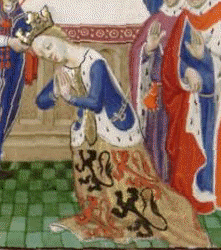
Long before this, Edward II had also toyed with marrying his eldest to one of Count Guillaume’s daughters. He’d even sent his trusted man, Walter Stapledon, Bishop of Exeter, to inspect the goods. A description still survives, but it is unclear whether it refers to Philippa or to one of her sisters. The bishop describes a dark-haired girl with dark eyes, a full mouth and good teeth. All in all, the bishop found her pleasant enough, and one hopes young Edward agreed, that distant June day of 1326 when he first clapped eyes on the girl who was to become his wife.
We have no idea what Philippa looked like, but as she lived in the fourteenth century, she was burdened with a hairdo that is decidedly unflattering. If you look at her effigy in Westminster abbey, what you mostly see are those heavy arrangements of braids framing her face. Maybe she was a bit more daring in her youth – maybe there were days when she wore her hair loose and uncovered – but if so, that ended after she’d married Edward. Married women were supposed to keep their hair covered, as it was a well-known fact men went all gaga at the sight of curls billowing in the wind.
Philippa spent most of her childhood in Valenciennes, Guillaume’s principal city, but would also have been regular visitors at Le Quesnoy where Guillaume and his family enjoyed such noble pastimes as hunting and hawking. Her education was geared at preparing her for the role of a royal consort, even more so once the betrothal documents had been signed.
Isabella’s invasion was a success. The hated Despenser was executed, Edward II was imprisoned and forced to abdicate, and in February of 1327, Prince Edward was crowned Edward III. On the other side of the English Channel, preparations began for Philippa’s wedding.
Like many other young ladies of the time, Philippa was married twice: first by proxy, i.e. Edward sent over a man to stand in his stead, the second time in January of 1328 in York – this time the real thing in the half-finished cathedral with her young and handsome husband at her side. She was not quite fourteen, he was fifteen.
At the time of the wedding, Edward must have been in the grip of conflicting emotions: he’d recently seen his father buried (some people say Edward II didn’t die, but let us bypass that for now), his mother had awarded herself a huge income which seriously depleted the royal coffers, Roger Mortimer was effectively in charge of running the country (albeit with Isabella), and Edward was beginning to suspect neither Isabella nor Roger were all that keen on stepping down from their position of power. So what did that make him? A leashed lion? For a young man determined to become a perfect king, that was not an option.
He found a confidante in Philippa, someone as firmly in his own corner as he was. Philippa might initially have been intimidated by her mother-in-law, but she had every reason to side with her husband, starting with the fact that Queen Isabella showed little interest in ensuring her daughter-in-law was appropriately crowned. From where Isabella was standing, England was better off with one crowned king – her son – and one crowned queen – herself.
In 1330, Edward pushed through the coronation of his wife, by then pregnant with their first child. Mama Isabella was not entirely pleased, but public opinion was moving in the direction of Edward and Philippa, and when the little queen proudly presented her husband with a son and heir in June of 1330, Isabella should have realised power was slipping through her fingers. Edward III now had every reason to act – and act quickly – so as to retake control of his country. He did, which is how Mortimer ended up dead and Isabella ended up marginalised.
![]() |
| Philippa |
Over a period of 25 years, Philippa gave birth at least thirteen times, which means she was just sixteen when the first baby was born, over forty when the baby of the family, Thomas of Woodstock, saw the light of the day. Edward clearly enjoyed her company – and vice-versa – which explains why she accompanied her bellicose husband on various of his campaigns – both to Scotland but also to France, where she forever earned the reputation of being a gentle and good queen when she begged Edward to spare the burghers of Calais.
A little background: In 1337, Edward III claimed the French crown, this based on the fact that his mother was born a French princess. The French king obviously disagreed, and so began the Hundred Years’ War. After crushing the French at the battle of Crecy in 1346, Edward turned north – to Calais.
This town was protected by impressive walls, and no matter how many men Edward threw at the town, the defences held. Months of this did not improve Edward’s temper, so in February of 1347, he effectively closed off all lines of supply into the town. The siege of Calais had begun.
| The Siege of Calais |
The stubborn townspeople refused to give up, hoping their king would come to their aid. Philippe of France did show up, but he was still smarting after the loss at Crecy, and he was severely outnumbered and “outstrategised” by Edward, which made Philippe decide it was best to retreat and fight another day. Abandoned by their king, in August of 1347 Calais surrendered.
By then, Edward was seriously angry with the town for holding out for so long – it put a major dent in his calendar. Plus, he had hoped to force the French king into a decisive battle outside Calais, but Philippe had evaded that trap. I dare say Edward was tempted to unleash his men on the town, but as Edward was in France claiming the French crown, he realised this would not endear him to his French subjects. Instead he offered the people of Calais a deal: if six of them would come before him and give themselves up unconditionally, he would spare the rest.
Those six brave Calais burghers had no illusions as to what fate awaited them, especially as Edward ordered that they wear nothing but their shirts and a noose round their neck – ready to hang, if you will. They prostrated themselves before the smouldering Edward and begged for their lives. He ordered their heads to be cut off – ASAP.
![]() |
| Philippa begging for the life of the burghers |
This is when Philippa stepped forth from the shadows of history to hog the limelight. Heavily pregnant, she kneeled before her husband and begged him to show mercy, as she feared God would otherwise rob them of the child presently in her womb. Edward was not happy - at all. But he was fond of his wife, and was so touched by the sight of her on her knees that he reluctantly spared the six burghers and everyone lived happily ever after. Except that they didn’t – at least not the citizens of Calais who were evicted out of their town and replaced by Edward’s men. Neither did Philippa’s baby. A son, Thomas of Windsor, was born in 1347 but died within a year.
After the events at Calais, Philippa went back to being the mild wife she’d always been, never questioning her husband in public, however much she may have argued with him in private. Not that I think they did argue. I believe theirs was a happy and fulfilling marriage, one in which they enjoyed spending time together, sharing their thoughts with each other. In Philippa and their children Edward found the family he’d lost as a child when his mother and father ended up on opposite sides of a battlefield. In her, he had a loyal and devoted spouse. In him, she found a man who cherished and honoured her.
All good things come to an end. In the 1360s, Philippa fell ill, a wasting disease that had her growing weak and him desperate. This is when Edward began his association with Alice Perrers, his only known mistress, but his devotion for his wife and his distress at her continued illness were evident.
In July of 1369, Philippa sent for her husband. He rushed to her side and found her wan and pale in her bed. They held hands as she had him promise that once he died, he’d be buried beside her. Edward wept and gave her his word, gripping the hand of the woman who’d been his mainstay through life.
Philippa was all of fifty-five when she died, and had lived through the misfortune of seeing nine of her children die before her. Her husband never recovered from her death. Soon enough, he fell under the spell of Alice Perrers, even more so as his mind deteriorated, but in his heart I believe Philippa ruled uncontested – as she had always done.
All pictures in public domain and/or licensed under Wikimedia Creative Commons
~~~~~~~~~~~
Had Anna Belfrage been allowed to choose, she’d have become a professional time-traveller. As such a profession does not exist, she became a financial professional with two absorbing interests, namely history and writing.
Presently, Anna is hard at work with The King’s Greatest Enemy, a series set in the 1320s featuring Adam de Guirande, his wife Kit, and their adventures and misfortunes in connection with Roger Mortimer’s rise to power. The first book, In The Shadow of the Storm was published in 2015, the second, Days of Sun and Glory, was published in July 2016, and the third, Under the Approaching Dark, will be out in April 2017.
When Anna is not stuck in the 14th century, she's probably visiting in the 17th century, specifically with Alex(andra) and Matthew Graham, the protagonists of the acclaimed The Graham Saga. This is the story of two people who should never have met – not when she was born three centuries after him.
More about Anna on her website or on her blog!
Subscribe to:
Posts (Atom)


