Showing posts with label 7th Century. Show all posts

Wednesday, February 19, 2020

Beowulf: The Mound and the Dragon

By Mark Patton.

In earlier blog-posts, I explored the survival of the Anglo-Saxon poem, Beowulf, and the likely contexts for the poem's performance in the mead-halls of Anglo-Saxon royal courts. Kim Rendfeld has also discussed the origins of the two monsters that the eponymous hero has to defeat in the early stages of the poem, Grendel and his terrifying mother. These early conflicts represent a rite of passage that rulers in the real world of the early Middle Ages had to go through as they came of age. Beowulf is of royal blood, but must prove himself in battle before he can take his rightful place as his father's heir: a king who could not deliver victory in battle was not a king worthy of the title at all.

In the final section of the poem, however, Beowulf is, in his own right, King of the Geats (a people who lived in part of what is now Sweden), a successful warrior and respected ruler. One might think that he had nothing more to prove, but that's not how early Medieval kingship worked: a king always had something to prove, and the final proof was that of his own mortality, something that hangs particularly heavily over Beowulf and his people, since he has no son or heir to succeed him.

Beowulf's last encounter is with a different sort of monster, a dragon:

" ... the wide kingdom reverted to Beowulf. He ruled it well
for fifty winters, grew old and wise
as warden of the land
until one began
to dominate the dark, a dragon on the prowl
from the steep vaults of a stone-roofed barrow
where he guarded a hoard; there was a hidden passage,
unknown to men, but someone managed
to enter by it and interfere
with the heathen trove. He had handled and removed
a gem-studded goblet; it gained him nothing,
though with a thief's wiles he had outwitted
the sleeping dragon; that drove him into rage,
as the people of that country would soon discover."
(Translation by Seamus Heaney).

The awakened dragon wreaks vengeance on the entire community, and, although he was not the thief, it is Beowulf's duty, as protector of his people, to deal with it, even at the cost of his own life.

The "barrow" is recognisable as a burial mound, thousands of years older than the Seventh or Eighth Century poem. Since it is in Scandinavia, it is probably a Neolithic "passage grave," built by early farming people between five and six thousand years ago, but the "long-barrows" of England and Wales are of similar antiquity and significance.

The "passage grave" of Tustrup, Denmark. Photo: Malene Thyssen (licensed under GNU).

The "long barrow" of Wayland's Smithy, Oxfordshire. Photo: Dick Bauch (licensed under CCA). Wayland the Smith is a figure from Anglo-Saxon and Nordic mythology, so the monument must have been known to the contemporaries of the Beowulf poet. 


Although the Stone Age people who built these monuments had no knowledge of metal-working, objects of bronze and gold were sometimes placed in them by later people, either as ritual offerings or for safekeeping. There are also individual burial mounds, "round barrows," built during the Bronze Age, three to four thousand years ago, both in England and Scandinavia.

"Round barrows" on the Dorset Ridgeway. Photo: Jim Champion (licensed under CCA).


For the people of the Middle Ages, prehistoric burial mounds (whether "passage graves," "long barrows," or "round barrows") were distinctive features of the landscape, places of mystery and fear, but also places where a man, if he were brave enough, might dig in search of treasure.

The Rillaton gold cup dates to the Bronze Age (1700-1500 BC), and was found in a "round barrow" in Cornwall. Photo: Fae (licensed under CCA).

The Ringlemere gold cup is of similar antiquity (it may even have been made by the same goldsmith), and was found on a site in Kent where Anglo-Saxon burial mounds sit alongside those of the Bronze Age. Photo: Dominic Coyne (licensed under CCA).


The "passage grave" of Maes Howe, on the Mainland of Orkney, provides a remarkable parallel to the story of Beowulf. The Orkneyinga Saga tells how, in the year 1153, a party of Norsemen entered the monument, and took refuge there: "On the thirteenth day of Christmas they traveled on foot over to Firth. During a snowstorm they took shelter in Maeshowe, and two of his men went insane, which slowed them down badly, so that, by the time they reached Firth, it was night time."

The "passage grave" of Maes Howe. Photo: Tim Bekaert (image is in the Public Domain).


The archaeological evidence shows that Maes Howe really was entered, on at least one occasion, by Medieval Norsemen, who carved runic inscriptions on the stone walls. Some of these are timeless and predictable graffiti: "Inigerth is the most beautiful of all women ... Thorni f****d, Helgi carved." Others, however, refer to treasure: "Crusaders broke into Maeshowe: Lif, the Earl's cook, carved these runes. To the north-west is a great treasure hidden. It was long ago that a great treasure was hidden here. Happy is he that might find that great treasure. Hakon alone bore treasure from this mound, signed, Simon Sirith."

Runic inscriptions at Maes Howe. Photo: Islandhopper (licensed under GNU).

The"dragon" of Maes Howe. Image: Islandhopper (licensed under GNU).


There is even a picture of a dragon. Was it fear of this that drove later intruders insane? Did Hakon and Simon Sirith really find treasure, or had their imaginations been ignited by an oral performance of Beowulf, or a similar poem? Might it really still have been being performed (almost certainly in another language - Old Norse, rather than Anglo-Saxon), five centuries after it was composed, and one hundred and fifty years after the only written version to have survived was placed in a monastic library? Neither history nor archaeology provide definitive answers to these questions, but fiction can travel where the historian and archaeologist cannot go.
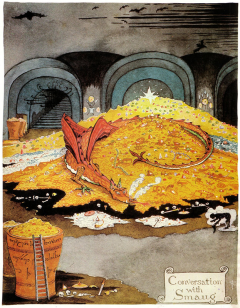
"Conversation with Smaug," by J.R.R. Tolkien ("The Hobbit"). Tolkien, who taught Anglo-Saxon at Oxford, and translated "Beowulf," drew extensively on the poem, and on the tradition to which it belongs, in his own fictional writing (image reproduced under fair usage protocols). 

[This is an Editors' Choice post, originally published on 17 August, 2017]

~~~~~~~~~~

Mark Patton blogs regularly on aspects of history and historical fiction at http://mark-patton.blogspot.co.uk. He is a published author of historical fiction and non-fiction, whose books can be purchased from Amazon.

Friday, December 14, 2018

Heroes of the Dark Ages - Who's yours?

by Matthew Harffy

If I were to ask a group of people to name a hero from the Early Medieval period, the era more commonly known as the Dark Ages, who do you think they might mention? Alfred the Great perhaps? After all, he is the only king to be known as “Great” that Britain has ever produced.

King Alfred the Great

Some might go with that famous warrior king from the end of the period, Harold Godwinson. He will forever be known to all British schoolchildren as the man who rather clumsily got an arrow in his eye at the Battle of Hastings on that most famous of dates, 1066.

Harold has something in his eye on the Bayeux Tapestry

Some people, unsure of what is fact and what is fiction, might even give King Arthur a plug. Now, we don’t even know whether Arthur really existed, and we certainly don’t have any facts about his life or who he was even if we believe he is not purely fictional. And yet, his name is synonymous with Britishness and the distant mist-veiled days of the Dark Ages. He is “the once and future king” who will return to rid us of an invading army when the land most needs him.

A watery tart lobs a sword at Arthur

People who are more knowledgeable of the period’s history, and who are more inclined to turn to learning rather than battle-glory as a sign of greatness, might well mention The Venerable Bede, the Northumbrian monk and scholar who wrote much of what is known of the history of Britain up to his death in the 8th century.

Bede - the grandfather of British history

If they are really into their seventh century history, people might say their hero is King Penda of Mercia, or King Oswald (later Saint Oswald) of Northumbria, but I think those people would be few and far between.

What I can guarantee is that nobody would say that their hero of the Early Medieval period is King Sigebehrt of East Anglia. Well, perhaps I can’t guarantee it, but if someone voted for him, you can be sure they would belong to an extremely niche crowd!

However, to his people, Sigebehrt was every bit the hero.

St. Felix and King Sigebehrt

King Sigebehrt of East Anglia (known later also as Saint Sigebehrt, following his ***SPOILER ALERT*** martyrdom ***SPOILER ALERT***), had been the epitome of the warrior kings of the Anglo-Saxons.

You may well be thinking that it’s no wonder you haven’t heard of some ancient king of a small area of modern-day England. But back in the 7th century, East Anglia was a big deal. It was one of the most powerful kingdoms of Britain, perhaps the most powerful for a time. Indeed, it was powerful enough for its king, Rædwald, to be called by Bede ‘Rex Anglorum’ (King of the Angles, which makes him sound like he was great at trigonometry, but remember that the Angles were the Germanic tribe who gave their name to what would eventually become England). Rædwald was not only able to rule over all the Angles, but also to put those he favoured on the thrones of other kingdoms, as he did with King Edwin of Northumbria.

Replica of the Sutton Hoo helmet

Rædwald is probably the noble buried in the ship beneath the famous mound at Sutton Hoo, and it is likely that Sigebehrt was either his stepson or his nephew. Whatever his relationship to the great king, Sigebehrt was part of the dynasty of the Wuffingas, the ruling family of East Anglia for many decades.

Little is known about Sigebehrt’s early life, save that he was exiled from East Anglia to France. Exile was common at the time for nobles with a claim to the throne. It certainly beats death! In France he became a Christian and was in fact the first English monarch to be baptised before his succession to the throne.

Upon the assassination of Rædwald’s son, Eorpwald, Sigebehrt returned to take the throne of East Anglia. Nothing is known about how he did this, but given the violence prevalent at the time and the fact his prowess in battle was later chronicled, it seems likely he had to fight his way to the top. That he was a Christian wouldn’t have hurt his prospects either, what with Edwin of Northumbria and Eadbald of Kent both having converted to Christianity and having ties to the Frankish rulers, who may well have aided Sigeberht to take the crown.

However he managed it, he was the king by 629 and he promptly went about setting things in motion that would cement Christianity’s place in the kingdom. During his stay in France, Sigeberht had been impressed by the learning found in the religious schools on the Continent. So, after setting up a Burgundian missionary, Felix (yet another Saint!), as Bishop of Dommoc (possibly Dunwich), Sigeberht then secured the future of the Church by establishing a school, based on the model that he had witnessed in France, where boys could be taught reading and writing in Latin.

Saint Fursey (not sure which one he is!)

Furthering the Church’s influence in his kingdom, he then granted the Irish hermit Fursey (yes, another Saint!), a monastery site called Cnobheresburg, most commonly identified as Burgh Castle, near Great Yarmouth.

If it sounds as though Sigebehrt was obsessed with learning and the Church, you wouldn’t be wrong. He was clearly much more interested in the Church than in governing and being a warlord king of the people of East Anglia. We know this, because a few years after attaining the throne, he abdicates power to Ecgric, another of the Wuffingas dynasty, whereby he promptly retires to his monastery at Beodricesworth (Bury St Edmunds).

Now this is where the story gets really interesting, and what drew me to the character in the first place.

In 636 or thereabouts, that most successful of pagan warlords of the age, Penda of Mercia, attacked East Anglia. For some reason the people didn’t think Ecgric was up to the task of defending them, so they went to Beodricesworth and dragged their erstwhile king, Sigebehrt, out from his monastery, that he might save them from the invading Mercians.

Well, the peaceful, Christian Sigebehrt refused to fight, but his ex-subjects were having none of it and he was forced onto the battlefield unarmed and unarmoured to lead his people. I won’t give you details of what happened, but let’s just say that a robe and a cross are not great protection against spears and swords! And you already know he becomes Saint Sigebehrt, after his ***SPOILER ALERT*** martyrdom ***SPOILER ALERT***, so join the dots!

Battles are never pretty

Sigebehrt, might not be the most famous of kings of the Early Medieval period, but he was certainly influential in securing the Church in East Anglia, and his life was definitely interesting enough to spark inspiration in me to write a novel featuring him and his unfortunate end. And if being brave enough to step into the chaos and havoc of a Medieval battlefield without weapons or armour doesn’t make you heroic, I don’t know what does!

Who is your Dark Ages hero or heroine? Leave a comment below. I’d love to read your thoughts.

~~~~~~~~~~

Matthew Harffy is the author of the Bernicia Chronicles, a series of novels set in seventh century Britain. KILLER OF KINGS, which features Sigebehrt, Ecgric and the battle with Penda is now available in hardback, e-book and audio.

The other books in the series, The Serpent Sword, The Cross and the Curse, Blood and Blade and Warrior of Woden are available on Amazon, Kobo, Google Play, and all good bookstores.

Website: www.matthewharffy.com
Twitter: @MatthewHarffy
Facebook: MatthewHarffyAuthor

Images:
King Alfred: Odejea [GFDL (http://www.gnu.org/copyleft/fdl.html) or CC BY-SA 3.0 (https://creativecommons.org/licenses/by-sa/3.0)]
King Arthur: Newell Convers Wyeth [Public domain]
Death of Harold: Myrabella [Public domain or CC0], from Wikimedia Commons
The Venerable Bede: The original uploader was Timsj at English Wikipedia. [Public domain], via Wikimedia Commons
Stained glass, Old Felixstowe Church: Copyright Andrew Hill
Sutton Hoo helmet: British Museum [CC BY-SA 2.5 (https://creativecommons.org/licenses/by-sa/2.5) or Public domain]
Saint Fursey: Public Domain
La victoire de Tullus Hostilius sur les forces de Veies et de Fidena ---- Giuseppe Cesari [Public domain], via Wikimedia Commons

Wednesday, January 17, 2018

Ælfflæd: An Abbess Who Was Always a Princess

By Kim Rendfeld


Ælfflæd’s life was decided in her father’s battle against the Mercians in 655. Northumbrian King Oswiu made a promise: if God granted him victory, he would give land and his 1-year-old daughter to the Church. Ælfflæd would never be a queen, but she wielded royal power.

When she was an infant, Ælfflæd was commended to the care of her mother’s kinswoman Hild, abbess of Hartlepool. Two years later, Hild founded the double monastery of Whitby with the donated land, and she and the toddler took up residence there.

Because of her father’s decision, Ælfflæd was no longer eligible for a political marriage. Probably not a bad thing in this family. Elder half-sister Alhflæd might have had something to do with the death of her husband, the son of the ruler Oswiu killed in battle. Her full sister, Osthryth, later married to a Mercian king, was murdered by Mercian nobles.

Ælfflæd grew up in Whitby, a center for learning and a cradle of bishops. While Ælfflæd was still a child, the abbey hosted the Synod of Whitby in 664 to decide whether the Church should practice Christianity like the Romans or the Celts. The two sides disagreed on many things such as the date for Easter and how tonsures should be shaped. Ælfflæd’s own parents were on different sides—her father favored the Celts while her mother supported the Romans. The Roman way prevailed.


At the abbey, Ælfflæd would become a teacher and was probably being groomed to succeed Hild. It was common for an abbey to pass from aunt to niece or another female relative. As an aristocrat, Ælfflæd was expected to lead.

After Oswiu died in 670, Ælfflæd’s widowed mother, Eanflæd, joined her daughter at Whitby. Eanflæd and Hild apparently were close in childhood, baptized together in 627. When Hild died in 680, Ælfflæd and Eanflæd jointly ruled the double monastery. Eanflæd died after 685, and Ælfflæd assumed sole rule until her death in 714.

And rule she did.

Ælfflæd might have played a role in one of Hild’s pupils becoming a bishop. She commissioned the Life of Gregory, a hagiography written by one of her monks or nuns, and oversaw the translation of her grandfather King Edwin’s relics to Whitby. She was influential enough to write to a continental abbess of behalf of religious women pilgrims. And she was a close friend of the holy man Cuthbert. One story has a linen girdle Cuthbert sent miraculously healing her of an illness that left her paralyzed. About 684, she consulted with him on a matter close to her heart.


She might have been concerned that her brother Ecgfrith, her father’s successor as king of Northumbria, had no sons. Ecgfrith’s first marriage with Etheldreda ended with her following her dream to be a nun, at the urging of Bishop Wilfrid (whom Hild also disliked), and her brother’s second marriage had yet to produce heirs. If we are to believe Cuthbert’s hagiography—and that’s a big if—Cuthbert reminded her that she had a half-brother born out of wedlock before her father’s first marriage. I have a feeling Ælfflæd knew all along and was testing Cuthbert’s loyalty.

Cuthbert was appointed a bishop of Lindisfarne soon after the meeting. Supposedly, he didn’t want the office. It would not surprise me if Ælfflæd played a role the decision.

Ecgfrith died in a disastrous battle in 685, and half-brother Aldfrith, a man in his 50s, ascended to the throne. Although she did not wear a crown, Ælfflæd was someone to reckon with when it came to making peace between Aldfrith and Wilfrid. The archbishop seeking the reconciliation wrote to both the king and his sister. Apparently brother and sister were close, and she had a streak of pragmatism.

When Aldfrith died at the end of his 20-year reign, he had an 8-year-old son, Osred. A rival named Eadwulf seized the throne but was expelled two months later, thanks to teamwork from Ælfflæd, Wilfrid, and a nobleman. Ælfflæd testified that Aldfrith wished for his successor to reconcile the royal family with Wilfrid, and Osred became Wilfrid’s adopted son and king. The next year, Wilfrid didn’t get the See of York as he wanted but he was allow to retain two churches and named a bishop.

With her combination of piety, education, and savvy, it is little wonder her contemporaries called her “a wise woman and learned in the Holy Scripture” and “ever the comforter and best counsellor of the whole kingdom.”

Public domain images via Wikimedia Commons.

Sources

“Ælfflæd (654–714)” by Alan Thacker, Oxford Dictionary of National Biography

“Osred I (696x8–716)” by David Rollason, Oxford Dictionary of National Biography

Bede’s Life of Cuthbert

Beda: A Journey to the Seven Kingdoms at the Time of Bede by Henrietta Leyser

The Earliest English Kings by D. P. Kirby

Double Agents: Women and Clerical Culture in Anglo-Saxon England, by Clare Lees, Gillian Overing

Motherhood and Mothering in Anglo-Saxon England by M. Dockray-Miller

Prayer and Thought in Monastic Tradition: Essays in Honour of Benedicta Ward SLG edited by Santha Bhattacharji, Dominic Mattos, Rowan Williams

A Handbook of Anglo-Saxon Studies, edited by Jacqueline Stodnick, Renée Trilling


~~~~~~~~~~

Kim Rendfeld has written two novels set in 8th century Europe. In The Cross and the Dragon, a Frankish noblewoman must contend with a jilted suitor and the fear of losing her husband (available on Amazon). In The Ashes of Heaven's Pillar, a Saxon peasant will fight for her children after losing everything else (available on Amazon). Her short story “Betrothed to the Red Dragon,” about Guinevere’s decision to marry Arthur, is set in early medieval Britain and available on Amazon.

Connect with Kim at on her website kimrendfeld.com, her blog, Outtakes of a Historical Novelist at kimrendfeld.wordpress.com, on Facebook at facebook.com/authorkimrendfeld, or follow her on Twitter at @kimrendfeld.


Saturday, June 3, 2017

A little-known saint from the Dark Ages: the tale of Bishop Birinus and Dorchester-on-Thames

by Matthew Harffy

When I first read that Dorchester had been an important town in the Anglo-Saxon kingdom of Wessex I had thought that it referred to the town that is in the modern-day county of Dorset. After all, Dorset is part of the West Country and would have been part of Alfred the Great’s Wessex. However, the research I was doing was about the seventh century, long before Alfred’s time and centuries before Wessex had become the pre-eminent power in Britain. It turned out that the Dorchester I had read about was not in Dorset, but in modern-day Oxfordshire and just thirteen miles southeast of Oxford. The Dorchester in question is Dorchester on Thames (or Dorchester-on-Thames).


It is a sleepy village now, picturesque and quintessentially English, with its timber-framed Tudor houses and the medieval abbey that dominates the settlement. It nestles in a bend of the River Thame just before it joins the Thames (or Isis, to use the alternative name for the river upstream of Dorchester), as it flows towards London and eventually the Thames Estuary and the North Sea. The modern name of the River Thames has often been thought to be derived from its two main tributaries, The Thame and The Isis. However, the ancient name of the river was Tamesis, which it seems was erroneously assumed to be made up of Thame and Isis in the middle ages.

Dorchester on Thames is picturesque and very English
The village of Dorchester is quaint and quiet and clearly well-to-do, but is hardly what one would consider a place of power. So what makes Dorchester on Thames so important in seventh century history?

The answer, as is so often the case with early medieval history, is linked to the rise of Christianity. In the early seventh century most of the tribes of northern Europeans who had settled in Britain, who we now call by the generic name of Anglo-Saxons were pagans. Incidentally, it was the Angles who gave England its name: Angleland. These Germanic tribes worshipped the gods that we all know as the pantheon made famous by the Vikings. The all-father Woden, Thunor, Tiw and Frige were the Anglo-Saxon equivalents of Odin, Thor, Tyr and Freya. But of course, Christianity is an evangelising faith, and from the north and west of Britain in the form of Irish missionaries, the word of the gospel was being brought to the pagans. And from the south of Britain, by way of the continent, came Christian missionaries sent by a series of popes from Rome.

These men of faith and learning must have been brave indeed to travel to unknown lands, having to learn the language and the culture of the warlike people and attempt to convert them to what they saw as the one true faith. These must have been formidable men, with passion and zeal and the patience to convince the Anglo-Saxons to convert. In most cases they did this through targeting the kings and the royal families. It seems that when a king decided to become a Christian, so did all his people. This certainly makes proselytising more efficient than if you had to convince every individual, but it still must have taken a great amount of courage and perseverance to get the warlike kings to turn away from the gods they had worshipped for generations and to whom they were said to be direct descendants!

Saint Birinus
One such European missionary was Birinus, now known as Saint Birinus. Before doing my research I had never heard of Birinus and I imagine that many of you reading this blog post will never have heard of him either. Not a great deal is known about him, save that he came from France at the order of Pope Honorius and set about converting the West Saxons. He landed on British shores at Southampton (Hamwic) where he founded the church of St Mary’s. Birinus had been made a bishop in Genoa and was obviously a man of great persuasion for, in 635, he had convinced Cynegils, King of the West Saxons, to allow him to preach the word of God to his people. Cynegils was in the process of negotiating an alliance with King Oswald of Northumbria. He hoped for Oswald’s aid against the rising star of the Anglo-Saxon warlords, Penda of Mercia. But the Christian Oswald baulked at joining forces with the pagan Cynegils and so it was that Cynegils was eventually baptised as a Christian by Bishop Birinus. Oswald became his godfather and also married Cynegils’ daughter. And the King of Wessex gave Dorchester on Thames to Bishop Birinus as his episcopal see.

For the next few years Birinus founded churches throughout the lands of the West Saxons before dying in 640. Shortly after his death, the bishop’s see shifted to Winchester, but it was Dorchester on Thames where the Christianisation of the West Saxons truly began.

Dorchester on Thames Abbey
There’s not a lot to remind us of the time when Dorchester on Thames was the centre of the episcopal see of Bishop Birinus. Nowadays, the village with a population of less than 1000 people, has a couple of pubs, the 12th century Abbey and also a Roman Catholic Church, a small convenience store, some allotments, and a primary school.

One of the pubs of Dorchester on Thames - The Fleur de Lys

I was pleased to see when I visited the village recently that the name of St Birinus is yet remembered in the name of the Roman Catholic Church and the primary school.


I wonder how many of the local inhabitants know who he was or why he is important, but I am sure the man who travelled from France to preach to the barbaric West Saxons would be pleased to know that his name was yet linked to both the church and the teaching of children in the village where he resided nearly 1,400 years ago.

A reminder of the past. An old milestone in Dorchester on Thames

It is interesting to note that the name of Cynegils, the king who gifted the village to Birinus, has not lived on in the same way, and I saw no mention of him in the village. Perhaps this is a reminder of how ephemeral earthly power is. Or perhaps it is more a testament to the fact that written records were kept by the church for many centuries before secular administrations caught up.


All photos copyright Matthew Harffy.

~~~~~~~~~~

Matthew Harffy is the author of the Bernicia Chronicles, a series of novels set in seventh century Britain. The first of the series, The Serpent Sword, was published by Aria/Head of Zeus on 1st June 2016, followed by the sequel, The Cross and The Curse in August and book three, Blood and Blade, in December. The fourth book in the series, Killer of Kings, was released on 1st June 2017.

Wednesday, February 22, 2017

Cyneburg: A Child of Wodan Who Became a Saint

By Kim Rendfeld

When she was growing up, Cyneburg might have believed she was a descendant of the god Wodan and expected to marry to strengthen her family’s political alliances. So how did this 7th-century Mercian princess feel when she learned she would wed the son of her father’s enemy and abandon her gods?

The marriage was before 653, which puts Cyneburg’s birth year around 640 or before. We don’t know what her childhood household was like, but judging by Cyneburg’s and her sisters’ names, Queen Cynewise must have had some influence. Cyneburg grew up with her father, King Penda, constantly at war with Northumbria, the union of Deira and Bernicia.

Although the kings of Mercia and Northumbria practiced different religions, the disparate faiths didn’t cause the conflict. Penda likely used his lineage to Wodan as his claim to power, but he was remarkably tolerant. Both Christians and pagans believed deities determined victory in war or success of the harvest – and they wreaked havoc if displeased. Yet Penda did not bother Christian missionaries on his lands. His reasons might have been political; it would be easier to make alliances with Christian rulers against a common foe if he didn’t persecute their holy men.

At the battle of Maserfield in 642, Penda killed Northumbrian King Oswald, then ritually dismembered his foe and displayed his head and arms as trophies. To the Mercians, Penda got rid of an oppressor. In Northumbrian eyes, Oswald was a martyr. (A year later, Oswald’s brother and successor, Oswy, retrieved the remains, which became relics.)

Penda’s attacks on Bernica went on years. It’s easy to imagine Cyneburg seeing Oswy, his children, and his people as oppressors and loathing them.

We don’t know which father suggested two marriages between their children. Cyneburg would marry Oswy’s heir, Alchfrith, and her eldest brother, Peada, would marry Oswy’s daughter. A condition for the marriages was that Cyneburg and Peada accept baptism.

Saint Chad, with Peada and Wulfhere at Lichfield Cathedral
(by Sjwells53, CC BY-SA 3.0 or GFDL,
via Wikimedia Commons)
We can assume the royal families were trying to make peace. The heaviest burden fell on the daughters: both fathers and husbands expected the women to use their connections to help the men get their way. If the wife gave birth to a healthy son, her position would be that much stronger.
History doesn’t record what Penda and Cyneburg discussed when she was betrothed. Did Cyneburg have doubts about leaving her old gods behind? About her husband? About whether the marriage would stop the wars?

The hoped-for peace was not to be.

In the 655, Oswy killed Penda in the battle of Winwæd and took over Mercia, but he allowed Peada to ascend to the throne. That is, until Peada’s untimely death a year later because of his wife’s betrayal.

Was Cyneburg heartbroken as her father, then her brother, died at the hands of her in-laws? Her husband was not innocent. He had fought alongside his father and was rewarded by being crowned subking of Deira.

The sources conflict on what happens next. The Anglo-Saxon Chronicle says Wulfhere, also a convert to Christianity, succeeded his brother and worked with Oswy to donate land to the monastery at Medeshamstead (later Peterborough), which Oswy and Peada had started. Wulfhere did this with the counsel of Cyneburg and sister Cyneswith.

From Encyclopædia Britannica, 1911
(public domain, via Wikimedia Commons

Bede tells a different story: Wulfhere was a youth and hid from Oswy. Then with support from noblemen, he wrested Mercia back from Oswy in 658, and Oswy accepted that loss.

Despite this turmoil, Cyneburg appears to be a faithful wife. She and her husband might have had six children (this fact depends on which source you believe). She also seems to have embraced her adopted faith. Like Cyneburg, four of their children were later revered as saints.

Cyneburg and her husband were responsible for building monasteries at Ripon and Stamford. Ripon got off to a rough start. The monks renounced the gift when they learned they had to give up the Celtic practice of Christianity and follow the Roman rule as Alchfrith wanted. The land was then entrusted to Wilfred, a cleric who followed Roman tradition.

The clash over Celtic vs. Roman rule would extend to Alchfrith and his own father in the 660s. Cyneburg was with her husband the 664 Synod of Whitby, where Oswy relented and agreed to the Roman rule. But father and son didn’t stop fighting. This time, they disagreed over who should be bishop. Alchfrith rebelled. And then disappeared.

We don’t know how the widowed Cyneburg reacted. Did she regret, or question, why she had become part of a family that fought each other? In Mercia, her enemies were not close relatives. Did she grieve for her husband? Did she despise Oswy? Or did she accept the tragedy as God’s will?

Her children probably stayed in Oswy’s court, but Cyneburg left. Was that departure yet another loss on top of so many?

She turned to Wulfhere and must have still been important in her homeland. Joined by her sister, Cyneburg became the abbess of Castor (originally Cyneburgecaestre). It was common for widowed queens to retire to abbeys. In her case, the nunnery might have been a refuge, and for Wulfhere, the move ensured that the land was in the hands of an ally.

Castor (By John Salmon, CC BY-SA 2.0,
via Wikimedia Commons)
Perhaps, Cyneburg wielded more power at Castor than in Northumbria. Although she was officially under the authority of a bishop, difficult travel and lack of instant communication meant she controlled the convent’s land and made decisions over the nuns she ruled. This was also a time when Christian kings wanted monks and nuns to pray for them. The act would please God, who would then allow pious kings win battles and stay healthy.

She embraced the religious life, showing compassion to the poor and zealously instructing the women in her care. She tried to influence her brothers – Wulfhere and his successor, Æthelred – to give alms and show mercy.

After her death around 680, her reputation for virtue lived on. The Bewcastle Cross, a stone monument created in the late 7th or early 8th century, has an inscription with her and Alchfrith’s name in rune. In the 10th century, she and two kinswomen were translated to Peterborough—a tribute to her fidelity to Christ.

Sources

The Lives of the Saints by Rev. Alban Butler http://www.bartleby.com/210/3/065.html

“Cyneburg,” New Catholic Encyclopedia http://www.encyclopedia.com/religion/encyclopedias-almanacs-transcripts-and-maps/cyneburg-st

Woman Under Monasticism: Chapters on Saint-lore and Convent Life Between A.D. 500 and A.D. 1500 by Lina Eckenstein

"Cyneburg of Mercia (fl. 655)." Dictionary of Women Worldwide: 25,000 Women Through the Ages, edited by Anne Commire and Deborah Klezmer, Gale Virtual Reference Library

The Anglo-Saxon Chronicle, translated by E.E.C. Gomme

Oxford Dictionary of National Biography:
‘Penda (d. 655)’ by S.E. Kelly
‘Alchfrith (fl. c.655–c.665)’ by Rosemary Cramp
‘Wulfhere (d. 675)’ by S.E. Kelly
‘Osric (d. 729)’ by D.J. Craig

~~~~~~~~~~

Kim Rendfeld has written two novels set in early medieval times and is working on a third.

You can order The Ashes of Heaven's Pillar, about a Saxon peasant who will fight for her children after losing everything else, at Amazon, Kobo, Barnes & Noble, and iTunes. Kim's first novel, The Cross and the Dragon, in which a Frankish noblewoman must contend with a jilted suitor and the fear of losing her husband, is available at Amazon, Kobo, iTunes, Barnes & Noble, Smashwords, CreateSpace, and other vendors.

Connect with Kim at on her website kimrendfeld.com, her blog, Outtakes of a Historical Novelist at kimrendfeld.wordpress.com, on Facebook at facebook.com/authorkimrendfeld, or follow her on Twitter at @kimrendfeld.

Wednesday, January 18, 2017

Osthryth: Murdered Queen of Mercia

By Kim Rendfeld

For Osthryth and her family, living into old age was a luxury.

She was born to Northumbrian King Oswy and his second wife, Eanflaed. My best guess of when is the mid-650s. She might have grown up hearing about her father’s brother Oswald, who had been king before Oswy.

Oswald was a conqueror and a devout Christian. In 742, the pagan king of Mercia, Penda, killed Oswald on the battlefield, ritually dismembered him, and displayed his head, arms, and hands on stakes. Oswy retrieved the trophies a year later and sent Oswald’s head to Lindisfarne and his arms and hands to Bamburgh. In those places, they became relics worthy of veneration. Perhaps Osthryth prayed before those relics.

Northumbria and Mercia were still at war, but Osthryth was too young to remember. In 655, Osthryth’s father was fighting Penda, even though two of her six siblings were married the Penda’s children. Her half-brother Alchfrith had wed Penda’s daughter and her half-sister Alhflæd had wed Penda’s son Peada. (The Mercian prince had converted to Christianity as part of the marriage agreement, with Oswy as his godfather.) Her 10-year-old full brother Ecgfrith was a hostage in Penda’s court.

Perhaps, she would have known that her father, with Alchfrith, went into battle against Penda at the River Winwæd when she was a baby. She might have understood that her full sister, Ælfflæd, was at a convent because her father had promised to give her and 12 estates to the Church if God granted him victory on the battlefield. Oswy had triumphed: he beheaded Penda.

Stained glass window at Worcester Cathedral
(by Violetriga, GFDL or CC-BY-SA-3.0,
via Wikimedia Commons)
She might have known Oswy took over Mercia and allowed Peada to succeed his father. But not for long. Peada died in 656, allegedly due to Alhflæd’s treachery. But Osthryth might have been told to see this another way: Alhflæd’s loyalty lay with her father rather than her husband. It’s not too much of a stretch to speculate that Oswy was displeased with Peada, let his daughter know, and she acted accordingly. Would such tales have taught Osthryth the family loyalty trumped everything, even the nuptial vow?

Yet Oswy’s rule over Mercia was short-lived. In 658, another of Penda’s son, Wulfhere, wrested it from him.

Oswy didn’t fight to keep it. Perhaps he was diverted by turmoil within the family. Oswy had rewarded Alchfrith by crowning him subking of Deira (Northumbria is the union of Deira and Bernicia), but father and son disagreed about ecclesiastic policy in the 660s. At issue was whether to practice Christianity like the Celts or the Romans. Osthryth’s parents, Oswy and Eanflaed, often celebrated Easter at different times—an awkward situation when the husband is feasting to celebrate the Resurrection while the wife is fasting for Lent.

Oswy relented and agreed to the Roman rule at the Synod of Whitby in 664, but that did not bring peace. Father and son disagreed over who should be bishop, and Alchfrith rebelled. And then disappeared.

History is silent on whether young Osthryth mourned her brother. She would face another loss soon. Her father, in failing health, died on Feb. 15, 670 (one of the few royal deaths from natural causes in that era), and Ecgfrith succeeded him.

Northumbria and Mercia were still at odds. In 674, Wulfhere led soldiers, wanting to force the Northumbrians to pay tribute. It didn’t work out that way for the Mercian king. Ecgfrith won and forced his adversary to pay tribute. Wulfhere died soon afterward, and his brother Æthelred succeeded him.

By User:Hel-hama, GFDL or CC-BY-SA-3.0,
 via Wikimedia Commons

Osthryth was a marriageable age, and Æthelred was single. This is the point in the story where I think, “Really, Ecgfrith? You’re going to arrange for your sister to marry Æthelred, even though your brother’s and sister’s marriages failed to uphold peace? What makes you think it will work this time?”

Osthryth and Æthelred were wed. She might have borne Æthelred a son, but we don’t know for certain. Apparently, the peace held for a while. Together, Osthryth and Æthelred patronized the monastery at Bardney in the province of Lindsey, a territory Mercia and Northumbria had fought over. Her young full brother Ælfwine was apparently a frequent visitor and beloved in both kingdoms.

But Osthryth's loyalty would be tested. Northumbria and Mercia would fight again, this time in 679 near the River Trent. Ælfwine died. Ecgfrith wanted to avenge his brother’s death, but an archbishop brokered a peace deal, and in a show of goodwill, Osthryth and Æthelred exiled a bishop at odds with the Northumbrian king.

After Ælfwine’s death, Osthryth had her Uncle Oswald’s remains—the parts of his body not in Lindisfarne or Bamburgh—moved to Bardney. To her, these were a martyr’s relics, and she wanted to promote Northumbrian sympathies. To the monks at Bardney, Oswald had been an oppressor, and they at first refused to take them. If we are to believe legend, the monks changed their minds after seeing a light come from the tent in which the remains were housed.

Oswald, from a circa 1220
manuscript (public domain,
via Wikimedia Commons)
The peace would remain uneasy. Ecgfrith died in a battle against the Picts in 685, and Osthryth’s half-brother Aldfrith, born out of wedlock before her father married the first time, succeeded him. When the bishop whom Ecgfrith hated quarreled with Aldfrith, Æthelred gave the guy a bishopric. We don’t know how Osthryth felt about this.

Like Alchfrith, Ecgfrith, Oswald, and her in-laws, Osthryth would be denied the luxury of old age. In 697, Mercian nobles murdered her. That’s all we know. Were they seeking justice for the king killed by her sister over 40 years ago? Or did they fear her influence on her husband?

She was buried at Bardney. Perhaps, Æthelred had some affection for his wife, or maybe he felt guilty and hoped to make amends with her spirit. He gave a monastery on lands his wife controlled to the bishopric of Worchester for the forgiveness of his and his wife’s sins.

Like Oswald, Osthryth and Æthelred would be venerated as saints.

Related story: Saint Etheldreda: Twice Married and Still a Virgin

Sources

Oxford Dictionary of National Biography, including:
“Osthryth (d. 697)” by S.E. Kelly
“Peada (d. 656)” by S.E. Kelly
“Wulfhere (d. 675)” by S.E. Kelly
“Oswiu (611/12–670)” by D. J. Craig,
“Oswald [St Oswald] (603/4–642)” by D. J. Craig
“Æthelred (d. after 704)” by Ann Williams
“‘Aldfrith (d. 704/5)” by Rosemary Cramp
“‘Ecgfrith (645/6–685)” by J.R. Maddicott

Bede's Ecclesiastical History of the English People, ed. and trans. B. Colgrave and R. A. B. Mynors

The Haskins Society Journal 6: Studies in Medieval History by Robert B. Patterson

Kim Rendfeld has written two novels set in early medieval times and is working on a third.

You can order The Ashes of Heaven's Pillar, about a Saxon peasant who will fight for her children after losing everything else, at Amazon, Kobo, Barnes & Noble, and iTunes. Kim's first novel, The Cross and the Dragon, in which a Frankish noblewoman must contend with a jilted suitor and the fear of losing her husband, is available at Amazon, Kobo, iTunes, Barnes & Noble, Smashwords, CreateSpace, and other vendors.

Connect with Kim at on her website kimrendfeld.com, her blog, Outtakes of a Historical Novelist at kimrendfeld.wordpress.com, on Facebook at facebook.com/authorkimrendfeld, or follow her on Twitter at @kimrendfeld.


Wednesday, December 21, 2016

St. Etheldreda: Twice Married and Still a Virgin

By Kim Rendfeld


The only husband East Anglian Princess Etheldreda ever wanted was Christ, but her family needed her to marry a lord and secure an alliance against the Mercians threatening her homeland. What was a seventh century lady to do?

Known today at Saint Audrey, Etheldreda was a dutiful daughter to King Anna. Politics in her world were violent. Her father had ascended to the throne around 641 after the deaths of two cousins in battle, one of whom seized the crown from a murderous usurper. She probably was 5 years old. She must have sensed that royalty was both privileged and dangerous. Very few kings died of old age or even natural causes.

Her family were devout Christians, even though they were in the Uffing clan, which claimed descent from the pagan god Wodan. Two of her sisters (who also became saints) were abbesses, and Etheldreda wanted that vocation. In Etheldreda’s case—as with all medieval aristocrats—family needs came before her heart’s desire.

Then a teenager, Etheldreda married Tonbert, ealdorman of the Southern Gyrwe in the Fens, around 652. Yet she persuaded him to respect her wish to remain a virgin, not an easy feat when conjugal relations were consider a husband’s (and wife’s) right.

Tonbert might have been much older than his bride and might have already had heirs. If that was the case, one less son to accommodate might have worked to his advantage. If he needed to sate his lust, he could do so with a whore. True, it was a sin, and he would need to confess and do penance. But in early medieval eyes, it was not that big a deal.

Tonbert’s morning gift to Etheldreda, usually bestowed after the marriage was consummated and thus deemed valid, was strategic. It was the Isle of Ely. This tract of land on the border with Mercia was surrounded by water and marshes, formidable natural defenses. In early medieval times, a morning gift would always belong to the wife, even if her husband set her aside.

Etheldreda’s marriage did not protect her father, who was killed with her brother (another saint) in a 754 battle against his longtime adversary, the pagan Mercian King Penda. Anna’s brother Athelhere ascended to the throne and recognized Penda as an overlord.

Etheldreda and Tonbert’s marriage would also be short-lived. Tonbert died around 655, the same year Athelhere and Penda died in battle against Northumbrian King Oswy, a Christian. Etheldreda retired to the Isle of Ely, a common act for early medieval widows. She might have thought she could pursue the religious life she always wanted.

From a 10th century illuminated manuscript
(public domain, via Wikimedia Commons)

It was not to be. In 660, her family, probably led by her father’s brother Athelwold, arranged for her to marry Egfrith, Oswy’s heir and a former hostage in King Penda’s court. It was another strategic marriage in which Northumbria and East Anglia could form an alliance against Mercia.

Egfrith was probably 15 at the time. Etheldreda might have been 24. Again, she persuaded her husband to respect her wishes to remain a virgin.

At first, Egfrith consented and held her in high regard. For about a decade, Etheldreda lived at court, enjoying the society of learned monks and nuns and becoming friends with Bishop Wilfred. When Egfrith succeed his father in 670, he had a problem. He needed heirs born within wedlock. He could have forced himself upon his wife—although horrific to modern eyes, medieval folk would not recognize the act as rape. Or he could have asked Etheldreda to retire to an abbey and thus free him for another marriage.

Instead he asked Bishop Wilfred to persuade Etheldreda to willingly come to the marriage bed. Perhaps Egfrith feared losing his alliance with East Anglia, control of his wife’s dowry, and the connections she had made. Perhaps he thought his sons’ connections to the Uffings would help form alliances. Perhaps he truly loved Etheldreda and wanted her to be a real wife.

It would have been easier for Wilfred if he complied with the king’s request and accept the rewards Egfrith offered for the bishop and his churches. But Wilfred did just the opposite. He encouraged Etheldreda to hold fast to her vow of virginity. Maybe he believed Etheldreda’s desire to be a nun was her true calling and feared God’s anger for meddling with that more than the king’s.

Egfrith was none too happy when Etheldreda asked him for his permission to leave. At first, he reluctantly agreed, and she traveled to his aunt’s convent. Apparently, he missed her and was determined to get her back, even if she wanted no such thing.

Egfrith’s aunt advised Etheldreda to flee. Disguised as a beggar, she left with only two nuns to accompany her. The legend includes a few miracles in her escape such as a tide that rose and stayed high at just the right time and a staff that transformed into a tree.

Whatever the circumstances, she made it to Ely, where 600 families already lived, and built a double monastery. Wilfred made her abbess. (Egfrith did remarry. His second wife hated Wilfred.)

Saint Ethelreda's statue at Ely Cathedral
(photo by Jim Linwood, CC BY 2.0,
via Wikimedia Commons)

Etheldreda’s abbey thrived over the next seven years. During that time, she choose an austere lifestyle, wearing only woolen garments rather than linen near the skin. She also abstained from warm baths—not bathing was a form of penance in early medieval times—with the exception of four great festivals. Even then, other nuns had used the water first.

Shortly before she died, she had a quinsy, a painful abscess in her tonsil, which she believed to be punishment for her earlier fondest for necklaces. A surgeon cut it out, but it didn’t help. She died June 23, 679.

Sixteen years after Etheldreda’s death, her sister (a third one) and successor St. Sexburga wanted to move Etheldreda’s remains from a wooden coffin to a more fitting tomb within the church. If we are to believe legend, Etheldreda’s body was not at all corrupted—even the surgical incision had healed—proof that she had been chaste her whole life.

Sources

Bede on St Etheldreda

"St. Etheldreda" by Ewan Macpherson, The Catholic Encyclopedia.

A Dictionary of Saintly Women, Volume 1, Agnes Baillie Cunninghame Dunbar

The Mammoth Book of British Kings and Queens by Mike Ashley

The Peterborough Version of the Anglo-Saxon Chronicle: Rewriting Post-Conquest History, Volume 27 of Anglo-Saxon studies, by Malasree Home

“The Retreat of St. Etheldreda” Catholic World, Volume 62, Paulist Fathers

“Etheldreda” (Northumbria Community)

~~~~~~~~~~

Kim Rendfeld has written two novels set in early medieval times and is working on a third.

You can order The Ashes of Heaven's Pillar, about a Saxon peasant who will fight for her children after losing everything else, at Amazon, Kobo, Barnes & Noble, and iTunes. Kim's first novel, The Cross and the Dragon, in which a Frankish noblewoman must contend with a jilted suitor and the fear of losing her husband, is available at Amazon, Kobo, iTunes, Barnes & Noble, Smashwords, CreateSpace, and other vendors.

Connect with Kim at on her website kimrendfeld.com, her blog, Outtakes of a Historical Novelist at kimrendfeld.wordpress.com, on Facebook at facebook.com/authorkimrendfeld, or follow her on Twitter at @kimrendfeld.


Thursday, August 18, 2016

Saint Wilgils: A Conversion That Goes Beyond Serious

By Kim Rendfeld


Saint Wilgils probably was born a pagan, but once he converted to Christianity, the faith dictated his life.

Wilgils, a householder in Northumbria, was likely born in the 630s, a turbulent time for both politics and religion. King Edwin, who had accepted baptism in 627, supported efforts to convert the population to Christianity, but those efforts were cut short in 633, when Edwin was slain in battle and a pagan was crowned king.

The folk might have seen Edwin’s death as a divine sign to return to their old gods, who determined what side won the war and whether the harvest would be plentiful or meager. Many converts never stopped believing in their pagan deities despite their baptismal vows. Early medieval Christians went to Mass and celebrated holidays, but they maintained pagan rituals, especially for healing or to ensure a good crop.

Then Oswald, a Christian, decided to come out of exile and seize the throne. (Some of you might remember Oswald from a recent EHFA post by Matthew Harffy; a link to his post is in my sources.) Oswald indeed won the kingdom around 634 and believed he owed his victory to Christ. He showed his gratitude by backing missionaries. Saint Aidan was appointed bishop and travelled throughout the country.

King Oswald of Northumbria,
from a circa 1220 manuscript
(public domain,
via Wikimedia Commons)
We can only guess at how the priests’ teachings impressed the young Wilgils. Alcuin’s hagiography of Wilgils’s son, the source of most information, says nothing of Wilgils’s childhood. Perhaps, Wilgils’s family believed Oswald’s God was the stronger deity and decided to accept Christianity.

Wilgils was more devout than the typical Christian. In an age when most people couldn’t read and a Bible cost much more than a herd of sheep, most of the laity understood only what the priests told them and what they could see in the statuary and murals.

If we are to believe Alcuin, Wilgils got married solely to beget “a child who should benefit many peoples.”

Even by early medieval standards, this is an unusual reason to wed. Among aristocrats, marriage was to forge or solidify alliances and increase wealth. For commoners such as Wilgils, families were seeking good in-laws. The family of a daughter sought a fellow who would provide for his wife and kids. The bachelor, or his parents, sought a young woman to take care of the house and rear the children. If husband and wife were fond of each other, that was nice but not the primary reason for the union.

If Wilgils was so moved by religious belief, why didn’t he forgo marriage and join a monastery? Did he find a young woman as zealous as he was?

Alcuin doesn’t tell us much about Wilgils’s wife. Even her name is a mystery. But he says the couple was devout. And, as is common in hagiographies, the woman had a prophetic dream. In this case, she saw the new moon increase to full, and then it fell into her mouth. She swallowed it, and her bosom was suffused with light. She asked a priest for an interpretation and was told the vision meant the son she had conceived that night would bring light to those in the darkness of error and attract the multitudes.

The couple’s son, Willibrord, was born on November 6, 658, or thereabouts. When he was a young boy—the typical age to send a child to school was 7—he was given to the church at Ripon.

Saint Willibrord, photo by Jwh
at Wikipedia Luxembourg (CC BY-SA 3.0 lu,
via Wikimedia Commons)
Were there tears from parents or son? Did the parents have any second thoughts? Were they sad but accepting the will of God? Did this cause a strain on the marriage? The hagiography answers none of these questions. We don’t know if the parents ever saw their son again.

For the parents, the sacrifice went beyond emotions. Sending their son away meant he could not help them cultivate land or raise livestock. Their act, though, was more than religious devotion. Willibrord now had a chance to get an education and set himself on the path to rule a bishopric or abbey.

If Wilgils and his wife’s whole purpose was to bring into the world a holy man who would minister to many, they succeeded. As an adult, Willibrord was called to be a missionary and crossed the Channel.

His parents remained in Britain. Later in life, presumably after his wife died, Wilgils joined a monastery. Perhaps, he was grieving and seeking solace. Or maybe he’d always been drawn to the clergy and was free to pursue it as a widower.

Wilgils embraced the monastic life. More than embraced it. It didn’t take long for him to decide what he really needed was solitude and an even more austere lifestyle. So he probably traveled for days to a promontory where the Humber River meets the North Sea, today’s Spurn Point. There, he became a hermit.

Spurn Point, 1979, photo copyrighted by Stanley Howe
(used under the terms of CC BY-SA 2.0,
via Wikimedia Commons)
In modern times, the spit of land is a nature preserve. The sea side has chalk grassland, sand dunes, and beaches. The estuary has mud flats. It looks like a nice place to visit, but even by early medieval standards, it was far from civilization.

Nevertheless, Wilgils built a chapel and dedicated it to Saint Andrew. He fasted and prayed, but the solitude he longed for proved elusive. People flocked to him, and he instructed them in the faith. He attracted the attention of the king and aristocrats, who donated land in the area so that Wilgils could build a church. At that church, Wilgils started a small but devout community of religious men.

His legacy would be twofold. The religious community would last past his death, and his famous son, Willibrord, would become the apostle of Frisia, preaching in dangerous lands and becoming embroiled in Frankish politics.

Sources

Medieval Sourcebook: Alcuin’s The Life of Saint Willibrord

“The Christians Are Coming! (The Islands of Iona and Lindisfarne)” by Matthew Harffy, English Historical Fiction Authors

England’s North East

Alcuin of York, by George Forrest Browne

The Lost Towns of the Yorkshire Coast, Thomas Sheppard

Visit Hull and East Yorkshire

Kim Rendfeld is the author of two novels set in early medieval Francia and is working on a third. In The Cross and the Dragon, Alda, a young Frankish noblewoman, must contend with a vengeful jilted suitor and the fear of losing her husband in battle. In The Ashes of Heaven's Pillar, Saxon peasant Leova will go to great lengths to protect her children after she's lost everything else.

The Cross and the Dragon was rereleased August 3, 2016, in print and ebook formats. You can order the book at Amazon, Kobo, iTunes, Barnes and Noble, Smashwords, CreateSpace, and other vendors. The Ashes of Heaven's Pillar will be rereleased in November 2016. Preorders are available at Kobo, Barnes and Noble, and iTunes. It will soon be available on Amazon.