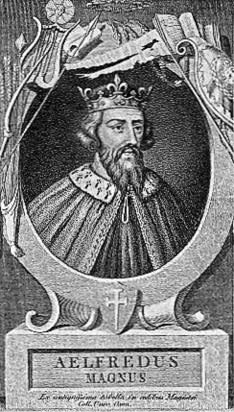
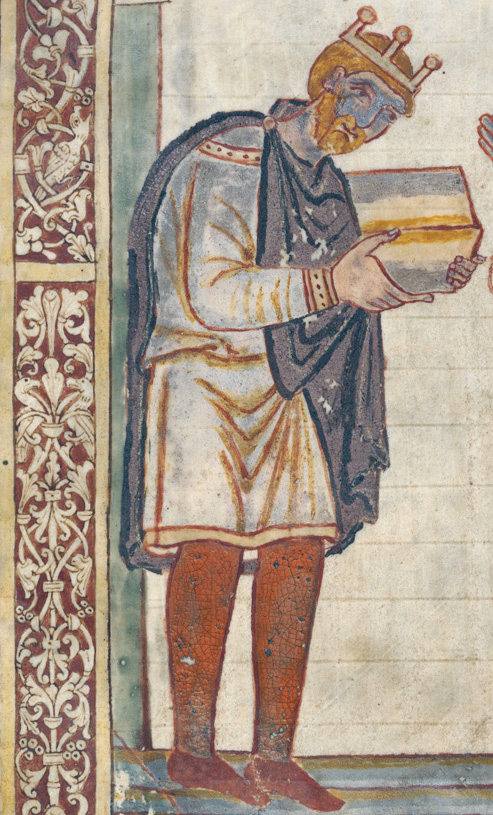
Showing posts with label King Alfred. Show all posts

Tuesday, June 18, 2019

Should Alfred Be Known as the Come-back King?

By Chris Bishop

My title may seem to be rather ‘trite’ when referring to one of the truly iconic figures from English history but it is surprisingly apt.  There are many stories of great men who have lost almost everything yet managed to restore themselves and Alfred the Great must surely rank highly among them.  Let me explain why.

His story actually starts in 793 - nearly a hundred years before the era for which he is best remembered - when there was a surprise Viking attack on a monastery at Lindisfarne.  This was followed by more raids until, in circa 865, a Viking army, known as the ‘Great Heathen Army’, landed in East Anglia determined to conquer England for themselves.  This largely Danish force quickly secured most of the kingdoms which made up England at that time leaving just one, Wessex, to stand alone.

By 870 Wessex was ruled by King Aethelred who, with his younger brother, Alfred, held the Vikings off but the only significant victory they achieved was at the Battle of Ashdown in 871.  There Aethelred is said to have spent so long at Mass that Alfred pre-empted things and ordered the attack himself, thus enhancing his military reputation.  Aethelred died later that same year, probably from wounds received at the Battle of Marton.

England 878 Attribution Link

In those days there was no automatic right of succession.  Kings were ‘chosen’ and Alfred, as an accomplished warrior, was the obvious contender to succeed his brother (though not the only one).  As King, he continued his campaign against the Vikings but could not secure a decisive victory.  He also tried to buy peace by paying tribute, an act which didn’t best please the church or many of the senior Saxons.  Then, in 877, he retired to his Royal Vill in Chippenham for the winter, thinking himself safe until Spring.  But on the 10th day after Christmas (in January 878) the Vikings under Jarl Guthrum launched a surprise attack.   Alfred’s army – or at least that part of it which had remained with him - was all but annihilated.  Alfred fled with a few survivors and hid in the desolate marshes at Athelney in the Somerset Levels, a time which features strongly in my first novel, Blood and Destiny.

Given the ferocity of the attack, Alfred was lucky to escape with his life.  In fact, luck is a key element in his story.  For a start, he was ‘lucky’ that only part of the Viking army attacked his Vill.  Had it been the full force it’s doubtful he would have survived.  Also, he was ‘lucky’ to be King in the first place as, being the youngest of five brothers, he was destined for a life in the church until one by one his brothers predeceased him and he found himself as King.  

But King of what?  His kingdom was all but lost and he had nothing which could be described as an army at his disposal.  Estimates of the numbers who accompanied him vary but it’s likely that many of them would have been wounded and no doubt dejected having lost family and friends in the attack - and the marshes at Athelney were a harsh and forbidding place in which to survive the winter.  Yet it is from this miserable and wretched period that many of the stories about Alfred emanate - such as the burning of the cakes and the contention that he disguised himself as a wandering minstrel and actually returned to Chippenham to spy on the Vikings.  Make what you will of the story about the cakes (you might like to see the blog on my website ‘So, Did Alfred Really Burn the Cakes?’ www.chrisbishopauthor.com) but the idea of him returning to spy on his enemies is an unlikely proposition given that the prize for anyone prepared to betray him would have been wealth beyond reckoning.  

Undaunted, Alfred conducted what might best be described as a guerrilla campaign against the Vikings and, by Easter that same year, had somehow managed to rally the Saxon people in sufficient numbers to strike back and win a decisive victory at the Battle of Ethandune which then secured his realm of Wessex and ultimately provided the basis for a united England, albeit that didn’t happen until several generations later. 
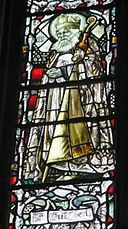
Stained-glass window in Gloucester
Cathedral depicting Cuthbert -
Attribution Link
 My novel, Blood & Destiny, offers one possible explanation of how he achieved this incredible ‘come back’ but it remains a mystery.  The Saxons had efficient mechanisms for calling their men to battle but after so many years of war it’s likely that most would have had their fill of raids and fighting, particularly as Alfred, having gone into hiding, would have been thought by many to have been slain or to have fled abroad.  If so, his reappearance at Easter may have been seen as some sort of ‘resurrection’ in itself, something which would have helped to stir many loyal Saxons into action.  After all, they were fighting not just for themselves and their families, but for their freedom, their religion and for their whole way of life. 

One other important aspect of the battle is that Alfred claimed to have had a visitation from St Cuthbert who urged him to avenge the Christian church.  The ‘support’ of such a holy and much-loved saint would have encouraged many Saxons to follow Alfred, especially as the visitation would have seemed believable given that St Cuthbert had been disinterred from his grave at Lindisfarne and moved to keep his remains safe from Viking hands.  If no longer at rest, it would have been easy and heartening for the deeply religious Saxons to think of the goodly saint supporting their cause. 

So, what do we know about this important battle? 


Memorial stone to the battle at Edington,
erected in 2000 - Attribution Link
Well, the answer is not very much.  We’re not even sure exactly where it took place – some claim it was in Somerset but more likely it was close to a place called Edington near Chippenham and is therefore sometimes called ‘The Battle of Edington.’  

We also know very little about the tactics employed that day or how the battle progressed, though my novel does include a detailed account of what I think may have happened.  This is based on the fact that typical Saxon tactics would have involved a defensive shield wall with their foes pressed up hard against them locked in desperate hand to hand combat – but on foot, not on horseback as is sometimes depicted, for at that time most warriors tended not to ride into battle.  There is a story of Alfred leading a charge at the Battle of Ashdown mounted on a white horse but I find this to be unlikely as commanders usually positioned themselves at the rear of the shield wall from where they could best direct their men using runners to ensure their orders were properly relayed to all.  Ironically, a full-scale charge on horseback was probably first used against the Saxons at the Battle of Hastings to devastating effect – but that’s another story.  

Battle reenactment scene - Attribution Link

The outcome of the battle was a surprising victory for Alfred, forcing the Vikings to retreat to Chippenham where they held out for many days before surrendering.  When they did, Alfred actually showed compassion and wisdom in agreeing the terms of a peace treaty (The Treaty of Wedmore) which eventually ceded control of lands to the Vikings to ensure they didn’t trouble Wessex again (The Danelaw).  This respite provided a period of relative and much needed peace which, although it didn’t last, enabled Alfred to instigate the many reforms and initiatives for which he is renowned.

The relevance of this surprising victory reaches deep into English culture for had King Alfred not triumphed there, virtually the whole of England would have been under Viking rule and Alfred himself either executed or slain.  Had that occurred, many of the hugely important events which followed would simply not have happened; including quite possibly the Battle of Hastings given that the Vikings had such close ties with the Normans – the name ‘Norman’ is actually derived from the ‘Norsemen’ or ‘Northmen’,  Vikings who had settled in that part of France.  Whilst not exactly brothers, they might be considered as cousins, albeit many times removed.  

There is one postscript to the battle in that recent archaeological evidence suggests that Alfred may not have stood alone at Edington.  Coins struck just after the battle depict Alfred and Ceolwulf II of Mercia sitting side by side, suggesting that he enlisted – or perhaps accepted - help from Ceolwulf to fight a common foe.  Or did it reflect the alliance between them once victory had been achieved?  
Either way, Alfred must be credited for restoring his realm and turning utter defeat into triumph – no mean achievement when you consider the forces he was up against and what he went on to accomplish. Little wonder that he is one of the few people in the history of the world to be afforded the title ‘The Great’.

[Illustrations: all sourced from Wikipedia/Commons Licence - click on attribution links for more details]

~~~~~~~~~~

Chris Bishop is the author of the Shadow of the Raven series, a trilogy set in the time of Alfred the Great.

Website: www.chrisbishopauthor.com
Twitter: @CBishop_author
Chris is a member of the Historical Novel Society and the Historical Writers' Association


Friday, December 14, 2018

Heroes of the Dark Ages - Who's yours?

by Matthew Harffy

If I were to ask a group of people to name a hero from the Early Medieval period, the era more commonly known as the Dark Ages, who do you think they might mention? Alfred the Great perhaps? After all, he is the only king to be known as “Great” that Britain has ever produced.

King Alfred the Great

Some might go with that famous warrior king from the end of the period, Harold Godwinson. He will forever be known to all British schoolchildren as the man who rather clumsily got an arrow in his eye at the Battle of Hastings on that most famous of dates, 1066.

Harold has something in his eye on the Bayeux Tapestry

Some people, unsure of what is fact and what is fiction, might even give King Arthur a plug. Now, we don’t even know whether Arthur really existed, and we certainly don’t have any facts about his life or who he was even if we believe he is not purely fictional. And yet, his name is synonymous with Britishness and the distant mist-veiled days of the Dark Ages. He is “the once and future king” who will return to rid us of an invading army when the land most needs him.

A watery tart lobs a sword at Arthur

People who are more knowledgeable of the period’s history, and who are more inclined to turn to learning rather than battle-glory as a sign of greatness, might well mention The Venerable Bede, the Northumbrian monk and scholar who wrote much of what is known of the history of Britain up to his death in the 8th century.

Bede - the grandfather of British history

If they are really into their seventh century history, people might say their hero is King Penda of Mercia, or King Oswald (later Saint Oswald) of Northumbria, but I think those people would be few and far between.

What I can guarantee is that nobody would say that their hero of the Early Medieval period is King Sigebehrt of East Anglia. Well, perhaps I can’t guarantee it, but if someone voted for him, you can be sure they would belong to an extremely niche crowd!

However, to his people, Sigebehrt was every bit the hero.

St. Felix and King Sigebehrt

King Sigebehrt of East Anglia (known later also as Saint Sigebehrt, following his ***SPOILER ALERT*** martyrdom ***SPOILER ALERT***), had been the epitome of the warrior kings of the Anglo-Saxons.

You may well be thinking that it’s no wonder you haven’t heard of some ancient king of a small area of modern-day England. But back in the 7th century, East Anglia was a big deal. It was one of the most powerful kingdoms of Britain, perhaps the most powerful for a time. Indeed, it was powerful enough for its king, Rædwald, to be called by Bede ‘Rex Anglorum’ (King of the Angles, which makes him sound like he was great at trigonometry, but remember that the Angles were the Germanic tribe who gave their name to what would eventually become England). Rædwald was not only able to rule over all the Angles, but also to put those he favoured on the thrones of other kingdoms, as he did with King Edwin of Northumbria.

Replica of the Sutton Hoo helmet

Rædwald is probably the noble buried in the ship beneath the famous mound at Sutton Hoo, and it is likely that Sigebehrt was either his stepson or his nephew. Whatever his relationship to the great king, Sigebehrt was part of the dynasty of the Wuffingas, the ruling family of East Anglia for many decades.

Little is known about Sigebehrt’s early life, save that he was exiled from East Anglia to France. Exile was common at the time for nobles with a claim to the throne. It certainly beats death! In France he became a Christian and was in fact the first English monarch to be baptised before his succession to the throne.

Upon the assassination of Rædwald’s son, Eorpwald, Sigebehrt returned to take the throne of East Anglia. Nothing is known about how he did this, but given the violence prevalent at the time and the fact his prowess in battle was later chronicled, it seems likely he had to fight his way to the top. That he was a Christian wouldn’t have hurt his prospects either, what with Edwin of Northumbria and Eadbald of Kent both having converted to Christianity and having ties to the Frankish rulers, who may well have aided Sigeberht to take the crown.

However he managed it, he was the king by 629 and he promptly went about setting things in motion that would cement Christianity’s place in the kingdom. During his stay in France, Sigeberht had been impressed by the learning found in the religious schools on the Continent. So, after setting up a Burgundian missionary, Felix (yet another Saint!), as Bishop of Dommoc (possibly Dunwich), Sigeberht then secured the future of the Church by establishing a school, based on the model that he had witnessed in France, where boys could be taught reading and writing in Latin.

Saint Fursey (not sure which one he is!)

Furthering the Church’s influence in his kingdom, he then granted the Irish hermit Fursey (yes, another Saint!), a monastery site called Cnobheresburg, most commonly identified as Burgh Castle, near Great Yarmouth.

If it sounds as though Sigebehrt was obsessed with learning and the Church, you wouldn’t be wrong. He was clearly much more interested in the Church than in governing and being a warlord king of the people of East Anglia. We know this, because a few years after attaining the throne, he abdicates power to Ecgric, another of the Wuffingas dynasty, whereby he promptly retires to his monastery at Beodricesworth (Bury St Edmunds).

Now this is where the story gets really interesting, and what drew me to the character in the first place.

In 636 or thereabouts, that most successful of pagan warlords of the age, Penda of Mercia, attacked East Anglia. For some reason the people didn’t think Ecgric was up to the task of defending them, so they went to Beodricesworth and dragged their erstwhile king, Sigebehrt, out from his monastery, that he might save them from the invading Mercians.

Well, the peaceful, Christian Sigebehrt refused to fight, but his ex-subjects were having none of it and he was forced onto the battlefield unarmed and unarmoured to lead his people. I won’t give you details of what happened, but let’s just say that a robe and a cross are not great protection against spears and swords! And you already know he becomes Saint Sigebehrt, after his ***SPOILER ALERT*** martyrdom ***SPOILER ALERT***, so join the dots!

Battles are never pretty

Sigebehrt, might not be the most famous of kings of the Early Medieval period, but he was certainly influential in securing the Church in East Anglia, and his life was definitely interesting enough to spark inspiration in me to write a novel featuring him and his unfortunate end. And if being brave enough to step into the chaos and havoc of a Medieval battlefield without weapons or armour doesn’t make you heroic, I don’t know what does!

Who is your Dark Ages hero or heroine? Leave a comment below. I’d love to read your thoughts.

~~~~~~~~~~

Matthew Harffy is the author of the Bernicia Chronicles, a series of novels set in seventh century Britain. KILLER OF KINGS, which features Sigebehrt, Ecgric and the battle with Penda is now available in hardback, e-book and audio.

The other books in the series, The Serpent Sword, The Cross and the Curse, Blood and Blade and Warrior of Woden are available on Amazon, Kobo, Google Play, and all good bookstores.

Website: www.matthewharffy.com
Twitter: @MatthewHarffy
Facebook: MatthewHarffyAuthor

Images:
King Alfred: Odejea [GFDL (http://www.gnu.org/copyleft/fdl.html) or CC BY-SA 3.0 (https://creativecommons.org/licenses/by-sa/3.0)]
King Arthur: Newell Convers Wyeth [Public domain]
Death of Harold: Myrabella [Public domain or CC0], from Wikimedia Commons
The Venerable Bede: The original uploader was Timsj at English Wikipedia. [Public domain], via Wikimedia Commons
Stained glass, Old Felixstowe Church: Copyright Andrew Hill
Sutton Hoo helmet: British Museum [CC BY-SA 2.5 (https://creativecommons.org/licenses/by-sa/2.5) or Public domain]
Saint Fursey: Public Domain
La victoire de Tullus Hostilius sur les forces de Veies et de Fidena ---- Giuseppe Cesari [Public domain], via Wikimedia Commons

Thursday, July 6, 2017

Barnstaple and John Delbridge

by Lauren Gilbert

A view of Barnstaple and its setting at low tide
Some years ago, I surprised my husband with a fishing trip in northwest Devon. We got off the train in Umberleigh, checked into a delightful hotel (with an equally delightful pub), and discovered...there was no fishing due to an unprecedented heat wave. Nothing daunted, we proceeded to explore the area. At dusk one evening, we witnessed the water rushing into a river at high tide, followed by a family of wild swans. The next day, we hopped back on the train and went on to Barnstaple. It was a fascinating town which we enjoyed exploring. My current work in process includes a gentleman who inherits a small estate in the vicinity of Barnstaple, so I decided to read up on its history.

Afred the Great
Barnstaple is what may be the oldest borough in England. The town was known in the 900’s, a typical Saxon stronghold. Known to the Romans as “Tunge abertawe” and to the Saxons as “Beardenstaple,” it was referred to as “Barum”, the Latin contraction, in documents of the era. It was created a burg (borough) by King Alfred. A mint was established, possibly by King Athelstan who also supposedly granted a charter with rights to hold a market and fair (If there were a charter, it has been lost-a charter dated 930 was proven a forgery and no other has ever been found). The earliest known coin was minted during King Eadwig’s reign (between 955-59). The mint was not a particularly active and ceased production in the 13th century.

King Athelstan I
It fell to the Normans about 1068, and the fall is discussed in the Domesday Book. It is believed that an original castle was built by King Athelstan, and strengthened after the Conquest. This may be the site of the known castle, built in wood in the 11th century by Geoffrey de Mowbray, Bishop of Coutances. Stone walls were erected subsequently, probably by Henry de Tracey. By 1326, castle was a ruin; only the motte remains as a mound. It was the only port in the southwest of England, and by 1290, an important trade center located on River Taw; trading with Europe, Ireland and New World. Imports included tobacco, wine, spices. Barnstaple was licensed to export wool from the 14th century and was a member of the early merchant Guild of St Nicholas. Exports included woolen material and pottery.

Other industries included lace making, fishing, and ship building. Barnstaple was the 3rd richest town in Devon in the 14th century (behind Exeter and Plymouth). Its importance as a port grew during the 14th to 16th centuries, and the city was represented in the Naval Council. There was a petition to Mary I to build a quay and merchants' exchange on the river in 1555. Barnstaple was a “privileged port” as a member of the Spanish Company (authorized to trade in Spain and Portugal) in 1577. There were 12 merchants in Barnstaple listed in the charter.

Trade with America was also very important in the 16th and 17th centuries. Barnstaple had a rather exciting military past as well. In 1588, 3-5 outfitted ships, manned by locals, sailed to join Sir Francis Drake to help defend against Spanish Armada. In 1642, when the English Civil War erupted, Barnstaple was originally pro-Parliamentarian, but changed sides four times. Seriously damaged after the war, the city eventually resumed its normal business and trading activities.

Queen Anne's Walk
Queen Anne’s Walk was built in 1708 (a rebuilding of the original Merchants' Walk built in Tudor times) and completed in 1713, as a merchant exchange on the river with its own quay for loading and unloading ships. A statue of Queen Anne was placed on the colonnade. In the 18th Century, the wool trade ended and Barnstaple began to import Irish wool which was sent on for manufacture. The harbour silted up (a process which began as early as the 17th century) and trade gradually moved to Bideford although there was local shipping (agricultural) until the 20th century. However, the town still maintained its importance as a market town. It has been represented in Parliament continuously since 1295 (it had 2 representatives until 1885 when representation was reduced to one member). It remains an important business and shopping site and the main town in North Devon.

Delbridge Arms

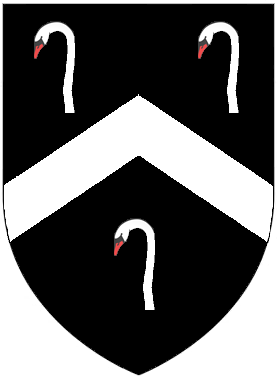
A name that recurred in the history of the town during the 16th century was John Delbridge. Who was John Delbridge? He was born in Barnstaple. His exact date of birth is unknown; however, he was baptized July 9, 1564. John was the 2nd son of Richard Delbridge, a merchant of Barnstaple, and his wife Alice. 

John was a Puritan, and was educated at Emmanuel College Cambridge (he enrolled July 3, 1604 as a paying student or commoner, not as a scholar), and later entered the Middle Temple in London May 10, 1606. He was married to Agnes Downe of Barnstable on January 10th, 1585. Agnes was the niece of Bishop Jewel, Bishop of Salisbury. They had five sons and three daughters, but only one son and daughter survived John. He became a successful cloth merchant, importing and exporting goods by 1591. He was involved in the Newfoundland fishing trade and was a member of the East India Company (1611-21), the French Company (1611), the Virginia. Company (from 1612 to at least 1623), the North West Passage Company (1612), and the Somers Island Company (from 1615 to at least 1622). He was also a member of the Council for Virginia (1621). Clearly, he was a man of great influence with fingers in many pies.

John was involved in the American colonies, including providing passage for colonists to Virginia and Bermuda. His ship The Swan took 70 new settlers to Virginia in 1620 and all survived the voyage (he was apparently known for well supplied ships, and few deaths). He was an active trader particularly in imported tobacco. Clearly successful, John acquired property in Virginia as well as in England. He owned a house in Barnstaple and by 1632 had an estate at West Buckland (a manor which included an advowson (right to appoint a clergyman to serve that area)) about eight miles from Barnstaple. He also had an estate at Bishop’s Tawton. John became active in politics. His political career includes: working under Robert Cecil (Elizabeth I’s chief minister) in 1602-1606 (dates approximate); serving as Mayor of Barnstaple three times (1600-1, 1615-16, 1633-4). He was elected Member of Parliament for Barnstaple six times (elections in 1614, 1621, 1624, 1625, 1626 and 1628), in which capacity he served on various committees (with his known expertise in trade matters) and was very vocal on a wide range of bills at least occasionally in open defiance of the king’s wishes. (He served with Pentecost Dodderidge, a fellow merchant, at least three times, and Alexander St. John, Knight as well).

Agnes died in May of 1639, and was buried May 15th of 1639. John made his will on May 27th and died June 24, 1639 at his home at Bishop's Tawton, leaving the bulk of his estate to his surviving son Richard, with bequests to other relatives and to the poor. 

Unrest was brewing, leading to the Civil War which erupted in 1642. The events involving the war and its aftermath left John Delbridge in obscurity. I couldn't help but wonder if his Puritan faith and service in Parliament steered the loyalty of his city to the Parliamentary side of the conflict, at least at the start.

This is not by any means a comprehensive history of Barnstaple or of John Delbridge; it does, however, serve to tickle one's fancy to look further into that fascinating town and its people.

Sources:

Holton, Denise and Hammett, Elizabeth. BARNSTAPLE THROUGH TIME. Stroud: Amberley Publishing, 2013. (Kindle Version); SECRET BARNSTAPLE. Stroud: Amberley Publishing, 2015. (Kindle Version)

The History of Parliament on-line. “Delbridge, John (1564-1639) of Barnstaple and Bishop’s Tawton, Devon.” HERE

GoogleBooks. Willis, Browne. NOTITIA PARLIAMENTARIA: Or A History of the Counties, Cities and Boroughs in England and Wales. 2nd Edition with Annotations. London: Robert Gosling, 1730. HERE ; Tudor and Stuart Devon: The Common Estate and Government : Essays Presented to Joyce Youngs. Edited by Todd Gray, Margery M. Rowe, and Audrey M. Erskine. Exeter: University of Exeter Press, 1992. HERE

Barnstaple Town Centre on-line. “History.” HERE

A Vision of Britain. “Descriptive Gazetteer Entry for Barnstaple” by John Marious Wilson in IMPERIAL GAZETTEER OF ENGLAND AND WALES (1870-72). HERE

Cambridge Alumni Database. “Delbridge, John.” HERE

View of Barnstaple taken by Lauren Gilbert (c) Lauren Gilbert


Images from Wikimedia Commons

Alfred the Great HERE

Athelstan HERE

Queen Anne's Walk HERE

Delbridge Arms HERE

~~~~~~~~~~
Lauren Gilbert, author of HEYERWOOD: A Novel, is working on her second novel set in Regency England, A RATIONAL ATTACHMENT. She lives in Florida with her husband. Please visit her website HERE.


Wednesday, January 8, 2014

Alfred and the Battle of Ashdown

By Rosanne E. Lortz

Before the gods that made the gods 

Had seen their sunrise pass,
The White Horse of the White Horse Vale 
Was cut out of the grass. 
Before the gods that made the gods 
Had drunk at dawn their fill, 
The White Horse of the White Horse Vale 
Was hoary on the hill. 
Age beyond age on British land, 
Aeons on aeons gone, 
Was peace and war in western hills, 
And the White Horse looked on….

Thus begins G.K. Chesterton’s epic poem The Ballad of the White Horse, the tale of King Alfred’s struggle against the Danish invaders. The poem begins in the middle of things, with the Danes having nearly conquered all of England and Alfred in hiding on the island of Athelney. The bulk of the poem deals with the Battle of Ethandun (more commonly known now as the Battle of Edington), where Alfred defeated the Danish king Guthrum and swore the Vikings to a treaty that would keep them out of the land of Wessex.

The victory at the Battle of Edington is probably the most famous moment of Alfred’s career, the story most retold in the histories of ninth century England. But seven years before Edington there was another battle, the Battle of Ashdown, that also resulted in a victory. It was the battle where Alfred won his spurs, so to speak. It was the battle where an untried leader, the youngest of five brothers, gave glimpses of the greatness that was to come. And coincidentally, it took place on January 8, one thousand one hundred forty-three years ago today.

The backstory to the Battle of Ashdown begins as any incident involving the Vikings must. Bishop Asser records that:
In the year of our Lord's incarnation 871, which was the twenty-third of king Alfred's life [i.e. he was twenty-two], the pagan army, of hateful memory, left the East-Angles, and entering the kingdom of the West- Saxons…scoured the country for plunder….
The Danes, or “pagan army” as Bishop Asser terms them, surprised and captured the town of Reading. From there, they began to send out raiding parties to loot the surrounding farms. The locals did an admirable job fending off the Danes until their king, Æthelred, arrived four days later, accompanied by his younger brother Alfred and the hastily gathered military of Wessex.

In his book The White Horse King, Benjamin Merkle notes that:
This would be the first actual combat that either Æthelred or Alfred had ever faced. The closest the two brothers had come to real fighting had been during the siege of Nottingham—a siege that had been resolved with the payment of the danegeld rather than with the sword point. Now Æthelred, twenty-five, and Alfred, twenty-two, arranged the might of Wessex for an assault on the Viking defenses, a daunting task. 
What followed was a disaster—as assaults on well-fortified towns held by skilled opponents often are. After much blood had been spilled, and after Æthelred, Alfred, and the men of Wessex had failed to breach the Danish defenses, their enemies poured through the gate and the attackers fled in a panicked retreat.

It was an inauspicious introduction to the world of warfare. But rather than giving up all hope, Æthelred, and Alfred managed to regroup the army for another attempt. The Danes sallied forth out of Reading to find more cities to pillage, and a few days later the army of Wessex “encountered the pagan army at a place called Ashdune, which,” as Bishop Asser tells us, “means the ‘Hill of the Ash.’” The exact location of the Battle of Ashdown is debated by historians, but popular tradition places it at Whitehorse Hill—where the famous stylized horse is carved into the grassy hillside, the white chalk horse that G. K. Chesterton refers to in his epic poem.


But whether or not it was on the slopes of Whitehorse Hill, it is certain that the Danes held the higher ground at Ashdown, looking down from the hill onto the West Saxons ranged below. Bishop Asser wrote:
The pagans had divided themselves into two bodies, and began to prepare defences, for they had two kings and many earls, so they gave the middle part of the army to the two kings, and the other part to all their earls. Which the Christians perceiving, divided their army also into two troops, and also began to construct defences.
Æthelred, being the king, was to engage the Danish kings. Alfred would engage the part of the Danish army led by the earls. Merkle notes that with Alfred’s lack of military experience and with the disaster at Reading fresh on everyone’s minds, “he had little to commend himself to the men of Wessex who were now expected to follow him up the soon-to-be-bloodied slope of Ashdown.”

The Danish warriors started to yell their usual taunts from the top of the hill, insulting the West Saxons’ parentage and manhood to the best of their abilities. Merkle writes:
But far more dismaying to Alfred than the taunting force on the hillside ahead was the absence on either flank of his brother and the second half of the Wessex army. The plan had been for both Alfred and Æthelred to immediately muster their forces and march to face the Danes. But Æthelred was nowhere in sight.
Where was Æthelred? Bishop Asser tells us that he was in his tent praying and hearing mass. And despite the fact that the battle was ready to be joined, he refused to put on his armor until the priest was done. His actions—or rather, his inaction—can either be seen as very pious or very cowardly. It certainly placed Alfred in a difficult position.

Returning to Bishop Asser, we read that “Alfred, though possessing a subordinate authority, could no longer support the troops of the enemy, unless he retreated or charged upon them without waiting for his brother.” Inexperienced as he was, Alfred discerned that he needed to act now, before the Danes swept down the hill like a tidal wave uprooting everything in their path. And so, despite the absence of his brother the king and despite the lack of a full half of the Saxon army, Alfred did what he had to. He charged up the hill—where the Vikings possessed both better ground and superior numbers.

The results were markedly better than the assault on Reading that the Saxons had made four days ago.
And when both armies had fought long and bravely, at last the pagans, by the divine judgment, were no longer able to bear the attacks of the Christians, and having lost a great part of their army, took to a disgraceful flight. One of their two kings, and five earls were there slain, together with many thousand pagans, who fell on all sides, covering with their bodies the whole plain of Ashdune.
In the above description of the battle, Bishop Asser does not mention the turning point of the battle which sent the “pagans” into “disgraceful flight.” When Alfred’s men charged up the hill, the Danes supposed that they were facing the whole of the Wessex army. They formed a shield wall and concentrated all their forces on Alfred.

When Æthelred finally finished his prayers and led the second half of the army against the enemy flank, the Danes were taken completely by surprise. In stark contrast to the battle at Reading, it was now the invaders’ turn to panic. Their shield wall crumbled and they fled pursued all day and all night till they reached the cover of the defenses they had erected at Reading.

In terms of significance, the Battle of Ashdown was not a great turning point militarily. The men of Wessex had lost a great deal of their number, just as the Danes had, and the weakened Wessex army was still unable to drive the Danes out of their stronghold. The Saxons suffered two more crushing defeats in the succeeding months, and Æthelred , receiving a serious wound, died not long afterward from infection.

The significance of the Battle of Ashdown lies in this—that it was a great turning point in the life of Alfred and in the confidence of the Saxons. Up until this point, Alfred had never led an army to victory. And up until this point, the Saxons had never defeated this large a company of Danes in pitched battle.

The Battle of Ashdown, on January 8, 871, showed the people of West Sussex that there was hope—that their enemies were not as invincible as they had feared, and that their soon-to-be king Alfred had the intelligence and the courage to overcome them.
___________________

Rosanne E. Lortz is the author of two books: I Serve: A Novel of the Black Prince, a historical adventure/romance set during the Hundred Years' War, and Road from the West: Book I of the Chronicles of Tancred, the beginning of a trilogy which takes place during the First Crusade.

You can learn more about Rosanne's books at her Official Author Website where she also blogs about writing, mothering, and things historical.

___________________

BIBLIOGRAPHY

Asser. The Life of King Alfred. Trans. J.A. Giles. http://omacl.org/KingAlfred/ (accessed January 6, 2014).

Chesterton, G. K. The Ballad of the White Horse.  http://www.archive.org/stream/theballadofthewh01719gut/botwh10.txt (accessed January 6, 2014)

Merkle, Benjamin. The White Horse King: The Life of Alfred the Great. Nashville, TN: Thomas Nelson, 2009.

Thursday, July 25, 2013

Aethelflaed, Lady of the Mercians

by Lisa Yarde


During the late ninth century in England, the Anglo-Saxon King Alfred of Wessex and his wife Ealhswith, a descendant of the royal family of Mercia, welcomed their first child. Their newborn daughter Aethelflaed entered a dangerous world, made so by frequent incursions from the Danes who had harried the English coasts and countryside for decades. Aethelflaed would have two brothers and two sisters, with whom she shared pivotal roles or eclipsed entirely.

During the children’s early years, their father Alfred brokered a treaty with the Dane, Guthrum. This chieftain had carved out a portion of northwestern England called the Danelaw, which included a ravaged portion of Mercia. The ensuing period of peace allowed for a marriage between Aethelflaed and the warrior Athelred, alternatively called an ealdorman or Lord of the Mercians.

Alfred supported his regime and gave him control of London and part of the Oxford area. The bride might have been in her late teens when the marriage took place, but Athelred’s age remains uncertain. They would have one child, a daughter named Aelfwynn. During the marriage, the couple issued joint charters. They also transferred the relics of Saint Oswald of Northumbria to the Gloucester priory they founded in his name.

In 899, Aethelflaed lost her father, whose son Edward eventually succeeded after fending off a rival claim for the throne from Alfred’s cousin. Aethelflaed and her husband continued to govern Mercia, though all of the country’s coinage bore King Edward’s name.

After the year 900, Athelred’s health steadily declined. His wife’s responsibilities increased until she became the de facto ruler. It is possible her power exceeded that of most women of her time as she fortified the defenses against Mercia’s Welsh and Danish enemies.

On the west, Mercia abutted northern Wales and Athelred had endured several conflicts with its people, which continued under Aethelflaed’s reign. In 905 when the Danes attacked Chester, she safeguarded the town. Aethelflaed also established new defenses at the boroughs of Bridgnorth and Bromsgrove.

For four years after Athelred’s death and his burial at Saint Oswald’s priory in 911, Aethelflaed also allegedly began strengthening several areas around Tamworth, Stafford, Warwick, Runcorn, and Eddisbury; there is some dispute as to whether Edward ordered the work instead. He reclaimed the London and Oxford lands his father had granted Athelred, rather than allowing the widowed Aethelflaed to rule them.

It remains certain that she also struck out against Mercia’s foes. In 916, she led an incursion into Wales to avenge the death of a Mercian abbot. She allied with her brother Edward for a fight against Northumberland’s Danes in 917. She gained Derby and Leicester in the struggle. Aethelflaed also pledged to intervene in the fight against Norse raiders determined to take York, but she died at Tamworth before this could occur. Interred at Saint Oswald’s priory after death, her tireless efforts against the Danes and Welsh gained her the title, Lady of the Mercians.

~~~~~~~~~~~~~


Lisa J. Yarde writes fiction inspired by the Middle Ages in Europe. She is the author of two historical novels set in medieval England and Normandy, The Burning Candle, based on the life of Isabel de Vermandois, and On Falcon's Wings, chronicling the star-crossed romance between Norman and Saxon lovers. Lisa has also written three novels in a six-part series set in Moorish Spain, Sultana,  Sultana’s Legacy and Sultana: Two Sisters, where rivalries and ambitions threaten the fragile bonds between members of a powerful family. Her short story, The Legend Rises, which chronicles Gwenllian of Gwynedd’s valiant fight against English invaders, is included in Pagan Writers Press’ 2013 HerStory anthology.

Born in Barbados, Lisa currently lives in New York City. She is also an avid blogger and moderates at Unusual Historicals. She is also a contributor at Historical Novel Reviews and History and Women. Her personal blog is The Brooklyn Scribbler.

Learn more about Lisa and her writing at the website www.lisajyarde.com. Follow her on Twitter or become a Facebook fan. For information on upcoming releases and freebies from Lisa, join her mailing list at http://eepurl.com/un8on.

Want more information about Lisa? Check out Media Resources.  


Tuesday, May 7, 2013

Alfred the Great and the Importance of the Oath

by Rosanne E. Lortz


On the list of English kings, only one has the honor to be called “the Great.” What was it that made Alfred of Wessex such an unforgettable monarch? How did he achieve the title that no subsequent English king has ever received?

Alfred’s military exploits are one possible reason for the title. During his reign of twenty-eight years, he brought back the realm of Wessex from near extinction, fighting off several Danish invasions and establishing himself as the high king of the Anglo-Saxons. His most memorable victory was at the Battle of Edington in 878, where he defeated a Danish host led by Guthrum, forcing the Danes to sign a treaty where they would withdraw from Alfred’s domains and convert to the Christian religion.

Alfred’s educational reform and literary achievements are another possible reason for the title. The previous century had seen a great decline in the literacy of the British Isles, with Latin being completely forgotten and only a few still remembering how to read in the Anglo-Saxon language. Alfred imported scholars from the continent and set up schools to teach his people their letters. Always one to lead by example, he mastered the difficult Latin language himself and then set about translating important works himself into the popular tongue.


But out of all the reasons why Alfred might be considered “the Great,” the one that I want to focus on today is the law code that he created for the Anglo-Saxons, a seminal work that would influence the laws of England and the nations she colonized for centuries to come.

William of Malmesbury, writing several centuries later, tells us that Alfred, “amid the din of war, enacted statutes....” In the midst of battle, rape, and pillage, Alfred strove to establish a society where those things would not occur, and he did this by means of law.

The importance of Alfred’s law code does not lie in its originality. The introduction contains a translation of the Ten Commandments, a recital of many of the case laws in the book of Exodus, an excerpt of Christ’s Sermon on the Mount, and a history of the Apostles with quotes from the book of Acts. Some historians have seen in this Alfred’s attempts to show how the Old Testament laws should be contextualized in an Anglo-Saxon society.

The historian F.N. Lee notes that:
Alfred had already: first re-enjoined the Decalogue or the Ten Commandments (Exodus 20:1-17); then illustrated their concrete application by way of case law (Exodus 21:1 to 23:9); and next assured his readers that Christ had not come to break the Ten Commandments, but to approve them well (Matthew 5:5-19). Indeed, Alfred had then gone on, together with all of Christ's Twelve Apostles, to enjoin…God's Law for man. This is seen quite clearly in the apostolic prohibitions enjoining abstinence from idolatry, bloodshed and fornication (Acts 15:23-29). 
Clearly, then, Alfred believed that the Apostles here (at the Synod of Jerusalem or the first General Assembly of the Christian Church) enjoined God's Commandments upon all of the Gentile [non-Jewish] Christians who had heard it—and who indeed should keep it.
Alfred, by quoting extensively from certain Scripture passages, was making an argument that Biblical law should be kept by the Anglo-Saxons. Following his introduction, Alfred continues his non-originality by quoting laws given by earlier kings.
Now I, King Alfred, have collected these laws, and have given orders for copies to be made of many of those which our predecessors observed, and which I myself approved.... I have not dared to presume to set down in writing much of my own; for I cannot tell what [innovations of mine] will meet with the approval of our successors. But those which were the most just of the laws I found—whether they dated from the time of Ina my kinsman, or of Offa King of the Mercians, or of Aethelberht who was the first [Anglo-Saxon or Anglo-Jutish king] to be baptized in England—these I have collected....
One can only assume that Alfred used the criteria of Biblical law (as outlined at length in his introduction) to determine which of his predecessors' laws were "most just" and should be included. The laws of these previous monarchs include all sorts of subjects—murder, maiming, perjury, theft—but when Alfred does finally launch into promulgating new laws of his own, the first law he gives is most instructive.
Of oaths and of weds [pledges]. 
1. At the first we teach, that it is most needful that every man warily keep his oath and his wed [pledge]. If anyone be constrained to either of these wrongfully, either to treason against his lord, or to any unlawful aid; then it is juster to belie than to fulfill. But if he pledge himself to that which it is lawful to fulfill, and in that belie himself, let him submissively deliver up his weapon and his goods to the keeping of his friends, and be in prison forty days…. Let him there suffer whatever the bishop may prescribe to him; and let his kinsmen feed him, if he himself have no food…. But if he escape, let him be held a fugitive, and be excommunicate of all Christ's churches….
In Alfred’s mind, the “most needful” thing in the kingdom was for men to keep their word. It was good faith and trust between men that built the fabric of a stable society. Peace, commerce, and learning were only possible in a world where a man’s word was his bond.

The Anglo-Saxon society was one plagued by failure to keep oaths. The epic poem Beowulf records a story of a truce made and broken between the Danes and the Frisians.
So, a truce was offered…
Both sides then sealed their agreement.
With oaths to Hengest, Finn swore
Openly, solemnly, that the battle survivors
Would be guaranteed honor and status.
No infringement by word or deed,
No provocation would be permitted. 
It is only a few lines later that the “unpermitted provocations” occur, and the truce is broken in violent bloodshed.
…longing woke
In the cooped up exile for a voyage home—
But more for vengeance, some way of bringing
Things to a head: his sword arm hankered
To greet the Jutes…
Thus blood was spilled….
This sort of oath-breaking was commonplace in the Anglo-Saxon world—and not just betrayal between two people groups, but also betrayal of a lord by his men. At the end of the epic, when Beowulf’s sword fails to cut through the dragon’s scales, his servant Wiglaf exhorts the other men to go help their lord!
“I remember that time when mead was flowing,
How we pledged loyalty to our lord in the hall,
Promised our ring-giver we would be worth our price,
Make good the gift of the war-gear,
Those swords and helmets, as and when
His need required… 
…now the day has come
When this lord we serve needs sound men
To give him their support. Let us go to him,
Help our leader through the hot flame
And dread of the fire….”
Unfortunately, rather than keep their oaths to Beowulf, the men ignore Wiglaf’s entreaties and leave their ring-giver to his fate.

Beowulf manuscript

Alfred’s world was beset with the same rampant oath-breaking that we see in Beowulf. Benjamin Merkle, in his biography The White Horse King, writes:
To understand the significance of oath-keeping to the king of Wessex, one need only think back on the many times when the integrity and strength of Alfred’s shieldwall during the crushing combat depended on the faithfulness of the oaths that his thegns had pledged during those less-dangerous moments of feasting and boasting in the mead hall. Similarly, one can remember the habitual treachery of the pagan Vikings, whose unctuous pledges of peace were disregarded by the Danes within hours of making the pledge. 
These “unctuous pledges of peace” were the bane of Alfred’s existence when dealing with the Danes. Two years prior to the Battle of Edington, Bishop Asser’s Life of King Alfred records that this same warband led by Guthrum had made a treaty with Alfred at Wareham,
to the effect that they should depart out of the kingdom, and for this they made no hesitation to give as many hostages as he named; also they swore an oath over the Christian relics…that they would depart speedily from the kingdom. But they again practiced their usual treachery, and caring nothing for the hostages or their oaths, they broke the treaty, and sallying forth by night, slew all the horsemen that the king had round him….
Alfred, King of the Saxons - silver penny
This earlier betrayal would undoubtedly have been in the back of Alfred’s mind when he parleyed with Guthrum after the Battle of Edington, but nevertheless, Alfred—determined to show the importance of an oath—still swore the treaty. And Guthrum, surprisingly, kept it. Over the course of the next few years, some of Guthrum’s nobles again resumed their depredations, but Guthrum refrained from attacking Alfred’s borders or breaking his baptismal vows.

Alfred, through legislation and through personal example, was resolved to make his country a place where false witness would not be borne. Merkle sums it up well when he says:
By giving so much weight to truthfulness in oath-making…Alfred helped to ensure that no man could break his oath without dire consequences.  If a man was found to have sworn falsely, he would be ostracized from society, losing his right to weapons, to property, and even to testify to his own innocence in court.  Thus, the men of Alfred’s day took great care to ensure that they did not make careless oaths or pledges.
There is, perhaps, little of originality in Alfred’s law code, but the preeminence he gives to a man’s oath had a powerful impact on his culture, and it is this law—the foundation for law in England and the countries she colonized—that can be considered the main reason why Alfred of Wessex is called “the Great.”
~~~~~~~~~~~~

Rosanne E. Lortz is the author of two books: I Serve: A Novel of the Black Prince, a historical adventure/romance set during the Hundred Years' War, and Road from the West: Book I of the Chronicles of Tancred, the beginning of a trilogy which takes place during the First Crusade.

You can learn more about Rosanne's books at her Official Author Website where she also blogs about writing, mothering, and things historical.

_________________________________

BIBLIOGRAPHY

Asser. The Life of King Alfred. Trans. J.A. Giles. http://omacl.org/KingAlfred/ (accessed May 6, 2013).

Heaney, Seamus, trans. Beowulf. New York: W.W. Norton & Company, 2000.'

Lee, F.N. "King Alfred the Great and Our Common Law." http://www.dr-fnlee.org/docs6/alfred/alfred.pdf (accessed May 6, 2013).

Merkle, Benjamin. The White Horse King: The Life of Alfred the Great. Nashville, TN: Thomas Nelson, 2009.

William of Malmesbury. The Kings before the Norman Conquest. Trans. Joseph Stephenson. Wales: Llancerch, 1989.