Showing posts with label Christian missionaries. Show all posts

Saturday, June 3, 2017

A little-known saint from the Dark Ages: the tale of Bishop Birinus and Dorchester-on-Thames

by Matthew Harffy

When I first read that Dorchester had been an important town in the Anglo-Saxon kingdom of Wessex I had thought that it referred to the town that is in the modern-day county of Dorset. After all, Dorset is part of the West Country and would have been part of Alfred the Great’s Wessex. However, the research I was doing was about the seventh century, long before Alfred’s time and centuries before Wessex had become the pre-eminent power in Britain. It turned out that the Dorchester I had read about was not in Dorset, but in modern-day Oxfordshire and just thirteen miles southeast of Oxford. The Dorchester in question is Dorchester on Thames (or Dorchester-on-Thames).


It is a sleepy village now, picturesque and quintessentially English, with its timber-framed Tudor houses and the medieval abbey that dominates the settlement. It nestles in a bend of the River Thame just before it joins the Thames (or Isis, to use the alternative name for the river upstream of Dorchester), as it flows towards London and eventually the Thames Estuary and the North Sea. The modern name of the River Thames has often been thought to be derived from its two main tributaries, The Thame and The Isis. However, the ancient name of the river was Tamesis, which it seems was erroneously assumed to be made up of Thame and Isis in the middle ages.

Dorchester on Thames is picturesque and very English
The village of Dorchester is quaint and quiet and clearly well-to-do, but is hardly what one would consider a place of power. So what makes Dorchester on Thames so important in seventh century history?

The answer, as is so often the case with early medieval history, is linked to the rise of Christianity. In the early seventh century most of the tribes of northern Europeans who had settled in Britain, who we now call by the generic name of Anglo-Saxons were pagans. Incidentally, it was the Angles who gave England its name: Angleland. These Germanic tribes worshipped the gods that we all know as the pantheon made famous by the Vikings. The all-father Woden, Thunor, Tiw and Frige were the Anglo-Saxon equivalents of Odin, Thor, Tyr and Freya. But of course, Christianity is an evangelising faith, and from the north and west of Britain in the form of Irish missionaries, the word of the gospel was being brought to the pagans. And from the south of Britain, by way of the continent, came Christian missionaries sent by a series of popes from Rome.

These men of faith and learning must have been brave indeed to travel to unknown lands, having to learn the language and the culture of the warlike people and attempt to convert them to what they saw as the one true faith. These must have been formidable men, with passion and zeal and the patience to convince the Anglo-Saxons to convert. In most cases they did this through targeting the kings and the royal families. It seems that when a king decided to become a Christian, so did all his people. This certainly makes proselytising more efficient than if you had to convince every individual, but it still must have taken a great amount of courage and perseverance to get the warlike kings to turn away from the gods they had worshipped for generations and to whom they were said to be direct descendants!

Saint Birinus
One such European missionary was Birinus, now known as Saint Birinus. Before doing my research I had never heard of Birinus and I imagine that many of you reading this blog post will never have heard of him either. Not a great deal is known about him, save that he came from France at the order of Pope Honorius and set about converting the West Saxons. He landed on British shores at Southampton (Hamwic) where he founded the church of St Mary’s. Birinus had been made a bishop in Genoa and was obviously a man of great persuasion for, in 635, he had convinced Cynegils, King of the West Saxons, to allow him to preach the word of God to his people. Cynegils was in the process of negotiating an alliance with King Oswald of Northumbria. He hoped for Oswald’s aid against the rising star of the Anglo-Saxon warlords, Penda of Mercia. But the Christian Oswald baulked at joining forces with the pagan Cynegils and so it was that Cynegils was eventually baptised as a Christian by Bishop Birinus. Oswald became his godfather and also married Cynegils’ daughter. And the King of Wessex gave Dorchester on Thames to Bishop Birinus as his episcopal see.

For the next few years Birinus founded churches throughout the lands of the West Saxons before dying in 640. Shortly after his death, the bishop’s see shifted to Winchester, but it was Dorchester on Thames where the Christianisation of the West Saxons truly began.

Dorchester on Thames Abbey
There’s not a lot to remind us of the time when Dorchester on Thames was the centre of the episcopal see of Bishop Birinus. Nowadays, the village with a population of less than 1000 people, has a couple of pubs, the 12th century Abbey and also a Roman Catholic Church, a small convenience store, some allotments, and a primary school.

One of the pubs of Dorchester on Thames - The Fleur de Lys

I was pleased to see when I visited the village recently that the name of St Birinus is yet remembered in the name of the Roman Catholic Church and the primary school.


I wonder how many of the local inhabitants know who he was or why he is important, but I am sure the man who travelled from France to preach to the barbaric West Saxons would be pleased to know that his name was yet linked to both the church and the teaching of children in the village where he resided nearly 1,400 years ago.

A reminder of the past. An old milestone in Dorchester on Thames

It is interesting to note that the name of Cynegils, the king who gifted the village to Birinus, has not lived on in the same way, and I saw no mention of him in the village. Perhaps this is a reminder of how ephemeral earthly power is. Or perhaps it is more a testament to the fact that written records were kept by the church for many centuries before secular administrations caught up.


All photos copyright Matthew Harffy.

~~~~~~~~~~

Matthew Harffy is the author of the Bernicia Chronicles, a series of novels set in seventh century Britain. The first of the series, The Serpent Sword, was published by Aria/Head of Zeus on 1st June 2016, followed by the sequel, The Cross and The Curse in August and book three, Blood and Blade, in December. The fourth book in the series, Killer of Kings, was released on 1st June 2017.

Wednesday, October 19, 2016

Saint Lebwin: A Reluctant Dark Ages Missionary Who Found Courage

by Kim Rendfeld

While in his native England around 754, Saint Lebwin apparently resisted the call to be a missionary. His 10th century hagiography says God admonished him three times before he got on a boat and traveled to the Continent.

Lebwin’s life in England, including his birth date, is a mystery other than that he was educated in a monastery. His reluctance to leave his homeland is understandable. Travel was uncomfortable and hazardous, and when he got to his destination, he would be preaching to a stubborn audience of pagans. This line of work also was dangerous. Saint Boniface, a Saxon missionary from Britain, and his companions had recently been martyred by a mob of pagans in Frisia.

We don’t know what persuaded Lebwin to go. Maybe he believed that he would someday stand before God and be asked to account for all the souls he could’ve brought to Christ. If he neglected that duty, he would face consequences in the afterlife.


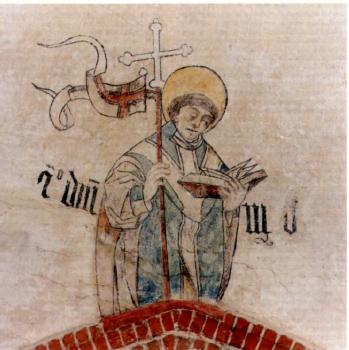
Saint Lebwin, from a fresco painted before 1800

Lebwin’s ship sailed to Utrecht, close to Frisia, and he was greeted by Saint Gregory, who was serving as bishop. A disciple of Boniface since childhood, Gregory might still have been mourning his mentor when Lebwin related God’s command.

Gregory sent Lebwin and a companion to a settlement on the River IJssel, an area the Frisians and Continental Saxons disputed. Here, he enjoyed the hospitality of an aristocratic Saxon widow named Abachilda, and with her support, found fertile ground. At first, the faithful built a chapel on the river’s west bank. Then they built a church across the river in Deventer, which was perhaps a merchant town. It proved to be a good place of operation for Lebwin. He traveled into Saxon lands and gained many followers, including the nobleman Folcbert of Sudberg.

Converting an aristocrat helped keep a missionary safe, and if a leader converted, so might his followers. But pagans of all classes might fear divine retribution. They believed their survival in this world depended on pleasing their gods. So they would leave behind a few stalks of grain for the goddess responsible for the harvest and their ability to feed themselves through winter. Or they might sacrifice war captives as a thanksgiving to Wodan, the god who decided which side won wars. Baptismal vows required Christians to renounce Wodan and other deities. Not a big deal if that convert was a peasant or a slave, who by definition had little influence. But if the new Christian was someone who could order others to displease the old gods, the consequences were dire.

That might be why a mob burned Lebwin’s church in Deventer and caused his followers to scatter.

If the mob was trying to scare Lebwin away, they were sorely disappointed. Instead he was determined to speak at the annual assembly of Saxon leaders at Marklohe. The decentralized peoples had no king, but noblemen from the villages did choose someone to lead soldiers during wartime.

Folcbert tried to dissuade Lebwin, fearing the Englishman would be killed. In addition, the roughly three weeks to get to Marklohe had its own hazards such as bandits and otherworldly creatures. Lebwin would not be moved and was certain God would protect him. Frustrated by his friend’s refusal, Folcbert sent him away.

The assembly at first went as planned, with the pagans giving thanks to their gods, asking for protection of their lands, and gathering in a circle. Suddenly, Lebwin showed up at the meeting in his priestly garb, holding a cross in one hand and the gospel in the crook of his other arm. He prophesized that if the Saxons followed the Christian God’s command, they would be richly rewarded, and no king would rule over them. If they didn’t, he predicted, a king from a nearby land would conquer them, and they would lose everything, even their freedom.


An 1869 illustration

It’s a convenient prophesy, written well over 100 years after Charlemagne had subjugated the Saxon peoples and the Church, with the monarch’s support, had made every attempt to obliterate the old religion. Like their pagan counterparts, Christians believed their deity had a hand in everything, including who won the battle, and this literary device was a way to reinforce that faith would be rewarded while disobedience was punished.

But might there be a grain of truth? Might Lebwin have feared that God would blame him for the lost souls if he didn’t summon the courage to speak to Saxon leaders? Hard to say for certain.

If Lebwin addressed the assembly, he did not get the response he wanted. The pagans thought he was a charlatan preaching nonsense and wanted to kill him. Somehow Lebwin escaped. A Saxon chided those assembled for their lack of manners—they had respected foreign envoys—and made the case for Lebwin to be left alone. Apparently, the Saxon leaders agreed, and they went back to their normal business.

Lebwin returned to Deventer and had his church rebuilt. He died of natural causes around 770 and was entombed within the church.

Later, pagan Saxons destroyed the church again—we don’t know exactly when—and spent three days vainly looking for his body, if we are to believe the hagiography. Pagan Saxons, who burned their dead, might not have understood the significance of a saint’s relics. The fruitless search might have been a creative addition to show that pagans were ultimately on the losing side. They didn’t find the relics because God didn’t want them to.


A mural from around 1880 depicting the destruction of the Irminsul.

In 772, Charlemagne and his Frankish forces invaded Saxony, and reminiscent of Saints Boniface and Willibrord, demolished their sacred pillar, the Irminsul. The enmity between the Franks and the Saxons went back for generations even then, but this was the first time the conflict had a religious tone. Two summers later, while Charlemagne was at war (literally) with his ex-father-in-law in Italy, the Saxons retaliated, wrecking churches.

In 775, the same year Charlemagne’s army was again fighting the Saxons, Saint Ludger was sent to Deventer to restore the church and find Lebwin’s relics. According to the hagiography, Lebwin appeared to Ludger in a dream, telling him where to find his body. Ludger did as instructed and found the remains. He moved one of the building’s outer walls to make sure the saint would always be present in the church he had lived for.

All images are public domain, via Wikimedia Commons.

Sources

Medieval Sourcebook: The Life of Lebwin

"St. Lebwin" by Thomas Kennedy, The Catholic Encyclopedia

Charlemagne's Early Campaigns (768-777): A Diplomatic and Military Analysis, by Bernard Bachrach

Butler's Lives of the Saints, Volume 11, edited by Alban Butler, Paul Burns

The Barbarian Conversion: From Paganism to Christianity, by Richard A. Fletcher

~~~~~~~~~~

Kim Rendfeld learned about the Frankish-Saxon wars while writing her first novel, The Cross and the Dragon, in which a Frankish noblewoman must contend with a jilted suitor and the fear of losing her husband. Kim wrote her second book, The Ashes of Heaven's Pillar, about a Saxon peasant who will fight for her children after losing everything else, to provide a Saxon perspective on the events.

The Cross and the Dragon was rereleased Aug. 3, 2016, in print and ebook formats. You can order the book at Amazon, Kobo, iTunes, Barnes and Noble, Smashwords, CreateSpace, and other vendors.
The Ashes of Heaven's Pillar will be rereleased on Nov. 2, 2016. Preorders for ebooks are available at Amazon, Kobo, Barnes and Noble, and iTunes. It will also be published in print, and if you would like a note when it's available, email Kim at kim [at] kimrendfeld [dot] com.

The wars between the Franks and the Saxons play a major role in Kim's third novel, Queen of the Darkest Hour, about Charlemagne’s fourth wife, Fastrada.

Connect with Kim at on her website kimrendfeld.com, her blog, Outtakes of a Historical Novelist at kimrendfeld.wordpress.com, on Facebook at facebook.com/authorkimrendfeld, or follow her on Twitter at @kimrendfeld.

Thursday, September 22, 2016

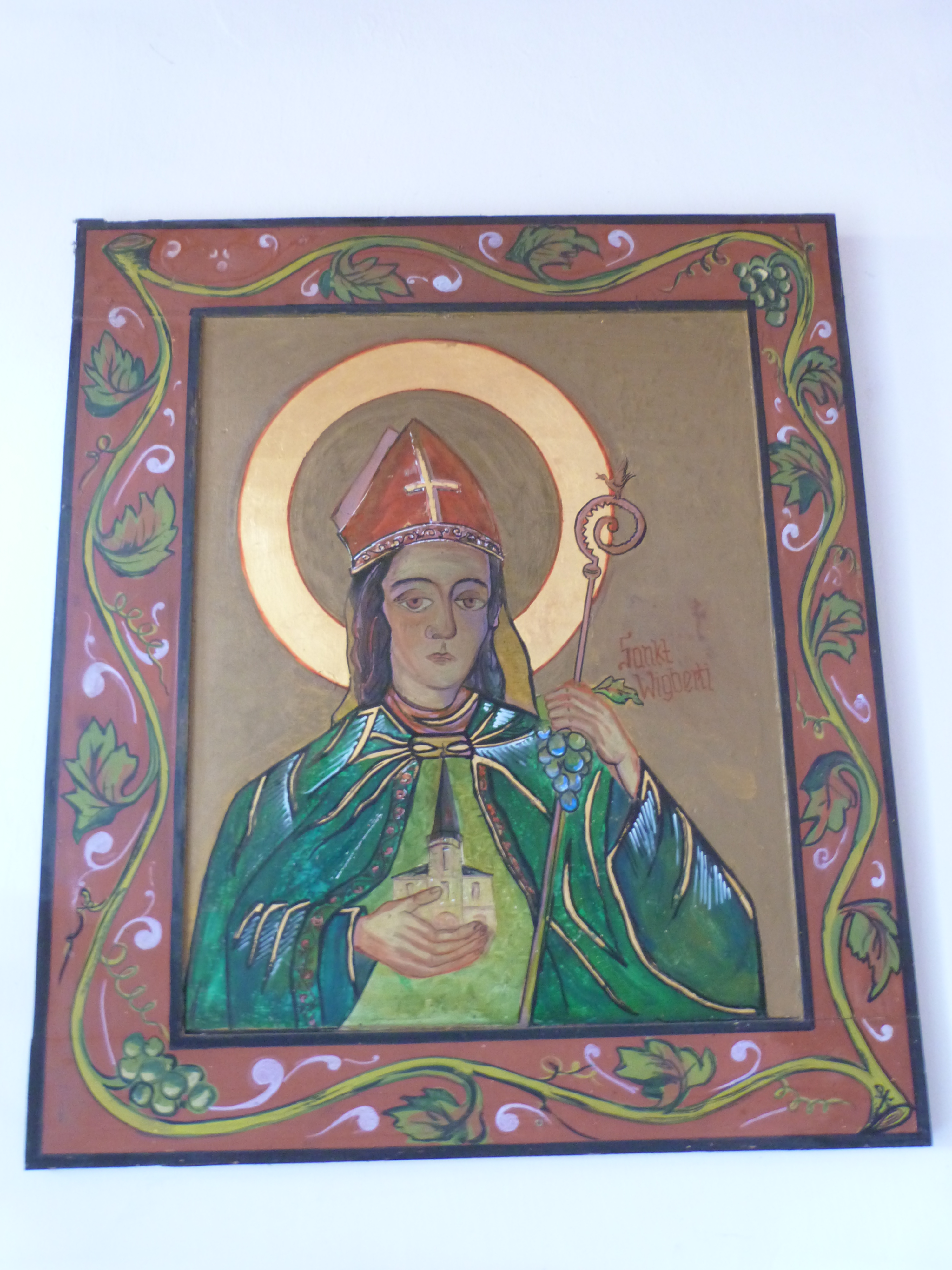
St. Wigbert: A 2nd Chance to Spread the Gospel?

by Kim Rendfeld

As the pagan Continental Saxons burned their way through East Francia in 774, the residents of the Abbey of Fritzlar feared for their church and their lives. When they left, they took a cherished possession with them to the hilltop fortress of Büraburg: the relics of Saint Wigbert.

The fortress also attracted refugees from smaller settlements in the area. Help for the Franks was far away. Their king, Charles (Charlemagne) had taken the army to Italy last fall to save Rome from the Lombards and ensure his young nephews would not have a claim to the Frankish throne. The Franks who were left behind had known it was only a matter of time before Saxons sought to avenge their defeat in 772, the one that destroyed their sacred pillar.

As the Saxons attacked Büraburg and burned houses outside it, I can imagine the Christians praying to the saint for protection. The fortress withstood the attack, and the Saxons proceeded to Fritzlar and tried to destroy the church. If we are to believe the Royal Frankish Annals, the Christians in the fortress beheld a miracle: two young men on white horses appeared and struck terror into the invaders, who fled. Later, the Franks found a dead Saxon beside the church. He was squatting on the ground and looked like he was about to blow on fuel to set the church afire.

The martyred Saint Boniface, who had consecrated the church, had prophesied it would not be burned. He was the one to appoint Wigbert as the abbot of Fritzlar. The annals don’t say which saint the faithful credited with the miracle, but it’s possible they believed their act of faith in preserving Wigbert’s relics played a part.


The remains of the southeastern gate of the Büraburg (JGALoewi at the
German language Wikipedia, GFDL or CC-BY-SA-3.0, via Wikimedia Commons)

Today, we don’t know much about Wigbert, especially his early years. More than one churchman in this era had this name, and the variant spellings add to the confusion. His hagiography was written about 90 years after his death. With scant information, this post amounts to my best guess of who this saint was.

Wigbert likely was a native of the Saxon kingdom of Wessex, the same area as fellow missionaries Boniface and Lioba. Wigbert’s birth year is unclear; sometime between 655 and 665 is as good an estimate as any, if the missionary to Frisia and abbot of Fritzlar are the same person. He was older than Boniface, who might have been born between 676 and 679, and Wigbert was “venerable” when Saint Willibrord was in Ireland from 678-690.

Because Wigbert was later appointed abbot, we can surmise he likely came from a noble family. He embraced the monastic life at a young age and spent time in Ireland with Bishop Egbert. Both had forsaken homeland and family and lived cut off from the world but close to God. Wigbert had lived as a hermit and was a learned man. In the 680s, Egbert sent Wigbert to Frisia to convert pagans to Christianity.

Perhaps they had heard that the Frisian ruler, Aldgisl, had been a gracious host to Bishop Wilfrid and allowed missionaries to preach. When Wigbert arrived, Aldgisl might have been out of power, and this was not good news for Wigbert. Missionaries needed support from the people’s leaders, who would provide protection for someone telling the populace what they believe is all wrong. And if the ruler converted, his followers often did as well.

Instead, Wigbert had to deal with Radbod. We don’t know what transpired between the two men, but there is no doubt Radbod was hostile to Christianity. According to legend, Radbod once had his toe in the baptismal font and asked if he would see his pagan ancestors after he died. Told he would not, Radbod refused the rite, saying he’d rather be with his family in hell than his enemies in heaven. The details probably are a dramatization, shall we say, but the gist is accurate. After two fruitless years of preaching to the Frisians and to Radbod, Wigbert returned to Ireland.

What happened in the following decades is hazy. The Venerable Bede says Wigbert gave up missionary work altogether. If he couldn’t persuade strangers, he would benefit his own people by serving as an example and living a holy, quiet life.

Or maybe Wigbert thought that at first. Bede wrote his history in 731 and died four years later, about the same time as Wigbert’s next chapter. Or I should say his next known chapter.

Photo by Catatine (GFDL
or CC BY-SA 4.0-3.0-2.5-2.0-1.0,
via Wikimedia Commons)

Enter Boniface, a disciple of Willibrord. Both men had missions to pagan lands. Boniface might have heard of Wigbert through his mentor or one of his relatives in Wessex. A letter from someone named Wigbert to monks in Glastonbury describes the warm welcome he received from Boniface upon his safe arrival in Germany, and the writer asks the monks to convey the news to Mother Tetta and her nuns at the double monastery of Wimbourne, also in Wessex. Tetta was an ally of Boniface’s and allowed nuns from her abbey to carry out Boniface’s mission on the Continent.

The year was 734, and Wigbert would have been an old man, even by our standards. The question that comes to my mind: is the missionary to Frisia and the abbot of Fritzlar the same person? The best answer I can give is: it’s possible, even though about 50 years had passed since his last mission. Age alone would not be a detriment, and he was still healthy enough to fast. Boniface needed a knowledgeable, learned man to lead the new monastery at Fritzlar, and a grandfatherly priest who had preached in foreign lands before might have filled the role well.

What went through Wigbert’s head? Did he yearn for that second chance? Did he worry about failing again? Or did he reason circumstances were different this time? Boniface’s mission, and by extension Wigbert’s, had the support of Charles Martel, the Frankish mayor of the palace and the most powerful man in the realm.

Apparently Wigbert did well at Fritzlar. Three years later, Boniface asked him to lead the monastery at Ortdorf as well.

Later, ill and sensing his end was near, he resigned his government of the abbeys. He died about 747 and was buried in the church at Fritzlar.

Six years after the scare in 774, Archbishop Lull had Wigbert’s relics translated to Hersfeld, and his shrine was adorned with silver and gold. A church was built there in 850 but burned in 1037. A new church was constructed, but a fire consumed it in 1761, taking the relics with it. A sad fate for the relics the monks in Fritzlar risked their lives to save. Sadder still is how little we know about the saint for whom they took that risk.

Sources

"St. Wigbert" by Klemens Löffler, The Catholic Encyclopedia, Vol. 15. New York: Robert Appleton Company, 1912.

"St. Egbert" by George Phillips, The Catholic Encyclopedia, Vol. 5. New York: Robert Appleton Company, 1909.

Letters of Saint Boniface

Lives of Saints, by Rev. Alban Butler

Alcuin’s The Life of Saint Willibrord

Bede's Ecclesiastical History of England: A Revised Translation with Introduction, Life, and Notes, translated by A. M. Sellar, G. Bell, 1907, pg. 319

St. Cuthbert, His Cult and His Community to AD 1200, by Gerald Bonner, David W. Rollason, Clare Stancliffe

Handbook of Dutch Church History, edited by Herman Selderhuis

~~~~~~~~~~

Thanks to research on this blog post, Kim Rendfeld has new material for her work in progress, Queen of the Darkest Hour, a novel about Charlemagne’s fourth wife, Fastrada.

Kim's debut, The Cross and the Dragon, in which a Frankish noblewoman must contend with a jilted suitor and the fear of losing her husband, was rereleased August 3, 2016, in print and ebook formats. You can order the book at Amazon, Kobo, iTunes, Barnes and Noble, Smashwords, CreateSpace, and other vendors. Until Sept. 25, 2016, you can enter the giveaway for The Cross and the Dragon.

Kim’s second book, The Ashes of Heaven's Pillar, about a mother who will fight for her children after losing everything else, will be rereleased in Nov. 2,  2016. Preorders for ebooks are available at Amazon, Kobo, Barnes and Noble, and iTunes.

Monday, August 1, 2016

The Christians Are Coming! (The islands of Iona and Lindisfarne)

by Matthew Harffy

The early seventh century was a time of military and religious upheaval in Britain. The different rulers of the small kingdoms across the island vied for supremacy, and violence and death were never far away. Unsurprisingly, most kings of the day died in battle and few reigned for more than a few years at best, some only for months before meeting their bloody ends.

Holderness cross
By portableantiquities [CC BY 2.0 (http://creativecommons.org/licenses/by/2.0)], via Wikimedia Commons

As Angles, Saxons and Britons fought for the land, so different religions battled for the souls of the populace. Christianity resurged on the island, pushing the older religions back into the darkest recesses of mountain valleys and deep forests. By the middle of the century Christianity had been adopted by most of the nations of Britain (or at least by their nobles and royal families). From the south came missionaries sent from Rome; Europeans such as Augustus, Paulinus, Birinus and Felix. From the north came a different flavour of Christianity, not Roman in background, but Irish.

The story of this northern Christianity is one of two islands. Iona in the west and Lindisfarne in the east.

Iona Abbey Scotland - seen from ferry
By Jan Smith from Brisbane, Australia (First glimpse of Iona) [CC BY 2.0 (http://creativecommons.org/licenses/by/2.0)], via Wikimedia Commons

Iona became the centre of the Irish Christian mission in the sixth century when Colm Cille (more commonly known as Columba), an Irish noble, was exiled. He settled on the small island of Iona, which was probably known as Hii at the time and almost certainly gaining its modern name from a transcription error of Ioua Insula (“Island of the yews”) to Iona sometime in the thirteenth century. Iona was then part of the Irish kingdom of Dál Riata and Columba was given it as a base for him and his brethren of monks from whence to preach to the people of Dál Riata and the Picts.

The mission was very successful and Iona became a Christian stronghold in the northwest of the British Isles. The expansion from the west to the east coast came as a result of another exiled noble taking up residence in Iona. This time it was Oswald, the offspring of Æthelfrith, the king of Northumbria.

In 633, after spending his formative years on Iona, Oswald, son of Æthelfrith, was presented the opportunity to take back the throne that had been his father’s. His father’s killer, Edwin, had in turn been slain by an alliance of Penda of Mercia and Cadwallon of Gwynedd. Oswald brought a warband south and confronted Cadwallon near Hadrian’s Wall. Before the battle, Oswald ordered a great cross to be erected and had his men kneel and pray to God for victory.

In the ensuing battle, Oswald’s warhost crushed Cadwallon’s force, slaying the Welsh king and cementing Oswald as the ruler of Northumbria. Christ had granted Oswald victory, and he vowed to bring Christ to the people.

Beach at low tide, Holy Island, Northumberland - geograph.org.uk - 1231059
Christine Matthews [CC BY-SA 2.0 (http://creativecommons.org/licenses/by-sa/2.0)], via Wikimedia Commons

As soon as he was settled on his new throne, Oswald sent to Iona for a bishop to guide his pagan people to Christ. The brethren of Iona eventually sent Aidan, a gentle and patient man who believed in engaging all people, even slaves, in discourse about Christ. He set up a monastery on the island of Lindisfarne, also known now as Holy Island. From that tidal island base, which in many ways mirrored Iona in the west, Aidan set about bringing Christianity to Northumbria.

Aidan travelled the land, founding churches and monasteries throughout the north, and Lindisfarne became famous as a place of religious teaching and great learning. And all the while, the bishops of Lindisfarne worked alongside the kings of Northumbria to bring the word of Christ to a land that had all but forgotten that religion after the Romans had left the island some two centuries before.

Statue of St Aidan, Lindisfarne Priory
By mattphotos (Flickr) [CC BY 2.0 (http://creativecommons.org/licenses/by/2.0)], via Wikimedia Commons

Oswald was followed on the throne by his brother Oswiu, who continued to champion Christianity and was responsible for convening the Synod of Whitby in 664. The Synod is important, for it was there that the two competing forms of the faith – Roman and Irish – were debated and one chosen. Such intricacies as the way monks' hair should be tonsured and how the date of Easter should be calculated were discussed. It might not sound like much, but the ramifications of the decision were far-reaching. The Roman way was decided upon, which ultimately saw Lindisfarne, with its Irish roots, fall out of favour.

It was still a place of great learning, however, and the following decades would see the creation of wonderful treasures such as the Lindisfarne Gospels. This period of cultural flowering is known as the Golden Age of Northumbria. Monks sought peaceful meditation of the will of God, praying and working diligently over beautiful manuscripts that would become famous all over the known world. For a hundred years or more the island of Lindisfarne was a beacon of education and culture.

St. Matthew - Lindisfarne Gospels (710-721), f.25v - BL Cotton MS Nero D IV
St. Matthew - Lindisfarne Gospels (710-721), f.25v - BL Cotton MS Nero D IV, via Wikimedia Commons

Little did those scholarly scribes know that one day Northmen would descend upon their island retreat, smashing the peace and tranquillity in a welter of blood. For one of the things that Lindisfarne is now famous for is that, in 793, it became the location of the first recorded Viking raid in Britain. Those treasures that were so well-known to be guarded only by peaceful monks proved too much temptation to raiders from across the North Sea.

But for those decades in the seventh and eighth centuries, Lindisfarne was a centre of learning and wisdom that saw Northumbria become one of the most important kingdoms of Britain, whose influence was felt across the continent.

~~~~~~~~~~~~~

Matthew Harffy is the author of the Bernicia Chronicles, a series of novels set in seventh century Britain. The first of the series, The Serpent Sword, was published by Aria, an imprint of Head of Zeus on 1st June 2016. The sequel, The Cross and The Curse was released on 1st August 2016. Book three, Blood and Blade, is due for publication in December 2016.

The Serpent Sword and The Cross and the Curse are available on Amazon, Kobo, Google Play, and all good online bookstores.

Blood and Blade is available for pre-order on Amazon and all good online bookstores.

Twitter: @MatthewHarffy

Wednesday, April 23, 2014

Bringing God to the Vikings - or the story of the talking heads

by Anna Belfrage

In those faraway times when the Scandinavian region spawned bellicose Vikings at a horrifying rate, most of Europe was already adequately christened. Not so Norway, Denmark or Sweden, where the ancient religion honouring Odin, Thor and Frey was alive and kicking well into the second millennium.  Adam of Bremen, writing in the 11th century, has left us with a detailed description of the heathen temples in Uppsala (just north of Stockholm, these days Uppsala is the home of the Swedish Archbishop), complete with dripping human sacrifices and the bloodied statues of the gods.

While both the Norwegian and Danish kings converted to Christianity in the tenth century, the Swedish kings were far more obdurate, laughing at the idea of replacing their powerful, lusty gods with that milksop, The White Christ. Turning the other cheek was to a Viking with any sense of self-respect an idiotic concept, and the “do unto your neighbour” part was not at all aligned with the idea of raiding and ravaging – although, to be fair, Swedish Vikings did less of the raiding and ravaging than their Norwegian and Danish brethren, no matter how nominally Christian they were.

Clinging to old faiths when everyone else is embracing the new can become a liability. Trade can be affected, for example. Treaties tend to be difficult to push through, and quite often Sweden would find itself defending its corner alone, against its (more or less) Christian neighbours. The king in Sweden during the first decades of the second millennium was Olof Skötkonung, step-son to Sven Tveskägg (Svein Forkbeard) and, one would assume, under this particular king’s influence. Sven had since some time back become Christian, the contemporary Norwegian king Saint Olav was also Christian (although this didn’t stop him from dismembering people who refused to accept the new God, or from continuing his raiding expeditions when he felt the urge to fill his coffers, or to do some disembowelling on the side when people didn’t toe the line) and at some point in time it seems Olof Skötkonung fell for peer pressure. He decided to convert, and sent to England for an adequate converter.

Sven Tveskägg celebrating at his baptism
At the time, the Anglo-Saxon influence on the Nordic countries was huge. (Well, it still is; a bunch of enthusiastic Anglophiles the lot of us, if we’re going to be frank) Yes, it was Sven Tveskägg who conquered England, not the other way around, but as a consequence, learned men and skilled craftsmen from England came in growing numbers to Scandinavia. Our early churches were staffed with English clerics, our budding administration was developed by intrepid Angles, even that new fad (new from a Nordic perspective), minting coins, was overseen by English immigrants. Actually, the organisation of the Scandinavian mints seems to have been a monopoly, with one Englishman by the name of Godwine popping up in Denmark, Norway and Sweden to set up new mints, each such mint producing coins very obviously modelled on Anglo-Saxon coins, complete with picture of English King Aethelred (!) on one side and a cross on the other. On top of all this cultural exchange, we have Gloucester-born Saint Sigfrid, the man responsible for bringing the word of God to the Swedish King.

Depending on what sources you read, Sigfrid was the Archbishop of York, or he  wasn’t. Adam of Bremen describes him as an English Benedictine monk, no more, no less. Mostly it’s Swedish sources citing him as an archbishop – I guess it made Olof feel more comfortable about his conversion if someone high up the hierarchy did it – but personally I doubt such a distinguished prelate would have left all behind to set off across the North Sea. Seriously, Olof Skötkonung’s immortal soul wasn’t that important…

So let us instead assume Sigfrid was a lowly Benedictine monk commanded to bring the word of God to this heathen king. With a sigh and a rustle of his heavy woollen habit he bowed to the will of his superior and started packing. Among the things he packed, were his three nephews, rather oddly named Unaman, Sunaman and Wineman.

Off Sigfrid went to Sweden and the eagerly awaiting king. In 1008, Olof Skötkonung was baptised a Christian, and in gratitude to Sigfrid, he named the Benedictine monk bishop of Växjö – or maybe he was being pragmatic, Sweden wasn’t exactly littered with men of God. Whatever the case, Sigfrid blessed the king and rode off into the dark forests that covered most of Sweden at the time, making for the non-descript hamlet of Växjö.


Olof Skötkonung now had a tricky situation on his hands; while the southern parts of his kingdom were already to a large extent Christian, the larger parts of it weren’t – and not too keen on having a silly bugger who had become a Christian as a king. After all, real men had no time for a wimpy weakling like the Christ, they wanted gods that roared and drank and fornicated – as real men should. Olof decided to address this by doing an Elizabeth – like five hundred years before her – and stated that he had no business dictating what beliefs a person should hold, as long as the beliefs in question didn’t threaten his rule. A happy compromise for everyone, with the people of the north continuing to do their midwinter blot stuff and Olof spending the last decade of his life bringing modernity to his backwards country , like issuing the first coins with aforementioned Godwine’s help, and endowing a church or two, complete with a literate priest.

St Sigfrid baptising the heathen 
Sigfrid must have enjoyed the rush of successful conversion. Step by step, he worked his way through the forests, baptising as he went. At his heels trotted his faithful nephews, and pretty soon Sigfrid could beam at a sizeable congregation come Sundays. His new followers were dazzled by this educated Englishman, and even more by the church silver he adorned his simple church with. They listened avidly as he told them stories from the Bible, and I’d guess a predilection for the somewhat bloodier stories in the old Testament – the one about Jezebel and the dogs would have gone down well.

One day, Sigfrid was called away for business – the king may have needed him. Rather reluctantly, he left his little congregation, comforted by the fact that his three godly nephews would keep them on the straight and narrow. Unaman, Sunaman and Wineman did as well as they could, but clearly they were not as revered as Sigfrid, and one dark night some of the more recent converts broke in to steal the church silver. The nephews protested, raised their arms up high and prayed and preached, telling the thieves to stop this stupid behaviour. The robbers, stressed by these constantly talking Englishmen, chopped their heads off, mid-sentence, so to say.

Sigfrid returned to find his church ravaged and his nephews gone. Well, he found their bodies, hastily buried, but their heads had seemingly gone up in smoke, something that had Sigfrid very worried, as how were his poor, faithful nephews to face Resurrection without their heads? (Valid question; one that must have worried all those poor blokes that were beheaded and quartered in the centuries to come) Sigfrid instigated a one man head-hunting team, looking under every bush, every rocky outcrop in the vicinity. But the forests were vast, three heads were ludicrously small – think grains of sand in a desert, although not as well camouflaged – and no matter how much he looked, he couldn’t put Unaman, Sunaman and Wineman together again. Until the night he went walking along the shores of a nearby lake.

Suddenly, Sigfrid saw a light come dancing over the darkened water. Hang on; there were three lights moving towards him, and as Sigfrid was a devout man who scoffed at superstition and did not fear death, he remained where he was as the lights approached him. Clearly, Sigfrid was an early upholder of the “stiff upper lip” approach to life. Me, I would have run screaming into the woods, which goes to show I lack Sigfrid’s fortitude – which is why he is a saint and I am not. Anyway, there was Sigfrid, standing still as the lights started to hover over the surface a short distance away. He took off his shoes and waded towards them, and “poof”, just like that, the lights were extinguished. Sigfrid looked everywhere for them, and in so doing he came upon a heavy barrel.

St Sigfrid holding the barrel with the three heads
In that barrel were the three missing heads, still talking thirteen to the dozen. On and on they went about God’s mercy and capacity to forgive.  Sigfrid wept and swore vengeance, upon which one of the heads said “It is already done.”
“Yes,” added the second head, “the Lord has seen it done.”
 “Upon the heads of their grandchildren shall vengeance be heaped,” said the third head. (Not entirely fair, in my opinion.)
Sigfrid was overcome with joy and fell to his knees. The barrel with the three preaching heads is depicted on the first formal seal of the Bishopric of Växjö.

I will leave it up to each and every one of you to decide whether you believe in this story of decapitated talking heads. What is, however, indisputable, is the enormous impact of Anglo-Saxon England on the budding Nordic states. When excavating the ancient parts of Lund, at the time Scandinavia’s largest town, time and time again the archaeologists stumble over English names,  English craftsmanship, English coins. The Scandinavian church was equally “Anglified” - to the huge irritation of the German sees - the courts of the Scandinavian kings teemed with English advisors. And just so you know, Sigfrid isn’t the only Englishman sanctified for bringing the word of God to this remote corner of the world – but he’s the only one to come complete with his own personal ventriloquist act.


Anna Belfrage is the author of five published books, A Rip in the Veil, Like Chaff in the Wind, The Prodigal Son, A Newfound Land and Serpents in the Gardenall part of The Graham Saga  Set in seventeenth century Scotland and Virginia/Maryland, The Graham Saga tell the story of Matthew and Alex, two people who should never have met – not when she was born three hundred years after him.
For more information about Anna's books please visit Amazon US or Amazon UK - or why not drop by her website?