Showing posts with label Beowulf. Show all posts

Wednesday, February 19, 2020

Beowulf: The Mound and the Dragon

By Mark Patton.

In earlier blog-posts, I explored the survival of the Anglo-Saxon poem, Beowulf, and the likely contexts for the poem's performance in the mead-halls of Anglo-Saxon royal courts. Kim Rendfeld has also discussed the origins of the two monsters that the eponymous hero has to defeat in the early stages of the poem, Grendel and his terrifying mother. These early conflicts represent a rite of passage that rulers in the real world of the early Middle Ages had to go through as they came of age. Beowulf is of royal blood, but must prove himself in battle before he can take his rightful place as his father's heir: a king who could not deliver victory in battle was not a king worthy of the title at all.

In the final section of the poem, however, Beowulf is, in his own right, King of the Geats (a people who lived in part of what is now Sweden), a successful warrior and respected ruler. One might think that he had nothing more to prove, but that's not how early Medieval kingship worked: a king always had something to prove, and the final proof was that of his own mortality, something that hangs particularly heavily over Beowulf and his people, since he has no son or heir to succeed him.

Beowulf's last encounter is with a different sort of monster, a dragon:

" ... the wide kingdom reverted to Beowulf. He ruled it well
for fifty winters, grew old and wise
as warden of the land
until one began
to dominate the dark, a dragon on the prowl
from the steep vaults of a stone-roofed barrow
where he guarded a hoard; there was a hidden passage,
unknown to men, but someone managed
to enter by it and interfere
with the heathen trove. He had handled and removed
a gem-studded goblet; it gained him nothing,
though with a thief's wiles he had outwitted
the sleeping dragon; that drove him into rage,
as the people of that country would soon discover."
(Translation by Seamus Heaney).

The awakened dragon wreaks vengeance on the entire community, and, although he was not the thief, it is Beowulf's duty, as protector of his people, to deal with it, even at the cost of his own life.

The "barrow" is recognisable as a burial mound, thousands of years older than the Seventh or Eighth Century poem. Since it is in Scandinavia, it is probably a Neolithic "passage grave," built by early farming people between five and six thousand years ago, but the "long-barrows" of England and Wales are of similar antiquity and significance.

The "passage grave" of Tustrup, Denmark. Photo: Malene Thyssen (licensed under GNU).

The "long barrow" of Wayland's Smithy, Oxfordshire. Photo: Dick Bauch (licensed under CCA). Wayland the Smith is a figure from Anglo-Saxon and Nordic mythology, so the monument must have been known to the contemporaries of the Beowulf poet. 


Although the Stone Age people who built these monuments had no knowledge of metal-working, objects of bronze and gold were sometimes placed in them by later people, either as ritual offerings or for safekeeping. There are also individual burial mounds, "round barrows," built during the Bronze Age, three to four thousand years ago, both in England and Scandinavia.

"Round barrows" on the Dorset Ridgeway. Photo: Jim Champion (licensed under CCA).


For the people of the Middle Ages, prehistoric burial mounds (whether "passage graves," "long barrows," or "round barrows") were distinctive features of the landscape, places of mystery and fear, but also places where a man, if he were brave enough, might dig in search of treasure.

The Rillaton gold cup dates to the Bronze Age (1700-1500 BC), and was found in a "round barrow" in Cornwall. Photo: Fae (licensed under CCA).

The Ringlemere gold cup is of similar antiquity (it may even have been made by the same goldsmith), and was found on a site in Kent where Anglo-Saxon burial mounds sit alongside those of the Bronze Age. Photo: Dominic Coyne (licensed under CCA).


The "passage grave" of Maes Howe, on the Mainland of Orkney, provides a remarkable parallel to the story of Beowulf. The Orkneyinga Saga tells how, in the year 1153, a party of Norsemen entered the monument, and took refuge there: "On the thirteenth day of Christmas they traveled on foot over to Firth. During a snowstorm they took shelter in Maeshowe, and two of his men went insane, which slowed them down badly, so that, by the time they reached Firth, it was night time."

The "passage grave" of Maes Howe. Photo: Tim Bekaert (image is in the Public Domain).


The archaeological evidence shows that Maes Howe really was entered, on at least one occasion, by Medieval Norsemen, who carved runic inscriptions on the stone walls. Some of these are timeless and predictable graffiti: "Inigerth is the most beautiful of all women ... Thorni f****d, Helgi carved." Others, however, refer to treasure: "Crusaders broke into Maeshowe: Lif, the Earl's cook, carved these runes. To the north-west is a great treasure hidden. It was long ago that a great treasure was hidden here. Happy is he that might find that great treasure. Hakon alone bore treasure from this mound, signed, Simon Sirith."

Runic inscriptions at Maes Howe. Photo: Islandhopper (licensed under GNU).

The"dragon" of Maes Howe. Image: Islandhopper (licensed under GNU).


There is even a picture of a dragon. Was it fear of this that drove later intruders insane? Did Hakon and Simon Sirith really find treasure, or had their imaginations been ignited by an oral performance of Beowulf, or a similar poem? Might it really still have been being performed (almost certainly in another language - Old Norse, rather than Anglo-Saxon), five centuries after it was composed, and one hundred and fifty years after the only written version to have survived was placed in a monastic library? Neither history nor archaeology provide definitive answers to these questions, but fiction can travel where the historian and archaeologist cannot go.
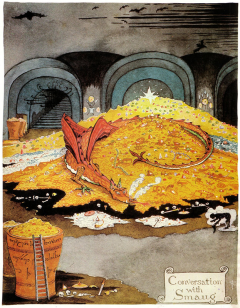
"Conversation with Smaug," by J.R.R. Tolkien ("The Hobbit"). Tolkien, who taught Anglo-Saxon at Oxford, and translated "Beowulf," drew extensively on the poem, and on the tradition to which it belongs, in his own fictional writing (image reproduced under fair usage protocols). 

[This is an Editors' Choice post, originally published on 17 August, 2017]

~~~~~~~~~~

Mark Patton blogs regularly on aspects of history and historical fiction at http://mark-patton.blogspot.co.uk. He is a published author of historical fiction and non-fiction, whose books can be purchased from Amazon.

Wednesday, July 26, 2017

Beowulf: Tales Told in Mead-Halls

By Mark Patton.

In an earlier blog-post, I looked at the remarkable survival, in a single manuscript copy of the Tenth or Eleventh Century, of the epic Anglo-Saxon poem, Beowulf. This manuscript was probably produced by Christian monks, perhaps at Malmesbury Abbey, but the poem itself is much earlier (perhaps Seventh or Eighth Century), and its context Pagan. The original poets (we don't know if there was one, or if there were many) were almost certainly illiterate, and their words memorised, handed down, and modified over several centuries in an oral tradition, much like that of Homer's Iliad and Odyssey.

The language of the poem is an early form of English, but the story that it tells takes place in Scandinavia. Neither England, Denmark, or Sweden were unified countries at the time the poem was composed. The king at whose court Beowulf was first performed (possibly Raedwald of East Anglia) may have ruled in England, but his ancestors probably came from the Nordic lands, perhaps even Geatland (part of modern Sweden), the home of the poem's hero.

The poet even tells us something about the sort of hall in which he would have performed his poems:

"The fortunes of war favoured Hrothgar.
Friends and kinsmen flocked to his ranks,
young followers, a force that grew
to be a mighty army. So his mind turned
to hall-building:he handed down orders
for men to work on a great mead-hall
meant to be a wonder of the world forever;
it would be his throne-room an there he would dispense
his God-given goods to young and old ... 
 ... And soon it stood there,
finished and ready, in full view,
the hall of halls. Heorot was the name
he had settled on it, whose utterance was law ... 
... The hall towered,
its gables high and wide and awaiting
a barbarous burning. That doom abided,
but in time it would come: the killer instinct
unleashed among in-laws, the blood-lust rampant."
(Translation by Seamus Heaney).

No such hall has survived, but archaeologists believe that they have located Hrothgar's Heorot, including the post-holes of his mead-hall, and of its surrounding buildings, at Lejre in Denmark. King Raedwald's mead-hall has not yet been found, but it was probably close to the burial-ground of his dynasty, which archaeologists have discovered, at Sutton Hoo, in Suffolk. Richard Denning has, on another post on this site, described some of the artefacts found there: some of these probably belonged to Raedwald himself, and they include fragments of a lyre which the Beowulf-poet may have used in the performance of his works.

The reconstructed great hall of Fyrkat, Denmark, some centuries later than that in which the Beowulf-poet performed. Photo: Maik Meid (licensed under CCA). 

One of the burial mounds at Sutton Hoo. Photo: Geoff Dallimore (licensed under GNU).


We will never know quite what such a performance would have sounded like, but here are two recordings that may give an intimation. In the first, Benjamin Bagby recites the opening verses of Beowulf itself; whilst, in the second, Will Rowan sings part of another Anglo-Saxon poem, Deor (a poem about a poet), to the accompaniment of a lyre similar to that found at Sutton Hoo. An epic poem such as Beowulf  typically includes tales within tales, so there would be plenty of scope for a bard to perform the various sections in different ways.

Lyre fragments from Sutton Hoo. Photo: Andreas Praefcke (image is in the Public Domain).


When archaeologists excavate the remains of a wooden building, such as the mead-hall at Lejre, or a similar structure at Yeavering in northern England, what they see, in effect, is the bare bones of a once great hall, and, if they then go on to reconstruct it (whether physically or digitally), this is generally what we ourselves see. Making things up is no part of the job-description of the archaeologist or historian.

Digital image of a great hall and associated buildings at Yeavering. Photo: Past Perfect (reproduced under Fair Use Protocols).


As historical fiction writers, however, it is fundamentally a part of our job-description to make up those aspects of the past for which evidence has not survived. In imagining a Saxon, or Danish, or Geatish mead-hall, I would look to the later Medieval wooden "stave-churches" of Norway, built and decorated, almost certainly, by the Christian descendants of the carpenters and carvers who laboured on the Pagan mead-halls.

The stave-church of Heddal, Norway. Photo: Christian Bartis (licensed under CCA).

The stave-church of Lomen, Norway. Photo: Nina Aldin Thune (licensed under GNU).

Detail of the carving in the stave-church of Urnes, Norway. Photo: Nina Aldin Thune (licensed under CCA).


As for the mead that was served, it is unlikely to have had much in common with the refined liqueur that can be purchased today at heritage sites. The mead drunk by hordes of warriors, to drown their fears on the eve of battle, was a form of ale (it was not "beer," which is flavoured with hops, not used for this purpose until a much later date). Most ale was flavoured with something - often herbs picked from hedgerows: meadowsweet, dandelion, burdock; but mead was flavoured, far more expensively, with honey, which a king such as Hrothgar or Raedwald served only to his elite warriors, his bards, his queen and her ladies.

~~~~~~~~~~

Mark Patton is a published author of historical fiction and non-fiction, whose books can be purchased from Amazon.

Tuesday, July 19, 2016

Beowulf: A Miraculous Literary Survival

By Mark Patton

The Anglo-Saxon poem, Beowulf, tells of a great hero, a prince who sails from his native Geatland (part of modern Sweden) to the court of King Hrothgar in Denmark to defeat a monster, Grendel, who has been terrorising the Danish people. Having dealt with the monster, he must also defeat its mother, who comes to Hrothgar's hall seeking revenge. Returning to Geatland in a ship laden with treasure bestowed on him by the grateful Danes, Beowulf becomes King of his people, but he will ultimately have to face a threat closer to home, a dragon that he will defeat, but only at the cost of his own life.

The poem is among the very earliest works of English literature (so early, in fact, that most of us can understand it only in translation), but that it survived at all is little short of miraculous. Previous blog-posts by Kim Rendfeld have dealt with the character of Grendel and with the blending of fiction and historical fact in the poem, but in this post I would like to explore the no-less remarkable story of the survival of the poem itself.

The manuscript of Beowulf, British Library (image is in the Public Domain).

Beowulf survives in a single manuscript, probably created by a monk at Malmesbury Abbey in the early years of the Eleventh Century. This monk may well have copied it from an earlier manuscript, which has not survived, and which may have been as early as the Eighth Century.

Malmesbury Abbey. Photo: Arpingstone (image is in the Public Domain).

The world described in the poem is clearly a Pagan one, but the poet himself (whose name we will almost certainly never know) was probably a Christian (he refers to "God" in the singular, but, doubtless as keen as any author of historical fiction to avoid anachronism, does not mention Christ). This points to the Seventh Century, when England was in transition from Paganism to Christianity, and aspects of the dialect point, more specifically, to the court of King Raedwald (reigned c599-624 AD) in East Anglia (he was born a Pagan, subsequently baptised as a Christian, but later, according to Bede, reverted to Paganism), who many believe to have been the king buried in the Sutton Hoo ship burial. The handful of historical characters mentioned in the poem, however, seem to have lived in the Sixth Century, so the "Beowulf Poet," like the Greek Homer, was almost certainly working within a pre-existing oral tradition.

Excavation of the ship-burial at Sutton Hoo (image is in the Public Domain). A similar, but not identical, funerary ritual involving a ship is described in the poem itself.
Fragments of a lyre found with the Sutton Hoo ship-burial, British Museum. Photo: Andreas Praefcke (image is in the Public Domain).

The original, oral version of the poem may have been recited or sung to the accompaniment of the instrument shown above, a reconstruction of which can be heard here.

Beowulf would probably have become one of the foundation texts of English literature had it not been for 1066 and all that. In the centuries that followed, Anglo-Saxon as a written language gradually died out, replaced by Latin and Anglo-Norman. The manuscript of Beowulf remained in a monastic library, possibly at Malmesbury, possibly elsewhere; the poem did not influence the work of Chaucer or Shakespeare, Milton or Pope, since they did not know of its existence and would not have been able to read the manuscript even if they had stumbled upon it.

With Henry VIII's dissolution of the monasteries, the contents of their libraries were scattered. The most beautifully illuminated Medieval manuscripts had obvious (and very considerable) financial value, and thus are unlikely to have been lost, but Beowulf does not fall into this category; it may have survived only because it was bound together in a volume with other, elaborately decorated works. Many other manuscripts are likely to have been burned or discarded, and we will never know, either in historical or in literary terms, quite what we lost at that moment in time.

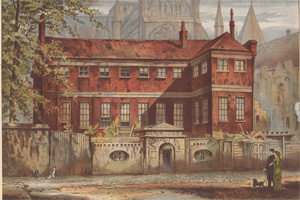
The volume containing the Beowulf manuscript was acquired by Sir Robert Bruce Cotton (1570-1631), one of the leading bibliophiles of his day, and formed part of his library at Ashburnham House close to the entrance to Westminster Abbey (the volume is referred to as "Cotton Vitellius A" because, in this library, it was on the first shelf beneath a bust of the Roman Emperor, Vitellius). Francis Bacon, Sir Walter Raleigh and James Ussher were among the scholars who worked in Cotton's library, but none of them would have been capable of reading Beowulf.

Sir Robert Bruce Cotton, by Cornelis Janssens van Ceulen (image is in the Public Domain).

Ashburnham House, Dean's Yard, Westminster (image is in the Public Domain).

Following Cotton's death, his house, including the library, was acquired by the nation as the basis of what would become the British Library. On the 23rd of October, 1731, however, a fire broke out in the building. The Keeper of the King's Libraries, Richard Bentley, rescued what manuscripts he could, and, as luck would have it, the volume including Beowulf was among these, although it was badly damaged in the fire. Ashburnham House was entirely destroyed, and with it, a great many manuscripts.

It was only with the emergence of Anglo-Saxon and Norse scholarship in the Nineteenth and early Twentieth Centuries that Beowulf once more became readable. A full transcription was made by an Icelandic scholar, Grimur Jonsson Thorkelin, in 1815, and a verse translation into modern English by Francis Barton Gummere in 1909.

In the course of my research over the past years, I have had many priceless Medieval manuscripts on my desk at the British Library, but this one I have only ever seen behind glass. Few scholars are allowed to handle it today, because the damage done by the fire of 1731 was permanent, and even, in a sense, ongoing: some of the words that Thorkelin and Gummere were able to read are no longer legible in the manuscript today. One scholar who did have access to it was J.R.R. Tolkien, and his translation, together with his scholarly notes, has recently been published by his son, Christopher. Seamus Heaney's adaptation may, in poetic terms, be preferred by many, but Tolkien's notes are invaluable to anyone who seeks truly to understand the poem, and it is also through Tolkien's own influential fiction that Beowulf, somewhat belatedly, takes its rightful place in the canon of English literature.

~~~~~~~~~~~~~

Mark Patton blogs regularly on aspects of history and historical fiction at http://mark-patton.blogspot.co.uk. His novels, Undreamed Shores, An Accidental King, and Omphalos, are published by Crooked Cat Publications, and can be purchased from Amazon. He is currently working on The Cheapside Tales, a London-based trilogy of historical novels.

Tuesday, April 5, 2016

Grendel: Pagan or Christian?

By Kim Rendfeld


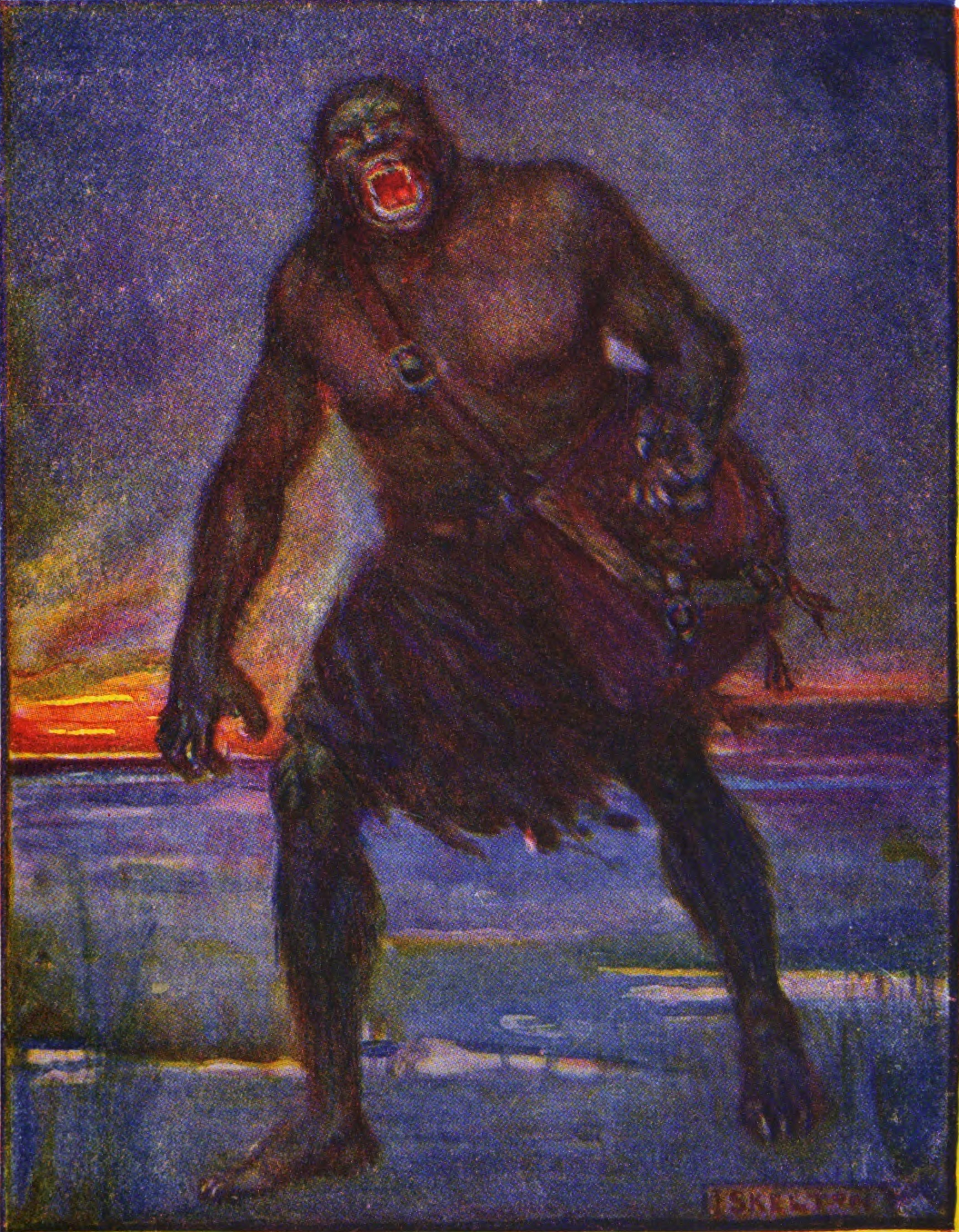
Grendel and his mother, the first two monsters Beowulf faces in the poem bearing his name, are both frightening and fascinating—and their creator blends pagan beliefs with a deep understanding of Christianity.

We might never know who penned the oldest English epic poem between the middle of the seventh century and end of the 10th, but it is proof that its author had a great intellect and great imagination, even though most people who lived in the Dark Ages could not read or write. (And like many medieval writers, Beowulf’s creator included a healthy dose of gore.)


Called a “demon,” “fiend out of hell,” and “shadow stalker,” Grendel shares many of traits of a draugr, an undead creature from Scandinavian mythology. He resents the living, wreaks murderous havoc, cannot be placated, and cannot be slain by ordinary weapons. Otherworldly beings were so real to an early medieval audience, the folk took precautions to appease or hinder them such as having a wake for the dead or burying a corpse with a Host—the presence of Christ—in their mouth.

However, Grendel is living enemy. Instead of a burial mound, he inhabits a fen.

Yet the poet bases his explanation for Grendel’s monstrosity on Christian beliefs by saying Grendel is a descendant of Cain. The poet might have read a letter from the Apostle John, who exhorts Christians to love one another and not be like Cain, not only because the character is murderous but because by that act, he became more like Satan than Adam.

So Grendel is not only the bane of Heorot Hall; he is an enemy of God. The poet calls him “God-cursed” and says he bears God’s wrath. The only way to stop Grendel is to kill him. Beowulf delivers the fatal blow by tearing off the monster’s arm while they wrestle. Grendel flees home. In the morning, the men get a good look at the disembodied limb, which is like “barbed steel,” and they realize none of their weapons would have worked.


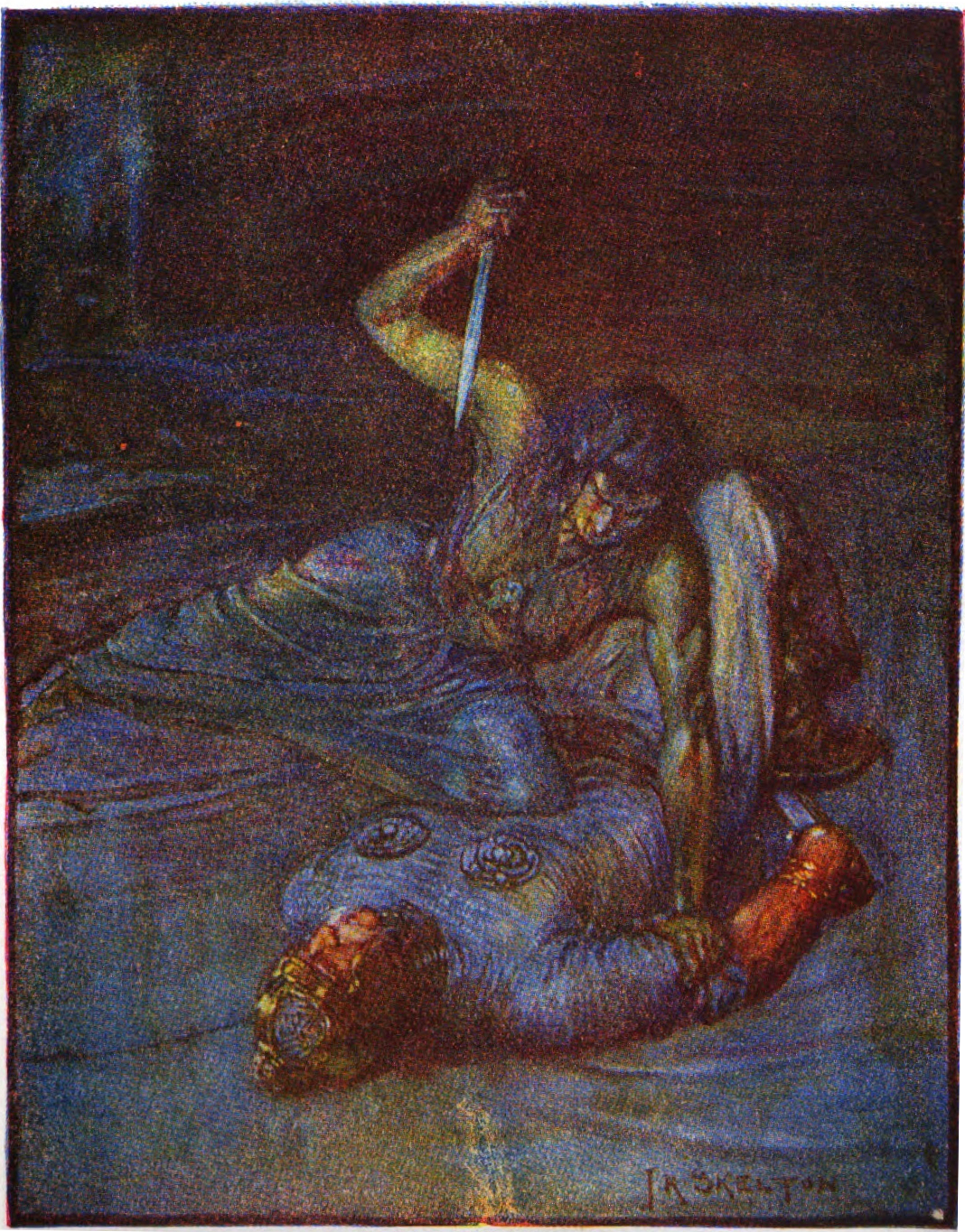
Like some draugrs, Grendel has a mother, and in her grief, she is more dangerous than her son. She doesn’t have a name, which makes her even more fearsome. In one sense, the reader can sympathize with her. Sure her only child was a monster (literally), but he was still her son. And she, like the humans, will avenge her dead loved one. She claims the king's right-hand man the very night Heorot Hall celebrates Grendel’s demise.

The only way for Beowulf to stop her is to pursue her to her underwater lair and kill her with a weapon in her hoard, another element of pagan mythology. The sword is so heavy only Beowulf can wield it, and when he uses it to claim Grendel's head a trophy, the monster’s blood is so toxic it melts the weapon to the hilt. Like a good Christian warrior, Beowulf credits God for the victory when he later recounts the fight.

With these monsters and other elements, Beowulf gives modern readers a glimpse how Christian and pagan beliefs coexisted in early medieval times.

Illustrations by J.R. Skelton (public domain, via Wikimedia Commons)

Sources

The Walking Dead: draugr and Aptrgangr in Old Norse Literature,” The Viking Answer Lady

“Beowulf’s Monsters: Comparing the Mythology of Grendel, Cain, and Satan" by Sean Hadley

Beowulf, translated by Seamus Heaney

Kim Rendfeld reread Beowulf while researching her second novel, The Ashes of Heaven’s Pillar, and she continues to be fascinated by the poem. She is also the author The Cross and the Dragon and is working on Queen of the Darkest Hour. For more about Kim and her fiction, visit kimrendfeld.com or her blog, Outtakes. You can also connect with her on Facebook and Twitter.

Monday, November 2, 2015

Anglo Saxons and Their Horses

Part One 
by Helen Hollick

Until recently, it was widely accepted that Anglo-Saxon armies consisted solely of infantry formation, horses being used only for transportation. But as Ann Hyland points out, "...this seems a complete waste of potential energy and resources" suggesting that while it is unthinkable that entire armies were mounted, wealthier men were more than capable of undertaking mounted fighting and of utilising the horse in a variety of offensive tactics, as circumstances of battle, terrain etc., dictated.

Mounted warfare during the Anglo-Saxon period is shown in sculpture and referred to in manuscripts. The Anglo-Saxon Chronicle for 937 is a record of Aethelstan's triumph over the Scots - the corresponding Croyland Chronicle on this campaign is very clear: "... and Singin unhorsed the Scottish king."

The Native British pony (the present-day breeds of Welsh, Fell, Dales, Exmoor etc.,) were enhanced during the Roman occupation by the cross breeding of new stock and bloodlines, introduced into Britain through cavalry regiments raised from countries holding established equestrian cultures and known for breeds of superior quality. The most priced war horses being the Frisian, Burgundian and Thuringian. These Roman imports would have rapidly improved British stock by adding height, bulk and speed to the already established stamina, intelligence and ability to survive a poor winter climate and sparse food. Britain had - and still has - a rich wealth of these strong and hardy ponies, some around the 12 - 13 h.h. (hands high) mark, others reaching 14.2 h.h. It is significant that the modern day Fell and Dales breeds resemble the modern Frisian, a breed of horse that was much valued in antiquity and remained highly prized in later Medieval times.

Exmoor Pony 12.2 hands *
a breed thought to be more
 than 2000 years old
Some degeneration of breeding must have occurred as the Anglo-Saxon period initially developed, once deprived of the organised resources of knowledge and trade of the Roman administration and army. But horses were still required, if not for riding, then as pack ponies and vehicle pulling. References to horses and riding run throughout the Anglo-Saxon Chronicle and are scattered among the Welsh laws of Hywel Dda (died 950) reflecting the importance of the equine among Welsh society.

Welsh Pony
 (Section C 13.2 hands *)
Giraldus (c1146 - 1223) comments that the Welsh interest in life consists of "caring for their horses and keeping their weapons in good order" and that their leaders "ride into battle on swift mettlesome horses."

Bede (died 735) relates an anecdote about Bishop Aiden, who apparently gave a gift from King Oswine, a well bred horse, to a beggar. Annoyed, the king exclaimed that a common bred horse was the more suitable offering. The love of racing among young clerics was also remarked upon by Bede.

The laws of King Ine (688 - 726) comment that the horse-wealh was held in high regard, and that he had charge of the king's stud. The position of horse-weard, the watcher of the king's horses, is also mentioned. He appears also in Æthelberht's laws (860-6). These references suggest that the horse-wealh managed a self-contained stud, where controlled breeding was practised, while the "free-range" system, stallions running freely with mares, were under the management of the horse-weard.

There are indications of the size of such studs under the Welsh laws and Anglo-Saxon wills. A brief reference from the time of Athelstan (924 - 39) mentions that he had received as a gift, 300 fine coursers and their trappings. This more than adequately shows the extent of a king's wealth in horse-flesh and implies that acquiring new blood and different breeds occurred much earlier than assumed. Previously it has been accepted that serious horse-breeding and the introduction of quality stock was a result of the Norman Conquest.

Adult riding an Exmoor
Kathy Hollick Blee riding aside
(permission of copyright granted)
Horses appear in several references in the poem Beowulf written between 680 - 800. Racing is mentioned as Danish warriors spur their bay horses renowned for speed and stamina and:

     "Then, as a sign of victory, Hrothgar, son of Healfdene
     Presented to Beowulf ....
     Eight war-horses
     With glancing bridles, one with a saddle
     Studded with stones - battle seat of the Danes."

Not to be outdone by the generosity of Hrothgar's gift, Beowulf presents four matching bays and three graceful horses, complete with brightly coloured saddles.

* a hand - unit of measurement 1 hand = 4 inches

PART TWO – THE HORSES OF 1066  - click here

Sources:

Anthony Dent and Daphne Machin Goodall
  A History of British Native Ponies  J.A.Allen 1988
  (first published 1962 under the title of The Foals of Epona)

Julian Glover (adaptation from translation by Michael Alexander and Edwin Morgan)
  Beowulf Alan Sutton 1987

Ann Hyland
  The Medieval Warhorse  Sutton Publishing 1994

Stephan Morillo
  Warfare under the Anglo-Norman Kings 1066 - 1135  Boydell Press 1994

Tim Severin:
  Crusader - By horse to Jerusalem Hutchinson 1989

Dorothy Whitlock ed and Trans
   Anglo-Saxon Wills  Oxford University Press 1930


I  explore the use of horses in the post-Roman period quite extensively in my Arthurian Pendragon's Banner Trilogy

Book One

Wednesday, September 2, 2015

Tolkien, the Battle of Finnsburg and Hengest

by Richard Denning

Battle of Finnsburg c445 A.D


Tolkien the Scholar


The Hobbit and The Lords of the Rings have quite rightly made Tolkien famous as the creator of Middle Earth. Indeed, to many those books far exceed his achievements as a Scholar.

Yet of course Tolkien was in fact a Professor of Anglo-Saxon Studies at Oxford for many years, and in that time he contributed extensively to the study of the period before and after the Anglo-Saxon (the English) race migrated across the North Sea to create a land that would one day be called England.

He would often lecture on the Battle of Finnsburg and pieces of epic poetry which are called The Fragment and the Episode. His argument was that these stories were not fiction but related to actual historical events: a real battle somewhere in what is now Holland, one of whose participants was Hengest, who, legend has it, led the first Anglo-Saxons across the sea to Kent.

Battle of Finnsburg: Background


The Battle of Finnsburgh may have taken place in the court of Finn—one of the Kings of the Frisians (a tribe that lived in what is now Holland).

Finn had a body of Jutes in exile in his land and serving him.  The battle happened when the Jutes blood enemies, the Danes, arrived.

Jutes - A Tribe from Jutland, North Denmark. One of the 3 main Anglo-Saxon Tribes that would migrate to Britain.

Danes - invaders who maybe conquered Jutland sending some into exile, creating the basis for a blood feud.

The theory Tolkien put forward was that Finn, King of the Frisians had married Hildburh the sister of Hnaef, a Danish Prince and son of Hoc the Danish King.

Hnaef went to visit his sister in Frisia and was invited to sleep in the main hall. One of Hnaef’s chief followers was an Angle (another Anglo-Saxon tribe originally from Denmark) called Hengest.

Finn had by then employed some exiled Jutes as warriors. The Jutes hated the Danes who had conquered their land.

The Jutes attacked the Danes in the hall and after a long siege broke in and killed Hnaef. Finn was obliged to back up the Jutes, but most of his warriors died.

Hengest agreed to a truce with Finn but was eventually reminded of his oath to avenge Hnaef’s death and renewed the fighting, killing Finn and destroying Finnsburgh, then taking Hnaef's sister home to her people.

Soon after this Hengest and his brother Horsa were invited into Britain as mercenaries—according to legend, the first of the English. Did this battle win him fame or notoriety and so lead to the invitation to go to Kent?

Battle of Finnsburg: The Evidence


Evidence for the Battle of Finnsburg come primarily from two pieces of Anglo-Saxon text called The Fragment and The Episode

The Fragment


This is a short, 50 line long section of epic poetry that was discovered in 1705 in  Lambeth Palace.  It starts abruptly in the middle of the action and ends also abruptly.  Yet it gives us a description of a conflict that has already burst into bloodshed.

The fragment  describes a young prince called Hnæf who along with around sixty of his men is besieged within a great hall. It goes on to name some of the participants and some of the actions in  the ensuing battle including talking about one of the attackers who is killed.  It specifically mentions that the attacker is from Frisia.

The Episode


The greatest and also one of the earliest of the epic poems in Old English is of course Beowulf which tells the story of a legendary hero who fights the monster Grendel and his mother as well as a dragon.

At one point in the epic a bard, scop or court poet  relates the tales of the Battle of Finnsburg. The language use implies that the listener would already know something of the battle—meaning that to a 7th or 8th century audience the battle was familiar.

The scop's story  starts with Hildeburh, daughter of the Danish King Hoc and brother to Hnaef lamenting the loss of her brother and her son through Finn, King of the Frisians who was also killed in the fighting.

The picture given is that of a battle between Danes on one side and Jutes and Frisians on the other and where there are heavy losses on both sides. It is this tale from which we hear of the peace deal struck between Hengest (left in charge of the Danes after Hnaef is killed) and Finn. Later a warrior places a sword on Hengest’s lap. The sword may have been that upon which Hengest swore fealty to Hnaef. The implication was that Hengetst was duty bound to renew the fighting to avenge Hnaef.

In the ensuing fighting Finn and his entire remaining force are destroyed in what is called the Frisian slaughter. After this the Danes return home led by Hengest

The same man?


Tolkien and other scholars have speculated that Hengest of the Battle of Finnsburg is the same as the Hengest who led his men across the sea to Kent, the first of all the Anglo Saxons (according to the Anglo-Saxon Chronicle entry below).

A.D. 449. This year ...Hengest and Horsa, invited by Vortigern, King of the Britons to his assistance, landed in Britain in a place that is called Ipwinesfleet, first of all to support the Britons, but they afterwards fought against them. …. They then sent to the Angles and desired them to send more assistance. They described the worthlessness of the Britons and the richness of the land.  (Anglo –Saxon Chronicle)


For most people these poems are obscure references to legendary times, but to Tolkien and other scholars The Fragment and the Episode are part of the earliest history of England, relating to the background of one of the founders of the earliest English Kingdom, Kent.

Many scholars will say that we have little evidence of Hengest and Horsa and really cant be sure of any of this, but in the accounts of the battle of Finnsburg I believe you see part of what led Hengest to go to England. Did he make his name in this fight? Did he make enemies to avoid? Did he loose face at the Danish court and choose to gamble all on an adventure across the sea?

The Fragments and the Episode tease and suggest answers but don't quite tell enough. But we can have fun speculating.

~~~~~~~~~~~~~

Richard Denning is a historical fiction author whose main period of interest is the Early Anglo-Saxon Era. His Northern Crown series explores the late 6th and early 7th centuries through the eyes of a young Saxon lord.

Explore the darkest years of the dark ages with Cerdic.

www.richarddenning.co.uk

Amazon


Monday, April 21, 2014

Beowulf: Is the Oldest English Epic Historical Fiction?

By Kim Rendfeld


Was Beowulf the product of a poet’s lively imagination? Borrowed from tales told by the fire? Based on actual historical events? The more I look into the origins of oldest epic in the English language, the more I believe it is a combination of all of the above.

Beowulf was composed somewhere between the middle of the seventh century and end of the 10th, a period that overlaps with the migration of peoples who lived in Germany and Scandinavia. Faithful readers of the poem will remember that it’s set in Scandinavia, so it should come as no surprise that the migrants took their stories with them. They maintained cultural ties to the Baltic in the fifth and sixth centuries, and Anglo-Scandinavian trade in glass claw beakers (fancy drinking vessels) continued into the seventh.

The folk might have told tales about a ruler’s death in battle on a foreign land. They might have made references to a sixth century enemy from today’s Sweden. They might have woven in objects from daily life such as harps and helmets. If the purpose was to entertain rather than educate during long winter nights, someone might have embellished the tale with a hero and monsters.

A reenactor displays some replicas of grave goods
from the Sutton Hoo ship-burial
Photo by Ziko van Dijk
Today, we have tantalizing clues to where the poet borrowed from history. Gregory of Tours’s History of the Franks recounts a Danish-Frankish war, estimated to have occurred around 523, in which the Danish king was killed – similar to passages describing the death of Hygelac, Beowulf’s kinsman. A high-status burial mound in Sweden may be the final resting place of Ohthere, a king who is named a few times in the poem. Artifacts from Sutton Hoo are consistent with objects mentioned in the epic.

We might never know the true origin of the oldest epic in the English language and will likely never know who wrote it. But even with its mysteries, it reveals something valuable: the culture of its writer.

Through the poem, we see that the characters in Beowulf are Christian but practice their faith differently than most modern day believers. They are much more interested in justice than mercy. When Grendel, the monster descended from Cain, wreaks havoc, they want vengeance. The pagan influence was still strong. The image of boars on a helmet was a sign of strength as well as a beast sacred to a god, and the characters burned their dead, piling grave goods on the pyre.

Whoever wrote Beowulf likely meant to entertain his contemporaries, perhaps even a lord looking for a diversion or claiming descent from the hero to assert power, but the poet left a gift for all generations.

Sources

Beowulf, translated by Seamus Heaney (very good reading, even if you’re not doing research)

The Origins of Beowulf: And the Pre-Viking Kingdom of East Anglia, by Sam Newton

Formation and Resolution of Ideological Contrast in the Early History of Scandinavia (PhD thesis) Carl Edlund Anderson. University of Cambridge, Department of Anglo-Saxon, Norse & Celtic (Faculty of English)

Images via Wikimedia Commons in the public domain or used under the terms of the GNU Free Documentation License.

Kim Rendfeld studied Beowulf in college and rediscovered the epic poem as she was researching her second novel, The Ashes of Heaven’s Pillar (August 28, 2014, Fireship Press), a tale of the lengths a medieval mother with go to protect her children when she’s lost everything else. Her latest release is a companion to The Cross and the Dragon (2012, Fireship Press), a tale of love amid the wars and bloods of Charlemagne’s reign. For more about Kim visit her blog, Outtakes of a Historical Novelist, at kimrendfeld.wordpress.com or her website, kimrendfeld.com or send an e-mail to kim [at] kimrendfeld [dot] com.

Tuesday, May 7, 2013

Alfred the Great and the Importance of the Oath

by Rosanne E. Lortz


On the list of English kings, only one has the honor to be called “the Great.” What was it that made Alfred of Wessex such an unforgettable monarch? How did he achieve the title that no subsequent English king has ever received?

Alfred’s military exploits are one possible reason for the title. During his reign of twenty-eight years, he brought back the realm of Wessex from near extinction, fighting off several Danish invasions and establishing himself as the high king of the Anglo-Saxons. His most memorable victory was at the Battle of Edington in 878, where he defeated a Danish host led by Guthrum, forcing the Danes to sign a treaty where they would withdraw from Alfred’s domains and convert to the Christian religion.

Alfred’s educational reform and literary achievements are another possible reason for the title. The previous century had seen a great decline in the literacy of the British Isles, with Latin being completely forgotten and only a few still remembering how to read in the Anglo-Saxon language. Alfred imported scholars from the continent and set up schools to teach his people their letters. Always one to lead by example, he mastered the difficult Latin language himself and then set about translating important works himself into the popular tongue.


But out of all the reasons why Alfred might be considered “the Great,” the one that I want to focus on today is the law code that he created for the Anglo-Saxons, a seminal work that would influence the laws of England and the nations she colonized for centuries to come.

William of Malmesbury, writing several centuries later, tells us that Alfred, “amid the din of war, enacted statutes....” In the midst of battle, rape, and pillage, Alfred strove to establish a society where those things would not occur, and he did this by means of law.

The importance of Alfred’s law code does not lie in its originality. The introduction contains a translation of the Ten Commandments, a recital of many of the case laws in the book of Exodus, an excerpt of Christ’s Sermon on the Mount, and a history of the Apostles with quotes from the book of Acts. Some historians have seen in this Alfred’s attempts to show how the Old Testament laws should be contextualized in an Anglo-Saxon society.

The historian F.N. Lee notes that:
Alfred had already: first re-enjoined the Decalogue or the Ten Commandments (Exodus 20:1-17); then illustrated their concrete application by way of case law (Exodus 21:1 to 23:9); and next assured his readers that Christ had not come to break the Ten Commandments, but to approve them well (Matthew 5:5-19). Indeed, Alfred had then gone on, together with all of Christ's Twelve Apostles, to enjoin…God's Law for man. This is seen quite clearly in the apostolic prohibitions enjoining abstinence from idolatry, bloodshed and fornication (Acts 15:23-29). 
Clearly, then, Alfred believed that the Apostles here (at the Synod of Jerusalem or the first General Assembly of the Christian Church) enjoined God's Commandments upon all of the Gentile [non-Jewish] Christians who had heard it—and who indeed should keep it.
Alfred, by quoting extensively from certain Scripture passages, was making an argument that Biblical law should be kept by the Anglo-Saxons. Following his introduction, Alfred continues his non-originality by quoting laws given by earlier kings.
Now I, King Alfred, have collected these laws, and have given orders for copies to be made of many of those which our predecessors observed, and which I myself approved.... I have not dared to presume to set down in writing much of my own; for I cannot tell what [innovations of mine] will meet with the approval of our successors. But those which were the most just of the laws I found—whether they dated from the time of Ina my kinsman, or of Offa King of the Mercians, or of Aethelberht who was the first [Anglo-Saxon or Anglo-Jutish king] to be baptized in England—these I have collected....
One can only assume that Alfred used the criteria of Biblical law (as outlined at length in his introduction) to determine which of his predecessors' laws were "most just" and should be included. The laws of these previous monarchs include all sorts of subjects—murder, maiming, perjury, theft—but when Alfred does finally launch into promulgating new laws of his own, the first law he gives is most instructive.
Of oaths and of weds [pledges]. 
1. At the first we teach, that it is most needful that every man warily keep his oath and his wed [pledge]. If anyone be constrained to either of these wrongfully, either to treason against his lord, or to any unlawful aid; then it is juster to belie than to fulfill. But if he pledge himself to that which it is lawful to fulfill, and in that belie himself, let him submissively deliver up his weapon and his goods to the keeping of his friends, and be in prison forty days…. Let him there suffer whatever the bishop may prescribe to him; and let his kinsmen feed him, if he himself have no food…. But if he escape, let him be held a fugitive, and be excommunicate of all Christ's churches….
In Alfred’s mind, the “most needful” thing in the kingdom was for men to keep their word. It was good faith and trust between men that built the fabric of a stable society. Peace, commerce, and learning were only possible in a world where a man’s word was his bond.

The Anglo-Saxon society was one plagued by failure to keep oaths. The epic poem Beowulf records a story of a truce made and broken between the Danes and the Frisians.
So, a truce was offered…
Both sides then sealed their agreement.
With oaths to Hengest, Finn swore
Openly, solemnly, that the battle survivors
Would be guaranteed honor and status.
No infringement by word or deed,
No provocation would be permitted. 
It is only a few lines later that the “unpermitted provocations” occur, and the truce is broken in violent bloodshed.
…longing woke
In the cooped up exile for a voyage home—
But more for vengeance, some way of bringing
Things to a head: his sword arm hankered
To greet the Jutes…
Thus blood was spilled….
This sort of oath-breaking was commonplace in the Anglo-Saxon world—and not just betrayal between two people groups, but also betrayal of a lord by his men. At the end of the epic, when Beowulf’s sword fails to cut through the dragon’s scales, his servant Wiglaf exhorts the other men to go help their lord!
“I remember that time when mead was flowing,
How we pledged loyalty to our lord in the hall,
Promised our ring-giver we would be worth our price,
Make good the gift of the war-gear,
Those swords and helmets, as and when
His need required… 
…now the day has come
When this lord we serve needs sound men
To give him their support. Let us go to him,
Help our leader through the hot flame
And dread of the fire….”
Unfortunately, rather than keep their oaths to Beowulf, the men ignore Wiglaf’s entreaties and leave their ring-giver to his fate.

Beowulf manuscript

Alfred’s world was beset with the same rampant oath-breaking that we see in Beowulf. Benjamin Merkle, in his biography The White Horse King, writes:
To understand the significance of oath-keeping to the king of Wessex, one need only think back on the many times when the integrity and strength of Alfred’s shieldwall during the crushing combat depended on the faithfulness of the oaths that his thegns had pledged during those less-dangerous moments of feasting and boasting in the mead hall. Similarly, one can remember the habitual treachery of the pagan Vikings, whose unctuous pledges of peace were disregarded by the Danes within hours of making the pledge. 
These “unctuous pledges of peace” were the bane of Alfred’s existence when dealing with the Danes. Two years prior to the Battle of Edington, Bishop Asser’s Life of King Alfred records that this same warband led by Guthrum had made a treaty with Alfred at Wareham,
to the effect that they should depart out of the kingdom, and for this they made no hesitation to give as many hostages as he named; also they swore an oath over the Christian relics…that they would depart speedily from the kingdom. But they again practiced their usual treachery, and caring nothing for the hostages or their oaths, they broke the treaty, and sallying forth by night, slew all the horsemen that the king had round him….
Alfred, King of the Saxons - silver penny
This earlier betrayal would undoubtedly have been in the back of Alfred’s mind when he parleyed with Guthrum after the Battle of Edington, but nevertheless, Alfred—determined to show the importance of an oath—still swore the treaty. And Guthrum, surprisingly, kept it. Over the course of the next few years, some of Guthrum’s nobles again resumed their depredations, but Guthrum refrained from attacking Alfred’s borders or breaking his baptismal vows.

Alfred, through legislation and through personal example, was resolved to make his country a place where false witness would not be borne. Merkle sums it up well when he says:
By giving so much weight to truthfulness in oath-making…Alfred helped to ensure that no man could break his oath without dire consequences.  If a man was found to have sworn falsely, he would be ostracized from society, losing his right to weapons, to property, and even to testify to his own innocence in court.  Thus, the men of Alfred’s day took great care to ensure that they did not make careless oaths or pledges.
There is, perhaps, little of originality in Alfred’s law code, but the preeminence he gives to a man’s oath had a powerful impact on his culture, and it is this law—the foundation for law in England and the countries she colonized—that can be considered the main reason why Alfred of Wessex is called “the Great.”
~~~~~~~~~~~~

Rosanne E. Lortz is the author of two books: I Serve: A Novel of the Black Prince, a historical adventure/romance set during the Hundred Years' War, and Road from the West: Book I of the Chronicles of Tancred, the beginning of a trilogy which takes place during the First Crusade.

You can learn more about Rosanne's books at her Official Author Website where she also blogs about writing, mothering, and things historical.

_________________________________

BIBLIOGRAPHY

Asser. The Life of King Alfred. Trans. J.A. Giles. http://omacl.org/KingAlfred/ (accessed May 6, 2013).

Heaney, Seamus, trans. Beowulf. New York: W.W. Norton & Company, 2000.'

Lee, F.N. "King Alfred the Great and Our Common Law." http://www.dr-fnlee.org/docs6/alfred/alfred.pdf (accessed May 6, 2013).

Merkle, Benjamin. The White Horse King: The Life of Alfred the Great. Nashville, TN: Thomas Nelson, 2009.

William of Malmesbury. The Kings before the Norman Conquest. Trans. Joseph Stephenson. Wales: Llancerch, 1989.