Showing posts with label medieval saints. Show all posts

Thursday, August 18, 2016

Saint Wilgils: A Conversion That Goes Beyond Serious

By Kim Rendfeld


Saint Wilgils probably was born a pagan, but once he converted to Christianity, the faith dictated his life.

Wilgils, a householder in Northumbria, was likely born in the 630s, a turbulent time for both politics and religion. King Edwin, who had accepted baptism in 627, supported efforts to convert the population to Christianity, but those efforts were cut short in 633, when Edwin was slain in battle and a pagan was crowned king.

The folk might have seen Edwin’s death as a divine sign to return to their old gods, who determined what side won the war and whether the harvest would be plentiful or meager. Many converts never stopped believing in their pagan deities despite their baptismal vows. Early medieval Christians went to Mass and celebrated holidays, but they maintained pagan rituals, especially for healing or to ensure a good crop.

Then Oswald, a Christian, decided to come out of exile and seize the throne. (Some of you might remember Oswald from a recent EHFA post by Matthew Harffy; a link to his post is in my sources.) Oswald indeed won the kingdom around 634 and believed he owed his victory to Christ. He showed his gratitude by backing missionaries. Saint Aidan was appointed bishop and travelled throughout the country.
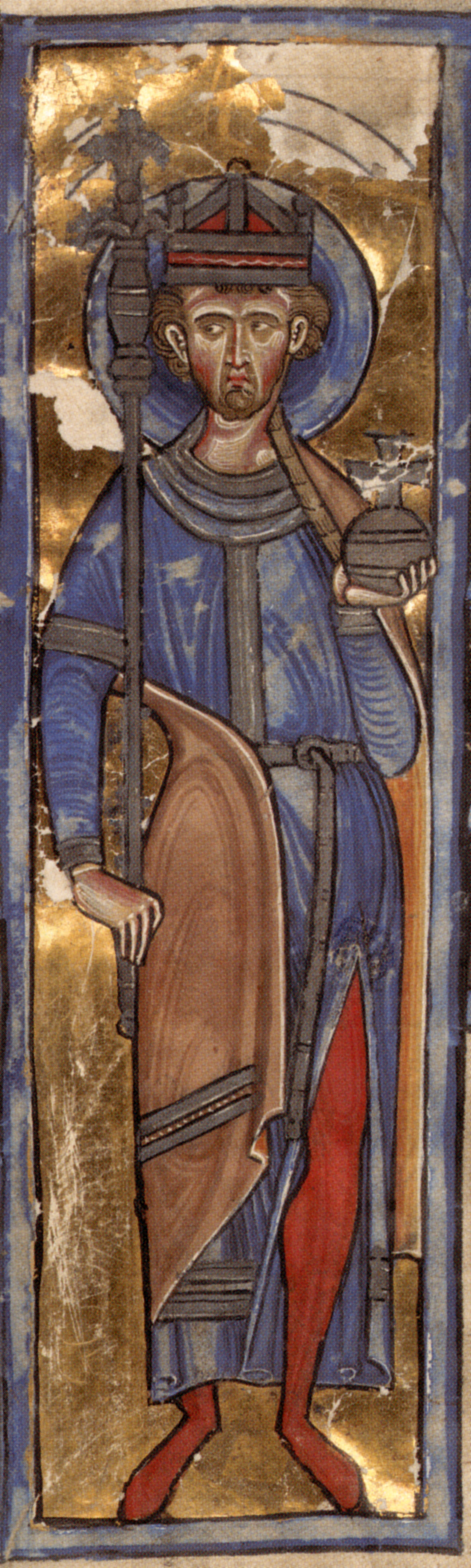
King Oswald of Northumbria,
from a circa 1220 manuscript
(public domain,
via Wikimedia Commons)
We can only guess at how the priests’ teachings impressed the young Wilgils. Alcuin’s hagiography of Wilgils’s son, the source of most information, says nothing of Wilgils’s childhood. Perhaps, Wilgils’s family believed Oswald’s God was the stronger deity and decided to accept Christianity.

Wilgils was more devout than the typical Christian. In an age when most people couldn’t read and a Bible cost much more than a herd of sheep, most of the laity understood only what the priests told them and what they could see in the statuary and murals.

If we are to believe Alcuin, Wilgils got married solely to beget “a child who should benefit many peoples.”

Even by early medieval standards, this is an unusual reason to wed. Among aristocrats, marriage was to forge or solidify alliances and increase wealth. For commoners such as Wilgils, families were seeking good in-laws. The family of a daughter sought a fellow who would provide for his wife and kids. The bachelor, or his parents, sought a young woman to take care of the house and rear the children. If husband and wife were fond of each other, that was nice but not the primary reason for the union.

If Wilgils was so moved by religious belief, why didn’t he forgo marriage and join a monastery? Did he find a young woman as zealous as he was?

Alcuin doesn’t tell us much about Wilgils’s wife. Even her name is a mystery. But he says the couple was devout. And, as is common in hagiographies, the woman had a prophetic dream. In this case, she saw the new moon increase to full, and then it fell into her mouth. She swallowed it, and her bosom was suffused with light. She asked a priest for an interpretation and was told the vision meant the son she had conceived that night would bring light to those in the darkness of error and attract the multitudes.

The couple’s son, Willibrord, was born on November 6, 658, or thereabouts. When he was a young boy—the typical age to send a child to school was 7—he was given to the church at Ripon.

Saint Willibrord, photo by Jwh
at Wikipedia Luxembourg (CC BY-SA 3.0 lu,
via Wikimedia Commons)
Were there tears from parents or son? Did the parents have any second thoughts? Were they sad but accepting the will of God? Did this cause a strain on the marriage? The hagiography answers none of these questions. We don’t know if the parents ever saw their son again.

For the parents, the sacrifice went beyond emotions. Sending their son away meant he could not help them cultivate land or raise livestock. Their act, though, was more than religious devotion. Willibrord now had a chance to get an education and set himself on the path to rule a bishopric or abbey.

If Wilgils and his wife’s whole purpose was to bring into the world a holy man who would minister to many, they succeeded. As an adult, Willibrord was called to be a missionary and crossed the Channel.

His parents remained in Britain. Later in life, presumably after his wife died, Wilgils joined a monastery. Perhaps, he was grieving and seeking solace. Or maybe he’d always been drawn to the clergy and was free to pursue it as a widower.

Wilgils embraced the monastic life. More than embraced it. It didn’t take long for him to decide what he really needed was solitude and an even more austere lifestyle. So he probably traveled for days to a promontory where the Humber River meets the North Sea, today’s Spurn Point. There, he became a hermit.

Spurn Point, 1979, photo copyrighted by Stanley Howe
(used under the terms of CC BY-SA 2.0,
via Wikimedia Commons)
In modern times, the spit of land is a nature preserve. The sea side has chalk grassland, sand dunes, and beaches. The estuary has mud flats. It looks like a nice place to visit, but even by early medieval standards, it was far from civilization.

Nevertheless, Wilgils built a chapel and dedicated it to Saint Andrew. He fasted and prayed, but the solitude he longed for proved elusive. People flocked to him, and he instructed them in the faith. He attracted the attention of the king and aristocrats, who donated land in the area so that Wilgils could build a church. At that church, Wilgils started a small but devout community of religious men.

His legacy would be twofold. The religious community would last past his death, and his famous son, Willibrord, would become the apostle of Frisia, preaching in dangerous lands and becoming embroiled in Frankish politics.

Sources

Medieval Sourcebook: Alcuin’s The Life of Saint Willibrord

The Christians Are Coming! (The Islands of Iona and Lindisfarne)” by Matthew Harffy, English Historical Fiction Authors

England’s North East

Alcuin of York, by George Forrest Browne

The Lost Towns of the Yorkshire Coast, Thomas Sheppard

Visit Hull and East Yorkshire

Kim Rendfeld is the author of two novels set in early medieval Francia and is working on a third. In The Cross and the Dragon, Alda, a young Frankish noblewoman, must contend with a vengeful jilted suitor and the fear of losing her husband in battle. In The Ashes of Heaven's Pillar, Saxon peasant Leova will go to great lengths to protect her children after she's lost everything else.

The Cross and the Dragon was rereleased August 3, 2016, in print and ebook formats. You can order the book at Amazon, Kobo, iTunes, Barnes and Noble, Smashwords, CreateSpace, and other vendors. The Ashes of Heaven's Pillar will be rereleased in November 2016. Preorders are available at Kobo, Barnes and Noble, and iTunes. It will soon be available on Amazon.

Monday, November 24, 2014

A Fight over Who Gets the Martyr's Relics

By Kim Rendfeld


St. Boniface would have never wanted the dispute that followed his martyrdom in 754. Two of his disciples, Sts. Lull and Sturm, wanted his remains.

The stakes were high. Martyr’s relics were attributed with miraculous powers, and churches that housed them attracted pilgrims and their alms.

Lull, the Wessex-born archbishop of Mainz, and Sturm, the Bavarian-born founding abbot of Fulda, had been close to the martyr.

The 11th century Sacramentary of Fulda
shows Boniface baptizing
converts and being martyred.
Sturm and Boniface had met in Bavaria when Sturm was a boy. With his parents' permission, Sturm traveled with Boniface to Fritzlar, where he was left in the care of that abbot and became a priest in the 730s. At Boniface's urging, Sturm spent nine years in the wilderness, seeking the perfect site for a new monastery. Boniface then persuaded the Frankish mayor of the palace to donate the land and blessed the site for Fulda in 744.

Lull had met Boniface, also a native of Wessex, in the 730s while Lull was on a pilgrimage to Rome. Lull had been a monk at Malmesbury but was persuaded to join the monastery at Fritzlar, which Boniface had founded. Boniface must have been impressed with Lull. He consecrated him as a bishop about 753 and later chose Lull as his successor as the archbishop of Mainz. Boniface went out of his way for Lull to be accepted and even wrote to Fulrad, the influential abbot of St. Dennis, to convince Pepin to look favorably on Lull’s new position.

Boniface left the safety of Mainz for the dangerous mission to Frisia, where pagans slaughtered him and his companions. If we are to believe Eigil, Sturm's hagiographer, Boniface weighed in a couple of times on where his body should rest. As always, I leave to the reader to decide the veracity.

When Boniface and his slain followers were taken to Utrecht, the companions' bodies were buried, but the locals were unable to lift Boniface's bier. They took that as a sign to send the martyr elsewhere. Once they made that realization, the body was easily moved and loaded onto a boat that went to Mainz.

At Mainz, Lull claimed the relics for his city, but Sturm had rushed there and argued that Boniface had said during his life that he wanted to be entombed at Fulda. The two places were very different. At the time, Mainz was almost 800 years old, dating back to the Romans. Fulda was only 10 years old, founded in the middle of nowhere.

Boniface again stepped in. Appearing in a deacon's dream, he asked why his journey to Fulda was delayed. Lull refused to believe it until the deacon swore on the altar.

So Boniface was taken to Fulda, and the monastery thrived.

Lull gave up the fight on the relics, but he retaliated. Three of his supporters told Frankish King Pepin that Sturm was disloyal. The abbot of Fulda didn't defend himself, saying he would put his trust in God.

Sturm and some companions were exiled for two years to the abbey of Jumièges and treated well, but the monks at Fulda were unhappy, especially with their abbey now under Lull's jurisdiction. When they rejected the abbot he appointed, the archbishop conceded and let them choose one of their own. They did so with the sole purpose of bringing Sturm home. Soon monks, along with nuns at convents and the faithful at other churches, were praying.

Boniface’s tomb at Fulda.
The prayers worked. Pepin summoned Sturm and said he had forgotten what they were quarreling over. When Sturm affirmed his loyalty, he returned to Fulda, which was no longer under Lull’s authority, and oversaw construction and decorated Boniface's tomb.

The relics were the monastery’s greatest treasure. They were so valued that when the monks feared an attack from pagan Saxons in 778, they removed the relics and fled to the forest. After three days in tents, they got word that the locals had fended off the attack and it was safe to return.

Perhaps, Boniface would have been heartened by what Sturm said on his deathbed in 779. “Pray to God for me,” he said to his brothers, “and if I have committed any fault among you through human frailty or wronged anyone unjustly, forgive me as I also forgive all those who have offended or wronged me, including Lull, who always took sides against me.”

Public domain images via Wikimedia Commons

Sources:

Eigil’s Life of Sturm

Athelstan Museum

Francis Mershman, "St. Boniface," The Catholic Encyclopedia

Rev. Alban Butler, The Lives of the Saints

Joseph Lins, "Mainz," The Catholic Encyclopedia

~~~~~~~~~~~~~

Sturm makes a brief appearance in Kim Rendfeld’s latest release, The Ashes of Heaven’s Pillar (2014, Fireship Press), a story of a Saxon mother and the lengths she will go to protect her children.

To read the first chapters of Ashes or Kim’s debut, The Cross and the Dragon (2012, Fireship Press), or learn more about her, visit kimrendfeld.com or her blog Outtakes of a Historical Novelist at kimrendfeld.wordpress.com. You can also like her on Facebook at facebook.com/authorkimrendfeld, follow her on Twitter at @kimrendfeld, or contact her at kim [at] kimrendfeld [dot] com.

Kim's book are available at Amazon, Barnes & Noble, and other retailers.