Showing posts with label Whitby Abbey. Show all posts

Wednesday, January 17, 2018

Ælfflæd: An Abbess Who Was Always a Princess

By Kim Rendfeld


Ælfflæd’s life was decided in her father’s battle against the Mercians in 655. Northumbrian King Oswiu made a promise: if God granted him victory, he would give land and his 1-year-old daughter to the Church. Ælfflæd would never be a queen, but she wielded royal power.

When she was an infant, Ælfflæd was commended to the care of her mother’s kinswoman Hild, abbess of Hartlepool. Two years later, Hild founded the double monastery of Whitby with the donated land, and she and the toddler took up residence there.

Because of her father’s decision, Ælfflæd was no longer eligible for a political marriage. Probably not a bad thing in this family. Elder half-sister Alhflæd might have had something to do with the death of her husband, the son of the ruler Oswiu killed in battle. Her full sister, Osthryth, later married to a Mercian king, was murdered by Mercian nobles.

Ælfflæd grew up in Whitby, a center for learning and a cradle of bishops. While Ælfflæd was still a child, the abbey hosted the Synod of Whitby in 664 to decide whether the Church should practice Christianity like the Romans or the Celts. The two sides disagreed on many things such as the date for Easter and how tonsures should be shaped. Ælfflæd’s own parents were on different sides—her father favored the Celts while her mother supported the Romans. The Roman way prevailed.


At the abbey, Ælfflæd would become a teacher and was probably being groomed to succeed Hild. It was common for an abbey to pass from aunt to niece or another female relative. As an aristocrat, Ælfflæd was expected to lead.

After Oswiu died in 670, Ælfflæd’s widowed mother, Eanflæd, joined her daughter at Whitby. Eanflæd and Hild apparently were close in childhood, baptized together in 627. When Hild died in 680, Ælfflæd and Eanflæd jointly ruled the double monastery. Eanflæd died after 685, and Ælfflæd assumed sole rule until her death in 714.

And rule she did.

Ælfflæd might have played a role in one of Hild’s pupils becoming a bishop. She commissioned the Life of Gregory, a hagiography written by one of her monks or nuns, and oversaw the translation of her grandfather King Edwin’s relics to Whitby. She was influential enough to write to a continental abbess of behalf of religious women pilgrims. And she was a close friend of the holy man Cuthbert. One story has a linen girdle Cuthbert sent miraculously healing her of an illness that left her paralyzed. About 684, she consulted with him on a matter close to her heart.
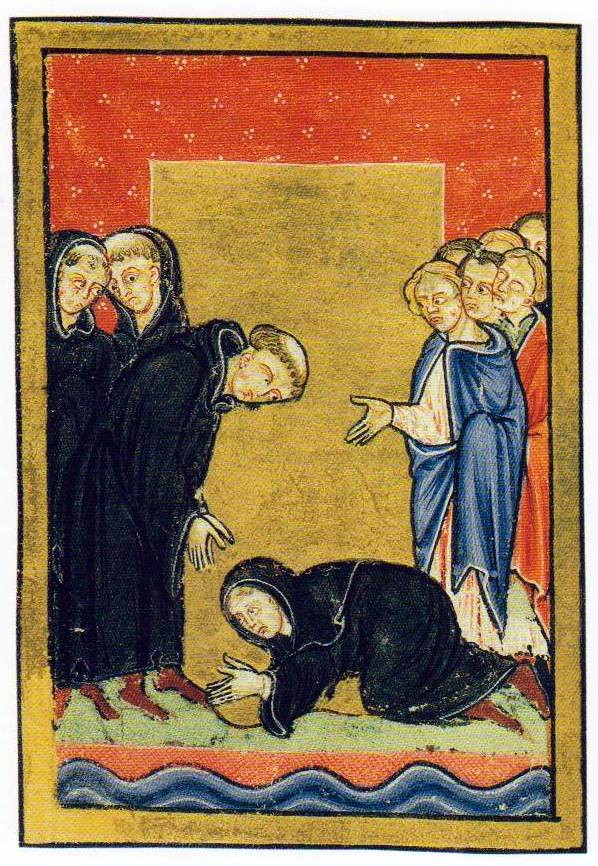


She might have been concerned that her brother Ecgfrith, her father’s successor as king of Northumbria, had no sons. Ecgfrith’s first marriage with Etheldreda ended with her following her dream to be a nun, at the urging of Bishop Wilfrid (whom Hild also disliked), and her brother’s second marriage had yet to produce heirs. If we are to believe Cuthbert’s hagiography—and that’s a big if—Cuthbert reminded her that she had a half-brother born out of wedlock before her father’s first marriage. I have a feeling Ælfflæd knew all along and was testing Cuthbert’s loyalty.

Cuthbert was appointed a bishop of Lindisfarne soon after the meeting. Supposedly, he didn’t want the office. It would not surprise me if Ælfflæd played a role the decision.

Ecgfrith died in a disastrous battle in 685, and half-brother Aldfrith, a man in his 50s, ascended to the throne. Although she did not wear a crown, Ælfflæd was someone to reckon with when it came to making peace between Aldfrith and Wilfrid. The archbishop seeking the reconciliation wrote to both the king and his sister. Apparently brother and sister were close, and she had a streak of pragmatism.

When Aldfrith died at the end of his 20-year reign, he had an 8-year-old son, Osred. A rival named Eadwulf seized the throne but was expelled two months later, thanks to teamwork from Ælfflæd, Wilfrid, and a nobleman. Ælfflæd testified that Aldfrith wished for his successor to reconcile the royal family with Wilfrid, and Osred became Wilfrid’s adopted son and king. The next year, Wilfrid didn’t get the See of York as he wanted but he was allow to retain two churches and named a bishop.

With her combination of piety, education, and savvy, it is little wonder her contemporaries called her “a wise woman and learned in the Holy Scripture” and “ever the comforter and best counsellor of the whole kingdom.”

Public domain images via Wikimedia Commons.

Sources

“Ælfflæd (654–714)” by Alan Thacker, Oxford Dictionary of National Biography

“Osred I (696x8–716)” by David Rollason, Oxford Dictionary of National Biography

Bede’s Life of Cuthbert

Beda: A Journey to the Seven Kingdoms at the Time of Bede by Henrietta Leyser

The Earliest English Kings by D. P. Kirby

Double Agents: Women and Clerical Culture in Anglo-Saxon England, by Clare Lees, Gillian Overing

Motherhood and Mothering in Anglo-Saxon England by M. Dockray-Miller

Prayer and Thought in Monastic Tradition: Essays in Honour of Benedicta Ward SLG edited by Santha Bhattacharji, Dominic Mattos, Rowan Williams

A Handbook of Anglo-Saxon Studies, edited by Jacqueline Stodnick, Renée Trilling


~~~~~~~~~~

Kim Rendfeld has written two novels set in 8th century Europe. In The Cross and the Dragon, a Frankish noblewoman must contend with a jilted suitor and the fear of losing her husband (available on Amazon). In The Ashes of Heaven's Pillar, a Saxon peasant will fight for her children after losing everything else (available on Amazon). Her short story “Betrothed to the Red Dragon,” about Guinevere’s decision to marry Arthur, is set in early medieval Britain and available on Amazon.

Connect with Kim at on her website kimrendfeld.com, her blog, Outtakes of a Historical Novelist at kimrendfeld.wordpress.com, on Facebook at facebook.com/authorkimrendfeld, or follow her on Twitter at @kimrendfeld.


Thursday, August 22, 2013

The Haunting Power of Whitby Abbey

by Nancy Bilyeau


I have a passion for abbey ruins. Part of the reason is that I am writing a thriller trilogy set during the Dissolution of the Monasteries, and through my research I've discovered fascinating things about the world inhabited by my protagonist, a Dominican novice, in Dartford. But every ruin has a story to tell, and few are as enthralling as Whitby, in north Yorkshire.


THE FOUNDING: The first religious establishment on the site sprang up during Christianity's infancy in Britain. The founding abbess was Hilda (or Hild), a princess born in 614. She was the great-niece of King Edwin of Northumbria. After her father was poisoned in a court plot, she was brought up in the royal family, baptized by Paulinus, a  Roman missionary.

Inspired by her sister, who became a nun, Hilda chose a religious life and became an abbess. When she was about 40, Hilda became the abbess at Streoneshalh, named after a Roman tower (later known as Whitby). She created a double monastery of Celtic monks and nuns, who studied the scriptures and performed good works. Her wisdom was so respected that the first synod of 664 was held there.

St Hilda
It is said that given a choice between Celtic religious laws and those of Rome, the majority voted for Rome at the synod. The Celtic influence--and the female leadership--faded at Whitby and at other monasteries in the early medieval age.

Hilda died on November 17, 680. She was made a saint and her relics were transferred to Glastonbury by a king.

For centuries, visitors have sworn that they see Hilda when they visit the abbey. Lionel Charlton, in his 1779 History of Whitby, writes:

"At a particular time of the year, in the summer months, at ten or eleven in the forenoon, the sunbeams fall in the inside of the northern part of the choir; and 'tis then that the spectators who stand on the west side of Whitby churchyard, so as just to see the most northerly part of the abbey, imagine that they perceive in one of the highest windows there the resemblance of a woman, arrayed in a shroud. Though we are certain that it is only a reflection caused by the splendor of the sun's beams, yet it is commonly believed to be an appearance of Lady Hilda, in her shroud."
More happily it is said that when sea birds fly by the abbey, they dip their wings in honor of St. Hilda.


THE ORDER:  Hilda's monastery did not last--Viking raids in the late 9th century wiped out the monks and destroyed the structure. For 200 years the place by the sea was desolate.

A soldier serving William the Conqueror named Reinfrid became a monk and discovered the crumbling monastery. William de Percy, the first of the illustrious Northern noble family, gave Reinfrid the land and enough money to create a Benedictine order of monks.

This house of monks thrived  for almost 500 years. This was when the large buildings, church and cloister and library and so forth, were raised, the ruins of which can be seen today.

That way of life came to an end when Henry VIII broke with Rome and destroyed the monasteries. Whitby was surrendered to the will of the king in 1539. It was stripped of its valuables and abandoned.


THE INSPIRATION: Sir Walter Scott in one of his early epic poems, Marmion, tells a romantic story that lends a lingering eeriness to Whitby. With more than his usual looseness with the  facts, Scott conflated St. Hilda and the Benedictine monastery with the Celtic-tinged magic of the Isle of Lindisfarne, in a plot that is ostensibly about the battle of Flodden in 1513 but actually revolves around a lustful English lord.

Lord Marmion has a secret mistress at the "Abbey of St. Hilda", a "dishonest" nun named Constance living at "high Whitby's cloistered pile." After her lover abandons her, for her "broken vows" and "sordid soul," Constance is walled alive at the abbey:
"Yet well the luckless wretch might shriek, well might her paleness terror speak! For there were seen, in that dark wall, Two niches, narrow, deep, and tall; Who enters at such grisly door shall ne'er, I ween, find exit more...Two haggard monks stood motionless; Who, in holding high a blazing torch, Showed the grim entrance of the porch: Reflecting back the smoky beam, The dark-red walls and arches gleam. Hewn stones and cement were displayed, And building tools in order laid."
An illustration from Marmion
Grim indeed.

But Whitby was to find its greatest fame in fiction nearly a century later.

An Irish author and theatrical manager named Bram Stoker decided to set part of his 1897 novel, Dracula, in Whitby. Stoker, who had spent several holidays at the coastal town of Whitby, makes vivid atmospheric use of the abbey ruins, the churchyard, the many steps leading up to it as well as the train station and lighthouses. From the journal of future Dracula victim Mina Murray, who is staying with her friend Lucy Westenra nearby: "Right over the town is the ruin of Whitby Abbey, which was sacked by the Danes, and is the scene in 'Marmion' where the girl was built up in the wall. It is a most noble ruin, of immense size, and full of beautiful and romantic bits; there is a legend that a white lady is seen in one of the windows."

Bram Stoker 

In a key section of the book, the Demeter, a ship that had set sail from the Bulgarian port of Varna, drifted into the harbor of Whitby after a ferocious storm. "A strange schooner" it was, wrote Mina in her journal, "and lashed to the helm was a corpse, with a drooping head which swung horribly to and from with each motion of the ship. No other form could be seen on deck at all." No other crew were found in the boat, just its cargo: "a number of great wooden boxes filled with mould."

The next day, Mina writes:
"Early this morning a large dog, a half-bred mastiff belonging to a coal merchant close to Tate Hill Pier, was found dead in the roadway opposite its master's yard. It had been fighting and manifestly had had a savage opponent, for its throat was torn away, and its belly was slit open as if with a savage claw." 

Of course, that was only the beginning...

HE PRESERVATION: During World War I, the abbey was damaged again. This time it was two German battlecruisers aiming for a signal post. They blasted away at the abbey for 10 minutes.

Whitby is now in the care of English Heritage, available for visits most of the year. To learn more, go to http://m.english-heritage.org.uk/daysout/properties/whitby-abbey/#


***
To read other parts of the series, go to:

Part One: Listening to Blackfriars
Part Two: Furness Abbey
Part Three: Thetford Priory
Part Four: Tintern Abbey

~~~~~~~~~~~~

Nancy Bilyeau is the author of The Crown and The Chalice. The Crown was on the shortlist of the Crime Writers Association's Ellis Peters Historical Dagger Award.

The Chalice was released in paperback on Feb 13th in the United Kingdom.

To learn more, go to www.nancybilyeau.com