Showing posts with label Pagan. Show all posts

Saturday, June 3, 2017

A little-known saint from the Dark Ages: the tale of Bishop Birinus and Dorchester-on-Thames

by Matthew Harffy

When I first read that Dorchester had been an important town in the Anglo-Saxon kingdom of Wessex I had thought that it referred to the town that is in the modern-day county of Dorset. After all, Dorset is part of the West Country and would have been part of Alfred the Great’s Wessex. However, the research I was doing was about the seventh century, long before Alfred’s time and centuries before Wessex had become the pre-eminent power in Britain. It turned out that the Dorchester I had read about was not in Dorset, but in modern-day Oxfordshire and just thirteen miles southeast of Oxford. The Dorchester in question is Dorchester on Thames (or Dorchester-on-Thames).


It is a sleepy village now, picturesque and quintessentially English, with its timber-framed Tudor houses and the medieval abbey that dominates the settlement. It nestles in a bend of the River Thame just before it joins the Thames (or Isis, to use the alternative name for the river upstream of Dorchester), as it flows towards London and eventually the Thames Estuary and the North Sea. The modern name of the River Thames has often been thought to be derived from its two main tributaries, The Thame and The Isis. However, the ancient name of the river was Tamesis, which it seems was erroneously assumed to be made up of Thame and Isis in the middle ages.

Dorchester on Thames is picturesque and very English
The village of Dorchester is quaint and quiet and clearly well-to-do, but is hardly what one would consider a place of power. So what makes Dorchester on Thames so important in seventh century history?

The answer, as is so often the case with early medieval history, is linked to the rise of Christianity. In the early seventh century most of the tribes of northern Europeans who had settled in Britain, who we now call by the generic name of Anglo-Saxons were pagans. Incidentally, it was the Angles who gave England its name: Angleland. These Germanic tribes worshipped the gods that we all know as the pantheon made famous by the Vikings. The all-father Woden, Thunor, Tiw and Frige were the Anglo-Saxon equivalents of Odin, Thor, Tyr and Freya. But of course, Christianity is an evangelising faith, and from the north and west of Britain in the form of Irish missionaries, the word of the gospel was being brought to the pagans. And from the south of Britain, by way of the continent, came Christian missionaries sent by a series of popes from Rome.

These men of faith and learning must have been brave indeed to travel to unknown lands, having to learn the language and the culture of the warlike people and attempt to convert them to what they saw as the one true faith. These must have been formidable men, with passion and zeal and the patience to convince the Anglo-Saxons to convert. In most cases they did this through targeting the kings and the royal families. It seems that when a king decided to become a Christian, so did all his people. This certainly makes proselytising more efficient than if you had to convince every individual, but it still must have taken a great amount of courage and perseverance to get the warlike kings to turn away from the gods they had worshipped for generations and to whom they were said to be direct descendants!

Saint Birinus
One such European missionary was Birinus, now known as Saint Birinus. Before doing my research I had never heard of Birinus and I imagine that many of you reading this blog post will never have heard of him either. Not a great deal is known about him, save that he came from France at the order of Pope Honorius and set about converting the West Saxons. He landed on British shores at Southampton (Hamwic) where he founded the church of St Mary’s. Birinus had been made a bishop in Genoa and was obviously a man of great persuasion for, in 635, he had convinced Cynegils, King of the West Saxons, to allow him to preach the word of God to his people. Cynegils was in the process of negotiating an alliance with King Oswald of Northumbria. He hoped for Oswald’s aid against the rising star of the Anglo-Saxon warlords, Penda of Mercia. But the Christian Oswald baulked at joining forces with the pagan Cynegils and so it was that Cynegils was eventually baptised as a Christian by Bishop Birinus. Oswald became his godfather and also married Cynegils’ daughter. And the King of Wessex gave Dorchester on Thames to Bishop Birinus as his episcopal see.

For the next few years Birinus founded churches throughout the lands of the West Saxons before dying in 640. Shortly after his death, the bishop’s see shifted to Winchester, but it was Dorchester on Thames where the Christianisation of the West Saxons truly began.

Dorchester on Thames Abbey
There’s not a lot to remind us of the time when Dorchester on Thames was the centre of the episcopal see of Bishop Birinus. Nowadays, the village with a population of less than 1000 people, has a couple of pubs, the 12th century Abbey and also a Roman Catholic Church, a small convenience store, some allotments, and a primary school.

One of the pubs of Dorchester on Thames - The Fleur de Lys

I was pleased to see when I visited the village recently that the name of St Birinus is yet remembered in the name of the Roman Catholic Church and the primary school.


I wonder how many of the local inhabitants know who he was or why he is important, but I am sure the man who travelled from France to preach to the barbaric West Saxons would be pleased to know that his name was yet linked to both the church and the teaching of children in the village where he resided nearly 1,400 years ago.

A reminder of the past. An old milestone in Dorchester on Thames

It is interesting to note that the name of Cynegils, the king who gifted the village to Birinus, has not lived on in the same way, and I saw no mention of him in the village. Perhaps this is a reminder of how ephemeral earthly power is. Or perhaps it is more a testament to the fact that written records were kept by the church for many centuries before secular administrations caught up.


All photos copyright Matthew Harffy.

~~~~~~~~~~

Matthew Harffy is the author of the Bernicia Chronicles, a series of novels set in seventh century Britain. The first of the series, The Serpent Sword, was published by Aria/Head of Zeus on 1st June 2016, followed by the sequel, The Cross and The Curse in August and book three, Blood and Blade, in December. The fourth book in the series, Killer of Kings, was released on 1st June 2017.

Wednesday, April 19, 2017

Yes, the Anglo-Saxon Spring Goddess Eostre Did Exist

By Kim Rendfeld


The Venerable Bede probably did not realize he would create a controversy for centuries when he wrote about the months of the year. In De Ratione Temporum (The Reckoning of Time), he mentioned the English used to call April Eosturmonath.

“Eosturmonath has a name which is now translated ‘Paschal month’, and which was once called after a goddess of theirs named Eostre, in whose honour feasts were celebrated in that month. Now they designate that Paschal season by her name, calling the joys of the new rite by the time-honoured name of the old observance.” (Translated by Faith Wallis, Liverpool University Press, 1988)

Eostre might have been a goddess of spring. Or of the dawn. Or both. Worshipers might have lit bonfires, drawn healing waters during her festival, and have maidens wearing white. (Tales of Eostre, also known as Ostara, transforming a wounded bird into an egg-laying rabbit are from the 19th century, apparently from Germans influenced by the Romantic Nationalist movement.)

The problem is, Bede’s mention of Eostre is the only one in historical records. Even scholars have debated whether she existed among the deities pagans worshiped. Some argue Bede got it wrong.

Bede (672/3-735), a monk at Wearmouth-Jarrow in Northumbria, penned the famous Historia Ecclesiastica (Ecclesiastical History of the English Nation) about the English peoples’ conversion to Christianity in the seventh century. Anyone who has studied the Middle Ages will tell you the writers of that time were far from objective observers and would have been less than meticulous about how they portrayed pagan beliefs, especially if the followers of those religions officially converted about 100 years before.

Despite the lack of evidence, it is possible Eostre was real to early medieval pagans in today’s England and Germany. There is a dearth of information about anything that early medieval pagans believed and how they worshiped, much to the frustration of a novelist trying to depict pagan characters in eighth-century Saxony. The faithful didn’t write their mythology down. In fact, the Continental Saxons had no written language as we know it, and among cultures that used pens and parchment, only a select few could read. Even fewer could write—that task was often left to clerks employed by aristocrats, the only people who could afford book. So, there might be a lot of god, goddesses, and other supernatural beings that we’ll never know about.

"Ostara" (1901) by Johannes Gehrts


Paganism Not Completely Dead

A lot of what we do know about Saxon mythology comes to us in remnants such as poems, folk tales, rituals, and what their literate enemies had to say. On top of that, the eighth-century Church made every effort to obliterate a religion it believed to be devil worship when Charlemagne conquered territory in Saxony and Avaria and used increasingly harsh measures to get the indigenous peoples to convert.

Even after a populace accepted baptism, pagan practices did not vanish. In fact, they continued for generations. The Church officially prohibited what it called sorcery, but the faithful, including the clergy, still turned to white magic—vestiges of paganism. It was common for Christians to wear amulets beside their crosses. A priest might employ someone to interpret his dreams. A manuscript copied by a monk might have a magical square with the letters of a patient’s name and the number of the day on which they fell ill. The epic poem Beowulf has both Christian and pagan elements. The monsters, Grendel and his mother, are descendants of Cain, but human warriors wear helmets with boar figures, a symbol of a pagan god.

Keep in mind that the practice of a religion differed from region to region. Even Christian rites varied with geography. So it would not be a surprise if Eostre was revered in one place but ignored in another.

In arguing for Eostre’s existence, Jacob Grimm, one of the Grimm brothers who collected German folk tales, takes a look at the language. The holy day to celebrate Jesus’s resurrection is Easter in English and Ostern in German. Other languages, including French, Danish, Norwegian, Swedish, Icelandic, and even Latin, are a variation on Pasch. Easter comes to us through Old English and is akin to Old High German. Pasch originates in pesah, the Hebrew word for Passover. Eostre is also similar to the Austri, mentioned in the Norse Edda. The gender is different, but both are spirits of light.

"Frigg as Ostara" (1882)


If You Can’t Beat Them ...

Like other pagan practices, the rites associated with Eostre were probably so much a part of the culture that rather than ban them, Church leaders used them to celebrate a holy day occurring about the same time. The reason would be to celebrate Jesus conquering sin and death rather than the arrival of a goddess. It wouldn’t be the first time a seasonal celebration was adapted to a new religion. And it was a happier and more peaceful way to get converts to accept their new faith.

In other words, I conclude that Bede got it right. As Grimm states, Eostre “seems therefore to have been the divinity of the radiant dawn, of upspringing light, a spectacle that brings joy and blessing, whose meaning could be easily adapted to the resurrection-day of the Christians' God.”

At this time of year, life returns. Birds are singing again, flowers bloom, green shoots emerge from the earth, and gardeners can start planting crops. And isn’t that a cause for celebration, no matter what religion?

Sources

Bede, on ‘Eostre’

Ostara’s Home Page

Jacob Grimm’s Teutonic Mythology, Volume 1, pp. 288-291

“The Goddess Eostre: Bede’s Text and Contemporary Pagan Tradition(s)” by Carole Cusack, The Pomegranate 9.1 (2007) 22-40

Pierre Riché’s Daily Life in the World of Charlemagne, translated by Jo Ann McNamara

Ostara and the Hare: Not Ancient, but Not As Modern As Some Skeptics ThinkFolklife Today by Stephen Winick

Merriam-Webster

~~~~~~~~~~

Kim Rendfeld researched the pagan religion of eighth-century Continental Saxons as best she could while writing her second novel, The Ashes of Heaven's Pillar, about a Saxon peasant who will fight for her children after losing everything else. The book is available at AmazonKoboBarnes & NobleiTunesCreateSpaceSmashwords, and other vendors.

Kim's first novel, The Cross and the Dragon, in which a Frankish noblewoman must contend with a jilted suitor and the fear of losing her husband, is available at Amazon, Kobo, iTunes, Barnes & Noble, Smashwords, CreateSpace, and other vendors.

Kim is working on her third novel, Queen of the Darkest Hour, about Charlemagne's influential fourth wife, Fastrada, and his rebellious eldest son, Pepin.
Connect with Kim at her website kimrendfeld.com, her blog, Outtakes of a Historical Novelist at kimrendfeld.wordpress.com, on Facebook at facebook.com/authorkimrendfeld, or follow her on Twitter at @kimrendfeld.


Monday, October 31, 2016

From Samhain to Hallowe'en

by Elaine Moxon


In ancient times it wasn’t possible to keep whole herds through winter, so minimum livestock was retained and the rest were slaughtered and salted. The killing and preserving was done at ‘Samhain’ (summer’s end), which marked the start of the Celtic New Year. The last crops also had to be harvested by the last day of October (or its equivalent date of the era), Samhain-Eve. The festival of Samhain would last for three days from 31st October until 2nd November, thus crossing the border between the Old Year and into the New Year. Hence, Samhain is a time of change and transition.

To welcome friendly visiting ancestral ghosts, candles were lit on shrines in the west of the home to honour lost loved ones who had passed to the ‘Summerlands’. At the customary feast, a place setting would be set for those absent, and food and drink left for the ‘guest’ at the front door. The door would remain unlocked to allow the dead to enter. For spirits with no family to visit, additional offerings would be left on window sills and doorsteps. To keep away those with malevolent intentions, turnips or mangelwurzels were carved into ‘death’ heads with ghoulish expressions and left outside with a candle glowing inside. This has been replaced in many places with the pumpkin heads we see in abundance at Hallowe’en.


Samonios - October-November in the Celtic calendar, meaning ‘seed fall’
Samhuinn - beginning of winter: OBOD (pronounced ‘sow’ as in cow – ‘inn’)
Samhain - November, Irish Gaelic
Samhuin - All Hallows, Scottish Gaelic

By the 7th Century the three days of the festival were Christianised as follows:
  • All-Hallows Day, 31st October
  • All-Saints Day, 1st November
  • All-Souls Day, 2nd November
However, the traditions of the festival continued despite the Christianisation of the feast days, as this was thought to be a dangerous time. The ‘veil’ between the world of the living and the ‘Otherworld’ or land of the dead lifted, allowing communion with those who had already passed on into what was sometimes known as the ‘wilder life’. Ancestral ghosts and otherworldly creatures were thought to be abroad. These spectres came in benevolent as well as malevolent forms and ancient traditions abound with rituals that have endured into the modern day. The Celts, as noted by Caesar, were self-proclaimed ‘sons of the god of night’ and counted the seasons by the number of nights, not days. Therefore, ritual celebration was observed on the eve of a special date, hence why we have Hallowe’en, All Hallows Eve on 31st October, the night preceding Samhain.

Nationwide [Britain]

The ‘Wild Hunt’ swept through the skies at Samhain, with one of several figures at its head depending on the belief system of those at ground level: 
  • In the north, Odin
  • In Germania, Woden
  • In Wales, Gwynn ap Nudd, King of the Fairies
  • In England, Herne the Hunter or King Arthur
  • In Scotland, ghostly hunters with hawks on their hands, followed by packs of hounds known as Gabriel’s Ratchets.
Those out late at night carried black-handled knives or a steel needle threaded through their coat sleeve, so they would not be ‘taken’ by these sky-riding spirits. There is a hint here to the modern-day ‘witch on a broomstick’!

Scotland

Folk traditions attempted to obliterate this otherworldly connection through ritual and pranks (today’s trick-or-treat). Young men impersonated spirits with masks and veiled or blackened faces. The boundary between the sexes was blurred too with girls and boys wearing clothes of the opposite sex. Ploughs and carts were driven away and gates moved or tossed into ponds and ditches. Horses were led away and left in other people’s fields.


Ireland

The ‘Feast of Tara’ was a great assembly held at Samhain when renewal of kingships and kingdoms took place. Offerings were thrown to the gods into a sacred fire, in thanks for the year’s harvest and prayers were said for the forthcoming year. Ideally, four provincial kings and their kinfolk would sit in a square around the High King who sat at the centre; a symbolic assertion of the order and stability of the people. This was important to establish at such an unstable time of year, when the growing forces of darkness and chaos threatened with the long hours of darkness outside.

Fire kept away cold, discomfort and wild animals, as well as evil spirits. As recent as the 19th Century in Britain and Ireland, people would light brands from a large bonfire and run around fields and hedges of homes, surrounding parish boundaries with a magic circle of light. The ashes from the fire were later sprinkled over the fields to protect them from evil during the winter months (improving the soil at the same time!).

Here, too, young men would create hullabaloo throughout the countryside, marching in large groups blowing horns and wearing white sheets and horse’s heads. On hearing the horns, housewives would offer cakes to the approaching marauders as to deny them offerings would result in trickery. Once again we see here the underlying mischief, born of more serious ritual, that today is performed by countless children knocking doors for sweets.


Wales

At Samhain, a large fire would be lit in the hearth and families would gather to consume warm, sweetened ale from a ‘wassail’ bowl. Roasted apples and nuts were used in divination games to foretell the fortunes of the following year. Here we find a source for the apple bobbing and games of conkers that are so popular among children and adults alike! Apples have long been associated with immortality and can be found in numerous myths and legends from around the world. The Goddess Idun of Norse mythology was the keeper of the apples of immortality that were fed upon by the gods of Asgard to retain their immortality. Likewise, in Greek mythology the Goddess Hera owned a sacred apple tree, attended by three sisters known as the Hesperides. In Celtic myth the famous isle of apples, or ‘Avalon’ was an otherworldly paradise to which King Arthur was taken by three fairy queens (one of whom was Morgan Le Fay, fay meaning ‘fate’). Apples also link to the triple goddess that abounds in Celtic and Pagan religions and is where we find the symbol of the pentacle or five-pointed star/star of knowledge – when the fruit is cut horizontally.


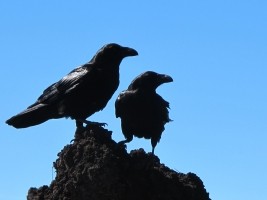
A harvest supper known as the ‘Hag’s Feast’ would be shared at Samhain, in honour of the winter hag or crone, who rules between Samhain and Imbolc (1st February). This ‘dark goddess’ ruled the inner tides of human emotion, the ‘womb’ of the ocean and the realm of dreams. The darkness of the womb gives birth to human life, as the dark of night and winter gives birth to day and springtime. Thus this figure and her time of year were about restoring and regenerating spirit, inner strength and hope. She has now been transposed into solely her darkest aspect, as the witch riding through the land on a wolf (or broomstick!) striking down signs of life with her wand of winter. The sign of the dark goddess is the black feather and her birds are carrion and so here we find the crows and ravens of Hallowe’en. It is also worth noting the two ravens belonging to Odin from Norse mythology.


Modern Pagans use this time to also connect with loved ones who have departed and for introspection. Feasting and familial gathering form part of a remembrance service where worries can be released onto paper and burned in the ‘Samhuinn fire’, which can be as elaborate as a large communal bonfire or as intimate as a single candle flame in ones home.

As you choose your costume and prepare to embark on a night of chaos and ghoulish fun, consider the ancient rituals you will be sharing with our ancestors!
BIBLIOGRAPHY:
OBOD – Samhuinn & Alban Elued [Autumn Equinoxe]
Hamlyn History - ‘Myths Retold’ by Diana Ferguson
‘Visions of the Cailleach’ by Sonita d’Este & David Rankine
‘Pagan Feasts’ by Anna Franklin & Sue Phillips
ALL IMAGES: courtesy of  Visualhunt.com

~~~~~~~~~~

Elaine writes historical fiction as ‘E S Moxon’. Her debut 'Wulfsuna' was published January 21st, 2015 and is the first in her Wolf Spear Saga series of Saxon adventures, where a Seer and one named ‘Wolf Spear’ are destined to meet. She is currently writing her second novel, set once again in the Dark Ages of 5th Century Britain. You can find out more about Book 2 from Elaine’s website where she has a video diary charting her writing progress. She also runs a blog. Elaine lives in the Midlands with her family and their chocolate Labrador.


Blood, betrayal and brotherhood.
An ancient saga is weaving their destiny. 
A treacherous rival threatens their fate. 
A Seer's magic may be all that can save them. 
WULFSUNA 
~


Tuesday, November 17, 2015

Winter Crone Legends

by Elaine Moxon

"She who hardens the ground with the frost and ice, which quickens the dormant seeds in the earth's womb."
'VISIONS OF THE CAILLEACH' - Sonia d'Este & David Rankine

'The Cailleach' by Michael Hickey

Winter is almost upon us, the solstice looming as the nights lengthen and daylight becomes a rare and precious thing. To our ancient ancestors we are in 'Geimredh', the dark half of the year. The sun takes his leave of us for more and more hours, our lives increasingly illuminated by the moon. Writing Dark Ages historical fiction, it is important that I know what this time means to my characters, both Britonic and Saxon. Both cultures contain legends of the Crone or Winter Hag, a goddess of good or evil who shapes the land and controls the very forces of nature. She has many guises and names, including:-
  • Death Goddess
  • Wise Woman
  • Frau Holle/Hel
  • Valkyrie
  • Cailleach
  • Lady of the Beasts
  • Hag of the Mist
  • Harsh Spirit of Winter
  • Hag of the Mill-Dust
Geimredh begins at 'Samhuinn' (1st November), which for the Celts marked the beginning of a new year, a beginning shrouded in darkness, where they believed the veil between the living and dead was at its thinnest, thus allowing ease of communion between the worlds. Incidentally, burial chambers and stone circles are often oriented to the midwinter solstice, aligning those buried and the winter rituals performed within them to the Otherworld. It is also the time of the last harvest where the pagan Lord dies with the cutting of the last sheaf and begins his journey through the underworld, laid to rest in the womb of the Great Mother. It is therefore fitting that his matrimonial partner, the Lady or Goddess, takes the helm to guide her people until he is re-born in the spring. Then she will be the virgin maiden, awaiting her lover. If the harvest was good, this final sheaf was fashioned into a 'kern maiden', referencing the fruitful spring goddess. However, if the harvest was poor, it was fashioned into the guise of the Crone and no, one farmer would wish to keep it long in his house for it brought bad luck. Such was the fear of the Crone's power.

Even before man cultivated grains and modelled kern maidens, the Crone was still venerated and was a symbol of death. The elder tree is sacred to the autumn equinoxe for pagans to this day, but as far back as the Megalithic period it was present. Known as the 'tree of death', representations of elder leaves have been found carved onto funerary flints at Megalithic burial sites. There is also evidence of Welsh and Manx Celts planting elders on new graves. Winter continues to be a harsh time for many in our modern world. Death is never far away. The old or infirm, people or animals, can perish. For our ancestors, living so close to the land, tied by their dependency upon it, this was moreso. As in death, the world around them was bereft of light. Devoid of life, it must have seemed as though the Otherworld had taken over; the world of the Crone. In winter, fodder is scarce and our ancestors slaughtered weaker animals to save feed for the stronger beasts, and to feed themselves through the winter.

In such a barren landscape, any fruits borne during this time were considered sacred. Apples, a symbol of the sun and immortality, would be stored as long as possible. These remain in our modern psyche when we bob for apples at Hallowe'en, chew toffee apples or wassail our apple trees. When cut crossways an apple forms a 5-pointed star or 'pentacle' and this referred to the 5 sacred roles of the Lady or Goddess: birth, initiation, consummation, repose and death. Blackberries, with their growing cycle of green-red-black as the fruits turn, signifies the 3 stages of the goddess as maid-mother-crone and was sacred to the Celts. They also revered the hazelnut tree, as in autumn it produces flowers for beauty and fruit (nuts) for wisdom. Eating the nuts was said to impart knowledge and wisdom to those who ate them. Its association with water (the entrance to the Otherworld) made it a popular offering and has been found in lakes, wells and springs - once again the domain of female deities. This is further confirmed by 'Coll', the bardic number nine - hazel trees fruit after 9 years of growth. Nine is sacred to the aspect of the triple goddess (3 x 3 = 9). Finally, elder berries, indeed any berries remaining through winter, were deemed by the Druids to be a gift from the 'Earth Mother' or Crone and would be gathered to make ceremonial wines. In other rituals, married Celtic women would paint their naked bodies in woad to honour 'the veiled one'. Again, this is a reverence of the Winter Crone, She who controls the veil to the Otherworld, She who folds the elderly and 'tired children into her cloak of death to await another dawn'.

'White Wolf' courtesy of wallpapercave.com

The Crone can be found throughout many cultures in both a benevolent and malevolent form. You may recognise some of them!

"It is written that before the Norman invasion of England, Gyrth had a dream that a great witch stood on the island, opposing the King's fleet with a fork and trough. Tord dreamed that before the army of the people of the country was riding a huge witch-wife upon a wolf, and she tossed the invading soldiers into its mouth."
FROM BRANSTON'S DESCRIPTION OF A FAILED INVASION ATTEMPT BY HAROLD HARDRADA IN 1066 IN 'THE LAST GODS OF ENGLAND'.

Here we see resemblance to the Norse Valkyrie, Frau Holle or Hel - goddesses associated with death.


She rides through the sky on the back of a wolf, striking down signs of growth with her wand, spreading winter across the land. If she sees you, she will keep her mantle of snow over the land, so you must remain still.

"The man held the Druid wand first over his head and then over hers, at which she dropped down as if dead. He then mourned for her, dancing about her body to the changing music. Then he raised her left hand, touched it with the wand, and the hand came alive, and began to move up and down. The man became overjoyed and danced about. Next he would bring her other arm and her legs to life. Then he knelt over her, breathed into her mouth and touched her heart with the wand. She leapt up fully alive, and both danced joyously."
THE 'CAILLEACH AN DUDAIN' DANCE OR 'HAG OF THE MILL-DUST', APPROPRIATELY DANCED AT THE AUTUMN EQUINOXE, FROM THE ORDER OF BARDS, OVATES AND DRUIDS FOR 'ALBAN ELUED'.

Here we see 'the death of the fertile Mother of Life in the barren months that were to come and the promise of her resurrection in springtime'.

Other familiar representations of the Winter Crone are the Hag witches in Disney's 'Snow White' and 'Sleeping Beauty', where the aforementioned princesses are the spring-like maidens and the evil Crones their nemeses. We can also find similarities between the 'Snow Queen' in C. S. Lewis' 'The Lion, the Witch and the Wardrobe', who is reminiscent of Hans Christian Andersen's 'The Snow Queen'. Meanwhile, Queen Elsa of Disney's 'Frozen' provides us with a more benevolent Winter Witch. She holds swathe over the land that is plunged into an eternal winter, building a palace of ice and a giant, boulder-like creature. As Beowulf hunts Grendel's mother in her watery cave (another Crone legend), so Elsa is hunted. It takes her sister Anna, another representation of the spring goddess, to persuade Arundel's population their Snow Queen has a good heart and can, if she wants to, remove winter from the land.

'The Snow Queen' by Elena Ringo

In conclusion, we are never far from these legends. Despite the many years separating us from our Megalithic or Dark Age ancestors, the legends persist and continue to permeate our so-called 'modern' lives. In reality, we are closer to our forebears than we imagine!

BIBLIOGRAPHY:
'Pagan Feasts' - Anna Franklin & Sue Phillips
'Visions of the Cailleach' - Sonita d'Este & David Rankine
'Alban Elued' - Order of Bards, Ovates & Druids

~

Elaine has always loved writing and history. When she decided to combine the two, she wrote her Dark Ages debut 'WULFSUNA', which was published in January 2015 through SilverWood Books. She enjoys baking, knitting and gardening and lives in the Midlands with her family and their mad Labrador. She is currently writing the second book in her ‘Wolf Spear Saga’ series.