Showing posts with label Sutton Hoo. Show all posts

Friday, December 14, 2018

Heroes of the Dark Ages - Who's yours?

by Matthew Harffy

If I were to ask a group of people to name a hero from the Early Medieval period, the era more commonly known as the Dark Ages, who do you think they might mention? Alfred the Great perhaps? After all, he is the only king to be known as “Great” that Britain has ever produced.

King Alfred the Great

Some might go with that famous warrior king from the end of the period, Harold Godwinson. He will forever be known to all British schoolchildren as the man who rather clumsily got an arrow in his eye at the Battle of Hastings on that most famous of dates, 1066.

Harold has something in his eye on the Bayeux Tapestry

Some people, unsure of what is fact and what is fiction, might even give King Arthur a plug. Now, we don’t even know whether Arthur really existed, and we certainly don’t have any facts about his life or who he was even if we believe he is not purely fictional. And yet, his name is synonymous with Britishness and the distant mist-veiled days of the Dark Ages. He is “the once and future king” who will return to rid us of an invading army when the land most needs him.

A watery tart lobs a sword at Arthur

People who are more knowledgeable of the period’s history, and who are more inclined to turn to learning rather than battle-glory as a sign of greatness, might well mention The Venerable Bede, the Northumbrian monk and scholar who wrote much of what is known of the history of Britain up to his death in the 8th century.

Bede - the grandfather of British history

If they are really into their seventh century history, people might say their hero is King Penda of Mercia, or King Oswald (later Saint Oswald) of Northumbria, but I think those people would be few and far between.

What I can guarantee is that nobody would say that their hero of the Early Medieval period is King Sigebehrt of East Anglia. Well, perhaps I can’t guarantee it, but if someone voted for him, you can be sure they would belong to an extremely niche crowd!

However, to his people, Sigebehrt was every bit the hero.

St. Felix and King Sigebehrt

King Sigebehrt of East Anglia (known later also as Saint Sigebehrt, following his ***SPOILER ALERT*** martyrdom ***SPOILER ALERT***), had been the epitome of the warrior kings of the Anglo-Saxons.

You may well be thinking that it’s no wonder you haven’t heard of some ancient king of a small area of modern-day England. But back in the 7th century, East Anglia was a big deal. It was one of the most powerful kingdoms of Britain, perhaps the most powerful for a time. Indeed, it was powerful enough for its king, Rædwald, to be called by Bede ‘Rex Anglorum’ (King of the Angles, which makes him sound like he was great at trigonometry, but remember that the Angles were the Germanic tribe who gave their name to what would eventually become England). Rædwald was not only able to rule over all the Angles, but also to put those he favoured on the thrones of other kingdoms, as he did with King Edwin of Northumbria.

Replica of the Sutton Hoo helmet

Rædwald is probably the noble buried in the ship beneath the famous mound at Sutton Hoo, and it is likely that Sigebehrt was either his stepson or his nephew. Whatever his relationship to the great king, Sigebehrt was part of the dynasty of the Wuffingas, the ruling family of East Anglia for many decades.

Little is known about Sigebehrt’s early life, save that he was exiled from East Anglia to France. Exile was common at the time for nobles with a claim to the throne. It certainly beats death! In France he became a Christian and was in fact the first English monarch to be baptised before his succession to the throne.

Upon the assassination of Rædwald’s son, Eorpwald, Sigebehrt returned to take the throne of East Anglia. Nothing is known about how he did this, but given the violence prevalent at the time and the fact his prowess in battle was later chronicled, it seems likely he had to fight his way to the top. That he was a Christian wouldn’t have hurt his prospects either, what with Edwin of Northumbria and Eadbald of Kent both having converted to Christianity and having ties to the Frankish rulers, who may well have aided Sigeberht to take the crown.

However he managed it, he was the king by 629 and he promptly went about setting things in motion that would cement Christianity’s place in the kingdom. During his stay in France, Sigeberht had been impressed by the learning found in the religious schools on the Continent. So, after setting up a Burgundian missionary, Felix (yet another Saint!), as Bishop of Dommoc (possibly Dunwich), Sigeberht then secured the future of the Church by establishing a school, based on the model that he had witnessed in France, where boys could be taught reading and writing in Latin.

Saint Fursey (not sure which one he is!)

Furthering the Church’s influence in his kingdom, he then granted the Irish hermit Fursey (yes, another Saint!), a monastery site called Cnobheresburg, most commonly identified as Burgh Castle, near Great Yarmouth.

If it sounds as though Sigebehrt was obsessed with learning and the Church, you wouldn’t be wrong. He was clearly much more interested in the Church than in governing and being a warlord king of the people of East Anglia. We know this, because a few years after attaining the throne, he abdicates power to Ecgric, another of the Wuffingas dynasty, whereby he promptly retires to his monastery at Beodricesworth (Bury St Edmunds).

Now this is where the story gets really interesting, and what drew me to the character in the first place.

In 636 or thereabouts, that most successful of pagan warlords of the age, Penda of Mercia, attacked East Anglia. For some reason the people didn’t think Ecgric was up to the task of defending them, so they went to Beodricesworth and dragged their erstwhile king, Sigebehrt, out from his monastery, that he might save them from the invading Mercians.

Well, the peaceful, Christian Sigebehrt refused to fight, but his ex-subjects were having none of it and he was forced onto the battlefield unarmed and unarmoured to lead his people. I won’t give you details of what happened, but let’s just say that a robe and a cross are not great protection against spears and swords! And you already know he becomes Saint Sigebehrt, after his ***SPOILER ALERT*** martyrdom ***SPOILER ALERT***, so join the dots!

Battles are never pretty

Sigebehrt, might not be the most famous of kings of the Early Medieval period, but he was certainly influential in securing the Church in East Anglia, and his life was definitely interesting enough to spark inspiration in me to write a novel featuring him and his unfortunate end. And if being brave enough to step into the chaos and havoc of a Medieval battlefield without weapons or armour doesn’t make you heroic, I don’t know what does!

Who is your Dark Ages hero or heroine? Leave a comment below. I’d love to read your thoughts.

~~~~~~~~~~

Matthew Harffy is the author of the Bernicia Chronicles, a series of novels set in seventh century Britain. KILLER OF KINGS, which features Sigebehrt, Ecgric and the battle with Penda is now available in hardback, e-book and audio.

The other books in the series, The Serpent Sword, The Cross and the Curse, Blood and Blade and Warrior of Woden are available on Amazon, Kobo, Google Play, and all good bookstores.

Website: www.matthewharffy.com
Twitter: @MatthewHarffy
Facebook: MatthewHarffyAuthor

Images:
King Alfred: Odejea [GFDL (http://www.gnu.org/copyleft/fdl.html) or CC BY-SA 3.0 (https://creativecommons.org/licenses/by-sa/3.0)]
King Arthur: Newell Convers Wyeth [Public domain]
Death of Harold: Myrabella [Public domain or CC0], from Wikimedia Commons
The Venerable Bede: The original uploader was Timsj at English Wikipedia. [Public domain], via Wikimedia Commons
Stained glass, Old Felixstowe Church: Copyright Andrew Hill
Sutton Hoo helmet: British Museum [CC BY-SA 2.5 (https://creativecommons.org/licenses/by-sa/2.5) or Public domain]
Saint Fursey: Public Domain
La victoire de Tullus Hostilius sur les forces de Veies et de Fidena ---- Giuseppe Cesari [Public domain], via Wikimedia Commons

Monday, April 2, 2018

Sutton Who? Who is buried at Sutton Hoo?

by Matthew Harffy

Sutton Hoo is one of the most important historical sites of Great Britain. The name derives from the Old English (Sutton = South farmstead and Hoo = someone who lives on a spur of a hill).

Sutton Hoo is situated near the village of Woodbridge on the River Deben in the county of Suffolk, the southern part of East Anglia. The history of the place can be split into two distinct eras: recent (from 1930s to the present day), and early medieval (from the early seventh century).

Mound 2 at Sutton Hoo

Before the owner of the house at Sutton Hoo, Mrs Edith Pretty, invited local archaeologist, Basil Brown, to dig into the many mounds that dotted an area of her land, there was nothing much to make Sutton Hoo stand out from a historical point of view. But, as the archaeologists dug into the sandy soil in 1939, uncovering perfect lines of rivets showing the shape of the overlapping planks of a great clinker-built ship buried beneath the largest mound, it quickly became apparent that Sutton Hoo had a historical importance none had imagined before then.

The village of Woodbridge and the river Deben
in the distance (viewed from Sutton Hoo)

All of the mounds had been disturbed over the centuries and most of the treasures that lay within had been stolen. But amazingly, although the largest mound (known as Mound 1) had suffered from the attentions of grave robbers in the sixteenth century (possibly the infamous Dr John Dee, who obtained a royal permit to dig for treasure in burial mounds in East Anglia), Brown found in 1939 that the main burial chamber that had been erected over the ship was largely undisturbed.

Reconstruction of the inside of Mound 1

At least it had not been disturbed by men; the earth had fallen in centuries ago, crushing the items stored within and damaging many of them. And of course, the passing of time had wreaked havoc with the organic materials and iron. However, the treasures that were pulled forth from the earth showed that the man buried in the ship was hugely wealthy, a pagan and almost certainly a king.

Basil Brown during the dig of Mound 1 in 1939

The most recognisable artefact is of course the Sutton Hoo helmet, the remains of which are now on display in the British Museum. Time has taken its toll on the helmet, but when we see a replica showing it as it would have been when worn and buried with its owner, we can but marvel at the workmanship and artistry.

Replica of the Sutton Hoo Helmet (by Ivor Lawton)

There were many other important pieces that came from the grave, each providing invaluable insight into the customs of the time and the identity of the man buried.

Among many other items of value, the following are a few of the most important finds from Mound 1:

  • a large Byzantine silver bowl, which had travelled over 1,500 miles to reach its resting place
  • thirty-seven gold coins 
  • an ornate golden belt buckle 


Replica of the gold belt buckle
  • two gold and garnet shoulder clasps 
  • a harp 
  • nine spears 
  • a whetstone sceptre 

Replica of the whetstone sceptre
  • a shield with intricate gold fittings

Replica of the shield and gold fittings

The excavation of the mounds was halted during the Second World War, but since that time the investigations of the site has continued to the present day, first under the direction of Rupert Bruce-Mitford (1965-71), then Martin Carver (1983-92). In subsequent digs since the war, many other graves have been found in the area around the mounds. It is believed that these newly-discovered bodies, which were buried with no grave goods, in shallow graves are from a later time. Looking at the evidence, they were probably criminals who had been hanged from a gallows near the highway that ran past the mounds.


The mounds at Sutton Hoo

Other mounds have also been excavated, shining more light into the darkness of the time when these mounds were erected. A young warrior is buried alongside his horse in Mound 17 and Mound 14 probably held the body of a woman, given the grave goods found.


Replica pattern welded sword

We will almost certainly never know who each of these people were due to the period when they were buried and the lack of documentary evidence in what is commonly known as the Dark Ages.

Nevertheless, there is enough evidence to pinpoint the age of the ship burial of Mound 1 as between 590 and 640. Weighing up the finds of such riches, along with the location of the mounds, only four miles from Rendlesham, where Bede says the King of East Anglia had his great hall, and the fact that the burial is pagan, it seems overwhelmingly likely that Mound 1 at Sutton Hoo is the ship burial of the great King Rædwald of East Anglia, who died in 624 or 625.

Artist's impression of King Rædwald

This of course takes us into the second historical era of Sutton Hoo. The early seventh century, when Christianity had yet to be adopted by all the kingdoms of Britain. A time when warrior kings of the Angles and the Saxons held sway over retinues of thegns and vied for power and territory with neighbouring kings in a way that could be compared to the gangs of modern-day cities or the cattle barons of the American West in the nineteenth century.

Such a man was Rædwald, ruler over East Anglia, one of the richest kingdoms of Britain. He had supposedly converted to Christianity when visiting Kent, but apostatised once more on his return to East Anglia where, instead of destroying the shrines to the old gods, he built new Christian shrines alongside them. Claiming Woden as one of his ancestors, as did all of the Anglo-Saxon kings of the time, he would have worn the great helmet that was buried with him into combat, not only as protection but as an indication of his wealth and extreme power.

Artist's impression of the interior of an Anglo-Saxon great hall

Rædwald’s power stretched well beyond the borders of East Anglia. When the young Edwin of Deira fled from his enemies in Northumberland, he ended up finding a safe haven in the hall of Rædwald. Edwin’s sworn enemy, King Æthelfrith, would rather avoid a war with a king as mighty as Rædwald but he clearly believed that the King of East Anglia could be swayed by gold. For we are told in Bede’s History of the English Church and People that Æthelfrith sent Rædwald increasingly large bribes in the form of coins in exchange for Edwin. It seems Rædwald was tempted by the offer until his wife famously told him that it was “altogether unworthy of so great a king to sell his good friend in such distress for gold, and to sacrifice his honour, which is more valuable than all other adornments, for the love of money”. And so, listening to his wife and recognising the wisdom of her words, Rædwald not only rejected Æthelfrith’s offer but instead lent his aid to Edwin and marched with him northward where together they defeated Æthelfrith. Thus Rædwald installed Edwin as King of Northumbria.

The National Trust Exhibition Hall at Sutton Hoo

Visiting the site today and seeing in the National Trust Exhibition Hall the stunning replicas of the grave goods that were buried with Rædwald to be carried into the afterlife in his great ship, one gets an idea of the powerful hold this man must have had on his people. And I think we must consider ourselves extremely fortunate that after 1,400 years and numerous attempts to rob the graves of Sutton Hoo, these most fabulous, iconic artefacts have been recovered and kept safe, allowing them to be witnessed and studied by history lovers for generations to come.

Image attribution:

All photos copyright Matthew Harffy, unless otherwise stated.
The image of the 1939 dig is by Harold John Phillips - Screen capture of image from home movie, Public Domain, https://commons.wikimedia.org/w/index.php?curid=14677136

~~~~~~~~~~

Matthew Harffy is the author of the Bernicia Chronicles, a series of novels set in seventh century Britain. The latest book in the series, Warrior of Woden was released on 1st April 2018.

The previous books in the series, The Serpent Sword, The Cross and theCurse, Blood and Blade and Killer of Kings are available on Amazon, Kobo, Google Play, and all good bookstores.

Kin of Cain, a standalone prequel novella, is currently free on Amazon worldwide.

Twitter: @MatthewHarffy

Monday, July 25, 2016

The Horse in Early Medieval Britain

By Elaine Moxon

In heraldry, the horse signifies readiness to act for one’s king and country or a readiness for duty. It is also a symbol of speed, intellect and virility. These attributes have their roots in very early history. Our affinity with this beast resonates throughout our pre-history. In Sub-Roman Britain our Celtic ancestors were riding horses as well as using them to pull chariots, which were themselves symbols of speed and agility. At Sutton Hoo there is a wealth of grave goods highlighting the importance of horses in Saxon noble culture from the 5th Century onwards (gilt-bronze decorated bridles, bran tubs, horses as symbols on metalwork and ceramics such as Pagan cremation urns, bow-brooches, footplates).


Sutton Hoo helmet
Picture courtesy of A.J. Pilkington

Detail of Sutton Hoo helmet
Picture courtesy of A.J. Pilkington

Aside from burials, archaeological evidence does exist to support horses used in Anglo-Saxon warfare between 650 – 899AD, although there are some who continue to dispute this. Wooden saddles and a step-rope for mounting (not a riding stirrup) were being used. The horse was incredibly useful as transport, scouting, a fast attack (as I used in my ‘Battle of Bathumtun’ in WULFSUNA) and, if an army came under siege, food. Whilst no direct evidence exists of warriors engaging in battle on horseback, that is not to say it could not have been the case and indeed, I made use of this grey area when writing my novel. Lack of archaeological evidence can often provide the writer room for fictional creativity!

Bede mentions the bearing of weapons and riding a stallion as ‘attributes of the elite male warrior class’ so to ignore this, even if it may be a social or cultural stereotype, would be to ignore at least an essence of the historical fact. Likewise, Sundkvist says the horse is ‘the most important animal of the Old Scandinavian cult’. They ‘played a part in sacrifices and divination, were emblems of sovereignty and symbolised a warrior-ideal’. To support these comments, an array of Old English words abound that refer to horses and their upkeep:
Stodfaldas – stud folds/paddocks
Stodmyra – stud mares
Stodhors – stud stallions
Stodðeofas – stud thieves
Hengest – stallion
Horsa – horse
Horsþegn – horse thegn/thane
There are also several mentions of the importance of horses in a variety of literature from, or in reference to, the Early Medieval period or thereabouts. These further substantiate horses as means of owning and showing wealth and a deeper spiritual connection with the divine. It is worth noting here that in Germanic culture white horses were linked to nobility and kingship, while red (chestnut) horses were linked to Frejya and fertility.

a saddle made fair with skill, adorned with gems...was the war-seat of the high-king.’~ Beowulf
(Horse) ‘is for leaders the joy of princes –
A steed proud in its hooves – where the hero
Wealthy in mounts exchanges speech –
And shall always be a comfort for the restless.’~ Old English Rune Poem, Exeter Book
Peculiar to that people, in contrast, is to try as well the portents and omens of horses: maintained at public expense in the groves and woods, they are white and untouched by any earthly task; when yoked to the sacred chariot, the priest and the king or leading man of the state escort them and note their neighs and snorts. To no other auspices is greater faith granted, not only among the common folk, but among the nobles and priests, for they see themselves as mere servants of the gods, but the horses as their intimates.’~ Tacitus (of horses and the Germanic people).
...all the blood from them was called hlaut (sacrificial blood), and hlautbolli, the vessel holding that blood; and hlauteiner, the sacrificial twigs (aspergills). These were fashioned like sprinklers, and with them were to be smeared all over with blood the pedestals of the idols and also the walls of the temple within and without; and likewise the men present were to be sprinkled with blood. But the meat of the animals was to be boiled and to serve as food at the banquet.’~ Snorri, Saga of Hákon the Good from Heimskringla
I know that I hung on the windy tree
For nine full nights, wounded with a spear, given to Oðinn,
Myself to myself,
On that tree of which no one knows
For nine full nights, wounded with a spear, given to Oðinn,Myself to myself,On that tree of which no one knowsWhere the roots run.’~ Hávamál, from Prose Edda

Yggdrasil Tree
Wikimedia Commons [Public Domain]
That aforementioned tree is Yggdrasil, the World Tree connecting all the worlds in Norse (and Germanic) mythology. It is interesting to note that ‘Yggdrasil’ can be translated as Ygg’s Horse and ‘Ygg’ is another name for Odin. Odin, or the Saxon equivalent Woden, was the Chief of all the gods in later centuries (replacing Tiw as the all powerful leader of the gods). He of course rode ‘Sleipnir’ the famous eight-legged horse to enable him passage between the land of the living and the land of the dead, resonating with other cultures and legends like ‘Epona’. The same might be said of the mythical unicorn or Pegasus. All of these horse-like creatures link in some way to the divine and magical.

It is not uncommon to find that the eating of blood or flesh of animals, thought to be a link to the divine, is carried out as a way for people to connect with deities. For instance, on the Baltic island of Őland, hundreds of horse remains have been unearthed. The animals were stabbed for blood-letting and their bones split to remove the marrow. Feasts of horseflesh have also been uncovered from the Viking period at Lade and Maere in Trøndelag, Norway. In Denmark there are records of horse sacrifices every nine years, nine being a magical number for the Saxons and other Germanic people.

In conclusion, the Early Medieval age is steeped in horse mythology and the enduring image of warrior and horse irrevocably entwined; an image that would prevail for centuries after.

Bibliography 

Seven Ages of Britain – Justin Pollard
A Nobleman Should be on a Horse’s Back – Stephen Pollington
Woden’s Warriors – Paul Mortimer

Additional Attributions

Yggdrasil Tree By Unknown - AM 738 4to, 44r. Digitized version available from http://skaldic.arts.usyd.edu.au/db.php?table=images&id=22912. Image processing (crop, erase etc.) by Skadinaujo (talk · contribs), Public Domain, https://commons.wikimedia.org/w/index.php?curid=6049413

~~~~~~~~~
Elaine Moxon writes historical fiction as ‘E S Moxon’. Her debut Wulfsuna was published January 21, 2015 and is the first in her Wolf Spear Saga series of Saxon adventures, where a Seer and one named ‘Wolf Spear’ are destined to meet.

She is currently writing her second novel, set once again in the Dark Ages of 5th Century Britain. You can find out more about Book 2 from Elaine’s website where she has a video diary charting her writing progress. She also runs a blog. Elaine lives in the Midlands with her family and their chocolate Labrador.


Blood, betrayal and brotherhood.
An ancient saga is weaving their destiny.
A treacherous rival threatens their fate.
A Seer's magic may be all that can save them.

Tuesday, July 19, 2016

Beowulf: A Miraculous Literary Survival

By Mark Patton

The Anglo-Saxon poem, Beowulf, tells of a great hero, a prince who sails from his native Geatland (part of modern Sweden) to the court of King Hrothgar in Denmark to defeat a monster, Grendel, who has been terrorising the Danish people. Having dealt with the monster, he must also defeat its mother, who comes to Hrothgar's hall seeking revenge. Returning to Geatland in a ship laden with treasure bestowed on him by the grateful Danes, Beowulf becomes King of his people, but he will ultimately have to face a threat closer to home, a dragon that he will defeat, but only at the cost of his own life.

The poem is among the very earliest works of English literature (so early, in fact, that most of us can understand it only in translation), but that it survived at all is little short of miraculous. Previous blog-posts by Kim Rendfeld have dealt with the character of Grendel and with the blending of fiction and historical fact in the poem, but in this post I would like to explore the no-less remarkable story of the survival of the poem itself.

The manuscript of Beowulf, British Library (image is in the Public Domain).

Beowulf survives in a single manuscript, probably created by a monk at Malmesbury Abbey in the early years of the Eleventh Century. This monk may well have copied it from an earlier manuscript, which has not survived, and which may have been as early as the Eighth Century.

Malmesbury Abbey. Photo: Arpingstone (image is in the Public Domain).

The world described in the poem is clearly a Pagan one, but the poet himself (whose name we will almost certainly never know) was probably a Christian (he refers to "God" in the singular, but, doubtless as keen as any author of historical fiction to avoid anachronism, does not mention Christ). This points to the Seventh Century, when England was in transition from Paganism to Christianity, and aspects of the dialect point, more specifically, to the court of King Raedwald (reigned c599-624 AD) in East Anglia (he was born a Pagan, subsequently baptised as a Christian, but later, according to Bede, reverted to Paganism), who many believe to have been the king buried in the Sutton Hoo ship burial. The handful of historical characters mentioned in the poem, however, seem to have lived in the Sixth Century, so the "Beowulf Poet," like the Greek Homer, was almost certainly working within a pre-existing oral tradition.

Excavation of the ship-burial at Sutton Hoo (image is in the Public Domain). A similar, but not identical, funerary ritual involving a ship is described in the poem itself.
Fragments of a lyre found with the Sutton Hoo ship-burial, British Museum. Photo: Andreas Praefcke (image is in the Public Domain).

The original, oral version of the poem may have been recited or sung to the accompaniment of the instrument shown above, a reconstruction of which can be heard here.

Beowulf would probably have become one of the foundation texts of English literature had it not been for 1066 and all that. In the centuries that followed, Anglo-Saxon as a written language gradually died out, replaced by Latin and Anglo-Norman. The manuscript of Beowulf remained in a monastic library, possibly at Malmesbury, possibly elsewhere; the poem did not influence the work of Chaucer or Shakespeare, Milton or Pope, since they did not know of its existence and would not have been able to read the manuscript even if they had stumbled upon it.

With Henry VIII's dissolution of the monasteries, the contents of their libraries were scattered. The most beautifully illuminated Medieval manuscripts had obvious (and very considerable) financial value, and thus are unlikely to have been lost, but Beowulf does not fall into this category; it may have survived only because it was bound together in a volume with other, elaborately decorated works. Many other manuscripts are likely to have been burned or discarded, and we will never know, either in historical or in literary terms, quite what we lost at that moment in time.

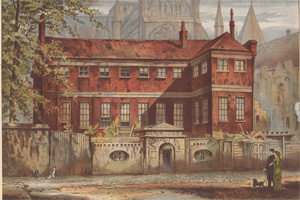
The volume containing the Beowulf manuscript was acquired by Sir Robert Bruce Cotton (1570-1631), one of the leading bibliophiles of his day, and formed part of his library at Ashburnham House close to the entrance to Westminster Abbey (the volume is referred to as "Cotton Vitellius A" because, in this library, it was on the first shelf beneath a bust of the Roman Emperor, Vitellius). Francis Bacon, Sir Walter Raleigh and James Ussher were among the scholars who worked in Cotton's library, but none of them would have been capable of reading Beowulf.

Sir Robert Bruce Cotton, by Cornelis Janssens van Ceulen (image is in the Public Domain).

Ashburnham House, Dean's Yard, Westminster (image is in the Public Domain).

Following Cotton's death, his house, including the library, was acquired by the nation as the basis of what would become the British Library. On the 23rd of October, 1731, however, a fire broke out in the building. The Keeper of the King's Libraries, Richard Bentley, rescued what manuscripts he could, and, as luck would have it, the volume including Beowulf was among these, although it was badly damaged in the fire. Ashburnham House was entirely destroyed, and with it, a great many manuscripts.

It was only with the emergence of Anglo-Saxon and Norse scholarship in the Nineteenth and early Twentieth Centuries that Beowulf once more became readable. A full transcription was made by an Icelandic scholar, Grimur Jonsson Thorkelin, in 1815, and a verse translation into modern English by Francis Barton Gummere in 1909.

In the course of my research over the past years, I have had many priceless Medieval manuscripts on my desk at the British Library, but this one I have only ever seen behind glass. Few scholars are allowed to handle it today, because the damage done by the fire of 1731 was permanent, and even, in a sense, ongoing: some of the words that Thorkelin and Gummere were able to read are no longer legible in the manuscript today. One scholar who did have access to it was J.R.R. Tolkien, and his translation, together with his scholarly notes, has recently been published by his son, Christopher. Seamus Heaney's adaptation may, in poetic terms, be preferred by many, but Tolkien's notes are invaluable to anyone who seeks truly to understand the poem, and it is also through Tolkien's own influential fiction that Beowulf, somewhat belatedly, takes its rightful place in the canon of English literature.

~~~~~~~~~~~~~

Mark Patton blogs regularly on aspects of history and historical fiction at http://mark-patton.blogspot.co.uk. His novels, Undreamed Shores, An Accidental King, and Omphalos, are published by Crooked Cat Publications, and can be purchased from Amazon. He is currently working on The Cheapside Tales, a London-based trilogy of historical novels.

Wednesday, November 6, 2013

Tuning my Lyre: Anglo-Saxon Instruments

by Richard Denning


We have a pretty good idea of what musical instruments the Anglo-Saxons used. The Cotton collection in the British Museum includes the top image showing a Saxon king playing a harp with a horn player, an early trumpet and a rebec (a early violin type instrument). The lower image shows a lyre, bone flute and another type of woodwind.

I now own four replica instruments based on Anglo-Saxon originals so I thought I would show them today. 

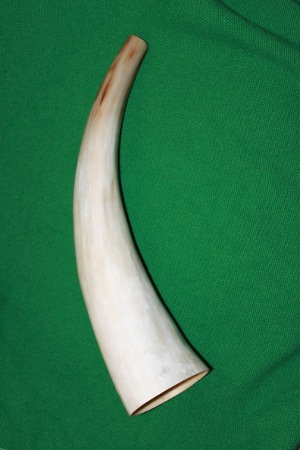
First I have the Horn. This is an Ox-horn. Horns were used in battle as signals but also in ceremonial matters. The lord of a hall might summon his people to feast by standing at the door and blowing the horn. It is played by holding it in the corner of your mouth and blowing raspberries across it.

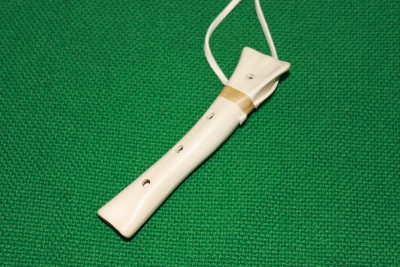
Next up is the bone flute. Many of these have been found in burials -- usually made of sheep or deer bone. They have three holes, but the hole at the end can be blocked as well to create more notes.


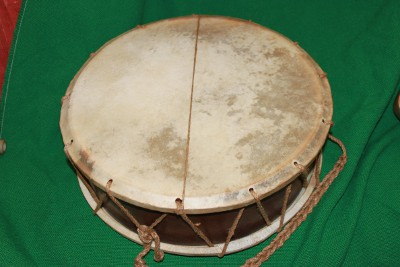
 Drums were certainly used. There are more difficult to replicate as nothing much now survives -- drums being made of animal skin and wood. Animal skin would have been stretched over a wooden hoop and tightened by rope.

Finally here is my lyre. Its made of yew. (Various woods were used.) It has six strings and can create a range of chords, notes and a good deal of noise. We are lucky that King Redwald of East Anglia was buried with a Lyre in his famous Sutton Hoo ship burial. Part of this lyre survives and allows for a decent replica.The original lyre is in the British Museum.


This is the original Sutton Hoo Lyre in the British Museum:


  Here is a video of me playing (badly) these instruments.  I don't think I will start a musical career!


---------------------------------------------------------------
Richard Denning is an author of historical fiction. His main period is the early Anglo-Saxon Era. The Amber Treasure, first book of the Northern Crown Series is a B.R.A.G Medallion winner. Shield Maiden, first book of the Nine Worlds Series is a Children's Literary Classics Silver Medalist. Find out more http://www.richarddenning.co.uk/