Showing posts with label Oswald. Show all posts

Wednesday, January 18, 2017

Osthryth: Murdered Queen of Mercia

By Kim Rendfeld

For Osthryth and her family, living into old age was a luxury.

She was born to Northumbrian King Oswy and his second wife, Eanflaed. My best guess of when is the mid-650s. She might have grown up hearing about her father’s brother Oswald, who had been king before Oswy.

Oswald was a conqueror and a devout Christian. In 742, the pagan king of Mercia, Penda, killed Oswald on the battlefield, ritually dismembered him, and displayed his head, arms, and hands on stakes. Oswy retrieved the trophies a year later and sent Oswald’s head to Lindisfarne and his arms and hands to Bamburgh. In those places, they became relics worthy of veneration. Perhaps Osthryth prayed before those relics.

Northumbria and Mercia were still at war, but Osthryth was too young to remember. In 655, Osthryth’s father was fighting Penda, even though two of her six siblings were married the Penda’s children. Her half-brother Alchfrith had wed Penda’s daughter and her half-sister Alhflæd had wed Penda’s son Peada. (The Mercian prince had converted to Christianity as part of the marriage agreement, with Oswy as his godfather.) Her 10-year-old full brother Ecgfrith was a hostage in Penda’s court.

Perhaps, she would have known that her father, with Alchfrith, went into battle against Penda at the River Winwæd when she was a baby. She might have understood that her full sister, Ælfflæd, was at a convent because her father had promised to give her and 12 estates to the Church if God granted him victory on the battlefield. Oswy had triumphed: he beheaded Penda.

Stained glass window at Worcester Cathedral
(by Violetriga, GFDL or CC-BY-SA-3.0,
via Wikimedia Commons)
She might have known Oswy took over Mercia and allowed Peada to succeed his father. But not for long. Peada died in 656, allegedly due to Alhflæd’s treachery. But Osthryth might have been told to see this another way: Alhflæd’s loyalty lay with her father rather than her husband. It’s not too much of a stretch to speculate that Oswy was displeased with Peada, let his daughter know, and she acted accordingly. Would such tales have taught Osthryth the family loyalty trumped everything, even the nuptial vow?

Yet Oswy’s rule over Mercia was short-lived. In 658, another of Penda’s son, Wulfhere, wrested it from him.

Oswy didn’t fight to keep it. Perhaps he was diverted by turmoil within the family. Oswy had rewarded Alchfrith by crowning him subking of Deira (Northumbria is the union of Deira and Bernicia), but father and son disagreed about ecclesiastic policy in the 660s. At issue was whether to practice Christianity like the Celts or the Romans. Osthryth’s parents, Oswy and Eanflaed, often celebrated Easter at different times—an awkward situation when the husband is feasting to celebrate the Resurrection while the wife is fasting for Lent.

Oswy relented and agreed to the Roman rule at the Synod of Whitby in 664, but that did not bring peace. Father and son disagreed over who should be bishop, and Alchfrith rebelled. And then disappeared.

History is silent on whether young Osthryth mourned her brother. She would face another loss soon. Her father, in failing health, died on Feb. 15, 670 (one of the few royal deaths from natural causes in that era), and Ecgfrith succeeded him.

Northumbria and Mercia were still at odds. In 674, Wulfhere led soldiers, wanting to force the Northumbrians to pay tribute. It didn’t work out that way for the Mercian king. Ecgfrith won and forced his adversary to pay tribute. Wulfhere died soon afterward, and his brother Æthelred succeeded him.

By User:Hel-hama, GFDL or CC-BY-SA-3.0,
 via Wikimedia Commons

Osthryth was a marriageable age, and Æthelred was single. This is the point in the story where I think, “Really, Ecgfrith? You’re going to arrange for your sister to marry Æthelred, even though your brother’s and sister’s marriages failed to uphold peace? What makes you think it will work this time?”

Osthryth and Æthelred were wed. She might have borne Æthelred a son, but we don’t know for certain. Apparently, the peace held for a while. Together, Osthryth and Æthelred patronized the monastery at Bardney in the province of Lindsey, a territory Mercia and Northumbria had fought over. Her young full brother Ælfwine was apparently a frequent visitor and beloved in both kingdoms.

But Osthryth's loyalty would be tested. Northumbria and Mercia would fight again, this time in 679 near the River Trent. Ælfwine died. Ecgfrith wanted to avenge his brother’s death, but an archbishop brokered a peace deal, and in a show of goodwill, Osthryth and Æthelred exiled a bishop at odds with the Northumbrian king.

After Ælfwine’s death, Osthryth had her Uncle Oswald’s remains—the parts of his body not in Lindisfarne or Bamburgh—moved to Bardney. To her, these were a martyr’s relics, and she wanted to promote Northumbrian sympathies. To the monks at Bardney, Oswald had been an oppressor, and they at first refused to take them. If we are to believe legend, the monks changed their minds after seeing a light come from the tent in which the remains were housed.
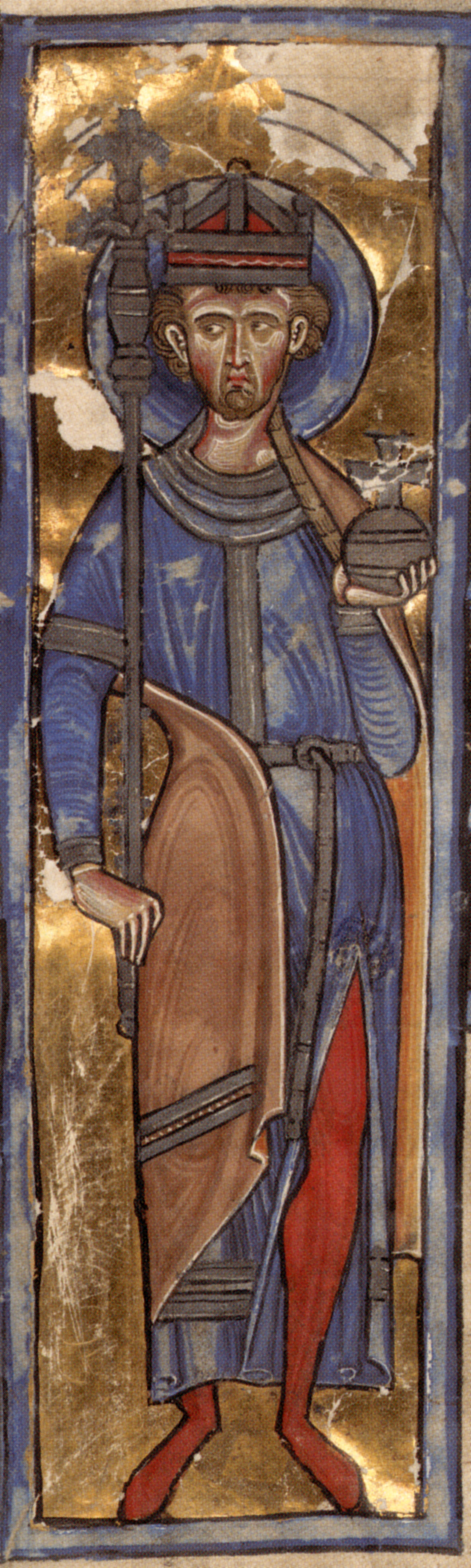
Oswald, from a circa 1220
manuscript (public domain,
via Wikimedia Commons)
The peace would remain uneasy. Ecgfrith died in a battle against the Picts in 685, and Osthryth’s half-brother Aldfrith, born out of wedlock before her father married the first time, succeeded him. When the bishop whom Ecgfrith hated quarreled with Aldfrith, Æthelred gave the guy a bishopric. We don’t know how Osthryth felt about this.

Like Alchfrith, Ecgfrith, Oswald, and her in-laws, Osthryth would be denied the luxury of old age. In 697, Mercian nobles murdered her. That’s all we know. Were they seeking justice for the king killed by her sister over 40 years ago? Or did they fear her influence on her husband?

She was buried at Bardney. Perhaps, Æthelred had some affection for his wife, or maybe he felt guilty and hoped to make amends with her spirit. He gave a monastery on lands his wife controlled to the bishopric of Worchester for the forgiveness of his and his wife’s sins.

Like Oswald, Osthryth and Æthelred would be venerated as saints.

Related story: Saint Etheldreda: Twice Married and Still a Virgin

Sources

Oxford Dictionary of National Biography, including:
“Osthryth (d. 697)” by S.E. Kelly
“Peada (d. 656)” by S.E. Kelly
“Wulfhere (d. 675)” by S.E. Kelly
“Oswiu (611/12–670)” by D. J. Craig,
“Oswald [St Oswald] (603/4–642)” by D. J. Craig
“Æthelred (d. after 704)” by Ann Williams
“‘Aldfrith (d. 704/5)” by Rosemary Cramp
“‘Ecgfrith (645/6–685)” by J.R. Maddicott

Bede's Ecclesiastical History of the English People, ed. and trans. B. Colgrave and R. A. B. Mynors

The Haskins Society Journal 6: Studies in Medieval History by Robert B. Patterson

Kim Rendfeld has written two novels set in early medieval times and is working on a third.

You can order The Ashes of Heaven's Pillar, about a Saxon peasant who will fight for her children after losing everything else, at AmazonKoboBarnes & Noble, and iTunes. Kim's first novel, The Cross and the Dragon, in which a Frankish noblewoman must contend with a jilted suitor and the fear of losing her husband, is available at Amazon, Kobo, iTunes, Barnes & Noble, Smashwords, CreateSpace, and other vendors.

Connect with Kim at on her website kimrendfeld.com, her blog, Outtakes of a Historical Novelist at kimrendfeld.wordpress.com, on Facebook at facebook.com/authorkimrendfeld, or follow her on Twitter at @kimrendfeld.


Monday, August 1, 2016

The Christians Are Coming! (The islands of Iona and Lindisfarne)

by Matthew Harffy

The early seventh century was a time of military and religious upheaval in Britain. The different rulers of the small kingdoms across the island vied for supremacy, and violence and death were never far away. Unsurprisingly, most kings of the day died in battle and few reigned for more than a few years at best, some only for months before meeting their bloody ends.

Holderness cross
By portableantiquities [CC BY 2.0 (http://creativecommons.org/licenses/by/2.0)], via Wikimedia Commons

As Angles, Saxons and Britons fought for the land, so different religions battled for the souls of the populace. Christianity resurged on the island, pushing the older religions back into the darkest recesses of mountain valleys and deep forests. By the middle of the century Christianity had been adopted by most of the nations of Britain (or at least by their nobles and royal families). From the south came missionaries sent from Rome; Europeans such as Augustus, Paulinus, Birinus and Felix. From the north came a different flavour of Christianity, not Roman in background, but Irish.

The story of this northern Christianity is one of two islands. Iona in the west and Lindisfarne in the east.

Iona Abbey Scotland - seen from ferry
By Jan Smith from Brisbane, Australia (First glimpse of Iona) [CC BY 2.0 (http://creativecommons.org/licenses/by/2.0)], via Wikimedia Commons

Iona became the centre of the Irish Christian mission in the sixth century when Colm Cille (more commonly known as Columba), an Irish noble, was exiled. He settled on the small island of Iona, which was probably known as Hii at the time and almost certainly gaining its modern name from a transcription error of Ioua Insula (“Island of the yews”) to Iona sometime in the thirteenth century. Iona was then part of the Irish kingdom of Dál Riata and Columba was given it as a base for him and his brethren of monks from whence to preach to the people of Dál Riata and the Picts.

The mission was very successful and Iona became a Christian stronghold in the northwest of the British Isles. The expansion from the west to the east coast came as a result of another exiled noble taking up residence in Iona. This time it was Oswald, the offspring of Æthelfrith, the king of Northumbria.

In 633, after spending his formative years on Iona, Oswald, son of Æthelfrith, was presented the opportunity to take back the throne that had been his father’s. His father’s killer, Edwin, had in turn been slain by an alliance of Penda of Mercia and Cadwallon of Gwynedd. Oswald brought a warband south and confronted Cadwallon near Hadrian’s Wall. Before the battle, Oswald ordered a great cross to be erected and had his men kneel and pray to God for victory.

In the ensuing battle, Oswald’s warhost crushed Cadwallon’s force, slaying the Welsh king and cementing Oswald as the ruler of Northumbria. Christ had granted Oswald victory, and he vowed to bring Christ to the people.

Beach at low tide, Holy Island, Northumberland - geograph.org.uk - 1231059
Christine Matthews [CC BY-SA 2.0 (http://creativecommons.org/licenses/by-sa/2.0)], via Wikimedia Commons

As soon as he was settled on his new throne, Oswald sent to Iona for a bishop to guide his pagan people to Christ. The brethren of Iona eventually sent Aidan, a gentle and patient man who believed in engaging all people, even slaves, in discourse about Christ. He set up a monastery on the island of Lindisfarne, also known now as Holy Island. From that tidal island base, which in many ways mirrored Iona in the west, Aidan set about bringing Christianity to Northumbria.

Aidan travelled the land, founding churches and monasteries throughout the north, and Lindisfarne became famous as a place of religious teaching and great learning. And all the while, the bishops of Lindisfarne worked alongside the kings of Northumbria to bring the word of Christ to a land that had all but forgotten that religion after the Romans had left the island some two centuries before.

Statue of St Aidan, Lindisfarne Priory
By mattphotos (Flickr) [CC BY 2.0 (http://creativecommons.org/licenses/by/2.0)], via Wikimedia Commons

Oswald was followed on the throne by his brother Oswiu, who continued to champion Christianity and was responsible for convening the Synod of Whitby in 664. The Synod is important, for it was there that the two competing forms of the faith – Roman and Irish – were debated and one chosen. Such intricacies as the way monks' hair should be tonsured and how the date of Easter should be calculated were discussed. It might not sound like much, but the ramifications of the decision were far-reaching. The Roman way was decided upon, which ultimately saw Lindisfarne, with its Irish roots, fall out of favour.

It was still a place of great learning, however, and the following decades would see the creation of wonderful treasures such as the Lindisfarne Gospels. This period of cultural flowering is known as the Golden Age of Northumbria. Monks sought peaceful meditation of the will of God, praying and working diligently over beautiful manuscripts that would become famous all over the known world. For a hundred years or more the island of Lindisfarne was a beacon of education and culture.

St. Matthew - Lindisfarne Gospels (710-721), f.25v - BL Cotton MS Nero D IV
St. Matthew - Lindisfarne Gospels (710-721), f.25v - BL Cotton MS Nero D IV, via Wikimedia Commons

Little did those scholarly scribes know that one day Northmen would descend upon their island retreat, smashing the peace and tranquillity in a welter of blood. For one of the things that Lindisfarne is now famous for is that, in 793, it became the location of the first recorded Viking raid in Britain. Those treasures that were so well-known to be guarded only by peaceful monks proved too much temptation to raiders from across the North Sea.

But for those decades in the seventh and eighth centuries, Lindisfarne was a centre of learning and wisdom that saw Northumbria become one of the most important kingdoms of Britain, whose influence was felt across the continent.

~~~~~~~~~~~~~

Matthew Harffy is the author of the Bernicia Chronicles, a series of novels set in seventh century Britain. The first of the series, The Serpent Sword, was published by Aria, an imprint of Head of Zeus on 1st June 2016. The sequel, The Cross and The Curse was released on 1st August 2016. Book three, Blood and Blade, is due for publication in December 2016.

The Serpent Sword and The Cross and the Curse are available on Amazon, Kobo, Google Play, and all good online bookstores.

Blood and Blade is available for pre-order on Amazon and all good online bookstores.

Twitter: @MatthewHarffy

Sunday, February 28, 2016

King Edgar, his earls, and the birth of politics in England

by Annie Whitehead

In AD937 King Athelstan was declared king of not only England but of the Scots and Irish too. For whatever reason (and there's been surprisingly little conjecture about this) he never married. Upon his death the throne passed very quickly to his two brothers and then, in 955, to his young nephew, Edwy (Eadwig) who reigned for only four years and was succeeded by his brother, Edgar "the peaceable".

Detail of New Minster Charter, showing Edgar

Athelstan's brother Eadred had subdued the Viking kingdom of York, chasing Erik Bloodaxe to his death atop Stainmore, and Edgar was able to rule a kingdom which was free from Viking attack and, ostensibly, united.

But Edgar's succession had only been possible by initially splitting the kingdom, with the old kingdom of Mercia allying itself to him against his brother in Wessex. And nature abhors a vacuum; so too, it seems, does human nature. Anglo-Saxon history now becomes one not of warring kingdoms and marauding invaders, but in-fighting, back-stabbing, and courtly intrigue.

Putting aside the unfortunate but very timely (for some) death of Edwy at just 19, Edgar's court soon filled up with men seeking favour, power, wealth and influence. Edgar was young (14 or 15) and seemingly pious - he recalled the exiled Bishop Dunstan (Who'd been banished by Edwy after he caught Edwy in bed with his wife, and her mother!) and he supported Dunstan and Bishop Aethelwold in their campaign for monastic reform.

The old kingdoms had transmuted into earldoms and the earls of Mercia, East Anglia and Northumbria became the first 'over-mighty barons'. The old kingdoms might have vanished but tribal sensibilities and border disputes had not (the Mercians, particularly, had rallied behind a nationalist flag when they rose up in support of Edgar)

The Churchmen had the chroniclers on their side, but there is evidence which points to their feathering their own nests, taking land unlawfully, and there is an account of Archbishop Oswald feasting royally in his abbey at Ramsey while outside, folk starved, unable to pay the food rents owed to the Church.


Ramsey Abbey gatehouse - 15thc (nothing remains of the original building)

The earls of East Anglia were members of what amounted to a dynasty, descended from a man whose epithet "Half-king" tells all we need to know about his power.

The earl of Mercia, Aelfhere, was a minor member of the royal family and equally well-connected. Notoriously tempestuous, he took exception to the bishop of Worcester's increasingly frequent attempts to establish centres of power and authority within his earldom. That same bishop, Oswald, also illegally held in duality the archbishopric of York, and thus trod on the toes of the earl of Northumbria, too.

Bickering was kept to a minimum by Edgar. Strong, cocksure, he played the factions against one another and inspired devotion from them all. He recognised the Danelaw, he built up the fleet, and was famously rowed along the River Dee by several kings who bowed in homage to him.


But he, too, died young, although not childless. He left sons - one begotten through a nefarious relationship with a woman who had been promised to the Church and was on the brink of taking holy orders, the other to his queen, the powerful but fragile Aelfthryth.

The factions divided, with the Church and the East Anglians supporting the firstborn son, Edward, while Aelfhere of Mercia supported the queen, citing her son as having been born 'in the purple'. What followed has been labelled the 'anti-monastic reaction' but was essentially a politically driven righting of perceived wrongs.

And there it might have ended, with squabbling and a few land-grabs. But someone, and many pointed fingers at the queen, decided to remove Edward from the scene. Permanently.


"Aelfthryth looks on as Edward is stabbed" Foxe's Book of Martyrs

And so the years of 'peace' had seen the growth of politics, self-serving nobles and the development of sharp elbows in the corridors of power. Now, the king of England was Aethelred. He was young, he was badly-counselled, (as Christopher Brooke puts it, "Dissidence and half-suppressed revolt ... in Aethelred's time now walked openly") and the Vikings were getting ready to sail again. So many young, strong, and politically astute Anglo-Saxon kings had died young, while Aethelred was to live long enough to see all their hard work unravel, in spectacular fashion.

(All illustrations public domain/Wiki Commons)
Select bibliography:
Papers: An Outing on the Dee (Mediaeval Scandinavia 14) & Princeps Merciorum gentis: the family career and connections of Aelfhere, ealdorman of Mercia (Anglo-Saxon England 10) by Ann Williams
Athelstan 'Half King' and his family - Cyril Hart (Cambridge Journals)
The Saxon and Norman Kings - Christopher Brooke
Anglo-Saxon Chronicle - ed Garmonsway


Annie Whitehead studied Anglo-Saxon history under the tutelage of Professor Ann Williams. She wrote her first book, To Be A Queen, in order to tell the often overlooked story of Aethelflaed, daughter of Alfred the Great. It was long-listed for HNS Indie Book of the year 2016. Her new release, Alvar the Kingmaker, tells the story of Aelfhere, earl of Mercia, described both as "The blast of the mad wind from the western territories" and as "The glorious earl".
To Be A Queen - Kindle
Alvar the Kingmaker - Kindle
Paperbacks/Hardbacks