Showing posts with label church. Show all posts

Thursday, August 14, 2014

The Seven Deadly Sins – And What They Say About Medieval Society

by Helena P. Schrader

The other day, a friend and I were trying to list the seven deadly sins. We couldn’t, so we went and looked them up. The list surprised me for including “sins” that seem odd in modern society and that got me thinking about how the definition of “deadly sins” reflected the ills of Medieval Society.  Essentially, the Church was trying to discourage certain types of behavior thought detrimental to a functioning, Christian society by proclaiming them “deadly” sins – sins so egregious that they brought the sinner “spiritual death” – if the sinner did not repent, do penance and receive absolution.
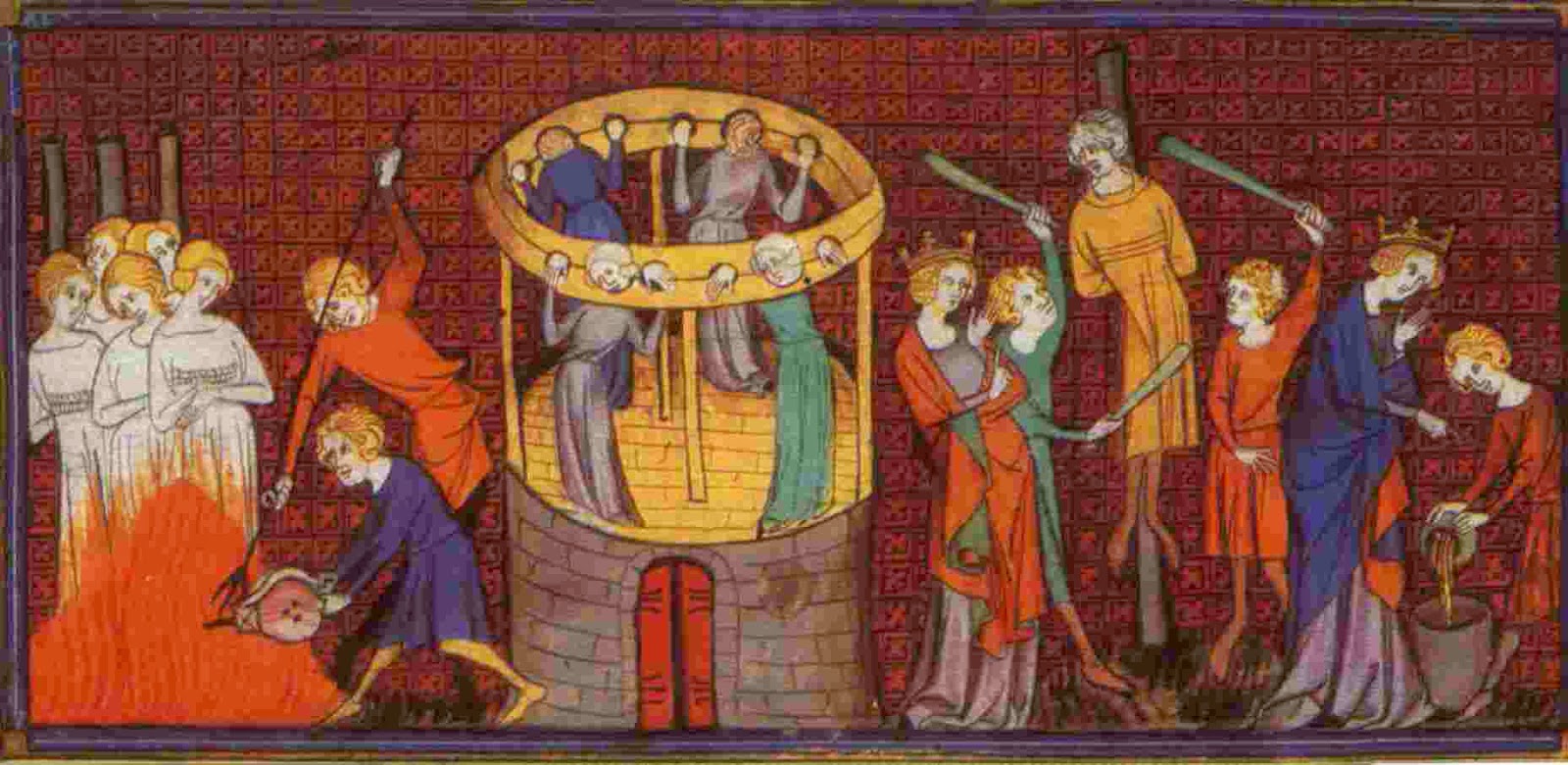

Now some of the deadly sins still strike us as reprehensible behavior. Wrath, for example, is something no one would recommend and most people would agree brings harm – usually not only to the intended target. Likewise lust is a sin whose negative impact is widely recognized to this day. No matter how tolerant modern society may be of sexual freedom for consenting adults, lust remains a dangerous emotional force behind many modern crimes from child abuse and rape to trafficking in persons. Finally, envy is still seen as undesirable. 

But greed has more recently been praised as “good” – some people in modern society equating it with ambition and the driving force behind capitalism and free private enterprise. Even more striking, “pride” is something we hold up as a virtue, not a sin. We are proud of our country, proud of our armed forces, proud to be who we are – or at least we strive to be. And who nowadays would put “gluttony” or “sloth” right up there beside lust, wrath and envy?

Upon reflection, however, I concluded that the deadly sins tell us a great deal about what behavior Medieval Society particularly feared.

In a society where hunger was never far from the poor and famines occurred regularly enough to scar the psyche of contemporaries, excessive consumption of food was not about getting fat it was about denying others.  Because there were always poor who did not have enough to eat just around the corner, someone who indulged in gluttony rather than sharing excess food was clearly violating the most fundamental of Christian principles. Nothing could be more essential to the concept of Christian charity than giving food to the hungry, and a person who not only kept what he/she needed for himself but engaged in excess eating was therefore especially sinful.


Sloth is the other side of the same coin. In a society without machines, automation or robots, the production of all food, shelter and clothing depended on manual labor. Labor was the basis of survival, and survival was often endangered. Medieval society could not afford for any member to be idle. Even the rich were not idle! Medieval queens, countesses and ladies no less than their maids spun, wove and did other needlework – when they weren’t running the estates of their husbands. The great magnates of the realm were the equivalent of modern corporate executives, managing vast estates and ensuring both production and distribution of food-stuffs. The gentry provided not just farm management but the services now provided by police, lawyers and court officials. In medieval society every man and woman had their place – and their job. Whether the job was to work the land or to pray for the dead, it was a job that the individual was expected to fulfill diligently and energetically. Sloth was therefore seen as a dangerous threat to a well-functioning society.


~~~~~~~~~~~~~

Helena P. Schrader is the author of numerous books of history and historical fiction.  She is currently working on a biographical novel in three parts of Balian d’Ibelin. Read more about her published works at: http://helenapschrader.com and more about her series of novels set in the age of chivalry at: http://tales-of-chivalry.com You can also follow Helena’s blogs: about writing: http://schradershistoricalfiction.blogspot.com about the history of the crusader kingdoms at: http://defendingcrusaderkingdoms.blogspot.com

A crusader in search of faith —
A lame lady in search of revenge —
And a king who would be saint.

St. Louis’ Knight takes you to the Holy Land in the 13th century and a world filled with nobles, knights prophet — and assassins.

Buy now!

Saturday, May 31, 2014

Pudding sleeves, Finger Posts, and Mr. Prunella: A little colorful language for the parson

Francis Grose, author of Dictionary of he Vulgar Tongue
by Maria Grace

I confess, I am a word nerd. I love language captivates me, especially in the way it relates to a culture. Slang, the speech of the common man, paints such a picture of the speaker's world. I love it!

Since every place and time has its own unique slang, I thought it would be interesting to share some Regency era slang from time to time. Today's offering a little colorful language related to the church.


Colorful names for a Parson...

  • Autem Bawler 
  • Body Of Divinity Bound In Black Calf
  • Devil Catcher, or Devil Driver Snub Devil
  • Dominee
  • Parish-bull
  • Pudding Sleeves 
  • Levite  
  • Spiritual Flesh-broker 

Sir John. The old title for a country parson

Postilion Of The Gospel. A parson who hurries over the service.
Turnpike-man. A parson; because the clergy collect their tolls at our entrance into and exit from the world.
Finger-post. A parson; so called, because he points out a way to others which he never goes himself. Like the fingerpost, he points out a way he has never been, and, probably, will never go, i. e. the way to heaven.
Mr. Prunella. parsons' gowns being frequently made of prunella.
One In Ten. A parson: an allusion to his tithes.
Gluepot. A parson: from joining men and women together in matrimony.
Puzzle-text. An ignorant blundering parson.

…and his curate


Parson's Journeyman. A curate.
Hedge Priest. An illiterate, unbeneficed curate, apatrico.

Colorful names for a Parish clerk

  • Amen Curler 
  • Canticle 
  • Chuck Farthing 
The church...
  • Autem 
  • Gospel Shop
  • Steeple-house  
…and its pulpit
  • Clack-loft 
  • Hum Box 
  • Prattling-box
To look over the wood; to ascend the pulpit, to preach

Referring to the devil

  • Black Spy 
  • Old Harry
  • Old One
  • Old Poger
  • Ruffian. 
  • Old Nick.  from Neken, the evil spirit of the north.
  • Old Scratch. probably from the long and sharp claws with which he is frequently delineated.
Complaining about the preaching

Canting. Preaching with a whining, affected tone, perhaps a corruption of chanting

Spoil Pudding. A parson who preaches long sermons, keeping his congregation in church till the puddings are overdone.
Scraping. A mode of expressing dislike to a person, or sermon, practised at Oxford by the students, in scraping their feet against the ground during the preachment.
Long-winded. A long-winded parson; one who preached long tedious sermons.

Complaining about the tithe

 Black Fly. The greatest drawback on the farmer is the black fly, i. e. the parson who takes the tithe of the harvest.
Pinch On The Parson's Side. To defraud the parson of his tithe.
Priest-craft. The art of awing the laity, managing their consciences, and diving into their pockets.
  
Interesting Expressions related to church and the clergy

Church Work. Said of any work that advances slowly.

Churchyard Cough. A cough that is likely to terminate in death.
Hums. Persons at church.
Japanned. Ordained. To be japanned; to enter into holy orders, to become a clergyman, to put on the black cloth; from the color of the japan ware, which is black.
Thorough Churchman. A person who goes in at one door of a church, and out at the other, without stopping.
To boil one's lobster. for a churchman to become a soldier; lobsters, which are of a bluish black, being made red by boiling.
To cuckold the parson. to go to bed with one's wife before she has been churched.
To dine with Duke Humphrey. to fast. In old St. Paul's church was an aisle called Duke Humphrey's walk, and persons who walked there while others were at dinner, were said to dine with Duke Humphrey.
To fly a blue pigeon. to steal lead off a church.


Quoted from: Grose, Captain (Francis). (2004) Dictionary of the Vulgar Tongue, 1811 ed. Ikon Classics

~~~~~~~~~~~~

 Maria Grace is the author of Darcy's Decision,  The Future Mrs. Darcy, All the Appearance of Goodness, and Twelfth Night at LongbournClick here to find her books on Amazon. For more on her writing and other Random Bits of Fascination, visit her website. You can also like her on Facebook, follow on Twitter or email her.
Enhanced by Zemanta

Friday, December 21, 2012

Of Scotland, Glencoe and the Reformers

by Shawn Lamb

Have you ever run across a story that just had to be told? That is what happened to me when my husband and I visited Edinburgh, Scotland. History buff that I am, I loved touring England, Wales and Scotland, and took every opportunity to find historical gems to bring home.  One such find, was an intriguing non-fiction book by John Prebble titled "Glencoe". I bought it and tucked it away in my suitcase. 

Not until I returned home to the U.S., did I read it and became hooked!  The story of Glencoe gnawed at me, needing to be told and wouldn’t let me go until I set down to write. Yet not fictionalized in any trivial way, but told as it happened to those involved, the the good and bad of the entire incident.

I expanded my research to discover a rich, yet complex series of circumstances leading up to Glencoe. Most know the time period called the "Highland Clearances" ended in the fateful battle of Culloden in 1745. However, not many realize Glencoe sparked the revolt.

For centuries Scotland and England clashed, with the Civil War being a great turning point. This factor played a part in the events leading to Glencoe. One of the most powerful clans at time –Clan Campbell, rose to political prominence, and used its influence to execute personal vendettas. Some of these revenge-laced initiatives came in response to robber raids or acts during the Civil War committed against the clan.

Robber raids were a common practice in the Highlands, sort of a training exercise for the real act of war. They mostly involved stealing livestock, and could result in injury and death, but that was something to avoid. The MacDonalds of Glencoe were part of raiding group called “The Gallows Herd”. MacIain, the Glencoe chief, also participated in the Civil War as a young man. Needless to say, the Campbells didn’t think very highly of the MacDonalds of Glencoe.

Whereas governmental politics and clan rivalry played a part in shaping events in the Highlands, so did the Scottish Reformers. Second only to John Knox was a man named Alexander Henderson. He played such a crucial role in establishing the National Covenant and Reforming the Church of Scotland that a statue of him stands in Stirling.

Why do I bring up Alexander Henderson? Because relatives of his lived in Glencoe. Known for their large stature and physical strength, these Hendersons were the hereditary pipers and bodyguards of the MacDonald chief. The MacDonalds were predominately Catholic and among the Jacobites, those clans remaining loyal to King James VI after being deposed by William of Orange.

Imagine being related to one of the most power Reformers in Scotland while living and serving the chief of a Catholic Clan? Add to that fact, the Kirk and Church of Scotland commissioned Protestant missionaries from England and sons of clan chiefs educated in universities to win over the Jacobites.  There are records of missionaries in around Glencoe since the Civil War. A seed for conflict perhaps? Yes and no.

The code of clan life went beyond religious affiliations, beyond personal and clan feuds. In such a hostile and unforgiving environment as the Highlands, survival ruled. Story after story in Scottish lore tells of the unbiased acts of hospitality giving no thought to blood feuds or allegiances when sanctuary is sought and granted. In my book, I use the telling of the story involving my husband’s own clan – Lamont, to help illustrate this point. It is perhaps the most horrendous aspect of what happened at Glencoe, which some call murder under trust.

All these complexities figure into the events leading up to the fateful February night. The story practically told itself, with little fictionalizing from me. With the publication of Glencoe, the gnawing I felt is now satisfied, but the echoes of what happened there, are still heard today.