Showing posts with label English Regency. Show all posts

Thursday, July 11, 2019

When Picnics were for the Privileged Class


by Maria Grace

The concept of a picnic has been existence for a very long time. (Of course, one could argue that eating outdoors was the very first way to eat, but let’s not go back quite that far.) Food historians suggest that the modern concept of the picnic evolved from traditional moveable outdoor feasts. The first English picnics were medieval hunting feasts staged before the chase (not after, I suppose, in case the hunt wasn’t particularly successful, but I digress).

The word picnic (which the OED says did not occur in print in English until 1748, in a letter by Lord Chesterfield) probably originated with the French pique nique found in a 1649 satirical French poem in which Frères Pique-nicques is known for visiting friends “armed with bottles and dishes.” (Kennedy, 2013) The word later was used to mean to ‘pick a place’, typically an isolated spot, where a group could enjoy a pleasant meal together, free from distractions and demands of daily life.

The English word ‘picnic’ became associated with card-playing, drinking and conversation. By 1802, British Francophiles formed a Pic-Nic society in London devoted to eating, drinking and performing amateur theatricals. Dinners for this society were provided by the members who drew lots to determine who would be bringing which dish—we wouldn’t want thirty-seven blancmanges to show up for the same picnic, would we?

The idea of a picnic also referred to a dinner where all those present contributed foods and was eaten indoors—rather like the modern pot luck meal. The meaning gradually changed to include the concept of eating out-of-doors and by 1860 (solidly in the Victorian era), the change in meaning—a meal eaten outdoors—was complete.

Picnics and the Privileged Class


In the 1800s, British authors began to describe picnics: the adventures of characters who staged their meals in pastoral locations, rather like theater sets. Romantic aesthetics were often important in crafting the ideal picnic setting. In “Emma,” Jane Austen’s character Mrs. Elton plans a “sort of Gipsy party.” She had in mind walking about the gardens, gathering strawberries, sitting under trees and the like, in addition to enjoying a meal out-of-doors. Her stated intention was to keep things as natural and simple as possible. (Kennedy, 2013)

However unpretentious picnics might appear, this activity was actually far from being simple. Hubbell (2006) tells us:
“Picnicking, which first evolved in early nineteenth century Britain, is an ideological act, freighted with values for ‘nature’ and ‘culture’, food and taste, aesthetics and ethics, community and solitude. To picnic is to consume not only particular food, but also a specific environment chosen according to an aesthetic standard, and a particular form of sharing food according to certain standards of behavior.

It means creating a moveable feast and overcoming difficulties and inconveniences, not only for preparation and transportation, but also for consumption and cleanup. Yet picnicking is the pleasurable pursuit of a leisured people, so the difficulty of moving the feast has some reward. The reward is primarily ideological: it enables the participant to share a form of eating that creates relationships between small groups of people, natural landmarks, and cultural ideals. These relationships form a consciousness of national identity. Picnicking, especially for early nineteenth-century picnickers, was thus a way of performing Britishness.”
So picnicking was far more than an impromptu meal outdoors. Even when each person attending brought food, it meant a great deal of work for everyone, especially the servants. Since picnicking was, during Jane Austen’s day, mostly the province of the privileged, servants were definitely involved.

Food and furnishing, dining ware and linens, not to mention the accouterments for any intended amusements—games, fishing, reading and the like—all had to be packed up and transported to the picnic site. Keep in mind, too, that the wagons used for transport might not actually be able to make it all the way to the chosen site and the final distance might require everything to be hand carried there. Afterwards, of course, it would all have to be packed up to be taken home, and possibly cleaned or laundered before being put away.

It was not until the Victorian Era with the rise of the middle class and train transportation that picnics became more widely enjoyed.

Sample Menu


With out the benefit of modern refrigeration or convenient packaged food, what might have been eaten at a picnic? This suggested menu comes from Mrs. Beeton’s 1860 book, which is decidedly Victorian, but the foods are indicative of what might have been served in Austen’s era as well.

BILL OF FARE FOR A PICNIC FOR 40 PERSONS

A joint of cold roast beef, a joint of cold boiled beef, 2 ribs of lamb, 2 shoulders of lamb, 4 roast fowls, 2 roast ducks, 1 ham, 1 tongue, 2 veal-and-ham pies, 2 pigeon pies, 6 medium-sized lobsters, 1 piece of collared calf’s head, 18 lettuces, 6 baskets of salad, 6 cucumbers.

Stewed fruit well sweetened, and put into glass bottles well corked; 3 or 4 dozen plain pastry biscuits to eat with the stewed fruit, 2 dozen fruit turnovers, 4 dozen cheesecakes, 2 cold cabinet puddings in moulds, 2 blancmanges in moulds, a few jam puffs, 1 large cold plum-pudding (this must be good), a few baskets of fresh fruit, 3 dozen plain biscuits, a piece of cheese, 6 lbs. of butter (this, of course, includes the butter for tea), 4 quartern loaves of household broad, 3 dozen rolls, 6 loaves of tin bread (for tea), 2 plain plum cakes, 2 pound cakes, 2 sponge cakes, a tin of mixed biscuits, 1/2 lb, of tea. Coffee is not suitable for a picnic, being difficult to make. 
Things not to be forgotten at a Picnic 
A stick of horseradish, a bottle of mint-sauce well corked, a bottle of salad dressing, a bottle of vinegar, made mustard, pepper, salt, good oil, and pounded sugar. If it can be managed, take a little ice. It is scarcely necessary to say that plates, tumblers, wine-glasses, knives, forks, and spoons, must not be forgotten; as also teacups and saucers, 3 or 4 teapots, some lump sugar, and milk, if this last-named article cannot be obtained in the neighbourhood. Take 3 corkscrews.

3 dozen quart bottles of ale, packed in hampers; ginger-beer, soda-water, and lemonade, of each 2 dozen bottles; 6 bottles of sherry, 6 bottles of claret, champagne à discrétion, and any other light wine that may be preferred, and 2 bottles of brandy. Water can usually be obtained so it is useless to take it.
So, the next time you pack a few sandwiches and some cold cans of soda, reflect back on what the picnic used to be, and how Jane Austen would so be judging you now!

References

Beeton, Isabella. Beeton's Book of Household Management. London: S. O. Beeton Publishing, 1861.

Cameron, Collette. “Pleasures and Proprieties of a Country Picnic. Collette Cameron. / May 31, 2015. Accessed June 3, 2019. https://collettecameron.com/pleasures-and-proprieties-of-a-country-picnic

Davidson, Alan. The Oxford Companion to Food. Oxford: Oxford University Press, 1999.

Gaston, Diane. Regency Picnic or a Labor Day? The Risky Regencies. September 5, 2011. Accessed June 3, 2019. http://www.riskyregencies.com/2011/09/05/regency-picnic-or-a-labor-day/

Hubbell, Andrew. How Wordsworth invented picnicking and saved British Culture. Romanticism, Volume 12, Number 1, 2006, pp. 44-51 (Article) Published by Edinburgh University Press DOI: For additional information about this article Access provided at 11 Jun 2019 https://doi.org/10.1353/rom.2006.0003

Kennedy, Pagan. "Who Made That Picnic." New York Times, August 23, 2013. Accessed June 3, 2019. https://www.nytimes.com/2013/08/25/magazine/who-made-that-picnic.html

Oliver, Lynne. “The Food Timeline: Food-Picnics.” The Food Timeline. 2004. Accessed Jun 3, 2019, http://www.foodtimeline.org/foodpicnics.html

Sanford, Vic.Emma: Picnicking on Box Hill Jane Austen’s World. March 21, 2008. Accessed June 3, 2019. https://janeaustensworld.wordpress.com/2008/03/21/emma-picnicking-on-box-hill/

~~~~~~~~~~


Though Maria Grace has been writing fiction since she was ten years old, those early efforts happily reside in a file drawer and are unlikely to see the light of day again, for which many are grateful. 


After penning five file-drawer novels in high school, she took a break from writing to pursue college and earn her doctorate. After 16 years of university teaching, she returned to her first love, fiction writing.

Click here to find her books on Amazon. For more on her writing and other Random Bits of Fascination, visit her website. You can also like her on Facebook, or follow on Twitter.

Saturday, December 22, 2018

It’s your Natal Day, Regency Style

by David William Wilkin


“It is the old girl's birthday, and that is the greatest holiday and reddest-letter day in Mr. Bagnet's calendar.” Charles Dickens, Bleak House Chapter 49, 1853.

This is not the only Dickensian reference we have to celebration of a birthday. 

From Dickens the Pickwick Papers 1836-1837, we have this:

“ "Never mind that," said the old gentleman; "you're much too fond of punch, Tom."
Tom Smart was just on the point of protesting that he hadn't tasted a drop since his last birthday, “

Regency Tea Party

And then there is the practice of giving flowers on a birthday:
“For instance, the recurrence of a birthday affords a suitable occasion for paying a compliment of a more marked character than mere words express. Birthday bouquets intended as offerings to young people, are most appropriate when composed of spring flowers-wild if possible.” Cassells Household Guide, New and Revised Edition (4 Vol.) c.1880.

Happy Birthday William Powell Frith

Though Dickens writes just at the beginning of the Victorian era, we can extrapolate that things he observed when young (Charles lived from 1812 to 1870) were customs that were also in place when he was older. Especially as some customs relating to birthdays were practiced for several centuries by the time of the Regency.
As mentioned in previous posts, the time of the English Regency, when George the III was mad and his son George (who would be King George IV) oversaw the government for his father was from 1811 to 1820. The culture of the period though, fashion, art, extends from an earlier time, and does not change until Victoria has been on the throne for a little while. For simplicity, if we look at this from 1788 when George was first mad, to 1837, when his son William died, we have a fifty year period that Charles Dickens knew well.
One in which birthdays, as the character Tom Smart above found a way to celebrate with some punch, were honored.
Birthdays have been celebrated for a long time. First in ancient Egypt, 3000 BC (still celebrated in modern Egypt as well, I am willing to wager, despite the country going through regime change.) First in Egypt and then in Babylonia the birth of male royalty was what was celebrated. The practice began after Menes united the Upper and Lower Kingdoms. These were elaborate feasts in which slaves, servants, and freedmen all took part. Even prisoners could be released from the jails.

Walter Frederick Osborne The Birthday Party

Plutarch writes how Cleopatra threw an immense birthday celebration for Mark Antony. (They deserved some happiness before their tragic end.) A few Cleopatras before, though her husband Ptolemy gave her for a birthday present the dismembered body of their son. (Cleo II)
After the invitation of the celebration of Birthdays by the Egyptians, we move on to ancient Greece. Often we think that the Romans took all that was Greek, but here we have the Greeks taking that which is Egyptian and Persian, it would seem. Persians made cakes. (In the Regency Era, Marie Antoinette would tell you that the French did as well.)

Why not, our ancient Greek ancestors thought, put Cake and Birthday together. Philochorus writes that Artemis’ birthday was celebrated on the sixth day of each month with a large honey cake. That would be twelve birthday celebrations a year. The cake was even topped with lighted candles. 

It was the Gods who were fortunate to have their birthdays celebrated monthly. Mere mortal women and children, no birthday party at all (chauvinism goes back a long way.) For the man of the house, though, the annual celebration there was nothing that was too lavish, even after death.

The Romans (remember, they steal everything) put a twist harkening back to the Egyptians. Important statesmen would find their Natal Day festivities national holidays. IN 44 BC Caesar rated an annual parade, circus performance, gladiators, a banquet and a play.


Then came Christianity. And birthday observances stopped.
It was equating entering the world with Original Sin, and since that was the day of your birth, why mark it as special. (One day they might even come up with Temperance...)
What was celebrated instead was the death days (not the birthdays) of the saints. These became their feast days. A saint is born when he/she passes into heaven.
Before the fourth century, it was heresy to try and figure out when JC was born. But after, the church decided they wanted to know, and thus with much serious discussion, we have Christmas.

The Age of Augustus, the Birth of Christ
Jean-Léon Gérôme
By the 12th century, parish churches were recording the birth dates of women and children. Now families were celebrating with annual parties and the birthday cake, along with candles reemerged. (I won’t argue that this was now the end of the Dark Ages as light was reintroduced.)


John Lorimar Grandmother's Birthday

The reemergence was first called the Kinderfeste. It began at dawn. The birthday child was greeted with a cake with the candles already lit. And these candles were changed to stay lit the entire day. A full day of partying.
Making a wish and blowing out the candles also comes from the Kinderfeste tradition. There was an old tradition, now gone of the Birthday Man. An elf who brought extra gifts to the birthday child. 
Now bringing it to the Regency. Jane, for all our Janeites, does not mention Birthday celebrations I went through 17 sources on daily life in Georgian times, and again no mention of the activity. Writers up to now may not have cared. But we do have some examples as noted above in Dickens. Whether it is Tom Smart taking a nip at every birthday to acknowledge the occasion, or the old girl who made of it a great celebration each year.
That suggests to me (though as you have read, we don't have much that is definitive) that should you have the chance to celebrate, and the means to do so, why would you not want to have a lavish affair like Cleopatra and Marc Antony. Certainly the Ton of the Regency was always looking for entertainments and here was a reason for it.

Research (partial)
Charles Panati Panati’s Extraordinary Origins of Everyday Thing, 1987
Sally Mitchell Daily Life in Victorian England, 1996
Maggie Lane Jane Austen’s World, 1996
Daniel Pool, What Jane Austen Ate and Charles Dickens Knew, 1993


* * *

Editor's Choice: This post was originally posted on this blog, August 31, 2012.


Mr. Wilkin writes Regency Historicals and Romances, Ruritanian (A great sub-genre that is fun to explore) and Edwardian Romances, Science Fiction and Fantasy works. He is the author of the very successful Pride & Prejudice continuation; Colonel Fitzwilliam’s Correspondence. He has several other novels set in Regency England including The End of the World and The Shattered Mirror. His most recent work is the humorous spoof; Jane Austen and Ghosts, story of what would happen were we to make any of these Monsters and Austen stories into a movie.

And Two Peas in a Pod, a madcap tale of identical twin brothers in Regency London who find they must impersonate each other to pursue their loves.


The links for all locations selling Mr. Wilkin's work can be found at the webpage and will point you to your favorite internet bookstore: David’s Books, and at various Internet and realworld bookstores including the iBookstoreAmazonBarnes and NobleSmashwords.


He is published by Regency Assembly Press
And he maintains his own blog called The Things That Catch My Eye where the entire Regency Lexicon has been hosted these last months as well as the current work in progress of the full Regency Timeline is being presented.


You also may follow Mr. Wilkin on Twitter at @DWWilkin
Mr. Wilkin maintains a Pinterest page with pictures and links to all the Regency Research he uncovers at Pinterest Regency-Era


Tuesday, December 11, 2018

Advice from a Lady of Distinction

by Maria Grace


Clothing made a (Wo)man
Ackermann's 1809

During the Regency era, fairly strict rules defined how a lady of quality should dress according to the time of day and her anticipated activities.  Theoretically, one wore Undress in the morning, Half-dress in the afternoon, and Full Dress for (formal) evening events. If it sounds like a gentlewoman had to change clothes several times a day, you’d be right. To be active in society, a Regency era lady had to have the right garment for the right occasion, and that added up to a lot of gowns (and corresponding expense.)

Unfortunately wearing the wrong sort of gown at the wrong time could be a devastating social blunder. Ladies (and gentlemen) were judged by their dress. If you did not dress properly, it was a sure statement about your fortune (or lack thereof) and your place in society. In a very real sense, a man or woman was made by their appearance, for better or worse.

Given the very negative impact dressing improperly could have on a young lady in society,  one could hardly blame said young ladies and their mothers for seeking advice from those who might know better than themselves. Enter ‘A Lady of Distinction’, the esteemed authoress of The Mirror of Graces  (1811). This unnamed woman (women publishing anonymously was common in the era) says of herself in the preface:
These pages were not intentionally at first written for publication, but originally composed by the desire of some female friends, who live at a remote part of the west of England; and who, aware of her consummate knowledge of the world, and experience in all that is honourable in the art of captivation, had applied to her for certain directions on the subject. She indulgently complied with their request, and in the elegant treatise we now present to our readers, gratified her friends with as fine a lesson on PERSONAL and MENTAL accomplishments as could ever flow from the experienced and delicate pen of a woman of VIRTUE and of TASTE.
What better recommendations to heed her advice could we have? Moving on…

Importance of good taste
While good taste has always been, well good, in just about every era, it took on a moral aspect during the Regency era that has a lot in common with a lot of modern standards about dress. We might raise an eyebrow, or comment unfavorably upon the lady who shows up to the grocery store in her pajamas, and some would go so far as to condemn her character for it. The Regency era was just a judgemental, perhaps even more so
.
1809 Ackermann's Walking Dress
In the words of A Lady of Distinction:

Fine taste in apparel I have ever seen the companion of pure morals, while a licentious style of dress is as certainly the token of the like laxity in manners and conduct. To correct this dangerous fashion ought to be the study and attempt of every mother, of every daughter, of every woman…p. 19
…I beg leave to observe, that I never yet met with a woman whose general style of dress was chaste, elegant, and appropriate, that I did not find, on further acquaintance, to be in disposition and mind, an object to admire and love. P 63-64
Effectively, the taste with which a woman dressed herself was a reflection of her morals, her character, and to some degree her virtue as well. As if deciding what wear wasn’t tough enough to start with!
Attention to one’s station in life, and not trying to leave that sphere to which she was born (as Lady Catherine was wont to say) reflected good morality as well. Upward mobility as we understand it today was considered inappropriate at best and vulgar at worst.
As there is a proprietary in adapting your dress to the different seasons of your life, and the peculiar character of your figure, there is likewise a necessity that it should correspond with the station you hold in society.
This is a subject not less of a moral concern than it is a matter of taste. … It is not from a proud wish to confine elegance to persons of quality that I contend for less extravagant habits in the middle and lower orders of people:  it is a conviction of the evil which their vanity produces that impels me to condemn  in toto the present levelling and expensive mode. P.85
Apparently A Lady’s fear was that spending too much money on clothing and the like would drive a poorer family into ruin and thus reflected bad character and moral. Because of course, those of the lower orders could not make intelligent and informed decisions on how to spend their income. I have a hunch that, though she does not say it, there is also a concern that a girl from the lower orders might be mistaken for one of higher rank or station and some poor young man might extend his attentions to the undeserving girl he might meet at a public assembly.


Dress According to Your Age

1809 Ackermann's- Dancing Dress
In addition to dressing for one’s station, one must also dress according to one’s age. A Lady of Distinction does not mince words in making a distinction between what is appropriate for young ladies versus older matrons. She says:
In the spring of youth, when all is lovely and gay, then, as the soft green, sparkling in freshness, bedecks the earth; so, light and transparent robes, of tender colours, should adorn the limbs of the young beauty … Her summer evening dress may be of a gossamer texture; but it must still preserve the same simplicity, though its gracefully-diverging folds may fall like the mantle of Juno…In this dress, her arms, and part of her neck and bosom may be unveiled: but only part. The eye of maternal decorum should draw the virgin zone to the limit where modesty would bid it rest.” P71

Where in doubt may be about this or that hue being becoming or genteel (as it is very possible it may neither be the one nor the other), let the puzzled beauty leave both, and securely array herself in simple white. That primeval hue never offends, and frequently is the most graceful robe that youth and loveliness can wear. P. 122
In contrast, by the time a woman sees her thirtieth birthday (which by the standards of the day was approaching what we would consider middle age), she should be reconsidering her mode of dress:
As the lovely of my sex advance towards the vale of years, I counsel them to assume a graver habit and a less vivacious air. Cheerfulness is becoming at all times of life; but sportiveness belongs to youth alone’ and when the meridian or decline of our days affects it is every heavy and out of place … At this period she lays aside the flowers of youth, and arrays herself in the majesty of sobriety, or in the grandeur of simple magnificence… Long is the reign of this commanding epoch of a woman’s age; for from thirty to fifty she may most respectably maintain her station on this throne of matron excellence.” P 81
 Our authoress actually has quite a bit to say about how disgusting and inappropriate it is for an ‘older’ woman to seek to draw attention to her appearance as might be appropriate for a younger woman. To have men pay attention to her appearance was regarded vulgar and repulsive. Modesty was the name of the game for the matron of the Regency era.

Modesty

Not unlike today, the amount of skin to be shown in the name of fashion invited some very strongly worded commentary.
Custom regulates the veiling or unveiling the figure, according to different periods in the day. In the morning the arms and bosom must be completely covered to the throat and wrists. From the dinner hour to the termination of the day, the arms, to a graceful height above the elbow may be bare; and the neck and shoulders unveiled as far as delicacy will allow.  P. 95
1809 Ackermann's Although the focus is
supposed
to be on the hats,
notice the neckline and the gloves.
Just how much unveiling delicacy allowed might be a bit debatable. Apparently it was not an absolute degree of exposure, but also related to the ‘charms’ of the beauty being exposed.
To the exposure of the bosom and back, as some ladies display those parts of their person, what shall we say? This mode (like every other which is carried to excess and indiscriminately followed) is not only repugnant to decency, but most exceedingly disadvantageous to the charms of nine women out of ten.  …  When a woman, grown to the age of discretion for her own choice: unveils her beauties to the sun and moon;” then, from even an Helen’s charms the sated eye turns away loathing. … Were we even, in a frantic and impious passion, to set virtue aside, policy should direct out damsels to be more sparing of their attractions. An unrestrained indulgence of the eye robs imagination of her power, and prevents her consequent influence on the heart. And if this be the case where real beauty is exposed how much more subversive of its aim must be the studied display of an ordinary or deformed figure! pp92-93
 If the prevailing fashion be to reject the long sleeve, and to partially display the arm, let the glove advance considerably above the elbow, and there be fastened with a drawing string or armlet. But this should only be the case when the arm is muscular, coarse or scraggy. When it is fair, smooth and rounds, it will admit of the glove being pushed down to a little above the wrists. p. 130

So immodesty was even worse for a plain woman than an attractive one—who knew?
So there you have it, to be perceived as a woman of virtue and taste was no simple feat. Good taste had to be acquired—probably by studying tomes such as The Mirror of Graces along with fashion magazines like Ackermann’s Repository. One needed to dress according to her age and her station in life, keeping in mind both her own physical assets and appropriate modesty while realizing one’s entire future could rest upon making the right impression on the local society. No pressure right?

Reference

Regency Etiquette: The Mirror of Graces (1811). Enl. ed. Mendocino, CA: R.L. Shep;, 1997.

~~~~~~~~~~~~~~~~~~~~~~~~~~~~~~
Though Maria Grace has been writing fiction since she was ten years old, those early efforts happily reside in a file drawer and are unlikely to see the light of day again, for which many are grateful. 

After penning five file-drawer novels in high school, she took a break from writing to pursue college and earn her doctorate. After 16 years of university teaching, she returned to her first love, fiction writing.

Click here to find her books on Amazon. For more on her writing and other Random Bits of Fascination, visit her website. You can also like her on Facebook, or follow on Twitter.


Monday, November 12, 2018

Early Education of up-and-coming Gentlemen

by Maria Grace
"In all well-regulated states, the two principal points in view in the education of youth, ought to be, first, to make them good men, good members of the universal society of mankind; and in the next place to frame their minds in such a manner, as to make them most useful to that society to which they more immediately belong; and to shape their talents, in such a way, as will render them most serviceable to the support of that government, under which they were born, and on the strength and vigour of which, the well-being of every individual, in some measure depends." (Sheridan, 1756)
Although sentiments for the education of youth (read here, male youth; female education would not be considered worthwhile yet for quite some time), no one really argued for state-provided education for middle and upper-class children before 1850. (Brown, 2011) That was left entirely in the hands of the parents. Although considerable effort and activity went into educating these children, it was hardly standardized. How a young boy was educated depended entirely on the preferences and means of his family.

Early education

On the whole, early education in the home was preferred. Mothers and governesses would provide a boy’s first education, often teaching him the basics of reading and writing. Usually by the age of seven, he would graduate from being taught by women to being educated by men. There were no standards of how this worked though. The specific details varied by family and by social class.

A male tutor might be brought into the home to teach the child, preparing him for the next step in his education. This could continue for just a few years until the boy was deemed ready for a boarding school, or it could continue until he was ready for university study, depending on the educational philosophy of the family, usually the father. (Selwyn 2010)

Alternatively, a boy might be sent to a local scholar, often a clergyman, for lessons as a day student. Many clergymen also took such students on as boarders, running small schools to supplement their income teaching anywhere for half a dozen to two dozen students.

Preparatory Schools

These smaller schools which routinely took boys in the 7 to 13-year-old age range were often referred to as preparatory schools, preparing boys for the larger public schools that often preceded entry into the universities.

These schools were usually held in the schoolmaster’s home. Jane Austen’s father, Rev. George Austen conducted such a school out of the vicarage in Steventon beginning in 1793. His living as a vicar was £230 a year. He charged £35 per term for each of his student boarders. It is easy to see how taking even just a few students could substantially augment his family’s income. The work though did not fall on him alone. His wife cooked, cleaned, sewed, and mother-henned the boys in her care, much like a surrogate mother. (Sanborrn, 2016)

In larger schools where the teaching staff consisted of ordained clergymen, teachers could make as much as £200-400 a year, giving them a comfortable middle-class income. (Davidoff 2002) Headmasters in such schools, especially if scholars themselves, might enjoy a position of respect and distinction in local society. (Selwyn 2010)

By modern standards, preparatory school curriculum was very limited. It consisted mainly of Latin and Greek classical texts (both prose and verse), modern and ancient history, some mathematics, and the use of globes to locate nations. French and Italian might be taught as extras (for additional fees), along with handwriting, dancing, drawing and a smattering of scientific subjects. (Le Faye, 2002) No curriculum standards existed, so what might actually be taught varied widely and there was no guarantee that a particular teacher was actually well versed in the subjects he taught.

Teachers in these preparatory schools were most often clergymen or failed ordinals. There were far more men ordained than there were livings to provide for them. In 1805, it was estimated that up to 45% of those ordained never found a church living and were forced to work as (usually highly underpaid) curates for men who had a living or to try their hand at teaching or take up another occupation entirely outside the church (Southam, 2005). After their education in these preparatory schools, boys might then progress to a public school.

Public Schools

Public schools were public in the sense that boys were taught in groups outside of their private homes, not in the sense that these institutions were funded by public funds. A number of public schools existed, but the landed elite, in particular, chose to send their sons to a select number of these schools: Eton, Harrow, Winchester, Westminster, Rugby, Charterhouse and Shrewsbury. (Adkins, 2013) The exact timing and duration of a boy’s stay at school varied greatly. Some were sent as young as age seven and stayed until age eighteen. More commonly boys started public schools around age thirteen and stayed about five years.

Though Regency era education was very different from modern education, two factors, in particular, seem to distinguish it most from modern schooling: the curriculum taught and the lifestyle of the students.

What was Taught

In his 1693 treatise, Some Thoughts Concerning Education, John Locke recommended that instruction in foreign languages (beginning with a living language like French) should start as soon as a boy could speak English. Locke considered Latin and Greek to be absolutely essential to a gentleman’s education, enabling him to read classical literature. In addition, he endorsed the study of geography, astronomy, anatomy, chronology, history, mathematics and geometry. (Morris, 2015).

Based on Locke’s foundations, students were expected to know some Latin upon arrival to public school. “The first two years of their education was entirely a study of Latin–memorizing, reciting, reading, and answering set questions in that language, so pronunciation too.… Thus they learned to be confident public speakers, first in Latin, then in classical Greek and finally in English.” (Bennetts 2010) These studies also developed an understanding of the moral and philosophical issues brought up by classical thinkers and a literary appreciation of poetry and prose. Dancing, fencing, and other sports also featured in some curriculums.

What was notably absent from both public school and university educations were courses on anything the modern mind would consider practical. Since these establishments catered to gentlemen who were not destined to actually work for their living, courses like bookkeeping or land management that might equip them for jobs (oh the horror!) were relegated to schools that catered to the sons of men in trade. (Selwyn 2010)

Life in public school

Students at public schools either boarded at the school itself or in town at boarding houses known as ‘Dame’s Houses’ usually overseen by a ‘Dame’ or landlady. In the early 1800s, about thirteen such houses were associated with Eton. Although school life was very regimented, with school days running from six in the morning until eight in the evening, there was actually very little direct supervision over the boys. They were often left to fend for themselves. Once they entered public school, most boys spent the majority of their year at school, with only a few weeks of holidays spent back home during the year.

With a strong economic incentive to admit as many students as possible, public schools were often so crowded that even beds were shared by two or more boys at the same time. The same incentives also influenced the quantity and quality of food made available to the students. Those with pocket money frequently supplemented their rations at local shops. (Brander, 1973)

Under such conditions, it was no surprise that public school culture was wild. Almost no limits were placed to the amount the boys could drink, gamble, fight and indulge any sexual bent with maidservants, local prostitutes, and girls living in town. Even the institution of prefects (older boys in charge of younger ones) did little to curb the out of control behavior. “ … Most schools suffered occasional rebellions, or mutinies, resulting in mass expulsions or floggings. In 1797, Dr. Ingles, headmaster of Rugby, had his door blown open by gunpowder. The boys at Harrow were even more ambitious, setting up a roadblock and blowing up one of the governor's carriage.” (Brander, 1973)

Bullying and Brutality

Not only was dissolute, licentious behavior the norm, bullying and brutality were expected. Corporal punishment consisting of flogging with a birch, or caning with a rod until blood was drawn from the bare buttocks, was regarded as the normal and accepted punishment for transgressions. Such punishments were frequently delivered in public, adding additional humiliation to the experience.

Not only was brutality dished out from the masters to the students, older boys were put in charge of younger ones and permitted to order them about and punish them with beatings just as the schoolmasters did. Depending on the sorts of friends a boy did or did not make and how he got on with others, especially older students, a boy’s public school years could be very testing indeed.

Why was it tolerated?

If public schools could be so bad, why did not parents intervene? Why would a father who had suffered through such school days send his son into a place that brutalized him?

In short, such an environment was regarded as essential for inculcating the toughness and fortitude men needed to perform their social roles. “Educators and parents subscribed to the principle that one was fit to command only after one had learned to obey. And those young boys of the gentry and nobility were there to learn their place and destiny in England's highly structured society.” (Laudermilk, 1989)

So, even if a boy had been able to appeal to parents for help, he would have been unlikely to receive either assistance or sympathy. At a very tender age, he was literally on his own, to survive the experience in whatever way he could. Is it any wonder that the friends a boy made during his time in public school were often strong allies for a lifetime?

References

Adkins, Roy, and Lesley Adkins. Jane Austen's England. Viking, 2013.

Austen, Jane, and David M. Shapard. The Annotated Persuasion. New York: Anchor Books, 2010.

Bennetts, M.M. A gentleman’s education. M.M. Bennets. July 20, 2010. Accessed October 5, 2016. https://mmbennetts.wordpress.com/2010/07/27/a-gentlemans-education/

Brander, Michael. The Georgian Gentleman. Glasgow: University Press, 1973.

Brown, Richard. Educating the middle-classes 1800-1870. Looking at History. Accessed October 29, 2016. http://richardjohnbr.blogspot.com/2011/02/educating-middle-classes-1800-1870.html>

Davidoff, Leonore, and Catherine Hall. Family Fortunes: Men and Women of the English Middle Class, 1780-1850. Chicago: University of Chicago Press, 1987.

Day, Malcom. Voices from the World of Jane Austen. David and Charles, 2006.

Evans, Bronwen. Eton College During the Regency Era. Collette Cameron. May, 9, 2015. Accessed October 3, 2016. https://collettecameron.com/2015/09/eton-college-during-the-regency-era/

Glover, Anne. Regency Culture and Society: Harrow. Regency Reader. November, 15, 2013. Accessed October 10, 2016. http://www.regrom.com/2013/11/15/regency-culture-and-society-harrow/

Laudermilk, Sharon H., and Teresa L. Hamlin. The Regency Companion. New York: Garland, 1989.

LeFaye, Deirdre. Jane Austen: The World of Her Novels. New York: Abrams, 2002.

Locke, John. Some Thoughts concerning Education. London, 1693.

Morris, Diane H. “I Am Illiterate by Regency Standards.” Moorgate Books. Thursday, October 8, 2015. Accessed May 22, 2017. http://www.moorgatebooks.com/10/i-am-illiterate-by-regency-standards/

Sanborn, Vic. "19th Century Learning Academies and Boarding Schools: An Eyewitness Account" Jane Austen’s World. August 1, 20012. Accessed October 28, 2016. https://janeaustensworld.wordpress.com/tag/regency-schooling

Selwyn, David. Jane Austen and children. London: Continuum, 2010.

Sheridan, Thomas. British Education. London: R. and J. Dodeley, 1756.

Southam, Brian . “Professions,” in Jane Austen in Context edited by Janet Todd, p 366-376. Cambridge, UK: Cambridge University Press, 2005.

Sullivan, Margaret C., and Kathryn Rathke. The Jane Austen Handbook: Proper Life Skills from Regency England. Philadelphia, PA: Quirk Books, 2007.

~~~~~~~~~~

Though Maria Grace has been writing fiction since she was ten years old, those early efforts happily reside in a file drawer and are unlikely to see the light of day again, for which many are grateful.

After penning five file-drawer novels in high school, she took a break from writing to pursue college and earn her doctorate. After 16 years of university teaching, she returned to her first love, fiction writing.

Click here to find her books on Amazon. For more on her writing and other Random Bits of Fascination, visit her website. You can also like her on Facebook, or follow on Twitter.

Tuesday, September 11, 2018

The Role of the Circulating Library

by Maria Grace

During the Georgian Era literacy rates among the ‘common man’ rose. Consequently, the demand for reading materials increased, driving the rise of two new literary forms, the newspaper and the novel. By 1720, twenty four newspapers were published in Britain. By the 19th century there were fifty four newspapers printed in London alone.

The High Cost of Reading


Unfortunately, the cost of reading material did not decrease with the increase in demand. But, where there’s a will, there’s a way. People banded together to form “newspaper societies” where groups of people, usually those in a local parish, would contribute a weekly sum. With these pooled funds, the society would purchase subscriptions to one or more newspapers. The newspapers would be shared among those in the society.

While they might not be the first to get the news, society members did manage to get their hands on what they might not be able to individually afford. By 1820, around five thousand of these societies were still going strong.

Whether booksellers took note of the idea or came upon it on their own, they realized that, as with newspapers,  there were far more readers who wanted books than could actually afford to pay for them. For some perspective, in 1815, the average (three-volume) novel cost a guinea (a pound and a shilling). Based on the current worth of a guinea's gold content, that was roughly the equivalent of $100 in modern currency.

This doesn’t tell the whole story though. In the early 1800s, a comfortable middle class salary for a family of four was in the neighborhood of £250. (A guinea was slightly more than a pound, but let’s keep the math a little easier.) At the price of a guinea, a typical novel would cost you 1/250 of your yearly income. If you consider the median US income in 2018 as $60,000 (rounding up just a smidge for the sake of the math), then that same novel carries a price tag on the order of $240. Ouch!

Enter the Circulating Library

Booksellers, particularly those in big cities like London, had already begun making changes in their business practices to reflect these economic realities. By the mid-1700s, they had started encouraging clients to linger at their shops “offering comfortable chairs, a warm fireside in cold weather, some even offering refreshments. The best of these shops soon became places where those with literary interests congregated regularly. Even if a bookseller made enough to afford to employ an assistant or two, most spent a goodly portion of their time in their shops, chatting with their customers. In the days before published book and theater reviews, it was these discussions which enabled people to keep up with the news of the literary world. By the mid-eighteenth century, the social aspects of these literary bookstores were nearly as important as the books they housed.” (Kane, 2011)

From here, it was only a short leap for booksellers to allow their best patrons to take books home with them to continue reading, for a fee of course. Trustworthy patrons were often allowed to rent books to read and return. The idea grew and by 1728, James Leake had established the first circulating library in England. (Hilden, 2018) In 1742 Reverend Samuel Fancourt, opened the first circulating library in London. He has also been credited with coining the term circulating library. (Kane, 2011) By the end of the 18th century there were 1,000 circulating libraries across England. (Hilden, 2018)

Libraries Holdings

Early library holdings varied according to the anticipated subscribers of the library. Sometimes existing social clubs or book clubs formed libraries to cater to the interests of their members. These libraries might feature books on science, arts, the classics, law, history, religion or philosophy. Other “club” libraries might feature somewhat broader topics and even some newspapers or magazines which could be made available to members in a separate reading room. These libraries were not open to the public though, available only to members of the club. (Kane, 2011)

Music libraries formed in places like Bath, specifically to allow subscribers access to sheet music. (McLeod, 2017)
Bath Chronicle and Weekly Gazette - Thursday 11 April 1816 

Since the circulating library was first and foremost a business, it behooved the library to cater to as many as could afford the price of a subscription. So, most library catalogs reflected a much wider selection of books, appealing to the tastes of both men and women since most libraries could not afford to discriminate on the basis of gender. Savvy proprietors quickly realized that the most profitable sort of book was the fashionable novel.

Novels were different than traditional nonfiction books. Where nonfiction works might be read and reread, consulted through the years as a valuable reference, this was not so with the novel. The novel was in fact a “consumable” good. Typically one read a novel once and never again. It was exactly the sort of book that made little sense to purchase (as an individual) and a tremendous amount of sense to rent.

Library catalogues reflected the (largely female reading) public’s hunger for novels. The average circulating library’s catalogue typically listed around five thousand titles. About twenty percent of those were fiction. However, many libraries boasted multiple copies of those novels, sometimes as many as twenty five copies. So that twenty percent of titles probably made up a much larger percentage of the libraries actual holdings. Research on smaller libraries, those averaging less than four hundred and fifty titles, reveals collections of up to seventy five percent fiction titles. Some research suggests that fiction was checked out three to four times as much as nonfiction, implying that for some of these smaller libraries almost all of their stock and trade was in the renting of novels. (Erickson, 1990)

Libraries as a social space


Libraries were first and foremost a business, not a public service as we think of them today. Generally, they required a town with a population of at least two thousand to be profitable. Consequently, they were almost exclusively found in larger towns and resorts.

Libraries could exist in smaller areas, but in those places, they were more of a sideline, added to an existing business. “In 1791, William Lane, famed for the Minerva Press, advertised ‘complete CIRCULATING LIBRARIES . . . from One Hundred to Ten Thousand Volumes' for sale to grocers, tobacconists, picture-framers, haberdashers, and hatters eager for a profitable side line.”(Benson, 1997) Other libraries (those small or not so small) supplemented their income with additional lines of luxury goods like haberdashery, hosiery, hats, tea, tobacco, perfume and even patent medicine. (Erickson, 1990) They might even go so far as to advertise these goods in the local paper.  (McLeod, 2017)

Taunton Courier, and Western Advertiser - Thursday 09 February 1815 

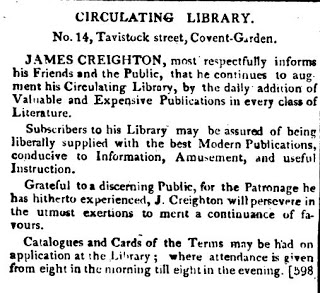
Since libraries survived on traffic from the local public, they sought to draw public attention from the local newspapers. Construction of a new library was often publicized in the newspaper as were additions to a library’s collections.

Hull Advertiser and Exchange Gazette - Saturday 10 January 1807 

La Belle Assemblee, the popular ladies' journal, carried advertisements for circulating libraries: (McLeod, 2017)


To encourage their customers to visit and to linger, libraries, especially in resort areas, often installed reading rooms and “daytime lounges where ladies could see others and be seen, where raffles were held and games were played …” (Erickson, 1990) These rooms were often gathering places for acquaintances to meet or for people to stop and rest during a long excursion into town.

“Since it was the custom to subscribe to the libraries immediately upon arrival in the watering places and resorts, their subscription books became a useful guide to who was in town. In Sanditon the subscription book is used this way. Mr. Parker and Charlotte Heywood go to Mrs. Whitby's circulating library after dinner to examine the subscription book. When they look into it, Mr. Parker ‘could not but feel that the List was not only without Distinction, but less numerous than he had hoped.’” (Erickson, 1990)

Libraries as a business


The circulating library’s profits (primarily) came from lending books to readers for a fee and later selling the used copies for a reduced price after a book (usually a novel) declined in popularity, typically about nine months after its publication.

Subscription prices varied but were generally affordable for the middling classes. Lending periods could vary depending on the kind of book borrowed—two to six days might be the period for a popular new work. Beyond the price of subscription, heavy fines, which could include purchasing the book, could be imposed for returning books late or damaging the books. (Erickson, 1990)

A catalogue of Hookham’s circulating library, 1829

Just how much did a library subscription cost? “The Nobles' brothers charged ten shillings sixpence per year, or three shillings per quarter. The subscriber was then entitled to any two books from the collection at any time. For an additional charge they would even deliver books to your London residence… Some libraries, such as Hookham's, had sliding rates according to services selected.” (Benson, 1997)

(Sanford, 2010)

Most lending libraries had a reading room with the daily newspapers and the most popular magazines available occasionally. Some had a few bookshelves with the most popular current books on them. What they did not feature were rooms of shelves where patrons could browse. In general, the books were kept in closed stacks, away from the public.

In order to borrow a book, a subscriber would peruse the library catalogue lists and select a title. Then, they would go to a clerk who would consult their lists to find the press mark which would allow them to identify what shelf and position to find the book on. The clerk would retrieve the book and allow the patron to determine whether or not they wanted to borrow said book. Clerks tended to be very knowledgeable on the latest books available and might offer recommendations as well. (Kane, 2015) While waiting for the clerk to retrieve their book, patrons might spend time in the reading room, looking over the goods for sale, or even enjoying some light refreshments.

Library failures


In The Use of Circulating Libraries, Thomas Wilson warned that not one circulating library in twenty is, by its profits enabled to give support to a family, or even pay for the trouble and expense attending it; therefore the bookselling and stationary business should always be annexed, and in country towns, some others may be added, particular small, expensive luxury items. (Erickson, 1990) Though it may seem a rather dire warning, running a circulating library required significant business savvy.

Because novels were largely a consumable good, they had a limited shelf life and depreciated quickly, rather like fruit. A substantial portion of a library’s income had to be reinvested in new stock in order to keep new, attractive titles on their shelves. At the beginning of the nineteenth century, rising book prices made this particular difficult task, with many libraries declaring bankruptcy. Mrs. Martin’s Circulating library in Basingstoke to which Jane Austen subscribed, opened in 1798, and failed in 1800. Half the library failures from 1732 to 1799 took place in the nine year period from 1790 to 1799. (Erickson, 1990)

Over the course of the 19th century, books became less expensive. Declining taxes and falling prices on paper, the rise of the paperback cover, and industrialization made books more affordable. Moreover, public libraries came on the scene and allowed individuals to borrow without a subscription fee. Together, these forces brought about the decline of the circulating library, but their influence on the reading public is still felt today.

References

“British Newspaper History”. Accessed September 6, 2018 https://www.999inks.co.uk/british-newspaper-history.html

Book Shops” Georgian Index. 2003 Accessed August 29, 2018. http://www.georgianindex.net/books/Hatchard.html

Austen, Jane. Ed. R. W. Chapman. Jane Austen's letters to her Sister Cassandra and others. 2nd ed. Oxford: Oxford University Press, 1979.

Benson, Mary Margaret. “Parasols & Gloves & Broches & Circulating Libraries.” Persuasions # 19, 1997 Jane Austen Society of North America.

Erickson, Lee. "The Economy of Novel Reading: Jane Austen and the Circulating Library." Studies in English Literature, 1500-190030, no. 4 (1990): 573-90. doi:10.2307/450560.

Feather, John. The Provincial Book Trade in Eighteenth-Century England. Cambridge: Cambridge Univ. Press, 1985.

Glover, Anne. Regency Hot Spots: Bookseller Shops and the Subscription Library. Regency Reader. November 6, 2015. Accessed August 1, 2018. http://www.regrom.com/2015/11/06/regency-hot-spots-bookseller-shops-and-the-subscription-library/

Hatch, Donna. Circulating Libraries in Regency England. Historical Hussies. Friday, November 7, 2014. Accessed July 0, 2018. http://historicalhussies.blogspot.com/2014/11/circulating-libraries-in-regency-england.html

Hilden, L. A. Circulating Libraries in Regency England. L.A. Hilden. July 23, 2018. Accessed July 31, 2018. http://www.lahilden.com/index.php?categoryid=6&p2_articleid=206

Jacobs, Edward and Antonia Forster. "'Lost Books' and Publishing History: Two Annotated Lists of Imprints for the Fiction Titles Listed in the Circulating Library Catalogs of Thomas Lowndes (1766) and M. Heavisides (1790), of Which No Known Copies Survive." The Papers of the Bibliographical Society of America 89 (1995): 260-97.

Kane, Kathryn. Before the Call Number: The Pressmark. The Regency Redingote. January 16, 2015. Accessed August 29, 2018. https://regencyredingote.wordpress.com/2015/01/16/before-the-call-number-the-pressmark/

Kane, Kathryn. Regency Circulating Libraries — Why, How and Who? The Regency Redingote. October, 211, 2011, Accessed August 12, 2018. https://regencyredingote.wordpress.com/2011/10/21/regency-circulating-libraries-why-how-and-who/.

Manley, K. A. "London Circulating Library Catalogues of the 1740s." Library History 8 (1989) 3,74-79.

Mc Leod, Lesley Anne. Who Doesn't Love a Library? Lesley Anne McLeod. Wednesday, November 8, 2017. http://lesleyannemcleod.blogspot.com/2017/11/who-doesnt-love-library.html

Sanborn, Vic. The Circulating Library in Regency Resorts. Jane Austen’s World. August 30, 2010. Accessed August 15, 2018. https://janeaustensworld.wordpress.com/2010/08/30/the-circulating-library-in-regency-times/
~~~~~~~~~~~~~~~~~~~~~~~~~~~~~~


Though Maria Grace has been writing fiction since she was ten years old, those early efforts happily reside in a file drawer and are unlikely to see the light of day again, for which many are grateful.

After penning five file-drawer novels in high school, she took a break from writing to pursue college and earn her doctorate. After 16 years of university teaching, she returned to her first love, fiction writing.

Click here to find her books on Amazon. For more on her writing and other Random Bits of Fascination, visit her website. You can also like her on Facebook, or follow on Twitter.