Showing posts with label Medieval Society. Show all posts

Friday, July 17, 2015

Thinking Medieval

by Carol McGrath

It is always difficult for the writer of historical fiction to completely slip into the mind set of a particular era. The old adage applies- "The past is a foreign country; they do things differently there." Sometimes, the best that fiction writers can do is to be aware of the thinking that dominated a particular era and to create within an historical story a sideways glance to fool us into believing in the authenticity of the recreated world. Writers achieve this through meticulous research about day to day life such as clothing, homes, architecture, country, town, food , occupations and so on.

Medieval Kitchen at Chenonceau Castle in France Stock Photos
Inside the Kitchen of a Medieval Castle

For my first set of novels which have been set in medieval England, Denmark, Ireland and Russia I did, in fact, research how religion dominated contemporary thought. The Norman Conquest, for example, brought a significant wave of religious changes to England. Before the eleventh century, the English Church was a Royal Church. It was freer than the Continental Church. For example, there was a Bible in the Vernacular. Ordinary people could understand the Mass and Plain Song which was not always conducted or sung in Latin.

Southwall Minster

William the Conqueror sailed to England from Normandy with the Pope's banner fluttering amongst his pennants. In partnership with the Church, he had been able to claim support for what he 'sold' as a crusade against the perjurer King Harold. Harold had sworn to support William's claim to England's throne on relics gathered from all over Normandy. This event is depicted on the Bayeux Tapestry and is recorded in many Norman Sources of the period. At the time the reforming Roman Church was  was increasing its control.  The Augustine Reforms were aimed at preventing priests from marrying and bishops from holding more than one see simultaneously, amongst other agendas. After the Norman Conquest, Cathedrals replaced old Minsters, just as castles represented secular control over the kingdom. There was the tightening of an already existent Feudal System.

Image result for The Bayeux Tapestry free images
Harold's Oath as depicted on The Bayeux Tapestry

The Church controlled peoples' thoughts. A duel interactive secular and non secular control meant that individuality of thought was suspect. People, of course, had personal conflicts. They cherished emotions such as love, jealousy, greed, joy, sorrow etc. None the less, the Church controlled their souls and, as a consequence, the way these emotions played out. Think of Heaven and Hell paintings in Medieval Churches. Consider reenactments of Biblical, particularly Apocryphal episodes that were dramatized for audiences from Church to market place. Simply, people believed in Divine Providence as the cause of human affairs.

Image result for medieval heaven and hell painting
Medieval Heaven and Hell Depiction

Society was organic. This was in itself Body Politic. By this, I mean that each member of society was meant to work in cooperation with all others, each performing its divinely appointed and fixed function that in turn contributed to the welfare of the whole. Antithetical movements were dangerous. Why did Robin Hood live as an outlaw? Why was Wat Tyler's rebellion ruthlessly quashed? Medieval thought process continued into the Tudor period despite movements such as Humanism which encouraged study and discussion of texts, despite the rise of the merchant middle class, despite the increase of literacy with the development of the printing press. Despite all these factors, the early Tudor monarchy fostered a sense of unity and common purpose.

Image result for Robin Hood free images
Robin Hood, the rebellious thinker.

However, change was in the air. Men began to seek for policies that might create a new England. It was initially more of a literary than political movement. In fact, new concepts had emerged in literature between the thirteenth and fifteenth centuries. A social comment is apparent in Piers Plowman, a text which blended secular and religious problems into a single moral analysis pointing out society's ills. It is not the same as addressing these ills. There remained the sense that social problems were moral in origin. Landlords, tenants, churchmen would all suffer in proportion to their sins. If individuals acted towards each other as Christian precept would have them act, the conflicting situation would vanish. There was no real thought given to manipulating social problems such as poverty prior to the Elizabethan Age using governmental legislation.  The ideal remained that of an ordained society of rigid divisions dependent on the proper conduct of each person in his or her appointed place. Moreover, usury was a sin!

Thomas More educated his daughters, was a Humanist thinker but would not criticize the Church

Human nature outs. With huge profits to be made for merchants, particularly cloth merchants, with the printing of Bibles in the vernacular, with increased literacy, the dissolution of monasteries, enclosures of common land for profitable sheep farming, individualism emerges within society during the sixteenth century. In England, people are not quite controlled in the same way by the Church and State as they were in the era of Heaven and Hell paintings and reenactments of Biblical and Apocryphal episodes that were dramatized throughout the land on saint's feast days. Society begins to break free of the notion that the process of knowledge is only completed by one's elevation to a state of grace achievable only by each member of society performing its divinely appointed and fixed function for the welfare of the whole.

~~~~~~~~~~~~~

Carol McGrath's The Betrothed Sister, to be released in September, is the third in Carol McGrath's acclaimed historical series, the Daughters of Hastings Trilogy.

Carol McGrath lives in Oxfordshire with her husband and family. She taught History until she took an MA in Creative Writing at The Seamus Heaney Centre, Queens University Belfast, followed by an MPhil in Creative Writing at Royal Holloway, University of London. Her debut novel, The Handfasted Wife, first in a trilogy about the royal women of 1066 entitled The Daughters of Hastings, was shortlisted for the RoNAS, 2014 in the historical category. The Swan-Daughter and The Betrothed Sister followed to complete this best-selling trilogy. Carol reviews for the HNS. She is the co-ordinator of the 2016 Conference in Oxford.  Find Carol on her website:

www.carolcmcgrath.co.uk.

Facebook: The Daughters of Hastings series

The Handfasted Wife
The Swan Daughter
The Betrothed Sister

Wednesday, April 15, 2015

Sibling Relations in the Medieval World

by Helena P. Schrader

Throughout the Middle Ages family ties were imprisoning. Everything revolved around family. Families stuck together through thick and thin. They paid each other's ransoms. They stood as hostages for one another. They were witnesses for one another’s contracts. They were each other’s clients and lords. They fought together and were buried in the same crypt.


Henry II and Richard I, enemies in life, lie side-by-side in Frontevauld Abbey.

This does not, of course, mean that all family members got along with one another all the time. On the contrary, the tensions within medieval families could be brutal and bitter. (The best example is, of course, Henry II, who had to fight wars with his sons, and whose sons fought each other in a series of shifting alliances.) But where there was less at stake or where personalities (and egos) less grandiose, families usually worked together and presented a common front to the outside world regardless of how many rivalries and tensions they had among themselves.

This record is astonishing when one remembers how fluid medieval families were, with high mortality removing siblings and parents, and when one considers how short childhood was.  Princes were often set up in their own household at a very early age; Edward of Woodstock, for example, had his own household physically separated from his parents and siblings from the age of three. Even younger sons were expected to leave the parental home at the age of seven to serve first as pages and then squires in the households of other lords, not returning until they were knighted at 16 or 17. Admittedly, in some cases this may have helped forge the bonds between brothers, if they were close enough in age to serve together somewhere else, becoming natural allies, or where they were sent to the households of much older brothers as was the case of John of Gaunt, who was raised for a time in the Black Prince’s household. But for the majority of boys, the years of training would have been years of separation from their family.

Yet the history of the Middle Ages is littered with examples of brothers who had very close ties. With the notable exception of Henry II’s sons, most Plantagenet brothers were astonishingly close. Henry III and Richard of Cornwall, Edward II and the unfortunate Edmund of Kent, the Black Prince and John of Gaunt, Edward IV and Richard III are all examples of princes who supported one another even at the risk of their lives or beyond the grave as John of Gaunt did by supporting his brother’s son. Nor were such ties between brothers unique to princes. William Marshal tried to help his elder brother, even when the latter was on the wrong side of politics. The Lusignan brothers together tried to capture Eleanor of Aquitaine and, after that failed, all three younger brothers sought their fortune in the Holy Land with astonishing success. The Montfort brothers fought together to conquer their father’s intransigent Viscounty, and it was the death of one that discouraged the others and induced them to give up the struggle. In the following generation, Simon de Montfort the Younger’s sons fought together unfailingly. The “Ibelin brothers” are named together as if they were a single unit in many accounts of the Kingdom of Jerusalem. Robert the Bruce was at times abandoned by practically everybody except his brothers. Indeed, Medieval society expected brothers to stand together in right and wrong, and any other kind of behavior was considered unsavory or an indication of an individual’s exceptional unworthiness.


Sisters too were close, but this is more understandable as they were generally raised together — until they married. Marriage could, of course, occur at a very early age. As I mentioned in an earlier post, Marguerite Capet was betrothed at 8 months (yes, months) and married at age three, the age at which she moved in with her in-laws. But whether sisters by blood or marriage, young girls generally stayed together under the tutelage of their mother, mother-in-law or step-mother until they were sexually mature and old enough to run their own household as the wives of mature men. (By mature men, I don’t necessarily mean emotionally mature men, only legally mature, which was roughly 15 years of age in the medieval world, although it varied from kingdom to kingdom and across the centuries.) Notably, regardless of the age a girl was at her wedding, consummation of the marriage and co-habitation with a husband did not generally occur until after a girl had reached sexual maturity, which could be as young as 12 but was more often 14 or 15. As a result, it is hardly surprising that we have many examples of women retaining close ties to their sisters throughout their lives. One of my favorite examples is the enduring affection of Queen Eleanor, Henry III’s Queen, for her sister Marguerite, Queen of Louis IX of France, although their husbands were sometimes at war with one another.

More touching, given how often they were separated, are examples of brothers and sisters with strong ties. Richard I was so outraged by his sister Joanna’s treatment at the hands of her husband’s successor that he threatened to use his crusading army to obtain her rights and forced a very favorable settlement upon the King of Sicily. Henry III was so fond of his sister Eleanor that he let her marry far below her station, the third son of a French parvenu, Simon de Montfort, a decision he surely came to regret. Richard I, of course, might have been more concerned about a perceived affront to the English crown and his own honor than his sister’s welfare, but he did take her with him on crusade and there are other indications that they were close. Among the nobility there are many similar examples.

All of which goes to show that family ties, even when under stress — or perhaps particularly under stress — are amazingly resilient. Shared identity and shared nurseries appears to have forged remarkable bonds between siblings which could transcend political fronts (as in the case of the Marshal brothers or the Provence sisters) and certainly bridged long distances and long absences.

~~~~~~~~~~~~~

Helena P. Schrader is the author of numerous works of history and historical fiction.  She holds a PhD in History from the University of Hamburg.  The first book of a three-part biographical novel of Balian d’Ibelin, who defended Jerusalem against Saladin in 1187 and was later one of Richard I’s envoys to Saladin, is now available for sale.  Read more at:
http://helenapschrader.com or follow Helena’s blogs:Schrader’s Historical Fiction and Defending the Crusader Kingdoms.

A Biographical Novel of Balian d’Ibelin
Book I


A landless knight,
                A leper King
                                And the struggle for Jerusalem.


Buy now in Paperback or Kindle format!


Saturday, March 14, 2015

Parents and Children in 12th Century

by Helena P. Schrader

Writers and readers of history and historical fiction will agree that for all the changes in technology and fashion, human emotions have remained remarkably consistent. Love, hate, jealousy, greed, ambition and anger can all be found in any era of history. But this is not to say that the social customs governing the interaction between the sexes or between children and adults have always been the same.  As a test reader brought home to me the other day, modern man often forgets that intra-family relationships could be very different in ages past.

English families in the 12th century were very different from what they are today. First and foremost, in a feudal society where one’s station in life was largely determined by what one was born to be, family meant much more than it does today. The family into which one was born determined one’s social status and — at least for first born son — the profession as well. The youth of noble families had two options, arms or the church.  Merchant and tradesmen’s sons were likewise expected to work in the parental trade or learn a similar trade. For peasants there was no choice at all; all were destined to till the soil.


Even within a specific strata of society, family played a much more important role than it does today.  Because blood ties determined not just status but inheritance and access to patronage, everyone was very conscious of who their blood relations were — not just within the immediate family but aunts and uncles, cousins and second cousins, including those once, twice and thrice removed.  The wealthy and powerful had an obligation to their poor relations, while the poor and unfortunate turned to the strongest members of the family for support. Younger sons, who had no lands to inherit, sought service under the banner of their more distant relatives. For example, the young William Marshal, who as a fourth son had no paternal inheritance and after being knighted owned only his horse and his armor, sought service with his mother’s brother, the Earl of Salisbury. Guy de Lusignan, the fourth son of the Poitevin baron Hugh de Lusignan and equally destitute, trailed after his elder brother Aimery, who had become Constable of Jerusalem. The pattern repeated itself ten thousand fold.

Marriages, of course, were made to serve the interests of the wider family and were concluded between families not individuals.  This practice led to children being promised (betrothed) at very tender ages.  Marguerite Capet of France comes immediately to mind; she was betrothed to the three year old heir of Henry II of England before she had lived a single year; she could not yet even speak much less consent. Not only did the betrothal take place before she could possibly understand what was going on, Marguerite was turned over to the keeping of strangers so she could be reared in the territories she had been dowered with. She then “married” Henry the Young King at the ripe old age of three (3). Her bridegroom was five (5).

Not all marriages were so extreme.  Henry and Marguerite were the children of rival kings, but child marriages were by no means the exception among the nobility and this brings us to the very core of family structures: the rearing of children and parent/child relationships. Obviously, the very high rates of infant mortality had an impact on the relationships between parents and children.  The allegations of some historians that medieval parents could not “afford” to become too attached to their children because they lost so many of them have been soundly refuted by historical evidence of intense grief on the part of parents as recorded in wills, chronicles, letters, etc.


The high levels of infant (and maternal!) mortality did, however, make life less certain for all, and families were constantly in flux — children and mothers died, making younger children suddenly heirs or heiress but also step-children of a second, third or fourth wife. Children might be raised by step-mothers or step-fathers as one or the other biological parent died and the remaining parent remarried, or they might be raised by older brothers or sisters, if both parents died, while girls, as we have seen, might be raised not by their parents but by their in-laws.  Children unlucky enough to be completely orphaned became the wards of their father’s overlord and were raised either in his household or a location of his choosing.

To suggest that the relationships between children and their step-parents, parents-in-law or guardians were less affectionate than in modern families would be presumptuous. Humans have the capacity to love small children regardless of the blood-ties. But in such a fluid world it is also inevitable that many children did find themselves in the care of adults that for one reason or another did not feel strongly about them or even resented and hated them. In short, high rates of mortality among parents probably did more to undermine family ties than the high rates of infant mortality.


On the other hand, noble children were raised by nurses and nannies not by the noblewomen who gave them birth, much less the barons who sired them. Wet nurses were almost universal in this period, and no household account is complete without nurses, nannies and servants of the nursery. Arguably, children may have received more affection and physical attention from these hired/surrogate mothers than from their biological mothers, but the role of these servants must also not be exaggerated. Servants might be life-long retainers, but they might also come and go as circumstances called for. Above all, in feudal society, servants remained servants and children of noble blood learned very early on to respect and “love” their betters and their peers not their social inferiors.


Childhood was short in any case. For royalty, it was not uncommon for children not only to marry but to be set up in their own household, surrounded by a complete staff of officials, at a very early age.  For example, Henry the Young King, the eldest surviving son of Henry II, was set up in his own household at the age of eight. Edward of Woodstock, Edward III’s heir 150 years later, was set up in an independent household at the age of three. To be sure, small children did not control their own destinies, but at the latest by the age of seven they were being taught their future duties, whether that was by serving as a page in another household or by serving as the head of an independent household under the tutelage of an appointed guardian. This custom may well account for the often tense relationships between fathers and sons, something so well illustrated by Henry II’s problems with his rebellious sons.

On the other hand, the reason sons were sent away to train was because of the widespread belief that parents were too fond of their children to discipline them. By letting others (not strangers but more distant relatives) do the hard work of teaching rambunctious youths their manners and obedience, parents retained the privilege of being indulgent and tender to their children. Like sending a child to boarding school in latter centuries, the custom of sending children away for their education did not necessarily weaken the bonds of affection between parents and children but may, at least in some instances, have actually strengthened them.


But no essay on parental relations in the 12th century would be complete without the story of William Marshal .  John Marshal an adherent of the Empress Matilda in the bitter civil war of the early 12th Century, gave his fourth son, William, as a hostage to King Stephan as a pledge to not to reinforce the garrison of a besieged castle. He broke his word, and when King Stephen reminded John Marshal that his son’s life was forfeit, Marshal reportedly replied: “Hang him, I have the anvil and hammer to make more and better sons.”  And yet, when Stephen did not hang the six-year-old and William eventually returned to his paternal home, there was no apparent recriminations or hostility between them. Furthermore, the very custom of demanding hostages suggests that most fathers would not risk their sons’ lives. The story of Marshal is remembered in large part because it was so unusual — and because it seems to have been such a pivotal moment in William’s own life; it appears to have set him on the course of absolute and unwavering loyalty to his own word, as if by never breaking an oath he could prove his father had been wrong to break his. Furthermore, William Marshal’s relations with his own children appears to have been closer to what we would consider normal in the 21st century, with every indication of deep affection.

The historical record has left us with examples of dysfunctional families like Henry II and his “devil’s brood,” but also families with close and intense ties such as Balian d’Ibelin, who sought a safe-conduct from Salah-ad-Din to bring his family out of beleaguered Jerusalem. We should not doubt that love was as strong then as now, but be conscious that the factors outlined above made families substantially different from what they are today.

~~~~~~~~~~~~~

Helena P. Schrader is the author of numerous works of history and historical fiction.  She holds a PhD in History from the University of Hamburg.  The first book of a three-part biographical novel of Balian d’Ibelin, who defended Jerusalem against Saladin in 1187 and later took part in the Third Crusade, is now available for sale.  Read more at: http://helenapschrader.com or follow Helena’s blogs: Schrader’s Historical Fiction and Defending the Crusader Kingdoms.

A Biographical Novel of Balian d’Ibelin
Book I


A landless knight,
                A leper King
                                And the struggle for Jerusalem.


Buy now in Paperback or Kindle format!


Friday, February 13, 2015

Social Mobility in Medieval England

by Helena P. Schrader

The rigid class structure of medieval society has frequently mislead casual students of the period to assume that there was little to no social mobility in the Middle Ages. While it is certainly true that it was impossible for a serf to become a king or vice versa, and individuals were largely confined to their broad social strata, society was far less stagnant than frequently alleged.


The accumulation of wealth was, then as now, the best means of upward mobility. Contrary to popular opinion, archeological evidence suggests that many peasants, even serfs, could through hard work, judicious management, clever marriage alliances (and luck, of course) acquire substantial land-holdings. They built large, comfortable houses comparable to manor houses, and could, when circumstances favored them, buy their freedom. The first step of the ladder.

Freemen likewise had opportunities for the accumulation of wealth, and already by the 12th Century there were merchants in major cities such as London, Southampton, and York that could afford grand houses (by the standards of their day) often surpassing the houses of poorer nobles and gentry.  The very need for sumptuary laws in the 14th century underscores the degree to which wealth attained through trade or industry had started to surpass the wealth of the landed aristocracy making the latter jealous of the former.

The Church, of course, had always offered the sons of peasants opportunities for advancement. A particularly bright boy could be given to the Church (with the consent of his landlord, who would hardly be in a position to refuse), and if very talented that peasant boy could theoretically rise to very high office. Thomas Becket is perhaps the most prominent English example of a youth of “low” (in this case merchant) birth rising to the highest ecclesiastical office in the Kingdom.  More common and still a step upward, youths of peasant origin with a church education could become household officials to the nobility as clerks, stewards, confessors and chancellors. The Templars and Hospitallers, meanwhile, reserved certain senior offices within the Orders for non-noble members.


Another avenue for upward mobility — and one of only two open to girls — was, of course, marriage. Marriage in the Middle Ages was concluded between families for material/political gain. While this usually entailed marrying within one’s class, the English nobility, in contrast to the French, recognized the advantages of marrying money, particularly the daughters of the fabulously wealthy wool merchants of the High Middle Ages. Such a practice benefitted both parties, of course, because not only did the bride take on her husband’s title, but her brothers and sisters, nieces and nephews could henceforth expect patronage from her noble husband. As a result of such alliances, youth of non-noble birth acquired access to training as squires and so knighthood as well.


The other option for girls was, of course, to become the mistress of a great lord or the king. This was considerably more risky as men’s affection could prove short-lived. But the more successful courtesans generally obtained for their family members as well as themselves significant material advantages for as long as they were in favor. These in turn could be used to advance the entire family socially. In very rare instances, such as the case of Katherine de Roet, the liaison might even be legalized; after being John of Gaunt’s mistress for years and giving him four bastards, Katherine eventually became John of Gaunt’s third wife and died as Duchess of Lancaster.

But marriage for men could also be a stepping stone upwards.  Admittedly, no family willingly gave a daughter to a man of significantly lower birth, but the guardians of heiresses were much less scrupulous.  Indeed, one of the most important means by which a king could reward a favorite was through the award of an heiress. A man who married an heiress acquired the titles and lands that went with her regardless of his own social background. Thus, for example, William Marshal, a landless younger son, gained his barony by marriage to the heiress of Pembroke.


Royal service, of course, offered yet another means of advancement. Here the opportunities were various from battlefield knightings to royal appointments. I have already mentioned Thomas Becket, but another good example is the above mentioned William Marshal. Born the fourth son of John Marshal, he started out in life with nothing but his horse and his armor, the former of which he promptly lost in a melee. He took service, as was usual, with a maternal uncle and here had a stroke of luck. While he as part of his uncle’s retinue escorting Queen Eleanor across her own territories in Poitou, they were attacked by the rebellious Lusignan brothers, who promptly killed William’s uncle in an ambush. William himself fought fiercely, bareheaded and on foot, against 68 men (according to his 13th century biographer) killing six before he himself was gravely injured and carried off a hostage. This act of youthful courage earned him the enduring gratitude of not only the Queen of England, but her husband, Henry II. William Marshal was taken into the royal household where he served with sufficient skill, diligence and discretion to be appointed tutor-in-arms to Henry the Young King. Although his rise was not always easy and he encountered a number of set-backs, he would eventually rose to Regent of England, ruling for the under-aged Henry III.

And as long as there was a Christian presence in the Holy Land (Outremer), there was always the option of going East to seek one’s fortune there. Fulcher of Chartes, the chaplain of Baldwin of Boulogne, wrote of the crusader kingdoms:

Every day relatives and friends arrive from the West come to join us. They do not hesitate to leave everything they have behind them. Indeed,  by the grace of God, he who was poor attains riches here. He who had no more than a few deniers finds himself here in possession of a fortune. He who owned not so much as one village finds himself, by God’s grace, the lord of a city.
Bartlett, W.B., Downfall of the Crusader Kingdom, The History Press, 2007, p. 189.

While Fulcher of Chartes was undoubtedly and unabashedly seeking to encourage immigration to the Latin East, he did not exaggerate. Peasants had to receive their freedom to be able to participate on a crusade, and if they made it to the Holy Land and chose to settle there — as tens of thousands did — they settled as free men and burghers, not serfs. But it was the younger sons of obscure European noblemen that took the greatest prizes: Barison (of unknown and possibly non-noble origin) received the newly built castle of Ibelin, married the heiress of Ramla, and paved the way for his descendants to become queens and regents of both Jerusalem and Cyprus. Reynald de Chatillon married the widowed Princess of Antioch to become a prince. And Guy de Lusignan, the third son of Poitevan nobleman, took the greatest prize of all: he married the widowed Princess of Jerusalem and became a king.


In short, there were many more opportunities for social mobility in the Middle Ages than is popularly assumed.

~~~~~~~~~~~~~

Helena P. Schrader is the author of numerous works of history and historical fiction.  She holds a PhD in History from the University of Hamburg.  The first book of a three-part biographical novel of Balian d’Ibelin, who defended Jerusalem against Saladin in 1187 and was later one of Richard I’s envoys to Saladin, is now available for sale.  Read more at: http://helenapschrader.com or follow Helena’s blogs: Schrader’s Historical Fiction and Defending the Crusader Kingdoms.

A Biographical Novel of Balian d’Ibelin

Book I

A landless knight,
                A leper King
                                And the struggle for Jerusalem.

Buy now in Paperback or Kindle format!

Thursday, August 14, 2014

The Seven Deadly Sins – And What They Say About Medieval Society

by Helena P. Schrader

The other day, a friend and I were trying to list the seven deadly sins. We couldn’t, so we went and looked them up. The list surprised me for including “sins” that seem odd in modern society and that got me thinking about how the definition of “deadly sins” reflected the ills of Medieval Society.  Essentially, the Church was trying to discourage certain types of behavior thought detrimental to a functioning, Christian society by proclaiming them “deadly” sins – sins so egregious that they brought the sinner “spiritual death” – if the sinner did not repent, do penance and receive absolution.


Now some of the deadly sins still strike us as reprehensible behavior. Wrath, for example, is something no one would recommend and most people would agree brings harm – usually not only to the intended target. Likewise lust is a sin whose negative impact is widely recognized to this day. No matter how tolerant modern society may be of sexual freedom for consenting adults, lust remains a dangerous emotional force behind many modern crimes from child abuse and rape to trafficking in persons. Finally, envy is still seen as undesirable. 

But greed has more recently been praised as “good” – some people in modern society equating it with ambition and the driving force behind capitalism and free private enterprise. Even more striking, “pride” is something we hold up as a virtue, not a sin. We are proud of our country, proud of our armed forces, proud to be who we are – or at least we strive to be. And who nowadays would put “gluttony” or “sloth” right up there beside lust, wrath and envy?

Upon reflection, however, I concluded that the deadly sins tell us a great deal about what behavior Medieval Society particularly feared.

In a society where hunger was never far from the poor and famines occurred regularly enough to scar the psyche of contemporaries, excessive consumption of food was not about getting fat it was about denying others.  Because there were always poor who did not have enough to eat just around the corner, someone who indulged in gluttony rather than sharing excess food was clearly violating the most fundamental of Christian principles. Nothing could be more essential to the concept of Christian charity than giving food to the hungry, and a person who not only kept what he/she needed for himself but engaged in excess eating was therefore especially sinful.


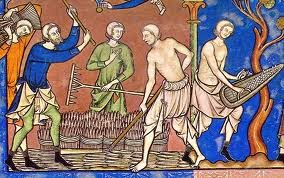
Sloth is the other side of the same coin. In a society without machines, automation or robots, the production of all food, shelter and clothing depended on manual labor. Labor was the basis of survival, and survival was often endangered. Medieval society could not afford for any member to be idle. Even the rich were not idle! Medieval queens, countesses and ladies no less than their maids spun, wove and did other needlework – when they weren’t running the estates of their husbands. The great magnates of the realm were the equivalent of modern corporate executives, managing vast estates and ensuring both production and distribution of food-stuffs. The gentry provided not just farm management but the services now provided by police, lawyers and court officials. In medieval society every man and woman had their place – and their job. Whether the job was to work the land or to pray for the dead, it was a job that the individual was expected to fulfill diligently and energetically. Sloth was therefore seen as a dangerous threat to a well-functioning society.


~~~~~~~~~~~~~

Helena P. Schrader is the author of numerous books of history and historical fiction.  She is currently working on a biographical novel in three parts of Balian d’Ibelin. Read more about her published works at: http://helenapschrader.com and more about her series of novels set in the age of chivalry at: http://tales-of-chivalry.com You can also follow Helena’s blogs: about writing: http://schradershistoricalfiction.blogspot.com about the history of the crusader kingdoms at: http://defendingcrusaderkingdoms.blogspot.com

A crusader in search of faith —
A lame lady in search of revenge —
And a king who would be saint.

St. Louis’ Knight takes you to the Holy Land in the 13th century and a world filled with nobles, knights prophet — and assassins.

Buy now!