Showing posts with label language. Show all posts

Monday, January 4, 2016

What Did I Just Say? : Adoption of English by the Norman Ruling Class

by Joyce DiPastena

Did you know that the origins of the beloved Christmas carol, "Angels We Have Heard on High" might go back to the year 129 AD, when Bishop Telesphorus of Rome ordered "In the Holy Night of the Nativity of our Lord and Savior, all shall solemnly sing the 'Angel's Hymn?'" Or it might stretch back only as far as the 16th century. Or the 17th. The only thing scholars seem absolutely agreed upon is that "Angels We Have Heard on High" was first published in French in 1855, and appeared in an English translation in 1862. It is highly suspected that the actual carol dates back at least to the 1700s, but no one can prove it, because there is no evidence that it was written down prior to 1855.

And so it is with the mystery of when the ruling Norman class of England began speaking English. No definitive date can be stated for the spoken word, only for the written word. Absent medieval recording devices, or short of being able to enter a time machine, scholars can only make educated guesses for when the Norman conquerors adopted English as their common language.

From the days of William the Conqueror in 1066, French had been the language of the ruling class of England. It was long assumed that French remained their dominant language until King John lost his dukedom of Normandy to France in 1204. Barons who had formerly held lands on both sides of the English Channel found themselves cut off from Normandy and forced to focus their energies on ruling solely their English lands. Severed thus from the continent, they increasingly lost interest in their Norman-French origins and began to absorb the language of the conquered English race.

The Normans came to England speaking Norman-French
Bayeux Tapestry

However, more recent scholars have begun to offer a different view. Jacquie Heys, a graduate student of the University of Toronto Canada, has compiled a compelling essay entitled, "French as the Mother-Tongue in Medieval England". In her essay, she quotes Roger Dahood, professor at the University of Arizona, as saying that, "by 1173, and for an indeterminate time before then, members of the baronage spoke English."

Among other evidence cited by Dahood is the observation of Richard FitzNigel (also known as Richard FitzNeal). Richard later became Bishop of London, but around 1158/1159 he was appointed royal treasurer by King Henry II of England. Richard held this post over the king's exchequer for nearly 40 years and became thoroughly acquainted with the workings of this administrative office. In 1177 Henry II asked Richard to compile a book about his work at the exchequer. The result was Dialogus de Scaccario (Dialogue Concerning the Exchequer), a richly detailed source of information on royal finances in the 12th century. Completed sometime between 1177-1180 (well before King John's loss of Normandy), Richard noted in the treatise that "Nowadays when English and Normans live close together and marry and give in marriage to each other, the nations are so mixed that it can scarcely be decided . . . who is of English birth and who is of Norman."

This would hardly be the case if the English and Normans continued to speak different languages.

By the Twelfth Century, Normans
and English were intermarrying
Codex Manesse

It is true that at the very highest levels of the ruling class, namely the king and his court, French continued to predominate, but these were men who continued to spend more time in their continental possessions than they did in England. And King Henry II of England (1133-1189) is said by his contemporaries to have understood English, although he never learned to speak it. As the kings increasingly employed mercenary soldiers to fight their wars, the common barons remained in England interacting with their English subjects and becoming increasingly English themselves. At a minimum, many, if not most, of the ruling class had most likely become bilingual by the 12th century.

The first English government document to be published in English, the Provisions of Oxford, was released in 1258 in the reign of King John's son, Henry III, but we cannot judge the date of the ascendency of the English language by the written language alone. The written word always lags behind the spoken vernacular, especially among populations that were largely illiterate, as was the case in the Middle Ages, and thus provides few records that reflect what may have been the common speech versus records of 'official' correspondence of various sorts.

So until someone invents that time machine, arguments will undoubtedly continue to be made on both sides of this question. Authors of historical fiction are therefore likely safe in assuming whichever conclusions best fit the individual needs of their stories.

~~~~~~~~~~~~~~~~~~~~~~~~

References:

Dahood, Roger. Hugh de Morville, William of Canterbury, and Anectodal Evidence for English Language History. Speculum 69 (1994): 54).

FitzNigel, Richard. Dialogus de Scaccario (Dialogue Concerning the Exchequer), Yale Law School, The Avalon Project: http://avalon.law.yale.edu/medieval/excheq.asp

Heys, Jacquie. French as the Mother-Tongue in Medieval England, (c 2001) (http://homes.chass.utoronto.ca/~cpercy/courses/6361Heys.htm)

Vising, Johan. Anglo-Norman Language and Literature. London: Oxford UP, 1923.

~~~~~~~~~~~~~~~~~~~~~~~~

Joyce DiPastena is the author of eight medieval novels and novellas, including the critically acclaimed The Lady and the Minstrel, in which barons and serfs communicate freely in English during the reign of King John. The Historical Novel Society called The Lady and the Minstrel: " . . . a deeply-researched book that . . . bears comparison well with other great novels of the Middle Ages. I loved the book and highly recommend it."

Joyce's website
Joyce on Amazon
Joyce on Barnes & Noble
Joyce on iBooks
Joyce on Kobo
Joyce on Smashwords 
Joyce's Facebook page
Joyce's blogs http://jdp-news.blogspot.com and http://medievalresearch.blogspot.com


Monday, October 13, 2014

Bantlings, Kinchins and Cossets: Colorful Language Regarding Children.


Francis Grose, author of 
Dictionary of he Vulgar Tongue
by Maria Grace

One of the things that fascinates me most about slang is its very changeable nature. Words can change meaning at the drop of a hat. New words come into lay and may be gone in an instant, or they may stay around for a very long time.

I found some very familiar terms in this offering of Regency era language pertaining to children.

Infants

  • Bantling
  • Brat
  • Chit  
  • Lullaby Cheat

Boys
  • Young shaver
  • Kid
  • Little Breeches

Girls
  • Sow Child

Children
  • Kinchin. A little child.
  • Urchin. A child, a little fellow: also, a hedgehog.
Bull Chin. A fat chubby child.
Cherubim. Peevish children, because cherubim and seraphim continually do cry.
Chip of the old block. A child who, either in person or sentiments, resembles its father or mother.
Cosset. A foundling.
One of his get. One of his offspring or begetting.
Mother's loll. A favorite child, the mother's darling
Pin-basket. The youngest child.

Illegitimate children
  • Love-begotten Child 
  • Merry-begotten
  • Squeaker
  • A natural son or daughter
To stand Moses: a man is said to stand Moses when he has another man's bastard child fathered upon him, and he is obliged by the parish to maintain it.
A wrinkle-bellied whore. One who has had a number of bastards as child-bearing leaves wrinkles in a woman's belly.

Being with Child
  • A woman has got her belly full
  • A girl who sprained her ankle
  • A woman has a white swelling.
  • That wench is poisoned, see how her belly is swelled
Hans In Kelder. Jack in the cellar; i.e. the child in the womb: a health frequently drank to breeding women or their husbands.
Jack In A Box.  A child in the mother's womb.
Launch. The delivery, or labor, of a pregnant woman.

Interesting Expressions related to children
Heavy baggage; women and children.
Black Monday. The first Monday after the school-boys' holidays, or breaking up, when they are to go to school and produce or repeat the tasks set them. 
To sing the black psalm; to cry
A chip of the old block; a child who, either in person or sentiments, resembles its father or mother.
Chitty-paced. Baby-faced; said of one who has a childish look. 
He has deserved the cushion; a saying of one whose wife is brought to bed of a boy: implying, that, having done his business effectually, he may now indulge or repose himself. 
Foundling. A child dropped in the street, and found and educated at the parish expense.
Free of fumbler's hall; a saying of one who cannot get his wife with child.
Marriage Music. The squalling and crying of children.
His mouth is full of pap; he is still a baby.
Prattle. Insignificant talk: generally applied to women and children.
He is as like his father as if he was spit out of his mouth: said of a child much resembling his father.
Sunburnt. Clapped: also, having many male children.

Quoted from: Grose, Captain (Francis). (2004) Dictionary of the Vulgar Tongue, 1811 ed. Ikon Classics

~~~~~~~~~~~~

 Maria Grace is the author of Darcy's Decision,  The Future Mrs. Darcy, All the Appearance of Goodness, and Twelfth Night at LongbournClick here to find her books on Amazon. For more on her writing and other Random Bits of Fascination, visit her website. You can also like her on Facebook, follow on Twitter or email her.

Sunday, August 17, 2014

Grimalkins, Buffers, Prancers and Chick-a-Biddies: Animals of the Regency Era


by Maria Grace

Francis Grose 
Author of Dictionary of The Vulgar Tongue
We have a house full of cats and a dog who thinks she a momma-cat.  They all have their own proper names. But they've also got multiple nicknames each. I may just incorporate a few of these regency Era slang terms as new nicknames for them!
  
Cat
  • Grimalkin. 
  • Tibby.
Ram Cat. A he cat.
Gib Cat. A northern name for a he-cat, there commonly called Gilbert.
Cherry-coloured Cat. A black cat, their being black cherries as well as red.
Smellers. A cat's whiskers.

Dog
  • Buffer
  • Jugelow
Gnarler. A little dog that, by his barking, alarms the family when any person is breaking into the house.
Rum Bugher. A valuable dog. 

Horse
  • Grogham
  • Keffel
  • Prad
  • Prancer
Rip. A miserable rip; a poor, lean, worn-out horse.
Roarer. A broken-winded horse.
Rum Prancer. A fine horse. 
Star Gazer. A horse who throws up his head
Queer Prancer. A bad worn-out foundered horse
Scarlet Horse. A high red, hired or hack horse: a pun on the word hired.
Galloper. A blood-horse, a hunter.
Gibbe. A horse that shrinks from the collar, and will not draw.

Chickens ect
  • Cackler. 
  • Margery Prater.
  • Chick-a-biddy. 
Sucking Chicken. A young chicken
Cackler's Ken. A hen-roost. 
Cackling Cheats. Fowls. 
Cackling Farts. Eggs. 
Cobble Colter. A turkey.
Gobbbler. A turkey cock.
Quacking Cheat. A duck.
Tib Of The Buttery. A goose.

Cow
  • Dunnock. 
  • Mower. 
Cow's Spouse. A bull.
Churk. The udder.

Calf
  • Blater
  • Cow's Baby
  • Essex Lion
  • Quaking Cheat
  • Rumford lion

Sheep
  • Bleating Cheat
  • Woolbird
  • Havil
Bleating Rig. Sheep-stealing. 

Hogs
  • Grunter. 
  • Swing Tail. 

Lice
  • Active Citizen 
  • Creepers 
  • Scotch Greys  

Other Animals
Dickey. An ass.
Roll your dickey; drive your ass.
Kingswood Lion. An ass. Kingswood is famous for the great number of asses kept by the colliers who inhabit that place.
Long One. A hare: a term used by poachers.
Pantek. A hart; that animal is, in the Psalms, said to pant after the fresh water brooks
Sea Lawyer. A shark.

Quoted from: Grose, Captain (Francis). (2004) Dictionary of the Vulgar Tongue, 1811 ed. Ikon Classics
~~~~~~~~~~~~

 Maria Grace is the author of Darcy's Decision,  The Future Mrs. Darcy, All the Appearance of Goodness, and Twelfth Night at LongbournClick here to find her books on Amazon. For more on her writing and other Random Bits of Fascination, visit her website. You can also like her on Facebook, follow on Twitter or email her.
Enhanced by Zemanta

Saturday, May 31, 2014

Pudding sleeves, Finger Posts, and Mr. Prunella: A little colorful language for the parson

Francis Grose, author of Dictionary of he Vulgar Tongue
by Maria Grace

I confess, I am a word nerd. I love language captivates me, especially in the way it relates to a culture. Slang, the speech of the common man, paints such a picture of the speaker's world. I love it!

Since every place and time has its own unique slang, I thought it would be interesting to share some Regency era slang from time to time. Today's offering a little colorful language related to the church.


Colorful names for a Parson...

  • Autem Bawler 
  • Body Of Divinity Bound In Black Calf
  • Devil Catcher, or Devil Driver Snub Devil
  • Dominee
  • Parish-bull
  • Pudding Sleeves 
  • Levite  
  • Spiritual Flesh-broker 

Sir John. The old title for a country parson

Postilion Of The Gospel. A parson who hurries over the service.
Turnpike-man. A parson; because the clergy collect their tolls at our entrance into and exit from the world.
Finger-post. A parson; so called, because he points out a way to others which he never goes himself. Like the fingerpost, he points out a way he has never been, and, probably, will never go, i. e. the way to heaven.
Mr. Prunella. parsons' gowns being frequently made of prunella.
One In Ten. A parson: an allusion to his tithes.
Gluepot. A parson: from joining men and women together in matrimony.
Puzzle-text. An ignorant blundering parson.

…and his curate


Parson's Journeyman. A curate.
Hedge Priest. An illiterate, unbeneficed curate, apatrico.

Colorful names for a Parish clerk

  • Amen Curler 
  • Canticle 
  • Chuck Farthing 
The church...
  • Autem 
  • Gospel Shop
  • Steeple-house  
…and its pulpit
  • Clack-loft 
  • Hum Box 
  • Prattling-box
To look over the wood; to ascend the pulpit, to preach

Referring to the devil

  • Black Spy 
  • Old Harry
  • Old One
  • Old Poger
  • Ruffian. 
  • Old Nick.  from Neken, the evil spirit of the north.
  • Old Scratch. probably from the long and sharp claws with which he is frequently delineated.
Complaining about the preaching

Canting. Preaching with a whining, affected tone, perhaps a corruption of chanting

Spoil Pudding. A parson who preaches long sermons, keeping his congregation in church till the puddings are overdone.
Scraping. A mode of expressing dislike to a person, or sermon, practised at Oxford by the students, in scraping their feet against the ground during the preachment.
Long-winded. A long-winded parson; one who preached long tedious sermons.

Complaining about the tithe

 Black Fly. The greatest drawback on the farmer is the black fly, i. e. the parson who takes the tithe of the harvest.
Pinch On The Parson's Side. To defraud the parson of his tithe.
Priest-craft. The art of awing the laity, managing their consciences, and diving into their pockets.
  
Interesting Expressions related to church and the clergy

Church Work. Said of any work that advances slowly.

Churchyard Cough. A cough that is likely to terminate in death.
Hums. Persons at church.
Japanned. Ordained. To be japanned; to enter into holy orders, to become a clergyman, to put on the black cloth; from the color of the japan ware, which is black.
Thorough Churchman. A person who goes in at one door of a church, and out at the other, without stopping.
To boil one's lobster. for a churchman to become a soldier; lobsters, which are of a bluish black, being made red by boiling.
To cuckold the parson. to go to bed with one's wife before she has been churched.
To dine with Duke Humphrey. to fast. In old St. Paul's church was an aisle called Duke Humphrey's walk, and persons who walked there while others were at dinner, were said to dine with Duke Humphrey.
To fly a blue pigeon. to steal lead off a church.


Quoted from: Grose, Captain (Francis). (2004) Dictionary of the Vulgar Tongue, 1811 ed. Ikon Classics

~~~~~~~~~~~~

 Maria Grace is the author of Darcy's Decision,  The Future Mrs. Darcy, All the Appearance of Goodness, and Twelfth Night at LongbournClick here to find her books on Amazon. For more on her writing and other Random Bits of Fascination, visit her website. You can also like her on Facebook, follow on Twitter or email her.
Enhanced by Zemanta

Sunday, April 6, 2014

Clod Pates, Sapsculls and Noddies: Fools in the Regency Era


Francis Grose, author of Dictionary of he Vulgar Tongue
by Maria Grace

Since I am a writer, language captivates me, especially in the way it relates to a culture. With three teen aged sons living at home I get to hear a lot of the slang they encounter. I never cease to be fascinated by the terms that come up, and how often I haven't a clue what they are referring to.

Since every era has its own unique slang, I thought it would be interesting to share some Regency era slang from time to time. Today's offering: calling out a fool in a Regency appropriate way.

A Fool

  • AddlePate, Clod Pate, Shallow Pate
  • Ben
  • Buzzard


  • Chaw Bacon. A countryman. A stupid fellow.


  • Cod's Head


  • Dummie: A wooden man. A fool.


  • Gudgeon: One easily imposed on. from the fish of that name, which is easily taken.


  • Gull: A simple credulous fellow, easily cheated.


  • Jack Adams


  • Jacob


  • Jolter Head: A large head; metaphorically a stupid fellow.


  • Loggerhead


  • Lout: A clumsy stupid fellow.


  • Mud


  • Nick Ninny, Nickumpoop, or Nincumpoop, Ninny, or Ninnyhammer


  • Nickin, Nikey, or Nizey. A soft simple fellow: also, a diminutive of Isaac.


  • Nocky Boy


  • Noddy


  • Nokes


  • Paper-scull,  Sapscull


  • Pig-widgeon


  • Ralph Spooner


  • Rum Cull: A rich fool, easily cheated, particularly by his mistress.
  • Simkin


  • Simon: Sixpence. Simple Simon; a natural, a silly fellow;


  • Simpleton: Abbreviation of simple Tony or Anthony, a foolish fellow.


  • Spoony: Foolish, half-witted, nonsensical; a man who has been drinking till he becomes disgusting by his very ridiculous behavior, is said to be spoony drunk; and from hence it is usual to call a very prating shallow fellow, a rank spoon


  • Tom Coney


  • Tony

  • To Describe a Fool Plainly
    • Beetle-headed, Buffle-headed, Chuckle-headed, Fat Headed, Leatherheaded, Mutton-headed
    • Benish
    • Bird-witted: Inconsiderate, thoughtless, easily imposed on.
    • Cakey
    • Clumpish
    • Cork-brained
    • Sammy
    • Sappy
    • Squirish
    • Windy
    To Describe a Fool more colorfully
    • A poor honey: a harmless, foolish, good-natured fellow.
    • A hubble-bubble fellow: a man of confused ideas, or one thick of speech, whose words sound like water bubbling out of a bottle.
    • He is no burner of navigable rivers: he is no man of extraordinary abilities; or, rather, he is but a simple fellow.
    • He is a young chub, or a mere chub: a foolish fellow, easily imposed on: an allusion to a fish of that name, easily taken.
    • His garret, or upper story is empty, or unfurnished: He has no brains, he is a fool.
    • He is like a rope-dancer's pole, lead at both ends: a saying of a stupid sluggish fellow.
    • Pudding-headed Fellow: A stupid fellow, one whose brains are all in confusion.
    • He was rocked in a stone kitchen: his brains having been disordered by the jumbling of his cradle.
    • Sleeveless Errand: A fool's errand, in search of what it is impossible to find.
    To Make a Fool of Someone
    • Bam. A jocular imposition, the same as a humbug. See
    • Humbug. Bamboozle. To make a fool of any one, to humbug or impose on him.

    Quoted from: Grose, Captain (Francis). (2004) Dictionary of the Vulgar Tongue, 1811 ed. Ikon Classics
    ~~~~~~~~~~~~
     Maria Grace is the author of Darcy's Decision,  The Future Mrs. Darcy, All the Appearance of Goodness, and Twelfth Night at LongbournClick here to find her books on Amazon. For more on her writing and other Random Bits of Fascination, visit her website. You can also like her on Facebook, follow on Twitter or email her.
    Enhanced by Zemanta

    Wednesday, September 11, 2013

    They didn't say that...did they?

    by Maria Grace


    In both reading and writing historical fiction, we’re on the lookout for expressions that do not fit the era. Most often the trouble is modern expressions creeping into a historical work. But here are Regency era (or older) expressions that sound far more modern than they are:

    Barbecue: 1650s, "framework for grilling meat, fish, etc.," from American Spanish barbacoa. About 1730 the term was used for an outdoor feast where a whole animal was roasted and to describe the animal so roasted.

    Bigwigs: As the cost of wigs increased, very large wigs (perukes) became a scheme for flaunting wealth. Bigwigs were snobs who could afford big, poufy perukes. 

    Chock-full: found about 1400; “Chock” is an alternative spelling of “choke”.

    Croak: A slang verb for “to die”, from the sound of a death rattle.

    Pea-shooter: 1803; quickly generalized to any ineffective weapon.

    Pronto: A musical direction borrowed from Italian in 1744, meaning “quickly”
    .
    Real thing: meaning genuine, was first used in 1818.

     • Red Tape: excessive bureaucratic nonsense, from the red tape used to bind up legal and other official documents.

    Sell out: An officer who has sold his commission back to the army; the way an officer would retire from an army career.

    Snug as a bug in a rug: A rug was a particularly heavy blanket for sleeping and “bug” refers to a bedbug.

     • So-so: mediocre; first recorded use as an adverb was in 1530 and as an adjective (so-so wine) in 1542.

    Son of a gun: the illegitimate son of a militia officer.

    Swagger. To bully, brag, or boast, also to strut.

    Sweet heart: a girl's lover, or a man's mistress; from a sweet cake in the shape of a heart.

    To wet one's whistle: to drink.

    Turned off: a convict would climb a ladder to the gallows. The prisoner would be ‘turned off’ the ladder to be hanged.

    White lie: A harmless lie, one not told with a malicious intent, a lie told to reconcile people at odds with one another.

    Whitewashed: One who has taken the benefit of an act of insolvency, to defraud his creditors, has been whitewashed.

    Wild-goose chase: A tedious uncertain pursuit, like the following a flock of shy, wild geese.

    Word of Mouth: To drink by word of mouth, i.e. out of the bowl or bottle instead, of a glass.

    And my personal favorite:

    Kerfuffle: an agitated disturbance; goes back to 1583.

    References 

    Grose, Captain (Francis). (2004) Dictionary of the Vulgar Tongue, 1811 ed. Ikon Classics
    Online Etymology Dictionary 
    Why Did People Wear Powdered Wigs?

    ~~~~~~~~~~~~
     Maria Grace is the author of Darcy's Decision,  The Future Mrs. Darcy and All the Appearance of GoodnessClick here to find her books on Amazon. For more on her writing and other Random Bits of Fascination, visit her website. You can also like her on Facebook, follow on Twitter or email her.

    Monday, June 10, 2013

    A little colorful language: Weddings and Marriage

    by Maria Grace 


    Since June is the month for weddings, I thought it might be interesting to share a little Regency color with some slang expressions related to marriage, weddings, husbands and wives.

    The Wedding

    LEAPING OVER THE SWORD. An ancient ceremonial said to constitute a military marriage. A sword being laid down on the ground, the parties to be married joined hands, when the corporal or serjeant of the, company repeated these words: Leap rogue, and jump whore, And then you are married for evermore. Whereupon the happy couple jumped hand in hand over the sword, the drum beating a ruffle; and the parties were ever after considered as man and wife.

    Marriage 

    LEG-SHACKLED. Married.
    MARRIAGE MUSIC. The squalling and crying of children.
    NOOZED. Married, hanged.
    PARSONS MOUSE-TRAP; Marriage.
    PRIEST-LINKED. Married.
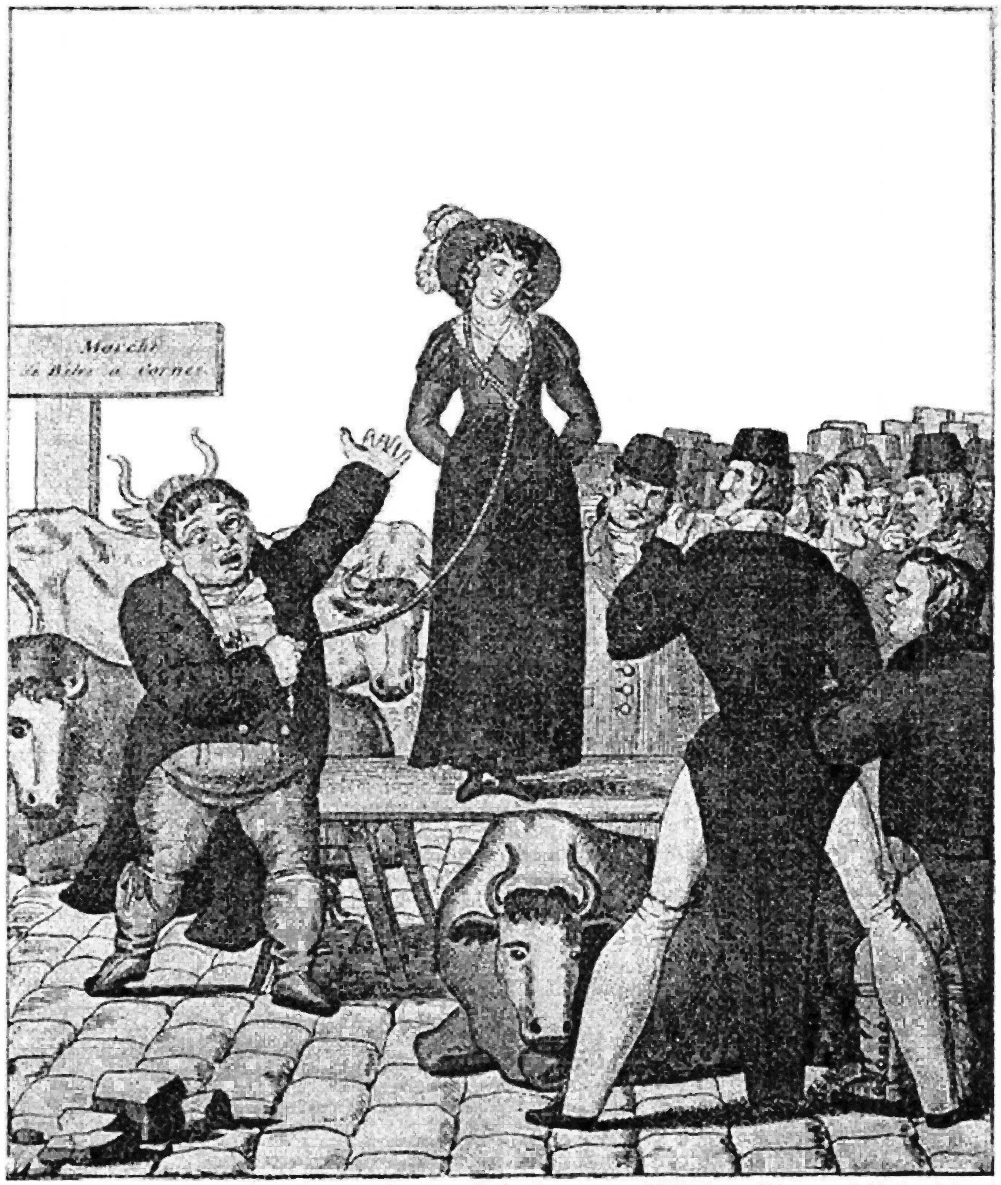
    SMITHFIELD BARGAIN. A bargain whereby the purchaser is taken in. This is likewise frequently used to express matches or marriages contracted solely on the score of interest, on one or both sides, where the fair sex are bought and sold like cattle in Smithfield.
    SPLICED. Married: an allusion to joining two ropes ends by splicing.
    TO RIDE IN ANY ONE'S OLD BOOTS; to marry or keep his cast-off mistress.

    Wife 

    CAT'S FOOT. To live under the cat's foot; to be under the dominion of a wife henpecked.
    COMFORTABLE IMPORTANCE. A wife.
    CURTAIN LECTURE. A woman who scolds her husband when in bed, is said to read him a curtain lecture.
    DEVIL'S DAUGHTER. It is said of one who has a termagant for his wife, that he has married the Devil's daughter, and lives with the old folks.
    DISTRACTED DIVISION. Husband and wife fighting.
    DIVIDE. To divide the house with one's wife; to give her the outside, and to keep all the inside to one's self, i.e. to turn her into the street.
    FREEHOLDER. He whose wife accompanies him to the alehouse.
    FRIGATE: the latter a sea phrase, originally applied to a ship, the captain of which had his wife on board, supposed to command him.
    THE GREY MARE IS THE BETTER HORSE; said of a woman who governs her husband.
    HAND BASKET PORTION. A woman whose husband receives frequent presents from her father, or family, is said to have a hand-basket portion.
    HEN HOUSE. A house where the woman rules;
    HENPECKED. A husband governed by his wife, is said to be henpecked.
    HONEST WOMAN. To marry a woman with whom one has cohabitated as a mistress, is termed, making an honest woman of her.
    TO JOIN GIBLETS; said of a man and woman who cohabit as husband and wife, without being married; also to copulate.
    LAWFUL BLANKET. A wife.
    LEFT-HANDED WIFE. A concubine; an allusion to an ancient German custom, according to which, when a man married his concubine, or a woman greatly his inferior, he gave her his left hand.
    PETTICOAT HOLD. One who has an estate during his wife's life, called the apron-string hold.
    QUEEN STREET. A man governed by his wife, is said to live in Queen street, or at the sign of the Queen's Head.
    RIB. A wife. A crooked rib, a unfaithful wife.
    SHE HOUSE. A house where the wife rules, or, as the term is, wears the breeches.
    TENANT AT WILL. One whose wife usually fetches him from the alehouse.
    TENANT FOR LIFE. A married man; i.e. possessed of a woman for life.
    WHITE SERGEANT. A man fetched from the tavern or ale-house by his wife, is said to be arrested by the white sergeant.
    WHITHER-GO-YE. A wife, wives being sometimes apt to question their husbands whither they are going.
    WIFE IN WATER COLOURS. A mistress, or concubine; water colours being, like their engagements, easily effaced, or dissolved.

    Husband
    CUCKOLD. The husband of an unfaithful wife
    COLT'S TOOTH. An old fellow who marries or keeps a young girl, is said to have a colt's tooth in his head.
    HE IS GONE TO VISIT HIS UNCLE; saying of one who leaves his wife soon after marriage.
    HE HAS  MADE A NAPKIN OF HIS DISHCLOUT; a saying of one who has married his cook maid.
    HE HAS TIED A KNOT WITH HIS TONGUE, THAT HE CANNOT UNTIE WITH HIS TEETH: i.e. he is married.
    HORN MAD. A person extremely jealous of his wife, is said to be horn mad.
    OX HOUSE. He must go through the ox house to bed; a saying of an old fellow who marries a young girl.
    SHE COMBED HIS HEAD WITH A JOINT STOOL; she threw a stool at him.
    TO COMB ONE'S HEAD; to clapperclaw, or scold any one: a woman who lectures her husband, is said to comb his head.

    Reference:
    All definitions taken from: Grose, Captain (Francis). (2004) Dictionary of the Vulgar Tongue, 1811 ed. Ikon Classics


    ~~~~~~~~~~~~
    Maria Grace is the author of Darcy's Decision,  The Future Mrs. Darcy and All the Appearance of GoodnessClick here to find her books on Amazon. For more on her writing and other Random Bits of Fascination, visit her website. You can also like her on Facebook, follow on Twitter or email her.

    Friday, May 31, 2013

    What the dickens and balderdash!

    by Maria Grace 


    Confound it all!

    One of the frustrations of writing historical fiction is discovering your character could not do/hear/see/say something because it had not been invented yet! Such is my plight as I just discovered my Regency era heroine could not say 'Confound it!' as the saying did not exist for nearly another 40 years! A few other things she could not say (and the year in which she could have said them) include:


    • botheration – c. 1835
    • by gum – c. 1825
    • cheeky – c. 1830
    • cheerio – c. 1910
    • confound it – c. 1850
    • darned - c. 1815
    • drat – c. 1815
    • fancy that – c. 1834
    • frightfully – c. 1830
    • (all) right – c. 1837
    • right you are – c. 1865
    • smashing – c. 1850
    But, when frustrated, as I am at the moment, she could have said any of these (and the year they made their appearance):
    • bah --c. 1600
    • balderdash – c.1675
    • barmy -- c. 1600
    • beastly – c. 1200
    • blasted – (damned) c. 1600
    • by (Saint) George – c. 1719, by Jove – c. 1570
    • by the bye – c. 18th C.
    • criminy - c. 1700
    • daft – c. 1450
    • damn- c.1300's but avoided in print until 1930's
    • damnation
      - c.1300's but avoided in print until 1930's
    • dang -- c. 1790
    • darn - c. 1790
    • deuced (damned) -- c. 1785
    • devilish – c. 1450
    • devil of a... – c. 1750
    • dickens (What the dickens?) - late 1600
    • egad -- c. 1675
    • fiddle-de-dee - c. 1785
    • fiddle faddle – from 18th C.
    • fiddlesticks – from 17th C.
    • fudge- from the 1610
    • gads -- from 17th C.
    • gadzooks -- c. 1655
    • ghastly – c. 1325
    • golly - c. 1775
    • good gracious – from 18th C.
    • goodness! – mid 19th C.
    • gosh - c. 1760
    • go to the devil – from 14th C.
    • gracious – from 18th C., gracious me – from 19th
    • hocus pocus from 1620
    • I say – from 17th C.
    • la – from 16th C.
    • lo and behold -- by 1810
    • Nation: abbreviation of damnation--by 19th C.
    • oh! - c. 1550, oh-oh -- c. 173
    • pah -- c. 1600
    • pish -- c. 1595
    • pooh -- c. 1600
    • poop- c. 1744
    • pshaw -- c. 167
    • rot it – 17th -- 18th C.
    • rubbish -- c. 1630
    • son of a (female dog)--c 1707
    • son of a gun -- c. 1710
    • tosh - (nonsense) c. 1530
    • What (how) the devil – from 17th C.
    • zooks - c. 1635
    • zounds - c. 1600
    What a beastly lot of devilish rubbish it is to care whether or not she could have said any of these phrases.

    Confound it all!  

    Resources:
    Dictionary.com
    English Through the Ages, by William Brohaugh, Writer’s Digest Books, 1998
    Etymology of Expressions compiled by Joanna Waugh http://www.joannawaugh.com/Expressions.html
    Etymology Online http://www.etymonline.com/
     
    ~~~~~~~~~~~~
     Maria Grace is the author of Darcy's Decision,  The Future Mrs. Darcy and All the Appearance of GoodnessClick here to find her books on Amazon. For more on her writing and other Random Bits of Fascination, visit her website. You can also like her on Facebook, follow on Twitter or email her.