Showing posts with label Women. Show all posts

Tuesday, May 31, 2016

The Life of the Governess Continued: Agnes Porter

by Lauren Gilbert

The Governess
As we’ve already seen, governesses were a necessary feature in upper class households with children. The position came to be regarded as oppressive, socially ambiguous and somehow shameful. This is especially true of the Victorian era, when middle class and tradesman families who had acquired new wealth wanted governesses for their children as a sign of their new status (and to help their children move into a higher social sphere). In many ways, this created a new tension in that, at the same time, there was a plethora of unattached gentlewomen seeking employment who went to work for people whom they might never have considered a social equal. Within the household, a governess had the social strain of being kept “in her place” combined with the need to provide their female students with less intellectual stimulation and more accomplishments, creating a singularly isolated and intellectually arid situation. This is the situation from which JANE EYRE and her like was born. Miss Trimmer (see my previous post HERE.) and Miss Agnes Porter, today’s subject, had the advantage of being from an earlier generation. They grew up at a time when education for girls was not as restricted (even if only in their reading) and worked at a time when governesses were employed primarily by the aristocracy, so the issue of rank was already settled.

Fortunately, Agnes Porter left diaries and letters, which give us an opportunity to learn about her working life. However, we do not have as much personal detail as we could wish. Ann Agnes Porter was born on June 18, sometime around 1750-52 (exact year unknown) in Edinburgh, the oldest of 4 children (she had 2 sisters and a brother; her brother died young). Her father was Francis Porter, born about 1718. His parents having died when he was young, he was apprenticed at age 12 under his uncle, a woolendraper in Great Yarmouth. Although he completed his apprenticeship, he apparently had different ambitions; by 1750, he was an ordained Anglican clergyman living in Edinburgh and married to a woman named Elizabeth (maiden name unknown but of apparently better connections) and beginning his own family. It is important to note that, despite his beginnings in trade, by becoming a clergyman and marrying a woman of somewhat better status, he raised himself up to a higher social level. This allowed his daughters to be considered gentlewomen, an important consideration.

Although Mr. Porter does not seem to have held a permanent living for most of his career, he performed marriages and services and apparently continued his studies. Despite the fact he and his family seem to have relocated to Chelsea near London by about 1763, Francis Porter was awarded a Doctor of Divinity degree by Edinburgh University in 1765. He had also benefited from a series of inheritances from aunts, first in 1757, again in 1764 and again in 1765, inheriting money and property in Great Yarmouth, among other benefits. The family remained in the Chelsea-London area until about 1770. In 1778, he was given his own living at Wroughton, Wiltshire, as vicar. He died March 28, 1782 at Wroughton, living his widow and 3 daughters.

We know nothing of the education of Agnes and her sisters. There is no indication that she or her sisters were sent away to school; there is a strong probability they were educated at home. We don’t know what benefits Mr. Porter’s inheritances may have afforded the family prior to his death. As a clergyman, particularly one pursuing his own education, one assumes there were books in the households in which they lived. There is an indication that Agnes and her youngest sister Fanny were in Boulogne, France, for some time as girls; certainly, Agnes spoke respectable French as an adult. At some point, she must have had music lessons, as she played the piano and the harpsichord and sang. It is apparent she read widely, had an inquiring mind, and acquired the usual skills: the use of the globes (celestial and terrestrial), drawing, geography, etc.

Agnes spent some time in the household of a wealthy family named Ramey in Great Yarmouth. John Ramey, head of the household, may have been a friend or acquaintance of her father. She may have been in the household for at least part of the time as Mrs. Ramey’s companion, and was there at the time her father died in 1782. There is no indication of what happened to the property Mr. Porter had inherited in Great Yarmouth; he left little to his surviving family and, as the widow of a clergyman, Mrs. Porter had to leave the house that had come with the living. From this point, it was apparent that Agnes was going to have to support herself and her mother. Her first known position as a governess was in the household of a family named Goddard with several daughters later in 1782, which was located in Swindon, not far from Wroughton. She stayed there a short time, before moving on to the household of the 2nd Earl of Ilchester in January of 1784. She was then in her early thirties. Her salary was 100 pounds per year and she was provided with comfortable rooms of her own, including the use of a parlour.

Lord Ilchester’s family was wealthy and related to Lord Holland and Charles James Fox, one of the strong Whig families. Despite this, his wife and children spent most of their time at Redlynch in Somerset, rather than in London or at other more imposing estates. Lady Ilchester was the daughter of an Irish gentleman, and apparently the marriage was a love match. At the time Agnes Porter joined their household, Lord and Lady Ilchester had 3 daughters, and her arrival occurred just before the birth of a 4th daughter. Lady Ilchester, by all accounts, was a warm-hearted person who preferred life in the country with her children, and Agnes Porter became very attached to her. It appears that Miss Porter and Lady Ilchester became friends. A son and 2 more daughters were born. Sadly, Lady Ilchester died in June of 1790, shortly after the birth of her 6th daughter. Agnes Porter had the teaching of and a great deal of the care of the children. Lord Ilchester was involved with his children, particularly the older ones, taking them on visits from home and to his London home during the season.

Miss Porter’s teaching style seems to have been less reliant on learning by rote than by experience, reward and making the lessons fun. She heard their prayers and their lessons, took them for walks, supervised their play and read with them. This could involve a day lasting up to 16 hours, and occurred every day. Having an affectionate relationship with their mother and fondness for the children must have made things much easier for Miss Porter and the family (unlike the periodic tensions between Selina Trimmer and Georgiana, Duchess of Devonshire and Elizabeth, the 2nd duchess). After the death of Lady Ilchester, Miss Porter was even more involved with the day-to-day care of the younger children. She genuinely liked teaching. She was also a sympathetic friend to the two older girls who were growing up and no longer required teaching as much as guidance.

During this time, Miss Porter was able to see friends, especially when in London. Her youngest sister Fanny Richards (who had married a clergyman) visited her at Redlynch. She sent money to her mother and younger sister Elizabeth, who lived with Mrs. Porter. She also corresponded with her sister Fanny. Agnes wrote and published a book of children’s stories in 1791. However, despite the many advantages of her position, she worried about her mother and wanted to spend more time with her which was difficult. She visited when she could, and was concerned about her mother’s health. Agnes was there multiple times in 1791, and again in July of 1792, when she paid her mother’s debts and arranged for more care for her (sister Elizabeth was apparently not a reliable caregiver, which added to Agnes’ worries). She was also anxious about an indigent old age, despite Lord Ilchester’s promise of an annuity of 30 pounds per year. She hoped for a marriage, and a home of her own, as that offered the most security.

In 1794, one of Lord Ilchester’s older daughters, Mary, married Thomas Talbot and moved with him to his home Penrice Castle in Wales. This was a wrench, as Lady Mary and Miss Porter were friends. They did however engage in correspondence. On June 8, 1794, Miss Porter’s beloved mother died. Then, in August of 1794, Lord Ilchester married again, to his cousin Maria Digby, a much younger woman. Although Miss Porter tried to be optimistic, the new Lady Ilchester did not warm to Miss Porter, apparently uncomfortable with Miss Porter’s affectionate relationship with her stepchildren. The birth of a son two years later to Lord and Lady Ilchester only exacerbated the tension, culminating in Miss Porter’s determination to leave the position in 1796, although restricted by her situation (where to go?). Fortunately, a friend, Mrs. Upchur, offered Miss Porter 100 pounds per year to come as companion, so Miss Porter was able to give her notice to Lord Ilchester, who was distressed to lose her. She moved in with Mrs. Upchur in September of 1797. She was in her mid forties and had been with them over a decade.

In March 1799, Mrs. Upchur died, leaving Agnes 100 pounds. Later in 1799, her friend and former pupil Lady Mary Talbot, now a mother herself, invited Miss Porter to come to Penrice to teach her children, also offering 100 pounds per year. This gave Miss Porter the opportunity to return to a country household with a congenial mistress and a second generation of children to teach. She remained with the family until she retired in 1806. Lord Ilchester had died in 1802, but he left many debts and an unclear will, so it took much time for the promised annuity to be paid. At some point in 1808, the payment of the annuity finally became reliable.

Fortunately, the Talbots continued to pay her 30 pounds per year after her retirement and she was able to go live with her married sister Fanny and her brother-in-law in Fairford, Gloucestershire. She periodically returned to Penrice to help out, and also visited London and Norfolk. At some point, she decided to leave her sister’s home (there is a suggestion that her brother-in-law’s evangelical beliefs were not compatible with her beliefs, and particularly her fondness for cards). Ultimately, she spent the last few years of her life comfortably in lodgings in Bruton, a happy situation near Redlynch where she had acquaintance and was able to enjoy a social life. Agnes maintained her correspondence with Lady Mary Talbot until she passed away in February 1814, in her early 60’s. She left approximately 2000 pounds, which she had settled with a will written in 1813, benefiting her sister Fanny and some cousins, and leaving a few other bequests.

Agnes Porter’s diaries give us many insights to her life and activities as a governess that we do not have with Selina Trimmer. She acknowledged herself as plain, but she retained her intellectual curiosity and strove to learn. She read books about education, tried to teach herself Latin, German and Italian, and continued to read widely during her life. She clearly had positions in the Ilchester and Talbot homes that allowed her privacy and a certain amount of freedom and paid her decently, allowing her to support her mother and to save something for herself. In spite of this, she was dogged by the uncertainty of her situation and the fear of being alone and poor in her old age. Throughout her career, as successful and satisfying as it was in many ways, Agnes Porter wanted to be married. She had her hopes raised and disappointed more than once well into her middle years. It’s no wonder that, after Lord Ilchester’s death, she pursued her annuity until it was resolved and paid regularly.


The information here is from the following sources:

Brandon, Ruth. GOVERNESS The Lives and Times of the Real Jane Eyres. 2008: Walker Publishing Co., New York, NY.

Martin, Joanna, ed. A GOVERNESS IN THE AGE OF JANE AUSTEN The Journals and Letters of Agnes Porter. 1998: The Hambledon Press, London, England.

I highly recommend both books. Unfortunately, I found no portrait of Miss Porter in the public domain.


Image: The Governess by Emily Mary Osborne, 1860. Wikimedia Commons. HERE


Lauren Gilbert lives in Florida with her husband.  Her first published work, HEYERWOOD: A Novel, was released in 2011.  Her second novel, working title A RATIONAL ATTACHMENT in in process.  Visit her website HERE for more information.

Tuesday, January 12, 2016

Marginalized Healer to Revered Hospital Matron

by Peter Ardern

I had the privilege of commencing my nurse training at the time of the traditional matron and ward sister. I developed a huge respect and still hold fond memories of learning from these highly skilled ladies. Their demise in the 1970s led me to, in the late 1990s, meet with and write about many of their lives and subsequently to examine the history of women in nursing.

The Woman Healer

From pre-history women have been regarded as the passive healers. They succoured the child and mended the wounded-warrior husband. They were the gatherer while the husband was the hunter. Both views can be and should now be challenged.

This ‘passive role’ of women in health has been re-enforced throughout the last two millennia. Custom, practice, and forced exclusion from academic institutions prevented women from attaining a higher education and therefore excluded them from the opportunity to contribute to the science of medicine.

Instead there developed the tradition of the rural, untrained woman healer. Doctors practised mostly for the wealthy or in the larger cities. So to these people the woman healer was virtually the unlicensed doctor, and in the absence of a medical practitioner, healing became the essential responsibility for these mothers and wives.

The techniques these ladies used were learned from family, friends, or from observing other healers.
They were the midwives/abortionists, nurses, and advisors. They could be the equal of pharmacists in cultivating healing herbs and unguents. They travelled from home to home and village to village. These women were effectively doctors without degrees.

Untutored in medicine, they used therapies based on plants, empirics, traditional home remedies, purges, bloodletting, and minor surgery.

They had their own painkillers, digestive aids, and anti-inflammatory agents, using ergot for the pain of labour at a time when the church held that pain in labour was the Lord’s just punishment for Eve’s original sin.

For centuries the female healer performed a service virtually indistinguishable from that of the one so guarded and aggressively defended by academically trained physicians.

Over the centuries, the use of magic, amulets, and incantations were also popular. Unfortunately these proved to be the undoing of many of these healers in the 15th to 17th centuries. In those centuries they became known as witches and charlatans by the authorities. And with this title they were mercilessly persecuted. Many of these women healers were burned because they used ‘cures’ and it only took the accusation of one doctor for ‘the witch’ to be found guilty.

The eighteenth century saw a new tolerance of the healers so long as they did not infringe on the doctor’s territory.

The nurse as we know her

Hospitals and nursing, as we know them, began in the 18th century with the building of new hospitals. The reformation, which began in 1534, had sounded the death knell for the poor sick, by sweeping away the few hospitals there were. This proved so calamitous that Henry the VIII was compelled to open St Thomas in 1550.

In the middle of the seventeenth century larger hospitals were built and the first simple hierarchical structure was in operation in the leading hospitals. It was headed by a triad of medical staff, governors and untrained matrons; then came the sisters, nurses, and helpers. It was not until the nineteenth century that matron’s duties and responsibilities were more clearly defined.

In the early years of the early 19th century, a nurse was simply a woman who happened to be nursing someone – a sick child or an aging relative. There were hospitals, and they did employ nurses. But the hospitals of the time still served largely as refuges for the dying poor with only token care provided. Hospital nurses were often disreputable, prone to drunkenness, prostitution, and thievery; their living conditions were often scandalous.

The religious orders did play a continuous role in providing care for the sick and in improving conditions and were often the only source of care. One among many nursing orders was the Little Company of Mary founded by Mother Mary Potter.

Florence Nightingale


The Nightingale reforms

Florence Nightingale undoubtedly changed nursing. Her basic principles were to lay the foundation of nursing as we were to know it for over a hundred years;
1/ A trained matron to have undisputed authority.
2/ A planned course of theoretical and practical training.
3/ A nurses’ home to be established at every hospital.

With a matron in charge, there were clear lines of accountability that were to be the cornerstone of nursing for over a century. It was the trained matron who was now the respected leader of the hospital. And from her nursing staff she demanded a high commitment of care. The following pledge ensured that.
I solemnly pledge myself before God and in the presence of this assembly to pass my life in purity and to practice my profession faithfully.
I will abstain from whatever is deleterious and mischievous, and will not take or knowingly administer any harmful drug.
I will do all in my power to elaborate the standard of my profession, and will hold in confidence all personal matters committed to my keeping, and all family affairs coming to my knowledge in the practice of my calling.
With loyalty will I endeavour to aid the Physician in his work and devote myself to the welfare of those committed to my care.
This was the first of three pledges and avowed by nurses for over sixty years. (This is often mistakenly ascribed to Miss Nightingale; it was however created by the Farrand Nurse Training School in Detroit, in 1892, for Miss Nightingale.)

Dr. Jex-Blake
Through Miss Nightingale the middle-class lady began to have an influence on the working world. These ladies embodied the very spirit of femininity as defined by sexist Victorian society, where nursing was still seen as a natural vocation for women, second only to motherhood. It would take many years before the ladies of nursing stood on equal footing to the men of medicine. Sophia Jex-Blake was the first female English Physician to bridge this gap, but it would take many years before women in medicine could count themselves to be on an equal footing to men.

The departure of the traditional matron and traditional ward sister in the 1970s also saw the demise of the famed mobcap, white cuffs, dark blue uniform, and cape.

~~~~~~~~~~~~~

In the late 1990s I spent a good two years seeking and interviewing a number of these traditional matrons and sisters. Hence I wrote, When Matron Ruled, The Nursing Sister, and paperback, When Sister Ruled.

My new novel, Dorothy’s Dream, combines many facets of the above history. Inspired by Hettie Ferris, a woman healer, and Aunt Annie, a Nightingale nurse in the Crimea, Dorothy achieves her dream of being a trained nurse. Then she discovers she is still a woman in a man’s world.

Dorothy’s Dream, A Historic Romance, is now available on Amazon.


Friday, December 4, 2015

Bluestockings: The Victorian Campaign for Female Education

by Carol Hedges

In 1971 I graduated from Westfield College, University of London with a BA (Hons) in English & Archaeology. I took it for granted that I had a right to go to university and that following my degree, I would enter the marketplace as a professional woman, equal to any man doing the same job of work.

When I started researching the roles and expectations of young Victorian women for my current wip Murder & Mayhem, which features 17 year old ‘Feminist’ Laetitia Simpkins, I discovered how lucky I was to have been born in the mid-20th century rather than the mid-19th.

For bright young Victorian women, the doors to further education closed at 16. Intellectual curiosity and thinking skills were considered a waste of time, given that the purpose of a woman’s life was to marry and be the mother of (many) children.

As one contemporary wrote: “Girls are to dwell in quiet homes, among a few friends; to exercise a noiseless influence, to be submissive and retiring.” (Sewell, Principles of Education).

Interestingly as far back as 1694, Mary Astell’s A Serious Proposal to the Ladies suggested a type of university education. But of course, the very fact that the proposer was female meant that the idea was not taken up or considered seriously.

Women were just thought of as physically incapable of scholarship. For a start their brains were nearly 150 grammes lighter than men’s brains. So that must indicate that their intellect was weaker. And then there was the vexed question of menstruation, which sapped the body of lifeblood.

Put those two together, and it was quite apparent that women who used their brain too much ran the risk of becoming sterile, as their wombs atrophied, thus negating their purpose in life, or even worse, producing “ a puny, enfeebled and sickly race” of children.

You may laugh, or gasp in amazement, but this was a widely held medical opinion at the time. Girls were strongly advised to focus on making their homes a sphere of accomplishment, rather than striving for a higher education. And to wait patiently for some young man (who may well have had the benefit of a university education) to come calling.

That the ‘petticoat problem’ began to resolve itself was entirely due to the actions of a few determined young women who decided that rather than break down the doors, they’d pick the lock and fight for equal education for women.

In 1850 North London Collegiate School opened, and a few years later Cheltenham Ladies College. The key word is ‘college’ – these weren’t places to learn embroidery, a smattering of French, some maths and what to do in a thunderstorm. They were seats of learning, encouraging girls to see themselves as capable of entering university and from there, the workplace.

In 1879 London University became the first to admit women undergraduates on the same terms as men. One of the pioneering women who enabled this to happen was Constance Maynard, who in 1863 campaigned for girls to be allowed to sit the Cambridge Locals (the equivalent of GCSEs) and then the Higher Locals (A levels).

When I was at Westfield, originally founded as a women’s college, my hall of residence was called Maynard House, a fitting tribute to a Bluestocking pioneer. Without women like her, prepared to step out of the shadows and campaign for their beliefs, I would not have had the benefit of a university education, and the opportunity to have a productive and fulfilling career.

~~~~~~~~~~~~~

Carol Hedges is a British author of books for children, young adults and adults. Her novel Jigsaw, about a teenager's suicide, was shortlisted for the Angus Book Award and nominated for the Carnegie Medal in 2001.[1] Her most recent works are the Spy Girl series for teenagers published by Usborne, and the Victorian Detective series for adults, published by Crooked Cat and featuring detectives Leo Stride and Jack Cully.

She lives in Hertfordshire and is married with a grown-up daughter.

Amazon author page: http://amzn.to/1N1P3DF

Blog: carolhedges.blogspot.co.uk

Twitter: @carolJhedges


Thursday, October 1, 2015

12th Century Woman: Place in Society, Marriage and Childbirth

Summarised background research to developing my book All That is Truth Will Be Revealed.

by Denise J Hale

Until recently I was working with young people; as a part of my role I had to ensure they understood “equality and diversity”. Most young people had a blasé attitude to these subjects; ‘yeah I know about that’, ‘we’re all equal now’, ‘course men and women are treated equally’. Even harder was trying to ensure they were aware of protection from sexual harassment; luckily newspaper stories of events in the 70’s could be referred to. There is no doubt that our attitudes to these subjects have changed within my lifetime.

It may seem a strange leap to medieval history, but it was thinking of the similarities and differences within the two societies which inspired my book.

Too many girls I spoke with were complacent about equality, yet women are still not treated equally in many sectors of society. I began to think about a period in England where women were not viewed as equal, when arranged marriages were the norm and married women wore veils to hide their hair. I have studied various periods of history as part of my degree, but the earliest (not counting the Romans) was 1450. Prior to that I had a rudimentary knowledge of Celts, Anglo-Saxons, Vikings, Norman Conquest, Crusades, Plantagenets, War of the Roses and the founding of the Tudor dynasty. Now I wanted to know more about the zeitgeist of the medieval era.

Selecting a period

In the summer of 1190 the recently crowned King, Richard I, left England for the Holy Wars along with his knights and their men. This is not an illustration of Richard, but it shows anxious women, on the edge of the picture, watching their men leave.


It was these women, on the edge of history, I wanted to learn more about.

Class and women’s place

After the Norman invasion a chronicler summarised England as having three classes; ‘those that pray, those that fight and those that work.’ The chronicler was referring to men, but women were, of course, present in all these classes. Medieval writers rarely mention women, and when they do they are often termed as chattel in marriages. Richard did not even allow women (or, incidentally, Jews) to attend his coronation.

Within ‘those that pray’ were the nuns. However, unlike their male counterparts they could not conduct services, even in nunneries only male priests could conduct Mass and other Christian rituals. The Church viewed women harshly. The original sin, according to the Bible, was caused by the actions of Eve and led to her, and Adam’s, expulsion from Paradise. God even punished women by inflicting on them the pains of childbirth. Women were naturally inferior to men; after all, man was made in God’s image. The head of the Church was the Pope and the English clergy answered to him for their actions, not the King. The language of the Church was Latin; it was both spoken and written.

Many nuns would have been ladies from noble families, and some would be able to read. It was not uncommon for older women (and men) to enter religious houses. Queen Eleanor retired to Fontevraud (one of many religious establishments she’d give endowments), and here she became a nun. People recognised the brevity of their life, and there was a strong belief in an after-life for the soul. Its destination was dependant on your actions on earth and your contrition for your sins. Fasting and penance were not only practised by the religious orders but were part of everyone’s life.

Fighting was the major occupant of the nobles; whether defending their own lands or performing feudal service for their Lord. Women’s roles were home based—wives and mothers, the bearing of heirs being particularly important. In many cases these women would have been managing their husband’s affairs whilst they were away.

Marriages of the nobility were arranged by parents; few were love-matches. Gaining alliances, strengthening of land holdings and gaining of property were all attainable from a good marriage. Dowries were obtained from the bride’s family by the groom’s, however, the bride’s family could also gain advantages from the union. Girls, of course, had to be virgins and many marriages were agreed when the girls, in particular, were very young. At this stage the marriage contract may be sealed, but the consummation of a marriage would not take place. Intercourse with a girl, not yet a woman, (the arrival of menstruation was recognised as the beginning of womanhood) was considered as likely to damage the girl and risk the possibility of her being unable to bear children. The completion of the marriage contract required an exchange of vows to take place. This would occur at the door of the church with witnesses before a priest. The bride would be standing on the groom’s left, as it was believed Eve was created from one of Adam’s left rib-bones. After the vows were exchanged everyone would enter the Church to celebrate Mass. The marriage also had to be consummated for it to be valid.

The third group of people, the workers, were a mixture of people including traders, craftsman, freemen, villains, serfs. For the most part they did not speak the same language as the nobles (Norman French) although, after one hundred years since the invasion, there were bi-lingual speakers in both groups. The majority would have been tied to the land and were viewed as their lord’s property. They would be expected to work his land (as well as any granted to them) and their wives and children would work alongside them; tilling, planting and harvesting. Most of the workers in the castles would have been men, including in the kitchen. There were also skilled castle workers which included blacksmiths, wood workers, leather workers, stone masons, grooms.

Note—the ladies of the castle were served mainly by other noble women. Noble men would also serve in the castle; pages, squires, men-in-arms, clerics. I suspect Normans tended to trust other Normans when sharing their living space.

Marriage, for workers, was unlikely to involve very young girls; most women would be in their 20s, and it was less likely to involve the church. A couple, wanting to wed, would need a witness to hear their vows. This was enough to constitute a lawful marriage as long as neither had previously married, was not a close relation and was not being forced to wed, i.e. ‘had not given their word freely'. The reading of banns to safeguard against unlawful marriages was introduced following Herbert Walter’s Westminster Council 1200.
Note: I have been told it was usual to request permission from their lord before marrying; I am still trying to verify the facts on this.

Childbirth and Menstruation

In 1190s, whilst men faced death on the battlefield, it was childbirth that claimed the lives of women. The birthing room was presided over by women; no man was supposed to enter.


Due to the high risk of death a woman would attend mass before birth in order to be prepared if the worst wa0s to befall her. Midwives were the only women who were given permission to perform a church service. 7'Midwives could baptise a baby, but only if the baby was unlikely to survive, so that its soul would gain entry to heaven. Due to the risk of infant mortality living babies were taken and baptised within days of birth although the mother could not leave the birthing chamber till she was ready to be churched.

Menstruation, at this time, is a source of some very strange beliefs. Women looking at fresh milk, or wine, could turn it sour. The blood could kill plants and rust metal! Priests certainly did not allow women in this condition to enter and defile the holy ground of a church!

Churching normally took place 40 days after childbirth, when bleeding had stopped. On the positive side it allowed women recovery time. The service was a celebration of her return to the church and the safe delivery of a child; it would be followed by a feast.

Holy women often did not menstruate. This was due to the effects of fasting and their restricted diet, but was viewed as a sign of their release from the consequences of Eve’s sin.

Marriage and Sex

"52-aspetti di vita quotidiana, amore,Taccuino Sanitatis, Cas" by Giovannino de' Grassi - book scan Bibliotheca Casanatense Roma. Italia.. Licensed under Public Domain via Commons.

Once married it was believed to be important for the woman to reach climax in intercourse, as well as the man, in order both their seeds were released to create a baby.

Throughout the medieval period the church sought to control both sex and marriage. Although lust was viewed as a sin, within marriage sex was a necessity for the providing of children. Various edicts were issued including naming days when sex even within marriage was sinful, positions that were sinful, acts which were sinful.

Writing my novel

Like many others I absorb information about history and ideas related to history, then think, what if? What if a girl experienced a little bit more freedom than others of her gender? What if the future that was planned for her is destroyed? What if an opportunity is given to her family, and she can change its fortune?

Eventually Helena’s story began to enfold. It began as a romance, but as it developed other factors came into it. The three sons of Lord Westbury were partially based on a family of original crusaders—the eldest embracing the life of a soldier, the second son looking for ways to gain status and the third destined for the church. In the original family the youngest left the church himself whilst I amended this decision to being his father’s. All three sons trained as soldiers from a young age, as most men would have at this time. Not many would be able to read and write though. Edwin, the youngest son, learnt both skills from the monks. His eldest brother, Richard, could also read. Helena’s father appointed their priest for both his ecclesiastical proficiencies and his ability to read and write. He was also tutor to his sons and allowed Helena to join their reading lessons.

I also wanted to ensure that the society’s bi-lingual aspect came across in my novel; the ruling class spoke Norman French and the lower classes the native ‘English’. Hand made books were produced, but only the rich could afford them; they were written in either Latin or French depending on their subject matter. Before the twelfth century all readers read aloud; as manuscripts began to acquire spacing between the words, they became easier to read without muttering the words. However, people still read aloud to share the story with others.

Following a battle incident in which his life was saved by the actions of Helena’s betrothed, causing him to lose his own life, Lord Westbury promised Helena’s father that she could marry one of his sons. Beside his sense of gratitude Lord Westbury would have been aware that, even through Helena’s father is a Norman noble, Helena would have very little dowry and was likely to encounter difficulties obtaining another suitable husband. The returning of John’s heart in a gold casket is based on burials of Crusaders’ hearts found in two Suffolk churches.

Besides her father’s absence, her mother’s illness, mixed with her family’s improvised state, has allowed Helena a freedom which would not have been normal for an unmarried nobleman’s daughter. Her mother’s illness is not named. I viewed it as gynaecological problem following her seventh childbirth, originally ignored by her and then not recognised, or even treatable, by doctors.

The story begins with Helena’s father’s return and Helena having to leave her home and family, carrying with her with the responsibility ‘to make a good marriage’ without any support or guidance available to her. Even her letters home will have to be dictated to a household cleric. Her first impressions are of the higher status of this family to her own; clothing, furnishing, even windows and floors are to impress others as much as for comfort. Lifestyle envy, despite a recent ‘Times’ article, is not new. Lady Westbury is unwelcoming to her. Whilst her husband may have made a promise she does not want her sons to marry this girl who brings nothing but her beauty to a marriage. Edwin, however, treats Helena with respect and kindness. Unsurprisingly, after her family leaves, Helena feels uncomfortable; she finds her freedom curtailed, she makes mistakes, and, eventually, she falls in love with the one brother who is not available to her. When her mother dies she is able, at last, to leave Westbury. She is accompanied home by the youngest and eldest sons.

Apart from creating a readable story, within ‘All that is truth will be revealed’, I hope I have provided an insight into the lives of people in this era. Helena is not the only one to make mistakes and then have to deal with their consequences.

~~~~~~~~~~~~~

I was born in Gloucestershire and, so far, have lived here all my life. I am married with two boys.
History was always something I enjoyed; whether it was reading about people and events, watching films or TV dramas, or visiting stately houses and castles. I wanted to take history as an A’level but was told it didn’t fit into the maths based course that I hoped would lead to a job.

I worked as a programmer/analyst and undertook an Open University Degree in my spare time. I probably should have studied for a computer-based degree to further my career, instead I opted for history and art based units. One of my last units was 'Approaching Literature'. After I finished the degree I completed a few writing courses. I wrote various short stories; one was read on Radio Gloucestershire, another won first prize in a writing competition. I also wrote a couple of novels, but they weren’t published.

In 2014 I started to write a medieval historical novel. I have just completed this novel and am presently working on its sequel. I would like to follow the family I created, 'The Westburys', through till the death of the last Plantagenet King, in 1485.

Website

Amazon

Tuesday, August 4, 2015

Wool, Women and WWII

by Davina Blake

English women recruited to the Auxiliary Territorial Service (the ATS) in World War II found themselves the proud possessors of a mountain of kit mostly made from wool: two itchy khaki uniforms, four pairs of lisle stockings, three pairs of khaki lock-knit knickers (ouch!), two pairs of striped men's pyjamas, eight starched collars, including the studs to attach them, and a greatcoat meant for a man.


Iris Bryce, a new recruit, said, "The shoes were so heavy I clonked along feeling like Frankenstein."

During the height of the War, in 1943, an astonishing 10,325,000 battle dress jackets and trousers were produced by Britain's wool and textile industry. (Figures from British War Production 1939 - 45).

The uniforms extended right through to the underwear. Iris found the boned corsets so unforgiving and unflattering that she sent them home to her Gran, but was told that this was illegal as all the kit belonged to the King's Uniform, and she was not allowed to give it away.

For some poorer women, the uniform was a relief. Clothes rationing for civilians had been introduced in 1941, and in 1942 the government set maximum prices. The Board of Trade permitted only a few styles, made only from specified cloths, the ones that were not being used for battledress. Stockings were only available made in lisle or wool, as silk was needed for parachutes. Women painted their legs with potassium permanganate to give a somewhat streaky tan. A black eyebrow pencil was used to give the impression of a seam. By saving on stockings, the clothing coupons were reserved for more essential purchases, such as shoes and coats.

Some women from slum conditions found the single bed, provided by the army barracks, luxurious after sharing with siblings or other family members, and the uniform helped to instil a sense of equality amongst women from many different backgrounds.


Austerity continued at home. "Mother was very good at sewing," says Joan Ball. "If sheets became thin in the middle she cut them in half and stitched the sides together to make them last a bit longer." Joan had several cousins, and her mother made all their dresses, charging 2/6d (15p) for them. 

When Joan joined the ATS, she was sent to Pontefract training base for six weeks. She says: "Every morning we had kit parade where everything had to be laid out on our beds, bedding folded so that every blanket was the same, jacket buttons and shoes polished. We then had to stand to attention at the foot of the bed, not daring to move. After inspection we assembled on the parade ground and marched up and down until the Sergeant Major was satisfied with our performance."

Joan was billeted in the Queen Elizabeth Barracks, Chilworth, where the dining room catered for a thousand girls. Joan says, "The food was generally plain and rather stodgy. We had scrambled egg, which arrived on huge trays and was made from dried egg, for breakfast."


Talking of Queen Elizabeth Barracks, The Queen also served with the ATS - with the Number 1 'Beaufront' Company, Here she can be seen can be seen with an Austin K2 ambulance. I wonder if she found the army issue corset unmanageable too!


Knitting for Britain

Homes were mostly unheated in the winter as coal was needed for essential factories and industries. Most women were expected to knit - for themselves, for their families and for their fighting husbands. Bales of wool were supplied in regulation colours and the WRVS would wind the wool into skeins and issue it to women. Buses and trams were full of women knitting - not to knit was seen as unpatriotic. The Red Cross gave out patterns for sweaters, balaclavas, socks, mufflers, fingerless mitts (which allowed soldiers to keep their hands warm while shooting), and toe covers (for injured soldiers with legs in casts).


Sources:
Corsets and Camouflage - Kate Adie
The Daily Mail
Vintage and One of a Kind Magazine

~~~~~~~~~~~~~

Find out more about my WWII novel Past Encounters on my website www.davinablake.com
Davina Blake also writes as Deborah Swift.

Tuesday, June 30, 2015

Preserving the World in Paint - Women Artists of the Stuart Period

by Deborah Swift

The story of  The Lady’s Slipper is a story about a rare wild flower, but it is also the story of the 17th century artist who wished to capture its unique beauty in paint.

When researching the heroine of my novel I looked to female artists of the seventeenth century, especially those who painted flowers and the natural world. Unsurprisingly not many are documented, but here I give you just a taste of three extraordinary women who really lived, and one imaginary artist who only lives between the pages of my novel. Can you spot the imaginary artist amongst the real ones?

Maria Sybilla Merian (1647-1717)
Maria seemed to be an infant prodigy and Maria’s step-father, who was also a painter, doted on her, predicting that she would increase the fame of the Merian family name; so, apparently, did her half-brothers Matthäus and Caspar, twenty years her senior. She studied flowers, and more importantly - insects, keeping her own live specimens, and often travelling abroad in search of more specimens to draw. In her time, it was very unusual that someone would be genuinely interested in insects, which had a bad reputation and were colloquially called "beasts of the Devil." She described the life cycles of 186 insect species, amassing evidence that contradicted the contemporary notion that insects were "born of mud" by some sort of spontaneous generation.


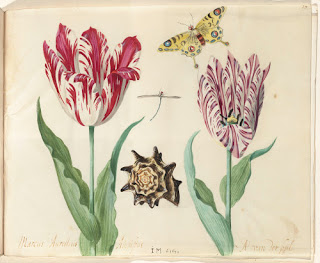
Just one of Merian’s superb paintings
of pomegranates, insects and butterflies

Alice Ibbetson (1635 - 1701)

Alice was an English watercolourist whose studies of natural forms were some of the earliest annotated studies of medicinal herbs and flowers. Brought up by her botanist father John Ibbetson, who built his renowned Physic Garden with the help of John Tradescant, her work was collected by wealthy patrons including Sir John Fairfax. Unfortunately her early studies of flowers and fruit were lost when Parliamentary troops fired her home during the English Civil War, and the family were forced to flee for their lives. John Ibbetson’s notes survive however, and are much influenced by the herbals of Nicholas Culpeper. Ibbetson’s early life was beset by tragedy, but later she made her home in New Hampshire where she continued to record native medicinal flora, some for the first time.
 
A page from Alice Ibbetson’s notebook. Her flower
paintings were much admired for their fluidity of line.

Mary Beale (1633 – 1699)

Mary Beale was the first fully professional woman artist in England. Her husband Charles even left his job as a clerk to help Mary prepare her canvases and mix her paints. He experimented with pigments and became an expert in the field. She quickly made enough from the business to support her family, including her sons Bartholomew and Charles (later an admired society miniaturist). While she painted, Charles would write up detailed notebooks in which he customarily referred to his wife as 'Dearest Heart' and described the sittings, the sitters and his own technical discoveries. The majority of his notes have been lost, but those for the years 1677 and 1681 survive in the archives of the Bodleian Library at Oxford and the National Portrait Gallery. His notebook of 1677 details a busy year: 83 commissions, bringing in earnings of £429. During the 1660s, when the plague ravaged London, Beale moved her home and workplace out of the city to the safety of Allbrook Farmhouse.

Nell Gwyl (Nell Gwyn) by Mary Beale. I can definitely see
from this painting why she would attract the notice of the King!

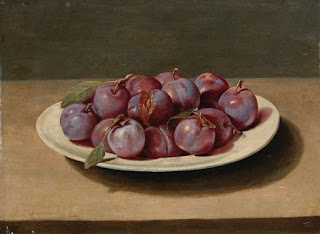
Louise Moillon (1610–1696) was one of seven children. Her father was the landscape and portrait painter Nicolas Moillon, but he died when she was an infant, and her mother when she was only twenty. Her mother’s inventory of possessions included a series of paintings on wooden panels by her daughter Louise, so it would appear that Louise showed talent from an early age. The high esteem in which her work was held is demonstrated by the fact that in 1639 Charles I of England had five still life pieces by the artist, framed in pear wood and ebony. Mouillon’s work was admired for its lifelike quality but also for its restrained stillness.


Bowl of Plums by Louise Moillon

~~~~~~~~~~~~~

I hope you enjoyed the pictures. An earlier version of this post appeared here in 2010.
www.deborahswift.com
Twitter @swiftstory

Sunday, May 31, 2015

The Longevity of the Neville Women

by Susan Appleyard

It is impossible to be definitive, but it seems the life expectancy of a woman in the Middle Ages was about thirty-five to forty. While the average life expectancy of a man was truncated by battle and block, as well as work related accidents, the battlefield for women was the birthing chamber. Many died in childbirth (5%) or from complications arising afterward (as many as 15%). If a woman survived her child-bearing years, however, she stood a good chance of living into her fifties or sixties.

I was surprised to discover that the Neville women, four sisters, all lived to a ripe old age. By the Neville women, I mean the daughters of Earl Ralph of Westmoreland and his second wife, Joan Beaufort: Eleanor, Katherine, Anne and Cecily. The trouble with living so long is that collectively they outlived numerous husbands, sons and even grandsons. I decided to look into this, focussing on the male members of the families who reached manhood. Information about girls is harder to find, especially if they were younger daughters or didn’t marry well.

Eleanor was the eldest, born c. 1397 died 1472. She had three spouses, but children with only the second and third. The second was Henry Percy Earl of Northumberland, with whom she had ten, seven of them boys. Of the four I could track, all four predeceased her, although one was a bishop and might have been expected to live longer than the others who all died in battle or under the axe. One of her grandsons became Earl of Northumberland in his turn and also predeceased her, while another had five sons who all outlived her. I coul’t discover anything about her second husband and the two sons she had with him.

Katherine, Duchess of Norfolk, came next, born c.1400 and died sometime after 1483. She had 4 husbands but only 1 son and 1 grandson, who did not outlive her but were fortunate to die natural deaths.

Anne was born c.1411 and died in 1480, outliving two husbands. By her first, Humphrey Stafford, Duke of Buckingham, she had four sons and outlived all but one. Of two grandsons, one survived her.

Cecily, born 1415, died 1495, the youngest and best known had only one husband, Richard Duke of York with whom she had four sons and outlived them all. The eldest was King Edward IV, who had two sons, known as the princes in the tower. A contentious issue, but it is highly likely that Cecily outlived them. Her second son was killed at the age of 17 and had no issue. The third son, George had one son who outlived his grandmother by about four years. Her fourth son, King Richard III had one son who did not outlive her.

Most of the information above came from Wikipedia and http://www.geni.com/

~~~~~~~~~~~~~

Susan Appleyard is an author of historical fiction. She has written two books set during the War of the Roses, which are available at Amazon, and a third is due to be released in June.

Wednesday, November 12, 2014

Christina Robertson, Successful Female Artist in a Man's World

by Debra Brown

Portret Orlovoi Davidovoi
People have, at times, asked me about the wonderful portrait (to the left) I use as my avatar on Facebook. I tell them she is Evangeline, the protagonist in my work in progress. That is how I have always seen Evangeline, at least, though without the head covering.

The portrait, though, is that of (apparently) Orlovoi Davidovoi of the Russian aristocracy, and comes with this description on Wikimedia:Русский: Ольга Ивановна Орлова-Давыдова (1814–1876), дочь князя Ивана Ивановича Барятинского (1722–1825). Feel free to help me out with that.

(Helena Schrader tells me Ольга Ивановна Орлова-Давыдова is Olga Invanovna Orlova-Davidova (all feminine form as she's a lady) and дочь князя Ивана Ивановича Барятинского means the daughter of Princess Ivana Ivanovicha Baryatinskogo. Thanks, Helena!)

Christina Robertson, Self Portrait
The artist is the amazing Christina Robertson.

Christina Robertson (née Sanders, 1796-1854) was born in Scotland but settled in London with her artist husband, James Robertson, whose career she would eclipse. They were married in 1822. Christina gave birth to eight children, four of whom lived to adulthood. Little is recorded about her life beforehand, sadly, not even where she received any formal education. Isabella Bradford says her father painted coaches, and her uncle was a miniaturist who "taught her painting and helped her launch her career". Her talent brought her out of the realm of unknowns into high places.

Christina began to show her work in the annual exhibitions of the Royal Academy in London and Edinburgh beginning in 1823. She also exhibited with the Society of British Artists starting from 1824 and the British Institution as of 1833. In 1829 she became the only woman ever to become an honorary member of the Scottish Academy.

Zinaida Ivanovna Yusupova
In the 1830s and 40s, her work was used as the basis for engravings for magazines including The Court Magazine, La Belle Assemblée, Heath's Book of Beauty and John Burke's Portrait Gallery of Distinguished Females. Through these she caught the eye of Russian nobility, who at the time found anything English to be fashionable, and went to Paris to paint for various ones there.

Grand Duchess of Russia
Alexandra Nikolaievna
After an exhibition in St. Petersburg in 1839, she was hired as painter in residence to do full length portraits of the Emperor Nicholas I and the Empress Alexandra Feodorovna. She was named an honorary member of the Imperial Academy of Art. Christina returned to Russia in 1847 to an enthusiastic welcome, and she stayed for several years although the Crimean War changed the views of the Russian upper classes. Perhaps this war was the cause of problems for Christina.

The Imperial Couple rejected a painting of a daughter-in-law and deemed the portrait of another unsatisfactory. They continued to hire her to work for them, however, even having her do a second painting of the Empress. Some of her clients, though, refused to pay her.

Z.Yusupova (Naryshkina)
Christina's health declined. She died in St. Petersburg in 1854 and was buried in the Volkhov Lutheran Cemetery. Her work can be seen in various Russian museums, but the largest collection is in the Hermitage.

There is a lovely gallery of her work here. Many of her Russian nobility portraits can be seen here and Russian royalty here on Wikimedia.


Olga Nikolaïevna


Children with Parrot

Maryrob

References

http://commons.wikimedia.org/wiki/Category:Russian_nobility_by_Christina_Robertson

http://twonerdyhistorygirls.blogspot.com/2013/08/intrepid-women-scottish-artist.html

http://www.undiscoveredscotland.co.uk/usbiography/r/christinarobertson.html

~~~~~~~~~~~~~

Debra Brown cut her teeth on the Bookhouse Books which created a nagging longing to live in a land of castles and wear flowing gowns and headdresses. Though life was busy and full, she eventually became able to do so vicariously through the characters of her books.

Her first published novel, The Companion of Lady Holmeshire (World Castle Publishing, 2011), is set in early Victorian England. Emma, a former servant girl, was chosen as companion to The Countess of Holmeshire and dragged along into polite society where she was sure to receive a rude reception.

Debra's beloved work-in-progress, For the Skylark, is on the back burner but simmering slowly. She runs the English Historical Fiction Authors blog and is an author and co-editor of Castles, Customs, and Kings: True Tales by English Historical Fiction Authors (Madison Street Publishing, 2013) which will soon be released as an audiobook. Please watch for Volume Two of Castles, Customs, and Kings in the future.

Amazon US
Amazon UK

Tuesday, June 10, 2014

An Accomplished Young Lady

by Maria Grace

During the Regency era, a proper education was crucial to a middle or upper class young lady’s future. Since a woman’s only ‘proper’ aspiration was to marriage, her education focused on making her noticeable to potential husbands. Her accomplishments enabled her to display cultural distinction and set herself apart from women who were merely ‘notable’—those who could only manage a household but not cultivate elegant socializing.

The number of accomplishments a young lady acquired reflected the financial state of her family and the level of sacrifice they were willing to make to improve her chances of marrying well.

Men of the middle and upper classes sought a wife who would be a social asset to them (in addition to a good dowry of course.)  A "social asset" was to never be an intellectual threat to her husband, but to able to follow conversation, and perhaps more importantly to keep a conversation away from unpleasantries and steered toward good humor for all. She could understand what was being said around her, but did not have ready opinions or advice to offer.

Certain subjects were considered necessary for becoming that desired social asset.  These included:

Reading

No young woman could be considered accomplished without the ability to read. Not only was it necessary for basic household management and correspondence, but it formed a foundation for intelligent conversation and for reading aloud for the entertainment of others.

Though young ladies were not encouraged to read heavy subjects like philosophy and theology, serious books were considered appropriate as they enabled interesting conversation. Similarly, scripture to enable her to recognize passages and sermons, such as Fordyce’s, aimed at young women, were appropriate reading for an accomplished lady.

Writing

In this context, writing did not refer to a creative endeavor, but rather being able to create a letter with beautiful penmanship, correctly spelled and with excellent grammar.  Young women would be schooled in the art of letter writing, with books dedicated to the topic and offering examples of good letters for her to emulate. She might even copy particularly pretty phrases out of these book for use in her own letters.

Arithmetic

No mistress could run a household or estate without a solid understanding of basic math.  She had to be able to keep accounts, balance a budget, calculate how much food and others supplies needed to be bought, track expenses and even forecast trends in the use of supplies.

Few women would have exposure to advanced algebra or other pure mathematics.  She had no practical use for them and would be dangerously close to challenging her husband’s expertise if she knew them.

Sciences and Social sciences

The natural sciences and social sciences were significant to young ladies only insofar as they facilitated the art of refined conversation.  General awareness and rote memorization in areas of history, politics, geography, literature and philosophy were sufficient for ladies of quality.

A cursory knowledge of botany was common.  Ladies who were more interested might also become learned in the use of plants as home remedies since the mistress of an estate was often the first one consulted in cases of injury and illness.

Languages

Despite the Napoleonic wars, a working knowledge of French was indispensable for a young lady.  Italian and German, for singing and understanding sung performances were also useful, but conversational fluency was not expected.  Greek and Latin, beyond a handful of commonly used phrases were the purview of men and not included in a young lady’s curriculum.

Music

Though not expected to be virtuosos, quality young ladies were expected to be proficient musicians.  Playing and singing were considered seductive to men since they displayed her body and bearing to potential suitors. Furthermore, once married, musical skills would be useful for long evening of entertaining both her husband and her guests.

Only a few instruments were considered appropriate for young ladies.  Anything which needed to be blown into was a risk for causing a reddened face and heaving bosom, neither of which would be attractive, much less alluring, so they were out of the question. The violin, which required raised arms, was also inappropriate.  The short bodied dresses of the era presented too many possibilities for embarrassing mishaps.  Moreover, the violin required a higher level of expertise to perform and the potential for embarrassing oneself with a mediocre was greater.

The harp was the most desirable instrument, but most had to make do with the piano which had replaced the harpsichord in popularity. Some young ladies also learned the guitar.

Not only did girls need to be able to play and sing, but they had to be able to dance. The dance floor was the place for young ladies to interact with their suitors, a place where they could escape the watchful eyes of their chaperones and engage in somewhat private conversation and even touch, which was otherwise entirely forbidden. Skilled and graceful partners were highly desirable. Girls who danced poorly could expect to spend a lot of time without a partner.

Artistic endeavors

Girls were encouraged to draw and paint and given training in it whenever possible.  Particularly talented girls might even exhibit their work at local or national levels, or teach other girls, all of which could be valuable if she failed to obtain a husband.

Filigree work, now known as quilling, and japanning, now called decoupage, were also encouraged as ways for ladies to display their artistic skills. Screens, small chests and trunks and various bric-a-brac were frequently the object of their efforts.

Needlework (plain and fancy)

Needlework was one of the most practical subjects for a young lady. No matter what her future might hold, clothing, plain or elegant, would be a part of it. Clothing required mending and making.  Even ladies who could hire out their own sewing would often engage in making garments for charitable cases in their parish. Fancy work included embroidery, cross stitch, knotting, netting and more.

Needlework need not be a solitary endeavor. Often, women would bring along their work baskets during social calls and work as they visited. If someone arrived without something to work on, a hostess might offer something from her workbasket to her visitor.  Of course, the elegance of the project would reflect upon the seamstress and fancy projects were more desirable for working in company than plain.

Boarding Schools

Girl’s education was a bit of a controversial subject. Girls from wealthy and cultured homes were often educated by their mothers since they could hire enough help with the household work to have time to invest in their daughter’s education. They might enlist the aid of additional teaching masters for training in music, languages and dance. Alternatively, at the age of ten, parents might consider sending their daughter to a boarding school, sometimes for as little as a year or two to ‘finish’ their accomplishments. If the girls was in the way at home, she might be sent off for much longer. 

Boarding school could be a risky proposition.  Many girls' school were underfunded, badly managed, and were never quite respectable. Teachers frequently came from the ranks of  clever, but poor former students, impoverished gentlewomen, poor relatives of the clergy or retired servants of the upper classes.

Subjects taught at these schools included decidedly nonacademic subjects like sewing and fancy needlework, drawing, dancing, music. Polite literature, including mythology, writing, arithmetic, botany, history, geography, and French formed the balance of the more academic studies.  Rudiments of stagecraft and acting might also be taught as training in elocution and grace of movement.

Parents typically paid twenty to thirty guineas per year for these schools.  Some of these subjects, particularly those which required additional masters to be brought in, like dance, might incur additional fees. Washing and the privilege of being a ‘parlor boarder’ who enjoyed extra privileges like eating with the mistress of the school and using the parlor, also incurred additional fees.

Armed with these skills, a young woman would be considered ready to enter society and engage in the all-important task of finding a suitable husband.

References
Baird, Rosemary. Mistress of the House, Great Ladies and Grand Houses. Phoenix (2003)
Collins, Irene . Jane Austen, The Parson's Daughter Hambledon (1998) 
Collins, Irene . Jane Austen & the Clergy The Hambledon Press (2002)
Davidoff, Leonore & Hall, Catherine. Family Fortunes: Men and Women of the English Middle Class 1780-1850 Routledge (2002)
The Female Preceptor. Essays On The Duties Of The Female Sex, Conducted By A Lady. 1813 and 1814
Fullerton, Susannah. Jane Austen & Crime JASA Press (2004)
Harvey, A. D. Sex in Georgian England Phoenix Press (1994)
Ives, Susanna  Educating Your Daughters – A Guide to English Boarding Schools in 1814, March, 10 2013.  
Jones, Hazel. Jane Austen & Marriage Continuum Books (2009)
Lane, Maggie. Jane Austen's World Carlton Books (2005)
Laudermilk, Sharon & Hamlin, Teresa L. The Regency Companion Garland Publishing (1989)
Le Faye, Deirdre. Jane Austen: The World of Her Novels Harry N. Abrams (2002)
Martin, Joanna. Wives and Daughters Hambledon Continuum (2004
Selwyn, David. Jane Austen & Leisure The Hambledon Press (1999)
Sullivan, Margaret C. The Jane Austen Handbook Quirk Books (2007)
Watkins, Susan. Jane Austen's Town and Country Style Rizzoli (1990)


~~~~~~~~~~~~


 Maria Grace is the author of Darcy's Decision,  The Future Mrs. Darcy, All the Appearance of Goodness, and Twelfth Night at LongbournClick here to find her books on Amazon. For more on her writing and other Random Bits of Fascination, visit her website. You can also like her on Facebook, follow on Twitter or email her.