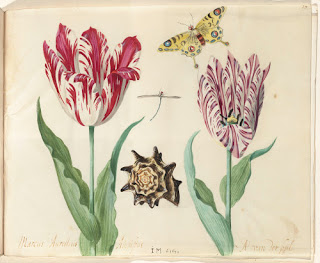
'Talke of perfect happpinesse or pleasure, and what place was so fit for that as the garden place wherein Adam was set to be the Herbarist?'
John Gerard, Herball (1597)
 |
| 17th century herbal |
During the Middle Ages in England, religious communities compiled the sort of lists we know as herbals, detailing their medicinal uses. The composition of plants and the beauty of flowers was recorded in florilegia, books containing floral artwork. With the rise of printed books in the Renaissance period, with improvements in the printing process, metal engraving, and the skills of colourists, this category of literature and plant lore increased in availability and popularity.
In 1557, Thomas Tusser produced possibly the first advice book, A Hundred Pointes of Good Husbandrie. He offers up useful rhymes such as 'Good titlth brings seedes, ill tilture weedes.' And here we find the earliest evidence that flowers and herbs were used not only for physic, but for decorating the house. His recommendations include plants still grown today, though his spelling varies from ours:
batchlors buttonsThe next important contributor to garden literature is Thomas Hyll (or Hill), who chose as his pseudonym Didymus Mountain. The Profitable Arte of Gardening: A most briefe and pleasaunte treatyse, teachynge how to dresse, sowe, and set a garden (1563) is recognised as the first guide to gardening printed in England. He followed it in 1577 with The Gardener's Labyrinth.
columbines
daffadowndillies
sweet brier
flower de luce [the iris]
hollihockes
lavender
lark's foot [larkspur]
paoncies [pansies]
hartease [viola]
rosmarie
snap dragons
violets
 |
| John Gerard |
John Gerard, gardener to Lord Burghley, is responsible for the most famous horticultural volume of this period. The Great Herball, or General Historie of Plantes appeared in 1597. Its author lived in Holborn and was employed at his lordship's London house as well as at the Theobalds estate. Primarily a description of the plants' medicinal properties with advice on cultivation, he solicited--or permitted--his wife to contribute some topics of particular interest to females. Illustrations in Gerard's first edition were not created for the book, but were reprints from a German book published several years earlier. In 1633, botanist Thomas Johnson edited and revised Gerard's Herball, correcting errors and improving the scientific content.
 |
| Varieties of thyme in the Herball |
It is very likely that William Shakespeare was familiar with the Herball. Within the past year, evidence was presented that his portrait illustrates the frontispiece of of Gerard's 1597 work.
 |
| Is this really the face of William Shakespeare? |
Regardless of whether the gentleman brandishing a fritillary is the Bard, his plays and poems are crammed with plant and flower references and metaphors.
"The marigold that goes to bed with the sun
And with him rises weeping; these are flowers
Of middle summer, and I think they are give
To men of middle age." The Winter's Tale
In the tragedy Romeo and Juliet, Friar Laurence is conscious of both positive and negative powers of the herbs he gathers:
"Within the infant rind of this small flower
Poison hath residence and medicine power:
For this, being smelt, with that part cheers each part;
Being tasted, slays all senses with the heart.
Two such opposed kings encamp them still
In man as well as herbs, grace and rude will;
And where the worser is predominant,
Full soon the canker death eats up that plant."
 |
| John Parkinson |
John Parkinson was very much aware of the decorative value of flowers. This author's Long Acre residence was adjacent to Covent Garden, and his proximity to the market gardens served him well. For adorning the house he suggested scented daffodils ('many are so exceeding sweet that a very few are sufficient to perfume a whole chamber'), wallflowers ('generally used in nosegays, and to deck up houses'), and iris. He was a great admirer of the newly popular tulip, introduced to England in the 1570s. The descriptive language used by Parkinson, and others, to convey the beauty can be quite poetic and evocative:
"The Anemonies likewise or Windeflowers are so full of variety and so dainty, so pleasant and so delightsome flowers, that the sight of them doth enforce an earnest longing desire in the minde of any one to be a posessor of some of them at the least." Paradisus Terrestris (1629)Nicholas Culpeper's The English Physican (1652) must be the best known of all the herbals.
 |
| Nicholas Culpeper |
A polymath, after his apprenticeship to an apothecary he advanced to become a translator of medical texts, a physician, a botanist, and an astrologist. During England's Civil War he was under suspicion of practising witchcraft. He opposed the insular nature of the medical sciences, in particular the Society of Apothecaries.
A firm proponent of the dissemination of medical knowledge, he published his works with the ordinary person in mind, using language and terms that could be easily understood and pricing his works cheaply. For these reasons, and because he disputed many of the accepted treatments and cures, he was unpopular with contemporary physicans.
If Culpeper had a favourite herb, it must have been rosemary:
"The oil of Rosemary. It hath all the virtues of the oil of connamon, nutmegs, carraway, and juniper berries; besides which it is much more powerful than any of them, strenghtening the brain and memory, fortifying the heart, resisting poison, and curing all sorts of agues; it is absolutely the greatest strengthener of sight, and restorer of it also, if lost: it makes the heart merry, and takes away all foolish phantasms out of the brain. It cleanseth the blood, cures tooth-ache, easeth all pains, and takes away the causes which hinder conception: it hath a very grateful taste, and hath so many virtues that I can never express them all, or give it its due commendation."
 |
| Culpeper's English Physician |
Before Culpeper's day, the herbal (primarily a descriptive botanical catalogue) had inspired the publication of explicit guides to gardening practices, with recommendations for cultivation of all varieties of herbs, flowers, vines, trees, shrubs, and fruit, and instructive essays. Here is list of some publications produced during the 17th century, popular with the gentry and yeomanry, often dedicated to prominent patrons from the aristocracy:
The Countrie Farme (1600) Richard Surflet
The Fruiterers Secrets (1604) N.F.
Floraes Paradise (1608) Hugh Platt
The English Husbandman (1613) Gervase Markham
The Second Booke of the English Husbandman (1615) Gervase Markham
The Country House-wifes Garden (1617) William Lawson
A New Orchard and Garden (1618) William Lawson
Of Gardens (1625) Francis Bacon
Theatrum Botanicum (1640) John Parkinson
A Treatise of Fruit Trees (1653) Edward Hobday
Adam in Eden: or, Natures Paradise (1657) William Coles
The French Gardener: Instructing How to Cultivate all sorts of Fruit-Trees, and Herbs for the Garden (1658) John Evelyn (translation from the French)
The School of Physic (1659) Nicholas Culpeper
The Garden Book (1659) Thomas Hamner
Sylva, or a Discourse of Forest Trees and the Propagation of Timber in His Majesties Dominions... (1664) John Evelyn
The Gardener's Almanack (1683) Samuel Gilbert
The Compleat Gardeners Practice (1664) Stephen Blake
Kalendarium Rusticum (1675) John Worlidge
The Florist's Vade-Mecum (1682) Samuel Gilbert
An Improvement to the Art of Gardening (1694) Robert Sharrock
The Gardener's Almanack (1697) Leonard Meager
Throughout the 18th century, gardening guides proliferated. In that century and well into the 19th, voyages of discovery returned exotic specimens to England, hybridisers created ever more spectacular plants, botanical art flourished, and printing technology advanced. These simultaneous developments resulted in exquisitely produced and lavishly illustrated florilegia.
Robert Furber's The Flower Garden Display'd (1732) was intended as an advertisement for his Kensington nursery business.
 |
| Furber's flowers for March |
It wasn't not merely a sensation in its own time: even now prints for each of the twelve months continue to be reproduced, framed, and placed on walls all over the world. Flora Londinensis (1777-1798), written by Richard Curtis and amply illustrated, is another fine example of botanical information combined with artistry.
Although modern science has expanded our knowledge of plants, their culture, and their habits, these wonderful books from the past contain interesting lore--and gardening advice never really goes out of style!
 |
| Illustration from Culpeper's herbal |
 Margaret Porter is the award-winning and bestselling author of twelve period novels, whose other publication credits include nonfiction and poetry. A Pledge of Better Times, her highly acclaimed novel of 17th century courtiers Lady Diana de Vere and Charles Beauclerk, 1st Duke of St. Albans, is her latest release, available in trade paperback and ebook. Margaret studied British history in the UK and the US. As historian, her areas of speciality are social, theatrical, and garden history of the 17th and 18th centuries, royal courts, and portraiture. A former actress, she gave up the stage and screen to devote herself to fiction writing, travel, and her rose gardens.