Showing posts with label portraits. Show all posts

Thursday, November 30, 2017

Frozen Moments in Time - The Art of Anthony van Dyck

by Anna Belfrage

Las Meninas, D Velázquez
Say Philip IV of Spain and chances are people will visualise a series of portraits by Diego Velázquez, principally that rather impressive work of art Las Meninas. What the great Velázquez did for the Spanish Hapsburgs in the 17th century, today’s protagonist did for the court of Charles I of England, painting a series of portraits that qualify as masterpieces. His skills made him the most sought after portraitist in England and as a result Anthony van Dyck became very, very rich and just as famous.

Anthony (Well, if we’re going to be correct his birth-name was Antoon) saw the light of the day on the 22 of March in 1599. His father was a well-respected and wealthy cloth merchant in Antwerp, and Anthony was his seventh child and second son. Where Papa travelled to sell his silks and gossamer-thin linens, Mrs van Dyck remained at home to raise their children and devote herself to her embroidery. Gifted with an artist’s eye, Mrs van Dyck embroidered landscapes and figures and little Anthony was quite enthralled by the end results. Soon enough, when Mama was sewing he was drawing on whatever he could find and so impressed was his mother that she managed to convince her husband to allow little Anthony to pursue the career of an artist by apprenticing him to the Flemish artist Hendrik van Balen from the age of ten.

Etching by van Dyck
It was apparent to everyone that Anthony had talent in spades. At the age of fourteen he painted his first commissioned portrait, proudly inscribing his age as well as his name on the finished work of art. At age sixteen, he and his friend Jan Brueghel Jr. opened their own studio. By now, Anthony was making a name for himself, not only as a painter but also as a draughtsman and an excellent etcher. (Some would argue that the art of etching peaked with Anthony’s work, never again to reach similar heights of artistry)

Anthony, self-portrait 1613-14
At nineteen, he was admitted into the guild of St Luke’s in Antwerp, thereby effectively recognised as a master of painting. With this under his belt, Anthony van Dyck was hired by Peter Paul Rubens as his chief assistant, which essentially meant he had made it to the top. Rubens was the most famous Northern European artist of the time, his studio churning out a stream of high quality paintings, many of them featuring religious themes. Rubens was a leading figure within the cultural aspect of the Counter Reformation, the Catholic movement spearheaded by Spain that had as its aim to limit the “spiritual damage” caused by the Reformation.

Tiger Hunt, Peter Paul Rubens. A lot of life (and death)

Anthony van Dyck shared Rubens' Catholic heritage and thrived under Rubens' tutelage, producing not only portraits but also a number of religious paintings and a few historical works. Rubens was very fond of historical paintings, huge canvases brimming with life and figures. He was also very impressed by his young adept, telling whoever wanted to hear that van Dyck was the best young painter he had ever met. He also encouraged van Dyck to foster his obvious talent for portraiture—a talent that required not only impressive skills as a painter but also a diplomatic flair to ensure the sitter was pleased with the end result. In effect, if a portrait painter wanted commissions, he had to be willing to do the 17th century equivalent of photo shopping to flatter whoever was being depicted.

Thomas Howard by Rubens
Rubens and van Dyck parted ways in the early 1620s. Rubens urged van Dyck to go to Italy and study the Italian masters. Our Anthony was all for going to Italy, but before doing so he detoured to England where for some months he was in King James’ employ. While in England, he met the Catholic peer Thomas Howard, Earl of Arundel, who was something of a fanatic art collector. Born in penury due to his father’s refusal to abandon his Catholic faith, Thomas was destined to end up heavily in debt due to his collection which contained everything from antique marbles to paintings by da Vinci, Rubens and a certain Titian. Our Anthony spent hours gawking at Arundel’s Titian portraits, realising just how much he had left to learn—and how right Rubens was when he repeatedly told van Dyck to go to Italy.

Anthony returned to Flanders to prepare for his trip to Italy. While at home, he fell in love and for a while there all thoughts of furthering his career by studying in Italy went AWOL as our handsome youth pursued tender caresses and kisses. However, youthful passions tend to be ephemeral, so after some months of cow’s eyes and ardent courting our young man did depart for Italy where he was to remain for close to six years.

Elena Grimaldi by van Dyck
A much wiser (if still rather young) Anthony van Dyck returned to Antwerp in 1627. By now, he had built quite the reputation and as he was not only a skilled artist but also charming and well-spoken he could soon add the Hapsburg regent of Spanish Flanders, Archduchess Isabella, to his clients. However, remaining in Flanders came with one major hurdle for someone as ambitious as van Dyck: there was one undisputed painting master in Flanders, and his name was Rubens, not van Dyck.

Meanwhile, in England King James had departed this world and been succeeded by his son, Charles I. While this king had about as much political skill as a bull in a china shop, he did have a genuine interest for art. Early on, he began amassing an impressive collection of paintings and during van Dyck’s years in Italy he had now and then facilitated a transaction on behalf of the English king.

Feeling somewhat frustrated by always walking in Rubens’ shadow, in 1632 Anthony van Dyck decided to try his luck in England. He was welcomed with open arms by King Charles and his wife, Queen Henrietta Maria. In fact, he was welcomed with open arms by more or less everyone in the English aristocracy. Once the king had decided he would only sit for one artist—van Dyck—his courtiers fell over their feet in their haste to have themselves and their families immortalised by the Dutchman.

King Charles, three aspects by A van Dyck
King Charles gave van Dyck a house and a studio at Blackfriars and was a frequent guest, together with his wife. The following years saw van Dyck churn out one portrait after the other, many of them of his royal patron and his family.

The Stuarts that gaze back at us from van Dyck’s canvases are a handsome lot, with soulful eyes and regular features. Such defects as buckteeth or excessive frailty are glossed over—van Dyck had no intention of risking his lucrative income by being too honest which of course has me wondering just how reliable van Dyck’s portraits are.

Charles I, by A van Dyck (and that horse HAS to be Spanish!) 
In his forty or so portraits of Charles I, the king is depicted riding, sitting, standing—always with a regal air that speaks of power and determination. Never is he presented as being as short and slight as he was. However, despite the potential airbrushing, the formal poses and the rich attires, the portraits pulsate with frozen life, as if at any moment the king will call for his horse, or the queen bend down to whisper something in the dwarf’s ear, or the young princes and princesses break apart from their tight group, the boys running one way, the girls another.

King Charles' children. IMO one of van Dyck's best portraits

Margaret Lemon (van Dyck)
All this painting made Anthony van Dyck rich. Very, very rich, which was fortunate as this was a man with little thought of tomorrow and a tendency to spend as lavishly as those he painted. He redecorated his house, he kept his various mistresses in style, dressed in the most expensive fabrics and in general lived life to the full. So profligate was his spending that his various friends at court became concerned and decided it was time their favourite painter settled down with a wife and got rid of his expensive ladies—especially his favourite mistress and sometime muse, Margaret Lemon, who according to malicious gossip had the temperament of an aggravated bear.

Mary, Lady van Dyck (van Dyck)
The king hoped that by ensuring van Dyck married an Englishwoman the artist would remain forever in England which is why he suggested van Dyck should marry a Mary Ruthvens, former lady-in-waiting to Henrietta Maria. Didn’t really work out as planned. Van Dyck spent months away from England both before and after his wedding, sometimes in Flanders, sometimes in France, where he tried (with little success) to win commissions from the French court.

To the left, Titian's portrait of Charles V
To the right, van Dyck's portrait of James Stuart.
Titian's influence is evident...

Anthony van Dyck returned to England for the last time in 1640. By then, the political unrest that was to explode into the English civil war was already evident, and the king had other things on his mind than being preserved in oils. Where before Anthony had had more commissions than he could cope with, now it was rather the reverse. It got to him, and the last months of his life were plagued not only by ill health but also by depression.

In December of 1641, Anthony van Dyck died at the age of forty-two. Other than his widow and two little girls he left behind an impressive collection of portraits, paintings that would set the standard for English portraiture for the coming century or so. Compared to Velázquez, van Dyck’s work can come across as bland, the little imperfections that give character toned down. But his undeniable skill with brush and pigments have given us vibrant snapshots of a world since lost, a time when gallants proudly wore lace and satin, long flowing hair and extravagant clothes. Young lions who would, to a large extent, lose both lace, ribbons, silk and life in the devastating English Civil War.

All pictures in public domain and/or licensed under Wikimedia Creative Commons

~~~~~~~~~~~

Had Anna Belfrage been allowed to choose, she’d have become a professional time-traveller. As such a profession does not exist, she became a financial professional with two absorbing interests, namely history and writing.

Presently, Anna is hard at work with The King’s Greatest Enemy, a series set in the 1320s featuring Adam de Guirande, his wife Kit, and their adventures and misfortunes in connection with Roger Mortimer’s rise to power. And yes, Edmund of Woodstock appears quite frequently. The first book, In The Shadow of the Storm was published in 2015, the second, Days of Sun and Glory, was published in July 2016, and the third, Under the Approaching Dark, was published in April 2017.

When Anna is not stuck in the 14th century, she's probably visiting in the 17th century, specifically with Alex(andra) and Matthew Graham, the protagonists of the acclaimed The Graham Saga. This is the story of two people who should never have met – not when she was born three centuries after him. The ninth book, There is Always a Tomorrow, was published in November 2017.

Tuesday, June 30, 2015

Preserving the World in Paint - Women Artists of the Stuart Period

by Deborah Swift

The story of  The Lady’s Slipper is a story about a rare wild flower, but it is also the story of the 17th century artist who wished to capture its unique beauty in paint.

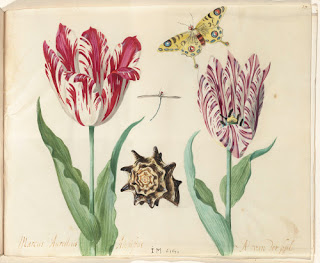
When researching the heroine of my novel I looked to female artists of the seventeenth century, especially those who painted flowers and the natural world. Unsurprisingly not many are documented, but here I give you just a taste of three extraordinary women who really lived, and one imaginary artist who only lives between the pages of my novel. Can you spot the imaginary artist amongst the real ones?

Maria Sybilla Merian (1647-1717)
Maria seemed to be an infant prodigy and Maria’s step-father, who was also a painter, doted on her, predicting that she would increase the fame of the Merian family name; so, apparently, did her half-brothers Matthäus and Caspar, twenty years her senior. She studied flowers, and more importantly - insects, keeping her own live specimens, and often travelling abroad in search of more specimens to draw. In her time, it was very unusual that someone would be genuinely interested in insects, which had a bad reputation and were colloquially called "beasts of the Devil." She described the life cycles of 186 insect species, amassing evidence that contradicted the contemporary notion that insects were "born of mud" by some sort of spontaneous generation.


Just one of Merian’s superb paintings
of pomegranates, insects and butterflies

Alice Ibbetson (1635 - 1701)

Alice was an English watercolourist whose studies of natural forms were some of the earliest annotated studies of medicinal herbs and flowers. Brought up by her botanist father John Ibbetson, who built his renowned Physic Garden with the help of John Tradescant, her work was collected by wealthy patrons including Sir John Fairfax. Unfortunately her early studies of flowers and fruit were lost when Parliamentary troops fired her home during the English Civil War, and the family were forced to flee for their lives. John Ibbetson’s notes survive however, and are much influenced by the herbals of Nicholas Culpeper. Ibbetson’s early life was beset by tragedy, but later she made her home in New Hampshire where she continued to record native medicinal flora, some for the first time.
 
A page from Alice Ibbetson’s notebook. Her flower
paintings were much admired for their fluidity of line.

Mary Beale (1633 – 1699)

Mary Beale was the first fully professional woman artist in England. Her husband Charles even left his job as a clerk to help Mary prepare her canvases and mix her paints. He experimented with pigments and became an expert in the field. She quickly made enough from the business to support her family, including her sons Bartholomew and Charles (later an admired society miniaturist). While she painted, Charles would write up detailed notebooks in which he customarily referred to his wife as 'Dearest Heart' and described the sittings, the sitters and his own technical discoveries. The majority of his notes have been lost, but those for the years 1677 and 1681 survive in the archives of the Bodleian Library at Oxford and the National Portrait Gallery. His notebook of 1677 details a busy year: 83 commissions, bringing in earnings of £429. During the 1660s, when the plague ravaged London, Beale moved her home and workplace out of the city to the safety of Allbrook Farmhouse.

Nell Gwyl (Nell Gwyn) by Mary Beale. I can definitely see
from this painting why she would attract the notice of the King!

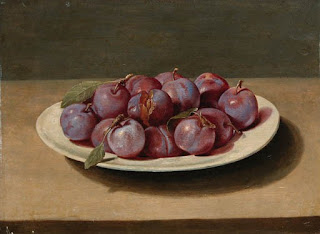
Louise Moillon (1610–1696) was one of seven children. Her father was the landscape and portrait painter Nicolas Moillon, but he died when she was an infant, and her mother when she was only twenty. Her mother’s inventory of possessions included a series of paintings on wooden panels by her daughter Louise, so it would appear that Louise showed talent from an early age. The high esteem in which her work was held is demonstrated by the fact that in 1639 Charles I of England had five still life pieces by the artist, framed in pear wood and ebony. Mouillon’s work was admired for its lifelike quality but also for its restrained stillness.


Bowl of Plums by Louise Moillon

~~~~~~~~~~~~~

I hope you enjoyed the pictures. An earlier version of this post appeared here in 2010.
www.deborahswift.com
Twitter @swiftstory

Friday, April 17, 2015

Sir Godfrey Kneller, the de Veres, and the Beauclerks

by Margaret Porter

Such are thy pictures, Kneller, and such thy skill,
That Nature seems obedient to thy will;
Comes out and meets thy pencil in the draught,
Lives there, and wants but words to speak her thoughts.
                                                       ~~ John Dryden

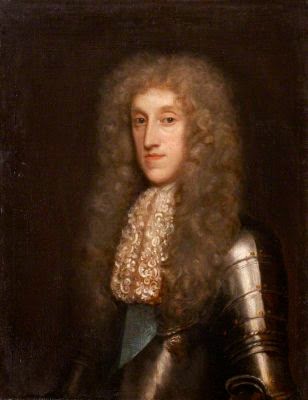
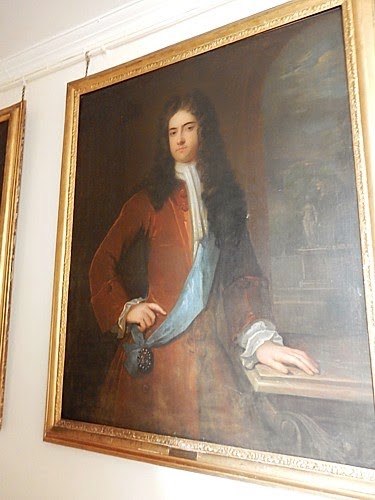
Aubrey de Vere, 20th Earl of Oxford
In 1678, two years after arriving in England with his brother, the German artist Godfrey Kneller produced a magisterial, much-admired portrait of King Charles II. As a result, "his reputation daily increased so that most noblemen and ladies would have their pictures done by him," irrespective of their political affiliation or religious preferences. Aubrey de Vere, 20th Earl of Oxford, a soldier and courtier boasting one of the longest pedigrees in the land, was among the artist's subjects. Kneller painted his illustrious client in battle armour. 

the first portrait
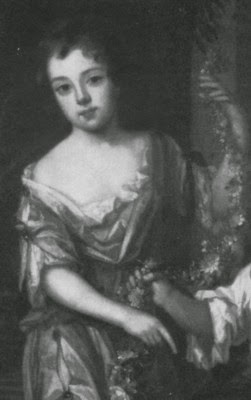
When the Earl's daughter Lady Diana de Vere first posed for Kneller, she was no more than ten years old. Holding up a floral garland, she stands beside her younger sister Mary, seated beside her. By the early 1680s, when this double portrait  was completed, the German artist was at the pinnacle of prominence.

Nell Gwyn, with her son and without, with or without her clothes on, was often painted by renowned portraitists Peter Lely and Simon Verelst. Kneller succeeded them as the most fashionable artist of the day, remaining so after Nell’s death in 1687 and the Glorious Revolution of the following year. King William III and Queen Mary II shared the deposed James II's preference for Kneller's work.

Charles Beauclerk, Duke of St Albans
By 1690 Nell's son and heir, the Duke of St Albans, had embarked upon a military career. At about that time the handsome young man posed for a three-quarter length portrait. This would be the first of many Beauclerk portraits produced by Kneller, now a naturalised Englishman. He'd established a residence and studio in the north east corner of Covent Garden. Not only the nobility flocked there--the Duke’s father, King Charles II, had also visited the artist to sit for his portraits, a mark of great favour.

One of Kneller's most memorable and presumably enjoyable commissions came a year after the double coronation of William and Mary. As the former battled foreign enemies on the Continent, the Queen decided to imitate her own mother's gallery of beauties at Windsor Castle, produced by Lely. Mary proposed a set of paintings for Hampton Court Palace, being altered by Sir Christopher Wren to suit her and William's architectural tastes. Her plan was mocked by her father’s former mistress, Lady Dorchester, who famously quipped, "Madam, if the King was to ask for portraits of all the wits in his court, would not the rest think he called them fools?"

Diana, a Hampton Court Beauty
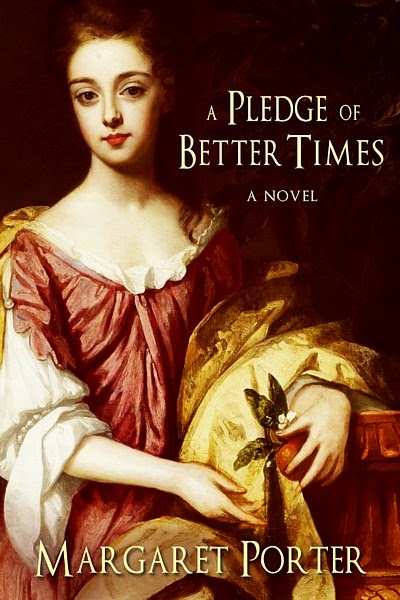
Undeterred, Mary put Kneller to work, and her loveliest and most virtuous attendants made their way to his studio to have their charms preserved as life-sized canvases. Of the twelve original paintings only eight remain. The most admired of the set is that of Lady Diana de Vere, who at that time was either officially or unofficially attached to the court as maid of honor. She poses with an orange tree, holding an orange in her hand—doubtless designating the de Veres’ fealty to the new rulers from the House of Orange. The paintings of Diana and the other ladies were positioned in the narrow spaces between the tall windows of Hampton Court's riverside Water Gallery (later demolished). Each was set within a blue-and-white painted frame to complement the Queen’s extensive Delftware collection. Diana's portrait currently hangs in the King’s Dining Room, and is now surrounded by giltwood frame. Duchess of St Albans, the title she gained at her marriage to Charles Beauclerk, was inscribed at a later date. (A detail of this work appears on the cover of my novel A Pledge of Better Times.)

The 20th Earl of Oxford 
in Garter Robes
 Having pleased the monarchs with portraits of beauties and military men, on 3 March 1691/2, Kneller became Sir Godfrey. “His Majesty, to shew his Kingly approbation of his Art and Manners, was pleas’d to confer the Honour of Knighthood upon him…and as an extraordinary Mark of his Grace and Favour, Honour’d him with the Present of a Sword, by the Hands of the Right Honourable Lord Chamberlain." The artist also became a Gentleman of the Privy Chamber, and received an honorary doctorate from Oxford. An acquaintance reported, "In June 1693 Sir Godfrey Kneller told me he has had fourteen persons sett to him in a day." Some of those persons sat to him as many as a dozen times for a single portrait! Diana’s father, Lord Oxford, a Knight of the Garter, a member of the Privy Council, a Lieutenant General, and a Gentleman of the King’s Bedchamber, commissioned a splendid full-length Kneller likeness at approximately the time his daughter was posing for her Beauty portrait.

Diana, 1694
Author's collection
Upon her marriage in 1694, Diana became Duchess of St Albans and again sat to Kneller—for a third time. The painting was promptly delivered to engraver John Smith, who revised her features and hair somewhat when producing prints for public sale. One of these holds a special place in my personal art gallery!

 In 1695, the Crown granted Kneller an annuity of £200 per year. Two years afterwards he received additional proofs of William’s admiration, a large gold medal stamped with the King’s image and a golden chain worth £300. It appears in most of the later self-portraits (as seen below) and on the bust attached to his burial monument.

After her accession to the throne, Diana’s friend Queen Mary would sit only to Kneller. A copy of her portrait, or the King’s, could be purchased for the price of £50, and judging from their wide dissemination this was a reliable source of income for Kneller and his assistants. Not only were the paintings acquired for civic and government buildings, they went abroad as presents to fellow rulers, territorial governors, ambassadorial residences, and so forth. And Kneller even travelled with—or without—the King, to make portraits of foreign allies and friends in the Low Countries.

1st Duke of St Albans, 1704
Kneller produced a Kit-Kat style portrait of Charles Beauclerk wearing a blue coat in 1704, as the the Duke was falling out of favour with Queen Anne—not that he ever really had it. Probably at her husband's instigation, Kneller created additional pictures of Diana: seated in a landscape wearing “a dark blue dress with red scarf,” and an oval half-length in which she appears in a “white dress with red mantle and holding a chalice.” These two passed through auction houses and are privately owned. Lord Cholmondeley’s Houghton Hall holds another Kneller portrait of “the Duchess of St. Albans ... in a blue dress, her son in a brown coat and a purple mantle, at her side.”

Duke of St Albans
The private family apartments of a Gloucestershire castle contain large three-quarter sized portraits of both Charles and Diana, and I greatly appreciate the owners’ invitation to view and photograph these paintings. They appear to have been created in 1718, after Charles became a Knight of the Garter—he wears a handsome crimson coat crossed with a blue sash from which hangs a jewel-studded Lesser George medallion.


Diana, Duchess of St Albans


Diana sits serenely in a white dress, fingering a blue ribbon. By my count this later painting represents the seventh time she posed for Kneller, indicating that she must have got to know him rather well!


Kneller's Self-portrait
Kneller was a companion of Dryden, Addison, Swift, and Pope, most of whom wrote verses proclaiming his talent and fame and what they regarded as his genius. He died aged seventy-four on 19 October, 1723, three years ahead of his regular client the Duke of St Albans. Two days before his death his friend Pope visited him, and declared, “I believe, Sir Godfrey, if Almighty God had had your assistance, the world would have been formed more perfect.”

These laudatory lines were composed by Addison:

Thou, Kneller, long with noble pride,
The foremost of thy art hast vied
With nature in a generous strife,
And touched the canvas into life.

Though later critics were less enamoured of Kneller’s style and works than his contemporaries, I remain forever grateful to him for touching those canvases and presenting my characters as they appeared to him in life!

~~~~~~~~~~~~~
Images: thepeerage.com, National Portrait Gallery, Wikimedia Commons, author's collection and personal photo archive

Sources: Documents in the British Library; Sir Godfrey Kneller: His Life & Times, Lord Killanin; Beauty, Sex, and Power: A Story of Debauchery and Decadent Art at the Late Stuart Court, Brett Dolman, David Souden, Olivia Fryman; Oxford Dictionary of English Biography

~~~~~~~~~~~~~


Margaret Porter, who can claim a few tiny drops of de Vere blood, is the award-winning and bestselling author of several historical fiction genres, and is also published in nonfiction and poetry. A Pledge of Better Times, the story of courtiers Lady Diana de Vere and Charles Beauclerk, 1st Duke of St. Albans, and of Diana's father Aubrey de Vere, was just released in trade paperback and ebook. Margaret studied British history in the UK and the US. As historian, her areas of speciality are social, theatrical, and garden history of the 17th and 18th centuries, royal courts, and portraiture. A former actress, she gave up the stage and screen to devote herself to fiction writing, travel, and her rose gardens.

Wednesday, November 12, 2014

Christina Robertson, Successful Female Artist in a Man's World

by Debra Brown

Portret Orlovoi Davidovoi
People have, at times, asked me about the wonderful portrait (to the left) I use as my avatar on Facebook. I tell them she is Evangeline, the protagonist in my work in progress. That is how I have always seen Evangeline, at least, though without the head covering.

The portrait, though, is that of (apparently) Orlovoi Davidovoi of the Russian aristocracy, and comes with this description on Wikimedia:Русский: Ольга Ивановна Орлова-Давыдова (1814–1876), дочь князя Ивана Ивановича Барятинского (1722–1825). Feel free to help me out with that.

(Helena Schrader tells me Ольга Ивановна Орлова-Давыдова is Olga Invanovna Orlova-Davidova (all feminine form as she's a lady) and дочь князя Ивана Ивановича Барятинского means the daughter of Princess Ivana Ivanovicha Baryatinskogo. Thanks, Helena!)

Christina Robertson, Self Portrait
The artist is the amazing Christina Robertson.

Christina Robertson (née Sanders, 1796-1854) was born in Scotland but settled in London with her artist husband, James Robertson, whose career she would eclipse. They were married in 1822. Christina gave birth to eight children, four of whom lived to adulthood. Little is recorded about her life beforehand, sadly, not even where she received any formal education. Isabella Bradford says her father painted coaches, and her uncle was a miniaturist who "taught her painting and helped her launch her career". Her talent brought her out of the realm of unknowns into high places.

Christina began to show her work in the annual exhibitions of the Royal Academy in London and Edinburgh beginning in 1823. She also exhibited with the Society of British Artists starting from 1824 and the British Institution as of 1833. In 1829 she became the only woman ever to become an honorary member of the Scottish Academy.

Zinaida Ivanovna Yusupova
In the 1830s and 40s, her work was used as the basis for engravings for magazines including The Court Magazine, La Belle Assemblée, Heath's Book of Beauty and John Burke's Portrait Gallery of Distinguished Females. Through these she caught the eye of Russian nobility, who at the time found anything English to be fashionable, and went to Paris to paint for various ones there.

Grand Duchess of Russia
Alexandra Nikolaievna
After an exhibition in St. Petersburg in 1839, she was hired as painter in residence to do full length portraits of the Emperor Nicholas I and the Empress Alexandra Feodorovna. She was named an honorary member of the Imperial Academy of Art. Christina returned to Russia in 1847 to an enthusiastic welcome, and she stayed for several years although the Crimean War changed the views of the Russian upper classes. Perhaps this war was the cause of problems for Christina.

The Imperial Couple rejected a painting of a daughter-in-law and deemed the portrait of another unsatisfactory. They continued to hire her to work for them, however, even having her do a second painting of the Empress. Some of her clients, though, refused to pay her.

Z.Yusupova (Naryshkina)
Christina's health declined. She died in St. Petersburg in 1854 and was buried in the Volkhov Lutheran Cemetery. Her work can be seen in various Russian museums, but the largest collection is in the Hermitage.

There is a lovely gallery of her work here. Many of her Russian nobility portraits can be seen here and Russian royalty here on Wikimedia.


Olga Nikolaïevna


Children with Parrot

Maryrob

References

http://commons.wikimedia.org/wiki/Category:Russian_nobility_by_Christina_Robertson

http://twonerdyhistorygirls.blogspot.com/2013/08/intrepid-women-scottish-artist.html

http://www.undiscoveredscotland.co.uk/usbiography/r/christinarobertson.html

~~~~~~~~~~~~~

Debra Brown cut her teeth on the Bookhouse Books which created a nagging longing to live in a land of castles and wear flowing gowns and headdresses. Though life was busy and full, she eventually became able to do so vicariously through the characters of her books.

Her first published novel, The Companion of Lady Holmeshire (World Castle Publishing, 2011), is set in early Victorian England. Emma, a former servant girl, was chosen as companion to The Countess of Holmeshire and dragged along into polite society where she was sure to receive a rude reception.

Debra's beloved work-in-progress, For the Skylark, is on the back burner but simmering slowly. She runs the English Historical Fiction Authors blog and is an author and co-editor of Castles, Customs, and Kings: True Tales by English Historical Fiction Authors (Madison Street Publishing, 2013) which will soon be released as an audiobook. Please watch for Volume Two of Castles, Customs, and Kings in the future.

Amazon US
Amazon UK

Saturday, February 16, 2013

London was Home to Henry James and John Singer Sargent

by Mary F. Burns

I grew up in love with England. Even before the Beatles showed up on the scene, I’d been reading about King Arthur and the Knights of the Round Table, and I longed to visit Camelot and Stonehenge and the Tower of London. Mary Stewart’s deep and imaginative rendering of the Arthurian legend through the eyes of Merlin—from young boy to ancient spirit of the woods—was a constant inspiration and delight. In college, I read Jane Austen for the first time, and I also fell deeply in love with Henry James—probably the most prominent American to love England so much he ultimately became a citizen of that country on 26 July 1915, about six months before he died, as a declaration of loyalty to his adopted country and in protest against America's refusal to enter the war. James lived in London for many years, was a member of the Reform Club (which I visited in 1993—they were finally allowing ladies in for luncheon), and settled in Rye, at Lamb House, which is a National Trust property.

In 1999, I came across the paintings of John Singer Sargent at a huge exhibition in Washington, D.C. and found that he was another American who lived most of his life in Europe and especially in England, after 1884 until his death in 1925. I was overwhelmed by his stunning, enormous portraits, and vowed I would write a novel about him. While conducting research about Sargent, I discovered that he not only knew Henry James, but also that James was an active patron of the young painter, and was very influential in persuading him to leave Paris and come to live in London. I had no trouble imagining why these men preferred England (or Europe) to America. James’s novels are the quintessential exploration of the differences between the Old and the New Worlds, usually as seen through the eyes of a fresh, young, innocent American who comes upon the landscape of the tired, cynical and sinful Europeans who both misunderstand and underestimate the newcomer. But it’s clear that James nonetheless admires those very cynics, those inveterate, experienced sinners, and is convinced there is much to learn from them, and knowledge to be gained that one simply cannot get in the United States. (Just read The Ambassadors!) Sargent, on the other hand, was actually born in Florence, Italy—his parents were the ex-patriates, especially his mother, who vastly preferred Europe to American, and rarely went back home to Boston, despite her husband's longing to do so.

Sargent spoke five languages, was a talented musician and obviously a brilliant artist. He settled in Paris after his art training, when he was in his early twenties, and he intended to stay there—but scandalous circumstances in 1884 made it impossible for him to earn a living in Paris, so he fled to London and was assisted by Henry James and other friends in making himself known to potential clients. He eventually rented a studio on Tite Street in Chelsea, just north of the River Thames. In the late 19th century, Tite Street was a favored and fashionable location for people of an artistic and literary disposition. Sargent’s residence was at No. 31 and his studio at No. 33, formerly the studio of James McNeill Whistler. Other famous people who lived at Tite Street at the time were Oscar Wilde and Edwin Austin Abbey.

In a way similar to the experience of the Impressionists in Paris, whose paintings were rejected so thoroughly by the academic Salon held every year that they started their own gallery (helped by wealthy friends) to exhibit their “plein air” paintings, the upstart artists in London were enormously assisted by the opening of the Grosvenor Gallery in 1877 by Sir Coutts Lindsay and his wife Blanche (née Rothschild). Initially, the Grosvenor was a showcase for the works of the Pre-Raphaelite painters—such as Edward Burne-Jones, William Holman Hunt, John Everett Millais, Dante Gabriel Rossetti, and Walter Crane, whose paintings were not approved by the Royal Academy of Art for its annual exhibition. Unlike both the Royal Academy and especially the French Salon, the Grosvenor approached art exhibitions in a completely new way, placing several works by an artist in the same room, arranged with ample space and natural lighting to help the viewer appreciate the works as part of a whole style or way of painting.

In 1877, a famous incident occurred there when the art critic John Ruskin visited the gallery, where an exhibition of paintings by Whistler was on display. Ruskin's savage review of Whistler's work led to a long-drawn-out libel case between the two men. Sadly, although Whistler won the case, the judge awarded him a mere farthing in damages, leaving the American artist bankrupt and bitter. But the case made the gallery famous as the home of the Aesthetic movement, which was satirized in Gilbert and Sullivan’s musical Patience, a play about the folly of chasing fads, which includes the line, “A pallid and thin young man, A haggard and lank young man, A greenery-yallery, Grosvenor Gallery, Foot-in-the-grave young man!”

Henry James wrote essays on art criticism for both London and New York magazines, and frequently attended the Grosvenor Gallery, where in 1882, Sargent exhibited three Venetian studies, of which James spoke highly. A large and brilliant portrait by Sargent titled “Dr. Pozzi at Home” was exhibited the same year at the Royal Academy—James referred to it as “splendid” and, comparing it to two portraits of Cardinals (Manning by Watts, and Newman by Millais), wrote that “Sargent’s flamboyant physician out-Richelieus the English Cardinals, and is simply magnificent.” An English friend of Sargent’s, Violet Paget (whose pen name was Vernon Lee), wrote to a friend about this portrait: “I went to the Academy, poor stuff for the most part, but John’s red picture, tho’ less fine than his Paris portrait, magnificent, of an insolent kind of magnificence, more or less kicking other peoples pictures to bits.”

As in Paris, Sargent was able to straddle both the accepted and the new worlds of art in London, too. He became so in demand by the London aristocracy and wealthy merchant class that his popularity was depicted in a cartoon by the famous Max Beerbohm, showing wealthy female clients lined up at his door, and Sargent peering warily out the window at them. By the early 1900’s, Sargent was thoroughly tired of portraiture, and as he’d earned vast amounts of money in the previous decades, he spent more time painting landscapes, or more “impressionistic” figures in landscapes. A great way to take a look at hundreds of Sargent paintings is visit the online site www.jssgallery.org .

John Singer Sargent died on April 14, 1925, and is buried in Brookwood Cemetery, Surrey. Henry James died on February 28, 1916, and is buried in Cambridge Cemetery, Cambridge, Massachusetts.

A little about me:

Mary Burns lives in San Francisco with her husband Stu. She is a member of and reviewer for the Historical Novel Society, and she is on the planning board for the North American HNS Conference to be held in St. Petersburg, Florida in mid-June, 2013. Her novel Portraits of an Artist, about John Singer Sargent, is available online and in bookstores from Sand Hill Review Press (ISBN: 9781937818128). Please visit her blog at www.portraitsofanartist.blogspot.com, on her Facebook Author Page, or at Goodreads.


N.B.—A Giveaway of a copy of Portraits of an Artist will be posted on this blog for the week of February 25th.