Showing posts with label Education. Show all posts

Friday, December 4, 2015

Bluestockings: The Victorian Campaign for Female Education

by Carol Hedges

In 1971 I graduated from Westfield College, University of London with a BA (Hons) in English & Archaeology. I took it for granted that I had a right to go to university and that following my degree, I would enter the marketplace as a professional woman, equal to any man doing the same job of work.

When I started researching the roles and expectations of young Victorian women for my current wip Murder & Mayhem, which features 17 year old ‘Feminist’ Laetitia Simpkins, I discovered how lucky I was to have been born in the mid-20th century rather than the mid-19th.

For bright young Victorian women, the doors to further education closed at 16. Intellectual curiosity and thinking skills were considered a waste of time, given that the purpose of a woman’s life was to marry and be the mother of (many) children.

As one contemporary wrote: “Girls are to dwell in quiet homes, among a few friends; to exercise a noiseless influence, to be submissive and retiring.” (Sewell, Principles of Education).

Interestingly as far back as 1694, Mary Astell’s A Serious Proposal to the Ladies suggested a type of university education. But of course, the very fact that the proposer was female meant that the idea was not taken up or considered seriously.

Women were just thought of as physically incapable of scholarship. For a start their brains were nearly 150 grammes lighter than men’s brains. So that must indicate that their intellect was weaker. And then there was the vexed question of menstruation, which sapped the body of lifeblood.

Put those two together, and it was quite apparent that women who used their brain too much ran the risk of becoming sterile, as their wombs atrophied, thus negating their purpose in life, or even worse, producing “ a puny, enfeebled and sickly race” of children.

You may laugh, or gasp in amazement, but this was a widely held medical opinion at the time. Girls were strongly advised to focus on making their homes a sphere of accomplishment, rather than striving for a higher education. And to wait patiently for some young man (who may well have had the benefit of a university education) to come calling.

That the ‘petticoat problem’ began to resolve itself was entirely due to the actions of a few determined young women who decided that rather than break down the doors, they’d pick the lock and fight for equal education for women.

In 1850 North London Collegiate School opened, and a few years later Cheltenham Ladies College. The key word is ‘college’ – these weren’t places to learn embroidery, a smattering of French, some maths and what to do in a thunderstorm. They were seats of learning, encouraging girls to see themselves as capable of entering university and from there, the workplace.

In 1879 London University became the first to admit women undergraduates on the same terms as men. One of the pioneering women who enabled this to happen was Constance Maynard, who in 1863 campaigned for girls to be allowed to sit the Cambridge Locals (the equivalent of GCSEs) and then the Higher Locals (A levels).

When I was at Westfield, originally founded as a women’s college, my hall of residence was called Maynard House, a fitting tribute to a Bluestocking pioneer. Without women like her, prepared to step out of the shadows and campaign for their beliefs, I would not have had the benefit of a university education, and the opportunity to have a productive and fulfilling career.

~~~~~~~~~~~~~

Carol Hedges is a British author of books for children, young adults and adults. Her novel Jigsaw, about a teenager's suicide, was shortlisted for the Angus Book Award and nominated for the Carnegie Medal in 2001.[1] Her most recent works are the Spy Girl series for teenagers published by Usborne, and the Victorian Detective series for adults, published by Crooked Cat and featuring detectives Leo Stride and Jack Cully.

She lives in Hertfordshire and is married with a grown-up daughter.

Amazon author page: http://amzn.to/1N1P3DF

Blog: carolhedges.blogspot.co.uk

Twitter: @carolJhedges


Sunday, August 11, 2013

A Proper Education - Stuart Schools

By Deborah Swift

In the Stuart Era it was not unusual for a girl to be married at twelve or thirteen, and for a boy to finish school and go to university by the age of sixteen. Girls were seldom educated unless they were of wealthy families, and even then the subjects taught were usually French, dancing, music, needlework and household management. Only a few were taught mathematics or sciences as these skills were thought inessential in a wife.

Boys of course were educated. The leading schools were Eton, St Paul's, Winchester, Westminster and The Merchant Taylors Schools, which  were founded by men from the Guild. The Merchant Taylors used to be armourers. The Linen Armourers, an allied craft to the Tailors, originally made the padded tunics or gambesons worn under suits of armour, and by the 17th Century had grown to be one of the most influential guilds in London. The London School was founded in 1562, but burnt down in the Great Fire of 1666 and had to be rebuilt. 

The Merchant Taylors Company also founded schools such as this one in Hertfordshire. The school above in Mill Street, Ashwell, was built in 1681 by the Merchant Taylors Company as a result of a bequest for this purpose made by Henry Colbron, a London scrivener. 

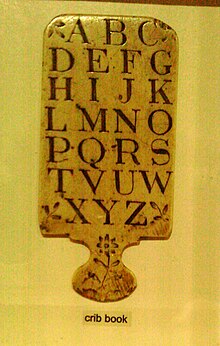
For the unfortunate pupils school days began at 6am and went on until late afternoon when the light was best. Study would be undertaken by means of slates to write on, and horn books which the teacher used as text books.

Tuer - Miss Campion holding a horn book.
From the Museum of Derby


The boys would be severely disciplined for laziness or stupidity in a way we would find unacceptable today. The birch rod was a symbol of a master's authority, as servants were frequently beaten, and it was exactly the same in school. Whether you were an apprentice or at school, you were likely to be on the receiving end of  corporal punishment. Flogging was frequent and severe, as it was thought to drive 'devils' from the body. It was thus used for every moral lapse or failing, and the boy would typically have his bottom beaten until blood flowed. Another common punishment was to use a 'ferula' - a flat ruler with a rounded end into which a hole had been cut. This was used to strike the hand or mouth and the hole brought up a terrible blister.


Some noble boys were educated at home, but by the 17th Century the private tutor was much less popular, as numbers of schools increased. 'Grammar Schools' took day pupils and 'Colleges' were residential and took boarders. But occasionally boys were placed in the homes of a suitable tutor. They would go to Oxford or Cambridge Universities usually at 14 to 16 years old. Childhood was certainly short in those days.

Young gentry were often sent on a Grand Tour which was an rite of passage that introduced them to the cultural riches of Europe and gave them an insight into foreign affairs and diplomatic relations. A typical tour would include Paris, Geneva, Turin, Florence, Venice, Rome. In my book 'A Divided Inheritance,' Zachary Deane is sent on just such a tour by his uncle.


File:Ostade Village school.jpg
17th Century Village School - Issac ostade (school of)

All through his schooling life the boy would have leisure time with his friends which more often than not involved blood sports such as falconry, shooting, stag hunting and badger baiting. At University there was 'swearing, drinking,rioting and hatred of all piety' 
(Simonds d'Ewes Cambridge 1620).

There were one or two attempts to introduce the idea of French Academies, for example in 1635 the Museum Minervae was established under royal patronage by Sir Francis Kynaston in Bedford Square, and its course included the arts, antiquities and military studies as well as mathematics and languages. Charles I  himself donated books, antiques, and other apparatus. Unfortunately, the fortunes of the Museum Minervae Academy declined when its patron was executed! 

Corpus Christi College, Cambridge
Cambridge University (Picture : The Times)


Once schooling was over the boy would often be sent abroad - wherever there was a War - to gain military experience. To the left, men training with Matchlock Musquettes - popular during the first half on the 17th Century. During the Thirty Years War many young men from England went to fight on the continent. No doubt their experiences were useful when they returned and needed to fight during the English Civil Wars.


Sources: Caliver Books English Civil War Notes, Stuart England - Blair Worden, www.britishhistory.ac.uk, www.olivercromwell.org ,
www.merchant-taylors.co.uk


More about Deborah: www.deborahswift.co.uk


Tuesday, May 21, 2013

Boy Sailors During the Age of Nelson and Napoleon

by M.M. Bennetts


Anyone who has thrilled to the dramas of naval derring-do such as Horatio Hornblower or Master and Commander will have observed that on the British ships of the late 18th and early 19th centuries, there were a great many boys--often as young as 12--serving aboard His Majesty's Ships.  

Indeed, it had been a 12 year old boy who had saved the day and the general (in this case, Sir Francis Drake) back in 1578 after a fracas with natives near the Island of Mocha.  So boys, working their way up the ladder, as it were, proved a common feature of the English navy from its beginnings.  And they were called 'Younkers'.

The eighteenth century saw a great rise in charitable institutions which were often founded to enable the poorest of London poor to climb out of the gutter and provide for themselves in a legitimate trade.  In 1756, The Marine Society was just one of these ventures--others included the Foundling Hospital and the Royal Hospital School.  At the first meeting of the founders, held at the King's Arms Tavern in Cornhill, they met to approve "A Plan of the Society for contributing towards a supply of Two or Three thousand Mariners for the Navy."

They began an Entry Book for Boys on 5 August 1756.  In this document, they recorded all the pertinent information they received about the boys, their age (if known), whether they had parents or were fatherless, their place of abode.  They also used the term 'friendless' which was in their eyes a worse condition than being an orphan.

The next meeting of this Society stated their aims:  "John Fielding having procured 24 boys for sea service, they were all clothed by the Society...Order'd that 10 of said boys be sent to Admiral Broderick and 14 to Capt. Barber of the Princess Royal at the Nore and that each boy shall have a Testament, Common Prayer Book, Clasp Knife and a printed list of their Cloths."

In 1756, of course, Britain was on the brink of entering the Seven Years' War.  During that period of time, the Royal Navy's manpower requirements rose swiftly--from 10,000 men to 80,000.  Moreover, there was an endless need for servants aboard ship, for cabin boys, loblolly boys, carpenters' mates...

Indeed, the Society launched a massive newspaper campaign to recruit:  "All stout Lads and Boys who incline to go on board His Majesty's Ships, as servants, with a view to learn the duty of a seaman, and are upon examination, approved by the Marine Society, shall be handsomely clothed and provided with bedding and their charges borne down to the ports where His Majesty's Ships lye, with all proper encouragement."

By 1772, the Regulations of the Marine Society were including a great deal more information about the boys they received.  There were columns in which to note if a boy was 'good' or not so good; some are recorded as having 'little or no guard against temptation', while others are said to be 'abominably corrupted [by the] most wicked company, in the most wicked parts of these kingdoms' or 'hardened in iniquity'.

Still, the Marine Society was offering these boys, described by the magistrate John Fielding as "numberless miserable, deserted, ragged, and iniquitous pilfering Boys that at this Time shamefully infested the Streets of London" a new life, one which included an education of sorts leading to a lifelong trade, steady rations, safe housing and a kitbag which included a felt hat, a kersey pea jacket, two worsted caps, waistcoat, shirts, trousers, three pairs of drawers, and a pair of shoes.  It seemed a good deal for many.

And over time, as the Society grew along with the need for more boys to feed the ever-expanding British naval workforce, magistrates, beadles, parish officers, aldermen and bishops all came to use the Society's provision as one option for criminal youth--a positive choice as opposed to the Gallows--which boys were then referred to, unsurprisingly, as Scape Gallowses.

But what of young teenage officers?  The midshipmen?  For the call of the sea wasn't just heard by those on the streets, but also by the middle-class sons of merchants, doctors, lawyers, yeoman farmers, all up and down the land for whom the navy promised adventure, dashing careers, promotion, and enrichment through limitless prize money.

Many, such as the small 12 year old boy, a son of a Norfolk clergyman, who would become Admiral Lord Nelson in time, would go to sea courtesy of a relation or patron, a serving captain perhaps--someone who had position and influence in the navy and who would take them under their wing, providing them with a classroom at sea where they would learn all the necessary skills and tools to--one hoped--eventually pass their examinations and rise above the post of Mid-Shipman.

For others of the gentry classes, there was the necessity of a good naval education at one of many institutions such as the Portsmouth Naval Academy, founded in 1729, which was open to "the Sons of Noblemen and Gentlemen, who shall not be under thirteen years of age nor above sixteen at the time of their admission."

And it was here, at these Naval Academies, that one can see the breadth of the education required for a young man who hoped to succeed in the navy of Nelson's time.  It was an immensely broad plan of education, requiring no less than two years' study:  "It being intended that the Master of the Academy shall instruct Scholars in writing, arithmetic, drawing, Navigation, Gunnery, Fortification and other noteful parts of Mathematics, and also in the French Language, Dancing, Fencing and the exercise of the Firelock."  

But that wasn't all, for the Academy also required that boys engage in a whole range of technical training which they would need as potential naval officers, including, "The Description and Use of the Terrestrial Globe, Geography, Chronology, Spherics, Astronomy, Latitude, Longitude, Day's Work, and Marine Surveying."

Two of Jane Austen's brothers attended the Portsmouth Academy.  Francis Austen enrolled there in 1786 at the age of eleven, and he was a model student, going to sea two years later.  His brother, Charles, who was sent to the Academy in 1791 was not so assiduous in his studies, and he did not leave the Academy until he had served the full term of his work there, in 1794 when he was sent aboard HMS Daedelus.  Both of Austen's brothers would in due time become admirals.

Interestingly, however, the Portsmouth Academy also had its detractors, many of whom considered it, "a sink of vice and abomination, [which] should be abolished..."  And it finally closed its doors in 1806, although many other such institutions--such as the Naval Academy at Chelsea--carried on, providing unequalled training for a future within the wooden walls.

~~~~~~~~~~~~


M.M. Bennetts is a specialist in early 19th century European history and the Napoleonic wars, and is the author of two novels, May 1812 and Of Honest Fame set during the period.  A third novel, Or Fear of Peace, is due out in 2014.

For further information, please visit the website and historical blog at www.mmbennetts.com