Showing posts with label Queen Victoria. Show all posts

Thursday, August 27, 2020

Lady Sarah Frederica Caroline Villiers: An English Princess

 By Lauren Gilbert

https://commons.wikimedia.org/wiki/File:Schloss_Esterh%C3%A1zy_Eisenstadt_1587.jpg

Schloss Esterházy, Eisenstadt, Darstellung von Lady Sarah Frederica Caroline Child Villiers 
by Karl Gruber / CC BY 3.0 AT 


Lady Sarah Caroline Frederica Caroline Child-Villiers was born August 12, 1822 in London, and was baptized May 27, 1823 in St George’s Hanover Square Parish. Her mother was Sarah Sophia Child-Villiers, Countess of Jersey and her father George Child-Villiers, 5th Earl of Jersey. She was born into one of the wealthiest and most powerful families.

At age 18, Sarah was One of 12 bridesmaids to Queen Victoria when she married Prince Albert in 1840. They wore gowns designed by Queen Victoria, and each received a brooch designed by Prince Albert, shaped like an eagle in turquoises.

Sarah married Prince Miklos Pal Esterhazy von Galantha on Feb 8, 1842. (The date was changed multiple times.) Born June 25, 1817, Prince Miklos (Nicholas in English) was the son of Prince Pal Anton Esterhazy von Galantha and his wife Princess Maria Theresia Esterhazy von Galantha. (Lady Jersey and Princess Esterhazy were both Lady Patronesses of Almack’s and friends.) After marriage, Sarah's title in English was Princess Nicholas Esterhazy von Galantha.
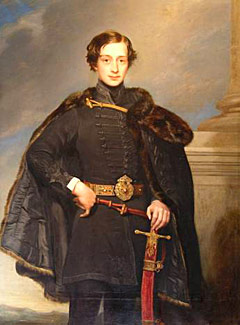
Nikolaus III, prince Esterházy de Galántha (public domain)

Theirs was a love match according to Esterhazy Palace data and the Duchess de Dino.(1) Nicholas had spent much of his life in England as the son of the Austrian Ambassador, so he and Lady Sarah Frederica could have become acquainted as children, especially given their mothers’ connection. Theirs was an unusually long engagement. It was known that they wanted to marry as early as 1836 (they apparently fell in love as teenagers). Prince Paul apparently was not pleased with the match (at least in part due to difference in status: the Jersey’s were not of a royal house, and Lady Jersey’s roots were in trade (her grandfather being the banker Robert Child)). He tried to prevent the match despite the fact the young couple were in love. There are indications that Princess Esterhazy was not enthused either (there are comments in the MEMOIRS OF THE DUCHESS DE DINO about having Lady Jersey as a mother-in-law (2), and a suggestion that the Esterhazy’s avoided having Lady Jersey in Vienna as much as possible). 

Lady Jersey encouraged the match. There were suggestions that she pursued the match relentlessly due to the status of the groom’s family. It seems equally possible that she wanted her daughter to marry the man she loved. Prince Paul tried to get out of the engagement as late as June 1841(3). However, he finally conceded. Lady Sarah Frederica’s trousseau was prepared and displayed for viewing in December 1841(4).

The marriage settlement was finally signed Monday Feb 7, 1842, and Lady Sarah Frederica and Prince Nicholas were married on Tuesday, February 8, 1842. Their wedding involved two ceremonies. At 10:00 in the morning, the couple was married in a Roman Catholic service in the library of Chandos House, the Austrian Embassy, performed by Rev. Dr. Griffiths, Apostolical Vicar of London. This service was followed by a breakfast. Shortly after 11:00, the wedding party arrived in St. George’s Hanover Square, where a Church of England service was performed by Robert Bagot, the Lord Bishop of Oxford (the bride’s uncle by marriage).

At this service, Lady Sarah Frederica had six bridesmaids, two of whom were her sisters Clementina and Adela*. She was given away by her father, who was visibly emotional. This service was followed by a sumptuous luncheon at the Child-Villiers home in Berkley Square, which included three bridal cakes. The wedding was a significant social event. Following the luncheon, the bride and groom spent some days at Osterley Park (the Countess of Jersey’s seat, formerly that of Robert Child), returning to Chandos House before leaving for Europe to join Prince and Princess Esterhazy. They arrived in Vienna in April 1842(5).

Prince and Princess Nicholas had an active social life in both England and Austria. Newspaper accounts document them going back and forth for a variety of social and family events (which included presentation at Queen Victoria’s Drawing Room on February 26, 1846, and a visit to the spa town of Ischl, Austria in August 1847 that included her mother and her sister Clementina (7)).

Prince and Princess Nicholas had six children, five of whom survived to adulthood: Pal Antal Miklos Prince Esterhazy von Galantha, born March 11, 1843 and died August 2nd, 1898; Alajos Gyogy Prince Esterhazy von Galantha, born March 9th, 1844 and died October 25th, 1912; Adolf Prince Esterhazy von Galantha born October 5th, 1846 and died in infancy February 1st, 1847; Sara Zsofia Princess Esterhazy von Galantha, born March 16th, 1848 and died February 22nd, 1885; Maria Terezia Princess Esterhazy von Galantha, born November 29th, 1849 and died May 7th, 1856 and Antal Miklos Furst Esterhazy von Galantha, born January 14th, 1851 and died February 10th, 1935. (The names are shown as in Vienna.)

Princess Nicholas sadly developed a lung complaint (consumption). After suffering several months of illness and unsuccessful spa treatments in Europe (at Ems and Ischl particularly), she finally went, at her doctor’s suggestion, to England to see if the air of her native country would help. It did not; she died at Torquay, Devon, England on November 17, 1853. She was buried at Eisenstadt in the Esterhazy vault. In 1871, Prince Nicholas raised an obelisk in the palace gardens in her memory. There is also a memorial in the Jersey family vault at the country estate in Middleton Stoney, England. Prince Nicholas did not remarry.
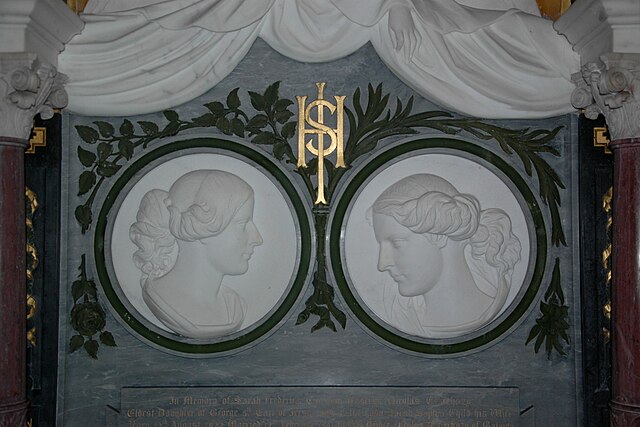
Church of England parish church of All Saints, Middleton Stoney, Oxfordshire; Jersey Chapel: detail of the tomb of Princess Esterhazy and Lady Clementina Villiers 
by Motacilla / CC BY-SA

*Newspaper accounts showed her sister's name as Adelaide; her name is correctly Adela Corisande.

Footnotes

(1) THE MEMOIRS OF THE DUCHESSE DE DINO, entry for June 16, 1841.

(2) THE MEMOIRS OF THE DUCHESSE DE DINO, entry for June 19, 1841.

(3) THE MEMOIRS OF THE DUCHESSE DE DINO, entry for June 16, 1841.

(4) Devizes and Wiltshire Gazette, Thursday 23 December 1841-British Newspaper Archives

(5) MEMOIRS OF THE DUCHESSE DE DINO, entry for April 17, 1842.

(6) The Globe, Saturday 26 March 1842-British Newspaper Archives.

(7) The Morning Post - Friday 27 February 1846, and the Morning Post- Saturday, 04 September 1847-British Newspaper Archives.

Sources include: 

Sudley, Lord, editor. THE LIEVEN-PALMERSTON CORRESPONDENCE 1828-1856. London: John Murray, 1943.

British Newspaper Archives. Northampton Mercury, Saturday 12 June 1841; London Evening Standard, MARRIAGE OF PRINCE NICHOLAS ESTERHAZY AND LADY SARAH VILLIERS, 22 December 1841; Devizes and Wiltshire Gazette, Trousseau of the Lady Sarah Villiers, Thursday 23 December 1841; Oxford Chronicle and Reading Gazette, MARRIAGE OF PRINCE NICHOLAS ESTERHAXY AND LADY SARAH VILLIERS< Saturday 12 February 1842; Weekly Freeman’s Journal Saturday, FASHIONABLE INTELLIGENCE, 12 March 1842; Globe, FASHION AND TABLE-TALK, Windsor, Friday. Saturday 26 March 1842; Morning Post, Ischl, Aug. 26, Saturday 04 September 1847; and John Bull, DEATH OF HER HIGHNESS PRINCESS NICHOLAS ESTERHAZY, Saturday 19 November 1853. (All articles © British Library Board) HERE

Gutenberg.org The Project Gutenberg’s eBook of MEMOIRS OF THE DUCHESSE de DINO (Afterwards the Duchesse de Tallyrand) 1841-1850, edited by Princess Radziwill, New York: Charles Scribner’s Sons, London: William Heinemann, 1910. HERE

RoyalCentral.co.uk “Queen Victoria’s Bridesmaids” by Elizabeth Jane Timms, July 4th, 2019. HERE

Thepeerage.com “Lady Sarah Frederica Caroline Child-Villiers.” HERE ; “Miklos Pal Prinz Esterhazy von Galantha.’’ http://www.thepeerage.com/p32788.htm#i327874

Esterhazy.net “Lady Sarah Child-Villiers.” HERE ; ‘’Prince Miklos Pal Esterhazy de Galantha.’’ HERE

Szervuszaustria.hu “Princess Have Happy and Less Happy Lives”. Supplement to the Eisenstadt Exhibition. November 6, 2012.HERE

Books.google.com THE NEW WORLD: A Weekly Family Journal of Popular Literature, Science, Art and News, Volume 3. New York: 1841. THE NEW WORLD, December 25, 1841. “Foreign Items.” HERE ; THE GENTLEMAN’S MAGAZINE, Volume XLI New Series, January to June inclusive. London: John Bowyer Nichols and Sons, 1854. January 1854, P. 106. Obituary of Princess Nicholas Esterhazy. HERE

Wikipedia. “Robert Bagot (Bishop)”. Last edited 29 January 2020. HEREImages from Wikimedia Common.

~ ~ ~ ~ ~ ~ ~ ~ ~ ~

Lauren Gilbert was introduced to English authors early in life. Lauren has a bachelor of arts degree in liberal arts English with a minor in Art History. A long time member of JASNA, she has presented a number of programs. She lives in Florida with her husband. 

Lauren's first book, HEYERWOOD A Novel, is available. A RATIONAL ATTACHMENT is her second novel. A long-time contributor to the English Historical Fiction Authors blog, her work is included in both volumes of CASTLES, CUSTOMS AND KINGS: True Tales by English Historical Fiction Authors. She is also researching material for a biography. For more information, visit her website.


Wednesday, May 6, 2020

John Brown: Victoria's Lover or Rasputin-like Figure?

By Emma Rose Millar

Since first watching Dame Judi Dench and Billy Connolly in the 1997 film, Mrs Brown, I have been intrigued by Queen Victoria’s relationship with her ghillie: were the pair really lovers, or was he simply her loyal servant and protector?


There is no doubting Victoria’s early love for Albert. She was an obsessive letter writer and journal keeper. Aged twenty, she wrote in her diary about her first evening of married life:
“I never ever spent such an evening! My dearest, dearest, dear Albert sat on a footstool by my side, and his excessive love and affection gave me feelings of heavenly love and happiness I never could have hoped to have felt before! He clasped me in his arms and we kissed each other again and again! His beauty, his sweetness and gentleness—really how can I ever be thankful enough for such a husband.”
She often wrote of her pride in his achievements, particularly the Great Exhibition of 1851. Albert was indeed intelligent and enterprising, and often, especially in the early years, he was frustrated by his lack of power. However, as Victoria became increasingly occupied with her children, Albert took on more responsibilities. Victoria sometimes resented Albert’s authority, and fierce arguments between the couple were a regular occurrence. Frequently, they would cease to be on speaking terms and communicated only in writing. Many of these letters survive and have given us a fascinating insight into their relationship.

When Albert died of typhoid fever in 1861, Victoria was devastated. She wrote to her eldest daughter, also called Victoria, asking: “How I, who leant on him for all and everything – without whom I did nothing, moved not a finger, arranged not a print or photograph, didn’t put on a gown or bonnet if he didn’t approve it shall go on, to live, to move, to help myself in difficult moments?”


For years Victoria mourned Albert, retreating from public life and wearing black for the remaining forty years of her life. After his death, whenever decisions needed to be made, Victoria felt the absence of Albert acutely. She attempted to guess what the Prince Consort would have advised and attended many séances in order to communicate with him directly. Victoria famously consulted Daniel Dunglas Home, one of the most lauded mediums of the era, and Georgiana Eagle, whom she gave an engraved watch, for supposedly channelling Albert’s ghost.

In 1861, a 13-year-old medium, Robert James Lees, held a séance in Birmingham during which he went into a trance and delivered a message from the Prince Consort that he wished to speak with his wife, the Queen. One of the sitters there was a professional editor, who published his account, which was subsequently brought to Victoria’s attention. The Queen’s position dictated a cautious approach. She sent two courtiers to Lees’ next séance in her place, instructing them that they were not to reveal their identities. During the séance, Lees again went into a trance and produced a voice phenomenon which the courtiers instantly recognised as Prince Albert. The spirit then addressed the courtiers by their real names and gave intimate details of life at the palace, which they considered only Albert could have known.

Following the séance, Lees wrote a letter to the Queen, using the supposedly supernatural gift of automatic writing, where the spirit takes over the body of the spirit medium long enough to write a message. Lees’ letter was filled with personal details and signed by a pet name used only between Albert and Victoria. Victoria was utterly convinced that the letter was genuine and sent at once for Lees, who conducted a further séance at the Palace, again channelling Albert’s voice.

Lees as an older man

According to Lees’ children, he performed another nine séances, impressing the Queen so much that she invited him to join the Royal household. However, he refused the offer on the advice of his spirit guides. Speaking through Lees, Albert’s final words of comfort were, “You will still be able to receive messages from the boy who used to hold my gun at Balmoral.”

The boy who carried Albert’s gun was John Brown.

After Lees revelations, Brown was sent for to become the Queen’s personal groom at Osbourne, her house on the Isle of Wight. The relationship between John Brown and Queen Victoria remains a source of conjecture. Her courtiers were pleased at first that he was able to coax her out of her misery, but they soon became concerned that she had fallen utterly under his spell.

Brown immediately adopted a bullying and familiar manner with the Queen that astonished courtiers and caused her daughters to refer to him as ‘Mama’s lover.’ He became increasingly domineering, towards the rest of the royal household. Other servants came to despise him, and secretly dubbed Brown ‘the Queen’s stallion.’ Brown encouraged the Queen to drink whisky with him, Begg’s Best being their preferred tipple. She was soon referring to him as ‘fascinating Johnny Brown’.

A shocked Foreign Secretary, the Earl of Derby, recorded that ‘contrary to etiquette and even decency,’ Queen Victoria and John Brown slept in adjoining rooms, with only a door between them. Some sources suggest that the pair even married in secret. Lewis Harcourt, First Viscount Harcourt’s diaries state that one of the Queen's chaplains, Rev Norman McLeod, made a deathbed confession repenting his action in presiding over Queen Victoria's marriage to John Brown. Victoria was buried with a lock of Brown’s hair, his photograph, Brown’s mother's wedding ring, along with several of his letters.

However, Irish author, J. H Brennan claims in his book, Whisperers, the History of the Spirit World that far from being lovers, John Brown was a spirit medium who was channelling messages from Albert’s ghost. In the blue room, which Victoria had turned into a shrine to her late husband, she would sit with Brown and a few trusted courtiers, in the dark, where she would sit and wait. John Brown would then begin to speak, not in his own voice, but in the voice of the Prince Consort, telling Victoria what she should do.

After John Brown’s death in 1883, Victoria wrote to the Earl of Cranbrook, “the Queen feels that life for the second time is become most trying and sad to bear deprived of all she so needs.” This letter could perhaps be alluding to her losing Albert for the second time – she was no longer able to communicate with him through Brown.

Whether or not John Brown was behind Lees’ claims to be able to channel Albert’s spirit, we do not know, although it is telling that when recounting his first experience of Spiritualism, Lees wrote:
“I am personally aware that as a child I cried at being left in the darkness unless I saw a mysterious and to others invisible kilted Highlander who remained beside me talking or singing till I fell asleep. And even now, after a lapse of half a century the vivid memory of his strong but kindly face is as freshly recalled as if he had sat beside me whilst this New Year was born.”

[This is an Editor's Choice archive post, originally published on EHFA 29 October 2018]

~~~~~~~~~~

Emma Rose Millar writes historical fiction and children’s picture books. She won the Legend category of the Chaucer Awards for Historical Fiction, with FIVE GUNS BLAZING in 2014. Her novella THE WOMEN FRIENDS: SELINA, based on the work of Gustav Klimt and co-written with author Miriam Drori was published in 2016 by Crooked Cat Books, and was shortlisted for the Goethe Award for Late Historical Fiction. Her third novel, DELIRIUM, a Victorian ghost story, published by Crooked Cat Books was shortlisted for the Chanticleer Paranormal Book Awards in 2017.

Delirium
1881

Saint Anne’s Lunatic Asylum, London.

One woman whose secret has driven her to the brink of insanity; another who claims she can tell fortunes and communicate with the dead. With seemingly no way out – and everything at stake – only one of them has the tenacity to survive.

Lies, murder, obsession... Delirium.

Find Delirium on Amazon
Follow Emma Rose Millar on Twitter
On Facebook
On Goodreads


Friday, June 14, 2019

The Duke of Wellington’s Female Circle: Frances, Lady Shelley

by Lauren Gilbert

Lady Shelley, from a miniature by G. Sanders, in the possession of Spencer Shelley Esq.


Arthur Wellesley, the Duke of Wellington, was known to enjoy women, particularly pretty, intelligent women. He was credited with many mistresses (whether or not true) and he had many women friends whose company he enjoyed. One of these women was Frances, Lady Shelley, a notable diarist.

Frances was born in June 16, 1787 at Preston, Lancashire. Her father was Thomas Winckley, and her mother was Jacintha Dalrymple Hesketh. Originally known as Janet or Jennet, Jacintha was the previously-widowed sister of the famous courtesan Grace Dalrymple Elliot, whose family had a connection to the Earl of Peterborough. Jacintha and Thomas were descended of Jacobite families and they married in 1785. Thomas was about 17 years older than Jacintha. Jacintha had children (5 daughters and a son) by her first husband. Apparently Thomas did not care for the Hesketh connection; only one of Frances’ half-siblings lived in the household with her and her parents, and they rarely met the Hesketh siblings. The household was not a particularly happy one; Thomas spent a lot of time with his cronies, drank heavily and liked to play pranks. Accounts indicate that Thomas was quite well off. Shortly after moving his family to Larkhill, Thomas died in 1794, leaving his widow, their daughter Frances and 2 illegitimate sons. Jacintha inherited the house and furniture; the residue of Thomas’ estate was left to Frances, who was 6 years old.

In 1795, at the age of 8, Frances was sent to school at Twickenham, where she resided for 2 years. She was removed from school and went to live at her mother’s home in Bath, under the instruction of a governess. She also had a drawing master. Apparently, she had delicate health, possibly with lung problems. At age 10, her doctor recommended fresh air and exercise, so she was allowed to spend a lot of time outdoors. She read a great deal, including the works of the poet Cowper and the tracts of Hannah Moore, and was imbued with a spirit of reform at a young age.

Jacintha Winckley remarried on September 1, 1799 in Bath. She wed Major James Barrington, an Irish career Army man. Although Frances later professed to be shocked by it, and claimed that her mother had had no one to advise her, the marriage was witnessed by Jacintha’s daughter (and Frances’ half-sister) Harriet Hesketh Despard and her husband General John Despard. Although respected by his fellow soldiers, Frances did not like him. Shortly after the marriage, the household moved to London, where Jacintha became very sick. Sometime before Jacintha’s death, Frances returned to her mother’s room to find a stranger visiting: her notorious aunt Grace Dalrymple Elliott. It was her only meeting with her aunt. Frances stayed with and cared for her mother until about 1801 when she was removed from the Barrington household by her guardian Reverend Geoffrey Hornby (who was related to Thomas Winckley, and whose son would inherit Thomas’ estate if Frances died). Jacintha died January 7, 1802, when Frances was approaching 15 years old.

Shortly thereafter, her half-brother, Sir Thomas Hesketh, brought Frances to live with him and his family. She again had a governess, and got on well with her sister-in-law. In order to gain polish and improve her accomplishments, she was placed with Mrs. Olier in Gloucester Place, Portman Square in London. Mrs. Olier took 4 pupils, each paying 1000 pounds. Frances spent 2 years in this establishment. She returned at age 17 to her half-brother’s home, where she entered local society. It appears that in January of 1805, she was presented at the court of King George III. Initially, her social engagements involved Lancashire and Cheshire families known to her and her half-brother, although she wanted to enter the haute ton. She made the acquaintance of Lord and Lady Sefton, who were friends of Sir John Shelley.

Sir John Shelley, 5th Baronet of Michelgrove, was born March 3, 1772, and was 15 years older than Lady Shelley.  He was handsome, charming and a member of the highest society.  He was also known for his fondness for gambling, horse racing, drinking, and womanizing.  One of his closest friends from his school days was Lord George Villiers, subsequently Lord Jersey. Sir John had served in the army in the Coldstream Guards, including time as aide-de-camp to the Duke of Sussex. He discovered that his father had demolished the family fortune to the extent that Sir John was forced to sell his family estate, Michelgrove, for 100,000 pounds when he came of age.  The loss of this property was painful to him for a very long time. His friends (including the Seftons) were hoping to see him settle down in a good marriage.  He was present at a dinner to which Frances and her family were invited.
Sir John Shelley, 6th Baronet. 1815, pencil and ink. By George Hayter (1792-1871).
Frances’ brother and others objected to Sir John's courtship of her, and she returned to her brother’s home. Her diary indicates that she agreed to marry Randal Wilbraham, a scholar and widower with 3 frail children, but came to her senses and broke it off the next day. For fear of scandal, her brother tried to compel her to marry Wilbraham but she refused so he ordered her out of his home. She returned to Rev. Hornby’s home for a few months, and then was allowed to return to her brother’s house.

Sir Thomas Hesketh lived 19 miles from Lord Sefton. Sir Thomas was determined to keep Frances away from Sir John Shelley; Lord Sefton was determined to assist Sir John Shelley in his pursuit of Frances. Sir John convinced Frances of his sincerity. It took time, but eventually Sir John won over Frances’ family and they became engaged. They were married June 4, 1807 at St. George’s, Hanover Square. As the wife of Sir John, Frances, Lady Shelley gained entrée to the highest level of society. However, she discovered that reforming a rake was no easy task. He had had many romances, including one with Lady Boringdon (Lady Jersey’s sister) and another with Lady Haggerstone (Maria Fitzherbert’s sister). Lady Boringdon was violently in love with Sir John, and had wanted him to elope with her.

After their marriage, Sir John received congratulations from his racing companions at Ascot, and they were presented at court by his aunt. Subsequently, they went to Osterley Park for a country visit with Lord and Lady Jersey. Lady Shelley found Lady Jersey to be domineering and rude, and was not happy there. (One can’t help wondering if Sir John’s previous relationship with Lady Jersey’s sister contributed to the awkwardness of the occasion.) As luck would have it, Sir John suffered an injury to his ankle which delayed their departure. Lady Shelley spent as much time as possible in her room or in the gardens, avoiding Lady Jersey and the other women in attendance. She was delighted when they were finally able to leave.

As they went forward as a couple, she did not interfere with his activities, and encouraged him to go to social engagements without her. They became a most devoted couple and Lady Shelley’s diary and letters indicate that they were very active socially, and often in company with the Jerseys. (Lady Jersey apparently bestowed the nicknames “Goose” and “Country Girl’) on Lady Shelley, which I’m sure did not improve relations between the ladies.) Lord and Lady Shelley had 5 children between 1808 and 1813: John Villiers Shelley born March 18, 1808, Frederick born May 5, 1809, Frances Louisa (Fanny Lucy) born February 2, 1811, Adolphus Edward born March 2, 1812, and Spencer born December 24, 1813.

In 1814, Sir John inherited a property, Maresfield, near Uckfield in East Sussex. Lady Shelley spent 70,000 pounds updating the estate. Having an estate improved Sir John’s position in the county, and made up for the loss of Michelgrove to some degree. They were in London for the peace celebrations and activities in 1814, attending the King of France’s levee at Grillon’s Hotel on April 22, and the arrival of the Emperor of Russia on May 13 as well as others. The Shelleys gave a party on July 18th which was attended by Marshall Blucher and General Platoff. Among the guests were Mrs. Wellesley Pole, accompanied by the Duke of Wellington. Sir John was known to the Duke from his army days, and Lady Shelley was quite impressed with the Duke. Lady Shelley met the Duke of Wellington again at a party at Wanstead House (the home of the Duke’s brother, William Wellesley Pole) on July 21 1814. This party was attended by members of the highest society.

Portrait of the Duke of Wellington by Francisco Goya, between 1812 and 1814
Information in Lady Shelley’s diary and other sources indicates that she and the Duke enjoyed conversation and riding together as she was a notable horsewoman. The Duke returned to Paris in August of 1814, by which time Lady Shelley entertained a great regard and respect for him. The Shelleys returned to Maresfield for the rest of the summer. After the Battle of Waterloo (June 18, 1815), the Shelleys planned a trip to Paris and departed Maresfield on July 13, 1815. They landed in Calais on July 15 and journeyed to Paris, where they arrived a few days later.

During this time in Paris, the Duke allowed them to use his boxes at the theatres in Paris, and escorted Lady Shelly on horseback to various military reviews. She dined with him regularly as Sir John was often out if not ill with gout. He introduced her to various personages. She attended the Allied Review of Troops in July in a glass coach with outriders and footmen provided by the duke. Gossip about their relationship was, of course, rife. The Duke simultaneously entertained more than one mistress, about whom Lady Shelley was aware but somehow managed not to meet. Her diary does not read like one would expect a record of a passionate affair but as a more platonic, intimate friendship. She also wrote of her husband with great affection.

Lord and Lady Shelley subsequently returned to England in September of 1815. The Duke and Lady Shelley maintained a regular correspondence. On Jun 18, 1816, Lord and Lady Shelley sailed from Brighton to France and journeyed back to Paris. The Shelleys dined with the Duke of Wellington on June 23, 1816. After that, Lady Shelley socialized with the Duke, and rode his horse Copenhagen (the horse he rode in the Battle of Waterloo) at least once in the Bois de Boulogne. (Her diary indicates that she and her husband spent time together, as well as having separate engagements.) However, the Duke was not there long, as he intended to go to Cheltenham, England to take the water and to spend time with his wife Kitty and their sons. Lady Shelley dined with him regularly until his departure.

The Shelleys left Paris July 7 on a European tour and travelled through France to Switzerland. Lady Shelley received a letter from the Duke of Wellington written July 10 at Cheltenham, a newsy, social letter in which he sent regards to Lord Shelley and asked her to write when she had time. They travelled on through the German states, to Prague, Austria and Hungary where she met the Princess Esterhazy and Lord Shelley went hunting with the Prince. They went to Vienna, where they spent a month. Their journey took them on to spend the winter in Italy, which Lady Shelley enjoyed very much, being particularly fond of Naples. It is interesting to note that, according to her journal, Lady Shelley indicated some kind of reconciliation with Lady Jersey in Italy. During her travels (as indeed during her life), Lady Shelley maintained an extensive correspondence with family and friends, as well as the Duke of Wellington. They finally returned home March 25, 1817. Their youngest child Cecilia Victorine was born sometime in 1818.

Both Lord and Lady Shelley maintained friendships with the Duke of Wellington and many personages highly placed in society and government circles. Lord Shelley served in Parliament from 1804-1806, and again from 1816-1831. He maintained his interest in horse racing, which kept him in the same circle as Lord Sefton, Lord Jersey and other racing aficionados. (His horse Prince Paul lost the Derby despite being the favourite in 1818, which was a sad disappointment to both; they had counted on winning the purse to ease a cash shortage.) Lady Shelley also went on to form a close friendship with Mrs. Harriet Arbuthnot, another of the Duke of Wellington’s closest female friends (and rumoured mistresses). Her diary and collected letters (in 2 volumes) show that, while she and the Duke of Wellington maintained a steady correspondence and met frequently when possible, she was deeply attached to Lord Shelley who was also on excellent terms with the Duke. In her diary, Lady Shelley refers to political matters, travels, and her personal impressions of people she met. They also entertained the Duke of Wellington at their home.

The only breach in the friendship between the Duke of Wellington and Lady Shelley occurred in 1847. The Duke wrote what he considered a private and personal letter to Sir John Burgoyne in which he described the weakness of England’s defenses. Concerned, Sir John showed it to Lady Shelley. She shared that information, publication of the information resulted, and the Duke was furious with her. (Her motive was honourable, in that she hoped action would be taken according to the Duke’s wishes; unfortunately, the Duke did not appreciate her efforts.) Although the Duke met Lord Shelley with pleasure, he remained on the outs with Lady Shelley, until 1850 when Lord Shelley managed to heal the breech. It is sad to note that she lost her both husband and her dear friend in 1852: her husband passed away on March 28, 1852, and the Duke of Wellington on September 14, 1852.

Lady Shelley maintained her diary and continued her travels and correspondence until late in life. She started to write an autobiography, which was unfinished, and made notes in her diary to clarify things. (She provided the details of Lord Shelley’s courtship and their marriage in 1855.) The closest she came to hinting at an affair with the Duke was her description of her hero-worship of Wellington and the intoxication of being his chosen companion and then his acknowledged friend.(1) It is very possible they had a romantic relationship (dalliance on his side, hero-worship on hers) that did not involve a physical affair, that evolved to a more mature and sincere friendship.

In 1868, she built a house on the Isle of Wight that was called Maresfield Lodge. She became a friend of Queen Victoria, with whom she dined at Osborne. Queen Victoria visited Lady Shelley when she became ill in early 1873, and came to see Lady Shelley when she got word that Lady Shelley was dying.

Frances, Lady Shelley died February 24, 1873 aged almost 86 years at her home on the Isle of Wight. She lived through interesting and momentous times, had the opportunity to know and observe many of the movers and shakers through the last reigns of the Georgians and into the Victorian era, and recorded her observations. Her diaries, which were edited by her grandson Richard Edgcumbe, provide a fascinating window onto the late Georgian and Victorian eras.

FOOTNOTE:

Shelley, Frances. (Richard Edgcumbe, editor.) THE DIARY OF FRANCES LADY SHELLEY, Vol 2. P. 405

SOURCES INCLUDE:

Delaforce, Patrick. WELLINGTON THE BEAU The Life and Loves of the Duke of Wellington. 2004: Pens & Sword Books Ltd., Barmsley, South Yorkshire. (First published 1990 by The Windrush Press.)

Edgcumbe, Richard, ed. THE DIARY OF FRANCES LADY SHELLEY 1787-1817. Vol. 1. 1912: John Murray, London.

Shelley, Frances. Edited by Richard Edgcumbe. THE DIARY OF FRANCES LADY SHELLEY Vol. 2. (This covers 1818-1859.) Originally published 1912. 2012: Forgotten Books. (Reprint)

Major, Joanne and Murden, Sarah. AN INFAMOUS MISTRESS The Life, Loves and Family of the Celebrated Grace Dalrymple Elliott. 2016: Pen & Sword Books, Ltd., Barmsley, South Yorkshire. (Kindle version)

Manning, Jo. MY LADY SCANDALOUS The Amazing Life and Outrageous Times of Grace Dalrymple Elliott, Royal Courtesan. 2005: Simon & Schuster, New York.

Blog Preston. “Notable People of Preston – Frances Lady Shelley 1787 to 1873” by Gill Lawson, October 18, 2013. HERE

History of Parliament Online. “Shelley, Sir John, 6th Bt. (1772-1852) of Maresfield Park, Suss.” by Howard Spencer (no post date). HERE

History Today. “The Duke of Wellington and Lady Shelley” by Prudence Hannay. Vol. 25 Issue 2 published February 2, 1975. HERE

Illustrations:
Lady Shelley: scanned frontispiece from my personal copy of  THE DIARY OF FRANCES LADY SHELLEY 1787-1817.

Lord Shelley: Wikimedia Commons (Public Domain)  HERE

Portrait of the Duke of Wellington: Wikimedia Commons (Public Domain)  HERE

~~~~~~~~~~~~~
Lauren Gilbert is a dedicated reader and student of English literature and history, holding a BA in liberal arts English with a minor in Art History. A long-time member of the Jane Austen Society of North America, she has done various presentations for the local region, and delivered a break out session at the 2011 Annual General Meeting. Her first book, HEYERWOOD: A Novel was published in 2011, and her second, A RATIONAL ATTACHMENT, will be released later this year. She lives in Florida with her husband, and is researching material for a biography. For more information, visit her website. 

Thursday, February 28, 2019

Dresser to the Queen: Miss Marianne Skerrett

By Lauren Gilbert

In the television series VICTORIA, Mr. Francatelli had a relationship and married Nancy Skerrett, known as Mrs. Skerrett, who was the Queen’s dresser. She was a young woman with a sketchy past who tragically died young. In real life, Miss Marianne Skerrett rose to be the Queen’s principle dresser, and was with Queen Victoria for twenty-five years. You can see multiple images of Miss Skerrett on the Royal Collections Trust Website. One can be found HERE.

Miss Skerrett was born about 1793 in London; she was baptized in St Martin-in-the-Fields. Her parents were Walter Frye Skerrett and Albinia Mathias Skerrett. Walter had links to the West Indies (including Antigua, Barbados, Bermuda, Montserrat and what is now Guyana), and was a slave owner. He was born in 1762, possibly in Liverpool. By 1791, he was in London where he married Albinia Mathias in that year in St.-Martin-in-the-Fields Church. Albinia, who had been born about 1760, was a friend of Charlotte Burney (a sister of author Fanny Burney).


Interior of St. Martin-In-The-Fields 1810 (Plate 79 of MICROCOSM OF LONDON by Thomas Rowlandson)

There are indications that Mr. Skerrett had been a colonel in the British Army during the Peninsular Wars, and that he was mentioned in William Francis Napier in his HISTORY OF THE WAR IN THE PENINSULA. However, in Napier’s book, the colonel in question is named only as “Colonel Skerrett”, and there is no indication of Walter Frye Skerrett or a W. F. Skerrett or even W. Skerrett in the London Gazette or other sources that military appointments, promotions etc. are mentioned. (It seems likely that the Colonel Skerrett in Napier’s book was actually John Skerrett. There are a couple of other Skerretts who made rank as well.) It seems unlikely that Walter Frye Skerrett served in the British Army. However, records indicate he was very active in litigation as there are numerous court cases in which he was involved relating to business matters in the West Indies. It appears he may have owned a business in London, as one of these cases refers potential litigants to his representatives in the West Indies or to W. F. Skerrett and Co. in London. Walter Frye Skerrett died January 27, 1828.

Marianne was the older daughter born to Walter and Albinia. A second daughter, Henrietta, was born in London about 1796. So far, I have found no information about Miss Skerrett’s childhood or youth, including her education. However, it is reasonable to assume that it was respectable, and that she received some form of education. Multiple descriptions of Marianne indicate she was intelligent, well-read, and fluent in multiple languages (Danish, French and German). Additionally, artist John Callcott Horsley, in his RECOLLECTIONS OF A ROYAL ACADEMICIAN, described Marianne Skerrett as small (under five feet tall), thin, plain and a devout Christian.

In 1837, at approximately age 44, Marianne Skerrett was appointed head dresser with the care of jewelry. Data indicates that Laura Petty FitzMaurice, Marchioness of Lansdowne (principal Lady of the Bedchamber from August 1837 to September 1838) recommended Miss Skerrett to the queen. (There are indications that the Lansdowne family was also known to the Burney family.) This appointment put Marianne Skerrett in the Queen’s household at the time of Victoria’s coronation on June 28, 1838, so (in her capacity as head dresser with the care of jewelry) it is very likely that Miss Skerrett would have been involved in the preparations for that event.

Queen Victoria in Coronation Robes 1838 by George Hayter

Marianne Skerrett became head dresser and wardrobe woman. Available information suggests she was in that position about 1841. Her duties included ordering the Queen’s clothes and accessories, maintaining the wardrobe accounts, supervising hairdressers, seamstresses and others involved with the Queen’s wardrobe and appearance. In September of 1842, when Victoria’s former governess Baroness Louise Lehzen finally retired from the Queen’s household and left for Germany, Miss Skerrett took on some of Lehzen’s duties in addition to her own.

These additional duties included acting as a personal secretary to the Queen, in that Miss Skerrett wrote to tradesmen, commissioned artists and engravers, responded to solicitations for assistance from former servants, paid the bills incurred for creating and maintaining the Queen’s wardrobe, and wrote recommendations for other dressers and maids, all on the Queen’s behalf. Miss Skerrett may also have written some of the Queen’s personal correspondence to various family members on Victoria’s behalf. She also assisted Victoria with her etchings. In the years that Miss Skerrett was in Victoria’s household, she became a fixture on whom the Queen and other members of the household relied to get things done.

On February 1, 1847, Miss Skerrett even testified at court against a man named Francis Olifieres who had been indicted for stealing jewelry in 1845, in the course of which theft he alleged a connection to the royal household. Miss Skerrett’s brief testimony established that Mr. Olifieres had had one commission for the royal household in 1842, had had no interview with the Queen and had not been employed in the royal household. After other testimony, Mr. Olifieres was determined to be guilty and sentenced to be transported.

The time finally came when Marianne Skerrett was ready to resume life outside of the royal household. She retired from the Queen’s service in 1862 at the age of 69, and was given a pension of 70 pounds. She went to live with her sister in Marylebone in London, where she apparently lived until her death July 29, 1887. During her retirement, she remained in contact with Queen Victoria through letters and visits. Aged about 94 years at her death, Miss Skerrett left an estate valued at over 5000 pounds, and a will which was probated on October 8, 1887. She left Queen Victoria a painting by William Hogarth called The Popple and Ashley Families, which was a painting of a Bermuda family that showed Miss Skerrett’s grandmother as a child. This painting is still part of the royal collection and you can see it HERE.

Sources include:
Troide, Lars E. and Cook, Stewart J. THE EARLY JOURNALS AND LETTERS OF FANNY BURNEY Vol. V, 1782-1783. 2012: McGill-Queen’s University Press.  P. 256. (Reference can be viewed in preview on Google Books HERE.)

Georgian Papers Programme.  “Introducing the Georgian Goodies Series” (date posted and author not shown).  HERE

GoogleBooks.  THE GENTLEMAN'S MAGAZINE (London, England) Vol 143 (The Gentleman’s Magazine and Historical Chronicle From January to June 1828 Volume XCVIII by Sylvanus Urban, Gentleman.  1828: London, England.) P. 188. HERE;  Horsley, John Callcutt, R.A.  RECOLLECTIONS OF A ROYAL ACADEMICIAN.  Mrs. Edmund Helps, editor. 1903: E. P. Dutton and Company, New York.  Pp. 126-131.  HERE; Napier, William Francis Patrick.  HISTORY OF THE WAR IN THE PENINSULA and In the South of France from the year 1807 to the year 1814. 1836:  David Christy, Oxford.  HERE

Gov.UK  Find A Will.  Here. (Select Wills and Probate 1858-1996 and put in Surname Skerrett, Year of death 1887.)  

OldBaileyOnline. Old Bailey Proceedings. 1st February 1847.  HERE

The Gazette Official Public Record. HERE

The National Archives.  Discovery. Annual Army Lists, 1700-1799 and 1800-1899.  HERE

University College London. LEGACIES OF BRITISH SLAVE-OWNERSHIP. “Walter Frye Skerrett, Profile and Legacies Summary 1762-1828.”  (No author or post date shown.) HERE

Unofficial Royalty.  “Marianne Skerrett” by Susan Flantzer.  Posted October 9, 2018.  HERE

Image of Miss Skerrett:  Royal Collections Trust.  Photograph of a full-length portrait of Miss Marianne Skerrett, Albumen print, RCIN 2906440.  HERE; Copyright information HERE 

Wikimedia Commons Images:
St. Martin-in-the-Fields (Public Domain) HERE
Victoria in Coronation Robes (Public Domain) HERE

A special thank you to Dr. Jacqueline Reiter, who steered me to the London Gazette and the Annual Army lists at the National Archives regarding Walter Frye Skerrett’s Army service.  She was also gracious enough to check data in her own possession.   

~~~~~~~~~~

Lauren Gilbert is the author of HEYERWOOD: A Novel.  A long-time member of the  Jane Austen Society of North America and life-long reader of history and historical novels, she has a Bachelor of Arts in English with a minor in Art History.  She lives in Florida with her husband, where she is working on her second novel A RATIONAL ATTACHMENT, to be released this year and the research for a biography.  Visit her website HERE for more information.

Tuesday, October 24, 2017

Plants vs. Winter: The Origins of English Conservatories

by K.M. Pohlkamp

Your ruthless Viscount patron has commissioned a heinous new poison. Your stores of toxic cuttings and seeds are running low and the backyard garden is blanketed with snow. Dear assassin, how will you grow the plant ingredients you need?

This dilemma developed while writing my historical novel, Apricots and Wolfsbane, set in the early 1500’s England. Yes, my assassin could have simply harvested a sufficient supply of seeds and cuttings during the previous fall. Yawn. She could have purchased supplies from a shadowy figure in the alley. Instead, I had her bartered for access to a solarium.

Since my character exists in early Tudor England, like a good historical fiction author, I began research period solariums only to find the word didn’t exist until about the mid 1800’s.

Well then.

A quick find and replace later, my assassin’s solarium transformed into a greenhouse.

Problem solved, right?

After all, greenhouse technology was first used in about 30 A.D. to provide the Roman emperor Tiberius with an ample supply of “cucumbers” which physicians believed would ward off his ailments. (Historical note: he likely did not eat cucumbers, but rather melons that lacked sweetness.)

The Roman philosopher, Pliny the Elder, described those first Roman greenhouses as:
“beds mounted on wheels which they moved out into the sun and then on wintry days withdrew under the cover of frames glazed with transparent stone.” 
 The “transparent stone” roofs were thin sheets of mica that were kept warm by maintained fires outside of the stone walls.

It wasn’t until the 13th century that the Italians built the first modern greenhouses (Giardini botanici) which fostered new species brought home by explorers of Africa, the Middle East, Asia and, later, the New World. Development of the concept spread and by 1450, Korea also had “temperature controlled” houses as documented by Jeon Son in his 1459 cookbook, Sanga Yorok.

These early structures comprised of modest wood or metal frames with glass. In southern Europe, a simple roof or a wall of windows maintained sufficient warmth thanks to the “greenhouse effect.” During the day, sunlight warmed the interior of the structure and the glass trapped enough residual heat to keep the plants content throughout the night, even in winter.


This was all great if my assassin was Italian, or Korean, or Spanish. But she’s English. Those early, simple concepts of passive heating proved insufficient against the harsh winter of Northern Europe. 

Thankfully for her (and me), the concept of greenhouses finally took root in England in the 16th century. But even before that time, the value of moving plants inside during cold nights was well understood by the English.

The Gardener's Labyrinth, written by Thomas Hill in 1577 under the pseudonym Didymus Mountain, was the first common gardening book written in English. The book describes the concept of a greenhouse by referencing Tiberius’ original inspiration: (You can download the beautiful original document here.)
“The young plants may be defended from cold and boisterous windes, yea, frosts, the cold aire, and hot Sunne, if Glasses made for the onely purpose, be set over them, which on such wise bestowed on the beds, yeelded in a manner to Tiberius Caesar, Cumbers all year, in which he took great delight . . .”
In the 17th century, glasshouses in Britain came to be called “orangeries,” developed to shelter citrus imported from Spain. Orangeries were originally built as extensions to large buildings but evolved to be separate structures. To fight the brutal winter, early English orangeries featured a charcoal underfloor heating system that dispersed warmth through channels called “hypocausts.” The structures had solid roofs and walls, usually with a large door to facilitate relocation of the trees. Maintenance of the greenhouses required attentive care to close at night and prepare for winter weather.

The popularity of orangeries grew in 1689 when William III took the crown of England, Ireland and Scotland. Also around this time in 1661, Louis XIV commissioned a great glasshouse for Versailles measuring 150 m (490 ft) long, 13 m (43 ft) wide, and 14 m (46 ft) high. These events further transformed glasshouses from university, government and scientific institutions into symbols of aristocracy and the social elite. In England, this status was especially bolstered by the 1696 “window tax” and the 1764 “glass tax.” 

The great English conservatories were born.

The word “conservatory” is derived from the Latin conservato (meaning “stored or preserved”) and the Latin root ory  (meaning “a place for”). However, the word came to invoke glazed structures for conserving or protecting plants from cold weather.

John Nash designed four conservatories for Buckingham Palace in 1825. However, when William IV ordered remodeling of the palace, one of the conservatories was moved to Kew in 1836. The structure remains the oldest, fully glazed greenhouse still standing. The design features structural columns to support the heavy weight of the glass panel roof and walls.

Nash House at Kew Gardens. Photo from Reference [3].

As symbols of prestige, glasshouses became cutting edge with increasing innovations. The magnificent glass and iron greenhouse of the Palm House in Kew was constructed under Queen Victoria between 1844 and 1848 by architect Decimus Burton and iron worker Richard Turner. To achieve construction on the massive scale, architects borrowed techniques from the shipbuilding industry, which provides rationale for why the building resembles an overturned hull. The structure consists of wrought iron arches held together by horizontal tubular structures containing long pressed cables. The center of the greenhouse nave is 19 m (62 ft) high.

Palm House Green House. Photo from www.kew.org

Sir Joseph Paxton, the gardens superintendent for the Duke of Devonshire, supervised the construction of an iron-framed Great Conservatory at Chatsworth house between 1836 and 1841. The conservatory covered three-quarters of an acre, and at the time, was the largest glass building in the world. Shaped like a tent, it measured 20.5 meters (67 ft) high and 84 m (277 ft) long. Eight boilers heated the conservatory, requiring the operation of ten men and seven miles of iron pipe. During the Great War, the massive amounts of coal required became unavailable, but all the gardeners were enlisted anyway.  Unattended, all the contained plants perished and the Great Conservatory was demolished in 1920.

However, the Great Conservatory became Paxton’s model for the Crystal Palace. Constructed in 22 weeks, the Crystal Palace covered 19 acres and was the largest enclosed space at the time. Containing 293,625 panes of glass, the palace spread five times as long as the Palm House (undoubtedly on purpose), and higher than Westminster Abbey. For his efforts, Paxton was knighted by Queen Victoria. 

The Crystal Palace. Photo from the BBC Hulton Picture Library.

The Crystal Palace was destroyed by fire on the night of November 30, 1936. The two surviving towers were demolished in 1941. The Walt Disney World Magic Kingdom restaurant of the same name was not modeled after the Crystal Palace in London, as you might expect, but rather by after the San Francisco’s conservatory of Flowers.

As all fads, the greenhouse craze would not last. Britain’s expanding empire and new wealth from the Industrial Revolution enabled the construction of an increasing number of glasshouses. However, the Industrial Revolution also decreased the cost of making glass so severely that the glass and window taxes were abolished in 1845 and 1851, respectively. Glasshouses subsequently became affordable to the English middle class and businessmen quickly realized that caste represented a larger consumer base potential. By the early 20th century, plain, self-assembled, small glasshouses were manufactured with iron structures for the common home garden.  

After hours of research, I determined it is possible my English assassin could have had access to a rudimentary glasshouse - if her connections possessed sufficient wealth. Such structures were not common in early Tudor England, but the concepts and technology were understood. However my research posed a new dilemma only I could answer: would access to such a luxury allow my ambitious assassin to prevail . . .

References

[1] Bruno, Gwen. “A Short History of the Greenhouse.” Dave’s Garden. March 1, 2012. Accessed July 13, 2017. http://davesgarden.com/guides/articles/view/3607#

[2] “History of the Conservatory” Richmond Oak Conservatories Ltd. Accessed July 15, 2017. http://www.oakconservatories.co.uk/history-of-the-conservatory/

[3] Hodgson, Larry. “A Brief History of the Greenhouse.” Laidback Gardener. January 27, 2016. Accessed July 12, 2017. https://laidbackgardener.wordpress.com/2016/01/27/a-brief-history-of-the-greenhouse/

[4[ Mountain, Didymus. The Gardener's Labyrinth. 1577.

[5] Paris, H.S. et al. “What the Roman emperor Tiberius grew in  his greenhouses.”  Cucurbitaceae 2008, Proceedings of the IXth EUCARPIA meeting on genetics and breeding of Cucurbitaceae (Pitrat M, ed), INRA, Avignon (France), May 21-24th, 2008. 

[6] “The Crystal Palace.” Disney Vacation Planner. Accessed July 16, 2017. http://www.solarius.com/dvp/wdw/crystal-palace.htm

[7] “The First Greenhouses: From Rome, to America.” RIMOL Greenhouse Systems Blog. February 4, 2013. Accessed July 14, 2017. https://www.rimolgreenhouses.com/blog/the-first-greenhouses-from-rome-to-america

[8] “Way Back When: A history of the English Glasshouse” Hartley Magazine. September 3, 2015. Accessed July 13, 2017. https://hartley-botanic.co.uk/magazine/a-history-of-the-english-glasshouse/

~~~~~~~~~~

K.M. Pohlkamp is the author of the Tudor-era novel, Apricots and Wolfsbane, following the career of a female poison assassin. She is a proud mother of two, a blessed wife to the love of her life, and a Mission Control flight controller at NASA. Originally from Wisconsin, she now resides in Houston, Texas.


Twitter: @KMPohlkamp


Monday, April 13, 2015

Death Becomes Her

by Sandra Byrd

Queen Victoria's Daughters, mourning
The Victorians cared very much about how outward appearances reflected inward sentiments and morality. One way they expressed themselves was through mourning clothes and jewelry. Queen Victoria famously wore black from the time of Prince Albert's death  in 1861 till her own death some 40 years later.  Mourning regulations were handy social signals to others. Deaths were announced via mourning stationary and sealed with black wax. Sally Mitchell, in Daily Life in Victorian England reminds us that, "Mourning clothes made other people aware of a loss and prevented intrusive personal remarks."

The Business of Mourning


According to Kristine Hughes (The Writer’s Guide to Everyday Life in Regency and Victorian England),  early in the nineteenth century ladies' magazines "regularly featured fashion plates depicting proper funeral attire, along with articles detailing proper etiquette for the occasion." She goes on to tell us that linen drapers shops offered mourning departments. Why? It was big, big business.  Who didn't know someone who had died? Women were limited to the colors black and then grey, but might creatively use different fabrics, textures, and styling to indicate status, wealth, and personal taste. Hughes claims that, "one of the first categories of clothing to be mass-produced was mourning clothes." Believably so!

What to Wear


Contrary to the Queen's lengthy example, a widow was expected to mourn her husband for only two years - most people didn't live as long as Victoria, and there was little time to waste. Mitchell reminds us that the widow, "could moderate her funereal clothing a bit after a while to 'half-mourning,' which consisted of pinstripe black." Later this also included grays, especially for the younger generation.

Mitchell continues, "During the first year of mourning, widows were to conduct themselves as veritable social outcasts, forced to refuse all invitations, the only visits permitted being to close relatives or church services, including weddings and christenings." The parent or a child of the deceased was expected to mourn for a shorter period of time: Twelve months in whole, which eventually moved in color from black, to grey before the full color spectrum was allowed along with full engagement in social activities. Siblings mourned for six months.

Funerals


Unless the death was a suicide, funerals usually took place in the morning.  Mitchell says, "Among the gentry and prosperous middle classes, the coach was draped in black velvet and the horses wore black plumes," and, "Male friends or hired mourners called mutes walked alongside. Sometimes they carried the heavy black pall that was draped over the coffin. Everyone attending the funeral wore black garments made of wool and crepe. Men wore black gloves; flowing bands of black cloth known as weepers were tied around their hats. Even among the poorest, it was important for immediate relatives to wear black clothing."

No family? Few friends? No problem.  Mourners would be hired.  In fact, the British newspaper The Daily Express newspaper tells us that mutes, "looked tragic during the service and doubled as waiters for the wake. Dickens despised them and in the funeral in Martin Chuzzlewit he describes: 'Two mutes… looking as mournful as could reasonably be expected of men with such a thriving job in hand.'"

Black Baubles, Hair Rings and Pulled Teeth


One of the most fascinating, and perhaps creepy, aspect of Victorian mourning was the jewelry it inspired.

Items made of jet grew popular after the Queen wore it upon the death of Prince Albert, a custom she did not abandon clear to her own death in 1901. According to Hughes, "Jet jewelry has been associated with mourning for some time, though it was not mass-produced before the early 19th century. Jet is made from the fossilized driftwood of the monkey puzzle tree and is also found in the form of slate."  Mitchell adds," Very close relatives might wear a brooch or watch-fob woven from the dead person’s hair."

Yes, hair.

Hughes tells us that, "Jewelry made from the hair of the deceased was popular from 1790 to 1840, and this, too, was incorporated into mourning jewelry, being given settings of black or white enamel, jet with gold, and often embellished with the words 'In Memoriam.'" Sometimes they would take a tooth from a deceased and mount it in a ring or a necklace.  They didn't eat much sugar then so contrary to current opinion, their teeth were pretty good.  Just, perhaps, not pretty in the finger.

Memento Mori


Memento Mori is Latin for, Remember... you have to die.  During the early days of photography, the Victorians would take pictures of the recently deceased in their homes, gardens, or even beds, posed doing something they would have done while alive.  Perhaps it was a macabre way to remind the survivors to think of the fleetingness of life, and to number their days.  The oddest, most morbid photos included babies who had passed away settled neatly into their prams.

What's Old Is New Again


It's true that there is nothing new under the sun, and mourning is big business again. Black still predominates, and while pictures of those passed are not popular, The Daily Express reports that, "Rent A Mourner, an Essex-based company providing sad people for funerals when (as its website delicately puts it) 'here may be a low turnout expected'. Bookings are also on the up because people want something more dramatic than a mousey British send-off. They want sobbing, hair tearing and breast beating, in the way of excitable foreigners."

Perhaps this is an answer to temporary job needs. As Assistant Editor Jennifer Selway puts it, "Yes, a career in professional mourning could be the answer. Short hours, free booze and all the ham sandwiches you can eat."

No hairy brooches required.

~~~~~~~~~~~~~

To learn more about Sandra's new Victorian Gothic Romance series, Daughters of Hampshire, including the first book, Mist of Midnight, please visit: http://www.sandrabyrd.com/


Sunday, June 29, 2014

Queen Adelaide, the Last Georgian Queen


By Lauren Gilbert

http://upload.wikimedia.org/wikipedia/commons/thumb/2/2e/Samuel_Raven_-_The_Duchess_of_Clarence%2C_later_Queen_Adelaide_-_Google_Art_Project.jpg/500px-Samuel_Raven_-_The_Duchess_of_Clarence%2C_later_Queen_Adelaide_-_Google_Art_Project.jpg

Miniature of the Duchess of Clarence,

later Queen Adelaide, 1818, by Samuel Raven

When Queen Victoria took the throne of England in 1837, it was considered the beginning of a new era, a new beginning, moving away from the wild, wastrel ways of her immediate predecessors, especially the debauched King George IV.  However, the queen consort Adelaide was not to be lumped in with them.  

Adelaide of Saxe-Meiningen, wife of William III, was willing to accept William’s proposal in the royal marriage frenzy following the death of Princess Charlotte in 1817.    (William was promised debt relief and an increased income if he married.)  She did her best to curb William’s eccentricities, and ultimately became a beloved figure in her own right.  But who was she?

Adelaide was the elder daughter of George I, the reigning Duke of Saxe-Meiningen, and his wife Princess Louise Eleonore of Hohenloh-Langenburg, born after 10 years of childlessness on August 13, 1792 in Meiningen.  She was given the very grand name of Adelaide Louisa Theresa Caroline Amelia (originally Adelheid Luise Therese Caroline Amalie in her native German).  

A Protestant, she was christened on August 19 in the castle chapel with an imposing list of godparents that included the reigning Prince of Hohenlohe-Langenburg and the Crown Princess of Saxony.  Another daughter named Ida was born 2 years later and, after a still birth, a son, Crown Prince Bernhard was born in 1800.  

Duke George was very interested in his children’s education (Adelaide and Ida began their lessons before the birth of the prince), and drew up a program of education himself, with an emphasis on religion and morals.  Their lessons included French and Italian.  By all accounts, Adelaide was intelligent and well educated.
Meiningen was a small state with a paternalistic government.  Education was highly thought of, and there was great pride in the founding of a girls’ school in 1797 where the girls were taught by men and studied Latin and other subjects.  There were also industrial schools where orphans and poor children were taught trades.  

The Duke supervised the government and the people’s needs closely.  By all accounts, Adelaide was raised in a progressive but controlled, structured environment.  Her father died in December of 1803, and her mother ruled as regent for the young prince, continuing the firm leadership of the late Duke. 

The tranquillity of this small state was destroyed by the activities of Napoleon, crossing back and forth with his armies, quartering his soldiers on the local inhabitants, banning English goods, and causing great damage and suffering when Napoleon was not satisfied.  Meiningen joined the Confederation of the Rhine, and sent 300 men to join the Allied Army.  

There was great suffering and privation during these years, and it appears that Adelaide spent much of this period assisting her mother with her duties in trying to maintain the people’s morale and welfare.
Taxation was very high in post-war Meiningen, and Adelaide was much occupied with trying to relieve the conditions of the poor in the state, and formed an organization of women to work with the Poor-Law Commission to assist with providing food and work to those found deserving.    She was a significant support to her mother as well.  

Adelaide’s sister Ida was betrothed in 1816, and married the Duke of Weimar June 2 of 1816.  This was the first time she and her sister were separated. Then, in 1818, Adelaide was caught up in the search for a suitable bride for William, the English Duke of Clarence, son of George III.
William had considered marriage before, notably after quarrelling with his long-time mistress, Mrs. Jordan (with whom he had 10 children).  In 1811, he proposed to an heiress, Lady Catherine Long, who apparently lost no time in accepting someone else.  Subsequently, he proposed to another young woman of rank, Miss Elphinstone, who turned him down immediately.  

William then apparently lost interest in the marriage project until 1817, when the death of Princess Charlotte (the heiress to the throne behind her father George, Prince of Wales and later George IV) made it essential for the unmarried sons of George III to do their duty.  (Mrs. Jordan’s death in 1816 made it somewhat easier for William.)  

In 1818, it appeared that William was unlikely to ever marry but, to everyone’s astonishment, he proposed to an heiress named Miss Wykeham, who possessed an income of 16,000 a year and a passion for hard riding.  (She was supposed to have worn spurs).  To the dismay of his family and the government, William’s proposal was accepted. It took two Council meetings and the combined efforts of the Regent, Castlereagh, the Duke of York and Lord Liverpool to talk him out this unsuitable alliance.  

At this point, Queen Charlotte apparently took a hand in the search for a suitable bride for William.  (Apparently by now, no one trusted him to do it himself.) Once Adelaide was identified as an acceptable candidate, the financial negotiations began.  William drove a hard bargain, but finally accepted what the government offered and proposed to Adelaide, with their engagement being announced in Meiningen April 19, 1818.  

There are indications that she was not happy about the engagement, but marriage to a royal duke with the potential of being queen and the possible mother to an heir to the throne of England was too much to dismiss lightly.  Adelaide was 25 (almost 26) and William was almost 53 years old.
Adelaide started on her journey to England on June 20, 1818 accompanied by the Duchess of Meiningen and her ladies and gentlemen.  Although Queen Charlotte had written to Adelaide, William did not deem it appropriate for him to escort his bride.  They arrived in London 14 days later.  She does not appear to have created much interest at the time of her entry.

Adelaide married William on July 11, 1818, at Kew Palace with Queen Charlotte present.  Although William had parted from Mrs. Jordan, leaving her to die in penury, he had remained a devoted father to his children and expected Adelaide to welcome them as well.  There is a great deal of speculation on how she felt about this, but all accounts indicate she treated his children with great kindness and affection.
A few weeks after their wedding, the Duke and Duchess of Clarence settled in Hanover.  Although Adelaide was not considered a beauty (allegedly plain, thin and having some kind of skin problem), apparently she and William settled down contentedly to a quiet life in Hanover.   

Adelaide quickly became pregnant but unfortunately delivered her child prematurely in March of 1819.  The baby girl, who was baptized Charlotte Augusta Louisa, lived only a few hours. Adelaide was quite ill after the birth, and both she and William were devastated by the baby’s death. 

After she recovered, they left Hanover and travelled through Europe.  They visited her mother in Meiningen, and continued on to meet the royal yacht at Dunkirk.  Their sailing was, unfortunately, delayed by a miscarriage.   They finally reached Clarence House in November of 1819.  This is the beginning of Adelaide’s life in England.
A few months of marriage to Adelaide had apparently done much to calm William’s excitability and improve his manners, and they were apparently happy living a quiet life, dividing their time between Clarence House in London and Bushy Park.  

The Duke of Kent and his wife had produced a daughter, Victoria, of whom William and Adelaide were very fond. When the Duke of Kent died on January 23, 1820, Adelaide paid multiple visits to his widow.  Much is written about her good relationships with her husband’s family and her efforts to keep the peace.  

King George III also died on January 29, 1820 making the Prince Regent King George IV.  His already debauched court was further scandalized when George IV’s wife Caroline decided to return to England for the coronation.  With her reputation for morality and kindness, Adelaide may not have felt comfortable (or even particularly welcome) at George IV’s court.  

At any rate, she was pregnant and living an extremely quiet life at this time, although she was present at the marriage of William’s daughter Elizabeth at St. George’s Hanover Square in December 4th, 1820.
On December 10, 1820, Adelaide gave birth to another premature daughter.  She was named Elizabeth Georgina Adelaide.  Again, Adelaide was quite ill and took several weeks to recover.  

At the beginning of March of 1821 the weather turned extremely cold.  Little Princess Elizabeth became very ill and died March 4, 1821 at only 4 months old.  The baby’s funeral was March 10th.  This was a tragedy from which Adelaide never fully recovered.  

Although she did become pregnant again, her pregnancies ended in miscarriages, including one, supposedly, of twin boys.  William was very sympathetic and was also upset over the loss of his children with Adelaide.  

An affectionate note written by Adelaide a short time after her baby’s death to the two-year-old Princess Victoria illustrated the kindness and warm-heartedness of Adelaide.
In June of 1822, the Duke and Duchess travelled to Europe.  Their travels included a visit to Meiningen, where they were greeted by Adelaide’s younger brother, the duke.  She was also able to spend time with her mother.  Later they also visited the Duke and Duchess of Weimar (her sister Ida and her husband) and saw the battlefield of Waterloo.  

Adelaide and William left for England in September of 1822.  They returned to continue their quiet life at Clarence House and Bushy Park, with occasional visits to see George IV at the Royal Pavilion in Brighton. Apparently, she was able to spend time with her family in Europe at periodic intervals during this period.    

Adelaide and William, by all accounts, became extremely fond of each other and had a congenial marriage.  Their last visit to Europe lasted over six months, during which time Adelaide was able to participate in her brother’s wedding festivities among other family visits from which they returned to England in early summer 1826. 
Frederick, Duke of York and heir to George IV, became ill in December of 1826 and died in January of 1827, leaving William heir to the throne.  This was completely unexpected, and thrust the Duke and Duchess of Clarence from their quiet life into political and social prominence.    

William was also made Lord High Admiral in April, which appeared to be almost more important to him, as it gave him the opportunity to suggest reforms and improvements for the navy.  (He was also pleased when he was granted additional funds.)
William and Adelaide led much more active social lives, together and separately; they gave a ball at the Admiralty on the anniversary of Waterloo on March 18, 1828 and hosted receptions. Unfortunately, William’s views and renewed excitability (apparently resulting from his unexpected elevation) brought him into conflict with Sir George Cockburn, head of the Board of the Admiralty, and he was ultimately compelled to resign as Lord High Admiral, even though many of his suggestions and ideas had merit.   

Apparently, he was quite unstable for a time in 1828 resulting in the Duke of Cumberland declaring him as mad as their father.  Available information indicates a period of quiet at Bushy Park with Adelaide finally restored his equilibrium.
Adelaide and William remained at Bushy Park for the next year or so.  Adelaide enjoyed long walks, embroidery, and was very happy at Bushy Park.  Several accounts indicate she did not look forward to being queen.  

George IV was also living much retired and became very ill in early 1830.  An early harbinger of change was a visit paid by Lady Jersey to Adelaide. (Adelaide and Lady Jersey were not close, and Adelaide expressed her surprise at Lady Jersey’s new interest in her.)

William was very fond of his brother, the king, and his moods swung from anticipation of what was to come, then to grief for his brother’s condition. As the end approached, he took residence in Windsor on May 25, 1830 and visited his brother daily.  George IV died June 26, 1830.  It must be said that there was little mourning for him.
Adelaide stayed at Bushy Park while William entered into his new life in London with gusto.  She lived quietly, spending time with the Duchess of Kent (mother of Princess Victoria) and in her usual pursuits. She did not attend George IV’s funeral procession, although she did observe the funeral itself from the Queen’s Closet.  

There was concern about William’s state as he was again exhibiting a certain amount of agitation, and the Duke of Cumberland was again making comments about William’s fitness to rule.  The fact that William did get through this period and relations with his brothers were smoothed over (even with the Duke of Cumberland) was attributed to Adelaide’s kindness and her ability to calm William.
Adelaide and William preferred a simpler life, and it showed in their coronation at Westminster Abbey on September 8, 1831.  (William had no taste for pomp and had not wanted a coronation at all.)  It was a pared-down ceremony, and there was no banquet at Westminster Hall. Adelaide paid for her own crown, using some of her own jewels and paying for the setting.   

William’s lack of pretension, warmth and good nature were well received, and Adelaide shared in his initial popularity.  However, his long-winded, loud speech, his excitability and lack of dignity created concerns. He was also interested in issues and politics, which had been neglected by George IV.  He said too much, insulted and offended people, and made himself extremely visible. Ultimately, he became a laughing stock.
In the early 1830’s there was great pressure for reform. When a bill to reform parliament was defeated a month after the coronation, crowds were angry. With her conservative, sheltered background, Adelaide found the prospect of change difficult and opposed reform.  William, on the other hand, was an advocate of reform.   

When the conservative House of Lords rejected another reform bill, William threatened to create enough liberal peers to make sure it passed, and the reform bill passed in May, 1832.  William was pleased, but it made him unpopular in conservative circles.   

Adelaide was also unpopular, accused by the conservatives of wielding her influence to push the King toward this liberal stand and by the liberals of meddling too much with politics through expressing her conservative views which encouraged the conservatives to fight reform.  

William and Adelaide were also disappointed in their efforts to have a closer relationship with their niece (and his heir) Princess Victoria, because of long-running tensions with the Duchess of Kent and the duchess’ restrictions on Victoria’s activities. 
As 1832 progressed, William’s physical and mental health deteriorated under these pressures and he became irritable and forgetful.  Adelaide objected to the politically-motivated removal without warning of her chamberlain Lord Howe and refused to appoint another.  He continued to serve her household in an unofficial capacity, which resulted in rumours of an illicit relationship.
By 1835, William had become stubborn and almost impossible to get along with. He tried to circumvent his ministers at every opportunity (without success), cursing and abusing them. He was frightened for the future of the realm, afraid of foreign invasion (he was especially suspicious of Russia), and of the Duchess of Kent serving as regent for Princess Victoria if he were to die before her majority. He did not trust the government to protect the realm.  

However, his affection for his wife remained constant.  In 1836, he suggest that her name be given to a new colony in south Australia; the city still bears her name.
William was pleased when Victoria’s 18th birthday came on May 24, 1837, taking great satisfaction that the Duchess of Kent would be denied the position of regent.  His physical condition deteriorated, and his primary concern was surviving until the anniversary of the Battle of Waterloo on June 18.  

The few pleasures he had included visits from his children and grandchildren. This must have been an excruciating time for Adelaide, with all the bad feeling, arguing and in-fighting combined with watching the inevitable decline of her husband and the death of her mother in the spring.  

She lived her usual quiet life, giving receptions and drawing rooms.  She also suffered a period of extreme illness, during which she was unable to assist William.  

Once she was sufficiently recovered, she was with him constantly, not leaving to change clothes for the last 10 days or so of his life. William died in Adelaide’s arms June 20, 1837 at Windsor Castle.
William’s funeral was at Windsor on July 10, and Adelaide attended, sitting in the Royal Closet at St. George’s. Letters between Adelaide and the new queen, Victoria, show an affectionate relationship, with Victoria allowing Adelaide to stay in Windsor at her pleasure, allowing her to take what she wished (Adelaide took a cup that William had used and a picture of him with his children); Adelaide in her turn wrote warmly to Victoria, offering her blessings and prayers to the new queen, showing no signs of begrudging her niece anything. Adelaide retired to Marlborough House and her beloved Bushy Park with no sign of regret.
For a while after William’s death, Adelaide received no visitors. She had never fully recovered from her illness at the time of William’s last illness, and the strain of caring for him and his subsequent death resulted in a recurrence of her own illness. Custom prevented her from attending Victoria’s coronation, although she sent a lovely letter of congratulation and best wishes to her niece on that day.  She retained the servants who had worked for her when she was Duchess of Clarence.  
Adelaide became noted for her charitable work and became widely loved. According to one account half of her income was devoted to various charities, including several church funds. 

A year after William’s death, Adelaide cruised the Mediterranean and visited Malta, where she was received enthusiastically. Apparently there was no Anglican church at Malta, and she wrote to the queen and prime minister about the situation. She was ultimately responsible for founding and endowing the Anglican Cathedral of St Paul at Valetta, Malta (she laid the foundation stone in 1839).
Adelaide remained on excellent terms with her niece. After her return, she visited the Queen in her box at the opera, attended her wedding, and was one of the sponsors for the queen’s first child, Princess Victoria Adelaide Mary Louise. (However, Adelaide did annoy Queen Victoria by writing to her, expressing strong Tory leanings.)  

Adelaide also remained on good terms with the dowager Duchess of Kent (Victoria’s mother) and other members of the royal family. Her own family spent much time with her, and she was still very involved with William’s children and grandchildren.   

She continued to have health problems, and she ultimately lost the use of one lung.  She changed residences frequently, apparently trying to find a place where she would improve to no avail. Her last residence was Bentley Priory, in Middlesex, where she died December 2, 1849. Her sister and her nephew were with her, and Queen Victoria and Prince Albert visited her the week before she died. Adelaide was buried with William.    

 Sources include:
Crofton, Ian.  The Kings and Queens of England.  New York: Metro Books, 2011 (by arrangements with Quercus Editions Ltd).
Erickson, Carolly.  HER LITTLE MAJESTY The Life of Queen Victoria.  New York: Simon & Schuster, 1997.
Erickson, Carolly.  ROYAL PANOPLY Brief Lives of the English Monarchs.  New York: History Book Club, 2003.
Williamson, David.  History of the Kings and Queens of England.  National Portrait Gallery, 1998 (Barnes & Noble edition 2003).
Sanders, Mary.  The Life and Times of Queen Adelaide. London: Stanley, Paul & Go, 1915.  On-line at https://archive.org/stream/lifetimesofqueen00sandiala/lifetimesofqueen00sandiala_djvu.txt
Britain Express website.  Dictionary of British History.  “Queen Adelaide 1792-1849.” http://www.britainexpress.com/History/articles.htm?article=11
Oxford Dictionary of National Biography (on-line).  Clerke, E. M. and Purdue, A. W.  “Adelaide {Princes of Saxe-Meiningen}(1792-1849), queen of the United Kingdom of Great Britain and Ireland, consort of William IV.”  http://www.oxforddnb.com/view/printable/162
The Advertiser (on-line).  McGuire, Michael.  “How Well Do You Really Know Our Queen Adelaide?” May 3, 2013.  http://www.adelaidenow.com.au/news/south-australia/how-well-do-you-really-know-our-queen-adelaide/story-e6frea83-1226634913209
Lauren Gilbert, author of HEYERWOOD A Novel, lives in Florida with her husband.  A second novel is expected out later this year.  For more information, visit her website at www.lauren-gilbert.com