
By Lauren Gilbert

Schloss Esterházy, Eisenstadt, Darstellung von Lady Sarah Frederica Caroline Child Villiers
by Karl Gruber / CC BY 3.0 AT
Lady Sarah Caroline Frederica Caroline Child-Villiers was born August 12, 1822 in London, and was baptized May 27, 1823 in St George’s Hanover Square Parish. Her mother was Sarah Sophia Child-Villiers, Countess of Jersey and her father George Child-Villiers, 5th Earl of Jersey. She was born into one of the wealthiest and most powerful families.
At age 18, Sarah was One of 12 bridesmaids to Queen Victoria when she married Prince Albert in 1840. They wore gowns designed by Queen Victoria, and each received a brooch designed by Prince Albert, shaped like an eagle in turquoises.
Sarah married Prince Miklos Pal Esterhazy von Galantha on Feb 8, 1842. (The date was changed multiple times.) Born June 25, 1817, Prince Miklos (Nicholas in English) was the son of Prince Pal Anton Esterhazy von Galantha and his wife Princess Maria Theresia Esterhazy von Galantha. (Lady Jersey and Princess Esterhazy were both Lady Patronesses of Almack’s and friends.) After marriage, Sarah's title in English was Princess Nicholas Esterhazy von Galantha.
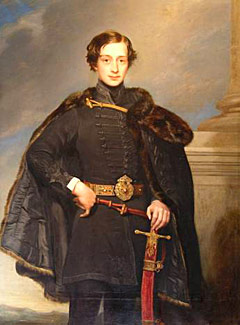
Nikolaus III, prince Esterházy de Galántha (public domain)
Theirs was a love match according to Esterhazy Palace data and the Duchess de Dino.(1) Nicholas had spent much of his life in England as the son of the Austrian Ambassador, so he and Lady Sarah Frederica could have become acquainted as children, especially given their mothers’ connection. Theirs was an unusually long engagement. It was known that they wanted to marry as early as 1836 (they apparently fell in love as teenagers). Prince Paul apparently was not pleased with the match (at least in part due to difference in status: the Jersey’s were not of a royal house, and Lady Jersey’s roots were in trade (her grandfather being the banker Robert Child)). He tried to prevent the match despite the fact the young couple were in love. There are indications that Princess Esterhazy was not enthused either (there are comments in the MEMOIRS OF THE DUCHESS DE DINO about having Lady Jersey as a mother-in-law (2), and a suggestion that the Esterhazy’s avoided having Lady Jersey in Vienna as much as possible).
Lady Jersey encouraged the match. There were suggestions that she pursued the match relentlessly due to the status of the groom’s family. It seems equally possible that she wanted her daughter to marry the man she loved. Prince Paul tried to get out of the engagement as late as June 1841(3). However, he finally conceded. Lady Sarah Frederica’s trousseau was prepared and displayed for viewing in December 1841(4).The marriage settlement was finally signed Monday Feb 7, 1842, and Lady Sarah Frederica and Prince Nicholas were married on Tuesday, February 8, 1842. Their wedding involved two ceremonies. At 10:00 in the morning, the couple was married in a Roman Catholic service in the library of Chandos House, the Austrian Embassy, performed by Rev. Dr. Griffiths, Apostolical Vicar of London. This service was followed by a breakfast. Shortly after 11:00, the wedding party arrived in St. George’s Hanover Square, where a Church of England service was performed by Robert Bagot, the Lord Bishop of Oxford (the bride’s uncle by marriage).
At this service, Lady Sarah Frederica had six bridesmaids, two of whom were her sisters Clementina and Adela*. She was given away by her father, who was visibly emotional. This service was followed by a sumptuous luncheon at the Child-Villiers home in Berkley Square, which included three bridal cakes. The wedding was a significant social event. Following the luncheon, the bride and groom spent some days at Osterley Park (the Countess of Jersey’s seat, formerly that of Robert Child), returning to Chandos House before leaving for Europe to join Prince and Princess Esterhazy. They arrived in Vienna in April 1842(5).
Prince and Princess Nicholas had an active social life in both England and Austria. Newspaper accounts document them going back and forth for a variety of social and family events (which included presentation at Queen Victoria’s Drawing Room on February 26, 1846, and a visit to the spa town of Ischl, Austria in August 1847 that included her mother and her sister Clementina (7)).
Prince and Princess Nicholas had six children, five of whom survived to adulthood: Pal Antal Miklos Prince Esterhazy von Galantha, born March 11, 1843 and died August 2nd, 1898; Alajos Gyogy Prince Esterhazy von Galantha, born March 9th, 1844 and died October 25th, 1912; Adolf Prince Esterhazy von Galantha born October 5th, 1846 and died in infancy February 1st, 1847; Sara Zsofia Princess Esterhazy von Galantha, born March 16th, 1848 and died February 22nd, 1885; Maria Terezia Princess Esterhazy von Galantha, born November 29th, 1849 and died May 7th, 1856 and Antal Miklos Furst Esterhazy von Galantha, born January 14th, 1851 and died February 10th, 1935. (The names are shown as in Vienna.)
Princess Nicholas sadly developed a lung complaint (consumption). After suffering several months of illness and unsuccessful spa treatments in Europe (at Ems and Ischl particularly), she finally went, at her doctor’s suggestion, to England to see if the air of her native country would help. It did not; she died at Torquay, Devon, England on November 17, 1853. She was buried at Eisenstadt in the Esterhazy vault. In 1871, Prince Nicholas raised an obelisk in the palace gardens in her memory. There is also a memorial in the Jersey family vault at the country estate in Middleton Stoney, England. Prince Nicholas did not remarry.
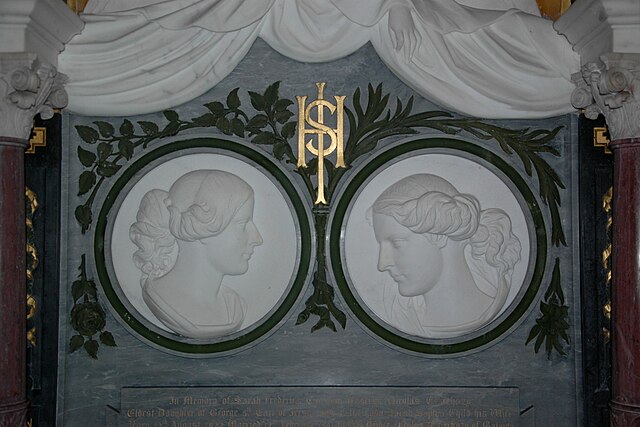
Church of England parish church of All Saints, Middleton Stoney, Oxfordshire; Jersey Chapel: detail of the tomb of Princess Esterhazy and Lady Clementina Villiers
by Motacilla / CC BY-SA
(1) THE MEMOIRS OF THE DUCHESSE DE DINO, entry for June 16, 1841.
(2) THE MEMOIRS OF THE DUCHESSE DE DINO, entry for June 19, 1841.
(3) THE MEMOIRS OF THE DUCHESSE DE DINO, entry for June 16, 1841.
(4) Devizes and Wiltshire Gazette, Thursday 23 December 1841-British Newspaper Archives
(5) MEMOIRS OF THE DUCHESSE DE DINO, entry for April 17, 1842.
(6) The Globe, Saturday 26 March 1842-British Newspaper Archives.
(7) The Morning Post - Friday 27 February 1846, and the Morning Post- Saturday, 04 September 1847-British Newspaper Archives.
Sources include:
Sudley, Lord, editor. THE LIEVEN-PALMERSTON CORRESPONDENCE 1828-1856. London: John Murray, 1943.British Newspaper Archives. Northampton Mercury, Saturday 12 June 1841; London Evening Standard, MARRIAGE OF PRINCE NICHOLAS ESTERHAZY AND LADY SARAH VILLIERS, 22 December 1841; Devizes and Wiltshire Gazette, Trousseau of the Lady Sarah Villiers, Thursday 23 December 1841; Oxford Chronicle and Reading Gazette, MARRIAGE OF PRINCE NICHOLAS ESTERHAXY AND LADY SARAH VILLIERS< Saturday 12 February 1842; Weekly Freeman’s Journal Saturday, FASHIONABLE INTELLIGENCE, 12 March 1842; Globe, FASHION AND TABLE-TALK, Windsor, Friday. Saturday 26 March 1842; Morning Post, Ischl, Aug. 26, Saturday 04 September 1847; and John Bull, DEATH OF HER HIGHNESS PRINCESS NICHOLAS ESTERHAZY, Saturday 19 November 1853. (All articles © British Library Board) HERE
Gutenberg.org The Project Gutenberg’s eBook of MEMOIRS OF THE DUCHESSE de DINO (Afterwards the Duchesse de Tallyrand) 1841-1850, edited by Princess Radziwill, New York: Charles Scribner’s Sons, London: William Heinemann, 1910. HERE
RoyalCentral.co.uk “Queen Victoria’s Bridesmaids” by Elizabeth Jane Timms, July 4th, 2019. HERE
Thepeerage.com “Lady Sarah Frederica Caroline Child-Villiers.” HERE ; “Miklos Pal Prinz Esterhazy von Galantha.’’ http://www.thepeerage.com/p32788.htm#i327874
Esterhazy.net “Lady Sarah Child-Villiers.” HERE ; ‘’Prince Miklos Pal Esterhazy de Galantha.’’ HERE
Szervuszaustria.hu “Princess Have Happy and Less Happy Lives”. Supplement to the Eisenstadt Exhibition. November 6, 2012.HERE
Books.google.com THE NEW WORLD: A Weekly Family Journal of Popular Literature, Science, Art and News, Volume 3. New York: 1841. THE NEW WORLD, December 25, 1841. “Foreign Items.” HERE ; THE GENTLEMAN’S MAGAZINE, Volume XLI New Series, January to June inclusive. London: John Bowyer Nichols and Sons, 1854. January 1854, P. 106. Obituary of Princess Nicholas Esterhazy. HERE
Wikipedia. “Robert Bagot (Bishop)”. Last edited 29 January 2020. HEREImages from Wikimedia Common.
~ ~ ~ ~ ~ ~ ~ ~ ~ ~

Lauren Gilbert was introduced to English authors early in life. Lauren has a bachelor of arts degree in liberal arts English with a minor in Art History. A long time member of JASNA, she has presented a number of programs. She lives in Florida with her husband.
Lauren's first book, HEYERWOOD A Novel, is available. A RATIONAL ATTACHMENT is her second novel. A long-time contributor to the English Historical Fiction Authors blog, her work is included in both volumes of CASTLES, CUSTOMS AND KINGS: True Tales by English Historical Fiction Authors. She is also researching material for a biography. For more information, visit her website.


_(1785-1867)%2C_by_Alfred_Edward_Chalon.jpg/452px-Sarah_Sophia_Child_Villiers%2C_Countess_of_Jersey_(n%C3%A9e_Fane)_(1785-1867)%2C_by_Alfred_Edward_Chalon.jpg)

