Showing posts with label Nell Gwyn. Show all posts

Friday, November 4, 2016

An Extravagant Royal Mistress: Nell Gwyn's Silver

by Margaret Porter

In February 1671, King Charles II moved his mistress Nell Gwyn into a newly built brick residence at Pall Mall's western end.

Nell and her sons by King Charles II

The king granted a "long lease under the Crown," but Nell strenuously objected to these terms. She proudly declared that she had always "conveyed [her affections and body] free under the Crown and always would, and would not accept it till it was conveyed free to her by an act of Parliament." The king assented. A large property adjacent to St. James's Park, it boasted seventeen fireplaces and some furniture left by the previous occupant, Lord Scarsdale. The site, now 79 Pall Mall, is marked by a Blue Plaque denoting its association with Nell.

Nell's Blue Plaque
In March 1671, John Evelyn encountered King Charles outside his queen's rooms at Whitehall and left this immortal account of his reluctant encounter with the royal mistress:
I thence walk'd with him thro' St. James;s Parke to the garden, where I both saw and heard a very familiar discourse between [him]...and Mrs. Nellie as they cal'd an impudent comedian, she looking ouf of her garden on a terrace at the top of the wall, and [he]... standing on the green walke under it. I was heartily sorry at this scene.
At about this time Nell was being painted by Peter Lely, depicted as Venus with her year-old son Charles (as yet lacking surname or title) kneeling beside her, head bowed, in the guise of Cupid. Nell placed the portrait in her salle des miroirs (hall of mirrors).

Nell in the nude. Private collection.

By the time her second son James was born on Christmas Day, ten months after moving into her new residence, Nell had a rival for His Majesty's affections: Louise de Kerouaille, placed at the English court by King Louis XIV of France, who bore the king's son in July, 1672. A year later he bestowed on her the title Duchess of Portsmouth and provided lavish apartments in Whitehall Palace. Competition between the mistresses seems to have included precious metals as well as the monarch's affection. When word circulated that a silversmith was making a costly dinner service, the king's gift to his French mistress, Londoners visited the shop to stare at these objects and "throw out curses against the duchess." Some declared that the silver should be melted and poured down Louise's throat. And everyone believed that "it was a thousand pities His Majesty had not bestowed this bounty on Madam Ellen." Nell purchased her own dinner service of solid silver, engraved with the initials E.G. (for her full name, Ellen or Eleanor Gwyn) and paid £60 for "a dozen silver trencher plates."

The absence of any payment for Nell's double-blade silver-handle fruit knife may confirm the legend that it was given by Charles II. Its silver blade was used to cut oranges, and the steel blade was used for non-acidic fruit.

Nell's fruit knife. Private Collection.

Not content with her gleaming tableware, Nell also commissioned a silver bed, and received this bill from silversmith John Coques in 1674:

Delivered the head of ye bedstead weighing 885 ounces 12lb. and I have received 636 ounces 15 dweight so that there is over and above of me owne silver two hundred forty-eight ounces 17 dweight at 7s. l1d. per ounce . . .which comes to £98 10s. 2d.
For ye making of ye 636 ounces 15 d't at 2s. 11d. per ounce comes to £92 17s. 3d.
Delivered ye kings head weighing 197oz 5dwt
one figure weighing 445oz 15dwt
ye other figure with ye character weighing 428oz 5dwt
ye slaves and ye rest belonging unto it 255oz
ye two Eagles weighing 169oz 10dwt
one of the crowns weighing 94oz 5dwt
ye second crowne weighing 97oz 10dwt
ye third crowne weighing 90oz 2dwt
ye fourth crowne weighing 82oz
one of ye Cupids weighing 121oz 8dwt
ye second boye weighing 101oz 10dwt
ye third boye weighing 93oz 15dwt
ye fourth boye weighing 88oz 17dwt
Altogether two thousand two hundred sixty five ounces 2d. weight of sterling silver at 8s.per ounce comes to £906 0s. 10d.
Paid for ye Essayes of ye figures and other things into ye Tower £0 5s. 0d.
Paid for Jacob Hall dancing upon ye rope of wire-work £110 0d.
For ye cleansing and burnishing a sugar box, a pepper box, a mustard pot, and two kruyzes £0 12s. 0d.
For mending ye greatte silver andirons £0 10s. 0d.
Paid to ye cabinet-maker for ye greatte board for ye head of the bedstead and for ye other board that comes under it and boring the holes into ye (bedstead) head £3 0s. 0d.
Paid to Mr Consar for carving ye said board £10 0s. 0d.
For ye bettering ye solder wich was in the old bedstead £5 3s. 7d.
Paid to ye smith for ye two iron hoops and for ye 6 iron bars, krampes, and nails £1 5s. 0d.
Paid for ye woodden pedestal for one of ye figures £0 4s. 6d.
Paid ye smith for a hook to hang up a branche candlestick £0 2s. 0d.
Paid to ye smith for ye bars, kramps and nails to hold up ye slaves £0 5s. 0d.
Given to my journeyman by order of Madame Guinne £1 0s. 0d.
Paid to ye smith for ye ironwork to hold up ye Eagles and for ye two hooks to hold the bedstead against the wall £0 3s. 0d.
Paid for ye pedestal of ebony to hold up the 2 georses £1 10s. 0d.
For ye mending of y gold hourglass £0 2s. 6d.
Delivered 2 silver bottles weighing 37oz 17dwt at 8s. per ounce comes to £15 2s. 9d.
Paid for ye other foot to hold up ye other figure £0 4s. 6d.
For soldering ye holes and for repairing, mending ,and cleansing the two figures of Mr Traherne his making £3 0s. 0d.
For ye making of a crowne upon one of ye figures £10 0s. 0d.
Given to my journeyman by order of Madame Guinne £1 0s. 0d.
Delivered a handle of a knife weighing 11dwt more then ye old one which comes with ye making of it to £0 5s. 10d.
For ye cleansing of eight pictures £0 10s. 0d.
In all comes to £1135 3s. 1d.
 

The silversmith's bill.

The total is estimated to be £100-150,000 in modern currency. The symbolism of the figures adorning the bed is clear. The king's head, described by a descendant of Nell's as weighing the same as "a fully grown cat," and coronet represent her lover, the provider of house and the funds with which she purchase the magnificent bed. It is supposed that her sons were models for the cherubs or "boyes". The motif of slaves provides an exotic element, one that recurred in Restoration plays. Eagles and crowns stand for power. Most surprising of all is the figure of rope-dancer Jacob Hall balancing on a wire--he was one of Barbara Castlemaine's reputed lovers. Clearly an existing bed was re-fitted, and its structure and supports are clarified by references to the cabinetmaker who provided the headboard, the man who carved it, and the smith responsible for the ironmongery involved in its assembly. Iron hooks were necessary to secure the bedstead to the wall.

A bed so grand required an equally grand setting, so Nell hired carvers, furniture makers, and an upholsterer to improve her bedroom. The woodwork featured her E.G. monogram, window seats were added, curtained with satin. These improvements were completed by August 1675. The work must have created dust and dirt enough to spoil the windows, because she had them re-glazed. The glass came from Normandy, the finest in that period, cut into small individual panes.

By this time Nell's income was £4000 per year, paid quarterly, increasing to £5000 after her son Charles was ennobled as the Duke of St. Albans. Unlike other mistresses, whose child support payments went to trustees, Nell directly received the monies for her son's maintenance--one biographer believes this was because she was the only one deemed trustworthy enough to actually spend the money on her children. She had a supplementary Irish pension and received occasional monetary gifts--one funded her bedchamber's refurbishment.

In late 1678, Nell's house was robbed. On January 3, this advertisement appeared in the London Gazette:
All goldsmiths and others to whom our silver plate may be sold, marked with the cipher E.G., flourished, weighing about 18 ounces, are desired to apprehend the bearer thereof, till they give notice to Mr Robert Johnson, in Heathcock Alley, Strand, over against Durham Yard, or to Mrs Gwin's porter in the Pell Mell, by whom they shall be rewarded.
Notice of Nell's stolen silver in the London Gazette.
It is not recorded whether these items were recovered and the reward paid. But it was the hated Louise, Duchess of Portsmouth, who had the lion's share of silver furniture. On October 4, 1683, John Evelyn--fated to find himself in the company of the King's lewd women--reports:
Following His Majesty through thro' the galleries, I went...into the Dutchesse of Portsmouth's dressing room within her bedchamber, where she was in her morning loose garment, her maids combing her, newly out of her bed...but that which engag'd my curiosity was the rich and splendid furniture of this woman's apartment . . . plate, tables, stands, chinmey furniture, sconces, branches (candelabra), braseras (braziers), &c. all of massive silver, and out of number.
Ten years after taking delivery of her silver bed, Nell was selling certain items of silver, to be melted down, to cover her recent expenditures. As she related in a letter to one Madam Jennings: "The bill is very dear to boil the plate, but necessity hath no law."

She retained many valuables when she died, probably in that great silver bed. Her will, made a few months before her death in 1687, references "all manner of my jewels, plate, household stuff, goods, chattels, credit, and other estate whatsoever, I gave and bequeath the same...by way of trust for my said dear son...for his own sole use and peculiar benefit and advantage." Although she bequeathed her only surviving son and heir diamonds, jewels, plate, artwork, three houses (in London, Windsor, Nottinghamshire), and lesser property, mostly she left him debts. Much of her silver was held by the bankers Child & Co. as a pledge towards her overdraft. Some time after the young Duke of St. Albans came of age and before his marriage to Lady Diana de Vere, daughter of the 20th Earl of Oxford, he sold the Pall Mall house and much of his mother's jewellery. The eventual sale of her plate brought £3,791.5s.9d. A silver teapot remained with the family until 1786.

The duke's 2-piece silver spirits flask, engraved with his coat of arms, is displayed in the Victoria & Albert Museum. There's no evidence that his mother commissioned it, but she might have done in her last year. It's exactly the sort of costly personal item she loved to bestow on the beloved son who far outranked her.


The Duke of St. Albans's spirits flask

Nell's legend endures, and history remembers her as a woman endowed with wit, beauty, spirit, humour, affection--and extravagant tastes.

~~~~~~~~~~~~~
 
Margaret Porter is the award-winning and bestselling author of twelve period novels, whose other publication credits include nonfiction and poetry. Nell Gwyn's son is a primary character in A Pledge of Better Times, her highly acclaimed novel of 17th century courtiers Lady Diana de Vere and Charles Beauclerk, 1st Duke of St. Albans. Margaret studied British history in the UK and the US. As historian, her areas of speciality are social, theatrical, and garden history of the 17th and 18th centuries, royal courts, and portraiture. A former actress, she gave up the stage and screen to devote herself to fiction writing, travel, and her rose gardens.

Connect with Margaret:

Monday, September 7, 2015

Bedchamber Ladies and Maids of Honour at the Late Stuart Court

by Margaret Porter

Readers of historical novels set in a royal court will be familiar with the terms “lady of the bedchamber” and “maid of honour.” But what were the responsibilities required of these positions, their advantages and disadvantages?

Fans of Tudor history and fiction know that several ladies-in-waiting became Queen of England. Anne Boleyn served Queen Katherine of Aragon, as did Jane Seymour—who was also Anne's lady-in-waiting when King Henry began to fancy her. And her successor, Anne of Cleves, had flighty Catherine Howard as a maid of honour. 

The Stuarts preferred marrying royalty, but their princes and kings routinely slept with female members of the royal household. Stuart queens had their favourites as well. But royalty were nothing if not fickle, and deep affection could sometimes transform into enmity.

A bedchamber lady who rose high & fell far
Aristocratic ladies and gentry women of the late 17th century coveted a position at court for many reasons. Proximity to eligible gentlemen—the rich, the powerful, the landed—meant they might marry well, gaining wealth or a title or both. It was a means of promoting family interests, and quite a few courtiers inherited positions held by their parents or grandparents. Often a member of a queen’s retinue became the king’s pampered mistress. By giving birth to a royal bastard, she ensured financial support for her lifetime. Another reason court service was a desirable career for a well-born womanit ensured an annual salary, room and board, and sometimes even a generous dowry. She wore pretty clothes and received ample attention from male courtiers. She also gained material goods—gifts from the sovereign might include jewellery, lace, clothing, and valuable mementos. On the death of a queen, her clothing and possessions were distributed to those who had served her.

The disadvantages were just as numerous. Salaries and stipends came irregularly and were often in arrears. Providing the monarch with aristocratic companionship was an arduous duty. One had to stand for hours on end, attain perfection in dancing and manners, assist at the royal toilette and robing, determine which visitors were welcome and properly introduce them. Those who had no taste for dalliance fended off libertines intent on seduction. Those who dallied with courtiers ran the risk of an unwanted pregnancy—an ordinary bastard hadn’t the cachet of a royal one. Miss Trevor, said to be the prettiest of the Duchess of York’s maids of honour, abruptly left the court before delivering her bastard child. According to one intimately familiar with Charles II’s household, “the Queen’s and Duchess’s maids of honour…bestow their favours to the right and left, and not the least notice is taken of their conduct.”

Ladies-in-waiting and maids of honour served on a rotating basis, one week at a time. They had lodgings in each royal residence. At the top of the hierarchy was the Groom of the Stole, responsible for all the bedchamber staff, and was sometimes also styled First Lady of the Bedchamber. In addition to the ladies and the maids, there were bedchamber women or dressers, of lowlier status, who performed more menial bedchamber tasks.

Charles II

His was the golden age of the bedchamber lady as royal mistress—or vice versa. Upon his marriage, the King foisted his mistress Barbara Palmer, neé Villiers, Countess of Castlemaine, upon his Portuguese bride, sparking a domestic crisis. Later he chased after the beautiful and elusive Frances Stewart, who returned to the Queen's service after marrying the Duke of Richmond. Even the actress Nell Gwyn, “the indiscreetest and wildest creature that was ever in a court” was given a nominal position in the Queen’s service as a Lady of the Privy Chamber. Her French rival Louise de Kerouaille began as a maid of honour to Charles’s sister, Henriette, Duchess of Orleans, at the French court. Later, as the English king’s mistress, she was assured of a place as a Lady of the Bedchamber, although the Queen would not let her enter it. Her apartments at Whitehall were grander than Her Majesty’s.

The "golden" Jane, Mrs Myddelton, in gold
It was, in a sense, the beginning of the “professional beauty,” whose portrait was painted to hang in royal palaces, and adorned humbler abodes in the form of an engraving. Jane Myddelton, described as “all white and golden,” and “the most beautiful woman in England, and the most amiable,” falls into that category. Frances Jennings, sister of the future Duchess of Marlborough, inspired Anthony Hamilton to write, “Her face reminded me of the dawn, or of some Goddess of the Spring.” On one occasion she and her fellow maid of honour Goditha Price, disguised as orange girls, sold fruit at the theatre. They went unrecognised by the male courtiers who accosted them, or their mistress the Duchess of York.
Diarist Samuel Pepys is a rich source of information on the exploits and amours of ladies of the court, several of whom fired his admiration and his secret passion.

James II


A Catholic convert, James’s devotion to his religion never inhibited him from sleeping with ladies of the court. As Duke of York, he preyed upon the ladies who served his first and second wives, such loose-moralled creatures as Diana Kirke, Lady Denham, and many others. Arabella Churchill, who served his first duchess, bore him four children.

The wild and witty Catherine Sedley
Catherine Sedley, his most famous mistress, resisted all attempts to dislodge her from his court and his bed, much to the consternation of Mary of Modena, his jealous young queen. Despite the fact that Catherine was Protestant and claimed to be far cleverer than he, James would not set her aside, no matter how his wife and priests urged him. Lord Dorset addressed these lines to her: “Dorinda’s sparkling wit, and Eyes/United, cast too fierce a Light.”

Mary II


When Mary and her husband William succeeded her de-throned father, they imposed a new sedateness and propriety upon the court. Her bedchamber ladies and maids of honour were faithful, respectable wives and chaste young maidens. The Countess of Derby, as Groom of the Stole, received £800, with a further £400 as Mistress of the Robes, for a total annual salary of £1200—no mean sum in those days. Her five Ladies of the Bedchamber were paid £500 per year, and usually there were six maids of honour, receiving £200 per year.

Mary, Countess of Dorset
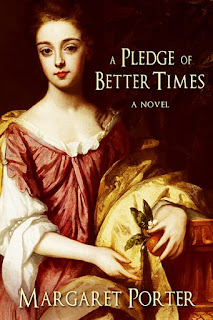
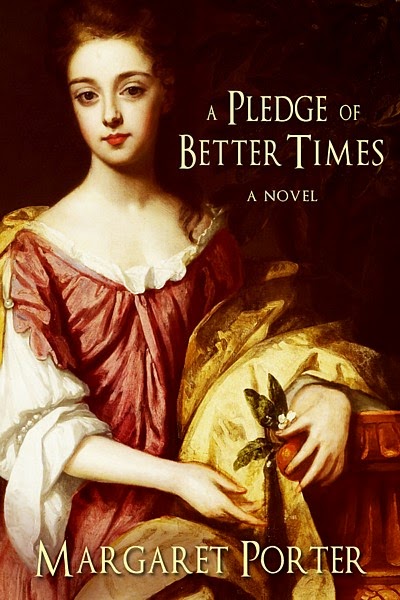
Mary commissioned Godfrey Kneller to paint a series of portraits of the loveliest and most virtuous ladies, known as the Hampton Court Beauties. Among them was the Countess of Dorset, her favourite Lady of the Bedchamber, who died soon after sitting to Kneller. Another attendant, Lady Diana de Vere, whose Hampton Court portrait graces my novel’s cover, bore Mary’s train at her coronation and became the bride of Nell Gwyn’s son Charles, 1st Duke of St Albans. At their marriage, the Queen granted the couple an annuity of £2000.

At the palace, Mary’s ladies joined her in needlework (her favourite occupation), escorted her to chapel prayers, and read aloud to her. In public they accompanied her to the theatre, on walks and promenades, and even to St. James’s Fair, their identities concealed by black vizard masks.

Queen Anne

Sarah, Duchess of Marlborough, wearing her
gold key of office
On assuming England’s throne, Anne designated her longtime companion and confidante Sarah, Duchess of Marlborough, Groom of the Stole and Keeper of the Privy Purse. It was this all-powerful aristocrat who “prepared a list of ye ladies of ye best quality, ye nearest ye Queen in age and most suited to her temper to be Ladies of the Bedchamber.” In addition to Sarah there were ten—two of them, not surprisingly, were her own daughters. Each received a salary of £1000. The six maids of honour had a stipend of £300 per annum. The Queen was a firm Tory and Sarah strongly Whig, thus the party affiliation of Her Majesty’s attendants was balanced. By the last years of the reign, the number of bedchamber ladies had dropped to eight.
The royal account books reveal that in 1707, the Master of the Great Wardrobe was given £24 10s to purchase “umbrellas for the Maids of Honour.”

Perhaps in no other reign was the relationship of the bedchamber ladies and the monarch so closely scrutinised, or their political powers—real or presumed—so discussed. Sarah, through her firm—some might even say bullying—management of the Queen, soon put herself out of favour. And it was her own cousin Abigail Masham, neé Hill, who supplanted her as Anne’s caretaker and Keeper of the Privy Purse. But because she was a mere “Mrs,” and of a lower class, she couldnt have Sarahs position of Groom of the Stole. It was bestowed upon the extremely aristocratic Duchess of Somerset, who had served at court for many a year and whom Anne greatly respected.

Sarah embarked on her long career at court in the 1670s as a maid of honour to Anne Hyde, Duchess of York, and it lasted till her dismissal in the early days of 1711. Her history demonstrates the heights to which a determined female could climb—and also how she could descend, on losing the royal favour.

 ~~~~~~~~~~~~

Margaret Porter is the award-winning and bestselling author of twelve period novels, nonfiction and poetry. Lady Diana de Vere's association with Queen Mary's court is featured in A Pledge of Better Times, her highly acclaimed novel of 17th century courtiers the 1st Duke and Duchess of St. Albans (available in trade paperback and ebook). Margaret studied British history in the UK and the US. As historian, her areas of speciality are social, theatrical, and garden history of the 17th and 18th centuries, royal courts, and portraiture. A former actress, she gave up the stage and screen to devote herself to fiction writing, travel, and her rose gardens.


Tuesday, June 30, 2015

Preserving the World in Paint - Women Artists of the Stuart Period

by Deborah Swift

The story of  The Lady’s Slipper is a story about a rare wild flower, but it is also the story of the 17th century artist who wished to capture its unique beauty in paint.

When researching the heroine of my novel I looked to female artists of the seventeenth century, especially those who painted flowers and the natural world. Unsurprisingly not many are documented, but here I give you just a taste of three extraordinary women who really lived, and one imaginary artist who only lives between the pages of my novel. Can you spot the imaginary artist amongst the real ones?

Maria Sybilla Merian (1647-1717)
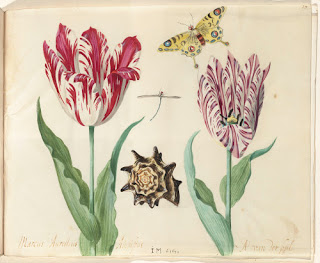
Maria seemed to be an infant prodigy and Maria’s step-father, who was also a painter, doted on her, predicting that she would increase the fame of the Merian family name; so, apparently, did her half-brothers Matthäus and Caspar, twenty years her senior. She studied flowers, and more importantly - insects, keeping her own live specimens, and often travelling abroad in search of more specimens to draw. In her time, it was very unusual that someone would be genuinely interested in insects, which had a bad reputation and were colloquially called "beasts of the Devil." She described the life cycles of 186 insect species, amassing evidence that contradicted the contemporary notion that insects were "born of mud" by some sort of spontaneous generation.


Just one of Merian’s superb paintings
of pomegranates, insects and butterflies

Alice Ibbetson (1635 - 1701)

Alice was an English watercolourist whose studies of natural forms were some of the earliest annotated studies of medicinal herbs and flowers. Brought up by her botanist father John Ibbetson, who built his renowned Physic Garden with the help of John Tradescant, her work was collected by wealthy patrons including Sir John Fairfax. Unfortunately her early studies of flowers and fruit were lost when Parliamentary troops fired her home during the English Civil War, and the family were forced to flee for their lives. John Ibbetson’s notes survive however, and are much influenced by the herbals of Nicholas Culpeper. Ibbetson’s early life was beset by tragedy, but later she made her home in New Hampshire where she continued to record native medicinal flora, some for the first time.
 
A page from Alice Ibbetson’s notebook. Her flower
paintings were much admired for their fluidity of line.

Mary Beale (1633 – 1699)

Mary Beale was the first fully professional woman artist in England. Her husband Charles even left his job as a clerk to help Mary prepare her canvases and mix her paints. He experimented with pigments and became an expert in the field. She quickly made enough from the business to support her family, including her sons Bartholomew and Charles (later an admired society miniaturist). While she painted, Charles would write up detailed notebooks in which he customarily referred to his wife as 'Dearest Heart' and described the sittings, the sitters and his own technical discoveries. The majority of his notes have been lost, but those for the years 1677 and 1681 survive in the archives of the Bodleian Library at Oxford and the National Portrait Gallery. His notebook of 1677 details a busy year: 83 commissions, bringing in earnings of £429. During the 1660s, when the plague ravaged London, Beale moved her home and workplace out of the city to the safety of Allbrook Farmhouse.

Nell Gwyl (Nell Gwyn) by Mary Beale. I can definitely see
from this painting why she would attract the notice of the King!

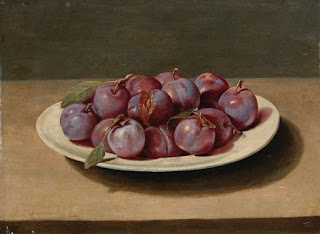
Louise Moillon (1610–1696) was one of seven children. Her father was the landscape and portrait painter Nicolas Moillon, but he died when she was an infant, and her mother when she was only twenty. Her mother’s inventory of possessions included a series of paintings on wooden panels by her daughter Louise, so it would appear that Louise showed talent from an early age. The high esteem in which her work was held is demonstrated by the fact that in 1639 Charles I of England had five still life pieces by the artist, framed in pear wood and ebony. Mouillon’s work was admired for its lifelike quality but also for its restrained stillness.


Bowl of Plums by Louise Moillon

~~~~~~~~~~~~~

I hope you enjoyed the pictures. An earlier version of this post appeared here in 2010.
www.deborahswift.com
Twitter @swiftstory

Thursday, May 7, 2015

The First Duke of St Albans: His Early Years

by Margaret Porter

On this date, the eighth of May, in 1670 actress Nell Gwyn bore a son and named him Charles—for his father, whose identity was no secret. As one letter-writer reported, "Elianor Quin, one that belongs to the King’s play hous, was brought to bed of a boy in her house in Lyncoln’s Inns fields . . . the King’s bastard.” Unlike the other illegitimate offspring, the infant had no surname and no title. Within months the royal mistress returned to the stage, for she received no income from the royal purse. Before long her protector provided a grand new residence close to St. James’s Palace and its gardens, which he eventually deeded to her.

When the court painter Peter Lely portrayed her on canvas as Venus, her little son was included in the portrait as Cupid, kneeling at her side. The next time she posed as the goddess of love, she was attended by a pair of cherubs—she had borne a second son.

The boys wore the costliest of children’s garments and had a pet donkey in the garden which provided milk for His Majesty's bastards. In his sixth year, young Charles received at last from his father a surname—Beauclerk—and a pair of titles, Baron Heddington and Earl of Burford. At age 10 he became an only child again after his little brother died at school in France. Despite this tragedy, Charles was also sent there for his education, academic and social. On his birthday in 1683 he was presented to King Louis XIV—his cousin—and was at that time described as “le duc de Saint-Alban, fils du roi d’Angleterre et de Mademoiselle Gouin, comédienne.” His father had bestowed the dukedom earlier that year. He divided his time between England and France, for in March of the following year John Evelyn observed him at the Royal Chapel, and his mother wrote from Burford House, her mansion in Windsor, “The Duke brought me down with him my crochet of diamonds, and I love it the better because he brought it.”

In February 1685 the fates of Charles and his mother altered drastically. The young man received a ring from his dying father, and was still in London six weeks later, when the Gazette reported, “Lost in the King’s Garden near St. James's Park, a black and white Spaniel Bitch, near a year old, her Legs white, with some mottled black Spots, most white about her Neck, with a little white up her Face, and the top of her Tail white. Whoever brings her to the Duke of St. Albans in the Pall-Mall, shall have a Guinea reward.” Perhaps the runaway spaniel was another legacy from the King, who was remarkably devoted to his dogs.

By November Charles had resumed his studies at L’Académie du Sieur Coulon near Versailles, where in 1686 he contracted smallpox and promptly recovered.His education was intended to prepare him for a career in the military—his elder half-brothers had served with distinction in the army. But he was also attending balls in his spare time, for early in 1687, Princess Anne wrote to her sister Princess Mary in Holland to report her fondness for a dance “called the Rigadoon which the D[uke] of St Albans brought out of France . . . mightily liked and indeed it was a very pretty one I thought.” But soon thereafter she reported with regret, "I have no reason to like it now, for I believe it was the dance that made me miscarry, for there is a great deal of jumping in it.”

His mother had been suffering from ill health for some time, and after a period of prolonged illness during 1687, she died in November. Unaware of the extent of her debts, everyone assumed that Charles inherited a vast fortune. At the end of the month his uncle, King James II, wrote to his daughter Mary, “she hath not left the Duke of St. Albans so much as was believed.” James had settled the mortgage on Bestwood Park, the Nottinghamshire hunting lodge King Charles had granted Nell, but her income had never adequately supported her spendthrift ways and lavish lifestyle. Unlike the other royal mistresses, she had made no financial demands of the King. His widow, Dowager Queen Catherine, was fond enough of Charles Beauclerk to provide him with an allowance of £2000 per year to augment his other stipends from the Privy Purse.

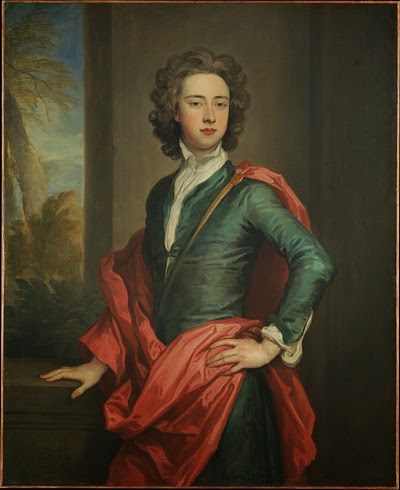
Charles Beauclerk, Duke of St Albans
As the product of an irregular liaison between a monarch and a play actress, a proud young man, and a firm Protestant, Charles would not have felt comfortable at a newly Roman Catholic court. He’d firmly resisted King James’s unrelenting efforts to bring about his conversion. Apparently the prospect of becoming a soldier was more to his liking, and he not only received his uncle’s permission to return to the Continent for that purpose, he received a recommendation. Shortly before Charles’s eighteenth birthday, King James wrote in French to the Duke of Lorraine declaring his nephew’s interest in supporting the war against the Turks, who had recently been driven from Vienna but now occupied Hungary.

And there the Duke of St. Albans would seize the opportunity to escape the shadow of scandal cast by his parents and begin to establish his own identity and reputation.
~~~~~~~~~~~~~
Images: National Portrait Gallery, Wikimedia Commons

Sources: Manuscript Letters in the British Library; The London Gazette; Oxford Dictionary of English Biography; Nell Gwyn: Mistress to a King by Charles Beauclerk; Right Royal Bastards: The Fruits of Passion by Peter Beauclerk-Dewar and Roger Powell; The House of Nell Gwyn by Peter Beauclerk-Dewar; Journal de Philippe de Courcillon de Dangeau.

~~~~~~~~~~~~~


Margaret Porter is the award-winning and bestselling author of several historical fiction genres, and is also published in nonfiction and poetry. A Pledge of Better Times, her highly acclaimed novel of courtiers Lady Diana de Vere and Charles Beauclerk, 1st Duke of St. Albans, was recently released in trade paperback and ebook. Margaret studied British history in the UK and the US. As historian, her areas of speciality are social, theatrical, and garden history of the 17th and 18th centuries, royal courts, and portraiture. A former actress, she gave up the stage and screen to devote herself to fiction writing, travel, and her rose gardens.

Amazon