Showing posts with label witches. Show all posts

Friday, January 26, 2018

From Witches to Riches - a Story of Immorality


by Anna Belfrage

Lägg till bildtext
Sometime around 1620, a boy was born in Suffolk, England, to a Puritan clergyman called John Hopkins. The little boy was named Matthew, had a number of older siblings and that’s about everything we know about this young man’s childhood. One must assume he had dreams of his future (even if his mother most definitely did not warble “Qué será,será” while smoothing his hair down) and there must have been days when he worried that future of his would be very short and stunted, what with the increasing tensions between King and Parliament.

Whatever the case, the first time Matthew Hopkins steps out of the sea of anonymity to properly greet us is in 1645, when he proudly introduces himself as a Witch-finder. A what? Yup, you heard the young man: he’s making a living finding witches.

To understand his choice of profession, one needs certain context: England at the time was in the throes of Civil War, Puritan factions instilled a rampaging fear of evil, and to further add spice to this particular soup, it wasn’t all that long ago since the previous king, James VI of Scotland and I of England, had presided over the infamous Berwick Witch Trials, emphatically stating that witches did exist and had to be fought with all possible means. This most learned (but also rather foolish) king even wrote a book about witches , a text young Matthew seems to have studied quite avidly.

Witches have been around for a long time. For primitive man, so much of what surrounded him was difficult to interpret as anything but magic, and it follows that if there is magic there are people who can use magic. Even to this day, a surprisingly large percentage of the world’s population remains convinced that witches and wizards exist, and the savvy person makes sure never to tread on said witches’ toes.

From a Christian perspective, witches did not exist – at least not initially. The early fathers of the Church may have been derogatory of women in general, blaming them for everything from excessive carnal desires to a weak intellect and a propensity to sin, but they rarely said anything about witches. In fact, the Church held it heretical to claim someone was a witch, as to do so was to give credence to Satan’s lies.

But things happened as they say, and on one hand the Church was fighting a battle against ancient superstitions that insisted witches existed, on the other the Holy Catholic Church was being beset by heretics. And somewhere along the line, someone was smart enough to combine the accusations of heresy with those of unnatural magic – take the downfall of the Knight Templars, for example.

The Inquisition, ever eager for more victims to sink its teeth into, started mumbling and grumbling about witches – and especially about the heretical aspects of witches, as these old crones per definition worshiped Satan. A couple of fanatic monks latched on, a malleable pope sighed and went with the flow, and by the close of the 15th century, the Holy Church had concluded that witches did exist – and had to be rooted out. A papal bull confirmed this was so, a detailed handbook in how to identify the evil creatures (Malleus Maleficarum or The Witch Hammer - the Latin is in feminine, presupposing witches are mostly female) had conveniently been written in 1487, and armed with both these documents the representatives of good set out to do away with evil. Hmm. Major hmm, as these supposedly evil people were often women who deviated somewhat from the norm or who earned their living as healers and midwives.

Over the coming two centuries, somewhere around 45 000 to 65 000 people were to be executed as witches – mostly based on their own confessions, extracted from them via torture. Many of these poor souls were burned alive, but in most cases they were hanged, or beheaded, or garrotted, or strangled, before they were burnt. I suppose we must consider this a mercy. In the cases where they were burnt, it was often the sin of heresy that had them being tied alive to the stake. The Holy Church deemed heresy a far graver sin than that of dabbling in magic.

In difference to most of Europe, England had an established judicial process that required there to be proof before anyone was found guilty of anything (I know: such a novel concept!). This in turn means that England has a relatively low number of convicted witches – estimates land around 500 people, all in all. Of these, 300 can be attributed to Matthew Hopkins, who obviously took to the role as Witch-finder as fish take to water.

Back to 1645 and Hopkins’ grand debut – and it was quite the coup, as young Matthew managed to have close to thirty people convicted and executed as witches in one fell swoop. I guess he did some high-fives while pocketing the sizeable amount of money he was paid for his services – and herein lies the key to our Matthew’s dark, corroded soul: he was greedy, and he had found a way to make very easy money!

In March of 1645, Hopkins went after one Elizabeth Clarke. A perfect victim, seeing as this lady’s mother had been hanged as a witch. At his insistence, Elizabeth was thrown into prison, and his subsequent interrogation had her confessing to everything – and naming five other women as witches.

So what did he do to this poor woman, to have her condemning herself to death by her own confession? Hopkins was a subtle man – and more than aware that torture was forbidden in England. Of course, “torture” is relative, and throwing someone naked into a dark cold room, beating them and leaving them without food or light could be considered torture. As would another of Hopkins’ favourite methods, namely sleep deprivation. The poor prisoner was constantly watched, and whenever they seemed about to nod off, they were hauled to their feet and made to walk until they were properly awake.

If this failed, Hopkins advocated tying people in a cross-legged position for well over twenty-four hours, after which he would have them walked up and down in their cells until their bare feet blistered and bled. Nice guy, huh? And then we have the humiliating process of “pricking” which involved shaving the poor victim of all their body hair and then repeatedly sinking a needle or other sharp object into the victim. Should Matthew hit upon a point that didn’t bleed – well, obviously the naked, terrified woman being inspected was a witch. How convenient if one should use a pricking implement where the blade could be retracted into the handle, thereby ensuring there was no blood.

Poor Elizabeth caved in. So did most of the other women apprehended, and at the subsequent trial in Chelmsford in July of 1645, thirty-two people were accused of being witches. Twenty-nine were condemned to hang, and for every witch found guilty, Hopkins pocketed twenty shillings – a huge amount of money when considering a labourer earned at most half a shilling a day.

With Chelmford, Hopkins reputation was made. While he was never appointed by Parliament – and in fact there were quite a number of people in various positions of power that objected to Hopkins – he proclaimed himself Witch-finder General and went on to make the lives of the unfortunate women living in East Anglia even more uncertain than they already were.

Not one to rest on his laurels, Hopkins leapt onwards and upwards, and at the following trials in Bury St Edmunds in August of 1645, he noted with glee that 18 people were hanged on the same day based on his testimony. Two were men. One of these men was close to seventy, a minister named John Lowes. After several nights of sleep deprivation, coupled with being chased back and forth in his cell until he collapsed only to be pulled back to his feet and be subjected to it all again, Mr Lowes broke down and confessed that yes, he was a witch that had even caused a ship to sink off Harwich. No one bothered to check if a ship had in fact sunk…

Hopkins was now unstoppable. Hundreds of women – and a handful of men – were arrested and subjected to his patented forms of interrogation. If everything else failed, Hopkins recommended the “swimming” test, whereby the person was tied up and thrown into the water. If the person floated they were guilty. If they sank, they were not. Most people float – at least initially – when thrown in water. And once they start sinking, chances are they’re already more dead than alive… Hopkins, however, hedged his bets, and had ropes attached to the victim’s waist – to save them if they sank, he said, but just as likely his accomplices knew to use the rope to make sure the person “floated”.

Throughout 1646, Matthew Hopkins hauled one person after another to the gallows. At times, he was fortunate enough to see up to twenty people hang simultaneously, at others he had to content himself with only the single dead woman.

Obviously, Hopkins had a giant streak of sadism in him. Plus he rather liked the wealth he was amassing. And when people started questioning his methods he was very affronted, which was why he published a little pamphlet called Discovery of Witches in 1647, describing what he did and why. Some were less than impressed, and as the outraged voices of reason began to gain the upper hand, Matthew Hopkins found it wise to slip back into the obscurity from whence he came.

It is believed Hopkins died in 1647. Church records support that assumption. Some people hope that the legend by which he met his death at an angry mob who submitted him to his swimming test is true. Sadly, I am more prone to believe the version whereby he died in his bed of consumption, having coughed his lungs to pieces over several consecutive months. Whatever the case, I don’t think he was much missed.

In Revenge and Retribution, my main character, Alex Graham, faces accusations of being a witch. No wonder she is more than unnerved when she hears this. Just the thought of being subjected to one more humiliating inspection after the other – plus the fear that she might be found guilty – must have led to an endless number of sleepless nights!

An Editor's Choice from the archives, originally published August 26, 2014.
~~~~~~~~~~~~~

Had Anna Belfrage been allowed to choose, she’d have become a professional time-traveller. As such a profession does not exist, she became a financial professional with two absorbing interests, namely history and writing.

Presently, Anna is hard at work with The King’s Greatest Enemy, a series set in the 1320s featuring Adam de Guirande, his wife Kit, and their adventures and misfortunes in connection with Roger Mortimer’s rise to power. And yes, Edmund of Woodstock appears quite frequently. The first book, In The Shadow of the Storm was published in 2015, the second, Days of Sun and Glory, was published in July 2016, and the third, Under the Approaching Dark, was published in April 2017.

When Anna is not stuck in the 14th century, she's probably visiting in the 17th century, specifically with Alex(andra) and Matthew Graham, the protagonists of the acclaimed The Graham Saga. This is the story of two people who should never have met – not when she was born three centuries after him. The ninth book, There is Always a Tomorrow, was published in November 2017.


Monday, October 31, 2016

From Samhain to Hallowe'en

by Elaine Moxon


In ancient times it wasn’t possible to keep whole herds through winter, so minimum livestock was retained and the rest were slaughtered and salted. The killing and preserving was done at ‘Samhain’ (summer’s end), which marked the start of the Celtic New Year. The last crops also had to be harvested by the last day of October (or its equivalent date of the era), Samhain-Eve. The festival of Samhain would last for three days from 31st October until 2nd November, thus crossing the border between the Old Year and into the New Year. Hence, Samhain is a time of change and transition.

To welcome friendly visiting ancestral ghosts, candles were lit on shrines in the west of the home to honour lost loved ones who had passed to the ‘Summerlands’. At the customary feast, a place setting would be set for those absent, and food and drink left for the ‘guest’ at the front door. The door would remain unlocked to allow the dead to enter. For spirits with no family to visit, additional offerings would be left on window sills and doorsteps. To keep away those with malevolent intentions, turnips or mangelwurzels were carved into ‘death’ heads with ghoulish expressions and left outside with a candle glowing inside. This has been replaced in many places with the pumpkin heads we see in abundance at Hallowe’en.


Samonios - October-November in the Celtic calendar, meaning ‘seed fall’
Samhuinn - beginning of winter: OBOD (pronounced ‘sow’ as in cow – ‘inn’)
Samhain - November, Irish Gaelic
Samhuin - All Hallows, Scottish Gaelic

By the 7th Century the three days of the festival were Christianised as follows:
  • All-Hallows Day, 31st October
  • All-Saints Day, 1st November
  • All-Souls Day, 2nd November
However, the traditions of the festival continued despite the Christianisation of the feast days, as this was thought to be a dangerous time. The ‘veil’ between the world of the living and the ‘Otherworld’ or land of the dead lifted, allowing communion with those who had already passed on into what was sometimes known as the ‘wilder life’. Ancestral ghosts and otherworldly creatures were thought to be abroad. These spectres came in benevolent as well as malevolent forms and ancient traditions abound with rituals that have endured into the modern day. The Celts, as noted by Caesar, were self-proclaimed ‘sons of the god of night’ and counted the seasons by the number of nights, not days. Therefore, ritual celebration was observed on the eve of a special date, hence why we have Hallowe’en, All Hallows Eve on 31st October, the night preceding Samhain.

Nationwide [Britain]

The ‘Wild Hunt’ swept through the skies at Samhain, with one of several figures at its head depending on the belief system of those at ground level: 
  • In the north, Odin
  • In Germania, Woden
  • In Wales, Gwynn ap Nudd, King of the Fairies
  • In England, Herne the Hunter or King Arthur
  • In Scotland, ghostly hunters with hawks on their hands, followed by packs of hounds known as Gabriel’s Ratchets.
Those out late at night carried black-handled knives or a steel needle threaded through their coat sleeve, so they would not be ‘taken’ by these sky-riding spirits. There is a hint here to the modern-day ‘witch on a broomstick’!

Scotland

Folk traditions attempted to obliterate this otherworldly connection through ritual and pranks (today’s trick-or-treat). Young men impersonated spirits with masks and veiled or blackened faces. The boundary between the sexes was blurred too with girls and boys wearing clothes of the opposite sex. Ploughs and carts were driven away and gates moved or tossed into ponds and ditches. Horses were led away and left in other people’s fields.


Ireland

The ‘Feast of Tara’ was a great assembly held at Samhain when renewal of kingships and kingdoms took place. Offerings were thrown to the gods into a sacred fire, in thanks for the year’s harvest and prayers were said for the forthcoming year. Ideally, four provincial kings and their kinfolk would sit in a square around the High King who sat at the centre; a symbolic assertion of the order and stability of the people. This was important to establish at such an unstable time of year, when the growing forces of darkness and chaos threatened with the long hours of darkness outside.

Fire kept away cold, discomfort and wild animals, as well as evil spirits. As recent as the 19th Century in Britain and Ireland, people would light brands from a large bonfire and run around fields and hedges of homes, surrounding parish boundaries with a magic circle of light. The ashes from the fire were later sprinkled over the fields to protect them from evil during the winter months (improving the soil at the same time!).

Here, too, young men would create hullabaloo throughout the countryside, marching in large groups blowing horns and wearing white sheets and horse’s heads. On hearing the horns, housewives would offer cakes to the approaching marauders as to deny them offerings would result in trickery. Once again we see here the underlying mischief, born of more serious ritual, that today is performed by countless children knocking doors for sweets.


Wales

At Samhain, a large fire would be lit in the hearth and families would gather to consume warm, sweetened ale from a ‘wassail’ bowl. Roasted apples and nuts were used in divination games to foretell the fortunes of the following year. Here we find a source for the apple bobbing and games of conkers that are so popular among children and adults alike! Apples have long been associated with immortality and can be found in numerous myths and legends from around the world. The Goddess Idun of Norse mythology was the keeper of the apples of immortality that were fed upon by the gods of Asgard to retain their immortality. Likewise, in Greek mythology the Goddess Hera owned a sacred apple tree, attended by three sisters known as the Hesperides. In Celtic myth the famous isle of apples, or ‘Avalon’ was an otherworldly paradise to which King Arthur was taken by three fairy queens (one of whom was Morgan Le Fay, fay meaning ‘fate’). Apples also link to the triple goddess that abounds in Celtic and Pagan religions and is where we find the symbol of the pentacle or five-pointed star/star of knowledge – when the fruit is cut horizontally.


A harvest supper known as the ‘Hag’s Feast’ would be shared at Samhain, in honour of the winter hag or crone, who rules between Samhain and Imbolc (1st February). This ‘dark goddess’ ruled the inner tides of human emotion, the ‘womb’ of the ocean and the realm of dreams. The darkness of the womb gives birth to human life, as the dark of night and winter gives birth to day and springtime. Thus this figure and her time of year were about restoring and regenerating spirit, inner strength and hope. She has now been transposed into solely her darkest aspect, as the witch riding through the land on a wolf (or broomstick!) striking down signs of life with her wand of winter. The sign of the dark goddess is the black feather and her birds are carrion and so here we find the crows and ravens of Hallowe’en. It is also worth noting the two ravens belonging to Odin from Norse mythology.


Modern Pagans use this time to also connect with loved ones who have departed and for introspection. Feasting and familial gathering form part of a remembrance service where worries can be released onto paper and burned in the ‘Samhuinn fire’, which can be as elaborate as a large communal bonfire or as intimate as a single candle flame in ones home.

As you choose your costume and prepare to embark on a night of chaos and ghoulish fun, consider the ancient rituals you will be sharing with our ancestors!
BIBLIOGRAPHY:
OBOD – Samhuinn & Alban Elued [Autumn Equinoxe]
Hamlyn History - ‘Myths Retold’ by Diana Ferguson
‘Visions of the Cailleach’ by Sonita d’Este & David Rankine
‘Pagan Feasts’ by Anna Franklin & Sue Phillips
ALL IMAGES: courtesy of  Visualhunt.com

~~~~~~~~~~

Elaine writes historical fiction as ‘E S Moxon’. Her debut 'Wulfsuna' was published January 21st, 2015 and is the first in her Wolf Spear Saga series of Saxon adventures, where a Seer and one named ‘Wolf Spear’ are destined to meet. She is currently writing her second novel, set once again in the Dark Ages of 5th Century Britain. You can find out more about Book 2 from Elaine’s website where she has a video diary charting her writing progress. She also runs a blog. Elaine lives in the Midlands with her family and their chocolate Labrador.


Blood, betrayal and brotherhood.
An ancient saga is weaving their destiny. 
A treacherous rival threatens their fate. 
A Seer's magic may be all that can save them. 
WULFSUNA 
~


Saturday, July 25, 2015

James VI and I and Witches, Both Friend and Foe

by Linda Root

Witches were not a new phenomenon in 1578 when James VI decided he had been bullied and manipulated long enough and took control of Scotland 's government.  At the time, staying clear of kidnappers and potential usurpers was more of a problem than warlocks, daemons and witches.


Comprehensive legislation targeting the occult had been passed by Parliament during his mother’s reign but was seldom enforced unless an accused practitioner ran afoul of a power group or had assets coveted by others. Thus, between over-reaching barons who sought to kidnap him and tutors who considered physical abuse a means of instilling kingliness, young James approached adulthood with more threatening monsters than those drawing their powers from the Netherworld. He hardly needed to add witches to the mix.

Tutor George Buchanan
There are no glaring signs of paranoia concerning the occult in the young king’s profile until he faced the initially unhappy prospect of a dynastic marriage. By then, James had been King of Scots for nearly twenty years, and he understood dynastic politics. As much as he enjoyed the circle of poets and philosophers populating his salon at Stirling, they could not give him the one thing needed to secure his crown. For that, he needed an heir, and to produce one necessitated procuring a wife. Therefore, he entered into negotiations with the Danes for the hand of one of the King of Denmark’s sisters. The chosen one was adolescent Princess Anne, who was fourteen.


The king’s unhealthy concern with witchcraft and the occult began with his marriage to Anne of Denmark. They wed by proxy in August 1589 at Kronborg, Denmark, with George  Keith, 5th Earl Marischal, sitting in for James in their bridal bed. North Sea storms nearly left Queen Anne shipwrecked as she sailed to Scotland to meet her spouse. As it was, instead of sailing to her coronation, she ended up marooned in Oslo.  The already daemonophobic Danes were convinced witches were to blame.

In what one of his biographers has called the one romantic episode of his life, the King of Scots braved both witches and the North Sea, commandeered a less than enthusiastic Chancellor Thirlestane and sailed to Scandinavia to fetch his bride.  It was less than smooth sailing, but he made it safely to a Scandinavian port. While in Denmark, he shared his apprehensions concerning interference from the Underworld with his brother-in-law the King of Denmark and apparently got an earful from King Christian. Then he learned that a congregation of covens had been held at North Berwick where they tossed tortured feral cats into the surf and offered incantations to the Devil to churn the seas. There is ample evidence a group of Scottish witches indeed congregated on All Hallows Eve in a North Berwick churchyard, harboring a malicious intent.


The guest of honor was said to have been the Devil himself, although there were hints it was the king’s dynastically ambitious first cousin Wild Frank Stewart in disguise. By the time James managed to get his youthful bride home to Scotland to be crowned,  he was ready for a witch hunt. While he did not publish his learned treatise entitled Daemnologie on the subject (https://en.wikipedia.org/wiki/Daemonologie) until 1597, as soon as James had Queen Anne safely in her marriage bed, he began enforcing the legislation passed during his mother Marie Stuart’s reign.  For once he did not sit back and let his minister John Maitland, Lord Thirlestane handle it. He supervised the trials of the accused North Berwick Witches himself and sometimes took part in interrogations.

Substantial evidence was introduced in the various trials indicating the incident at North Berwick was aimed at him, not Danish Queen Anne. Even more shocking to the king, the event seemed to have been choreographed by Cousin Frank, who stood very close in line to take the throne if some ill befell his cousin James. There were even allegations that Francis Stewart, 5th Earl of Bothwell, was the Devil Incarnate. But with James, once he freed himself from the anti-Marian influences of the men who had controlled his unhappy childhood, blood flowed thicker than water, and Wild Frank went unpunished. Only his purported minions were strangled and burned, including a brutally tortured old woman named Agnes Sampson, all, of course, under the supervision of the Scottish Kirk.

By 1599 when he wrote a treatise on kingship to his young son Henry Frederick, Duke of Rothesay, James was aware accusations of witchcraft were often motivated by a lust for profit or revenge. He advised the prince to be skeptical of allegations coming from those with something to gain from a conviction. Nevertheless, a fear of witches had been planted in the king’s fertile brain.


But in the world of James Stuart, King of Scots, not all traitors or witches were created equal. Wild Frank Stewart was not his only cousin to have links to the Underworld overlooked. The king’s formidable cousin Margaret Flemyng was believed to be the leading Dianist in Scotland. During his examinations of the female defendants in the North Berwick Trials, James became aware of the moral frailty of the fairer sex.


The Devil found women easy targets. But their inherent vulnerability made them easier to forgive. What is more, Margaret was the Countess of Atholl, and her husband was an essential player in the king’s government. Attacking his much-loved wife would have been counterproductive. Moreover, the Countess had been present at his mother’s bedside on the occasion of his birth and two days later had been nearby when his father Henry Stuart, Lord Darnley, erstwhile King of Scots, acknowledge the infant James as his own begotten son. Thanks to his mother’s enemies, James Charles Stuart’s pedigree had been subject to debate, and the king looked favorably upon anyone who provided proof of his legitimacy.

The king surely knew the story explaining why Cousin Margaret was in the birthing chamber of the Queen of Scots. She was chosen, not in spite of, but because of her reputation as a witch. She was not present to assist the well-respected midwife Margaret Houston nor as a potential nurse or birthing coach. She was there to employ her talents as a Dianist. Her duty in the birthing chamber was to cast Queen Marie Stuart’s labor pains upon their mutual friend Mary (aka Margaret) Forbes, Lady Reres.  The means, of course, was through the use of incantations. Even the deeply religious Queen of Scots was amenable to the use of witchcraft when the situation called for it.

Not a great deal of documentation is extant concerning Margaret Flemyng’s life, but what survives is enough for us to wish there were more. There is no evidence she was ever officially confronted concerning her Dianist beliefs and practices. When James assumed personal rule in 1578, he appointed her husband, James Stewart, Earl of Atholl to the chancellorship in spite of his open embrace of Catholicism and his wife’s reputation as a white witch. Her link to occult practices was overlooked due to her kinship to the king and the power of her husband, John Stewart, Earl of Atholl. Stewart remained in high office until he was poisoned at a dinner party hosted by his rival James Douglas, Earl of Morton, in April 1579. Margaret had a good idea of who poured the tainted wine. What part incantations might have played in Morton's execution two years later in June 1591 is anybody's guess.

We are uncertain as to Margaret Fleming’s birth date and date of death, but we know she was among the oldest of her parents’ eight children, a daughter of Lord Malcolm Flemying of Biggar and Princess Janet (Jonet) Stewart, one of King James IV’s several legitimatized bastards.
Lad Janet Flemyng, La Belle Ecossaise
  Lady Flemying was the aunt of Marie Stuart, Queen of Scots. Lady Margaret was married three times. All three of her spouses predeceased her. Her first husband, Lord Robert Graham, was Master of Montrose, presumptive heir of his childless brother. He and Margaret had several daughters, but only one son, who became the third Earl of Montrose when his father was killed in action at Pinkie Cleugh in 1547, fighting alongside Margaret’s father Malcolm Fleming, and at least one of her brothers-in-law.

Those of us who are entranced by Scotland’s ability to produce colorful heroes will recognize Margaret Fleming as the great-grandmother of the martyred warrior The Great Montrose, James Graham, First Marquis of Montrose, one of 17th Century Scotland’s most appealing gentlemen warriors.

The Great Montrose (Margaret's great grandson)
After Pinkie, Dame Margaret did not remain a widow for long.  In 1549, she was contracted to wed Thomas Erskine, Master of Mar. During their marriage, he may have been the Regent James Hamilton, Earl of Arran’s Ambassador to England. No notations exist as to his place of death or whether he and his bride spent time in England. According to documents from the period, substantial wealth was settled on Lady Margaret as a result of the deaths of her first two husbands. The third was the most formidable of the three—John Stewart, 4th Earl of Atholl.

As Countess of Atholl, Margaret Fleming came into her own. She was a first cousin to the Queen of Scots and the half-sibling of a legitimatized bastard of the King of France through her mother Janet Stewart, Lady Flemyng, who had taken time off as Marie Stuart’s governess to bear a son to Henri II.

While Margaret’s history is colorful, no single fact is as noteworthy as her reputation as  a leading Dianist—a white witch—at a time when witches were usually drowned or burned, or both. 


The child originally called Charles James Stewart was born in Edinburgh Castle on June 19, 1556, in what some historians have described as a fortified room within the royal apartments of what was considered an impregnable castle. While the Queen continued to reside in Holyrood Palace, after the murder of her personal secretary and favorite David Rizzio, she considered the palace vulnerable.


Those permitted to move with her to the hilltop castle were few and vetted. One of the least welcome was her husband Henry Stuart, Lord Darnley, the unacknowledged King of Scots, who had played a principal role in David Rizzio’s murder, possibly hoping for a miscarriage which might leave him in a position to seize the throne. His political machinations since were well known to the queen.

Marie Stuart was no fool. She populated the Castle with a security team. Although her brother Moray and her loyal champion Bothwell were enemies, she managed to negotiate a truce allowing each of them and their henchmen to lodge within the castle in case she needed their protection. No doubt Darnley was the focus of her concerns. Small wonder that her personal friend John Stewart, Earl of Atholl was present outside the fortified room.

Those among her ladies chosen to accompany her into the inner sanctum were an unusual group.  Only one of her lifelong companions known as the Four Maries was present in a principal role—the plump blonde Marie Beaton, wife of Alexander Ogilvie of Boyne. She did not come alone. She brought her kinswoman Lady Reres. The Countess of Atholl joined them in the chamber. The midwife was Margaret Huston (Houston), a midwife popular with aristocratic Scottish women and who may have delivered the countess’s son John.

While some accounts, notably those of Marian distracter George Buchanan, describe Lady Reres as the infant’s designated nurse, it is more likely she was to be the prince’s governess. In virtually all other accounts, the nurse was named Alice. In a journal article entitled The Coffin in the Wall [1] appearing in the Scottish Historical Review, Alice Forbes, writing in the early 20th century, supports a theory claiming Lady Reres’s function at the birthing was due to her own advanced pregnancy, in case a substitute infant was needed in a crisis.  Forbes speculates that such a need arose, and  a son born to Lady Reres was the child christened at Stirling in December. In the same article, the theory is discredited by co-author R.K.Hannay, who finds the popular report in which the Countess of Atholl was commissioned to use incantations to caste the queen’s labor pains on Dame Mary Forbes, Lady Reres, more feasible than a tale embellished with a changing.

Author Anne Forbes article claiming a lineage linking her bloodline to the present royals has a certain appeal, but the facts do not support the rumor. She generally follows the oft disputed version of Marie Stuart’s history propounded by Agnes Strickland, Prince Labanoff and the Queen’s French Secretary during her captivity, Claud Nau, the same questionable source who declares the Queen gave birth to a child while imprisoned at Loch Leven.

Ms. Forbes account gains credibility due to a nineteenth century discovery of a small coffin in the wall near the Royal Apartments.[2] She rests her case on a purported eyewitness account of a man who had business in the castle at the time of the Queen’s delivery and saw Lady Reres in bed and in apparent pain. 
Anne Forbes'  interpretation does not make James Stuart a changeling or menopausal Lady Reres an expectant mother, but it does suggest that in the minds of Lady Reres and perhaps the Queen, the incantations worked.  While rumors claiming the prince to be the son of David Rizzio dogged King James for most of his life, the one claiming he was the son of Lord and Lady Reres did not take hold.

Conclusion:

In the early pages of my 2011 debut novel, The First Marie and the Queen of Scots, my young protagonist Marie Flemyng protests her exodus from Scotland in the entourage of the five-year-old Queen of Scots to her brother James, 4th Lord Fleming:
“Since faither died, you are the laird. You can have me put ashore. I can live with Margaret.”
“Your sister is a widow expecting a child. She has enough to handle without a spunky sister.”
“When I am grown I will be just like Margaret.”

The Queen's cousin Marie Flemyng became a formidable woman, indeed. She was the chief of the Four Maries and, later, the wife of Foreign Secretary William Maitland,who was  regarded by Elizabeth Tudor as 'the flower of the wit of Scotland.' In spite of some  poorly researched statements to the contrary, they were a devoted couple. When she joined her husband William Maitland inside besieged Edinburgh Castle during the years of the Lang Siege (1570-1573), she left her young children at Blair-Atholl in the care of her older sister Margaret. Had she been less a partner to her famous husband, she might have remained there and let Maitlland face the endgame without her. After Maitland's death while awaiting a sham trial for treason, her enemies implied she too was a Dianist, a member  of her sister's coven at Blair. Both she and her sister Margaret remained on friendly terms with their cousin King James VI and outlived most of their critics and enemies.  They are remote ancestors of The Duke of Cambridge through a line extending through Janet, Lady Fleming from Henry VII,  traced through the line of Diana, Princess of Wales.


AUTHOR’S NOTE:

While I do not find Ann Forbes’ speculation as to the birth of King James VI and I compelling, I discount Hannay’s argument based upon her age as calculated from the birthdate of her two sons as unfounded. The best argument in support of Ms. Forbes on that point comes from the Flemying family itself.  Margaret Flemyng’s mother Janet Stewart, Lady Flemyng, gave birth to an illegitimate son of the King of France in 1551 when she was 40.  My youngest son was born when I was 43. I do not find child birth at age 46 impossible, even in those times.  However, other accounts describe Lady Reres as a heavy, grey-haired woman aged beyond her years.

Sources such as Prince Labanoff, who relied on Claud Nau who was the Queen’s secretary many years after, are suspect. Nau was almost certainly an agent of the Guises and would have altered his reports to please his benefactors. Anything from the pen of George Buchanan or his followers is suspect.  However, the reports dealing with Margaret Flemyng’s role as a Dianist white witch run as a common thread in accounts of James VI and I’s birth.

Historians who touch upon the Four Maries sometimes dwell upon the irony of Calvinist William Maitland’s children having been brought up as Roman Catholics and thus attribute staunch Catholic beliefs to the Flemyings of Biggar. However, Alison Weir in Mary, Queen of Scots andthe Murder of Lord Darnley lists barons Flemying and Livingston among the Protestants. Further reading suggests the Flemings and Livingstons, whether Catholic or Protestant, were religiously flexible moderates with loyalties firmly in the camp of the Queen. Princess Janet Stewart, Lady Flemying, was drawn to the New Learning, and I presume the same of her younger daughters Marie and Agnes. The older children, especially James, 4th Lord Flemyng, and Margaret, Countess of Atholl, are best described as enlightened Catholics. The religion of the Maitland children is more a result of having spent their formative years at Blair-Atholl in the household of the Catholic Earl of Atholl, John Stewart, than any influence their absent mother may have had upon them.  Expatriate James Maitland is a recurring character in my Legacy of the Queen of Scots series.

[1] The Coffin in the Wall.: Alice Forbes and R. K. Hannay, The Scottish Historical Review, Vol. 15, No. 58 (Jan., 1918), pp. 146-158: http://www.jstor.org/stable/25519062


~~~~~~~~~~~~~

ABOUT THE AUTHOR: Linda Root is the author of The First Marie and the Queen of Scots, a fictionalized life of Marie Flemyng, chief of The Four Maries; The Last Knight and the Queen of Scots, a shamelessly embellished but heavily researched fictional biographical novel of Sir William Kirkcaldy of Grange; and the four books of The Legacy of the Queen of Scots series, The Midwife’s Secret: The Mystery of the Hidden Princess; The Other Daughter; 1603: The Queen’s Revenge, and soon to be published In the Shadow of the Gallows. All are or soon to be available on Amazon and as Kindle books.  She shares a California mini-rancho with husband Chris, two giant wooly malamutes, 23 hens and a rooster named Henry Eight. Root lives in Yucca Valley, California where she retired as a Supervising Deputy District Attorney in 2004, following 23 years as a major crimes prosecutor.


Monday, January 5, 2015

Witches and Midwives in Early Modern England

by Sam Thomas

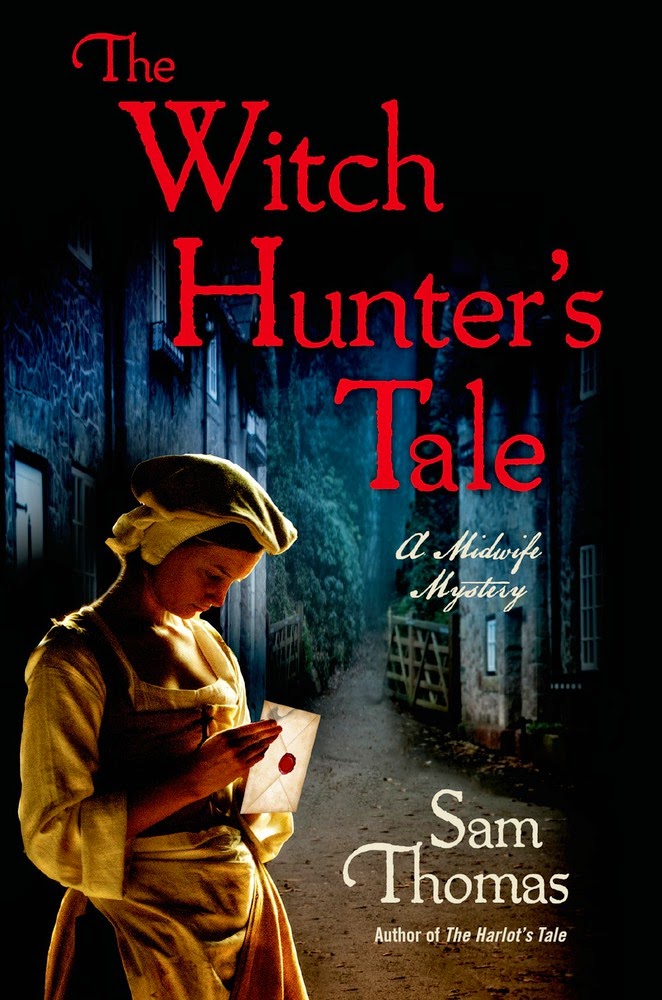
English Historical Fiction Authors alum Sam Thomas is back to celebrate the launch of the third Midwife Mystery featuring Bridget Hodgson, The Witch Hunter's Tale. Return to Civil War York as Bridget faces enemies old and new, or if you're new to the series, pick up the first installment for just $2.99. But before you do that, here's the low-down on witches and midwives.

For many years, conventional wisdom has connected midwives and witches. The connection was first drawn in a 1487 book called Malleus Maleficarum (The Hammer of Witches) by a medieval clergyman named Heinrich Kramer. In Malleus, Kramer asserts the existence of “witch midwives, who surpass all other witches in their crimes… the number of them is so great that…it is thought they there is scarcely any tiny hamlet in which at least one is not to be found.” This accusation, coupled with a tiny number of cases in which midwives were accused of witchcraft, has cemented this into popular culture.

The problem is that the existence of the “midwife witch” is a myth – the number of midwives accused of witchcraft is vanishingly small. The truth is that midwives hunted witches, which is what I should like to discuss today.

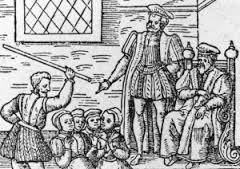
The midwife’s connection to witches depends on a creature called the Devil’s Familiar, and even if you've never heard the phrase, you know what I mean. Imagine your typical Halloween witch. You know that black cat we envision hanging about with a witch? That’s the modern version of the Devil’s Familiar, Satan’s representative to the witch after she sells her soul. In the early modern period, the Familiar could be a cat, of course, but also a mouse, bird, mole, frog, or toad…nearly any small animal would do. According to demonologists, witches called on their familiars when they needed help, and some claimed that the witch could not practice magic without the familiar’s assistance. (Click on the image to the left for a closer look.)

So how does the midwife come into things?

According to common lore, in order to survive, the familiar had to suck from the “witch’s teat,” an unnatural growth usually found in a woman’s armpit or “secret places.” The teat’s existence was taken as evidence of a woman’s guilt, and who better to recognize such a growth than a midwife?

According to an account written in 1597, when a mother and daughter were jointly accused of witchcraft, the magistrates “agreed that certain women should search the mother and the daughter to see if they could find any such marks on them as are usually found on witches. The old woman they stripped, and found behind her right shoulder a thing much like the udder of an ewe that giveth suck, with two teats like unto two great warts, the one behind under her armhole, the other a handful off towards the top of her shoulder.”

This discovery – along with other evidence and the suspect’s confession – led officials to cast the poor woman into prison, where, “had she lived, she should have been executed.”

This is not of course to say that midwives made witch-hunting their primary business, for cases of witchcraft were both spectacular and rare. But it remains true that, as guardians of public well-being, midwives had an obligation to protect mothers and children, and in some cases that meant hunting witches.

~~~~~~~~~~~~~

Sam Thomas is the author of the Midwife Mystery series. You can learn more about the history and mystery of midwifery at his website.

Sunday, November 2, 2014

Medieval Sorcery

By E.M. Powell

At this time of year, there is much talk of witches, with large numbers of people happy to don a pointy black hat and party hard. Medieval people would have been unlikely to join in. The matter of anyone who practised magic was complex and they would have recognised the concept of a sorcerer rather than a witch.
© 2014 E.M. Powell 

In medieval Europe two forms of magic existed: natural and demonic. Natural magic used the hidden powers in nature, helping with cures and protection. Demonic magic was a perversion of religion, practised it was believed by those who had turned away from God and instead to the devil. It was the practise of sorcerers.

The Practice of Sorcery

It was a widely-held belief that sorcerers could curse somebody with words, leading to illness or death. Sorcerers were also thought to be able to cause animal death, crop failure or an adverse change in the weather. The evil words could be a corrupted blessing, or a simple appeal to the devil. The supposed victim was not usually present at the utterance of curses.


© 2014 E.M. Powell 
Far more useful evidence to those making accusations of demonic magic were physical objects left on or near their property by the sorcerer. These objects were considered to have magical properties that could inflict harm. They could include animal bodies, mysterious powders, human faeces or even wood from a gallows. Poisoned food was also a frequent accusation.

In 1326, Pope John XXII wrote in his letter, Sorcery and the Inquisitors, of many objects that could serve the sorcerer’s purpose:  ‘Grievingly we observe…that many who are Christian in name only…sacrifice to demons, adore them, make or have made images, rings, mirrors, phials, or other things for magic purposes and bind themselves to demons.’

He had experienced several attempts on his life, including one by poison and alleged sorcery.


© 2014 E.M. Powell 
There are also records of image magic. A sorcerer in fourteenth century Coventry was accused of making a wax image of a neighbour, sticking spikes into it that caused the man to go mad with a pain in his head and finishing him off by driving the spike through the image’s heart.

It was widely believed that impotence or lack of sexual desire was caused by sorcery. If a man consumed forty ants boiled in daffodil juice, then lifelong impotence would follow. Physician Arnold of Villanova wrote a treatise On Bewitchments around 1300 in which he gave numerous remedies. They include ‘fumigation of the bedchamber with the bile of a fish and smearing the walls with the blood of a black dog.’ That would indeed provide a certain ambience to a love nest.


© 2014 E.M. Powell 
Sorcerers
Some accounts of medieval sorcery are on a far grander scale.

Guibert of Nogent, writing around 1115, gives details of the heretics of Soissons. Meeting in underground chambers, they would light candles and then do something unmentionable to naked women with them. Indiscriminate sexual intercourse then took place. Any babies born from these acts were then allegedly burned at later meetings and their ashes baked into bread which was eaten. The strong overtones of blasphemy in this account are very clear.

William of Malmesbury (d 1142) wrote an account of the Sorceress of Berkeley, who had died in 1065. He describes her as ‘a woman addicted to sorcery…skilled in ancient augury, she was excessively gluttonous, perfectly lascivious, setting no bounds to her debaucheries.’ She repented on her death bed and begged for her body to be saved from Satan, with her corpse sewed up in a stag’s skin, placed in a stone coffin and weighted with lead and iron and secured with chains. It was no good. A devil broke into the church and made off with her on the back of a barbed black horse.


© 2014 E.M. Powell 
The legend of the Sorceress of Ryazan dates from 1237. At Ryazan, a town on the eastern border of medieval Russia, a ‘woman of astonishing ugliness’ arrived with other riders on a snowy morning, demanding tithes. She was spurned. A few months later, a horde of murdering Mongols sacked the town.

Sorcery Trials and Punishment 

Secular laws and Church laws/canons attempted to tackle the problem of sorcery, and mutually influenced each other.  Secular laws dealt with the crime of magic and attempted to address harm done to people by magic.


Penalties included execution. The Church could order penance for the sin of magic and/or could excommunicate the offender. Excommunication, with the threat of eternal condemnation to hell, was as terrifying as a death sentence.

From Sorcery to Witchcraft


© 2014 E.M. Powell 
A sermon preached by Bernardino of Siena 1427 encourages people to cry out ‘To the flames! To the flames!’ if someone offers to cure the sick with magic. He also encouraged people to report sorcery, because if they did not, they shared in the guilt.

Sorcery trials increased in the fourteenth century, but the latter half of the fifteenth century saw a dramatic increase. Heinrich Kramer published Malleus Maleficarum (Hammer of Witches, c 1486), the most important medieval treatise on witchcraft. It strongly emphasised the demonic element in sorcery and (tragically) the conspiratorial nature of witchcraft.

Medieval sorcery was evolving into witchcraft. And in its name, around 50,000 women and men were executed by burning at the stake or hanging from the fifteenth to the eighteenth century.

How interesting that John of Salisbury, (d 1180) secretary to Archbishop Thomas Becket, wrote in 1154 of ‘the belief in evil nocturnal assemblies, where infants are murdered and eaten by witches. Such beliefs also state that the infants are granted mercy by the witch-ruler, who returns them unharmed to their cradles. Who could be so blind as not to see in all this a pure manifestation of wickedness created by sporting demons?’ 
© 2014 E.M. Powell 

He answers his own question with a great deal of sense:
‘Indeed, it is obvious from this that it is only poor old women and the simpleminded kinds of men who enter into these beliefs.’

What a tragedy that his view did not prevail.


References:

Kieckhefer, Richard: Magic in the Middle Ages, Cambridge University Press (2000)

Kelly, John: The Great Mortality, Harper Perennial (2006)
Kors & Peters (eds.): Witchcraft in Europe 400-1700, University of Pennsylvania Press (2001)
Lindahl, C., McNamara, J & Lindow, J. (eds.): Medieval Folklore, Oxford University Press (2002)
Maxwell-Stuart, P.G.: Witchcraft- A History, Tempus Publishing Limited (2004)


E.M. Powell’s medieval thrillers The Fifth Knight and The Blood of the Fifth Knight have been #1 Amazon bestsellers. Born and raised in the Republic of Ireland into the family of Michael Collins (the legendary revolutionary and founder of the Irish Free State), she lives in northwest England with her husband, daughter and a Facebook-friendly dog. She blogs for EHFA, reviews for the Historical Novel Society and contributes to The Big Thrill.

Book #3 in the series, The Lord of Ireland, based on the Lord John's disastrous 1185 campaign, will be published by Thomas & Mercer in 2016. Find out more at www.empowell.com.
Amazon.com
Amazon.co.uk
Amazon,ca
Amazon.com.au


Thursday, December 20, 2012

The Prophetess & the End of the World

By Nancy Bilyeau


In the spring of 1881, families across England deserted their homes, too distraught to sleep in their beds. They slept in fields or prayed in churches and chapels for God to spare their lives in the apocalypse that was foretold: "The world to an end shall come; in eighteen hundred and eighty one."


The author of their terror was Mother Shipton, also known as Ursula Shipton, a woman whose prophecies had been circulating through England and beyond for centuries. The first famous man whose life she prophesied was Cardinal Thomas Wolsey, the minister to Henry VIII until 1530. In often cryptic verse, the crone-like seer predicted wars, rebellions and all matter of natural disasters. After London burned in 1666, Samuel Pepys wrote in his diary: "Mother Shipton's word is out." Her prophecies were published in one form or another over 20 times between 1641 and 1700. In the 1800s, her predictions grew even more terrifying: The end-of-the-world was foretold in a book published in 1862. Its other prophetic verse included: "A carriage without a horse shall go; Disaster fill the world with woe; In water iron then shall float; As easy as a wooden boat."

The world did not end in 1881. People began sleeping in their beds once more. It was not the first time that fear of a Mother Shipton prediction convulsed a nation and it would not be the last.


Today there is considerable skepticism that a voluble prophetess named Mother Shipton ever existed. Many of her written predictions are, after all, confirmed forgeries, created to sell greater numbers of chapbooks and almanacs. Her 1684 "biographer" spun spooky details of her birth and existence; the 1881 end-of-the-world prophecy was debunked when the Victorian editor Charles Hindley publicly confessed to concocting the verses himself.


Entrance to Shipton Cave
Nonetheless, belief in Mother Shipton persisted. Today a thriving tourist attraction called Mother Shipton's Cave, at Knaresborough, North Yorkshire, features the cave where she was born and the petrifying well where objects can turn to stone. There's also a shop selling mugs, tea towels, thimbles, and wishing-well water in dark pink, ruby red and kelly green.

But just because Mother Shipton has become the label on kelly- green wishing-well water does not mean that she has no basis in fact. Like Robin Hood or King Arthur, it's believed that if we were able to trace the myth-making back to the very beginning, a living, breathing person could be identified


There are no written references to Mother Shipton in the 1500s. That name does not appear in print until 1641. But a mention of a "witch of York" in a chilling letter written by King Henry VIII himself could be the elusive source of the legend.

The context of the letter is critical. It was written to Thomas Howard, duke of Norfolk, while the duke was in the middle of a clean-up operation following the Northern rebellion against the king known as the Pilgrimage of Grace. Thousands of commoners and a fair number of nobles rose up against the reforms in religion forced on the country by Henry VIII. The rebels were particularly aggrieved by the fresh taxes and the closing of the monasteries, which in the poorer regions of the North were needed sources of food, shelter, and medical care. The Duke of Norfolk had easily defeated this 1537 outbreak, which followed the main rebellion of 1536, and he was now imprisoning and then executing people without trial, imposing martial law. He wrote his king that he hanged more than 70.


A watercolor of the rebellion showing, somewhat inaccurately,  that the army was led by priests and monks
Henry VIII dictated the following letter to Norfolk in response:
“We shall not forget your services, and are glad to hear also from sundry of our servants how you advance the truth, declaring the usurpation of the bishop of Rome… We approve of your proceedings in the displaying of our banner, which being now spread, till it is closed again the course of our laws must give place to martial law; and before you close it up again, you must cause such dreadful execution upon a good number of inhabitants, hanging them on trees, quartering them, and setting their heads and quarters in every town, as shall be a fearful warning, whereby shall ensue the preservation of a great multitude... You shall send up to us the traitors Bigod, the friar of Knareborough, Leche, if he may be taken, the vicar of Penrith and Towneley, late chancellor to the bishop of Carlise, who has been a great promoter of these rebellions, the witch of York and one Dr. Pykering, a canon. You are to see to the lands and goods of such as shall now be attainted, that we may have them in safety, to be given, if we be so disposed, to those who have truly served us..."

"The witch of York"...could this be a contemporary reference to a woman who not only caused enough trouble to incite the wrath of Henry VIII but also transformed into Mother Shipton? Her legend grew and grew in the 1600s, in published almanacs: Ursula was born in a cave in 1488, the child of an orphan servant girl and an unknown father--perhaps Lucifer himself. She was singularly ugly, called "Devils Bastard" and "Hag-face." Nonetheless, Ursula married a builder named Toby Shipton and lived quietly with him, never prosecuted for witchcraft though regularly uttering prophecy. "Her stature," wrote her biographer, "was larger than common, her body crooked, her face frightful; but her understanding extraordinary." How much of this describes the same "witch of York" cited by Henry VIII is unknown.


Cardinal Thomas Wolsey
The fact that Mother Shipton's first known prediction concerned the fate of Cardinal Wolsey is significant. According to Wolsey's gentleman usher and later biographer, George Cavendish, Wolsey, near the end of his life, was disturbed by a prophecy heard. Cavendish wrote: " 'There is a saying, quoth he, 'that When this cow rideth the bull, then priest beware thy skull." According to Tudor-court interpretation, the cow was Anne Boleyn, who in her holding sway over Henry VIII and convincing him to divorce his queen to marry her, triggered the break with the Catholic Church. Mother Shipton was not attributed to this prophecy by Cavendish. But in the future, her soothsaying would intertwine with Wolsey's fate.

Belief in prophecy ran through every level of Tudor society. It reached a fever pitch during the dangerous 1530s, when queens and courtiers were beheaded, monasteries fell, and rebels were hanged from trees across the North of England. 


Many prophecies were used for political purposes. Uprisers against Henry VII said they were following the ancient sages. The rebels of the Pilgrimage of Grace cried that Henry VIII was the ancient 'Mouldwarp,' a monster ruler foretold by Merlin who would be "cast down." Anthony Babington, who conspired to assassinate Elizabeth I, carried a prediction of Merlin's sayings. One popular prophecy during Elizabeth's time was "When HEMPE is soon, England's done." HEMPE was thought to stand for Henry-Edward-Mary-Philip-Elizabeth.  Madeleine Dodds in Political Prophecies in the Reign of Henry VIII wrote:  "Political prophecies tended to be invoked at a time of crisis, usually to demonstrate that some drastic change, either desired or already accomplished, had been foreseen by the sages of the past."


In the 1700 and 1800s, Mother Shipton's prophecies broadened to cataclysmic disasters, amazing inventions, and, of course, the end of the world. Stripped of politics, they were more potent than ever. Perhaps they filled a deep craving within to feel that everything happens by some design, even if it is drawn by an ancient mystic, sage or witch. We are all of us fulfilling an obscure and coded destiny.


It's a craving that we still see around us today. It just might be part of being human.


----------------------------------------------------------------------------------------------------


Nancy Bilyeau is the author of the Tudor-era thriller The Crown, now on sale in North America, the United Kingdom and nine foreign markets. It was put on the short list for the Crime Writers' Association Ellis Peters Historical Dagger Award for 2012.


The sequel, The Chalice, which goes on sale on Feb 28th, 2013 in the United Kingdom and March 5th, 2013 in North America, revolves around a deadly prophecy. And yes, Mother Shipton is part of the plot.


For more information, go to www.nancybilyeau.com