Showing posts with label traditions. Show all posts

Monday, October 31, 2016

From Samhain to Hallowe'en

by Elaine Moxon


In ancient times it wasn’t possible to keep whole herds through winter, so minimum livestock was retained and the rest were slaughtered and salted. The killing and preserving was done at ‘Samhain’ (summer’s end), which marked the start of the Celtic New Year. The last crops also had to be harvested by the last day of October (or its equivalent date of the era), Samhain-Eve. The festival of Samhain would last for three days from 31st October until 2nd November, thus crossing the border between the Old Year and into the New Year. Hence, Samhain is a time of change and transition.

To welcome friendly visiting ancestral ghosts, candles were lit on shrines in the west of the home to honour lost loved ones who had passed to the ‘Summerlands’. At the customary feast, a place setting would be set for those absent, and food and drink left for the ‘guest’ at the front door. The door would remain unlocked to allow the dead to enter. For spirits with no family to visit, additional offerings would be left on window sills and doorsteps. To keep away those with malevolent intentions, turnips or mangelwurzels were carved into ‘death’ heads with ghoulish expressions and left outside with a candle glowing inside. This has been replaced in many places with the pumpkin heads we see in abundance at Hallowe’en.


Samonios - October-November in the Celtic calendar, meaning ‘seed fall’
Samhuinn - beginning of winter: OBOD (pronounced ‘sow’ as in cow – ‘inn’)
Samhain - November, Irish Gaelic
Samhuin - All Hallows, Scottish Gaelic

By the 7th Century the three days of the festival were Christianised as follows:
  • All-Hallows Day, 31st October
  • All-Saints Day, 1st November
  • All-Souls Day, 2nd November
However, the traditions of the festival continued despite the Christianisation of the feast days, as this was thought to be a dangerous time. The ‘veil’ between the world of the living and the ‘Otherworld’ or land of the dead lifted, allowing communion with those who had already passed on into what was sometimes known as the ‘wilder life’. Ancestral ghosts and otherworldly creatures were thought to be abroad. These spectres came in benevolent as well as malevolent forms and ancient traditions abound with rituals that have endured into the modern day. The Celts, as noted by Caesar, were self-proclaimed ‘sons of the god of night’ and counted the seasons by the number of nights, not days. Therefore, ritual celebration was observed on the eve of a special date, hence why we have Hallowe’en, All Hallows Eve on 31st October, the night preceding Samhain.

Nationwide [Britain]

The ‘Wild Hunt’ swept through the skies at Samhain, with one of several figures at its head depending on the belief system of those at ground level: 
  • In the north, Odin
  • In Germania, Woden
  • In Wales, Gwynn ap Nudd, King of the Fairies
  • In England, Herne the Hunter or King Arthur
  • In Scotland, ghostly hunters with hawks on their hands, followed by packs of hounds known as Gabriel’s Ratchets.
Those out late at night carried black-handled knives or a steel needle threaded through their coat sleeve, so they would not be ‘taken’ by these sky-riding spirits. There is a hint here to the modern-day ‘witch on a broomstick’!

Scotland

Folk traditions attempted to obliterate this otherworldly connection through ritual and pranks (today’s trick-or-treat). Young men impersonated spirits with masks and veiled or blackened faces. The boundary between the sexes was blurred too with girls and boys wearing clothes of the opposite sex. Ploughs and carts were driven away and gates moved or tossed into ponds and ditches. Horses were led away and left in other people’s fields.


Ireland

The ‘Feast of Tara’ was a great assembly held at Samhain when renewal of kingships and kingdoms took place. Offerings were thrown to the gods into a sacred fire, in thanks for the year’s harvest and prayers were said for the forthcoming year. Ideally, four provincial kings and their kinfolk would sit in a square around the High King who sat at the centre; a symbolic assertion of the order and stability of the people. This was important to establish at such an unstable time of year, when the growing forces of darkness and chaos threatened with the long hours of darkness outside.

Fire kept away cold, discomfort and wild animals, as well as evil spirits. As recent as the 19th Century in Britain and Ireland, people would light brands from a large bonfire and run around fields and hedges of homes, surrounding parish boundaries with a magic circle of light. The ashes from the fire were later sprinkled over the fields to protect them from evil during the winter months (improving the soil at the same time!).

Here, too, young men would create hullabaloo throughout the countryside, marching in large groups blowing horns and wearing white sheets and horse’s heads. On hearing the horns, housewives would offer cakes to the approaching marauders as to deny them offerings would result in trickery. Once again we see here the underlying mischief, born of more serious ritual, that today is performed by countless children knocking doors for sweets.


Wales

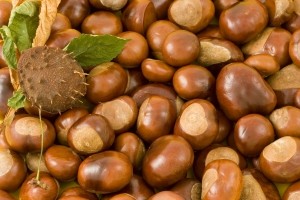
At Samhain, a large fire would be lit in the hearth and families would gather to consume warm, sweetened ale from a ‘wassail’ bowl. Roasted apples and nuts were used in divination games to foretell the fortunes of the following year. Here we find a source for the apple bobbing and games of conkers that are so popular among children and adults alike! Apples have long been associated with immortality and can be found in numerous myths and legends from around the world. The Goddess Idun of Norse mythology was the keeper of the apples of immortality that were fed upon by the gods of Asgard to retain their immortality. Likewise, in Greek mythology the Goddess Hera owned a sacred apple tree, attended by three sisters known as the Hesperides. In Celtic myth the famous isle of apples, or ‘Avalon’ was an otherworldly paradise to which King Arthur was taken by three fairy queens (one of whom was Morgan Le Fay, fay meaning ‘fate’). Apples also link to the triple goddess that abounds in Celtic and Pagan religions and is where we find the symbol of the pentacle or five-pointed star/star of knowledge – when the fruit is cut horizontally.

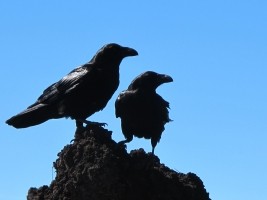
A harvest supper known as the ‘Hag’s Feast’ would be shared at Samhain, in honour of the winter hag or crone, who rules between Samhain and Imbolc (1st February). This ‘dark goddess’ ruled the inner tides of human emotion, the ‘womb’ of the ocean and the realm of dreams. The darkness of the womb gives birth to human life, as the dark of night and winter gives birth to day and springtime. Thus this figure and her time of year were about restoring and regenerating spirit, inner strength and hope. She has now been transposed into solely her darkest aspect, as the witch riding through the land on a wolf (or broomstick!) striking down signs of life with her wand of winter. The sign of the dark goddess is the black feather and her birds are carrion and so here we find the crows and ravens of Hallowe’en. It is also worth noting the two ravens belonging to Odin from Norse mythology.

Modern Pagans use this time to also connect with loved ones who have departed and for introspection. Feasting and familial gathering form part of a remembrance service where worries can be released onto paper and burned in the ‘Samhuinn fire’, which can be as elaborate as a large communal bonfire or as intimate as a single candle flame in ones home.

As you choose your costume and prepare to embark on a night of chaos and ghoulish fun, consider the ancient rituals you will be sharing with our ancestors!
BIBLIOGRAPHY:
OBOD – Samhuinn & Alban Elued [Autumn Equinoxe]
Hamlyn History - ‘Myths Retold’ by Diana Ferguson
‘Visions of the Cailleach’ by Sonita d’Este & David Rankine
‘Pagan Feasts’ by Anna Franklin & Sue Phillips
ALL IMAGES: courtesy of  Visualhunt.com

~~~~~~~~~~

Elaine writes historical fiction as ‘E S Moxon’. Her debut 'Wulfsuna' was published January 21st, 2015 and is the first in her Wolf Spear Saga series of Saxon adventures, where a Seer and one named ‘Wolf Spear’ are destined to meet. She is currently writing her second novel, set once again in the Dark Ages of 5th Century Britain. You can find out more about Book 2 from Elaine’s website where she has a video diary charting her writing progress. She also runs a blog. Elaine lives in the Midlands with her family and their chocolate Labrador.


Blood, betrayal and brotherhood.
An ancient saga is weaving their destiny. 
A treacherous rival threatens their fate. 
A Seer's magic may be all that can save them. 
WULFSUNA 
~


Tuesday, December 1, 2015

Ye Olde Christmas Traditions

by Steven A. McKay


Christmas isn't a new invention – it's been around for quite a while, in one form or another, as you're probably aware! Many of our favourite traditions are relatively recent additions though, such as the red-suited, white-bearded Santa with his elves, Rudolph the red-nosed reindeer and Slade with their annoying yet brilliantly catchy song.

Of course, winter has always been a time for people to celebrate, as the old year gives way to the new and we look forward to what the future will bring us. Medieval folk shared many of our customs and they had some interesting ones of their own that didn't carry over to the present day.

With the passing of summer, things become bleak and drab so, at Christmas we decorate our houses to chase away the gloom. In the middle-ages they used evergreens like holly, ivy and mistletoe to brighten the place, a tradition stemming from the Roman festival of Saturnalia.

Icy holly by Liz West

Holly was thought to deter witches while men wore it to attract female admirers. Ivy also kept evil forces away but it was kept outside the home, while mistletoe – a plant venerated by the pagan Druids – was really frowned on by the Church but that didn't stop suitors kissing beneath it as they do to this day.

Of course, the main evergreen we use to see in Christmas nowadays is the fir tree, with its fairy lights and shiny baubles. Medieval people didn't have a tree in their house but a candlelit fir was displayed in London in the fifteenth century and, in general, it was seen as a Christian symbol, possibly to combat the pagan oak.

Many of those traditions originated in even earlier times, with the Vikings, who celebrated the winter solstice, their Yuletide, around the same time as we enjoy Christmas.

Our lovely, chocolatey Yule Log, for example, which is a cake nowadays but in pre-Christian days it  was an actual log or even a small tree, carved with protective runes and brought inside with great ceremony to be used as fuel for the household's fire during December.

That should last a while!

Santa Claus takes many elements from the Viking legends. They believed Odin, or Old Man Winter, a white-bearded old man in a hooded robe who flew around the world on an eight-legged horse, gave out gifts to the good and punishments to the bad. He would even be invited into people's homes with food and drink.

Yuletide was often referred to as “drinking yule”, which suggests drinking a lot of alcohol played a big part in the Viking celebrations, with feasting, games and songs. Which of course carried on into medieval times and nowadays...well, I'd imagine more booze is sold in December than any other time of the year. We certainly carried on that custom!

Getting back to medieval times, the people had various saints' days which were celebrated throughout the winter, with some of them even carrying over after Christmas Day (which is still the case for those of Catholic faith).

December the 26th was St Stephen's day and it saw sword dances and mumming plays which sound pleasant enough, but the animals were also bled (in those days, of course, bleeding was seen as healthy!) and in Wales, female servants would have their arms and legs beaten bloody by young men with holly branches! Ouch. Thankfully that tradition died out…

Odin/Father Winter

There was also Holy Innocents' Day on the 28th, and Epiphany on January 6th, but most interesting to me was St Lucy's Day, which was on the 13th of December and was a celebration of light. This is another feast day that has links to earlier, pagan times, with candles and processions. Of course, Lucifer, before he became synonymous with Satan, was known as the light-bringer, so it seems clear to me that St Lucy's Day was actually a celebration of Lucifer (bear in mind, the Latin word lucifer was once even applied to Jesus)...

Which brings me rather neatly to my own little take on medieval festivities.

Friar Tuck and the Christmas Devil is my brand new novella and December 1323 is the backdrop for much superstition and fear. I greatly enjoyed writing and researching it and, who knows, maybe reading it each December will become as much a modern tradition as Scrooge and Noddy Holder/Mariah Carey!

I am doing a giveaway of the book this week. Click HERE to find out more, and leave a comment below to enter!


Steven A. McKay is the bestselling author of the Forest Lord series of books, Wolf's Head, The Wolf and the Raven, and Rise of the Wolf. All his books are available on Kindle, paperback and from Audible.

To buy Friar Tuck and the Christmas Devil click HERE

To find all of Steven's books on Amazon, click HERE 

Sign up HERE to Steven's email list and get a FREE short story, "The Escape", starring Little John in a tight spot...

Steven's WEBSITE

References:
Jackson, Sophie - The Medieval Christmas (The History Press, 2005)
http://skandland.com/vikxmas.htm
http://www.whychristmas.com/customs/yulelog.shtml
http://freya.theladyofthelabyrinth.com/?page_id=397
http://www.timetravel-britain.com/articles/christmas/santa.shtml
http://www.mrshea.com/germusa/customs/lucia.htm


Monday, August 31, 2015

For Whom the Bell Tolls- Early Tudor Way of Death

by Carol McGrath

Imagine a silent, sombre procession moving slowly through the streets of London from the deceased's home to the local Parish church. The bells toll, and the funeral bier is covered with black cloth. The year is 1512. King Henry has been on the throne for three years. He is young, a golden Renaissance prince, and, as yet, there is no hint of Reformation in England. In fact Henry VIII was conservative. He was Catholic as far as the Church liturgy was concerned all his life. Funerals during his reign remained traditional, no different to those of Medieval times. Even during the Elizabethan era many features of medieval funerals for the wealthy, middling or poor remained the same.

Queen Elizabeth I 's funeral cortege

If the deceased was wealthy, this procession would be led by servants bearing banners and coats of arms. There would be attendants clad in black gowns carrying black staves. Black was provided to invited mourners. Generally there were no flowers. Mourners carried herbs. Sprigs of rosemary for remembrance would be worn in the hat, pinned to the sleeves and onlookers might wear mourning rings showing skeletons or crosses.

The bell's tolling would summon attendants to the graveside and bring comfort, not only to the living, but to the dead. People were prompted to prayer by the tolling bells. These helped the soul on its journey. If one was superstitious, one might believe that tolling bells would chase off any evil spirits that could molest the soul. After the Reformation in the mid sixteenth century, bell tolling was limited. The bells would ring 'moderately' at funerals. It was no longer an official belief that they were beneficial to the passage of the dead person's soul.

Bell tolling helped the passage of the soul

Winding and watching were important aspects of a death ritual. They were also a practical necessity. This work involved washing, winding the corpse in a shroud and watching over the candle lit corpse before it was carried in procession to the church for burial. A midwife could be employed for corpse washing duty! A shroud could be linen, but by the mid seventeenth century shrouds were woolen to give a flagging wool trade a boost. Although a box might occasionally be used, unless a person was wealthy he/ she was buried in the shroud. Generally, no more than two to three days would pass between death and burial. Infectious bodies were buried as soon as possible. Equally, the very wealthy might be embalmed to allow time for mourners to gather.

Watching the corpse involved sitting up all night with the dead body. It was a custom that continued after the Reformation. The body might be laid out on a floor covered with a sheet. The corpse was constantly attended and watched, a tradition similar to that of Celtic Wakes. It secured another mark of respect for the deceased's family. It safeguarded the body from tampering. Sometimes the watchers imagined that they saw visions. It could be frightening. Imagine the stories they whispered as they prayed for the safe passage of a soul.

Image result for free pictures of rosemary
Rosemary for Remembrance

Most bodies rested on biers and were not carried in coffins from the time they departed for the Church until they were placed in the grave. A bier was a frame with handles designed to transport and support the corpse. These were often supplied by the Parish, and they would be stored at the back of the Church. The Parish might also loan out a mortuary cloth, a pall, to cover the bier. Guilds supplied such trappings for the burial of guild members. The hearse was originally a frame to hold candles that were placed over the body during the funeral service. Eventually the meaning of hearse changed to include the whole ensemble whether bier or a coffin that transported the body to the grave.

Death was never far away. A Church wall painting

The poor of the Parish expected a funeral dole. In fact, it was the poor who were sometimes employed to accompany or carry the corpse. Funeral processions in Tudor London were often led by members of the poor dressed in mourning livery. Since black was the colour of Tudor mourning, the wealthy who could afford acres of black cloth would provide mourning cloaks for the guests, gowns, hangings, draperies, covers and gifts such as mourning rings or gloves. Thus, a mourner could easily be identified by apparel. Traditionally, the funerals of the well-to-do were accompanied by deeds of charity and acts of largesse.

Tudor Generosity!

Mourners who accompanied the body to the grave might be fortified with ale, wine or spirits. Guests would also be provided with refreshments later. Funeral meals were semi public occasions, and a large company could be expected. Vast amounts of food and drink were consumed after Tudor funerals. For the well to do, new middle class they became an occasion!

The Tudors Artifacts - The Tudors Wiki

To find out more about Tudor and Stuart funerals read Birth, Marriage and Death, Ritual, Religion and the Life Cycle in Tudor and Stuart England by David Cressy, Oxford University Press.

My new novel in progress opens with a London funeral and is set in 1512.

~~~~~~~~~~~~~

Carol McGrath

The Handfasted Wife published by Accent Press 2013
The Swan-Daughter published by Accent Press 2014
The Betrothed Sister published by Accent Press 2015

www.carolcmcgrath.co.uk