Showing posts with label Samhain. Show all posts

Monday, October 31, 2016

From Samhain to Hallowe'en

by Elaine Moxon


In ancient times it wasn’t possible to keep whole herds through winter, so minimum livestock was retained and the rest were slaughtered and salted. The killing and preserving was done at ‘Samhain’ (summer’s end), which marked the start of the Celtic New Year. The last crops also had to be harvested by the last day of October (or its equivalent date of the era), Samhain-Eve. The festival of Samhain would last for three days from 31st October until 2nd November, thus crossing the border between the Old Year and into the New Year. Hence, Samhain is a time of change and transition.

To welcome friendly visiting ancestral ghosts, candles were lit on shrines in the west of the home to honour lost loved ones who had passed to the ‘Summerlands’. At the customary feast, a place setting would be set for those absent, and food and drink left for the ‘guest’ at the front door. The door would remain unlocked to allow the dead to enter. For spirits with no family to visit, additional offerings would be left on window sills and doorsteps. To keep away those with malevolent intentions, turnips or mangelwurzels were carved into ‘death’ heads with ghoulish expressions and left outside with a candle glowing inside. This has been replaced in many places with the pumpkin heads we see in abundance at Hallowe’en.


Samonios - October-November in the Celtic calendar, meaning ‘seed fall’
Samhuinn - beginning of winter: OBOD (pronounced ‘sow’ as in cow – ‘inn’)
Samhain - November, Irish Gaelic
Samhuin - All Hallows, Scottish Gaelic

By the 7th Century the three days of the festival were Christianised as follows:
  • All-Hallows Day, 31st October
  • All-Saints Day, 1st November
  • All-Souls Day, 2nd November
However, the traditions of the festival continued despite the Christianisation of the feast days, as this was thought to be a dangerous time. The ‘veil’ between the world of the living and the ‘Otherworld’ or land of the dead lifted, allowing communion with those who had already passed on into what was sometimes known as the ‘wilder life’. Ancestral ghosts and otherworldly creatures were thought to be abroad. These spectres came in benevolent as well as malevolent forms and ancient traditions abound with rituals that have endured into the modern day. The Celts, as noted by Caesar, were self-proclaimed ‘sons of the god of night’ and counted the seasons by the number of nights, not days. Therefore, ritual celebration was observed on the eve of a special date, hence why we have Hallowe’en, All Hallows Eve on 31st October, the night preceding Samhain.

Nationwide [Britain]

The ‘Wild Hunt’ swept through the skies at Samhain, with one of several figures at its head depending on the belief system of those at ground level: 
  • In the north, Odin
  • In Germania, Woden
  • In Wales, Gwynn ap Nudd, King of the Fairies
  • In England, Herne the Hunter or King Arthur
  • In Scotland, ghostly hunters with hawks on their hands, followed by packs of hounds known as Gabriel’s Ratchets.
Those out late at night carried black-handled knives or a steel needle threaded through their coat sleeve, so they would not be ‘taken’ by these sky-riding spirits. There is a hint here to the modern-day ‘witch on a broomstick’!

Scotland

Folk traditions attempted to obliterate this otherworldly connection through ritual and pranks (today’s trick-or-treat). Young men impersonated spirits with masks and veiled or blackened faces. The boundary between the sexes was blurred too with girls and boys wearing clothes of the opposite sex. Ploughs and carts were driven away and gates moved or tossed into ponds and ditches. Horses were led away and left in other people’s fields.


Ireland

The ‘Feast of Tara’ was a great assembly held at Samhain when renewal of kingships and kingdoms took place. Offerings were thrown to the gods into a sacred fire, in thanks for the year’s harvest and prayers were said for the forthcoming year. Ideally, four provincial kings and their kinfolk would sit in a square around the High King who sat at the centre; a symbolic assertion of the order and stability of the people. This was important to establish at such an unstable time of year, when the growing forces of darkness and chaos threatened with the long hours of darkness outside.

Fire kept away cold, discomfort and wild animals, as well as evil spirits. As recent as the 19th Century in Britain and Ireland, people would light brands from a large bonfire and run around fields and hedges of homes, surrounding parish boundaries with a magic circle of light. The ashes from the fire were later sprinkled over the fields to protect them from evil during the winter months (improving the soil at the same time!).

Here, too, young men would create hullabaloo throughout the countryside, marching in large groups blowing horns and wearing white sheets and horse’s heads. On hearing the horns, housewives would offer cakes to the approaching marauders as to deny them offerings would result in trickery. Once again we see here the underlying mischief, born of more serious ritual, that today is performed by countless children knocking doors for sweets.


Wales

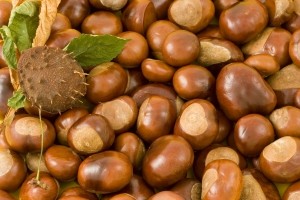
At Samhain, a large fire would be lit in the hearth and families would gather to consume warm, sweetened ale from a ‘wassail’ bowl. Roasted apples and nuts were used in divination games to foretell the fortunes of the following year. Here we find a source for the apple bobbing and games of conkers that are so popular among children and adults alike! Apples have long been associated with immortality and can be found in numerous myths and legends from around the world. The Goddess Idun of Norse mythology was the keeper of the apples of immortality that were fed upon by the gods of Asgard to retain their immortality. Likewise, in Greek mythology the Goddess Hera owned a sacred apple tree, attended by three sisters known as the Hesperides. In Celtic myth the famous isle of apples, or ‘Avalon’ was an otherworldly paradise to which King Arthur was taken by three fairy queens (one of whom was Morgan Le Fay, fay meaning ‘fate’). Apples also link to the triple goddess that abounds in Celtic and Pagan religions and is where we find the symbol of the pentacle or five-pointed star/star of knowledge – when the fruit is cut horizontally.

A harvest supper known as the ‘Hag’s Feast’ would be shared at Samhain, in honour of the winter hag or crone, who rules between Samhain and Imbolc (1st February). This ‘dark goddess’ ruled the inner tides of human emotion, the ‘womb’ of the ocean and the realm of dreams. The darkness of the womb gives birth to human life, as the dark of night and winter gives birth to day and springtime. Thus this figure and her time of year were about restoring and regenerating spirit, inner strength and hope. She has now been transposed into solely her darkest aspect, as the witch riding through the land on a wolf (or broomstick!) striking down signs of life with her wand of winter. The sign of the dark goddess is the black feather and her birds are carrion and so here we find the crows and ravens of Hallowe’en. It is also worth noting the two ravens belonging to Odin from Norse mythology.
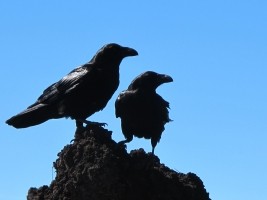

Modern Pagans use this time to also connect with loved ones who have departed and for introspection. Feasting and familial gathering form part of a remembrance service where worries can be released onto paper and burned in the ‘Samhuinn fire’, which can be as elaborate as a large communal bonfire or as intimate as a single candle flame in ones home.

As you choose your costume and prepare to embark on a night of chaos and ghoulish fun, consider the ancient rituals you will be sharing with our ancestors!
BIBLIOGRAPHY:
OBOD – Samhuinn & Alban Elued [Autumn Equinoxe]
Hamlyn History - ‘Myths Retold’ by Diana Ferguson
‘Visions of the Cailleach’ by Sonita d’Este & David Rankine
‘Pagan Feasts’ by Anna Franklin & Sue Phillips
ALL IMAGES: courtesy of  Visualhunt.com

~~~~~~~~~~

Elaine writes historical fiction as ‘E S Moxon’. Her debut 'Wulfsuna' was published January 21st, 2015 and is the first in her Wolf Spear Saga series of Saxon adventures, where a Seer and one named ‘Wolf Spear’ are destined to meet. She is currently writing her second novel, set once again in the Dark Ages of 5th Century Britain. You can find out more about Book 2 from Elaine’s website where she has a video diary charting her writing progress. She also runs a blog. Elaine lives in the Midlands with her family and their chocolate Labrador.


Blood, betrayal and brotherhood.
An ancient saga is weaving their destiny. 
A treacherous rival threatens their fate. 
A Seer's magic may be all that can save them. 
WULFSUNA 
~


Saturday, October 31, 2015

The Celtic Feast of Samhain and Hallow'een

by Arthur Russell

Aerial view of the earthworks on Tlachtga's Hill
Celebrating Samhain 

The Hill of Ward near Athboy in Co Meath is regarded as the site where the traditional celebration of Samhain was centred in pre-Christian Ireland. The ancient Celtic name for the Hill is Tlachtga (from the old Gaelic words meaning “Earth Spear”). This derives from the name of the Celtic goddess of Fertility. An associated legend about her tells that Tlachtga (pronounced Clackda) was a Witch and the daughter of the powerful wizard and chief Druid, Mug Ruith.

Note  Older legends of Mug Ruith suggest he was a Sun God.

The legend speaks of Tlachtga and Mug Ruith journeying to Italy to put themselves under the tuition of a powerful wizard called Simon Magnus. In course of this, the three constructed a flying wheel called the Roth Rámach, which they used to sail through the air to demonstrate their powers. Mug Ruith and Tlachtga returned to Ireland and brought the flying wheel with them. The legend also relates that the wizard’s three sons raped Tlachtga and fathered triplet sons on her. She died after giving birth and the earthworks that can still be seen on the summit of the Hill of Ward (Tlachtga) were raised over her grave and the annual Samhain festival inaugurated to her honor.

Whatever the Festival’s origin, the Hill of Ward, then known as Tlachtga, was established as a center of Celtic religious worship over 2,000 years ago focusing on the celebration of the feast of Samhain. From the beginning it was overshadowed by the more famous and prestigious neighboring site at the Royal seat on the Hill of Tara less than 10 kms to the east, but it remained for centuries the center of the annual Great Fire Festival of Samhain that signaled the onset of winter. 

The rituals and ceremonies carried out here by the pre-Christian Irish offered assurance to the people that the powers of darkness, which had by that time of year become strongly established over the land would be overcome, and the powers of light and life would eventually prevail. Animal bones were cast into the fires of Samhain, which added a special spiritual significance to the ceremonial flames. The fire was called 'tine chnámh' (pronounced tina kin-awve) or bone fire, from which the English word ‘bonfire’ is derived. The Celts believed that Oiche Samhain (the Night of Samhain) marks a time of year when the veil between the world of the Living and the world of the Dead melts away for a short while. During those hours the souls of all who had died since the last Samhain moved into the next life and there was relatively free movement of the dead as they made return visits to their former lives. The Celtic Druids considered the Hill of Tlachtga to be a place where the veil between living and dead was at its thinnest on that night.

The pre-historic landscape of the Boyne Valley. 

Map of the Boyne Valley area showing pre-historic sites
The ceremonial Hill is located midway between the Royal site on the Hill of Tara and the Neolithic burial sites of Loughcrew to the North-west; both of which have their own burial structures which are aligned to the seasonal position of the Sun as it goes through its annual cycle around the sky.

Mound of the Hostages at Tara
Note - The Mound of the Hostages on the crest of the Hill of Tara is actually aligned to the rising sun on November 1st. Tlaghtga is located at the edge of the Boyne Valley, an area which is already rich in pre-historic sites. These include – Tara, the ancient site for the Irish Árd Ríthe (High Kings), Brú na Bóinne encompassing Newgrange (associated with the Winter Solstice), and the structures of Knowth and Dowth, Tailteann – which is associated with Loughcrew – which has a complex of passage tombs aligned to the equinox sunrises in March and September. 

Samhain Rituals

The Celtic feast of Samhain (Samhain is the Gaelic word for November) marks the beginning of Winter. The tradition was to extinguish all fires across the countryside before sunset on the eve of the feast. After darkness fell, the druids who had gathered on top of the Hill called Tachtla lit the first fire. The fire from this was transported by chariot to both Tara and Loughcrew as well as to five other designated sites throughout the land to relight fires there. From these fires all other fires in the land would be relit. The night sky would be illuminated by the spreading Samhain fires as they worked their way through the countryside. After Christianity arrived, the old pagan festival of Samhain were transformed into a celebration of All Souls or All Hallows to honour their dead who had passed to a better world. The notion that it was possible to more easily communicate with the dead during the darkening days as winter approached seemed to persist. From this came the name Hallow'eve (the eve of All Souls day) or Hallowe'en. Many of the associated traditional practices and games were kept and developed over succeeding centuries to what we know today.

Note  Among the many Hallowe'en traditions that developed over the centuries in Celtic countries such as Ireland, Scotland, Wales and the Isle of Man was the making of Hallowe'en lanterns using the humble turnip grown on many farms. Selected turnips were chosen and had the central pulp removed; holes were cut in the shell of the bulb to represent eyes, nose and mouth and a lighted candle placed inside to be placed on gateposts and on windows on the night of Hallowe'en. Emigrants to the New World during the 18th and 19th century brought the lantern making tradition with them but adapted the much bigger and softer pumpkin as Hallowe'en ware. It is interesting to note that the tradition of using pumpkins (not turnips) as Hallowe'en lanterns has during the last century effectively come from the New World to replace the turnip as the favoured vegetable for the Hallowe'en lantern.

It is also interesting to note that the Pilgrim Fathers were not in favour of celebrating Hallowe'en at all, so it awaited the arrival of later waves of immigrants from Europe, especially Ireland and Scotland, to establish the celebration of Hallowe'en in the New World.

The Samhain Festival revived at Tlachtga’s Hill: 

In recent years, the Samhain celebration has been revived at the Hill which is regarded as the centre for Samhain celebrations. It is expected that on the evening of each October 31st over 1000 people from many countries will gather in the Fairgreen of Athboy to observe the ancient ritual of Samhain on the ancient site. Tlachtga’s Hill is close to the town of Athboy in Co Meath, where on the evening of October 31st townspeople and anyone who cares to join them will assemble in the centre of the town, some wearing druid costumes and carrying lanterns, to walk the short distance to the hill outside the town. There they will light the traditional Samhain bonfire. In doing this, they will repeat and recall the actions of their ancestors of centuries before as they mark the passing of another year and the beginning of the coming winter.

 As always, the emphasis will not be just to look back but also to look forward. The dead will duly remembered and honoured, as they should be.

 The living, those who have lived through the year that is winding down to its annual sleep and who are alive to see this night, will be reminded by the fire that the dark winter days of November and December will pass. Light and life will return once more, all in due time, for everything under the Heavens has its season.


~~~~~~~~~~~~~

Arthur Russell is the Author of Morgallion, a novel set in medieval Ireland during the Invasion of Ireland in 1314 by the Scottish army led by Edward deBruce, the last crowned King of Ireland. It tells the story of Cormac MacLochlainn, a young man from the Gaelic crannóg community of Moynagh and how he and his family endured and survived that turbulent period of history. Morgallion has been recently awarded the IndieBRAG Medallion and is available in paperback and e-book form.

More information available on website - www.morgallion.com


Tuesday, October 30, 2012

All Hallows and All Souls


By Lauren Gilbert

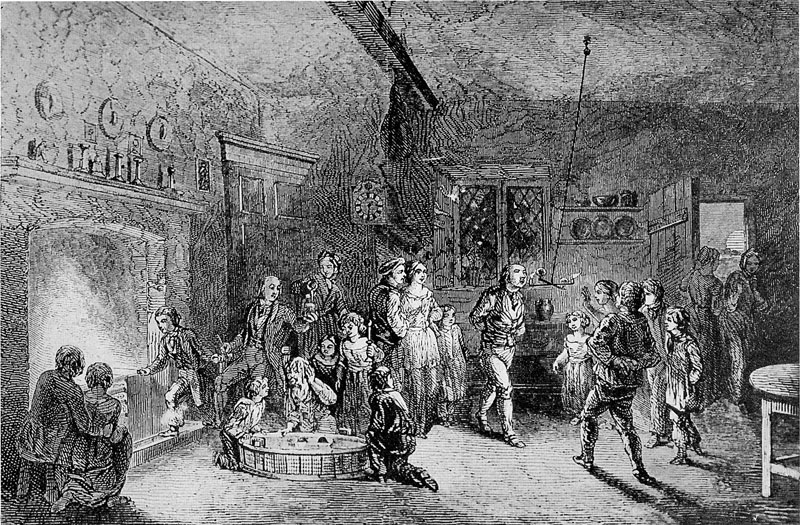
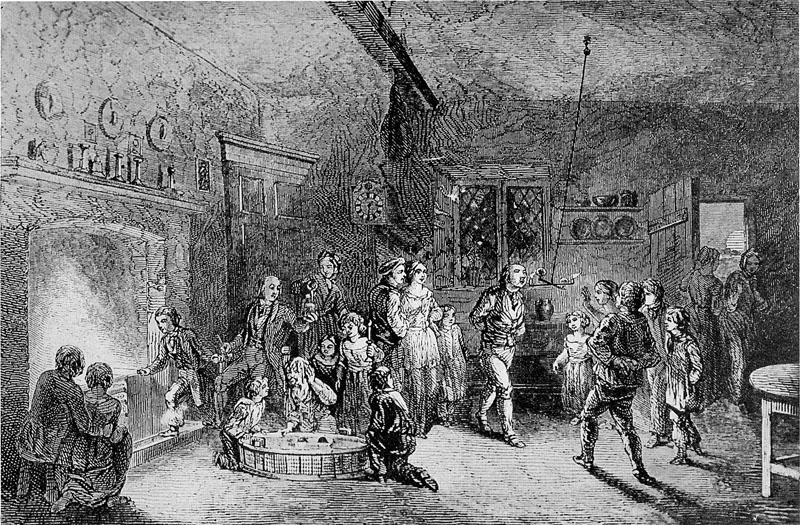
From The Book of Hallowe'en 1919


At this time of year, around the world, people celebrate in remembrance for the dead: specifically deceased saints and deceased loved ones. Tonight, we will be celebrating Halloween. In the United States, and many other western nations, this has become a secular holiday, full of games, sweet treats, costumes and fun. However, it is still celebrated as a religious tradition and has deep historical roots.

In the CONCISE OXFORD ENGLISH DICTIONARY, “Hallow” is defined as follows: verb-to make holy or consecrate; noun-archaic word for a saint or holy person. Pope Gregory IV extended a holiday to the whole Catholic Church in 835 AD to honor all of the saints, known and unknown, which was called All Saints Day, on November 1. This was and is a holy day of obligation in the Catholic church, and attendance at mass was required. This day was also known as All Hallows Day. As with many Christian holidays, it absorbed an earlier, non-Christian holiday, the ancient Celtic holiday, Samhain, which fell at roughly the same time.

As with other Catholic days of obligation, the evening before is the start of the celebration, or vigil. Therefore, the evening of October 31 became All Hallows Eve, or All Hallows Even. This is the root of Hallowe’en (now Halloween), the first known usage of which occurred about 1700. Samhain was an ancient Celtic and Gaelic holiday celebrated on the night before their New Year, which roughly coincides with October 31. On this night, the division between the living and the dead becomes blurred. Celtic customs included bonfires (and sacrifices) and wearing costumes to ward off spirits.

In 1000 AD, the feast of All Souls was established on November 2 by the Catholic Church. On this day, the office of the dead was read, and all of the faithful who had died and were in purgatory were remembered. During the service, survivors could have the names of their deceased loved ones read upon request. It was thought that the spirits of the dead returned to visit their homes, and candles were lit to guide them. Before the Reformation, poor Christians would beg for money or food, offering prayers for the dead in exchange. In England, by the 19th century, this morphed into a tradition called “souling” where children would sing a specific song for money or soul cakes.

You can see the words of the song and a modern recipe for the cakes HERE. http://projectbritain.com/year/november.htm

The modern celebration of Halloween as a secular holiday has embraced the costumes, the bonfires and candles, and the requests for “treats” from the pagan and early Christian traditions, while losing (or ignoring) the religious solemnity.

All Saints Day and All Souls Day are both still celebrated today, not only by the Catholic Church, but by other Christian denominations including the Church of England. The Book of Common Prayer contains this collect for All Saints Day: God, who hast knit together thine elect in one communion and fellowship, in the mystical body of thy Son Christ our Lord: Grant us grace so to follow thy blessed Saints in all virtuous and godly living, that we may come to those unspeakable joys, which thou hast prepared for them that unfeignedly love thee; through Jesus Christ our Lord.

On All Souls Day, the Church of England celebrates the Eucharist of the Commemoration of the Faithful Departed. While it is fun to celebrate Halloween as a secular event, it is important to remember the history and roots of the celebration.

CONCISE OXFORD ENGLISH DICTIONARY.11th edition. Oxford University Press, Oxford NY © 2008, Pg. 644

ABOUT.COM/Catholicism. Richert, Scott P. All Souls Day. http://catholicism.about.com/od/holydaysandholidays/p/All_Souls_Day.htm

Catholic Encyclopedia online New Advent: http://www.newadvent.org/cathen/01315a.htm (All Saints Day)

Catholic Encyclopedia online-New Advent: http://www.newadvent.org/cathen/01315b.htm (All Souls Day)

Church of England website. The Book of Common Prayer. http://www.churchofengland.org/prayer-worship/worship/book-of-common-prayer/collects-epistles-and-gospels/all-saints'-day.aspx

Project Britain Website; Project Britain Folklore Calendar. Facts about November. http://projectbritain.com/year/november.htm

History.com (The History Channel online).Origins of Halloween. http://www.history.com/topics/halloween

Image from Wikimedia. org http://upload.wikimedia.org/wikipedia/commons/f/f8/Book_of_Hallowe%27en.jpg

Merriam-Webster online. http://www.merriam-webster.com/dictionary/halloween

The Telegraph Online. Chivers, Tom. Hallowe'en: a history of All Hallows' Eve, from Samhain to trick-or-treat. http://www.telegraph.co.uk/news/uknews/6468637/Halloween-a-history-of-All-Hallows-Eve-from-Samhain-to-trick-or-treat.html

The Telegraph Online. Ross, Tim. Churches attempt to take the ‘dark side’ out of Hallowe’en. 10/31/09 http://www.telegraph.co.uk/news/uknews/8097043/Churches-attempt-to-take-the-dark-si

Lauren Gilbert lives in Florida, and is the author of HEYERWOOD: A Novel.  You can find out more about the novel at http://www.heyerwood.com