Showing posts with label Fire Festivals. Show all posts

Monday, October 31, 2016

From Samhain to Hallowe'en

by Elaine Moxon


In ancient times it wasn’t possible to keep whole herds through winter, so minimum livestock was retained and the rest were slaughtered and salted. The killing and preserving was done at ‘Samhain’ (summer’s end), which marked the start of the Celtic New Year. The last crops also had to be harvested by the last day of October (or its equivalent date of the era), Samhain-Eve. The festival of Samhain would last for three days from 31st October until 2nd November, thus crossing the border between the Old Year and into the New Year. Hence, Samhain is a time of change and transition.

To welcome friendly visiting ancestral ghosts, candles were lit on shrines in the west of the home to honour lost loved ones who had passed to the ‘Summerlands’. At the customary feast, a place setting would be set for those absent, and food and drink left for the ‘guest’ at the front door. The door would remain unlocked to allow the dead to enter. For spirits with no family to visit, additional offerings would be left on window sills and doorsteps. To keep away those with malevolent intentions, turnips or mangelwurzels were carved into ‘death’ heads with ghoulish expressions and left outside with a candle glowing inside. This has been replaced in many places with the pumpkin heads we see in abundance at Hallowe’en.


Samonios - October-November in the Celtic calendar, meaning ‘seed fall’
Samhuinn - beginning of winter: OBOD (pronounced ‘sow’ as in cow – ‘inn’)
Samhain - November, Irish Gaelic
Samhuin - All Hallows, Scottish Gaelic

By the 7th Century the three days of the festival were Christianised as follows:
  • All-Hallows Day, 31st October
  • All-Saints Day, 1st November
  • All-Souls Day, 2nd November
However, the traditions of the festival continued despite the Christianisation of the feast days, as this was thought to be a dangerous time. The ‘veil’ between the world of the living and the ‘Otherworld’ or land of the dead lifted, allowing communion with those who had already passed on into what was sometimes known as the ‘wilder life’. Ancestral ghosts and otherworldly creatures were thought to be abroad. These spectres came in benevolent as well as malevolent forms and ancient traditions abound with rituals that have endured into the modern day. The Celts, as noted by Caesar, were self-proclaimed ‘sons of the god of night’ and counted the seasons by the number of nights, not days. Therefore, ritual celebration was observed on the eve of a special date, hence why we have Hallowe’en, All Hallows Eve on 31st October, the night preceding Samhain.

Nationwide [Britain]

The ‘Wild Hunt’ swept through the skies at Samhain, with one of several figures at its head depending on the belief system of those at ground level: 
  • In the north, Odin
  • In Germania, Woden
  • In Wales, Gwynn ap Nudd, King of the Fairies
  • In England, Herne the Hunter or King Arthur
  • In Scotland, ghostly hunters with hawks on their hands, followed by packs of hounds known as Gabriel’s Ratchets.
Those out late at night carried black-handled knives or a steel needle threaded through their coat sleeve, so they would not be ‘taken’ by these sky-riding spirits. There is a hint here to the modern-day ‘witch on a broomstick’!

Scotland

Folk traditions attempted to obliterate this otherworldly connection through ritual and pranks (today’s trick-or-treat). Young men impersonated spirits with masks and veiled or blackened faces. The boundary between the sexes was blurred too with girls and boys wearing clothes of the opposite sex. Ploughs and carts were driven away and gates moved or tossed into ponds and ditches. Horses were led away and left in other people’s fields.


Ireland

The ‘Feast of Tara’ was a great assembly held at Samhain when renewal of kingships and kingdoms took place. Offerings were thrown to the gods into a sacred fire, in thanks for the year’s harvest and prayers were said for the forthcoming year. Ideally, four provincial kings and their kinfolk would sit in a square around the High King who sat at the centre; a symbolic assertion of the order and stability of the people. This was important to establish at such an unstable time of year, when the growing forces of darkness and chaos threatened with the long hours of darkness outside.

Fire kept away cold, discomfort and wild animals, as well as evil spirits. As recent as the 19th Century in Britain and Ireland, people would light brands from a large bonfire and run around fields and hedges of homes, surrounding parish boundaries with a magic circle of light. The ashes from the fire were later sprinkled over the fields to protect them from evil during the winter months (improving the soil at the same time!).

Here, too, young men would create hullabaloo throughout the countryside, marching in large groups blowing horns and wearing white sheets and horse’s heads. On hearing the horns, housewives would offer cakes to the approaching marauders as to deny them offerings would result in trickery. Once again we see here the underlying mischief, born of more serious ritual, that today is performed by countless children knocking doors for sweets.


Wales

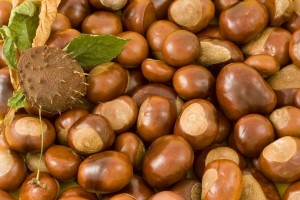
At Samhain, a large fire would be lit in the hearth and families would gather to consume warm, sweetened ale from a ‘wassail’ bowl. Roasted apples and nuts were used in divination games to foretell the fortunes of the following year. Here we find a source for the apple bobbing and games of conkers that are so popular among children and adults alike! Apples have long been associated with immortality and can be found in numerous myths and legends from around the world. The Goddess Idun of Norse mythology was the keeper of the apples of immortality that were fed upon by the gods of Asgard to retain their immortality. Likewise, in Greek mythology the Goddess Hera owned a sacred apple tree, attended by three sisters known as the Hesperides. In Celtic myth the famous isle of apples, or ‘Avalon’ was an otherworldly paradise to which King Arthur was taken by three fairy queens (one of whom was Morgan Le Fay, fay meaning ‘fate’). Apples also link to the triple goddess that abounds in Celtic and Pagan religions and is where we find the symbol of the pentacle or five-pointed star/star of knowledge – when the fruit is cut horizontally.

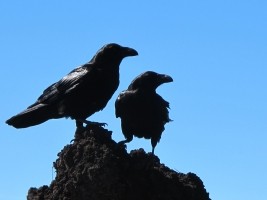
A harvest supper known as the ‘Hag’s Feast’ would be shared at Samhain, in honour of the winter hag or crone, who rules between Samhain and Imbolc (1st February). This ‘dark goddess’ ruled the inner tides of human emotion, the ‘womb’ of the ocean and the realm of dreams. The darkness of the womb gives birth to human life, as the dark of night and winter gives birth to day and springtime. Thus this figure and her time of year were about restoring and regenerating spirit, inner strength and hope. She has now been transposed into solely her darkest aspect, as the witch riding through the land on a wolf (or broomstick!) striking down signs of life with her wand of winter. The sign of the dark goddess is the black feather and her birds are carrion and so here we find the crows and ravens of Hallowe’en. It is also worth noting the two ravens belonging to Odin from Norse mythology.

Modern Pagans use this time to also connect with loved ones who have departed and for introspection. Feasting and familial gathering form part of a remembrance service where worries can be released onto paper and burned in the ‘Samhuinn fire’, which can be as elaborate as a large communal bonfire or as intimate as a single candle flame in ones home.

As you choose your costume and prepare to embark on a night of chaos and ghoulish fun, consider the ancient rituals you will be sharing with our ancestors!
BIBLIOGRAPHY:
OBOD – Samhuinn & Alban Elued [Autumn Equinoxe]
Hamlyn History - ‘Myths Retold’ by Diana Ferguson
‘Visions of the Cailleach’ by Sonita d’Este & David Rankine
‘Pagan Feasts’ by Anna Franklin & Sue Phillips
ALL IMAGES: courtesy of  Visualhunt.com

~~~~~~~~~~

Elaine writes historical fiction as ‘E S Moxon’. Her debut 'Wulfsuna' was published January 21st, 2015 and is the first in her Wolf Spear Saga series of Saxon adventures, where a Seer and one named ‘Wolf Spear’ are destined to meet. She is currently writing her second novel, set once again in the Dark Ages of 5th Century Britain. You can find out more about Book 2 from Elaine’s website where she has a video diary charting her writing progress. She also runs a blog. Elaine lives in the Midlands with her family and their chocolate Labrador.


Blood, betrayal and brotherhood.
An ancient saga is weaving their destiny. 
A treacherous rival threatens their fate. 
A Seer's magic may be all that can save them. 
WULFSUNA 
~


Monday, February 1, 2016

IMBOLC, St Brighid & the arrival of Spring

by Elaine S Moxon

In the northern hemisphere, February is a harsh month, but long-hoped for signs of new life begin to emerge at this time. The first shoots appear - the first stirrings of spring in the womb of Mother Earth; the first ploughing is carried out; lambs are born; calves are born; larks sing; the sea can be calm enough to occasionally launch fishing boats and corvids nest in the trees. Well, the pair of crows is back in the oak tree outside our house and it’s wonderful to see them. It means February is here and spring is around the corner. They always arrive around Imbolc, or ‘Ewe’s Milk’ as our Celtic ancestors called it. A Pagan festival for the returning of the light, often associated with St Brighid, it is my personal favourite of the 8 Celtic festivals (and incidentally the only one associated solely with a female deity within this polytheistic belief system). For many it is a time of wondrous inspiration as we emerge from the dark nights and into the lighter, longer days; re-birthed if you will.

Celebrations at this time of year are not confined to a single belief however. It is, or has been, a significant time in many cultures around the world including Aztecs, Christians, Druids, Greeks, Romans and Tibetans. It remains the Tibetan New Year as well as the Aztec New Year (the latter now celebrated in Mexico). The Romans carried candles through the streets to celebrate the Goddess Februa, the mother of Mars. An old hag figure would also release a dragon to be fought and overcome, possibly representing winter, while a young maiden released a lamb. For Christians it is Candlemas, representing the presentation of the infant Christ in the Temple. In the pastoral calendar it is the lambing season, and so is fitting that this festival celebrates the bringing of children into the world and provides a derivation for its Celtic name.

Connecting with the candle-carrying of Candlemas, it is interesting to note that Imbolc is a ceremony of light. For the Celts and Druids, of which I write about in my books, it is the time of the maiden/virgin goddess. Known as Bride or Brighid, from the Celtic name for a fire goddess – Breo (fiery) Saigit (arrow) – her symbol is the 3 fire arrows of ‘inspiration’, ‘healing’ and the ‘hearth’ or ‘forge’. One might say her influence on our ancient ancestors was so strong, Christianity embraced her into their light ceremonies and Breosaigit the fiery goddess merged with the image of Mary: virginal maidens who both gave life.

Part of 'Feast of Presentation' by Bellini, via www.churchyear.net

Brighid is the muse of the poet, the midwife and the smith and can be found depicted with 3 objects: the mirror, the spinning wheel and the cup or grail. The goddess worshipped by our Celtic ancestors was portrayed with a comb and mirror, as the mermaid still is to this day. The mirror, used for scrying and divination reveals other worlds as it does for Alice in Wonderland. The spinning wheel depicts the revolving cycle of sun and moon, the great cycle of life-death-rebirth and the Norns of fate, spinning the threads of creation in Norse mythology. Its power reveals itself even today through fairytales such as ‘Sleeping Beauty’. Lastly the cup is the womb, from which all life is born (and as was shared from the Holy Grail – the cup of life) and from which all things are sustained, as the ewe’s milk sustains the new-born lambs. Also known as Imbolg or Oimelc, in Gaelic it means ‘in the belly’.

Usually portrayed in a white cloak, Brighid bears a lantern and birch walking staff with a wolf by her side. The staff – a fertilising phallus – is used to regenerate life in the land and its animals. Birch, having white bark, is associated with purification and was used by the Celts and Druids to ritually drive out dark spirits and unwanted, lingering remnants of the old year. Brighid is also known as the ‘White Swan’, hinting at other ancient forms of the goddess in snake or bird form. This connects too with her image cloaked in white and an older tradition of Celtic women painting themselves and going naked to honour ‘the Veiled One’. Swans also echo Nordic legends of the ‘Swan Maidens’, a form of Norns or Valkyries who lure men as do, incidentally, mermaids. The wolf is a guardian, ruler of the winter quarter of the year beginning at Celtic New Year with Samhain and ending at Imbolc. February was ‘the wolf month’.

Detail of antlered figure, via archeurope.eu

Gundestrup Cauldron, via en.wikipedia.org

Wolves and hounds appear frequently in Celtic mythology as helpers or guides. They are the companion of the forest god Cernunnos and appear on the Gundestrup cauldron. The mother of the Celtic god Lugh, whose son is venerated at the festival of Lughnasadh (August 31st-September 1st) was killed while in the form of a hound. The Irish King Cormac claimed to have been suckled by wolves and tribes often claimed descent from wolf-packs, both Celtic and Germanic. In my novel ‘WULFSUNA’ the tribe name literally means ‘Wolf Sons’ and the warriors affiliate themselves closely with the animal, in behaviour as well as appearance, by wearing wolf pelts; the howling and gnawing on shields by ‘Berserkers’ is very animalistic and was done to instil fear into the hearts of the enemy.

For the Celts and Druids, the virgin goddess or ‘Bride’ is the Winter Goddess or Hag who has regained her youth, emerging from the womb of the Earth anew. The custom of corn dolls made at the last and first ploughing to safeguard crops evolved into the St Brighid’s Cross made today from rushes or straw – these are not a crucifix, but a cross of equal points reminiscent of a more ancient sun symbol.

Cross of St Brighid

In Scotland, young girls would make the ‘Bride’ dolls and visit neighbours, who would pay homage by giving gifts of bannocks, butter or cheese. Older women would make the ‘Bride’ doll a bed in a basket and welcome the effigy of the saint into their home for the night. The next day young men visited to pay tribute after which there was much merrymaking and feasting and sharing of the food gifts with the poor. An elderly neighbour, who a few years ago had to go into a home, would secretly leave me a small pot of hyacinths on my back windowsill. He did it for 15 years and it warmed my heart. So in these lean times, in the spirit of our ancestors, I invite friends or family for a meal, or make apple butter for neighbours from my winter store of home-grown cooked apples. However you show it, bring some light into another’s life and spread the spirit of spring!

~~~~~~~~~~~~~


Elaine writes historical fiction as 'E S Moxon'. Her debut Wulfsuna was published January 21st, 2015 and is the first in her Wolf Spear Saga series of Saxon adventures, where a Seer and one named 'Wolf Spear' are destined to meet. She is currently writing her second novel, set once again in the Dark Ages of 5th Century Britain. You can find out more about Book 2 from Elaine's website where she has a video diary charting her writing progress. She also runs a blog. Elaine lives in the Midlands with her family and their chocolate Labrador.