Showing posts with label 16th century. Show all posts

Monday, February 6, 2023

Sleeve Puffs, Lace Ruffs, and The Queen's Wardrobe

by Sandra Byrd


"Queen Elizabeth was so fond of her clothes that she would never part with any of them, and it is said that at her death there were three thousand dresses and 'head attires' in her wardrobe." So claims Herbert Norris in his tome, Tudor Costume and Fashion.

Elizabeth actually was known to give away some of her clothing—to her ladies, to maids of honor, and to other less well-off nobles. But there is no doubt that the woman, like her mother and father before her, was a clothes horse.

Queen Elizabeth I Coronation Robes
Her coronation robes, according to Norris, "consisted of a dress with a long train of gold tissue lined with white sarcenet and bordered with ermine, and worn over the Spanish farthingale." Of interest is the fact that, of course, ermine, the winter white fur of the English stoat, is common among the robes of state, sometimes being powdered (as was the queen's visage) to make it even whiter.

Although both Queen Anne Boleyn and her daughter were particular to French fashion, the queen retained a fondness for the Spanish hoop and  underskirt fashion nearly all of her reign. But how did the queen, and others of the age, know what was fashionable in France, or anywhere else?

Portraits of ladies and nobles in other lands were available through diplomatic channels, and they provided insight into continental fashion. Queen Elizabeth tried, in vain, to bring over a French seamstress at least once during her reign.

More interesting, though, were the fashion dolls that were sent from land to land. Helena von Snakenborg, Marchioness of Northampton, sent such a doll to her Swedish sister, Karin Bonde, in 1604. Helena's letter to her sister says, "As regards the doll, which, dearest sister, you have mention in your letter, we have sent our servant up to London, to have it dressed in the best and latest fashion of the season. When it is ready it shall be sent to you as you desire." According to Janet Arnold's Queen Elizabeth's Wardrobe Unlock'd, there is just such a little doll preserved at a museum in Stockholm, dating from the late 16th century. Click here to see the doll.

Helena  (Elin) von Snakenborg,
Marchioness of Northampton

There are two fashion accessories for both men and women that are particularly noted to the Elizabethan era: the ruff and gloves. Norris teaches that the ruff started out as "a cutwork or lace edging on the neckbands of gentlemen's shirts" before the reign of Elizabeth's brother, Edward VI. But they continued to grow until, as John Davis writes in Life in Elizabethan Days, "ruffs a foot deep are very usual and a gallant's head sticking out of them looks (as a courtier remarked) 'like John the Baptist's head upon a platter.'"

The ruffs were often lace or linen, and were formed and curled on hot irons. Norris states that, "Starch, called by the Puritans as 'the Devil's liquor'" was brought over from the Netherlands, and that a Dutch woman whose husband was Elizabeth's coachman "monopolized in England the knowledge of clear starching."

The queen was famously vain of her long white fingers, and rightly so. To protect them, and to show them to their best advantage, she often wore gloves. Gloves were most often made of soft kid, and were embroidered and embossed, or had delicate ruffs of their own sewn on. Norris says that perfumed gloves were not common until later in Elizabeth's reign, when they became very popular indeed. The queen received a dozen pair of them as gifts for the New Year, 1599.

The queen was famous, like her father, for an abhorrence to "evil smells."  This made perfumed gloves very popular,  but also an easy vehicle for those who would like to poison her through inhalants. In 2012, the London department store Selfridges sponsored an exhibition of gloves to mark the Diamond Jubilee of Queen Elizabeth II. The centerpiece of the exhibit? The gloves worn by Queen Elizabeth I at her 1559 coronation.  You can view the entire collection here: Selfridge's Diamond Jubilee Glove Exhibit.

James I
According to Lace: A History, by Santina Levey, in today's money, Queen Elizabeth I averaged £9535 4 wardrobe each of the last four years of her reign; James I (That's King James of the King James Bible) averaged £36,377 per year during the first five years of his.  In today's money, that's roughly £1,191,875 ($1,883,163) per year for Elizabeth or £4,547,125 ($7,184,458) for James. So perhaps the Stuarts were the biggest clothes horses of all!

~~~~~~~~~~~~


The author of more than fifty books, Sandra’s work has received many awards, nominations, and accolades, including a starred review from Publisher’s Weekly and multiple starred reviews and Best Book selections from Library Journal. Other awards include the Historical Novel Society’s Editor’s Choice award, two Christy Awards finalists, a Bookpage Top Pick for Romance, and inclusion on Booklist’s Top Ten Inspirational Books of the Year list.

As an editor and an in-demand writing coach, Sandra is passionate about helping writers develop their talents and has mentored hundreds of writers at all stages of their writing careers. 

A dedicated foodie, Sandra cooks through the topic and location of every book she writes. In addition, she collects vintage glass and serve ware in her free time, loves long walks with her husband, and Sunday Suppers with her growing family. 


Find the Tudor Ladies in Waiting series here.

Friday, October 30, 2020

The Truth About Halloween and Tudor England

by Nancy Bilyeau

I have a passion for 16th century England. My friends and family, not to mention my agent and editors, are accustomed to my obsession with the Tudorverse. Namely, that for me, all roads lead back to the family that ruled England from 1485 to 1603. Could it be possible that Halloween, one of my favorite days of the year, is also linked to the Tudors?

Yes, it turns out, it could.

The first recorded use of the word "Halloween" was in mid-16th century England. It is a shortened version of "All-Hallows-Even" ("evening"), the night before All Hallows Day, another name for the Christian feast that honors saints on the first of November.
But it's not just a literal connection. To me, there's a certain spirit of Halloween that harkens back to the Tudor era as well. Not the jack o' lanterns, apple-bobs and haunted houses (and not the wonderful Christopher Lee "Dracula" movies that I watch on TCM network every October, two in a row if I can). It's that mood, frightening and mysterious and exciting too, of ghosts flitting through the trees; of charms that just might bring you your heart's desire; of a distant bonfire spotted in the forest; of a crone's chilling prophecy.

The Oxford Astrologer
In pre-Reformation England, the Catholic Church co-existed with belief in astrology and magic. It was quite common to attend Mass regularly and to consult astrologers. "The medieval church appeared as a vast reservoir of magical power," writes Keith Thomas in his brilliant 1971 book Religion and the Decline of Magic. Faithful Catholics tolerated the traditions of the centuries-old Celtic festival of Samhain ("summer's end"), when people lit bonfires and put on costumes to scare away the spirits of the unfriendly dead. In fact, an Eighth Century pope named November 1st as the day to honor all Catholic saints and martyrs with an eye toward Samhain.

Soul cakes
Nothing shows the merger of Celtic and Christian beliefs better than "soul cakes." These small, round cakes, filled with nutmeg or cinnamon or currants, were made for All Saints’ Day on November 1st. The cakes were offered as a way to say prayers for the departed (you can picture the village priest nodding in approval) but they were also given away to protect people on the day of the year that the wall was thinnest between the living and the dead, a Celtic if not Druid belief. I am fascinated by soul cakes, and I worked them into my first novel, The Crown, a thriller set in 1537-1538 England. Soul cakes even end up being a clue!

In the early 16th century, Halloween on October 31st, All Saints’ Day (or All Hallows Day) on November 1st and All Souls’ Day on November 2nd were a complex grouping of traditions and observances. Life revolved around the regular worship, the holidays and the feast days that constituted the liturgy. As the great Eamon Duffy wrote: "For within that great seasonal cycle of fast and festival, of ritual observance and symbolic gesture, lay Christians found the paradigms and the stories which shaped their perception of the world and their place in it."
Sculptures smashed at Worcester Cathedral.
Henry VIII changed the perceptions of the kingdom forever when he broke from Rome. A guiding force in his reformation of the Catholic Church was the destruction of what he and his chief minister Thomas Cromwell scorned as "superstition." Saints' statues were removed; murals telling mystical stories were painted over; shrines were pillaged; the number of feast days was sharply reduced so that more work could be done during the growing season. "The Protestant reformers rejected the magical powers and supernatural sanctions which had been so plentifully invoked by the medieval church," writes Keith Thomas. The story in The Crown is told from the perspective of a young Catholic novice who struggles to cope with these radical changes.


My children love Halloween as much as I do. Yet somehow Halloween, the day before All Saints’ Day, survived the government's anti-superstition movement, to grow and survive long after the Tudors were followed by the Stuarts. It’s now a secular holiday that children adore (including mine, who are trying on costumes four days early). 

As for me, I relish the candy handouts, costumes and scary movies—and I also cherish our society’s stubborn fondness for bonfires and charms and ghosts and sweet cakes, for in them can be found echoes of life in the age of the Tudors.

This is an Editor's Choice and was originally published on October 27, 2011.
~~~~~~~~~~

Nancy Bilyeau is a historical novelist and magazine editor based in New York. She wrote the Joanna Stafford trilogy, a trio of thrillers set in Henry VIII’s England, for Simon & Schuster. Her fourth novel is The Blue, an 18th century thriller revolving around the art & porcelain world. Her latest novel is Dreamland, set in Coney Island of 1911, is published by Endeavour Quill. A former staff editor at Rolling Stone, Entertainment Weekly, and InStyle, Nancy is currently the deputy editor at the Center on Media, Crime and Justice at John Jay College and contributes to Town & Country, CrimeReads, and Mystery Scene magazine.

For more information, visit www.nancybilyeau.com.

Friday, February 14, 2020

The Mystery of The Queen’s Pearl

by Judith Arnopp

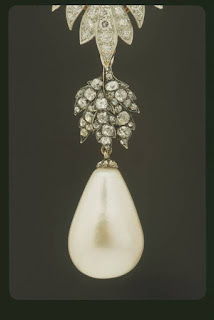
Since my youth I have been awed by the story of La Peregrina, the ‘royal’ pearl that had passed from queen to queen until it was given as a Valentine present to Elizabeth Taylor by Richard Burton. As a girl I quite envied Elizabeth Taylor‘s ownership of such a historic piece of jewellery. It was good to see a perfect specimen that had once graced the bosom of a Tudor queen dangling in the cleavage of a twentieth century heroine. I was disappointed to learn a few years ago that it was indeed a different, if very similar, pearl. Unsure if it was true or just more fake news, I scanned the internet for information but the articles I found just increased my confusion.

Mary Tudor by Master John 

There is a lot of misinformation out there. I even found one article stating that:

‘The Spanish master, Diego Velazquez, in the mid 1600s painted Queen Isabel wearing the pearl, and he also painted young sweet Mary, Queen of England wearing the pearl before she became Bloody Mary and had her namesake niece, Mary Queen of Scots, beheaded.’

Oops, big boo boo! I didn’t read this unreliable article any further but I did find some offering useful information.

Elizabeth’s Taylors jewel is smaller than the one that Mary wore and it seems that the one of Tudor fame has been mislaid. The mystery becomes more complex when you discover there is another similar pearl with the almost identical name of La Pelegrina. Wikipedia explains it thus:

"La Pelegrina" is a Spanish word. Some gem historians translated it as "the Incomparable", but actually "La Pelegrina" has no such meaning in Spanish. Other gem historians believe that the name "La Pelegrina" was made to show a connection between "La Pelegrina" and another famous pearl “La peregrine”. "La Peregrina" means ‘The Pilgrim" or "the Wanderer", and rhyming the names "La Pelegrina" and "La Peregrina" could mean that the name "La Pelegrina" was meant to be also "the pilgrim" or "the Wanderer", and a single letter was changed to distinguish between the two different pearls.”
Confused? I am.

But undaunted, I set out to see if I could trace the path of two gems, almost identical in appearance, with almost identical names.

La Pelegrina was discovered on the coast of Santa Margarita in the Gulf of Panama in the 16th century. The man who found it was a slave who was rewarded for his discovery with his freedom. Inca Garcilaso de la Vega wrote about this in his Royal Commentaries of Peru.

‘This pearl, by nature pear-shaped, had a long neck and was moreover as large as the largest pigeon’s egg. It was valued at fourteen thousand four hundred ducats but Jacoba de Trezzo, a native of Milan, and a most excellent workman and jeweller to his Catholic Majesty, being present when thus it was valued said aloud that it was thirty – fifty – a hundred thousand ducats in order to show thereby that it was without parallel in the world.’ (La Pelegrina pearl. (2019, August 31). Retrieved from https://en.wikipedia.org/wiki/La_Pelegrina_pearl)

In 1660 Philip IV of Spain gave the pearl to his daughter, Maria Theresa, on her marriage to Louis XIV of France. The pearl travelled with her to France and disappeared after Maria Theresa’s death in 1683. It did not reappear until 1826 when it showed up in St. Petersburg. It is believed that it then entered the French crown jewel collection but was stolen during the revolution along with the rest of the crown jewels. Sometime after that it travelled to Russia where Zinaida Yusupova was painted wearing it. The pearl then passed to her son, Felix Yusupov, (who interestingly, was involved with the murder of Rasputin.)

In 1917 during the October Revolution Felix smuggled the pearl, together with other royal jewels out of Russia. He later sold many of his treasures but hung on to La Pelegrina until 1953 when he sold it to a jeweller in Geneva.

Portrait of Zinaida Yusupova (1861-1939)
by François Flameng

La Peregrina
The first mention of this pearl is in Commentarios Reales de Los Incas by Garcilaso de la Vega (1539-1616). He describes a pear-shaped pearl arriving in Spain from Venezuela (although according to Wiki other sources mention Panama) in 1579. It was sold to King Phillip II of Spain who later married Mary I of England. (This made my ears prick, perhaps he did give it to her after all). He intended it as a gift for his daughter but instead added to the crown jewels where it is recorded as being for two hundred years.

Juan Pantoja de la Cruz, Margaret of Austria, 
Queen of Spain wearing the pearl (c. 1606) 

It seems to me that Philip may very well have given it as a marriage gift to Mary but there is no record of that ever having taken place. There are portraits of Mary sporting a very similar one. It would be lovely to think this was THE pearl but it is not recorded and neither is it listed with the jewels he did give her that were later returned to Spain after her death.

La Peregrina was worn by many Spanish queens. Margaret of Austria wore it while married to Philip III and it appears in portraits of Elizabeth of France and Mariana of Austria who were wives of Philip IV.

Peter Paul Rubens, Elisabeth of France, 
Queen of Spain wearing the pearl (c. 1625) 
When the elder brother of Napoleon Bonaparte ruled Spain in the 1800s it came into his possession but he left the kingdom after the French lost the Battle of Vitoria. At this time he made off with several of the crown jewels and it is believed La Pelegrina was among them. He bequeathed the pearl to his nephew who would become Napoleon III of France. It was Napoleon III who sold the pearl while in exile in England to James Hamilton, Later Duke of Abercon, who purchased it as a gift for his wife, Louisa. It remained in the Hamilton family until they sold it at Sothebys in 1969.
During the course of its history the pearl came close to catastrophe on several occasions. Once it was lost down the back of a sofa at a party at Windsor Castle, the second time during a ball at Buckingham Palace.

It was bought in 1969 by Richard Burton for $37,000 as a Valentine’s gift (hint-hint husband) for his wife Elizabeth. In her book My Love Affair with Jewellery she relates a story of it almost being swallowed by one of their dogs.

‘At one point I reached down to touch La Peregrina and it wasn't there! I glanced over at Richard and thank God he wasn't looking at me, and I went into the bedroom and threw myself on the bed, buried my head into the pillow and screamed. Very slowly and very carefully, I retraced all my steps in the bedroom. I took my slippers off, took my socks off, and got down on my hands and knees, looking everywhere for the pearl. Nothing.‘

Then on seeing one of the puppies chewing something …

‘I just casually opened the puppy's mouth and inside his mouth was the most perfect pearl in the world. It was—thank God—not scratched.’ (Elizabeth Taylor: my love affair with Jewelry - Simon & Schuster; 1 Oct. 2002) N.B: Ms Taylor seems to have recounted this tale several times, each one slightly different.’

Mary Tudor by Hans Eworth 1554, NPG 4861
© National Portrait Gallery, London 

The Burtons, at the time believing the pearl to have belonged to Mary Tudor purchased a portrait of Mary wearing the pearl and when it was discovered the connection was likely to be false, they donated the painting to the National Portrait Gallery.

La Peregina was sold after Elizabeth Taylor’s death fetching more than eleven million dollars.

“La Peregrina.” La Peregrina - Smithsonian Institution,
Photo by NMNH Photo Services.
So, curiouser and curiouser. We now have two different pearls, neither of which seems to be have been worn by Mary although she is clearly wearing a very similar one is several portraits.

I found an article from a few years ago by jewellery exhibitor Symbolic & Chase who showcased a jewel which they called ‘The Mary Tudor Pearl.’ According to their description the Renaissance pearl surfaced in 2004, having been lost since the late 16th century, and can be dated back to 1526. It measures 258.12 grains (64.5 carats, 69.8 carats with its diamond cap) making it the third largest well-formed natural pearl documented to date.

The provenance leads at last to Mary.

‘Between 1526 and 1539 the pearl entered into the outstanding jewellery collection of the Empress Isabella of Portugal (1503-1539), either as a diplomatic gift or by the Empress purchasing it. When the Empress died in 1539 the pearl was inherited by her daughter, Juana of Austria (1535-1573). Following a short marriage to Prince John of Portugal (1537 – 1554), Juana returned to Spain to assume regency for her brother, Philip II. The pearl became part of Philip’s dowry for his new bride, Mary Tudor (1516-1558), after whom the pearl has been christened.'

Mary Tudor, Queen of England, 
second wife of Felipe II’ by Anthonis Mor 

‘It is an outstanding asymmetrical drop-shaped pearl that was much admired by the Tudor courts and is featured in Royal portraiture of Mary Tudor, namely ‘Mary Tudor, Queen of England, second wife of Felipe II’ by Anthonis Mor at the Museo del Prado and ‘Queen Mary I’ by Hans Eworth, which has been included below courtesy of The Bridgeman Art Library. A similar painting by Hans Eworth of Queen Mary I also hangs at the National Portrait Gallery.' ("The Mary Tudor Pearl Unveiled", Kari Pearls: Natural Pearls - A Trusted Resource.)

But is this and Mary’s pearl one and the same? The stories of all three jewels are so close, the provenances quite similar with it passing through the hands of so many European Royals, could their stories not just been horribly mixed up? Just as I was beginning to believe it was, I came across this website and discovered I wasn’t the only one in search of it. This website sums the whole thing up far more succinctly than I could ever do. He believes there is a third jewel, now known as Queen Mary’s Pearl and concludes that:

‘Mary Tudor never owned La Peregrina, though she did own a slightly larger pearl now known as the Mary Tudor Pearl.
Mary Tudor wore her pearl suspended from a golden brooch set with the Grande diamond that Philip II inherited from his mother, Isabel de Aviz.
Upon her death, Mary Tudor returned this brooch to her husband, who removed the pearl and gave it back to his sister Joanna.
Upon Joanna's death, the pearl was put up for auction.
The pearl failed to sell at the 1574 auction, but a man by the name of Diegor Ruiz purchased it in 1581 for 3,300 reales. After this, the pearl disappears from record.
In 2004, this pearl appears on the block at Christie's London, at which time it is purchased by Symbol & Chase of Bond Street.’
©2006-2020 EraGem®

For more information, read this very fascinating blog post.

~~~~~~~~
Judith Arnopp is the author of twelve Historical Fiction novels and has contributed to several non-fiction anthologies. you can find more about Judith's work on her webpage: www.judithmarnopp.com or her Author Page: author.to/juditharnoppbooks
Judith's latest novel is The Heretic Wind: the life of Mary Tudor, Queen of England available on Kindle and Paperback. The audio version will be available later in 2020.


Friday, January 17, 2020

Romancing the Tower of London: William Harrison Ainsworth

By Nancy Bilyeau

On a December night in 1840, a sizable group of writers, editors, publishers, printers and illustrators gathered at the Sussex Hotel, in the fashionable town of Royal Tunbridge Wells, for a dinner party. It is possible that Charles Dickens, the young author of Oliver Twist and The Life and Adventures of Nicholas Nickleby, was invited to the party. Most definitely in attendance was George Cruikshank, the talented illustrator of Oliver Twist.

The host of this lavish affair was the famed 35-year-old novelist William Harrison Ainsworth. The occasion: the successful serialization over the last year of his fifth novel, The Tower of London: A Historical Romance, which told the story of the tragic Lady Jane Grey, beginning with her arrival by barge at the Tower to launch her nine-day-reign and ending with her decapitation on Tower Green on July 10, 1553.

William Harrison Ainsworth

The novelist was sure to have cut quite the dash at his own party: He was tall, slim and dark, with a fondness for stylish clothes that earned him the description dandy. From the Oxford Dictionary of National Biography: "Lady Blessington, whose salon he attended, said he and Count D'Orsay were the two handsomest men in London."

In a passage accepted as autobiographical, a character in one of Ainsworth's novels says, "Some people told me I was handsome, and my tailor (excellent authority, it must be admitted) extolled the symmetry of my figure, and urged me to go into the Life Guards."

Ainsworth was at perhaps the zenith of his career in 1840. He was a friendly rival to Dickens; in fact, his 1839 novel Jack Shepard outsold Oliver Twist in early editions, and Ainsworth had recently replaced Dickens as editor of Bentley's Miscellany, the predominant fiction magazine.


The rivalry with Dickens would not last; nor would the friendship. Dickens would become a colossus as Ainsworth slowly sank into oblivion. His 39 historical novels, all of them romances and adventures, were astoundingly popular with the reading public of Victorian England, but not with the critics. Although Ainsworth was himself a genial and generous man, he was often on the receiving end of literary volleys almost hysterical in their dislike. When his books no longer sold as well, he had no circle of supporters to buoy him. Quite the opposite. One writer said of him in 1870: "Let us start with an opinion fearlessly expressed as it is earnestly felt, that the existence of this writer is an event to be deplored." Ainsworth was still alive when this sentiment was published, and in reduced circumstances.

That dazzling night at Royal Tunbridge Wells, Ainsworth, mercifully, could not know that his books would go out of print, that fellow writers such as Edgar Allan Poe would describe his prose as "turgid pretension."

Yet he is not without a legacy. The book celebrated that night, The Tower of London: A Historical Romance, triggered a new kind of interest in William the Conqueror's castle keep. It was an interest that deepened through the Victorian age, and is part of the reason visitors pour into the Tower, to the tune of 2 million a year.

Ainsworth was born on February 4, 1805, in Manchester, as the city became the center of the industrial movement. Thomas Ainsworth was a prominent lawyer and pressured his oldest son to follow him in that profession, which he did for a time, but without much enthusiasm. There was a younger son, Thomas Gilbert Ainsworth, who at university suffered a "brain fever" and was incapicitated by mental illness his entire life.

Two years after the father died, Ainsworth, newly married, published his first novel, the romance Sir John Chiverton. It brought him to the attention of Walter Scott, who befriended Ainsworth but privately referred to him as an "imitator." His next two books, the historical novels Rockwood and Jack Schepard, both featuring famous outlaws, were tremendous successes. Yet some criticized the romanticizing of criminals, a complaint Dickens was also hearing with Oliver Twist.

It was time to try something different.

When Ainsworth, along with his illustrator, George Cruikshank, researched the Tower of London, it was far from the smoothly operating tourism operation of today. It had been two centuries since the last monarch, Charles II, resided there. Dickens wrote: "Once a fortress, a royal residence, a court of justice and a prison, {the Tower} is now a government storehouse and armory." An outbreak of disease caused by poor water supply (and blamed on the filthy moat) killed three men of the garrison.

A visitor in 1851 wrote:

"Every one must be struck with the incivility and want of accommodation therein. Upon entering the gates this afternoon I found some hundreds of persons, male and female, huddled together, striving to obtain tickets from a window under a portico where no two persons can pass abreast, and the scene there reminded me of what might be expected at the gallery entrance of a theatre on boxing night. After waiting just one hour we obtained our tickets and were ordered into what is called the ante or refreshment room. This room is about 12ft. by 18ft., with a counter containing ginger pop, buns, &c., immediately behind which are two waterclosets (I understand recently erected). I will not attempt to describe the stench one had to contend with, the place being completely crammed with persons waiting their turns or numbers to be called, but merely add that this room seems to be the resort of pickpockets, two ladies having been eased of their purses, containing some pounds, during the half hour I was present therein."

Ainsworth opened the door to a more illustrious period in the Tower's history. It's true that the novel's prose is melodramatic ("heaving bosoms," "piercing black eyes" and "sinister smiles") and the pages are crowded with Gothic characters (not one or two but three supporting characters who are giants--and a dwarf!) along with august personages of the past. But Ainsworth's diligent research brings to life the grounds, the kitchens, the passageways, the prison cells and the beautiful chapels of the Tower. He made full, imaginative use of the Tower of London, as a setting for a story of high drama. And Cruikshank's 40 engravings and 58 woodcuts play their suggestive part.


Cruikshank's depiction of Lady Jane Grey
And in the center of it all is Lady Jane Grey, a character of undeniable pathos, surrounded by conspiracies. Ainsworth invests the Spanish ambassador, Simon Renard, with the malevolent abilities of a Blofeld straight from Bond. Northumberland is formidable indeed.There is an energy to the book, and an eerie, even frightening atmosphere. The rack, the Scavenger's Daughter and the infamous Little Ease are all present and accounted for.

The current official Historical Royal Palaces Tower of London "fact sheet" on torture emphasizes how little actual torture has taken place within its walls: "Myth-making reached its peak in the 19th century, spurred on by novelists who wished to evoke the Tower of London in its former days as an ancient fortress and stronghold e.g. Ainsworth’s The Tower of London." Ainsworth may have put the devices of torture to Gothic uses, but they were very much present in the 16th century. Ironically, government-approved torture of prisoners ebbed during the reigns of Edward VI, Jane Grey, and Mary, only to rise to highest levels during reign of Elizabeth.

After The Tower of London, Ainsworth's career went on for more than thirty years. The characters in his books were not dimensional; bosoms continued to heave and black eyes to snap. R.H. Horne, Dickens' friend and collaborator, described Ainsworth as "a reviver of old clothes" whose novels are "generally dull except when revolting." Punch satirized Ainsworth as an aging Tudoresque dandy with the caption "The Greatest Axe-and-Neck Romancer of Our Time."


By the time of the Punch jab, Ainsworth, a widower, was responsible for his mentally ill brother. He had accepted a government pension because...he needed it. A year after a dinner in his honor in Manchester, arguably the only place where he was still esteemed, William Harrison Ainsworth died at the age of 77.
But the Tower felt the lingering impact of Ainsworth. In the foreword of his book, he had called for the opening to the public of Beauchamp Tower, the place of imprisonment of the Lady Jane Grey, where she is thought to have written on the wall of her cell. The cause was taken up by powerful patrons, including Prince Albert. Beauchamp was restored by architects and made available to visitors; other buildings were opened too.

Ainsworth's influence, as explained in The Tower of London: The Official Illustrated History:

"In The Tower of London: A Historical Romance, the Tower was first and foremost the setting for an endless series of heart-rending events and foul play. The author tells of dungeons though in fact the Tower has very few basement rooms and of a time when Tower Hill boasted a scaffold and "its soil was dyed with the richest and best blood in the land.” Such fantasies, backed by the relentless march of the romantic movement, helped create and fuel an ever-increasing demand to see and experience such events.”

No matter how much the novel's violence veers into fantasy, the faintly menacing image of the Tower that draws the throngs of the curious today was created in part by William Harrison Ainsworth. He was the greatest neck-and-axe romancer of his time...and perhaps of ours too.

This article is an Editor's Choice and was originally published August 19, 2012. 

~~~~~~~~~~

Nancy Bilyeau is a historical novelist and magazine editor based in New York. She wrote the Joanna Stafford trilogy, a trio of thrillers set in Henry VIII’s England, for Simon & Schuster. Her fourth novel is The Blue, an 18th century thriller revolving around the art & porcelain world. Her latest novel is Dreamland, set in Coney Island of 1911, is published by Endeavour Quill. A former staff editor at Rolling Stone, Entertainment Weekly, and InStyle, Nancy is currently the deputy editor at the Center on Media, Crime and Justice at John Jay College and contributes to Town & Country, CrimeReads, and Mystery Scene magazine.

For more information, visit www.nancybilyeau.com.

Monday, October 1, 2018

Coronation of Queen Mary I

By Samantha Wilcoxson

Princess Mary Tudor was crowned Queen Mary I on October 1, 1553, in an event without precedent. After fighting successfully for her birthright, Mary became England's first queen regnant.

Entrance of Queen Mary I with Princess Elizabeth
into London 1553, by John Byam Liston Shaw
The spectacle had actually begun several days earlier when Mary arrived at the Tower of London with her sister, Elizabeth. They were welcomed with music, decorations, and a volley of the Tower guns by the mayor and aldermen of London. Time here was spent rehearsing for the coronation. Mary also met with her councillors and pledged herself, on her knees, to "the task God had been pleased to lay on her to His greater glory and service, to the public good and all her subjects' benefit." It was an emotional moment that left many of the men in tears. Then, on September 30, the sisters rode through the city to the Palace of Westminster, where the coronation ceremony would begin.

Their procession was planned to impress Londoners with the vision of everything they believed their monarch should be, and they were met by cheering crowds. Rich fabrics and vibrant colors glittered with magnificent jewels, silver, and gold. Even the horses were draped in beautifully embroidered cloth. Amid this dizzying array of wealth, Queen Mary was expected to stand out. She rode in an open chariot draped in gold. Her dress of purple velvet trimmed in ermine was complimented by the crimson velvet worn by her ladies and silver cloth-of-gold worn by Princess Elizabeth and Anne of Cleves. The bejeweled crown that Mary wore for the procession was reported to be so heavy that she wearily propped up her head with her hands.

Queen Mary I,  1554
by Hans Eworth
Crowds, pageants, and performers vied for Mary's attention as her procession slowly moved from the Tower to Westminster. Choirs of children sang as wine flowed from fountains. An acrobat even performed atop the weathervane of St Paul's Cathedral. After what must have been an exhausting day, Mary prepared for her coronation.

The next day was certainly one filled with both excitement and anxiety for this woman who had been at various times pampered and bastardized by a tempestuous father. Mary was not necessarily the showman that Henry VIII had been, so to be put on display before crowds would have been stressful, even without the knowledge that she was setting a historical precedent. Setting aside her shyness and timidity, Mary was determined that her coronation be held according to the customs of the kings who had come before her.

Mary wore crimson velvet robes and walked on blue fabric from the porch of Westminster Hall to the Abbey. Her auburn hair was worn loose in the style of a queen, but the orb, scepter, and crown of kingship were carried before her. Inside Westminster Abbey, swathes of cloth-of-gold hung from the choir to the altar and covered the grand chair upon which Mary was seated.

She was presented by the Bishop of Winchester:
"Sirs, here present is Mary, rightful and undoubted inheritrix by the laws of God and man to the crown and royal dignity of this realm of England, France and Ireland, whereupon you shall understand that this day is appointed by the peers of this land for the consecration, inunction and coronation of said most excellent Princess Mary; will you serve at this time, and give your wills and assent to the same."

"Yea, yea, yea. God save Queen Mary," those assembled responded.

Mary gave her offering and lay prostrate upon cloth-of-gold cushions as prayers were invoked above her. After a sermon by the Bishop of Chichester on the obedience owed to kings, Mary was prostrate again to swear her oaths as queen, followed by her anointing. Bishop Gardiner touched holy oil to Mary's forehead, temples, shoulders, and chest as she knelt wearing a sleeveless purple velvet corset. After the anointing, Mary was again regally dressed in a crimson velvet mantle and crimson cloth-of-gold slippers.

Gold coin featuring Queen Mary I, 1555
Trumpets announced the moment each of three crowns was placed upon Mary's head, and the choir sang Te Deum when the coronation ring was placed on her finger. She then received the sword and spurs that would have been presented to a crowned king and received the homage of her clergy and magnates. Finally, another offering was made, and Mary carried the orb and scepters (one traditionally the queen's and the other the king's) to her coronation feast.

She was Queen of England, but she had taken a long road to get there. Her mother's only child, Mary had been raised to believe she would be her father's heir. When Henry VIII broke with both Katherine of Aragon and the Catholic Church in order to disinherit Mary, she may have believed she would never see the throne. Through many trials and tribulations, which did not end once she was queen, Mary endured.

Additional Reading
Mary Tudor: Princess, Bastard, Queen by Anna Whitelock
The First Queen of England: The Myth of Bloody Mary by Linda Porter


All images in the public domain through Wikimedia Commons

~~~~~~~~~~

Samantha Wilcoxson is the author of the Plantagenet Embers series featuring women of the Wars of the Roses and Tudor England. Her current project is taking her back to the beginning of the Plantagenet dynasty.

An incurable bibliophile and sufferer of wanderlust, Samantha lives in Michigan with her husband and three teenagers. You can connect with her on her blog or on Facebook, Twitter, Instagram, and Goodreads.


Friday, July 6, 2018

16th Century British Furniture Primer

by K.M. Pohlkamp

My character hears approaching footsteps, and she knows she mustn’t be discovered with the poison in her hand. Rushing to her intended victim’s bed chamber, she hides behind the...

Uh… What does she hide behind? What furniture would have existed in a 16th century noble bedroom?

Such plot questions often send me into a consuming spiral of research, and this one was no different. But I vehemently maintain perusing Tudor history websites counts as writing - it’s for research! And at least it’s more easily justified than scanning my Twitter feed.

Unfortunately, however, as the prominent British woodwork journalist, Charles Hayward, truthfully writes of England:

“...[T]he troublous times through which this country went in the Middle Ages certainly enabled destruction to carry out its work of waste. An army marching through an enemy country would spare little that came its way, and even in peaceful times the outbreak of fire must have been an ever-present source of danger. Domestic houses are invariably built of timber and, as the fire on the open hearth is almost never allowed to go out, being just fanned to a flame every morning, the chances of the building catching fire is high.”

In addition to the likelihood that furniture was destroyed, few pieces existed to begin with. During the medieval period, furniture was sparse and a symbol of status and wealth resulting from the scarcity of wood and skilled artisans.

However, Henry VIII began to change this. The King benefited from the frugality of his predecessor, Henry VII, and used the Crown’s amassed financial reserves to outfit his palaces with luxurious furniture. Cardinal Wolsey shared the King’s fondness for lavish spending and an inventory of Hampton Court records once listed 280 beds.

During Tudor England, a well-off master bedroom contained a bed, a chest to hold clothes, and possibly a cupboard. Beyond the bedroom, homes of nobility usually also contained a large table, a chair for the owner of the house, benches and stools for the rest of the household, a cupboard, and a chest. Poorer souls often only had a mattress and stools or benches. It was not until later in Queen Elizabeth’s reign that wealth and prosperity became more commonplace and yeomen famers were able to purchase additional pieces of furniture. But what did Tudor furniture look like? As with most historical questions, the few surviving pieces, writings, and artwork can help us piece together the past.

Cupboards, Aumbrys and Chests

From 1300-1550, the armoire or aumbry served the equivalent purpose of today’s cupboard. In English, the term armoire evolved to aumbry, then ambry and almery, which derives from a term for hutch, which was a box storing meat and bread scraps to be given to the poor. It is not until later in the reign of Henry VIII that the word “cupboard” is found, but in this time period, both terms are appropriate. John Smythe (1490-1544) of Blackmore Priory referred to a “fine almery with four dores for breade” in his 1543 will, and a 1527 inventory of Cardinal Wolsey’s possessions included 21 “cupboardes of waynescotte whereof V be close cupboards.”

Regardless of its name, this piece of furniture was used to store food. The first aumbrys were simple boxes with shelves and doors, but later, “Gothic tracery” was added to the front to provide ventilation for the purposes of food preservation.

A press cupboard from 16101

Depiction of late-16th-century three drawer chest1

Tudor-style cabinet5

The “court cupboard,” or set of shelves, first appeared in Britain during the Tudor period and is believed to have come from Italy or France. These pieces sometimes included hidden drawers used by aristocracy to store plates, eating utensils, wine, and other things. The top was often covered with cloth.

Example of a court cupboard and its hidden drawers1


Chairs

While chairs became more common in Tudor England, they were still expensive. The use of chairs was often restricted to high-ranking persons. Consider the platforms at the end of great halls featuring an imposing throne chair. Even in an upper-class home, children and servants used stools and only the head of the house had a chair. Everyone else was left to settle with benches, stools, and even sit on chests. The poor only had stools and benches.

The transition from sitting on chests to chairs is evident in 16th century chair design which was inspired by the six-board chest. This can be seen by comparing the depicted chair’s construction with the chest above.

Box chair 10th-16th century1

Beds

In the late 16th century, the “tester” (or canopy) above beds of the privileged were no longer suspended from the ceiling, giving rise to the “four-posted bed.” Curtains were still hung from the tester to reduce draft and contain warmth.

Sketch of a "four-posted bed" from the late 16th century1

In a middle-class home, the mattress was often stuffed with flock (a type of rough wool). The poor, however, slept on mattresses stuffed with stray or thistledown that were laid upon ropes strung across a wooden frame.

To explore some design terminology evident in the depicted bed, the two foot posts of the piece are elaborately decorated with vertical lines known as flutes which are topped with ionic capitals. The large turned shapes of the posts are called bulbs and note how thick they are. These shapes would diminish in breadth in later Jacobian furniture. The frieze, or central area under the bed’s tester, could have been inlayed with an emblem, a family crest, or another decorative motif. Common themes for bed decor was for each post to represent one of The Four Evangelists, or angels.

Wood Paneling

In affluent houses, walls might be lined with oak paneling to keep out drafts if they were not already lined with tapestries for the same purpose. The earliest wood panels in Britain were made from riven oak, smoothed with an adze. Three common designs for wood paneling appeared in Tudor homes: the linenfold, the parchemin or vine pattern, and more Renaissance inspired carved panels.

Linenfold Wood Panel7
Rare pair of early 16th century parchemin panels8


Windows

Wait… Huh? 

In the 15th century a small minority of people could afford glass windows, however, in the 16th century they became more common – but again, they were still expensive. Thus if you moved to a new house, the windows moved with you along with the furniture. Period windows were made of small pieces of glass held together by strips of lead, known as “lattice windows.”

Technique and Decoration

16th century furniture was made by guilds that specialized in the trades of upholstery, turning, joinery, and carpentry. Guilds determined who was allowed to practice the trade in order to maintain standards and regulate prices. This also controlled how much furniture was produced and resulted in common designs. For example, members of carpentry guilds were not allowed to use mortice and tenon joints and "joiner” guilds were not allowed to use nails.

Amongst woodworkers, early 16th century to ~1650 is known as “The Period of Oak” until England’s native oak wood was replaced with walnut and mahogany. Hinges at this time were made of iron.

As far as design, British oak furniture falls into three distinct eras: Gothic, Renaissance, and the Jacobean/Commonwealth periods.

During Tudor England, Gothic motifs fell out of fashion and were deemed too crowded with detail, however, the painted ornate styles hung around in England more so than the rest of Europe. This may have been influenced by Henry VIII’s separation from the Roman Catholic Church that delayed the spread of Italian Renaissance styling to the country.

Tudor furniture décor was dominated by turning, painting, and inlays (where wood is set into recessed areas), especially of floral and geometric designs. As mentioned above, to our modern eyes Tudor furniture had large turnings and coarse design not found in the finer craftsmanship of later periods that reduced the size of design elements. It looks “heavy” or “massive” and consequently was not terribly comfortable – though I would rather sit in a straight-back chair then on a stool or the floor. But the “massive” quality may have contributed to the durability of furniture. Furniture was expected to last for generations and be passed to children and grandchildren.

Panels, such as on chests, cabinets, or beds, were often decorated with biblical or mythological subjects. Round-headed arches and semi-circular fan patters were used along with animal forms (dolphin or lion head) and of course the Tudor rose, carnation, or a vine.

However by 1530, the impact of Italian Renaissance design begins to appear in English furniture. These new motifs of symmetry, classical antiquity, and humanism coordinated well with the old linen-fold designs. The design transition was accelerated by Elizabeth I who opened England to Italian aesthetics.

(Lastly for the curious reader, my assassin crouches behind a tall, oak chest as the door creaks open in her wake, but TBD if the cover proves sufficient...)

References and For Further Reading:
[1] McInnis, Raymond. A History of Woodworking: Narratives of Woodworking Ephocs in America and Britain. Accessed 6/27/18: http://www.woodworkinghistory.com/index.html

[2] Symbols of Status in 16th Century and 17th Century England. Accessed 6/30/18: https://sites.google.com/site/splendor319/home

[3] Muscato, Christopher. 16th Century English Furniture: History & Styles. Accessed 6/30/18: https://study.com/academy/lesson/16th-century-english-furniture-history-styles.html

[4] The Red List. Furniture Design: English Tudor & Elizabethan (second half of the 16th century). Accessed 6/30/18. https://theredlist.com/wiki-2-18-392-887-view-15th-17th-centuries-profile-english-tudor-elizabethan-second-half-of-the-16th-century.html

[5] European Furniture Styles Handbook: Tudor Furniture. Accessed 6/30/18. http://www.european-furniture-styles.com/Tudor-Furniture.html

[6] Lambert, Tim. A World History Encyclopedia: Life in 16th Century England. Accessed 6/30/18. http://www.localhistories.org/tudor.html

[7] Panel-Linen Fold. Heartwood Carving Design, Fabrication, Restoration and Customization. Accessed 6/30/18. https://www.heartwoodcarving.com/panel-linen-fold-folded-linen-carving

[8] Rare pair of 16th century parchemin panels. Woodcock Antiques. Accessed 6/30/18. https://www.woodcockantiques.com/product-page/a-rare-pair-of-early-16th-century-panels

~~~~~~~~~~~~~~


K.M. Pohlkampis the author of the Readers’ Favorite 5-star novel Apricots and Wolfsbane, which follows the career of a female poison assassin in Tudor England. The historic thriller was short listed for the 2018 International Chaucer Historical Fiction Awards and received a 2018 Best Book Award – Historical/Tudor from the Texas Association of Authors. K.M. is a proud mother of two, a blessed wife to the love of her life, and a Mission Control flight controller at NASA. Originally from Wisconsin, she now resides in Houston, Texas.

Website: www.kmpohlkamp.com
Twitter: @KMPohlkamp
Facebook: https://www.facebook.com/kmpohlkamp
Goodreads: https://www.goodreads.com/book/show/36194389
Amazon/Kindle: https://www.amazon.com/dp/B076FMFVJT
Google Play: https://play.google.com/store/books/details/K_M_Pohlkamp_Apricots_and_Wolfsbane?id=e7lIDwAAQBAJ
FVPub.com: https://www.fillesvertespublishing.com/product/apricots-and-wolfsbane-k-m-pohlkamp/ (Helps out the author at no additional cost to you!)


Wednesday, November 15, 2017

The Counter-Reformation of Mary I

By Samantha Wilcoxson

Queen Mary I
Portrait by Eworth
Queen Mary I does not enjoy the popularity of her sister or the entertainment value of her father. Her relatively short reign was spent striving toward a goal that few of us understand today. The modern worldview that firmly separates church and state makes it difficult to comprehend how responsible Queen Mary felt for her subjects' salvation and how passionately she believed she was doing the right thing with her attempt at counter-reformation in England.

We look back with the benefit of almost 500 years of hindsight and wonder how Mary failed to realize that her plans to return England to Catholicism after her father's break from Rome twenty years earlier were doomed. The fact that Protestantism flourished after Mary's death indicates to us that Mary should have seen the signs that it was coming or that she should have taken a dose of modern tolerance and embraced her subjects' differences, but to promote either of these ideas is to fail to fully understand the mindset of a 16th century monarch.

As Eamon Duffy states in his Fires of Faith: Catholic England under Mary Tudor, "No sixteenth-century European state willingly accepted or could easily imagine the peaceful coexistence of differing religious confessions." Even Mary's sister, Elizabeth, who would later claim "no desire to make windows into men's souls" was scarcely less active in her persecution of Catholics. In Mary's time, the idea that faith was separate from law or that varying beliefs could thrive within one geographic area was not the progressive thought we believe it to be but something between heresy and treason.

Mary I's Entrance into London
Oil Painting by Shaw
Mary did not go into her reign believing counter-reformation would fail but that she was obligated to give it her best shot. Quite the contrary. When the common people helped secure her crown, which they knew meant a return to the Catholic mass, Mary was certain that most of her subjects shared her ambitions. Not only did she have vast popular support, but she had her cousin, Cardinal Reginald Pole. He had almost been elected to the papacy in 1550, and with his support England's smooth transition to the 'true faith' seemed assured.

During Mary's first Parliament, the marriage of Henry VIII and Katherine of Aragon was deemed valid, erasing Mary's illegitimacy if not the scars left from that difficult period of her life. Her brother Edward's religious reforms were also overturned, allowing Mary to reasonably believe the changes she planned to make would occur quickly and easily.

Pole published sermons to be used throughout Mary's kingdom in an effort to reach those too young to remember the old faith that they might embrace it. However, they soon realized that reformed teaching was being perpetrated at some of the highest levels in the church. Heresy is a charge that does not make sense to the modern mind but was more serious than we can imagine in the 16th century. To secure the salvation of her subjects, Mary believed that it was necessary to outlaw Protestant books and teaching. When some reformers resisted, the burnings began.

Procession into St Mary's
Engraving by Myers
The 284 people burned for heresy during the reign of Queen Mary is what she is chiefly remembered for. The most notable, historical figures such as Latimer, Ridley, and Cranmer, did go to the stake with Mary's consent, but many of the other, more controversial convictions occurred under the supervision of local law enforcement who sometimes allowed charges of heresy to be used more to settle scores than root out false teaching. Burning heretics was meant to give them a foretaste of hell in the hope that they would recant and be saved for eternity. Better to suffer a finite time on Earth than forever in hell. However, Mary and her counter-reformers were surprised to find that a shocking number of convicted Protestants held firm to their beliefs, becoming witnesses to their faith rather than examples of recantation.

In the meantime, Mary made what was possibly her most serious mistake. Instead of choosing an eligible Englishman, such as Edward Courtenay or even Reginald Pole, as a husband, Mary fell in love with Prince Philip of Spain. Fear that this would make England a vassal of Spain or the Holy Roman Empire, which Philip's father ruled, caused rebellions and distrust of Mary's queenship much more than her return to Catholicism had. When the two fused into one surge of disillusionment with Mary's reign, the objectives that had seemed within reach fell away from England's first queen regnant.

Illuminated Manuscript of
Mary blessing cramp rings
During her five year reign, Mary suffered two false pregnancies, likely caused by uterine cancer. The marriage that she fought so hard for proved loveless and childless. Finally, her devotion to her people and her faith failed to be enough to see England restored to Rome and what she considered the 'true faith.' She died knowing that Elizabeth, the sister she did not trust but had little choice but to name as her heir, would reverse all of her efforts. Little did she know how stridently that sister would also work to blacken her name in order that the name of Elizabeth I would shine more gloriously.

The auspicious beginning of Mary's reign and the outpouring of love from her subjects would have helped heal the wounds left from a difficult life at the hands of her father and given her hope for the future. However, Mary could not see as clearly as we see today that successful counter-reformation in England was not what God had in mind for her after all.


Additional Reading
Fires of Faith: Catholic England under Mary Tudor by Eamon Duffy
The First Queen of England by Linda Porter


All images in the public domain through Wikimedia Commons

~~~~~~~~~~

Samantha Wilcoxson is the author of the Plantagenet Embers series featuring women of the Wars of the Roses and Tudor England.

An incurable bibliophile and sufferer of wanderlust, Samantha lives in Michigan with her husband and three teenagers. You can connect with her on her blog or on Facebook, Twitter, Instagram, and Goodreads.