Showing posts with label Elizabeth I. Show all posts

Monday, February 6, 2023

Sleeve Puffs, Lace Ruffs, and The Queen's Wardrobe

by Sandra Byrd


"Queen Elizabeth was so fond of her clothes that she would never part with any of them, and it is said that at her death there were three thousand dresses and 'head attires' in her wardrobe." So claims Herbert Norris in his tome, Tudor Costume and Fashion.

Elizabeth actually was known to give away some of her clothing—to her ladies, to maids of honor, and to other less well-off nobles. But there is no doubt that the woman, like her mother and father before her, was a clothes horse.

Queen Elizabeth I Coronation Robes
Her coronation robes, according to Norris, "consisted of a dress with a long train of gold tissue lined with white sarcenet and bordered with ermine, and worn over the Spanish farthingale." Of interest is the fact that, of course, ermine, the winter white fur of the English stoat, is common among the robes of state, sometimes being powdered (as was the queen's visage) to make it even whiter.

Although both Queen Anne Boleyn and her daughter were particular to French fashion, the queen retained a fondness for the Spanish hoop and  underskirt fashion nearly all of her reign. But how did the queen, and others of the age, know what was fashionable in France, or anywhere else?

Portraits of ladies and nobles in other lands were available through diplomatic channels, and they provided insight into continental fashion. Queen Elizabeth tried, in vain, to bring over a French seamstress at least once during her reign.

More interesting, though, were the fashion dolls that were sent from land to land. Helena von Snakenborg, Marchioness of Northampton, sent such a doll to her Swedish sister, Karin Bonde, in 1604. Helena's letter to her sister says, "As regards the doll, which, dearest sister, you have mention in your letter, we have sent our servant up to London, to have it dressed in the best and latest fashion of the season. When it is ready it shall be sent to you as you desire." According to Janet Arnold's Queen Elizabeth's Wardrobe Unlock'd, there is just such a little doll preserved at a museum in Stockholm, dating from the late 16th century. Click here to see the doll.

Helena  (Elin) von Snakenborg,
Marchioness of Northampton

There are two fashion accessories for both men and women that are particularly noted to the Elizabethan era: the ruff and gloves. Norris teaches that the ruff started out as "a cutwork or lace edging on the neckbands of gentlemen's shirts" before the reign of Elizabeth's brother, Edward VI. But they continued to grow until, as John Davis writes in Life in Elizabethan Days, "ruffs a foot deep are very usual and a gallant's head sticking out of them looks (as a courtier remarked) 'like John the Baptist's head upon a platter.'"

The ruffs were often lace or linen, and were formed and curled on hot irons. Norris states that, "Starch, called by the Puritans as 'the Devil's liquor'" was brought over from the Netherlands, and that a Dutch woman whose husband was Elizabeth's coachman "monopolized in England the knowledge of clear starching."

The queen was famously vain of her long white fingers, and rightly so. To protect them, and to show them to their best advantage, she often wore gloves. Gloves were most often made of soft kid, and were embroidered and embossed, or had delicate ruffs of their own sewn on. Norris says that perfumed gloves were not common until later in Elizabeth's reign, when they became very popular indeed. The queen received a dozen pair of them as gifts for the New Year, 1599.

The queen was famous, like her father, for an abhorrence to "evil smells."  This made perfumed gloves very popular,  but also an easy vehicle for those who would like to poison her through inhalants. In 2012, the London department store Selfridges sponsored an exhibition of gloves to mark the Diamond Jubilee of Queen Elizabeth II. The centerpiece of the exhibit? The gloves worn by Queen Elizabeth I at her 1559 coronation.  You can view the entire collection here: Selfridge's Diamond Jubilee Glove Exhibit.

James I
According to Lace: A History, by Santina Levey, in today's money, Queen Elizabeth I averaged £9535 4 wardrobe each of the last four years of her reign; James I (That's King James of the King James Bible) averaged £36,377 per year during the first five years of his.  In today's money, that's roughly £1,191,875 ($1,883,163) per year for Elizabeth or £4,547,125 ($7,184,458) for James. So perhaps the Stuarts were the biggest clothes horses of all!

~~~~~~~~~~~~


The author of more than fifty books, Sandra’s work has received many awards, nominations, and accolades, including a starred review from Publisher’s Weekly and multiple starred reviews and Best Book selections from Library Journal. Other awards include the Historical Novel Society’s Editor’s Choice award, two Christy Awards finalists, a Bookpage Top Pick for Romance, and inclusion on Booklist’s Top Ten Inspirational Books of the Year list.

As an editor and an in-demand writing coach, Sandra is passionate about helping writers develop their talents and has mentored hundreds of writers at all stages of their writing careers. 

A dedicated foodie, Sandra cooks through the topic and location of every book she writes. In addition, she collects vintage glass and serve ware in her free time, loves long walks with her husband, and Sunday Suppers with her growing family. 


Find the Tudor Ladies in Waiting series here.

Thursday, February 2, 2023

Elizabeth I at Table

 by Sandra Byrd

"Queen Elizabeth was an intellectual," Colin Spencer tells us in his book British Food: An Extraordinary Thousand Years of History, "highly civilised, and greatly disdained soporific indulgence in huge banquets and orgies of drinking. The menu for her dinner on 17 November 1576, a date that marked the eighteenth anniversary of her succession, was not a special one... A first course of choice of beef, mutton, veal, swan or goose, capon, conies, fruit, custard and fritters, manchet (the best white bread made up in small loaves) ale and wine.  Second course provided lamb or kid, herons or pheasants, cocks or godwits, chickens, pigeons, larks, tart butter and fritters."

Although this may seem like quite a bit of food to us, historian Eric Ives tells us in The Life and Death of Anne Boleyn that at a feast held at the 1532 Field of the Cloth of Gold celebrated by Elizabeth's father, Henry VIII, there were 170 dishes.  As can be seen by the regularly increasing size of Henry's armor (his waist measured 52" at the end of his reign!) these dishes were not only presented to display his wealth but were regularly indulged in. Elizabeth, on the other hand, wore her small rings clear through to the end of her reign.

She cared, too, that her friends ate well for their health. Toward the end of his life, the queen teased her favorite Robert Dudley about his girth. Author Anne Somerset, in her biography, Elizabeth I, says the queen "chaffed him that he should cut his daily meat consumption to 'two ounces of flesh ... and for his drink the twentieth part of a pint of wine.'"

Syllabub
If the Queen herself indulged immoderately in any course it was sweets.  She was known to prefer syllabubs: sweetened wine or cider blended with milk and sugar and whipped into a light, sweet foam, as well as marchpane, an almond paste candy most often known to us as marzipan. Tradition tells us that Elizabeth had bad teeth and that for a while, women attempted to blacken their teeth cosmetically to fit in with her royal appearance.

Elizabeth's sparse eating habits likely contributed to her long life, but her sweet tooth may have brought about her end.  Biographer Alison Plowden says, "The immediate physical cause of the queen's last illness seems to have been a streptococcal throat infection, possibly connected with dental sepsis."

Spencer says, "Elizabeth was keen to bolster the fishing industry by making sure that people consumed fish in Lent and on fast days, because her fleet partly depended on the availability of the fisherman and their craft."  According to author Richard Balkwill in Food and Feasts in Tudor Times, the fish the queen ate so often of would have been kept fresh by being wrapped in cool seaweed and stored in a wet larder at Hampton Court Palace.  England's first sushi?
Hampton Court Kitchens

By the end of the Tudor era, food choices for all were not so much predicated by religious calendars and royal decree as by the wealth of the individual. Author Spencer writes, "It was now becoming possible for individuals to rise in the world, and if you had money, you flaunted it." Sumptuary laws were flouted, and "nothing could stop the gentry from flaunting their riches in food and clothing."  Which meant, of course, black teeth properly earned for the well-to-do of any rank.

~~~~~~~~~~~~

The author of more than fifty books, Sandra’s work has received many awards, nominations, and accolades, including a starred review from Publisher’s Weekly and multiple starred reviews and Best Book selections from Library Journal. Other awards include the Historical Novel Society’s Editor’s Choice award, two Christy Awards finalists, a Bookpage Top Pick for Romance, and inclusion on Booklist’s Top Ten Inspirational Books of the Year list.

As an editor and an in-demand writing coach, Sandra is passionate about helping writers develop their talents and has mentored hundreds of writers at all stages of their writing careers. 

A dedicated foodie, Sandra cooks through the topic and location of every book she writes. In addition, she collects vintage glass and serve ware in her free time, loves long walks with her husband, and Sunday Suppers with her growing family. 


Find the Tudor Ladies in Waiting series here.

Friday, July 14, 2017

Did the Queen Kill Her Husband? The First Trial of Mary, Queen of Scots

by Barbara Kyle

Mary, Queen of Scots

The news that reached London astonished Queen Elizabeth and all her court. Her cousin Mary, Queen of Scots, had been defeated on the battlefield near Glasgow and in terror had fled to England. She had arrived in a fishing boat on the coast of Cumbria with nothing but the clothes she stood up in. It was May 1568.

Mary instantly wrote to her "dear cousin" Elizabeth asking for her protection and her support. Eager for revenge, Mary wanted to rage back to Scotland at the head of an army and vanquish her enemies. Those enemies were led by her own half-brother, the Earl of Moray. 

The year before, Moray and his confederates had forced her (she said at knife-point) to abdicate and had taken over the government. He had also accused her of adultery and conspiring with her lover to murder her husband, Lord Darnley.

Welcome to the shark-infested waters of 16th-century Scottish politics.

Mary and Darnley
Darnley had indeed been murdered - the house he was staying in near Edinburgh was blown up. It had been undermined with kegs of gunpowder. Charges for masterminding the crime were laid against the Earl of Bothwell, the tough military man Mary had turned to when her marriage had soured. Many believed their relationship was adulterous. At his trial Bothwell was acquitted, thanks to Mary's support, and three months after Darnley's death she took Bothwell as her new husband.

Moray then accused Mary herself of the murder and imprisoned her. Bothwell fled to Denmark. Mary escaped, raised an army, and that's when she came up against Moray's army on the Glasgow battlefield. She lost, losing her kingdom for a second time. She was twenty-six years old.

Arriving in England as a royal refugee, Mary fully expected the support of her cousin Elizabeth. Mary was often blind to reality when she had a passionate stake in a situation, and never was she more blind than when she asked Elizabeth for help.

That's because Mary's arrival in England created a terrible quandary for Elizabeth. England was Protestant, but a large, disgruntled portion of its people were Catholics who believed that Mary, a pious Catholic, should be on the throne, since they regarded Elizabeth as illegitimate and a heretic. Both queens had Tudor blood. (Elizabeth was the granddaughter of the first Tudor monarch, Henry VII; Mary was his great-granddaughter.) 

Elizabeth, unmarried at thirty-five, had no children, and Mary had the best claim to succeed her. Elizabeth feared that Mary would be a lightning rod for these disaffected Catholics to rise up to depose her. If they tried, Mary could expect the backing of the mightiest power in Europe, Catholic Spain.  

Elizabeth's councillors were appalled at the thought of Mary moving freely about England to draw Catholics to her cause, and they advised her to imprison Mary. Elizabeth recoiled at that, for she took her cousin's royal status very seriously. However, she knew that Mary was a dangerous threat to her throne. So, crafty ruler that she was, she found a way forward. 

Her solution was Machiavellian - and pure Elizabeth. She let it be know that, much as she sympathized with her fellow queen, she could not support her if Mary was, indeed, an adulteress and a murderer. To discover the truth, she proclaimed, she would hold an inquiry into the charges against Mary.  

In soothing letters to her cousin she assured her that if the charges proved unfounded, as Mary vehemently insisted, Elizabeth would wholeheartedly back her in restoring her to her Scottish throne. Elizabeth's tactic was one that modern-day crafters of smear campaigns would appreciate. Dirt, once it is hurled, tends to stick. If it did, Elizabeth would be free to abandon Mary and uphold the alliance she wanted with Moray's Protestant government in Scotland. Mary, at this point, was notorious for the scandals that had swirled around her, so at the news that there would be an inquiry all of Europe waited, agog, for the outcome.

It was not called a trial, since English courts had no jurisdiction over foreign rulers, but for all intents and purposes, a trial is what it was. Elizabeth set the venue; the proceedings would take place at York, then move to Westminster. She invited the Earl of Moray to come and argue his case before her commissioners. He eagerly agreed, and set out from Edinburgh with a rookery of lawyers.

Westminster
Mary was furious. She said there was only one way she would appear to answer charges made by her subjects: if they were brought before her in chains. She refused to attend the inquiry. It was one of the many impetuous decisions she made that doomed her, for by all accounts she had extraordinary charm and had she attended she might very possibly have won the commissioners' sympathy. Instead, she appointed commissioners to act in her name, Lord Herries and the Bishop of Ross. These men were staunchly loyal to her, but they did not have her "star" power.

Elizabeth appointed the Duke of Norfolk, the premier peer of her realm, to preside. But Norfolk, like just about everyone involved in this intricate piece of political theater, including Elizabeth, had a hidden agenda. Mary, ever seeking to enhance her power base in England, had made Norfolk an offer he could not resist: marriage. Secretly, in letters, the two formed a marriage plan. For Norfolk, it was the brass ring. Mary had the best claim to be Elizabeth's heir, and if she came to the throne, then he, as her husband, would be king. Norfolk, therefore, was secretly predisposed to find Mary innocent.

But then something happened that changed the course of the proceedings, and of history. Moray presented evidence to the English commissioners: eight letters written by Mary to the Earl of Bothwell while she was married to Darnley. These have become known as the "casket letters," so named because, Moray said, they were found in a small silver casket in Bothwell's house after he had fled the country. Found under a bed!

How convenient, Mary raged. She had good reason to rage, for she only heard of this development from leaks. Moray had presented the letters to Elizabeth's commissioners alone, in secret. Mary was not allowed to see the evidence that was to damn her.

And damning it was. The letters were the intimate words of a woman to her lover. She called herself "the most faithful lover that ever you had or shall have" and "I end, after kissing your hands...your humble and faithful lover who hopeth shortly to be another thing unto you for my pains...Love me always, as I shall love you." "I remit myself wholly unto your will." Worse, they indicated that Mary and Bothwell had indeed been plotting to kill Darnley. "Burn this letter, for it is too dangerous." News of the letters, carefully leaked, shocked all of Europe.

Mary swore to her dying day that the letters were forged. And the fact that she was allowed no rebuttal at the inquiry was such a miscarriage of justice, her furious commissioners withdrew in protest.

Elizabeth gave Mary one last chance to come before the inquiry and defend herself. Mary refused, sure that such a desperate move would be a virtual confession of guilt. But the damage had already been done. Mary's reputation was in tatters. Even many of her Catholic followers turned away from her. Elizabeth was satisfied. She wrapped up the inquiry without even proclaiming a verdict. She didn't need to.

Did Mary plot with Bothwell to murder her husband? We may never know. The casket letters no longer exist. Moray took them back to Scotland where they eventually ended up in the possession of Mary's son, James. He became king, and the letters were never seen again.

Mary never regained her freedom. Elizabeth kept her under house arrest for the next nineteen years. Hers was a comfortable captivity, spent in a series of old castles with a small retinue to serve her, but it was captivity nonetheless. During those nineteen years she plotted ceaselessly to take Elizabeth's crown. 

Eventually, she was part of a plot in which her own writings - irrefutable this time - proved her guilt. Elizabeth had had enough. Charged with conspiring to murder Elizabeth, Mary came to trial in October 1586. This time, it was not her reputation that was in jeopardy, it was her life. 

The trial was a mere formality, its outcome never in question. Three months later Mary was executed, beheaded at Fotheringhay Castle.

The famous rivalry between these two queens has enthralled the world for over four hundred years. It enthralls us still.


An Editor's Choice, originally published 29 April 2013.
~~~~~~~~~~~~


Barbara Kyle is the author of the Tudor-era "Thornleigh" novels including,  The Queen's Gamble, The Queen's Captive, The King's Daughter, The Queen's Lady, and Blood Between Queens.

Website: www.BarbaraKyle.com
Facebook: Barbara Kyle Author Page
Twitter: BKyleAuthor

Thursday, November 17, 2016

The End of an Era: The Deaths of Queen Mary and Cardinal Pole

by Samantha Wilcoxson

On this day, many will celebrate the beginning of the Elizabethan age with the accession of Queen Elizabeth I. Few will mourn the passing of her sister, the less politically savvy and much misunderstood Queen Mary I.

Queen Mary I
That she is often referred to as 'Bloody Mary' is a testament to just how little is known of the older daughter of Henry VIII. This nickname is one that was applied to her long after her death, after decades of Elizabethan propaganda had painted their chosen image of Mary. In truth, Mary was welcomed with open arms by her subjects after the death of her brother, Edward VI. When Mary died on November 17, 1558, her dream of an England restored to Rome died with her. 

Mary's greatest partner in reviving Catholicism in England had been her cousin, Cardinal Reginald Pole. He, severely ailing himself, heard the news that his queen had died in the morning and lay dead himself before the end of the day. These two pillars of the counter-reformation fell as one and left the faith crumbling under Elizabeth's rule.

Both Mary and Reginald had faced challenges for most of their lives, and largely due to the same person, Mary's father King Henry VIII. His favor had been showered upon each of them in their early years but revoked when it no longer suited the tempestuous king. Each learned that standing up to Henry VIII led to years of heartache, and, in Reginald's case, required one to evade assassination attempts.

Mary had spent a charmed childhood as the only child of Katherine of Aragon. Queen Katherine's many attempts to give Henry another child failed, and she was content to make Mary his heir in a way that Henry was never completely comfortable with. Still, Mary was raised as if she might become queen, while Henry was alert to better options.

Henry's quest sent him on his infamous course through six wives and resulting in only one young son before he died. Mary was content that her brother should be the one to rule, despite his youth. She was a conservative woman with traditional beliefs, and did not consider that her right to rule might trump Edward's. However, when Edward died tragically young, she did not feel the same way about her cousin Lady Jane Grey.

Mary remembered her mother's dream for her (and the Act of Supremacy) when Jane attempted to usurp her throne. Thousands rallied to Mary's side, and she was declared queen with little bloodshed within a fortnight of her brother's death. Mary had been born a princess, made a bastard, and enthroned as the Queen of England. Her primary work as queen would be to restore England to Rome and rid her kingdom of heretics. To help her in this, she called upon her cousin, Cardinal Reginald Pole.

Reginald was the son of Mary's former governess, Margaret Pole Countess of Salisbury. He had been recognized as a child with great academic abilities, and Henry VIII had been happy to support him in his education. When Mary's trouble began, so did Reginald's. Instead of garnering support for Henry's plans to set aside Katherine and free himself to marry another, Reginald wrote De Unititate denouncing the king's actions and encouraging him to reconsider his responsibilities as God's anointed. Henry never did take constructive criticism well.

By 1541, Henry had ordered the executions of Reginald's mother and oldest brother, Henry Pole Baron Montague. Assassins had been sent to rid the king of Reginald as well, but those efforts proved unsuccessful. With Mary's accession, Reginald was finally free to return to his homeland, but he found it much changed by Edwardian reforms.

Together, Mary and Reginald hoped to repeal those reforms and secure the salvation of Mary's subjects by returning England to what they believed was the true faith.

Mary had already seen the mass restored as soon as she gained her crown in 1553. When Cardinal Pole arrived near the end of 1554, it was the restoration or removal of heretics that was left to deal with. Many Englishmen had been content to take up the mass and faith that they remembered from their younger days. However, younger people had only known the Church of England and were not as certain that they desired change. Both Mary and Reginald believed that these Protestants would embrace Catholicism once they had heard preaching of the truth.

Reality was not quite so simple. In 1555 the burning of heretics began in the hope that those who faced such punishment might repent and those who witnessed it would wish to be saved. It was a widely held belief at the time that even those who burned were given a foretaste of hell in the flames that they might repent before death and avoid the eternal fires. It is difficult to wrap the modern mind around this concept, but the focus was on the eternal and salvation considered one's primary concern.

Burning of Latimer and Ridley
The intent was to select heretics whose work it was to lead others astray for this punishment. Vociferous and well-known Protestants, such as Bishops Latimer, Ridley and Cranmer, were chosen in the hope that their deaths or recantations would most effectively turn others to Catholicism. No one expected many burnings to occur, and many who recanted were spared.

While some counselled Mary to increase punishments and others encouraged her to put an end to them, the public outcry became a blend of those who believed in the religious reforms and those who were horrified by Mary's choice of a husband. Philip of Spain was widely unpopular in England because people assumed that England would eventually be made one more kingdom held under the Holy Roman Emperor when Philip's father, Charles V, died. People were still uncertain about a woman's ability to rule in her own name, and it was suspected that Philip would have his way with Mary and England. The two complaints became joined in many minds, and a protest against Philip was a refusal of Catholicism.

Added to Mary's problems were her own poor health and lack of heir. She had believed herself to be pregnant twice, but both proved false. It is likely that Mary was truly suffering the symptoms of uterine cancer, for shortly after her second phantom pregnancy, she died.

On the morning of November 17, 1558, an ailing Cardinal Pole received the news that his cousin, his queen, his partner in the counter-reformation had passed away peacefully in her sleep shortly after happily stating that she saw little children singing to her. This seems to have been more than Reginald could bear. He died about 12 hours later, bringing an end to England's reconciliation with Rome.

Elizabeth's Entry into London
Mary's sister, Elizabeth, quickly took charge with the determination of one who has been simply biding their time until they could do so. She, along with John Foxe, ensured that Mary became remembered as 'Bloody Mary' for the 280 burnings that had occurred during her reign. Despite known inaccuracies, the pictures painted by Foxe, such as Latimer allegedly saying to Ridley as their fires were lit, 'Be of good comfort, Master Ridley, and play the man; we shall this day light such a candle by God's grace in England as shall never be put out', continue to serve their purpose in blackening Mary's name.

Elizabeth refused to fulfil Mary's last wishes that her debts be paid and that money be given for the establishment of a soldiers' hospital in London. Mary had also requested that her mother's remains be placed next to her own, which Elizabeth also refused. Instead, in 1603, it was Elizabeth who shared Mary's tomb. The sisters would likely both be disappointed with this arrangement.

Mary had survived adversity and hardship, endured a self-serving father and loveless marriage, yet succeeded where no woman before her had. As England's first Queen, she rose above the ambitions and manipulations that many in the Tudor court were obsessed with. Her first and foremost concern was the salvation of her subjects. She bravely pursued this goal, and, even if she did not succeed in restoring England to Rome, she did leave to her sister a kingdom which she had proven could be ruled by a woman.

As are many who live at the end of an era, Mary has been greatly misunderstood and unfairly maligned by those who followed her and did not share her beliefs. By her contemporaries, she was well loved, as is evinced in this lament written for her funeral.

How many noble men restored and other states also
Well showed her princely liberal heart, which gave both friend and foe. 

As princely was her birth, so princely was her life, 
Constant, courtise, modest and mild; a chaste and chosen wife. 

Of mirror of all womanhood! Oh Queen of virtues pure!
Oh constant Marie! filled with grace no age can thee obscure.

Additional Reading

The First Queen of England by Linda Porter
Mary Tudor: Princess, Bastard, Queen by Anna Whitelock
Fires of Faith: Catholic England under Mary Tudor by Eamon Duffy
Reginald Pole: Prince and Prophet by Thomas Mayer

Photo Credits

Mary I: Cassell's History of England
Reginald Pole: National Portrait Gallery, London
Latimer and Ridley: Foxe's Book of Martyrs
Elizabeth's Entry into London: Cassell's History of England

~~~~~~~~~~

Samantha Wilcoxson is a first generation American with British roots. She is passionate about reading, writing, and history, especially the Plantagenet and Tudor dynasties. Her novel, Plantagenet Princess, Tudor Queen: The Story of Elizabeth of York has been recognized as a Historical Novel Society Editor's Choice. The Plantagenet Embers series continues with Faithful Traitor: The Story of Margaret Pole and will conclude with Queen of Martyrs: The Story of Mary I in 2017.

Samantha has also published two middle grade novels, No Such Thing as Perfect and Over the Deep: A Titanic Adventure.

When not reading or writing, Samantha enjoys traveling and spending time at the lake with her husband and three children. You can connect with Samantha on her blog, Twitter, Goodreads, Booklikes, and Amazon.


Thursday, October 27, 2016

So We'll Go No More A-courting - Of an Insane Swede and Elizabeth I

by Anna Belfrage

Back in 16th century Europe, every bachelor prince around had his eyes set on the (initially) young redheaded queen of England. Not necessarily because they were totally blinded by her beauty or admired her wit, but because she was a female ruler of an island quite a few of the prospective grooms would love to get their hands on. They assumed that once wed and bedded, Elizabeth would graciously retire to birth babies while turning over the government of her kingdom to her husband. Elizabeth, as we know, had other plans. Her decision not to marry reflects she was fully aware of how constraining her role as wife would be, and Elizabeth had no intention of being constrained. At all.

All those wanna-be suitors were blissfully unaware of Elizabeth’s disinclination to marry. So, I assume, were Elizabeth’s counsellors, who spent a lot of time presenting various marital options to the queen. Soon enough, the brighter of them cottoned on to the fact that their virgin queen had every intention of remaining both an official virgin and a ruling queen – but she was willing to dangle herself as bait before the prospective grooms if it served England’s interests.
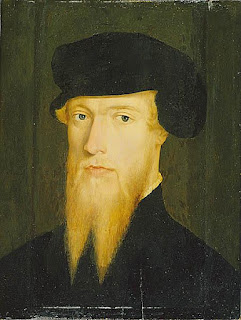
Erik of Vasa
One of Elizabeth’s suitors was Swedish. As per the prevalent opinion, he was a dashing young man, beautiful enough to turn heads on the street. Erik Vasa, Prince of Sweden, not only had legs to die for, but he was well-educated and the heir to the Swedish throne – in itself a new-fangled concept, seeing as up to Erik’s father taking the throne, Swedish kings had always been elected. Erik also suffered from moments of borderline insanity – not something that would have been shared with a future bride.

Erik and Elizabeth had a lot in common; both born in 1533, both of them redheads and members of relatively young royal dynasties, both of them bright and vivacious… the list is quite long. They also had very forceful fathers, but by the time Erik proposed to Elizabeth, hers was long dead while Erik’s father, Gustav Vasa, was very much alive, and not at all in favour of an alliance with England.

Gustav Vasa is an enigmatic character whom people love to hate and hate to love. Brave and principled, ruthless and avaricious, he shares a number of traits with Henry Tudor, foremost among them the fact that he won his crown by conquest, not by undisputed blood-right. After having escaped with his life from the horrors of the Stockholm bloodbath, Gustav Vasa was essentially the only remaining Swedish noble capable of challenging the Danish king (who had annexed Sweden in a most brutal fashion), and challenge him he did, until that propitious day in June of 1523 when Gustav rode into Stockholm to the loud acclaim of the people, there to claim his throne.

Gustav Vasa
People who win their crowns tend to be a tad more defensive of them and their royal prerogatives – some sort of general insecurity, I’d guess. Gustav Vasa set about setting his house in order with fervour, and just like Henry Tudor, he made sure to marginalise those families that could potentially be a threat to his throne. One such family was the Sture family, and it became a constant bogeyman to the Vasa dynasty until our dear Erik, years later, took matters in his own hands and murdered them. (This was during one of his insane period, they say. Huh. I think the man was permanently ridding himself of the competition)

Elizabeth had similar bogeymen – or bogeywomen – and used a similar solution, although she never lowered herself to sullying her own hands with blood. Besides, Elizabeth’s father had done a good job of reducing the number of prospective candidates to the English throne, her sister Mary had done her bit, and so when Elizabeth came to the throne she wasn’t exactly beset by wanna-be kings. One somewhat dangerous relative remained: the handsome and well-educated (if quite dislikeable) Lord Darnley, but Elizabeth pulled the teeth of that particular lion by ensuring Darnley married her Scottish cousin instead. We all know just how unhappy the Darnley – Mary Queen of Scots union was, but at least it produced an heir to the Scottish – and eventually also English – throne.
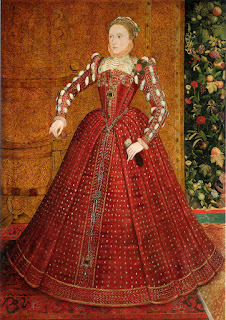
Elizabeth around 1563
Back to our Erik and his aspirations to add the crown of England to that of Sweden: In difference to Elizabeth, Erik had grown up with numerous siblings in a loud and boisterous family. One of Gustav Vasa’s more attractive qualities was the respect with which he treated his wives (all three of them) and daughters. In fact, the man had a soft spot for strong women in general, so one could have assumed he’d be as taken as Erik with the notion of making Elizabeth his daughter-in-law. Not so. England he dismissed as unimportant, and instead Gustav Vasa wanted his son to contract a good dynastic marriage with, for example, a Danish princess.

Erik in his wooing portrait
Erik sniffed. Dear Papa was an old dodger, and far too concerned with brokering a peace with Denmark. He, Erik, had other plans. He was going to be a modern king, ushering in a new time, an age of learning, of opening Sweden to the influences from the continent. So despite Gustav’s grumblings, Erik proceeded with his long-distance wooing, starting by commissioning a grand painting of himself. This representation, in Erik’s humble opinion, would cause Elizabeth heart palpitations and have her skipping with glee at the thought of tying the knot with such a handsome man. Besides, dear Lizzie had but recently come into her queenship and would be delighted at having a man of such intellectual prowess as Erik by her side. Well…

Erik’s brother, Johan, was sent off to London, there to woo the queen on Elizabeth’s behalf. The portrait was displayed. Elizabeth ooed and aaed, thanked Johan for the beautiful gifts (there was more than the portrait – Erik had a flair for grand gestures) and looked at him from under fluttering lashes when she suggested that brother Erik come in person next time. No matter how handsome the portrait, she ardently desired to lay eyes on her Swedish suitor – as soon as possible.

Mission accomplished, Johan must have thought, high-fiving his companions as he hastened down to their waiting ship. Meanwhile, Elizabeth cast one last look at Erik’s painted features and suggested he be placed in storage somewhere – it would not do to have one suitor hanging on the wall when the next presented himself.

Johan was back in Sweden in April of 1560. Erik was not one to procrastinate. Upon hearing Elizabeth wanted to look him full in the face, be dazzled by his presence, he immediately began planning a trip to England, wanting nothing but to crush his lips to those of his potential blushing bride. A date in August was set, and preparations were going according to plan when Gustav Vasa took a turn for the worse. The old king had been ailing for some years by now, and with his death imminent, Erik, as his heir, could not leave.
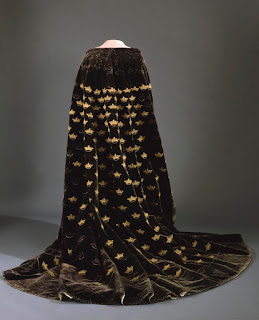
Erik's Coronation Mantle
In September of 1560, Gustav Vasa died. Suddenly, Erik had much more on his plate than the pursuit of an English bride. As the new king, he had a country to rule, starting with curbing the power of his half-brothers and preparing for the first ever coronation in Swedish history. So Elizabeth would have to wait – and it wasn’t as if Erik lacked for female company. The young, vivacious king was welcomed with open arms by most women he as much as looked at. He did that a lot – look, I mean.

I dare say Elizabeth was not overly distressed upon hearing her Swedish suitor would not be coming. After all, she too had other, far more pressing, concerns. But she kept the portrait, and it took 350 years or so for it to make its way back to Sweden. I guess that now and then she just had to feast her eyes on Erik Vasa and his oh, so gorgeous legs.

Erik would go on to marry a commoner, imprison his brothers, murder the Sture family, go totally insane, be deposed and locked up by brother Johan, spending years behind walls before he was finally poisoned – as per the legend with an arsenic-laced pea soup. Not, all in all, a happy life. But once, he was young and charming, the whole world an oyster before him. Once, he had hoped to crown that oyster with an English pearl and set off for a Happily Ever After. Fate, as they say, had other plans.

(all pictures in the public domain)

~~~~~~~~~~~
Had Anna been allowed to choose, she’d have become a professional time-traveller. As such a profession does not exist, she became a financial professional with two absorbing interests, namely history and writing. 

Presently, Anna is hard at work with The King’s Greatest Enemy, a series set in the 1320s featuring Adam de Guirande, his wife Kit, and their adventures and misfortunes in connection with Roger Mortimer’s rise to power. And yes, Hugh Despenser plays a central role.The first book, In The Shadow of the Storm was published in 2015, the second, Days of Sun and Glory, was published in July 2016.

When Anna is not stuck in the 14th century, she's probably visiting in the 17th century, specifically with Alex and Matthew Graham, the protagonists of the acclaimed The Graham Saga. This is the story of two people who should never have met – not when she was born three centuries after him.

More about Anna on her website or on her blog!

Wednesday, May 18, 2016

Vagrants and Vagabonds in Tudor England

by Deborah Swift


Jacques Bellange (c. 1575–1616)
The Beggar Looking Through his Hat 
Hark! Hark! The dogs do bark!
The beggars are coming to town:
Some in rags, some in jags*
And one in a velvet gown 


Some gave them white bread,
And some gave them brown,
And some gave them a horse-whip,
And sent them out of town.


Tudor London attracted vagrants and beggars from all over England, who were in search of the rich pickings of the city. The Dissolution of the Monasteries in 1536 led to an increase in the number of vagrants, as the monasteries had been the chief source of charity, and had also provided employment for vast numbers of people who worked for them as agricultural labourers. The nursery rhyme above is attributed to this time. Because travel by horsepower was so slow, it was unusual for people to reside outside their birth town, and so all migrant travellers were treated with a degree of suspicion, especially if they were poor. This is why travelling actors had to procure a licence.

Sites of the Monasteries
There was of course, no police force, so crime was an enormous problem, tackled by extreme punishments designed to act as a deterrent. More than 70,000 people were executed during the reign of Henry VIII, many for what we would consider minor offences. Stealing was a hanging offence, and begging outside your home area was punishable by being tied to a cart and flogged, or locked in the stocks to be pelted by passers-by.

Village Stocks in Beetham Lancashire

There were so many beggars that a law was passed in 1547 which stated that anyone who was homeless could be made to be a slave for a period of two years. Should they run away from their master, they would then be branded with a 'V' and committed to slavery for life. This law was, unsurprisingly, extremely unpopular, and was revoked three years later in 1550. The 1563 Act reaffirmed the policy of whipping able-bodied beggars, but to prevent offenders from persistent begging a further Act stated that vagabonds should be burned through the right ear and, if they were arrested again, they could be imprisoned and executed. These policies of ear-boring and hanging remained the law until 1593.


With draconian punishment the order of the day, many turned to crime. A book published in 1552, 'A Manifest Detection of Diceplay' gives the first written evidence of the criminal underworld operating in Tudor London, and says that 'sleight and crafty deceit ... is common in every corner.' There were five prisons in London, to house the burgeoning number of petty criminals: The Clink, The Compter, The Marhalsea, The King's Bench and the White Lyon. The underworld looked to its own, however, and specific areas, such as Alsatia, and Southwark, became known as places where those on the run from the law could find refuge. And of course they were also the places where any rich man needed to guard his purse.

Beggar being whipped through town

The Poor Relief Act of 1576 was supposed to be the solution, but in fact it divided the poor into two categories:

The Deserving Poor This category was for those people who wanted to work but were unable to find suitable employment. The first category included the old, the sick, and widows, who were provided accommodation in almshouses and orphanages with a productive but sedentary activity such as spinning or weaving, by which they earned their Poor Relief, which was provided by each parish through taxation.
The Undeserving Poor Also called 'sturdy beggars', this category was for those who were physically able to work but chose not to. They gained no sympathy and were to be whipped through the town until they learnt the error of their ways. Many poor workers were harried from town to town as they sought work, and many feigned sickness in order to fall into the category where they would qualify for Poor Relief. The alternative for these people was the 'house of correction', where the able-bodied but persistently unemployed or in debt could be punished.

The first house of correction was Bridewell in London, and many other such institutions were called 'bridewells' after it. Bridewell was opened in 1533 in a former royal palace on the banks of the Fleet River and also housed homeless children. Because of this, it also became the first major charitable institution. The picture below shows it in Tudor times - after the Great Fire of London in 1666, it had to be rebuilt.
Bridewell 

However, the main purpose of a house of correction was to punish offenders, so they would correct their behaviour, and not just to be a depriver of liberty. Punishment was usually either hard labour, or whipping which could be observed as entertainment from the public gallery. The most common charges against prisoners were prostitution, petty theft, and something called 'loose, idle and disorderly conduct'. More than two-thirds of the prisoners were female, and many were recent migrants to London. These women, often widows trying to support their families, were also put to hard labour, and a common task for female offenders was beating hemp to make linen. 

The 1597 Act required each town to provide a prison, such as Bridewell, for vagrants and thieves, and paid for by local taxes. In the Tudor mind, there was barely a distinction between a beggar and a thief. Beggars caught offending were punished and then returned to their native parish.This system caused a great burden on parishes where harvests had failed, and whole populations were condemned to one area, unable to seek sustenance elsewhere. Surprisingly, most prisoners in houses of correction were released within a week of their imprisonment, so they could return home and to make room for others who needed this short, sharp shock of a punishment. 


Matters were made worse by a series of bad harvests in the 1590s, and the fact that during the reign of Elizabeth I, the population grew by a third - from three to four million people. By now, London was the biggest city in Europe with a population of somewhere between 130,000 and 150,000. To deal with this, The 1601 Poor Law consolidated all these various acts and laws to form one cohesive whole. It remained largely in place until the 18th-century workhouse movement began at the end of the 17th century. 

Giacomo Ceruti 1720  Little Beggar Girl and Woman Spinning
* Jags - Slashes or slits exposing material of a different colour, and popular during the Tudor period.

Sources:
The Elizabethan Underworld by Gamini Salgado
Everything You Wanted to Know about The Tudors, But Were Afraid to Ask by Terry Breverton
Life in Tudor England by Penry Williams 
BBC The Tudors
Pictures from Wikpedia, or my own unless otherwise linked.

Deborah Swift is an ex-costume designer for the BBC, and the author of four historical novels, and three more for young adults. She lives in the north of England in a 17th century village, with her husband and lucky black cat. Find out more on her website www.deborahswift.com , where she has a historical fiction blog or follow her on Twitter @swiftstory

You might also like Lowlifes of Elizabethan London, also on this blog.

Wednesday, March 9, 2016

Blank Tudor Faces

Judith Arnopp

 We have all become so familiar with royal Tudor images that we no longer really see them. One glance tells us who they are. We think we know them. They exude power, majesty and the iron fist of mastery.

Earlier portraits of the Plantagenet kings, and even the early portraits of Henry VII are very different to that of his son and grandchildren. But it was Henry VII, the first ‘Tudor’ king who began to develop the ‘Tudor’ brand.

The royal portraits of Henry VI, Edward IV, Richard III are all quite sombre, the artist doing his best to portray an ordinary man who was king. Even this portrait of Henry Tudor has nothing overtly regal about it; there is even a glimpse of personality, perhaps a measure of distrust, cynicism, impatience, or is it amusement? However you interpret his expression, it is a portrait of a human being, not a representation of royal supremacy.

 In the early days of Henry’s reign his position was unstable, he was an unknown quantity. There were no guarantees of peace and there were several Yorkist attempts to take his throne. The Tudors were the new kids on the block; nobody could foresee what sort of king Henry would make and his popularity depended very much on that of his wife, Elizabeth of York. Yorkist propaganda demeaned his claim to the throne, declaring that his mother’s line was illegitimate and that Lancaster had stolen the crown in 1399. They also sneered at his great grandfather who had been a lowly innkeeper.

Henry, realising he needed to reinforce his hold on the country, invented (or perhaps ‘embellished’ is a better word) his family history to create an impressive Tudor dynasty. He stressed the royal connection of his mother, Margaret Beaufort, and her descent from John of Gaunt and, to strengthen his claim further, he legally removed the stigma of bastardy from the family. He reiterated the royal descent of his grandmother, Katherine of Valois and, more surprisingly, claimed descent from the ancient Welsh King Cadwaladr, and King Arthur. To further cement his link to Arthur he named his first born son in his honour and embellished the round table at Winchester with the Tudor rose.

With the blood of both York and Lancaster flowing in the veins of his two sons and several daughters the Tudor line looked set to continue but Arthur’s sudden death in 1502 taught Henry that a king can never have too many sons. He lost no time in teaching his remaining son, later to become Henry VIII, the finer points of kingship. He stressed the importance of his role, the unreliability of the fickle populace, and the crucial need for strong male heirs to perpetuate the dynasty. The importance of heirs was a lesson young Henry never forgot, and one he fought tooth and nail for the rest of his life to achieve.

The blooming of the Renaissance and the introduction of men like Holbein to the royal court helped to reinforce this new Tudor image, and during Henry VIII’s reign new style of royal portraiture began.

I think of them as ‘power portraits’ that were loud declarations of Tudor permanence and dominance.
This one was painted by Holbein the younger after 1537, at a time when Henry was at the height of his power. He had freed himself from Anne Boleyn and the Pope, and Jane Seymour had finally provided the son and heir he’d been craving.

Today, we are used to seeing this image and others like it but imagine its impact in a world in which images were rare and people’s lives were not dominated by photographs or colour. Everything in this portrait is designed to impress; we cannot take our eyes from the breadth of shoulder; the sumptuous quality of his clothes; his immovable stance; the potent codpiece, and the unflinching expression in his eye. The portrait exudes wealth, power and uncompromising control. It is an unspoken declaration. ‘I am the king; it shall be as I say.’ There is not the slightest hint of insecurity, yet Henry was very insecure.

We all know about Henry; his failed marriages, his quest for an heir, his break with Rome, his megalomania, and ruthless rule but, what about the man behind the grandeur? Take a closer look at his face. What does it tell us about the inner man?

He looks bullish at first glance but on closer inspection you will see his eyes are blank, his expression closed. You might say he looks belligerent or mean but is that really what we are seeing, or is that a preconceived idea, because of what we already know? Personally, I think his inner feelings are obscured by my pre-knowledge but, if I try to wipe my mind and focus solely on his face, I see ennui, and sadness. As if he is hiding behind his own splendour.


All the Tudor monarchs have this same expression. The portraits as a whole are only concerned with an outward show of majesty, a declaration of authority. Edward VI was ten years old when he became king, a young skinny boy with a burgeoning ego that would soon match his father’s. Here he is carefully painted in a similar stance to Henry. He is well-padded and embellished in satin and fur, and a much smaller cod-piece than his father’s promises future virility and heirs to carry on the Tudor name. But again, it is the image of a king with an empty face. ‘I may be young,’ he is saying, ‘but do not underestimate me; I am my father’s son.’

Edward’s short reign was one of religious persecution as the Protestant king tried to terrorise his subjects into following his will. His premature death was greeted with relief by many Catholics for now it was the turn of the Protestants to be subjected to the will of Mary Tudor.

Unlike her father and brother, Mary is seated, but her portrait is no less authoritative. Her erect posture and uncompromising stare are enough to turn living flesh into stone but there is little to be read there; we cannot see beyond her steely gaze to the woman within.

Her attempts to reinstate the Catholic religion and wipe out the much newer Protestant religion resulted in the burnings and torture that earned her the posthumous name ‘Bloody Mary.’ But viewed more objectively, her personal sorrows were immeasurable. Mary had lived a sorry life; rejected by her father, disinherited from the succession, stripped of her title ‘princess’, separated from her mother, Katherine of Aragon, Mary channelled all her frustration and anger into her religion. Her devotion to God and the Catholic Church was matched only by her passion for her husband, the reluctant Philip of Spain, and her wish for a son to follow after her.

Her health was never good; there is some evidence that her menstrual cycle was erratic and she suffered both physically and mentally from a young age. In later years her failure to conceive, her phantom pregnancies and failing marriage compounded her misery until she died a painful death in 1558 leaving no heir. Mary, who had gone to extreme lengths to rid England of the new religion, was now forced to leave the realm in the hands of a Protestant queen, her sister Elizabeth.


Elizabeth was the greatest Tudor of them all and the one who exploited royal portraiture to the full. The queen was very aware of the power of image and iconography. Encouraged by her adviser, John Dee, her portraits became more and more extreme. In every image she is majestic and fabulously dressed, her tiny frame all but obliterated by satin, velvet, lace and jewels. In looks Elizabeth resembled her great grandmother, Margaret Beaufort and her grandfather, Henry VII but by nature she was very much like her father.

If her grandfather and father had coveted England and parts of Europe, Elizabeth's ambitious eye went further - to the New World. In the Armada painting below, her hand rests on a globe and, just in case the viewer should forget who wears it, the crown of England is just above. If you look closely, her famously long, white fingers are covering the Americas and behind her are commemorative paintings of the Spanish fleet being driven onto a rocky shore by a storm that became known as the 'Protestant Wind,' suggesting God's approval of England's victory over Catholic Spain. Elizabeth is proclaiming herself the saviour of her people; the mother of her expanding empire: a victorious, virgin queen, blessed by God.


These are the things the Tudors wanted the world to see and believe. Their private 'selves', their inner thoughts and feelings were none of our concern and so they turned their faces into masks - a blank page devoid of personality yet replete with majesty.


Although the Tudors are well-documented and easily accessible through portraits and records, writing about them is not easy. We know what they did and when they did it; we know the relationships they had, the political scene, the style of their clothing, the shade of their hair and eye colour but there are only the tiniest glimpses of their inner selves. In order to populate my novels with believable characters I have to mentally prise off their masks, strip off their rich finery, and try to reach inside their minds. What is left are people as ordinary as you and I. In their natural state it is easier to consider these icons of monarchy as human beings, and imagine the emotions that triggered their most bizarre behaviour.  Each Tudor monarch had hopes and fears (mostly of failure) and insecurity, and they had dreams too, and a vast self-disappointment that ate away at them all.

For all their power, all their wealth and status, they could not have or hold the things they most desired: fidelity and adulation.

Photographs in the public domain from Wikimedia Commons


Judith Arnopp is the author of eight historical fiction novels including:

The Beaufort Bride: Book one of The Beaufort Chronicles - Available to pre-order NOW

A Song of Sixpence: the story of Elizabeth of York and Perkin Warbeck

Intractable Heart: the story of Katheryn Parr

The Kiss of the Concubine: a story of Anne Boleyn

The Winchester Goose: at the court of Henry VIII

The Song of Heledd

The Forest Dwellers

Peaceweaver


For more information please visit the webpage

Author page: click here

or look for her on Facebook.