Showing posts with label Mary Tudor. Show all posts

Friday, February 14, 2020

The Mystery of The Queen’s Pearl

by Judith Arnopp

Since my youth I have been awed by the story of La Peregrina, the ‘royal’ pearl that had passed from queen to queen until it was given as a Valentine present to Elizabeth Taylor by Richard Burton. As a girl I quite envied Elizabeth Taylor‘s ownership of such a historic piece of jewellery. It was good to see a perfect specimen that had once graced the bosom of a Tudor queen dangling in the cleavage of a twentieth century heroine. I was disappointed to learn a few years ago that it was indeed a different, if very similar, pearl. Unsure if it was true or just more fake news, I scanned the internet for information but the articles I found just increased my confusion.

Mary Tudor by Master John 

There is a lot of misinformation out there. I even found one article stating that:

‘The Spanish master, Diego Velazquez, in the mid 1600s painted Queen Isabel wearing the pearl, and he also painted young sweet Mary, Queen of England wearing the pearl before she became Bloody Mary and had her namesake niece, Mary Queen of Scots, beheaded.’

Oops, big boo boo! I didn’t read this unreliable article any further but I did find some offering useful information.

Elizabeth’s Taylors jewel is smaller than the one that Mary wore and it seems that the one of Tudor fame has been mislaid. The mystery becomes more complex when you discover there is another similar pearl with the almost identical name of La Pelegrina. Wikipedia explains it thus:

"La Pelegrina" is a Spanish word. Some gem historians translated it as "the Incomparable", but actually "La Pelegrina" has no such meaning in Spanish. Other gem historians believe that the name "La Pelegrina" was made to show a connection between "La Pelegrina" and another famous pearl “La peregrine”. "La Peregrina" means ‘The Pilgrim" or "the Wanderer", and rhyming the names "La Pelegrina" and "La Peregrina" could mean that the name "La Pelegrina" was meant to be also "the pilgrim" or "the Wanderer", and a single letter was changed to distinguish between the two different pearls.”
Confused? I am.

But undaunted, I set out to see if I could trace the path of two gems, almost identical in appearance, with almost identical names.

La Pelegrina was discovered on the coast of Santa Margarita in the Gulf of Panama in the 16th century. The man who found it was a slave who was rewarded for his discovery with his freedom. Inca Garcilaso de la Vega wrote about this in his Royal Commentaries of Peru.

‘This pearl, by nature pear-shaped, had a long neck and was moreover as large as the largest pigeon’s egg. It was valued at fourteen thousand four hundred ducats but Jacoba de Trezzo, a native of Milan, and a most excellent workman and jeweller to his Catholic Majesty, being present when thus it was valued said aloud that it was thirty – fifty – a hundred thousand ducats in order to show thereby that it was without parallel in the world.’ (La Pelegrina pearl. (2019, August 31). Retrieved from https://en.wikipedia.org/wiki/La_Pelegrina_pearl)

In 1660 Philip IV of Spain gave the pearl to his daughter, Maria Theresa, on her marriage to Louis XIV of France. The pearl travelled with her to France and disappeared after Maria Theresa’s death in 1683. It did not reappear until 1826 when it showed up in St. Petersburg. It is believed that it then entered the French crown jewel collection but was stolen during the revolution along with the rest of the crown jewels. Sometime after that it travelled to Russia where Zinaida Yusupova was painted wearing it. The pearl then passed to her son, Felix Yusupov, (who interestingly, was involved with the murder of Rasputin.)

In 1917 during the October Revolution Felix smuggled the pearl, together with other royal jewels out of Russia. He later sold many of his treasures but hung on to La Pelegrina until 1953 when he sold it to a jeweller in Geneva.

Portrait of Zinaida Yusupova (1861-1939)
by François Flameng

La Peregrina
The first mention of this pearl is in Commentarios Reales de Los Incas by Garcilaso de la Vega (1539-1616). He describes a pear-shaped pearl arriving in Spain from Venezuela (although according to Wiki other sources mention Panama) in 1579. It was sold to King Phillip II of Spain who later married Mary I of England. (This made my ears prick, perhaps he did give it to her after all). He intended it as a gift for his daughter but instead added to the crown jewels where it is recorded as being for two hundred years.

Juan Pantoja de la Cruz, Margaret of Austria, 
Queen of Spain wearing the pearl (c. 1606) 

It seems to me that Philip may very well have given it as a marriage gift to Mary but there is no record of that ever having taken place. There are portraits of Mary sporting a very similar one. It would be lovely to think this was THE pearl but it is not recorded and neither is it listed with the jewels he did give her that were later returned to Spain after her death.

La Peregrina was worn by many Spanish queens. Margaret of Austria wore it while married to Philip III and it appears in portraits of Elizabeth of France and Mariana of Austria who were wives of Philip IV.

Peter Paul Rubens, Elisabeth of France, 
Queen of Spain wearing the pearl (c. 1625) 
When the elder brother of Napoleon Bonaparte ruled Spain in the 1800s it came into his possession but he left the kingdom after the French lost the Battle of Vitoria. At this time he made off with several of the crown jewels and it is believed La Pelegrina was among them. He bequeathed the pearl to his nephew who would become Napoleon III of France. It was Napoleon III who sold the pearl while in exile in England to James Hamilton, Later Duke of Abercon, who purchased it as a gift for his wife, Louisa. It remained in the Hamilton family until they sold it at Sothebys in 1969.
During the course of its history the pearl came close to catastrophe on several occasions. Once it was lost down the back of a sofa at a party at Windsor Castle, the second time during a ball at Buckingham Palace.

It was bought in 1969 by Richard Burton for $37,000 as a Valentine’s gift (hint-hint husband) for his wife Elizabeth. In her book My Love Affair with Jewellery she relates a story of it almost being swallowed by one of their dogs.

‘At one point I reached down to touch La Peregrina and it wasn't there! I glanced over at Richard and thank God he wasn't looking at me, and I went into the bedroom and threw myself on the bed, buried my head into the pillow and screamed. Very slowly and very carefully, I retraced all my steps in the bedroom. I took my slippers off, took my socks off, and got down on my hands and knees, looking everywhere for the pearl. Nothing.‘

Then on seeing one of the puppies chewing something …

‘I just casually opened the puppy's mouth and inside his mouth was the most perfect pearl in the world. It was—thank God—not scratched.’ (Elizabeth Taylor: my love affair with Jewelry - Simon & Schuster; 1 Oct. 2002) N.B: Ms Taylor seems to have recounted this tale several times, each one slightly different.’

Mary Tudor by Hans Eworth 1554, NPG 4861
© National Portrait Gallery, London 

The Burtons, at the time believing the pearl to have belonged to Mary Tudor purchased a portrait of Mary wearing the pearl and when it was discovered the connection was likely to be false, they donated the painting to the National Portrait Gallery.

La Peregina was sold after Elizabeth Taylor’s death fetching more than eleven million dollars.
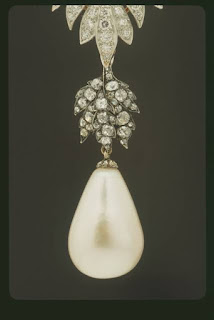
La Peregrina.” La Peregrina - Smithsonian Institution,
Photo by NMNH Photo Services.
So, curiouser and curiouser. We now have two different pearls, neither of which seems to be have been worn by Mary although she is clearly wearing a very similar one is several portraits.

I found an article from a few years ago by jewellery exhibitor Symbolic & Chase who showcased a jewel which they called ‘The Mary Tudor Pearl.’ According to their description the Renaissance pearl surfaced in 2004, having been lost since the late 16th century, and can be dated back to 1526. It measures 258.12 grains (64.5 carats, 69.8 carats with its diamond cap) making it the third largest well-formed natural pearl documented to date.

The provenance leads at last to Mary.

‘Between 1526 and 1539 the pearl entered into the outstanding jewellery collection of the Empress Isabella of Portugal (1503-1539), either as a diplomatic gift or by the Empress purchasing it. When the Empress died in 1539 the pearl was inherited by her daughter, Juana of Austria (1535-1573). Following a short marriage to Prince John of Portugal (1537 – 1554), Juana returned to Spain to assume regency for her brother, Philip II. The pearl became part of Philip’s dowry for his new bride, Mary Tudor (1516-1558), after whom the pearl has been christened.'

Mary Tudor, Queen of England, 
second wife of Felipe II’ by Anthonis Mor 

‘It is an outstanding asymmetrical drop-shaped pearl that was much admired by the Tudor courts and is featured in Royal portraiture of Mary Tudor, namely ‘Mary Tudor, Queen of England, second wife of Felipe II’ by Anthonis Mor at the Museo del Prado and ‘Queen Mary I’ by Hans Eworth, which has been included below courtesy of The Bridgeman Art Library. A similar painting by Hans Eworth of Queen Mary I also hangs at the National Portrait Gallery.' ("The Mary Tudor Pearl Unveiled", Kari Pearls: Natural Pearls - A Trusted Resource.)

But is this and Mary’s pearl one and the same? The stories of all three jewels are so close, the provenances quite similar with it passing through the hands of so many European Royals, could their stories not just been horribly mixed up? Just as I was beginning to believe it was, I came across this website and discovered I wasn’t the only one in search of it. This website sums the whole thing up far more succinctly than I could ever do. He believes there is a third jewel, now known as Queen Mary’s Pearl and concludes that:

‘Mary Tudor never owned La Peregrina, though she did own a slightly larger pearl now known as the Mary Tudor Pearl.
Mary Tudor wore her pearl suspended from a golden brooch set with the Grande diamond that Philip II inherited from his mother, Isabel de Aviz.
Upon her death, Mary Tudor returned this brooch to her husband, who removed the pearl and gave it back to his sister Joanna.
Upon Joanna's death, the pearl was put up for auction.
The pearl failed to sell at the 1574 auction, but a man by the name of Diegor Ruiz purchased it in 1581 for 3,300 reales. After this, the pearl disappears from record.
In 2004, this pearl appears on the block at Christie's London, at which time it is purchased by Symbol & Chase of Bond Street.’
©2006-2020 EraGem®

For more information, read this very fascinating blog post.

~~~~~~~~
Judith Arnopp is the author of twelve Historical Fiction novels and has contributed to several non-fiction anthologies. you can find more about Judith's work on her webpage: www.judithmarnopp.com or her Author Page: author.to/juditharnoppbooks
Judith's latest novel is The Heretic Wind: the life of Mary Tudor, Queen of England available on Kindle and Paperback. The audio version will be available later in 2020.


Monday, January 27, 2020

Something about Mary

by Judith Arnopp

Anthonis MorMuseo del PradoMadrid, 1554 - Public Domain

Mary was the eldest of Henry VIII’s children. In her infancy she was lauded as a princess, the king referred to her as his ‘pearl’ and she was afforded every honour due to a Henrygirl in her position. Her mother, Catherine of Aragon, after suffering numerous miscarriages and still births was growing old. and her fertile years were at an end. As her fertility died, so did Henry’s love for her.

Anne Boleyn was everything the queen was not; young, fertile, witty and entrancing and Henry was unable to resist. In the years that followed, Mary and her mother’s status was brought into question, the marriage declared illegal and Mary was branded illegitimate. Teenage years are often difficult. Our emotions are in turmoil as we struggle to come to terms with the adult world. Imagine the thirteen year old Mary, isolated from those she loved, separated from her mother and compelled to deny the validity of her parent’s marriage and condemn herself as illegitimate.

Anne Boleyn National Portrait Gallery - Public Domain

In 1533 Henry and the now pregnant Anne Boleyn were married – seventeen-year-old Mary was heartbroken, the hurt intensified when she was sent as a servant to the household of her new sister, Elizabeth.

I would imagine there are difficulties for anyone accustomed to being the apple of their father’s eye when suddenly supplanted by the arrival of a new sibling but Mary was not just replaced in her father’s affection but in every aspect of her former life. Her titles were stripped, her property removed and her status demolished along with any hope of ever becoming queen. Her father’s love must have seemed like some distant dream, and since her nebulous status made her all but unmarriageable her future looked bleak.

Yet, she seems to have borne no ill-will toward Elizabeth. The same cannot be said for Anne however, whom Mary refused to acknowledge as queen and declared she knew no queen of England other than her mother. The Spanish ambassador, Chapuys, began a rumour that Anne was plotting to poison Mary, a rumour (if it were a rumour) that undermined Mary’s security even further.

During my studies of Mary, I discovered an isolated figure, never more so than during this traumatic period. She was not allowed to see her mother again and was inconsolable when Catherine died in January 1536, just four months before Anne Boleyn herself went to the scaffold. With Anne’s demise one might have imagined Mary’s trials were at an end but although her new step-mother, Jane Seymour, went out of her way to reunite Mary and Henry and persuaded the king to bring her back to court, Mary’s humiliation was not over. Henry insisted she accept him as head of the church in England, renounce papal authority and acknowledge Henry and Catherine’s marriage was invalid and she herself illegitimate. One would imagine that this was a very high price to pay for paternal love that should have been her due.

Henry VIII Holbein - Public Domain

Even after Mary returned to court and her household was reinstated and she was reunited with her lifelong friend, Susan Clarencieux her life continued to be difficult. As the dissolution of the monasteries intensified, Mary saw the church she saw as the ‘true church’ all but demolished. She had to sit quietly while monks and nuns were punished. Henry was no longer the golden king of Mary’s infancy but became increasingly ruthless, a trait that grew worse after Queen Jane died shortly after childbirth, providing Henry with Edward, the son he’d longed for.

After the execution of her fifth step-mother, Katherine Howard, Mary was invited to act as hostess at court until the king married his final wife, Katheryn Parr. For a short time the royal family were reunited and almost ‘normal’ or at least as normal as the Tudors ever managed. Encouraged by Parr, Henry welcomed all three of his children back into the fold and, although they remained illegitimate both Mary and Elizabeth were reinstated in the line of succession, after Edward. It was only a brief respite for Mary, who under her brother’s strictly Protestant rule, was to suffer further subjection and torment.

All things considered, there is little wonder that Mary grew into a troubled adult, and ultimately became as harsh a ruler as her father. Of all the women I have studied and written about in my novels, Mary strikes me as the most pitiful. She wasn’t friendless; the people loved Mary from her cradle to her deathbed but for much of the time were afraid to show it.

Edward VI Attributed William Scrots - Public Domain

From infancy she suffered trauma that would have broken most people. But Mary stood firm for as long as she could under constant pressure from her father and his councillors, her brother and his protectors and never ceased to champion her religion. Isolated and terrified, she stood for what she believed was right and, once the crown was finally within her grasp, she did not hesitate to step up to the mark and fight for it.

In a premeditated act, the Duke of Northumberland persuaded Edward to name his cousin, Lady Jane Grey, as his heir in Mary’s place. Having previously married Jane to his son, Guildford Dudley, Northumberland clearly planned to manipulate her and rule in her stead. But Mary was having none of it and rallied an army at Framlingham Castle where support for Northumberland quickly crumbled.

Mary’s reign has been largely regarded as a failure and from our perspective it is easy to see how she earned the title Bloody Mary. As queen, Mary married against the will of the people. She failed to understand the desire of the populace to worship in the manner of their choosing. She failed to provide an heir, suffering phantom pregnancies and dying before her innovative plans for England came to fruition. Yet some of those plans were promising.

She began many policies that have since been laid at Elizabeth's door: reforms to the economy, naval expansion and colonial exploration and had her reign been longer, she may have been remembered very differently. Her success is always measured against Elizabeth's yet Mary had just five years against Elizabeth's forty-four. As with her father, Mary is remembered for her very worst acts yet there was much more to her than religious persecution and brutality. I do not seek to whitewash her actions but to consider the events of her life as she saw them, and it cannot be denied that Mary flew the Tudor banner bravely. She was stalwart, stubborn and loyal. She was sometimes unwise, she was overly passionate and she could be harsh but despite everything, she was loved by her people.

Mary Tudor by Hans Eworth. National Portrait gallery - public domain

~~~~~~~~~~
Judith Arnopp is the author of twelve historical fiction novels, her latest being in The Heretic Wind: the life of Mary Tudor, Queen of England available on Kindle, in Paperback and soon on audible.

To find out more please visit her website www.judithmarnopp.com


Monday, October 1, 2018

Coronation of Queen Mary I

By Samantha Wilcoxson

Princess Mary Tudor was crowned Queen Mary I on October 1, 1553, in an event without precedent. After fighting successfully for her birthright, Mary became England's first queen regnant.

Entrance of Queen Mary I with Princess Elizabeth
into London 1553, by John Byam Liston Shaw
The spectacle had actually begun several days earlier when Mary arrived at the Tower of London with her sister, Elizabeth. They were welcomed with music, decorations, and a volley of the Tower guns by the mayor and aldermen of London. Time here was spent rehearsing for the coronation. Mary also met with her councillors and pledged herself, on her knees, to "the task God had been pleased to lay on her to His greater glory and service, to the public good and all her subjects' benefit." It was an emotional moment that left many of the men in tears. Then, on September 30, the sisters rode through the city to the Palace of Westminster, where the coronation ceremony would begin.

Their procession was planned to impress Londoners with the vision of everything they believed their monarch should be, and they were met by cheering crowds. Rich fabrics and vibrant colors glittered with magnificent jewels, silver, and gold. Even the horses were draped in beautifully embroidered cloth. Amid this dizzying array of wealth, Queen Mary was expected to stand out. She rode in an open chariot draped in gold. Her dress of purple velvet trimmed in ermine was complimented by the crimson velvet worn by her ladies and silver cloth-of-gold worn by Princess Elizabeth and Anne of Cleves. The bejeweled crown that Mary wore for the procession was reported to be so heavy that she wearily propped up her head with her hands.

Queen Mary I,  1554
by Hans Eworth
Crowds, pageants, and performers vied for Mary's attention as her procession slowly moved from the Tower to Westminster. Choirs of children sang as wine flowed from fountains. An acrobat even performed atop the weathervane of St Paul's Cathedral. After what must have been an exhausting day, Mary prepared for her coronation.

The next day was certainly one filled with both excitement and anxiety for this woman who had been at various times pampered and bastardized by a tempestuous father. Mary was not necessarily the showman that Henry VIII had been, so to be put on display before crowds would have been stressful, even without the knowledge that she was setting a historical precedent. Setting aside her shyness and timidity, Mary was determined that her coronation be held according to the customs of the kings who had come before her.

Mary wore crimson velvet robes and walked on blue fabric from the porch of Westminster Hall to the Abbey. Her auburn hair was worn loose in the style of a queen, but the orb, scepter, and crown of kingship were carried before her. Inside Westminster Abbey, swathes of cloth-of-gold hung from the choir to the altar and covered the grand chair upon which Mary was seated.

She was presented by the Bishop of Winchester:
"Sirs, here present is Mary, rightful and undoubted inheritrix by the laws of God and man to the crown and royal dignity of this realm of England, France and Ireland, whereupon you shall understand that this day is appointed by the peers of this land for the consecration, inunction and coronation of said most excellent Princess Mary; will you serve at this time, and give your wills and assent to the same."

"Yea, yea, yea. God save Queen Mary," those assembled responded.

Mary gave her offering and lay prostrate upon cloth-of-gold cushions as prayers were invoked above her. After a sermon by the Bishop of Chichester on the obedience owed to kings, Mary was prostrate again to swear her oaths as queen, followed by her anointing. Bishop Gardiner touched holy oil to Mary's forehead, temples, shoulders, and chest as she knelt wearing a sleeveless purple velvet corset. After the anointing, Mary was again regally dressed in a crimson velvet mantle and crimson cloth-of-gold slippers.

Gold coin featuring Queen Mary I, 1555
Trumpets announced the moment each of three crowns was placed upon Mary's head, and the choir sang Te Deum when the coronation ring was placed on her finger. She then received the sword and spurs that would have been presented to a crowned king and received the homage of her clergy and magnates. Finally, another offering was made, and Mary carried the orb and scepters (one traditionally the queen's and the other the king's) to her coronation feast.

She was Queen of England, but she had taken a long road to get there. Her mother's only child, Mary had been raised to believe she would be her father's heir. When Henry VIII broke with both Katherine of Aragon and the Catholic Church in order to disinherit Mary, she may have believed she would never see the throne. Through many trials and tribulations, which did not end once she was queen, Mary endured.

Additional Reading
Mary Tudor: Princess, Bastard, Queen by Anna Whitelock
The First Queen of England: The Myth of Bloody Mary by Linda Porter


All images in the public domain through Wikimedia Commons

~~~~~~~~~~

Samantha Wilcoxson is the author of the Plantagenet Embers series featuring women of the Wars of the Roses and Tudor England. Her current project is taking her back to the beginning of the Plantagenet dynasty.

An incurable bibliophile and sufferer of wanderlust, Samantha lives in Michigan with her husband and three teenagers. You can connect with her on her blog or on FacebookTwitterInstagram, and Goodreads.


Friday, April 14, 2017

Mary I: Her Mother's Daughter

by Samantha Wilcoxson

Katherine of Aragon as the Madonna
painted by Michael Sittow
We all inherit a few habits and characteristics from our mothers – for better or worse. This is no less true for Queen Mary I and her mother Katherine of Aragon. The interesting thing about the similarities between these women is that one is remembered rather fondly and with great sympathy, while the other has been branded with the label ‘Bloody Mary.’

Katherine is widely admired for her refusal to back down when Henry VIII decided to set her aside. A bold combination of stubbornness and faith gave Katherine the strength to remain steadfast, regardless of what Henry put her through. She was never disrespectful, often saying that she would honor her husband’s will in all things, save where her conscience demanded that she followed God. Similar words would be used by her daughter. Henry appreciated the sentiment from neither.

Mary stood up to her father, much as her mother had, continuing to proclaim her love and respect for him while at the same time demanding that no title besides Princess was appropriate for her. Henry had long separated Mary from her mother, but she had her governess, Margaret Pole the Countess of Salisbury, at her side to bolster her up (at least until that great lady’s execution in 1541). The two of them refused Henry’s request for Mary’s royal jewels and denied Anne Boleyn’s status as queen.

Henry decided to break up Mary’s household in order to bring her into line. Margaret Pole was crushed to have Mary removed from her care and offered to cover all household expenses if Mary was left with her. Henry refused and instead forced Mary to serve in the household of her infant half-sister. This time may have seemed like the nadir of Mary’s life, but the knowledge of her mother’s courage in even worse circumstances gave her the strength to go on.

Katherine of Aragon
1st Queen of Henry VIII
After Henry’s death, Mary's life changed, but the challenges did not cease. With young Edward VI surrounded by reformist advisors, the faith that had seen Mary through tough times put her at odds with the brother she loved. Katherine had given Mary an example in this as well. When faith was all that Katherine had left, abandoned by her husband and her health failing, she had demonstrated to her daughter that it was all she needed. Mary also clung to her faith, having mass held within her household long after it was outlawed by Edwardian statutes. She was prepared to be a martyr for her faith.

Mary probably had not expected to be queen once she had a brother so many years younger than herself. Yet, when Edward died in 1553, Mary proved that she had inherited the strength of a true queen from her mother. Katherine had never doubted that Mary should be Henry’s heir and that he had no need for a son. Henry had clearly disagreed, but Mary’s chance came anyway.

Both Katherine and Mary could be submissive and pious, believing deeply in the specific roles that God had assigned to them. However, they could each be bold and courageous when they believed God’s will was being thwarted. Katherine proved this when she served as regent for Henry in the war against Scotland and in the battle for her marriage, and Mary proved it in her journey to the throne.

Queen Mary I
Daughter of Katherine of Aragon
Few anticipated any serious challenge from the Lady Mary when the council schemed to place her cousin, Lady Jane Grey, on the throne in her place. Sure, Mary had clung stubbornly to the mass against Edward’s wishes, but she had also done her best to stay away from court and live quietly. Edward’s Devise for the Succession had not had the chance to make its way through Parliament, but it was expected that his sisters could be subdued if necessary. If they thought that they would easily neutralize Henry VIII’s daughters, they were heartily disappointed.

Mary had submitted to many humiliations in her life by this time. She was 37, unmarried and childless, since neither her father or brother wished to legitimize her position or give her the power of a husband at her side. But when it was her turn for the crown, she proved, once again, that she was Katherine of Aragon’s daughter.


As it turned out, she had little opposition. Edward’s councilors may have convinced themselves that Jane would be easily accepted, but the people still had fond memories for the Princess Mary and sympathy for her shoddy treatment. Jane’s reign was ended within a fortnight, and Mary was queen, just as her mother always knew she would be.

Additional Reading
Mary Tudor: Princess, Bastard, Queen by Anna Whitelock
The First Queen of England by Linda Porter
The Children of Henry VIII by Alison Weir

All images in the public domain through Wikimedia Commons
~~~~~~~~~~

Samantha Wilcoxson is the author of the Plantagenet Embers Trilogy. Queen of Martyrs, the final installment in the series was recently released featuring Queen Mary I.

An incurable bibliophile and sufferer of wanderlust, Samantha lives in Michigan with her husband and three teenagers. You can connect with her on her blog or on FacebookTwitter, and Goodreads

Wednesday, March 9, 2016

Blank Tudor Faces

Judith Arnopp

 We have all become so familiar with royal Tudor images that we no longer really see them. One glance tells us who they are. We think we know them. They exude power, majesty and the iron fist of mastery.

Earlier portraits of the Plantagenet kings, and even the early portraits of Henry VII are very different to that of his son and grandchildren. But it was Henry VII, the first ‘Tudor’ king who began to develop the ‘Tudor’ brand.

The royal portraits of Henry VI, Edward IV, Richard III are all quite sombre, the artist doing his best to portray an ordinary man who was king. Even this portrait of Henry Tudor has nothing overtly regal about it; there is even a glimpse of personality, perhaps a measure of distrust, cynicism, impatience, or is it amusement? However you interpret his expression, it is a portrait of a human being, not a representation of royal supremacy.

 In the early days of Henry’s reign his position was unstable, he was an unknown quantity. There were no guarantees of peace and there were several Yorkist attempts to take his throne. The Tudors were the new kids on the block; nobody could foresee what sort of king Henry would make and his popularity depended very much on that of his wife, Elizabeth of York. Yorkist propaganda demeaned his claim to the throne, declaring that his mother’s line was illegitimate and that Lancaster had stolen the crown in 1399. They also sneered at his great grandfather who had been a lowly innkeeper.

Henry, realising he needed to reinforce his hold on the country, invented (or perhaps ‘embellished’ is a better word) his family history to create an impressive Tudor dynasty. He stressed the royal connection of his mother, Margaret Beaufort, and her descent from John of Gaunt and, to strengthen his claim further, he legally removed the stigma of bastardy from the family. He reiterated the royal descent of his grandmother, Katherine of Valois and, more surprisingly, claimed descent from the ancient Welsh King Cadwaladr, and King Arthur. To further cement his link to Arthur he named his first born son in his honour and embellished the round table at Winchester with the Tudor rose.

With the blood of both York and Lancaster flowing in the veins of his two sons and several daughters the Tudor line looked set to continue but Arthur’s sudden death in 1502 taught Henry that a king can never have too many sons. He lost no time in teaching his remaining son, later to become Henry VIII, the finer points of kingship. He stressed the importance of his role, the unreliability of the fickle populace, and the crucial need for strong male heirs to perpetuate the dynasty. The importance of heirs was a lesson young Henry never forgot, and one he fought tooth and nail for the rest of his life to achieve.

The blooming of the Renaissance and the introduction of men like Holbein to the royal court helped to reinforce this new Tudor image, and during Henry VIII’s reign new style of royal portraiture began.

I think of them as ‘power portraits’ that were loud declarations of Tudor permanence and dominance.
This one was painted by Holbein the younger after 1537, at a time when Henry was at the height of his power. He had freed himself from Anne Boleyn and the Pope, and Jane Seymour had finally provided the son and heir he’d been craving.

Today, we are used to seeing this image and others like it but imagine its impact in a world in which images were rare and people’s lives were not dominated by photographs or colour. Everything in this portrait is designed to impress; we cannot take our eyes from the breadth of shoulder; the sumptuous quality of his clothes; his immovable stance; the potent codpiece, and the unflinching expression in his eye. The portrait exudes wealth, power and uncompromising control. It is an unspoken declaration. ‘I am the king; it shall be as I say.’ There is not the slightest hint of insecurity, yet Henry was very insecure.

We all know about Henry; his failed marriages, his quest for an heir, his break with Rome, his megalomania, and ruthless rule but, what about the man behind the grandeur? Take a closer look at his face. What does it tell us about the inner man?

He looks bullish at first glance but on closer inspection you will see his eyes are blank, his expression closed. You might say he looks belligerent or mean but is that really what we are seeing, or is that a preconceived idea, because of what we already know? Personally, I think his inner feelings are obscured by my pre-knowledge but, if I try to wipe my mind and focus solely on his face, I see ennui, and sadness. As if he is hiding behind his own splendour.


All the Tudor monarchs have this same expression. The portraits as a whole are only concerned with an outward show of majesty, a declaration of authority. Edward VI was ten years old when he became king, a young skinny boy with a burgeoning ego that would soon match his father’s. Here he is carefully painted in a similar stance to Henry. He is well-padded and embellished in satin and fur, and a much smaller cod-piece than his father’s promises future virility and heirs to carry on the Tudor name. But again, it is the image of a king with an empty face. ‘I may be young,’ he is saying, ‘but do not underestimate me; I am my father’s son.’

Edward’s short reign was one of religious persecution as the Protestant king tried to terrorise his subjects into following his will. His premature death was greeted with relief by many Catholics for now it was the turn of the Protestants to be subjected to the will of Mary Tudor.

Unlike her father and brother, Mary is seated, but her portrait is no less authoritative. Her erect posture and uncompromising stare are enough to turn living flesh into stone but there is little to be read there; we cannot see beyond her steely gaze to the woman within.

Her attempts to reinstate the Catholic religion and wipe out the much newer Protestant religion resulted in the burnings and torture that earned her the posthumous name ‘Bloody Mary.’ But viewed more objectively, her personal sorrows were immeasurable. Mary had lived a sorry life; rejected by her father, disinherited from the succession, stripped of her title ‘princess’, separated from her mother, Katherine of Aragon, Mary channelled all her frustration and anger into her religion. Her devotion to God and the Catholic Church was matched only by her passion for her husband, the reluctant Philip of Spain, and her wish for a son to follow after her.

Her health was never good; there is some evidence that her menstrual cycle was erratic and she suffered both physically and mentally from a young age. In later years her failure to conceive, her phantom pregnancies and failing marriage compounded her misery until she died a painful death in 1558 leaving no heir. Mary, who had gone to extreme lengths to rid England of the new religion, was now forced to leave the realm in the hands of a Protestant queen, her sister Elizabeth.


Elizabeth was the greatest Tudor of them all and the one who exploited royal portraiture to the full. The queen was very aware of the power of image and iconography. Encouraged by her adviser, John Dee, her portraits became more and more extreme. In every image she is majestic and fabulously dressed, her tiny frame all but obliterated by satin, velvet, lace and jewels. In looks Elizabeth resembled her great grandmother, Margaret Beaufort and her grandfather, Henry VII but by nature she was very much like her father.

If her grandfather and father had coveted England and parts of Europe, Elizabeth's ambitious eye went further - to the New World. In the Armada painting below, her hand rests on a globe and, just in case the viewer should forget who wears it, the crown of England is just above. If you look closely, her famously long, white fingers are covering the Americas and behind her are commemorative paintings of the Spanish fleet being driven onto a rocky shore by a storm that became known as the 'Protestant Wind,' suggesting God's approval of England's victory over Catholic Spain. Elizabeth is proclaiming herself the saviour of her people; the mother of her expanding empire: a victorious, virgin queen, blessed by God.


These are the things the Tudors wanted the world to see and believe. Their private 'selves', their inner thoughts and feelings were none of our concern and so they turned their faces into masks - a blank page devoid of personality yet replete with majesty.


Although the Tudors are well-documented and easily accessible through portraits and records, writing about them is not easy. We know what they did and when they did it; we know the relationships they had, the political scene, the style of their clothing, the shade of their hair and eye colour but there are only the tiniest glimpses of their inner selves. In order to populate my novels with believable characters I have to mentally prise off their masks, strip off their rich finery, and try to reach inside their minds. What is left are people as ordinary as you and I. In their natural state it is easier to consider these icons of monarchy as human beings, and imagine the emotions that triggered their most bizarre behaviour.  Each Tudor monarch had hopes and fears (mostly of failure) and insecurity, and they had dreams too, and a vast self-disappointment that ate away at them all.

For all their power, all their wealth and status, they could not have or hold the things they most desired: fidelity and adulation.

Photographs in the public domain from Wikimedia Commons


Judith Arnopp is the author of eight historical fiction novels including:

The Beaufort Bride: Book one of The Beaufort Chronicles - Available to pre-order NOW

A Song of Sixpence: the story of Elizabeth of York and Perkin Warbeck

Intractable Heart: the story of Katheryn Parr

The Kiss of the Concubine: a story of Anne Boleyn

The Winchester Goose: at the court of Henry VIII

The Song of Heledd

The Forest Dwellers

Peaceweaver


For more information please visit the webpage

Author page: click here

or look for her on Facebook.

Saturday, February 27, 2016

Mary Tudor's Double Engagement

By Lizzy Drake


There is nothing like a bit of gossip, especially if it's about a wedding and it's even better if it's Tudor. It's one of those points in history where every book gives a different date. Was Mary Tudor engaged to Charles of Castile or Louis XII of France? The answer of course, is both, but for a point of time she may have been engaged to Charles and Louis at the same time. Mary had been betrothed to Charles of Castile for years (from 1507) before it was abruptly and rather secretively dropped and substituted for a match with the ageing French monarch. The couple were meant to marry in May 1514, but instead of her younger betrothed, she ended up wedding Louis in October 1514. Mary, who reputedly begged to be allowed to marry her first match was highly romanticized by television and historical fiction as having great willful fits in a vain attempt to not be forced to marry Louis. But the question remains – during Henry's secret arrangement for his sister to wed Louis, was Mary still engaged to Charles?

Wiki even gives two different months when her engagement to Charles is ended (my guess here is two different historians have edited it and forgot to check over the whole document – it happens). Some historians cite as early as October for her engagement's end to Charles, but it must not have been official at this point as he writes to her as a groom-to-be, asking about her health and giving full attention to their supposed future together as husband and wife. Is Charles simply ignoring the fact that the engagement has ended or has he simply not been told?

The key for understanding Mary's role (let's face it, she wasn't very active in her choices) is understanding her brother and monarch, Henry's, political allegiances. For while Mary is engaged to Charles, England is at war with France and supporting Ferdinand of Spain, Margaret of Austria (Savoy) and the alliance to the Catholic faith, League of Cambrai. In December 1513, Wolsey is sending out letters to most of Europe's leaders, begging for a peace treaty to be drawn up with France, which Ferdinand does (much to Henry's annoyance) and tells the French king that Henry cannot be trusted, all this as Ferdinand had been using Henry's money to fund his grudge against France and had more than once double-crossed Henry.

Henry is the one truly deciding who his sister will marry and who will become the best political match as a future brother-in-law. He'd already lost one sister to Scotland who had become a political enemy, though now that her husband had fallen (King James was slain at Flodden), she was the country's Regent as the young new king grew into his shoes. Henry needed to make a better match for his sister Mary. Charles of Castile, as nephew to Catherine of Aragon who was still communicating and showing allegiance to her Spanish roots, was part of Ferdinand's plans and could lead Henry's sister to be another pawn for Spain. Now that Ferdinand has once again gone behind Henry's back with France, Henry may have decided it would do to have some of his own blood keeping him informed, and in October 1514, Mary Tudor was married to Louis XII, a man very much her senior and very different from the caring younger man Charles she was first engaged to.

We don't know exactly at what point Mary was informed of her new groom, but as the tension between Ferdinand and Henry grew, one can only assume that Charles was not informed until Ferdinand was. As a revenge plot against Ferdinand as much as a political ploy from Henry, it would have been beneficial to keep everyone save Louis of France (and I imagine Wolsey, who probably put the idea into Henry's head in the first place) in the dark for as long as possible before Ferdinand could undo Henry's work.


Charles eventually did marry – to Isabella of Portugal many years later (1526) which shows how difficult royal matches could be to make. Mary, whose health was never great (there are many apothecary bills for Mary when she was in Henry's court and only lived to the age of 30) only suffered to be Louis's wife for a year before he died from, what was assumed at the time, marital exertions with his young Queen. Mary returned to England and decided to take fate into her own hands by marrying for love, one of the King's favorites, Charles Brandon.

References:

British History Online – December 1513 letters

Wikipedia (to illustrate conflicting dates given by historians)

deLisle, Leanda; Tudor, The Family Story; Vintage Press, London 2014

Doran, Susan; The Tudor Chronicles 1485-1603; Metro Books, New York

Tremlett, Giles; Catherine of Aragon, Henry's Spanish Queen; Faber and Faber, London 2010

_______________________________________________________________________________


Lizzy Drake is the author of the Tudor era Elspet Stafford Mysteries. She is currently working on book 2 of the series which involves an early Tudor 'magician' at Framlingham Castle. She has been studying Tudors for over 15 years and has a MA in Medieval Archaeology from the University of York.

Wednesday, September 23, 2015

Duty first - of Philip II, his Tudor Matter and life in general

by Anna Belfrage

Philip II
Philip II of Spain tends to be remembered for two – well, three – things from an English perspective:

  • He married Mary Tudor – a match not exactly made in heaven between a love-sick woman and a man who married out of political obligations 
  • He wooed his former sister-in-law Elizabeth Tudor, supposedly hoping to marry her when Mary died 
  • He sent the Spanish Armada to conquer England.

One could think, based on this, that Philip had a special affinity for England, that his heart and soul longed to be an Englishman. I’m sorry to break this to you, but from Philip’s perspective, England was pretty insignificant – this was a man with more titles than would fit on the fly leaf of a Bible, ruler of a huge empire. No, Philip’s interest in England emanated from his irritation with this pesky Protestant kingdom and its determined support to those equally pesky Protestants in the Spanish Dominions.

Philip II comes down to us through the years as something of a bore. Too stiff, too dour, too fond of black…Rarely does anyone mention his impressive library in El Escorial, where the books were turned the wrong way so that instead of spines, the visitors saw only gold-edged pages. Rarely does anyone mention that Philip had read a substantial part of all those books – conversant in multiple languages, raised to rule, and from a family that set a high value on schooling their princes, Philip had received an excellent and thorough education. And rarely does anyone mention his other wives, his problems with his children, his affectionate letters to his daughters, his carefully chosen gifts to both his children and his wives – or his gruesome death.

So today, I thought we’d spend some time with Philip – or Felipe el Prudente, as those of us who speak Castilian prefer to call him.

Charles I&V
Being born the son of an extremely capable man is not always a blessing. In this case, Philip II had giant footprints to fill, but he doesn’t seem to have been unduly daunted. Philip was born the eldest son of Charles I & V, that powerful Holy Roman Emperor who was ever a champion of his aunt, Catherine of Aragon (see? Another, if indirect, English connection) who ruled an empire so vast he decided it was too big for any mortal man to manage well – which was why, upon Charles’ death, Philip did not become the next Holy Roman Emperor. Being King of Spain and its growing empire was enough of a challenge.

Charles married Philip’s mother to make his Spanish grandees happy. He himself was in no hurry to wed, but by all accounts he was happy with his Portuguese wife, and his son and heir was raised in a harmonious household. Once again, to appease those Spanish grandees, Philip was raised in Spain, speaking Castilian as his first language.

Philip was a serious man – and somewhat shy. Already as a boy, his distinguishing characteristic was his sense of duty. Duty to his father, duty to his mother, duty to his tutors – and as he grew, this would morph into duty to his country, to his family and wives.

Rarely did Philip do something for himself. Never did he caper about while warbling “don’t worry, be happy.” In Philip’s strictly regimented life, happy was not something a serious man aspired to, and as to worry, well Philip always worried. About being good enough. About the lack of sons. About the situation in England. About the Spanish Netherlands. About God. About the state of his linens – Philip had an abhorrence of anything dirty and was meticulous about his hygiene. Major plus, if you ask me…

Charles was quite taken with this reflective son of his, and once Philip was over his childhood years, father and son bonded as Charles tried to teach Philip everything he knew about ruling an empire consisting of various people, various languages, various cultures. There was one fundamental difference between Charles and Philip: Charles had been raised in the polyglot court of his aunt Margaret of Austria, had as a matter of course been exposed to various creeds, various cultures. Philip, on the other hand, had been raised in the tender care of devoted Catholics in a country that viewed all cultures but their own with a sizeable pinch of suspicion. Let’s just say that Philip’s upbringing left him somewhat less…flexible.

He was however, ever the obedient and dutiful son. So when Charles arranged Philip’s first marriage with Princess Maria Manuela of Portugal, Philip of course agreed. As an aside, being a prince – just as much as being a princess – meant little say in who you married. Royal marriage was for building alliances and consolidating power, not for something as ephemeral as love.

Purportedly Maria Manuela
Anyway: Maria Manuela and Philip were of an age – both of them were sixteen – and liked each other well enough. They were also very closely related: Maria’s mother was Philip’s paternal aunt, and Philip’s mother was Maria’s paternal aunt, plus Philip’s maternal grandmother was his father’s maternal aunt. Well: let’s just say it was complicated. Very complicated – and it didn’t help that the somewhat unstable bloodline of Juana of Castile  appeared all over the place. So when little Maria Manuela gave birth to a son in 1545, the baby had a DNA cocktail that did not exactly predestine him to greatness. Even worse, Maria died in childbirth, and Philip was left with a feeble if male heir but no wife.

Years passed. In England, that heretic of a king, the man who’d broken with the Holy Church, finally died – and it was Philip’s conviction Henry VIII was destined for hell. As we all know, Henry’s son was not long for this world, and in 1553, Mary Tudor became Queen of England.

Holy Roman Emperor Charles made happy sounds, as did the Pope. At last an opportunity to bring England back into the fold of the true faith! At the time, Mary was in her late thirties. She was more than aware that time was running out, and she desperately wanted an heir of impeccable Catholic lineage. Charles slid a look at his son – at the time 27 or so – slid a look at Mary, and suggested they wed, despite being cousins. Well: it was suggested to Mary – Philip was ordered to comply with daddy’s wishes.

Mary, wearing Philip's gift to her,
the famous pearl La peregrina
Mary was over the moon. Handsome Philip had everything she desired in a bridegroom. Whether the groom was as thrilled is debatable – his aide wrote that “the marriage was concluded for no fleshly consideration” – but as always Philip set his shoulders and proceeded to do his duty. In this case, his duty was to check the growing power of France and preserve control over the Low Countries. A fiercely Protestant England had offered succour to the Protestants in the Spanish Netherlands, but now, with Mary and Philip firmly in charge, such safe harbours no longer existed. Philip could therefore hope to quell the difficult Dutch before they all embraced the Reformation. That did not go so well for him, putting it mildly, but that is a story for another day.

Mary very much wanted to become pregnant. Here, yet again, Philip did his duty, but despite hope, prayers and effort there was no child – there was just a phantom pregnancy. Philip seems to have doubted all along that Mary was pregnant, and after the sad matter had come to an end, he left his bride for the restless Low Countries. Mary was inconsolable. What Philip felt is unknown, but he was courteous enough to bid his wife a tender farewell.

Philip and Mary
We are now in 1555, and this is when Philip supposedly was starting to regard Elizabeth Tudor as a potential replacement for his sister. Hmm. At the time, Mary was not yet forty, and while barren there was nothing to suggest she was about to die anytime soon. Not that Philip did not enjoy Elizabeth’s company – he liked intelligent and erudite women – and Elizabeth came with the added plus of being younger than Philip rather than eleven years older. But there were issues regarding Elizabeth’s faith, and Philip would never consider marrying a Protestant – his soul shrieked in pain at the thought.

Still, I imagine there was some attraction, and Elizabeth was smart enough to establish a cordial relationship with her brother-in-law, very soon to become one of the more powerful European monarchs.  In 1556, Charles abdicated in favour of his son and brother. Philip became king of Spain and all its dominions, his uncle became the next Holy Roman Emperor, based in the historical homeland of the Hapsburgs, namely Austria.

Mary’s reign was plagued by famine, by her cleansing of the heretics among her subjects, by dwindling trade as her Spanish husband forbade her from doing anything detrimental to Spain. Of course her subjects grumbled, and there were plots aplenty – even, in some cases, headed by her Catholic subjects. France and Spain were at loggerheads, and with Mary being married to Philip, France considered England an enemy too – rightly so, as per Philip, who wanted England’s help in defeating these upstart Frenchies who had the temerity to question just who was the most important Catholic monarch in the world. That’s why Philip popped by on a visit in 1557 – to convince Mary to support war with France. Mary hoped this conjugal visit would lead to other things, and lo and behold, some months later Mary declared herself pregnant. Yet again, a phantom pregnancy…

Poor Mary – no child, no loving husband, just a cool political union as expressed by Philip’s rather laconic comment upon hearing about Mary’s death in 1558. “I feel reasonable regret,” he said.

Elizabeth of Valois
Philip had other matters to concern himself, first and foremost the situation in France. And then there was the matter of his son, Don Carlos, all of thirteen and showing worrying signs of mental instability. Don Carlos had been proposed as a groom for Elizabeth of Valois, this as an attempt to heal the rift between France and Spain. At the Treaty of Cateau-Cambresis, Philip went one step further and offered to marry Elizabeth himself, despite an age difference of almost twenty years.

By all accounts, this was a very happy marriage. Philip was a devoted husband, entranced by his pretty and vivacious wife. She stood by his side during that most difficult time in his life, when his son went from bad to worse until at last Philip had no option but to incarcerate Don Carlos, by now mad as a hatter. Philip’s little wife might have been young, but she was wise, and in her company he found comfort and hope – plus she gave him children. Daughters, to be sure, but healthy living children. A son would surely follow. Unfortunately, that did not happen. Elizabeth died in childbirth – yet another girl, stillborn, and Philip was devastated.

By now we’re in 1568, and while relationships with France remained coolly cordial, Philip now had another mess on his hands: the Low Countries had risen in insurrection, protesting the heavy yoke of Spanish taxes and demanding the right to embrace the Protestant faith. England, of course, hastened to the aid of their religious brethren. Philip was pissed off, putting it mildly. Here he’d been advocating a lenient approach towards the upstart English and their Protestant queen, urging the Pope to cool down, not do anything hasty, and this is how the English dogs repaid him?

On top of the utter political mess in the Spanish Netherlands, plus the rather urgent matter of halting Ottoman expansion into Europe, Philip had the pressing matter of begetting an heir, which was why he married his niece, Anna of Austria, in 1570.

Little Diego
Anna was yet another young bride, more than twenty years his junior, but just like Elizabeth she was affectionate and kind, and Philip was as happy with her as he’d been with his French princess. Anna gave Philip sons – beautiful boys, and Philip had his heir, the Infante Fernando, who died at age six in dysentery. A grief-struck father consoled himself with the fact that there was the Infante Diego to take the dead son’s place. Except that four years later he also died, this time of small-pox. Fortunately, there was one son left, little Philip. Not that Philip was the son his father would have hoped for, being small and sickly, but at least he was alive.

Anna of Austria
Anna died in 1580, leaving Philip a widower for the fourth time. He was never to re-marry. Instead, he invested his efforts in his children and his empire, a lot of his energy directed at pacifying the Dutch now that the Ottomans had been adequately crushed at Lepanto in 1571.

In England, Elizabeth encouraged support to the Dutch, quietly applauded English pirates when they attacked the treasure-laden Spanish galleons, and in general caused Philip much irritation. But so far, Elizabeth had no children, and the obvious heir to the English crown was therefore Mary, Queen of Scots, at present Elizabeth’s prisoner. A light in the tunnel for Catholics everywhere, was Mary – a light brutally extinguished when Elizabeth was prevailed upon to sign the execution order for her cousin in 1587.

The situation in the Spanish Netherlands went from bad to worse, and with Mary dead, there was no hope the English would come to their senses all by themselves and turn from their heretic faith. No, it fell upon Philip to take responsibility for their souls – and, while he was at it, effectively squash all support for the Dutch reformers – which was why he decided to send the Armada, an effort to invade England and once and for all reinstall the Catholic faith. We all know how that ended, don’t we?

Philip in his younger years
Today, we tend to measure Philip by his few failures rather than his numerous successes. Partly because he was who he was, partly because of his turn-coat secretary Antonio Pérez, generations of Europeans have been fed an image of Philip as a cold-hearted fanatic who delighted in seeing heretics twist in torment. Philip has become a victim to the Black Legend, whereby Spain – and Philip – are depicted as infested by evil. Philip has been accused of killing his own son, of strangling prisoners with his own hands. He had been defamed and ridiculed – even in his own lifetime – and rarely has anyone risen to defend him, least of all Philip himself, who chose to never respond to the more ludicrous of Pérez’ accusations.

I would argue Philip was much more than this: in his private letters, we see a man who concerned himself greatly with the well-being of those he loved. In how he managed his empire, we see a man who eschewed absolute power, attempting instead to ensure there were future controls in place. Genuinely devout, he quelled some of the more fanatic aspects of the Counter-Reformation, he encouraged learning and education and brought Spain firmly out of the Middle Ages. Yes, he was the enemy of Protestants' champions such as William the Silent. But he was equally the hero of his Catholic subjects, the determined defender of Europe against the Ottomans, and a man who always tried to do his duty. Always.

Philip's favourite daughter, Catalina
In 1598, an old and weakened Philip fell ill. By now, he was a lonely old man – of his eleven children only three remained alive, and his favourite daughter had recently died, the single occasion in which Philip gave in to open despair, cursing fate for taking his loved ones from him. For 55 days, the king lay dying, covered in pustules and weeping sores. Incapable of rising from his bed, he lay in his stinking waste, any attempt at keeping him clean futile. A humiliating death for a man who abhorred being dirty. He died clutching the same crucifix his father had held when he died. At the moment of his death he was lucid, and it is said he saw Death coming and smiled in welcome, free at last from this life of duty and sorrows – so many sorrows.

~~~~~~~~~~~~~

Anna Belfrage is the successful author of eight published books, all of them part of The Graham Saga. Set in 17th century Scotland, Virginia and Maryland, this is the story of Matthew Graham and his wife, Alex Lind - two people who should never have met, not when she was born three centuries after him.

Anna's books have won several awards - recently, one of her books won the HNS Indie Book of the Year Award -  and are available on Amazon, or wherever else good books are sold.

Presently, Anna is working on a new series set in 14th century England - the first installment will be published in November 2015. Plus, after the above, she's thinking Philip II has potential as a character...

For more information about Anna and her books, please visit her website. If not on her website, Anna can mostly be found on her blog.