Since my youth I have been awed by the story of La Peregrina, the ‘royal’ pearl that had passed from queen to queen until it was given as a Valentine present to Elizabeth Taylor by Richard Burton. As a girl I quite envied Elizabeth Taylor‘s ownership of such a historic piece of jewellery. It was good to see a perfect specimen that had once graced the bosom of a Tudor queen dangling in the cleavage of a twentieth century heroine. I was disappointed to learn a few years ago that it was indeed a different, if very similar, pearl. Unsure if it was true or just more fake news, I scanned the internet for information but the articles I found just increased my confusion.
 |
| Mary Tudor by Master John |
There is a lot of misinformation out there. I even found one article stating that:
‘The Spanish master, Diego Velazquez, in the mid 1600s painted Queen Isabel wearing the pearl, and he also painted young sweet Mary, Queen of England wearing the pearl before she became Bloody Mary and had her namesake niece, Mary Queen of Scots, beheaded.’
Oops, big boo boo! I didn’t read this unreliable article any further but I did find some offering useful information.
Elizabeth’s Taylors jewel is smaller than the one that Mary wore and it seems that the one of Tudor fame has been mislaid. The mystery becomes more complex when you discover there is another similar pearl with the almost identical name of La Pelegrina. Wikipedia explains it thus:
"La Pelegrina" is a Spanish word. Some gem historians translated it as "the Incomparable", but actually "La Pelegrina" has no such meaning in Spanish. Other gem historians believe that the name "La Pelegrina" was made to show a connection between "La Pelegrina" and another famous pearl “La peregrine”. "La Peregrina" means ‘The Pilgrim" or "the Wanderer", and rhyming the names "La Pelegrina" and "La Peregrina" could mean that the name "La Pelegrina" was meant to be also "the pilgrim" or "the Wanderer", and a single letter was changed to distinguish between the two different pearls.”
Confused? I am.
But undaunted, I set out to see if I could trace the path of two gems, almost identical in appearance, with almost identical names.
La Pelegrina was discovered on the coast of Santa Margarita in the Gulf of Panama in the 16th century. The man who found it was a slave who was rewarded for his discovery with his freedom. Inca Garcilaso de la Vega wrote about this in his Royal Commentaries of Peru.
‘This pearl, by nature pear-shaped, had a long neck and was moreover as large as the largest pigeon’s egg. It was valued at fourteen thousand four hundred ducats but Jacoba de Trezzo, a native of Milan, and a most excellent workman and jeweller to his Catholic Majesty, being present when thus it was valued said aloud that it was thirty – fifty – a hundred thousand ducats in order to show thereby that it was without parallel in the world.’ (La Pelegrina pearl. (2019, August 31). Retrieved from https://en.wikipedia.org/wiki/La_Pelegrina_pearl)
In 1660 Philip IV of Spain gave the pearl to his daughter, Maria Theresa, on her marriage to Louis XIV of France. The pearl travelled with her to France and disappeared after Maria Theresa’s death in 1683. It did not reappear until 1826 when it showed up in St. Petersburg. It is believed that it then entered the French crown jewel collection but was stolen during the revolution along with the rest of the crown jewels. Sometime after that it travelled to Russia where Zinaida Yusupova was painted wearing it. The pearl then passed to her son, Felix Yusupov, (who interestingly, was involved with the murder of Rasputin.)
In 1917 during the October Revolution Felix smuggled the pearl, together with other royal jewels out of Russia. He later sold many of his treasures but hung on to La Pelegrina until 1953 when he sold it to a jeweller in Geneva.
La Peregrina
The first mention of this pearl is in Commentarios Reales de Los Incas by Garcilaso de la Vega (1539-1616). He describes a pear-shaped pearl arriving in Spain from Venezuela (although according to Wiki other sources mention Panama) in 1579. It was sold to King Phillip II of Spain who later married Mary I of England. (This made my ears prick, perhaps he did give it to her after all). He intended it as a gift for his daughter but instead added to the crown jewels where it is recorded as being for two hundred years.
It seems to me that Philip may very well have given it as a marriage gift to Mary but there is no record of that ever having taken place. There are portraits of Mary sporting a very similar one. It would be lovely to think this was THE pearl but it is not recorded and neither is it listed with the jewels he did give her that were later returned to Spain after her death.
La Peregrina was worn by many Spanish queens. Margaret of Austria wore it while married to Philip III and it appears in portraits of Elizabeth of France and Mariana of Austria who were wives of Philip IV.
When the elder brother of Napoleon Bonaparte ruled Spain in the 1800s it came into his possession but he left the kingdom after the French lost the Battle of Vitoria. At this time he made off with several of the crown jewels and it is believed La Pelegrina was among them. He bequeathed the pearl to his nephew who would become Napoleon III of France. It was Napoleon III who sold the pearl while in exile in England to James Hamilton, Later Duke of Abercon, who purchased it as a gift for his wife, Louisa. It remained in the Hamilton family until they sold it at Sothebys in 1969.
But undaunted, I set out to see if I could trace the path of two gems, almost identical in appearance, with almost identical names.
La Pelegrina was discovered on the coast of Santa Margarita in the Gulf of Panama in the 16th century. The man who found it was a slave who was rewarded for his discovery with his freedom. Inca Garcilaso de la Vega wrote about this in his Royal Commentaries of Peru.
‘This pearl, by nature pear-shaped, had a long neck and was moreover as large as the largest pigeon’s egg. It was valued at fourteen thousand four hundred ducats but Jacoba de Trezzo, a native of Milan, and a most excellent workman and jeweller to his Catholic Majesty, being present when thus it was valued said aloud that it was thirty – fifty – a hundred thousand ducats in order to show thereby that it was without parallel in the world.’ (La Pelegrina pearl. (2019, August 31). Retrieved from https://en.wikipedia.org/wiki/La_Pelegrina_pearl)
In 1660 Philip IV of Spain gave the pearl to his daughter, Maria Theresa, on her marriage to Louis XIV of France. The pearl travelled with her to France and disappeared after Maria Theresa’s death in 1683. It did not reappear until 1826 when it showed up in St. Petersburg. It is believed that it then entered the French crown jewel collection but was stolen during the revolution along with the rest of the crown jewels. Sometime after that it travelled to Russia where Zinaida Yusupova was painted wearing it. The pearl then passed to her son, Felix Yusupov, (who interestingly, was involved with the murder of Rasputin.)
In 1917 during the October Revolution Felix smuggled the pearl, together with other royal jewels out of Russia. He later sold many of his treasures but hung on to La Pelegrina until 1953 when he sold it to a jeweller in Geneva.
 |
| Portrait of Zinaida Yusupova (1861-1939) by François Flameng |
La Peregrina
The first mention of this pearl is in Commentarios Reales de Los Incas by Garcilaso de la Vega (1539-1616). He describes a pear-shaped pearl arriving in Spain from Venezuela (although according to Wiki other sources mention Panama) in 1579. It was sold to King Phillip II of Spain who later married Mary I of England. (This made my ears prick, perhaps he did give it to her after all). He intended it as a gift for his daughter but instead added to the crown jewels where it is recorded as being for two hundred years.
 |
| Juan Pantoja de la Cruz, Margaret of Austria, Queen of Spain wearing the pearl (c. 1606) |
It seems to me that Philip may very well have given it as a marriage gift to Mary but there is no record of that ever having taken place. There are portraits of Mary sporting a very similar one. It would be lovely to think this was THE pearl but it is not recorded and neither is it listed with the jewels he did give her that were later returned to Spain after her death.
La Peregrina was worn by many Spanish queens. Margaret of Austria wore it while married to Philip III and it appears in portraits of Elizabeth of France and Mariana of Austria who were wives of Philip IV.
 |
| Peter Paul Rubens, Elisabeth of France, Queen of Spain wearing the pearl (c. 1625) |
During the course of its history the pearl came close to catastrophe on several occasions. Once it was lost down the back of a sofa at a party at Windsor Castle, the second time during a ball at Buckingham Palace.
It was bought in 1969 by Richard Burton for $37,000 as a Valentine’s gift (hint-hint husband) for his wife Elizabeth. In her book My Love Affair with Jewellery she relates a story of it almost being swallowed by one of their dogs.
‘At one point I reached down to touch La Peregrina and it wasn't there! I glanced over at Richard and thank God he wasn't looking at me, and I went into the bedroom and threw myself on the bed, buried my head into the pillow and screamed. Very slowly and very carefully, I retraced all my steps in the bedroom. I took my slippers off, took my socks off, and got down on my hands and knees, looking everywhere for the pearl. Nothing.‘
Then on seeing one of the puppies chewing something …
‘I just casually opened the puppy's mouth and inside his mouth was the most perfect pearl in the world. It was—thank God—not scratched.’ (Elizabeth Taylor: my love affair with Jewelry - Simon & Schuster; 1 Oct. 2002) N.B: Ms Taylor seems to have recounted this tale several times, each one slightly different.’
‘I just casually opened the puppy's mouth and inside his mouth was the most perfect pearl in the world. It was—thank God—not scratched.’ (Elizabeth Taylor: my love affair with Jewelry - Simon & Schuster; 1 Oct. 2002) N.B: Ms Taylor seems to have recounted this tale several times, each one slightly different.’
 |
| Mary Tudor by Hans Eworth 1554, NPG 4861 © National Portrait Gallery, London |
The Burtons, at the time believing the pearl to have belonged to Mary Tudor purchased a portrait of Mary wearing the pearl and when it was discovered the connection was likely to be false, they donated the painting to the National Portrait Gallery.
La Peregina was sold after Elizabeth Taylor’s death fetching more than eleven million dollars.
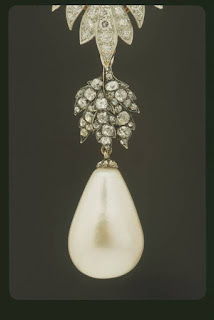 |
| “La Peregrina.” La Peregrina - Smithsonian Institution, Photo by NMNH Photo Services. |
I found an article from a few years ago by jewellery exhibitor Symbolic & Chase who showcased a jewel which they called ‘The Mary Tudor Pearl.’ According to their description the Renaissance pearl surfaced in 2004, having been lost since the late 16th century, and can be dated back to 1526. It measures 258.12 grains (64.5 carats, 69.8 carats with its diamond cap) making it the third largest well-formed natural pearl documented to date.
The provenance leads at last to Mary.
‘Between 1526 and 1539 the pearl entered into the outstanding jewellery collection of the Empress Isabella of Portugal (1503-1539), either as a diplomatic gift or by the Empress purchasing it. When the Empress died in 1539 the pearl was inherited by her daughter, Juana of Austria (1535-1573). Following a short marriage to Prince John of Portugal (1537 – 1554), Juana returned to Spain to assume regency for her brother, Philip II. The pearl became part of Philip’s dowry for his new bride, Mary Tudor (1516-1558), after whom the pearl has been christened.'
‘It is an outstanding asymmetrical drop-shaped pearl that was much admired by the Tudor courts and is featured in Royal portraiture of Mary Tudor, namely ‘Mary Tudor, Queen of England, second wife of Felipe II’ by Anthonis Mor at the Museo del Prado and ‘Queen Mary I’ by Hans Eworth, which has been included below courtesy of The Bridgeman Art Library. A similar painting by Hans Eworth of Queen Mary I also hangs at the National Portrait Gallery.' ("The Mary Tudor Pearl Unveiled", Kari Pearls: Natural Pearls - A Trusted Resource.)
 |
| Mary Tudor, Queen of England, second wife of Felipe II’ by Anthonis Mor |
‘It is an outstanding asymmetrical drop-shaped pearl that was much admired by the Tudor courts and is featured in Royal portraiture of Mary Tudor, namely ‘Mary Tudor, Queen of England, second wife of Felipe II’ by Anthonis Mor at the Museo del Prado and ‘Queen Mary I’ by Hans Eworth, which has been included below courtesy of The Bridgeman Art Library. A similar painting by Hans Eworth of Queen Mary I also hangs at the National Portrait Gallery.' ("The Mary Tudor Pearl Unveiled", Kari Pearls: Natural Pearls - A Trusted Resource.)
But is this and Mary’s pearl one and the same? The stories of all three jewels are so close, the provenances quite similar with it passing through the hands of so many European Royals, could their stories not just been horribly mixed up? Just as I was beginning to believe it was, I came across this website and discovered I wasn’t the only one in search of it. This website sums the whole thing up far more succinctly than I could ever do. He believes there is a third jewel, now known as Queen Mary’s Pearl and concludes that:
‘Mary Tudor never owned La Peregrina, though she did own a slightly larger pearl now known as the Mary Tudor Pearl.
Mary Tudor wore her pearl suspended from a golden brooch set with the Grande diamond that Philip II inherited from his mother, Isabel de Aviz.
Upon her death, Mary Tudor returned this brooch to her husband, who removed the pearl and gave it back to his sister Joanna.
Upon Joanna's death, the pearl was put up for auction.
The pearl failed to sell at the 1574 auction, but a man by the name of Diegor Ruiz purchased it in 1581 for 3,300 reales. After this, the pearl disappears from record.
In 2004, this pearl appears on the block at Christie's London, at which time it is purchased by Symbol & Chase of Bond Street.’ ©2006-2020 EraGem®
For more information, read this very fascinating blog post.
~~~~~~~~
Judith Arnopp is the author of twelve Historical Fiction novels and has contributed to several non-fiction anthologies. you can find more about Judith's work on her webpage: www.judithmarnopp.com or her Author Page: author.to/juditharnoppbooks
Judith's latest novel is The Heretic Wind: the life of Mary Tudor, Queen of England available on Kindle and Paperback. The audio version will be available later in 2020.