Showing posts with label charles dickens. Show all posts

Tuesday, December 22, 2020

Behind the Scenes of Charles Dickens' 'A Christmas Carol'

by Nancy Bilyeau

It may well be the most beloved Christmas story ever written. Charles Dickens' novella, originally titled Christmas Carol. In Prose. Being a Ghost Story of Christmas, was published on December 19, 1843, and sold 6,000 copies by Christmas Day. It has never gone out of print and is the basis for countless adaptations, giving way to debates over who is the best Ebeneezer Scrooge: Alastair Sim or Reginald Owen, George C. Scott or Patrick Stewart.

Autographed manuscript of the title page of 'A Christmas Carol,' signed by Dickens. Purchased byJohn Pierpont Morgan before 1900. Image courtesy of Morgan Library & Museum Media Department.
While the story itself is both touching and mythic, taking a closer look at Dickens' decision to write the book and the personal history that he poured into it is illuminating.

Dickens, to put it bluntly, wrote A Christmas Carol because he needed the money. He'd found literary fame due to the success of The Pickwick Papers and Oliver Twist, but his new book, Martin Chuzzlewit, was not as successful.

Dickens had a wife and four children to support; his wife, Catherine, was pregnant with their fifth. He came up with the idea to rent the family’s London home and live on the Continent for a year. A Christmas Carol was written to fund this move. A story of spirits who appear at Christmastime was not invented by Dickens. For centuries, during the longest and darkest nights of the year, it was thought that the barrier between this world and the afterlife was at its thinnest. This was the time for ghosts to show themselves to the living.

The original cover of A Christmas Carol. Dickens insisted that it be bound in crimson morocco, a  durable goatskin leather. The binding is elegantly decorated in gilt with the name "Thomas Mitton Esqre." Dickens presented the bound manuscript to Mitton, his close friend and creditor, possibly as a Christmas gift. From the J.P. Morgan collection, courtesy of the Morgan Media Department 

Dickens penned the book in six weeks. He wrote in a concentrated burst from 9 am to 2 pm every day. Writing would be followed by long brainstorming walks.

He scribbled many notes in the margins as he went, making swift corrections. According to curators of a Dickens exhibit at the Morgan Library & Museum, owner of the original manuscript, "Deleted text is struck out with a cursive and continuous looping movement of the pen and replaced with more active verbs—to achieve greater vividness or immediacy of effect—and fewer words for concision. This heavily revised sixty-six-page draft—the only manuscript of the story—was sent to the printer in order for the book to be published on 19 December, just in time for the Christmas market."

Page 2 of the original manuscript of A Christmas Carol,
showing Dickens' corrections.
From the collection of the Morgan Library & Museum,
image courtesy of the Media Department 

Literary historians believe that because he needed to write so fast, Dickens focused on a topic already close to his heart. He fueled the story with his own feelings about the terrible conditions for the poor in England. The 1834 New Poor Law went far toward criminalizing poverty. Dickens was furious about the grim fate of the working class, and he used this novella to write about it.

As for the book's characters, debates go on about which real-life "misers" Dickens based the elderly Ebeneezer Scrooge on or his partner Jacob Marley. When it comes to the younger Scrooge, though, Dickens' own youth can be seen in glimpses. His years of loneliness and resentment come through.

In the story, the boy Ebeneezer Scrooge has been sent away to a boarding school (one with dirty rooms and cracked windows) by a father who seems to want nothing to do with him.

 Dickens had a complicated relationship with his father, John Dickens. When he was 12, Charles Dickens was removed from school and forced to work at a blacking factory for 10 hours a day, six days a week. The reason: his father, John Dickens, had been sentenced to Marshalsea Prison because he was unable to pay a debt of 40 pounds; his wife and younger children joined him there, while Charles lived alone in lodgings. 

This means that when still a child, Charles Dickens was under intense pressure to make money and relieve this debt. It was the family's only way out of prison. These memories never left Dickens: “My whole nature was so penetrated with grief and humiliation,” he told a friend.

Charles Dickens,
photo courtesy of the Morgan Library & Museum, media department.
The character of Bob Cratchit, Scrooge's weak, hapless, but warm-hearted clerk, bears some resemblance to Dickens' father. This makes Scrooge's abuse of Cratchit in the first three-quarters of the story all the more interesting.

A crucial character in A Christmas Carol is Scrooge's older sister Fan, who is the only person to love him unconditionally but dies as a young woman after giving birth to her son, Fred.

"Always a delicate creature, whom a breath might have withered," said the Ghost. "But she had a large heart."
"So she had," cried Scrooge.
Fan, it seems clear, was based on Dickens' older sister Frances, known in the family as Fanny, who was close to her brother when they were children. 

She was "clever and accomplished," according to Dickens biographer Claire Tomalin. A talented musician,  in 1823 she became a student at the Royal Academy of Music in London.  She was expected to become the star of the family, not Charles. Biographers believe that he was often envious of Fanny.

According to the Charles Dickens Museum, "Fanny’s schooling was, however, often marred by her father’s inability to pay her fees. A letter survives from John Dickens, dated 25 May 1826, in which he suggests a payment plan, offering to pay '£10 quarterly from the 24th June next and the same to continue until the account is finally closed.' "

 Christmas Carol, London: Chapman & Hall, 1843
Illustration by John Leech depicting Marley's Ghost.
Photo courtesy of Morgan Library & Museum, media department
Fanny did have a career as a professional singer, with a "pure" singing style. In 1837, she married a fellow musician and they settled in Manchester. The couple had two sons. Harry was a bright child with some sort of physical handicap. "Once Fanny Dickens married and had children, her career declined," wrote Tomalin.

Fanny became ill with tuberculosis and went into a long decline. When Fanny died, Harry passed away shortly afterward at the age of 8. Some have speculated that the child was Dickens' inspiration for Tiny Tim.

Such family tragedies would seem to provide strong inspiration for Dickens in his character creations of Fan and Tiny Tim. What is chilling is that Fanny and Harry died years after Dickens wrote A Christmas Carol.  

By the time his sister fell ill, Dickens was in a much better financial position. He hired the best doctors for Fanny, but nothing could save her. She died at the age of 38 on September 2, 1848. Dickens arranged for her burial in Highgate Cemetery. Harry was buried there too, as were Charles Dickens' parents and other members of his family.

Charles Dickens, the great writer, did not join them. He is buried elsewhere.


Highgate cemetery, where many members of Dickens' family were
buried, including his sister Fanny and his nephew Harry

~~~~~~~~~~~~
Nancy Bilyeau is a novelist and magazine editor. She has published four historical novels. Nancy recently published a novella, The Ghost of Madison Avenue, set in 1912 New York City and telling a Christmas story. For more information, visit Nancy's website at http://www.nancybilyeau.com/.

Friday, January 17, 2020

Romancing the Tower of London: William Harrison Ainsworth

By Nancy Bilyeau

On a December night in 1840, a sizable group of writers, editors, publishers, printers and illustrators gathered at the Sussex Hotel, in the fashionable town of Royal Tunbridge Wells, for a dinner party. It is possible that Charles Dickens, the young author of Oliver Twist and The Life and Adventures of Nicholas Nickleby, was invited to the party. Most definitely in attendance was George Cruikshank, the talented illustrator of Oliver Twist.

The host of this lavish affair was the famed 35-year-old novelist William Harrison Ainsworth. The occasion: the successful serialization over the last year of his fifth novel, The Tower of London: A Historical Romance, which told the story of the tragic Lady Jane Grey, beginning with her arrival by barge at the Tower to launch her nine-day-reign and ending with her decapitation on Tower Green on July 10, 1553.

William Harrison Ainsworth

The novelist was sure to have cut quite the dash at his own party: He was tall, slim and dark, with a fondness for stylish clothes that earned him the description dandy. From the Oxford Dictionary of National Biography: "Lady Blessington, whose salon he attended, said he and Count D'Orsay were the two handsomest men in London."

In a passage accepted as autobiographical, a character in one of Ainsworth's novels says, "Some people told me I was handsome, and my tailor (excellent authority, it must be admitted) extolled the symmetry of my figure, and urged me to go into the Life Guards."

Ainsworth was at perhaps the zenith of his career in 1840. He was a friendly rival to Dickens; in fact, his 1839 novel Jack Shepard outsold Oliver Twist in early editions, and Ainsworth had recently replaced Dickens as editor of Bentley's Miscellany, the predominant fiction magazine.


The rivalry with Dickens would not last; nor would the friendship. Dickens would become a colossus as Ainsworth slowly sank into oblivion. His 39 historical novels, all of them romances and adventures, were astoundingly popular with the reading public of Victorian England, but not with the critics. Although Ainsworth was himself a genial and generous man, he was often on the receiving end of literary volleys almost hysterical in their dislike. When his books no longer sold as well, he had no circle of supporters to buoy him. Quite the opposite. One writer said of him in 1870: "Let us start with an opinion fearlessly expressed as it is earnestly felt, that the existence of this writer is an event to be deplored." Ainsworth was still alive when this sentiment was published, and in reduced circumstances.

That dazzling night at Royal Tunbridge Wells, Ainsworth, mercifully, could not know that his books would go out of print, that fellow writers such as Edgar Allan Poe would describe his prose as "turgid pretension."

Yet he is not without a legacy. The book celebrated that night, The Tower of London: A Historical Romance, triggered a new kind of interest in William the Conqueror's castle keep. It was an interest that deepened through the Victorian age, and is part of the reason visitors pour into the Tower, to the tune of 2 million a year.

Ainsworth was born on February 4, 1805, in Manchester, as the city became the center of the industrial movement. Thomas Ainsworth was a prominent lawyer and pressured his oldest son to follow him in that profession, which he did for a time, but without much enthusiasm. There was a younger son, Thomas Gilbert Ainsworth, who at university suffered a "brain fever" and was incapicitated by mental illness his entire life.

Two years after the father died, Ainsworth, newly married, published his first novel, the romance Sir John Chiverton. It brought him to the attention of Walter Scott, who befriended Ainsworth but privately referred to him as an "imitator." His next two books, the historical novels Rockwood and Jack Schepard, both featuring famous outlaws, were tremendous successes. Yet some criticized the romanticizing of criminals, a complaint Dickens was also hearing with Oliver Twist.

It was time to try something different.

When Ainsworth, along with his illustrator, George Cruikshank, researched the Tower of London, it was far from the smoothly operating tourism operation of today. It had been two centuries since the last monarch, Charles II, resided there. Dickens wrote: "Once a fortress, a royal residence, a court of justice and a prison, {the Tower} is now a government storehouse and armory." An outbreak of disease caused by poor water supply (and blamed on the filthy moat) killed three men of the garrison.

A visitor in 1851 wrote:

"Every one must be struck with the incivility and want of accommodation therein. Upon entering the gates this afternoon I found some hundreds of persons, male and female, huddled together, striving to obtain tickets from a window under a portico where no two persons can pass abreast, and the scene there reminded me of what might be expected at the gallery entrance of a theatre on boxing night. After waiting just one hour we obtained our tickets and were ordered into what is called the ante or refreshment room. This room is about 12ft. by 18ft., with a counter containing ginger pop, buns, &c., immediately behind which are two waterclosets (I understand recently erected). I will not attempt to describe the stench one had to contend with, the place being completely crammed with persons waiting their turns or numbers to be called, but merely add that this room seems to be the resort of pickpockets, two ladies having been eased of their purses, containing some pounds, during the half hour I was present therein."

Ainsworth opened the door to a more illustrious period in the Tower's history. It's true that the novel's prose is melodramatic ("heaving bosoms," "piercing black eyes" and "sinister smiles") and the pages are crowded with Gothic characters (not one or two but three supporting characters who are giants--and a dwarf!) along with august personages of the past. But Ainsworth's diligent research brings to life the grounds, the kitchens, the passageways, the prison cells and the beautiful chapels of the Tower. He made full, imaginative use of the Tower of London, as a setting for a story of high drama. And Cruikshank's 40 engravings and 58 woodcuts play their suggestive part.


Cruikshank's depiction of Lady Jane Grey
And in the center of it all is Lady Jane Grey, a character of undeniable pathos, surrounded by conspiracies. Ainsworth invests the Spanish ambassador, Simon Renard, with the malevolent abilities of a Blofeld straight from Bond. Northumberland is formidable indeed.There is an energy to the book, and an eerie, even frightening atmosphere. The rack, the Scavenger's Daughter and the infamous Little Ease are all present and accounted for.

The current official Historical Royal Palaces Tower of London "fact sheet" on torture emphasizes how little actual torture has taken place within its walls: "Myth-making reached its peak in the 19th century, spurred on by novelists who wished to evoke the Tower of London in its former days as an ancient fortress and stronghold e.g. Ainsworth’s The Tower of London." Ainsworth may have put the devices of torture to Gothic uses, but they were very much present in the 16th century. Ironically, government-approved torture of prisoners ebbed during the reigns of Edward VI, Jane Grey, and Mary, only to rise to highest levels during reign of Elizabeth.

After The Tower of London, Ainsworth's career went on for more than thirty years. The characters in his books were not dimensional; bosoms continued to heave and black eyes to snap. R.H. Horne, Dickens' friend and collaborator, described Ainsworth as "a reviver of old clothes" whose novels are "generally dull except when revolting." Punch satirized Ainsworth as an aging Tudoresque dandy with the caption "The Greatest Axe-and-Neck Romancer of Our Time."


By the time of the Punch jab, Ainsworth, a widower, was responsible for his mentally ill brother. He had accepted a government pension because...he needed it. A year after a dinner in his honor in Manchester, arguably the only place where he was still esteemed, William Harrison Ainsworth died at the age of 77.
But the Tower felt the lingering impact of Ainsworth. In the foreword of his book, he had called for the opening to the public of Beauchamp Tower, the place of imprisonment of the Lady Jane Grey, where she is thought to have written on the wall of her cell. The cause was taken up by powerful patrons, including Prince Albert. Beauchamp was restored by architects and made available to visitors; other buildings were opened too.

Ainsworth's influence, as explained in The Tower of London: The Official Illustrated History:

"In The Tower of London: A Historical Romance, the Tower was first and foremost the setting for an endless series of heart-rending events and foul play. The author tells of dungeons though in fact the Tower has very few basement rooms and of a time when Tower Hill boasted a scaffold and "its soil was dyed with the richest and best blood in the land.” Such fantasies, backed by the relentless march of the romantic movement, helped create and fuel an ever-increasing demand to see and experience such events.”

No matter how much the novel's violence veers into fantasy, the faintly menacing image of the Tower that draws the throngs of the curious today was created in part by William Harrison Ainsworth. He was the greatest neck-and-axe romancer of his time...and perhaps of ours too.

This article is an Editor's Choice and was originally published August 19, 2012. 

~~~~~~~~~~

Nancy Bilyeau is a historical novelist and magazine editor based in New York. She wrote the Joanna Stafford trilogy, a trio of thrillers set in Henry VIII’s England, for Simon & Schuster. Her fourth novel is The Blue, an 18th century thriller revolving around the art & porcelain world. Her latest novel is Dreamland, set in Coney Island of 1911, is published by Endeavour Quill. A former staff editor at Rolling Stone, Entertainment Weekly, and InStyle, Nancy is currently the deputy editor at the Center on Media, Crime and Justice at John Jay College and contributes to Town & Country, CrimeReads, and Mystery Scene magazine.

For more information, visit www.nancybilyeau.com.

Wednesday, March 14, 2018

An Ancient Legality that Named a House

By Sarah Rayne

The legal profession has always been a novelists’ treasure house, and lawyers themselves are a gift to writers of fiction. Old documents, particularly ones held by the family solicitor, such as a Will, can provide motives the reader hasn't yet suspected, and extra detail for the author to draw on.

Charles Dickens drew on his time as a solicitor’s clerk and court reporter to weave satirical portrayals of the English legal system, with characters caught like hapless insects in the dusty spider-strands of the law.
 

When, in Oliver Twist, Mr Bumble advised a court that, ‘The law is an ass’, Dickens may have been borrowing from a 17th century play called Revenge for Honour, which is attributed to both George Chapman and Henry Glapthorne, depending on which source you check. Not much seems known about Henry Glapthorne, but apparently Master Chapman signed an agreement for a loan which never materialised. According to the reports, he spent years petitioning Chancery to release him from payment, but at one stage was arrested for debt. (A fate which hovers over many writers to this day). Under those circumstances (supposing the facts to be accurate), it’s hardly surprising that Master Chapman did what a great many other writers have done: he wrote out his frustrations in the plot.

English law is peppered with all kinds of curious legalities – many of which had names that have almost vanished from the dictionaries. There are tithes and torts and peppercorn rents. There’s assumpsit (medieval breach of contract), and gavelkind (a Saxon form of limited land ownership). There’s something called aberemurder (spontaneous and gratuitous murder) and there’s witenagemote, which was an assembly of local elders in medieval England.

And there are one or two ancient laws, whose fragments still crop up…

Some years ago, when writing a novel, I searched for an appropriate house name for the brooding old orphanage/workhouse that played such an integral part in the plot. Names of places matter just as much as names of characters. You can’t call a Victorian asylum Rosemount Manor, or a gaol housing condemned prisoners Summerville Court.

Then I came across mortmain.

In medieval times, kings often had the amiable – if unthinking – habit of bestowing large swathes of land on religious houses. This was excellent for the abbeys and monasteries and churches of course – it resulted in them becoming extremely wealthy. Land yields profits, and in those days there would be all kinds of revenue to be scooped up: tenant farmers, who must pay rent to their overlord – fishing rights on stretches of river, grazing rights on open land. Market days and fairs, for which pedlars could set up stalls – and for which tolls were payable.

But if the abbeys and the monasteries were raking it in, the king was not. The problem was that religious houses do not succumb to mere mortality – they are never under age, neither do they marry, commit felony, or become attainted for treason. They do not, in short, fall victim to any of the fates that generate taxes. Thus, on the death of an abbot, the land simply passed to the next abbot – meaning that it was held in perpetuity, and that the medieval equivalent of modern death duties could not be enforced. This was known as mortmain – from Old French mortemain, and from the medieval Latin manus mortua. Mortmain was the possession of property in dead hands.


As tensions between the church and the Crown increased, ways to close this mortmain loophole were sought.

The first attempt seems to have been made by King John, in 1215, with Magna Carta – that ‘Great Charter of the Liberties’ that came into being at the famous meeting at Runnymede.

Magna Carta was never straightforward. John was not popular with the barons; he had squabbled rather disastrously with the French, and he was resented by the Church, who did not like being told what to do by an Angevin king, and, moreover, a king whom they had excommunicated in 1209. Magna Carta went into several editions, was the subject of many objections, and was tweaked until it squeaked. It almost makes the junketings of Juncker, Barnier and May seem like a parish council tiff.

But one of Magna Carta’s provisions was an attempt to prohibit the form of land ownership known as mortmain. It was unfortunate that John died in 1216 before he could get this fully established, because his son, Henry III, was not over-enthusiastic about enforcing it. Henry liked the Church. He liked its authority, and he liked knowing it was on his side. He was not going to get into tussles with it over the ownership of land and the sneaky side-stepping of taxes.

It was Henry’s son, Edward I, he of the lion-like appearance and warlike demeanour, who took up the cudgels and brought the prohibition of perpetual ownership centre stage. There were two Statutes – in 1279 and 1290 – and the 1279 one has no truck with ambiguity. It prohibits, “any person whatsoever, religious or other, to buy or sell, or under colour of any gift, term or other title, to receive from anyone any lands or tenements in such a way that such lands and tenements should come into mortmain”.

That, thought Edward and his advisors, would put the nuisance firmly in its place. More to the point, it would ensure that the kingdom’s revenues were preserved – and in time, increased.

A sceptic might wonder if a side-aim of this was to check the growing wealth and power of the church, and a cynic might call to mind how vastly expensive wars are, and how helpful taxation is in funding them. And Edward Plantagenet certainly fought a great many wars.

But even with the Statute of Mortmain firmly in existence, the problem persisted. Over the years, wise men and fools – kings and princes and chancellors – expended time and energy trying to break the legal grip of the church. Lawyers pondered and wrangled in leisurely and expensive fashion. It was an irritant and a constant cause of vexation. Not for nothing, does Shakespeare give a character in Henry VI the devout plea, ‘First thing we do, let’s kill all the lawyers’.

It was not until more than two centuries later that matters were resolved. Henry VIII swept aside the old order, gave way to the new, and confiscated Church lands wholesale. Amidst the carnage that was the Reformation, the law of Dead Man’s Hand became more or less obsolete. It was, in fact, finally abolished in 1960.

But whatever mortmain’s complexities, it provided a splendid name for my fictional house in A Dark Dividing.
~~~~~~~~~~


Sarah Rayne’s first novel was published in 1982, and since then she has written more than 25 books. As well as being published in America and Australia, her novels have been translated into German, Dutch, Russian, and Turkish.The daughter of an Irish comedy actor, Sarah began writing in her teens, with plays for the Lower Third to perform in her convent school.Much of her inspiration comes from the histories and atmospheres of old buildings, which is strongly apparent in many of her settings – Charect House in Property of a Lady, Twygrist Mill in Spider Light, and the Irish cottage,Tromloy, in Death Notes.  Music also influences a number of her plots: the music hall songs in Ghost Song, the eerie death lament ‘Thaisa’s Song’ in The Bell Tower, and the lost music in Chord of Evil that hides a devastating secret from WWII.
Connect with her at http://www.sarahrayne.co.uk/
https://www.facebook.com/SarahRayneAuthor
https://sarahrayneblog.wordpress.com/
http://www.youtube.com/user/SarahRayneAuthor

Find out more about Death Notes here: http://www.sarahrayne.co.uk/project/death-notes

Saturday, June 8, 2013

Victorian Violence: Repelling Ruffians (Part Two)

by Terry Kroenung


 Genteel Self Defense
"I can almost hear people say, ‘Oh, this is all rubbish; I’m not going to be attacked; life would not be worth living if one had to be always ‘on guard’ in this way.’ Well, considering that this world, from the time we are born to the time we die, is made up of uncertainties, and that we are never really secure from attack at any moment of our lives, it does seem worth while to devote a little attention to the pursuit of a science, which is not only healthful and most fascinating, but which may, in a second of time, enable you to turn a defeat into a victory, and save yourself from being mauled and possibly killed in a fight which was none of your own making. 

"Added to all this, science gives a consciousness of power and ability to assist the weak and defenceless, which ought to be most welcome to the mind of any man. Though always anxious to avoid anything like ‘a row,’ there are times when it may be necessary to interfere for the sake of humanity, and how much more easy is it to make that interference dignified and effective if you take your stand with a certainty that you can, if pushed to extreme measures, make matters very warm indeed for the aggressor? 

"The consciousness of power gives you your real authority, and with it you are far more likely to be calm and to gain your point than you would be without the knowledge. Backed up by science, you can both talk and act in a way which is likely to lead to a peaceful solution of a difficulty, whereas, if the science is absent, you dare not, from very uncertainty, use those very words which you know ought to be used on the occasion.” ~ Rowland George Allanson-Winn, 5th Baron of Headley, 1890

Pugilism
"Professional pugilism has died out, as much choked by the malpractices of its followers as strangled by public opinion…The noble art of self-defence is not, however, altogether neglected, but finds its place among the athletic sports, and the clubs by which it is encouraged may be congratulated on keeping alive one of the oldest institutions, in the way of manly exercise, on record.” ~ Charles Dickens, Jr., 1879

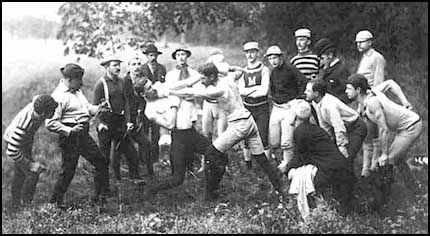
As we are concerned with the employment of self-defense techniques in the protection of one’s person and loved ones on the streets of Victorian London, it is not our purpose here to elaborate upon prize fights. Yet it is indisputably true that the one informed the other. Effective methods of pugilism were developed in the ring and then adopted by gentlemen on the boulevards. British boxing arose from the Age of Enlightenment’s love of all things classical. The ancient Greek sport of pankration, renowned for its brutality, and subsequent Roman variants, were revived in much more genteel versions in the mid 18th century.

It was the upper-classes who led the way in this, as simple brawling with fists had never died out among the working folk. Naturally, gambling was the impetus for injecting rules and order into what had been a mere vulgar scrap. A way had to be found to settle disputes when great sums were being wagered on gentlemen’s champions.

Thus the first regulations were set in place by former fighter John Broughton. His interest in fair play – gloves, set rounds, no attacking a downed man, etc. -- was somewhat selfish: he ran a school to teach pugilism to men of refinement and they did not wish to take broken jaws and black eyes home to their ladies.

Here we see the beginnings of the later Victorian attitude that boxing was a quintessentially English activity to be practiced by the ‘quality.’ To be sure, those less-mannered had always been beating one another to a bloody pulp in the alleys of London, but by the 1780’s pugilism began to evolve into an art that eventually replaced fencing in the hearts of the British middle- and upper-classes.

The decades-long struggle with France accelerated this urge toward the good manly virtue of boxing. Fisticuffs were seen as an antidote to the effeminate ways of the Continent. Less lethal than dueling (a strong selling point with every man needed to carry a musket against Bonaparte) and purely egalitarian (man vs. man with no underhanded doctoring of weapons), boxing became a national craze.


But it was a fad that suffered from early Victorian attitudes. That age’s philosophy stressed morality, faith, and family rather than the violence that Napoleon’s threat had necessitated. So the vogue waned for some time, as fighting was considered as beneath the dignity of a proper man. But when it returned it did so with a vengeance. The Queensberry Rules of 1867 were adopted with alacrity and became so widespread that the very nature of boxing changed.

With padded gloves an absolute requirement, tactics and footwork had to shift. First off, there actually could  be tactics, rather than mere flailing away until someone collapsed. In bare-knuckle boxing the defense, such as it was, was with the forearms rather than the hands. To protect one’s face the stance was upright, leaning the head back to keep it away from the opponent’s fists. Now the heavy gloves served as a shield to crouch behind.

In order to defeat this barrier, the now-familiar bobbing and weaving came into play, along with active footwork. Counter-intuitively, this all made the sport rather more dangerous. With bare knuckles a fighter had to pull a punch somewhat or risk a shattered hand. Now blows were delivered with much more fury and with greater rapidity. As a result men were struck harder and more often, since fights resulted in less bout-ending blood and broken teeth than before.

The cumulative effect of many punches caused more damage and actual knockouts than a few nasty but less forceful knuckle strikes. Brain injuries became common.


In a sense the popularity and widespread adoption of the Queensberry Rules might have been the downfall of many a well-trained but rule-bound gentleman when it came to actual no-holds-barred self-defense in the street. When accosted by an alley ruffian intent on relieving him of his wallet or watch, the club-trained man of means may have found himself at a disadvantage when kicked, grappled, or struck with a club. One can imagine him being overwhelmed mentally, as well, as the thug did not conform to the rules. Fair play did not enter into the equation.

But one can also imagine the contrary. Assailed by an unskilled, desperate, possibly intoxicated street thief, the training in pugilism might have made for a brief encounter. For the value in boxing does not lie only in simple techniques, but in the intangible qualities of confidence, cool-headedness, and quick judgement of the opponent’s strengths and weaknesses. Indeed, simply knowing how to take a punch, and how to mitigate the impact of it, would be of immeasurable value in itself. Attacked by an over-confident, swaggering hooligan who launched a clumsy haymaker, the gentleman’s schooling at his club could very well have resulted in the automatic response of step into the attack,/block, it/simultaneously punch with other fist.

Here we would be well-advised to recall the words of Allanson-Winn at the beginning of this essay, that pugilism is "a science, which is not only healthful and most fascinating, but which may, in a second of time, enable you to turn a defeat into a victory, and save yourself from being mauled and possibly killed in a fight which was none of your own making.”

As proof of the efficacy of pugilism as self-defense, though admittedly not in a historical context, we offer this video of a trained boxer fending off a veritable horde of enraged attackers with only the skills a Victorian gentleman might have learned from his boxing instructor:


In Part 3 we will explore the variety of weapons available to a Victorian in defending against armed or unarmed assailants, from the ubiquitous walking stick or umbrella to the cudgel or loaded riding crop.
Part 4 will conclude the series with an examination of Bartitsu, the only mixed martial art of this era and indeed, the first such.

~~~~~~~~~~~~
Terry Kroenung is the author of Brimstone and Lily, a seriocomic fantasy novel set in 1862, and its sequel, Jasper’s Foul Tongue. Book 3 in the series, Jasper’s Magick Corset, will be available in September. Paragon of the Eccentric, his Steampunk prequel to War of the Worlds, is pending. He has also written dramas set in the 19th century, such as Gentle Rain and Coolness and Courage.

Saturday, May 11, 2013

Victorian Violence: Repelling Ruffians (Part One)

by Terry Kroenung


 "The housebreaker freed one arm, and grasped his pistol. The certainty of immediate detection if he fired, flashed across his mind even in the midst of his fury; and he beat it twice with all the force he could summon, upon the upturned face that almost touched his own.

She staggered and fell: nearly blinded with the blood that rained down from a deep gash in her forehead; but raising herself, with difficulty, on her knees, drew from her bosom a white handkerchief--Rose Maylie's own--and holding it up, in her folded hands, as high towards Heaven as her feeble strength would allow, breathed one prayer for mercy to her Maker.

It was a ghastly figure to look upon. The murderer staggering backward to the wall, and shutting out the sight with his hand, seized a heavy club and struck her down."
    --- Oliver Twist, Charles Dickens

To judge by this disturbing scene (or, indeed, any episode of Ripper Street) it was as much as a man’s life was worth to walk the streets of Victorian London. Robbery and murder were commonplace, pickpockets were as ubiquitous as fleas on a mongrel, and as for an unaccompanied woman, well…

But was that true? Or were the news reports of that era just as slanted toward the sensational as are our own? ‘If it bleeds, it leads’ is the motto of modern media and certainly British journalism of the 19th century could hardly claim to be more scrupulous. The truth is that we do not know with any degree of certainty.

Then as now circumstances and geography dictated risk. Jack the Ripper’s outrages were committed in sordid Whitechapel, after all, and not in genteel Kensington. A critical mass of the poor and desperate has always led to increased criminality.

Wise ladies and gentlemen preferred to avoid dirty, ill-lit areas with foul reputations. Forewarned is forearmed and all that. Yet an assault could happen at any time and place. It was no respecter of persons, either. In 1862 a Member of Parliament was garroted and robbed in broad daylight in Pall Mall.

Earlier centuries may well have been worse. The gin-soaked gutters of Hogarth’s time, with none of Robert Peel’s bluebottles or even the Bow Street Runners to keep the peace, were likely a horror-show. A noticeable decrease in wretchedness did occur with the advent of the Metropolitan Police, though it took until the 1880’s for that force to gain wide-spread respect. Ennui was not a risk faced by the Peelers.

In a typical Dickensian year (1856) the force arrested over 73,000 people. And we would do well to remember that an enormous percentage of crimes went unreported or unrecorded. The citizenry did not trust its own officers, often with good reason. Particularly in the early days the policeman was often just as likely as the most hardened East Ender to be guilty of an offense.


Even if the bobby was honest, many residents felt it a waste of time to make a complaint, since so many crimes were not solved. Let us give savagery the benefit of the doubt and presume that it was enough of a concern that measures had to be taken.

To this end most men of the middle and upper classes considered training in pugilism and singlestick to be an essential part of their education. When faced with a determined defender, many a hooligan would likely seek easier prey. Quite apart from such practical considerations, the manly arts also served to toughen the mind and spirit, preparing a fellow for the rugged vicissitudes of life. Instructional manuals abounded, all stressing this point:

"Physical education is indispensable to every well-bred man and woman. A gentleman should not only know how to fence, to box, to ride, to shoot and to swim, but he should also know how to carry himself gracefully, and how to dance, if he would enjoy life to the uttermost. A graceful carriage can best be attained by the aid of a drilling master, as dancing and boxing are taught. A man should be able to defend himself from ruffians, if attacked, and also to defend women from their insults."
     --- Our Deportment, 1879

Naturally certain of these skills were better-suited to the country house than the alleys of the metropolis. Be that as it may, expertise with stick and fist doubtless preserved many a life when faced with a resolute robber in a fetid corner of the Empire’s capital. At a minimum it would have enabled the victim to keep a cool head and react with grace under pressure.

In Part Two we shall investigate what techniques and tools would have been available to a gentleman, or lady, in such duress.

~~~~~~~~~~~~

Terry Kroenung is the author of Brimstone and Lily, a seriocomic fantasy novel set in 1862, and its sequel, Jasper’s Foul Tongue. Book 3 in the series, Jasper’s Magick Corset, will be available in September. Paragon of the Eccentric, his Steampunk prequel to War of the Worlds, is pending. He has also written dramas set in the 19th century, such as Gentle Rain and Coolness and Courage.

Monday, February 4, 2013

Poet's Corner

Karen V. Wasylowski

"The communication of the dead is tongued with fire beyond the language of the living"
Epitaph on the memorial to T.S.Eliot.


The South Transept of Westninster Abbey is a special place when it comes to British culture.   It is here the mortal remains (or at least a memorial) of some of the greatest poets, playwrights and writers in English literature have been laid to rest, beginning with Geoffrey Chaucer in 1556.  Over the centuries the tradition has grown, and only a chosen few have been considered worthy of this honor.


You can see how brilliant this man is...

Chaucer actually owed his Westminster burial more to his position, Clerk of Works of the Palace of Westminster, than to his writing, but in 1556 he was moved the South Transept, along with Edmund Spencer, British Poet and writer of 'The Faerie Queen', and the popular corner began to take off.  Lord Byron is commemorated there, William Shakespeare as well (although his actual burial place is Stratford-upon-Avon)

Samuel Horsley, Dean of Westminster in 1796, was said to have tartly refused the request for actress Kitty Clive to be buried in the Abbey:

"...if we do not draw some line in this theatrical ambition to mortuary fame, we shall soon make Westminster Abbey little better than a Gothic Green Room!"


The memorials take several forms, either a stone slab on the floor or more elaborate carved monuments. The Bronte sisters are commemorated together, on one slab, which was not unveiled until 1947, the four founders of the Royal Ballet were commemorated in 2009.  

The inscription over the grave of Ben Jonson is misspelled, ("O Rare Ben Johnson" )


Robert Browning's grave is adjacent to Alfred Tennyson, (Elizabeth is buried in Florence), Charles Dickens' is at home there too, as well as, Thomas Hardy, Handel, Henry Irving, Dr. Samuel Johnson, Rudyard Kipling, Richard Brinsley Sheridan.

Memorials include our wonderful Jane Austen, Keats, W. H. Auden, Elizabeth Browning, Robert Burns, Lewis Carroll, the Eliots, T. S. and George, Jenny Lind, Longfellow, Shelley, Thackeray, Dylan Thomas, Oscar Wilde, C. S. Lewis, D.H. Lawrence, and on and on...

As floor and wall space began to run out, the decision was taken to install a stained glass memorial window (unveiled in 1994 in memory of Edward Horton Hubbard), and it is here that new names are added in the form of inscribed panes of glass. There is room for 20 names, and currently there are six names on this window, with a new entry (Elizabeth Gaskell) unveiled on 25 September 2010.


There are even some of those nasty actors laying around in there.  David Garrick, an actor, playwright and produce, died in 1779.  His acting style was less bombastic than his predecessors, more natural.


Dame Sybil Thorndike, who has the distinction of having a play, Saint Joan, written specifically for her by George Bernard Shaw, and...


Laurence Kerr Olivier, Baron Olivier. Olivier is buried alongside some of the people he portrayed in theatre and film, including King Henry V, General John Burgoyne, Air Chief Marshal Hugh Dowding and William III of England and II of Scotland.
~~~~~~~~~~~~~~~

Karen V. Wasylowski is the author of two books.  Her first born, "Darcy and Fitzwilliam," is a sequel to Jane Austen's "Pride and Prejudice".  Her second book, "Sons and Daughters" is a sequel to "Darcy and Fitzwilliam"  Both books can be purchased here on Amazon.com.  

Wednesday, March 21, 2012

The Birth of "Bloody Mary"

By Nancy Bilyeau


Bloody Mary is the name of a drink that always contains booze and tomato juice and sometimes contains a dash of Worcestershire sauce, cayenne pepper, lemon, salt, black pepper or a vigorous celery stalk. In 1939, the newspaper This New York reported breathlessly, “George Jessel’s newest pick-me-up that is receiving attention from the town’s paragraphers is called a Bloody Mary: half tomato juice, half vodka.”


Bloody Mary is also the name of a macabre children’s game. Find a mirror, turn out the lights, and call out her name three times. When you switch on the light, Bloody Mary herself will appear in the mirror—the ghost of a woman wrongly accused of killing her own children.


And, most significantly, Bloody Mary is the moniker for Mary Tudor, the oldest child of Henry VIII. At the age of 37, she courageously took the throne by force after her half-brother Edward altered the act of succession. Young Edward wanted his Protestant cousin, Lady Jane Grey, to follow him, not his Catholic sister. But Mary raised an army and overthrew Jane’s fragile government. Her five-year reign is not considered a success. She married a Hapsburg prince—the marriage was very unpopular—and had a phantom pregnancy (maybe two). England experienced bad harvests every year during her reign. A war with France ended in disaster: the loss of Calais.


 Those new to the 16th century sometimes have trouble keeping the “Mary”s straight. There is Mary, Queen of Scots, the beauty who married three times, lost her throne and was eventually executed by Elizabeth I. She was romantic. The Mary I write about in this post is the other one—the “Bloody” one who, in her zealousness to turn England back into a Catholic country had 284 Protestant martyrs burned at the stake. While more than 300 Catholic martyrs died during the reigns of Henry VIII and Elizabeth I, Mary is the one who carries the reputation of being a merciless, bigotry-filled killer.


How that reputation evolved over the centuries is very interesting.


Mary Tudor was a woman of her time. While that may seem obvious, she was followed by a half-sister who was in some ways ahead of her time. Mary took a husband to secure the succession by having children, as every monarch was expected to do. Elizabeth refused to marry. Mary upheld the Catholic religion and did not recognize the opposing point of view. Elizabeth famously said, “There is only one Christ, Jesus, one faith, all else is a dispute over trifles.” Mary and Elizabeth, while close when young, distrusted each other by the time Mary took the throne. The relationship went downhill from there. When Elizabeth succeeded, she did not honor Mary’s request to be buried with her mother, Katherine of Aragon, and rarely spoke well of her older sibling.


But it wasn’t Elizabeth who ensured that Mary would be detested for centuries. The first person to push her toward infamy—hard—was John Foxe, the Protestant author of The Book of Martyrs. Most English people did not witness the burnings of condemned heretics. But thanks to Foxe’s widespread book, first published in 1563, the horror of being burned at the stake was made starkly clear. These descriptions make for harrowing reading, then and now.


It was Foxe who wrote, “The next victim was the amiable Lady Jane Gray, who, by her acceptance of the crown at the earnest solicitations of her friends, incurred the implacable resentment of the bloody Mary.” But the nickname did not take hold then—in fact, it did not spring up until a century later.
The succession crisis over James, Duke of York, directly led to the vilification of Mary Tudor. Fear that James, who converted to Catholicism, would succeed his brother, Charles II, gripped much of England. Should a Catholic become king, one politician warned, the kingdom would see persecutions as “bloody or bloodier than the ones in Mary’s reign.” An anonymous ballad in 1674 declared that after Edward VI died “Then Bloody Mary did begin/in England for to tyrannize.” She was used as a threatening memory of tyranny and death and slavish devotion to the Pope. This was the genesis of Bloody Mary.


            The revolution of 1688 put a Protestant on the throne and the Act of Union in 1707 ensured that a Catholic could never rule England. But paranoia about Jacobite risings led to more and more denunciations of Mary I. Today historians agree that, no matter what one thinks of her later reign, Mary was an attractive young woman, well educated and exceptionally talented in music. She loved fine clothes, jewelry and gambling. She was a devoted godmother and generous friend right up until her death. But in the lowest point of Mary’s historical reputation she was depicted as not only bloodthirsty and tyrannical but also stupid and hideous.


Here is how an 18th century historian describes the Tudor queen: “Mary was not formed to please, she had nothing of the woman in either her history or her behavior; she was stiff, formal, reserved, sour, haughty and arrogant, her face plain and coarse, without any soft features to smooth its roughness or any insinuating graces to shade its defects. Everything in her looks, her air, her carriage and manner, was forbidding…scarce ever was there a person so utterly void of all the agreeable qualities.”


            A century later, no less a figure than Charles Dickens attacked Mary with ferocity. In A Child’s History of England, Dickens ranted: “As BLOODY QUEEN MARY, this woman has become famous, and as BLOODY QUEEN MARY she will ever be justly remembered with horror and detestation in Great Britain. Her memory has been held in such abhorrence that some writers have arisen in later years to take her part and show that she was, upon the whole, quite an amiable and cheerful sovereign! ‘By their fruits ye shall know them,’ said OUR SAVIOR. The stake and the fire were the fruits of this reign, and you shall judge this Queen by nothing else.”


            It is not until the 20th century that attempts were made to draw a more balanced portrait of Mary. Last year saw the publication of Mary Tudor: Old and New Perspectives, a collection of scholars’ essays co-edited by Susan Doran and Thomas S Freeman. On the first page, the editors say, the purpose of the book is to reveal an “educated, resourceful and pragmatic queen.” One of the essays (bravely) takes on the issue of the martyrs: “The burning of 284 religious dissidents is morally unjustifiable from a twenty-first-century perspective. It is important to remember, however, that the values of the 21st century are not the values of the 16th century, and that in the 16th century the execution of obstinate heretics was almost universally regarded as a necessary duty of a Christian ruler.”


            Will the real Mary Tudor finally emerge from the shadows, thanks to books like this one? I look forward to new perspectives on the oldest daughter of Henry VIII. The screams of the dying martyrs of the 1550s can never be silenced.  But the time may have come for Mary’s name to stand alone—and for  “Bloody” to be no more.
           
            ---------------------------------------------------------

UK cover/Orion
US cover/S&S
            The Lady Mary Tudor is a character in The Crown and The Chalice, a series of historical thrillers published by Simon & Schuster and now on sale in North America, the United Kingdom and Germany. The Chalice is available for $1.99 on amazon and Barnes & Noble for the month of February. The third and final book in the trilogy, The Tapestry, will be published March 24th.
            For more information, go to www.nancybilyeau.com


Tuesday, March 20, 2012

Child labour and Pick-pockets

by Marie Higgins

When I start to write a new story, I flesh out my characters to see what makes them tick. In my latest story, my heroine had a terrible past. She was told at a young age while she was in school that her family had died in a house fire. The man who told her this devastating news then ruined her life by selling her to the villain - Richard Macgregor who taught orphans how to pick-pocket. These orphans ranged from seven or eight years of age to sixteen or seventeen. He controlled them and they were afraid of making him upset because he'd whip them.

This is what I decided to research for my story "The Sweetest Touch", a Regency Romance. I was appalled at what I discovered. We all know there were several different social classes. The higher class of people had the money to send their children to school to receive an education. However, the children from the working class didn't have this luxury. If a family could not afford to put their children in school, the children had to find jobs to help the support the family. It was not uncommon to expect children to work along side their mothers, often in textiles, mills, or factories. In 1788, two-thirds of those who worked in factories were children who worked 13 hour days - six days a week! (And we think we have it bad!) Most employers liked hiring women and children because they didn't have to pay them as much.

The Industrial Revolution became notorious for employing children in factories and mines and as chimney sweeps. In fact...did you know that Charles Dickens worked at the age of twelve in a blacking factory because his family was in debtors' prison?

Orphans weren't as lucky to work in factories, which is why most of them joined gangs and would steal to survive. Oliver Twist (written by Charles Dickens) is the story of an orphaned boy who was in one of these gangs. While writing my story, I wanted my heroine to remember the struggles she had in the ten years she was with Richard Macgregor and the other orphans. There were times while writing this story that I got emotional just thinking about the way of life for these poor waifs. Researching this definitely helped my story!!

I'd like to share with you a part of my story. In the beginning, the readers know my heroine (Louisa) is a pick-pocket. But within a couple pages, she's in an accident and loses her memory. The hero (Trevor) is the one who hit her with his curricle, and feels like he should keep her at his home working as a servant. Soon, she's gets the task of being the hero's children's nursemaid. At this point in the story she still does not remember her past. In this scene, heroine, hero and his children, are walking up the street to a pastry shop.

Trevor glanced at Louisa to ask if she would like a pastry, but she wasn’t looking toward the window. She focused on something behind him. Instead of her shy smile he’d watched for the past little while, a suspicious frown tugged on her lips.

Just as he turned to see what bothered her, another person bumped into him, making him stumble. “Forgive me for not seeing—” he began to say, but the vagabond didn’t stop.

Louisa gasped and jumped in the stranger’s path. As the young lad skirted around to avoid her, Louisa’s hand slipped in the boy’s pocket quick as a flash. The vagabond pushed her shoulder, aiming his glare right at her, opened his mouth to speak…but then stopped. Wide eyes stared at Louisa for a few seconds, before he sprinted into a run.

Shock washed over Trevor as he witnessed the scene. Her movement was so quick—so precise—he wondered if he’d actually seen what he had.

Louisa stood still, staring at the object in her hand. Her face void of color.

“What in heaven’s name—” Trevor snapped, but then noticed what she held out to him. My pocket watch? He dug inside his pocket—the same place he always kept his watch—but it wasn’t there. Words choked in his throat. The thief.

“Your Grace,” Louisa said in a shaky voice. “I could not allow him to steal from you.” She handed him the watch.

Still in shock, he shook his head. “How did you know he was stealing from me?”

“I…” She turned her head and stared at the direction the lad had run. “I saw him take your watch, and I knew I had to get it back.”

“But, Louisa,” Trevor stepped closer. “You took my watch right out of his pocket and he didn’t even notice.”

She gave a faint, emotionless chuckle. “I know.”

“How…” Trevor shook his head. Her wide eyes and colorless face told him this had been a mystery to her as well.

“Well,” he said, expelling his breath, “shall we venture into the shop and get some pastries for our drive home?”

Nodding, she folded her shaking arms. “Yes. That is a splendid idea.” She hurried to the twins and held their hand.

Trevor opened the door for the three before entering the shop. His mind whirled with unanswered questions but more with the fear that he knew what the answers were all along. By Louisa’s quick actions as she retrieved his watch, Trevor now realized what her past had been. The realization left a bitter taste to his mouth that no pastry would be able to remove.

 "The Sweetest Touch" book #2 in my Regency Romance series.

Marie Higgins is a multi-published author of romance; from refined bad-boy heroes who makes your heart melt to the feisty heroines who somehow manage to love them regardless of their faults. Visit her website / blog to discover more about her – http://mariehiggins84302.blogspot.com


Friday, February 10, 2012

The Harlot Who Was Dickens’ Muse, or, Even Greater Expectations

by Katherine Ashe

This is the story of a British author’s inspiration. It happens his muse was an American woman. She fits into the history of British letters for she was the inspiration for Miss Havisham, the bitter spinster jilted at the altar who is the central character of Great Expectations. Just how far may an novel depart from the facts of its inspiration? Very far indeed.

Granted, Dickens met her when she was an old woman, a wealthy dowager living in a mansion in New York City’s then fashionable Harlem. She was Madame Jumel, widow of the wealthy French liquor importer, Stephen Jumel, and wealthy even more in her own right, for she had cornered the Manhattan real estate market just as farms were being divided into the blocks now demarcated from 14th Street to 34th Street. She was, by her own effort, the richest woman in the western world.

She entertained Charles Dickens during one of his American tours. And astonished him by showing him her dining room, festooned with cobwebs, scattered with green and rock hard crumbs. For the room was her relic of the night she entertained Joseph Bonaparte, the Emperor of France’s brother.

Also, in her household was a little girl, actually her sister’s granddaughter, whom she was training to entrance men with her charms. A little boy was even provided for the child to practice upon. Thus Eliza Jumel came to inspire the character of the raddled, embittered, jilted-at-the altar Miss Havisham, of Great Expectations.

Dickens noted what he saw, and wrote the story that sprang to his mind. But the truth of Madame Jumel could not have been further from Miss Havisham.

We know the actual details of Eliza’s life because, after her death, the son, George Washington Bowen, whom she left in Providence, Rhode Island, to be brought up in the brothel of Mother Freelove Ballou, sued to gain her estate. A parade of witnesses, from her own servants in New York, to the Governor of Rhode Island himself who, from his childhood, remembered her as Betsy Bowen, the tart of the dockyards.

The revelations left New York scandalized, titillated, entranced. Madame Jumel was eccentric, yes. A few years before her death she had offered charity to homeless men during an economic crash. The men found themselves dressed in uniforms (designed and paid for by Madame) and being drilled daily by the lady herself astride her charger. She was preparing to invade of Mexico and make herself an empress. If this sounds like utter madness, it wasn’t quite. She was carrying forward the plans of her second husband, Aaron Burr.

What was Madame’s heritage? She was born Eliza (Betsy) Bowen, the daughter of a servant girl who, very unfortunately, previously had become pregnant and was cast into the streets of Providence. There she was first rescued by a brothel owner named Solomon Angel (one would not dare to make these names up) who handed her on to Mother Freelove.

In 1775 the now confirmed harlot, Phoebe, attracted the attention of a gentleman visiting Providence, and he took such an interest in her that he gave her enough money to stay off the streets for a while. During her time of absence from her profession, Phoebe discovered she was pregnant, and the child she bore was Eliza. The father, she informed Eliza, was none other than George Washington.

While still sheltered from life on the streets, Phoebe married a fisherman named Bowen, and the baby Eliza was given his name. But Bowen soon fell from his boat in a drunken stupor and was drowned.

Phoebe and Eliza were back at Mother Freelove’s, where Eliza, or Betsy as she was being called, grew to be a lively beauty and a great asset to the establishment. That is, until a French sea captain named DelaCroix, finding her not only winsome but quite intelligent as well, lured her to France. There he taught her French, and she joined several other of his protégées in his remarkable business.

Betsy, speaking French now, was set up by Captain DelaCroix in New York City and passed off as his wife. The aim was to entrap rich men into affairs with this lonely, lovely French wife. Then the captain would appear in the midst of a scene flagrant and the fearful lover would find himself the victim of blackmail. Charming, n’est pas?

New York City was prosperous and merry in these early years of the 1800’s, and Eliza’s victims included the very best people. But there were two men who escaped being her victims: Alexander Hamilton and Aaron Burr. Hamilton, because gossip had it he as a love-child of George Washington’s – hence Eliza may have considered him her brother – and she did have SOME standards, you know.

Burr, because she fell in love with him, and he got rid of Captain DelaCroix for her and set her up in a career in the theater.

On the stage she was not nearly the success she had been in the boudoir, but she did well enough to dazzle an acquaintance of Burr, the liquor importer Stephen Jumel, a Frenchman with his own fleet of ships. Her French was sufficiently convincing even to fool him.

Soon Eliza gave up the stage and was installed as Jumel’s mistress, with the clothes, the coach, the house: all the accoutrements of a wife except the legality. Why did Burr give her up? He was pursuing a political career. A career that would bring him repeatedly into tied vote with Thomas Jefferson for the Presidency of the United States. He couldn’t afford a woman with Eliza’s reputation. But there’s every indication that he loved her, and her acquisition by Jumel may have done nothing to slow him down—at first.

Secure and rich, Eliza now set her sites to the next step up: official marriage to Jumel. The businessman was frantically summoned to return at once from a trip to Washington. What he found was Eliza, pale, coughing her last, attended by his doctor and a priest. History has it that, in tears, he begged his mistress if there was anything he could do for her in these, her last moments, and she murmured, “Yes, Stephen, make an honest woman of me.” The priest was there, the rite was performed, and Eliza leapt from her deathbed screaming, “I’m Mrs. Jumel!”

Jumel was known for his practical jokes. He took this one in good part, and married Eliza again, properly in a church.

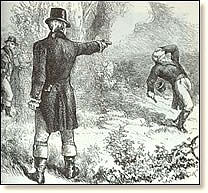
It was about this time that Burr found his access to his beloved curbed. The doors of the Jumel house were mysteriously closed to him. And it was at this time that his exchange of letters with Alexander Hamilton, which led to their fatal duel, commenced. The letters show Burr being vague in his complaint. He had withstood Hamilton’s politically aimed slanders for years without wincing, but now he was implacable but rather vague. Hamilton tried every means to appease his opponent, until at last Burr accused him of having irreparably impaired his private life. He demanded Hamilton “give satisfaction” and the duel took place on the cliff at Weehawken, New Jersey. Was the cause Eliza? Had Hamilton hinted to Jumel an ongoing relationship that caused Burr’s banning from the Jumel house?

After the duel, which brought on Hamilton’s slow death, Burr retreated to Washington to serve out his term as Vice-President of the United States. He had been the runner-up in the Jefferson/Burr presidential election and Vice Presidents then were the number two winner.

Dueling was of course illegal, officially Burr had murdered Hamilton, but in Washington, so long as he was serving in office, Burr couldn’t be touched by the law. His term finished, he fled west-- to found an army to invade Mexico and establish a dominion for himself. Unfortunately, Jefferson took fright, imagine the army was intended to abduct HIM. The law was sent after Burr and he was brought back ignominiously (he was a small man) tied on a lawman’s saddlebow. But accusations didn’t stick, and Burr ended exiled to France.

What was Mrs. Jumel doing all this time? Finding herself in such happy circumstances, she went to Providence hoping to rescue her sister. Their mother was dead by this time: shot as a squatter in an illegal shack. The sister, Eliza discovered, was also dead, found floating in Providence’s harbor. But she had left a little girl, named Eliza, who was beginning the cycle of their family’s sad history again, as a servant. Madame Jumel bought little Eliza out of servitude and made her an adoptive daughter.

Then she set about creating what was probably the first historical restoration in the United States, now known as the Morris Jumel Mansion (it claims to be the oldest house in Manhattan and can be can be visited: http://www.morrisjumel.org)

Why did Eliza do this? Built in 1765, this magnificent home of a royalist, Roger Morris, had been abandoned as the Continental Army moved into New York, and it came to serve as George Washington’s headquarters.

After the war it had degenerated into a country inn. Eliza persuaded Jumel to buy it, then spared no expense in restoring it, and magnificently furnishing its octagon ballroom. For this was to be the occasion of her entry into New York high society.

It was a grand event, no doubt. But it backfired. A guest brought a friend who was none other than the Governor of Rhode Island, who remembered Eliza as Betsy of the dock and streets, and he told Jumel a bit of his wife’s early history.

Years later, the servants reported how Jumel confronted Eliza – and she fought back. Had she not been a good wife? A good mother to their adopted daughter? How dare he take the word of a stranger above what he knew of her himself! And she brought from her capacious skirt’s pocket the little pistol he had given her. Jumel was reduced to tears, begging her not to shoot. Indeed, how could he have been so foolish? So cruel? Could she forgive him? If she only would forgive him, he would take her and little Eliza on a trip to France on his flagship named for her, the Eliza.

Eliza relented and put away her gun. And the Jumels went to France on the Eliza.

But nothing in Eliza’s life could be so ordinary as a shopping trip to Paris. Approaching her port of la Rochelle, the Eliza was battered by storms and driven south, taking shelter in the Gironde, near Bordeaux, to make repairs. There, a boat filled with magnificently uniformed French officers hailed them and asked to come aboard.

It seemed that Napoleon had just lost the Battle of Waterloo. He was intending to flee to America but his ship was trapped at La Rochelle, unable to leave harbor because of the storm. The American ship had been seen trying to beat her way in, then turning south. The Emperor’s aide de camp, Lelande, had been sent to see if that American ship could be found, and if it would be willing to rescue Napoleon and take him to where he might start a new life. The vanquished Emperor hoped to retire to a farm in New Jersey.

Of course the Jumels agreed. But by the time Lelande reached La Rochelle, the British had closed off the harbor. In despair, Napoleon had surrendered. In thanks, he sent Lelande back to the Jumels with a gift; his coach and his personal effects, all that remained of his earthy possessions.

The Jumels entered Paris in the Emperor’s wreath-emblazoned coach – and they were the only ones who knew what had become of Napoleon. Soon they were deep in efforts to free the Emperor, and Eliza was the darling of the Paris aristocracy. Forget about those parvenu snobs in New York City!

But soon the Jumels were near bankruptcy, attempting to fund the Emperor’s restoration.
There was the house in New York, and Stephen’s warehouses, they were worth something. Eliza insisted that only she knew the mansion’s worth, so she should return and see to its sale, while Stephen remained, seeing to their interests in Paris.

In New York, the first person Eliza contacted was Aaron Burr, who was returned from his French exile and had a small law practice now in Lower Manhattan. Burr advised Eliza to keep the house and rent it, and sell the warehouses. He would guide her in her investments of the proceeds. Thus Eliza got into the business of real estate speculation. How much was Burr’s work and how much Eliza’s will never be known, but in a few years she could move from her miserable room in a Long Island farmhouse back into her mansion with riches to spare.

Stephen returned from France. Life was idyllic; the mansion’s hilltop lands stretched down on each side to the Hudson and the East River, and the view from the master bedroom’s balcony reached (with a spy glass) to the harbor. Stephen, elderly now, loved his land, and rode the hay wagon up to the house with the last load of haying. He slipped off, broke his arm, the arm became gangrenous and soon he died.

Eliza was a very rich widow. Burr wasted little time. He brought a clergyman to visit. Aaron Burr and Eliza Betsy Bowen Jumel were married. During their divorce proceedings, which happened fairly soon afterward, she said he had forced her and embarrassed her into marrying him. And she accused her hasty husband of infidelity already.

It seemed that Burr, still entranced by the opportunities out West, sold one of Eliza’s carriages and its fine team of horse, and gave the proceeds to a woman who was leading a group of settlers westward. In a terrific argument in the mansion’s hall, Eliza insisted the woman was his mistress. He swore she was not, and then and there suffered a stroke. Crippled, barley able to speak, Burr insisted on being taken from the house, down the length of Manhattan to his office.

Paralysed, poverty-stricken, unable to pay his office’s rent, he ended living at the mercy of a kind woman innkeeper on Staten Island. It was there that Eliza’s lawyer, Alexander Hamilton Junior, handed Burr the final papers of divorce. Burr took the documents, saying, “I have always loved women…” and died. One might say he died at the hands of his victim Hamilton’s son.

Did Eliza regret her actions? She took up Burr’s project of invading Mexico and made it her own. But she died in her bed, composing a polite letter to a friend.

Madame Jumel, the inspiration for Miss Havisham, was a far cry from a jilted and embittered spinster.


Katherine Ashe is the author of the Montfort series; Montfort The Early Years, Montfort The Viceroy; Montfort The Revolutionary and Montfort The Angel with the Sword. Her radio series on Eliza Jumel, The Richest Woman in the Western World, starring Kathleen Widdoes, was broadcast on Public Radio in 1992.