Friday, August 15, 2014

The Importance of the Post Office in World War I

by E.M. Powell

I recently had the privilege of being involved with a project that has built a memorial of words to commemorate World War I. As part of the Letter to an Unknown Soldier project, thousands of people have written letters which will be preserved as a permanent memorial by the British Library in the National Archive.

As with so much of writing about history, the research took me down some side alleys. Now, so much of the history of World War I is familiar and iconic, even 100 years after the outbreak of war. And so it should be. Images of the trenches, the unimaginable loss of life, of the catastrophic destruction should never fade.

But it was the contribution to the war effort of something that we still use everyday that I found completely fascinating. It is not an institution that immediately springs to mind: it is the Post Office.

In 1914, the Post Office in the United Kingdom employed over 250,000 people and was the largest single employer in the world. With the outbreak of war, the operation was expanded even more as letters and parcels were sent between troops and loved ones. During the war, over 12 million letters were sent to the front line every week.

Letters were seen as essential in maintaining morale. I came to this project through the Bury Libraries and Archives Service. They sifted through their collection of newspapers to find glimpses of the role of the Post Office.

© 2014 E.M. Powell 
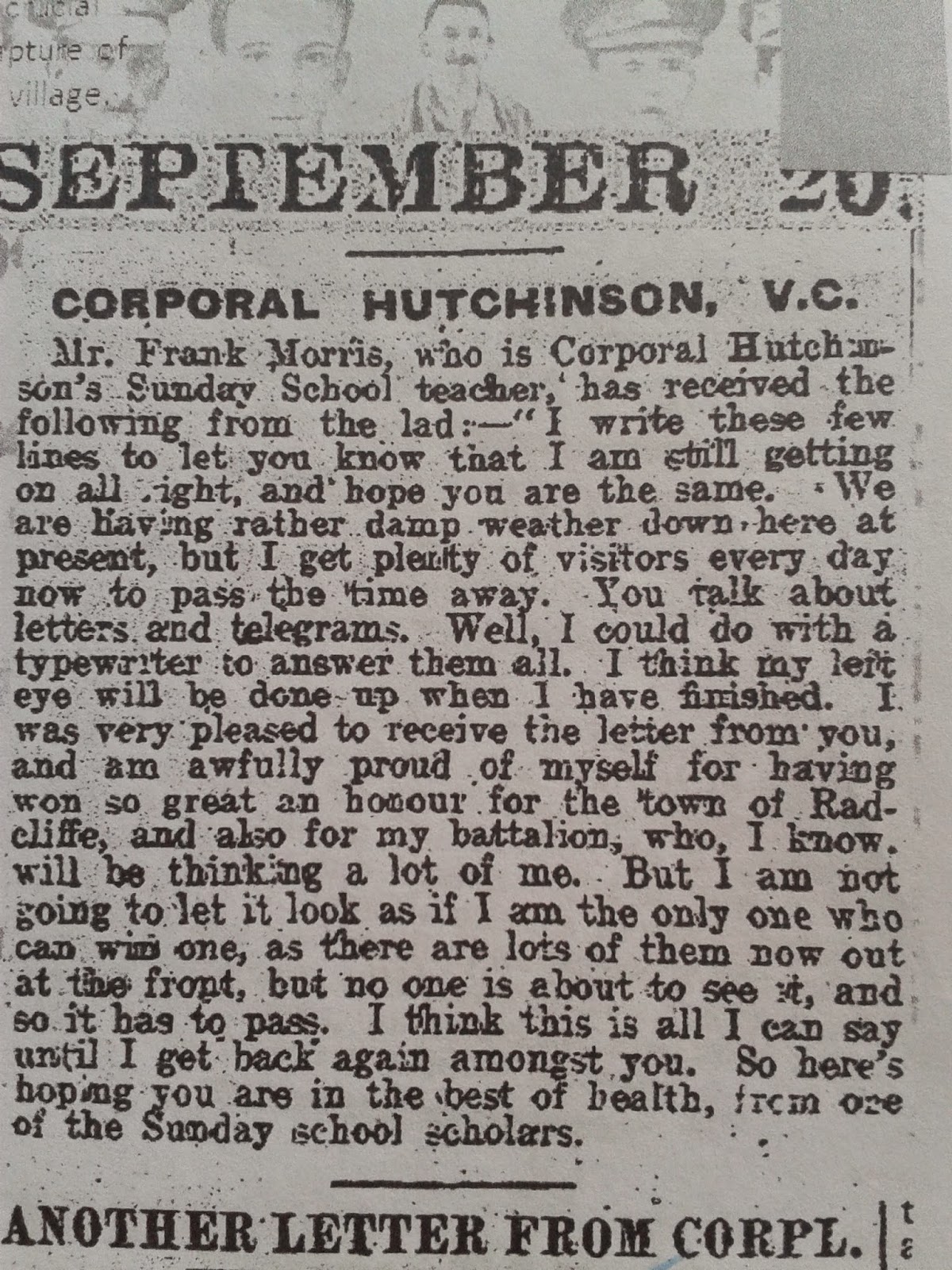
Here we see a report of a 1916 letter from Corporal Hutchinson, awarded the Victoria Cross (the highest military decoration for honour and valour), writing to his Sunday school teacher about all the messages of congratulation he has received.

But of course there is no detail about injuries or losses. All letters were heavily censored. Soldiers could use a field postcard, an honour postcard or self-censor. Field postcards were pre-printed, and the soldier just had to cross out the statements that did not apply. With an honour envelope, the sender had to sign a declaration to say their letters did not contain any sensitive information. Self-censorship was also widely used and soldiers gave those at home no hint of what life was like at the front.

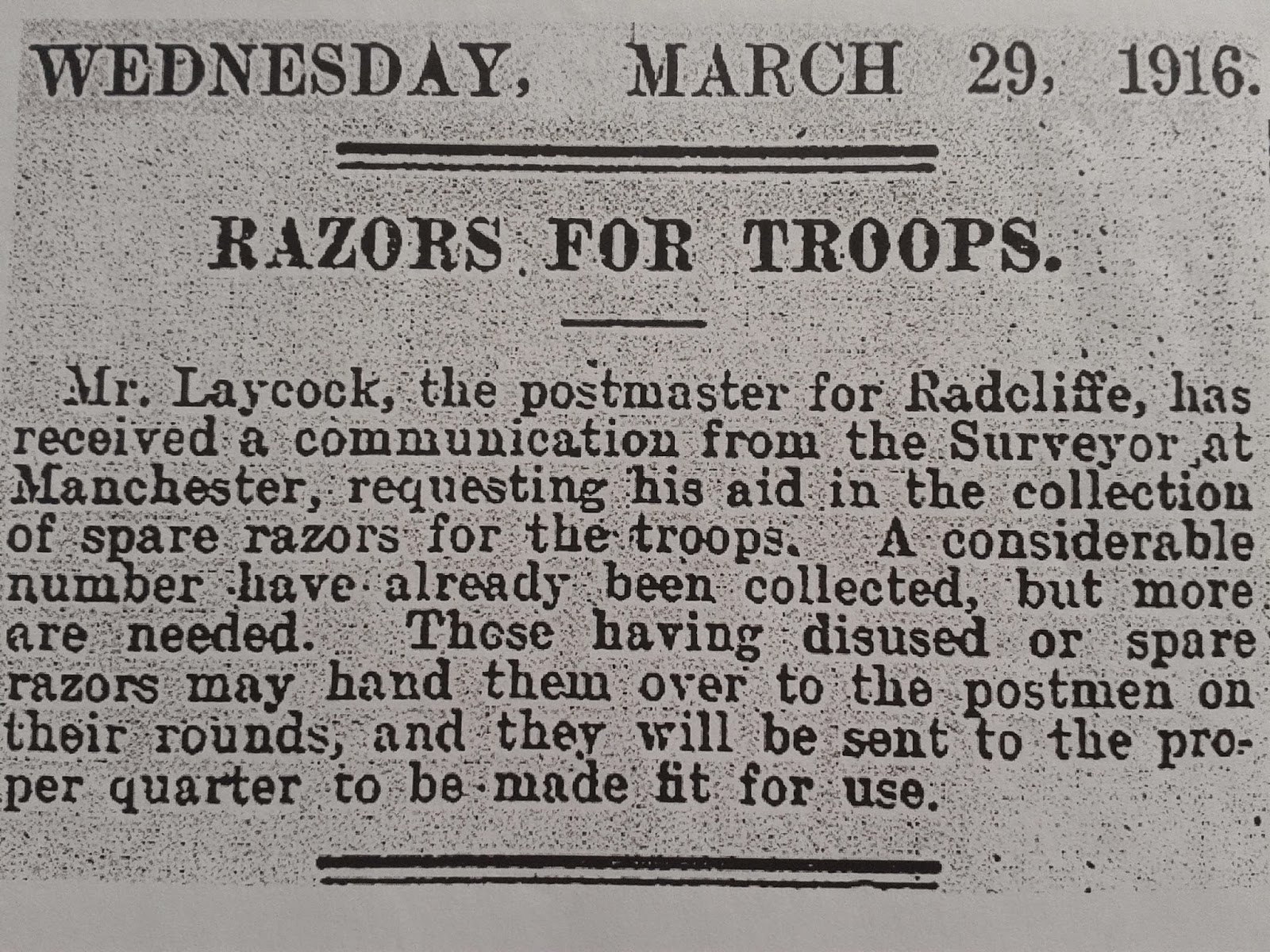
And of course it was not only letters. Parcels were essential too. Soldiers were sent items like soap and lice powder. Public donations of items was also made, as in this appeal for razors.

© 2014 E.M. Powell 

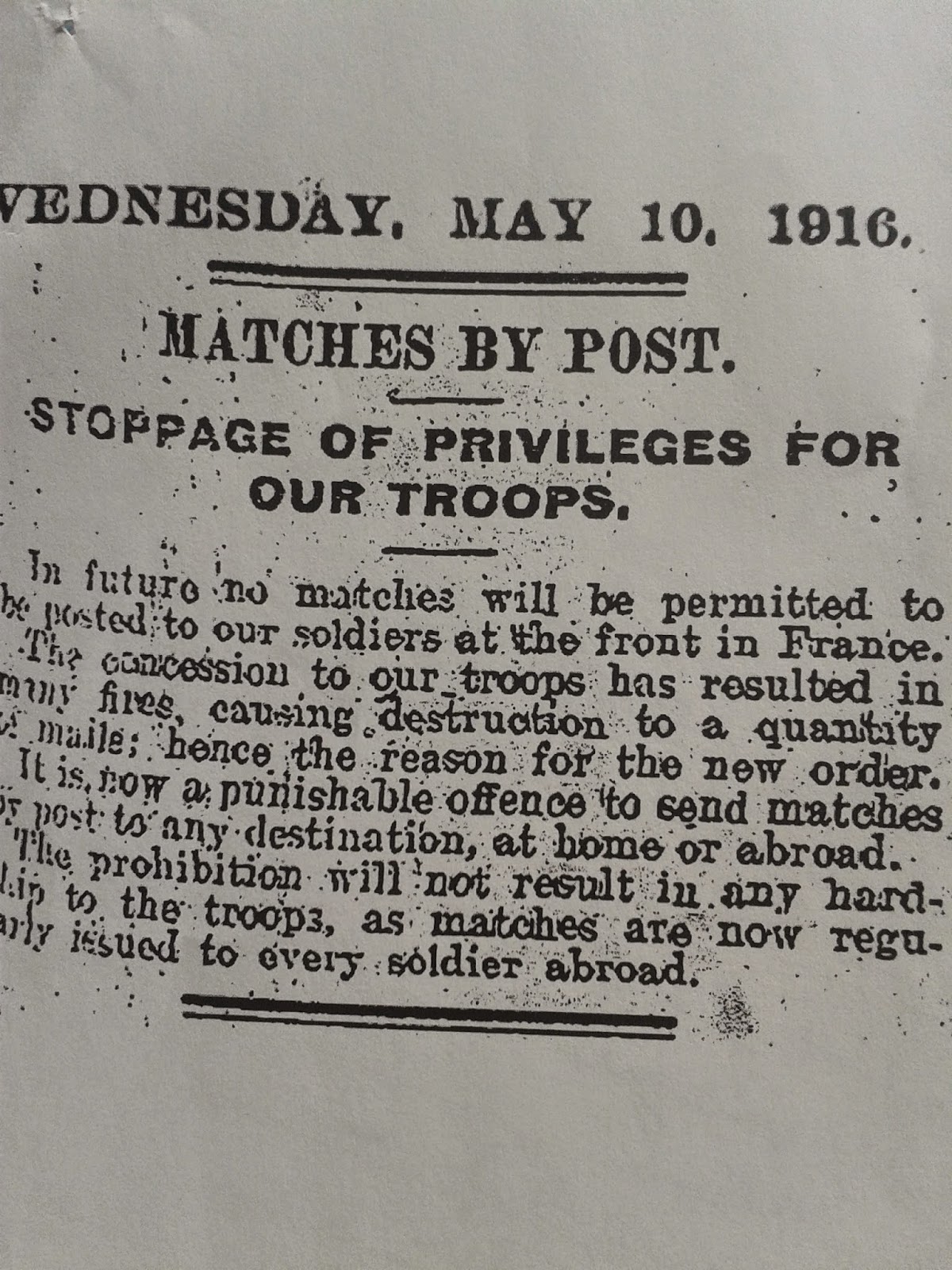
While sending large batches of sharp metal that potentially might be intercepted seems a little risky, the line was drawn when it came to matches.

© 2014 E.M. Powell 

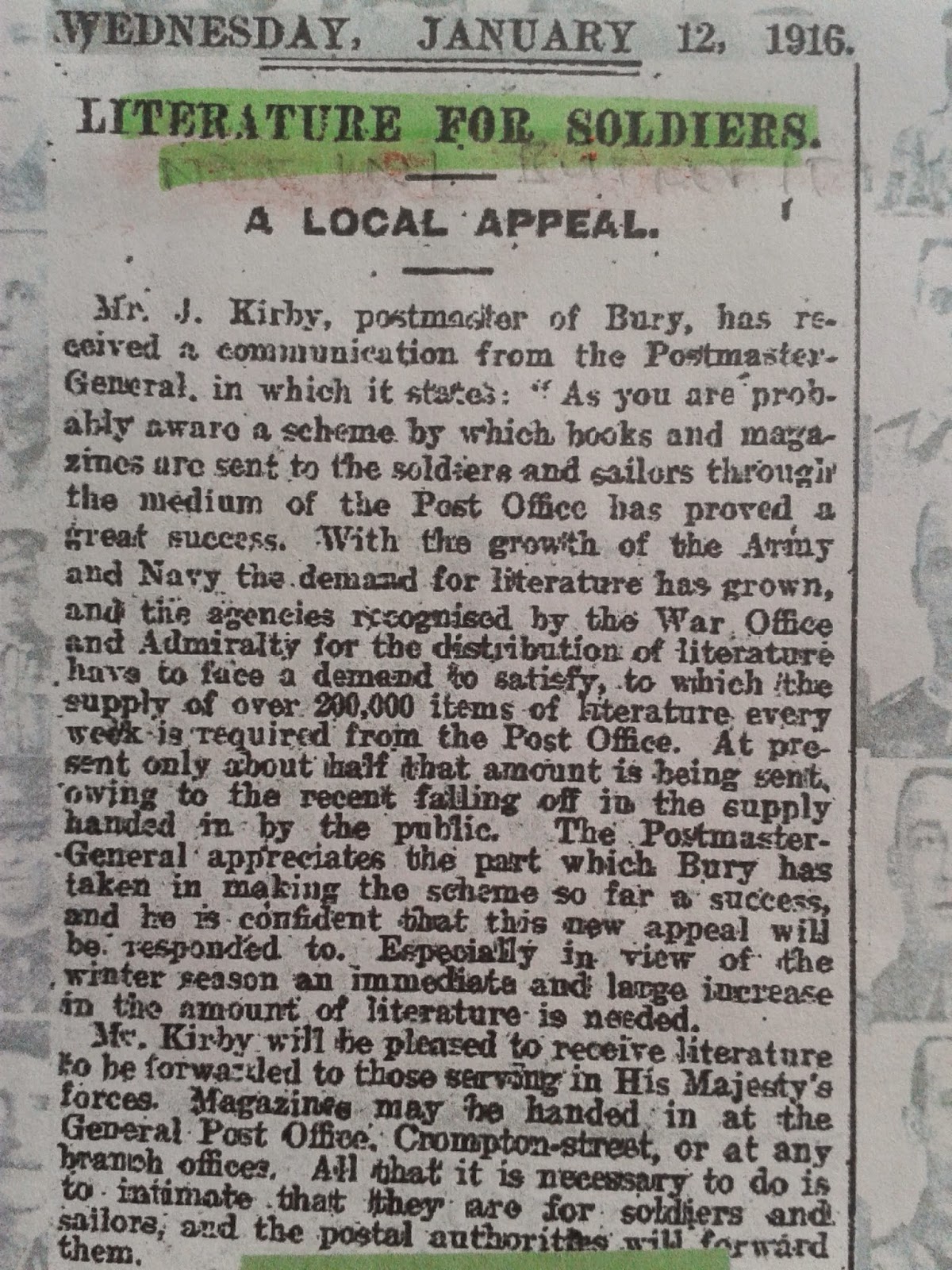
It was not just physical comforts either. Here we have an appeal for literature for soldiers.

© 2014 E.M. Powell 

Again, then the number of items being quoted (in the hundreds of thousands) is remarkable.

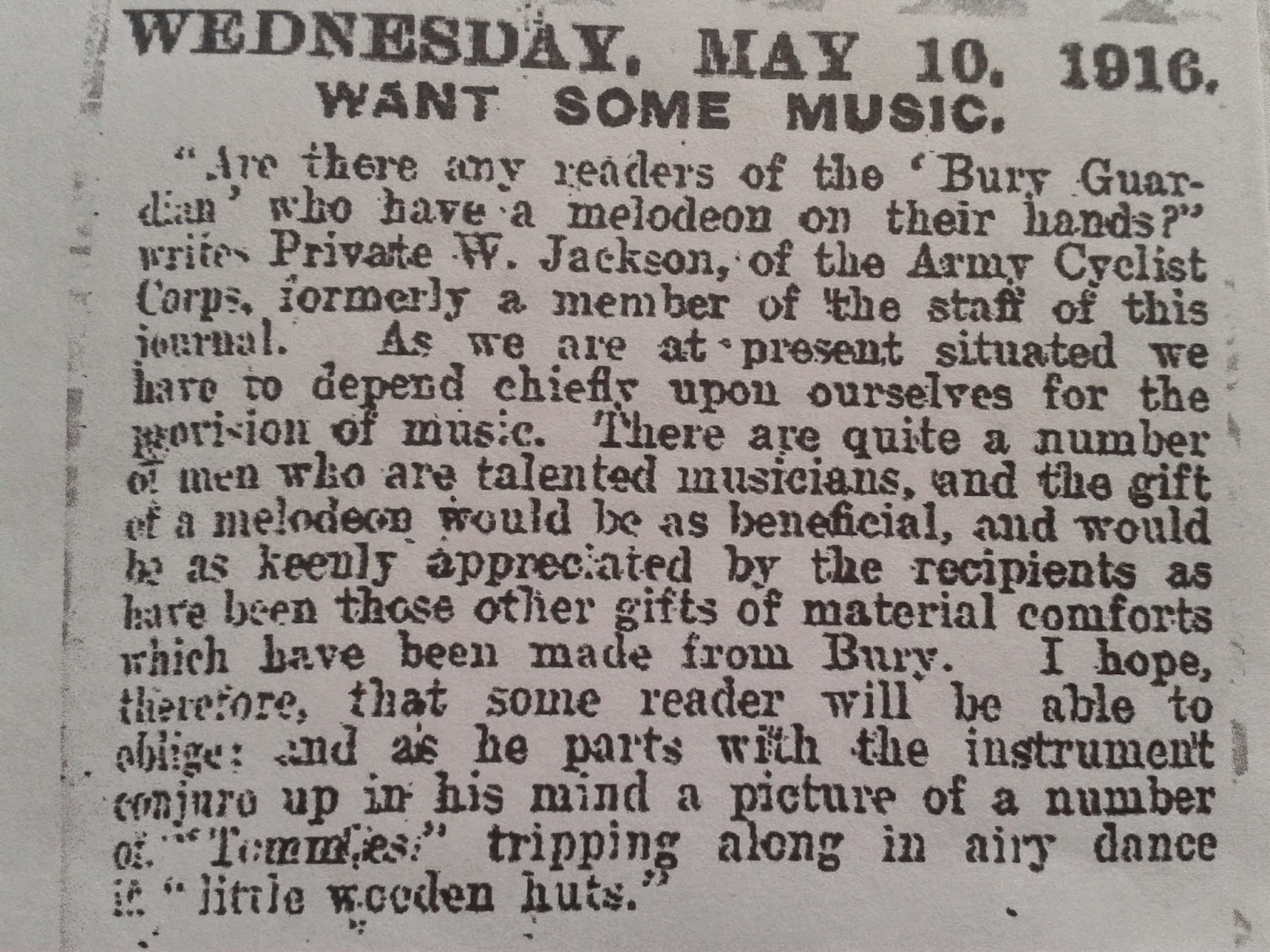
Another heart-rending appeal is for a melodeon:

© 2014 E.M. Powell 

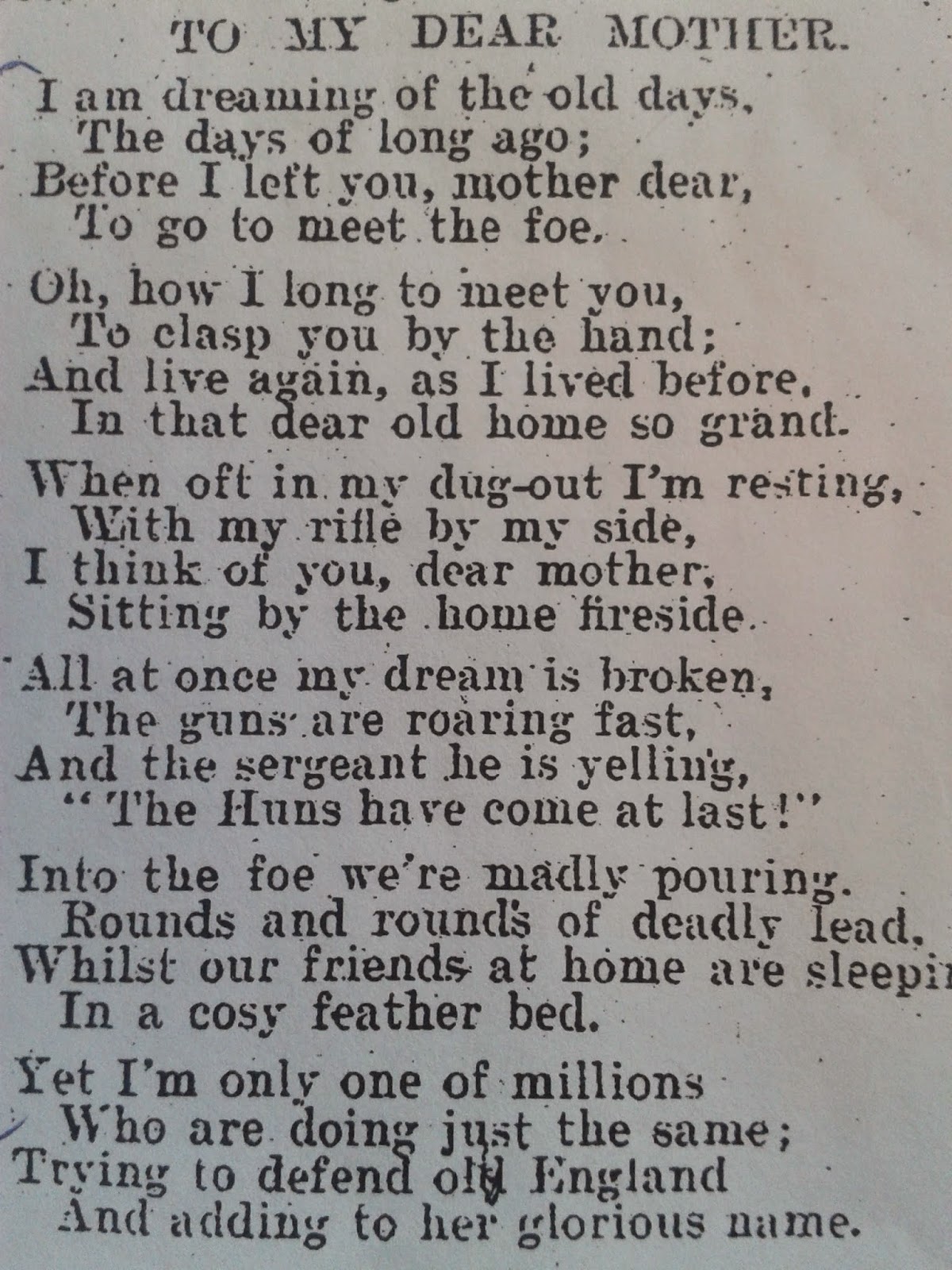
But of course the most heart-breaking items as always were the letters, for words are the most treasured possession of all.  The Archivist found this poem printed in a 1917 newspaper. It was sent by a Lance-Corporal J.W. Gilbert to his mother.

© 2014 E.M. Powell 

Lance-Corporal Gilbert was a cricket-playing mill worker before he enlisted. He never did come home to his cosy feather bed or his fireside. He never did come home to his mother. On June 16, 1917, Mrs. Gilbert received 'official information of his death.' She received this almost a year after being informed he was 'missing.' He was twenty-two years old.

The Post Office could never have brought back Mrs. Gilbert's son. But they brought his words back to her, as they did to millions of others. We can only hope that they were a small comfort.

~~~~~~~~~~~~~~~~~~~~~~~~~
References:
Letter to an Unknown Soldier: http://www.1418now.org.uk/whats-on/
The British Postal Museum & Archive: www.postalheritage.org.uk
BBC History- World War One Centenary: http://www.bbc.co.uk/history/0/ww1/
Bury Libraries and Archives: http://www.bury.gov.uk/index.aspx?articleid=3698

E.M. Powell is the author of The Fifth Knight, a medieval thriller based on the murder of Thomas Becket in Canterbury Cathedral in 1170.

The sequel, The Blood of The Fifth Knight, will be released by Thomas & Mercer on January 1st 2015.

Amazon US
Amazon UK
Amazon CA

Visit her website at www.empowell.com.

Thursday, August 14, 2014

The Seven Deadly Sins – And What They Say About Medieval Society

by Helena P. Schrader

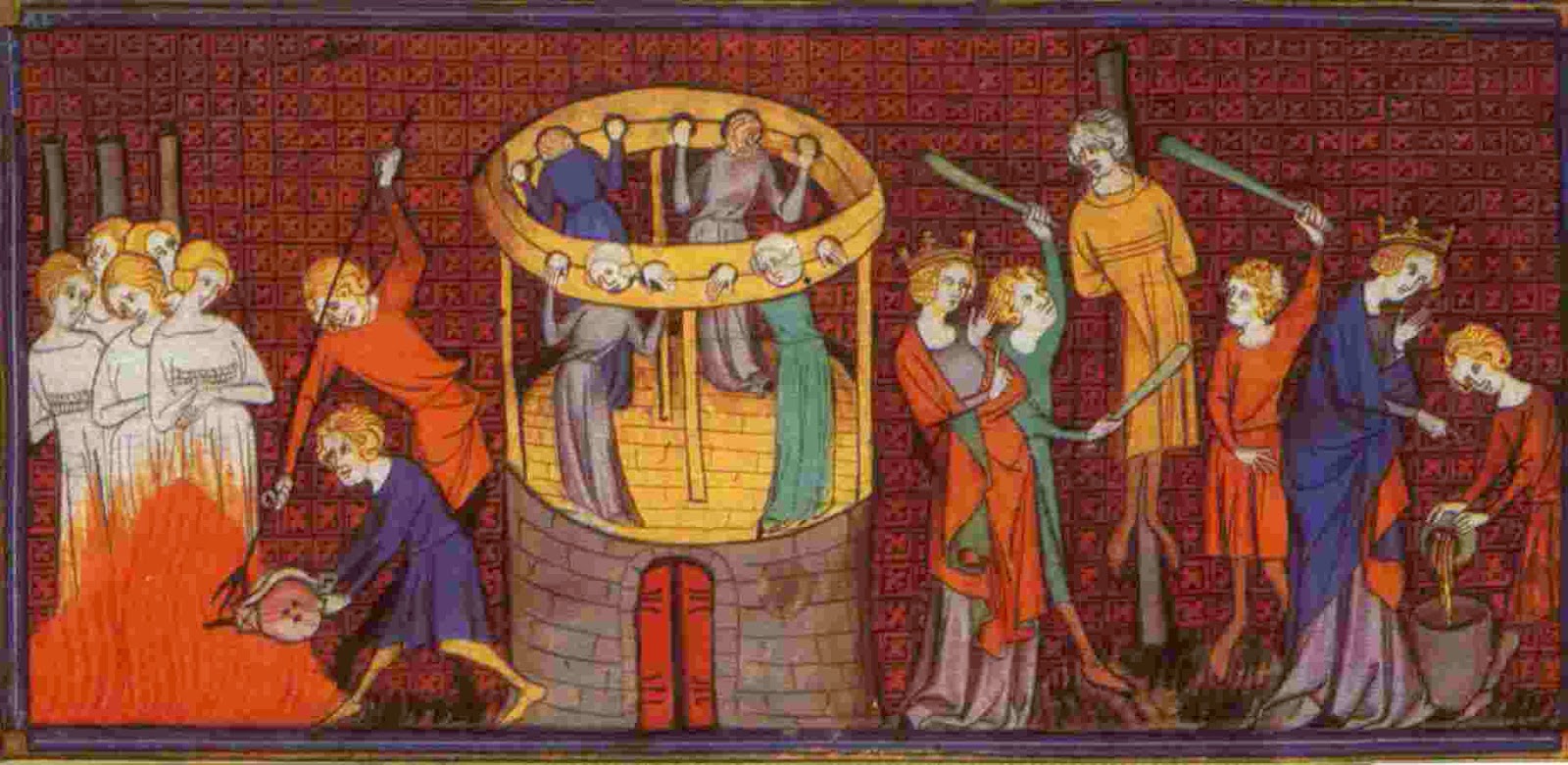
The other day, a friend and I were trying to list the seven deadly sins. We couldn’t, so we went and looked them up. The list surprised me for including “sins” that seem odd in modern society and that got me thinking about how the definition of “deadly sins” reflected the ills of Medieval Society.  Essentially, the Church was trying to discourage certain types of behavior thought detrimental to a functioning, Christian society by proclaiming them “deadly” sins – sins so egregious that they brought the sinner “spiritual death” – if the sinner did not repent, do penance and receive absolution.


Now some of the deadly sins still strike us as reprehensible behavior. Wrath, for example, is something no one would recommend and most people would agree brings harm – usually not only to the intended target. Likewise lust is a sin whose negative impact is widely recognized to this day. No matter how tolerant modern society may be of sexual freedom for consenting adults, lust remains a dangerous emotional force behind many modern crimes from child abuse and rape to trafficking in persons. Finally, envy is still seen as undesirable. 

But greed has more recently been praised as “good” – some people in modern society equating it with ambition and the driving force behind capitalism and free private enterprise. Even more striking, “pride” is something we hold up as a virtue, not a sin. We are proud of our country, proud of our armed forces, proud to be who we are – or at least we strive to be. And who nowadays would put “gluttony” or “sloth” right up there beside lust, wrath and envy?

Upon reflection, however, I concluded that the deadly sins tell us a great deal about what behavior Medieval Society particularly feared.

In a society where hunger was never far from the poor and famines occurred regularly enough to scar the psyche of contemporaries, excessive consumption of food was not about getting fat it was about denying others.  Because there were always poor who did not have enough to eat just around the corner, someone who indulged in gluttony rather than sharing excess food was clearly violating the most fundamental of Christian principles. Nothing could be more essential to the concept of Christian charity than giving food to the hungry, and a person who not only kept what he/she needed for himself but engaged in excess eating was therefore especially sinful.


Sloth is the other side of the same coin. In a society without machines, automation or robots, the production of all food, shelter and clothing depended on manual labor. Labor was the basis of survival, and survival was often endangered. Medieval society could not afford for any member to be idle. Even the rich were not idle! Medieval queens, countesses and ladies no less than their maids spun, wove and did other needlework – when they weren’t running the estates of their husbands. The great magnates of the realm were the equivalent of modern corporate executives, managing vast estates and ensuring both production and distribution of food-stuffs. The gentry provided not just farm management but the services now provided by police, lawyers and court officials. In medieval society every man and woman had their place – and their job. Whether the job was to work the land or to pray for the dead, it was a job that the individual was expected to fulfill diligently and energetically. Sloth was therefore seen as a dangerous threat to a well-functioning society.


~~~~~~~~~~~~~

Helena P. Schrader is the author of numerous books of history and historical fiction.  She is currently working on a biographical novel in three parts of Balian d’Ibelin. Read more about her published works at: http://helenapschrader.com and more about her series of novels set in the age of chivalry at: http://tales-of-chivalry.com You can also follow Helena’s blogs: about writing: http://schradershistoricalfiction.blogspot.com about the history of the crusader kingdoms at: http://defendingcrusaderkingdoms.blogspot.com

A crusader in search of faith —
A lame lady in search of revenge —
And a king who would be saint.

St. Louis’ Knight takes you to the Holy Land in the 13th century and a world filled with nobles, knights prophet — and assassins.

Buy now!

Wednesday, August 13, 2014

The Four Ancient Books of Wales

by Richard Denning

As a writer of historical fiction set in the late 6th and early 7th century I am constantly faced with a lack of documentation. I have in the past discussed the surviving historical documentation for this era  (Gildas: On the Ruin of Britain, Nennius: The History of the Britons, Bede: The Ecclesiastical History of the English People, the Annales Cumbriae and the Anglo-Saxon Chronicles) Taken as a whole they give us an idea of what went on between the end of Roman Britain and the creation of the Kingdom of England some five centuries later but there are vast gaps and few tangible facts.

Turning to what went on in the evolving Welsh Kingdoms there are so many gaps that we have to look to poetry to fill in some holes. The Four Ancient Books of Wales is a term coined by William Forbes Skeen (a Victorian historian and Antiquarian) to describe four surviving medieval manuscripts. These documents are written in Welsh and themselves date from the 13th to 15th centuries but contain texts some of which originate from as far back as the early as the sixth and seventh centuries.  So what we have are copies of earlier writings some of which date back to this post Roman period.  What is also fascinating is that they also contain some of the earliest references to a King Arthur and to a Merlin.

The four books included by Skene in his list are:
1)The Black Book of Carmarthen


This book is believed to be the earliest surviving manuscript written in Welsh as opposed to Latin. The Britons at the time the Romans left spoke a Celtic language called Brythonic. Out of these evolved the language we now know as Old Welsh. This book then shows the first poems written in this new language.

The book gets its name because it had a black binding and was probably created in the priory at Camarthen in the early 13th century from older possibly 9th century poetry.  Along with the other books many of the poems contains themes of praise and mourning but from a historical point of view there are references to Welsh Heroes of the 6th to 9th century. So we get snippets about battles in Cumbria and battles in which an Arthur and a Merlin participated.

2)The Book of Aneirin


This a late 13th century book written in Welsh and attributed to the late 6th century poet, Aneirin. The manuscript itself dates from around 1265, but is probably a copy of a lost 9th century original. This in turn was probably written down from the original poems composed by Aneirin three hundred years earlier and passed on as oral tradition.

Aneirin was present at and wrote his most famous poem about the Battle of Catraeth which was fought circa 595 to 600 AD between the Northumbrian Anglo-Saxons and the Northern British. It was a disaster for the British and so the poem, Y Gododdin is an eulogy for his fallen comrades. It remains the chief source we have for this battle. Here is an exerpt:

Men went to Catraeth at morn
Their high spirits lessened their life-span
They drank mead, gold and sweet, ensnaring;
For a year the minstrels were merry.
Red their swords, let the blades remain
Uncleansed, white shields and four-sided spearheads,
Before Mynyddog Mwynfawr's men.

3)The Red Book of Hergest


This manuscript was written shortly after 1382. It is bound in red leather and for a couple of centuries resided  at Hergest hence the name. Within this large volume is the heart of ancient Welsh poetry and prose including the Mabinogion  (a collection of early Welsh stories and lore) and a set of peculiarly Welsh lists called Triads. These are an odd collection of sets of three things such as:

Three Great Queens of Arthur:
Gwennhwyfar daughter of Cywryd Gwent, and Gwenhwyfar daughter of Gwythyr son of Greidiawl, and Gwenhwyfar daughter of Gogfran the Giant.

Three Noble Retinues of the Island of Britain:
The Retinue of Mynyddawg at Catraeth, and the Retinue of Dreon the Brave at the Dyke of Arfderydd, and the third, the Retinue of Belyn of Llyn in  Erethlyn in Rhos.

Now these lists don’t tell us much but they give us names and places that may be of use. When the history is so sparse just knowing there was a chap called Belyn from Llyn who took his retinue to Rhos (where other references suggest a battle occurred between the Welsh and Northumbrians in the 620’s now gives us something.)

Did you notice the mention in this triad of Mynyddawg at Catraeth  - who is also referred to in that quote from Aneirin in Y Goddodin. These poems then are more than just stiring verse. In many cases they are history retold. The trick of course is working out what is myth and what is history.

4)The Book of Taliesin


This dates from the first half of the 14th century. It contains poems from different authors –some from the 10th century and some much older. Many of them represent the very oldest poems that were composed in Welsh including those attributed to Taliesen who was active in the mid to late 6th century and composed in Brythonic the precursor to Old Welsh. Taliesen was a prolific writer on the “Old North” - the Post Roman world that was clashing with the new world of the Angles and Saxons.

In the morning of Saturday there was a great battle,
From when the sun rose until it gained its height.
Flamdwyn hastened in four hosts
Godeu and Reged to overwhelm.
They extended from Argoed to Arvynyd.
They retained not life during one day.
Flaindwyn called out again, of great impetuosity,
Will they give hostages? are they ready?
Owain answered, Let the gashing appear,
They will not give, they are not, they are not ready.
And Ceneu, son of Coel, would be an irritated lion
Before he would give a hostage to any one.
Urien called out again, the lord of the cultivated region,
If there be a meeting for kindred,
Let us raise a banner above the mountain,
And advance our persons over the border.
And let us misc our spears over the heads of men,
And rush upon Flamdwyn in his army,
And slaughter with him and his followers.
And because of the affair of Argoed Llwyfain,
There was many a corpse.
The ravens were red from the warring of men.
And the common people hurried with time tidings.
And I will divine the year that I am not increasing.
And until I fail in old age,
In the sore necessity of death,
May I not be smiling,
If I praise not Urien.

Taliesen gives us much of what we know about the battles between the Northumbrians (here under Flamebrand – a nickname for the Northumbrian king invading the Cumbrian lands of Rheged.) and the Britons. We get mentions of Owain and Urien  and other great British leaders like Coel (old King Cole of the nursery rhyme). It is also the main reference for the battle of Argoed Llwyfain – apparently fought on a Saturday morning according to this poem.

So these Four Ancient Books of Wales  are priceless. Yes they are mostly poems and semi myth. Indeed they are confusing and difficult to read but for the historian and for the historical fiction writer of the post Roman period for whom the expression “beggars can’t be choosers” might have been invented they give us something to get our teeth into and extract something approaching a history from.

~~~~~~~~~~~~~

Richard Denning is a historical fiction author whose main period of interest is the Early Anglo-Saxon Era. His Northern Crown series explores the late 6th and early 7th centuries through the eyes of a young Saxon lord.

Explore the darkest years of the dark ages with Cerdic.
www.richarddenning.co.uk


Tuesday, August 12, 2014

There’s Something About Those Pitt Brothers

by Stephenie Woolterton and Jacqui Reiter

We have, accidentally and with no prior contact, found ourselves studying a pair of historical brothers. Stephenie has set up a website dedicated to her research on the private life of William Pitt the younger (1759-1806), and is also currently writing a non-fiction biography of his – you guessed it – private life. She is also working on an historical fiction novel about Pitt’s one love story with the Honorable Eleanor Eden. Jacqui is working on a novel about Pitt's elder brother John, 2nd Earl of Chatham (1756-1835), famous for being the "family failure" and commanding a disastrous military expedition to Walcheren in 1809.

Since our historical interests are brothers, we naturally consider ourselves sisters-in-research. We are both passionate about our subjects, and when we get together we tend to talk a great deal. This, then, is a taster for the English Historical Fiction Authors blog of what happens when we Pitt fangirls – or, as someone once called us, the "Pittettes" – put our heads together.

Stephenie has created an open Facebook group called "The William Pitt the Younger Appreciation Group." We asked the members to think of some questions they would like us to answer about Mr. Pitt and Lord Chatham. We received several fabulous questions, and hope our answers will provide an entertaining and informative introduction to the Pitt boys and why we think everybody ought to love them as much as we do.

William Pitt the Younger and John, 2nd Earl of Chatham

 Question 1. Why William Pitt the Younger? Why the 2nd Lord Chatham?

Stephenie: If I had a penny for every time someone asked me this question, I’d be a millionaire! William Pitt the Younger, not to be confused with his father, William Pitt the Elder, was not only the youngest person to ever become head of the British government (at 24 years old), but he was also a Member of Parliament at 21, and his first term as Chancellor of the Exchequer was at the tender age of 22. Apart from Sir Robert Walpole, Pitt was the second-longest serving holder of the combined offices of First Lord of the Treasury and Chancellor of the Exchequer. However, it isn’t just his sheer longevity in office that is noteworthy. Many have heard of Pitt from history lessons in school, or as the man who first instituted income tax (albeit Pitt honestly saw it as a temporary measure). Some might also be aware that he died a bachelor during his second term in office. 

Pitt was an extremely private man, and he was ever careful in the choice of his words and in the content of his correspondence. After his death, much of his private papers were destroyed by one of his executors, his friend and former tutor George Pretyman-Tomline, so his personal life remains a perplexing mystery. Over the past two centuries since his death, his views – political and otherwise – have been interpreted in various contradictory ways, and in truth, he is a figure that appeals to many different types of people. He was a child prodigy, and he spoke and wrote in Greek and Latin by the age of 7. His grasp of mathematics was nothing short of awe-inspiring.

I came to Pitt in an indirect way. As an American interested in history, I learned about Pitt during my research on the American War of Independence. As I’ve lived in London, England for over a decade, my passion for British history and politics also took me in the direction of Pitt. If you study British political history, you almost cannot avoid him. There’s something special about his precociousness, his rise to power at an early age, and his maintenance of that power for over 19 years (and two terms in office), with only death separating him from that position.

Jacqui: Unsurprisingly, I came to Chatham through Pitt the Younger. I started writing a novel about Pitt while working on my PhD thesis on the politics of national defense during the Napoleonic Wars. Somewhere along the line I switched to Chatham's point of view. Somewhat to my own surprise I discovered I liked him.

I say “somewhat to my own surprise” because his historical reputation is  poor. He was reportedly very lazy, nicknamed “the late Lord Chatham”, and the 1809 expedition to Walcheren did not exactly cover him with laurels. He's often characterized as an arrogant scrounger.[1] I shan't say more here, because I could go on for hours, but while he definitely lived up to his reputation for indolence, there was so much more to him than that.

In many ways he is an overlooked figure. His identity and relationship to Pitt put him close to the heart of government, and he was also a wartime First Lord of the Admiralty and Master of the Ordnance. From a novelist's point of view he's pure gold. What must it have been like to be the elder brother of a political prodigy? How must Chatham have felt in the twin shadows cast by his father and brother?

Question 2. What would be Pitt and Chatham's reaction to modern-day Parliamentary politics? Which party would they join?

Stephenie: The only political distinction Pitt ever made was in 1779, at the age of 20, when he declared, “I do not wish to call myself any Thing but an Independent Whig.” [2] He believed in the Constitution as settled at the Revolution of 1688, and yet he stood apart as a non-party man. It is true that at the beginning of his political career he made several unsuccessful motions for parliamentary reform, and he supported the efforts for the abolition of the slave trade. He could have done more, but then he was the prime minister, and he had to be a jack-of-all-trades, as it were.

Pitt was a political pragmatist, and a financial administrator. I believe if he were to see modern-day Parliamentary politics, I truly believe he would be fascinated. Of course, he never supported the idea of universal suffrage, but he did hold quite liberal views for his time. If he could take part in 21st century politics, I believe he would throw himself entirely into it just as he did in the late 18th and early 19th centuries. As far as which political party Pitt would join, I have often thought of this question. I believe if Pitt were to align himself with any party, which he would have to do in order to be successful in the modern political world, he would most likely be a Conservative with liberal leanings.

Jacqui: If Chatham stepped through a wormhole and landed in modern-day Westminster he would probably approve of the way things are still done (he'd probably need a few minutes to calm down from the shock though, as well as a large tumbler of brandy).

He would probably recognize enough of the 18th century political system in the 21st century one to reassure him. Britain is still a monarchy; Parliament is still much as it was, even with universal suffrage, women MPs and so on. He'd be upset about the decrease in importance of the Queen and the House of Lords, but Chatham would probably feel reassured that all the work he and his brother undertook to stop the French Revolution crossing the Channel had not been in vain, and that the British Constitution, though added to, still relies on familiar Blackstonian precedents.

As for what party he would have joined, well...he might not see the point. That doesn't mean he would not have an opinion. Like all Pitts, Chatham definitely knew his political mind. He was not afraid to differ from Pitt, as he did on many of the weighty ideological issues of the period: political emancipation of Catholics and other non-Anglican denominations, the abolition of the slave trade, parliamentary reform, and so on. He would probably find most in common with the Conservatives, although I suspect he would look down his impressively long nose at all that pandering to the middle classes.

Question 3. To quote: "Did John and William ever paint the town red when they were young and wake up next morning blaming each other for the hangovers and a mysterious girl named Augusta?"

Stephenie: Pitt was known for loving port wine to an excessive degree, and Chatham liked wine as well, so I wouldn’t be surprised if the brothers had a bit too much to drink together on more than one occasion.  We do know that on February 28, 1784, Mr. Pitt was presented with the Freedom of the City of London at his brother’s house on Berkeley Square. Lord Chatham then accompanied Pitt and their brother in-law Lord Mahon to Grocer’s Hall for a lavish banquet. Needless to say, if the amount of toasts given is any indication, it can be inferred that much wine was consumed that night:

“The King; The Queen and the Royal Family; the Navy of Great Britain; the three branches of the legislature, and may the balance of power be preserved as fixed at the glorious revolution; may the present administration emulate the conduct of the late earl of Chatham of immortal memory, and may they continue to merit the same confidence and support of the people; the privileges and chartered rights of the United Kingdom; confusion to all those who would usurp on the rights of the king, the lords, or the people; may this free constitution continue unimpaired to the end of time; success to a reform in the representation of the people in parliament, and the shortening the duration of the power of the representatives; may the people continue to love and support their best friends. Mr. Pitt drank “success to the grocer’s company;” Lord Chatham, “the real sense of the people…” [3] You get the picture.

The toasts just kept on going from there. There must have been twenty toasts. On their way home, Pitt’s carriage, with him, Lord Chatham, and Lord Mahon inside, was attacked on St. James’s Street by rioters. Lord Chatham’s gold watch was stolen, and they had to flee inside White’s gentleman’s club in order to escape the blows of their attackers. Although they were largely unscathed, their carriage was completely destroyed. They must have suffered a severe emotional shock from the experience. As far as other occasions go where Pitt and Chatham shared a brotherly tipple together, I’m sure it happened on numerous occasions. As far as “Augusta” is concerned, I don’t think that would be recorded.

Jacqui: Stephenie is right about Chatham sharing Pitt's love of wine. I'm sure they got drunk together on occasion. Still, I doubt they “painted the town red” together. It's just not something I can see Chatham doing, although Pitt would definitely be up for it. Take this for example:

"Some little excess happen'd lately in Wimbledon. ... In the evening some of the neighbours were alarmed with noises at their doors, but nobody, I believe, has made any reflection upon a mere frolic – It has only been pleasantly remarked, that the rioters were headed by Master P– late Chancellor of the Ex–, and Master Arden, late Solicitor Gen".[4]

Chatham was always very conscious of his dignity and standing. Later in life his niece Lady Hester Stanhope described him travelling in great state. Nobody ever contrived "to appear as much of a prince as he does –his led horses, his carriages, his dress, his star and garter, all of which he shows off in his quiet way with wonderful effect".[5] Rather than joining in with Pitt's bumptious behaviour, I can picture Chatham telling him off in his role as head of the family.

I'm saying nothing about "Augusta".

Question 4. Was either brother left-handed? What colour were their eyes?

Stephenie: Mr. Pitt was definitely right-handed. In a letter written to his mother on 15th April 1779, Pitt was forced to write with his non-dominant left-hand due to a painful whitlow “having disabled my right Thumb from holding a Pen,” but he found it “so bad a Secretary that I must content myself with thanking you for your letter, and assuring you that I am in other respects perfectly well, resuming every thing else till this Substitute is become more expert, or the Principal again restor’d to it’s office.”[6]

Pitt to his mother with his left hand, 15 April 1779

I’ve also found evidence that his eyes were blue, like his father. Pitt’s first posthumous biographer, Henry Cleland, described Pitt as follows: “His person was tall and slender, his complexion rather fair, with blue eyes, large forehead, and prominent features; his countenance was strong, thoughtful, and rather stern, except when enlivened by some sudden impulse.”[7] All Pitt’s portraits seem to also suggest that his eyes were blue, with a hint of grey.

Jacqui: I have no evidence Chatham was right-handed, but I believe he must have been. His handwriting certainly has a marked rightward slant. In any case had he shown a tendency to be left-handed I suspect it would have been "corrected" by his tutor.

Lord Chatham's handwriting

As for his eyes, they were blue. This is clear in all his portraits, particularly the one by George Romney, currently at Chevening House.

Question 5. What were they like as children? Was Pitt as whiny as Blackadder portrays him?

A young boy, thought to be Pitt,
as a child – George Romney

Stephenie: The playwright and dramatist Frederick Reynolds (1764-1841) remembered going with his father to Hayes Place – the home of the Pitt family – in the early 1770s. There he met Lord Chatham's family for the first time, including their precocious young son William Pitt (then only about 11 or 12 years old). Reynolds recorded this experience for posterity, and it gives a small insight into Pitt as a young boy:

"His Lordship [Lord Chatham], I remember, was very kind to me, and on quitting the room with my father, desired his son William Pitt, then a boy about four years older than I was, to remain with, and amuse me, during their absence. Somehow, I did not feel quite bold on being left alone with this young gentleman. For a time, he never spoke, till at last, slyly glancing at him, to learn who was to commence the conversation, and observing mischief gathering in the corner of his eye, I retired to the window; "but gained nothing by my motion." He silently approached, and sharply tapping me on the shoulder, cried jeeringly, as he pointed to my feet, "So, my little hero, do you usually walk in spurs?" – "Walk?" I replied: "I rode here on my own pony." "Your own pony!" – He repeated with affected astonishment; "Your own pony? Upon my word! – and pray, what colour may he be? – probably blue, pink,  or pompadour?" At this moment, the present Lord Chatham [John Pitt, 2nd Lord Chatham, then fifteen] entering the room, the tormentor exclaimed, "I give you joy, brother, for you are now standing in the presence of no less a personage then the proprietor of the pompadour pony!" His brother frowned at him, and I was bursting with rage and vexation, when he coolly turned towards me, and said, "Your life is too valuable to be sported with. I hope you ride in armour?" "Be quiet, William – don't trifle so," cried his brother. "I am serious, John," he replied; "and if for the benefit of the present race he will preserve his life, I will take care it shall not be lost to posterity, for as my father intends writing a history of the late and present reigns mark my word, my little proprietor, I will find a niche for you, and your pompadour pony in the History of England." I could no longer restrain my spleen, and fairly stamped with passion to his great amusement. At this moment, the door opening, my facetious tormentor instantly cantered to the opposite side of the room, after the manner of a broken down pony, and then placing his finger on his lips, as if to forbid all tale-telling, disappeared at the other entrance. In course, every feeling of rage was smothered in the presence of the great Lord Chatham, and my father having taken his leave, mounted his horse, and trotted through the Park; I following on my pony, and delighting in my escape. But as I reached the gates, I was crossed in my path "by the fiend [William] again," – but, agreeably crossed, for he shook me by the hand with much good-humour, playfully asked my pardon, and then added, patting my pony, "He [Pitt] should at all times be happy to find both of us accommodation at Hayes, instead of a niche in the History of England."[8]

Although I would argue that Pitt was not the whiny boy as portrayed in the Blackadder TV series, he was conscious of his intelligence, and not afraid to demonstrate his wit on other unsuspecting people.

Jacqui: John was much the same as a child as he was later in life. He was much more serious than Pitt. He was bright: their tutor, Edward Wilson, recorded the Pitt children's grades for the benefit of the first Lord and Lady Chatham, and John frequently got better marks than William.[9] But he was also pleasure-loving, dancing the night away or running off with horse and hounds.

As for the second part of the question, the brothers were close, but I still suspect Chatham's answer would be "Yes! Yes, he was a whiny little brat!" Not sure what tipped me off about that. Maybe it was John's reaction in the story Stephenie quotes above about the pompadour pony. Maybe it was this line from a letter written by William at eleven, in which he passes comment on fourteen-year-old John's classical grammar: "Your Greek was excellent, and (I think) with practice you may become a Thucydides",[10] Enough said, right?

Question 6. Other than family matters, what interests did Pitt and Chatham share?

Stephenie: Chatham and Pitt shared a few similar interests. They were brothers with only a three-year age gap between them, and the vast majority of their childhood was spent under the same roof. They were raised to have a fierce loyalty to their country. It can be argued that to a large extent both brothers adhered to this sense of patriotism. Chatham joined the army at the age of 17, and Pitt immersed himself in politics by the age of 21. They both served their country in some capacity, and they both always consciously knew they were members of the Pitt family. They were the sons of the great ‘immortal Lord Chatham.’

Pitt and Chatham both enjoyed a love of wine, although Chatham’s consumption was probably quite a bit less than Pitt’s overindulgences, for it did not materially shorten his life as it did with Pitt.

The brothers loved horseback riding, and were encouraged from an early age to ride for health as well as for sport. They rode hard, and for many miles at a stretch. The Duke of Wellington later recorded to Pitt’s biographer, the 5th Earl Stanhope, that “a great deal was always said about his [Pitt] taking his rides – for he used then to ride eighteen or twenty miles every day – and great pains were taken to send forward his luncheon, bottled porter, I think, and getting him a beef-steak or mutton-chop ready at some place fixed beforehand…at dinner Mr. Pitt drank little wine; but it was at that time the fashion to sup, and he then took a great deal of port-wine and water.”[11]

Sir Egerton Brydges, in his autobiography, mentions Pitt’s noted love of riding, even whilst partaking in hunting (shooting):

“I was never introduced to Pitt: I saw him sometimes in the field, on hunting days, when he came down to Walmer. He seemed to delight in riding hard, with his chin in the air; but I believe had no skill as a sportsman – seeking merely exercise, and thinking, as Dryden says, that it was ‘better to hunt in fields for health unbought, than see the doctor for his noxious draught.’”[12] In his own way, Pitt enjoyed shooting, like his brother Chatham, although I believe his older brother was more successful in this pursuit.

Jacqui: Both brothers were accomplished classicists (Pitt's comments on Chatham's conjugations notwithstanding), and as Stephenie points out both loved field sports. Chatham's love of the chase started very early (I've seen references to him chasing hares in his very early teens) and he took a holiday every year in September and October, and often January and February as well, to enjoy the game on his own estate or that of a friend. He may, er, have neglected his official cabinet duties on occasion to go shooting, although he always came back to town if summoned.

Pitt and Chatham were also hard riders, and good ones at that, although Chatham managed to get kicked hard enough by a horse to break his leg.

Those shooting sessions for which Chatham received so much stick as a cabinet minister may have been medically necessary. He was never robust, described as “of a middling constitution … frequently ailing” while First Lord of the Admiralty.[13] As he got older and the stresses mounted – his wife suffered from recurring mental illness later in life – Chatham looked on shooting as a form of therapy: "We shot a good deal, and the exercise has rather been of use to me".[14]

While serving as governor in Gibraltar Chatham suffered from strong homesickness and depression, intensified by the fact the local terrain prevented him from taking the long rides he had been used to: "I own I am not very partial, to this place … What I most feel as a grievance is that the riding in Spain is so bad, and the wading to it, thro' the sand, is so tedious, that it requires great resolution, to take the exercise one ought to do here".[15]

Exactly how important exercise was to him can be gauged by the fact Chatham was having himself hoisted daily on horseback long after the use of his legs failed him in his late seventies.[16]

Question 7. Pitt and Napoleon settle things by arm wrestling: who wins?

Stephenie: Pitt. Every time. Hands down. Napoleon’s ego always gets in the way.

Jacqui: Pitt has the advantage of height, but Napoleon cheats by getting a bigger stool. Since Pitt always plays by the book ... Napoleon wins.

Question 8. "Can you include something about the tax on hair powder and how the Whigs and Tories were jokingly called guinea pigs?"

You mean this one? [17]
 
“Buy my pretty guinea pigs!”

References

[1] Sir Nathaniel Wraxall, Posthumous Memoirs of My Own Time (London, 1836) III, 129; David Andress, The Savage Storm (London, 2012) pp 134-5
[2] John Ehrman, The Younger Pitt: The Years of Acclaim (London, 1969)  p 59
[3] The Chelmsford Chronicle, 5 March 1784
[4] Robin Reilly, Pitt the Younger (London, 1978) p 84
[5] Lady Hester Stanhope to Lord Haddington, 15 Nov 1803, quoted in The Life and Letters of Lady Hester Stanhope, ed. Duchess of Cleveland (London, 1914) p 52
[6] Pitt to the Dowager Countess of Chatham, 14 April [1779], PRO 30/8/12 f 49
[7] Henry Cleland, Memoirs of the life of the Right Honourable William Pitt … (London, 1807) p 337
[8] Frederick Reynolds, The Life and Times of Frederick Reynolds (London, 1826) II, 67-69
[9] See Wilson's letters to Lady Chatham in the summer of 1766 and 1767, PRO 30/8/12
[10] J.H. Rose, William Pitt and National Revival (London, 1911) p 45
[11] Philip, Lord Stanhope, Life of Pitt IV, 346-7
[12] Sir Egerton Brydges, The Autobiography, Times, Opinions, and Contemporaries of Sir Egerton Brydges … (London, 1834) I, 37
[13] 19 July 1794, in Joseph Farington, Diary of Joseph Farington (London, 1922) I, 64
[14] Chatham to Tomline, 22 September 1819, Ipswich RO HA 119/562/688
[15] Chatham to Tomline, 27 February 1822, Ipswich RO HA 119/562/688
[16] Morning Post, 12 January 1833

~~~~~~~~~~~~~

About the Authors:

Stephenie Woolterton has an MSc in Social Research, and a background in Psychology. She is currently researching and writing her first book on the private life of William Pitt the Younger. She is also working on a historical novel about Pitt’s ‘one love story’ with Eleanor Eden. She has a website at: www.theprivatelifeofpitt.com and can be contacted via Twitter at: www.twitter.com/anoondayeclipse.

Jacqui Reiter has a Phd in 18th century political history. She believes she is the world expert on the life of the 2nd Earl of Chatham, and is writing a novel about his relationship with his brother Pitt the Younger. When she finds time she blogs about her historical discoveries at http://alwayswantedtobeareiter.wordpress.com/.

Monday, August 11, 2014

The Vindolanda Tablets: glimpses of military organisation and family life in Roman Britain

by Mark Patton

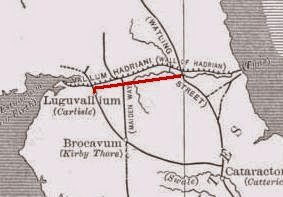
The Roman fort of Vindolanda often features in the itinerary of visitors to Hadrian's Wall, but it is earlier than the wall itself and located some distance to the south. The first wooden fort was built in around 85 AD by the First Cohort of Tungrians, and this was replaced by a larger fort, built ten years later by the Ninth Cohort of Batavians, numbering around a thousand men (both were auxiliary units recruited in different parts of what are now the Netherlands and Belgium). Further construction work was undertaken in around 100 AD under an officer named Flavius Cerealis, of whom there is more below. The fort was built to protect Stane Street, the main Roman road running through northern Britain from east to west.

The military bath-house of Vindolanda.
Photo: "Optimist on the run" (licensed under CCA).


Stane Street. Image: "Neddyseagoon,"
(licensed under GNU).

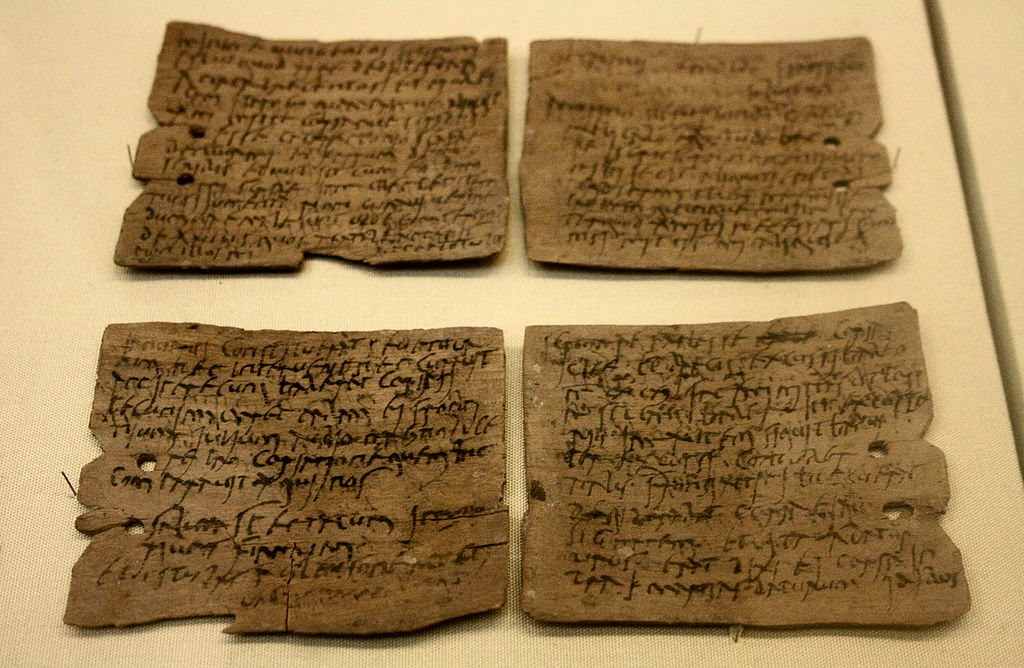
The most remarkable aspect of the archaeology of the fort is a series of letters, written in ink on tablets of thin wood. It is very unusual in northern Europe for such materials to survive, but the waterlogged conditions at Vindolanda have made this possible, and the letters give us a unique perspective on both military logistics and family life in Roman Britain.

This letter, for example, is from one officer to another.

Vindolanda Tablet II.343.
Photo: Michel Wal (licensed under GNU).

"Octavius to his brother Candidus, greetings. The hundred pounds of sinews from Marinus, I will settle up ... I have several times written to you that I bought about five thousand modii of grain, on account of which I need cash. Unless you send me some cash, at least five hundred denarii, the result will be that I shall lose what I have laid out as a deposit ... and I shall be embarrassed ... Make sure that you send me cash, so that I have ears of grain on the threshing floor ... I have already finished threshing all that I had." http://vindolanda.csad.ox.ac.uk/TVII-343.

Octavius and Candidus were not necessarily brothers in the biological sense. It is a common form of greeting between Roman soldiers, and it is unclear whether it has a specific meaning (they might, for example, have been "brothers" in the Cult of Mithras). Octavius is presumably procuring supplies from local farmers to feed his men, but cannot pay those farmers until he receives money from elsewhere. One can easily imagine the consequences of not receiving the funds, but also the practical difficulties involved (the same letter refers to the risk of injuring animals "whilst the roads are bad" - presumably because of inclement weather).

Not all of the letters involve military logistics. This one is between two women.

Vindolanda Tablet II.292.
Photo: Michel Wal (licensed under GNU).

" ... greetings. Just as I had spoken with you, sister, and promised that I would ask Brocchus and would come to you, I asked him and he gave me the following reply, that it was always readily permitted to me ... to come to you in whatever way I can ... Greet your Cerealis from me. Farewell my sister, my dearest and most longed-for soul. To Sulpicia Lepidina, wife of Cerealis, from Severa, wife of Brocchus." http://vindolanda.csad.ox.ac.uk/TVII-292.

Severa has asked her husband for permission to visit her friend, Sulpicia Lepidina. Sulpicia is the wife of Flavius Cerealis, the prefect at Vindolanda, who is also the commanding officer of Severa's husband, Brocchus. The final greeting is in a different hand to the body of the letter, so the likelihood is that Severa dictated the letter to a slave, but added the greeting herself.

The headquarters building at Vindolanda
in which Flavius Cerealis had his offices.
Photo: Phil Champion (licensed under CCA).

Both soldiers (Cerealis & Brocchus) have their wives and families living with them (there is another letter, in which Severa invites Lepidina to her birthday party, and mentions her little son). There are enough letters mentioning the same people to enable us to begin to understand something of their individual characters, and the dynamics of their relationships. Other letters refer to the supply of iron, beer, wine and leather; and the prices of these commodities.

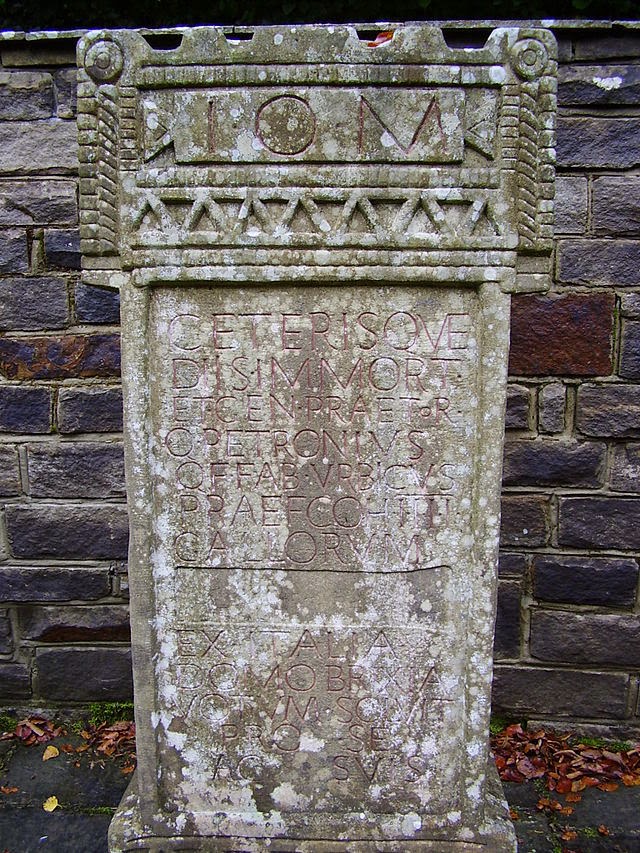
Altar dedicated to Jupiter Optimus
Maximus from the vicus (the civilian
settlement around the fort) of Vindolanda.
Photo: Alun Salt (licensed under CCA).

All of the letters are accessible online (both in Latin and in English translation) at http://vindolanda.csad.ox.ac.uk. Some of the originals can be seen at the British Museum. Until very recently, the Vindolanda tablets were absolutely unique in the context of Roman Britain, but recent excavations in London have revealed similar caches of documents, most of which have yet to be transcribed and translated. I am looking forward to meeting a whole new cast of characters when they are published!

~~~~~~~~~~~~~

Mark Patton blogs regularly on historical themes and historical fiction at http://mark-patton.blogspot.co.uk. His novels, Undreamed Shores and An Accidental King, are published by Crooked Cat Publications, and can be purchased from Amazon UK or Amazon USA.


Sunday, August 10, 2014

Giveaway: The Viceroy 1243 to 1253, Montfort The Founder of Parliament

Katherine Ashe is giving away Kindle copies of The Viceroy 1243 to 1253 Montfort The Founder of Parliament on Amazon Monday, August 11 through Wednesday, August 13.

Amazon US
Amazon UK
Amazon DE
Amazon CA

Madness, Melancholy and Medicine, Pt 1

by Maria Grace

Symptoms, types and  causes of nervous conditions diagnosed in the Georgian Era

The fine sensibility prized by women in the 18th century gave rise to an epidemic of nervous disorders in the early 19th century. Maladies of affluence and sophistication, nervous disorders paraded one's wealth, refinement and sensibility. Women were particularly susceptible to nervous disorders because of their ‘more delicate physiological network’. In fact, 'Nerves' were a woman’s claim to superior social status, the mark of being a lady.

The wealthy and indolent were not the only suffers though. Given that during the early 19th century people lived in a world where a small ache or upset stomach could be the harbinger of something far worse, or even fatal, it is not really surprising that hysterical diseases, hypochondria and melancholy—what we would call depression—were prevalent, especially when legitimized as disorders by respected doctors.  

General Causes of Nervous Disorders


While doctors agreed that they existed, "there's no Disease puzzled Physicians more than the Vapours, and Hysterick Fits. These complaints are produced by so many Causes, and appear in so many various Shares, that 'tis no easy Matter to describe them.” (Tennet) ‘The Annual Review’ said that after doctors started taking nervous disorders seriously, everyone was taking medication for them, outdoing each other with exaggerated symptoms and buying an array of medical equipment to deal with them. How strangely 21st century it all sounds.

Many factors contributed to the occurrence of nervous disorders. So many that very little did not contribute to these problems. Anything which resulted in too much relaxation or indolence might result in problems, just as did too much application or thought. Too much tea, too much fasting, unwholesome food or awkward posture all might result in the vapours.

Women were particularly susceptible to these disorders due not only to “peculiar organization of their frame…but to their very mode of living.” (Perkins) In specific, he felt an excess of “the passions of the mind”, which women were apt to experience, made them more prone to nervous conditions. Love, especially disappointed love, and anger were considered dangerous. Grief had the potential to be fatal, and fear might produce violent fits and convulsions.

Environmental factors might also weaken or disable one’s constitution, leaving the individual prone to nervous disorders. Intemperate air, excessive luxury and effeminacy had the power to degrade the constitution. Eating the wrong things (rich and fancy foods), or at the wrong times (late in the evenings), sleeping too long in the morning and indulging in too much recreation all contributed to a dangerous indolence that threatened ones vigor.

Symptoms and Types of Nervous conditions


According to William Buchan in his book Domestic Medicine (1790), “Of all diseases incident to mankind, those of the nervous kind are the most complicated and difficult to cure. A volume would not be sufficient to point out their various appearances. They imitate almost every disease; and are seldom alike in two different persons, or even in the same person at different times. Proteus-like, they are continually changing shape; and upon every fresh attack, the patient thinks he feels symptoms which he never experienced before. Nor do they only affect the body; the mind likewise suffers, and is often thereby rendered extremely weak and peevish.”

Like practitioners today, he recognized a number of different nervous conditions discernibly different from one another and which occasioned different courses of treatment. “These however are not to be considered as different diseases, but as various modifications of the same disease.”(Buchan) These disorders included: melancholy, low spirits, hysterical afflictions, hypochondriac affections, and nightmares.

OF MELANCHOLY 


Melancholy was considered a state of insanity that rendered an individual incapable of enjoying the pleasures or performing normal duties of life and might terminate in absolute madness.


It might be the result of inherited disposition, but more commonly intense thinking and violent passions of the mind, including those mentioned above and overreaching pride. Intense anger or cold that forced blood away from the brain could push melancholy into madness. Equally dangerous to the constitution were gloom and mistaken religious notions.

Acute fevers, suppression of ‘customary evacuations’, hard digestion or dryness of the brain constituted physical factors that contributed to a case of melancholy.

Both physical and emotional/behavioral symptoms could be detected in such cases. Physically the body would become ‘bound’, with thin urine, paleness and slow, weak pulse. Behaviorally, the individual might be seen fretful, fickle, attending to trifles and fond of solitude. The patient might be prone to imaginations—we could call them hallucinations—of being dead, an animal, too brittle to move, and the like. In its most extreme forms, melancholy might lead to suicidal behavior.

Today, this disorder would likely be considered an extreme form of depression, possibly with psychotic overtones.

OF LOW SPIRITS


Physicians of the era believed that those with weak nerves were likely to experience some degree of low spirits, a disturbance much like melancholy, but less severe. Symptoms could include sleeplessness, headaches, indigestion and loss of appetite. These would be exacerbated by solitude and gloomy thoughts, while cheery company and amusements might ameliorate them.

In addition to weak nerves, low spirits might be brought on by continued mental distress or through more direct physical causes. A weak, relaxed state of the stomach or bowels, or an obstruction thereof might be the culprit. Similarly, “suppression of the menstrual or of the hemorrhoidal flux” (Buchan) could cause them.

Today, this disorder would likely be considered a mild mood disorder, possibly dysthymia.

OF HYPOCHONDRIAC AFFECTIONS


Those of melancholy temperament were the most susceptible to hypochondriac attacks in which “the worst consequences imagined from any unusual feeling even of the slightest kind; and in respect to such apprehensions and feelings, there is always the most obstinate belief and persuasion.” (Perkins) Physical symptoms tended to cluster around digestive upsets, and vague physical discomforts.

The chief cause of the disorder was thought to lie in indolent, luxurious lifestyles or conversely overly unfortunate or studious ones. Congestion of one or more of the abdominal organs was thought to be the foremost cause of this problem.

This disorder sounds most like hypochondria, possibly with a mood disorder like depression or dysthymia as well. 

OF HYSTERIC AFFECTIONS 


Women, who were considered particularly delicate, were thought to be most susceptible to hysterical complaints. These included fits of laughter or crying, fainting, convulsions, low spirits, anxiety, heart palpations, and cramps throughout the body.

These complaints were thought to be brought on by sudden irritations of the stomach or intestines or a sudden suppression of menses. Violent emotions like fear, grief, anger or intense disappointment might aggravate the condition.

Today this disorder might be considered a somatization disorder, or possibly an adjustment disorder depending on the specific symptoms involved.

OF THE NIGHT-MARE 


Patients afflicted by nightmares experience, during sleep, a sensation of oppression or weight on their chest that they cannot shake off. They may cry out during sleep, often fancying themselves in some grave danger to life or limb which results in awakening.

Nightmares were thought to be the result of blood stagnating in the brain and lungs, arising more from indigestion than nervous affection, though those things which oppressed the mind, like deep thought or anxiety, could also contribute to the condition.

Today, this might be diagnosed as a nightmare disorder.

Avoiding Nervous Disorders 


Doctors offered specific advice on how these disorders might be avoided. “Excessive grief, intense study, improper diet, and neglect of exercise, are the great sources of this extensive class of diseases…Grief indulged destroys the appetite and digestion, depresses the spirits, and induces a universal relaxation and debility of the whole system… (While) misfortunes indeed are not to be avoided, but surely their effects, by a vigorous and proper exertion of the mind, might be rendered less hurtful…

Domenico Feti - Melancholy (Version 2) "The effects of intense study are pretty similar to those occasioned by grief. It preys upon the animal spirits, and destroys the appetite and digestion. To prevent these effects, studious persons ought… never study too long at a time; nor attend long to one particular subject, especially if it be of a serious nature. They ought likewise to be attentive to their posture, and should take care frequently to unbend their minds by music, diversions, or going into agreeable company.” (Buchan)

Attention should be paid with regard to proper diet, which avoided extremes of all forms. Regular exercise and fresh air should be a part of one’s routine. “But the most general cause of nervous disorders is indolence. The active and laborious are seldom troubled with them. They are reserved for the children of ease and affluence, who generally feel their keenest force. All we shall say to such persons is that the means of prevention and cure are both in their own power. If the constitution of human nature be such, that man must either labor or suffer diseases; surely no individual has any right to expect an exemption from the general rule.” (Buchan)

In part 2 of this article, we will explore the treatments recommended for these disorders.

References

Buchan, William. Domestic Medicine: Or, A Treatise on the Prevention and Cure of Diseases by Regimen and Simple Medicines, 11th ed., (1790)
Parissien, Steven. Regency Style. Phaidon Press Limited (2000)
Perkins, John. Every Woman Her Own House-keeper; Or, the Ladies’ Library. James Ridgeway: London (1790)
Sales, Roger. Jane Austen and Representations of Regency England. Routledge (1994)
Shoemaker, Robert B. Gender in English Society 1650-1850 Pearson Education Limited (1998)
Tennet, John . Every Man his own Doctor: or, The Poor Planter's Physician, Williamsburg, VA, (1736).
The Home Book of Health and Medicine. Philadelphia: Key and Biddle. (1834)
Wilson, Ben. The Making of Victorian Values, Decency & Dissent in Britain: 1789-1837 The Penguin Press (2007)
Wiltshire, John - Contrib. to Jane Austen in Context. Cambridge University Press (2005)

~~~~~~~~~~~~

 Maria Grace is the author of Darcy's Decision,  The Future Mrs. Darcy, All the Appearance of Goodness, and Twelfth Night at Longbourn and Remember the Past.  Click here to find her books on Amazon. For more on her writing and other Random Bits of Fascination, visit her website. You can also like her on Facebook, follow on Twitter or email her.