Showing posts with label letters. Show all posts

Thursday, August 6, 2015

Keeping Up With The Medieval Joneses

by Anne O'Brien

They are of course beyond price for allowing us to step into the world of the English ruling family and aristocracy. The members of the Paston family also are well known for the range and depth of their correspondence, but fortunately for us there are others too to give insight into the lives of lesser gentry families. How gratifying that these writers, all unwittingly, build up our knowledge of medieval people and the society in which they lived. It should be no surprise to us that in some aspects we in the 21st century are little different in our goals and expectations, particularly when it comes to impressing the neighbours.

Margaret Walkerne was a member of a minor gentry family of the early 15th Century. She was daughter of Philip and Joan Redington. On being widowed, Joan became wife of Robert Armburgh, thus providing Margaret with a step father to whom she was not unwilling to turn when her own fledgling family fell into financial difficulties.


Margaret married William Walkerne in 1428 or 29, and on this occasion of her writing to her step-father, was expecting her first child. Here is her short simple letter which opens a number of interesting doors on custom and family ambition in the early 15th Century.

My dear and well beloved father,

I commend me to you ...I have but a little while to go and am like within a short time with the grace of God to be delivered of a child. And for as much as ladies and gentlewomen and other friends of my mother's and mine are like to visit me while I lie in childbed, and I am not purveyed of honest bedding, with the which my husband's honour and mine may not be saved ...

Here we see that Margaret expects her mother to be present for the birth of her child, and furthermore expects a round of visits from her own and family friends to wish her and the new child well. But clearly the quality of her bedding is an issue for Margaret.


It is very important for Margaret that she should make a good impression for herself and for her husband when the neighbours come to call. She continues, explaining their own lack of money to provide the necessary bedding ...

... and also my friends have been put to so grievous costs and importable charges through the entangling of their adversaries, and my husband in new come into his land (which) is but bare and as yet hath little profit taken thereof, and hath laid great cost on his husbandry, that he may not acquit them (the profits) to be as he would wish.


Which all goes to explain the many reasons why Margaret should be so short of money to spend on her appearance for the visiting ladies and gentlefolk. As well as the lack from their own lands, it would appear that she has already sent a plea to her friends for aid (for which they had been quick to make excuses!). So here finally she appeals to her step father for a loan:

Therefore I would beseech you of your good fatherhood that you would vouchsafe in saving of my husband's worship (honour) and mine, to lend me two marks or twenty shillings until the next term (rent) day (when) my husband's farm (rent) comes in, and then with the grace of God you shall be well and truly paid again. I can no more at this time.


Margaret's anxiety is clearly about putting on a good display when these local ladies come visiting. It is a matter of honour and family status and of great importance for her and her husband's standing in the local community. Keeping up with the Joneses is nothing new.

Did Margaret receive her loan to impress the neighbours? We do not know. What we do know is that Robert Armburgh and Margaret's mother Joan were themselves in serious financial difficulty over an ongoing legal case, as well as from the expenses for Margaret's wedding. Margaret might have had to stiffen her spine and receive her visitors with her less than the 'honest bedding' that she so desired.


What a splendid little letter, allowing us the opportunity to peek into the life and concerns of Margaret Walkerne in 1430. What a miracle that such correspondence of little apparent importance in the great scheme of things should have survived for almost six hundred years.

My novel of Joanna of Navarre, The Queen's Choice, will be released in Hardback and eBook in January 2016.

Visit my website for all up-to-date information.

Friday, August 15, 2014

The Importance of the Post Office in World War I

by E.M. Powell

I recently had the privilege of being involved with a project that has built a memorial of words to commemorate World War I. As part of the Letter to an Unknown Soldier project, thousands of people have written letters which will be preserved as a permanent memorial by the British Library in the National Archive.

As with so much of writing about history, the research took me down some side alleys. Now, so much of the history of World War I is familiar and iconic, even 100 years after the outbreak of war. And so it should be. Images of the trenches, the unimaginable loss of life, of the catastrophic destruction should never fade.

But it was the contribution to the war effort of something that we still use everyday that I found completely fascinating. It is not an institution that immediately springs to mind: it is the Post Office.

In 1914, the Post Office in the United Kingdom employed over 250,000 people and was the largest single employer in the world. With the outbreak of war, the operation was expanded even more as letters and parcels were sent between troops and loved ones. During the war, over 12 million letters were sent to the front line every week.

Letters were seen as essential in maintaining morale. I came to this project through the Bury Libraries and Archives Service. They sifted through their collection of newspapers to find glimpses of the role of the Post Office.

© 2014 E.M. Powell 
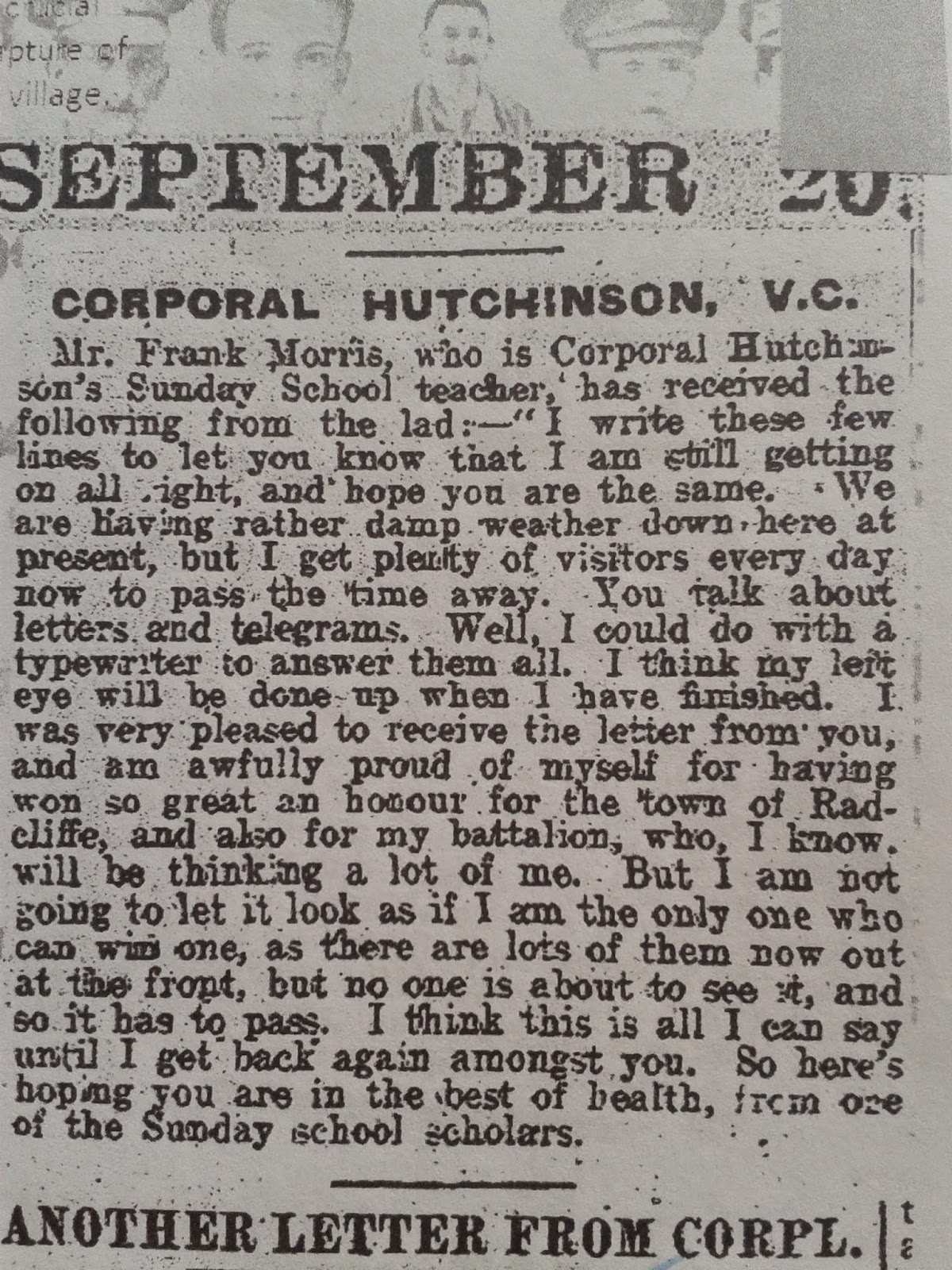
Here we see a report of a 1916 letter from Corporal Hutchinson, awarded the Victoria Cross (the highest military decoration for honour and valour), writing to his Sunday school teacher about all the messages of congratulation he has received.

But of course there is no detail about injuries or losses. All letters were heavily censored. Soldiers could use a field postcard, an honour postcard or self-censor. Field postcards were pre-printed, and the soldier just had to cross out the statements that did not apply. With an honour envelope, the sender had to sign a declaration to say their letters did not contain any sensitive information. Self-censorship was also widely used and soldiers gave those at home no hint of what life was like at the front.

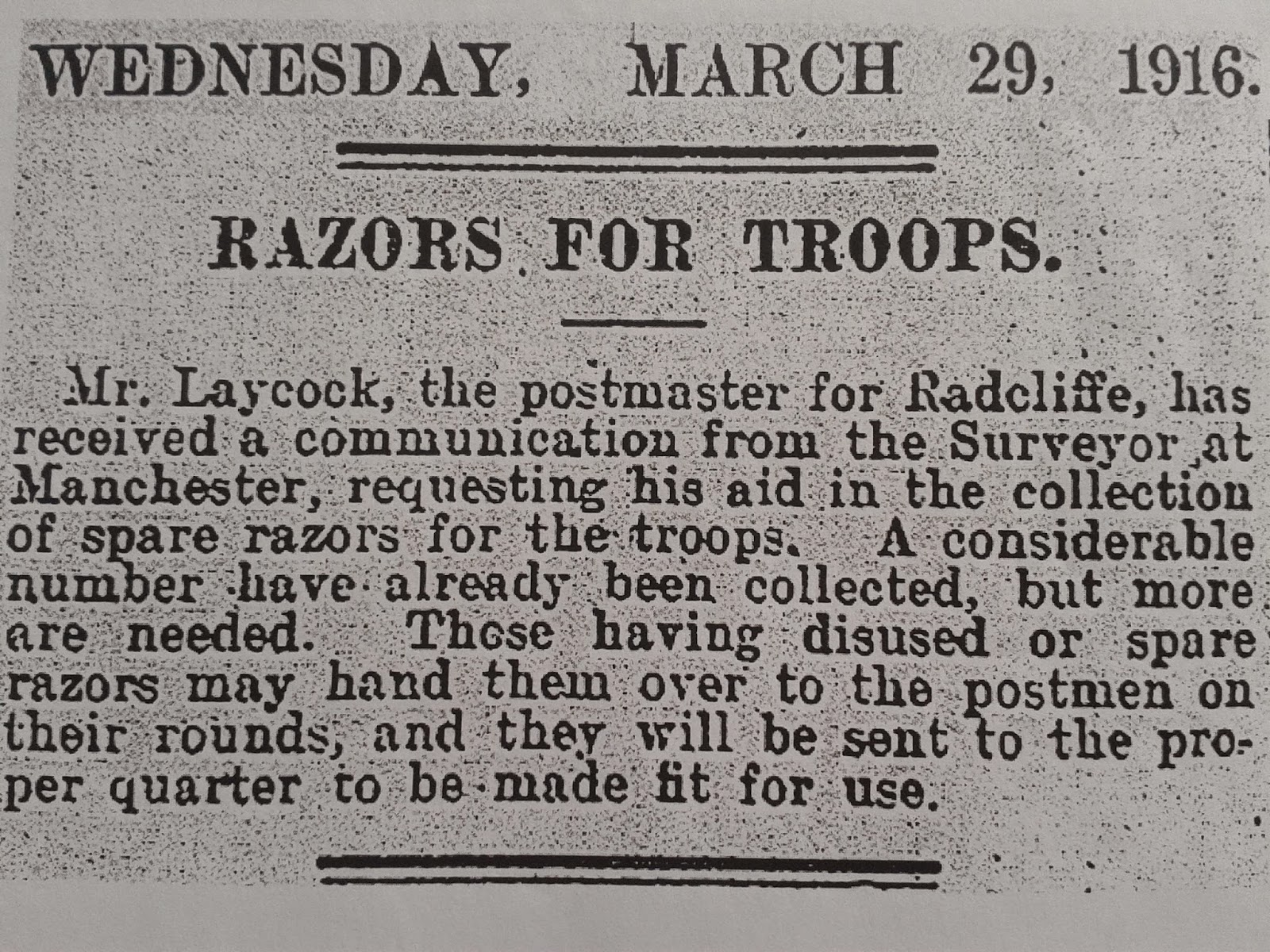
And of course it was not only letters. Parcels were essential too. Soldiers were sent items like soap and lice powder. Public donations of items was also made, as in this appeal for razors.

© 2014 E.M. Powell 

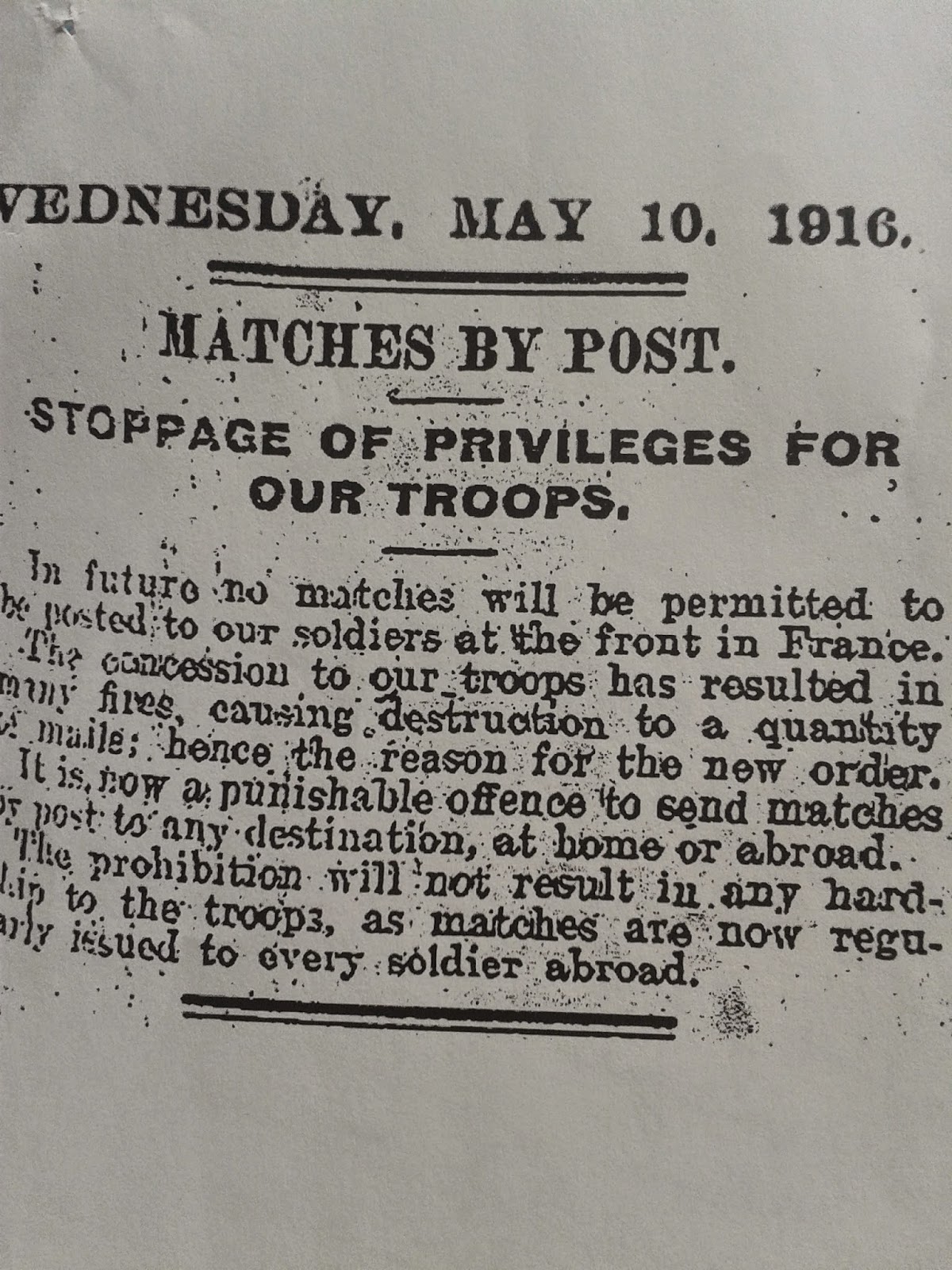
While sending large batches of sharp metal that potentially might be intercepted seems a little risky, the line was drawn when it came to matches.

© 2014 E.M. Powell 

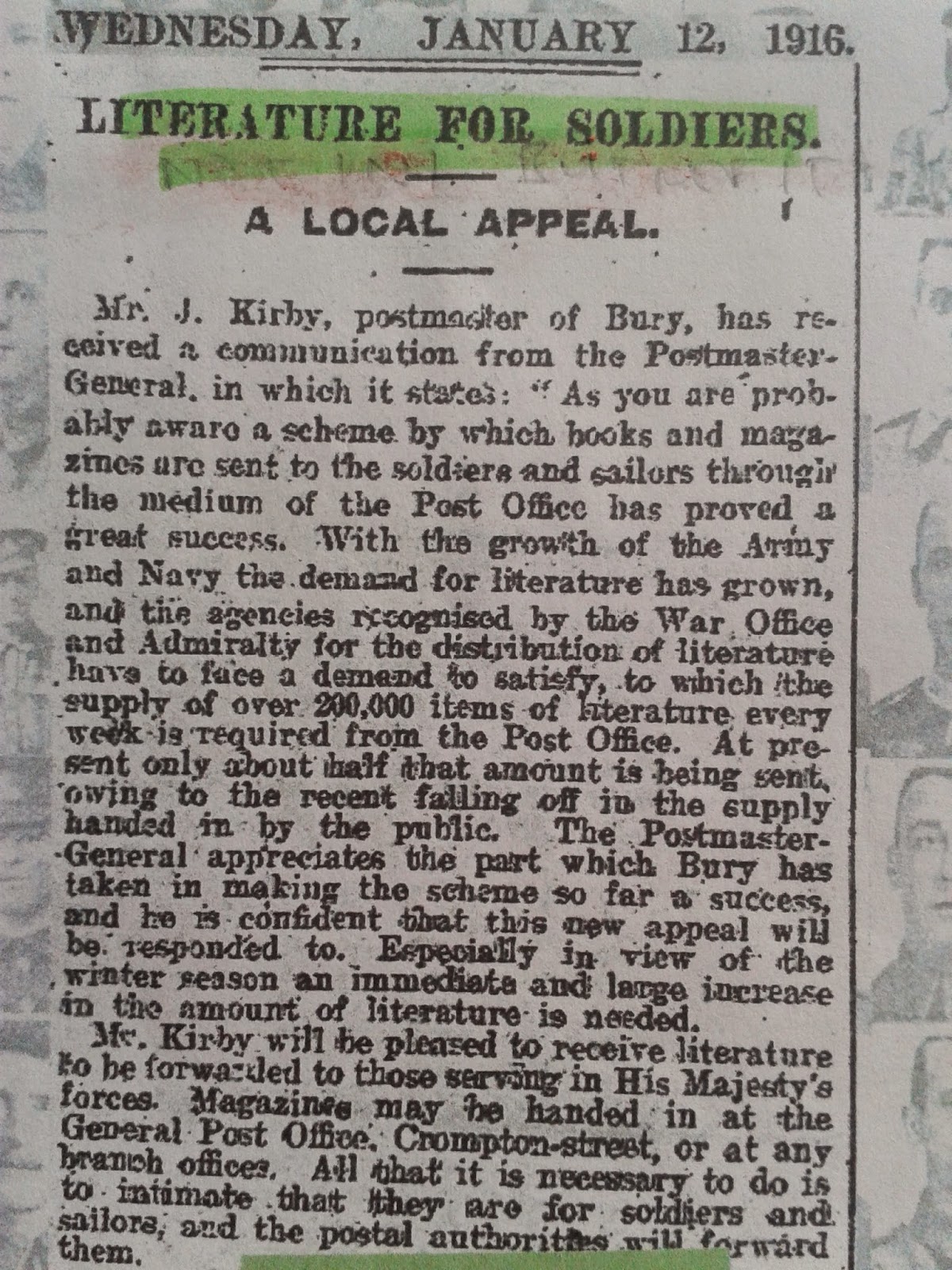
It was not just physical comforts either. Here we have an appeal for literature for soldiers.

© 2014 E.M. Powell 

Again, then the number of items being quoted (in the hundreds of thousands) is remarkable.

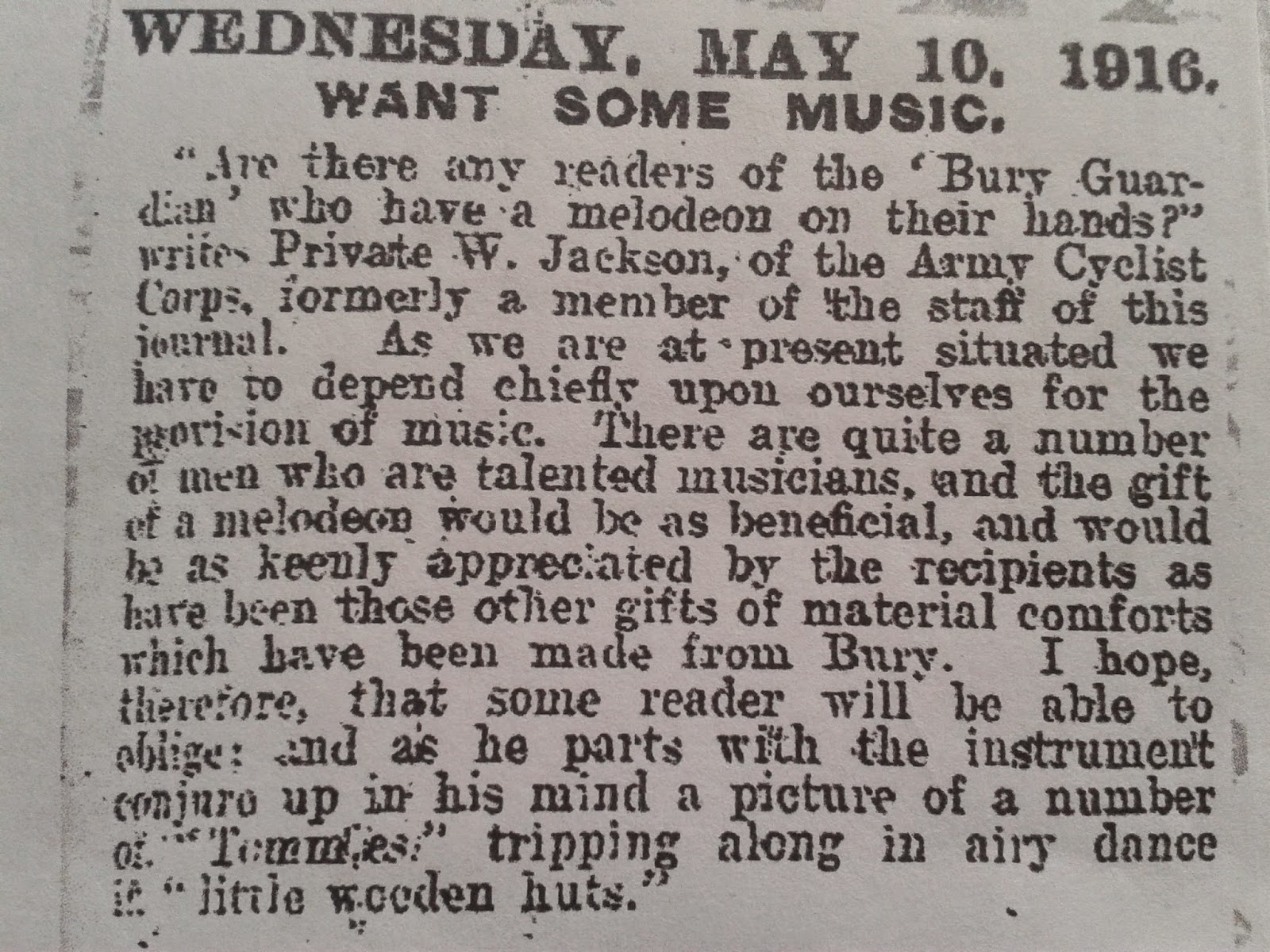
Another heart-rending appeal is for a melodeon:

© 2014 E.M. Powell 

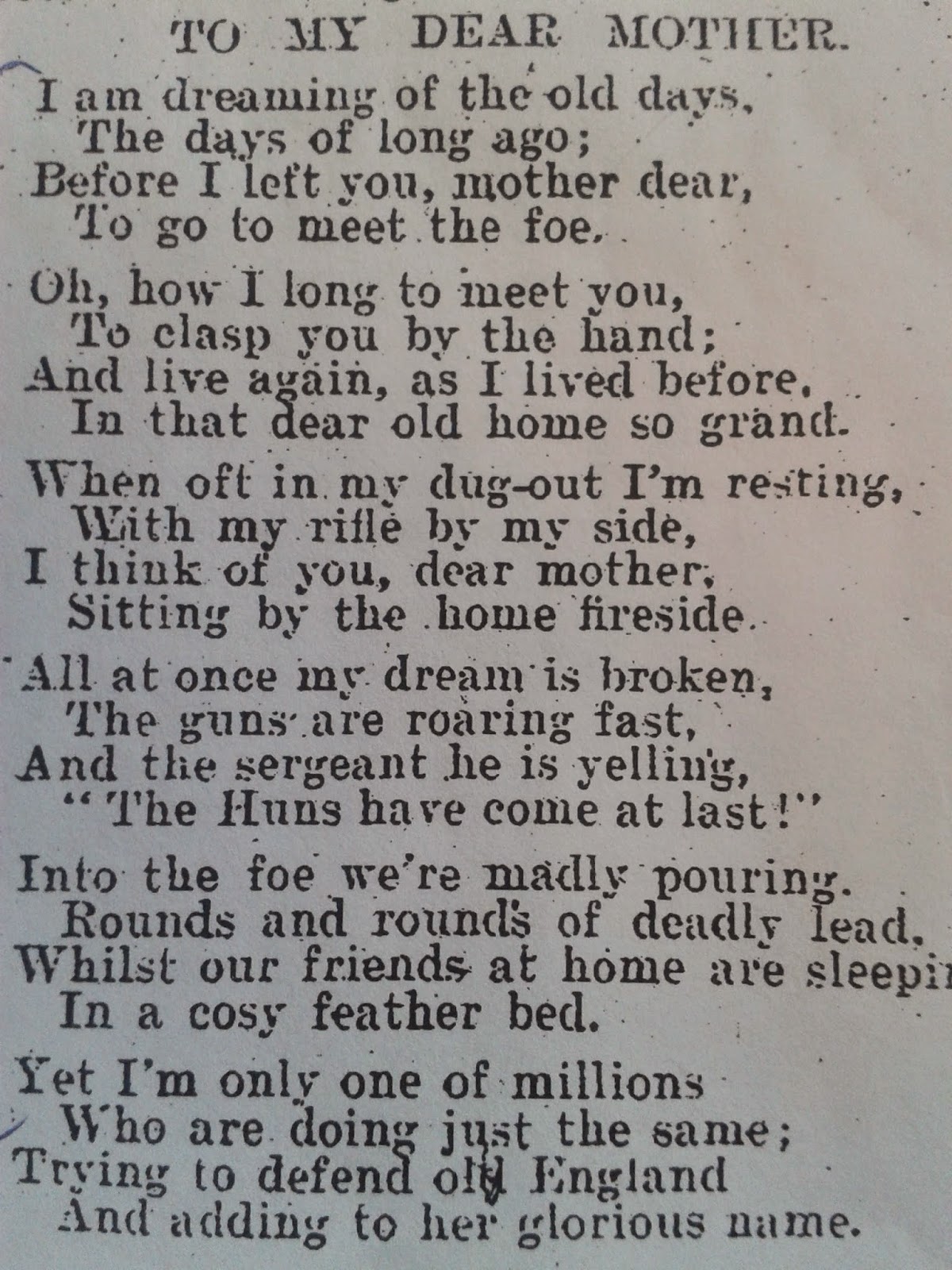
But of course the most heart-breaking items as always were the letters, for words are the most treasured possession of all.  The Archivist found this poem printed in a 1917 newspaper. It was sent by a Lance-Corporal J.W. Gilbert to his mother.

© 2014 E.M. Powell 

Lance-Corporal Gilbert was a cricket-playing mill worker before he enlisted. He never did come home to his cosy feather bed or his fireside. He never did come home to his mother. On June 16, 1917, Mrs. Gilbert received 'official information of his death.' She received this almost a year after being informed he was 'missing.' He was twenty-two years old.

The Post Office could never have brought back Mrs. Gilbert's son. But they brought his words back to her, as they did to millions of others. We can only hope that they were a small comfort.

~~~~~~~~~~~~~~~~~~~~~~~~~
References:
Letter to an Unknown Soldier: http://www.1418now.org.uk/whats-on/
The British Postal Museum & Archive: www.postalheritage.org.uk
BBC History- World War One Centenary: http://www.bbc.co.uk/history/0/ww1/
Bury Libraries and Archives: http://www.bury.gov.uk/index.aspx?articleid=3698

E.M. Powell is the author of The Fifth Knight, a medieval thriller based on the murder of Thomas Becket in Canterbury Cathedral in 1170.

The sequel, The Blood of The Fifth Knight, will be released by Thomas & Mercer on January 1st 2015.

Amazon US
Amazon UK
Amazon CA

Visit her website at www.empowell.com.

Thursday, July 10, 2014

Of Quills and Ink: Regency Letter Writing

by Maria Grace

Before telegraphs or telephones, email or texts, Twitter or Facebook, letter writing was the only way to maintain connections with distant family and friends. During the Regency era, writing letters, reading them, and sharing the news they contained was an essential part of social life, one largely slated for the women of the household.

Chelsea Porcelain Factory - Inkstand - Walters 48842 (2)Typically, women would write letters in the morning, before breakfast. They kept track of the letters they received and to whom they owed letters as carefully as other important social obligation like dinner invitations and entertaining. Though the information in a letter might be widely shared, one did not read another person’s letters. Select portions of letters might be read aloud to an audience. Sometimes the correspondent would indicate what could be read aloud by underlining passage. Otherwise, letters were considered very private and kept in locked boxes and drawers to preserve them from prying eyes.

Letter writing was considered an art form. Young ladies learned it as part of their necessary accomplishments. Governesses or boarding schools would teach handwriting, spelling and grammar, and the construction of suitable phrases to use in correspondence. Collections of letters by famous figures were often published. Similarly, books of sample letters could be found to assist a letter writer in conveying an appropriate sentiment. Phrases might even be copied directly from such books to insure a beautiful turn of phrase.

Not only could it be complicated to craft just the right words to convey a desired message, the very act of penning a letter was far more complex than sending off a quick text message today. ‘Dashing off a quick letter’ was hardly swift or simple process by today’s standards. A correspondent required a number of expensive supplies and specialized equipment to produce a proper letter.

Paper

The first step to crafting a letter was preparing the paper. Paper was an expensive commodity during the Regency, not like today when hundreds of note pads of various shapes and colors litter drawers, desks and countertops all over my house.

In the 1700’s, paper makers began standardizing paper sizes and watermarking them according to size. Foolscap, one of the most common (and smallest) paper sizes, was typically used for printing and letter writing. Even so, at 16 1/2 inches by 13 1/4 inches it was often too large for a specific task and was often trimmed to size. A writer would not waste paper by leaving large spaces empty.

Paper, sold at stationers, could be bought by the ream (480 sheets) or the bale (ten reams. It was most commonly sold by the quire (1/20th a ream, 24 sheets). In some cases, particularly for specialty paper, like drawing paper, it was sold by the sheet.


Writing implements

Once the paper was ready, a pen (most likely) or pencil would have to be readied.

Quill pens


By far the most common pen was a quill pen from goose, swan or crow feather. Goose quill pens enjoyed the greatest popularity.


English: Three goose feathers in stages of bei...
English: Three goose feathers in stages of being made into writing quills. Top: unmodified. Middle: polished. Bottom: cut and shaped. (Photo credit: Wikipedia)
Not just any feather was suitable for a quill pen. The best pens quills were those from primary flight feathers taken from living birds. A healthy goose could produce about twenty pen-quills a year. Large flocks of geese were maintained for the sole purpose of producing pen-quills. Feather from the left wing were favored because the curve made them easier for right-handed writers to use. Left handers preferred pens made from the right wing. Goose feathers were used primarily for writing pens. Swan pens produced very broad lines. In contrast, crow feathers produced very fine, flexible pen nibs, favored by artists and ladies who wrote with small, delicate lines.

Freshly plucked quills had to undergo extensive treatment before they could be turned into pens. The process, called quill-dutching started with plunging the quills into hot sand to remove the inner and outer membranes. The heat treatment also hardened the barrel of the quill and made it transparent. A treatment to nitric acid might be used to improve the appearance, but some thought it made the quills too brittle, so not all quills underwent this procedure. As a final step, quill dressers would trim away a section of the feathery ‘barb’ of the feather to make the pens easier to handle and take up less space in shipping. Bundles of twenty five or fifty quills were baled together and shipped to stationers’ shops.

The pens would not be ready for sale until they had the attention of a pen-cutters. These professionals used a small, sharp pen knife and cut the quill down to a usable writing nib. A well cut pen, if treated correctly, could be used for quite some time before needing to be recut, something typical done by the pen’s owner. A pen could be re-cut several times before it needed replacement.


Ink


Pens were of little use without ink. That should be fairly easy, right, a little lampblack or charcoal and some water and we’re ready to go. No, not at all. Ink are very complex substances to create.

The most common ink was iron gall ink, made from oak galls, iron sulfate and acacia gum. The galls were pulverized, soaked in rain water for seven to ten days, boiled half volume, then the iron sulfate and acacia gum were added. Sugar, salt or brandy might also be added to the infusion. The fluid was stored in a tightly stoppered stoneware jug and kept warm to ferment for two weeks. Finally it was strained and ready for use.


Oak Marble galls, one with Phoma gallorum fung...
Oak Marble galls, one with Phoma gallorum fungal attack. Chapeltoun, North Ayrshire, Scotland. (Photo credit: Wikipedia)
When first applied to paper, iron gall ink would be light grey, but after exposure to air, it darkened to a very permanent, dark purplish black. Although a useful, all purpose ink, if the iron sulfate content was too high, it would disintegrate the paper over time.

Red, blue, yellow and green writing inks were also available, each as complex to make as iron gall ink. Stationer’s made these inks available along with quills and paper. Some stationers would formulate their own ink, generating a brand loyalty in their customers.

For those seeking less expensive sources of ink, traveling ink sellers made their way through the streets, crying their wares along with sellers of fish, scissor grinders, and other tradesmen. They carried their supply in small barrels and dispensed it directly into the bottles supplied by their customers.


Pen knife 


" 12 - ITALY - Palmerino (o temperino) "scalprum librarium" quill knifePen knives, some extremely ornate, some plain, and some with folding blades, were another necessary implement for letter writing. Ordinary models might be acquired at the stationer’s while highly decorated models might come from a jeweler.

The knives were necessary to recut quill pens when the tips degraded from use. They were also indispensable for maintaining the other Regency era writing implement, the pencil. They were not, though, used in trimming paper.


Pencil


Though we take it for granted today, the pencil was the first truly portable, use anywhere, on almost anything writing instrument. Its introduction freed artists and writers from the constraints of quills and ink.

At first, solid sticks of graphite were wrapped in string or paper to make them cleaner to use. By the 17th century, various wood and metal holders, like chalk holders used today, had been developed. The exact date that graphite was encased in wood to create a cased pencil is not known. At first, these were all handmade and very expensive, but as machines were developed to do the job, they became affordable to common folk.

Plant sap, known as gum elastic could be used to rub out marks made by pencils. It was so effective it became known as a ‘rubber’. These ‘rubber’ cubes could be purchased at a stationer’s right alongside pencils. They were not actually attached to pencils like they are today until the end of the 19th century.

Sealing wax and wafers

Since envelopes did not come into general use until 1840, Regency era writers had to resort to other means to keep their correspondence sealed and private. The least expensive alternative was to wafers of flour and gum. Letters were folded to form an envelope and a person would lick the wafer to stick the paper shut.

Those who could afford more elegant means used sealing wax which provided a tamper evident seal for their documents. Despite its name, sealing wax contained little or no actual wax.

Siegel Art and science were required for the production of a high-quality sealing wax. Each maker tended to have their own special formula, and some included wax, while others did not. A formula from The Encyclopedia Britannica (1773), included beeswax, rosin, olive-oil and Venice turpentine. Other formulas included shellac, sandarac, rosin, pitch or mastic. “Spanish wax” contained shellac, mastic, turpentine, chalk or gypsum, color and fragrance.

In general, people preferred red sealing wax and it was the most commonly used wax. Black sealing wax marked letters bearing the news of death and during periods of mourning. Green was the only other color available during the Regency era, used by the office of the Exchequer and the courts, of both the government and the Church.

Sticks of sealing wax were about seven to eight inches in length and did not have a wick. They would be held over a candle to soften, then pressed down on the paper to be sealed. A seal or signet pressed into the soft wax made any tampering with the seal evident.

With all the specialized tools and supplies for letter writing it is little wonder that elaborate writing desks and desk sets to store everything were common in the era. Clearly our concept of dashing off a quick text in seconds on a cell phone bears little resemblance to the production that penning even a brief letter would have been during the Regency era.

References


All About It:or: the History and Mystery of Common Things. New York: W. Townsend &Company, 1859.
Collins, Irene. Jane Austen, The Parson's Daughter. Hambledon (1998)
Copeland, Edward, McMaster, Juliet, The Cambridge Companion to Jane Austen. Cambridge: Cambridge University Press, 1997.
Kathryn Kane.The Regency Redingote. Sealing … Wax? 16 November 2012
Kathryn Kane.The Regency Redingote.The Precious Regency Pencil 23 October 2009 
Kathryn Kane.The Regency Redingote.Ink — Regency Writing Fluid 18 September 2009
Kathryn Kane.The Regency Redingote.The Quill — The Regency Pen 11 September 2009
Kathryn Kane.The Regency Redingote.A Pen Knife was not always a "Pocket-Knife". 8 January 2010
Kathryn Kane.The Regency Redingote.Oh, foolish Foolscap! 31 October 2008
Lane, Maggie. Jane Austen's World. Carlton Books (2005)
Le Faye, Deirdre. Jane Austen: The World of Her Novels. Harry N. Abrams (2002)
Martin, Joanna . Wives and Daughters. Hambledon Continuum (2004)
Selwyn, David .  Jane Austen & Leisure The Hambledon Press (1999)
Todd, Janet M., Jane Austen in Context. Cambridge: Cambridge University Press, 2005.
Watkins, Susan.  Jane Austen's Town and Country Style Rizzoli (1990)
Willich, Anthony Florian Madinger, MD. and Cooper, Thomas, MD., The domestic encyclopedia: or A dictionary of facts and useful knowledge chiefly applicable to rural & domestic economy. With an appendix, containing additions in domestic medicine, and the veterinary and culinary arts. The whole illustrated with numerous engravings and cuts. In Three Volumes. Volume II.Phildadelphia: Abraham Small, 1821

~~~~~~~~~~~~

 Maria Grace is the author of Darcy's Decision,  The Future Mrs. Darcy, All the Appearance of Goodness, and Twelfth Night at LongbournClick here to find her books on Amazon. For more on her writing and other Random Bits of Fascination, visit her website. You can also like her on Facebook, follow on Twitter or email her.
Enhanced by Zemanta