Showing posts with label Georgian era. Show all posts

Wednesday, July 8, 2020

How grand was the aristocratic Georgian London house?

by Elizabeth Bailey

Unlike the grand country house, where successive owners could build extra wings whenever they felt like it, space was at a premium in London just as it is today. Georgians built up rather than wide. Although there were mansions of considerable size, these were exceptions. Not every landed family could have one or build one. There simply was not enough room to accommodate them all.


A double-fronted very large house, such as that occupied by the Polbrook family, had in general four huge rooms to each floor. On the floors above, an extra smaller room could be made of the space above the downstairs hall. Likewise, on the second or third floor, depending how many floors you had, you could make another small room in the space above the stairwell.

There would be two staircases, a narrow one for the servants, either at the back of the house, or tucked away in a recess somewhere. This gave access to all floors, including the attics where the servants slept. Internal walls here would create enough rooms to service the entire domestic staff, with the exception of the butler, who traditionally slept in a room near the pantry.

Down the servants’ stair to the basement, you would find the domestic offices, often a rabbit warren of small rooms and corridors. The housekeeper’s room will be here, as well as the butler’s pantry, the large kitchen, store-rooms and, down a further stair, the wine cellar, the coal cellar and very likely a junk room too. At the front of the house a main door led to a narrow area and steps up to the street.

If you had four or more floors, you might give over the whole of the first floor to a grand saloon for parties and a ballroom. However, a house without this facility could open out two rooms for the purpose of holding a dance. In the Polbrook house, they would use the Blue Salon and the Dining Room. This would give you an extended room about 23 feet long and a good 18 feet wide at the front, a little less at the back to accommodate the staircase.

Choosing this design for the Polbrooks makes it possible to create two good-sized parlours in the front at ground floor level, the posh Blue Salon for visitors and a cosier parlour in daily use by the family. The two rooms behind become the dining-room and the library, the latter accessed by a small vestibule which also houses the servants’ narrow staircase. The central hall runs from front to back, where we find the grand staircase winding around and up.


On the first floor, the principal bedchambers at the front are occupied by the master and mistress of the house, and the little room over the hall becomes my lady’s dressing room. One back bedroom is occupied by the second son of the house, Lord Francis Fanshawe, and the other is reserved for guests. The heir and the daughter of the house have rooms on the second floor, with two more bedrooms available at need.

All the main rooms have fireplaces, which create a stack of flues and chimneys either side of the house because fireplaces cannot share the same flue. In the Blue Salon, as was customary, the furniture is ranged around the walls, but the family parlour has a more cosy arrangement, with only one sofa against the wall and chairs set so as to enjoy better warmth from the fire.

In the domestic quarters, things are somewhat less than comfortable. The back door leads to a yard below the main garden behind the house, with the coal hole, sheds and other facilities, where dirty water might be disposed of and carpets beaten, for example. From the cellar below there is a further outside area, which is decidedly unsavoury with the servants’ privy, receptacles for the disposal of all the contents of the chamber pots, and a lane where the “night soil men” come through to take it all away in a cart. The stench is one of the major disadvantages of working below stairs.

As may be imagined, to keep these great houses operational you needed many servants, even in the London house. Under the butler, you have the indoor menservants such as footmen and boot boy. Under the housekeeper come the female staff: the housemaid, the chambermaid and the kitchen maid; and nominally, the cook, who reigned supreme in the kitchen. Then there are the ladies maids and the valets.

At need, extra help is hired in, like the laundry woman who collects the linen and takes it away to be washed elsewhere. Caterers may be brought in for balls, bringing waiters with them. Horses and carriages are kept in stables in a nearby mews, with grooms and stable boys living above them. In addition, there are a couple of gardeners and perhaps a skivvy or two.

In all, this aristocratic Georgian family required a dozen or so servants to service a household of three to five individuals, with perhaps an occasional relative or guest. This gives your sorely beset author of the upstairs downstairs murder mystery a cast of thousands, as they say, to manipulate, quite aside from the various characters to be found outside the home. It was rather a relief when research produced this relatively modest house instead of the grand mansions we tend to associate with the lords and ladies of an earlier era.

[This is an Editor's Choice archive post, originally published on EHFA 19th June 2018]

~~~~~~~~~~

Elizabeth Bailey feels lucky to have found several paths that have given her immense satisfaction – acting, directing, teaching and, by no means least, writing. Through the years, each path has crossed the other, honing and deepening her abilities in each sphere.

She has been privileged to work with some wonderful artistic people, and been fortunate enough to find publishers who believed in her and set her on the road.

To invent a world and persuade others to believe in it, live in it for a while, is the sole aim of the novelist. Elizabeth’s own love of reading has never abated, and if she can give a tithe of the pleasure to others as she has received herself, it’s worth all the effort.

You can check out Elizabeth’s website here http://www.elizabethbailey.co.uk/


Wednesday, October 30, 2019

Sex, Swearing and Humour in the Regency Period

By Caroline Miley

History is full of facts, but Catherine Morland is probably not the only reader who sometimes found them a little trying: “I read it [history] a little as a duty, but it tells me nothing that does not either vex or weary me. The quarrels of popes and kings, with wars or pestilences, in every page.”(1) Facts are, of course, of primary importance. But it's one thing to discover, for instance, that the Duke of Wellington's birthday was May Day, and quite another to know how it would have been celebrated - and the way life was lived is often far more interesting, but harder to discover, than reigns and dates and public events.

Thomas Rowlandson ‘Soldiers on a March’ 1808

Fortunately, in the late Georgian era there's a mass of contemporary material, ranging from newspapers, letters, diaries, memoirs and military dispatches to essays and novels. Not only are these full of useful information, they show clearly how people used to write and express themselves.

There's an idea that the Regency was full of people saying 'Demme, m'Lud, I do protest..' and so on, but a glance at Jane Austen's prose shows that ordinary people didn't speak like that at all. One of the things evident in reading a wide range of contemporary material is that educated people often used two quite different modes of expression, depending on what they were writing. There's the everyday, which is plain and unadorned. Clear, elegant prose was what the Georgians aimed for. Military dispatches, for instance, are models of concise statement. Here is the Duke of Wellington (in recorded speech): “All the business of war, and indeed all the business of life, is to endeavour to find out what you don't know by what you do; that's what I called 'guessing what was at the other side of the hill’.”(2) So too with letters, including those Jane Austen gives in her novels. But when describing scenery in memoirs, writers sometimes break into a special 'literary' form: 'When we attained the crest of the hill, what a vale of Elysian delight opened before us! Fair Venus herself would not disdain to dwell in the exquisite groves...' and so on. But they didn't talk like that. It was a poetic mode considered suitable for literature.

The real problem for anyone wishing to learn not only the facts but the feeling of an era, is the vast amount of material that never appears in print. At the forefront of this is sex and swearing. Neither subject is ever mentioned, although there must have been a great deal of both. We can know quite a lot about sex at the time, but less of how people talked about it, and therefore what they thought. It was not a subject for polite conversation, so remained hidden. Fielding’s novels (Tom Jones, The History of Moll Flanders) and contemporary plays show that, as might be expected, people were keen on sex and thought about it a lot. There are hints about sexual desire under the text of Austen’s novels and letters – Lydia’s elopement with Wickham, and other seductions, must have been motivated by libido, and there are occasional comments that ‘I could not like him in that way’. It is noteworthy that the Georgians were a great deal less squeamish about sex than the later Victorians. The fact of Colonel Brandon’s having an illegitimate daughter, for instance, doesn’t make him an unsuitable husband for Marianne. But when it comes to details of what people did and how they did it, if it were not for Fanny Hill (3) and Rowlandson's numerous, often very graphic erotic drawings, I don't know how we'd get on at all. As it is, these two sources provide almost too much information!

Swearing also doesn't appear in print, except the occasional genteel 'by G- sir!' Naval and military reminiscences give a few more clues - one of my favourites being the officer who recalled that he had been several days as a midshipman on his first ship before discovering that 'Damn your eyes!' was not a form of greeting. But I think it is safe to assume that there was a great deal of swearing among men and the lower classes of women, and that it centred, then pretty much as now, around the common ‘Anglo-Saxon’ sexual words in use today and blasphemy. In sharp contrast to today, though, a gentleman certainly did not swear in the presence of a lady.

Which brings me to the final category: humour. I've not been able to find any joke books of the period, but irony and satire there were in plenty, and I have to assume that broad fall-on-your-face humour was as likely to raise a laugh then as now. Again, the multitude of lampoons and caricatures of the period give us the best clues to this category. Thomas Rowlandson’s ‘The Stare Case’ depicts a crowd on the notoriously narrow staircase of the Royal Academy at Exhibition time. Plump ladies are tumbling down, their skirts hiked up to show their rounded bottoms (no underwear in those days), while some dirty old men (and the sculptor Nollekens) ogle them from the foot of the stairs. A similar idea animates his sketch of ‘The Line of Beauty (a concept in art), in which some Royal Academicians (4) have positioned themselves strategically to take in the more intimate charms of the nude model reclining before them.

Thomas Rowlandson  ‘R.A.s of Genius Reflecting on the True Line
 of Beauty, at the Life Academy Somerset House June 1, 1824’ 

There is a great deal of pictorial humour along those lines, as well as poking fun at stereotypes, such as fat greedy men shoving food into their faces and elegant dandies tight-lacing their corsets and padding their skinny hips. One of my favourites, ‘On the March’ which typically combines information with comedy, shows a line of soldiers and camp followers crossing a stream. All are burdened with various things; one man bears his wife on his back; a frolicking dog (a Rowlandson trademark) holds a bundle in his mouth, and at the rear a sturdy wife carries her officer husband, too refined to get his feet wet, on her back.

Thomas Rowlandson ‘The Stare Case’ 1811

But lampoons are not the place to find the more subtle wit that really characterised the age.  Here is Austen at her best, in her letters, where she spoke less guardedly than in her published works: “I do not want People to be very agreeable, as it saves me the trouble of liking them a great deal.”(5) And for a feast of raillery, as it was called, it’s hard to go past Sheridan, the noted wit and satirist, who thought that “There's no possibility of being witty without a little ill-nature”(6). His plays are full of comedy, and he must have been a formidable opponent as an MP. To understand late Georgian humour, you can do a lot worse than to read contemporary plays. The wit is often surprisingly modern, my favourite being this riposte by Goldsmith’s Tony Lumpkin, when his mother suggests that he doesn’t want to disappoint his friends waiting at the tavern: “As for disappointing them, I should not so much mind; but I can't abide to disappoint myself.”(7)

These are not the great affairs of State (or affairs of Statesmen) that are the staple of so much history. But if we want to get inside the lives of ordinary people and find out what they thought and how they lived, then nothing is more important than humour, sex and swearing.


Notes
(1) Northanger Abbey by Jane Austen, London, 1817, Chapter 14
(2) Quoted in The Croker Papers: The Correspondence and Diaries of the Late Right Honourable John Wilson Croker, LL.D F.R.S, Secretary of the Admiralty from 1809 to 1830 (1884), edited by Louis J. Jennings, Vol. III, p. 276.
(3) Memoirs of a Woman of Pleasure by John Cleland, London 1748.
(4) Plate 32 from Charles Molloy Westmacott's "English Spy" 1824. Each artist's easel is initialled for identification: B.R.H. for Benjamin Robert Haydon, M.A. Shee for Martin Archer Shee, T.L for Sir Thomas Lawrence, B.W. for Benjamin West, R.W. for Richard Westmacott, J.J. for John Jackson, J.F. for Joseph Farington, and F.C. for Francis Chantrey (courtesy Met Museum).
(5) Letter to her sister Cassandra, December 24, 1798.
(6) The School for Scandal, Act 1, Scene 1.
(7) She Stoops to Conquer by Oliver Goldsmith, 1773, Act 1 Scene 1.

~~~~~~~~~~

Caroline Miley is an art historian and author of literary historical novels set in the late Georgian era. Her debut novel, The Competition, won a Varuna Fellowship and a Fellowship of Australian Writers award, and was selected by the Royal Academy of Arts for its 250th Anniversary celebrations. Her latest novel, Artist on Campaign, was inspired by wondering what would happen if a rake of an artist was obliged to put up with the British Army, and vice versa.
Her interests are art, both as a practitioner and a viewer, books, films, history, travel and gardens.

Social media
https://www.carolinemiley.com/
https://www.facebook.com/carolinemileywriter/

Tuesday, September 11, 2018

The Role of the Circulating Library

by Maria Grace

During the Georgian Era literacy rates among the ‘common man’ rose. Consequently, the demand for reading materials increased, driving the rise of two new literary forms, the newspaper and the novel. By 1720, twenty four newspapers were published in Britain. By the 19th century there were fifty four newspapers printed in London alone.

The High Cost of Reading


Unfortunately, the cost of reading material did not decrease with the increase in demand. But, where there’s a will, there’s a way. People banded together to form “newspaper societies” where groups of people, usually those in a local parish, would contribute a weekly sum. With these pooled funds, the society would purchase subscriptions to one or more newspapers. The newspapers would be shared among those in the society.

While they might not be the first to get the news, society members did manage to get their hands on what they might not be able to individually afford. By 1820, around five thousand of these societies were still going strong.

Whether booksellers took note of the idea or came upon it on their own, they realized that, as with newspapers,  there were far more readers who wanted books than could actually afford to pay for them. For some perspective, in 1815, the average (three-volume) novel cost a guinea (a pound and a shilling). Based on the current worth of a guinea's gold content, that was roughly the equivalent of $100 in modern currency.

This doesn’t tell the whole story though. In the early 1800s, a comfortable middle class salary for a family of four was in the neighborhood of £250. (A guinea was slightly more than a pound, but let’s keep the math a little easier.) At the price of a guinea, a typical novel would cost you 1/250 of your yearly income. If you consider the median US income in 2018 as $60,000 (rounding up just a smidge for the sake of the math), then that same novel carries a price tag on the order of $240. Ouch!

Enter the Circulating Library

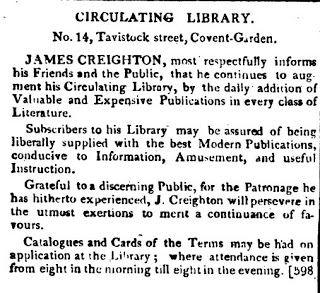
Booksellers, particularly those in big cities like London, had already begun making changes in their business practices to reflect these economic realities. By the mid-1700s, they had started encouraging clients to linger at their shops “offering comfortable chairs, a warm fireside in cold weather, some even offering refreshments. The best of these shops soon became places where those with literary interests congregated regularly. Even if a bookseller made enough to afford to employ an assistant or two, most spent a goodly portion of their time in their shops, chatting with their customers. In the days before published book and theater reviews, it was these discussions which enabled people to keep up with the news of the literary world. By the mid-eighteenth century, the social aspects of these literary bookstores were nearly as important as the books they housed.” (Kane, 2011)

From here, it was only a short leap for booksellers to allow their best patrons to take books home with them to continue reading, for a fee of course. Trustworthy patrons were often allowed to rent books to read and return. The idea grew and by 1728, James Leake had established the first circulating library in England. (Hilden, 2018) In 1742 Reverend Samuel Fancourt, opened the first circulating library in London. He has also been credited with coining the term circulating library. (Kane, 2011) By the end of the 18th century there were 1,000 circulating libraries across England. (Hilden, 2018)

Libraries Holdings

Early library holdings varied according to the anticipated subscribers of the library. Sometimes existing social clubs or book clubs formed libraries to cater to the interests of their members. These libraries might feature books on science, arts, the classics, law, history, religion or philosophy. Other “club” libraries might feature somewhat broader topics and even some newspapers or magazines which could be made available to members in a separate reading room. These libraries were not open to the public though, available only to members of the club. (Kane, 2011)

Music libraries formed in places like Bath, specifically to allow subscribers access to sheet music. (McLeod, 2017)
Bath Chronicle and Weekly Gazette - Thursday 11 April 1816 

Since the circulating library was first and foremost a business, it behooved the library to cater to as many as could afford the price of a subscription. So, most library catalogs reflected a much wider selection of books, appealing to the tastes of both men and women since most libraries could not afford to discriminate on the basis of gender. Savvy proprietors quickly realized that the most profitable sort of book was the fashionable novel.

Novels were different than traditional nonfiction books. Where nonfiction works might be read and reread, consulted through the years as a valuable reference, this was not so with the novel. The novel was in fact a “consumable” good. Typically one read a novel once and never again. It was exactly the sort of book that made little sense to purchase (as an individual) and a tremendous amount of sense to rent.

Library catalogues reflected the (largely female reading) public’s hunger for novels. The average circulating library’s catalogue typically listed around five thousand titles. About twenty percent of those were fiction. However, many libraries boasted multiple copies of those novels, sometimes as many as twenty five copies. So that twenty percent of titles probably made up a much larger percentage of the libraries actual holdings. Research on smaller libraries, those averaging less than four hundred and fifty titles, reveals collections of up to seventy five percent fiction titles. Some research suggests that fiction was checked out three to four times as much as nonfiction, implying that for some of these smaller libraries almost all of their stock and trade was in the renting of novels. (Erickson, 1990)

Libraries as a social space


Libraries were first and foremost a business, not a public service as we think of them today. Generally, they required a town with a population of at least two thousand to be profitable. Consequently, they were almost exclusively found in larger towns and resorts.

Libraries could exist in smaller areas, but in those places, they were more of a sideline, added to an existing business. “In 1791, William Lane, famed for the Minerva Press, advertised ‘complete CIRCULATING LIBRARIES . . . from One Hundred to Ten Thousand Volumes' for sale to grocers, tobacconists, picture-framers, haberdashers, and hatters eager for a profitable side line.”(Benson, 1997) Other libraries (those small or not so small) supplemented their income with additional lines of luxury goods like haberdashery, hosiery, hats, tea, tobacco, perfume and even patent medicine. (Erickson, 1990) They might even go so far as to advertise these goods in the local paper.  (McLeod, 2017)

Taunton Courier, and Western Advertiser - Thursday 09 February 1815 

Since libraries survived on traffic from the local public, they sought to draw public attention from the local newspapers. Construction of a new library was often publicized in the newspaper as were additions to a library’s collections.

Hull Advertiser and Exchange Gazette - Saturday 10 January 1807 

La Belle Assemblee, the popular ladies' journal, carried advertisements for circulating libraries: (McLeod, 2017)


To encourage their customers to visit and to linger, libraries, especially in resort areas, often installed reading rooms and “daytime lounges where ladies could see others and be seen, where raffles were held and games were played …” (Erickson, 1990) These rooms were often gathering places for acquaintances to meet or for people to stop and rest during a long excursion into town.

“Since it was the custom to subscribe to the libraries immediately upon arrival in the watering places and resorts, their subscription books became a useful guide to who was in town. In Sanditon the subscription book is used this way. Mr. Parker and Charlotte Heywood go to Mrs. Whitby's circulating library after dinner to examine the subscription book. When they look into it, Mr. Parker ‘could not but feel that the List was not only without Distinction, but less numerous than he had hoped.’” (Erickson, 1990)

Libraries as a business


The circulating library’s profits (primarily) came from lending books to readers for a fee and later selling the used copies for a reduced price after a book (usually a novel) declined in popularity, typically about nine months after its publication.

Subscription prices varied but were generally affordable for the middling classes. Lending periods could vary depending on the kind of book borrowed—two to six days might be the period for a popular new work. Beyond the price of subscription, heavy fines, which could include purchasing the book, could be imposed for returning books late or damaging the books. (Erickson, 1990)

A catalogue of Hookham’s circulating library, 1829

Just how much did a library subscription cost? “The Nobles' brothers charged ten shillings sixpence per year, or three shillings per quarter. The subscriber was then entitled to any two books from the collection at any time. For an additional charge they would even deliver books to your London residence… Some libraries, such as Hookham's, had sliding rates according to services selected.” (Benson, 1997)

(Sanford, 2010)

Most lending libraries had a reading room with the daily newspapers and the most popular magazines available occasionally. Some had a few bookshelves with the most popular current books on them. What they did not feature were rooms of shelves where patrons could browse. In general, the books were kept in closed stacks, away from the public.

In order to borrow a book, a subscriber would peruse the library catalogue lists and select a title. Then, they would go to a clerk who would consult their lists to find the press mark which would allow them to identify what shelf and position to find the book on. The clerk would retrieve the book and allow the patron to determine whether or not they wanted to borrow said book. Clerks tended to be very knowledgeable on the latest books available and might offer recommendations as well. (Kane, 2015) While waiting for the clerk to retrieve their book, patrons might spend time in the reading room, looking over the goods for sale, or even enjoying some light refreshments.

Library failures


In The Use of Circulating Libraries, Thomas Wilson warned that not one circulating library in twenty is, by its profits enabled to give support to a family, or even pay for the trouble and expense attending it; therefore the bookselling and stationary business should always be annexed, and in country towns, some others may be added, particular small, expensive luxury items. (Erickson, 1990) Though it may seem a rather dire warning, running a circulating library required significant business savvy.

Because novels were largely a consumable good, they had a limited shelf life and depreciated quickly, rather like fruit. A substantial portion of a library’s income had to be reinvested in new stock in order to keep new, attractive titles on their shelves. At the beginning of the nineteenth century, rising book prices made this particular difficult task, with many libraries declaring bankruptcy. Mrs. Martin’s Circulating library in Basingstoke to which Jane Austen subscribed, opened in 1798, and failed in 1800. Half the library failures from 1732 to 1799 took place in the nine year period from 1790 to 1799. (Erickson, 1990)

Over the course of the 19th century, books became less expensive. Declining taxes and falling prices on paper, the rise of the paperback cover, and industrialization made books more affordable. Moreover, public libraries came on the scene and allowed individuals to borrow without a subscription fee. Together, these forces brought about the decline of the circulating library, but their influence on the reading public is still felt today.

References

“British Newspaper History”. Accessed September 6, 2018 https://www.999inks.co.uk/british-newspaper-history.html

Book Shops” Georgian Index. 2003 Accessed August 29, 2018. http://www.georgianindex.net/books/Hatchard.html

Austen, Jane. Ed. R. W. Chapman. Jane Austen's letters to her Sister Cassandra and others. 2nd ed. Oxford: Oxford University Press, 1979.

Benson, Mary Margaret. “Parasols & Gloves & Broches & Circulating Libraries.” Persuasions # 19, 1997 Jane Austen Society of North America.

Erickson, Lee. "The Economy of Novel Reading: Jane Austen and the Circulating Library." Studies in English Literature, 1500-190030, no. 4 (1990): 573-90. doi:10.2307/450560.

Feather, John. The Provincial Book Trade in Eighteenth-Century England. Cambridge: Cambridge Univ. Press, 1985.

Glover, Anne. Regency Hot Spots: Bookseller Shops and the Subscription Library. Regency Reader. November 6, 2015. Accessed August 1, 2018. http://www.regrom.com/2015/11/06/regency-hot-spots-bookseller-shops-and-the-subscription-library/

Hatch, Donna. Circulating Libraries in Regency England. Historical Hussies. Friday, November 7, 2014. Accessed July 0, 2018. http://historicalhussies.blogspot.com/2014/11/circulating-libraries-in-regency-england.html

Hilden, L. A. Circulating Libraries in Regency England. L.A. Hilden. July 23, 2018. Accessed July 31, 2018. http://www.lahilden.com/index.php?categoryid=6&p2_articleid=206

Jacobs, Edward and Antonia Forster. "'Lost Books' and Publishing History: Two Annotated Lists of Imprints for the Fiction Titles Listed in the Circulating Library Catalogs of Thomas Lowndes (1766) and M. Heavisides (1790), of Which No Known Copies Survive." The Papers of the Bibliographical Society of America 89 (1995): 260-97.

Kane, Kathryn. Before the Call Number: The Pressmark. The Regency Redingote. January 16, 2015. Accessed August 29, 2018. https://regencyredingote.wordpress.com/2015/01/16/before-the-call-number-the-pressmark/

Kane, Kathryn. Regency Circulating Libraries — Why, How and Who? The Regency Redingote. October, 211, 2011, Accessed August 12, 2018. https://regencyredingote.wordpress.com/2011/10/21/regency-circulating-libraries-why-how-and-who/.

Manley, K. A. "London Circulating Library Catalogues of the 1740s." Library History 8 (1989) 3,74-79.

Mc Leod, Lesley Anne. Who Doesn't Love a Library? Lesley Anne McLeod. Wednesday, November 8, 2017. http://lesleyannemcleod.blogspot.com/2017/11/who-doesnt-love-library.html

Sanborn, Vic. The Circulating Library in Regency Resorts. Jane Austen’s World. August 30, 2010. Accessed August 15, 2018. https://janeaustensworld.wordpress.com/2010/08/30/the-circulating-library-in-regency-times/
~~~~~~~~~~~~~~~~~~~~~~~~~~~~~~


Though Maria Grace has been writing fiction since she was ten years old, those early efforts happily reside in a file drawer and are unlikely to see the light of day again, for which many are grateful.

After penning five file-drawer novels in high school, she took a break from writing to pursue college and earn her doctorate. After 16 years of university teaching, she returned to her first love, fiction writing.

Click here to find her books on Amazon. For more on her writing and other Random Bits of Fascination, visit her website. You can also like her on Facebook, or follow on Twitter.

Tuesday, July 11, 2017

Joining the Gentry

by Maria Grace

The Regency era gentleman was a fairly rare bird. During the era, the gentry class only made up about one and one half percent of the British population. When the rising merchant class had the means to join the elite group, they jumped at the chance. Still, the process was not as easy as simply buying their way in. The transition into the gentry class could take several generations to complete since inherited wealth, especially that related to land ownership, still offered higher social standing than earned wealth.

The Pathway to Gentry Standing

For those not gently born, the pathway to gentry status began with earning money, ideally a very great deal of it. However, wealth alone did not offer real status. It had to be turned into the trappings of the gentry: land, education, and connections.

Arguably, the most significant of these was the purchase of land. And by land, not just a small parcel would do. A yeoman farmer’s plot of fifty acres or so would only grant the status of a “respectable farmer”, not a gentleman. To be part of the gentry, a man needed at least three hundred acres, preferably already fashioned into an estate.

Photo credit: amandabhslater via Visualhunt / CC BY-SA

What is an Estate?

Through the Georgian era, estates were largely self-sustaining economic entities. The most obvious feature of an estate was the grand house where the master of the estate and his family lived and conducted their business. Houses might stand for generations, but changes in fashion, architecture, and gardening meant an estate owner might spend a great deal on bringing the house and grounds up to modern, fashionable standards.

While the house might be the most obvious feature, the more significant ones were those that provided income and sustenance to the owner. A home farm provided food and necessities for the family in residence, as well as the servants who lived with them. Tenant farms and rental properties provided the majority of a gentleman’s income. Natural land resources like trees (lumber), coal, fishing, etc. could supplement incomes. These passive forms of income separated the gentleman from the working class whose hands were soiled by paid work.

Acquiring an Estate

Large land owners were a very exclusive group. By the end of the eighteenth century, half the farm land of Britain belonged to only about five thousand families. (Lane, 2005)

How much did it take to acquire an estate?

In 1801, a one hundred acre estate (not enough to make one part of the gentry, though) in Sussex sold for £3,500. (Donnelly, 2012). In general, an estate would be priced at about thirty times the income it produced. So, an estate producing £1000 a year would sell for approximately £30,000.

To put these numbers in perspective, during the era, the edge of poverty was approximately £50 a year. A shopkeeper might make £150 a year. A comfortable middle class income was £250 while just a quarter million families made a very comfortable £700 pounds or more per year. In 1801, only the top one percent of the population made more than £800 a year. (Morris, 2014)So, it was just a very small fragment of the population who could aspire to land ownership.

Land Ownership was not Enough

Simply owning an estate was not sufficient to grant entry into the upper classes. A family was not part of the gentry until members of the gentry accepted them as part of their social equals. Socializing together was important, but intermarriage was the surest sign of acceptance. Before that could happen, all financial ties with the business that brought in the wealth—commerce, colonial endeavors, manufacturing, military, finance—had to be severed and the family seen to live in a “good sort of way.”

A man aspiring to the gentry class would ensure his sons, especially the eldest, received a gentleman’s education. At Cambridge or Oxford he would be taught the classics, at the not insubstantial sum of £300 a year. Perhaps more significant, the exposure to his social betters would allow him to develop the necessary social graces to mingle with the upper crust.

Photo via Visualhunt.com

While his expensive education would not actually provide useful instruction in how to manage an estate, it would afford him the opportunity to rub shoulders with others sons of the gentry, establishing connections that could serve him well throughout his life.

Not surprisingly, a daughter’s education was secondary, but if there was money available, she might be sent to a “finishing school,”  or girl’s seminary, to complete the education her mother would have begun at home. Training in French and Italian, dance, music, and deportment would be aimed at making her a “social asset” for her future husband—a man whom she might well meet through a brother’s connections. For a daughter, good manners and an excellent dowry were even more important than a pretty face and figure for social mobility.

Once the next generation was sufficiently acceptable to be marriageable to the gentry class, and an estate (and hopefully fortune to go with it) were inherited, the transition to gentry class could be considered complete.

The Importance of Owning Land

To the modern perspective, the emphasis on land over actual wealth seems perplexing. What made land so significant?

In the centuries leading up to the Regency era, people existed in a largely subsistence economy. Crops were difficult to grow and, for most, producing enough for personal use was an achievement. To grow more than one needed was truly a show of success and required a significant amount of land.

Growing crops for market helped shift the economy from a subsistence to a market economy, and helped solidify the mystique of land ownership. Land ownership became a prerequisite for social power. Only land owners could vote. Masters of large estates often served as local magistrates, presiding over civil and certain criminal complaints. They also frequently served as church wardens managing tithes to the local rector and maintaining the parish church.

Thus, land afforded not only economic power, but social standing and influence as well, making it the natural vehicle of the upwardly mobile nouveaux riche to make their impact upon society.

References

Colburn, Henry. A new system of practical domestic economy: founded on modern discoveries and the private communications of persons of experience. London: Printed for Henry Colburn and Co., 1823.

Davidoff, Leonore, and Catherine Hall. Family Fortunes: Men and Women of the English Middle Class, 1780-1850. Chicago: University of Chicago Press, 1987.

Donnelly, Shannon. "Regency Coin — What Did it Cost?" Shannon Donnelly's Fresh Ink. January 14, 2012. Accessed March 2, 2017. https://shannondonnelly.com/2012/01/14/regency-coin-what-did-it-cost/.

Jones, Chris. "Land Ownership." In Jane Austen in Context , 269-77. Cambridge: University Press, 2005.

Lane, Maggie. Jane Austen's World: The Life and times of England's Most Popular Novelist. 2nd ed. London: Carlton Books, 2005.

Morris, Diane. "Mr. Darcy Was a Second-Class Citizen." Moorgate Books. August 10, 2014. Accessed March 20, 2017. http://www.moorgatebooks.com/08/mr-darcy-was-a-second-class-citizen/.

Savage, William. "The Path to Landed Gentry Status." Pen and Pension. October 05, 2016. Accessed March 10, 2017. https://penandpension.com/2016/10/05/the-path-to-landed-gentry-status/.

Sullivan, Margaret C., and Kathryn Rathke. The Jane Austen Handbook: Proper Life Skills from Regency England. Philadelphia, PA: Quirk Books, 2007.

Wilson, Richard, and Alan Mackley. "Founding a landed dynasty, building a country house: the Rolfes of Heacham in the eighteenth century." In Counties and Communities: Essays on East Anglian History: Presented to Hassell Smith. University of East Anglia: Norwich: Centre of East Anglian Studies, 1996.

~~~~~~~~~~

Though Maria Grace has been writing fiction since she was ten years old, those early efforts happily reside in a file drawer and are unlikely to see the light of day again, for which many are grateful.

After penning five file-drawer novels in high school, she took a break from writing to pursue college and earn her doctorate. After 16 years of university teaching, she returned to her first love, fiction writing.

Click here to find her books on Amazon. For more on her writing and other Random Bits of Fascination, visit her website. You can also like her on Facebook, or follow on Twitter.


Saturday, April 30, 2016

Elizabeth Milbanke Lamb, The Formidable Lady Melbourne

By Lauren Gilbert


The Milbanke and Melbourne Families, c 1770, by George Stubbs

Her date of birth apparently unknown, Elizabeth Milbanke was baptized Oct 15, 1751 at Croft-on-Trees Yorkshire. Her father was Sir Ralph Milbanke (5th baronet), and her mother Elizabeth Hedworth. The family home was Halnaby Hall in Yorkshire. Her father and her mother’s father were both political (her grandfather was a member of parliament for County Durham). Elizabeth was intelligent and educated privately (probably at home), her studies including French, and poetry. Her brother Ralph inherited their father’s title. Her mother died in 1767, when Elizabeth was approximately 15 years old.

In 1769, at about age 17, Elizabeth met and married Sir Peniston Lamb, who was 24 years old, the marriage being celebrated on April 13 1769 in London. He was the 2nd baronet, and they promptly moved to London. It was a marriage of mutual advantage: her lineage was better and she brought 10,000 pounds to the marriage; he provided her access to the highest level of London society. He was a Whig politician, representing at one time the Borough of Malmsbury, and Elizabeth quickly found her feet as a political hostess. She also developed a good head for business, and organized her husband’s financial affairs, including overseeing the building of Melbourne House in Piccadilly, London. Sir Peniston obtained an Irish peerage as Lord Melbourne, Baron of Kilmore in 1771. In 1781, he was elevated to Viscount Melbourne.

Sir Peniston was almost immediately unfaithful, which Elizabeth accepted with tolerance, if not with grace. Elizabeth was beautiful, intelligent, and had the gift for making guests feel at ease, so became a successful hostess quickly. She also attracted confidences, which she remembered for future reference. Rather than show pique at her husband’s straying, Elizabeth focused her efforts on her activities as a reigning hostess and in making friendships that could be advantageous to her husband’s and family’s advancement. In time, these friendships included men, and involved affairs. Calm, rational, with a caustic wit, she seemed to be more comfortable with men than women. The first child, a son named Peniston born in 1770, was definitely Sir Peniston’s child. After that, who knew? It must be said that Sir Peniston accepted her affairs with the same toleration that she showed with his, including the children born of them. Elizabeth knew what Society expected and what Society would tolerate, and managed these activities with discretion.

A significant friendship ensued in 1774, when William Cavendish, the 5th Duke of Devonshire, married Georgiana Spencer. Elizabeth was quick to make friends with Georgiana, and became a mentor to her. (Since the Duchess of Devonshire had a better pedigree, more money and much higher rank, it was a way for Elizabeth to preserve her sphere of influence as a leader of society.) It may be said that Lady Melbourne kept her friends close, but kept her rivals closer by making friends with them. She was pragmatic and ruthless in her way.

Another significant friendship was that with Lord George Wyndham, 3rd Earl of Egremont. Lord Egremont was an advisor who educated her in agricultural and other business matters. He never married, and the friendship became romantic. Lord Egremont was supposedly the father of Elizabeth’s children William born 1779, Frederick born 1782, and Emily born 1787, all of whom were accepted by Sir Peniston. (The fact that he never married was attributed to Lady Melbourne’s influence in some sources.)

In 1782, Lady Melbourne became acquainted with George, the Prince of Wales. Their friendship developed into a fruitful relationship, resulting in an appointment as Gentleman of the Bedchamber at Carlton House for her husband in 1783, and another child, significantly named George, who was born in 1784 and widely believed to be the prince’s son. When that romance cooled about 1786, she resumed (assuming it had been interrupted) her relationship with Lord Egremont, as witnessed by the birth of Emily. Even so, she managed to maintain her friendship with the prince and a marital relationship with Sir Peniston. Harriet, the youngest child of the marriage, was born in 1789, and was believed to have been the only other child born by Lady Melbourne to her husband. Sadly, Harriet died of consumption (tuberculosis) on June 7, 1803, a devastating blow to Lady Melbourne. She was a devoted mother to her children, keenly interested in their development and studies. All of the children spent most of their time at the country estate of Brocket Hall in Hertfordshire, until the boys went to Eton. (Supposedly it was while visiting her son Peniston at Eton that she made the acquaintance of the Prince in 1782.)

The oldest son Peniston died January 24, 1805 of tuberculosis. Peniston had been his father’s favourite, and by all accounts was indulged by Sir Peniston, who gave him a personal allowance of 5000 pounds per year, allowed him to leave school early to travel the Continent, and engage in basically frivolous pastimes. Young Peniston was apparently very intelligent and replaced his father as MP for Newport, but was not particularly interested in politics and did very little. According to some sources, Peniston died in the arms of his mistress, whom Lady Melbourne brought to her son to comfort his last moments. The occasion of Peniston’s death is noted as the only time that Sir Peniston complained about his wife’s affairs, as young Peniston’s death meant that his heir would not be a child of his body. That heir was the second son, William, who also happened to be Lady Melbourne’s favourite. William had studied law, and entered into politics with real interest. His career and success became a primary focus for Lady Melbourne.


Peniston Lamb, 1805


Although Elizabeth maintained her friendship with Georgiana, the Duchess of Devonshire, she thoroughly disliked Harriet Ponsonby, Countess of Bessborough, the Duchess of Devonshire’s sister, and Caroline Ponsonby, the Countess’s daughter, as well. This dislike, however, did not prevent her from accepting her son William’s engagement and marriage in 1805 to Caroline. Lady Melbourne was a devoted mother, who was laser-focused on advancing her children’s interest at every turn by any means necessary, and was able to set aside her dislike since Caroline’s superior pedigree and influential relatives gave the match all the appearance of an advantageous one. This courtship and marriage started an explosive chain of events.

I do not propose to get into a detailed discussion of the life and affairs of Lady Caroline Lamb (the subject of many blogs, biographies and novels) but it is impossible to talk about Lady Melbourne without reference to her relationship with her daughter-in-law. In a word, bad. It is hard to imagine two ladies with less in common than Elizabeth and Caroline Lamb. From their appearance (Lady Melbourne being tall, full-fleshed and commanding vs. Caroline being slender, delicate and clinging) to their interests and personalities, they were almost direct opposites. As mentioned before, Elizabeth never liked Caroline or her mother, and she deeply resented Caroline’s influence over her son William. While pursuing and after wedding Caroline, William neglected his political career to enjoy the entertainments of the Devonshire set.


Caroline Lamb, by Eliza Trotter


Caroline was undisciplined and uncontrolled, intelligent but not well-educated, willing to have violent tantrums, had no concept of discretion or reticence, and unable to brook any restraint. Lady Melbourne was controlled, as well as controlling, even tempered, discreet, well-educated with a sharp wit and not reluctant to show her contempt for Caroline and her mother. William and Caroline lived on a floor in Melbourne Hall, which can only have exacerbated things to the maximum. In time, the marriage became difficult, and stressed even further after the birth of their son George in 1807, who was later found to be disabled. Then Caroline had a flirt, possibly an affair, with Sir Godfrey Webster in 1810, which alienated Lady Melbourne further.

Then, into this volatile mixture, we drop George Gordon Byron, the 6th Baron Byron and poet. Lady Melbourne was a mature woman (approximately 54 years old at the time of William’s marriage to Caroline in 1805) but she was a fascinating companion and still attractive to men. In 1811, Caroline met Lord Byron and by the middle of 1812, their affair was public knowledge. At some point, Lady Melbourne met Byron and developed a personal relationship with him herself, sharing letters from Caroline as well as engaging in her own correspondence with him. Although there was a large age difference (she was in her 60’s when he was in her 20’s), she was a fascinating correspondent, and subtly influenced Byron with her criticisms of Caroline.

Lady Melbourne’s brother’s daughter Anne Isabella Milbanke (known as Annabella) was in London, and was introduced to her aunt and society. Annabella managed to attract Byron’s by appearing cool and disapproving, at a point where his attraction to Caroline’s passions was wearing thin. William’s neglect of his political career put him out of office, which disappointed Lady Melbourne even further. Lady Melbourne and Byron communicated frequently during this time. Annabella found her interest focused on Byron; the couple ended up engaged in 1814, in spite of her doubts and his basic reluctance, thanks in no small part to Lady Melbourne’s machinations and encouragement. While Caroline was trying to hold Byron’s interest, Lady Melbourne and, to a lesser degree, Annabella were busy redirecting it. Ultimately, Caroline was completely out-classed in the Byron contest, in spite of her numerous and increasingly brazen attempts to recover his interest. The affair was over by the end of 1812; unfortunately, Caroline didn’t know it.

This was a tumultuous time for all concerned, with Caroline continuing her brazen behaviour and her pursuit of Byron, Byron’s relationships with his wife and half-sister becoming more bizarre, and Lady Melbourne still in touch with all. In 1816, William had almost reached the end of his tether, and (to the he relief, if not the pleasure, of his family) was on the brink of giving up on Caroline, Byron’s marriage to Annabella was falling apart, and everyone was exhausted. In the midst of the drama, Lord Melbourne achieved his peerage as Baron Melbourne in 1815. In April of 1816, Byron left England and William was ready to break with Caroline, to the pleasure of many, especially Lady Byron and his sister Emily. The straw that almost finished it was Caroline’s novel, GLENARVON, in which Caroline portrayed herself as the innocent victim of her husband and all of society (with recognizable portraits of friends and family). Caroline was basically cast out by society, and almost cast out by William. In spite of Lady Melbourne’s best efforts and the wishes of his family, he kept her as his wife until she died.

This long-running serial of her battle with her daughter-in-law (who was really not an equal combatant), I believe, shows all of Lady Melbourne’s least attractive traits: she was determined to dominate, overwhelmingly ambitious, certain she knew best, and willing to do whatever it took to accomplish her ends. She was cynical, hard and unconcerned with morality once she had decided what she wanted. This pattern continued throughout her life; she was less concerned with right than with expedience. She was shrewd and ambitious for her family, but somehow heartless.

Lady Melbourne died April 6, 1818 at Melbourne House in Whitehall. It was a protracted and painful death, attributed to rheumatism. All of her children except Frederick seemed to have been present. She was buried at Hatfield House in Hertfordshire. At the time of her death, none of her children had lived up to her ambitions for them. That lay all in the future: William resume his political career and became Prime Minister for Victoria; Emily married her lover Lord Palmerston (with Queen Victoria’s permission) and became the wife of a prime minister. Lord Melbourne, her husband outlived her, passing away in 1828.


Sources include:

Blyth, Henry. CARO The Fatal Passion. New York, Coward McCann & Geoghegan Inc.: 1972.

Cecil, David. The Young Melbourne. Bobbs-Merrill Company, Indianapolis and New York: 1939.

Douglass, Paul. Lady Caroline Lamb, A Biography. New York, Palgrave McMillan: 2004.

Foreman, Amanda. Georgiana Duchess of Devonshire. New York, Random House: 1998.

Gross, Jonathan David, ed. Byron’s “Corbeau Blanc” The Life and Letters of Lady Melbourne. Texas A & M, 1998 (original published by Rice University, 1998).

History and Other Thoughts blog. “Elizabeth Lamb, Viscountess Melbourne.” Read here.
World of the Marchioness blog. “Caroline Lamb: Family Connections-Brocket Hall.” August 17, 2014. Read here.


Image Attributions: 

The Milbanke and Melbourne Families, from Wikimedia Commons here.

Peniston Lamb, from Wikimedia Commons here.

Caroline Lamb, from Wikimedia Commons here.

~~~~~~~~~~~~~

Lauren Gilbert is the author of HEYERWOOD: A Novel, released in 2011, and is working on A RATIONAL ATTACMENT, due out later this year. A long-time resident of Florida, she lives with her husband. Visit her website here for more information.


Friday, July 10, 2015

The Ubiquitous Servant


by Maria Grace

Servants find their way into nearly every work of historical fiction, a familiar stock character in any era. The role and situation of the servant changed dramatically through the ages, in some cases little better than slaves, in others, like the late Georgian/early Victorian era, a person with recognized rights and responsibilities in the eyes of the law.

In the early to mid-1800’s many young people began their adult lives with positions in service. Many moved on to marriage (for the women) or other forms of work. Some remained in service all their adult lives progressing through the ranks to the upper servants ranks: housekeepers, butlers and housestewards. Many households, and nearly all that reached above the lowest classes employed at least one domestic servant.

Servant’s Wages

General recommendations suggested that for incomes of over a thousand pounds a year, about one third of that should go to household expenses and one quarter towards servants and equipage (horses and carriages), the same amount suggested for clothing and other extras. In general, the greater the income, the more servants and the more specialized the servants. A small household might have only one maid of all work whereas a large one might have upper maids, lower maids, laundry maids, dairy maids, nursery maids, still-room maids, scullery maids and a housekeeper to oversee them all.

Most considered an annual income of at least one hundred pounds or guineas a year to be the minimum necessary to employ a servant. At this income level, a household could hire a single young maid servant. (Female servant’s salaries were lower than male servants and the Male Servant Tax 1777-1852 made male servants more expensive to employ.) The expected salary for such a servant would be from five to ten guineas a year, depending on her capabilities.

At an annual income of two hundred pounds, an experienced maid of all work might be hired with an annual salary of twelve to fourteen guineas, but a male servant would probably not be hired until an income level of five to six hundred pounds a year was reached. A male servant’s wages began at around twenty guineas a year for an under footman. A butler might earn fifty and a French trained man-cook eighty. The top paid female servants, the housekeeper and lady’s maid might be paid as much as thirty guineas, notably less than the male servants.

As with the Commander of an Army

"As with the commander of an army, so it is with the mistress of a home" Beeton (1861) wrote. Though the mistress of a household might not be employed outside the home, she had a full-time occupation managing the servants and all the household work. In very large establishments, a housekeeper might manage many of the lower female servants; the mistress was ultimately responsible for directing the housekeeper, governess and lady’s maid. In smaller establishments, the mistress and her daughters might very well work alongside a maid of all work, or even several maids in order to accomplish all that needed to be done in the household. Even if she did not, the mistress of the household had to have a solid understanding of how each task must be done in order to properly supervise the servants.

Often the mistress of the household was herself responsible for hiring (and dismissing) servants. In doing so, household manuals such as Mrs. Beeton’s recommended that she obtain not just a letter of character, but interview the candidate’s previous mistress to ascertain the suitableness of the candidate for a position. Such consideration was important as servants became a kind of dependent upon the family to whom the mistress owed a particular duty of benevolence.

Servants who became ill could not, by law (Adams,1825) be dismissed during the duration of their employment contract. The mistress of the household had the responsibility to see to their proper medical treatment, food and comfort during their illness. Mistresses were encouraged to allow the servants to join family devotions and endeavor to make the servants "spend the Sabbath properly". Day to day, she would both promote their comfort and oversee the steady performance of their duties. Though cautioned not to become overly familiar with her servants, still mistresses were urged to treat them with kindness, gentleness and respect for their feelings.

Desirable qualities for servants

Young persons, on their first entering into service, should endeavor to divest themselves of former habits, and devote themselves to the control of those whom they engage to serve… They will wisely take advantage of the opportunity which Providence fortunately presents to them, to cultivate their minds and improve their principles… They will eagerly embrace every opportunity of learning everything that may be useful to themselves, and of doing anything that may be useful to others. (Adams, 1825)

Though some manuals considered time spent in service as an opportunity to improve one’s character, these same manuals also recommended particular necessary traits for good servants. Mistresses desired servants who were industrious, early-rising, punctual and orderly in their work. Similarly, honesty, loyalty, and cleanliness were also valuable. These traits are similar to those employers would look for today.

Due to the live-in, community nature of the servant employing household, several additional qualities were regarded important. These included, good temper, particularly necessary for getting along both with other servants, and for enduring a cranky mistress ranked high among desirable traits. Humility, modesty and temperance all made it far easier for servants to get along in the household, as did the avoidance of tale bearing. One household manual even devoted an entire section of how female servants were to treat others in the household so as to get along best with everyone.


References

Adams, Samuel, and Sarah Adams. The Complete Servant; Being a Practical Guide to the Peculiar Duties and Business of All Descriptions of Servants ... with Useful Receipts and Tables,. London: Knight and Lacey, 1825.

Barker, Anne. The Complete Servant Maid or Young Woman's Best Companion. Containing Full, Plain, and Easy Directions for Qualifying Them for Service in General, but More Especially for the Places of Lady's Woman, Housekeeper, Chambermaid, Nursery Maid, Housemaid, Laund. London: Printed for J. Cooke, No. 17, Pater-Noster Row, 1770.

BEETON, Isabella Mary. The Book of Household Management. Edited by Mrs. I. Beeton, Etc. [With Illustrations.]. London: S. O. Beeton, 1861.

Cosnett, Thomas. The Footman's Directory, and Butler's Remembrancer Or, the Advice of Onesimus to His Young Friends: Comprising, Hints on the Arrangement and Performance of Their Work ; Rules for Setting out Tables and Sideboards ; the Art of Waiting at Table, and Conduct. London: Printed for the Author ;, 1823.

Household Work, Or, The Duties of Female Servants Practically and Economically Illustrated, through the Respective Grades of Maid-of-all-work, House and Parlour-maid, and Laundry-maid : With Many Valuable Recipes for Facilitating Labour in Every Department. London: J. Masters, 1850.

The Servant's Guide and Family Manual: With New and Improved Receipts, Arranged and Adapted to the Duties of All Classes of Servants ... Forming a Complete System of Domestic Management. 2d ed. London: J. Limbird, 1831.

~~~~~~~~~~~~

 Maria Grace is the author of Darcy's Decision,  The Future Mrs. Darcy, All the Appearance of Goodness, and Twelfth Night at Longbourn and Remember the Past.  Click here to find her books on Amazon. For more on her writing and other Random Bits of Fascination, visit her website. You can also like her on Facebook, follow on Twitter or email her.

Saturday, January 10, 2015

The Shape of Georgian Beauty

by Maria Grace

Life in early modern societies was rife with bodily threats often resulting in bodily deformities. Nutritional deficits, disease and accidents all resulted in sometimes horrific alterations to the human form. Skin conditions, tumors, both benign and cancerous, and conditions like gout marked individuals in all walks of life. Moneyed and poor alike were subject to the debilitating effects to daily life.

Improvements in medical science focused on the prevention and correction of disfigurements. Progress in infant health and nutrition helped prevent many conditions and assistive technologies such as wooden legs and rupture trusses improved the productivity and general quality of life for many of those injured.

Assistive technologies quickly crossed the line from improving function to merely improving aesthetics. Though some argued whether it was acceptable to attempt to improve upon God’s creation by artificial means, even the Puritans came to accept man-made means to improve upon nature’s imperfections.

Deformity

By the eighteenth century, with the developing culture of politeness, the ‘deformed’ or ‘defective’ body presented a quandary for polite society. While some emphasized the moral virtue that developed as a result of bearing with bodily disfigurement, others registered concern for the lack of social ease evident when those bearing obvious ‘defects’ were present. Etiquette required that polite individuals avoided anything which would draw attention to another’s ‘weakness’. However, it was also recognized that a crooked body prevented one’s acceptance in polite society, being more prison than palace for the individual. The imperfect body was often referred to as dismal and miserable and jarring the sensibilities and discomposing the cheerfulness of mind, stealing pleasure from an otherwise pleasant experience.

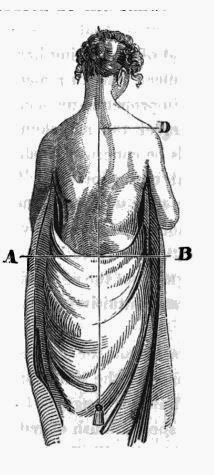
Straightening a child's posture
Nicolas Andry (1743) suggested that polite society should shun anything ‘shocking’ like visible impairments which might threaten virtuous interactions. Moreover, individuals who permitted, by their neglect, their bodies to become ‘ugly’ offended both society and God’s intentions. Thus, ‘orthopaedic’ intervention to restore the proper aesthetics to the body was an act of social and moral responsibility.

Causes and prevention of deformity

Experts concluded that preventing deformity was preferable (and easier) than curing it. Many suggested ignorant management in childhood was at the heart of many disfigurements and as such, more ‘scientific’ management might be applied to remedy them.

Towards the end of the Georgian era, malformations were classified by their causes including:

Those produced before birth

The result of tight lacing of long corsets, thought to impede the mother’s digestion, breathing, circulation and to even displace the womb itself. This practice was thought to impede the proper growth of a child resulting in dwarfism or other deformities of shape. Teaching mothers not to wear tight garments during pregnancy offered a simple remedy to this malady.

Those produced by ignorant nursing

In this case nursing referred to the care of the child in infancy. Infant bones were considered soft and unfinished, and the joints susceptible to injury by rough handling. Caregivers were directed to handle the infant as little as possible, allowing them to lie on mats and cushions without restrictions, and prevented from sitting and standing too soon.

Those produced by clothing in infancy

The practice of tight swaddling was still practiced in the Georgian era. However, toward the end of the period, the practice fell out of favor. The tight constriction of the infant was thought not only to be painful, but to restrict blood flow and to impede normal growth, forcing limbs and spine into unnatural shapes. Nurses were advised to adopt a looser mode of dress, but not so loose as to fail to support ‘feeble’ infant muscles, and to avoid dressing an infant too warmly and causing sweats in the night.

Those produced by dress in youth

Putting pressure on muscles was thought to weaken them. So the use of corsets, tight sleeves or garters was advised against; they might result in twisting the body out of natural position. Children’s clothing should be comfortable and allow the blood to flow freely and the body to move easily.

Those produced by position

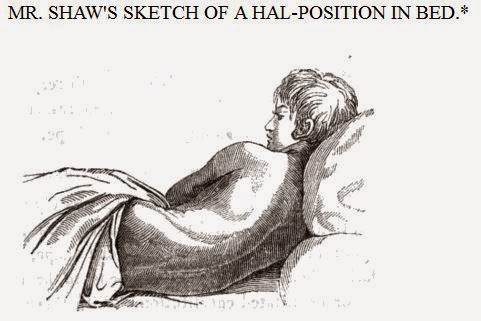
Sleeping on the same side of the bed every night, sitting on the same side of the window or fire every night or in any way that twists the body was to be scrupulously avoided. While reading, writing, sewing or practicing music, young ladies must maintain perfectly erect posture to avoid permanent deformation of the spine.

Correcting deformity

Once deformity occurred, Sheldrake argued that the amelioration of such irregularities was imperative as "not only their appearance is disagreeable, but by impeding the function of viscera, they will in time destroy that balance of the constitution which is so necessary to health and longevity.”

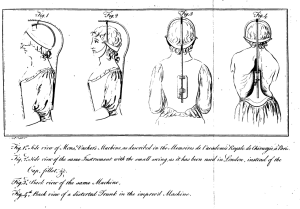
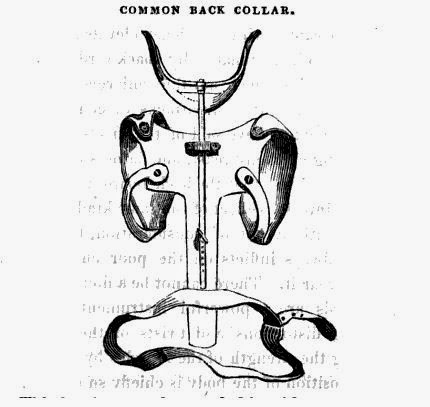
Stay makers and truss makers of the mid to late eighteenth century flooded the market with a cornucopia of devices to train young people’s bodies—particularly those of young women—as one trained young plants to grow strong and straight, often using braces and other contraptions made of newly available cast steel.

Braces and other devices

Devices to improve posture and keep and individual ‘straight’ were as varied as the manufacturers who made them. Large pieces of metal called backirons were hidden at the back of clothing and prevented slouching. Steel collars forced wearers to obey mothers’ and governesses’ injunctions to keep heads up, sometimes assisted by shoulder braces which pulled shoulders back. Neck swings stretched the spine by suspending the ‘patient’ in a block and tackle type device so that only their toes touched the ground.

Education chairs which forced the ‘patient’ to balance in a small hard seat without a support to lean against while windlass contraptions and stretching chairs performed similarly to neck swing. Despite the discomfort and pain these devices caused, they were widely sold throughout the eighteenth century.

As the century drew to a close and the nineteenth century dawned, a shift of perspective occurred leaning toward a more natural beauty, unencumbered by the rigorous management and training of the previous generations. The second part of this article will examine these changing conceptions of beauty and how to achieve it in the Regency era.

Bibliography

Andry, Nicolas. Orthopaedia: Or, the Art of Correcting and Preventing Deformities in Children . Vol. 1. London, 1743.

Buc'hoz, Pierre-Joseph. The Toilet of Flora Or, a Collection of the Most Simple and Approved Methods of Preparing Baths, Essences, Pomatums, Powders, Perfumes, Sweet-Scented Waters, and Opiates for Preserving and Whitening the Teeth, &c. &c. With Receipts for Cosmetics of Every Kind, That Can Smooth and Brighten the Skin, Give Force to Beauty, and Take off the Appearance of Old Age and Decay. For the Use of the Ladies. Improved from the French of M. Buchoz, M.D. London: Printed for J. Murray, Mo 12 Fleet-street and W. Nicoll, No. 51, in St. Paul's Church Yard, 1784.

Corbould, H. The Art of Beauty, Or, The Best Methods of Improving and Preserving the Shape, Carriage, and Complexion ; Together with the Theory of Beauty. London: Printed for Knight and Lacey ... and Westley and Tyrrell, Dublin, 1825.

Duties of a Lady's Maid with Direction for Conduct and Numerous Receipts for the Toilette. London: James Bulock, 1825.

Jeamson, Thomas. 1665. Artificiall embellishments. Or Arts best directions how to preserve beauty or procure it. Oxford: Printed by William Hall, amm. D.

Sanford, Victoria. "Public Reaction to Rising Waists During the Late 18th Century: Regency Fashion." Jane Austens World. June 2, 2010. Accessed January 9, 2015. https://janeaustensworld.wordpress.com/2010/06/03/public-reaction-to-rising-waists-during-the-late-18th-century-regency-fashion/.

Sheldrake, Timothy. An Essay on the Various Causes and Effects of the Distorted Spine ; on the Improper Methods Usually Practised to Remove That Distortion ; In Which That Recommended by Mr. Pott Is Considered, and the Bad Effects of Vacher's (commonly Called Jones's) Spinal Machine Are Pointed Out: With the Description of an Instrument That Is Better Calculated to Remove Those Distortions than Any Hitherto Made Use Of, and That Will Not Be Productive of the Pernicious Consequences That Have Been Caused by Most of the Other Machines. To Which Are Added, Some Observations on the Treatment of Ruptures ; Intended to Shew the Impracticability of Curing That Disorder by Any Other Means than the Use of Proper Truffes, and the Superior Utility of the Improved Elastic Truffes with Flexible Pads, Made by T. Sheldrake, Jun. London: Printed for C. Dilly, in the Poultry ;, 1783.

Snively, John H. A Treatise on the Manufacture of Perfumes and Kindred Toilet Articles. Nashville: C.W. Smith, 1877.

The Art of Preserving the Hair on Philosophical Principles. By the Author of The Art of Improving the Voice. London: Printed for Septimus Prowett, Old Bond Street, 1825.

The book of health & beauty, or the toilette of rank and fashion: embracing the economy of the economy of the beard eye-brovs gums nails breath eye-lashes hands skin complexion feet ips teeth eyes hair mouth tongue, 8::- 81c. With recipes, and directions for use, of safe and salutary cosmetics— perfumes—essences-simple ‘vaters—depilatories, etc. And a variety “ select recipes for the dressing room of both sexes. 2nd ed. London: Joseph Thomas, 1, Finch Lane, Cornhill, 1837.

The Hand-book of Bathing. London: W.S. Orr, 1841.

The Hand-book of the Toilette. 2nd ed. London: W.s. Orr and, 1841.

The New London Toilet: Or, a Compleat Collection of the Most Simple and Useful Receipts for Preserving and Improving Beauty, Either by Outward Application or Internal Use. With Many Other Valuable Secrets in Elegant and Ornamental Arts. Containing near Four Hundred Receipts under the following General Heads. Perfumes Fine Waters Baths Cosmetics Conserves Confectionary Snuffs Pastes Wash Balls Scented Powders Pomatums Fine Syrups Jellys Preserved Fruits, &c. With Every Species of Cosmetic That May Be Useful in Improving Beauty, or Concealing the Ravages of Time and Sickness. To Which Is Added a Treatise on the Art of Managing, Improving, and Dressing the Hair on the Most Improved Principles of That Art. London: Printed for Richardson and Urquhart, under the Royal-Exchange, 1778.

The Toilette of Health, Beauty, and Fashion: Embracing the Economy of the Beard, Breath, Complexion, Ears, Eyes, Eye-brows, Eye Lashes, Feet, Forehead, Gums, Hair, Head, Hands, Lips, Mouth, Mustachios, Nails of the Toes, Nails of the Fingers, Nose, Skin, Teeth, Tongue, Etc., Etc., : Including the Comforts of Dress and the Decorations of the Neck ... with Directions for the Use of Most Safe and Salutary Cosmetics ... and a Variety of Selected Recipes for the Dressing Room of Both Sexes. Boston: Allen and Ticknor, 1833.

Turner, David M. Disability in Eighteenth-century England: Imagining Physical Impairment. New York: Routledge, 2012.

Turner, D. M. and Withey, A. (2014), Technologies of the Body: Polite Consumption and the Correction of Deformity in Eighteenth‐Century England. History, 99: 775–796. doi:10.1111/1468-229X.12087

Withey, Alun. "(Dis)ability? Living with Impairment in Early Modern Britain." Dr Alun Withey. September 28, 2012. Accessed January 9, 2015. https://dralun.wordpress.com/2012/09/28/disability-living-with-impairment-in-early-modern-britain/.

Withey, Alun. "Sit up Straight! Bad Posture and the 'Neck Swing' in the 18th Century." Dr Alun Withey. January 15, 2014. Accessed January 9, 2015. https://dralun.wordpress.com/2014/01/15/sit-up-straight-bad-posture-and-the-neck-swing-in-the-18th-century/.

Withey, Alun. "Steel and the Body in the Enlightenment:." Dr Alun Withey. June 7, 2012. Accessed January 9, 2015. https://dralun.wordpress.com/2012/06/07/steel-and-the-body-in-the-enlightenment/.

~~~~~~~~~~~~

 Maria Grace is the author of Darcy's Decision,  The Future Mrs. Darcy, All the Appearance of Goodness, and Twelfth Night at Longbourn and Remember the Past, and A Jane Austen Christmas, .  Click here to find her books on Amazon. For more on her writing and other Random Bits of Fascination, visit her website. You can also like her on Facebook, follow on Twitter or email her.