Showing posts with label Sir Godfrey Kneller. Show all posts

Thursday, May 7, 2015

The First Duke of St Albans: His Early Years

by Margaret Porter

On this date, the eighth of May, in 1670 actress Nell Gwyn bore a son and named him Charles—for his father, whose identity was no secret. As one letter-writer reported, "Elianor Quin, one that belongs to the King’s play hous, was brought to bed of a boy in her house in Lyncoln’s Inns fields . . . the King’s bastard.” Unlike the other illegitimate offspring, the infant had no surname and no title. Within months the royal mistress returned to the stage, for she received no income from the royal purse. Before long her protector provided a grand new residence close to St. James’s Palace and its gardens, which he eventually deeded to her.

When the court painter Peter Lely portrayed her on canvas as Venus, her little son was included in the portrait as Cupid, kneeling at her side. The next time she posed as the goddess of love, she was attended by a pair of cherubs—she had borne a second son.

The boys wore the costliest of children’s garments and had a pet donkey in the garden which provided milk for His Majesty's bastards. In his sixth year, young Charles received at last from his father a surname—Beauclerk—and a pair of titles, Baron Heddington and Earl of Burford. At age 10 he became an only child again after his little brother died at school in France. Despite this tragedy, Charles was also sent there for his education, academic and social. On his birthday in 1683 he was presented to King Louis XIV—his cousin—and was at that time described as “le duc de Saint-Alban, fils du roi d’Angleterre et de Mademoiselle Gouin, comédienne.” His father had bestowed the dukedom earlier that year. He divided his time between England and France, for in March of the following year John Evelyn observed him at the Royal Chapel, and his mother wrote from Burford House, her mansion in Windsor, “The Duke brought me down with him my crochet of diamonds, and I love it the better because he brought it.”

In February 1685 the fates of Charles and his mother altered drastically. The young man received a ring from his dying father, and was still in London six weeks later, when the Gazette reported, “Lost in the King’s Garden near St. James's Park, a black and white Spaniel Bitch, near a year old, her Legs white, with some mottled black Spots, most white about her Neck, with a little white up her Face, and the top of her Tail white. Whoever brings her to the Duke of St. Albans in the Pall-Mall, shall have a Guinea reward.” Perhaps the runaway spaniel was another legacy from the King, who was remarkably devoted to his dogs.

By November Charles had resumed his studies at L’Académie du Sieur Coulon near Versailles, where in 1686 he contracted smallpox and promptly recovered.His education was intended to prepare him for a career in the military—his elder half-brothers had served with distinction in the army. But he was also attending balls in his spare time, for early in 1687, Princess Anne wrote to her sister Princess Mary in Holland to report her fondness for a dance “called the Rigadoon which the D[uke] of St Albans brought out of France . . . mightily liked and indeed it was a very pretty one I thought.” But soon thereafter she reported with regret, "I have no reason to like it now, for I believe it was the dance that made me miscarry, for there is a great deal of jumping in it.”

His mother had been suffering from ill health for some time, and after a period of prolonged illness during 1687, she died in November. Unaware of the extent of her debts, everyone assumed that Charles inherited a vast fortune. At the end of the month his uncle, King James II, wrote to his daughter Mary, “she hath not left the Duke of St. Albans so much as was believed.” James had settled the mortgage on Bestwood Park, the Nottinghamshire hunting lodge King Charles had granted Nell, but her income had never adequately supported her spendthrift ways and lavish lifestyle. Unlike the other royal mistresses, she had made no financial demands of the King. His widow, Dowager Queen Catherine, was fond enough of Charles Beauclerk to provide him with an allowance of £2000 per year to augment his other stipends from the Privy Purse.
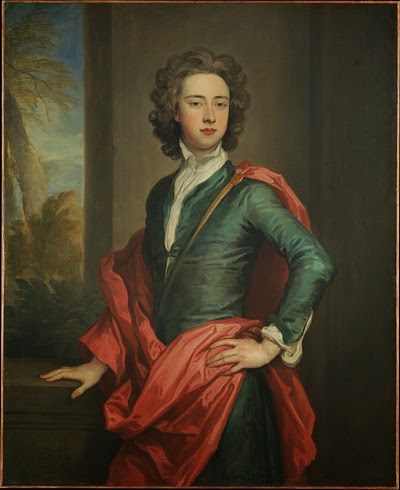
Charles Beauclerk, Duke of St Albans
As the product of an irregular liaison between a monarch and a play actress, a proud young man, and a firm Protestant, Charles would not have felt comfortable at a newly Roman Catholic court. He’d firmly resisted King James’s unrelenting efforts to bring about his conversion. Apparently the prospect of becoming a soldier was more to his liking, and he not only received his uncle’s permission to return to the Continent for that purpose, he received a recommendation. Shortly before Charles’s eighteenth birthday, King James wrote in French to the Duke of Lorraine declaring his nephew’s interest in supporting the war against the Turks, who had recently been driven from Vienna but now occupied Hungary.

And there the Duke of St. Albans would seize the opportunity to escape the shadow of scandal cast by his parents and begin to establish his own identity and reputation.
~~~~~~~~~~~~~
Images: National Portrait Gallery, Wikimedia Commons

Sources: Manuscript Letters in the British Library; The London Gazette; Oxford Dictionary of English Biography; Nell Gwyn: Mistress to a King by Charles Beauclerk; Right Royal Bastards: The Fruits of Passion by Peter Beauclerk-Dewar and Roger Powell; The House of Nell Gwyn by Peter Beauclerk-Dewar; Journal de Philippe de Courcillon de Dangeau.

~~~~~~~~~~~~~
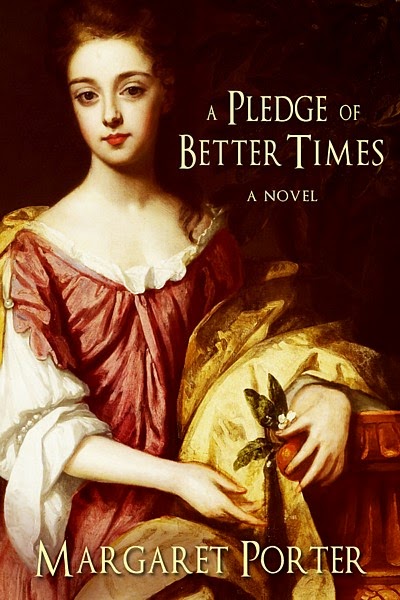

Margaret Porter is the award-winning and bestselling author of several historical fiction genres, and is also published in nonfiction and poetry. A Pledge of Better Times, her highly acclaimed novel of courtiers Lady Diana de Vere and Charles Beauclerk, 1st Duke of St. Albans, was recently released in trade paperback and ebook. Margaret studied British history in the UK and the US. As historian, her areas of speciality are social, theatrical, and garden history of the 17th and 18th centuries, royal courts, and portraiture. A former actress, she gave up the stage and screen to devote herself to fiction writing, travel, and her rose gardens.

Amazon

Friday, April 17, 2015

Sir Godfrey Kneller, the de Veres, and the Beauclerks

by Margaret Porter

Such are thy pictures, Kneller, and such thy skill,
That Nature seems obedient to thy will;
Comes out and meets thy pencil in the draught,
Lives there, and wants but words to speak her thoughts.
                                                       ~~ John Dryden

Aubrey de Vere, 20th Earl of Oxford
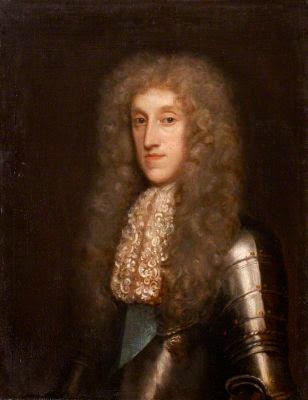
In 1678, two years after arriving in England with his brother, the German artist Godfrey Kneller produced a magisterial, much-admired portrait of King Charles II. As a result, "his reputation daily increased so that most noblemen and ladies would have their pictures done by him," irrespective of their political affiliation or religious preferences. Aubrey de Vere, 20th Earl of Oxford, a soldier and courtier boasting one of the longest pedigrees in the land, was among the artist's subjects. Kneller painted his illustrious client in battle armour. 

the first portrait
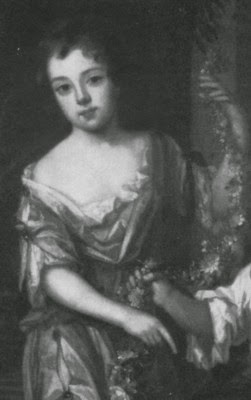
When the Earl's daughter Lady Diana de Vere first posed for Kneller, she was no more than ten years old. Holding up a floral garland, she stands beside her younger sister Mary, seated beside her. By the early 1680s, when this double portrait  was completed, the German artist was at the pinnacle of prominence.

Nell Gwyn, with her son and without, with or without her clothes on, was often painted by renowned portraitists Peter Lely and Simon Verelst. Kneller succeeded them as the most fashionable artist of the day, remaining so after Nell’s death in 1687 and the Glorious Revolution of the following year. King William III and Queen Mary II shared the deposed James II's preference for Kneller's work.

Charles Beauclerk, Duke of St Albans
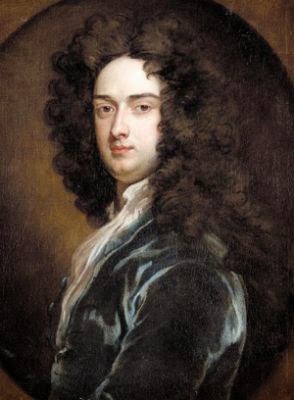
By 1690 Nell's son and heir, the Duke of St Albans, had embarked upon a military career. At about that time the handsome young man posed for a three-quarter length portrait. This would be the first of many Beauclerk portraits produced by Kneller, now a naturalised Englishman. He'd established a residence and studio in the north east corner of Covent Garden. Not only the nobility flocked there--the Duke’s father, King Charles II, had also visited the artist to sit for his portraits, a mark of great favour.

One of Kneller's most memorable and presumably enjoyable commissions came a year after the double coronation of William and Mary. As the former battled foreign enemies on the Continent, the Queen decided to imitate her own mother's gallery of beauties at Windsor Castle, produced by Lely. Mary proposed a set of paintings for Hampton Court Palace, being altered by Sir Christopher Wren to suit her and William's architectural tastes. Her plan was mocked by her father’s former mistress, Lady Dorchester, who famously quipped, "Madam, if the King was to ask for portraits of all the wits in his court, would not the rest think he called them fools?"

Diana, a Hampton Court Beauty
Undeterred, Mary put Kneller to work, and her loveliest and most virtuous attendants made their way to his studio to have their charms preserved as life-sized canvases. Of the twelve original paintings only eight remain. The most admired of the set is that of Lady Diana de Vere, who at that time was either officially or unofficially attached to the court as maid of honor. She poses with an orange tree, holding an orange in her hand—doubtless designating the de Veres’ fealty to the new rulers from the House of Orange. The paintings of Diana and the other ladies were positioned in the narrow spaces between the tall windows of Hampton Court's riverside Water Gallery (later demolished). Each was set within a blue-and-white painted frame to complement the Queen’s extensive Delftware collection. Diana's portrait currently hangs in the King’s Dining Room, and is now surrounded by giltwood frame. Duchess of St Albans, the title she gained at her marriage to Charles Beauclerk, was inscribed at a later date. (A detail of this work appears on the cover of my novel A Pledge of Better Times.)

The 20th Earl of Oxford 
in Garter Robes
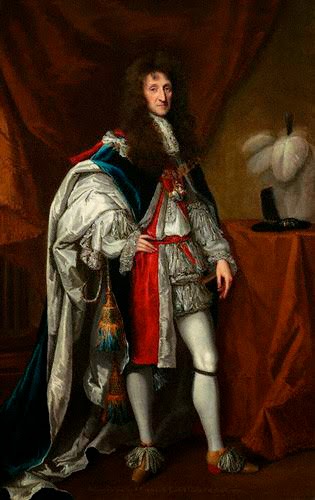
 Having pleased the monarchs with portraits of beauties and military men, on 3 March 1691/2, Kneller became Sir Godfrey. “His Majesty, to shew his Kingly approbation of his Art and Manners, was pleas’d to confer the Honour of Knighthood upon him…and as an extraordinary Mark of his Grace and Favour, Honour’d him with the Present of a Sword, by the Hands of the Right Honourable Lord Chamberlain." The artist also became a Gentleman of the Privy Chamber, and received an honorary doctorate from Oxford. An acquaintance reported, "In June 1693 Sir Godfrey Kneller told me he has had fourteen persons sett to him in a day." Some of those persons sat to him as many as a dozen times for a single portrait! Diana’s father, Lord Oxford, a Knight of the Garter, a member of the Privy Council, a Lieutenant General, and a Gentleman of the King’s Bedchamber, commissioned a splendid full-length Kneller likeness at approximately the time his daughter was posing for her Beauty portrait.

Diana, 1694
Author's collection
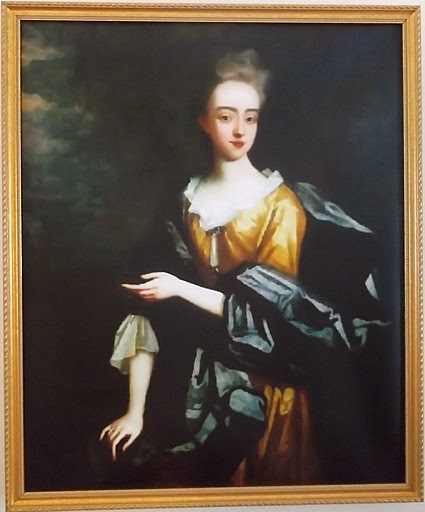
Upon her marriage in 1694, Diana became Duchess of St Albans and again sat to Kneller—for a third time. The painting was promptly delivered to engraver John Smith, who revised her features and hair somewhat when producing prints for public sale. One of these holds a special place in my personal art gallery!

 In 1695, the Crown granted Kneller an annuity of £200 per year. Two years afterwards he received additional proofs of William’s admiration, a large gold medal stamped with the King’s image and a golden chain worth £300. It appears in most of the later self-portraits (as seen below) and on the bust attached to his burial monument.

After her accession to the throne, Diana’s friend Queen Mary would sit only to Kneller. A copy of her portrait, or the King’s, could be purchased for the price of £50, and judging from their wide dissemination this was a reliable source of income for Kneller and his assistants. Not only were the paintings acquired for civic and government buildings, they went abroad as presents to fellow rulers, territorial governors, ambassadorial residences, and so forth. And Kneller even travelled with—or without—the King, to make portraits of foreign allies and friends in the Low Countries.

1st Duke of St Albans, 1704
Kneller produced a Kit-Kat style portrait of Charles Beauclerk wearing a blue coat in 1704, as the the Duke was falling out of favour with Queen Anne—not that he ever really had it. Probably at her husband's instigation, Kneller created additional pictures of Diana: seated in a landscape wearing “a dark blue dress with red scarf,” and an oval half-length in which she appears in a “white dress with red mantle and holding a chalice.” These two passed through auction houses and are privately owned. Lord Cholmondeley’s Houghton Hall holds another Kneller portrait of “the Duchess of St. Albans ... in a blue dress, her son in a brown coat and a purple mantle, at her side.”

Duke of St Albans
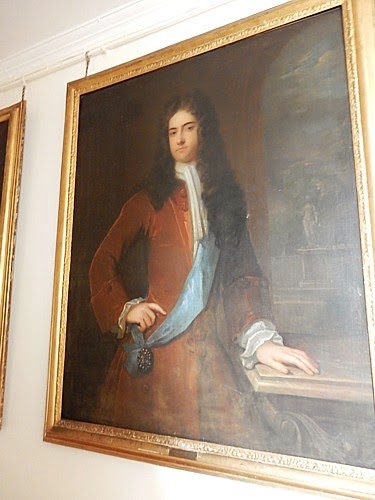
The private family apartments of a Gloucestershire castle contain large three-quarter sized portraits of both Charles and Diana, and I greatly appreciate the owners’ invitation to view and photograph these paintings. They appear to have been created in 1718, after Charles became a Knight of the Garter—he wears a handsome crimson coat crossed with a blue sash from which hangs a jewel-studded Lesser George medallion.


Diana, Duchess of St Albans


Diana sits serenely in a white dress, fingering a blue ribbon. By my count this later painting represents the seventh time she posed for Kneller, indicating that she must have got to know him rather well!


Kneller's Self-portrait
Kneller was a companion of Dryden, Addison, Swift, and Pope, most of whom wrote verses proclaiming his talent and fame and what they regarded as his genius. He died aged seventy-four on 19 October, 1723, three years ahead of his regular client the Duke of St Albans. Two days before his death his friend Pope visited him, and declared, “I believe, Sir Godfrey, if Almighty God had had your assistance, the world would have been formed more perfect.”

These laudatory lines were composed by Addison:

Thou, Kneller, long with noble pride,
The foremost of thy art hast vied
With nature in a generous strife,
And touched the canvas into life.

Though later critics were less enamoured of Kneller’s style and works than his contemporaries, I remain forever grateful to him for touching those canvases and presenting my characters as they appeared to him in life!

~~~~~~~~~~~~~
Images: thepeerage.com, National Portrait Gallery, Wikimedia Commons, author's collection and personal photo archive

Sources: Documents in the British Library; Sir Godfrey Kneller: His Life & Times, Lord Killanin; Beauty, Sex, and Power: A Story of Debauchery and Decadent Art at the Late Stuart Court, Brett Dolman, David Souden, Olivia Fryman; Oxford Dictionary of English Biography

~~~~~~~~~~~~~


Margaret Porter, who can claim a few tiny drops of de Vere blood, is the award-winning and bestselling author of several historical fiction genres, and is also published in nonfiction and poetry. A Pledge of Better Times, the story of courtiers Lady Diana de Vere and Charles Beauclerk, 1st Duke of St. Albans, and of Diana's father Aubrey de Vere, was just released in trade paperback and ebook. Margaret studied British history in the UK and the US. As historian, her areas of speciality are social, theatrical, and garden history of the 17th and 18th centuries, royal courts, and portraiture. A former actress, she gave up the stage and screen to devote herself to fiction writing, travel, and her rose gardens.